Presented by:
Jonalyn Vargas
Charina Gallo
Arrel Cabe de Leon
PROJECT-BASED AND MULTIMEDIA
LEARNING.WHAT IT IS?
• Focus question:
 What is project-based multimedia learning?
 What are the elements of project-based multimedia learning?
 Why used project-based multimedia learning?
 What are the disadvantages of the use of project-based learning
and multi-media project?
• Core Curriculum.
• At the foundation of any unit of this type is a clear set off
learning goals drawn from whatever curriculum or set of standard is in use. We
used the term core to emphasize that project-based multimedia learning should
address the basic knowledge and skills all student are expected to acquire, and
should not simply be an enrichment or extra-credit activity for a especial few.
Often, this project lend themselves well to multi-disiplinary or cross-curricular
approaches.
•
• Real-world Connection.
• It seeks to connects students work in school with the wider
world in which students live. You may designed this feature into a project by
means of the content chosen, the types of activities, the types of products, or in
other ways.
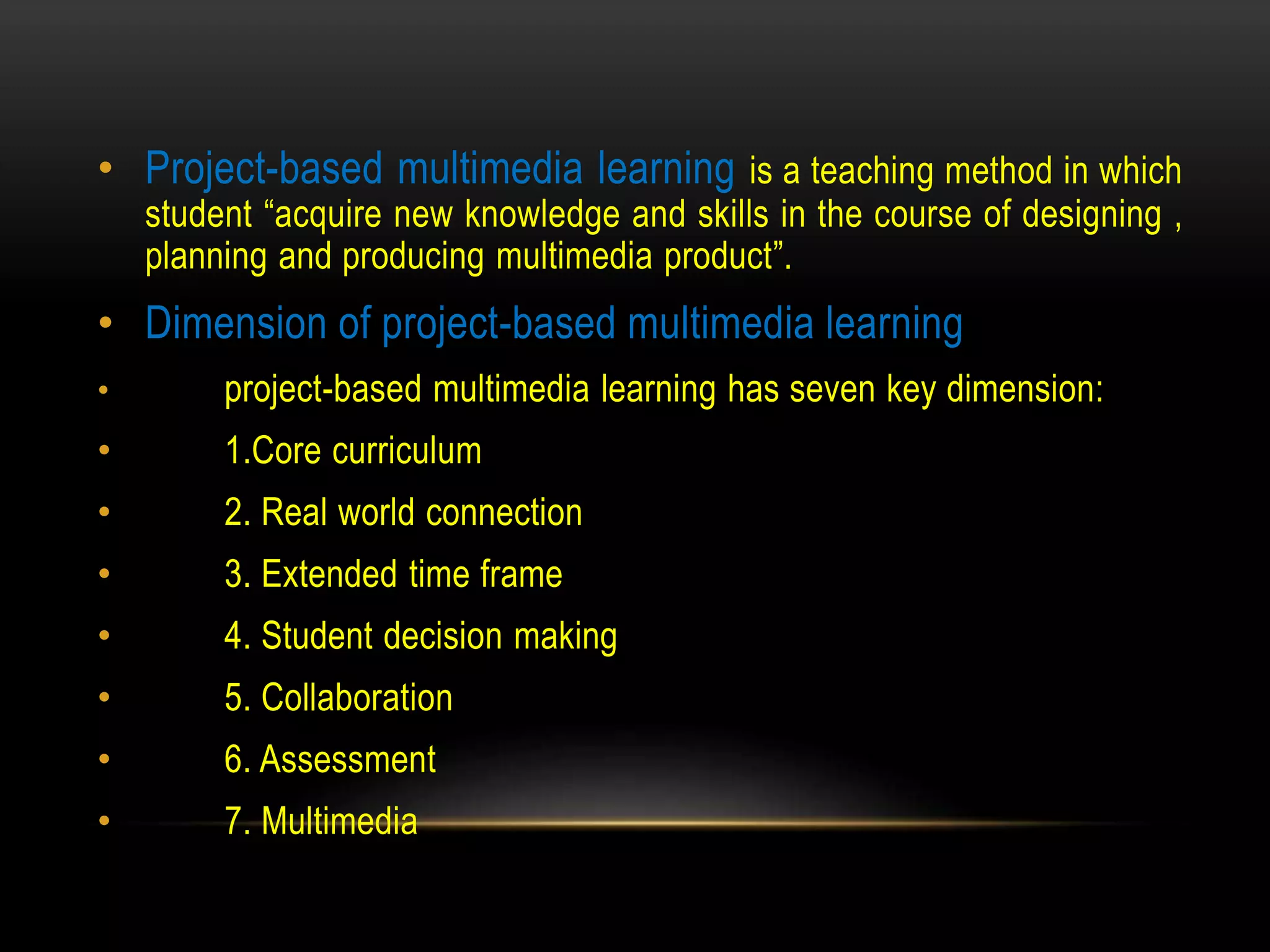
• Project-based multimedia learning is a teaching method in which
student “acquire new knowledge and skills in the course of designing ,
planning and producing multimedia product”.
• Dimension of project-based multimedia learning
• project-based multimedia learning has seven key dimension:
• 1.Core curriculum
• 2. Real world connection
• 3. Extended time frame
• 4. Student decision making
• 5. Collaboration
• 6. Assessment
• 7. Multimedia
• Extended time Frame.
• A good project is not a one-shot lesson: It extends over
extends over a significant period of time. The actual length of a project may
vary with the age of the students and the nature of the project. It may be
days, weeks, or months. What’s important is that students experience a
succession of challenges that culminates in a substantial final product from
which they can derived pride and a clear sense of accomplishment.
• Student Decision Making.
• In project-based multimedia learning, students have a say.
Teachers look carefully at what decision to be made and divide them into
“teacher’s” and “students” based on a clear rational. Though the teacher is
clearly in-charge, she tries to enlarge the area for student to make decisions
as well as the process for producing them.
• Collaboration.
• We define collaboration as working together jointly to
accomplished a common intellectual purpose in a manner superior to what
might have been accomplished working alone. Students may work in pairs or
in teams of as many as five or six. Collaborative projects not only involve
features of typical cooperative learning strategies but also transcend them in
this focus and the production of a jointly authored multimedia product.
• Assessment.
• Regardless of the teaching method used, data must be
gathered on what students have learned. When using multimedia project-
based multimedia learning, teachers face additional assessment challenges
because multimedia products by themselves do not represents a full pictures
of student learning. Students are gaining content information, becoming
better team members, solving problems and making choices about what new
information to show in their presentations.
• We consider assessment to have three different roles in a project-based
multimedia context.
 activities for developing expectations:
 activities for improving the media products; and
 activities for compiling and disseminating evidence of learning.
• Multimedia.
• In multimedia projects, students do not learn simply by “using” multimedia
produce by others; they learn by creating it themselves. The development of such
programs as hyper studio, kid pix, and netscape composer has made it possible for
students of all ages to become the authors of multimedia content. The real world
connection to the AIDS epidemic made the project relevant for students.
• What can be some limitations of use of
project-based multimedia learning strategy?
•
• One limitation that we see is the need for an
extended period of time. You need time to orient the students or
what are expected of them, guidelines, goals and objectives of
the projects, and more so for your students to gather and
organize thir data , work on their presentation and the like. This
strategy requires technical skill on your part and on the part of
your students.
• Summing Up.
•
• Project-based multimedia learning does not only involve
used for learning. The students end up with a multimedia product to
show what they learned. So they are not only learners of academic
content, they are at the same time authors of multimedia products at
the end of learning process. The goals and objectives of a project are
based on core curriculum as laid down in the curricular standards are
made crystal clear to students at the beginning of the projects. The
students work collaboratively over an extended time frame. As they
work, they employ life skills including decision making. Their learning
task ends up with a multimedia presentation through their multimedia
product.
•THANK YOU…….

LESSON 15:Project based learning and multimedia

  • 1.
    Presented by: Jonalyn Vargas CharinaGallo Arrel Cabe de Leon PROJECT-BASED AND MULTIMEDIA LEARNING.WHAT IT IS?
  • 2.
    • Focus question: What is project-based multimedia learning?  What are the elements of project-based multimedia learning?  Why used project-based multimedia learning?  What are the disadvantages of the use of project-based learning and multi-media project?
  • 3.
    • Core Curriculum. •At the foundation of any unit of this type is a clear set off learning goals drawn from whatever curriculum or set of standard is in use. We used the term core to emphasize that project-based multimedia learning should address the basic knowledge and skills all student are expected to acquire, and should not simply be an enrichment or extra-credit activity for a especial few. Often, this project lend themselves well to multi-disiplinary or cross-curricular approaches. • • Real-world Connection. • It seeks to connects students work in school with the wider world in which students live. You may designed this feature into a project by means of the content chosen, the types of activities, the types of products, or in other ways.
  • 4.
    • Project-based multimedialearning is a teaching method in which student “acquire new knowledge and skills in the course of designing , planning and producing multimedia product”. • Dimension of project-based multimedia learning • project-based multimedia learning has seven key dimension: • 1.Core curriculum • 2. Real world connection • 3. Extended time frame • 4. Student decision making • 5. Collaboration • 6. Assessment • 7. Multimedia
  • 5.
    • Extended timeFrame. • A good project is not a one-shot lesson: It extends over extends over a significant period of time. The actual length of a project may vary with the age of the students and the nature of the project. It may be days, weeks, or months. What’s important is that students experience a succession of challenges that culminates in a substantial final product from which they can derived pride and a clear sense of accomplishment. • Student Decision Making. • In project-based multimedia learning, students have a say. Teachers look carefully at what decision to be made and divide them into “teacher’s” and “students” based on a clear rational. Though the teacher is clearly in-charge, she tries to enlarge the area for student to make decisions as well as the process for producing them.
  • 6.
    • Collaboration. • Wedefine collaboration as working together jointly to accomplished a common intellectual purpose in a manner superior to what might have been accomplished working alone. Students may work in pairs or in teams of as many as five or six. Collaborative projects not only involve features of typical cooperative learning strategies but also transcend them in this focus and the production of a jointly authored multimedia product. • Assessment. • Regardless of the teaching method used, data must be gathered on what students have learned. When using multimedia project- based multimedia learning, teachers face additional assessment challenges because multimedia products by themselves do not represents a full pictures of student learning. Students are gaining content information, becoming better team members, solving problems and making choices about what new information to show in their presentations.
  • 7.
    • We considerassessment to have three different roles in a project-based multimedia context.  activities for developing expectations:  activities for improving the media products; and  activities for compiling and disseminating evidence of learning. • Multimedia. • In multimedia projects, students do not learn simply by “using” multimedia produce by others; they learn by creating it themselves. The development of such programs as hyper studio, kid pix, and netscape composer has made it possible for students of all ages to become the authors of multimedia content. The real world connection to the AIDS epidemic made the project relevant for students.
  • 8.
    • What canbe some limitations of use of project-based multimedia learning strategy? • • One limitation that we see is the need for an extended period of time. You need time to orient the students or what are expected of them, guidelines, goals and objectives of the projects, and more so for your students to gather and organize thir data , work on their presentation and the like. This strategy requires technical skill on your part and on the part of your students.
  • 9.
    • Summing Up. • •Project-based multimedia learning does not only involve used for learning. The students end up with a multimedia product to show what they learned. So they are not only learners of academic content, they are at the same time authors of multimedia products at the end of learning process. The goals and objectives of a project are based on core curriculum as laid down in the curricular standards are made crystal clear to students at the beginning of the projects. The students work collaboratively over an extended time frame. As they work, they employ life skills including decision making. Their learning task ends up with a multimedia presentation through their multimedia product.
  • 10.