
net-square © Saumil Shah
Dive into ROP
Return Oriented Programming
Introduction and Core Concepts
SAUMIL SHAH
www.net-square.com
net-square © Saumil Shah
Introduction
This tutorial shall introduce you
to Return Oriented Programming
commonly known as "ROP".
We will cover the core concepts
behind ROP and a small example
demonstrating them.
net-square © Saumil Shah
# who am i
Saumil Shah
CEO Net-square.
• Hacker, Speaker, Trainer,
Author.
• M.S. Computer Science
Purdue University.
• @therealsaumil
• LinkedIn: saumilshah
net-square © Saumil Shah
Background
• Here are some good refresher tutorials
before you dive into ROP:
• Operating Systems – A Primer
– understand how processes run,
• How Functions Work
– stack, frames, calls, returns, etc.,
• Introduction to Debuggers
– to try the discussed code example yourself.
net-square © Saumil Shah
Background
• And you need to know how stack
overflows work.
net-square © Saumil Shah
Agenda
Exploit Mitigation via DEP
Executable vs. Non-executable
regions
Ret2LibC
Return Oriented Programming
net-square © Saumil Shah
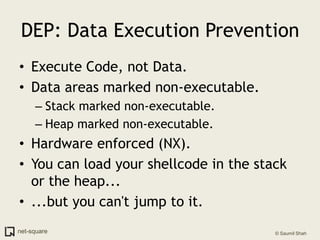
DEP: Data Execution Prevention
• Execute Code, not Data.
• Data areas marked non-executable.
– Stack marked non-executable.
– Heap marked non-executable.
• Hardware enforced (NX).
• You can load your shellcode in the stack
or the heap...
• ...but you can't jump to it.
net-square © Saumil Shah
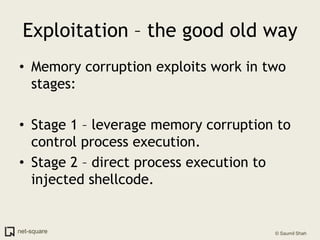
Exploitation – the good old way
• Memory corruption exploits work in two
stages:
• Stage 1 – leverage memory corruption to
control process execution.
• Stage 2 – direct process execution to
injected shellcode.
net-square © Saumil Shah
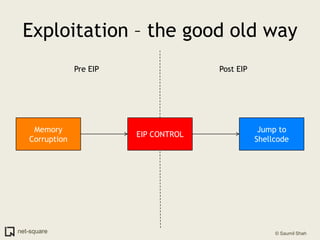
Exploitation – the good old way
EIP CONTROL
Memory
Corruption
Jump to
Shellcode
Pre EIP Post EIP
net-square © Saumil Shah
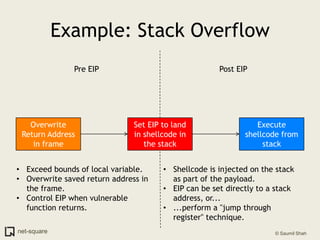
Example: Stack Overflow
Set EIP to land
in shellcode in
the stack
Overwrite
Return Address
in frame
Execute
shellcode from
stack
Pre EIP Post EIP
• Exceed bounds of local variable.
• Overwrite saved return address in
the frame.
• Control EIP when vulnerable
function returns.
• Shellcode is injected on the stack
as part of the payload.
• EIP can be set directly to a stack
address, or...
• ...perform a "jump through
register" technique.
net-square © Saumil Shah
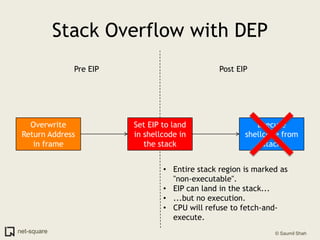
Stack Overflow with DEP
Set EIP to land
in shellcode in
the stack
Overwrite
Return Address
in frame
Execute
shellcode from
stack
Pre EIP Post EIP
• Entire stack region is marked as
"non-executable".
• EIP can land in the stack...
• ...but no execution.
• CPU will refuse to fetch-and-
execute.
net-square © Saumil Shah
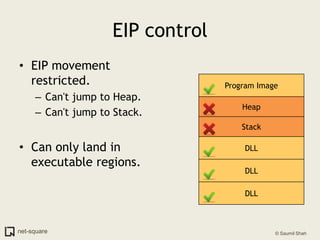
EIP control
• EIP movement
restricted.
– Can't jump to Heap.
– Can't jump to Stack.
• Can only land in
executable regions.
Program Image
Heap
Stack
DLL
DLL
DLL
net-square © Saumil Shah
The Solution?
• We borrow bits and pieces of code...
• ...that already exists in executable
regions of the process!
• We then create a SEQUENCE of operations
to be carried out.
net-square © Saumil Shah
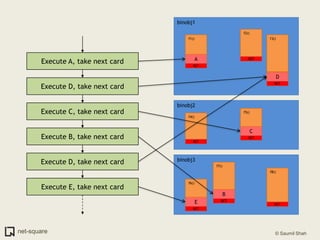
Orchestrating Code Execution
• Assume a series of cards where each card
indicates an operation to be performed.
• The code for that operation is present in
the executable regions of the process
memory.
– binary or shared library.
• A card shall contain the address of the
code it wants to execute.
net-square © Saumil Shah
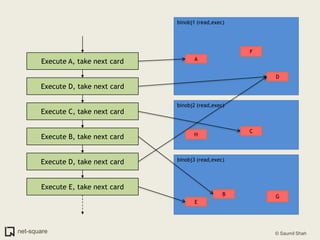
Orchestrating Code Execution
• If we can create a chain of cards, each
corresponding to a basic operation...
• ...we can perform complex operations.
• Example: Assume a complex operation
broken down into a sequence of basic
operations A, D, C, B, D, E.
net-square © Saumil Shah
binobj1 (read,exec)
binobj3 (read,exec)
binobj2 (read,exec)
A
E
H
D
F
B
C
G
Execute A, take next card
Execute D, take next card
Execute C, take next card
Execute B, take next card
Execute D, take next card
Execute E, take next card
net-square © Saumil Shah
Orchestrating Code Execution
• Complex code can therefore be
transformed into a sequence of primitive
operations...
• ...which are already present in the
process' executable regions.
• These operations are called GADGETS.
net-square © Saumil Shah
ROP – The Origins
• The first idea of executing EXISTING code
was discussed in 1997.
• Solar Designer's Ret2LibC technique.
• Devised to defeat non executable stack.
net-square © Saumil Shah
Ret2LibC
• Make EIP "return to an existing function"
after a stack overflow.
• If we can't execute shellcode...
• ...we will "return" to system("/bin/sh")
net-square © Saumil Shah
Ret2LibC - how does it work?
• Create a fake frame on the stack.
• After an overflowed function returns...
• ...set the EIP return address to the new
function.
• Append the fake frame.
• New function executes.
– parameters consumed from the fake frame.
• system("/bin/sh")
net-square © Saumil Shah
Ret2LibC – how does it work?
• The following function is vulnerable to a
stack overflow:
void func1(char *s)
{
char buffer[80];
strcpy(buffer, s);
:
:
}
net-square © Saumil Shah
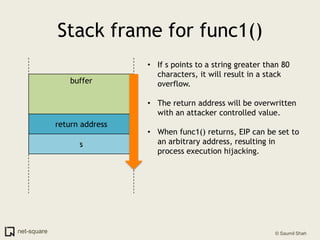
Stack frame for func1()
buffer
return address
s
• If s points to a string greater than 80
characters, it will result in a stack
overflow.
• The return address will be overwritten
with an attacker controlled value.
• When func1() returns, EIP can be set to
an arbitrary address, resulting in
process execution hijacking.
net-square © Saumil Shah
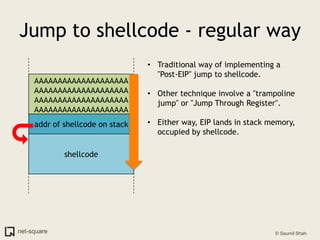
Jump to shellcode - regular way
AAAAAAAAAAAAAAAAAAAA
addr of shellcode on stack
shellcode
• Traditional way of implementing a
"Post-EIP" jump to shellcode.
• Other technique involve a "trampoline
jump" or "Jump Through Register".
• Either way, EIP lands in stack memory,
occupied by shellcode.
net-square © Saumil Shah
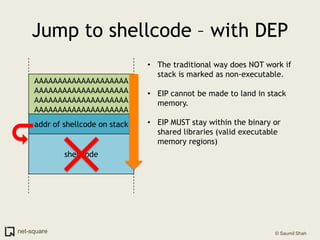
Jump to shellcode – with DEP
AAAAAAAAAAAAAAAAAAAA
addr of shellcode on stack
shellcode
• The traditional way does NOT work if
stack is marked as non-executable.
• EIP cannot be made to land in stack
memory.
• EIP MUST stay within the binary or
shared libraries (valid executable
memory regions)
net-square © Saumil Shah
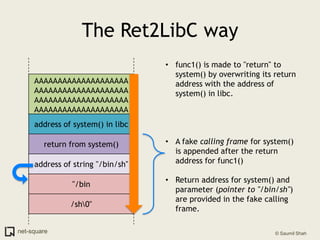
AAAAAAAAAAAAAAAAAAAA
address of system() in libc
return from system()
The Ret2LibC way
• func1() is made to "return" to
system() by overwriting its return
address with the address of
system() in libc.
• A fake calling frame for system()
is appended after the return
address for func1()
• Return address for system() and
parameter (pointer to "/bin/sh")
are provided in the fake calling
frame.
address of string "/bin/sh"
"/bin
/sh0"
net-square © Saumil Shah
AAAAAAAAAAAAAAAAAAAA
address of system() in libc
return from system()
The Ret2LibC way
address of string "/bin/sh"
"/bin
/sh0"
libc
system()
RET
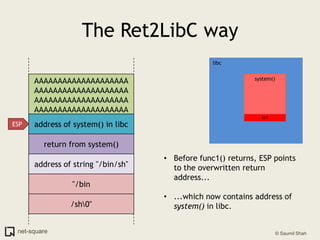
• Before func1() returns, ESP points
to the overwritten return
address...
• ...which now contains address of
system() in libc.
ESP
net-square © Saumil Shah
AAAAAAAAAAAAAAAAAAAA
address of system() in libc
return from system()
The Ret2LibC way
address of string "/bin/sh"
"/bin
/sh0"
libc
system()
RET
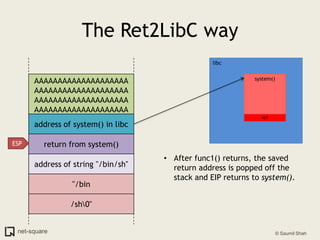
• After func1() returns, the saved
return address is popped off the
stack and EIP returns to system().
ESP
net-square © Saumil Shah
AAAAAAAAAAAAAAAAAAAA
address of system() in libc
return from system()
The Ret2LibC way
address of string "/bin/sh"
"/bin
/sh0"
libc
system()
RET
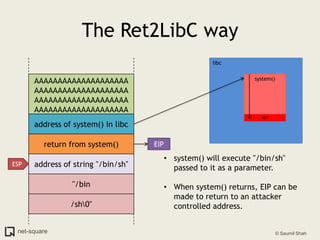
• system() will execute "/bin/sh"
passed to it as a parameter.
• When system() returns, EIP can be
made to return to an attacker
controlled address.
ESP
EIP
net-square © Saumil Shah
Ret2LibC - Conclusions
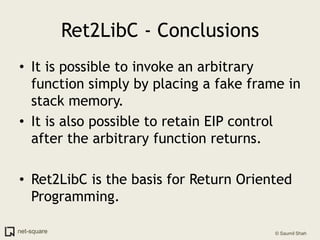
• It is possible to invoke an arbitrary
function simply by placing a fake frame in
stack memory.
• It is also possible to retain EIP control
after the arbitrary function returns.
• Ret2LibC is the basis for Return Oriented
Programming.
net-square © Saumil Shah
Return Oriented Programming
• Series of returns to functions.
• Chained frames.
• Transform EIP based primitives into stubs
(gadgets) that can be "returned into".
• We govern arbitrary code execution by
controlling frames on the stack.
• ESP is the new EIP!
net-square © Saumil Shah
Introduction to Return
Oriented Programming
Basic Concepts
net-square © Saumil Shah
Concepts
• Functions revisited
• Function calls and returns
• Stack overflows revisited
• Creating stack frames
• Chaining frames
• ESP control
net-square © Saumil Shah
Functions Revisited
• How is a function called?
• What does the stack frame look like?
net-square © Saumil Shah
Calling a function
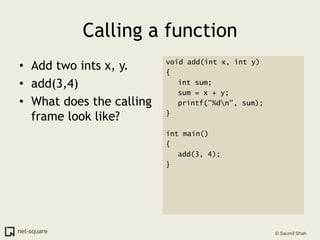
• Add two ints x, y.
• add(3,4)
• What does the calling
frame look like?
void add(int x, int y)
{
int sum;
sum = x + y;
printf("%dn", sum);
}
int main()
{
add(3, 4);
}
net-square © Saumil Shah
Stack frame for add(3,4)
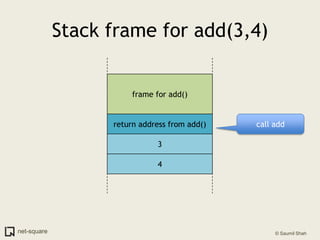
frame for add()
return address from add()
3
4
call add
net-square © Saumil Shah
Return from add(3,4)
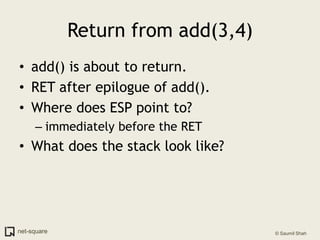
• add() is about to return.
• RET after epilogue of add().
• Where does ESP point to?
– immediately before the RET
• What does the stack look like?
net-square © Saumil Shah
Before the RET
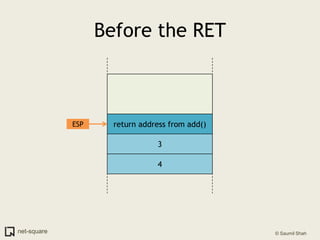
return address from add()
3
4
ESP
net-square © Saumil Shah
Another function
• Stack overflow in
func1.
• Can we call add(5, 6)
after returning from
func1?
void func1(char *s)
{
char buffer[128];
strcpy(buffer, s);
}
int main()
{
func1(argv[1]);
}
net-square © Saumil Shah
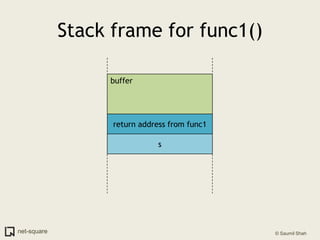
Stack frame for func1()
buffer
return address from func1
s
net-square © Saumil Shah
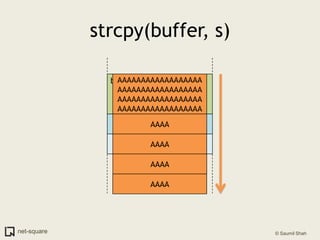
strcpy(buffer, s)
buffer
return address from func1
s
AAAAAAAAAAAAAAAAAA
AAAAAAAAAAAAAAAAAA
AAAAAAAAAAAAAAAAAA
AAAAAAAAAAAAAAAAAA
AAAA
AAAA
AAAA
AAAA
net-square © Saumil Shah
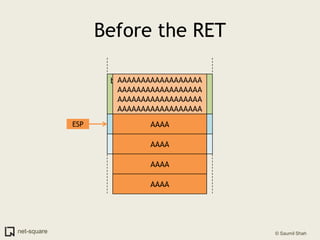
Before the RET
buffer
return address from func1
s
AAAAAAAAAAAAAAAAAA
AAAAAAAAAAAAAAAAAA
AAAAAAAAAAAAAAAAAA
AAAAAAAAAAAAAAAAAA
AAAA
AAAA
AAAA
AAAA
ESP
net-square © Saumil Shah
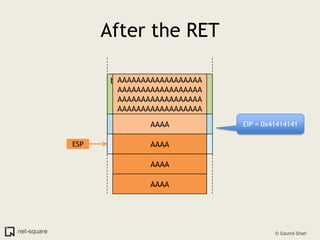
After the RET
buffer
return address from func1
s
AAAAAAAAAAAAAAAAAA
AAAAAAAAAAAAAAAAAA
AAAAAAAAAAAAAAAAAA
AAAAAAAAAAAAAAAAAA
AAAA
AAAA
AAAA
AAAA
EIP = 0x41414141
ESP
net-square © Saumil Shah
Return to add()
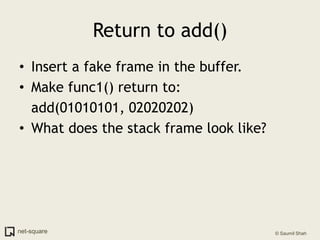
• Insert a fake frame in the buffer.
• Make func1() return to:
add(01010101, 02020202)
• What does the stack frame look like?
net-square © Saumil Shah
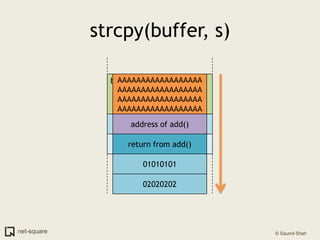
strcpy(buffer, s)
buffer
return address from func1
s
AAAAAAAAAAAAAAAAAA
AAAAAAAAAAAAAAAAAA
AAAAAAAAAAAAAAAAAA
AAAAAAAAAAAAAAAAAA
address of add()
return from add()
01010101
02020202
net-square © Saumil Shah
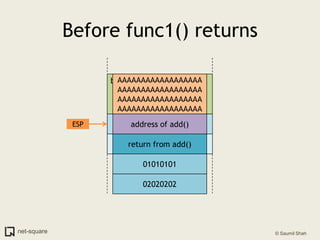
Before func1() returns
buffer
return address from func1
s
AAAAAAAAAAAAAAAAAA
AAAAAAAAAAAAAAAAAA
AAAAAAAAAAAAAAAAAA
AAAAAAAAAAAAAAAAAA
address of add()
return from add()
01010101
02020202
ESP
net-square © Saumil Shah
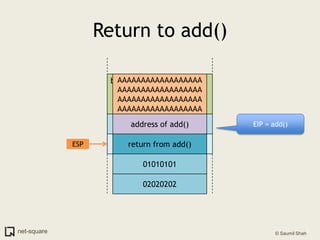
Return to add()
buffer
return address from func1
s
AAAAAAAAAAAAAAAAAA
AAAAAAAAAAAAAAAAAA
AAAAAAAAAAAAAAAAAA
AAAAAAAAAAAAAAAAAA
address of add()
return from add()
01010101
02020202
ESP
EIP = add()
net-square © Saumil Shah
Return to add()
• By carefully creating a frame...
• ...we can make the program "return to
our function".
• We control the parameters.
• We also control where to jump to after
our function returns.
net-square © Saumil Shah
rop_victim.c
int main(int argc, char *argv[])
{
add(3, 4);
func1(argv[1]);
}
void func1(char *s)
{
char buffer[128];
strcpy(buffer, s);
}
void print_hello(void)
{
printf("Hello Worldn");
}
void add(int x, int y)
{
int sum;
sum = x + y;
printf("%d + %d = %dn", x, y, sum);
}
stack overflow lurks here!
net-square © Saumil Shah
Building rop_victim
• Create a file called "rop_victim.c" with
the contents as shown in the previous
slide.
• Compile "rop_victim.c" as follows
• And run it normally:
$ gcc rop_victim.c –o rop_victim
$ ./rop_victim HELLOWORLD
net-square © Saumil Shah
Making func1() return to add()
• We shall exploit the stack overflow in
func1() and make it return to add().
• For this, we must inspect the calling
frame for add()...
• ...and eventually place a fake frame for
add() on the stack when overflowing
func1().
net-square © Saumil Shah
Inspecting add()'s calling frame
• Open "rop_victim" in gdb, and set a
breakpoint just before the call to add() in
main().
• We want to inspect the stack memory
before call add()...
• ...and immediately after call add() as
well.
$ gdb rop_victim
net-square © Saumil Shah
gdb'ing add
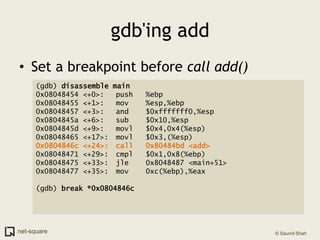
• Set a breakpoint before call add()
(gdb) disassemble main
0x08048454 <+0>: push %ebp
0x08048455 <+1>: mov %esp,%ebp
0x08048457 <+3>: and $0xfffffff0,%esp
0x0804845a <+6>: sub $0x10,%esp
0x0804845d <+9>: movl $0x4,0x4(%esp)
0x08048465 <+17>: movl $0x3,(%esp)
0x0804846c <+24>: call 0x80484bd <add>
0x08048471 <+29>: cmpl $0x1,0x8(%ebp)
0x08048475 <+33>: jle 0x8048487 <main+51>
0x08048477 <+35>: mov 0xc(%ebp),%eax
(gdb) break *0x0804846c
net-square © Saumil Shah
Before add
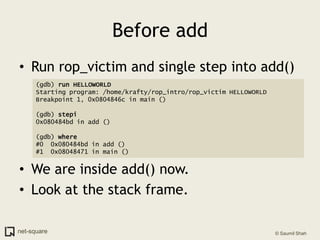
• Run rop_victim and single step into add()
• We are inside add() now.
• Look at the stack frame.
(gdb) run HELLOWORLD
Starting program: /home/krafty/rop_intro/rop_victim HELLOWORLD
Breakpoint 1, 0x0804846c in main ()
(gdb) stepi
0x080484bd in add ()
(gdb) where
#0 0x080484bd in add ()
#1 0x08048471 in main ()
net-square © Saumil Shah
Stack frame before add(3, 4)
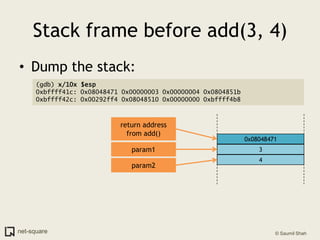
• Dump the stack:
(gdb) x/10x $esp
0xbffff41c: 0x08048471 0x00000003 0x00000004 0x0804851b
0xbffff42c: 0x00292ff4 0x08048510 0x00000000 0xbffff4b8
0x08048471
3
4
return address
from add()
param1
param2
net-square © Saumil Shah
Overflowing func1()
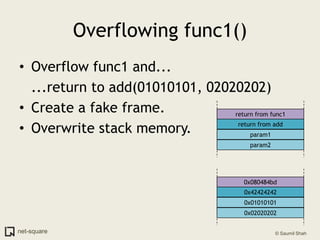
• Overflow func1 and...
...return to add(01010101, 02020202)
• Create a fake frame.
• Overwrite stack memory.
return from func1
param1
param2
return from add
0x080484bd
0x01010101
0x02020202
0x42424242
net-square © Saumil Shah
Creating a fake frame
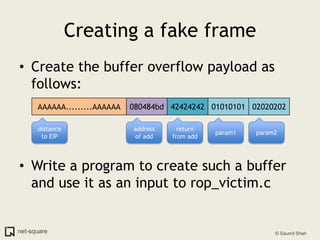
• Create the buffer overflow payload as
follows:
• Write a program to create such a buffer
and use it as an input to rop_victim.c
080484bdAAAAAA.........AAAAAA 42424242 01010101 02020202
distance
to EIP
address
of add
return
from add
param1 param2
net-square © Saumil Shah
ESP
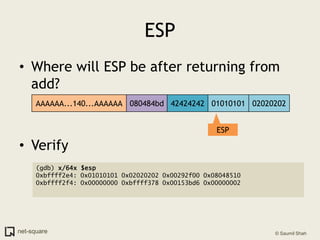
• Where will ESP be after returning from
add?
• Verify
080484bdAAAAAA...140...AAAAAA 42424242 01010101 02020202
(gdb) x/64x $esp
0xbffff2e4: 0x01010101 0x02020202 0x00292f00 0x08048510
0xbffff2f4: 0x00000000 0xbffff378 0x00153bd6 0x00000002
ESP
net-square © Saumil Shah
Chaining functions
• After add(01010101, 02020202), we want
to run add(03030303, 04040404).
• How should we set up the frames?
• First, study the frame after add() returns.
net-square © Saumil Shah
After add() returns
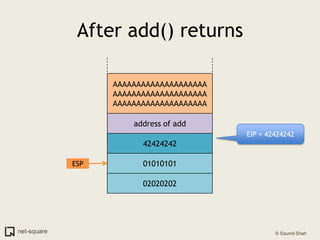
AAAAAAAAAAAAAAAAAAAA
address of add
42424242
01010101
02020202
ESP
EIP = 42424242
net-square © Saumil Shah
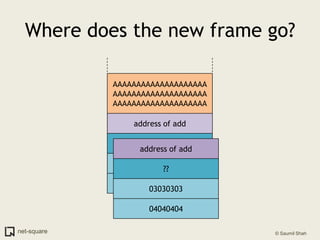
Where does the new frame go?
AAAAAAAAAAAAAAAAAAAA
address of add
42424242
01010101
02020202
address of add
??
03030303
04040404
net-square © Saumil Shah
Where does the new frame go?
• We get only ONE chance at strcpy.
• How do we preserver params 01010101
and 02020202?
• We can only APPEND the second frame
below our first frame.
• We have to unwind the first frame before
returning to the second frame.
• Answer: Return to Epilogue!
net-square © Saumil Shah
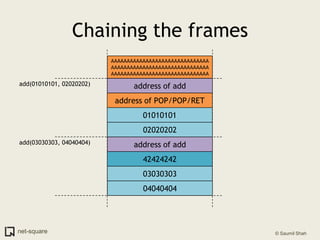
Chaining the frames
AAAAAAAAAAAAAAAAAAAAAAAAAAAAAAA
address of add
address of POP/POP/RET
01010101
02020202
address of add
42424242
03030303
04040404
add(01010101, 02020202)
add(03030303, 04040404)
net-square © Saumil Shah
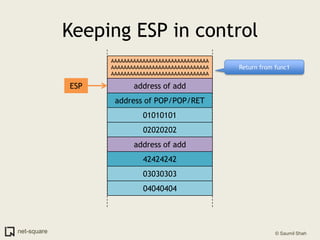
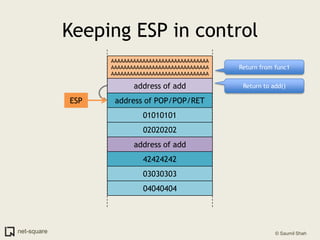
Keeping ESP in control
AAAAAAAAAAAAAAAAAAAAAAAAAAAAAAA
address of add
address of POP/POP/RET
01010101
02020202
address of add
42424242
03030303
04040404
ESP
Return from func1
net-square © Saumil Shah
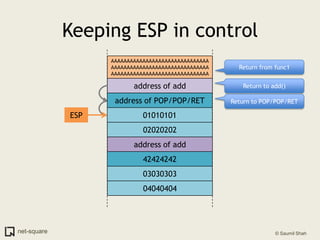
Keeping ESP in control
AAAAAAAAAAAAAAAAAAAAAAAAAAAAAAA
address of add
address of POP/POP/RET
01010101
02020202
address of add
42424242
03030303
04040404
ESP
Return from func1
Return to add()
net-square © Saumil Shah
Keeping ESP in control
AAAAAAAAAAAAAAAAAAAAAAAAAAAAAAA
address of add
address of POP/POP/RET
01010101
02020202
address of add
42424242
03030303
04040404
ESP
Return from func1
Return to add()
Return to POP/POP/RET
net-square © Saumil Shah
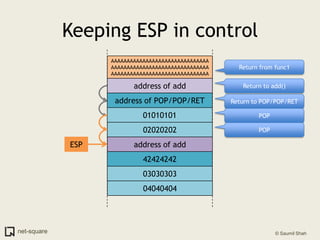
Keeping ESP in control
AAAAAAAAAAAAAAAAAAAAAAAAAAAAAAA
address of add
address of POP/POP/RET
01010101
02020202
address of add
42424242
03030303
04040404
ESP
Return from func1
Return to add()
Return to POP/POP/RET
POP
POP
net-square © Saumil Shah
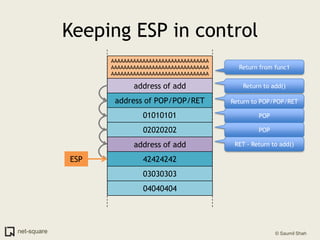
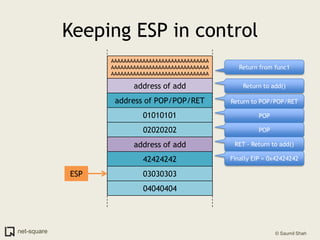
Keeping ESP in control
AAAAAAAAAAAAAAAAAAAAAAAAAAAAAAA
address of add
address of POP/POP/RET
01010101
02020202
address of add
42424242
03030303
04040404
Return from func1
Return to add()
Return to POP/POP/RET
POP
POP
ESP
RET - Return to add()
net-square © Saumil Shah
Keeping ESP in control
AAAAAAAAAAAAAAAAAAAAAAAAAAAAAAA
address of add
address of POP/POP/RET
01010101
02020202
address of add
42424242
03030303
04040404
Return from func1
Return to add()
Return to POP/POP/RET
POP
POP
ESP
RET - Return to add()
Finally EIP = 0x42424242
net-square © Saumil Shah
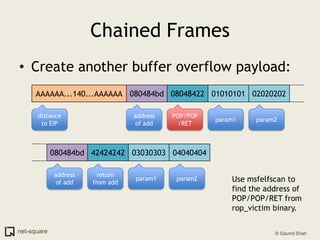
Chained Frames
• Create another buffer overflow payload:
080484bdAAAAAA...140...AAAAAA 08048422 01010101 02020202
distance
to EIP
address
of add
POP/POP
/RET
param1 param2
080484bd 42424242 03030303 04040404
address
of add
return
from add
param1 param2 Use msfelfscan to
find the address of
POP/POP/RET from
rop_victim binary.
net-square © Saumil Shah
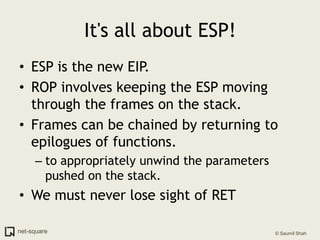
It's all about ESP!
• ESP is the new EIP.
• ROP involves keeping the ESP moving
through the frames on the stack.
• Frames can be chained by returning to
epilogues of functions.
– to appropriately unwind the parameters
pushed on the stack.
• We must never lose sight of RET
net-square © Saumil Shah
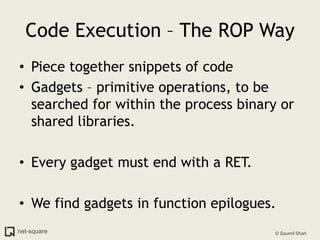
Code Execution – The ROP Way
• Piece together snippets of code
• Gadgets – primitive operations, to be
searched for within the process binary or
shared libraries.
• Every gadget must end with a RET.
• We find gadgets in function epilogues.
net-square © Saumil Shah
binobj1
binobj3
binobj2
A
E
D
f1()
f6()
f4()
f2()
f3()
B
C
f7()
f5()
f8()
RET
RET
RET
RET
RET
RET
RET
RET
Execute A, take next card
Execute D, take next card
Execute C, take next card
Execute B, take next card
Execute D, take next card
Execute E, take next card
net-square © Saumil Shah
To Conclude
• ROP requires a different way of thinking
about code execution.
• Code is not executed as a series of
opcodes and operands.
• Instead, code is executed via a series of
chained frames on the stack.
• Rather, a series of chained GADGETS on
the stack.
net-square © Saumil Shah
To Conclude
• The objective of this tutorial was to
introduce you to the concept of "Return
Oriented Programming".
• There's a lot more to be talked about
when it comes to ROP.
• Exploits on modern operating systems
which implement DEP necessarily require
ROP to execute shellcode.
net-square © Saumil Shah
To Conclude
• ROP requires a lot of hands-on practice.
• There are sophisticated tools available
for assembling your own ROP chains.
– skyrack
– RoPeMe
– ropshell.com, etc.
net-square © Saumil Shah
All-New! EXPLOITLAB 2013
saumil@net-square.com
@therealsaumil | blog.exploitlab.net

Dive into ROP - a quick introduction to Return Oriented Programming

  • 1.
    net-square © SaumilShah Dive into ROP Return Oriented Programming Introduction and Core Concepts SAUMIL SHAH www.net-square.com
  • 2.
    net-square © SaumilShah Introduction This tutorial shall introduce you to Return Oriented Programming commonly known as "ROP". We will cover the core concepts behind ROP and a small example demonstrating them.
  • 3.
    net-square © SaumilShah # who am i Saumil Shah CEO Net-square. • Hacker, Speaker, Trainer, Author. • M.S. Computer Science Purdue University. • @therealsaumil • LinkedIn: saumilshah
  • 4.
    net-square © SaumilShah Background • Here are some good refresher tutorials before you dive into ROP: • Operating Systems – A Primer – understand how processes run, • How Functions Work – stack, frames, calls, returns, etc., • Introduction to Debuggers – to try the discussed code example yourself.
  • 5.
    net-square © SaumilShah Background • And you need to know how stack overflows work.
  • 6.
    net-square © SaumilShah Agenda Exploit Mitigation via DEP Executable vs. Non-executable regions Ret2LibC Return Oriented Programming
  • 7.
    net-square © SaumilShah DEP: Data Execution Prevention • Execute Code, not Data. • Data areas marked non-executable. – Stack marked non-executable. – Heap marked non-executable. • Hardware enforced (NX). • You can load your shellcode in the stack or the heap... • ...but you can't jump to it.
  • 8.
    net-square © SaumilShah Exploitation – the good old way • Memory corruption exploits work in two stages: • Stage 1 – leverage memory corruption to control process execution. • Stage 2 – direct process execution to injected shellcode.
  • 9.
    net-square © SaumilShah Exploitation – the good old way EIP CONTROL Memory Corruption Jump to Shellcode Pre EIP Post EIP
  • 10.
    net-square © SaumilShah Example: Stack Overflow Set EIP to land in shellcode in the stack Overwrite Return Address in frame Execute shellcode from stack Pre EIP Post EIP • Exceed bounds of local variable. • Overwrite saved return address in the frame. • Control EIP when vulnerable function returns. • Shellcode is injected on the stack as part of the payload. • EIP can be set directly to a stack address, or... • ...perform a "jump through register" technique.
  • 11.
    net-square © SaumilShah Stack Overflow with DEP Set EIP to land in shellcode in the stack Overwrite Return Address in frame Execute shellcode from stack Pre EIP Post EIP • Entire stack region is marked as "non-executable". • EIP can land in the stack... • ...but no execution. • CPU will refuse to fetch-and- execute.
  • 12.
    net-square © SaumilShah EIP control • EIP movement restricted. – Can't jump to Heap. – Can't jump to Stack. • Can only land in executable regions. Program Image Heap Stack DLL DLL DLL
  • 13.
    net-square © SaumilShah The Solution? • We borrow bits and pieces of code... • ...that already exists in executable regions of the process! • We then create a SEQUENCE of operations to be carried out.
  • 14.
    net-square © SaumilShah Orchestrating Code Execution • Assume a series of cards where each card indicates an operation to be performed. • The code for that operation is present in the executable regions of the process memory. – binary or shared library. • A card shall contain the address of the code it wants to execute.
  • 15.
    net-square © SaumilShah Orchestrating Code Execution • If we can create a chain of cards, each corresponding to a basic operation... • ...we can perform complex operations. • Example: Assume a complex operation broken down into a sequence of basic operations A, D, C, B, D, E.
  • 16.
    net-square © SaumilShah binobj1 (read,exec) binobj3 (read,exec) binobj2 (read,exec) A E H D F B C G Execute A, take next card Execute D, take next card Execute C, take next card Execute B, take next card Execute D, take next card Execute E, take next card
  • 17.
    net-square © SaumilShah Orchestrating Code Execution • Complex code can therefore be transformed into a sequence of primitive operations... • ...which are already present in the process' executable regions. • These operations are called GADGETS.
  • 18.
    net-square © SaumilShah ROP – The Origins • The first idea of executing EXISTING code was discussed in 1997. • Solar Designer's Ret2LibC technique. • Devised to defeat non executable stack.
  • 19.
    net-square © SaumilShah Ret2LibC • Make EIP "return to an existing function" after a stack overflow. • If we can't execute shellcode... • ...we will "return" to system("/bin/sh")
  • 20.
    net-square © SaumilShah Ret2LibC - how does it work? • Create a fake frame on the stack. • After an overflowed function returns... • ...set the EIP return address to the new function. • Append the fake frame. • New function executes. – parameters consumed from the fake frame. • system("/bin/sh")
  • 21.
    net-square © SaumilShah Ret2LibC – how does it work? • The following function is vulnerable to a stack overflow: void func1(char *s) { char buffer[80]; strcpy(buffer, s); : : }
  • 22.
    net-square © SaumilShah Stack frame for func1() buffer return address s • If s points to a string greater than 80 characters, it will result in a stack overflow. • The return address will be overwritten with an attacker controlled value. • When func1() returns, EIP can be set to an arbitrary address, resulting in process execution hijacking.
  • 23.
    net-square © SaumilShah Jump to shellcode - regular way AAAAAAAAAAAAAAAAAAAA AAAAAAAAAAAAAAAAAAAA AAAAAAAAAAAAAAAAAAAA AAAAAAAAAAAAAAAAAAAA addr of shellcode on stack shellcode • Traditional way of implementing a "Post-EIP" jump to shellcode. • Other technique involve a "trampoline jump" or "Jump Through Register". • Either way, EIP lands in stack memory, occupied by shellcode.
  • 24.
    net-square © SaumilShah Jump to shellcode – with DEP AAAAAAAAAAAAAAAAAAAA AAAAAAAAAAAAAAAAAAAA AAAAAAAAAAAAAAAAAAAA AAAAAAAAAAAAAAAAAAAA addr of shellcode on stack shellcode • The traditional way does NOT work if stack is marked as non-executable. • EIP cannot be made to land in stack memory. • EIP MUST stay within the binary or shared libraries (valid executable memory regions)
  • 25.
    net-square © SaumilShah AAAAAAAAAAAAAAAAAAAA AAAAAAAAAAAAAAAAAAAA AAAAAAAAAAAAAAAAAAAA AAAAAAAAAAAAAAAAAAAA address of system() in libc return from system() The Ret2LibC way • func1() is made to "return" to system() by overwriting its return address with the address of system() in libc. • A fake calling frame for system() is appended after the return address for func1() • Return address for system() and parameter (pointer to "/bin/sh") are provided in the fake calling frame. address of string "/bin/sh" "/bin /sh0"
  • 26.
    net-square © SaumilShah AAAAAAAAAAAAAAAAAAAA AAAAAAAAAAAAAAAAAAAA AAAAAAAAAAAAAAAAAAAA AAAAAAAAAAAAAAAAAAAA address of system() in libc return from system() The Ret2LibC way address of string "/bin/sh" "/bin /sh0" libc system() RET • Before func1() returns, ESP points to the overwritten return address... • ...which now contains address of system() in libc. ESP
  • 27.
    net-square © SaumilShah AAAAAAAAAAAAAAAAAAAA AAAAAAAAAAAAAAAAAAAA AAAAAAAAAAAAAAAAAAAA AAAAAAAAAAAAAAAAAAAA address of system() in libc return from system() The Ret2LibC way address of string "/bin/sh" "/bin /sh0" libc system() RET • After func1() returns, the saved return address is popped off the stack and EIP returns to system(). ESP
  • 28.
    net-square © SaumilShah AAAAAAAAAAAAAAAAAAAA AAAAAAAAAAAAAAAAAAAA AAAAAAAAAAAAAAAAAAAA AAAAAAAAAAAAAAAAAAAA address of system() in libc return from system() The Ret2LibC way address of string "/bin/sh" "/bin /sh0" libc system() RET • system() will execute "/bin/sh" passed to it as a parameter. • When system() returns, EIP can be made to return to an attacker controlled address. ESP EIP
  • 29.
    net-square © SaumilShah Ret2LibC - Conclusions • It is possible to invoke an arbitrary function simply by placing a fake frame in stack memory. • It is also possible to retain EIP control after the arbitrary function returns. • Ret2LibC is the basis for Return Oriented Programming.
  • 30.
    net-square © SaumilShah Return Oriented Programming • Series of returns to functions. • Chained frames. • Transform EIP based primitives into stubs (gadgets) that can be "returned into". • We govern arbitrary code execution by controlling frames on the stack. • ESP is the new EIP!
  • 31.
    net-square © SaumilShah Introduction to Return Oriented Programming Basic Concepts
  • 32.
    net-square © SaumilShah Concepts • Functions revisited • Function calls and returns • Stack overflows revisited • Creating stack frames • Chaining frames • ESP control
  • 33.
    net-square © SaumilShah Functions Revisited • How is a function called? • What does the stack frame look like?
  • 34.
    net-square © SaumilShah Calling a function • Add two ints x, y. • add(3,4) • What does the calling frame look like? void add(int x, int y) { int sum; sum = x + y; printf("%dn", sum); } int main() { add(3, 4); }
  • 35.
    net-square © SaumilShah Stack frame for add(3,4) frame for add() return address from add() 3 4 call add
  • 36.
    net-square © SaumilShah Return from add(3,4) • add() is about to return. • RET after epilogue of add(). • Where does ESP point to? – immediately before the RET • What does the stack look like?
  • 37.
    net-square © SaumilShah Before the RET return address from add() 3 4 ESP
  • 38.
    net-square © SaumilShah Another function • Stack overflow in func1. • Can we call add(5, 6) after returning from func1? void func1(char *s) { char buffer[128]; strcpy(buffer, s); } int main() { func1(argv[1]); }
  • 39.
    net-square © SaumilShah Stack frame for func1() buffer return address from func1 s
  • 40.
    net-square © SaumilShah strcpy(buffer, s) buffer return address from func1 s AAAAAAAAAAAAAAAAAA AAAAAAAAAAAAAAAAAA AAAAAAAAAAAAAAAAAA AAAAAAAAAAAAAAAAAA AAAA AAAA AAAA AAAA
  • 41.
    net-square © SaumilShah Before the RET buffer return address from func1 s AAAAAAAAAAAAAAAAAA AAAAAAAAAAAAAAAAAA AAAAAAAAAAAAAAAAAA AAAAAAAAAAAAAAAAAA AAAA AAAA AAAA AAAA ESP
  • 42.
    net-square © SaumilShah After the RET buffer return address from func1 s AAAAAAAAAAAAAAAAAA AAAAAAAAAAAAAAAAAA AAAAAAAAAAAAAAAAAA AAAAAAAAAAAAAAAAAA AAAA AAAA AAAA AAAA EIP = 0x41414141 ESP
  • 43.
    net-square © SaumilShah Return to add() • Insert a fake frame in the buffer. • Make func1() return to: add(01010101, 02020202) • What does the stack frame look like?
  • 44.
    net-square © SaumilShah strcpy(buffer, s) buffer return address from func1 s AAAAAAAAAAAAAAAAAA AAAAAAAAAAAAAAAAAA AAAAAAAAAAAAAAAAAA AAAAAAAAAAAAAAAAAA address of add() return from add() 01010101 02020202
  • 45.
    net-square © SaumilShah Before func1() returns buffer return address from func1 s AAAAAAAAAAAAAAAAAA AAAAAAAAAAAAAAAAAA AAAAAAAAAAAAAAAAAA AAAAAAAAAAAAAAAAAA address of add() return from add() 01010101 02020202 ESP
  • 46.
    net-square © SaumilShah Return to add() buffer return address from func1 s AAAAAAAAAAAAAAAAAA AAAAAAAAAAAAAAAAAA AAAAAAAAAAAAAAAAAA AAAAAAAAAAAAAAAAAA address of add() return from add() 01010101 02020202 ESP EIP = add()
  • 47.
    net-square © SaumilShah Return to add() • By carefully creating a frame... • ...we can make the program "return to our function". • We control the parameters. • We also control where to jump to after our function returns.
  • 48.
    net-square © SaumilShah rop_victim.c int main(int argc, char *argv[]) { add(3, 4); func1(argv[1]); } void func1(char *s) { char buffer[128]; strcpy(buffer, s); } void print_hello(void) { printf("Hello Worldn"); } void add(int x, int y) { int sum; sum = x + y; printf("%d + %d = %dn", x, y, sum); } stack overflow lurks here!
  • 49.
    net-square © SaumilShah Building rop_victim • Create a file called "rop_victim.c" with the contents as shown in the previous slide. • Compile "rop_victim.c" as follows • And run it normally: $ gcc rop_victim.c –o rop_victim $ ./rop_victim HELLOWORLD
  • 50.
    net-square © SaumilShah Making func1() return to add() • We shall exploit the stack overflow in func1() and make it return to add(). • For this, we must inspect the calling frame for add()... • ...and eventually place a fake frame for add() on the stack when overflowing func1().
  • 51.
    net-square © SaumilShah Inspecting add()'s calling frame • Open "rop_victim" in gdb, and set a breakpoint just before the call to add() in main(). • We want to inspect the stack memory before call add()... • ...and immediately after call add() as well. $ gdb rop_victim
  • 52.
    net-square © SaumilShah gdb'ing add • Set a breakpoint before call add() (gdb) disassemble main 0x08048454 <+0>: push %ebp 0x08048455 <+1>: mov %esp,%ebp 0x08048457 <+3>: and $0xfffffff0,%esp 0x0804845a <+6>: sub $0x10,%esp 0x0804845d <+9>: movl $0x4,0x4(%esp) 0x08048465 <+17>: movl $0x3,(%esp) 0x0804846c <+24>: call 0x80484bd <add> 0x08048471 <+29>: cmpl $0x1,0x8(%ebp) 0x08048475 <+33>: jle 0x8048487 <main+51> 0x08048477 <+35>: mov 0xc(%ebp),%eax (gdb) break *0x0804846c
  • 53.
    net-square © SaumilShah Before add • Run rop_victim and single step into add() • We are inside add() now. • Look at the stack frame. (gdb) run HELLOWORLD Starting program: /home/krafty/rop_intro/rop_victim HELLOWORLD Breakpoint 1, 0x0804846c in main () (gdb) stepi 0x080484bd in add () (gdb) where #0 0x080484bd in add () #1 0x08048471 in main ()
  • 54.
    net-square © SaumilShah Stack frame before add(3, 4) • Dump the stack: (gdb) x/10x $esp 0xbffff41c: 0x08048471 0x00000003 0x00000004 0x0804851b 0xbffff42c: 0x00292ff4 0x08048510 0x00000000 0xbffff4b8 0x08048471 3 4 return address from add() param1 param2
  • 55.
    net-square © SaumilShah Overflowing func1() • Overflow func1 and... ...return to add(01010101, 02020202) • Create a fake frame. • Overwrite stack memory. return from func1 param1 param2 return from add 0x080484bd 0x01010101 0x02020202 0x42424242
  • 56.
    net-square © SaumilShah Creating a fake frame • Create the buffer overflow payload as follows: • Write a program to create such a buffer and use it as an input to rop_victim.c 080484bdAAAAAA.........AAAAAA 42424242 01010101 02020202 distance to EIP address of add return from add param1 param2
  • 57.
    net-square © SaumilShah ESP • Where will ESP be after returning from add? • Verify 080484bdAAAAAA...140...AAAAAA 42424242 01010101 02020202 (gdb) x/64x $esp 0xbffff2e4: 0x01010101 0x02020202 0x00292f00 0x08048510 0xbffff2f4: 0x00000000 0xbffff378 0x00153bd6 0x00000002 ESP
  • 58.
    net-square © SaumilShah Chaining functions • After add(01010101, 02020202), we want to run add(03030303, 04040404). • How should we set up the frames? • First, study the frame after add() returns.
  • 59.
    net-square © SaumilShah After add() returns AAAAAAAAAAAAAAAAAAAA AAAAAAAAAAAAAAAAAAAA AAAAAAAAAAAAAAAAAAAA address of add 42424242 01010101 02020202 ESP EIP = 42424242
  • 60.
    net-square © SaumilShah Where does the new frame go? AAAAAAAAAAAAAAAAAAAA AAAAAAAAAAAAAAAAAAAA AAAAAAAAAAAAAAAAAAAA address of add 42424242 01010101 02020202 address of add ?? 03030303 04040404
  • 61.
    net-square © SaumilShah Where does the new frame go? • We get only ONE chance at strcpy. • How do we preserver params 01010101 and 02020202? • We can only APPEND the second frame below our first frame. • We have to unwind the first frame before returning to the second frame. • Answer: Return to Epilogue!
  • 62.
    net-square © SaumilShah Chaining the frames AAAAAAAAAAAAAAAAAAAAAAAAAAAAAAA AAAAAAAAAAAAAAAAAAAAAAAAAAAAAAA AAAAAAAAAAAAAAAAAAAAAAAAAAAAAAA address of add address of POP/POP/RET 01010101 02020202 address of add 42424242 03030303 04040404 add(01010101, 02020202) add(03030303, 04040404)
  • 63.
    net-square © SaumilShah Keeping ESP in control AAAAAAAAAAAAAAAAAAAAAAAAAAAAAAA AAAAAAAAAAAAAAAAAAAAAAAAAAAAAAA AAAAAAAAAAAAAAAAAAAAAAAAAAAAAAA address of add address of POP/POP/RET 01010101 02020202 address of add 42424242 03030303 04040404 ESP Return from func1
  • 64.
    net-square © SaumilShah Keeping ESP in control AAAAAAAAAAAAAAAAAAAAAAAAAAAAAAA AAAAAAAAAAAAAAAAAAAAAAAAAAAAAAA AAAAAAAAAAAAAAAAAAAAAAAAAAAAAAA address of add address of POP/POP/RET 01010101 02020202 address of add 42424242 03030303 04040404 ESP Return from func1 Return to add()
  • 65.
    net-square © SaumilShah Keeping ESP in control AAAAAAAAAAAAAAAAAAAAAAAAAAAAAAA AAAAAAAAAAAAAAAAAAAAAAAAAAAAAAA AAAAAAAAAAAAAAAAAAAAAAAAAAAAAAA address of add address of POP/POP/RET 01010101 02020202 address of add 42424242 03030303 04040404 ESP Return from func1 Return to add() Return to POP/POP/RET
  • 66.
    net-square © SaumilShah Keeping ESP in control AAAAAAAAAAAAAAAAAAAAAAAAAAAAAAA AAAAAAAAAAAAAAAAAAAAAAAAAAAAAAA AAAAAAAAAAAAAAAAAAAAAAAAAAAAAAA address of add address of POP/POP/RET 01010101 02020202 address of add 42424242 03030303 04040404 ESP Return from func1 Return to add() Return to POP/POP/RET POP POP
  • 67.
    net-square © SaumilShah Keeping ESP in control AAAAAAAAAAAAAAAAAAAAAAAAAAAAAAA AAAAAAAAAAAAAAAAAAAAAAAAAAAAAAA AAAAAAAAAAAAAAAAAAAAAAAAAAAAAAA address of add address of POP/POP/RET 01010101 02020202 address of add 42424242 03030303 04040404 Return from func1 Return to add() Return to POP/POP/RET POP POP ESP RET - Return to add()
  • 68.
    net-square © SaumilShah Keeping ESP in control AAAAAAAAAAAAAAAAAAAAAAAAAAAAAAA AAAAAAAAAAAAAAAAAAAAAAAAAAAAAAA AAAAAAAAAAAAAAAAAAAAAAAAAAAAAAA address of add address of POP/POP/RET 01010101 02020202 address of add 42424242 03030303 04040404 Return from func1 Return to add() Return to POP/POP/RET POP POP ESP RET - Return to add() Finally EIP = 0x42424242
  • 69.
    net-square © SaumilShah Chained Frames • Create another buffer overflow payload: 080484bdAAAAAA...140...AAAAAA 08048422 01010101 02020202 distance to EIP address of add POP/POP /RET param1 param2 080484bd 42424242 03030303 04040404 address of add return from add param1 param2 Use msfelfscan to find the address of POP/POP/RET from rop_victim binary.
  • 70.
    net-square © SaumilShah It's all about ESP! • ESP is the new EIP. • ROP involves keeping the ESP moving through the frames on the stack. • Frames can be chained by returning to epilogues of functions. – to appropriately unwind the parameters pushed on the stack. • We must never lose sight of RET
  • 71.
    net-square © SaumilShah Code Execution – The ROP Way • Piece together snippets of code • Gadgets – primitive operations, to be searched for within the process binary or shared libraries. • Every gadget must end with a RET. • We find gadgets in function epilogues.
  • 72.
    net-square © SaumilShah binobj1 binobj3 binobj2 A E D f1() f6() f4() f2() f3() B C f7() f5() f8() RET RET RET RET RET RET RET RET Execute A, take next card Execute D, take next card Execute C, take next card Execute B, take next card Execute D, take next card Execute E, take next card
  • 73.
    net-square © SaumilShah To Conclude • ROP requires a different way of thinking about code execution. • Code is not executed as a series of opcodes and operands. • Instead, code is executed via a series of chained frames on the stack. • Rather, a series of chained GADGETS on the stack.
  • 74.
    net-square © SaumilShah To Conclude • The objective of this tutorial was to introduce you to the concept of "Return Oriented Programming". • There's a lot more to be talked about when it comes to ROP. • Exploits on modern operating systems which implement DEP necessarily require ROP to execute shellcode.
  • 75.
    net-square © SaumilShah To Conclude • ROP requires a lot of hands-on practice. • There are sophisticated tools available for assembling your own ROP chains. – skyrack – RoPeMe – ropshell.com, etc.
  • 76.
    net-square © SaumilShah All-New! EXPLOITLAB 2013 saumil@net-square.com @therealsaumil | blog.exploitlab.net