Polymorphism in Java
• Polymorphism in java is a concept by which
we can perform a single action by different
ways. Polymorphism is derived from 2 greek
words: poly and morphs. The word "poly"
means many and "morphs" means forms. So
polymorphism means many forms.
•
• There are two types of polymorphism in java:
compile time polymorphism and runtime
polymorphism. We can perform
polymorphism in java by method overloading
and method overriding.
• If you overload static method in java, it is the
example of compile time polymorphism.
Runtime Polymorphism in Java
• Runtime polymorphism or Dynamic Method
Dispatch is a process in which a call to an
overridden method is resolved at runtime
rather than compile-time.
• In this process, an overridden method is called
through the reference variable of a superclass.
The determination of the method to be called
is based on the object being referred to by the
reference variable.
Upcasting
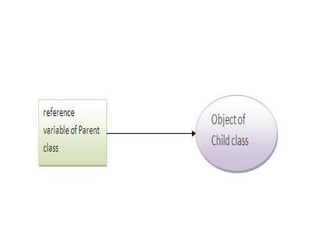
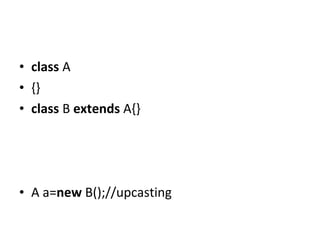
• When reference variable of Parent class refers
to the object of Child class, it is known as
upcasting. For example:
• class A
• {}
• class B extends A{}
• A a=new B();//upcasting
Example of Java Runtime Polymorphism
class Bike{
void run(){System.out.println("running");}
}
class Splender extends Bike{
void run()
{System.out.println("running safely with 60km");}
public static void main(String args[]){
Bike b = new Splender();//upcasting
b.run();
} }
Java Runtime Polymorphism with Data
Member
• Method is overridden not the datamembers,
so runtime polymorphism can't be achieved
by data members.
• class Bike{
• int speedlimit=90;
• }
• class Honda3 extends Bike{
• int speedlimit=150;
•
• public static void main(String args[]){
• Bike obj=new Honda3();
• System.out.println(obj.speedlimit);//90
• }
Java Runtime Polymorphism with
Multilevel Inheritance
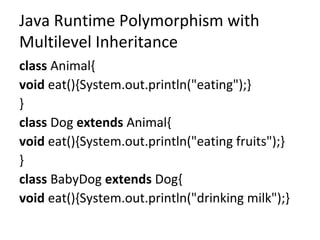
class Animal{
void eat(){System.out.println("eating");}
}
class Dog extends Animal{
void eat(){System.out.println("eating fruits");}
}
class BabyDog extends Dog{
void eat(){System.out.println("drinking milk");}
public static void main(String args[])
{  
Animal a1,a2,a3;  
a1=new Animal();  
a2=new Dog();  
a3=new BabyDog();  
a1.eat();  
a2.eat();  
a3.eat();  
}  }  

Polymorphism in java

  • 1.
  • 2.
    Polymorphism in Java •Polymorphism in java is a concept by which we can perform a single action by different ways. Polymorphism is derived from 2 greek words: poly and morphs. The word "poly" means many and "morphs" means forms. So polymorphism means many forms. •
  • 3.
    • There aretwo types of polymorphism in java: compile time polymorphism and runtime polymorphism. We can perform polymorphism in java by method overloading and method overriding. • If you overload static method in java, it is the example of compile time polymorphism.
  • 4.
    Runtime Polymorphism inJava • Runtime polymorphism or Dynamic Method Dispatch is a process in which a call to an overridden method is resolved at runtime rather than compile-time.
  • 5.
    • In thisprocess, an overridden method is called through the reference variable of a superclass. The determination of the method to be called is based on the object being referred to by the reference variable.
  • 6.
    Upcasting • When referencevariable of Parent class refers to the object of Child class, it is known as upcasting. For example:
  • 8.
    • class A •{} • class B extends A{} • A a=new B();//upcasting
  • 9.
    Example of JavaRuntime Polymorphism class Bike{ void run(){System.out.println("running");} } class Splender extends Bike{ void run() {System.out.println("running safely with 60km");} public static void main(String args[]){ Bike b = new Splender();//upcasting b.run(); } }
  • 10.
    Java Runtime Polymorphismwith Data Member • Method is overridden not the datamembers, so runtime polymorphism can't be achieved by data members.
  • 11.
    • class Bike{ •int speedlimit=90; • } • class Honda3 extends Bike{ • int speedlimit=150; • • public static void main(String args[]){ • Bike obj=new Honda3(); • System.out.println(obj.speedlimit);//90 • }
  • 12.
    Java Runtime Polymorphismwith Multilevel Inheritance class Animal{ void eat(){System.out.println("eating");} } class Dog extends Animal{ void eat(){System.out.println("eating fruits");} } class BabyDog extends Dog{ void eat(){System.out.println("drinking milk");}
  • 13.