Distribution and Channel Management
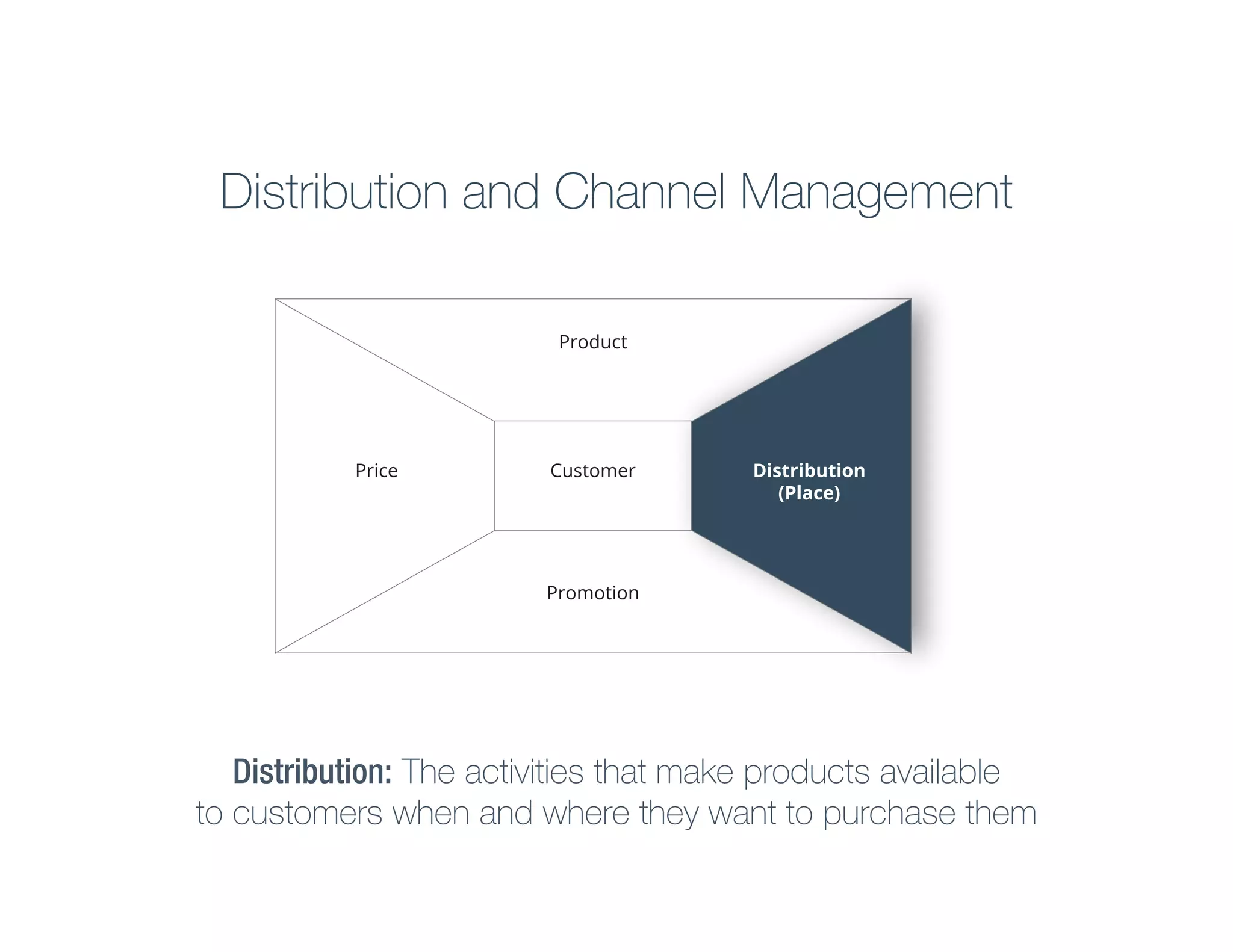
Product

Price

Customer

Distribution
(Place)

Promotion

Distribution: The activities that make products available
to customers when and where they want to purchase them
Channel-Selection Decision
Who are potential customers? • Where do they buy? • When do they buy?
How do they buy? • What do they buy?

50% are men

15% buy with iPhone

ale
S

Most male buyers are
single with no children

USA
100% of sales are domestic

25% buy instore

39% use laptops

50% use desktops

40% women buy online
Distribution / Channel Management
is Important Because:
	 •	
	 •	
		
	 •	

It affects sales — if the product is not available it can’t be sold
It affects profits — distribution can contribute up to 50 percent
of the final selling price of some goods
It influences customer satisfaction

The Marketing Channel Creates the Utility of:
•	
•	
•	
•	

time = when
place = where
possession = access
information = communication
Marketing Channel: The group of individuals and organizations that direct
the flow of products from producers (business) to customers – B2C

1
2

3
4

5
The Channel can have many Intermediaries (B2C)

A.)

2

1
Ma

Co

nu

B.)

2

1

tai

fac

3

2

Ma

Wh

nu

ole

fac

tur
er

2

1
Ma

ler

tur
er

1

nu

fac

Ag
tur
er

en

t

tai

er

ler

4

3
Wh

ole

er

nsu

me

r

Co

nsu

me

r

5

Re

sal

Co

4

Re

sal

r

3

Re

nu

D.)

me

tur
er

Ma

C.)

nsu

fac

tai

ler

Co

nsu

me

r
And International Distribution Channels Can
Include More as Exporters and Importers
Business to Business Marketing Channels (B2B)

E.)

2

1
Bu

Bu

sin

F.)

sin

ess

2

1
Bu

G.)

Bu

trib

ess

uto

sin

ess

Bu

sin

ess

ess

3

Ag

Bu

en

sin

t

2

1

sin

r

2

1
Bu

H.)

3

Dis

sin

ess

Ag

3
en

t

ess

Dis

4
trib

uto

Bu
r

sin

ess
Marketing Channel Design

Indirect Distribution
Uses intermediaries to
reach the target market


•	
•	
•	
•	

Type
Location
Density
Channel Levels

Direct Distribution

vs

Reaches the target
market directly
	 • 	 Uses its own
		 sales force or
		distribution outlets
	 • 	 Uses the Internet
Marketing Channel Design
Indirect Distribution is considered when:
		 • 	
			
		 • 	
		 •	
			

Intermediaries can perform distribution functions more
efficiently and at a lower cost
The target market is hard to reach directly
The business does not have the resources to perform the 		
distribution function

3

2

1
Ma

nu

fac

Wh
tur
er

ole

sal

Re

4

er

tai

ler

Co

nsu

me

r
Marketing Channel Design
Direct Distribution is considered when:
		 • 	 The target market is easily identifiable
		 •	 A knowledgeable and personal sales-force is a key ingredient
		 • 	 The business has a wide variety of products available for the
			target market
		 •	 Sufficient resources are available
		 •	 Intermediaries are not available for reaching the target market
		 •	 Intermediaries do not possess the capacity to service the
			 requirements of the target market

2

1
Ma

nu

Co

fac

tur
er

nsu

me

r
Marketing Channel Design
Internet Marketing Channels:


•	
•	
•	
•	
•	
•	
•	
•	
•	
•	
•	

SEO (Search Engine Optimization)
PPC (Pay Per Click Campaigns)
Social Media Marketing
Affiliate Marketing
Shopping Channels (ie. Google Product)
Mobile Marketing
Video Marketing
eDM (email Direct Marketing)
Online PR / Article Content Marketing
Display Advertising
Directory / Review Sites (ie. Yelp)
Marketing Channel Design
Multiple Marketing Channels:
Simultaneously using different marketing channels to reach diverse target
markets.

Oakley Retail / Outlet Stores
Oakley Website
Specialty Retailers
Online Retailers

Mail Order Catalogs
Retail Stores
SGHI Website
Putting together all the Intermediaries
in the Marketing Channel Creates
the Supply Chain

Key Tasks in Supply Chain Management


•	
•	
•	
•	

planning = coordination the partnerships to meet customer needs
sourcing = purchasing the goods and services to support the channel
delivering = moving the product through the channel
fortifying = the relationship with the customer
Selecting the Channel Design
Nature of the product:


•	
•	
•	
•	

Technical / complex (Specialist and Agents)
Customized and specific (Direct Distribution)
Less expensive / standardized (Longer Channels)
Brand image exclusivity (Limited Availability)

3

2

1
Ma

nu

fac

Wh
tur
er

ole

sal

Re

4

er

tai

ler

Co

nsu

me

r
Selecting the Channel Design
Nature of the business:


• 	 It’s size and scope – e.g. can it afford an in-house salesforce
•	 Does it have an established distribution network
•	 How much control does it want over distribution

3

2

1
Ma

nu

fac

Wh
tur
er

ole

sal

Re

4

er

tai

ler

Co

nsu

me

r
Selecting the Channel Design
The Competition:


• 	 What distribution channels and intermediaries do they use?
•	 Is it an international product?
•	 What’s the geographical spread?

3

2

1
Ma

nu

fac

Wh
tur
er

ole

sal

Re

4

er

tai

ler

Co

nsu

me

r
Selecting the Channel Design
Environmental Forces:


•	
•	
•	
•	

Adverse economic conditions in play
New technologies available e.g. software delivery
New labor or environmental laws
Taxes, tariffs, and trade agreements

3

2

1
Ma

nu

fac

Wh
tur
er

ole

sal

Re

4

er

tai

ler

Co

nsu

me

r
Selecting the Channel Design
Characteristics of the Intermediaries:


•	
•	
•	
•	
•	

Market Coverage
Sales Forecast
Costs
Resources
Profitability	


•	
•	
•	
•	
•	

Control
Motivation
Reputation
Competition
Contracts

3

2

1
Ma

nu

fac

Wh
tur
er

ole

sal

Re

4

er

tai

ler

Co

nsu

me

r
Selecting the Channel Design
Market Coverage:
	 •	
	 •	
		
	 •	
	 •	

Does the profile of customers match the target market profile?
Are the number of potential customers big enough to meet the
required distribution penetration?
Is the sales force big enough to cover the territory?
Is the existing delivery fleet and warehouse facilities adequate?

3

2

1
Ma

nu

fac

Wh
tur
er

ole

sal

Re

4

er

tai

ler

Co

nsu

me

r
Selecting the Channel Design
Sales Forecast:
	 • 	 What’s their sales forecast?
	 •	 Are they realistic?
	 •	 What are they willing to commit to in inventory?
	 •	 Do they have a marketing budget?
Some manufacturers even ask their distributors for a marketing plan
showing how they intend to market the supplier’s products.

3

2

1
Ma

nu

fac

Wh
tur
er

ole

sal

Re

4

er

tai

ler

Co

nsu

me

r
Selecting the Channel Design
Costs:
	 • 	 What will the relationship cost in terms of discounts,
		 commissions, stock investment and marketing?

3

2

1
Ma

nu

fac

Wh
tur
er

ole

sal

Re

4

er

tai

ler

Co

nsu

me

r
Selecting the Channel Design
Resources:
	 • 	 Does the target market require anything special such as technical
		 assistance, installation, quick deliveries, instant availability?
	 •	 If so can the distributor provide it?

3

2

1
Ma

nu

fac

Wh
tur
er

ole

sal

Re

4

er

tai

ler

Co

nsu

me

r
Selecting the Channel Design
Profitability:
	

• 	 How much profit will they generate for the manufacturer?

3

2

1
Ma

nu

fac

Wh
tur
er

ole

sal

Re

4

er

tai

ler

Co

nsu

me

r
Selecting the Channel Design
Control:


•	
•	
•	
•	

Do they have a reporting system in place?
How do they deal with problems?
How often are review meetings scheduled?
Can you influence the way they present your products?

3

2

1
Ma

nu

fac

Wh
tur
er

ole

sal

Re

4

er

tai

ler

Co

nsu

me

r
Selecting the Channel Design
Motivation:
	 • 	 Does the intermediary convey a sense of excitement and
		 enthusiasm about the product?
	 •	 What their sales force reaction to the product?

3

2

1
Ma

nu

fac

Wh
tur
er

ole

sal

Re

4

er

tai

ler

Co

nsu

me

r
Selecting the Channel Design
Reputation:


• 	 Does the intermediary have a solid track record of successes?
•	 How long have they been in business?
•	 Is their business dependent on one key-player, or is team based?

3

2

1
Ma

nu

fac

Wh
tur
er

ole

sal

Re

4

er

tai

ler

Co

nsu

me

r
Selecting the Channel Design
Competition:
	

• 	 Does the intermediary distribute any competitor’s products?

3

2

1
Ma

nu

fac

Wh
tur
er

ole

sal

Re

4

er

tai

ler

Co

nsu

me

r
Selecting the Channel Design
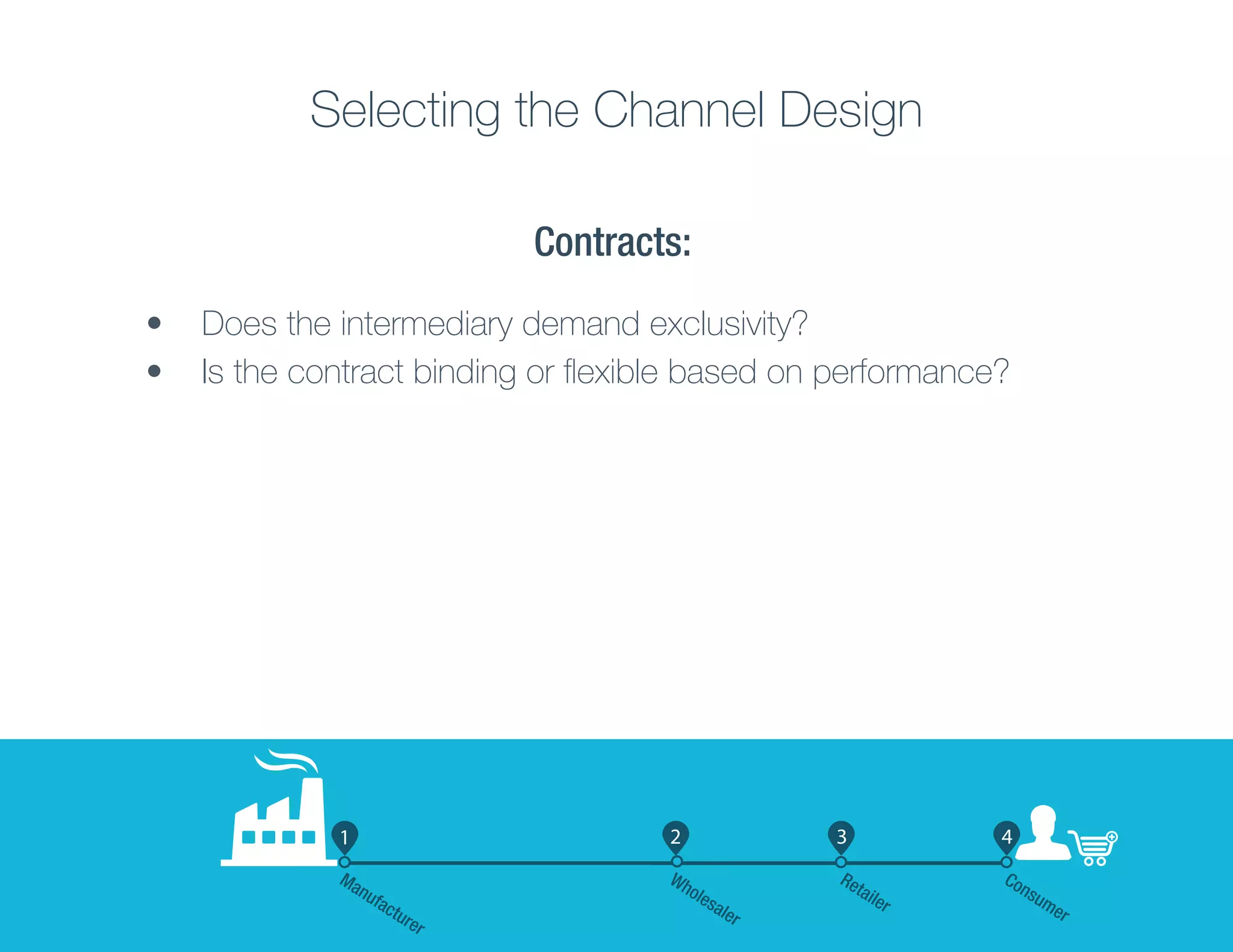
Contracts:


• 	 Does the intermediary demand exclusivity?
•	 Is the contract binding or flexible based on performance?

3

2

1
Ma

nu

fac

Wh
tur
er

ole

sal

Re

4

er

tai

ler

Co

nsu

me

r
Intensity of Market Coverage

Intensive

Selective

Convenience
products such as
Coke, Doritos

Consumer
products ie.
laptops, televisions

Available in many
retail locations

Available in some
retail locations

Exclusive
Specialty products
ie., Rolex watches
Available in few
retail locations
Supply Chain Management

Effective Distribution
Occurs when a limited number of retail locations account for a significant
percentage of the market. For example, the product is distributed 30% of
available retail outlets, but those retailers account for 80% of the market.
Supply Chain Management

Profitability
	

• Margins = (Revenues - Channel Costs)
Channel costs are:
Distribution costs / Advertising costs / Selling Costs
Supply Chain Management

Channel Conflict
Occurs when one channel member believes another channel member is
engaged in behavior that is preventing them from achieving their goals.

Sources of Channel Conflict
Channel member bypasses another member and sells or buys direct
Profit margins are uneven between channel members
Manufacturer believes channel member is not providing attention to its product
Manufacturer engages in dual distribution
Supply Chain Management

Channel Power
The channel leader may be any member of the supply chain.
Referred to as the Channel Captain, they are the dominant member
that takes on the role of coordinating, directing, and influencing the
other member’s goal achievements

Forms of Power
Ability to reward or coerce other members
Experts within the market
Legitimate right to dictate behavior
Supply Chain Management

Strategic Relationships
Two common strategies are Vertical Marketing Systems
and Horizontal Marketing Systems
Supply Chain Management

Vertical Marketing Systems
Manufacturers and intermediaries working closely together
They plan production, delivery and promotional schedules.
Share resources when possible.
Managed by the Channel Captain
Example: Luxottica
The manufacturer Luxottica purchased the brand “Oakley” and the
retail presence of “The Sunglass Hut” to deliver its products.
Supply Chain Management

Horizontal Marketing Systems
Occurs when two organizations on the same channel level cooperate
(e.g. two wholesalers or two retailers)
They share their expertise and channels
Decreases time to market entry
Example: Apple / Starbucks partnership
The purpose was for Starbucks customers to wirelessly browse,
search, preview, and purchase music from iTunes.
Legal Issues in Chain Management

Dual Distribution
The use two or more marketing channels to distributed the
same products to the same target market.
Considered illegal when the manufacturer uses company-owned outlets
to force independent retailers out of business by undercutting their prices.
Legal Issues in Chain Management

Restricted Sales Territory
Favored by intermediaries to protect a sales territory.
Conflicting rulings by the courts regarding the restraint of trade.
Legal Issues in Chain Management

Tying Agreements
An agreement where the manufacturer requires intermediaries to purchase
other products in addition to the most popular items.
The related practice of full-line forcing, where the manufacturer requires
the intermediary to carry the entire line. Deemed okay by the courts if
they are able to carry competing products
Legal Issues in Chain Management

Exclusivity
An agreement where the manufacturer forbids intermediaries
to carry competing products.
Deemed illegal if:


• 	 If the deal blocks as much as 10% of market share
• 	 The sales revenue is deemed “sizable”
•	 The manufacturer is larger and intimidating to the intermediary
Legal Issues in Chain Management

Refusal to Deal
The courts have held that manufacturers have the right to choose channel
members with which they will do business.
However, within existing channels manufacturers may not legally refuse
to deal with intermediaries merely because they resist policies that
are anticompetitive or restrain trade.

Distribution channel managment

  • 1.
    Distribution and ChannelManagement Product Price Customer Distribution (Place) Promotion Distribution: The activities that make products available to customers when and where they want to purchase them
  • 2.
    Channel-Selection Decision Who arepotential customers? • Where do they buy? • When do they buy? How do they buy? • What do they buy? 50% are men 15% buy with iPhone ale S Most male buyers are single with no children USA 100% of sales are domestic 25% buy instore 39% use laptops 50% use desktops 40% women buy online
  • 3.
    Distribution / ChannelManagement is Important Because: • • • It affects sales — if the product is not available it can’t be sold It affects profits — distribution can contribute up to 50 percent of the final selling price of some goods It influences customer satisfaction The Marketing Channel Creates the Utility of: • • • • time = when place = where possession = access information = communication
  • 4.
    Marketing Channel: Thegroup of individuals and organizations that direct the flow of products from producers (business) to customers – B2C 1 2 3 4 5
  • 5.
    The Channel canhave many Intermediaries (B2C) A.) 2 1 Ma Co nu B.) 2 1 tai fac 3 2 Ma Wh nu ole fac tur er 2 1 Ma ler tur er 1 nu fac Ag tur er en t tai er ler 4 3 Wh ole er nsu me r Co nsu me r 5 Re sal Co 4 Re sal r 3 Re nu D.) me tur er Ma C.) nsu fac tai ler Co nsu me r
  • 6.
    And International DistributionChannels Can Include More as Exporters and Importers
  • 7.
    Business to BusinessMarketing Channels (B2B) E.) 2 1 Bu Bu sin F.) sin ess 2 1 Bu G.) Bu trib ess uto sin ess Bu sin ess ess 3 Ag Bu en sin t 2 1 sin r 2 1 Bu H.) 3 Dis sin ess Ag 3 en t ess Dis 4 trib uto Bu r sin ess
  • 8.
    Marketing Channel Design IndirectDistribution Uses intermediaries to reach the target market • • • • Type Location Density Channel Levels Direct Distribution vs Reaches the target market directly • Uses its own sales force or distribution outlets • Uses the Internet
  • 9.
    Marketing Channel Design IndirectDistribution is considered when: • • • Intermediaries can perform distribution functions more efficiently and at a lower cost The target market is hard to reach directly The business does not have the resources to perform the distribution function 3 2 1 Ma nu fac Wh tur er ole sal Re 4 er tai ler Co nsu me r
  • 10.
    Marketing Channel Design DirectDistribution is considered when: • The target market is easily identifiable • A knowledgeable and personal sales-force is a key ingredient • The business has a wide variety of products available for the target market • Sufficient resources are available • Intermediaries are not available for reaching the target market • Intermediaries do not possess the capacity to service the requirements of the target market 2 1 Ma nu Co fac tur er nsu me r
  • 11.
    Marketing Channel Design InternetMarketing Channels: • • • • • • • • • • • SEO (Search Engine Optimization) PPC (Pay Per Click Campaigns) Social Media Marketing Affiliate Marketing Shopping Channels (ie. Google Product) Mobile Marketing Video Marketing eDM (email Direct Marketing) Online PR / Article Content Marketing Display Advertising Directory / Review Sites (ie. Yelp)
  • 12.
    Marketing Channel Design MultipleMarketing Channels: Simultaneously using different marketing channels to reach diverse target markets. Oakley Retail / Outlet Stores Oakley Website Specialty Retailers Online Retailers Mail Order Catalogs Retail Stores SGHI Website
  • 13.
    Putting together allthe Intermediaries in the Marketing Channel Creates the Supply Chain Key Tasks in Supply Chain Management • • • • planning = coordination the partnerships to meet customer needs sourcing = purchasing the goods and services to support the channel delivering = moving the product through the channel fortifying = the relationship with the customer
  • 14.
    Selecting the ChannelDesign Nature of the product: • • • • Technical / complex (Specialist and Agents) Customized and specific (Direct Distribution) Less expensive / standardized (Longer Channels) Brand image exclusivity (Limited Availability) 3 2 1 Ma nu fac Wh tur er ole sal Re 4 er tai ler Co nsu me r
  • 15.
    Selecting the ChannelDesign Nature of the business: • It’s size and scope – e.g. can it afford an in-house salesforce • Does it have an established distribution network • How much control does it want over distribution 3 2 1 Ma nu fac Wh tur er ole sal Re 4 er tai ler Co nsu me r
  • 16.
    Selecting the ChannelDesign The Competition: • What distribution channels and intermediaries do they use? • Is it an international product? • What’s the geographical spread? 3 2 1 Ma nu fac Wh tur er ole sal Re 4 er tai ler Co nsu me r
  • 17.
    Selecting the ChannelDesign Environmental Forces: • • • • Adverse economic conditions in play New technologies available e.g. software delivery New labor or environmental laws Taxes, tariffs, and trade agreements 3 2 1 Ma nu fac Wh tur er ole sal Re 4 er tai ler Co nsu me r
  • 18.
    Selecting the ChannelDesign Characteristics of the Intermediaries: • • • • • Market Coverage Sales Forecast Costs Resources Profitability • • • • • Control Motivation Reputation Competition Contracts 3 2 1 Ma nu fac Wh tur er ole sal Re 4 er tai ler Co nsu me r
  • 19.
    Selecting the ChannelDesign Market Coverage: • • • • Does the profile of customers match the target market profile? Are the number of potential customers big enough to meet the required distribution penetration? Is the sales force big enough to cover the territory? Is the existing delivery fleet and warehouse facilities adequate? 3 2 1 Ma nu fac Wh tur er ole sal Re 4 er tai ler Co nsu me r
  • 20.
    Selecting the ChannelDesign Sales Forecast: • What’s their sales forecast? • Are they realistic? • What are they willing to commit to in inventory? • Do they have a marketing budget? Some manufacturers even ask their distributors for a marketing plan showing how they intend to market the supplier’s products. 3 2 1 Ma nu fac Wh tur er ole sal Re 4 er tai ler Co nsu me r
  • 21.
    Selecting the ChannelDesign Costs: • What will the relationship cost in terms of discounts, commissions, stock investment and marketing? 3 2 1 Ma nu fac Wh tur er ole sal Re 4 er tai ler Co nsu me r
  • 22.
    Selecting the ChannelDesign Resources: • Does the target market require anything special such as technical assistance, installation, quick deliveries, instant availability? • If so can the distributor provide it? 3 2 1 Ma nu fac Wh tur er ole sal Re 4 er tai ler Co nsu me r
  • 23.
    Selecting the ChannelDesign Profitability: • How much profit will they generate for the manufacturer? 3 2 1 Ma nu fac Wh tur er ole sal Re 4 er tai ler Co nsu me r
  • 24.
    Selecting the ChannelDesign Control: • • • • Do they have a reporting system in place? How do they deal with problems? How often are review meetings scheduled? Can you influence the way they present your products? 3 2 1 Ma nu fac Wh tur er ole sal Re 4 er tai ler Co nsu me r
  • 25.
    Selecting the ChannelDesign Motivation: • Does the intermediary convey a sense of excitement and enthusiasm about the product? • What their sales force reaction to the product? 3 2 1 Ma nu fac Wh tur er ole sal Re 4 er tai ler Co nsu me r
  • 26.
    Selecting the ChannelDesign Reputation: • Does the intermediary have a solid track record of successes? • How long have they been in business? • Is their business dependent on one key-player, or is team based? 3 2 1 Ma nu fac Wh tur er ole sal Re 4 er tai ler Co nsu me r
  • 27.
    Selecting the ChannelDesign Competition: • Does the intermediary distribute any competitor’s products? 3 2 1 Ma nu fac Wh tur er ole sal Re 4 er tai ler Co nsu me r
  • 28.
    Selecting the ChannelDesign Contracts: • Does the intermediary demand exclusivity? • Is the contract binding or flexible based on performance? 3 2 1 Ma nu fac Wh tur er ole sal Re 4 er tai ler Co nsu me r
  • 29.
    Intensity of MarketCoverage Intensive Selective Convenience products such as Coke, Doritos Consumer products ie. laptops, televisions Available in many retail locations Available in some retail locations Exclusive Specialty products ie., Rolex watches Available in few retail locations
  • 30.
    Supply Chain Management EffectiveDistribution Occurs when a limited number of retail locations account for a significant percentage of the market. For example, the product is distributed 30% of available retail outlets, but those retailers account for 80% of the market.
  • 31.
    Supply Chain Management Profitability •Margins = (Revenues - Channel Costs) Channel costs are: Distribution costs / Advertising costs / Selling Costs
  • 32.
    Supply Chain Management ChannelConflict Occurs when one channel member believes another channel member is engaged in behavior that is preventing them from achieving their goals. Sources of Channel Conflict Channel member bypasses another member and sells or buys direct Profit margins are uneven between channel members Manufacturer believes channel member is not providing attention to its product Manufacturer engages in dual distribution
  • 33.
    Supply Chain Management ChannelPower The channel leader may be any member of the supply chain. Referred to as the Channel Captain, they are the dominant member that takes on the role of coordinating, directing, and influencing the other member’s goal achievements Forms of Power Ability to reward or coerce other members Experts within the market Legitimate right to dictate behavior
  • 34.
    Supply Chain Management StrategicRelationships Two common strategies are Vertical Marketing Systems and Horizontal Marketing Systems
  • 35.
    Supply Chain Management VerticalMarketing Systems Manufacturers and intermediaries working closely together They plan production, delivery and promotional schedules. Share resources when possible. Managed by the Channel Captain Example: Luxottica The manufacturer Luxottica purchased the brand “Oakley” and the retail presence of “The Sunglass Hut” to deliver its products.
  • 36.
    Supply Chain Management HorizontalMarketing Systems Occurs when two organizations on the same channel level cooperate (e.g. two wholesalers or two retailers) They share their expertise and channels Decreases time to market entry Example: Apple / Starbucks partnership The purpose was for Starbucks customers to wirelessly browse, search, preview, and purchase music from iTunes.
  • 37.
    Legal Issues inChain Management Dual Distribution The use two or more marketing channels to distributed the same products to the same target market. Considered illegal when the manufacturer uses company-owned outlets to force independent retailers out of business by undercutting their prices.
  • 38.
    Legal Issues inChain Management Restricted Sales Territory Favored by intermediaries to protect a sales territory. Conflicting rulings by the courts regarding the restraint of trade.
  • 39.
    Legal Issues inChain Management Tying Agreements An agreement where the manufacturer requires intermediaries to purchase other products in addition to the most popular items. The related practice of full-line forcing, where the manufacturer requires the intermediary to carry the entire line. Deemed okay by the courts if they are able to carry competing products
  • 40.
    Legal Issues inChain Management Exclusivity An agreement where the manufacturer forbids intermediaries to carry competing products. Deemed illegal if: • If the deal blocks as much as 10% of market share • The sales revenue is deemed “sizable” • The manufacturer is larger and intimidating to the intermediary
  • 41.
    Legal Issues inChain Management Refusal to Deal The courts have held that manufacturers have the right to choose channel members with which they will do business. However, within existing channels manufacturers may not legally refuse to deal with intermediaries merely because they resist policies that are anticompetitive or restrain trade.