Corporate strategy
The New Reality - #1Firms must learn to compete differently if they are to achieve strategic competitiveness in the 21st-century competitive landscape.  To provide an idea of what this means, new ways of competing may include: bringing new good and services to market more quickly
The use of new technologies (e.g., Amazon.com)
Diversifying the product line (e.g., Barnes and Nobles into music as a catalyst for growth)The New Reality - #2 Shifting product emphasis (e.g., U-Haul’s new focus on accessory sales) (i.e., Dual Branding)
 Consolidation (e.g., the merger of Exxon and Mobil)
 Combining online selling with physical stores  (e.g., CompUSA’s new strategy)The New Reality - #3 Dell Model for Growth
Have New Business Model (maybe changes every 5 years?)
Identify Core Competencies and then improve the four capabilities
Outsource non-core competencies
Create a “Brand Management Company”Brief Overview of Corporate StrategyThose strategies concerned with the broad and long-term questions of what business(es) the organization is in and what it wants to do with those businesses
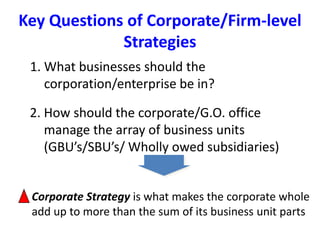
Key Questions of Corporate/Firm-level Strategies1. What businesses should the corporation/enterprise be in?2. How should the corporate/G.O. office manage the array of business units (GBU’s/SBU’s/ Wholly owed subsidiaries)Corporate Strategy is what makes the corporate whole add up to more than the sum of its business unit parts
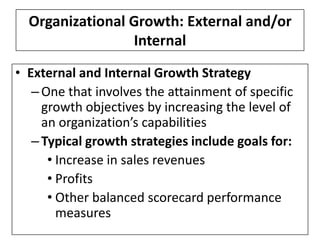
Organizational Growth: External and/or InternalExternal and Internal Growth StrategyOne that involves the attainment of specific growth objectives by increasing the level of an organization’s capabilitiesTypical growth strategies include goals for:Increase in sales revenuesProfitsOther balanced scorecard performance measures
Types of Growth StrategiesInternationalConcentrationOrganizationalGrowthDiversificationRelated Businesses
Unrelated BusinessesVertical IntegrationRelated Businesses
Unrelated BusinessesHorizontalIntegration:Along Value Chain

Corpor ate

  • 1.
  • 2.
    The New Reality- #1Firms must learn to compete differently if they are to achieve strategic competitiveness in the 21st-century competitive landscape. To provide an idea of what this means, new ways of competing may include: bringing new good and services to market more quickly
  • 3.
    The use ofnew technologies (e.g., Amazon.com)
  • 4.
    Diversifying the productline (e.g., Barnes and Nobles into music as a catalyst for growth)The New Reality - #2 Shifting product emphasis (e.g., U-Haul’s new focus on accessory sales) (i.e., Dual Branding)
  • 5.
    Consolidation (e.g.,the merger of Exxon and Mobil)
  • 6.
    Combining onlineselling with physical stores (e.g., CompUSA’s new strategy)The New Reality - #3 Dell Model for Growth
  • 7.
    Have New BusinessModel (maybe changes every 5 years?)
  • 8.
    Identify Core Competenciesand then improve the four capabilities
  • 9.
  • 10.
    Create a “BrandManagement Company”Brief Overview of Corporate StrategyThose strategies concerned with the broad and long-term questions of what business(es) the organization is in and what it wants to do with those businesses
  • 11.
    Key Questions ofCorporate/Firm-level Strategies1. What businesses should the corporation/enterprise be in?2. How should the corporate/G.O. office manage the array of business units (GBU’s/SBU’s/ Wholly owed subsidiaries)Corporate Strategy is what makes the corporate whole add up to more than the sum of its business unit parts
  • 12.
    Organizational Growth: Externaland/or InternalExternal and Internal Growth StrategyOne that involves the attainment of specific growth objectives by increasing the level of an organization’s capabilitiesTypical growth strategies include goals for:Increase in sales revenuesProfitsOther balanced scorecard performance measures
  • 13.
    Types of GrowthStrategiesInternationalConcentrationOrganizationalGrowthDiversificationRelated Businesses
  • 14.
  • 15.