
DISTRIBUTION MANAGEMENT
MODULE 1: INTRODUCTION TO DISTRIBUTION AND ITS ORIGIN
Learning Outcomes
By the end of this topic, you should be able to:
 Origin of Distribution
 Define Distribution & Distribution Management
 To be able to define and understand what Logistics and
Distribution is
 To know the basic function and major roles of Distribution in the
Industry
ORIGIN OF DISTRIBUTION
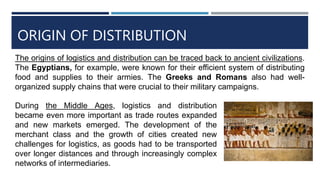
The origins of logistics and distribution can be traced back to ancient civilizations.
The Egyptians, for example, were known for their efficient system of distributing
food and supplies to their armies. The Greeks and Romans also had well-
organized supply chains that were crucial to their military campaigns.
During the Middle Ages, logistics and distribution
became even more important as trade routes expanded
and new markets emerged. The development of the
merchant class and the growth of cities created new
challenges for logistics, as goods had to be transported
over longer distances and through increasingly complex
networks of intermediaries.
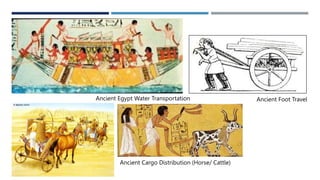
Ancient Egypt Water Transportation Ancient Foot Travel
Ancient Cargo Distribution (Horse/ Cattle)
ORIGIN OF DISTRIBUTION
The Industrial Revolution in the 18th and 19th centuries brought significant changes to logistics
and distribution. The invention of the steam engine and the expansion of rail and water
transportation networks made it possible to move goods more quickly and efficiently over longer
distances. During this time, logistics also began to be used in non-military contexts, such as in the
management of factories and warehouses.
The 20th century saw significant advancements in logistics and distribution, start the development
of new systems for managing supply chains.
In the 1950s and 1960s, the concept of physical distribution emerged, which focused on the
movement of goods from factories to customers.
In the 1980s and 1990s, the term “supply chain management” began to be used to describe the
holistic approach to managing the flow of goods and information from suppliers to customers.
Now, 21st century, the advent of the internet and digital technologies emerges and take
distribution into advancement
DISTRIBUTION MANAGEMENT
- refers to the process of overseeing the movement of goods from
supplier or manufacturer to point of sale. It is an overarching term
that refers to numerous activities and processes such as
packaging, inventory, warehousing, supply chain, and logistics.
Distribution management is an important part of the business cycle for
distributors and wholesalers. The profit margins of businesses depend on how
quickly they can turn over their goods. The more they sell, the more they earn,
which means a better future for the business. Having a successful distribution
management system is also important for businesses to remain competitive and
to keep customers satisfied.
Understanding the Distribution Management
Distribution management is critical to a company's financial success and
corporate longevity. Executing it successfully requires effective management of
the entire distribution process. The larger a corporation, or the greater the
number of supply points a company has, the more it will need to rely on
automation to effectively manage the distribution process.
Modern distribution management encompasses more than just moving products
from point A to point B. It also involves gathering and sharing relevant
information that can be used to identify key opportunities for growth and
competitiveness in the market. Most progressive companies now use their
distribution forces to obtain market intelligence which is vital in assessing their
competitive position.
PLACE DISTRIBUTION
- is a vital aspect of marketing
- ensuring the availability of the product in the right quantity, at the right time and
right place
- more important in international markets due to distance and transportation time
- importers, manufacturers and retailers are increasingly asking for just in time
deliveries
- distribution strategy varies from market to market depending on size and local
conditions
- is an integral part of a sales management
- It is the heartbeat of sales management
DISTRIBUTION PLANNING
- systematic decision making regarding the physical transfer of goods and
services from manufacturer to final user
This includes the following functions:
1. Transportation - it is the way on how to transfer the finished goods
from the producer/manufacturer to the ultimate buyer/consumer
DISTRIBUTION PLANNING
2. Inventory Management
- process on keeping the product safe and maintaining its stocks to
avoid shortage of supply
3. Customer transactions
- describes follow-ups on customers including the feedback and
satisfactory level after buying the product
There are basically two types of distribution: commercial distribution
(commonly known as sales distribution) and physical distribution
(better known as logistics).
Distribution involves diverse functions such as customer service,
shipping, warehousing, inventory control, private trucking-fleet
operations, packaging, receiving, materials handling, along with plant,
warehouse, store location planning, and the integration of information.
The goal is to achieve ultimate efficiency in delivering raw materials
and parts, both partially and finished products to the right place and
time in the proper condition. Physical distribution planning should align
with the overall channel strategy.
DISTRIBUTION CHANNELS
- it is a medium by which goods and services are made available to the
consumers for use or consumption.
- it is a means by which goods move from producers or manufacturers to
consumers.
- a good distribution channel shortens the time, place, and possession gaps
between the manufacturers and consumers.
- composed of marketing intermediaries.
- these intermediaries are persons and firms that operate between the producers
and the customers or industrial users.
- the two main categories of marketing intermediaries are wholesalers and
retailers
Channel Members
- may either e-manufacturers, service providers,
wholesalers, retailers, marketing specialist or
consumers.
Middlemen
- act as go-between the producer and the consumer
- refers to the following: wholesalers, retailers and
marketing specialist
DISTRIBUTION CHANNELS UNDER MARKETING
SERVICES
Channel members may either be:
1. Manufacturers- are the makers of a final product
2. Service Providers- are the ones who will provide intangible product
to gain satisfaction from the customers
3. Wholesalers- are engaged in the activity of selling products to
retailers, organizational users or other wholesalers and selling products
for resale
4. Retailers- are selling goods in small quantity directly to the consumer
5. Marketing Specialist- one who is expert in the field of marketing
6. Consumers- are the final and ultimate users of the product.
BASIC TYPES OF DISTRIBUTION CHANNEL
1. Direct Distribution Channel
- transfer or movement of goods and services from manufacturer to final user or
customer without the intervention of independent middleman.
- this is to channel or intermediaries chosen when the firms want to control the
entire marketing program.
- they have to close contact with consumers and have limited target markets
2. Indirect Distribution Channel
- is the transfer or movement of goods or tangible products and services or
intangible goods from manufacturer or producer to independent intermediaries to
customer.
- this channel is utilized by firms who want to expand their markets or end users.
INTENSITY OF CHANNELS COVERAGE
1. Exclusive distribution
- is the limited number of middlemen used in a geographic
area.
- it is also organized in a region or province to handle the sales
and distribution of the product.
2. Selective distribution
- is organizing a moderate number of wholesalers or retailers.
INTENSITY OF CHANNELS COVERAGE
3. Intensive distribution
- is organizing many middlemen that are used to obtain
market coverage and channel acceptance
4. Dual channels of distribution
- uses a combination of the above to appeal to different
market segments by selling through two or more different
channels.
PHYSICAL DISTRIBUTION
-THE TERM PHYSICAL DISTRIBUTION MAY BE DESCRIBED AS A BROAD RANGE OF
ACTIVITIES PRIMARILY CONCERNED WITH THE EFFICIENT MOVEMENT OF FINISHED
GOODS FROM THE END OF THE PRODUCTION LINE TO THE CONSUMER.
- IT INCLUDES THE MOVEMENT OF RAW MATERIAL FROM THE SOURCE TO THE
BEGINNING OF THE PRODUCTION
- IT COVERS THE BROAD RANGE OF ACTIVITIES ABOUT THE EFFICIENT DELIVERY OF
RAW MATERIAL, PARTS, SEMI-FINISHED ITEMS, AND FINISHED PRODUCTS TO
DESIGNATED PLACES AND DESIGNATED TIMES AND IN PROPER CONDITIONS.
Physical distribution may involve:
1. Customer service – the ability of the organization to satisfy the
customer to its maximum level.
2. Shipping – the ability to transfer a durable product from one
location to the other normally a far place.
3. Warehousing – the ability to properly store the raw material, semi
processed goods used to produce a final product.
4. Inventory control - the ability to provide sufficient supply of raw
material at the quantity, time and quality.
5. Packaging- the ability to make the product presentable before the
physical appearance including its taste, color, size, weight, and shape.
6. Receiving material handling- the ability to properly manage the
materials for the final production.
LOGISTICS
Logistics refers to the overall process of managing how resources
are acquired, stored, and transported to their final destination.
Logistics management involves identifying prospective distributors and
suppliers and determining their effectiveness and accessibility.
Logistics managers are referred to as logisticians.
"Logistics" was initially a military-based term used about how military
personnel obtained, stored, and moved equipment and supplies. The
term is now used widely in the business sector, particularly by
companies in the manufacturing sectors, to refer to how resources are
handled and moved along the supply chain.
Understanding Logistics in Management and Business
In simple terms, the goal of logistics management is to have the right
amount of a resource or input at the right time, getting it to the
appropriate location in proper condition, and delivering it to the correct
internal or external customer.
For example, in the natural gas industry, logistics involves managing
the pipelines, trucks, storage facilities, and distribution centers that
handle oil as it is transformed along the supply chain. An efficient
supply chain and effective logistical procedures are essential to
reduce costs and to maintain and increase efficiency. Poor logistics
lead to untimely deliveries, failure to meet the needs of clientele, and
ultimately causes the business to suffer.
TRANSPORTATION
It is the ability of the organization to transport the
available goods into the customer custody. It helps
in the proper distribution of products for customer
satisfaction and continuous patronage.
Five basic transportation forms:
1. Railroads- carry heavy, bulky items that are low in value over long distances.
Some of the products are inexpensive and low selling price.
2. Motor carries- transport small shipments over short distances or in a nearby
town. Some of the product need immediate delivery normally it is low cost of
production.
3. Waterways- move goods which are low in value but high-bulk freight on
barges via inland rivers and on tankers, freighters, and inter-coastal shipping.
Some of the products are high in bulk and transported from one region to
another.
4. Pipelines- reliable, continuous movements of liquids, gases and semi-liquid.
Pipelines have been modified to accept products for the safety and accessibility
of the customers.
5. Airways- fastest, most expensive form for perishable and emergency goods
that needed to be transported separately from others to avoid delay. Some of
the products are highly designed for upper class customers.
DISTRIBUTION STRATEGY
- it refers to the process of moving goods and services from
the company to the customer. The distribution channel that
will be adapted must provide a strategic advantage to the
company.
Common distribution channels are the following:
1. Direct Sale- is when the company/ firm’s plan is to move
goods directly to the ultimate users. This is the most
effective channel
2. Original equipment manufacturer sales involve selling
manufactured product and which is later sold as a finished
product to the end user. An example is the sound system
incorporated into cars.
3. Manufacturer’s representative is wholesalers employed by
one or several producers and paid on commission according
to quantity sold.
4. Wholesalers are channel members that sell to retailers or
other agents for further distribution through the channel until
they reach the final users.
5. Brokers are distributors who buy directly from distributor or
wholesaler and sell to retailers or end users.
6. Retailers are the ones who directly sell to customers in the
store. They buy products without any intermediaries or
middlemen.
7. Direct mail includes printed materials used in a targeted
campaign to consumers. These are sent directly to
consumers. These include catalogs, letters, e-mail and other
direct appeals.
THANK YOU

DISTRIBUTION MANAGEMENT - Introduction to Distribution and its origin

  • 1.
    DISTRIBUTION MANAGEMENT MODULE 1:INTRODUCTION TO DISTRIBUTION AND ITS ORIGIN
  • 2.
    Learning Outcomes By theend of this topic, you should be able to:  Origin of Distribution  Define Distribution & Distribution Management  To be able to define and understand what Logistics and Distribution is  To know the basic function and major roles of Distribution in the Industry
  • 3.
    ORIGIN OF DISTRIBUTION Theorigins of logistics and distribution can be traced back to ancient civilizations. The Egyptians, for example, were known for their efficient system of distributing food and supplies to their armies. The Greeks and Romans also had well- organized supply chains that were crucial to their military campaigns. During the Middle Ages, logistics and distribution became even more important as trade routes expanded and new markets emerged. The development of the merchant class and the growth of cities created new challenges for logistics, as goods had to be transported over longer distances and through increasingly complex networks of intermediaries.
  • 4.
    Ancient Egypt WaterTransportation Ancient Foot Travel Ancient Cargo Distribution (Horse/ Cattle)
  • 5.
    ORIGIN OF DISTRIBUTION TheIndustrial Revolution in the 18th and 19th centuries brought significant changes to logistics and distribution. The invention of the steam engine and the expansion of rail and water transportation networks made it possible to move goods more quickly and efficiently over longer distances. During this time, logistics also began to be used in non-military contexts, such as in the management of factories and warehouses. The 20th century saw significant advancements in logistics and distribution, start the development of new systems for managing supply chains. In the 1950s and 1960s, the concept of physical distribution emerged, which focused on the movement of goods from factories to customers. In the 1980s and 1990s, the term “supply chain management” began to be used to describe the holistic approach to managing the flow of goods and information from suppliers to customers. Now, 21st century, the advent of the internet and digital technologies emerges and take distribution into advancement
  • 6.
    DISTRIBUTION MANAGEMENT - refersto the process of overseeing the movement of goods from supplier or manufacturer to point of sale. It is an overarching term that refers to numerous activities and processes such as packaging, inventory, warehousing, supply chain, and logistics. Distribution management is an important part of the business cycle for distributors and wholesalers. The profit margins of businesses depend on how quickly they can turn over their goods. The more they sell, the more they earn, which means a better future for the business. Having a successful distribution management system is also important for businesses to remain competitive and to keep customers satisfied.
  • 7.
    Understanding the DistributionManagement Distribution management is critical to a company's financial success and corporate longevity. Executing it successfully requires effective management of the entire distribution process. The larger a corporation, or the greater the number of supply points a company has, the more it will need to rely on automation to effectively manage the distribution process. Modern distribution management encompasses more than just moving products from point A to point B. It also involves gathering and sharing relevant information that can be used to identify key opportunities for growth and competitiveness in the market. Most progressive companies now use their distribution forces to obtain market intelligence which is vital in assessing their competitive position.
  • 8.
    PLACE DISTRIBUTION - isa vital aspect of marketing - ensuring the availability of the product in the right quantity, at the right time and right place - more important in international markets due to distance and transportation time - importers, manufacturers and retailers are increasingly asking for just in time deliveries - distribution strategy varies from market to market depending on size and local conditions - is an integral part of a sales management - It is the heartbeat of sales management
  • 9.
    DISTRIBUTION PLANNING - systematicdecision making regarding the physical transfer of goods and services from manufacturer to final user This includes the following functions: 1. Transportation - it is the way on how to transfer the finished goods from the producer/manufacturer to the ultimate buyer/consumer
  • 10.
    DISTRIBUTION PLANNING 2. InventoryManagement - process on keeping the product safe and maintaining its stocks to avoid shortage of supply 3. Customer transactions - describes follow-ups on customers including the feedback and satisfactory level after buying the product
  • 11.
    There are basicallytwo types of distribution: commercial distribution (commonly known as sales distribution) and physical distribution (better known as logistics). Distribution involves diverse functions such as customer service, shipping, warehousing, inventory control, private trucking-fleet operations, packaging, receiving, materials handling, along with plant, warehouse, store location planning, and the integration of information. The goal is to achieve ultimate efficiency in delivering raw materials and parts, both partially and finished products to the right place and time in the proper condition. Physical distribution planning should align with the overall channel strategy.
  • 12.
    DISTRIBUTION CHANNELS - itis a medium by which goods and services are made available to the consumers for use or consumption. - it is a means by which goods move from producers or manufacturers to consumers. - a good distribution channel shortens the time, place, and possession gaps between the manufacturers and consumers. - composed of marketing intermediaries. - these intermediaries are persons and firms that operate between the producers and the customers or industrial users. - the two main categories of marketing intermediaries are wholesalers and retailers
  • 13.
    Channel Members - mayeither e-manufacturers, service providers, wholesalers, retailers, marketing specialist or consumers. Middlemen - act as go-between the producer and the consumer - refers to the following: wholesalers, retailers and marketing specialist
  • 14.
    DISTRIBUTION CHANNELS UNDERMARKETING SERVICES Channel members may either be: 1. Manufacturers- are the makers of a final product 2. Service Providers- are the ones who will provide intangible product to gain satisfaction from the customers 3. Wholesalers- are engaged in the activity of selling products to retailers, organizational users or other wholesalers and selling products for resale 4. Retailers- are selling goods in small quantity directly to the consumer 5. Marketing Specialist- one who is expert in the field of marketing 6. Consumers- are the final and ultimate users of the product.
  • 15.
    BASIC TYPES OFDISTRIBUTION CHANNEL 1. Direct Distribution Channel - transfer or movement of goods and services from manufacturer to final user or customer without the intervention of independent middleman. - this is to channel or intermediaries chosen when the firms want to control the entire marketing program. - they have to close contact with consumers and have limited target markets 2. Indirect Distribution Channel - is the transfer or movement of goods or tangible products and services or intangible goods from manufacturer or producer to independent intermediaries to customer. - this channel is utilized by firms who want to expand their markets or end users.
  • 16.
    INTENSITY OF CHANNELSCOVERAGE 1. Exclusive distribution - is the limited number of middlemen used in a geographic area. - it is also organized in a region or province to handle the sales and distribution of the product. 2. Selective distribution - is organizing a moderate number of wholesalers or retailers.
  • 17.
    INTENSITY OF CHANNELSCOVERAGE 3. Intensive distribution - is organizing many middlemen that are used to obtain market coverage and channel acceptance 4. Dual channels of distribution - uses a combination of the above to appeal to different market segments by selling through two or more different channels.
  • 18.
    PHYSICAL DISTRIBUTION -THE TERMPHYSICAL DISTRIBUTION MAY BE DESCRIBED AS A BROAD RANGE OF ACTIVITIES PRIMARILY CONCERNED WITH THE EFFICIENT MOVEMENT OF FINISHED GOODS FROM THE END OF THE PRODUCTION LINE TO THE CONSUMER. - IT INCLUDES THE MOVEMENT OF RAW MATERIAL FROM THE SOURCE TO THE BEGINNING OF THE PRODUCTION - IT COVERS THE BROAD RANGE OF ACTIVITIES ABOUT THE EFFICIENT DELIVERY OF RAW MATERIAL, PARTS, SEMI-FINISHED ITEMS, AND FINISHED PRODUCTS TO DESIGNATED PLACES AND DESIGNATED TIMES AND IN PROPER CONDITIONS.
  • 19.
    Physical distribution mayinvolve: 1. Customer service – the ability of the organization to satisfy the customer to its maximum level. 2. Shipping – the ability to transfer a durable product from one location to the other normally a far place. 3. Warehousing – the ability to properly store the raw material, semi processed goods used to produce a final product. 4. Inventory control - the ability to provide sufficient supply of raw material at the quantity, time and quality. 5. Packaging- the ability to make the product presentable before the physical appearance including its taste, color, size, weight, and shape. 6. Receiving material handling- the ability to properly manage the materials for the final production.
  • 20.
    LOGISTICS Logistics refers tothe overall process of managing how resources are acquired, stored, and transported to their final destination. Logistics management involves identifying prospective distributors and suppliers and determining their effectiveness and accessibility. Logistics managers are referred to as logisticians. "Logistics" was initially a military-based term used about how military personnel obtained, stored, and moved equipment and supplies. The term is now used widely in the business sector, particularly by companies in the manufacturing sectors, to refer to how resources are handled and moved along the supply chain.
  • 21.
    Understanding Logistics inManagement and Business In simple terms, the goal of logistics management is to have the right amount of a resource or input at the right time, getting it to the appropriate location in proper condition, and delivering it to the correct internal or external customer. For example, in the natural gas industry, logistics involves managing the pipelines, trucks, storage facilities, and distribution centers that handle oil as it is transformed along the supply chain. An efficient supply chain and effective logistical procedures are essential to reduce costs and to maintain and increase efficiency. Poor logistics lead to untimely deliveries, failure to meet the needs of clientele, and ultimately causes the business to suffer.
  • 22.
    TRANSPORTATION It is theability of the organization to transport the available goods into the customer custody. It helps in the proper distribution of products for customer satisfaction and continuous patronage.
  • 23.
    Five basic transportationforms: 1. Railroads- carry heavy, bulky items that are low in value over long distances. Some of the products are inexpensive and low selling price. 2. Motor carries- transport small shipments over short distances or in a nearby town. Some of the product need immediate delivery normally it is low cost of production. 3. Waterways- move goods which are low in value but high-bulk freight on barges via inland rivers and on tankers, freighters, and inter-coastal shipping. Some of the products are high in bulk and transported from one region to another. 4. Pipelines- reliable, continuous movements of liquids, gases and semi-liquid. Pipelines have been modified to accept products for the safety and accessibility of the customers. 5. Airways- fastest, most expensive form for perishable and emergency goods that needed to be transported separately from others to avoid delay. Some of the products are highly designed for upper class customers.
  • 24.
    DISTRIBUTION STRATEGY - itrefers to the process of moving goods and services from the company to the customer. The distribution channel that will be adapted must provide a strategic advantage to the company.
  • 25.
    Common distribution channelsare the following: 1. Direct Sale- is when the company/ firm’s plan is to move goods directly to the ultimate users. This is the most effective channel 2. Original equipment manufacturer sales involve selling manufactured product and which is later sold as a finished product to the end user. An example is the sound system incorporated into cars. 3. Manufacturer’s representative is wholesalers employed by one or several producers and paid on commission according to quantity sold.
  • 26.
    4. Wholesalers arechannel members that sell to retailers or other agents for further distribution through the channel until they reach the final users. 5. Brokers are distributors who buy directly from distributor or wholesaler and sell to retailers or end users. 6. Retailers are the ones who directly sell to customers in the store. They buy products without any intermediaries or middlemen. 7. Direct mail includes printed materials used in a targeted campaign to consumers. These are sent directly to consumers. These include catalogs, letters, e-mail and other direct appeals.
  • 27.