Dr: Wael H.Mansy, MDDr: Wael H.Mansy, MD
Assistant ProfessorAssistant Professor
College of PharmacyCollege of Pharmacy
King Saud UniversityKing Saud University
Disease of the veins
Brought to you by
Definition:
Varicose veins are veins that have become distended over
time. Long, tortuous and dilated veins of the superficial
varicose system due to the pooling of blood in the lower
extremities.
Varicose Veins
Brought to you by
Pathophysiology of Varicose Veins:
 Veins are thin-walled vessels that are easily distended by
the chronic pooling of blood in the lower extremities.
 Chronic distention of veins can reduce effectiveness of one-
way venous valves that are present in the lumen to prevent
the back flow of blood and lead to a condition termed
valvular incompetence.
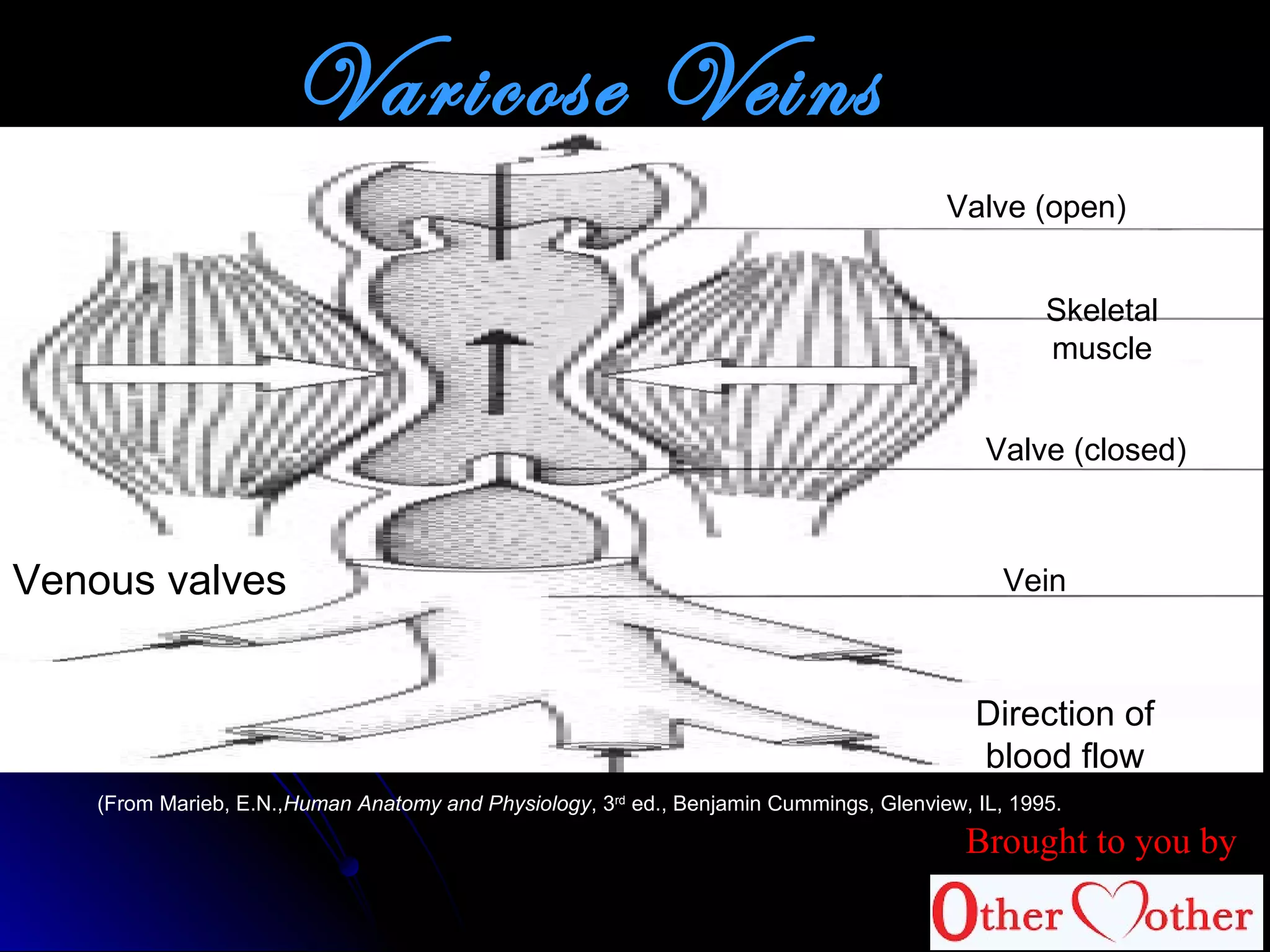
 These venous valves work in conjunction with skeletal
muscle pumps in the legs to move blood back to the heart
from the extremities.
Varicose Veins
Brought to you by
(From Marieb, E.N.,Human Anatomy and Physiology, 3rd
ed., Benjamin Cummings, Glenview, IL, 1995.
Varicose Veins
Valve (open)
Skeletal
muscle
Direction of
blood flow
Valve (closed)
VeinVenous valves
Brought to you by
Varicose Veins
Brought to you by
CausesCauses
PrimaryPrimary
 Congenital abnormality, most common cause (weakCongenital abnormality, most common cause (weak
mesenchymal tissue)mesenchymal tissue)
SecondarySecondary
 Anything that raises intra-abdominal pressure or raisesAnything that raises intra-abdominal pressure or raises
pressure in superficial/deep venous systempressure in superficial/deep venous system
 soso……::
 PregnancyPregnancy
 Abdominal/pelvic massAbdominal/pelvic mass
 AscitesAscites
 obesityobesity
 constipationconstipation
 thrombosis of leg veinsthrombosis of leg veins
 spend long periods of time standing (barbers, for example)
Brought to you by
The most common manifestations
are :
1. Aching and edema
2. Their appearance through the skin is unsightly.
3. May be associated with varicocele or inguinal hernia.
Treatment often involves:
1. The use of support stockings to prevent venous
pooling.
2. Surgical interventions may also be used to improve
appearance and reduce discomfort.
Varicose Veins
Brought to you by
Chronic venous
insufficiencyThe presence of varicose veins and valvular incompetence
can lead to a condition called chronic venous
insufficiency.
 As a result of chronically impaired blood flow, congestion,
edema and poor tissue nutrition, pathologic changes may
eventually occur in the lower extremities.
Brought to you by
 Manifestations may include:
skin atrophy, dermatitis, ulceration and tissue necrosis.
Infection or trauma of the lower extremities that
occurs in a patient with chronic venous
insufficiency may have serious consequences
because poor blood flow reduces delivery of
immune cells and impairs wound healing.
 Treatment involves:
interventions similar to those for varicose veins.
Chronic venous
insufficiency
Brought to you by
Venous ThrombosisA thrombus is
A blood clot that forms in the lumen of a blood vessel. A thrombus may form in an
artery, but it is more common in veins due to the lower pressure and reduced
blood flow found in the venous circulation.
 Factors that may contribute to the formation of a
thrombus include the following:
1. Stasis of blood due to poor blood flow, immobility, heart failure, myocardial
infarction and hypotension
2. Damage to blood vessels from trauma, surgery, IV drugs, catheters or immune
response
3. Hypercoagulability of blood resulting from pregnancy, malignancies, coagulation
disorders, dehydration or use of oral contraceptives
Brought to you by
 Thrombi may form in superficial vessels of the skin and extremities or
in deep veins of circulation or tissues. Most superficial thrombi are
benign and self-limiting, but deep vein thrombus (DVT) can be much
more dangerous.
 Although a thrombus may present with pain, tenderness and swelling,
it is estimated that nearly half of all deep vein thrombi are
asymptomatic.
 As most deep vein thrombi occur in the lower extremities, painful
compression or tenderness and swelling of the calf or thigh region
might be used to diagnose a DVT in these areas.
 DVT are associated with significant mortality and morbidity and require
intensive treatment.
Venous Thrombosis
Brought to you by
Treatment and
prevention
of venous thrombus
 Prevent blood stasis in susceptible patients
through ambulation, use of elastic stockings,
exercise or elevation of legs
 Anticoagulation therapy (warfarin, heparin)
Thrombolytic therapy to dissolve clots
(streptokinase, TPA).
 Surgical removal of clots.
Brought to you by
Embolism Unfortunately, for many patients with DVT the first manifestation of the
thrombus is a pulmonary embolism.
 An embolism is a thrombus that breaks loose and travels through circulation.
Common sites for lodging of emboliare the small pulmonary blood vessels of
the lungs. Emboli that lodge in cerebral or coronary blood vessels may be
rapidly fatal. A bolus of fat released by the breakage of long bones or an
injection of air o foreign matter into the bloodstream through intravenous or
intra-arterial lines can also act as an embolism. Ischemia and possible death of
tissues may occur when blood flow is blocked by an embolus.
Brought to you by
Anticoagulant and thrombolytic drug
therapy Anticoagulant drugs prevent the formation of blood clots by interfering with
distinct steps in the blood-clotting cascade (see Chapter 3). Two of the
most commonly used anticoagulants are warfarin (administered orally) and
heparin (administered intravenously). Warfarin prevents the reduction of
vitamin K, which is a cofactor necessary for activity of a key carboxylase in
the clotting cascade. Heparin acts via an effect on antithrombin III. As a
result of its mechanism of action, warfarin does not exert an anticoagulant
effect in vitro (i.e., blood in test tube) whereas Anticoagulant drugs prevent
the formation of blood clots by interfering with distinct steps in the blood-
clotting cascade . Two of the most commonly used anticoagulants heparin
does. Neither warfarin nor heparin has any action against clots that have
already formed. Both drugs are bound to a significant extent to circulating
plasma proteins that can alter their bioavailability. A main potential adverse
effect of both warfarin and heparin is unwanted bleeding and hemorrhage.
Drugs that inhibit microsomal metabolism, inhibit platelet aggregation or
displace oral anticoagulants from plasma proteins can enhance the action
of anticoagulants and increase the risk of unwanted bleeding.
Brought to you by
Aspirin
 is a potent inhibitor of platelet aggregation through its inhibition of
the enzyme cyclo-oxygenase.
 Inhibition of the cyclo-oxygenase enzyme reduces the formation
of thromboxane A2 , a substance that stimulates platelet
aggregation . Since platelet aggregation and activation appear to
play a major role in thrombus formation, drugs like aspirin may be
of significant therapeutic value in preventing their occurrence. A
number of clinical trials have demonstrated the effectiveness of
aspirin in preventing the tissue damage that accompanies blood
vessel occlusion in arteriosclerosis and myocardial infarction.
Anticoagulant and thrombolytic drug
therapy
Brought to you by
Anticoagulant and thrombolytic drug
therapy Thrombolytic drugs are also known as fibrinolytic or clot-dissolving drugs.
 Unlike anticoagulants that prevent the formation of blood clots, thrombolytic
drugs cannot prevent their formation. A number of thrombolytic drugs are now
available for clinical use, including streptokinase, anistreplase, alteplase
(tissue plasminogen activator) and urokinase.
 These agents promote the formation of plasmin (from plasminogen), an
enzyme that degrades the fibrin proteins that make up the framework of a
thrombus. The most common unwanted effects of these thrombolytic agents
are unwanted bleeding and hemorrhage. Thrombolytic drugs have proved to
be of clinical benefit in reducing mortality in patients experiencing myocardial
infarction.
Brought to you by
This platform has been started by ParveenThis platform has been started by Parveen
Kumar Chadha with the vision that nobodyKumar Chadha with the vision that nobody
should suffer the way he has sufferedshould suffer the way he has suffered
because of lack and improper healthcarebecause of lack and improper healthcare
facilities in India. We need lots of fundsfacilities in India. We need lots of funds
manpower etc. to make this vision a realitymanpower etc. to make this vision a reality
please contact us. Join us as a member forplease contact us. Join us as a member for
a noble cause.a noble cause.
Brought to you by
Our views have increased theOur views have increased the
mark of the 10,000mark of the 10,000
 Thank you viewersThank you viewers
 Looking forward for franchise,Looking forward for franchise,
collaboration, partners.collaboration, partners. Brought to you by
011-25464531,011-41425180,011-
66217387
+91-9818308353+,91-
9818569476
othermotherindia@gmail.com
www.other-mother.in
https://www.facebook.com/pages/Other-Mother-Nursing-Crusade/224235031114989?
ref=hl
http://www.linkedin.com/profile/view?
id=326103341&trk=nav_responsive_tab_profile
https://twitter.com/othermotherind
i
https://cparveen.wix.com/other-mother
A WORLDWIDE MISSITION
Contact Us:-
JOIN US
Saxbee Consultants Details :-www.parveenchadha.com
Brought to you by

Disease of the veins

  • 1.
    Dr: Wael H.Mansy,MDDr: Wael H.Mansy, MD Assistant ProfessorAssistant Professor College of PharmacyCollege of Pharmacy King Saud UniversityKing Saud University Disease of the veins Brought to you by
  • 2.
    Definition: Varicose veins areveins that have become distended over time. Long, tortuous and dilated veins of the superficial varicose system due to the pooling of blood in the lower extremities. Varicose Veins Brought to you by
  • 3.
    Pathophysiology of VaricoseVeins:  Veins are thin-walled vessels that are easily distended by the chronic pooling of blood in the lower extremities.  Chronic distention of veins can reduce effectiveness of one- way venous valves that are present in the lumen to prevent the back flow of blood and lead to a condition termed valvular incompetence.  These venous valves work in conjunction with skeletal muscle pumps in the legs to move blood back to the heart from the extremities. Varicose Veins Brought to you by
  • 4.
    (From Marieb, E.N.,HumanAnatomy and Physiology, 3rd ed., Benjamin Cummings, Glenview, IL, 1995. Varicose Veins Valve (open) Skeletal muscle Direction of blood flow Valve (closed) VeinVenous valves Brought to you by
  • 5.
  • 6.
    CausesCauses PrimaryPrimary  Congenital abnormality,most common cause (weakCongenital abnormality, most common cause (weak mesenchymal tissue)mesenchymal tissue) SecondarySecondary  Anything that raises intra-abdominal pressure or raisesAnything that raises intra-abdominal pressure or raises pressure in superficial/deep venous systempressure in superficial/deep venous system  soso……::  PregnancyPregnancy  Abdominal/pelvic massAbdominal/pelvic mass  AscitesAscites  obesityobesity  constipationconstipation  thrombosis of leg veinsthrombosis of leg veins  spend long periods of time standing (barbers, for example) Brought to you by
  • 7.
    The most commonmanifestations are : 1. Aching and edema 2. Their appearance through the skin is unsightly. 3. May be associated with varicocele or inguinal hernia. Treatment often involves: 1. The use of support stockings to prevent venous pooling. 2. Surgical interventions may also be used to improve appearance and reduce discomfort. Varicose Veins Brought to you by
  • 8.
    Chronic venous insufficiencyThe presenceof varicose veins and valvular incompetence can lead to a condition called chronic venous insufficiency.  As a result of chronically impaired blood flow, congestion, edema and poor tissue nutrition, pathologic changes may eventually occur in the lower extremities. Brought to you by
  • 9.
     Manifestations mayinclude: skin atrophy, dermatitis, ulceration and tissue necrosis. Infection or trauma of the lower extremities that occurs in a patient with chronic venous insufficiency may have serious consequences because poor blood flow reduces delivery of immune cells and impairs wound healing.  Treatment involves: interventions similar to those for varicose veins. Chronic venous insufficiency Brought to you by
  • 10.
    Venous ThrombosisA thrombusis A blood clot that forms in the lumen of a blood vessel. A thrombus may form in an artery, but it is more common in veins due to the lower pressure and reduced blood flow found in the venous circulation.  Factors that may contribute to the formation of a thrombus include the following: 1. Stasis of blood due to poor blood flow, immobility, heart failure, myocardial infarction and hypotension 2. Damage to blood vessels from trauma, surgery, IV drugs, catheters or immune response 3. Hypercoagulability of blood resulting from pregnancy, malignancies, coagulation disorders, dehydration or use of oral contraceptives Brought to you by
  • 11.
     Thrombi mayform in superficial vessels of the skin and extremities or in deep veins of circulation or tissues. Most superficial thrombi are benign and self-limiting, but deep vein thrombus (DVT) can be much more dangerous.  Although a thrombus may present with pain, tenderness and swelling, it is estimated that nearly half of all deep vein thrombi are asymptomatic.  As most deep vein thrombi occur in the lower extremities, painful compression or tenderness and swelling of the calf or thigh region might be used to diagnose a DVT in these areas.  DVT are associated with significant mortality and morbidity and require intensive treatment. Venous Thrombosis Brought to you by
  • 12.
    Treatment and prevention of venousthrombus  Prevent blood stasis in susceptible patients through ambulation, use of elastic stockings, exercise or elevation of legs  Anticoagulation therapy (warfarin, heparin) Thrombolytic therapy to dissolve clots (streptokinase, TPA).  Surgical removal of clots. Brought to you by
  • 13.
    Embolism Unfortunately, formany patients with DVT the first manifestation of the thrombus is a pulmonary embolism.  An embolism is a thrombus that breaks loose and travels through circulation. Common sites for lodging of emboliare the small pulmonary blood vessels of the lungs. Emboli that lodge in cerebral or coronary blood vessels may be rapidly fatal. A bolus of fat released by the breakage of long bones or an injection of air o foreign matter into the bloodstream through intravenous or intra-arterial lines can also act as an embolism. Ischemia and possible death of tissues may occur when blood flow is blocked by an embolus. Brought to you by
  • 14.
    Anticoagulant and thrombolyticdrug therapy Anticoagulant drugs prevent the formation of blood clots by interfering with distinct steps in the blood-clotting cascade (see Chapter 3). Two of the most commonly used anticoagulants are warfarin (administered orally) and heparin (administered intravenously). Warfarin prevents the reduction of vitamin K, which is a cofactor necessary for activity of a key carboxylase in the clotting cascade. Heparin acts via an effect on antithrombin III. As a result of its mechanism of action, warfarin does not exert an anticoagulant effect in vitro (i.e., blood in test tube) whereas Anticoagulant drugs prevent the formation of blood clots by interfering with distinct steps in the blood- clotting cascade . Two of the most commonly used anticoagulants heparin does. Neither warfarin nor heparin has any action against clots that have already formed. Both drugs are bound to a significant extent to circulating plasma proteins that can alter their bioavailability. A main potential adverse effect of both warfarin and heparin is unwanted bleeding and hemorrhage. Drugs that inhibit microsomal metabolism, inhibit platelet aggregation or displace oral anticoagulants from plasma proteins can enhance the action of anticoagulants and increase the risk of unwanted bleeding. Brought to you by
  • 15.
    Aspirin  is apotent inhibitor of platelet aggregation through its inhibition of the enzyme cyclo-oxygenase.  Inhibition of the cyclo-oxygenase enzyme reduces the formation of thromboxane A2 , a substance that stimulates platelet aggregation . Since platelet aggregation and activation appear to play a major role in thrombus formation, drugs like aspirin may be of significant therapeutic value in preventing their occurrence. A number of clinical trials have demonstrated the effectiveness of aspirin in preventing the tissue damage that accompanies blood vessel occlusion in arteriosclerosis and myocardial infarction. Anticoagulant and thrombolytic drug therapy Brought to you by
  • 16.
    Anticoagulant and thrombolyticdrug therapy Thrombolytic drugs are also known as fibrinolytic or clot-dissolving drugs.  Unlike anticoagulants that prevent the formation of blood clots, thrombolytic drugs cannot prevent their formation. A number of thrombolytic drugs are now available for clinical use, including streptokinase, anistreplase, alteplase (tissue plasminogen activator) and urokinase.  These agents promote the formation of plasmin (from plasminogen), an enzyme that degrades the fibrin proteins that make up the framework of a thrombus. The most common unwanted effects of these thrombolytic agents are unwanted bleeding and hemorrhage. Thrombolytic drugs have proved to be of clinical benefit in reducing mortality in patients experiencing myocardial infarction. Brought to you by
  • 17.
    This platform hasbeen started by ParveenThis platform has been started by Parveen Kumar Chadha with the vision that nobodyKumar Chadha with the vision that nobody should suffer the way he has sufferedshould suffer the way he has suffered because of lack and improper healthcarebecause of lack and improper healthcare facilities in India. We need lots of fundsfacilities in India. We need lots of funds manpower etc. to make this vision a realitymanpower etc. to make this vision a reality please contact us. Join us as a member forplease contact us. Join us as a member for a noble cause.a noble cause. Brought to you by
  • 18.
    Our views haveincreased theOur views have increased the mark of the 10,000mark of the 10,000  Thank you viewersThank you viewers  Looking forward for franchise,Looking forward for franchise, collaboration, partners.collaboration, partners. Brought to you by
  • 19.