Rod Bugawan
February 26, 2015
Lispcomb College of Pharmacy
Nashville, TN
Outline
Patient Background
Disease State
Supporting Study
Patient Treatment
Pharmacy Recommendations
Patient Background
CC: left leg pain and erythema.
HPI: 51 yo white male with PMH of Crohn’s, GERD, migratory
polyarthritis, migraines, and lower back pain presents with LLE
pain for 2 weeks. Patient denies any Hx of blood clots, recent
travel, trauma to the legs, animal bites or scratches to the legs.
ROS: negative for unintentional weight loss, fevers or chills, chest
pain/tightness/discomfort, dyspnea, abdominal pain,
diarrhea/constipation, bloody or melenic BMs, unusual changes
to UO, dysuria, hematuria, or focal neurologic symptoms
FMH: Father died from a blood clot.
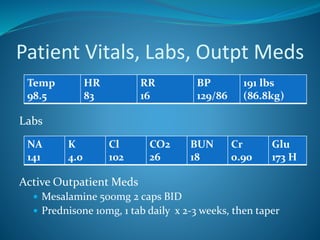
Patient Vitals, Labs, Outpt Meds
Labs
Active Outpatient Meds
ď‚— Mesalamine 500mg 2 caps BID
ď‚— Prednisone 10mg, 1 tab daily x 2-3 weeks, then taper
Temp
98.5
HR
83
RR
16
BP
129/86
191 lbs
(86.8kg)
NA
141
K
4.0
Cl
102
CO2
26
BUN
18
Cr
0.90
Glu
173 H
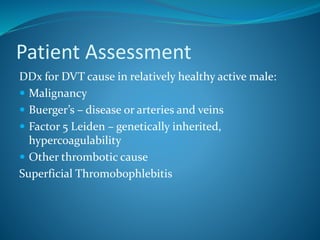
Patient Assessment
DDx for DVT cause in relatively healthy active male:
ď‚— Malignancy
 Buerger’s – disease or arteries and veins
 Factor 5 Leiden – genetically inherited,
hypercoagulability
ď‚— Other thrombotic cause
Superficial Thromobophlebitis
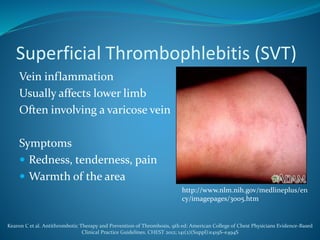
Superficial Thrombophlebitis (SVT)
Vein inflammation
Usually affects lower limb
Often involving a varicose vein
Symptoms
ď‚— Redness, tenderness, pain
ď‚— Warmth of the area
http://www.nlm.nih.gov/medlineplus/en
cy/imagepages/3005.htm
Kearon C et al. Antithrombotic Therapy and Prevention of Thrombosis, 9th ed: American College of Chest Physicians Evidence-Based
Clinical Practice Guidelines. CHEST 2012; 141(2)(Suppl):e419S–e494S
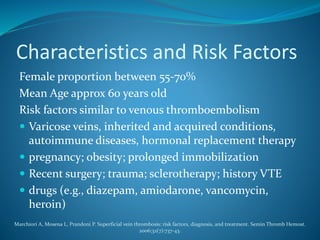
Characteristics and Risk Factors
Female proportion between 55-70%
Mean Age approx 60 years old
Risk factors similar to venous thromboembolism
ď‚— Varicose veins, inherited and acquired conditions,
autoimmune diseases, hormonal replacement therapy
ď‚— pregnancy; obesity; prolonged immobilization
ď‚— Recent surgery; trauma; sclerotherapy; history VTE
ď‚— drugs (e.g., diazepam, amiodarone, vancomycin,
heroin)
Marchiori A, Mosena L, Prandoni P. Superficial vein thrombosis: risk factors, diagnosis, and treatment. Semin Thromb Hemost.
2006;32(7):737-43.
Consequence of SVT
A prospective study of 844 patients, acute SVT > 5 cm:
4% with symptomatic pulmonary embolism,
10% proximal deep vein thrombosis (DVT)
13% distal DVT
Without VTE at presentation, despite 90% treated
3.1% developed symptomatic VTE
1.9% had recurrent VTE
3.3% had extension of the VTE (same location)
CHEST 2012
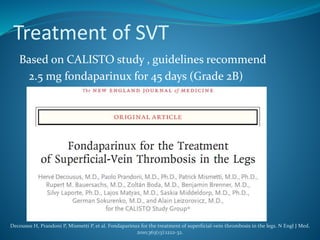
Treatment of SVT
Based on CALISTO study , guidelines recommend
2.5 mg fondaparinux for 45 days (Grade 2B)
Decousus H, Prandoni P, Mismetti P, et al. Fondaparinux for the treatment of superficial-vein thrombosis in the legs. N Engl J Med.
2010;363(13):1222-32.
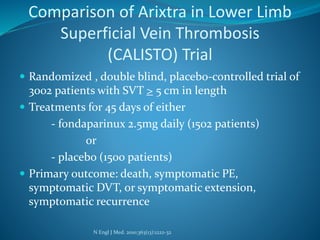
Comparison of Arixtra in Lower Limb
Superficial Vein Thrombosis
(CALISTO) Trial
ď‚— Randomized , double blind, placeb0-controlled trial of
3002 patients with SVT > 5 cm in length
ď‚— Treatments for 45 days of either
- fondaparinux 2.5mg daily (1502 patients)
or
- placebo (1500 patients)
ď‚— Primary outcome: death, symptomatic PE,
symptomatic DVT, or symptomatic extension,
symptomatic recurrence
N Engl J Med. 2010;363(13):1222-32
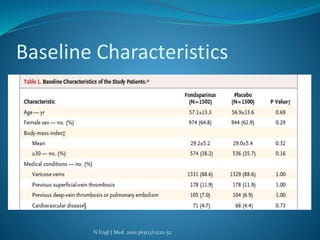
Baseline Characteristics
N Engl J Med. 2010;363(13):1222-32
Results
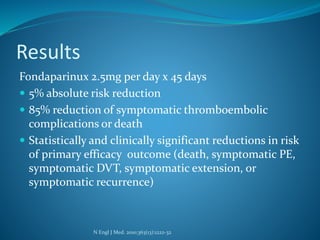
Fondaparinux 2.5mg per day x 45 days
ď‚— 5% absolute risk reduction
ď‚— 85% reduction of symptomatic thromboembolic
complications or death
ď‚— Statistically and clinically significant reductions in risk
of primary efficacy outcome (death, symptomatic PE,
symptomatic DVT, symptomatic extension, or
symptomatic recurrence)
N Engl J Med. 2010;363(13):1222-32
Results
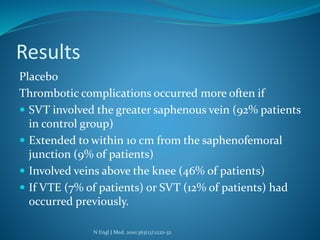
Placebo
Thrombotic complications occurred more often if
ď‚— SVT involved the greater saphenous vein (92% patients
in control group)
ď‚— Extended to within 10 cm from the saphenofemoral
junction (9% of patients)
ď‚— Involved veins above the knee (46% of patients)
ď‚— If VTE (7% of patients) or SVT (12% of patients) had
occurred previously.
N Engl J Med. 2010;363(13):1222-32
Results
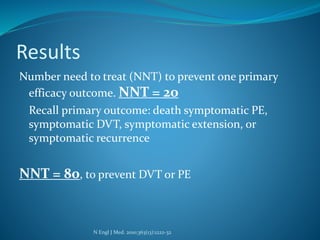
Number need to treat (NNT) to prevent one primary
efficacy outcome. NNT = 20
Recall primary outcome: death symptomatic PE,
symptomatic DVT, symptomatic extension, or
symptomatic recurrence
NNT = 80, to prevent DVT or PE
N Engl J Med. 2010;363(13):1222-32
Additional Treatments
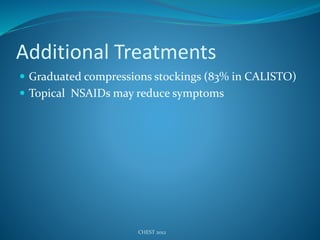
ď‚— Graduated compressions stockings (83% in CALISTO)
ď‚— Topical NSAIDs may reduce symptoms
CHEST 2012
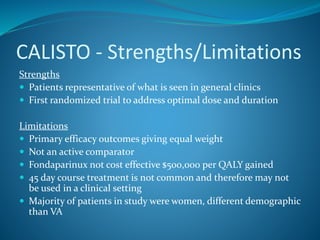
CALISTO - Strengths/Limitations
Strengths
ď‚— Patients representative of what is seen in general clinics
ď‚— First randomized trial to address optimal dose and duration
Limitations
ď‚— Primary efficacy outcomes giving equal weight
ď‚— Not an active comparator
ď‚— Fondaparinux not cost effective $500,000 per QALY gained
ď‚— 45 day course treatment is not common and therefore may not
be used in a clinical setting
ď‚— Majority of patients in study were women, different demographic
than VA
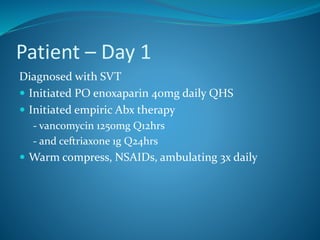
Patient – Day 1
Diagnosed with SVT
ď‚— Initiated PO enoxaparin 40mg daily QHS
ď‚— Initiated empiric Abx therapy
- vancomycin 1250mg Q12hrs
- and ceftriaxone 1g Q24hrs
ď‚— Warm compress, NSAIDs, ambulating 3x daily
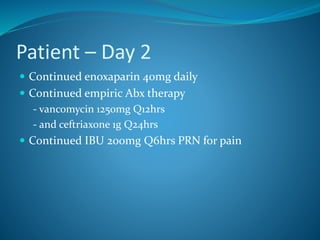
Patient – Day 2
ď‚— Continued enoxaparin 40mg daily
ď‚— Continued empiric Abx therapy
- vancomycin 1250mg Q12hrs
- and ceftriaxone 1g Q24hrs
ď‚— Continued IBU 200mg Q6hrs PRN for pain
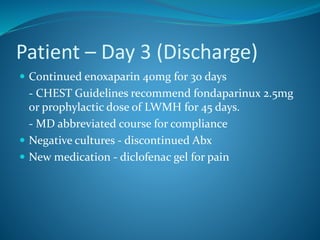
Patient – Day 3 (Discharge)
ď‚— Continued enoxaparin 40mg for 30 days
- CHEST Guidelines recommend fondaparinux 2.5mg
or prophylactic dose of LWMH for 45 days.
- MD abbreviated course for compliance
ď‚— Negative cultures - discontinued Abx
ď‚— New medication - diclofenac gel for pain
Cause of Patient’s SVT
Hx of Crohn’s disease
Multiple biopsies with last colonoscopy on 5/2014
Hypercoagulability from malignancy may be the origin
Pharmacist’s Role with
the Medical Team
Discuss with clinical team guideline recommendations
along with supporting studies
Duration of treatment
- 30 day vs 45 day treatment.
- 2 largest studies evaluating LMWH
ď‚— Suggest that 30 day treatment is too short
ď‚— Most symptomatic thromboembolic complications
occurring after treatment period.
Pharmacist’s Role with the Patient
Educate patients on:
- Dosing and administration of enoxaparin
- Signs and symptoms of bleeding
- Assess patient understanding via teach back
method
- common SE: nausea, diarrhea, fever, injxn irritation
References
ď‚— Marchiori A, Mosena L, Prandoni P. Superficial vein
thrombosis: risk factors, diagnosis, and treatment.
Semin Thromb Hemost. 2006;32(7):737-43.
ď‚— Kearon C et al. Antithrombotic Therapy and
Prevention of Thrombosis, 9th ed: American College
of Chest Physicians Evidence-Based Clinical Practice
Guidelines. CHEST 2012; 141(2)(Suppl):e419S–e494S
ď‚— Decousus H, Prandoni P, Mismetti P, et al.
Fondaparinux for the treatment of superficial-vein
thrombosis in the legs. N Engl J Med.
2010;363(13):1222-32.

Superficial vein thrombosis

  • 1.
    Rod Bugawan February 26,2015 Lispcomb College of Pharmacy Nashville, TN
  • 2.
    Outline Patient Background Disease State SupportingStudy Patient Treatment Pharmacy Recommendations
  • 3.
    Patient Background CC: leftleg pain and erythema. HPI: 51 yo white male with PMH of Crohn’s, GERD, migratory polyarthritis, migraines, and lower back pain presents with LLE pain for 2 weeks. Patient denies any Hx of blood clots, recent travel, trauma to the legs, animal bites or scratches to the legs. ROS: negative for unintentional weight loss, fevers or chills, chest pain/tightness/discomfort, dyspnea, abdominal pain, diarrhea/constipation, bloody or melenic BMs, unusual changes to UO, dysuria, hematuria, or focal neurologic symptoms FMH: Father died from a blood clot.
  • 4.
    Patient Vitals, Labs,Outpt Meds Labs Active Outpatient Meds ď‚— Mesalamine 500mg 2 caps BID ď‚— Prednisone 10mg, 1 tab daily x 2-3 weeks, then taper Temp 98.5 HR 83 RR 16 BP 129/86 191 lbs (86.8kg) NA 141 K 4.0 Cl 102 CO2 26 BUN 18 Cr 0.90 Glu 173 H
  • 5.
    Patient Assessment DDx forDVT cause in relatively healthy active male:  Malignancy  Buerger’s – disease or arteries and veins  Factor 5 Leiden – genetically inherited, hypercoagulability  Other thrombotic cause Superficial Thromobophlebitis
  • 6.
    Superficial Thrombophlebitis (SVT) Veininflammation Usually affects lower limb Often involving a varicose vein Symptoms  Redness, tenderness, pain  Warmth of the area http://www.nlm.nih.gov/medlineplus/en cy/imagepages/3005.htm Kearon C et al. Antithrombotic Therapy and Prevention of Thrombosis, 9th ed: American College of Chest Physicians Evidence-Based Clinical Practice Guidelines. CHEST 2012; 141(2)(Suppl):e419S–e494S
  • 7.
    Characteristics and RiskFactors Female proportion between 55-70% Mean Age approx 60 years old Risk factors similar to venous thromboembolism ď‚— Varicose veins, inherited and acquired conditions, autoimmune diseases, hormonal replacement therapy ď‚— pregnancy; obesity; prolonged immobilization ď‚— Recent surgery; trauma; sclerotherapy; history VTE ď‚— drugs (e.g., diazepam, amiodarone, vancomycin, heroin) Marchiori A, Mosena L, Prandoni P. Superficial vein thrombosis: risk factors, diagnosis, and treatment. Semin Thromb Hemost. 2006;32(7):737-43.
  • 8.
    Consequence of SVT Aprospective study of 844 patients, acute SVT > 5 cm: 4% with symptomatic pulmonary embolism, 10% proximal deep vein thrombosis (DVT) 13% distal DVT Without VTE at presentation, despite 90% treated 3.1% developed symptomatic VTE 1.9% had recurrent VTE 3.3% had extension of the VTE (same location) CHEST 2012
  • 9.
    Treatment of SVT Basedon CALISTO study , guidelines recommend 2.5 mg fondaparinux for 45 days (Grade 2B) Decousus H, Prandoni P, Mismetti P, et al. Fondaparinux for the treatment of superficial-vein thrombosis in the legs. N Engl J Med. 2010;363(13):1222-32.
  • 10.
    Comparison of Arixtrain Lower Limb Superficial Vein Thrombosis (CALISTO) Trial ď‚— Randomized , double blind, placeb0-controlled trial of 3002 patients with SVT > 5 cm in length ď‚— Treatments for 45 days of either - fondaparinux 2.5mg daily (1502 patients) or - placebo (1500 patients) ď‚— Primary outcome: death, symptomatic PE, symptomatic DVT, or symptomatic extension, symptomatic recurrence N Engl J Med. 2010;363(13):1222-32
  • 11.
    Baseline Characteristics N EnglJ Med. 2010;363(13):1222-32
  • 12.
    Results Fondaparinux 2.5mg perday x 45 days ď‚— 5% absolute risk reduction ď‚— 85% reduction of symptomatic thromboembolic complications or death ď‚— Statistically and clinically significant reductions in risk of primary efficacy outcome (death, symptomatic PE, symptomatic DVT, symptomatic extension, or symptomatic recurrence) N Engl J Med. 2010;363(13):1222-32
  • 13.
    Results Placebo Thrombotic complications occurredmore often if ď‚— SVT involved the greater saphenous vein (92% patients in control group) ď‚— Extended to within 10 cm from the saphenofemoral junction (9% of patients) ď‚— Involved veins above the knee (46% of patients) ď‚— If VTE (7% of patients) or SVT (12% of patients) had occurred previously. N Engl J Med. 2010;363(13):1222-32
  • 14.
    Results Number need totreat (NNT) to prevent one primary efficacy outcome. NNT = 20 Recall primary outcome: death symptomatic PE, symptomatic DVT, symptomatic extension, or symptomatic recurrence NNT = 80, to prevent DVT or PE N Engl J Med. 2010;363(13):1222-32
  • 15.
    Additional Treatments ď‚— Graduatedcompressions stockings (83% in CALISTO) ď‚— Topical NSAIDs may reduce symptoms CHEST 2012
  • 16.
    CALISTO - Strengths/Limitations Strengths ď‚—Patients representative of what is seen in general clinics ď‚— First randomized trial to address optimal dose and duration Limitations ď‚— Primary efficacy outcomes giving equal weight ď‚— Not an active comparator ď‚— Fondaparinux not cost effective $500,000 per QALY gained ď‚— 45 day course treatment is not common and therefore may not be used in a clinical setting ď‚— Majority of patients in study were women, different demographic than VA
  • 17.
    Patient – Day1 Diagnosed with SVT  Initiated PO enoxaparin 40mg daily QHS  Initiated empiric Abx therapy - vancomycin 1250mg Q12hrs - and ceftriaxone 1g Q24hrs  Warm compress, NSAIDs, ambulating 3x daily
  • 18.
    Patient – Day2  Continued enoxaparin 40mg daily  Continued empiric Abx therapy - vancomycin 1250mg Q12hrs - and ceftriaxone 1g Q24hrs  Continued IBU 200mg Q6hrs PRN for pain
  • 19.
    Patient – Day3 (Discharge)  Continued enoxaparin 40mg for 30 days - CHEST Guidelines recommend fondaparinux 2.5mg or prophylactic dose of LWMH for 45 days. - MD abbreviated course for compliance  Negative cultures - discontinued Abx  New medication - diclofenac gel for pain
  • 20.
    Cause of Patient’sSVT Hx of Crohn’s disease Multiple biopsies with last colonoscopy on 5/2014 Hypercoagulability from malignancy may be the origin
  • 21.
    Pharmacist’s Role with theMedical Team Discuss with clinical team guideline recommendations along with supporting studies Duration of treatment - 30 day vs 45 day treatment. - 2 largest studies evaluating LMWH  Suggest that 30 day treatment is too short  Most symptomatic thromboembolic complications occurring after treatment period.
  • 22.
    Pharmacist’s Role withthe Patient Educate patients on: - Dosing and administration of enoxaparin - Signs and symptoms of bleeding - Assess patient understanding via teach back method - common SE: nausea, diarrhea, fever, injxn irritation
  • 23.
    References  Marchiori A,Mosena L, Prandoni P. Superficial vein thrombosis: risk factors, diagnosis, and treatment. Semin Thromb Hemost. 2006;32(7):737-43.  Kearon C et al. Antithrombotic Therapy and Prevention of Thrombosis, 9th ed: American College of Chest Physicians Evidence-Based Clinical Practice Guidelines. CHEST 2012; 141(2)(Suppl):e419S–e494S  Decousus H, Prandoni P, Mismetti P, et al. Fondaparinux for the treatment of superficial-vein thrombosis in the legs. N Engl J Med. 2010;363(13):1222-32.