


Prof. Jayashree Ajith
Jai Institute Of Nursing and research Centre
Gwalior
DEPLOYMENT
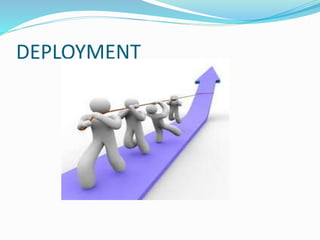
DEPLOYMENT
 Deployment is the process of using personnel in an
effective and efficient way •
 Meaning: use of something or someone
 • Deploy means arrange, manage or give position to
their employees. •
 Deployment in Nursing: staff Nurses having
qualification of bsc or msc nursing being deployed as
teaching faculty in schools and colleges i.e.
redesignation form staff nurse to tutor/ lecturer.
Higher cadre
OBJECTIVES
 Creating value to the customer and the service to
be able to be handed over to the service operatia
 Clear and comprehensive release and deployment
management plans on.
 Building, installing, testing and deploying release
packages efficiently, successfully and on schedule
 Ensuring new or changed services, enabling
systems, technology and organization are capable
of delivering the agreed service
Con……
 minimal unpredicted impact
 ensuring that customers, users, and service
management staff are satisfied
Retaining
 Employee retention involves taking measures to
encourage employees to remain in an organization for
the maximum of period. • Hiring is important but
retention of employees is even more important • The
top organizations are on top because they value their
employees and they know how to keep them. promo
PROMOTION
promotion
 • Promotion means the change to a higher job
accompanied by increased pay and privileges. •
Promotion involves a change from one job to another
that is better in terms of status and responsibilities --
flipp
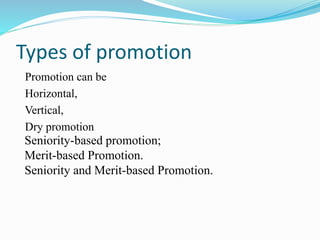
Types of promotion
Promotion can be
Horizontal,
Vertical,
Dry promotion
Seniority-based promotion;
Merit-based Promotion.
Seniority and Merit-based Promotion.
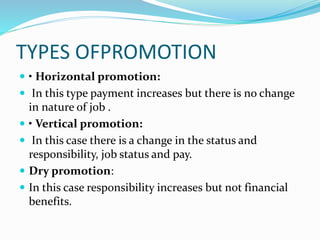
TYPES OFPROMOTION
 • Horizontal promotion:
 In this type payment increases but there is no change
in nature of job .
 • Vertical promotion:
 In this case there is a change in the status and
responsibility, job status and pay.
 Dry promotion:
 In this case responsibility increases but not financial
benefits.
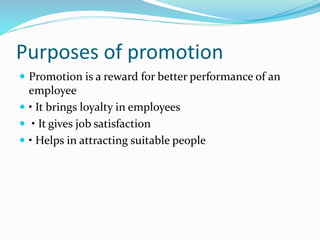
Purposes of promotion
 Promotion is a reward for better performance of an
employee
 • It brings loyalty in employees
 • It gives job satisfaction
 • Helps in attracting suitable people
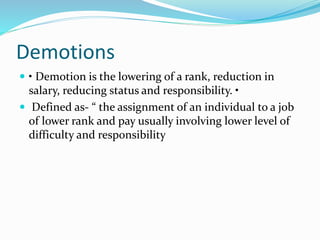
Demotions
 • Demotion is the lowering of a rank, reduction in
salary, reducing status and responsibility. •
 Defined as- “ the assignment of an individual to a job
of lower rank and pay usually involving lower level of
difficulty and responsibility
Causes of demotion
 • Breach of discipline
 • Inadequacy of knowledge
 • Unable to cope with change
 • Organizational changes
SUPRANNUATION
superannuation
 • Superannuation means pension given to the
employee after retirement. • Pension: steady income
given to person after retirement. pensions are the
payments made in the form of guaranteed annuity to a
retired or disabled person
 SUPERANNUATION
 Pension given to employees after retirement. Or
Includes all the benefits, arrears, compensations &
financial settlements.
 Superannuation types of pensions
 disability pension employment based pension
 social & state pension
 SUPERANNUATION
 Types of superannuation plans-
 ACCUMULATION FUND
 How much is accumulated over working life.
Investment earnings- expenses.
 DEFINED BENEFIT FUND Defined by a set formula
considering length of service & age of retirement. 16.
Deployment

Deployment

  • 1.
    Prof. Jayashree Ajith JaiInstitute Of Nursing and research Centre Gwalior
  • 2.
  • 3.
    DEPLOYMENT  Deployment isthe process of using personnel in an effective and efficient way •  Meaning: use of something or someone  • Deploy means arrange, manage or give position to their employees. •  Deployment in Nursing: staff Nurses having qualification of bsc or msc nursing being deployed as teaching faculty in schools and colleges i.e. redesignation form staff nurse to tutor/ lecturer. Higher cadre
  • 4.
    OBJECTIVES  Creating valueto the customer and the service to be able to be handed over to the service operatia  Clear and comprehensive release and deployment management plans on.  Building, installing, testing and deploying release packages efficiently, successfully and on schedule  Ensuring new or changed services, enabling systems, technology and organization are capable of delivering the agreed service
  • 5.
    Con……  minimal unpredictedimpact  ensuring that customers, users, and service management staff are satisfied
  • 6.
    Retaining  Employee retentioninvolves taking measures to encourage employees to remain in an organization for the maximum of period. • Hiring is important but retention of employees is even more important • The top organizations are on top because they value their employees and they know how to keep them. promo
  • 7.
  • 8.
    promotion  • Promotionmeans the change to a higher job accompanied by increased pay and privileges. • Promotion involves a change from one job to another that is better in terms of status and responsibilities -- flipp
  • 9.
    Types of promotion Promotioncan be Horizontal, Vertical, Dry promotion Seniority-based promotion; Merit-based Promotion. Seniority and Merit-based Promotion.
  • 10.
    TYPES OFPROMOTION  •Horizontal promotion:  In this type payment increases but there is no change in nature of job .  • Vertical promotion:  In this case there is a change in the status and responsibility, job status and pay.  Dry promotion:  In this case responsibility increases but not financial benefits.
  • 11.
    Purposes of promotion Promotion is a reward for better performance of an employee  • It brings loyalty in employees  • It gives job satisfaction  • Helps in attracting suitable people
  • 12.
    Demotions  • Demotionis the lowering of a rank, reduction in salary, reducing status and responsibility. •  Defined as- “ the assignment of an individual to a job of lower rank and pay usually involving lower level of difficulty and responsibility
  • 13.
    Causes of demotion • Breach of discipline  • Inadequacy of knowledge  • Unable to cope with change  • Organizational changes
  • 14.
  • 15.
    superannuation  • Superannuationmeans pension given to the employee after retirement. • Pension: steady income given to person after retirement. pensions are the payments made in the form of guaranteed annuity to a retired or disabled person
  • 16.
     SUPERANNUATION  Pensiongiven to employees after retirement. Or Includes all the benefits, arrears, compensations & financial settlements.
  • 17.
     Superannuation typesof pensions  disability pension employment based pension  social & state pension
  • 18.
     SUPERANNUATION  Typesof superannuation plans-  ACCUMULATION FUND  How much is accumulated over working life. Investment earnings- expenses.  DEFINED BENEFIT FUND Defined by a set formula considering length of service & age of retirement. 16.