Discipline
Discipline consists in the submission of one’s
impulses and powers to a regulation which
imposes from upon chaos and brings efficiency
and economy where there would otherwise be
ineffectiveness and waste
Definition
 Vital component in the process of education
 Control of behavior to attain a goal & purpose
 Good understanding of right of conduct , the
information of desirable habits & attitudes
 Subordination of individual interests in order to
bring efficiency and economy
 Willing acceptance of being controlled
Facts about discipline
 To create and maintain desirable conditions in the
teaching –learning situation .
 To create favorable attitudes toward the
establishment and the maintenance of conditions
essential to effective work , in order to achieve the
desired objectives
 To assist in the development of self control and
cooperation which are regarded as essential traits in
the daily living as well as in professional functioning
Aims of discipline
 Disciplinary measures are absolutely essential
 To increase the efficiency of the employee –
both teaching and non teaching
 To maintain peace , prevent anarchy and
regulate behaviour of people including
students
 To bring the change
Need for disciplinary
measures
 To convert the static staff to the dynamic staff
 To move towards the predetermined goal of
the educational institutions
 To promote the teamwork by providing equal
treatment
 facilitate & assist in learning those standards
of conduct acceptable within the society
 Helps to acquire characteristics of positive
nature such as self control and persistence
 Assists in securing stability of the social order
 Achieve security & maturity
Functions of discipline
 Disciplinary procedures should be in harmony with
the total goals of education
 Discipline should be based on and controlled by
love and not by fear
 The discipline should be mainly positive and
constructive
 Discipline should ensure equal justice all , respect
for the rights and dignity of the individual and
humanitarian treatment for all
Principles of discipline
 Discipline is not an end . It is just a means for
the successful implementation of the
educational program
 Disciplinary policies and procedures should be
primarily preventive , secondarily corrective
and never reattribute
 Situation specific disciplinary actions followed
by counseling
Types of discipline
Discipl
ine
Assertive
discipline
Democr
atic
disciplin
e
Self
discipline
Authoritari
an
discipline
 It’s a traditional form
 Authority of old over young
 Punishment for undesirable behavior
 Authoritarian parenting is an extremely strict
parenting style
Authoritarian discipline
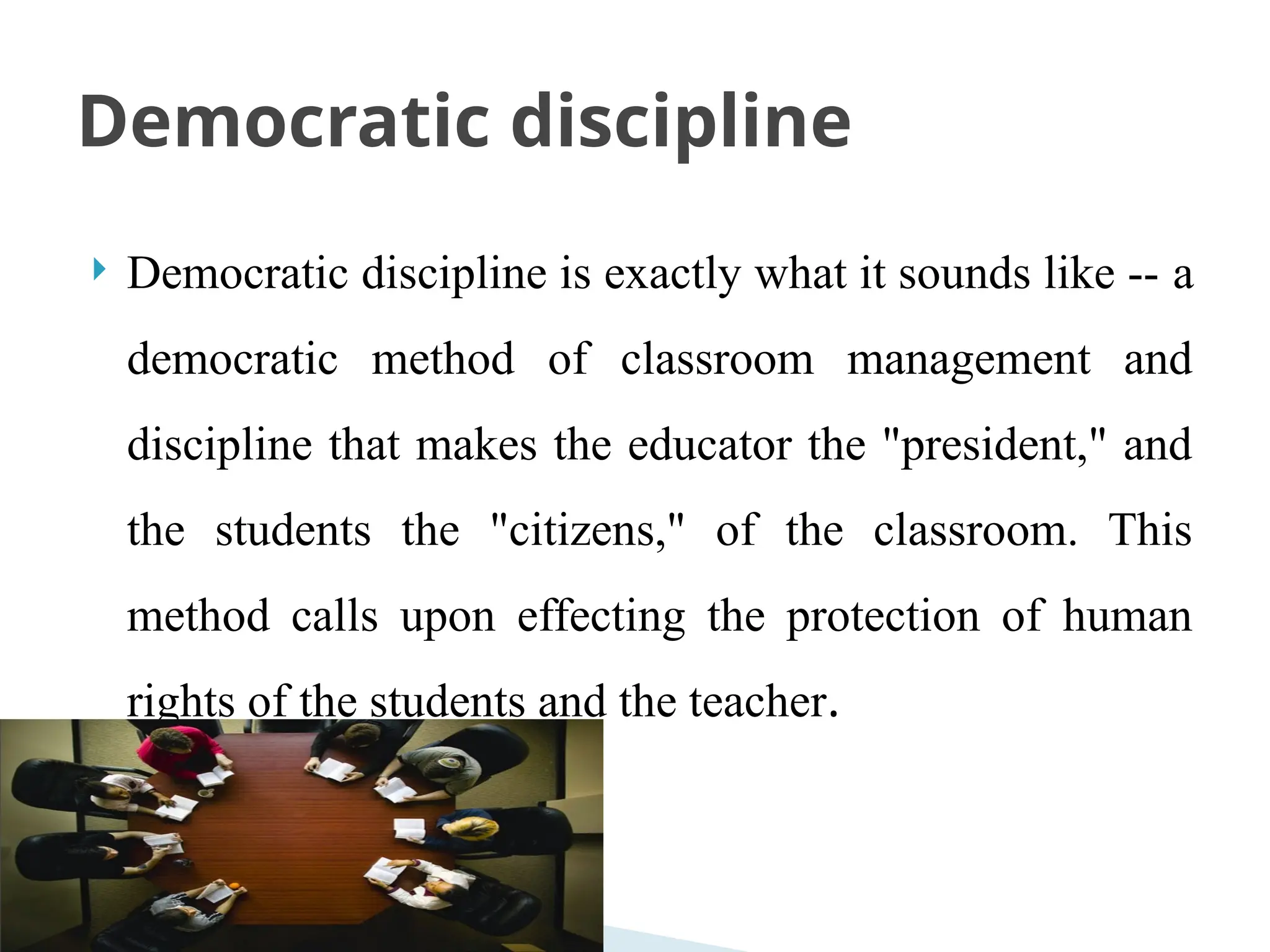
 Democratic discipline is exactly what it sounds like -- a
democratic method of classroom management and
discipline that makes the educator the "president," and
the students the "citizens," of the classroom. This
method calls upon effecting the protection of human
rights of the students and the teacher.
Democratic discipline
 No harsh punishment
 Reward and praise when he/she comes to
expected standards
 Motivation to live up to expectation
Characteristics of democratic
discipline techniques
 Clear expectation for the required behavior is set
out by the teacher
 Specific , concrete, and verbal praises are given
for the desired behavior
 Negative reinforcement for the undesired
behaviors
 Teacher is assertive in insisting on the
application of the rewards and sanctions
Assertive discipline
 Make the rules very clear , don’t be ambiguous
 Recognize when students behave correctly and praise
 Be specific when praising students , make sure they
know why they are being praised
 Reward exceptional behaviour
 Be clear of the consequences of bad behaviour
Methods of assertive discipline
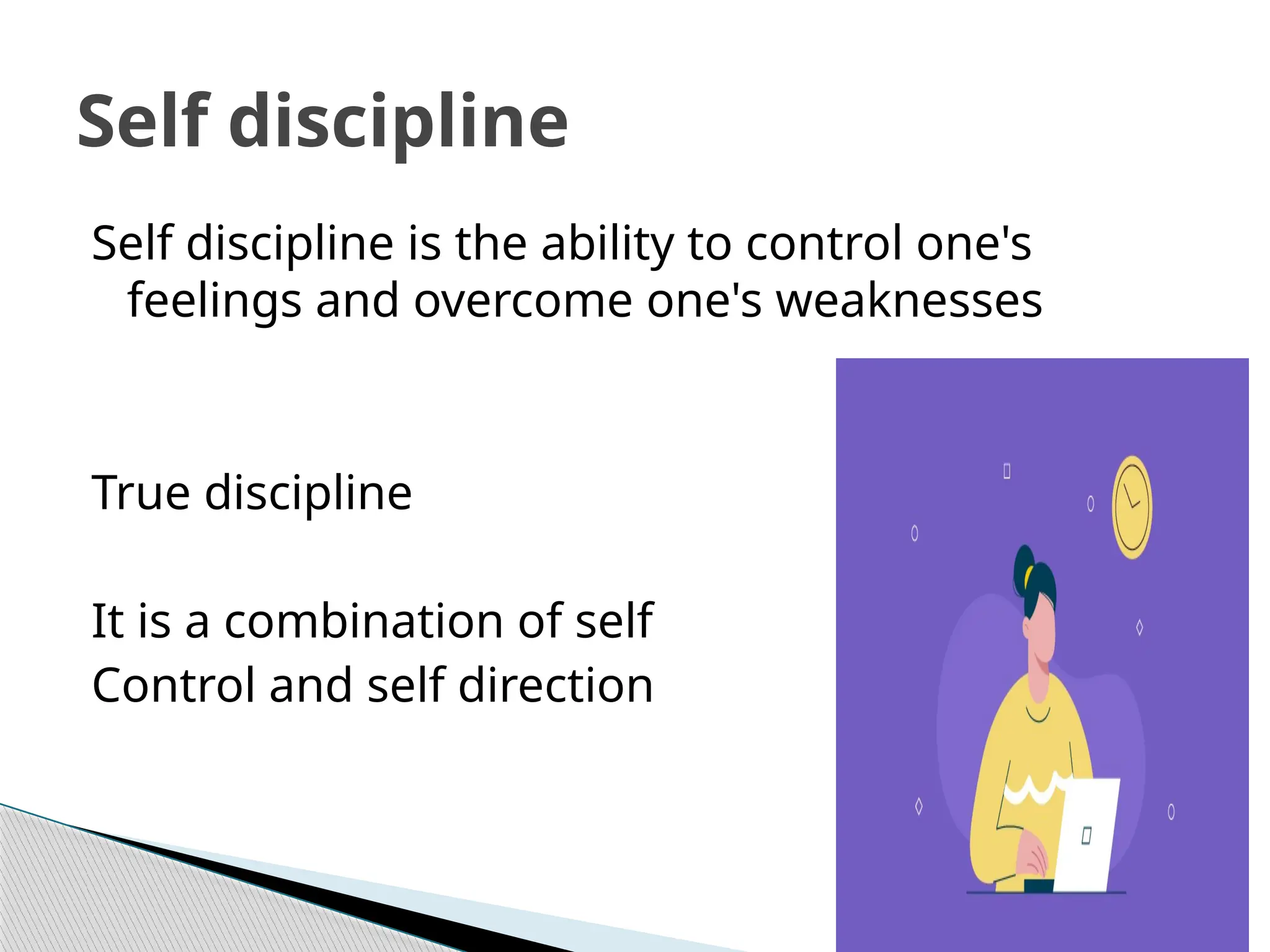
Self discipline is the ability to control one's
feelings and overcome one's weaknesses
True discipline
It is a combination of self
Control and self direction
Self discipline
Comp
ulsive
discipline
Natura
l
Persona
l
Soci
al
Super
natural
Nature of discipline
 Lowest level of discipline imposed from top to
down
 External rules by force
 Establishment of permanent and proper habits
of conduct
Compulsive discipline
 Personality centered
 It is educative in nature
 Three types of personal discipline : active
discipline, reactive discipline, and proactive
discipline.
Personal discipline
 Active discipline is doing what you need to in
that very moment such as eating a healthy
meal, limiting your distractions while studying,
and exercising.
Active discipline
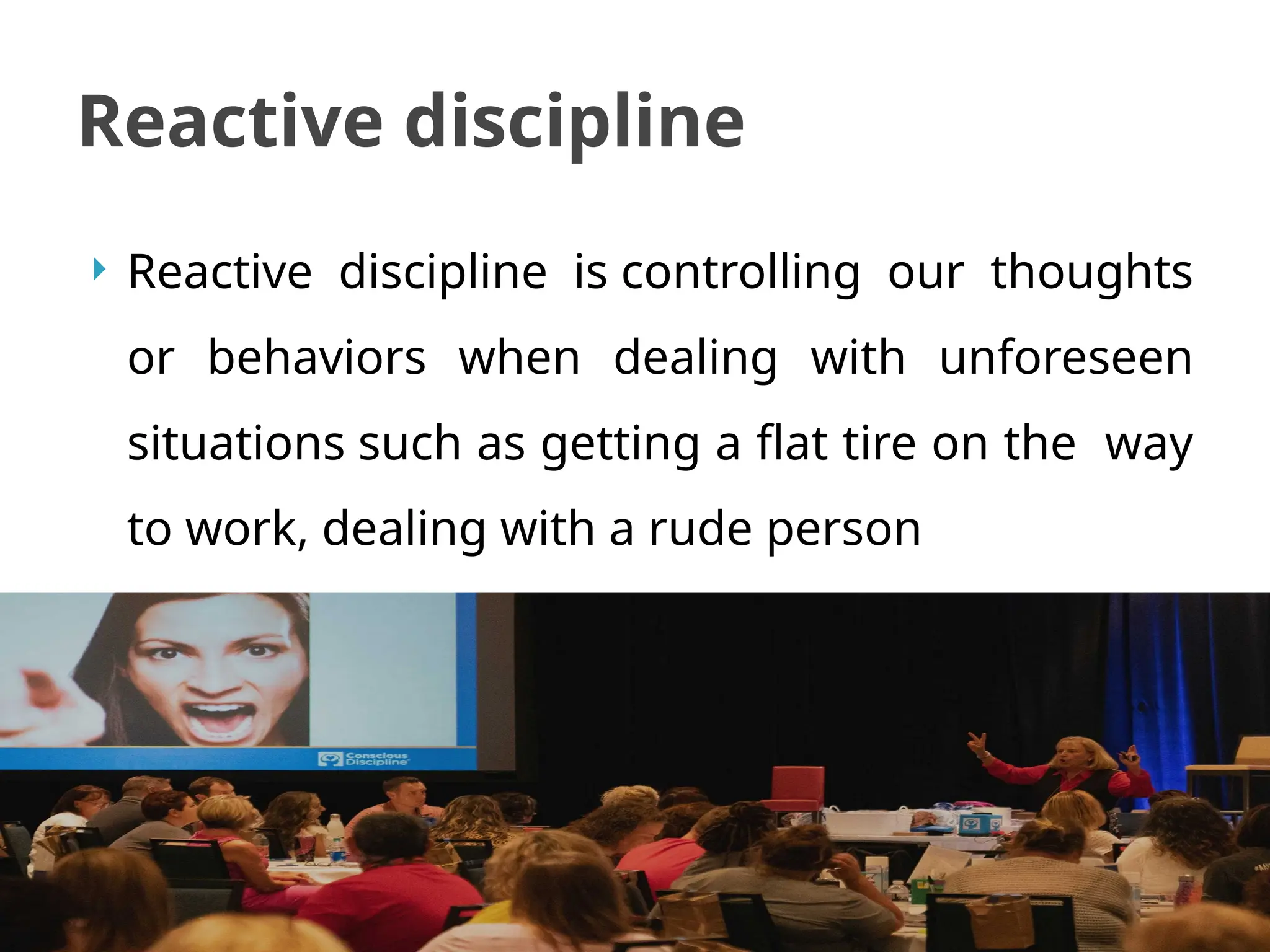
 Reactive discipline is controlling our thoughts
or behaviors when dealing with unforeseen
situations such as getting a flat tire on the way
to work, dealing with a rude person
Reactive discipline
 "Proactive" means to act in advance of a
situation, to design a plan of action. that will
give an individual maximum control over an
anticipated situation. A proactive approach to
discipline is a planning process that actively
pursues.
Proactive discipline
 Group norms based
 Self control is exercised through the social
context
 Social disciplines refer to the societal norms
that are part of society
Social discipline
 Take the form of positive support and
reinforcement
 Aim is to help the individual in molding his
behaviour and developing in a corrective and
supportive manner
 Constructive discipline or self discipline
Positive Aspects
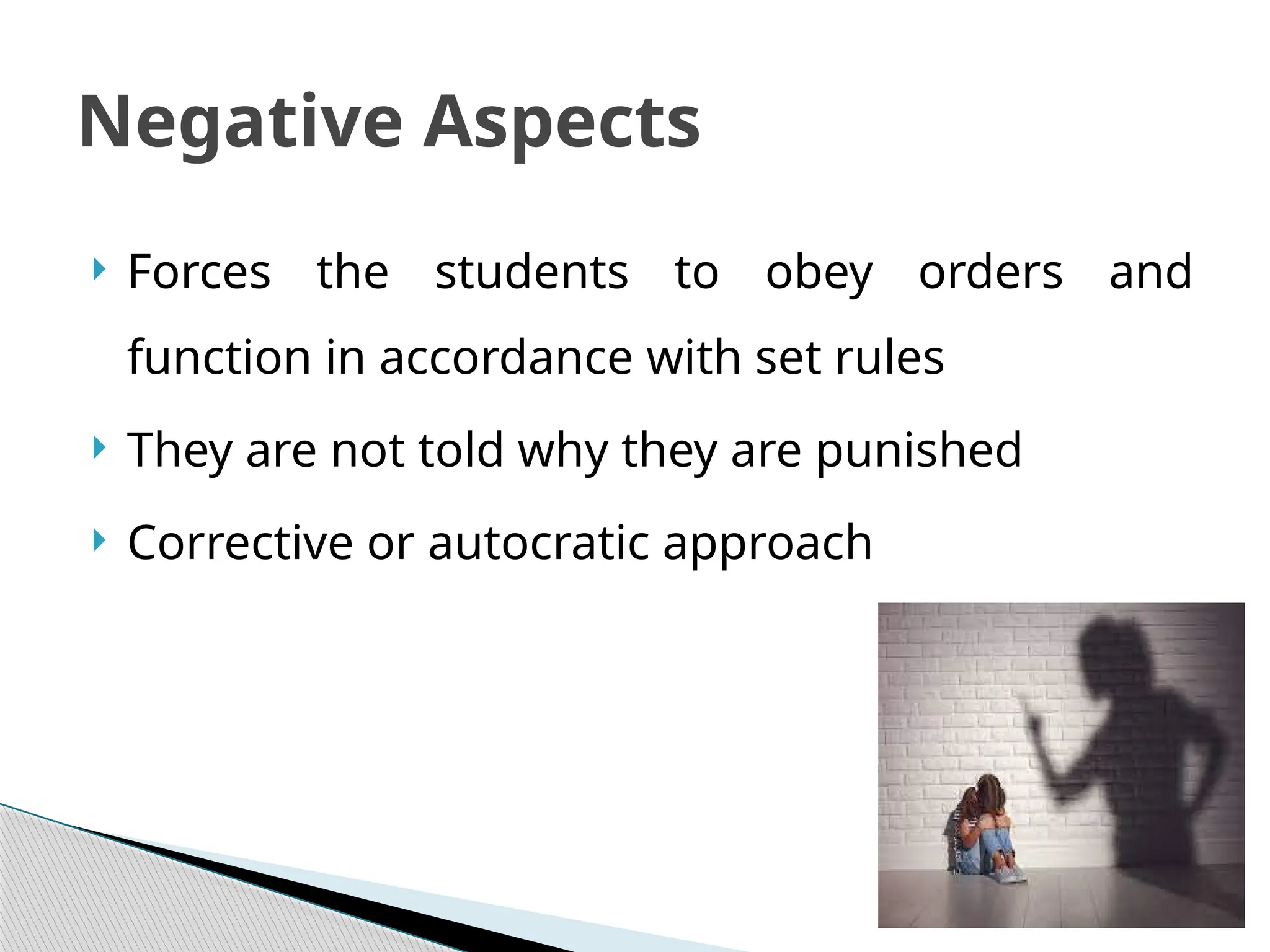
 Forces the students to obey orders and
function in accordance with set rules
 They are not told why they are punished
 Corrective or autocratic approach
Negative Aspects
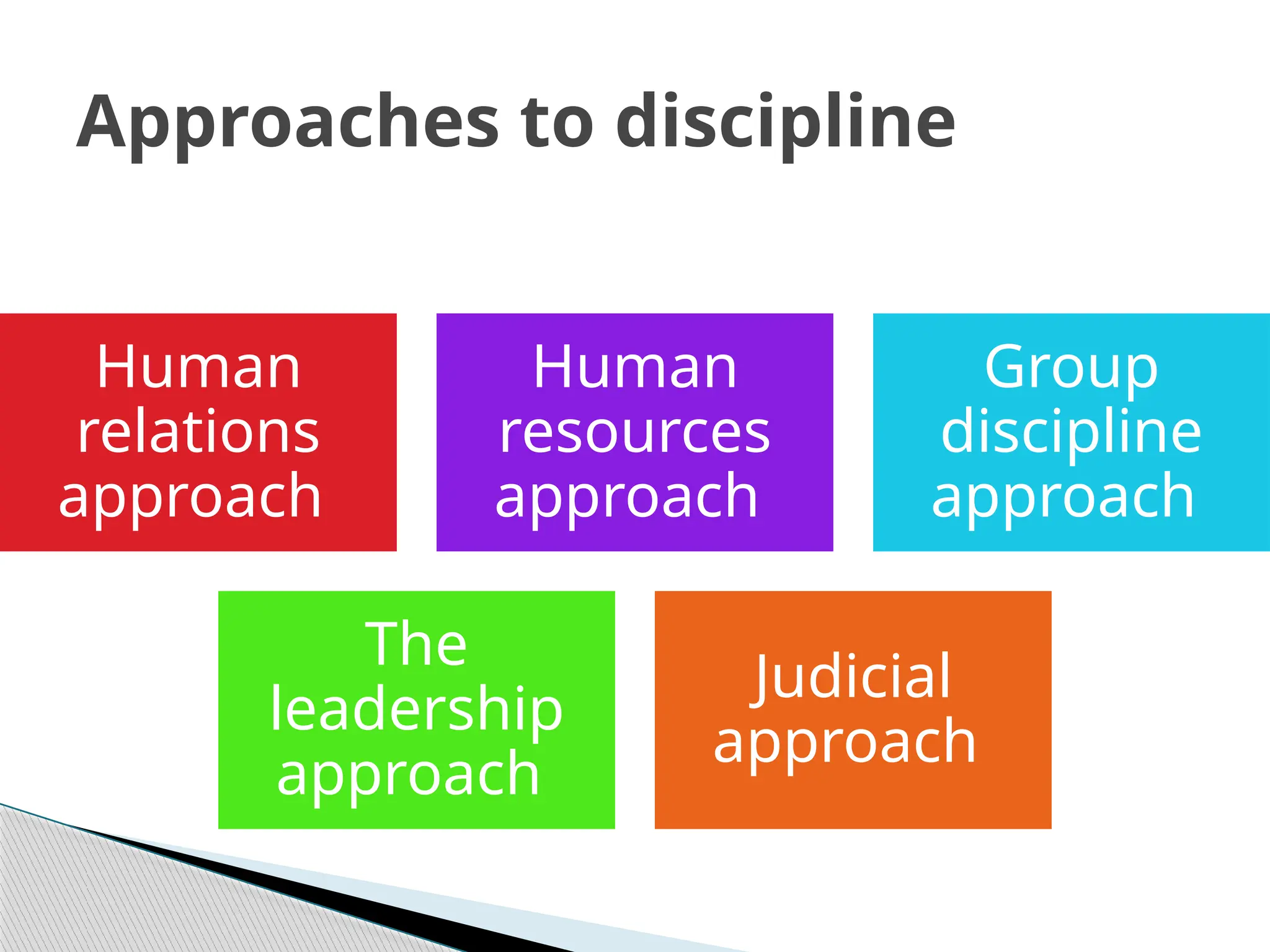
Human
relations
approach
Human
resources
approach
Group
discipline
approach
The
leadership
approach
Judicial
approach
Approaches to discipline
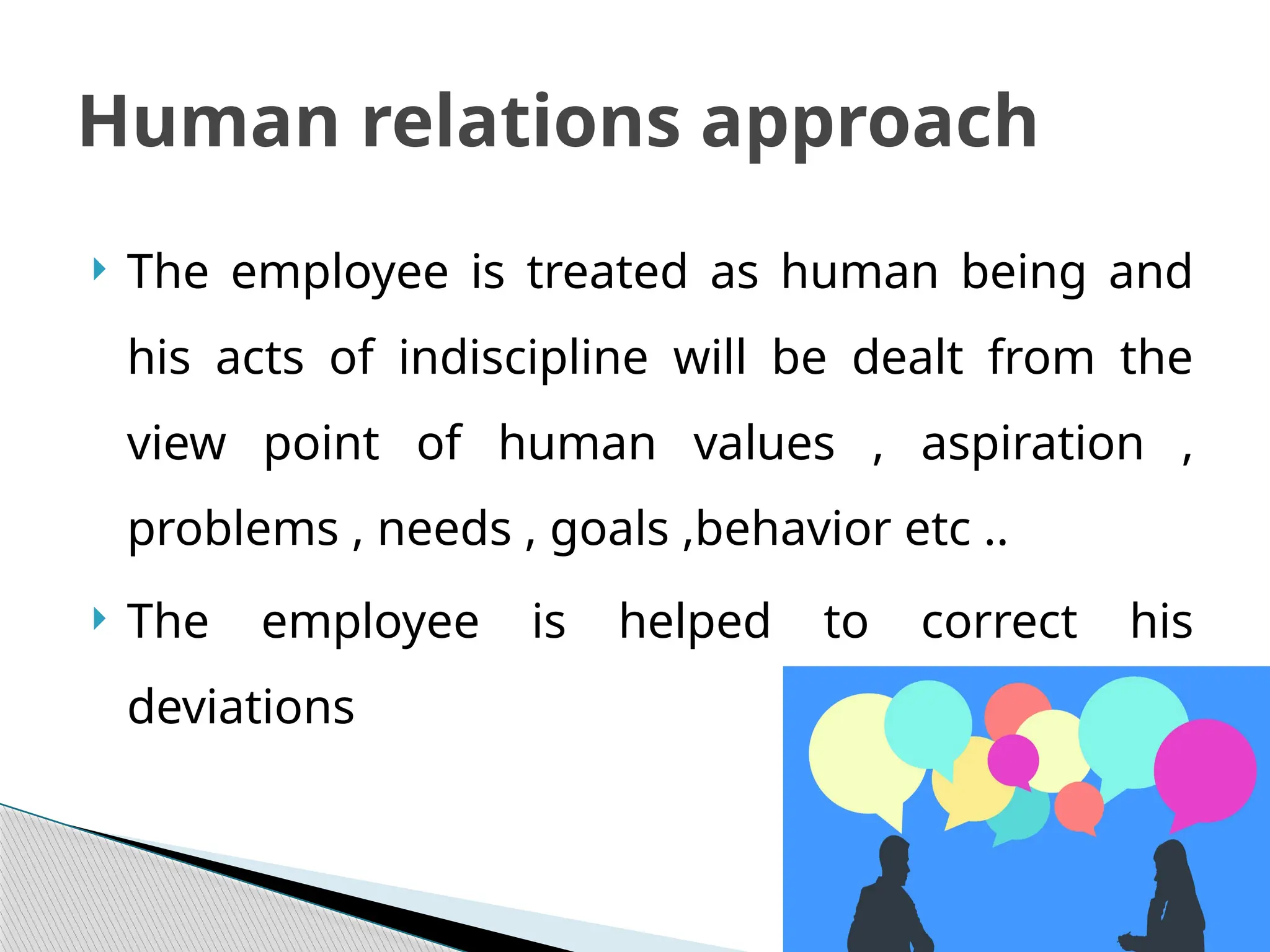
 The employee is treated as human being and
his acts of indiscipline will be dealt from the
view point of human values , aspiration ,
problems , needs , goals ,behavior etc ..
 The employee is helped to correct his
deviations
Human relations approach
 The employees are treated as a resource and
the acts of indiscipline are dealt by considering
the failures in the areas of development ,
maintenance and utilization of human
resources
Human resources approach
 The group , as a whole , sets the standards of
discipline, and punishments for the deviations
 The individual employees are awarded
punishments for their violation under the
group discipline approach
Group discipline approach
 Every superior administers the rules of
discipline and guides , trains and controls the
subordinates regarding disciplinary rules under
the leadership approach
The leadership approach
 In judicial approach , indisciplinary cases are
dealt on the basis of legislation and court
decisions
Judicial approach
 Traditional approach
 Developmental approach
 Positive discipline approach
 Self controlled discipline approach
 Enforced discipline approach
 Constructive vs Destructive discipline
Approaches of discipline
 This approach typically involves the
development and communication of clear rules
about acceptable and unacceptable behaviour,
and reasonable consequences for breaking the
rules. These consequences generally involve
punishment of the student who is considered
responsible for the bullying behaviour.
Traditional approach
 Developmental Discipline - an approach to
classroom management that involves a
concerted effort to create a caring community
in the classroom in which each child's needs for
autonomy, competence, and affection are
balanced with the needs of community in order
to maximize the learning and well-being of all.
Developmental approach
 More consistent with developmental –
constructivist education
 Children are viewed as having legitimate needs
and positive social motivations but sometimes
choose misguided means for satisfying their
needs
 Stress the importance of understanding the
reasons behind misbehaviour
 Positive discipline is an approach to teaching
that helps children succeed, gives them the
information they need to learn and supports
their development. It respects children's right
to healthy development, protection from
violence and active participation in their
learning.
Positive discipline
 Discipline is based on the understanding that
discipline must be taught and that discipline
teaches
 Positive discipline teaches adults to employee
kindness and firmness at the same time , and is
neither punitive nor permissive
• Mutual respect
 Adults model firmness by respecting
themselves and the needs of the situation .
and kindness by respecting the needs of the
child
Concepts of positive discipline
 Identifying the belief behind the behaviour
 Effective discipline recognizes the reasons kids
do what they do and works to change those
beliefs, rather than merely attempting to
change behaviour
 Effective communication and problem solving
skills
 Focusing on solutions instead of punishment
 Encouragement
 Encouragement notices effort and
improvement , not just success and builds long
–term self –esteem and empowerment
 Employee aligns his behaviour with that of the
organization’s official code of conduct
 Get tuned to work at peak performance by this
discipline
Self controlled discipline
 Enforced Discipline : Is a managerial
action. enforces employee compliance with
organization's. rules and regulations. ie it is a
common discipline.
Enforced discipline
 This approach focuses on understanding the
student's performance level and not on specific
skills and knowledge.
Constructive approach
 Destructive discipline includes suspension
without pay and termination.
Destructive approach
Preventive
Supportiv
e
Correctiv
e
Styles of discipline
 Preventive Discipline can be defined as the measures
many educators take to avert misbehavior by keeping
students engaged.
Rules
 Raise your hand.
 Be respectful of others.
 Keep your hands and feet to yourself.
 Listen and follow directions.
 Inside voices.
Preventive discipline
 The focus of preventive discipline is often on
the curriculum. If a curriculum is engaging,
interesting, and challenging (but not too
challenging), students will be less likely to get
off-task and misbehave. After all, if they are
interested and engaged in the lesson, they
won't even think about acting out.
preventive discipline in education
 Supportive discipline provides recognition,
development, and validation of many roles the
teacher uses to enhance the classroom. Over
time the art and science of teaching involves
acquisition of a large repertoire of skills to fully
utilize teaching / learning opportunities.
Supportive discipline
 Corrective discipline means that with each
admonishment an attempt is made to correct
the conduct or insufficiency. This is done by
providing a warning or, where appropriate, by
providing a corrective plan of action to be
followed.
Corrective discipline
 Any act or behaviour or performance contrary
to approved rules and regulations is known as
indiscipline. Indiscipline among teachers are
their acts of behaviour that affects effective
teaching, learning and administration of the
school.
Indiscipline
 Faulty disciplinary actions taken by the authorities may
lead to indiscipline
 Neglect of employees grievances
 Wrong placement and promotion / remunerations also
leads to indiscipline
 Deficiency of well – defined code of discipline
 Divide and rule policy
 Improper attitude towards employee’s problem
 Ill –equipped supervisor may cause indiscipline
Causes of indiscipline
 Lack of proper leadership
 Lack of supervision
 Violation of rights of employees
 Lack of proper promotional policy
 Employer’s attitude
 Lack of communication
 Lack of proper rules and regulations
 Bad working conditions
 Discrimination
Causes of indiscipline organization
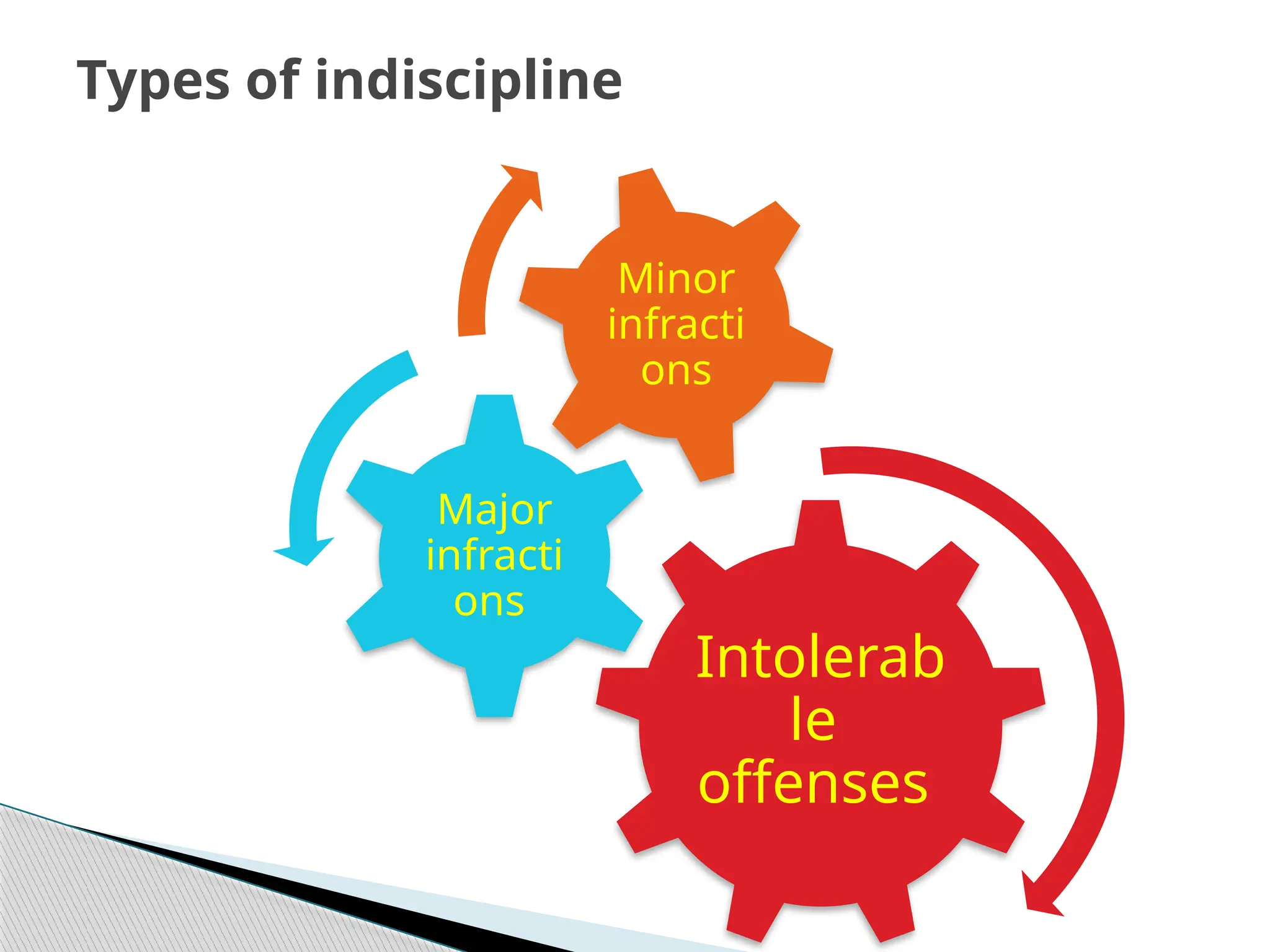
Intolerab
le
offenses
Major
infracti
ons
Types of indiscipline
 Minor infractions refer to those acts which do little
or no harm or which , when viewed in isolation
result , in very few serious consequences , but
which may become serious if they are accumulated
 For example , negligence, failure to be present
when needed , carelessness , minor violation of the
rules etc.
Minor infractions
 These are acts which substantially interfere with
the orderly operations of an organization . These
acts create apparently serious consequences
which any reasonable man shall agree
 Eg : Refusal to carry out the instructions ,
cheating ,violating safety rules
Major infractions
 These are offenses of such illegal / drastic
nature that they severely strain / endanger
employment relationship . They are full of
threat and menace to most people
 Eg : use of weapons , fighting which result in
serious harm to others
Intolerable offenses
Thank you

Discipline education ppt for students....

  • 1.
  • 2.
    Discipline consists inthe submission of one’s impulses and powers to a regulation which imposes from upon chaos and brings efficiency and economy where there would otherwise be ineffectiveness and waste Definition
  • 3.
     Vital componentin the process of education  Control of behavior to attain a goal & purpose  Good understanding of right of conduct , the information of desirable habits & attitudes  Subordination of individual interests in order to bring efficiency and economy  Willing acceptance of being controlled Facts about discipline
  • 4.
     To createand maintain desirable conditions in the teaching –learning situation .  To create favorable attitudes toward the establishment and the maintenance of conditions essential to effective work , in order to achieve the desired objectives  To assist in the development of self control and cooperation which are regarded as essential traits in the daily living as well as in professional functioning Aims of discipline
  • 5.
     Disciplinary measuresare absolutely essential  To increase the efficiency of the employee – both teaching and non teaching  To maintain peace , prevent anarchy and regulate behaviour of people including students  To bring the change Need for disciplinary measures
  • 6.
     To convertthe static staff to the dynamic staff  To move towards the predetermined goal of the educational institutions  To promote the teamwork by providing equal treatment
  • 7.
     facilitate &assist in learning those standards of conduct acceptable within the society  Helps to acquire characteristics of positive nature such as self control and persistence  Assists in securing stability of the social order  Achieve security & maturity Functions of discipline
  • 8.
     Disciplinary proceduresshould be in harmony with the total goals of education  Discipline should be based on and controlled by love and not by fear  The discipline should be mainly positive and constructive  Discipline should ensure equal justice all , respect for the rights and dignity of the individual and humanitarian treatment for all Principles of discipline
  • 9.
     Discipline isnot an end . It is just a means for the successful implementation of the educational program  Disciplinary policies and procedures should be primarily preventive , secondarily corrective and never reattribute  Situation specific disciplinary actions followed by counseling
  • 10.
  • 11.
     It’s atraditional form  Authority of old over young  Punishment for undesirable behavior  Authoritarian parenting is an extremely strict parenting style Authoritarian discipline
  • 12.
     Democratic disciplineis exactly what it sounds like -- a democratic method of classroom management and discipline that makes the educator the "president," and the students the "citizens," of the classroom. This method calls upon effecting the protection of human rights of the students and the teacher. Democratic discipline
  • 13.
     No harshpunishment  Reward and praise when he/she comes to expected standards  Motivation to live up to expectation Characteristics of democratic discipline techniques
  • 14.
     Clear expectationfor the required behavior is set out by the teacher  Specific , concrete, and verbal praises are given for the desired behavior  Negative reinforcement for the undesired behaviors  Teacher is assertive in insisting on the application of the rewards and sanctions Assertive discipline
  • 15.
     Make therules very clear , don’t be ambiguous  Recognize when students behave correctly and praise  Be specific when praising students , make sure they know why they are being praised  Reward exceptional behaviour  Be clear of the consequences of bad behaviour Methods of assertive discipline
  • 16.
    Self discipline isthe ability to control one's feelings and overcome one's weaknesses True discipline It is a combination of self Control and self direction Self discipline
  • 17.
  • 18.
     Lowest levelof discipline imposed from top to down  External rules by force  Establishment of permanent and proper habits of conduct Compulsive discipline
  • 19.
     Personality centered It is educative in nature  Three types of personal discipline : active discipline, reactive discipline, and proactive discipline. Personal discipline
  • 20.
     Active disciplineis doing what you need to in that very moment such as eating a healthy meal, limiting your distractions while studying, and exercising. Active discipline
  • 21.
     Reactive disciplineis controlling our thoughts or behaviors when dealing with unforeseen situations such as getting a flat tire on the way to work, dealing with a rude person Reactive discipline
  • 22.
     "Proactive" meansto act in advance of a situation, to design a plan of action. that will give an individual maximum control over an anticipated situation. A proactive approach to discipline is a planning process that actively pursues. Proactive discipline
  • 23.
     Group normsbased  Self control is exercised through the social context  Social disciplines refer to the societal norms that are part of society Social discipline
  • 24.
     Take theform of positive support and reinforcement  Aim is to help the individual in molding his behaviour and developing in a corrective and supportive manner  Constructive discipline or self discipline Positive Aspects
  • 25.
     Forces thestudents to obey orders and function in accordance with set rules  They are not told why they are punished  Corrective or autocratic approach Negative Aspects
  • 26.
  • 27.
     The employeeis treated as human being and his acts of indiscipline will be dealt from the view point of human values , aspiration , problems , needs , goals ,behavior etc ..  The employee is helped to correct his deviations Human relations approach
  • 28.
     The employeesare treated as a resource and the acts of indiscipline are dealt by considering the failures in the areas of development , maintenance and utilization of human resources Human resources approach
  • 29.
     The group, as a whole , sets the standards of discipline, and punishments for the deviations  The individual employees are awarded punishments for their violation under the group discipline approach Group discipline approach
  • 30.
     Every superioradministers the rules of discipline and guides , trains and controls the subordinates regarding disciplinary rules under the leadership approach The leadership approach
  • 31.
     In judicialapproach , indisciplinary cases are dealt on the basis of legislation and court decisions Judicial approach
  • 32.
     Traditional approach Developmental approach  Positive discipline approach  Self controlled discipline approach  Enforced discipline approach  Constructive vs Destructive discipline Approaches of discipline
  • 33.
     This approachtypically involves the development and communication of clear rules about acceptable and unacceptable behaviour, and reasonable consequences for breaking the rules. These consequences generally involve punishment of the student who is considered responsible for the bullying behaviour. Traditional approach
  • 34.
     Developmental Discipline- an approach to classroom management that involves a concerted effort to create a caring community in the classroom in which each child's needs for autonomy, competence, and affection are balanced with the needs of community in order to maximize the learning and well-being of all. Developmental approach
  • 35.
     More consistentwith developmental – constructivist education  Children are viewed as having legitimate needs and positive social motivations but sometimes choose misguided means for satisfying their needs  Stress the importance of understanding the reasons behind misbehaviour
  • 36.
     Positive disciplineis an approach to teaching that helps children succeed, gives them the information they need to learn and supports their development. It respects children's right to healthy development, protection from violence and active participation in their learning. Positive discipline
  • 37.
     Discipline isbased on the understanding that discipline must be taught and that discipline teaches  Positive discipline teaches adults to employee kindness and firmness at the same time , and is neither punitive nor permissive
  • 38.
    • Mutual respect Adults model firmness by respecting themselves and the needs of the situation . and kindness by respecting the needs of the child Concepts of positive discipline
  • 39.
     Identifying thebelief behind the behaviour  Effective discipline recognizes the reasons kids do what they do and works to change those beliefs, rather than merely attempting to change behaviour  Effective communication and problem solving skills  Focusing on solutions instead of punishment
  • 40.
     Encouragement  Encouragementnotices effort and improvement , not just success and builds long –term self –esteem and empowerment
  • 41.
     Employee alignshis behaviour with that of the organization’s official code of conduct  Get tuned to work at peak performance by this discipline Self controlled discipline
  • 42.
     Enforced Discipline: Is a managerial action. enforces employee compliance with organization's. rules and regulations. ie it is a common discipline. Enforced discipline
  • 43.
     This approachfocuses on understanding the student's performance level and not on specific skills and knowledge. Constructive approach
  • 44.
     Destructive disciplineincludes suspension without pay and termination. Destructive approach
  • 45.
  • 46.
     Preventive Disciplinecan be defined as the measures many educators take to avert misbehavior by keeping students engaged. Rules  Raise your hand.  Be respectful of others.  Keep your hands and feet to yourself.  Listen and follow directions.  Inside voices. Preventive discipline
  • 47.
     The focusof preventive discipline is often on the curriculum. If a curriculum is engaging, interesting, and challenging (but not too challenging), students will be less likely to get off-task and misbehave. After all, if they are interested and engaged in the lesson, they won't even think about acting out. preventive discipline in education
  • 48.
     Supportive disciplineprovides recognition, development, and validation of many roles the teacher uses to enhance the classroom. Over time the art and science of teaching involves acquisition of a large repertoire of skills to fully utilize teaching / learning opportunities. Supportive discipline
  • 49.
     Corrective disciplinemeans that with each admonishment an attempt is made to correct the conduct or insufficiency. This is done by providing a warning or, where appropriate, by providing a corrective plan of action to be followed. Corrective discipline
  • 50.
     Any actor behaviour or performance contrary to approved rules and regulations is known as indiscipline. Indiscipline among teachers are their acts of behaviour that affects effective teaching, learning and administration of the school. Indiscipline
  • 51.
     Faulty disciplinaryactions taken by the authorities may lead to indiscipline  Neglect of employees grievances  Wrong placement and promotion / remunerations also leads to indiscipline  Deficiency of well – defined code of discipline  Divide and rule policy  Improper attitude towards employee’s problem  Ill –equipped supervisor may cause indiscipline Causes of indiscipline
  • 52.
     Lack ofproper leadership  Lack of supervision  Violation of rights of employees  Lack of proper promotional policy  Employer’s attitude  Lack of communication  Lack of proper rules and regulations  Bad working conditions  Discrimination Causes of indiscipline organization
  • 53.
  • 54.
     Minor infractionsrefer to those acts which do little or no harm or which , when viewed in isolation result , in very few serious consequences , but which may become serious if they are accumulated  For example , negligence, failure to be present when needed , carelessness , minor violation of the rules etc. Minor infractions
  • 55.
     These areacts which substantially interfere with the orderly operations of an organization . These acts create apparently serious consequences which any reasonable man shall agree  Eg : Refusal to carry out the instructions , cheating ,violating safety rules Major infractions
  • 56.
     These areoffenses of such illegal / drastic nature that they severely strain / endanger employment relationship . They are full of threat and menace to most people  Eg : use of weapons , fighting which result in serious harm to others Intolerable offenses
  • 57.