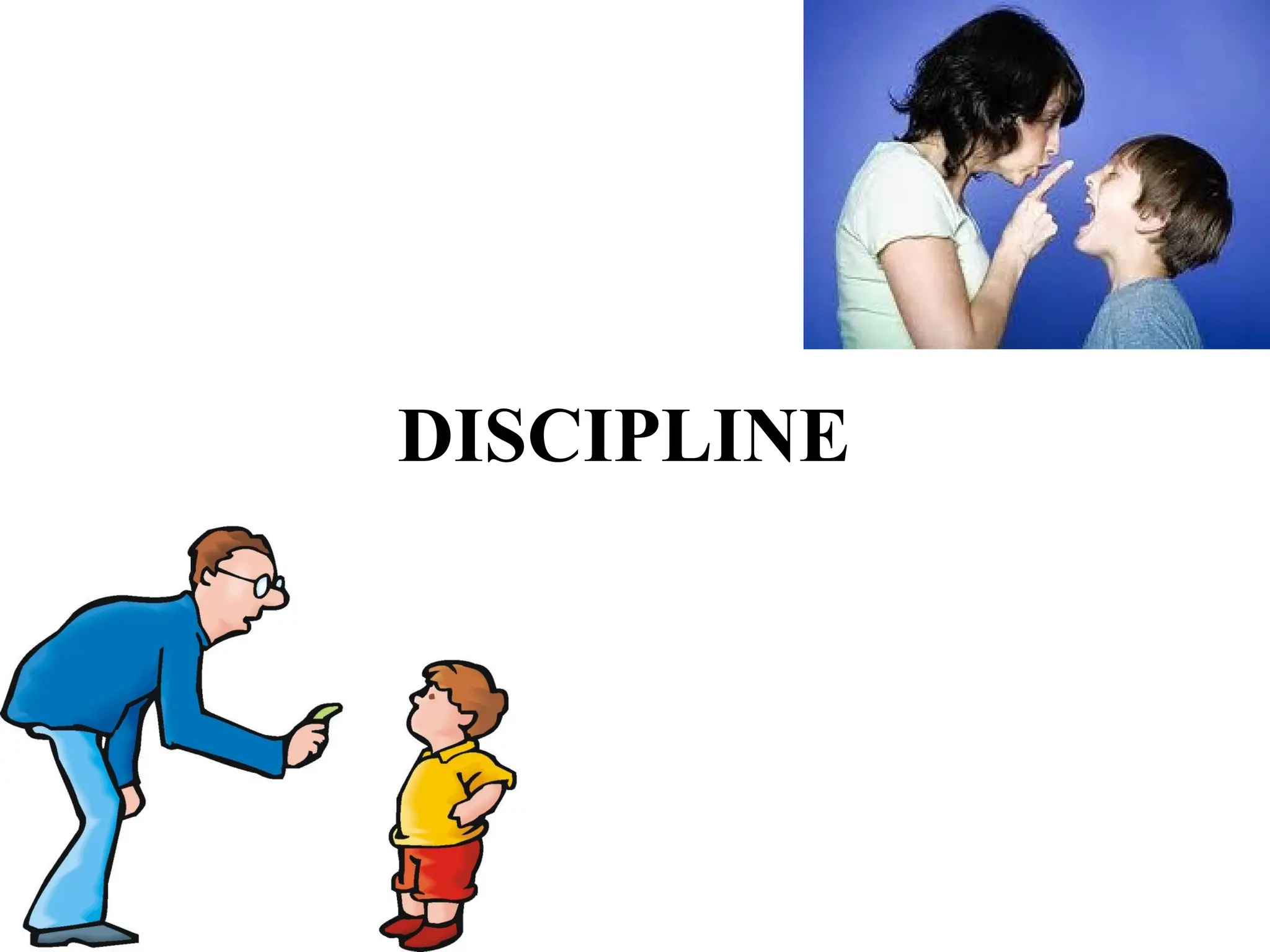
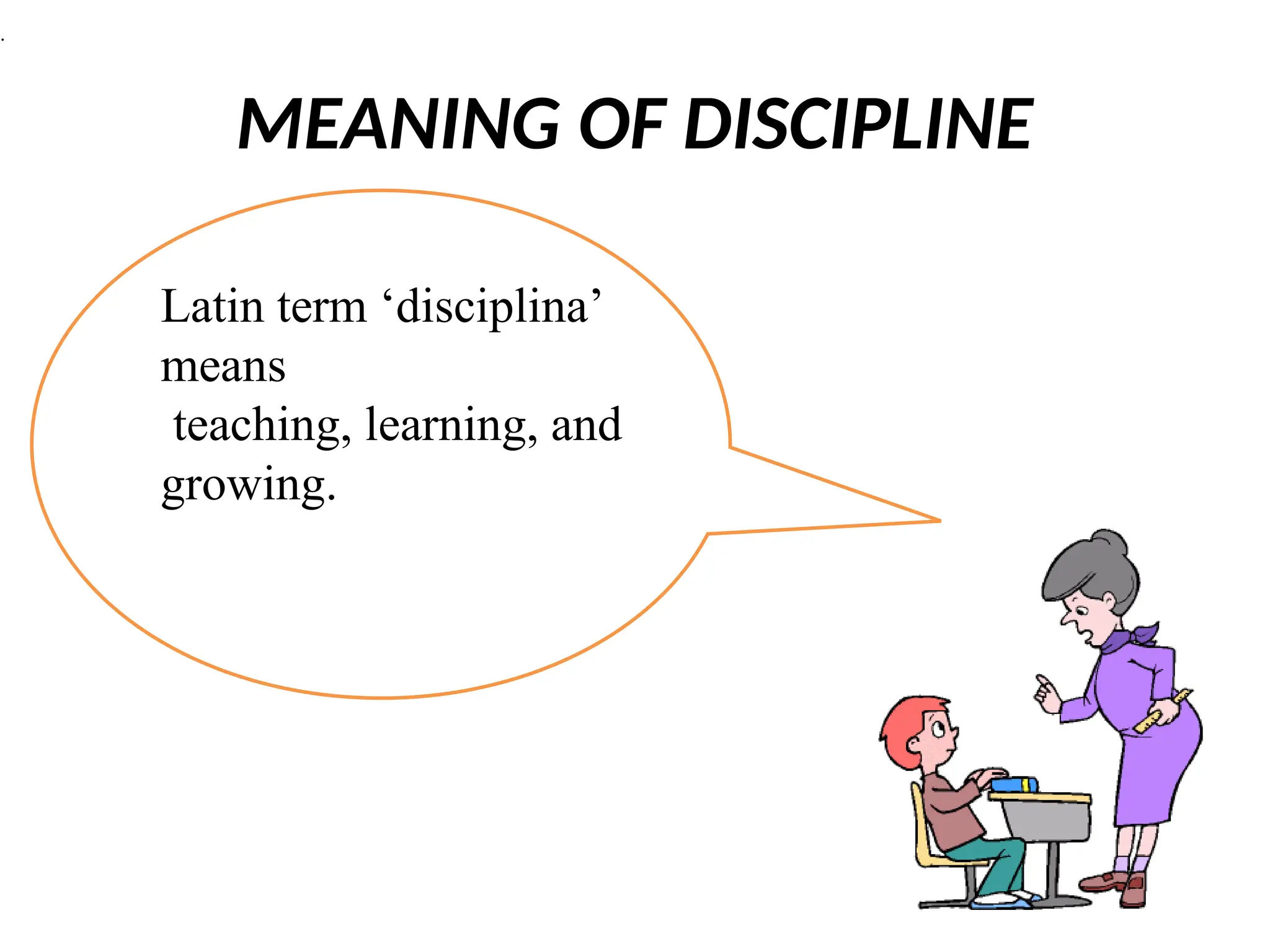
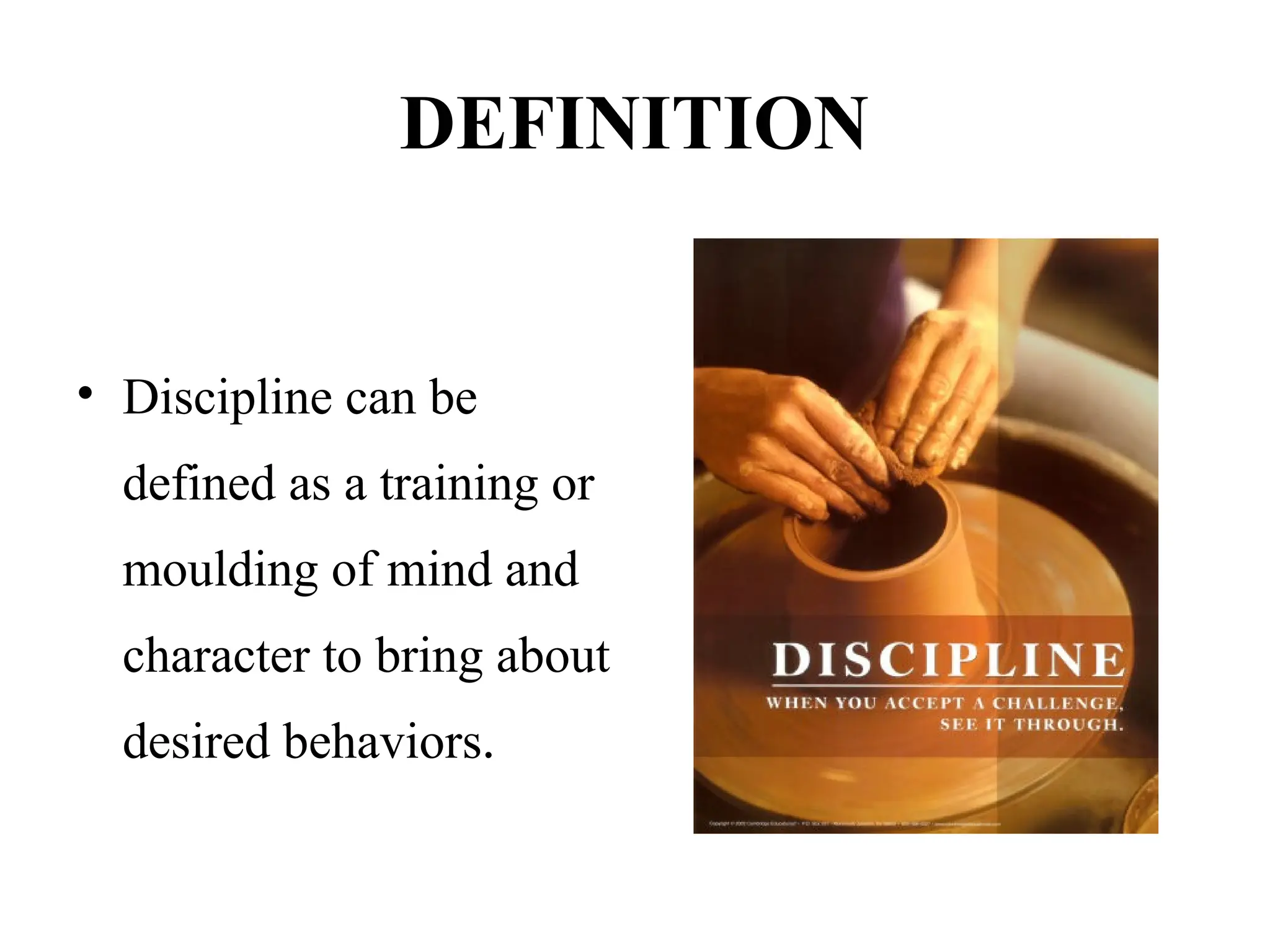
DISCIPLINE
MEANING OF DISCIPLINE
.
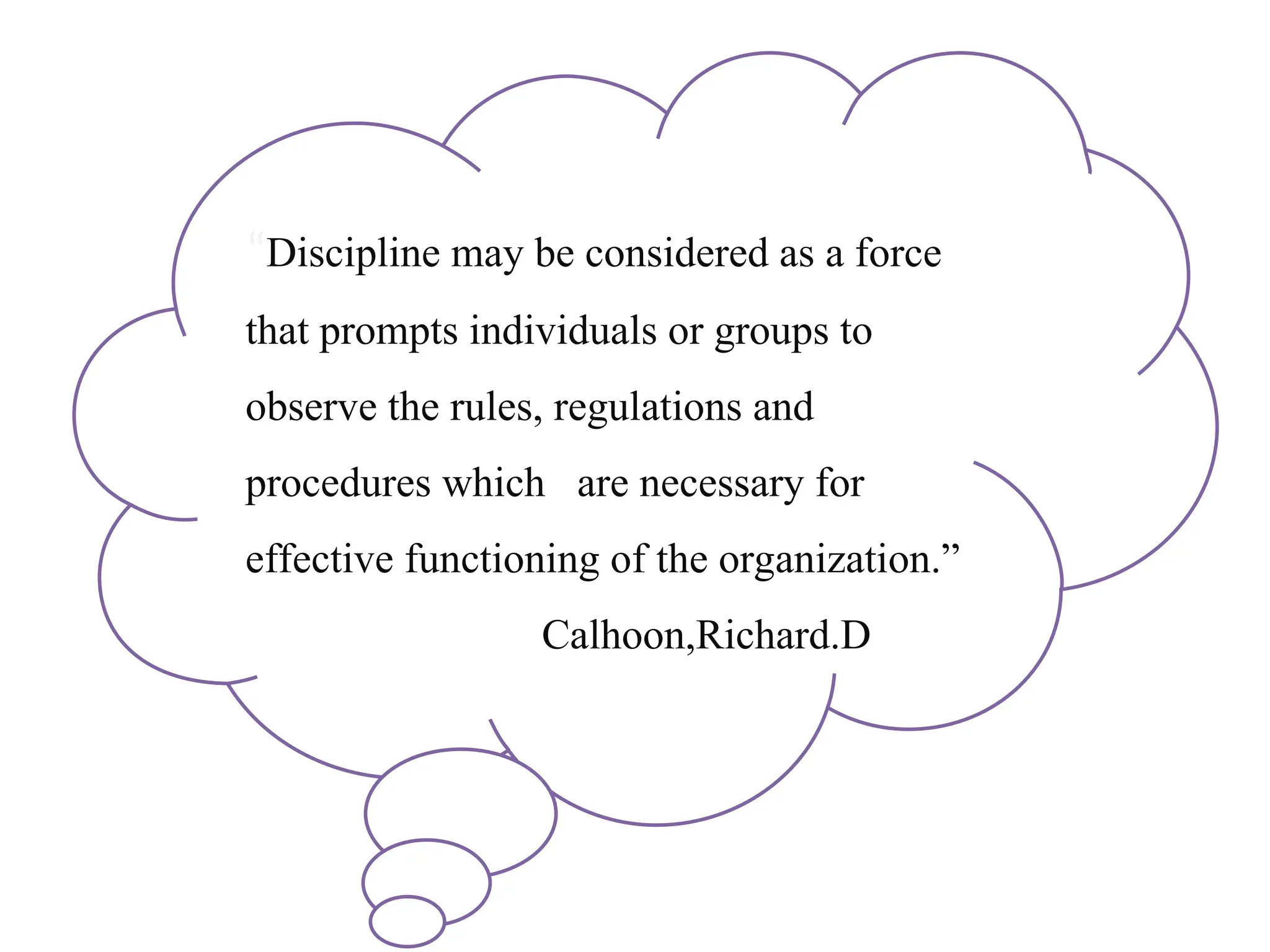
Latin term ‘disciplina’
means
teaching, learning, and
growing.
DEFINITION
• Discipline can be
defined as a training or
moulding of mind and
character to bring about
desired behaviors.
“Discipline may be considered as a force
that prompts individuals or groups to
observe the rules, regulations and
procedures which are necessary for
effective functioning of the organization.”
Calhoon,Richard.D
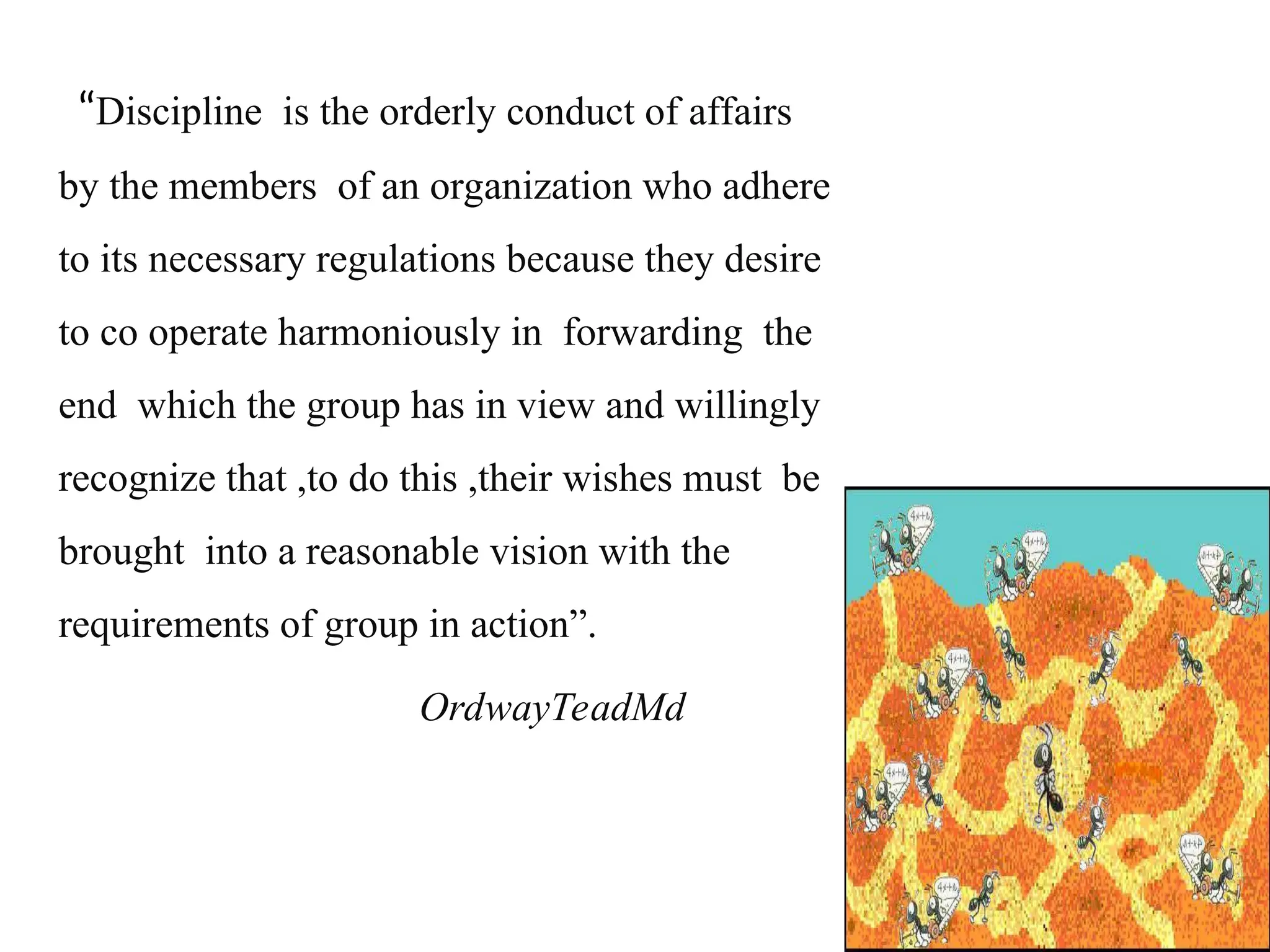
“Discipline is the orderly conduct of affairs
by the members of an organization who adhere
to its necessary regulations because they desire
to co operate harmoniously in forwarding the
end which the group has in view and willingly
recognize that ,to do this ,their wishes must be
brought into a reasonable vision with the
requirements of group in action”.
OrdwayTeadMd
• Discipline refers to working in
accordance with certain recognized
rules, regulations and customs, whether
they are written or implicit in character.
• “
DISCIPLINE
• Dream/ Decide what your goals and objectives are.
• Investigate/ Inquire their suitability for you/ in your
life
• Set up a plan to achieve them
• Come up with a time frame for their achievement
• Implement the plan and Institute the necessary
lifestyle changes required for you to achieve your
goals.
• Pray hard for your goals, Play hard at you Plans.
• LIve your plans. Make it your way of life.
• NEver give up. Change the plan or change the time
frame if you must, but never give up on the Dream.
Realizing you Dream is the D in Disciplined.
AIMS OF DISCIPLINE
• To obtain a willing acceptance of the rules,
regulations and procedures of an organization so that
goals can be achieved.
• To impart an element of certainty despite several
differences in informal behavior patterns and other
related changes
• To develop a spirit of tolerance and a desire to make
adjustments
• To give and seek direction and responsibility
• To create an atmosphere of respect for the human
personality and human relations
• To increase the working efficiency and morale of the
employees so that their productivity is stepped up, the
cost of production brought down and the quality of
production improved.
AIMS OF DISCIPLINE IN
EDUCATION
• To create and maintain desirable conditions in
teaching – learning situation
• To create favorable attitudes toward the establishment
and maintenance of conditions essential to effective
work
• To assist in the development of self control and co-
operation
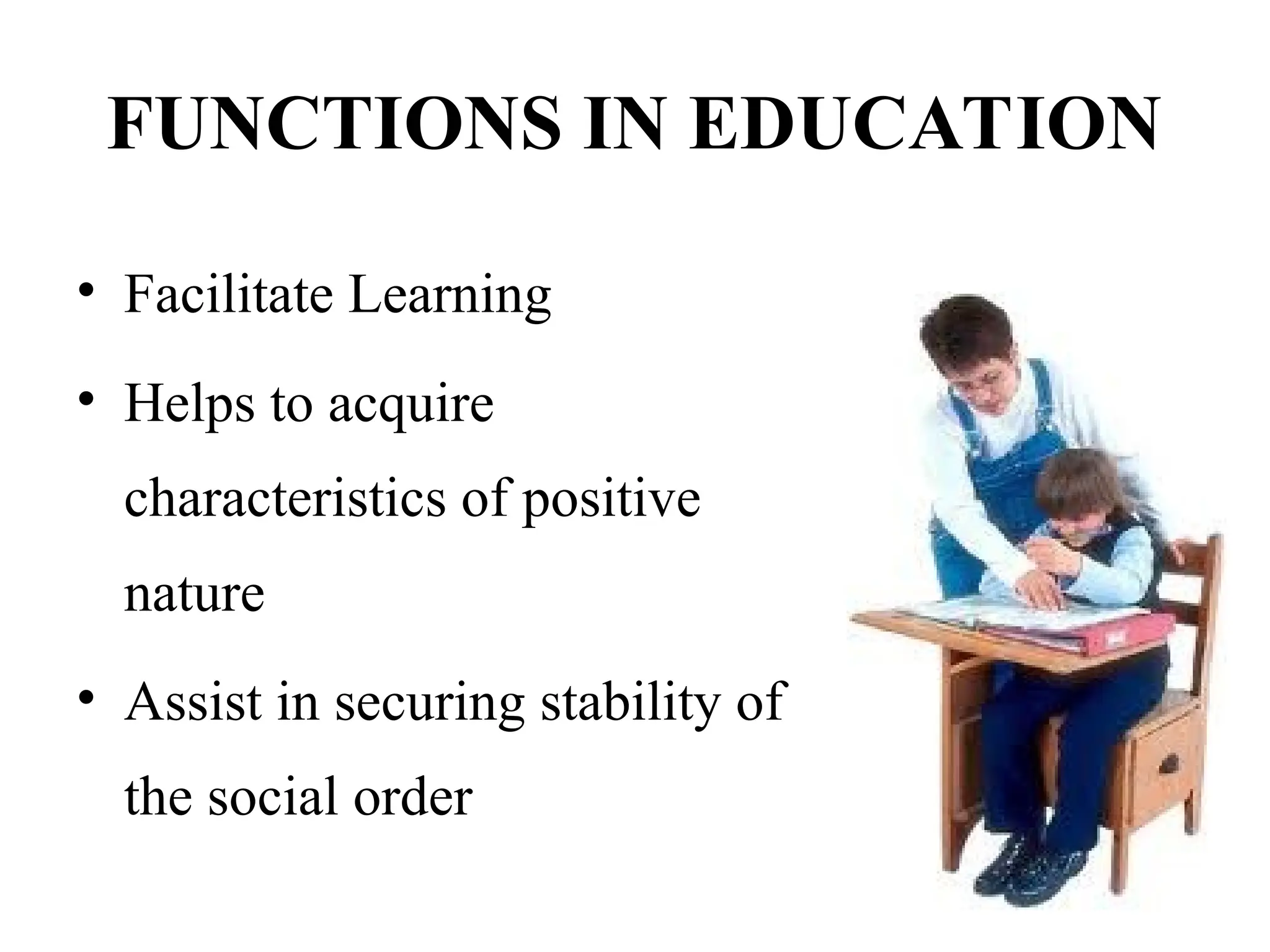
FUNCTIONS IN EDUCATION
• Facilitate Learning
• Helps to acquire
characteristics of positive
nature
• Assist in securing stability of
the social order
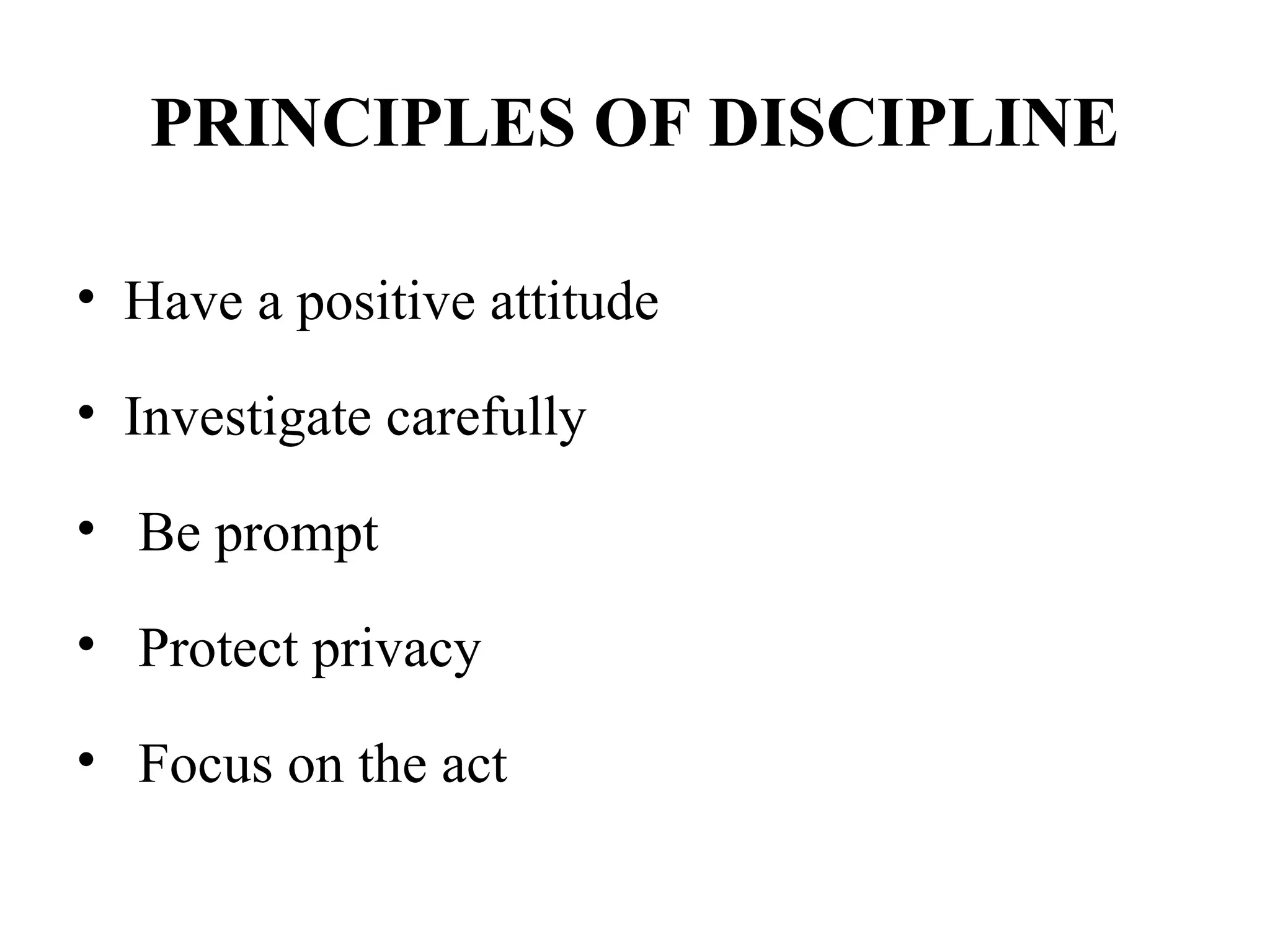
PRINCIPLES OF DISCIPLINE
• Have a positive attitude
• Investigate carefully
• Be prompt
• Protect privacy
• Focus on the act
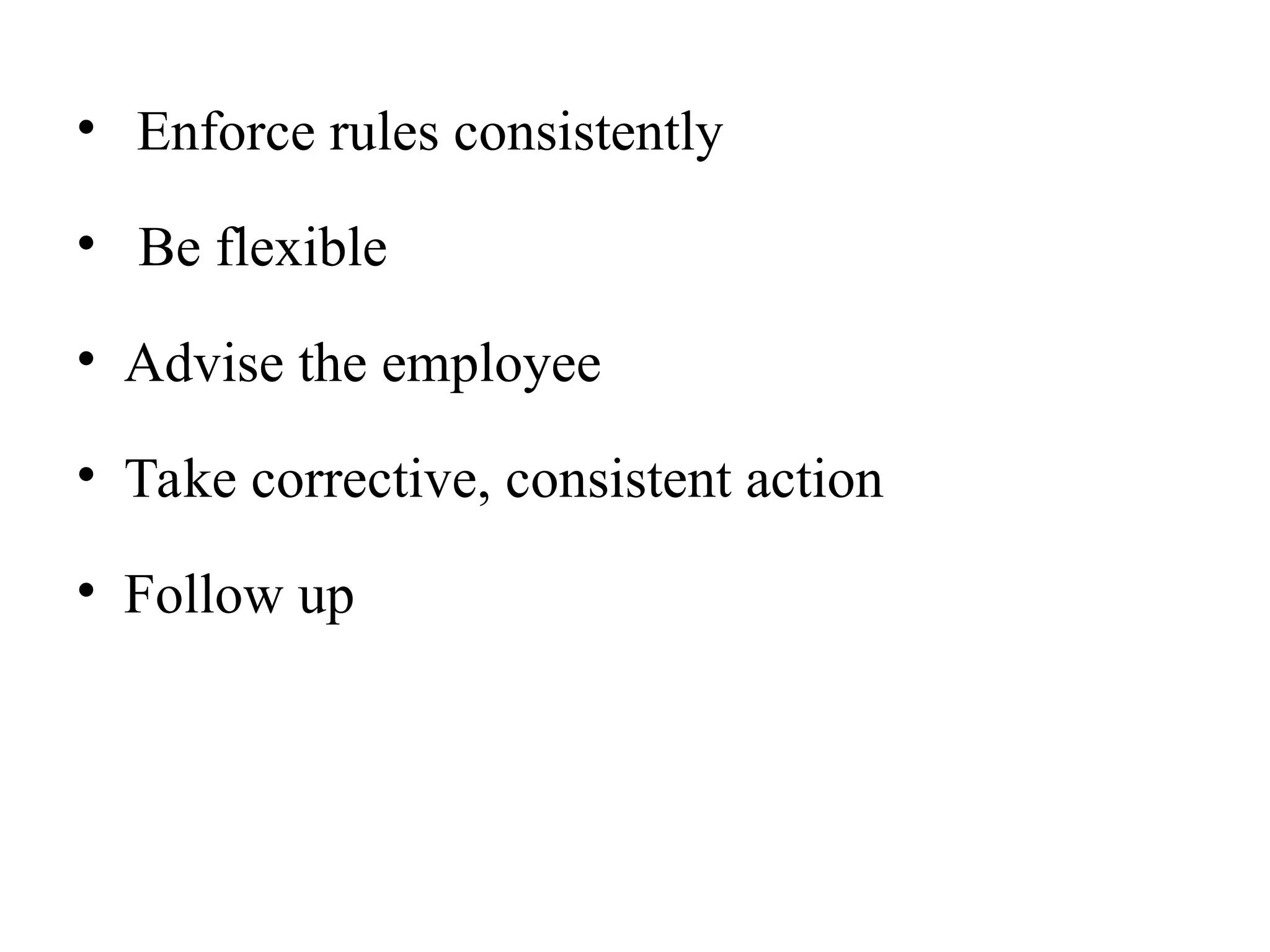
• Enforce rules consistently
• Be flexible
• Advise the employee
• Take corrective, consistent action
• Follow up
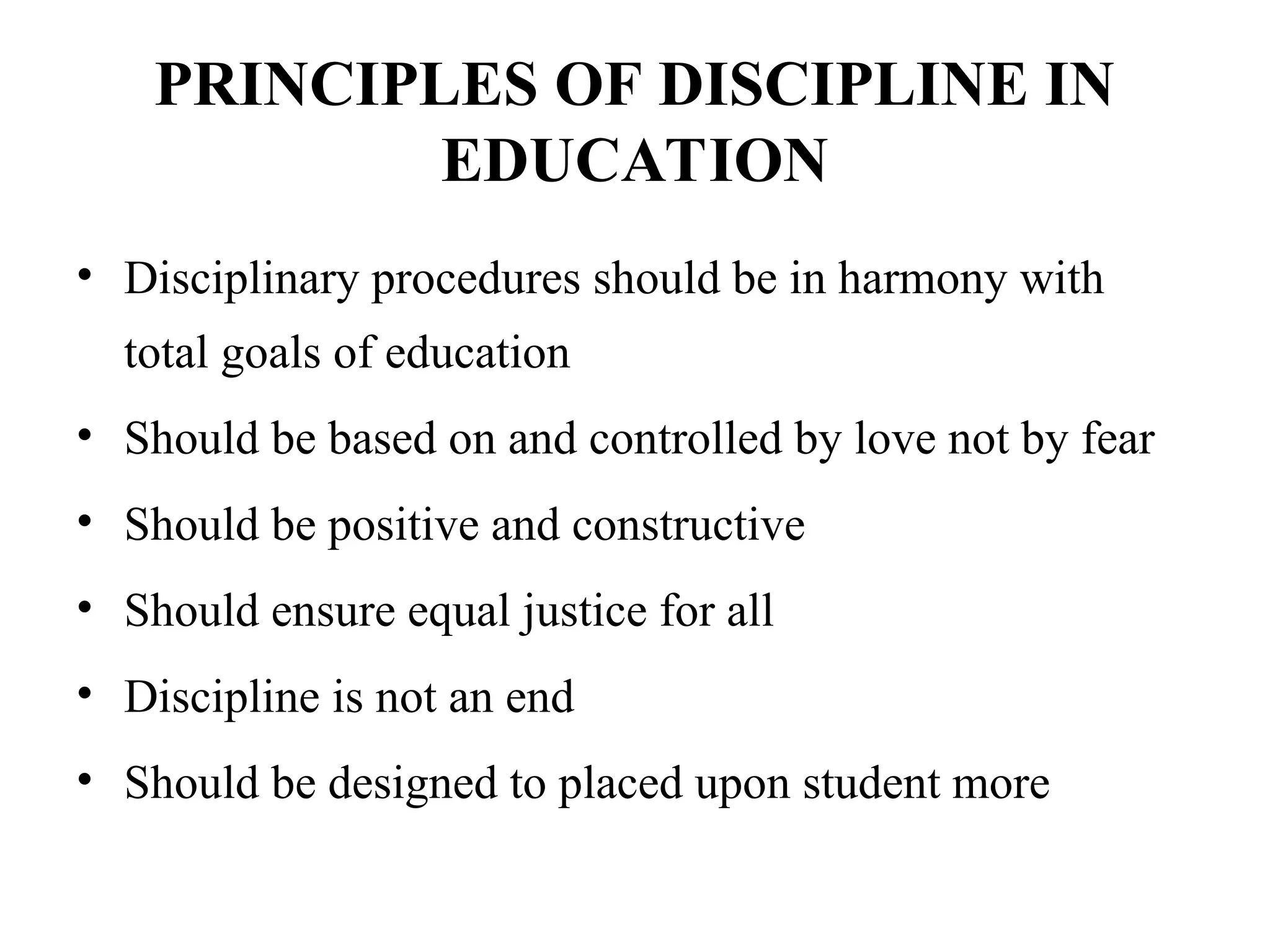
PRINCIPLES OF DISCIPLINE IN
EDUCATION
• Disciplinary procedures should be in harmony with
total goals of education
• Should be based on and controlled by love not by fear
• Should be positive and constructive
• Should ensure equal justice for all
• Discipline is not an end
• Should be designed to placed upon student more
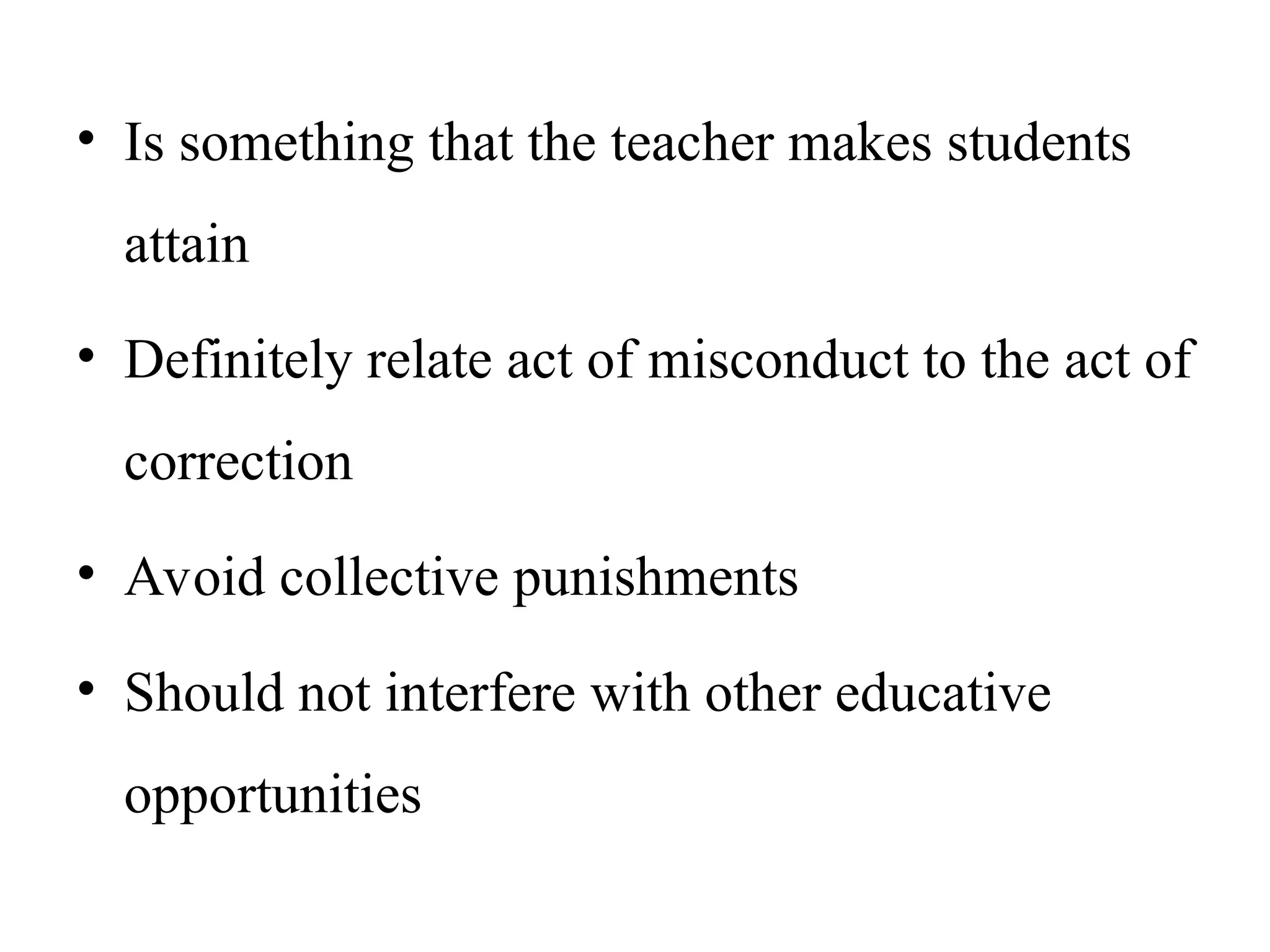
• Is something that the teacher makes students
attain
• Definitely relate act of misconduct to the act of
correction
• Avoid collective punishments
• Should not interfere with other educative
opportunities
PRINCIPLES FOR MAINTENANCE OF
DISCIPLINE:-
The most important principles to be observed in the
maintenance of discipline have been outlined by Yoder,
Heneman, Turnbull and Harold Stone. They are:
 All the rules should be framed in co-operation and
collaboration with the representatives of teachers and
students
 All the rules should be appraised at frequent and regular
interval to ensure that they are, and continue to be,
appropriate, sensible and useful.
 Rules should vary with changes in the teaching and
learning conditions
 Rules should be uniformly enforced if they are to be
effective.
 Penalties for any violation of any rules should be
clearly stated in advance.
 A disciplinary policy should have as its objectives
the prevention of any infringement rather than the
simple administration of penalties; however it should
be preventive rather than punitive.
 Extreme caution should be exercised to ensure that
infringements are not encouraged.
 If violations of a particular rule are fairly frequent, the
circumstances surrounding them should be carefully
investigated and studied in order to discover the cause or causes
of such violations.
 Recidivism must be expected. Some offenders would almost
certainly violate rules more often than others. These cases
should be carefully considered so that their causes may be
discovered.
APPROACHES OF DISCIPLINE
1. Traditional Approach : It emphasizes punishment for
undesirable behavior
2. Developmental Approach : It emphasizes discipline
as a shaper of desirable behavior
3. Positive Discipline Approach :It is based on the
assumption that an student with self-respect, respect for
authority, and interest in learning and will adhere to
high quality education standards
4. Self Controlled Discipline Approach : The
students bring his or her behaviour into
agreement with the institutional behavioural
official code
5. Enforced Discipline Approach : is a
common discipline imposed from the top
6.Human relation approach: In human relation
approach the student is helped to correct his deviations
7.Human resources approach: Under the human
resources approach, the student is treated as resource
and the act of indiscipline are dealt by considering the
failure in the area of development, maintenance and
utilization of human resources.
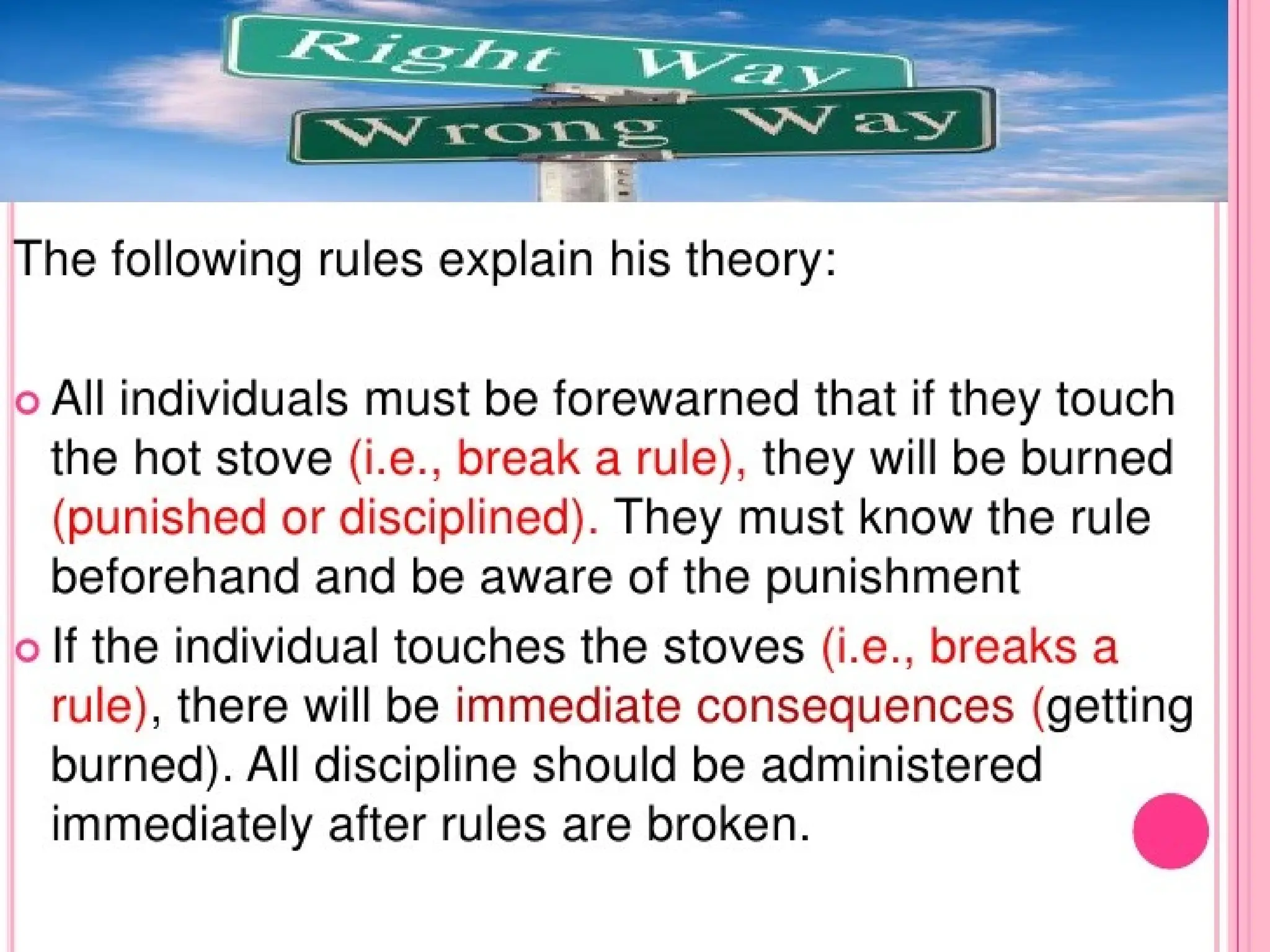
8.Group discipline approach: The group as a whole sets
the standards of discipline, and punishments for the
deviations.
The individual student is awarded punishments for
their violation under the group discipline approach.
9.Leadership approach: In this approach, every
teacher administers the rules of discipline and guides,
trains and controls the student regarding disciplinary
rules.
10.Judicial Approach: In judicial approach, in
disciplinary cases are dealt on the basis of legislation
and court decisions.
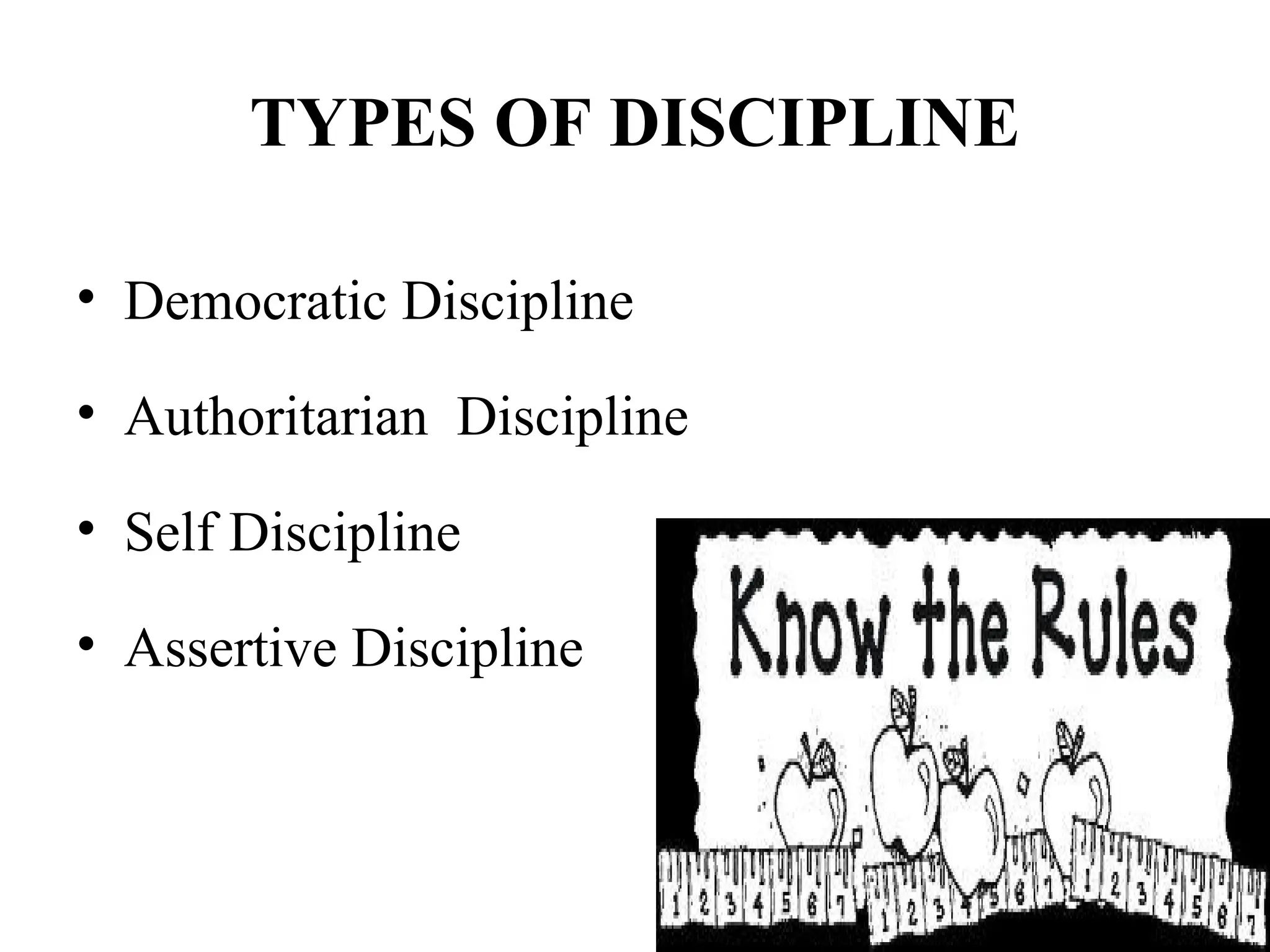
TYPES OF DISCIPLINE
• Democratic Discipline
• Authoritarian Discipline
• Self Discipline
• Assertive Discipline
DEMOCRATIC DISCIPLINE
• Otherwise called as Positive Discipline
• Democratic discipline emphasizes positiveness: a change in
vocabulary helps.
• The word "rules" sounds negative. Use the word
"guidelines" or "policies' instead.
• Input is accepted from all who are able to contribute
• Positive Discipline recognizes the importance of firmness
(rules, guidelines, accountability for actions) in our
relationships with children, as well as the kindness of the
permissive style of discipline, whereby children have a
voice and are treated respectfully and lovingly.
AUTHORITARIAN DISCIPLINE
• In the first style, the philosophy of discipline is
that children should do what they are told,
immediately and without question.
• The belief is that adults should have control
over children. In this style children have little
or no voice.
PERMISSIVE DISCIPLINE
• Permissive style is characterized by lots of love
and kindness, with parents having a hard time
setting up and sticking with guidelines or
structure.
• The adults who use this style do not want their
children to be mad, or sad, and they tend to give
in when children push limits.
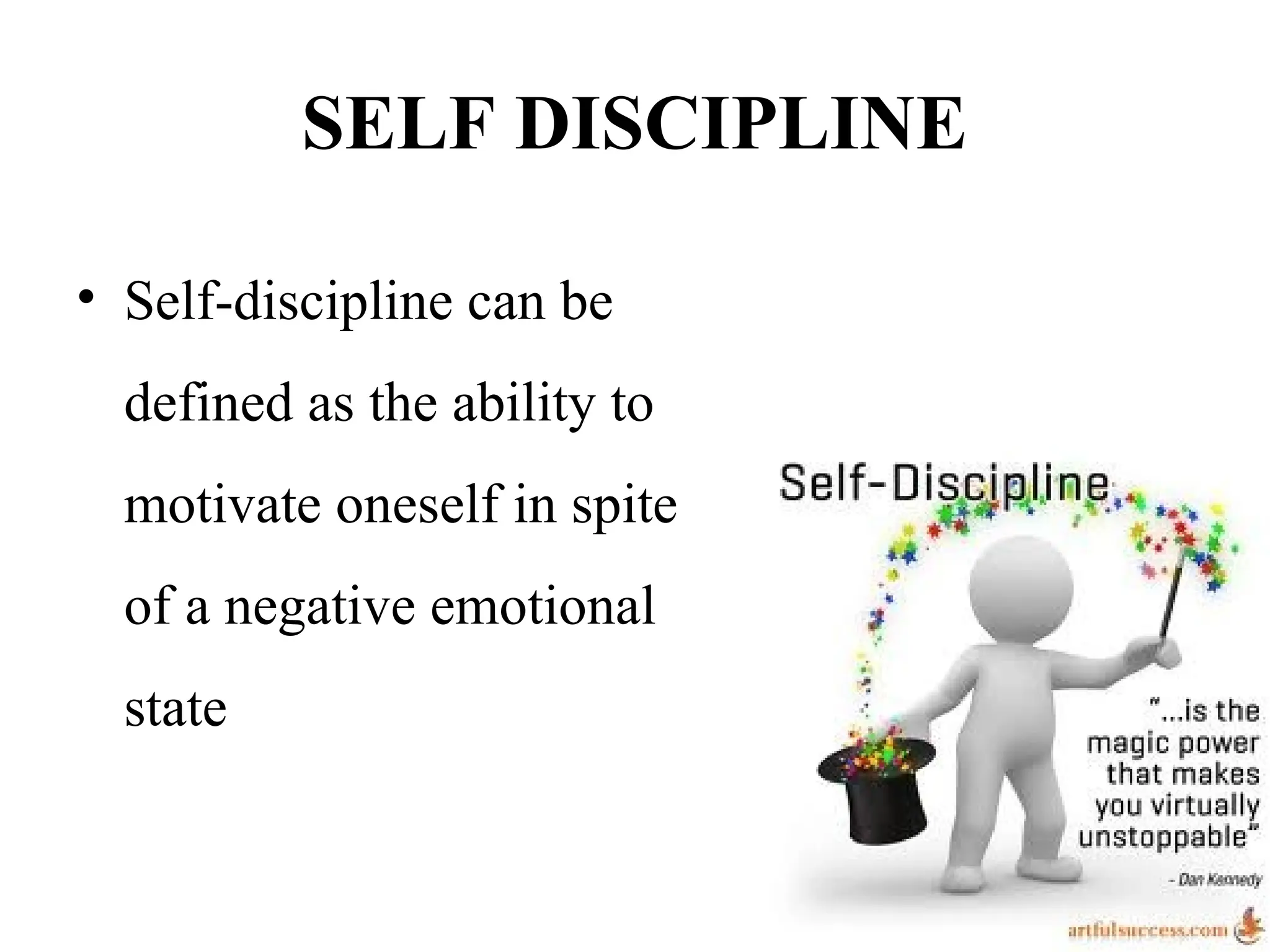
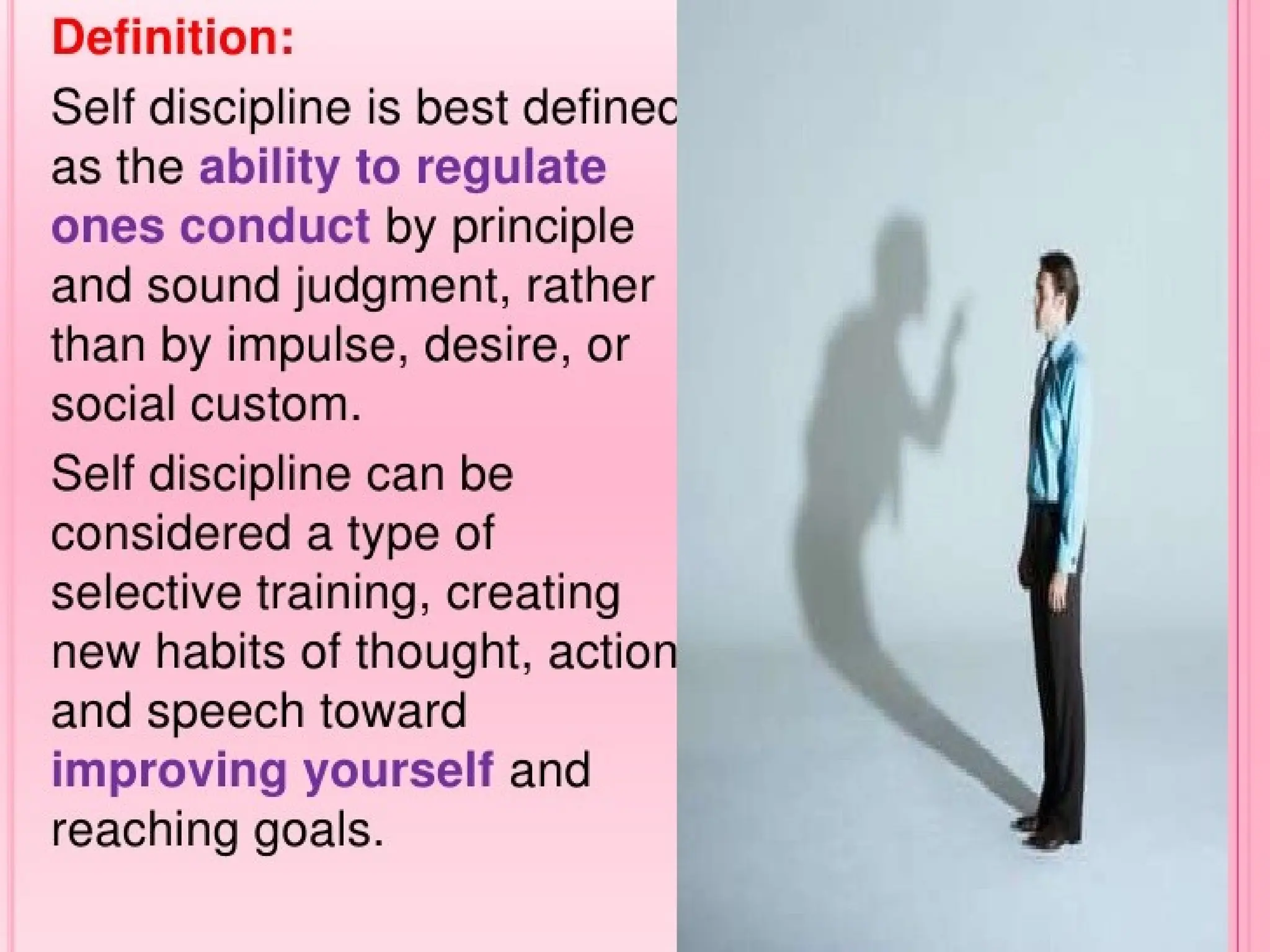
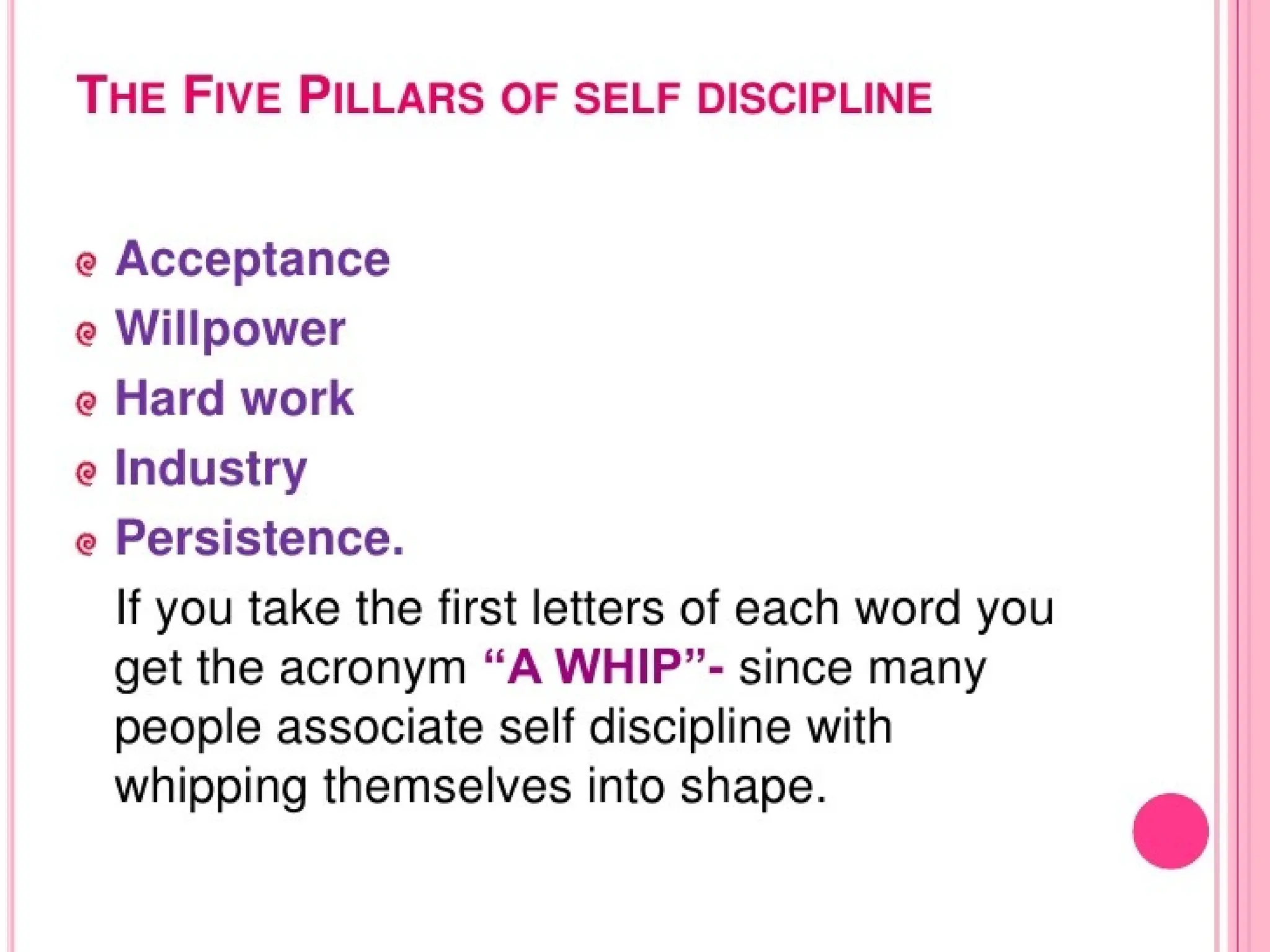
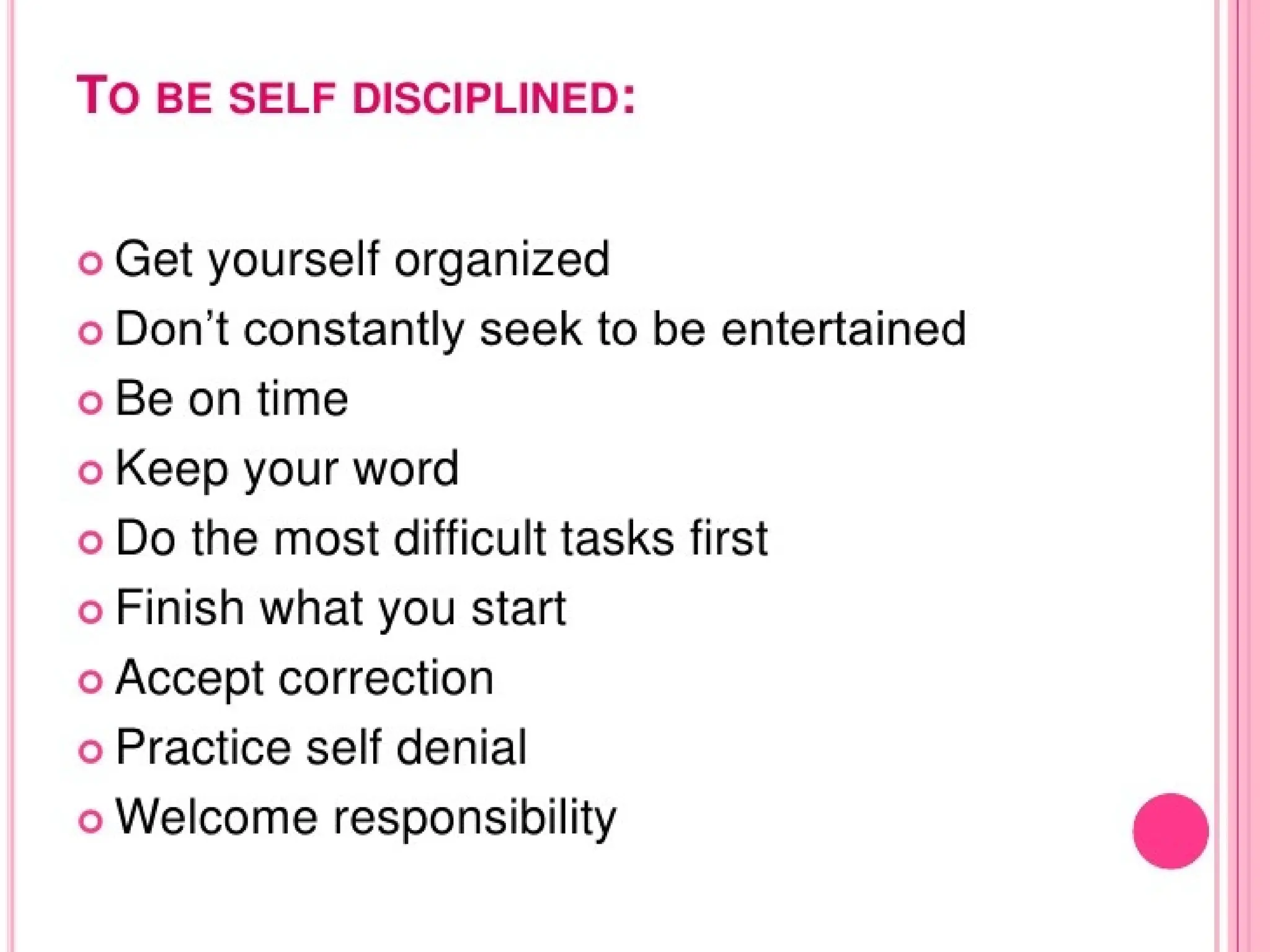
SELF DISCIPLINE
• Self-discipline can be
defined as the ability to
motivate oneself in spite
of a negative emotional
state
ASSERTIVE DISCIPLINE
• Assertive discipline is an approach to class room
management developed by Lee and Marlene Canter
• It involves a high level of teacher control in the class.
• Also called the "take-control" approach to teaching, as the
teacher controls their classroom in a firm but positive
manner.
• The approach maintains that teachers must establish rules
and directions that clearly define the limits of acceptable and
unacceptable student behavior, teach these rules and
directions, and ask for assistance from parents and/or
administrators when support is needed in handling the
behavior of students.
PREVENTIVE DISCIPLINE
• Its a positive procedure that emphasizes and rewards good behavior,
instead of looking for and punishing bad behavior.
• A procedure that rewards the defendant’s positive attitude, instead of
focusing on his wrongdoing and punishing him for it.
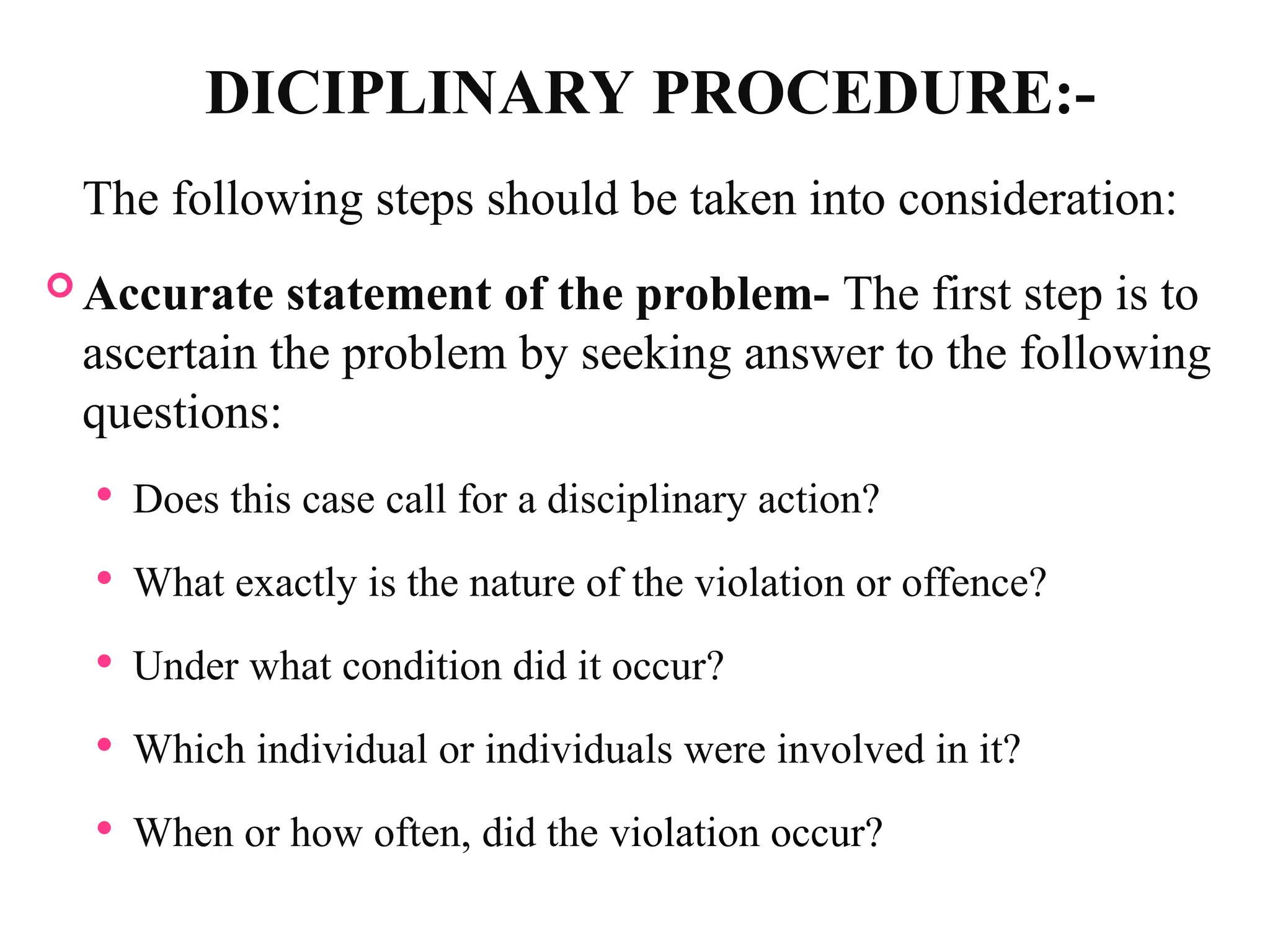
DICIPLINARY PROCEDURE:-
The following steps should be taken into consideration:
 Accurate statement of the problem- The first step is to
ascertain the problem by seeking answer to the following
questions:
 Does this case call for a disciplinary action?
 What exactly is the nature of the violation or offence?
 Under what condition did it occur?
 Which individual or individuals were involved in it?
 When or how often, did the violation occur?
Collecting facts bearing on the case-
Before any action is taken in a case, it is essential to
gather all the facts about it.
A thorough examination of the case should be made
within the stipulated time limit.
o Selection of tentative penalties- The kind of penalty
to be imposed for an offence should be determined
beforehand.
3/8/12
 Choice of Penalty- When a decision has been taken to impose a
penalty, the punishment to be awarded should be such as would
prevent a recurrence of the offence.
 Application of the Penalty- The application of the penalty
involves a positive and assured attitude on the part of the
management. If the disciplinary action is a simple reprimand, the
executive should calmly and quickly dispose of the matter.
o Follow-up on disciplinary action-
The ultimate purpose of disciplinary
action is to maintain discipline, to
ensure productivity, and avoid a
repetition of the offence.
A disciplinary action should,
therefore, be evaluated in terms of its
effectiveness after it has been taken.
3/8/12
BASIC INGREDIENT FOR A DISCIPLINARY
ACTION:-
The principle ingredients of a sound disciplinary system are:
Location of responsibility
Proper formulation and communication of rules
Rules and regulations should be reasonable
Equal treatment
Disciplinary action should be taken in Private
Importance of promptness in taking Disciplinary action
Get the facts
Action should be taken in cool atmosphere:
Natural justice
After a disciplinary action has been taken
the teacher should treat student in a normal
manner
Don’t back down when you are right
Negative Motivation should be handled in
a positive manner
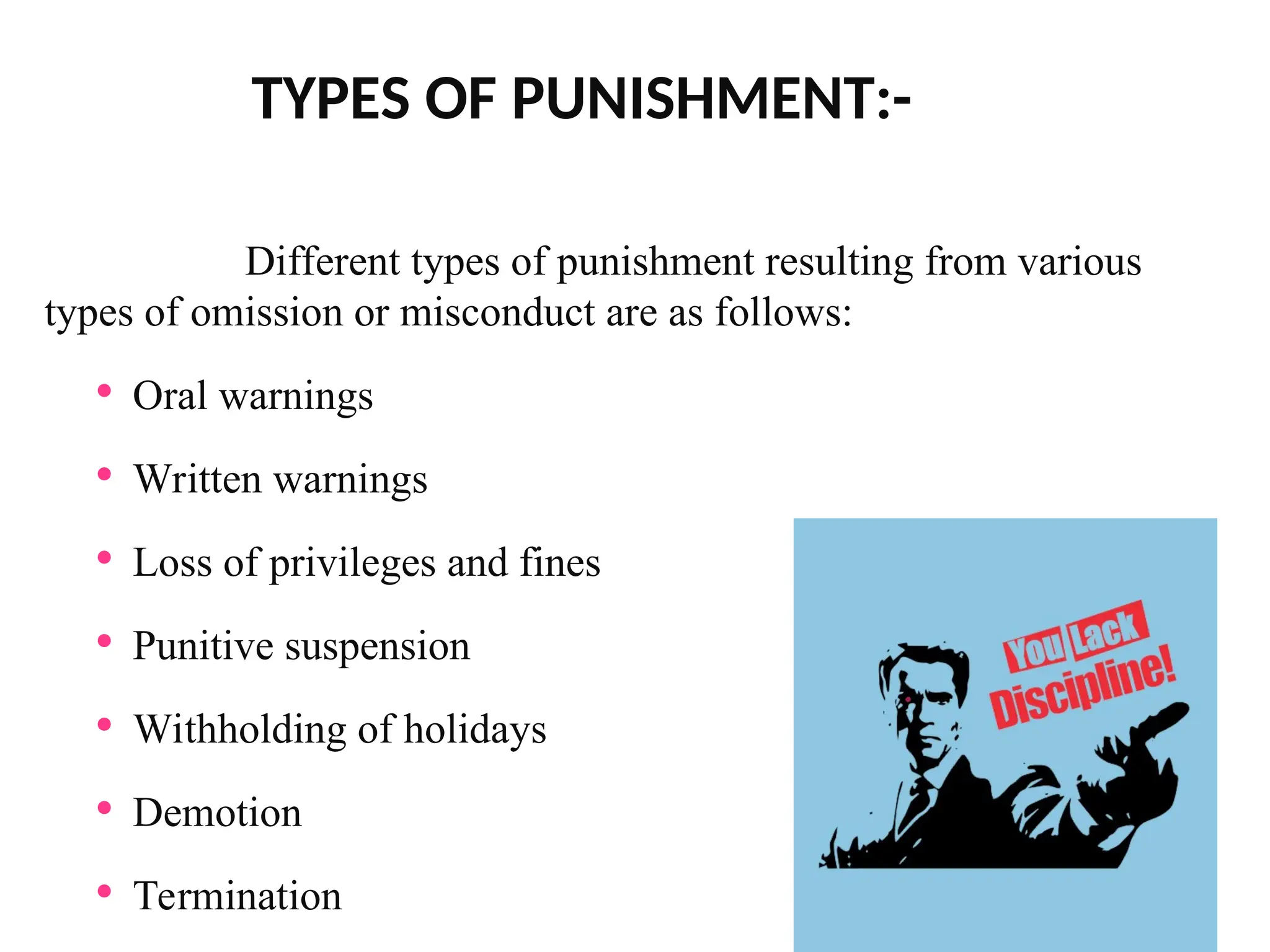
TYPES OF PUNISHMENT:-
Different types of punishment resulting from various
types of omission or misconduct are as follows:
 Oral warnings
 Written warnings
 Loss of privileges and fines
 Punitive suspension
 Withholding of holidays
 Demotion
 Termination
ROLE OF A TEACHER
• Ensure the classroom condition appropriate to her class
• Prepare lesson thoroughly
• Prepare to explain its significance
• Know your class
• Adopt an appropriate professional style
• Watch very carefully for signs of trouble
• Establish momentum at early stage
• Do not confuse the trivial and important
• Be seen as fair minded and impartial
• Teacher should know when and how to
reprimand
• Ensure punishments in needed situations
• Consider dismissal without hesitation
• Follow up all disciplinary matters
ppt.maintainence of DISCIPLINE ORGINAL.ppt

ppt.maintainence of DISCIPLINE ORGINAL.ppt

  • 2.
  • 3.
    MEANING OF DISCIPLINE . Latinterm ‘disciplina’ means teaching, learning, and growing.
  • 4.
    DEFINITION • Discipline canbe defined as a training or moulding of mind and character to bring about desired behaviors.
  • 5.
    “Discipline may beconsidered as a force that prompts individuals or groups to observe the rules, regulations and procedures which are necessary for effective functioning of the organization.” Calhoon,Richard.D
  • 6.
    “Discipline is theorderly conduct of affairs by the members of an organization who adhere to its necessary regulations because they desire to co operate harmoniously in forwarding the end which the group has in view and willingly recognize that ,to do this ,their wishes must be brought into a reasonable vision with the requirements of group in action”. OrdwayTeadMd
  • 7.
    • Discipline refersto working in accordance with certain recognized rules, regulations and customs, whether they are written or implicit in character. • “
  • 8.
    DISCIPLINE • Dream/ Decidewhat your goals and objectives are. • Investigate/ Inquire their suitability for you/ in your life • Set up a plan to achieve them • Come up with a time frame for their achievement
  • 9.
    • Implement theplan and Institute the necessary lifestyle changes required for you to achieve your goals. • Pray hard for your goals, Play hard at you Plans. • LIve your plans. Make it your way of life. • NEver give up. Change the plan or change the time frame if you must, but never give up on the Dream. Realizing you Dream is the D in Disciplined.
  • 10.
    AIMS OF DISCIPLINE •To obtain a willing acceptance of the rules, regulations and procedures of an organization so that goals can be achieved. • To impart an element of certainty despite several differences in informal behavior patterns and other related changes • To develop a spirit of tolerance and a desire to make adjustments
  • 11.
    • To giveand seek direction and responsibility • To create an atmosphere of respect for the human personality and human relations • To increase the working efficiency and morale of the employees so that their productivity is stepped up, the cost of production brought down and the quality of production improved.
  • 12.
    AIMS OF DISCIPLINEIN EDUCATION • To create and maintain desirable conditions in teaching – learning situation • To create favorable attitudes toward the establishment and maintenance of conditions essential to effective work • To assist in the development of self control and co- operation
  • 13.
    FUNCTIONS IN EDUCATION •Facilitate Learning • Helps to acquire characteristics of positive nature • Assist in securing stability of the social order
  • 14.
    PRINCIPLES OF DISCIPLINE •Have a positive attitude • Investigate carefully • Be prompt • Protect privacy • Focus on the act
  • 15.
    • Enforce rulesconsistently • Be flexible • Advise the employee • Take corrective, consistent action • Follow up
  • 16.
    PRINCIPLES OF DISCIPLINEIN EDUCATION • Disciplinary procedures should be in harmony with total goals of education • Should be based on and controlled by love not by fear • Should be positive and constructive • Should ensure equal justice for all • Discipline is not an end • Should be designed to placed upon student more
  • 17.
    • Is somethingthat the teacher makes students attain • Definitely relate act of misconduct to the act of correction • Avoid collective punishments • Should not interfere with other educative opportunities
  • 18.
    PRINCIPLES FOR MAINTENANCEOF DISCIPLINE:- The most important principles to be observed in the maintenance of discipline have been outlined by Yoder, Heneman, Turnbull and Harold Stone. They are:  All the rules should be framed in co-operation and collaboration with the representatives of teachers and students  All the rules should be appraised at frequent and regular interval to ensure that they are, and continue to be, appropriate, sensible and useful.
  • 19.
     Rules shouldvary with changes in the teaching and learning conditions  Rules should be uniformly enforced if they are to be effective.  Penalties for any violation of any rules should be clearly stated in advance.  A disciplinary policy should have as its objectives the prevention of any infringement rather than the simple administration of penalties; however it should be preventive rather than punitive.
  • 20.
     Extreme cautionshould be exercised to ensure that infringements are not encouraged.  If violations of a particular rule are fairly frequent, the circumstances surrounding them should be carefully investigated and studied in order to discover the cause or causes of such violations.  Recidivism must be expected. Some offenders would almost certainly violate rules more often than others. These cases should be carefully considered so that their causes may be discovered.
  • 21.
    APPROACHES OF DISCIPLINE 1.Traditional Approach : It emphasizes punishment for undesirable behavior 2. Developmental Approach : It emphasizes discipline as a shaper of desirable behavior 3. Positive Discipline Approach :It is based on the assumption that an student with self-respect, respect for authority, and interest in learning and will adhere to high quality education standards
  • 22.
    4. Self ControlledDiscipline Approach : The students bring his or her behaviour into agreement with the institutional behavioural official code 5. Enforced Discipline Approach : is a common discipline imposed from the top
  • 23.
    6.Human relation approach:In human relation approach the student is helped to correct his deviations 7.Human resources approach: Under the human resources approach, the student is treated as resource and the act of indiscipline are dealt by considering the failure in the area of development, maintenance and utilization of human resources.
  • 24.
    8.Group discipline approach:The group as a whole sets the standards of discipline, and punishments for the deviations. The individual student is awarded punishments for their violation under the group discipline approach.
  • 25.
    9.Leadership approach: Inthis approach, every teacher administers the rules of discipline and guides, trains and controls the student regarding disciplinary rules. 10.Judicial Approach: In judicial approach, in disciplinary cases are dealt on the basis of legislation and court decisions.
  • 26.
    TYPES OF DISCIPLINE •Democratic Discipline • Authoritarian Discipline • Self Discipline • Assertive Discipline
  • 27.
    DEMOCRATIC DISCIPLINE • Otherwisecalled as Positive Discipline • Democratic discipline emphasizes positiveness: a change in vocabulary helps. • The word "rules" sounds negative. Use the word "guidelines" or "policies' instead. • Input is accepted from all who are able to contribute • Positive Discipline recognizes the importance of firmness (rules, guidelines, accountability for actions) in our relationships with children, as well as the kindness of the permissive style of discipline, whereby children have a voice and are treated respectfully and lovingly.
  • 28.
    AUTHORITARIAN DISCIPLINE • Inthe first style, the philosophy of discipline is that children should do what they are told, immediately and without question. • The belief is that adults should have control over children. In this style children have little or no voice.
  • 29.
    PERMISSIVE DISCIPLINE • Permissivestyle is characterized by lots of love and kindness, with parents having a hard time setting up and sticking with guidelines or structure. • The adults who use this style do not want their children to be mad, or sad, and they tend to give in when children push limits.
  • 30.
    SELF DISCIPLINE • Self-disciplinecan be defined as the ability to motivate oneself in spite of a negative emotional state
  • 34.
    ASSERTIVE DISCIPLINE • Assertivediscipline is an approach to class room management developed by Lee and Marlene Canter • It involves a high level of teacher control in the class. • Also called the "take-control" approach to teaching, as the teacher controls their classroom in a firm but positive manner. • The approach maintains that teachers must establish rules and directions that clearly define the limits of acceptable and unacceptable student behavior, teach these rules and directions, and ask for assistance from parents and/or administrators when support is needed in handling the behavior of students.
  • 35.
    PREVENTIVE DISCIPLINE • Itsa positive procedure that emphasizes and rewards good behavior, instead of looking for and punishing bad behavior. • A procedure that rewards the defendant’s positive attitude, instead of focusing on his wrongdoing and punishing him for it.
  • 39.
    DICIPLINARY PROCEDURE:- The followingsteps should be taken into consideration:  Accurate statement of the problem- The first step is to ascertain the problem by seeking answer to the following questions:  Does this case call for a disciplinary action?  What exactly is the nature of the violation or offence?  Under what condition did it occur?  Which individual or individuals were involved in it?  When or how often, did the violation occur?
  • 40.
    Collecting facts bearingon the case- Before any action is taken in a case, it is essential to gather all the facts about it. A thorough examination of the case should be made within the stipulated time limit. o Selection of tentative penalties- The kind of penalty to be imposed for an offence should be determined beforehand. 3/8/12
  • 41.
     Choice ofPenalty- When a decision has been taken to impose a penalty, the punishment to be awarded should be such as would prevent a recurrence of the offence.  Application of the Penalty- The application of the penalty involves a positive and assured attitude on the part of the management. If the disciplinary action is a simple reprimand, the executive should calmly and quickly dispose of the matter.
  • 42.
    o Follow-up ondisciplinary action- The ultimate purpose of disciplinary action is to maintain discipline, to ensure productivity, and avoid a repetition of the offence. A disciplinary action should, therefore, be evaluated in terms of its effectiveness after it has been taken. 3/8/12
  • 43.
    BASIC INGREDIENT FORA DISCIPLINARY ACTION:- The principle ingredients of a sound disciplinary system are: Location of responsibility Proper formulation and communication of rules Rules and regulations should be reasonable Equal treatment Disciplinary action should be taken in Private Importance of promptness in taking Disciplinary action
  • 44.
    Get the facts Actionshould be taken in cool atmosphere: Natural justice After a disciplinary action has been taken the teacher should treat student in a normal manner Don’t back down when you are right Negative Motivation should be handled in a positive manner
  • 45.
    TYPES OF PUNISHMENT:- Differenttypes of punishment resulting from various types of omission or misconduct are as follows:  Oral warnings  Written warnings  Loss of privileges and fines  Punitive suspension  Withholding of holidays  Demotion  Termination
  • 46.
    ROLE OF ATEACHER • Ensure the classroom condition appropriate to her class • Prepare lesson thoroughly • Prepare to explain its significance • Know your class • Adopt an appropriate professional style • Watch very carefully for signs of trouble • Establish momentum at early stage
  • 47.
    • Do notconfuse the trivial and important • Be seen as fair minded and impartial • Teacher should know when and how to reprimand • Ensure punishments in needed situations • Consider dismissal without hesitation • Follow up all disciplinary matters