REFERRAL
SYSTEM
Presented by ,
Bincy Binu
4th year Bsc (N)
INTRODUCTION
Referral is a process by which a health workers transfers
the responsibility of care to another health professional or
social worker or to the community in response to its
inability or limitation to provide the necessary care.
Referral is a two way process and ensures that a continuum
of care is maintained to patients. It’s done from the
community to the primary health care services to hospitals
and within hospitals and vice versa . It also involves
support services such as transport and communication. A
referral may be for temporary , permanent or partial
transfer of responsibility for the care of a patient.
REFERRAL PROCESS
The referral process begins by referring health professionals
communicating to the receiving health professional or specialist
relevant patient information.
 The receiving health professional communicates back to the
referring health professional with information and plan for
continuum of care thereby completing the referral process.
 Referring unit is a health service organization that initiates the
referral process. A facility can be both a referring and receiving unit
depending on circumstances.
 Receiving unit is a health service organization that receives patient
or clients form referring units and ensures that required care is
given to the client and returns the patient with feedback.
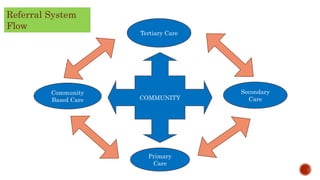
Tertiary Care
Secondary
Care
Primary
Care
Community
Based Care COMMUNITY
Referral System
Flow
LEVELS OF REFERRAL
SYSTEM
 Referral can be vertical as in the hierarchical arrangement of the
health services from the lower ends of the health tier system to the
higher ones. It also can be horizontal between similar levels of
facilities in the interest of patients for cost, location and other
reasons.
 Referrals can also be diagonal when a lower level health facility
refers patients to a specialized facility without necessarily passing
through the hierarchical system. Referrals can be among public,
private, community based and other traditional and alternative
medicine practitioners and sometimes social services are also
included.
Teaching hospital/ specialty hospital
District hospital
FRU/ Community health center /sub district
hospital
Subcentre level
Village level
Levels of
referral
system
CRITERIA FOR REFERRAL
The criteria for referral should be medical, objective and in the best
interest of the patient or client. The following are considered good
criteria for referrals:-
 When a patient needs an expert advice as determined by the
attending health professional.
 When technical examination is required that is not available at the
referring facility.
 When a technical intervention that is beyond the capabilities of the
facility is required.
 When patients require inpatient care that cannot be given at the
referring facility.
When the referring facility cannot no more accept patients
due to shortage of beds and unavailability of professionals.
Referrals are also made to the lower level health facilities
and community based organization in the best interest of
the patient depending on:-
a) The condition of the patient.
b) The capacity of the lower level health facility community
based organization.
CATEGORIES OF PATIENT
REFERRAL
Basis for the patient referral system depends upon the
resources available at the health center and condition of the
patient. Selection of the patient can be based on 3
categories:-
a) First category or fatal patient
In this category the patient who cannot survive despite the
best treatment made available to them. So, to send the
patient for treatment is the waste of time and money.
Hence it’s better to give appropriate treatment at the
health center itself with available resources.
b) Second Category or serious patient
In this category when condition of the patient is considered serious
but immediate treatment can save the life so before sending the
patient for referral attempts should be made to reduce the
seriousness of the condition after that patient should be sent for
referral.
c) Third category or General patient
In this category when the disease may be serious but patient
condition is normal and delayed treatment may not threaten to his
life than the patient can be immediately sent for referral. Similarly,
after the surgery or incase diagnosis is not available or for the use of
special technique the patient can be sent to a specialist hospital.
A GOOD REFERRAL
SYSTEM
 It’ll have a defined package of services provided at different levels of
care.
 It encourages an environment in which the care referral hospital is
viewed as a community resource.
 It should be responsive to local situation.
 It should include a properly functioning communication and
transport system.
 It should also be inclusive of the private sector; non- governmental
organization and community based care including social services.
BENEFITS OF A GOOD
REFERRAL SYSTEM
a) A good referral system increases the efficiency of the health
system by maximizing the appropriate use of health care facilities.
b) It strengthens the peripheral health facilities and improves the
decision making capacity of professionals at the lower level of the
referral network.
c) It also creates oppurtunities for balanced distribution of funds,
services and professionals while at the same time improving the
effectiveness of the health system.
d) A good referral system helps to promote cooperation among
primary, secondary and tertiary levels of care.
ESSENTIAL ELEMENTS OF A
REFERRAL SYSTEM
• A group of organization that in aggregate provide comprehensive
health care service in a defined geographic area.
• A unit that coordinates and overseas referral activities.
• Designated referral focal persons at each health facility.
• Directory of services and organization within a defined territory.
• Standardized referral format.
• Feedback loop to track referral.
• Documentation of referral.
ROLES AND
RESPONSIBILITIES
The roles and responsibilities of all nursing professionals working at
sub Centre, PHC,CHC and district hospital are given below , who
refer the patient and who receive the patient.
* Roles and responsibilities of the referring health professional
 Should have knowledge of referral system.
 Should know What, Whom, When and Where to refer
 Should fill the referral form with all the necessary information and
attach relevant documents.
 Explains to the patient the rationale, reasons for choice of doctor or
facility, preparation, expected cost and possible outcome of referral.
 Should be available to answer queries form the receiving facility
about the referral if necessary.
* Roles and responsibilities of receiving health professional
• Responds promptly to consultation requests.
• Reports in detail all pertinent findings and
recommendations to the referring health worker and may
outline opinion to the patient (feedback with all required
information and recommendation).
• Communicate with patient or family.
• Does not attempt by word or deed to undermine the role
of the referring health worker.
REFERRAL FORM
CONCLUSION
An effective referral system ensures that there is a close
relationship among all levels of health care, and individuals
can receive the best possible care. The main purpose of the
present study was to summarize studies that have
addressed factors affecting the successful implementation
of the referral system. It also assists in making cost
effective use of hospitals and primary health care services .
1. Prof. R. P. Saxena textbook of community health
nursing-2 for Bsc (N) students,3rd edition , Lotus
publishers, page no:-228-231.
2. Neelam Kumari , A textbook of community health
nursing-2, 2015 Edition , PV book publishers, page no:-
331-324.
3. K. K Gulani , Community health nursing, principles and
practice,3rd edition , Kumar publications house ,page no:-
534-536.
Referral System.pptx.  bsc nursing nursing

Referral System.pptx. bsc nursing nursing

  • 1.
  • 2.
    INTRODUCTION Referral is aprocess by which a health workers transfers the responsibility of care to another health professional or social worker or to the community in response to its inability or limitation to provide the necessary care. Referral is a two way process and ensures that a continuum of care is maintained to patients. It’s done from the community to the primary health care services to hospitals and within hospitals and vice versa . It also involves support services such as transport and communication. A referral may be for temporary , permanent or partial transfer of responsibility for the care of a patient.
  • 3.
    REFERRAL PROCESS The referralprocess begins by referring health professionals communicating to the receiving health professional or specialist relevant patient information.  The receiving health professional communicates back to the referring health professional with information and plan for continuum of care thereby completing the referral process.  Referring unit is a health service organization that initiates the referral process. A facility can be both a referring and receiving unit depending on circumstances.  Receiving unit is a health service organization that receives patient or clients form referring units and ensures that required care is given to the client and returns the patient with feedback.
  • 4.
  • 5.
    LEVELS OF REFERRAL SYSTEM Referral can be vertical as in the hierarchical arrangement of the health services from the lower ends of the health tier system to the higher ones. It also can be horizontal between similar levels of facilities in the interest of patients for cost, location and other reasons.  Referrals can also be diagonal when a lower level health facility refers patients to a specialized facility without necessarily passing through the hierarchical system. Referrals can be among public, private, community based and other traditional and alternative medicine practitioners and sometimes social services are also included.
  • 6.
    Teaching hospital/ specialtyhospital District hospital FRU/ Community health center /sub district hospital Subcentre level Village level Levels of referral system
  • 7.
    CRITERIA FOR REFERRAL Thecriteria for referral should be medical, objective and in the best interest of the patient or client. The following are considered good criteria for referrals:-  When a patient needs an expert advice as determined by the attending health professional.  When technical examination is required that is not available at the referring facility.  When a technical intervention that is beyond the capabilities of the facility is required.  When patients require inpatient care that cannot be given at the referring facility.
  • 8.
    When the referringfacility cannot no more accept patients due to shortage of beds and unavailability of professionals. Referrals are also made to the lower level health facilities and community based organization in the best interest of the patient depending on:- a) The condition of the patient. b) The capacity of the lower level health facility community based organization.
  • 9.
    CATEGORIES OF PATIENT REFERRAL Basisfor the patient referral system depends upon the resources available at the health center and condition of the patient. Selection of the patient can be based on 3 categories:- a) First category or fatal patient In this category the patient who cannot survive despite the best treatment made available to them. So, to send the patient for treatment is the waste of time and money. Hence it’s better to give appropriate treatment at the health center itself with available resources.
  • 10.
    b) Second Categoryor serious patient In this category when condition of the patient is considered serious but immediate treatment can save the life so before sending the patient for referral attempts should be made to reduce the seriousness of the condition after that patient should be sent for referral. c) Third category or General patient In this category when the disease may be serious but patient condition is normal and delayed treatment may not threaten to his life than the patient can be immediately sent for referral. Similarly, after the surgery or incase diagnosis is not available or for the use of special technique the patient can be sent to a specialist hospital.
  • 11.
    A GOOD REFERRAL SYSTEM It’ll have a defined package of services provided at different levels of care.  It encourages an environment in which the care referral hospital is viewed as a community resource.  It should be responsive to local situation.  It should include a properly functioning communication and transport system.  It should also be inclusive of the private sector; non- governmental organization and community based care including social services.
  • 12.
    BENEFITS OF AGOOD REFERRAL SYSTEM a) A good referral system increases the efficiency of the health system by maximizing the appropriate use of health care facilities. b) It strengthens the peripheral health facilities and improves the decision making capacity of professionals at the lower level of the referral network. c) It also creates oppurtunities for balanced distribution of funds, services and professionals while at the same time improving the effectiveness of the health system. d) A good referral system helps to promote cooperation among primary, secondary and tertiary levels of care.
  • 13.
    ESSENTIAL ELEMENTS OFA REFERRAL SYSTEM • A group of organization that in aggregate provide comprehensive health care service in a defined geographic area. • A unit that coordinates and overseas referral activities. • Designated referral focal persons at each health facility. • Directory of services and organization within a defined territory. • Standardized referral format. • Feedback loop to track referral. • Documentation of referral.
  • 14.
    ROLES AND RESPONSIBILITIES The rolesand responsibilities of all nursing professionals working at sub Centre, PHC,CHC and district hospital are given below , who refer the patient and who receive the patient. * Roles and responsibilities of the referring health professional  Should have knowledge of referral system.  Should know What, Whom, When and Where to refer  Should fill the referral form with all the necessary information and attach relevant documents.  Explains to the patient the rationale, reasons for choice of doctor or facility, preparation, expected cost and possible outcome of referral.  Should be available to answer queries form the receiving facility about the referral if necessary.
  • 15.
    * Roles andresponsibilities of receiving health professional • Responds promptly to consultation requests. • Reports in detail all pertinent findings and recommendations to the referring health worker and may outline opinion to the patient (feedback with all required information and recommendation). • Communicate with patient or family. • Does not attempt by word or deed to undermine the role of the referring health worker.
  • 16.
  • 17.
    CONCLUSION An effective referralsystem ensures that there is a close relationship among all levels of health care, and individuals can receive the best possible care. The main purpose of the present study was to summarize studies that have addressed factors affecting the successful implementation of the referral system. It also assists in making cost effective use of hospitals and primary health care services .
  • 18.
    1. Prof. R.P. Saxena textbook of community health nursing-2 for Bsc (N) students,3rd edition , Lotus publishers, page no:-228-231. 2. Neelam Kumari , A textbook of community health nursing-2, 2015 Edition , PV book publishers, page no:- 331-324. 3. K. K Gulani , Community health nursing, principles and practice,3rd edition , Kumar publications house ,page no:- 534-536.