Canter and Canter
Assertive Discipline
By: Cristina Eatherley & J’ree Cann
About the Canter’s
 Assertive discipline, or the Canter model, is a classroom
management model developed by Lee and Marlene
Canter.
 Lee Canter, who was an educator and clinical social
worker, devoted majority of his professional career to
helping educators work more effectively with students
who exhibited behavioral disorders.
 Marlene Canter has advanced training in special
education.
 Through their research and personal experiences, the
Canter’s developed Assertive Discipline.
Assertive Discipline
 Assertive discipline is a structured, systematic approach
designed to assist educators in running an organized,
teacher-in-charge classroom environment.
 It is also known as the "take-control" approach to
teaching, as the teacher controls their classroom in a
firm but positive manner.
 The approach maintains that teachers must establish
rules and directions that clearly define the limits of
acceptable and unacceptable student behavior, and
teach these rules and directions.
Principles of Assertive Discipline
 Responsible Behavior
 Classroom control
 Teachers have basic rights as educators
 Students have basic rights as learners
 Clear expectations and consequences
 Assertive rules
Principle's of Assertive discipline
From a teacher’s point of view:
 I will not tolerate any student stopping me from teaching.
 I will not tolerate any student preventing another student
from learning.
 I will not tolerate any student engaging in any behavior that is
not in the student's best interest and the best interest of
others.
 Most importantly, whenever a student chooses to behave
appropriately, I will immediately recognize and reinforce such
behavior.
 Finally, assertive teachers are the "boss" in their classroom.
They have the skills and confidence necessary to "take
charge" in their classroom.
Goal of Approach
 Allowing teacher’s to engage their students in the
learning environment in the classroom and continue on
despite any misbehaviors.
What it looks like in the classroom
 There is no reason for misbehavior in the classroom.
 Establish 4 or 5 rules and follow through with them.
 Determine appropriate positive and negative consequences
for the respective outcomes.
 Modeling rules, routines and expectations.
 Display rules clearly in the classroom.
 Review rules and expectations.
 Use encouraging words rather than condescending words.
Describing Expectations
 Some students may need more than just stating what
the rule is. It is important that you use examples to
make sure they clearly understand what is expected of
them
 Creating scenario's so they understand.
Modeling rules, routines and
procedures
-Not only must you verbalize the rules, but most
importantly you must model it for your students.
-Role play is a good way to model the rules.
Reviewing Expectations
 You can not expect your children to follow the rules if
you just to stick your rules on the wall and explain your
rules on only the first day of school. Children, especially
the younger ones, need to hear the rules being repeated
to them so that is clear to them.
 For the first couple weeks of school the teacher should
review these rules each day so that they can internalize
it.
 Eventually, if it is done enough times, you will only need
to review the rules occasionally.
 Most importantly you need to FOLLOW THROUGH!
Encouraging words vs. Condescending
Words
 Students respond to your requests, rules and demands 9
times out of 10 when encouraged in a positive manner.
 Encouragement focuses on the effort more than the
product, helping children evaluate their own efforts
towards their goals
Examples of Encouraging words:
 “ You put a lot of effort into your work.”
 “ I see you used your kind words when you asked John if
he could share his crayons.”
Rewards and Consequences
 In order for Assertive Discipline to work, the teacher
needs to establish clear rewards and consequences.
 Just as the rules need to be taught to the students, so
does the rewards and consequences that follow.
 The teacher needs to determine what will happen if
they follow the rules. Ex. Set up a reward system
 The teacher needs to determine what will happen if the
if students fail to comply to the rules.
 These rewards and consequences need to be clearly
established to the students.
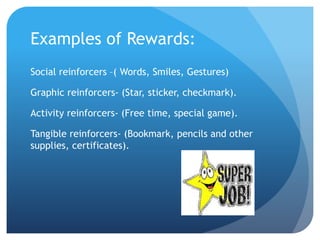
Examples of Rewards:
Social reinforcers –( Words, Smiles, Gestures)
Graphic reinforcers- (Star, sticker, checkmark).
Activity reinforcers- (Free time, special game).
Tangible reinforcers- (Bookmark, pencils and other
supplies, certificates).
Examples of Consequences:
-Timeout
-Loss of privileges
-Removed from class or group
-Calling the parent
-Detention
DO NOT USE THREATS! MAKE SURE YOU FOLLOW THROUGH
WITH WHATEVER YOU ARE GOING TO DO!
Example of Assertive Discipline
being used in a Classroom
 https://www.youtube.com/watch?v=9g-Jsc03hAo

assertive disipline .pptx

  • 1.
    Canter and Canter AssertiveDiscipline By: Cristina Eatherley & J’ree Cann
  • 2.
    About the Canter’s Assertive discipline, or the Canter model, is a classroom management model developed by Lee and Marlene Canter.  Lee Canter, who was an educator and clinical social worker, devoted majority of his professional career to helping educators work more effectively with students who exhibited behavioral disorders.  Marlene Canter has advanced training in special education.  Through their research and personal experiences, the Canter’s developed Assertive Discipline.
  • 3.
    Assertive Discipline  Assertivediscipline is a structured, systematic approach designed to assist educators in running an organized, teacher-in-charge classroom environment.  It is also known as the "take-control" approach to teaching, as the teacher controls their classroom in a firm but positive manner.  The approach maintains that teachers must establish rules and directions that clearly define the limits of acceptable and unacceptable student behavior, and teach these rules and directions.
  • 4.
    Principles of AssertiveDiscipline  Responsible Behavior  Classroom control  Teachers have basic rights as educators  Students have basic rights as learners  Clear expectations and consequences  Assertive rules
  • 5.
    Principle's of Assertivediscipline From a teacher’s point of view:  I will not tolerate any student stopping me from teaching.  I will not tolerate any student preventing another student from learning.  I will not tolerate any student engaging in any behavior that is not in the student's best interest and the best interest of others.  Most importantly, whenever a student chooses to behave appropriately, I will immediately recognize and reinforce such behavior.  Finally, assertive teachers are the "boss" in their classroom. They have the skills and confidence necessary to "take charge" in their classroom.
  • 6.
    Goal of Approach Allowing teacher’s to engage their students in the learning environment in the classroom and continue on despite any misbehaviors.
  • 7.
    What it lookslike in the classroom  There is no reason for misbehavior in the classroom.  Establish 4 or 5 rules and follow through with them.  Determine appropriate positive and negative consequences for the respective outcomes.  Modeling rules, routines and expectations.  Display rules clearly in the classroom.  Review rules and expectations.  Use encouraging words rather than condescending words.
  • 8.
    Describing Expectations  Somestudents may need more than just stating what the rule is. It is important that you use examples to make sure they clearly understand what is expected of them  Creating scenario's so they understand.
  • 9.
    Modeling rules, routinesand procedures -Not only must you verbalize the rules, but most importantly you must model it for your students. -Role play is a good way to model the rules.
  • 10.
    Reviewing Expectations  Youcan not expect your children to follow the rules if you just to stick your rules on the wall and explain your rules on only the first day of school. Children, especially the younger ones, need to hear the rules being repeated to them so that is clear to them.  For the first couple weeks of school the teacher should review these rules each day so that they can internalize it.  Eventually, if it is done enough times, you will only need to review the rules occasionally.  Most importantly you need to FOLLOW THROUGH!
  • 11.
    Encouraging words vs.Condescending Words  Students respond to your requests, rules and demands 9 times out of 10 when encouraged in a positive manner.  Encouragement focuses on the effort more than the product, helping children evaluate their own efforts towards their goals Examples of Encouraging words:  “ You put a lot of effort into your work.”  “ I see you used your kind words when you asked John if he could share his crayons.”
  • 12.
    Rewards and Consequences In order for Assertive Discipline to work, the teacher needs to establish clear rewards and consequences.  Just as the rules need to be taught to the students, so does the rewards and consequences that follow.  The teacher needs to determine what will happen if they follow the rules. Ex. Set up a reward system  The teacher needs to determine what will happen if the if students fail to comply to the rules.  These rewards and consequences need to be clearly established to the students.
  • 13.
    Examples of Rewards: Socialreinforcers –( Words, Smiles, Gestures) Graphic reinforcers- (Star, sticker, checkmark). Activity reinforcers- (Free time, special game). Tangible reinforcers- (Bookmark, pencils and other supplies, certificates).
  • 14.
    Examples of Consequences: -Timeout -Lossof privileges -Removed from class or group -Calling the parent -Detention DO NOT USE THREATS! MAKE SURE YOU FOLLOW THROUGH WITH WHATEVER YOU ARE GOING TO DO!
  • 15.
    Example of AssertiveDiscipline being used in a Classroom  https://www.youtube.com/watch?v=9g-Jsc03hAo