MR. RONIT RAJENDRA KHARADE
(ASSISTANT PROFESSOR & TPO)
FUNCTION OF
HUMAN RESOURCE MANAGEMENT
Functions of HRM
HRM functions (also called processes) are carried out by the HR
managers to fulfil the goals and objectives of the organization. They
perform two sets of functions, namely managerial functions and
operative functions. The managerial functions are the basic functions
performed by the HR managers in their capacity as managers or
heads of their own departments. In fact, all managers, irrespective of
their departments, perform these functions. The operative functions,
on the other hand, are specialized activities performed exclusively by
the HR managers, usually for all the departments. We shall first
discuss the managerial functions.
Managerial Functions
Functions like planning, organizing, staffing, directing and controlling
constitute the core managerial functions of an organization. The
specific activities performed under each of these functions are
explained as follows:
Planning
It is an effective tool to deal with the future. It involves the process of
pre- determining the personnel programmes that are necessary to attain
the organizational goals. In this context, accurate forecasting is vital to
the success of any plan. Planning is such a crucial function for an
organization that it is the key to all other managerial functions. The
steps involved in planning are
ď‚§Establishing goals and objectives to be achieved
ď‚§Developing rules and procedures
ď‚§Determining plans and forecasting techniques
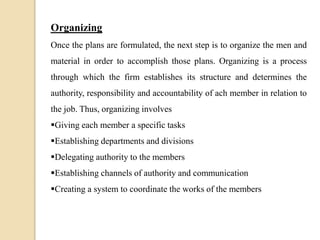
Organizing
Once the plans are formulated, the next step is to organize the men and
material in order to accomplish those plans. Organizing is a process
through which the firm establishes its structure and determines the
authority, responsibility and accountability of ach member in relation to
the job. Thus, organizing involves
ď‚§Giving each member a specific tasks
ď‚§Establishing departments and divisions
ď‚§Delegating authority to the members
ď‚§Establishing channels of authority and communication
ď‚§Creating a system to coordinate the works of the members
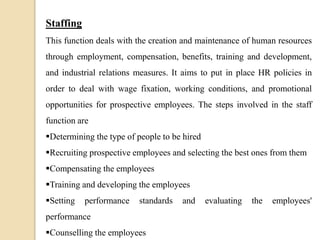
Staffing
This function deals with the creation and maintenance of human resources
through employment, compensation, benefits, training and development,
and industrial relations measures. It aims to put in place HR policies in
order to deal with wage fixation, working conditions, and promotional
opportunities for prospective employees. The steps involved in the staff
function are
ď‚§Determining the type of people to be hired
ď‚§Recruiting prospective employees and selecting the best ones from them
ď‚§Compensating the employees
ď‚§Training and developing the employees
ď‚§Setting performance standards and evaluating the employees'
performance
ď‚§Counselling the employees
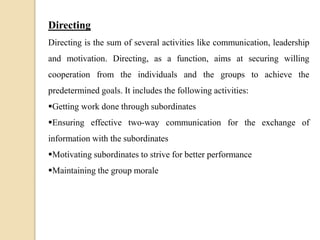
Directing
Directing is the sum of several activities like communication, leadership
and motivation. Directing, as a function, aims at securing willing
cooperation from the individuals and the groups to achieve the
predetermined goals. It includes the following activities:
ď‚§Getting work done through subordinates
ď‚§Ensuring effective two-way communication for the exchange of
information with the subordinates
ď‚§Motivating subordinates to strive for better performance
ď‚§Maintaining the group morale
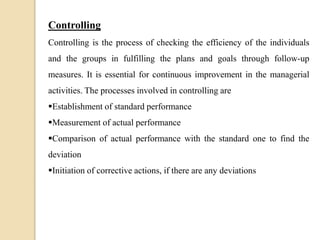
Controlling
Controlling is the process of checking the efficiency of the individuals
and the groups in fulfilling the plans and goals through follow-up
measures. It is essential for continuous improvement in the managerial
activities. The processes involved in controlling are
ď‚§Establishment of standard performance
ď‚§Measurement of actual performance
ď‚§Comparison of actual performance with the standard one to find the
deviation
ď‚§Initiation of corrective actions, if there are any deviations
Operative Functions
Staffing is one of the managerial functions. But this function is normally
performed by the HR managers for all the departments of the firm. In
most organizations, the HR department establishes personnel policies
and coordinates the HR functions of all the departments. This function is
also called the operative function or HRM function. It includes, amongst
others, the processes of hiring, training, compensating, appraising and
retaining employees, and attending to their labour relations, health and
safety, and equality concerns.
Procurement
Procurement refers to a series of activities undertaken by the HR
managers for filling the present and future vacancies of the
organization. The activities include job analysis and designing, HR
planning, recruitment and, finally, the selection of suitable employees.
Here, job analysis refers to both the determination of specific tasks and
responsibilities connected to a job and identifying the skills, knowledge
and abilities required for the job holder. HR planning involves choosing
and placing the right person at the right job and at the right time.
Recruitment involves gathering a pool of applicants from which
suitable employees may be selected. Lastly, selection involves
screening, testing, interviewing and hiring the most suitable employees
for the organization.
Development
Development here refers to both employees' training and management
development. HR managers are responsible for conducting and
supervising training and development programmes for employees. The
purpose of a training and development programme is to increase the
employees' competencies in their job by improving their knowledge,
skills and abilities. Training and development is widely accepted as a
method for enhancing the employee skills, increasing the individual
and organizational performance, improving the employee morale, and
achieving the business growth and success.
Compensation
Compensation refers to the determination of the pay scale and other
benefits for the employees. Establishing and maintaining the pay system
of an organization is one of the principal jobs of the HR managers. They
must devise ways to ensure fair and equitable pay rates. In addition, HR
managers should regularly manage the performance evaluation system of
the organization, and continuously design reward systems such as
performance- linked incentive plans and bonus and flexible work
schedules.
Maintenance
The maintenance function aims at retaining efficient and experienced
employees in the organization. This calls for creative HR practices. In
this regard, HR managers are responsible for offering a wide range of
HR programmes covering occupational safety, health promotion and
physical fitness, canteen facilities, recreation activities, transportation
programmes, employee suggestion schemes, career counselling and
growth for creating a positive work environment.
Integration
It consists mainly of industrial relations and aims at ensuring good
relations between the management and the employees. HR managers
have to implement industrial relations programmes that would ensure
ethical and fair treatment in disciplinary action, grievance redressed, and
career management processes. They should also counsel the employees
and the management to prevent and, when necessary, resolve disputes
over labour agreements or other labour relation issues. It is to be
understood here that the functions of HRM can vary widely from one
organization to another, depending upon its nature, size, and objectives.
For instance, a smaller organization may follow a shorter HRM process
with a greater emphasis on functions like procurement and compensation
and little or no priority for activities like training and development and
industrial relations maintenance. On the contrary, large organizations may
pursue a longer and more comprehensive HRM process to meet the
requirements of both the management and the workforce.
Function of HRM

Function of HRM

  • 1.
    MR. RONIT RAJENDRAKHARADE (ASSISTANT PROFESSOR & TPO) FUNCTION OF HUMAN RESOURCE MANAGEMENT
  • 2.
    Functions of HRM HRMfunctions (also called processes) are carried out by the HR managers to fulfil the goals and objectives of the organization. They perform two sets of functions, namely managerial functions and operative functions. The managerial functions are the basic functions performed by the HR managers in their capacity as managers or heads of their own departments. In fact, all managers, irrespective of their departments, perform these functions. The operative functions, on the other hand, are specialized activities performed exclusively by the HR managers, usually for all the departments. We shall first discuss the managerial functions.
  • 3.
    Managerial Functions Functions likeplanning, organizing, staffing, directing and controlling constitute the core managerial functions of an organization. The specific activities performed under each of these functions are explained as follows:
  • 4.
    Planning It is aneffective tool to deal with the future. It involves the process of pre- determining the personnel programmes that are necessary to attain the organizational goals. In this context, accurate forecasting is vital to the success of any plan. Planning is such a crucial function for an organization that it is the key to all other managerial functions. The steps involved in planning are ď‚§Establishing goals and objectives to be achieved ď‚§Developing rules and procedures ď‚§Determining plans and forecasting techniques
  • 5.
    Organizing Once the plansare formulated, the next step is to organize the men and material in order to accomplish those plans. Organizing is a process through which the firm establishes its structure and determines the authority, responsibility and accountability of ach member in relation to the job. Thus, organizing involves ď‚§Giving each member a specific tasks ď‚§Establishing departments and divisions ď‚§Delegating authority to the members ď‚§Establishing channels of authority and communication ď‚§Creating a system to coordinate the works of the members
  • 6.
    Staffing This function dealswith the creation and maintenance of human resources through employment, compensation, benefits, training and development, and industrial relations measures. It aims to put in place HR policies in order to deal with wage fixation, working conditions, and promotional opportunities for prospective employees. The steps involved in the staff function are ď‚§Determining the type of people to be hired ď‚§Recruiting prospective employees and selecting the best ones from them ď‚§Compensating the employees ď‚§Training and developing the employees ď‚§Setting performance standards and evaluating the employees' performance ď‚§Counselling the employees
  • 7.
    Directing Directing is thesum of several activities like communication, leadership and motivation. Directing, as a function, aims at securing willing cooperation from the individuals and the groups to achieve the predetermined goals. It includes the following activities: ď‚§Getting work done through subordinates ď‚§Ensuring effective two-way communication for the exchange of information with the subordinates ď‚§Motivating subordinates to strive for better performance ď‚§Maintaining the group morale
  • 8.
    Controlling Controlling is theprocess of checking the efficiency of the individuals and the groups in fulfilling the plans and goals through follow-up measures. It is essential for continuous improvement in the managerial activities. The processes involved in controlling are ď‚§Establishment of standard performance ď‚§Measurement of actual performance ď‚§Comparison of actual performance with the standard one to find the deviation ď‚§Initiation of corrective actions, if there are any deviations
  • 9.
    Operative Functions Staffing isone of the managerial functions. But this function is normally performed by the HR managers for all the departments of the firm. In most organizations, the HR department establishes personnel policies and coordinates the HR functions of all the departments. This function is also called the operative function or HRM function. It includes, amongst others, the processes of hiring, training, compensating, appraising and retaining employees, and attending to their labour relations, health and safety, and equality concerns.
  • 10.
    Procurement Procurement refers toa series of activities undertaken by the HR managers for filling the present and future vacancies of the organization. The activities include job analysis and designing, HR planning, recruitment and, finally, the selection of suitable employees. Here, job analysis refers to both the determination of specific tasks and responsibilities connected to a job and identifying the skills, knowledge and abilities required for the job holder. HR planning involves choosing and placing the right person at the right job and at the right time. Recruitment involves gathering a pool of applicants from which suitable employees may be selected. Lastly, selection involves screening, testing, interviewing and hiring the most suitable employees for the organization.
  • 11.
    Development Development here refersto both employees' training and management development. HR managers are responsible for conducting and supervising training and development programmes for employees. The purpose of a training and development programme is to increase the employees' competencies in their job by improving their knowledge, skills and abilities. Training and development is widely accepted as a method for enhancing the employee skills, increasing the individual and organizational performance, improving the employee morale, and achieving the business growth and success.
  • 12.
    Compensation Compensation refers tothe determination of the pay scale and other benefits for the employees. Establishing and maintaining the pay system of an organization is one of the principal jobs of the HR managers. They must devise ways to ensure fair and equitable pay rates. In addition, HR managers should regularly manage the performance evaluation system of the organization, and continuously design reward systems such as performance- linked incentive plans and bonus and flexible work schedules.
  • 13.
    Maintenance The maintenance functionaims at retaining efficient and experienced employees in the organization. This calls for creative HR practices. In this regard, HR managers are responsible for offering a wide range of HR programmes covering occupational safety, health promotion and physical fitness, canteen facilities, recreation activities, transportation programmes, employee suggestion schemes, career counselling and growth for creating a positive work environment.
  • 14.
    Integration It consists mainlyof industrial relations and aims at ensuring good relations between the management and the employees. HR managers have to implement industrial relations programmes that would ensure ethical and fair treatment in disciplinary action, grievance redressed, and career management processes. They should also counsel the employees and the management to prevent and, when necessary, resolve disputes over labour agreements or other labour relation issues. It is to be understood here that the functions of HRM can vary widely from one organization to another, depending upon its nature, size, and objectives.
  • 15.
    For instance, asmaller organization may follow a shorter HRM process with a greater emphasis on functions like procurement and compensation and little or no priority for activities like training and development and industrial relations maintenance. On the contrary, large organizations may pursue a longer and more comprehensive HRM process to meet the requirements of both the management and the workforce.