CONTENT


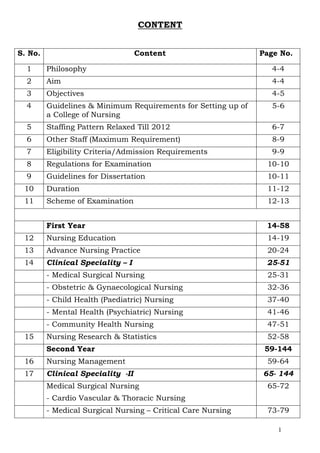
S. No.                             Content                     Page No.

  1      Philosophy                                               4-4
  2      Aim                                                      4-4
  3      Objectives                                               4-5
  4      Guidelines & Minimum Requirements for Setting up of      5-6
         a College of Nursing
  5      Staffing Pattern Relaxed Till 2012                       6-7
  6      Other Staff (Maximum Requirement)                        8-9
  7      Eligibility Criteria/Admission Requirements              9-9
  8      Regulations for Examination                            10-10
  9      Guidelines for Dissertation                            10-11
 10      Duration                                               11-12
 11      Scheme of Examination                                  12-13


         First Year                                             14-58
 12      Nursing Education                                      14-19
 13      Advance Nursing Practice                               20-24
 14      Clinical Speciality – I                                25-51
         - Medical Surgical Nursing                             25-31
         - Obstetric & Gynaecological Nursing                   32-36
         - Child Health (Paediatric) Nursing                    37-40
         - Mental Health (Psychiatric) Nursing                  41-46
         - Community Health Nursing                             47-51
 15      Nursing Research & Statistics                          52-58
         Second Year                                            59-144
 16      Nursing Management                                     59-64
 17      Clinical Speciality -II                               65- 144
         Medical Surgical Nursing                               65-72
         - Cardio Vascular & Thoracic Nursing
         - Medical Surgical Nursing – Critical Care Nursing     73-79

                                                                   1
- Medical Surgical Nursing – Oncology Nursing             80-87
     - Medical Surgical Nursing - Neurosciences Nursing        88-95
     - Medical Surgical Nursing - Nephro- Urology Nursing     96-102
     - Medical Surgical Nursing -Orthopedic Nursing           103-110
     - Medical Surgical Nursing - Gastro Enterology Nursing   111-117
     - Obstetric & Gynaecological Nursing                     118-124
     - Paediatric (Child Health) Nursing                      125-130
     - Psychiatric (Mental Health) Nursing                    131-137
     - Community Health Nursing                               138-144
18   Annexure – I (Staffing Pattern Relaxed till 2012)        145-145


                                                                 2
SYLLABUS AND REGULATIONS


       M.Sc. (NURSING)


              Published by

      INDIAN NURSING COUNCIL
  Combined Council Building, Kotla Road,
    Temple Lane, New Delhi – 110002


                                           3
Philosophy

National Health Policy(NHP) 2002 emphasizes the need to prepare nurses to
function in super-speciality areas who are required in tertiary care
institutions, entrusting some limited public health functions to nurses after
providing adequate training, and increase the ratio of degree holding vis a
vis diploma holding nurses.

It is observed that there is an acute shortage of nursing faculty in under
graduate and post graduate nursing programme in India

Indian Nursing Council believes that:

Post Graduate programme is essential to prepare nurses to improve the
quality of nursing education and practice in India. .

Post graduate programme in nursing builds upon and extends competence
acquired at the graduate levels, emphasizes application of relevant theories
into nursing practice, education, administration and development of
research skills.

The programme prepares nurses for leadership position in nursing and
health fields who can function as nurse specialists, consultants, educators,
administrators and researchers in a wide variety of professional settings in
meeting the National priorities and the changing needs of the society.

This programme provides the basis for the post masteral programme in
nursing. Further the programme encourages accountability and
commitment to life long learning which fosters improvement of quality care.


Aim

The aim of the postgraduate program in nursing is to prepare graduates to
assume responsibilities as nurse specialists, consultants, educators,
administrators in a wide variety of professional settings


Objectives

On Completion of the two year M.Sc Nursing programme, the graduate will
be able to:-

1.    Utilize/apply the concepts, theories and principles of nursing science
2.    Demonstrate advance competence in practice of nursing
3.    Practice as a nurse specialist.
4.    Demonstrate leadership qualities and function effectively as nurse
      educator and manager.
5.    Demonstrate skill in conducting nursing research, interpreting and
      utilizing the findings from health related research.

                                                                               4
6.    Demonstrate the ability to plan and effect change in nursing practice
      and in the health care delivery system.
7.    Establish collaborative relationship with members of other disciplines
8.    Demonstrate interest in       continued    learning   for   personal   and
      professional advancement.


Guidelines and Minimum Requirements for setting up of a
College of Nursing
1.    Any organization under the Central Government, State Government,
      Local body or a Private or Public Trust, Mission, Voluntary registered
      under Society Registration Act or a Company registered under
      company’s act wishes to open a M.Sc. Nursing programme, should
      obtain the No Objection/Essentiality certificate from the State
      Government.
2.    The Indian Nursing council on receipt of the proposal from the
      Institution to start nursing program, will undertake the first
      inspection to assess suitability with regard to physical infrastructure,
      clinical facility and teaching faculty in order to give permission to start
      the programme.
3.    After the receipt of the permission to start the nursing programme
      from Indian Nursing Council, the institution shall obtain the approval
      from the State Nursing Council and University.
4.    Institution will admit the students only after taking approval of State
      Nursing Council and University.
5.    The Indian Nursing Council will conduct inspection every year till the
      first batch completes the programme. Permission will be given year by
      year till the first batch completes.
6.    If the institution is recognized for B.Sc. (N) programme and if one
      batch has passed out after found suitable by INC, then the institution
      will be exempted from NOC/Essentiality certificate for M.Sc.(N)
      programe from the State Government.
7.    Super Speciality Hospital* can start M.Sc.(N) programme, however
      they have to get NOC/Essentiality certificate from respective State
      Government to start the M.Sc. (N) programme.
*Super Speciality Hospital are eligible to start M.Sc.(N) provided they have
respective speciality beds

Cardio thoracic beds

      50-100 bedded Cardiac Hospital, which has CCU, ICCU and ICU units
      with own thoracic unit or affiliated thoracic unit.

Critical Care beds

      250-500 bedded Hospital, which has a 8-10 beds critical care beds &
      ICUs

                                                                               5
OBG speciality beds

   50 bedded   parent hospital having:
        i.      Mother and neonatal units
       ii.      Case load of minimum 500 deliveries per year
      iii.      8-10 level II neonatal beds.
      iv.       Affiliation with level III neonatal beds

   Neuro speciality beds

        Minimum of 50 bedded Neuro care institution with advanced
        diagnostic, therapeutic and state of the art clinical facilities

   Oncology speciality beds

        Regional Cancer centers/Cancer Hospitals having minimum 100 beds,
        with medical and surgical oncology units with chemotherapy,
        radiotherapy, palliative care, other diagnostic and supportive facilities.

   Orthopaedic Speciality beds

        250-500 bedded Hospital, which has a 50 orthopaedic beds &
        rehabilitation units.

   Psychiatric beds

        Minimum of 50 bedded institutes of psychiatry and mental health
        having all types of patients (acute, chronic, adult psychiatric beds,
        child psychiatric beds and de-addiction facilities) , with advanced
        diagnostic, therapeutic and state of the art clinical facilities.

   Paediatrics beds

        50-100 bedded paediatric Hospital/ unit with paediatric surgery and
        level II or III neonatal units

   Gastroentrology beds

        50-100 bedded gastroentrology beds

   Nephro-Urology speciality beds

        50-100 bedded nephro urology hospital with dialysis and kidney
        transplants, urosurgery

STAFFING PATTERN:

   M.Sc. (N)

   If parent hospital is super-speciality hospital like cardio-thoracic
   hospital/cancer with annual intake 10 M.Sc(N) in cardio thoracic/cancer

                                                                                6
Professor cum coordinator                       1
              Reader / Associate Professor                    1
              Lecturer                                        2

    The above faculty shall perform dual role

    B.Sc.(N) and M.Sc.(N)

    Annual intake of 60 students in B.Sc.(N) and 25 students for M.Sc.(N)
    programme

    Professor-cum-Principal                           1
    Professor-cum-Vice Principal                      1
    Reader / Associate Professor                      5
    Lecturer                                           8
    Tutor / Clinical Instructor                      19
                                               ---------------
              Total                                  34

    One in each specialty and all the M.Sc(N) qualified teaching faculty will
    participate in all collegiate programmes.

    Teacher Student Ratio = 1 : 10 for M.Sc.(N) programme.

QUALIFICATIONS & EXPERIENCE OF TEACHERS OF COLLEGE OF NURSING

    Sr. No.     Post                                Qualification & Experience

    1           Professor-cum-Principal   -
                                          Masters Degree in Nursing
                                          -
                                          14 years experience after M.Sc. (N) in College of
                                          Nursing .
                                       - 3 years experience in administration (Years of
                                          experience is relaxable if suitable candidate is not
                                          available) (If a candidate is not available, minimum 5
                                          years of experience in college of nursing, with an
                                          aggregate of 14 years teaching experience)
    Desirable : Independent published work of high standard / doctorate degree / M.Phil.

    2          Professor-cum-Vice         -   Masters Degree in Nursing
               Principal                  -   14 years experience after M.Sc. (N) in College of
                                              Nursing .
                                          -   3 years experience in administration (Years of
                                              experience is relaxable if suitable candidate is not
                                              available) (If a candidate is not available, minimum 5
                                              years of experience in college of nursing, with an
                                              aggregate of 14 years teaching experience)

    Desirable : Independent published work of high standard / doctorate degree / M.Phil.


                                                                                               7
3            Reader / Associate      -   Master Degree in Nursing.
             Professor               -   10 years experience after M.Sc.(N) in a College of
                                         Nursing. (If a candidate is not available, 5 years of
                                         experience in College of Nursing with an aggregates
                                         of 10 years teaching experience.

Desirable : Independent published work of high standard /doctorate degree / M.Phil.

4            Lecturer                -   Master Degree in Nursing.
                                     -   3 years teaching experience after M.Sc. (N)

Note: Qualifications & Experience of Nursing Teaching faculty
             relaxed till 2012 & placed under Annexure - I

External /Guest faculty may be arranged for the selected units in different subjects as
required

NOTE:
  1.          No part time nursing faculty will be counted for calculating total
              no. of faculty required for a college.
    2.        Irrespective of number of admissions, all faculty positions
              (Professor to Lecturer) must be filled.
    3.        For M.Sc.(N) programme appropriate number of M.Sc. faculty in
              each speciality be appointed subject to the condition that total
              number of teaching faculty ceiling is maintained.
    4.        All nursing teachers must possess a basic university or equivalent
              qualification as laid down in the schedules of the Indian Nursing
              Council Act, 1947. They shall be registered under the State
              Nursing Registration Act.
    5.        Nursing faculty in nursing college except tutor/clinical instructors
              must possess the requisite recognized postgraduate qualification in
              nursing subjects.
    6.        Holders of equivalent postgraduate qualifications, which may be
              approved by the Indian Nursing Council from time to time, may be
              considered to have the requisite recognized postgraduate
              qualification in the subject concerned.
    7.        All teachers of nursing other than Principal and Vice-Principal
              should spend at least 4 hours in the clinical area for clinical
              teaching and/or supervision of care every day.


Other Staff (Minimum requirements)

(To be reviewed and revised and rationalized keeping in mind the
mechanization and contract service)

         •     Ministerial
                 a)     Administrative Officer           1
                 c)     Office Superintendent            1
                 d)     PA to Principal                  1
                 e)     Accountant/Cashier               1
                                                                                          8
•    Upper Division Clerk                2

     •    Lower Division Clerk                2

     •    Store Keeper                        1
            a)    Maintenance of stores       1
            b)    Classroom attendants        2
            c)    Sanitary staff              As per the physical space
            d)    Security Staff              As per the requirement

     •    Peons/Office attendants             4

     •    Library
            a)    Librarian                   2
            b)    Library Attendants          As per the requirement

      •   Hostel
           a)    Wardens                      2
           b)    Cooks, Bearers,              As per the requirement
                 Sanitary Staff
           c)    Ayas /Peons                  As per the requirement
           d)    Security Staff               As per the requirement
           e)    Gardeners & Dhobi            Depends on structural facilities
                 (desirable)

Eligibility Criteria/Admission Requirements:
1.   The candidate should be a Registered Nurse and Registered midwife or
     equivalent with any State Nursing Registration Council.
2.   The minimum education requirements shall be the passing of :
     B.Sc. Nursing / B.Sc. Hons. Nursing / Post Basic B.Sc. Nursing with
     minimum of 55% aggregate marks.
3.   The candidate should have undergone in B.Sc. Nursing / B.Sc. Hons.
     Nursing / Post Basic B.Sc. Nursing in an institution which is
     recognized by Indian Nursing Council.
4.   Minimum one year of work experience after Basic B.Sc. Nursing.
5.   Minimum one year of work experience prior or after Post Basic B.Sc.
     Nursing.
6.   Candidate shall be medically fit.
7.   5% relaxation of marks for SC/ST candidates may be given.


Entrance/Selection test

     Selection of the candidates should be based on the merit of the
     entrance examination held by University or competent authority.


                                                                          9
Regulations for examination:

Eligibility for appearing for the examination:

         75% of the attendance for theory and practicals. However 100% of
         attendance for practical before the award of degree

Classification of results:

•   50% pass in each of the theory and practical separately.
•   50-59% Second division
•   60-74% first division
•   75% and above is distinction
•   For declaring the rank aggregate of 2 years marks to be considered

If the candidate fails in either practicals or theory paper he/she has to re-
appear for both the papers (theory and practical)

Maximum no. of attempts per subject is three (3) inclusive of first attempt.
The maximum period to complete the course successfully should not exceed
4 years

Candidate who fails in any subject, shall be permitted to continue the
studies into the second year. However the candidate shall not be allowed to
appear for the Second year examination till such time that he/she passes all
subjects of the first year M.Sc nursing examination

Practicals

•   4 hours of practical examination per student.
•   Maximum number of 10 students per day per speciality.
•   The examination should be held in clinical area only for clinical
    specialities
•   One internal and external should jointly conduct practical examination
•   Examiner – Nursing faculty teaching respective speciality area in M.Sc
    nursing programme with minimum 3 years experience after M.Sc
    nursing.

Dissertation

Evaluation of the dissertation should be done by the examiner prior to viva
Duration: Viva-voce -minimum 30 minutes per student


Guidelines for Dissertation

Tentative Schedule for dissertation

S. No.                Activities                    Scheduled Time

    1.     Submission of the research       End of 9th month of 1st year
           proposal

                                                                           10
2.      Submission of dissertation –      End of 9th month of IInd Year
             Final

Note: - Administrative approval and ethical clearance should be obtained

A.         Research Guides

           a) Qualification of Guide

              Main guide : Nursing faculty / nursing expert in the same clinical
              speciality holding Ph.D./M.Phil/M.Sc. Nursing with a minimum of
              3 years experience in teaching in the Post Graduate Programme in
              Nursing.

              Co-Guide : A Co-Guide is a nursing faculty/expert in the field of
              study (may be from outside the college but should be within the
              city.)

           b) Guide – Students Ratio

              Maximum of 1:4 (including as co-guide)

           c) Research Committee

              There should be a research committee in each college comprising of
              minimum 5 members chaired by the Principal, College of Nursing.

Duration

Duration of the course is 2 years for M.Sc. (N)

              Available                         52 weeks
              Vacation                           4 weeks
              Examination                        2 weeks
              Gazetted holidays                  3 weeks
              Total weeks available             43 weeks
              40 hours per week               1720 hours
              Total hours for 2 years        3440 hours

                                  Course of Instruction
                                                      Theory       Practical
                                                        (hrs)        (hrs)
          1st year
          Nursing education                                 150                150
          Advance nursing practice                          150                200
          Nursing Research and statistics                   150                100
          *Clinical speciality –I                           150                650

                                                                                11
Total                                                             600               1100
           II nd Year
           Nursing Management                                                150                 150
           Nursing Research(Dissertation)                                                        300

           *Clinical Speciality-II                                           150                 950
           Total                                                             300               1400

           Educational visit 2 weeks

    *Clinical Speciality – Medical Surgical Nursing (Cardio Vascular & Thoracic Nursing,
    Critical care Nursing, Oncology Nursing, Neurosciences Nursing, Nephro-Urology Nursing,
    Orthopedic Nurisng, Gastro Enterology Nursing,)Obstetric & Gynaecological Nursing, Child
    Health (Paediatric) Nursing, Mental Health(Psychiatric) Nursing, Community Health
    Nursing, Psychiatric (Mental Health) Nursing etc.

    Note: Students have to maintain log book for each activity during the
    course of study

Scheme of Examination
                                                 Theory                            Practical
1st year                             Hours Internal         External Hours         Internal External
Nursing education                           3          25           75                    50            50
Advance nursing practice                    3          25           75
Nursing Research and
statistics                                  3       25**           75*
Clinical speciality -I                      3         25           75                   100          100
Total                                                100          300                   150          150


II nd Year
Nursing Management                          3          25           75
Dissertation & Viva                                                                     100            100
Clinical Speciality-II                      3         25           75                   100          100
Total                                                 50          150                   200          200
* Nursing research=50 and statistics=25
**Nursing research=15 and statistics=10
      1.     Minimum pass marks shall be 50 % in each of the Theory and practical papers separately.
      2.     A candidate must have minimum of 80% attendance (irrespective of the kind of absence)
             in theory and practical in each subject for appearing for examination.
      3.     A candidate must have 100% attendance in each of the practical areas before award of
             degree
      4.     A candidate has to pass in theory and practical exam separately in each of the paper.
      5.     If a candidate fails in either theory or practical paper he/she has to re-appear for both the
             papers (Theory and practical).
      6.     Maximum no. of attempts permitted for each paper is 3 including first attempt.

                                                                                                   12
7.    The maximum period to complete the course successfully should not exceed 4 (four)
        years
  8.    A candidate failing in more then two subjects will not be promoted to the IInd year.
  9.    No candidate shall be admitted to the subsequent IInd year examination unless the
        candidate has passed the Ist year examination.
  10.   Maximum number of candidates for all practical examination should not exceed 10 per
        day.
  11.   Provision of Supplementary examination should be made.
  12.   All practical examinations must be held in the respective clinical areas.
  13.   One internal and One external examiners(outside the University) should jointly conduct
        practical examination for each student
  14.   An examiner should be M.Sc (N) in concerned subject and have minimum of 3 (three)
        years post graduate teaching experience.
  15.   One internal and One external examiners(outside the University) should evaluate
        dissertation and jointly conduct viva-voce for each student
  16.   For Dissertation Internal examiner should be the guide and external examiner should be
        Nursing faculty / nursing expert in the same clinical speciality holding
        Ph.D./M.Phil/M.Sc. Nursing with a minimum of 3 years experience in
        guiding the research projects for Post Graduate students of Nursing.

Admission Strength

Annual admission strength for M.Sc (N) Programme should have prior
sanction/permission from the Indian Nursing Council on the basis of
clinical, physical facilities and teaching faculty.

Health Services

There should be provisions for the following health services for the students.

(a)     An annual medical examination.
(b)     Vaccination against Tetanus, hepatitis B or any other communicable
        disease as considered necessary.
(c)     Free medical care during illness and / provision of health insurance
        should be made.
(d)     A complete health record should be kept in respect of each individual
        students. The question of continuing the training of a student, with
        long term chronic illness, will be decided by the individual college.


                                                                                        13
CURRICULUM

                         NURSING EDUCATION

Placement : Ist Year
                                                           Hours of Instruction
                                                             Theory 150 Hours
                                                           Practical 150 Hours
                                                              Total : 300 Hours

Course Description

This course is designed to assist students to develop a broad understanding
of Fundamental Principles, concepts, trends and issues related to education
and nursing education. Further, it would provide opportunity to students to
understand, appreciate and acquire skills in teaching and evaluation,
curriculum development, implementation, maintenance of standards and
accreditation of various nursing educational programs.


Objectives

At the end of the course, students will be able to :

1.    Explain the aims of education, philosophies, trends in education and
      health: its impact on nursing education.
2.    Describe the teaching learning process.
3.    Prepare and utilize various instructional media and methods in
      teaching learning process.
4.    Demonstrate competency in teaching, using various instructional
      strategies.
5.    Critically analyze the existing nursing educational programs, their
      problems, issues and future trends.
6.    Describe the process of curriculum development, and the need and
      methodology of curriculum change, innovation and integration.
7.    Plan and conduct continuing nursing education programs.
8.    Critically analyze the existing teacher preparation programs in
      nursing.
9.    Demonstrate skill in guidance and counseling.
10.   Describe the problems and issues related to administration of nursing
      curriculum including selection and organization of clinical experience.
11.   Explain the development of standards and accreditation process in
      nursing education programs.
12.   Identify research priorities in nursing education.
13.   Discuss various models of collaboration in nursing education and
      services.


                                                                              14
14.    Explain the concept, principles, steps, tools and techniques of
             evaluation
      15.    Construct, administer and evaluate various tools for assessment of
             knowledge, skill, and attitude.

      Course Content

Units              Hours                            Course Content

            Theory   Practical

  I           10                 Introduction :
                                    Education :Definition, aims, concepts, philosophies
                                    & their education implications,
                                    Impact     of   Social,   economical,   political  &
                                    technological changes on education:
                                    • Professional education
                                    • Current trends and issues in education
                                    • Educational reforms and National Educational
                                       policy, various educational commissions-reports
                                    • Trends in development of nursing education in
                                       India

 II           20           30    Teaching – Learning Process
                                   Concepts of teaching and learning: Definition,
                                   theories of teaching and learning, relationship
                                   between teaching and learning.
                                   Educational aims and objectives; types, domains,
                                   levels, elements and writing of educational objectives
                                   Competency based education(CBE) and outcome
                                   based education(OBE)
                                   Instructional design: Planning and designing the
                                   lesson, writing lesson plan : meaning, its need and
                                   importance, formats.
                                   Instruction strategies – Lecture, discussion,
                                   demonstration, simulation, laboratory, seminar,
                                   panel, symposium, problem solving, problem based
                                   learning (PBL), workshop, project, role- play(socio-
                                   drama), clinical teaching methods, programmed
                                   instruction, self directed learning(SDL), micro
                                   teaching,    computer     assisted   instruction(CAI),
                                   computer assisted learning (CAL)


                                                                                  15
Units          Hours                              Course Content

        Theory   Practical

 III      10           10    Instructional media and methods
                                Key concepts in the selection and use of media in
                                education
                                Developing learning resource material using different
                                media
                                Instructional aids – types, uses, selection,
                                preparation, utilization.
                                Teacher’s role in procuring and managing
                                instructional Aids – Project and non-projected aids,
                                multi media, video-tele conferencing etc

 IV       10                 Measurement and evaluation:
                               Concept and nature of measurement and evaluation,
                               meaning, process, purposes, problems in evaluation
                               and measurement.
                               Principles of assessment, formative and summative
                               assessment-      internal   assessment     external
                               examination, advantages and disadvantages.
                               Criterion and norm referenced evaluation,

 V        12           10    Standardized and non-standardized tests :
                                Meaning,       characteristics,   objectivity,   validity,
                                reliability, usability, norms, construction of tests-
                                • Essay, short answer questions and multiple
                                    choice questions.
                                • Rating scales, checklist, OSCE/OSPE(Objective
                                    structured clinical/practical examination)
                                • Differential scales, and summated scales,
                                    sociometry, anecdotal record, attitude scale,
                                    critical incident technique
                                Question bank-preparation, validation, moderation
                                by panel, utilization
                                Developing a system for maintaining confidentiality

 VI       8            5     Administration, Scoring and Reporting
                               Administering a test; scoring, grading versus marks
                               Objective tests, scoring essay test, methods of
                               scoring, Item analysis.

 VII      12           6     Standardized Tools
                                Tests of intelligence aptitude, interest, personality,
                                achievement, socio-economic status scale, tests for
                                special mental and physical abilities and disabilities.


                                                                                  16
Units          Hours                            Course Content

        Theory   Practical

VIII      5            6     Nursing Educational programs
                               Perspectives of nursing education:      Global and
                               national.
                               Patterns of nursing education and training
                               programmes in India. Non-university and University
                               programs: ANM, GNM, Basic B.Sc. Nursing, Post
                               Certificate B.Sc. Nursing, M.Sc(N) programs, M.Phil
                               and Ph.D) in Nursing, post basic diploma programs,
                               nurse practitioner programs.

 IX       12           25    Continuing Education in Nursing
                               Concepts – Definition, importance, need scope,
                               principles of adult learning, assessments of learning
                               needs, priorities, resources.
                               Program planning, implementation and evaluation of
                               continuing education programs.
                               Research in continuing education.
                               Distance education in nursing.

 X        10           10    Curriculum Development
                               Definition, curriculum determinants, process and
                               steps of curriculum development, Curriculum
                               models, Types and framework.
                               Formulation of philosophy, objectives, selection and
                               organization of learning experiences; master plan,
                               course plan, unit plan.
                               Evaluation strategies, process of curriculum change,
                               role of students, faculty, administrators, statutory
                               bodies and other stakeholders.
                               Equivalency of courses: Transcripts, credit system.

 XI       8            4     Teacher preparation
                               Teacher – roles & responsibilities, functions,
                               characteristics, competencies, qualities,
                               Preparation of professional teacher
                               Organizing     professional   aspects     of teacher
                               preparation programs
                               Evaluation: self and peer
                               Critical analysis of various programs of teacher
                               education in India.


                                                                             17
Units          Hours                             Course Content

        Theory   Practical

 XII      10           5     Guidance and counseling
                               Concept, principles, need, difference between
                               guidance and counseling , trends and issues.
                               Guidance and counseling services : diagnostic and
                               remedial.
                               Coordination and organization of services.
                               Techniques of counseling : Interview, case work,
                               characteristics   of    counselor,    problems     in
                               counseling.
                               Professional preparation and training for counseling.

XIII      15           10    Administration of Nursing Curriculum
                               Role of curriculum coordinator – planning,
                               implementation and evaluation.
                               Evaluation of educational programs in nursing-
                               course and program.
                               Factors influencing faculty staff relationship and
                               techniques of working together.
                               Concept of faculty supervisor (dual) position.
                               Curriculum research in nursing.
                               Different models of collaboration between education
                               and service

XIV       10                 Management of nursing educational institutions
                               Planning,      organizing,      staffing,    budgeting,
                               recruitment, discipline, public relation, performance
                               appraisal, welfare services, library services, hostel,
 XV       5            5        Development and maintenance of standards and
                                accreditation in nursing education programs.
                                Role of Indian Nursing Council, State Registration
                                Nursing Councils, Boards and University.
                                Role of Professional associations and unions.


   Activities :
   • Framing philosophy, aims and objectives.
   • Lesson Planning.
   • Micro teaching-2.
   • Conduct practice teachings using different teaching strategies -10
     (like lecture cum discussion, demonstration- lab method, field trips,
     seminars, project, role play, panel discussion, clinical methods etc)
   • Preparation and utilization of instructional Aids using different media.
   • Develop course plans, unit plans, rotation plans.
   • Conduct a continuing education workshop.
   • Annotated bibliography.
   • Critical evaluation of any nursing education program offered by a
     selected institution.
   • Planning and Organizing field visits.

                                                                              18
•   Educational visits.
•   Field visits (INC/SNRC) to get familiar with recognition/registration
    process.
•   Construct, administer and evaluate tools (objective & essay type test,
    observation checklist, rating scale etc )
•   Observe and practice application of various non-standardized tests
    (intelligence, Aptitude, Personality, Sociometry, physical & mental
    disabilities tests.)

Methods of Teaching
• Lecture cum discussion
• Demonstration/ Return demonstration
• Seminar / Presentations
• Project work
• Field visits
• Workshop

Methods of evaluation
• Tests
• Presentation
• Project work
• Written assignments

Internal Assessment

                  Techniques                         Weightage
                  Test- (2 tests)                         50
                  Assignment                              25
                  Seminar/presentation                    25
                                               ----------------------
                                                          100
                                               ----------------------

                  Practical – Internal assessment

                  Learning resource material             25
                  Practice Teaching                      50
                  Conduct Workshop                       25
                  /Short Term Course

Practical – external assessment
Practice teaching- 1-                                    50
Preparation/use of learning resource material-1          25
Construction of tests/rotation plan.                     25


                                                                        19
ADVANCE NURSING PRACTICE


Placement: 1ST Year
                                                           Hours of Instruction
                                                             Theory 150 Hours
                                                           Practical 200 Hours
                                                             Total : 350 Hours

Course Description

The course is designed to develop an understanding of concepts and
constructs of theoretical basis of advance nursing practice and critically
analyze different theories of nursing and other disciplines.


Objectives:

At the end of the course the students will be able to:

1.   Appreciate and analyze the development of nursing as a profession.
2.   Describe ethical, legal, political and economic aspects of health care
     delivery and nursing practice.
3.   Explain bio- psycho- social dynamics of health, life style and health
     care delivery system.
4.   Discuss concepts, principles, theories, models, approaches relevant to
     nursing and their application.
5.   Describe scope of nursing practice.
6.   Provide holistic and competent nursing care following nursing process
     approach.
7.   Identify latest trends in nursing and the basis of advance nursing
     practice.
8.   Perform extended and expanded role of nurse.
9.   Describe alternative modalities of nursing care.
10. Describe the concept of quality control in nursing.
11. Identify the scope of nursing research.
12. Use computer in patient care delivery system and nursing practice.
13. Appreciate importance        of   self   development    and    professional
    advancement.


                                                                            20
Course Content

Unit   Hours                                 Content
 I      10         Nursing as a Profession
                     History    of    development     of   nursing   profession,
                     characteristics, criteria of the profession, perspective of
                     nursing profession-national, global
                     Code of ethics(INC), code of professional conduct(INC),
                     autonomy and accountability, assertiveness, visibility of
                     nurses, legal considerations,
                     Role of regulatory bodies
                     Professional organizations and unions-self defense,
                     individual and collective bargaining
                     Educational preparations, continuing education, career
                     opportunities, professional advancement & role and scope
                     of nursing education.
                     Role of research, leadership and management.
                     Quality assurance in nursing (INC).
                     Futuristic nursing.

 II      5     Health care delivery
                 Health care environment, economics, constraints, planning
                 process, policies, political process vis a vis nursing
                 profession.
                 Health care delivery system- national, state, district and
                 local level.
                 Major stakeholders in the health care system-Government,
                 non-govt, Industry and other professionals.
                 Patterns of nursing care delivery in India.
                 Health care delivery concerns, national health and family
                 welfare programs, inter-sectoral coordination, role of non-
                 governmental agencies.
                 Information, education and communication (IEC).
                 Tele-medicine.

III      10    Genetics
                 Review of cellular division, mutation and law of inheritance,
                 human genome project ,The Genomic era.
                 Basic concepts of Genes, Chromosomes & DNA.
                 Approaches to common genetic disorders.
                 Genetic testing – basis of genetic diagnosis, Pre symptomatic
                 and predisposition testing, Prenatal diagnosis & screening,
                 Ethical, legal & psychosocial issues in genetic testing.
                 Genetic counseling.
                 Practical application of genetics in nursing.

 IV      10    Epidemiology
                  Scope, epidemiological approach and methods,
                  Morbidity, mortality,
                  Concepts of causation of diseases and their screening,
                  Application of epidemiology in health care delivery, Health
                  survelliance and health informatics
                  Role of nurse
                                                                          21
Unit   Hours                              Content
 V      20     Bio-Psycho social pathology
                  Pathophysiology and Psychodynamics of disease causation
                  Life processes, homeostatic mechanism, biological and
                  psycho-social dynamics in causation of disease, life style
                  Common problems: Oxygen insufficiency, fluid and
                  electrolyte imbalance, nutritional problems, hemorrhage
                  ]and shock, altered body temperature, unconsciousness,
                  sleep pattern and its disturbances, pain, sensory
                  deprivation.
                  Treatment aspects: pharmacological and pre- post operative
                  care aspects,
                  Cardio pulmonary resuscitation.
                  End of life Care
                  Infection prevention (including HIV) and standard safety
                  measures, bio-medical waste management.
                  Role of nurse- Evidence based nursing practice; Best
                  practices
                  Innovations in nursing

VI      20     Philosophy and Theories of Nursing
                  Values, Conceptual models, approaches.
                  Nursing theories: Nightingale’s, Hendersons’s, Roger’s,
                  Peplau’s, Abdella’s, Lewine’s, Orem’s, Johnson’s, King’s,
                  Neuman’s, Roy’s, Watson parsce, etc and their applications,
                  Health belief models, communication and management, etc
                  Concept of Self health.
                  Evidence based practice model.

VIII    10     Nursing process approach
                  Health Assessment- illness status of patients/clients
                  (Individuals, family, community), Identification of health-
                  illness problems, health behaviors, signs and symptoms of
                  clients.
                  Methods of collection, analysis and utilization of data
                  relevant to nursing process.
                  Formulation of nursing care plans, health goals,
                  implementation, modification and evaluation of care.

IX      30     Psychological aspects and Human relations
                  Human behavior, Life processes & growth and development,
                  personality development, defense mechanisms,
                  Communication, interpersonal relationships, individual and
                  group, group dynamics, and organizational behavior,
                  Basic human needs, Growth and development, (Conception
                  through preschool, School age through adolescence, Young
                  & middle adult, and Older adult)
                  Sexuality and sexual health.
                  Stress and adaptation, crisis and its intervention,
                  Coping with loss, death and grieving,
                  Principles and techniques of Counseling.


                                                                       22
Unit      Hours                                Content
 X         10       Nursing practice
                       Framework, scope and trends.
                       Alternative modalities of care, alternative systems of health
                       and complimentary therapies.
                       Extended and expanded role of the nurse, in promotive,
                       preventive, curative and restorative health care delivery
                       system in community and institutions.
                       Health promotion and primary health care.
                       Independent practice issues,- Independent nurse-midwifery
                       practitioner.
                       Collaboration issues and models-within and outside
                       nursing.
                       Models of Prevention,
                       Family nursing, Home nursing,
                       Gender sensitive issues and women empowerment.
                       Disaster nursing.
                       Geriatric considerations in nursing.
                       Evidence based nursing practice- Best practices
                       Trans-cultural nursing.

XI          25      Computer applications for patient care delivery system and
                    nursing practice
                      Use of computers in teaching, learning, research and
                      nursing practice.
                      Windows, MS office: Word, Excel, Power Point,
                      Internet, literature search,
                      Statistical packages,
                      Hospital management information system: softwares.


 Practical

 Clinical posting in the following areas:

 •     Specialty area- in-patient unit   - 2 weeks
 •     Community health center/PHC       - 2 weeks
 •     Emergency/ICU                     - 2 weeks

 Activities

 •     Prepare Case studies with nursing process approach and theoretical
       basis
 •     Presentation of comparative picture of theories
 •     Family case- work using model of prevention
 •     Annotated bibliography
 •     Report of field visits (5)


                                                                              23
Methods of Teaching

•   Lecture cum discussion
•   Seminar
•   Panel discussion
•   Debate
•   Case Presentations
•   Exposure to scientific conferences
•   Field visits


Methods of evaluation :
• Tests
• Presentation
• Seminar
• Written assignments

Advance nursing Procedures

Definition, Indication and nursing implications;
• CPR, TPN, Hemodynamic monitoring, Endotrcheal intubation,
   Tracheostoma, mechanical ventilation, Pacemaker, Hemodialysis,
   Peritonial dialysis, LP, BT Pleural and abdominal parecentasis OT
   techniques, Health assessment,Triage,Pulse oxymetry

Internal Assessment

       Techniques                        Weightage

       Test- (2 tests)                      50
       Assignment                           25
       Seminar/presentation                 25
                                     ----------------------
                                             100
                                     ----------------------


                                                                       24
CLINICAL SPECIALITY – I

                      MEDICAL SURGICAL NURSING


Placement: 1st Year
                                                         Hours of instruction
                                                           Theory: 150 Hours
                                                         Practical: 650 Hours
                                                            Total : 800 Hours


Course Description

This course is common for the students undergoing clinical speciality-II in
neuro science nursing/cardiovascular & thoracic nursing/critical care
nursing/oncology nursing/orthopaedic and rehabilitation nursing/nephro &
urology nursing, gastroenterology nursing/ geriatric nursing.

It is designed to assist students in developing expertise and in depth
knowledge in the field of medical Surgical Nursing. It will help students to
appreciate the patient as a holistic individual and develop skill to function
as a specialized Medical-Surgical Nurse. It will further enable the student to
function as educator, manager and researcher in the field of Medical –
Surgical Nursing.


Objectives

At the end of the course the students will be able to:

1.    Appreciate the trends & issues in the field of Medical – Surgical
      Nursing as a speciality.
2.    Apply concepts & theories related to health promotion.
3.    Appreciate the client as a holistic individual.
4.    Perform physical, psychosocial assessment of Medical – Surgical
      patients.
5.    Apply Nursing process in providing care to patients.
6.    Integrate the concept of family centered nursing care with associated
      disorder such as genetic, congenital and long-term illness.
7.    Recognize and manage emergencies with Medical- Surgical patients.
8.    Describe various recent technologies & treatment modalities in the
      management of critically ill patients.
9.    Appreciate the legal & ethical issues relevant to Medical – Surgical
      Nursing.
10.   Prepare a design for layout and management of Medical – Surgical
      Units.

                                                                           25
11.   Appreciate the role of alternative systems of Medicine in care of
             patients.
       12.   Incorporate evidence based Nursing practice and identify the areas of
             research in the field of Medical – Surgical Nursing.
       13.   Recognize the role of Nurse practitioner as a member of the Medical –
             Surgical health team.
       14.   Teach Medical – Surgical Nursing to undergraduate nursing students
             & in-service nurses.
   COURSE CONTENT:
Unit  Hours                                 Content
 I      5   Introduction:
                Historical development of Medical- Surgical Nursing in India.
                Current status of health and disease burden in India.
                Current concept of health.
                Trends & issues in Medical – Surgical Nursing.
                Ethical & cultural issues in Medical – Surgical Nursing.
                Rights of patients.
                National health policy, special laws & ordinances relating to older
                people.
                National goals.
                Five year plans.
                National health programs related to adult health.

 II          20    Health Assessment of patients
                      History taking.
                      Physical examination of various systems.
                      Nutritional assessment.
                      Related investigations and diagnostic assessment.

 III         5     Care in hospital settings:
                      Ambulatory care.
                      Acute and Critical care.
                      Long term care.
                      Home Health Care.
                      Characteristics, care models, practice settings, interdisciplinary
                      team.
                      Hospitalization- effects of hospitalization on the patient & family.
                      Stressors & reactions related to disease process.
                      Nursing care using Nursing process approach.

 IV          10    Management of patients with disorders of Gastro intestinal tract
                     Review of anatomy and physiology.
                     Common       Disorders-etiology,   Patho  physiology,  Clinical
                     manifestations, complications, prognosis.
                     Health assessment- History taking, physical examination,
                     investigation and diagnostic assessment.
                     Treatment modalities and trends.
                     Nursing management.
                     Related research studies.
                     Evidence based nursing practice.
                     Rehabilitation and follow-up.

                                                                                 26
Unit   Hours                                Content
 V      10     Management of patients with disorders of nervous system
                 Review of anatomy and physiology.
                 Common       Disorders-    etiology, Patho  physiology,Clinical
                 manifestations, complications, prognosis.
                 Health assessment-History taking, physical examination,
                 investigation and diagnostic assessment.
                 Treatment modalities and trends.
                 Nursing management.
                 Related research studies.
                 Evidence based nursing practice.
                 Rehabilitation and follow-up.

VI      10     Management of patients with disorders of respiratory system
                 Review of anatomy and physiology.
                 Common       Disorders-    etiology, Patho  physiology,Clinical
                 manifestations, complications, prognosis.
                 Health assessment-History taking, physical examination,
                 investigation and diagnostic assessment.
                 Treatment modalities and trends.
                 Nursing management.
                 Related research studies.
                 Evidence based nursing practice.
                 Rehabilitation and follow-up.

VII     10     Management of patients with disorders of cardio vascular system
                 Review of anatomy and physiology.
                 Common       Disorders-    etiology, Patho  physiology,Clinical
                 manifestations, complications, prognosis.
                 Health assessment-History taking, physical examination,
                 investigation and diagnostic assessment.
                 Treatment modalities and trends.
                 Nursing management.
                 Related research studies.
                 Evidence based nursing practice.
                 Rehabilitation and follow-up.

VIII    5      Management of patients with disorders of blood
                 Review of anatomy and physiology.
                 Common       Disorders-    etiology, Patho  physiology,Clinical
                 manifestations, complications, prognosis.
                 Health assessment-History taking, physical examination,
                 investigation and diagnostic assessment.
                 Treatment modalities and trends.
                 Nursing management.
                 Related research studies
                 Evidence based nursing practice
                 Rehabilitation and follow-up

IX      10     Management of patients with disorders of genito urinary system
                 Review of anatomy and physiology.
                 Common Disorders- etiology, Patho physiology, Clinical
                 manifestations, complications, prognosis.
                                                                        27
Unit   Hours                                 Content
                  Health assessment-History taking, physical        examination,
                  investigation and diagnostic assessment.
                  Treatment modalities and trends.
                  Nursing management.
                  Related research studies.
                  Evidence based nursing practice.
                  Rehabilitation and follow-up.

 X      10     Management of patients with disorders of endocrine system
                 Review of anatomy and physiology.
                 Common Disorders- etiology, Patho physiology, Clinical
                 manifestations, complications, prognosis.
                 Health assessment-History taking, physical examination,
                 investigation and diagnostic assessment.
                 Treatment modalities and trends.
                 Nursing management.
                 Related research studies.
                 Evidence based nursing practice.
                 Rehabilitation and follow-up.

XI      10     Management of       patients with disorders of musculo-skeletal
               system
                  Review of anatomy and physiology.
                  Common       Disorders-    etiology, Patho  physiology,Clinical
                  manifestations, complications, prognosis.
                  Health assessment-History taking, physical examination,
                  investigation and diagnostic assessment.
                  Treatment modalities and trends.
                  Nursing management.
                  Related research studies.
                  Evidence based nursing practice.
                  Rehabilitation and follow-up.

XII     8      Management of patients with disorders of integumentory system
                 Review of anatomy and physiology.
                 Common       Disorders-    etiology, Patho  physiology,Clinical
                 manifestations, complications, prognosis.
                 Health assessment-History taking, physical examination,
                 investigation and diagnostic assessment.
                 Treatment modalities and trends.
                 Nursing management.
                 Related research studies.
                 Evidence based nursing practice.
                 Rehabilitation and follow-up.

XIII    5      Management of patients with disorders of Eye and ENT
                 Review of anatomy and physiology.
                 Common       Disorders-etiology,   Patho  physiology, Clinical
                 manifestations, complications, prognosis.
                 Health assessment-History taking, physical examination,
                 investigation and diagnostic assessment.
                 Treatment modalities and trends.
                                                                        28
Unit   Hours                                Content
                  Nursing management.
                  Related research studies.
                  Evidence based nursing practice.
                  Rehabilitation and follow-up.

XIV     8      Management of patients with disorders of reproductive system
                 Review of anatomy and physiology.
                 Common Disorders- etiology, Patho physiology, Clinical
                 manifestations, complications, prognosis.
                 Health    assessment-History     taking,  physical examination,
                 investigation and diagnostic assessment.
                 Treatment modalities and trends.
                 Nursing management.
                 Related research studies.
                 Evidence based nursing practice.
                 Rehabilitation and follow-up.

XV      8      Geriatric nursing
                 Nursing Assessment-History and Physical assessment.
                 Ageing;
                 Demography; Myths and realities.
                 Concepts and theories of ageing.
                 Cognitive Aspects of Ageing.
                 Normal biological ageing.
                 Age related body systems changes.
                 Psychosocial Aspects of Aging.
                 Medications and elderly.
                 Stress & coping in older adults.
                 Common Health Problems & Nursing Management;
                 Psychosocial and Sexual.
                 Abuse of elderly.
                 Role of nurse for care of elderly: ambulation, nutritional,
                 communicational, psychosocial and spiritual.
                 Role of nurse for caregivers of elderly.
                 Role of family and formal and non formal caregivers.
                 Use of aids and prosthesis (hearing aids, dentures,
                 Legal & Ethical Issues.
                 Provisions and Programmes for elderly; privileges, Community
                 Programs and health services;
                 Home and institutional care.
                 Issues, problems and trends.

XVI     8      Management       of patients with communicable and sexually
               transmitted diseases:
                  Review of immune system.
                  Common Disorders of immune system – HIV/AIDS.
                  Review of infectious disease process.
                  Communicable Diseases- etiology, Patho physiology, Clinical
                  manifestations, complications, prognosis.
                  Health assessment-History taking, physical examination,
                  investigation and diagnostic assessment.
                  Treatment modalities and trends.
                                                                        29
Unit   Hours                                 Content
                  Nursing management.
                  Related research studies.
                  Evidence based nursing practice.
                  Rehabilitation and follow-up.

XVII    8      Emergency, trauma and multi-system organ failure
                 DIC (disseminated intravascular coagulation)
                 Trauma, burns, poisoning
                 Etiology, Patho physiology, Clinical manifestations, complications,
                 prognosis.
                 Health    assessment-History     taking,   physical   examination,
                 investigation and diagnostic assessment.
                 • Treatment modalities and trends.
                 • Nursing management.
                 • Related research studies.
                 • Evidence based nursing practice.
                 • Rehabilitation and follow-up.


                                                                           30
Practical

                                                         Total = 660 Hours
                                                         1 Week = 30 Hours

S.No. Dept/Unit                               No. of Week      Total Hours
        General Medical Ward                         4           120 Hours
        General Surgical Ward                        4           120 Hours
        ICUs                                         4           120 Hours
        Oncology                                     2            60 Hours
        Ortho                                        2            60 Hours
        Cardio                                       2            60 Hours
        Emergency Department                         2            60 Hours
        Neuro                                        2            60 Hours
        Total                                   22 Weeks        660 Hours

Student Activities:

•   Clinical presentations
•   History taking
•   Health Assessment
•   Nutritional Assessment
•   Health Education related to disease conditions
•   Case studies
•   Project work
•   Field visits


                                                                        31
CLINICAL SPECIALITY-I

         OBSTETRIC AND GYNAECOLOGICAL NURSING


Placement : 1st year
                                                         Hours of Instruction
                                                           Theory : 150 Hours.
                                                         Practical : 650 Hours.
                                                            Total : 800 Hours.

Course Description

This course is designed to assist students in developing expertise and in-
depth understanding in the field of Obstetric and Gynaecological Nursing. It
will help students to appreciate the client as a holistic individual and
develop skill to function as an independent midwifery practitioner. It will
further enable the student to function as educator, manager, and researcher
in the field of Obstetric and Gynaecological nursing

Objectives

At the end of the course the students will be able to:

1.    Appreciate the trends in the field of midwifery, obstetrics and
      gynaecology as a speciality.
2.    Describe the population dynamics and indicators of maternal and
      child health
3.    Describe the concepts of biophysical, psychological and spiritual
      aspects of normal pregnancy, labor and puerperium.
4.    Provide comprehensive nursing care to women during reproductive
      period and newborns.
5.    Integrate the concepts of family centered nursing care and nursing
      process approach in obstetric and gynaecological nursing.
6.    Identify and analyze the deviations from normal birth process and
      refer appropriately.
7.    Describe the pharmacological agents, their effects during pregnancy,
      child birth, puerperium, lactation and the role of nurse
8.    Counsel adolescents, women and families on issues pertaining to
      pregnancy, child birth and lactation
9.    Describe the role of various types of complementary and alternative
      therapies in obstetric and gynaecological nursing.
10.   Incorporate evidence based nursing practice and identify the areas of
      research in the field of obstetric and gynaecological nursing.
11.   Describe the recent advancement in contraceptive technology and
      birth control measures
12.   Appreciate the legal and ethical issues pertaining to obstetric and
      gynaecological nursing
                                                                            32
Course Content


Units      Hours                                 Content
  I         10     Introduction
                      Historical and contemporary perspectives
                      Epidemiological aspects of maternal and child health
                      Magnitude of maternal and child health problems
                      Issues of maternal and child health : Age, Gender, Sexuality,
                      psycho Socio cultural factors
                      Preventive obstetrics
                      National health and family welfare programmes related to
                      maternal and child health: health care delivery system-
                      National Rural health mission, Role of NGO’s
                      Theories, models and approaches applied to midwifery practice
                      Role and scope of midwifery practice: Independent Nurse
                      midwifery practitioner
                      Legal and Ethical issues: Code of ethics and standards of
                      midwifery practice, standing orders
                      Evidence based midwifery practice
                      Research priorities in obstetric and gynaecological nursing.

 II         15     Human reproduction
                     Review of anatomy and        physiology of human reproductive
                     system: male and female
                     Hormonal cycles
                     Embryology
                     Genetics, teratology and counseling
                     Clinical implications

 III        25     Pregnancy
                      Maternal adaptation : Physiological, psychosocial
                       • Assessment – Maternal and foetal measures Maternal
                          measures:History taking , exmanination-General,physical
                          and obstetrical measure, identification of high risk,
                       • Foetal measure- clinical parameters, biochemical- human
                          estriol, Maternal Serum Alfa Feto Protein, Acetyl Choline
                          esterase (AchE), Triple Test Aminocentesis, Cordocentesis,
                          chorionic villus sampling (CVS)),
                       • Biophysical- (US IMAGING, Foetal movement count, Ultra
                          Sonography, Cardiotocography, cardiotomography, Non
                          Stress Test(NST), Contraction stress test(CST), amnioscopy,
                          foetoscopy,
                       • Radiological examination,
                      Interpretation of diagnostic tests and nursing implications
                      Nursing management of the pregnant women, minor disorders
                      of pregnancy and management, preparation for child birth and
                      parenthood, importance of institutional delivery , choice of birth
                      setting, importance and mobilizing of transportation, prenatal
                      counseling, role of nurse and crisis intervention, identification
                      of high risk pregnancy and refer
                      Alternative/complementary therapies

                                                                                33
Units   Hours                                Content
 IV      25     Normal Labour and nursing management:
                  Essential factors of labour
                  Stages and onset

                First stage: Physiology of normal labour
                   • Use of partograph: Principles, use and critical analysis,
                      evidence based studies
                   • Analgesia and anaesthesia in labour
                   • Nursing management

                Second stage
                  • Physiology , intrapartum monitoring
                  • Nursing management.
                  • Resuscitation , immediate newborn care and initiate breast
                     feeding (Guidelines of National neonatalogy forum of India)

                Third stage
                  • Physiology and nursing management

                Fourth stage – Observation, critical analysis and Nursing
                management.
                  • Various child birth practice: water birth, position change etc
                  • Evidence based practice in relation to labour intervention

                Role of nurse midwifery practitioner
                  • Alternative/complementary therapies

 V       20     Normal puerperium and nursing management
                  Physiology of puerperium
                  Physiology of lactation, lactation management, exclusive breast
                  feeding ,Baby friendly hospital intitative(BFHI)
                  Assessment of postnatal women .
                  Minor discomforts and complications of puerperium
                  Management of mothers during puerperium: Postnatal
                  exercises Rooming in, bonding, warm chain
                  Evidence based studies

                Role of nurse midwifery practitioner
                  • Alternative/complementary therapies

 VI      20     Normal Newborn
                   Physiology and characteristics of normal newborn
                   Physical and Behavioural assessment of newborn
                   Needs of newborn
                   Essential newborn care: Exclusive breast feeding,
                   Immunization, Hygiene measures, Newborn nutrition
                   Organization of neonatal care, services(Levels), transport,
                   neonatal intensive care unit, organization and management of
                   nursing services in NICU
                   Observation and care of newborn
                   Parenting process

                                                                            34
Units   Hours                                Content
 VII     10     Pharmoco dynamics in obstetrics
                  Drugs used in pregnancy, labour, post partum and newborn
                  Calculation of drug dose and administration
                  Effects of drugs used
                  Anaesthesia and analgesia in obstetrics
                  Roles and responsibilities of midwifery nurse practitioner
                  Standing orders and protocols and use of selected life saving
                  drugs and interventions of obstetric emergencies approved by
                  the MOHFW

VIII     10     Family welfare services
                  Population dynamics
                  Demography trends: vital statistics, calculation of indicators
                  especially maternal and neonatal mortality rates and problems
                  and other health problems
                  Recent advancement in contraceptive technology
                  Role of nurses in family welfare programmes in all settings
                  Role of independent nurse midwifery practitioner
                  Family life education
                  Evidence based studies
                  Information, Education and Communication(IEC)
                  Management information and evaluation system(MIES)
                  Teaching and supervision of health team members

 IX      5      Infertility
                   Primary and secondary causes
                   Diagnostic procedures
                   Counseling: ethical and legal aspects of assisted reproductive
                   technology(ART)
                   Recent advancement in infertility management.
                   Adoption procedures

                Role of nurses in infertility management.
 X       5      Menopause
                   Physiological, psychological and social aspects
                   Hormone Replacement Therapy
                   Surgical menopause
                   Counseling and guidance

                Role of midwifery nurse practitioner

 XI      5      Abortion
                  Types, causes
                  Legislations, Clinical rights and professional responsibility
                  Abortion procedures
                  Complications
                  Nursing management

                Role of midwifery nurse practitioner


                                                                             35
Practical

                                                            Total = 660 Hours
                                                            1 week = 30 Hours


S.No.    Deptt./Unit                             No. of Week      Total Hours
1        Anetenatal Wards & OPDs                        4                  120
2        Labour Room                                    5                  150
3        Postnatal Ward                                 2                   60
4        Family Planning Clinics                        2                   60
5        PHC/Rural maternity settings                   4                  120
6        Gynae                                          2                   60
7        Maternity OT                                   2                   60
8        NICU                                           1                   30
         Total                                       22 Weeks       660Hours


Procedures observed

•   Diagnostic investigations : amniotcentecis, chordocentecis, chorionic villi
    sampling
•   Infertility management: artificial reproduction : artificial insemination,
    invitro fertilization, and related procedures

Procedures assisted

•   Medical termination of pregnancy,


Procedures performed

•   Antenatal assessment-20
•   Postnatal assessment-20
•   Assessment during labour : use of partograph - 20
•   Per vaginal examination-20
•   Conduct of normal delivery-20
•   Episiotomy and suturing-10
•   Setting up of delivery areas
•   Insertion of intra uterine devices( copper T)


Others

•   Identification of high risk women and referral
•   Health education: to women and their families
•   Motivation of couples for planned parenthood
                                                                            36
CLINICAL SPECIALTY –I

              CHILD HEALTH (PAEDIATRIC) NURSING

Placement : Ist Year
                                                         Hours of Instruction
                                                           Theory 150 Hours
                                                         Practical 650 Hours
                                                           Total : 800 Hours

Course Description

This course is designed to assist students in developing expertise and in-
depth understanding in the field of Pediatric Nursing. It will help students to
appreciate the child as a holistic individual and develop skill to function as
neonatal and pediatric nurse specialist. It will further enable the student to
function as educator, manager, and researcher in the field of Paediatric
nursing

Objectives

At the end of the course the students will be able to:

1.    Appreciate the history and developments in the field of pediatrics and
      pediatric nursing as a specialty
2.    Apply the concepts of growth and development in providing care to the
      pediatric clients and their families.
3.    Appreciate the child as a holistic individual
4.    Perform physical, developmental, and nutritional assessment of
      pediatric clients
5.    Apply nursing process in providing nursing care to neonates &
      children
6.    Integrate the concept of family centered pediatric nursing care with
      related areas such as genetic disorders, congenital malformations and
      long term illness.
7.    Recognize and manage emergencies in neonates
8.    Describe various recent technologies and treatment modalities in the
      management of high risk neonates
9.    Appreciate the legal and ethical issues pertaining to pediatric and
      neonatal nursing
10.   Prepare a design for layout and management of neonatal units
11.   Incorporate evidence based nursing practice and identify the areas of
      research in the field of pediatric/neonatal nursing
12.   Recognize the role of pediatric nurse practitioner and as a member of
      the pediatric and neonatal health team
13.   Teach pediatric nursing to undergraduate students          & in-service
      nurses

                                                                            37
Course Content

Unit   Hours                                Content
 I      10      Introduction
                   Historical development of Pediatrics and Pediatric Nursing in
                   India;
                   Current status of child health in India;
                   Trends in Pediatrics and Pediatric Nursing,
                   Ethical and cultural issues in pediatric care
                   Rights of children
                   National health policy for children, special laws and
                   ordinances relating to children.
                   National goals,
                   Five year plans,
                   National health programs related to child health.

 II    10 Hrs   Assessment of pediatric clients
                  History taking
                  Developmental assessment
                  Physical assessment
                  Nutritional assessment
                  Family assessment

III     10      Hospitalized child
                  Meaning of hospitalization of the child, preparation for
                  hospitalization, effects of hospitalization on the child and
                  family
                  Stressors and reactions related to developmental stages,
                  play activities for ill hospitalized child.
                  Nursing care of hospitalized child and family -principles and
                  practices

IV      15      Pre-natal Pediatrics
                   Embryological and fetal development, Prenatal factors
                   influencing growth and development of fetus,
                   Genetic    patterns   of   common       pediatric   disorders,
                   chromosomal      aberrations,   genetic    assessment     and
                   counseling legal and ethical aspects of genetic, screening
                   and counseling role of nurse in genetic counseling,
                   Importance of prenatal care and role of pediatric nurse.

 V      15      Growth and Development of children
                  Principles of growth and development,
                  Concepts and theories of growth and development,
                  Developmental tasks and special needs from infancy to
                  adolescence, developmental milestones,
                  Assessment of growth and development of pediatric clients,
                  Factors affecting growth and development.

VI      15      Behavioral Pediatrics and Pediatric Nursing
                  Parent child relationship,
                  Basic behavioral pediatric principles and specific behavioral
                  pediatric concepts/disorders- maternal deprivation, failure
                                                                           38
Unit   Hours                                Content
                  to thrive, child abuse, the battered child,
                  Common behavioral problems and their management,
                  Child guidance clinic.

VII     15     Preventive Pediatrics and Pediatric Nursing
                  Concept, aims and scope of preventive pediatrics,
                  Maternal health and its influence on child health antenatal
                  aspects of preventive pediatrics,
                  Immunization, expanded program on immunization/
                  universal immunization program and cold chain,
                  Nutrition and nutritional requirements of children, changing
                  patterns of feeding, baby- friendly hospital initiative and
                  exclusive breast feeding,
                  Health education, nutritional education for children
                  Nutritional programs
                  National and international organizations related to child
                  health,

               Role of pediatric nurse in the hospital and community.

VIII    30     Neonatal Nursing
                 New born baby- profile and characteristics of the new born,
                 Assessment of the new born,
                 Nursing care of the new born at birth, care of the new born
                 and family,
                 High risk newborn- pre term and term neonate and growth
                 retarded babies,
                 Identification and classification of neonates with infections,
                 HIV & AIDS, Ophthalmia neonatorum, congenital syphilis.
                 High risk new born- Identification, classification and
                 nursing management
                 Organization of neonatal care, services(Levels), transport,
                 neonatal intensive care unit, organization and management
                 of nursing services in NICU.


IX      30     IMNCI
               (Integrated management of neonatal and childhood illnesses)


                                                                         39
Practical

                                                           Total = 660Hours
                                                          1 Week = 30Hours


S.No.    Deptt./Unit                        No. of Week          Total Hours
1        Pediatric Medicine Ward                 4                120 Hours
2        Pediatric Surgery Ward                  4                120 Hours
3        Labor Room/Maternity Ward               2                  60 Hours
4        Pediatric OPD                           2                  60 Hours
5        NICU                                    4                120 Hours
6        Creche                                  1                  30 Hours
7        Child Guidance Clinic                   1                  30 Hours
8        Community                               4                120 Hours
         Total                               22 Weeks             660 Hours


Student Activities

•   Clinical presentations
•   Growth & developmental assessment
•   Assessment & prescription of nursing interventions for sick children
•   Health education related to disease conditions
•   Nutritional assessment
•   Project work
•   Field visits


                                                                           40
CLINICAL SPECIALITY – I

             MENTAL HEALTH (PSYCHIATRIC) NURSING

Placement : 1st Year
                                                          Hours of Instruction
                                                            Theory 150 hours
                                                          Practical 650 hours
                                                            Total : 800 hours

Course Description

This course is designed to assist students in developing expertise and in-
depth understanding in the field of Psychiatric Nursing. It will help students
to appreciate the client as a holistic individual and develop skill to function
psychiatric nurse specialist . It will further enable the student to function
as educator, manager, and researcher in the field of Psychiatric nursing

Objectives

At the end of the course the students will be able to:

1.    Appreciate the trends and issues in the field of psychiatry and
      psychiatric nursing.
2.    Explain the dynamics of personality development and human
      behaviour.
3.    Describe the concepts of psychobiology in mental disorders and its
      implications for psychiatric nursing
4.    Demonstrate therapeutic communications skills in all interactions
5.    Demonstrate the role of psychiatric nurse practitioner in various
      therapeutic modalities
6.    Establish and maintain therapeutic relationship with individual and
      groups
7.    Uses assertive techniques in personal and professional actions
8.    Promotes self-esteem of clients, others and self
9.    Apply the nursing process approach in caring for patients with mental
      disorders
10.   Describe the psychopharmacological agents, their effects and nurses
      role
11.   Recognize the role of psychiatric nurse practitioner and as a member
      of the psychiatric and mental health team
12.   Describe various types of alternative system of medicines used in
      psychiatric settings
13.   Incorporate evidence based nursing practice and identify the areas of
      research in the field of psychiatric nursing


                                                                            41
Course Content

Units     Hours                                Content
  I        15     Introduction
                     Mental Health and Mental Illness
                     Historical perspectives
                     Trends, issues and magnitude
                     Contemporary practices
                     Mental health laws/Acts
                     National mental health program -National mental health
                     authority, state mental health authority
                     Human rights of mentally ill
                     Mental Health/ Mental Illness Continuum
                     Classification of mental illnesses-ICD, DSM
                     Standards of Psychiatric nursing
                     Challenges and Scope of psychiatric nursing
                     Multi-disciplinary team and role of nurse

                  Role of psychiatric nurse- extended and expanded

 II         10    Concepts of Psychobiology
                    The Nervous System:
                    • An Anatomical Review
                    • The Brain and limbic system
                    • Nerve Tissue
                    • Autonomic Nervous system
                    • Neurotransmitters
                    Neuroendocrinology
                     • Pituitary, Thyroid Gland
                     • Circadian Rhythms
                    Genetics
                    Neuro psychiatric disorders
                    Psychoimmunology
                     • Normal Immune response
                     • Implications for psychiatric Illness
                    Implications for Nursing

 III        10    Theories of Personality Development and relevance to nursing
                  practice
                     Psychoanalytic Theory- Freud’s
                     Interpersonal Theory-Sullivan’s
                     Theory of Psychosocial Development-Erikson’s
                     Theory of object relations
                     Cognitive Development Theory
                     Theory of Moral Development
                     A Nursing Model-Hildegard E.Peplau

 IV         5     Stress and its management
                     An introduction to the concepts of stress
                     Psychological Adaptation to stress
                     Stress as a Biological Response.
                     Stress as an Environmental Event.

                                                                              42
Units   Hours                               Content
                   Stress as Transaction between the Individual and the
                   Environment.
                   Stress management.

 V       10     Therapeutic communication and interpersonal relationship
                  Review communication process, factors affecting
                  communication
                  Communication with individuals and in groups
                  Techniques of therapeutic communication-touch therapy
                  Barrier of communication with specific reference to
                  psychopathology
                  Therapeutic attitudes
                  Dynamics of a therapeutic Nurse-client relationship;
                  Therapeutic use of self Gaining self-awareness
                  Therapeutic nurse-patient relationship its phases ; Conditions
                  essential to development of a therapeutic relationship
                  Therapeutic impasse and its management

 VI      10     Assertive Training
                   Assertive Communication
                   Basic Human Rights
                   Response Patterns
                   • (Nonassertive Behavior
                   • Assertive Behavior
                   • Aggressive Behavior
                   • Passive-Aggressive Behavior)
                   Behavioral Components of Assertive Behavior
                   Techniques that Promote Assertive Behavior
                   Thought-Stopping Techniques Method

                Role of The Nurse

 VII     10     Promoting Self-Esteem
                   Components of Self-Concept
                   The Development of Self-Esteem
                   The Manifestations of Low-Self-Esteem
                   Boundaries

                Role of The Nurse

         5      Women and Mental Health

                      • Normal reaction to conception, pregnancy and puerperium
                      • Problems related to conception, pregnancy and puerperium
                        and its management.
                      • Counselling – Premarital, marital and genetic


                                                                          43
Units   Hours                                Content
 VIII    10     The nursing process in psychiatric/mental health nursing
                  Mental health assessment- History taking, mental status
                  examination
                  Physical and neurological examination
                  Psychometric assessment
                  Investigations, Diagnosis and Differential diagnosis
                  Interpretation of investigations
                  Nurse’s role
                  Nursing case management
                  •  Critical pathways of care
                  Documentation
                   • Problem-oriented recording
                   • Focus charting
                   • The PIE method

 IX      35     Psycho social and physical therapies
                   Individual therapy
                   Behavioural Therapy- Relaxation therapy, cognitive therapy,
                   positive- negative reinforcement, bio-feedback, guided imagery,
                   ab-reactive therapy
                   Group Therapy
                   Family Therapy
                   Milieu Therapy
                   The Therapeutic Community
                   Occupational therapy
                   Recreational therapy
                   Play therapy
                   Music therapy
                   Light therapy
                   Color therapy
                   Aroma therapy

 XI      5      Electroconvulsive Therapy
                   Historical Perspectives
                   Indications
                   Contraindications
                   Mechanisms of Action
                   Side Effects
                   Risks Associated with Electroconvulsive Therapy
                   The Role of The Nurse in Electroconvulsive Therapy

 X       10     Psychopharmacology
                   Historical Perspectives
                   Role of a Nurse in Psychopharmacological Therapy
                   • Antianxiety Agents
                   • Antidepressants Agents
                   • Mood stabilizers
                   • Antipsychotics
                   • Sedative-Hypnotics
                   • Central Nervous System Stimulants
                   Future developments

                                                                            44
Units   Hours                              Content
 XII     15     Alternative systems of medicine in mental health
                   Types of Therapies
                   • Herbal Medicine
                   • Unani
                   • Siddha
                   • Homeopathic
                   • Acupressure and Acupuncture
                   • Diet and Nutrition
                   • Chiropractic Medicine
                   • Therapeutic Touch and Massage
                   • Yoga
                   • Pet Therapy


                                                                   45
Practical

                                                        Total = 660 Hours
                                                       1 Week = 30 Hours


S.No. Area of Posting                          No. of Week   Total Hours
1      Acute Psychiatric Ward                      4           120 Hours
2      Chronic Psychiatric ward                    4           120 Hours
3      Psychiatric Emergency Unit                  2            60 Hours
4      O.P.D                                       2            60 Hours
5      Family Psychiatric Unit                     2            60 Hours
6      Community Mental Health Unit                4           120 Hours
7      Rehabilitation / Occupational Therapy       4           120 Hours
       Unit/Half way home/ Day care centre
       Total                                    22 Weeks       660 Hours


Student Activities

•   History taking
•   Mental health assessment
•   Psychometric assessment
•   Personality assessment
•   Process recording
•   Therapies- Group Therapy
•   Family Therapy
•   Psychotherapy
•   Milieu Therapy
•   The Therapeutic Community
•   Occupational therapy
•   Recreational therapy
•   Play therapy
•   music therapy
•   Pet therapy
•   Counselling
•   Assisted ECT
•   Assisted EEG
•   Case studies
•   Case presentation
•   Project work
•   Socio and psycho drama
•   Field visits


                                                                       46
CLINICAL SPECIALITY- I

                   COMMUNITY HEALTH NURSING


Placement : 1st Year                                     Hours of Instructions
                                                            Theory 150 hours
                                                          Practical 650 hours
                                                             Total 800 hours

Course Description

The course is designed to assist students in developing expertise and in-
depth understanding in the field of Community Health Nursing. It would
help students to appreciate holistic life style of individuals, families &
groups and develop skills to function as Community Health Nurse
specialist/practitioner. It would further enable student to function as an
educator, manager and researcher in the field of Community Health
nursing.

Objectives

At the end of the course, the student will be able to:

1.    Appreciate the history and development in the field of Community
      Health and Community Health Nursing.
2.    Appreciate role of individuals and families in promoting health of the
      Community.
3.    Perform physical, developmental and nutritional assessment of
      individuals, families and groups.
4.    Apply the concepts of promotive, preventive, curative and
      rehabilitative aspects of health while providing care to the people.
5.    Apply nursing process approach while providing care to individuals,
      families, groups and community.
6.    Integrate the concepts of family centered nursing approach while
      providing care to the community.
7.    Recognize and participate in the management of emergencies,
      epidemics and disasters.
8.    Apply recent technologies and care modalities while delivering
      community health nursing care.
9.    Appreciate legal and ethical issues pertaining to community health
      nursing care.
10.   Conduct community health nursing care projects.
11.   Participate in planning, implementation and evaluation of various
      national health and family welfare programmes at local, state and the
      national level.
12.   Incorporate evidence based nursing practice and identify the areas of
      research in the community settings.
                                                                            47
13.   Participate effectively as a member of Community Health team.
      14.   Coordinate and collaborate with various agencies operating in the
            community by using inter-sectoral approach.
      15.   Teach community health nursing to undergraduates, in-service
            nurses and the community health workers.
      16.   Demonstrate leadership and managerial abilities in community health
            nursing practice


      Course Content
Unit        Hours                               Content
 I           10     Introduction
                       Historical development of Community Health and Community
                       health Nursing- World and India, various health and family
                       welfare committees
                       Current status, trends and challenges of Community Health
                       Nursing
                       Health status of the Community-community diagnosis
                       Scope of Community health Nursing practice
                       Ethical and legal issues
                       Socio-cultural issues in Community health Nursing
                       National Policies, plans and programmes
                       • National health policy
                       • National Population policy
                       • National Health and welfare Programmes
                       • National Health goals/ indicators/ Millennium developmental
                          goals(MDG)/ Strategies
                       • Planning process: Five year plans
                       • National Rural Health Mission
                       • Panchayat raj institutions

 II          10     Health
                      Concepts, issues
                      Determinants
                      Measurements
                      Alternate systems for health promotion and management of
                      health problems
                      Health economics
                      Health technology
                      Genetics and health
                      Waste disposal
                      Eco system
III          15     Population dynamics and control
                      Demography
                      Transition and theories of population
                      National population policy
                      National population programmes
                      Population control and related programmes
                      Methods of family limiting and spacing
                      Research, Census, National Family Health Survey


                                                                             48
Unit   Hours                               Content
 IV     30     Community health Nursing
                 Philosophy, Aims, Objectives, Concepts, Scope, Principles,
                 Functions
                 Community health Nursing theories and models
                 Quality assurance: Community health Nursing standards,
                 competencies, Monitoring community health nursing, nursing
                 audits
                 Family nursing and Family centered nursing approach
                 Family health nursing process
                       o Family health assessment
                       o Diagnosis
                       o Planning
                       o Intervention
                       o Evaluation

                 Nursing care for special groups: children, adolescents, adults,
                 women, elderly, physically and mentally challenged- Urban and
                 rural population at large
                 Community nutrition
                 Concept, role and responsibilities of community health Nurse
                 practitioners/nurse midwifery practitioners-decision making
                 skills, professionalism, legal issues

 V      45     Maternal and neonatal care
                 IMNCI(Integrated Management of Neonatal        And   Childhood
                 Illnesses) module
                 Skilled Birth Attendant (SBA) module

VI      15       Disaster nursing (INC module on Reaching out: Nursing Care in
                 emergencies)

VII     10     Information, education and communication
                  IEC/BCC: Principles and strategies
                  Communication Skills
                  Management information and evaluation system: Records and
                  reports
                  Information technology
                  Tele-medicine and tele-nursing
                  Journalism
                  Mass media
                  Folk media

VIII    15     Health care delivery system: Urban, rural, tribal and difficult
               areas
                 Health organization: National, State, District, CHC, PHC, Sub
                 Centre, Village - Functions, Staffing, pattern of assistance,
                 layout,    drugs,    equipments     and    supplies,Roles and
                 Responsibilities of DPHNO
                 Critical review of functioning of various levels, evaluation
                 studies, recommendations and nursing perspectives
                 Alternative systems of medicine
                 Training and supervision of health workers
                                                                        49
Unit   Hours                               Content
               Health agencies: NGO’s, Roles and functions
               Inter-sectoral coordination
               Public private partnership
               Challenges of health care delivery system


                                                             50
Practical                                                  Total = 660 Hours
                                                            1 Week = 30 Hours

S.No. Deptt./Unit                                   No. of Week     Total Hours
1       Sub-centre, PHC, CHC                             12           360 Hours
2       District family welfare bureau                    1             30 Hours
3       Urban centers                                     6           180 Hours
4       Field visits                                      3             90 Hours
        Total                                        22 Weeks         660 Hours
Student Activities

•   Identification of community leaders and resource persons(community
    mapping)
•   Community health survey
•   Community health nursing process- individual, family and special groups
    and community
•   Counseling
•   Health education – campaign, exhibition, folk media, preparation of IEC
    materials
•   Organising and participating in special clinics/camps and national
    health and welfare programmes-Organise atleast one health and family
    welfare mela/fair (all stalls of national health and family welfare activities
    should be included)
•   Estimation of Vital health statistics -Exercise
•   Drill for disaster preparedness
•   Organise atleast one in-service education to ANM’s/LHV/PHN/HW
•   Nutrition – Exercise on nutritional assessment on dietary planning,
    demonstration and education for various age groups
•   Filling up of Records, reports and registers maintained at SC/PHC/CHC
•   Assist women in self breast examination
•   Conduct antenatal examination
•   Conduct vaginal examination
•   Conduct deliveries
•   Post natal visits
•   Perform Episiotomy and suturing
•   Prepare Pap smear
•   Conduct Insertion/Removal of IUD
•   Blood Slide preparation
•   Field visits
•   Maintenance of log book for various activities


                                                                               51
NURSING RESEARCH AND STATISTICS


Placement: 1st Year
                                                          Hours of Instruction
                                                           Theory 150 Hours
                                                          Practical 100 Hours
                                                            Total : 250 Hours


                       Part-A : Nursing Research


                                                             Theory 100 Hours
                                        Practical 50 Hours
                                                              Total : 150 Hours

Course Description:

The course is designed to assist the students to acquire an understanding of
the research methodology and statistical methods as a basis for identifying
research problem, planning and implementing a research plan. It will
further enable the students to evaluate research studies and utilize research
findings to improve quality of nursing practice, education and management.

General Objectives:

At the end of the course, the students will be able to:

1.   Define basic research terms and concepts.
2.   Review literature utilizing various sources
3.   Describe research methodology
4.   Develop a research proposal.
5.   Conduct a research study.
6.   Communicate research findings
7.   Utilize research findings
8.   Critically evaluate nursing research studies.
9.   Write scientific paper for publication.


                                                                             52
Content Outline

Unit         Hours                              Course Content
        Theory Practical
 I        10             Introduction:
                            Methods of acquiring knowledge – problem solving and
                            scientific method.
                            Research – Definition, characteristics, purposes, kinds of
                            research
                            Historical Evolution of research in nursing
                            Basic research terms
                            Scope of nursing research: areas, problems in nursing,
                            health and social research
                            Concept of evidence based practice
                            Ethics in research
                            Overview of Research process

 II        5        5      Review of Literature
                             Importance, purposes, sources, criteria for selection of
                             resources and steps in reviewing literature.

III       12               Research Approaches and designs
                             Type: Quantitative and Qualitative
                             Historical, survey and experimental –Characteristics,
                             types advantages and disadvantages
                             Qualitative:    Phenomenology,     grounded  theory,
                             ethnography

IV        10        5      Research problem:
                             Identification of research problem
                             Formulation of problem statement and              research
                             objectives
                             Definition of terms
                             Assumptions and delimitations
                             Identification of variables
                             Hypothesis – definition, formulation and types.


 V         5        5      Developing theoretical/conceptual framework.
                             Theories: Nature, characteristics, Purpose and uses
                             Using, testing and developing conceptual framework,
                             models and theories.


VI         6               Sampling
                             Population and sample
                             Factors influencing sampling
                             Sampling techniques
                             Sample size
                             Probability and sampling error
                             Problems of sampling


                                                                               53
Unit            Hours                             Course Content
           Theory Practical
VII          20       10    Tools and methods of Data collection:
                              Concepts of data collection
                              Data sources, methods/techniques quantitative and
                              qualitative.
                              Tools for data collection – types, characteristics and their
                              development
                              Validity and reliability of tools
                              Procedure for data collection
VIII         5              Implementing research plan
                              Pilot Study, review research plan (design)., planning for
                              data collection, administration of tool/interventions,
                              collection of data

IX           10        10     Analysis and interpretation of data
                                Plan for data analysis: quantitative and qualitative
                                Preparing data for computer analysis and presentation.
                                Statistical analysis
                                Interpretation of data
                                Conclusion and generalizations
                                Summary and discussion

 X           10               Reporting and utilizing research findings:
                                Communication of research results; oral and written
                                Writing research report purposes, methods and style-
                                vancouver, American Psychological Association(APA),
                                Campbell etc
                                Writing scientific articles for publication: purposes &
                                style

XI           3         8      Critical analysis of research reports and articles

XII          4         7      Developing and presenting a research proposal


       Activities:

       •    Annotated Bibliography of research reports and articles.
       •    Review of literature of selected topic and reporting
       •    Formulation of problem statement, objective and hypothesis
       •    Developing theoretical/conceptual framework.
       •    Preparation of a sample research tool
       •    Analysis and interpretation of given data
       •    Developing and presenting research proposal
       •    Journal club presentation
       •    Critical evaluation of selected research studies
       •    Writing a scientific paper.


                                                                                   54
Method of Teaching

•   Lecture-cum-discussion
•   Seminar/Presentations
•   Project
•   Class room exercises
•   Journal club


Methods of Evaluation

•   Quiz, Tests (Term)
•   Assignments/Term paper
•   Presentations
•   Project work


Internal Assessment

      Techniques             Weightage (15marks)
      Term Test(2 tests)            40%
      Assignment                    20%
      Presentation                  20%
      Project work                  20%
      Total                        100%


                                                   55
Part –B : Statistics

                                                                   Hours of Instruction
                                                                     Theory 50 Hours
                                                                    Practical 50 Hours
                                                                     Total : 100 Hours


       Course Description

       At the end of the course, the students will be able to develop an
       understanding of the statistical methods and apply them in conducting
       research studies in nursing.

       General Objectives

       At the end of the course the students will be able to:

       1.   Explain the basic concepts related to statistics
       2.   Describe the scope of statistics in health and nursing
       3.   Organize, tabulate and present data meaningfully.
       4.   Use descriptive and inferential statistics to predict results.
       5.   Draw conclusions of the study and predict statistical significance of the
            results.
       6.   Describe vital health statistics and their use in health related research.
       7.   Use statistical packages for data analysis

Unit         Hours                              Course Content
        Theory Practical
 I        7        4     Introduction:
                            Concepts, types, significance and scope of statistics,
                            meaning of data,
                            sample, parameter
                            type and levels of data and their measurement
                            Organization and presentation of data – Tabulation of
                            data;
                            Frequency distribution
                            Graphical and tabular presentations.

 II         4          4       Measures of central tendency:
                                 Mean, Median, Mode

III         4          5       Measures of variability;
                                 Range, Percentiles, average deviation, quartile deviation,
                                 standard deviation

IV          3          2       Normal Distribution:
                                 Probability, characteristics and application of normal
                                 probability curve; sampling error.

                                                                                     56
Unit            Hours                            Course Content
           Theory Practical
 V           6        8     Measures of relationship:
                              Correlation – need and meaning
                              Rank order correlation;
                              Scatter diagram method
                              Product moment correlation
                              Simple linear regression analysis and prediction.

VI           5         2       Designs and meaning:
                                 Experimental designs
                                 Comparison in pairs, randomized block design, Latin
                                 squares.

VII          8         10      Significance of Statistic and Significance of difference
                               between two Statistics (Testing hypothesis)
                                  Non parametric test – Chi-square test, Sign, median test,
                                  Mann Whitney test.
                                  Parametric test – ‘t’ test, ANOVA, MANOVA,ANCOVA

VIII         5         5       Use of statistical methods in psychology and education:
                                 Scaling – Z Score, Z Scaling
                                 Standard Score and T Score
                                 Reliability of test Scores: test-retest method, parallel
                                 forms, split half method.

IX           4         2       Application of statistics in health:
                                 Ratios, Rates, Trends
                                 Vital health statistics – Birth and death rates.
                                 Measures related to fertility, morbidity and mortality

 X           4         8       Use of Computers for data analysis
                                 Use of statistical package.


       Activities

       •    Exercises on organization and tabulation of data,
       •    Graphical and tabular presentation of data
       •    Calculation of descriptive and inferential statistics(chi square, t-test,
            correlation)
       •    Practice in using statistical package
       •    Computing vital health statistics

       Methods of Teaching:

       •    Lecture-cum-discussion
       •    Demonstration – on data organization, tabulation, calculation of
            statistics, use of statistical package, Classroom exercises, organization
            and tabulation of data,


                                                                                   57
•   Computing Descriptive and inferential statistics; vital and health
    statistics and use of computer for data entry and analysis using
    statistical package.

Methods of Evaluation

•   Test, Classroom statistical exercises.

Internal Assessment

       Techniques                            Weightage 10 marks

       Test – (2 tests)                             100%


                                                                    58
NURSING MANAGEMENT


Placement : II Year
                                                        Hours of Instruction
                                                         Theory 150 Hours
                                                        Practical 150 Hours
                                                          Total : 300 Hours

Course Description

This course is designed to assist students to develop a broad understanding
of Principles, concepts, trends and issues related to nursing management.
Further, it would provide opportunity to students to understand, appreciate
and acquire skills in planning, supervision and management of nursing
services at different levels to provide quality nursing services.

Objectives

At the end of the course, students will be able to:

1.    Describe the philosophy and objectives of the health care institutions
      at various levels.
2.    Identify trends and issues in nursing
3.    Discuss the public administration, health care administration vis a vis
      nursing administration
4.    Describe the principles of administration applied to nursing
5.    Explain the organization of health and nursing services at the various
      levels/institutions.
6.    Collaborate and co-ordinate with various agencies by using multi-
      sectoral approach
7.    Discuss the planning, supervision and management of nursing
      workforce for various health care settings.
8.    Discuss various collaborative models between nursing education and
      nursing service to improve the quality of nursing care
9.    Identify and analyse legal and ethical issues in nursing administration
10.   Describe the process of quality assurance in nursing services.
11.   Demonstrate leadership in nursing at various levels


                                                                           59
Course Content

Unit Hours                                  Content
 I    10   Introduction
              Philosophy, purpose, elements, principles and scope of
              administration
              Indian Constitution, Indian Administrative system vis a vis health
              care delivery system: National, State and Local
              Organisation and functions of nursing services and education at
              National, State , District and institutions: Hospital and Community
              Planning process: Five year plans, Various Committee Reports on
              health, State and National Health policies, national population
              policy, national policy on AYUSH and plans,

 II     10    Management
                Functions of administration
                Planning and control
                Co-ordination and delegation
                Decision making – decentralization basic goals of decentralization.
                Concept of management

              Nursing management
                Concept, types, principles and techniques
                Vision and Mission Statements
                Philosophy, aims and objective
                Current trends and issues in Nursing Administration
                Theories and models

              Application to nursing service and education

III     15    Planning
                 Planning process: Concept, Principles, Institutional policies
                 Mission, philosophy, objectives,
                 Strategic planning
                 Operational plans
                 Management plans
                 Programme evaluation and review technique(PERT), Gantt chart,
                 Management by objectives(MBO)
                 Planning new venture
                 Planning for change
                 Innovations in nursing
              Application to nursing service and education

 IV     15    Organisation
                 Concept , principles, objectives, Types and theories, Minimum
                 requirements for organisation, Developing an organizational
                 Structure, levels, organizational Effectiveness and organizational
                 Climate,
                 Organising nursing services and patient care: Methods of patient
                 assignment- Advantages and disadvantages, primary nursing care,
                 Planning and Organising: hospital, unit and ancillary
                 services(specifically central sterile supply department, laundry,
                 kitchen, laboratory services, emergency etc)
                                                                              60
Unit Hours                                  Content

                Disaster management: plan, resources, drill, etc

             Application to nursing service and education

 V     15    Human Resource for health
               Staffing
               • Philosophy
               • Norms: Staff inspection unit(SIU), Bajaj Committee, High power
                  committee, Indian nursing council (INC)
               • Estimation of nursing staff requirement- activity analysis
               • Various research studies
               Recruitment: credentialing, selection, placement, promotion
               Retention
               Personnel policies
               Termination
               Staff development programme
               Duties and responsibilities of various category of nursing personnel

             Applications to nursing service and education

VI     15    Directing
                Roles and functions
                Motivation: Intrinsic, extrinsic, Creating motivating climate,
                Motivational theories
                Communication : process, types, strategies, Interpersonal
                communication, channels, barriers, problems, Confidentiality,
                Public relations
                Delegation; common delegation errors
                Managing conflict: process, management, negotiation, consensus
                Collective bargaining: health care labour laws, unions, professional
                associations, role of nurse manager
                Occupational health and safety

             Application to nursing service and education

VII    10    Material management
               Concepts, principles and procedures
               Planning and procurement procedures : Specifications
               ABC analysis,
               VED (very important and essential daily use) analysis
               Planning equipments and supplies for nursing care: unit and
               hospital
               Inventory control
               Condemnation

             Application to nursing service and education
VIII   15    Controlling
               Quality assurance – Continuous Quality Improvement
               • Standards
               • Models
               • Nursing audit
                                                                              61
Unit Hours                                      Content
                Performance appraisal: Tools, confidential reports, formats,
                Management, interviews
                Supervision and management: concepts and principles
                Discipline: service rules, self discipline, constructive versus
                destructive discipline, problem employees, disciplinary proceedings-
                enquiry etc
                Self evaluation or peer evaluation, patient satisfaction, utilization
                review

             Application to nursing service and education
IX    15     Fiscal planning
                Steps
                Plan and non-plan, zero budgeting, mid-term appraisal, capital and
                revenue
                Budget estimate, revised estimate, performance budget
                Audit
                Cost effectiveness
                Cost accounting
                Critical pathways
                Health care reforms
                Health economics
                Health insurance
                Budgeting for various units and levels

             Application to nursing service and education


 X    10     Nursing informatics
               Trends
               General purpose
               Use of computers in hospital and community
               Patient record system
               Nursing records and reports
               Management information and evaluation system (MIES)
               E- nursing, Telemedicine, telenursing
               Electronic medical records


XI    10     Leadership
               Concepts, Types, Theories
               Styles
               Manager behaviour
               Leader behaviour
               Effective leader: Characteristics, skills
               Group dynamics
               Power and politics
               lobbying
               Critical thinking and decision making
               Stress management

             Applications to nursing service and education

                                                                               62
Unit Hours                                    Content
XII   10   Legal and ethical issues

             Laws and ethics
               Ethical committee
               Code of ethics and professional conduct
               Legal system: Types of law, tort law, and liabilities
               Legal issues in nursing: negligence, malpractice, invasion of privacy,
               defamation of character
               Patient care issues, management issues, employment issues
               Medico legal issues
               Nursing regulatory mechanisms: licensure, renewal, accreditation
               Patients rights, Consumer protection act(CPA)
               Rights of special groups: children, women, HIV, handicap, ageing
               Professional responsibility and accountability
               Infection control
               Standard safety measures


    PRACTICALS
    1.    Prepare prototype personal files for staff nurses, faculty and
          cumulative records
    2.    Preparation of budget estimate, Revised estimate and performance
          budget
    3.    Plan and conduct staff development programme
    4.    Preparation of Organisation Chart
    5.    Developing nursing standards/protocols for various units
    6.    Design a layout plan for speciality units /hospital, community and
          educational institutions
    7.    Preparation of job description of various categories of nursing
          personnel
    8.    Prepare a list of equipments and supplies for speciality units
    9.    Assess and prepare staffing requirement for hospitals, community and
          educational institutions
    10.   Plan of action for recruitment process
    11.   Prepare a vision and mission statement for hospital, community and
          educational institutions
    12.   Prepare a plan of action for performance appraisal
    13.   Identify the problems of the speciality units and develop plan of action
          by using problem solving approach
    14.   Plan a duty roster for speciality units/hospital, community and
          educational institutions
    15.   Prepare: anecdotes, incident reports, day and night reports, handing
          and taking over reports, enquiry reports, nurses notes, Official letters,
          curriculum vitae, presentations etc

                                                                                63
16.   Prepare a plan for disaster management
17.   Group work
18.   Field appraisal report


                                               64
CLINICAL SPECIALITY – II

                      MEDICAL SURGICAL NURSING

      SUB SPECIALITY – CARDIO VASCULAR AND THORACIC NURSING


Placement : II year                                      Hours of Instruction
                                                           Theory : 150 hours.
                                                         Practical : 950 hours.
                                                           Total : 1100 hours.

Course Description

This course is designed to assist students in developing expertise and in-
depth understanding in the field of cardiovascular and thoracic nursing. It
will help students to develop advanced skills for nursing intervention in
various cardio medical and surgical conditions. It will enable the student to
function as Cardio vascular and Thoracic Nurse practitioner/specialist. It
will further enable the student to function as educator, manager and
researcher in the field of cardio vascular and thoracic nursing.

Objectives

At the end of the course the students will be able to:

1.     Appreciate trends and issues related to cardio vascular and thoracic
       Nursing.
2.     Describe the epidemiology, etiology, pathophysiology and diagnostic
       assessment of cardio vascular and thoracic conditions
3.     Participate in national health programs for health promotion,
       prevention and rehabilitation of patients with cardio vascular and
       thoracic conditions
4.     Perform physical, psychosocial & spiritual assessment
5.     Assist in various diagnostic, therapeutic and surgical procedures
6.     Apply nursing process in providing comprehensive care to patients
       with cardio vascular and thoracic conditions
7.     Demonstrate advance skills/competence in managing patients with
       cardio vascular and thoracic conditions including Advance Cardiac
       Life Support.
8.     Describe the various drugs used in cardio vascular and thoracic
       conditions and nurses responsibility
9.     Demonstrate skill in handling various equipments/gadgets used for
       critical care of cardio vascular and thoracic patients
10.    Appreciate team work & coordinate activities related to patient care.
11.    Practice infection control measures.
12.    Identify emergencies and complications & take appropriate measures

                                                                               65
13.    Discuss the legal and ethical issues in cardio vascular and thoracic
             nursing
      14.    Assist patients and their family to cope with emotional distress, grief,
             anxiety and spiritual needs.
      15.    Appreciate the role of alternative system of medicine in care of patient
      16.    Incorporate evidence based nursing practice and identify the areas of
             research in the field of cardio vascular and thoracic nursing
      17.    Identify the sources of stress and manage burnout syndrome among
             health care providers.
      18.    Teach and supervise nurses and allied health workers.
      19.    Design a layout of ICCU and ICTU and develop standards for cardio
             vascular and thoracic nursing practice.

      Content Outline

Unit    Hours                                 Content
 I        5   Introduction
                 Historical development, trends and issues in the field of cardiology.
                 Cardio vascular and thoracic conditions – major health problem.
                 Concepts, principles and nursing perspectives
                 Ethical and legal issues
                 Evidence based nursing and its application in cardio vascular and
                 thoracic nursing( to be incorporated in all the units)

 II         5    Epidemiology
                   Risk factors: hereditary, psycho social factors, hypertension,
                   smoking, obesity, diabetes mellitus etc
                   Health promotion, disease prevention, Life style modification
                   National health programs related to cardio vascular and thoracic
                   conditions
                   Alternate system of medicine
                   Complementary therapies

III         5    Review of anatomy and physiology of cardio vascular and
                 respiratory system
                    Review of anatomy and physiology of heart, lung, thoracic cavity
                    and blood vessels. Embryology of heart and lung.
                    Coronary circulation
                    Hemodynamics and electro physiology of heart.
                    Bio-chemistry of blood in relation to cardio pulmonary function.


 IV         20   Assessment and Diagnostic Measures:
                    History taking
                    Physical assessment
                    • Heart rate variability: Mechanisms , measurements, pattern,
                       factors, impact of interventions on HRV
                    Diagnostic tests
                    • Hemodynamic monitoring: Technical aspects, monitoring,
                       functional hemodynamic indices, ventricular function indices,
                                                                                   66
Unit   Hours                                    Content
                      output measurements (Arterial and swan Ganz monitoring).
                      Blood gases and its significance, oxygen supply and demand
                   • Radiologic examination of the chest: interpretation, chest film
                      findings
                   • Electro cardiography(ECG) : electrical conduction through the
                      heart, basic electrocardiography, 12 lead electrocardiogram, axis
                      determination
                      - ECG changes in: intraventricular conduction abnormalities-
                         Arrhythmias, ischemia, injury and infarction, atrial and
                         ventricular enlargement, electrolyte imbalance,
                  • Echocardiography:        technical aspects, special techniques,
                     echocardiography of cardiac structures in health and disease,
                     newer techniques
                  • Nuclear and other imaging studies of the heart: Magnetic
                     Resonance Imaging.
                  • Cardio electrophysiology procedures: diagnostic studies,
                     interventional and catheter ablation, nursing care
                  • Exercise testing: indications and objectives, safety and
                     personnel, pretest considerations, selection, interpretation, test
                     termination, recovery period
                  • Cardiac catheterization: indications, contraindications, patient
                     preparation, procedure, interpretation of data
                  • Pulmonary function test: Bronchoscopy and graphies
                  • Interpretation of diagnostic measures
                  • Nurse’s role in diagnostic tests

                  Laboratory tests using blood: Blood specimen collection, Cardiac
                  markers, Blood lipids, Hematologic studies, Blood cultures,
                  Coagulation studies, Arterial blood gases, Blood Chemistries,
                  cardiac enzyme studies, Serum Concentration of Selected drugs.
                  Interpretation and role of nurse


 V      25     Cardiac disorders and nursing management:
                 Etiology, clinical manifestations, diagnosis, prognosis, related
                 pathophysiology, treatment modalities and nursing management of:
                 • Hypertension
                 • Coronary Artery Disease.
                 • Angina of various types.
                 • Cardiomegaly
                 • Myocardial Infarction, Congestive cardiac failure
                 • Heart Failure, Pulmonary Edema, Shock.
                 • Rheumatic heart disease and other Valvular Diseases
                 • Inflammatory      Heart     Diseases,   Infective   Endocarditis,
                    Myocarditis, Pericarditis.
                 • Cardiomyopathy, dilated, restrictive, hypertrophic.
                 • Arrhythmias, heart block

               Associated illnesses


                                                                               67
Unit   Hours                                Content
 VI     10   Altered pulmonary conditions
                Etiology, clinical manifestations, diagnosis, prognosis, related
                pathophysiology, treatment modalities and nursing management of:
                • Bronchitis
                • Bronchial asthma
                • Bronchiectasis
                • Pneumonias
                • Lung abscess, lung tumour
                • Pulmonary tuberculosis, fibrosis, pneumoconiosis etc
                • Pleuritis, effusion
                • Pneumo, haemo and pyothorax
                • Interstitial Lung Disease
                • Cystic fibrosis
                • Acute and Chronic obstructive pulmonary disease (conditions
                   leading to)
                • Cor pulmonale
                • Acute respiratory failure
                • Adult respiratory distress syndrome
                • Pulmonary embolism
                • Pulmonary Hypertension

VII     10    Vascular disorders and nursing management
                Etiology, clinical manifestations, diagnosis, prognosis, related
                pathophysiology, treatment modalities and nursing management of:
                • Disorders of arteries
                • Disorders of the aorta
                • Aortic Aneurysms,
                • Aortic dissection
                • Raynaud’s phenomenon
                • Peripheral arterial disease of the lower extremities
                • Venous thrombosis
                • Varicose veins
                • Chronic venous insufficiency and venous leg ulcers
                • Pulmonary embolism

VIII    10    Cardio thoracic emergency interventions
                CPR- BLS and ALS
                Use of ventilator, defibrillator , pacemaker
                Post resuscitation care.
                Care of the critically ill patients
                Psychosocial and spiritual aspects of care
                Stress management; ICU psychosis
                Role of nurse

IX      10    Nursing care of a patient with obstructive airway
                 Assessment
                 Use of artificial airway
                 Endotracheal intubation, tracheostomy and its care
                 Complication, minimum cuff leak, securing tubes
              Oxygen delivery systems.
                 Nasal Cannula
                                                                         68
Unit   Hours                                Content
                 Oxygen mask, Venturi mask
                 Partial rebreathing bag
                 Bi-PAP and C-PAP masks
                 Uses, advantages, disadvantages, nursing implications of each.
               Mechanical Ventilation
                 Principles of mechanical ventilation
                 Types of mechanical ventilation and ventilators.
                 Modes of ventilation, advantage, disadvantage, complications.
                 PEEP therapy, indications, physiology, and complications. Weaning
                 off the ventilator.
                 Nursing assessment and interventions of ventilated patient.

 X      10     Congenital Heart Diseases,
                 Etiology, clinical manifestations, diagnois, prognosis, related
                 pathophysiology, treatment modalities and nursing management of:
                 • Embryological development of heart.
                 • Classification – cyanotic and acyanotic heart disease.
                 • Tetralogy of Fallots.
                 • Atrial Septal Defect, Ventricular Septal Defect., Eisenmenger’s
                    complex.
                 • Patent ductus arteriosus, AP window
                 • Truncus Arteriosus.
                 • Transposition of great arteries.
                 • Total Anomaly of Pulmonary Venous Connection.
                 • Pulmonary stenosis, atresia.
                 • Coarctation of aorta.
                 • Ebstein’s anomaly
                 • Double outlet right ventricle, Single ventricle, Hypoplastic left
                    heart syndrome.

XI      10     Pharmacology
                 Review
                 Pharmacokinetics
                 Analgesics/Anti inflammatory agents
                 Antibiotics, antiseptics
                 Drug reaction & toxicity
                 Drugs used in cardiac emergencies
                 Blood and blood components
                 • Antithrombolytic agents
                 • Inotropic agents
                 • Beta-blocking agents
                 • Calcium channel blockers.
                 • Vaso constrictors
                 • Vaso dilators
                 • ACE inhibitors.
                 • Anticoagulents
                 • Antiarrhythmic drugs.
                 • Anti hypertensives
                 • Diuretics
                 • Sedatives and tranquilizers.
                 • Digitalis.
                                                                             69
Unit   Hours                                   Content
                  • Antilipemics
                    Principles of drug administration, role and responsibilities of
                    nurses and care of drugs
XII     20     Nursing Care of patient undergoing cardio thoracic surgery
                 Indications, selection of patient
                 Preoperative assessment and preparation; counselling.
                 Intraoperative care: Principles of open heart surgery, equipment,
                 anaesthesia, cardiopulmonary by pass.
                 Surgical procedures for Coronary Artery Bypass Grafting, recent
                 advances and types of grafts, Valve replacement or reconstruction,
                 cardiac transplant, Palliative surgery and different Stents, vascular
                 surgery, other recent advances.
                 Thoracic surgery: lobectomy, pneumonectomy, tumour excision etc
                 Immediate postoperative care : assessment, post operative problems
                 and interventions : Bleeding, Cardiac tamponade, Low cardiac
                 output,    Infarction,    Pericardial  effusion,  Pleural     effusion,
                 Pneumothorax, Haemothorax, Coagulopathy, Thermal imbalance,
                 Inadequate., ventilation/perfusion, Neurological problems, renal
                 problems, Psychological problems.
                 Chest physiotherapy
                 Nursing interventions- life style modification, complementary
                 therapy/alternative systems of medicine.
                 Intermediate and late post operative care after CABG, valve surgery,
                 others.

               Follow up care

XIII    5      Cardiac rehabilitation
                 Process
                 Physical evaluation
                 Life style modification
                 Physical conditioning for cardiovascular efficiency through exercise
                 Counseling
                 Follow up care

XIV     5      Intensive Coronary Care Unit/intensive cardio thoracic unit:
                  Quality assurance
                  • Standards, Protocols, Policies, Procedures
                  • Infection control; Standard safety measures
                  • Nursing audit
                  • Design of ICCU/ICTU
                  • Staffing; cardiac team
                  • Burn out syndrome
                  Nurse’s role in the management of I.C.C.U and ICTU.
                  Mobile coronary care unit.
                  Planning inservice educational programme and teaching


                                                                                70
Practicals

                                                      Total – 960 Hours
                                                    1 Weeks = 30 Hours


S.No. Deptt/ Unit                           No. of Week    Total Hours
1     Cardio thoracic     -Medical               4          120 Hours
                          -Surgical              4          120 Hours
2.     OTs (Cardiac and thoracic)                4          120 Hours
3.     Casualty                                  2            60 Hours
4.     Diagnostic labs including cath lab        2            60 Hours
5.     ICCU                                      4          120 Hours
6.     ICU                                       4          120 Hours
7.     CCU                                       4          120 Hours
8.     Paediatric Intensive                      2            60 Hours
9.     OPD                                       2            60 Hours
       Total                                 32 Weeks       960 Hours

Essential Nursing Skills

Procedures Observed

1.    Echo cardiogram
2.    Ultrasound
3.    Monitoring JVP , CVP
4.    CT SCAN
5.    MRI
6.    Pet SCAN
7.    Angiography
8.    Cardiac cathetrisation
9.    Angioplasty
10.   Various Surgeries
11.   Any other

I. Procedures Assisted

1.    Arterial blood gas analysis
2.    Thoracentesis
3.    Lung biopsy
4.    Computer assisted tomography (CAT Scan)
5.    M.R.I.
6.    Pulmonary angiography
7.    Bronchoscopy
8.    Pulmonary function test
9.    ET tube insertion
10.   Tracheostomy tube insertion
11.   Cardiac catheterisation
12.   Angiogram
13.   Defibrillation
14.   Treadmill test
                                                                     71
15.   Echo cardiography
16.   Doppler ultrasound
17.   Cardiac surgery
18.   Insertion of chest tube
19.   CVP Monitoring
20.   Measuring pulmonary artery pressure by Swan-Ganz Catheter
21.   Cardiac Pacing

II. Procedures Performed

1.    Preparation of assessment tool for CT client (Cardiac, thoracic and
      vascular).
2.    ECG – Recording, Reading, Identification of abnormalities
3.    Oxygen therapy – Cylinder, central supply,
                          Catheter, nasal canula, mask, tent
                          Through ET and Tracheostomy tube
                          Manual resuscitation bag
4.    Mechanical ventilation
5.    Spirometer
6.    Tuberculen skin test
7.    Aerosal therapy
8.    Nebulizer therapy
9.    Water seal drainage
10.   Chest physiotheray including – Breathing Exercises
      Coughing Exercises
      Percussion & Vibration
11.   Suctioning – Oropharyngeal, nasotracheal, Endotrachieal
      Through tracheostomy tube
12.   Artificial airway cuff maintenance
13.   CPR
14.   Care of client on ventilator
15.   Identification of different –   Arrhythmias
      Abnormal pulses, respirations
      B.P. Variation
      Heart sounds
      Breath sounds
16.   Pulse oxymetry
17.   Introduction of intracath
18.   Bolus I.V. Injection
19.   Life line
20.   Maintenance of “Heplock”
21.   Subcutaneous of Heparin
22.   Obtaining leg measurements to detect early swelling in
      thrombophlebetes
23.   Identification of Homans signs
24.   Buergen – Allen exercises


                                                                            72
CLINICAL SPECIALITY – II

 MEDICAL SURGICAL NURSING - CRITICAL CARE NURSING

Placement: II Year
                                                          Hours of instruction
                                                            Theory: 150 hours
                                                          Practical: 950 hours
                                                            Total : 1100 hours

Course Description

This course is designed to assist students in developing expertise and in-
depth knowledge in the field of Critical care Nursing. It will help students
to develop advanced skills for nursing intervention in caring for critically ill
patients. It will enable the student to function as critical care nurse
practitioner/ specialist. It will further enable the student to function as
educator, manager and researcher in the field of Critical Care Nursing.

Objectives

At the end of the course the students will be able to

1.    Appreciate trends and issues related to Critical Care Nursing.
2.    Describe the epidemiology, etiology, pathophysiology and diagnostic
      assessment of critically ill patients
3.    Describe the various drugs used in critical care and nurses
      responsibility
4.    Perform physical, psychosocial & spiritual assessment
5.    Demonstrate advance skills/competence in managing critically ill
      patients including Advance Cardiac Life Support.
6.    Demonstrate skill in handling various equipments/gadgets used for
      critical care
7.    Provide comprehensive care to critically ill patients.
8.    Appreciate team work & coordinate activities related to patient care.
9.    Practice infection control measures.
10.   Assess and manage pain .
11.   Identify complications & take appropriate measures.
12.   Discuss the legal and ethical issues in critical care nursing
13.   Assist patients and their family to cope with emotional distress,
      spiritual, grief and anxiety
14.   Assist in various diagnostic, therapeutic and surgical procedures
15.   Incorporate evidence based nursing practice and identify the areas of
      research in the field of critical care nursing

                                                                              73
16.    Identify the sources of stress and manage burnout syndrome among
             health care providers.
      17.    Teach and supervise nurses and allied health workers.
      18.    Design a layout of ICU and develop standards for critical care nursing
             practice.


      Course Content


Unit        Hours                                  Content

 I            5     Introduction to Critical Care Nursing
                       Historical review- Progressive patient care(PPC)
                       Review of anatomy and physiology of vital organs, fluid and
                       electrolyte balance
                       Concepts of critical care nursing
                       Principles of critical care nursing
                       Scope of critical care nursing
                       Critical care unit set up including equipments supplies, use and
                       care of various type of monitors & ventilators
                       Flow sheets

 II          10     Concept of Holistic care applied to critical care nursing practice
                      Impact of critical care environment on patients:-
                      • Risk factors, Assessment of patients, Critical care psychosis,
                         prevention & nursing care for patients affected with
                         psychophysiological & psychosocial problems of critical care
                         unit, Caring for the patient’s family, family teaching
                      The dynamics of healing in critical care unit:-therapeutic touch,
                      Relaxation, Music therapy, Guided Imagery, acupressure
                      Stress and burnout syndrome among health team members

III          14     Review
                      Pharmacokinetics
                      Analgesics/Anti inflammatory agents
                      Antibiotics, antiseptics
                      Drug reaction & toxicity
                      Drugs used in critical care unit (inclusive of ionotropic, life saving
                      drugs)
                      Drugs used in various body systems
                      IV fluids and electrolytes
                      Blood and blood components
                      Principles of drug administration, role of nurses and care of drugs

IV           5      Pain Management
                       Pain & Sedation in Critically ill patients
                       Theories of pain, Types of pain, Pain assessment, Systemic
                       responses to pain
                       pain management-pharmacological and non-pharmacological
                       measures
                       Placebo effect
                                                                                 74
Unit   Hours                                 Content

 V      5      Infection control in intensive care unit
                  Nosocomial infection in intensive care unit; methyl resistant
                  staphylococcus aureus (MRSA), Disinfection, Sterilization,
                  Standard safety measures, Prophylaxis for staff

VI      10     Gastrointestinal System
                 Causes, Pathophysiology, Clinical types,      Clinical features,
                 diagnosis, Prognosis, Management: Medical, Surgical and Nursing
                 management of:-Acute Gastrointestinal Bleeding, Abdominal
                 injury, Hepatic Disorders:-Fulminent hepatic failure, Hepatic
                 encephalopathy, Acute Pancreatitis, Acute intestinal obstruction,
                 perforative peritonitis

VII     10     Renal System
                 Causes,    pathophysiology,   Clinical types,Clinical  features,
                 diagnosis, Prognosis, Management: Medical, Surgical and Nursing
                 management of:-Acute Renal Failure, Chronic Renal Failure, Acute
                 tubular necrosis, Bladder trauma
                 Management Modalities: Hemodialysis, Peritoneal Dialysis,
                 Continuous Ambulatory Peritoneal Dialysis, Continuous arterio
                 venus hemodialysis, Renal Transplant,

VIII    10     Nervous System
                 Causes,     pathophysiology,   Clinical   types,Clinical  features,
                 diagnosis, Prognosis, Management: Medical, Surgical and Nursing
                 management of:-Common Neurological Disorders:-Cerebrovascular
                 disease,     Cerebrovascular    accident,     Seizure    disorders,
                 GuilleinBarre-Syndrome, Myasthenia Gravis, Coma, Persistent
                 vegetative state, Encephalopathy, Head injury, Spinal Cord injury
                 Management Modalities: Assessment of Intracranial pressure,
                 Management of intracranial hypertension, Craniotomy
                 Problems associated with neurological disorders: Thermo
                 regulation, Unconsciousness, Herniation syndrome

IX      5      Endocrine System
                 Causes, Pathophysiology, Clinical types, Clinical features,
                 diagnosis, Prognosis, Management: Medical, Surgical and Nursing
                 Management of :-Hypoglycemia, Diabetic Ketoacidosis, Thyroid
                 crisis, Myxoedema, Adrenal crisis, Syndrome of Inappropriate/
                 hypersecretion of Antidiuretic Hormone (SIADH)

 X      15     Management of other Emergency Conditions
                 Mechanism of injury, Thoracic injuries, Abdominal injuries, pelvic
                 fractures, complications of trauma, Head injuries
                 Shock: Shock syndrome, Hypovolemic, Cardiogenic, Anaphylactic,
                 Neurogenic and Septic shock
                 Systemic inflammatory Response:The inflammatory response,
                 Multiple organ dysfunction syndrome
                 Disseminated Intravascular Coagulation
                 Drug Overdose and Poisoning,
                 Acquired Immunodeficiency Syndrome (AIDS)
                                                                           75
Unit   Hours                                  Content

                  Ophthalmic: Eye injuries, Glaucoma, retinal detachment
                  Ear Nose Throat: Foreign bodies, stridor, bleeding, quincy, acute
                  allergic conditions
                  Psychiatric emergencies;, suicide,
                  crisis intervention


XI      20     Cardiovascular emergencies
                 Principles of Nursing in caring for patient’s with Cardiovascular
                 disorders
                 Assessment: Cardiovascular system: Heart sounds, Diagnostic
                 studies:- Cardiac enzymes studies, Electrocardiographic
                 monitoring, Holter monitoring, Stress test. Echo cardiography,
                 Coronary angiography, Nuclear medicine studies
                 Causes, Pathophysiology, Clinical types, Clinical features,
                 Diagnostic Prognosis, Management : Medical, Surgical & Nurisng
                 management of:-Hypertensive crisis, Coronary artery disease,
                 Acute Myocardial infarction, Cardiomyopathy, Deep vein
                 thrombosis, Valvular diseases, Heart block, Cardiac arrhythmias &
                 conduction disturbances, Aneurysms, Endocarditis, Heart failure
                 Cardio pulmonary resuscitation BCLS/ ACLS
                 Management Modalities: Thrombolytic therapy, Pacemaker –
                 temporary & permanent, Percutaneous transluminal coronary
                 angioplasty, Cardioversion, Intra Aortic Balloon pump monitoring,
                 Defibrillations, Cardiac surgeries, Coronary Artery Bypass Grafts
                 (CABG/MICAS), Valvular surgeries, Heart              Transplantation,
                 Autologous blood transfusion, Radiofrequency Catheter Ablation

XII     15     Respiratory System
                 Acid-base balance & imbalance
                 Assesment : History & Physical Examination
                 Diagnostic Tests:Pulse Oximetry, End –Tidal Carbon Dioxide
                 Monitoring, Arterial blood gas studies, chest radiography,
                 pulmonary Angiography, Bronchoscopy, Pulmonary function Test,
                 Ventilation perfusion scan, Lung ventilation scan
                 Causes Pathophysiology, Clinical types, Clinical features,
                 Prognosis,    Management:     Medical,    Surgical and    Nursing
                 management of Common pulmonary disorders:-Pneumonia, Status
                 asthmaticus, interstitial drug disease, Pleural effusion, Chronic
                 obstructive    pulmonary     disease,   Pulmonary    tuberculosis,
                 Pulmonary edema, Atelectasis, Pulmonary embolism, Acute
                 respiratory failure, Acute respiratory distress syndrome (ARDS),
                 Chest Trauma Haemothorax, Pneumothorax
                 Management Modalities:-Airway Management
                 Ventilatory Management:-Invasive, non- invasive, long term
                 mechanical ventilations
                 Bronchial Hygiene:-Nebulization, deep breathing exercise, chest
                 physiotherapy, postural drainage, Inter Costal Drainage, Thoracic
                 surgeries


                                                                             76
Unit   Hours                                 Content

XIII    7      Burns
                 Clinical types, classification, pathophysiology, clinical features,
                 assessment, diagnosis, prognosis, Management: Medical, Surgical
                 & Nursing management of burns
                 Fluid and electrolyte therapy – calculation of fluids and its
                 administration
                 Pain management
                 Wound care
                 Infection control
                 Prevention and management of burn complications
                 Grafts and flaps
                 Reconstructive surgery
                 Rehabilitation

XIV     5      Obstetrical Emergencies
                 Causes, Pathophysiology, Clinical types, clinical features,
                 diagnostic Prognosis, Management: Medical, Surgical and Nursing
                 management of :Antepartum haemorrhage, Preeclampsia,
                 eclampsia, Obstructed labour and ruptured uterus, Post partum
                 haemorrhage, Peurperal sepsis, Obstetrical shock

XV      10     Neonatal Paediatric emergencies
                 Causes, pathophysiology, Clinical types, Clinical features,
                 diagnostic, Prognosis , Management: medical, surgical and Nursing
                 management of
                 • Neonatal emergencies
                 Asphyxia Neonatarum, Pathological Jaundice in Neonates,
                 Neonatal seizures, Metabolic disorders, Intra cranial Hemorrhage,
                 Neonatal      Sepsis,      RDS/HMD         (Respiratory   Distress
                 Syndrome/Hyaline Membrane Disease), Congenital disorders:-
                 • Cyanotic heart disease, tracheo oesophageal fistula, congenital
                    hypertropic pyloric stenosis, imperforate anus
                 • Pediatric emergencies
                 Dehydration, Acute broncho pneumonia, Acute respiratory distress
                 syndrome, Poisoning, Foreign bodies, seizures, traumas, Status
                 asthmaticus

XVI     2      Legal and ethical issues in critical care-Nurse’s role
                 Brain death
                 Organ donation & Counselling
                 Do Not Resuscitate(DNR)
                 Euthanasia
                 Living will

XVII    2      Quality assurance
                 Standards, Protocols, Policies, Procedures
                 Infection control; Standard safety measures
                 Nursing audit
                 Staffing
                 Design of ICU/CCU

                                                                            77
Practical

                                                         Total = 960 Hours
                                                        1 Week = 30 Hours

S.No. Deptt./Unit                           No. of Week          Total Hours
3      Burns ICU                                  2                60 Hours
5      Medical ICU                                8               240 Hours
6      Surgical ICU                              12               360 Hours
9      CCU                                        2                60 Hours
10     Emergency Department                       3                90 Hours
12     Dialysis Unit                              1                30 Hours
13     Transplant Room                            2                60 Hours
14     Paediatric/ NICU                           2                60 Hours
       Total                                 32 Weeks             960 Hours


ESSENTIAL CRITICAL CARE NURSING SKILLS

I. Procedures Observed

1.     CT Scan
2.     MRI
3.     EEG
4.     Hemodialysis
5.     Endoscopic Retrograde cholangio Pancreaticogram(ERCP)
6.     Heart/ Neuro/GI./ Renal Surgeries

II. Procedures Assisted

1.     Advanced life support system
2.     Basic cardiac life support
3.     Arterial line/arterial pressure monitoring/blood taking
4.     Arterial blood gas
5.     ECG recording
6.     Blood transfusion
7.     IV cannulation therapy
8.     Arterial Catheterization
9.     Chest tube insertion
10.    Endotracheal intubations
11.    Ventilation
                                                                           78
12.   Insertion of central line/cvp line
13.   Connecting lines for dialysis

III. Procedure Performed

1.    Airway management
      a. Application of oropharyngeal airway
      b. Oxygen therapy
      c. CPAP (Continuous Positive Airway pressure)
      d. Care of tracheostomy
      e. Endotracheal extubation
2.    Cardiopulmonary resuscitation, Basic cardiac life support, ECG
3.    Monitoring of critically ill patients – clinically with monitors, capillary
      refill time (CRT) assessment of jaundice, ECG.
4.    Gastric lavage
5.    Assessment of critically ill patients
           Identification & assessment of risk factors, Glasgow coma scale,
           and dolls eye movement, arterial pressure monitoring, cardiac
           output/pulmonary artery pressure monitoring, and detection of
           life threatening abnormalities
6.    Admission & discharge of critically ill patients
7.    Nutritional needs – gastrostomy feeds, pharyngeal feeds, jejunostomy
      feeds, TPN, formula preparation & patient education.
8.    Assessment of patient for alteration in blood sugar levels monitoring
      blood sugar levels periodically & administering insulin periodically.
9.    Administration of drugs: IM, IV injection, IV cannulation & fixation
      of infusion pump, calculation of dosages, use of insulin syringes/
      tuberculin, monitoring fluid therapy, blood administration.
10.   Setting up dialysis machine and starting, monitoring and closing
      dialysis
11.   Procedures for prevention of infections:
           Hand washing, disinfection & sterilization surveillance,         and
           fumigation universal precautions.
12.   Collection of specimen.
13.   Setting, use & maintenance of basic equipment, ventilator,       O2
      analyzer, monitoring equipment, transducers, defibrillator, infusion
      & syringe pumps, centrifuge machine.

IV Other Procedures:


                                                                              79
CLINICAL SPECIALITY-II

      MEDICAL SURGICAL NURSING- ONCOLOGY NURSING


Placement : II Year                                     Hours of Instruction
                                                        Theory : 150 hours
                                                       Practicals : 950 hours
                                                          Total : 1100 hours


Course Description

This course is designed to assist students in developing expertise and in-
depth understanding in the field of oncology Nursing. It will help students to
develop advanced skills for nursing intervention in various oncological
conditions. It will enable the student to function as oncology nurse
practitioner/specialist and provide quality care. It will further enable the
student to function as educator, manager, and researcher in the field of
oncology nursing

Objectives

1.    Explain the prevention, screening and early detection of cancer
2.    Describe the epidemiology, etiology, pathophysiology and diagnostic
      assessment of oncological disorders of various body systems
3.    Describe the psychosocial effects of cancer on patients and families.
4.    Demonstrate skill in administering/assisting in various treatment
      modalities used for patients with cancer
5.    Apply nursing process in providing      holistic care to patients with
      cancer.
6.    Apply specific concepts of pain management
7.    Appreciate the care of death and dying patients and value of
      bereavement support.
8.     Describe the philosophy, concept and various dimensions of palliative
      care
9.    Appreciate the role of alternative systems of medicine in care of cancer
      patients
10.   Appreciate the legal & ethical issues relevant to oncology nursing
11.   Recognize and manage Oncological emergencies
12.   Counsel the patients with cancer and their families
13.   Incorporate evidence based nursing practice and identify the areas of
      research in the field of oncology nursing
14.   Recognize the role of oncology nurse practitioner as a member of
      oncology team
15.   Collaborate with other agencies and utilize resources in caring for
      cancer patients.
                                                                       80
16.    Teach and supervise nurses and allied health workers.
      17.    Design a layout and develop standards for management of oncology
             units/hospitals and nursing care.

      Content outline

Unit        Hours.                                 Content

 I            4      Introduction
                        Epidemiology-Incidence, Prevalence – Global, National, State and
                        Local
                        Disease burden, concept of cancer, risk factors
                        Historical perspectives
                        Trends and issues
                        Principles of cancer management
                        Roles and responsibilities of oncology nurse

 II           5      The Nature of Cancer
                       Normal cell biology
                       The Immune system
                       Pathological and pathophysiological changes in tissues
                       • Biology of the cancer cell
                       • Clone formation Transformation
                       • Tumor stem lines
                       • Structure of a solid tumor
                       • Products produced by the tumor
                       • Systemic effects of tumor growth

III           4      Etiology of Cancer
                        Carcinogenesis,
                        Theories of cancer causation
                        Risk factors
                        Carcinogens – genetic factors, chemical carcinogens, radiation,
                        viruses, Immune system failure, rapid tissue proliferation
                        Hormone changes, diet, emotional factors.

 IV          10      Diagnostic Evaluation
                        Health assessment: History taking, physical examination,
                        Staging and grading of tumors,
                        TNM Classification
                        Common diagnostic tests
                        • Blood investigation: Haemetological, Bio-chemical, Tumor
                           markers, Hormonal assay
                        • Cytology:Fine needle aspiration cytology(FNAC)
                        • Histopathology: Biopsy
                        • Radiological assessment: MRI, Ultrasound, Computed
                           tomography, Mammography, Positron emission
                           tomography(PET), Radio nuclide imaging, Functional
                           metabolism imaging
                        • Endoscopies

                     Nurses responsibilities in diagnostic measures
                                                                                 81
Unit   Hours.                                Content

 V      10      Levels of prevention and care
                  Primary prevention – Guidelines for cancer detection, general
                  measures, Warning signs of cancer,
                  Self examination-Oral, Breast, Testicular
                  Secondary prevention – early diagnosis.
                  Screening
                  Tertiary prevention – disability limitation,
                  Rehabilitation :Mobility , Speech, Bowel and bladder, Ostomies etc
                  Patient and family education,
                  Discharge instruction, follow-up care and use of community
                  resources.
VI      25      Cancer Treatment Modalities and Nurse’s Role

                  Surgery
                  • Principles of surgical oncology
                  • Current surgical strategy,
                  • Determining surgical risk
                  • Special surgical techniques
                  • Pre-intra-postoperative nursing care
                  • Acute and chronic surgical complications
                  • Future directions and advances

                  Chemotherapy
                  • Principles and classification of chemotherapeutics
                  • Pharmacology of antineoplastic drugs- Mechanism of action,
                    Absorption, protein binding, Bio-transformation, excretion,
                    common side effects, drug toxicity
                  • Calculating drug doses,
                  • Therapeutic response to chemotherapy-Tumor variables, drug
                    resistance,
                  • Safety precautions

                  Radiation Therapy
                  • Physics of radiotherapy
                  • Types of ionizing rays
                  • Radiation equipments:Linear accelerator, cobalt,
                    Implants,Isotopes,
                  • Types of therapies: Oral, Brachy therapy, tele therapy, selectron
                    therapy
                  • Effects of radiation on the body tissue,
                  • Radiation biology – cell damage hypoxic cells, alteration of
                    tumor kinetics.
                  • Approaches to radiation therapy –
                  • External radiotherapy
                  • Internal radiotherapy – unsealed,
                  • Sealed sources.
                  • Effectiveness of radiotherapy-Radiosensitivity, treatment effects
                  • Complications of radiotherapy
                  • Radiation safety: Standards of Bhaba Atomic Research
                    Centre(BARC)
                                                                             82
Unit   Hours.                                      Content

                   Bone Marrow Transplantation /Stem Cell Transplantation
                   • Types, indications, transplantation procedure, complications
                     and nursing managment
                   • Types and donor sources
                   • Preparation and care of donor and recipient
                   • Bone marrow bank
                   • Legal and ethical issues

                   Immunotherapy (Biotherapy)
                   • Concepts and principles
                   • Classification of agents
                   • Treatment and applications

                   Gene Therapy
                   • Current Concepts and practices

                   Alternative and Complementary Therapies
                   • Current practices

VII     10         Pain management:- Theories, types and
                   • Nature of cancer pain
                   • Pathophysiology of pain
                   • Pain threshold

                   Assessment of pain
                   • Principles of cancer pain control
                   • Pharmacological: Opioid and non-opioid analgesic therapy
                   • Patient controlled analgesia(PCA)
                   • Other invasive techniques of pain control
                   • Recent developments in Cancer pain

                   Non- Pharmacological pain relief technique-
                   • Complementary therapies(Music, massage, meditation,
                     relaxation techniques, biofeed back etc)
                   • Psychological intervention in pain control
                   • Alternative system of medicines

                Role of nurse

VIII     5      Palliative care
                   Definition and scope, philosophy
                   Concept and elements of palliative care
                   Global and Indian perspective of palliative care
                   Quality of life issues
                   Communication skill
                   Nursing perspective of palliative care and its elements
                   Home care
                   Hospice care

                Role of nurse in palliative care
                                                                             83
Unit   Hours.                                 Content

IX       2        Infection control:
                  • Process of infection, risk of hospitalization, nosocomial
                     infections- prevention and control of infection in acute, long
                     term care facility and community based care
                  • Standard safety measures

 X      30      Nursing Care of Patients With Specific Malignant Disorders
                  Malignancies of G.I. system-oral, oesophagus, stomach, rectal,
                  liver & pancreas, care of ostomies/stoma
                  Respiratory malignancies
                  Genito urinary system malignancies- prostate Bladder, renal
                  testicular malignancies,
                  Gynecological malignancies-cervix, uterus, ovary
                  Hematological malignancies-Lymphomas, Leukemias.
                  Malignancies of musculoskeletal system
                  Endocrine malignancies
                  Skin
                  Head and Neck -brain tumors
                  Other malignancies – Breast cancer, AIDS related Malignancies
                  (Kaposi's Sarcoma)

XI      10      Paediatric malignancies
                  Leukemia, Lymphoma, Neuro- blastoma
                  Wilm’s tumor, Soft tissue sarcoma, Retinoblastoma
                  Nursing Management of children with Paediatric Malignancies

XII     15      Nursing Management of Physiological Conditions and Symptoms
                Of Cancer Patient
                   Nutrition: - effects of cancer on nutritional Status and its
                   consequences:-Anemia,       Cachexia,     Xerostomia, mucositis,
                   Dysphagia , nausea and vomiting, constipation, diarrhoea,
                   electrolyte imbalances, taste alterations

                  Impaired mobility: Decubitus ulcer, pathologic fractures,
                  thrombophlebitis, pulmonary embolism, contractures, footdrop

                Other symptoms
                  Dyspepsia & hiccup, dyspnoea
                  intestinal obstruction,
                  Fungating wounds
                  Anxiety & depression, insomnia
                  Lymph edema

                Impact of cancer on sexuality:
                  Effects of radiotherapy/ chemotherapy/surgery on sexuality of the
                  cancer patient
                  Nursing management of cancer patients experiencing sexual
                  dysfunction
                  Sexual counseling


                                                                              84
Unit   Hours.                                Content

XIII    10      Cancer Emergencies
                  Disseminated intravascular coagulation(DIC),
                  Malignant pleural effusion
                  Neoplastic cardiac tamponade and septic shock spinal cord
                  compression
                  Superior venacava syndrome
                  Metabolic emergency: hyper and hypo calcemia
                  Surgical emergency
                  Urological emergency
                  Hemorrhage
                  Organ obstruction
                  Brain metastasis
                  Nurses role in managing oncologic emergencies

XIV      8      Psycho-Social Aspects of Nursing Care
                   Psychological responses of patients with cancer
                   Psychosocial assessment –
                   Crisis intervention, coping mechanisms
                   Stress management, spiritual/cultural care and needs
                   Counseling: individual and family
                   Maximizing quality of life of patient and family

                Ethical, moral and legal issues-
                  End of life care
                  Grief and grieving process
                  Bereavement support
                  Care of Nurses who care for the dying.


XV       2      Layout and Design of an oncology institution/ ward, OPD,
                chemotherapy unit, Bone marrow transplantation unit, Pain
                clinic etc
                   Practice Standards of oncology nursing
                   • Policies and Procedures
                   Establishing Standing orders and Protocols

                Quality Assurance Programme in oncology units
                  Nursing audit


                                                                          85
Clinical Experience

S.    Deptt./ Unit                              No. of Week   Total Hours
No.
1     Medical Oncology ward                         6          180 Hours
2     Surgical Oncology ward                        6          180 Hours
3     Bone marrow transplantation Unit              2           60 Hours
4     Operation Theatre                             2           60 Hours
5     Radiotherapy Unit                             2           60 Hours
6     Chemotherapy Unit                             4          120 Hours
7     Out patient department and pain clinic        2           60 Hours
8     Pediatric Oncology ward                       2           60 Hours
9     Palliative Care ward                          2           60 Hours
10    Community oncology                            2           60 Hours
11    Hospice                                       1           30 Hours
12    Other field visits                            1           30 Hours
      Total                                      32 Weeks      960 Hours


Procedures Observed

1.    CT Scan
2.    MRI
3.    PET Scan(Positron Emission Tomography)
4.    Ultra sound
5.    Mammography
6.    Radio Nuclide Imaging
7.    Bone Scan
8.    Thyroid Function Test
9.    Functional and Metabolic Imaging
10.   Transportation of radioactive materials
11.   Others

Procedures Assisted

1.    IV cannulation – Open method
2.    Chemotherapy
3.    Radiotherapy – Brachytherapy – Low Density Radiation, High Density
      Radiation.
4.    Interstitial implantation
5.    Bio-therapy and Gene therapy
6.    Teletherapy – Treatment planning
7.    Bone marrow aspiration and biopsy
8.    Biopsy – tissue
9.    FNAC – Fine Needle Aspiration Cytology and biopsy
                                                                       86
10.   Advance Cardiac life support
11.   Endotracheal intubation
12.   Defibrillation Ventilation
13.   Tracheostomy
14.   Thoracentesis
15.   Paracentesis
16.   Lumbar Puncture
17.   Arterial Blood Gas
18.   Nerve Block
19.   Chest tube insertion
20.   Intercostal drainage
21.   CVP monitoring

Procedure Performed

1.    Screening for cancer
2.    Assessment of pain
3.    Assessment of Nutritionsl status
4.    Care of Tracheostomy
5.    Endotracheal intubation
6.    Gastric gavage
7.    Pap smear
8.    IV cannulation
9.    Care of surgical flaps
10.   Care of ostomies
11.   Blood transfusion and component therapy
12.   Counseling
13.   Practice standard safety measures
14.   Care of dead body and mortuary formalities

Other procedures

(As per the institutional protocol):

1.    Alternative therapies


                                                   87
CLINICAL SPECIALITY – II

 MEDICAL SURGICAL NURSING- NEUROSCIENCES NURSING

Placement : II Years
                                                        Hours of Instruction
                                                         Theory – 150 Hours
                                                        Practical- 950 Hours
                                                          Total : 1100 Hours

Course Description

This course is designed to assist students in developing expertise and in-
depth knowledge in the field of neurology and neurosurgical Nursing. It will
help students to develop advanced skills for nursing intervention in caring
for patients with neurological and neurosurgical disorders. It will enable the
student to function as neuroscience nurse practitioner/ specialist. It will
further enable the student to function as educator, manager and researcher
in the field of neurology and neurosurgical Nursing.

Objectives

At the end of the course the students will be able to

1.    Appreciate trends and issues related to neurology and neurosurgical
      Nursing.
2.    Review the anatomy and physiology of nervous system
3.    Describe the epidemiology, etiology, pathophysiology and diagnostic
      assessment of patients with neurological and neurosurgical disorders
4.    Perform neurological assessment and assist in diagnostic procedures
5.    Describe the concepts and principles of neuroscience nursing
6.    Describe the various drugs used in neurosciences and nurses
      responsibility
7.    Assist in various therapeutic and surgical procedures in neuroscience
      nursing
8.    Demonstrate advance skills/competence in managing patients with
      neurological and neurosurgical disorder following nursing process
      approach
9.    Identify psychosocial problems of patients with disabilities and assist
      patients and their family to cope with emotional distress, spiritual,
      grief and anxiety
10.   Participate in preventive, promotive and rehabilitative services for
      neurological and neurosurgical patients.
11.   Explain the legal and ethical issues related to brain death, organ
      transplantation and practice of neuroscience nursing
12.   Incorporate evidence based nursing practice and identify the areas of
      research in the field of neuroscience nursing


                                                                           88
13.    Organise and conduct inservice education program for nursing
             personnel.
      14.    Develop standards of care for quality assurance in neuroscience
             nursing practice
      15.    Identify the sources of stress and manage burnout syndrome among
             health care providers.
      16.    Teach and supervise nurses and allied health workers.
      17.    Plan and develop physical layout of neuro intensive care unit


      Course Content


Unit        Hours                                 Content

 I           5      Introduction

                       Introduction to neuroscience(neurological and neurosurgical)
                       nursing
                       • History-Development in neurological and neurosurgical
                          nursing, Service & education
                       • Emerging trends and issues in neurology and neuro surgery
                          and its implication to nursing.
                       • neurological and neurosurgical problems –
                       • Concepts, principles and nursing perspectives
                       • Ethical and legal issues
                       • Evidence based nursing and its application in neurological and
                          neurosurgical nursing


 II          5      Epidemiology
                      Major health problems-
                      Risk factors associated with neurological conditions- Hereditary,
                      Psychosocial factors, smoking, alcoholism, dietary habits, cultural
                      and ethnic considerations, occupational and infections.
                      Health promotion, disease prevention, life style modification and
                      its implications to nursing

                    Alternate system of medicine/complementary therapies


III          10     Review of Anatomy and physiology
                      Embryology
                      Structure and functions of Nervous system- CNS, ANS, cereberal
                      circulation , cranial and spinal nerves and reflexes, motor and
                      sensory functions
                      Sensory organs


                                                                                 89
Unit   Hours                                      Content

IV      15     Assessment and diagnostic measures
                  Assessment
                  • History taking
                  • Physical assessment, psychosocial assessment
                  • Neurological assessments, Glasgow coma scale interpretation &
                     its relevance to nursing.
                  • Common assessment abnormalities
                  Diagnostic measures
                   • Cerebro spinal fluid analysis
                   • Radiological studies-Skull and spine X-ray Cerebral
                      Angiography, CT Scan, Single Photon Emission Computer
                      Tomography(SPECT), MRI (Magnetic Resonance Imaging),
                      MRA, MRS, Functional MRI, Myelography, PET (Positron
                      Emission Test), Interventional radiology.
                   • Electorgraphic studies- Electro encephalo graphy, MEG, EMG,
                      video EEG,
                   • Nerve conduction studies-Evoked potentials, visual evoked
                      potentials,    brain   stem    auditory   evoked  potentials,
                      somatosensory evoked potentials
                   • Ultrasound studies-Carotid duplex, transcranial Doppler
                      sonography,
                   • Immunological studies
                   • Biopsies – muscle, nerve and Brain.

               Interpretation of diagnostic measures

               Nurse’s role in diagnostic tests

 V      5      Meeting Nutritional needs of neurological patients
                 Basic nutritional requirements
                 Metabolic changes following injury and starvation
                 Nutritional assessment
                 Common neurological problems that interfere with nutrition and
                 strategies for meeting their nutritional needs
                 Special metabolic and electrolyte imbalances
                 Chronic fatigue syndrome


VI      5      Drugs used in neurological and neurosurgical disorders
                 Classification
                 Indications, contraindications, actions and effects, toxic effects


               Role of nurse


                                                                              90
Unit   Hours                                Content

VII      10     Traumatic conditions.
                   Causes, pathophysiology, Clinical types, Clinical features,
                   diagnosis, Prognosis, Management: medical, surgical and Nursing
                   management of
                   • Cranio cerebral injuries.
                   • Spinal & Spinal cord injuries.
                   • Peripheral nerve injuries.
                   • Unconsciousness
 VIII    10     Cerebro vascular disorders.
                   Causes, pathophysiology, Clinical types, Clinical features,
                   diagnosis, Prognosis , Management: medical, surgical and Nursing
                   management of
                   • Stroke & arterio venous thrombosis.
                   • Haemorrhagic embolus.
                   • Cerebro vascular accidents.
                   • Intracranial aneurysm.
                   • Subarchnoid Haemorrhage.
                   • Arterio venous fistula.
                   • Brain tumours
                   Diseases of cranial nerves;Trigiminal neuralgia, Facial palsy,
                   Bulbar palsy.


  IX     10     Degenerating and demyelinating disorders
                  Causes, pathophysiology, Clinical types, Clinical features,
                  diagnostic, Prognosis , Management: medical, surgical and
                  Nursing management of
                  • Motor neuron diseases.
                  • Movement disorders- Tics, dystonia, chorea, wilson’s disease,
                     essential tremors
                  • Dementia.
                  • Parkinson’s disease.
                  • Multiple sclerosis.
                  • Alzemier’s


  X      10     Neuro infections
                  Causes, pathophysiology, Clinical types, Clinical features,
                  diagnostic, Prognosis , Management: medical, surgical and
                  Nursing management of Neuro infections
                  • Meningitis-types
                  • Encephalitis.
                  • Poliomyelitis.
                  • Parasitic infections.
                  • Bacterial infections
                  • Neurosyphilis.
                  • HIV & AIDS.
                  • Brain abscess.


                                                                          91
Unit   Hours                                Content

XI      10     Paroxysmal disorders.
                  Causes, pathophysiology, Clinical types, Clinical features,
                  diagnosis, Prognosis , Management: medical, surgical and Nursing
                  management of
                  • Epilepsy and seizures.
                  • Status epilepticus.
                  • Syncope.
                  • Menier’s syndrome.
                  • Cephalgia.

XII     10     Developmental disorders.
                 Causes, pathophysiology, Clinical types, Clinical features,
                 diagnostic, Prognosis , Management: medical, surgical and
                 Nursing management of
                 • Hydrocephalus.
                 • Craniosynostosis.
                 • spina bifida- Meningocele, Meningomyelocele encephalocele
                 • syringomyelia.
                 • Cerebro vascular system anomalies.
                 • Cerebral palsies.
                 • Down’s syndrome

XIII    10     Neuro muscular disorders.
                 Causes, pathophysiology, Clinical types, Clinical features,
                 diagnostic, Prognosis , Management: medical, surgical and
                 Nursing management of
                 • Polyneuritis – G B Syndrome.
                 • Muscular dystrophy.
                 • Myasthenia gravis.
                 • Trigeminal neuralgia.
                 • Bell’s palsy.
                 • Menier’s disease
                 • Carpal tunnel syndrome
                 • Peripheral neuropathies

XIV     5      Neoplasms – surgical conditions.
                 Causes, pathophysiology, Clinical types, Clinical features,
                 diagnostic, Prognosis , Management: medical, surgical and
                 Nursing management of
                 • Space occupying lesions -types
                 • Common tumors of CNS,
XV      5      Other disorders
                 Causes, pathophysiology, Clinical types, Clinical features,
                 diagnostic, Prognosis , Management: medical, surgical and
                 Nursing management of
                 Metabolic     disorders-    diabetes, insipidus,  metabolic
                 encephalopathy
                 Sleep disorders
                 Auto immune disorders- multiple sclerosis, inflammatory
                 myopathies
                                                                    92
Unit    Hours                                Content

XVI      10     Neuro emergencies
                  Causes, pathophysiology, Clinical types, Clinical features,
                  diagnostic, Prognosis , Management: medical, surgical and
                  Nursing management of
                   • Increased intracranial pressure
                   • Unconscious
                   • Herniation syndrome
                   • Seizures
                   • Severe head injuries
                   • Spinal injuries
                   • Cerebro vascular accidents

XVII     5      Rehabilitation.
                  Concept and Principles of Rehabilitation.
                  Factors affecting quality of life and coping
                  Rehabilitation in acute care setting, and following stroke, head
                  injury and degenerative disorders of brain
                  Physiotherapy.
                  Counselling
                  Care giver’s role

                Speech & Language.-Neurogenic communication disorders, Speech
                therapy

XVIII    5      Ethical and legal issues in neuroscience nursing
                  Brain death and organ transplantation
                  Euthanasia
                  Negligence and malpractice
                  Nosocomial infections

XIX      5        Quality assurance in neurolgical nursing practice
                  Role of advance practitioner in neurological nursing
                  Professional practice standards
                  Quality control in neurologic nursing
                  Nursing audit
                  Neuro ICU
                  • Philosophy, aims and objectives
                  • Policies, staffing pattern, design and physical plan of neuro ICU
                  • Team approach, functions
                  • Psychosocial aspects in relation to staff and clients of neuro
                      ICU,
                  • In-service education


                                                                            93
Practical
                                                         Total = 960 Hours
                                                        1 Week = 30 Hours


  S.No.             AREA OF POSTING            No. of Week   Total Hours
  1         O.P.D.                                 2                  60
  2         Casualty                               2                  60
  3         Diagnostics                            2                  60
  4         Neuro psychiatry                       1                  30
  5         Neuro Medical wards                    4                 120
  6         Paediatric Neuro ward                  2                  60
  7         Neuro surgical wards                   4                 120
  8         Head Injury ward                       3                  90
  9         ICU- neuro medicine                    4                 120
  10        I.C.U.- neuro surgical                 4                 120
  11        Rehabilitation                         2                  60
  12        Operation Theatre                      2                  60
            Total                               32 Weeks       960 Hours


ESSENTIAL NEURO NURSING SKILLS

I. Procedures Observed

  1.      CT scan
  2.      MRI
  3.      PET
  4.      EEG
  5.      EMG
  6.      Sleep pattern studies/Therapy
  7.      Radiographical studies
  8.      Neuro surgeries
  9.      Nerve conduction studies
  10.     Ultrasound studies
  11.     Any other

II. Procedures Assisted

  1.      Advanced Cardiac life support
  2.      Lumbar Puncture
  3.      Biopsies – muscle, nerve and Brain
  4.      Arterial Blood Gas
  5.      ECG Recording
  6.      Blood transfusion
  7.      IV cannulation – open method
                                                                        94
8.    Endotracheal intubation
   9.    Ventilation
   10.   Tracheostomy
   11.   ICP monitoring
   12.   Gama Knife
   13.   Cereberal angiography
   14.   Myelography
   15.   Neuro surgeries

III. Procedures Performed:
     1.   Airway management
          a. Application of Oro Pharyngeal Airway
          b. Care of Tracheostomy
          c. Conduct Endotracheal Intubation
          d. use of AMBU bag, artificial respirators
          e. Setting of Ventilators and Care of patients on ventilators
      2.   Cardio Pulmonary Resuscitation -Defibrillation
      3.   Neurological assessment -Glasgow coma scale
      4.   Gastric Lavage
      5.   IV Cannulation
      6.   Administration of emergency IV Drugs, fluid
      7. Care of patients with incontinence, bladder training
          Catheterization
      8.   Care of patients on traction related to the neurological conditions
      9.   Blood Administration.
      10. Muscle strengthening exercises
      11. Guidance and counseling
      12. Monitoring – management and care of monitors.

IV. Other Procedures:


                                                                             95
CLINICAL SPECIALITY – II

MEDICAL SURGICAL NURSING- NEPHRO-UROLOGY NURSING

Placement : II Year
                                                          Hour of Instruction
                                                           Theory : 150 Hours
                                                         Practical : 950 Hours
                                                           Total : 1100 Hours

Course Description

This course is designed to assist students in developing expertise and in-
depth understanding in the field of Nephro and urological Nursing. It will
help students to develop advanced skills for nursing intervention in various
nephro and urological conditions. It will enable the student to function as
nephro and urology nurse practitioner/specialist and provide quality care. It
will further enable the student to function as educator, manager, and
researcher in the field of nephro and urology nursing


Objectives

At the end of the course the students will be able to:

1.    Appreciate trends and issues related to nephro and urological
      nursing
2.    Describe the epidemiology, etiology, pathophysiology and diagnostic
      assessment of nephro and urological conditions
3.    Perform physical, psychosocial & spiritual assessment
4.    Assist in various diagnostic, therapeutic and surgical interventions
5.    Provide comprehensive nursing care to patients with nephro and
      urological conditions
6.    Describe the various drugs used in nephro and urological conditions
      and nurses responsibility
7.    Demonstrate skill in handling various equipments/gadgets used for
      patients with nephro and urological conditions
8.    Appreciate team work & coordinate activities related to patient care.
9.    Practice infection control measures.
10.   Identify emergencies and complications & take appropriate measures
11.    Assist patients and their family to cope with emotional distress, grief,
      anxiety and spiritual needs
12.   Discuss the legal and ethical issues in nephro and urological nursing
13.   Identify the sources of stress and manage burnout syndrome among
      health care providers


                                                                              96
14.    Appreciate the role of alternative system of medicine in the care of
             patient
      15.    Incorporate evidence based nursing practice and identify the areas of
             research in the field of nephro and urological nursing
      16.    Teach and supervise nurses and allied health workers.
      17.    Design a layout of kidney transplant unit and dialysis unit
      18.    Develop standards of nephro urological nursing practice


      Course Content
Unit        Hours                                  Content
 I            5     Introduction
                       Historical development: trends and issues in the field of nephro
                       and urological nursing.
                       nephro and urological problems
                       Concepts, principles and nursing perspectives
                       Ethical and legal issues
                       Evidence based nursing and its application in nephro and
                       urological nursing(to be incorporated in all the units)

 II          5      Epidemiology
                      Major health problems- urinary dysfunction, urinary tract
                      infections, Glomuerular disorders, obstructive disorders ad other
                      urinary disorders
                      Risk factors associated with nephro and urological conditions
                      conditions- Hereditary, Psychosocial factors, smoking, alcoholism,
                      dietary habits, cultural and ethnic considerations
                      Health promotion, disease prevention, life style modification and
                      its implications to nursing

                    Alternate system of medicine/complementary therapies

III          5      Review of anatomy and physiology of urinary system
                      Embryology
                      Structure and functions
                      Renal circulation
                      Physiology of urine formation
                      Fluid and electrolyte balance
                      Acid base balance
                      Immunology specific to kidney

 IV          20     Assessment and diagnostic measures
                       History taking
                       Physical assessment, psychosocial assessment
                       Common assessment abnormalities-dysurea, frequency, enuresis,
                       urgency, hesistancy, hematuria, pain, retention, burning on
                       urination, pneumaturia, incontinence, nocturia, polyurea, anuria,
                       oliguria,
                       Diagnostic tests-urine studies, blood chemistry, radiological
                       procedures-KUB, IVP,nephrotomogram, retrograde pylogram, renal
                       arteriogram, renalultrasound, CT scan, MRI, cystogram, renal
                                                                                  97
Unit   Hours                                 Content
                  scan, biopsy, endoscopy-cystoscopy, urodynamics studies-
                  cystometrogram, urinary flow study, sphincter electromyography,
                  voiding pressure flow study, videourodynamics, Whitaker study

               Interpretation of diagnostic measures

               Nurse’s role in diagnostic tests

 V      5      Renal immunopathy/Immunopathology
                 General Concept of immunopathology
                 Immune mechanism of glomerual vascular disease
                 Role of mediater systems in glomerula vascular disease

VI      15     Urological Disorders and Nursing Management
                 Etiology, clinical manifestations, diagnosis, prognosis, related
                 pathophysiology, medical , surgical and nursing management of
                 Urinary tract infections- pyelonephritis, lower urinary tract
                 infections,
                 Disorders for ureters, bladder and urethera
                 Urinary tract infections-
                 Urinary dysfunctions- urinary retention, urinary incontinence,
                 urinary reflux,
                 Bladder disorders- neoplasms, calculi, neurogenic bladder, trama,
                 congenital abnormalities
                 Benign prostrate hypertrophy(BPH)
                 Ureteral disorders: ureteritis, ureteral trauma, congenital
                 anomalies of ureters
                 Uretheral disorders- tumours, trauma, congenial anomalies of
                 ureters,

VII     25     Glomueral disorders and nursing management
                  Etiology, clinical manifestations, diagnosis, prognosis, related
                  pathophysiology, medical , surgical and nursing management of
                  Glomueralo nephritis- chronic, acute , nephritic syndrome
                  Acute Renal failure and chronic renal failure.
                  Renal calculi
                  Renal tumours-benign and malignant
                  Renal trauma
                  Renal abscess
                  Diabetic nephropathy
                  Vascular disorders
                  Renal tuberculosis
                  Polycystic
                  Congenital disorders
                  Hereditary renal disorders

VIII    10        Management of Renal emergencies
                  Anuria
                  Acute Renal failure
                  Poisoning
                  Trauma
                  Urine retention
                                                                           98
Unit   Hours                                  Content
                  Acute graft rejection
                  Hematuria
                  Nurse’s role

IX      10     Drugs used in urinary disorders
                 Classification
                 Indications, contraindications, actions and effects, toxic effects
                 Role of nurse

 X      10     Dialysis
                  Dialysis- Historical, types, Principles, goals
                  • Hemodialysis- vascular access sites- temporary and permanent
                  • Peritoneal dialysis
                  Dialsyis Procedures- steps, equipments, maintenance,
                  Role of nurse- pre dialysis, intra and post dialysis
                  Complications-
                  Counseling
                  patient education
                  Records and reports

XI      10        Kidney transplantation
                  Nursing management of a patient with Kidney transplantation
                  Kidney transplantations- a historical review
                  Immunology of graft rejections
                  The recipient of a renal transplant
                  Renal preservations
                  Human Leucocytic Antigen(HLA) typing matching and cross
                  matching in renal transplantation
                  Surgical techniques of renal transplantations
                  Chronic renal transplant rejection
                  Complication after KTP: Vascular and lymphatic, Uroloical,
                  cardiovascular, liver and neurological, infectious complication
                  KTP in children and management of pediatric patient with KTP
                  KTP in developing countries
                  Results of KTP
                  Work up of donor and recipient for renal transplant
                  Psychological aspect of KTP and organ donations
                  Ethics in transplants
                  Cadaveric transplantation

XII     5         Rehabilitation of patient with nephrological problems
                  Risk factors and prevention
                  Rehabilitation of patients on dialysis and after kidney transplant
                  Rehabilitation of patients after urinary diversions
                  Family and patient teaching

XIII    10     Pediatric urinary disorders
                 Etiology, clinical manifestations, diagnosis, prognosis, related
                 pathophysiology, medical , surgical and nursing management of
                 children with Renal Diseases -UTI, ureteral reflux, glomerulo
                 nephritis, nephrotic syndrome infantile nephrosis, cystic kidneys,
                 familial factors in renal diseases in childhood, Haemolytic uraemic
                                                                              99
Unit   Hours                              Content
                  syndrome. Benign recurrent haemturia, nephropathy,                wilms’
                  tumour

XIV     5      Critical care units- dialysis , KTP unit
                  Philosophy, aims and objectives
                  Policies, staffing pattern, design and physical plan of Dialysis and
                  KTP units
                  Team approach, functions
                  Psychosocial aspects in relation to staff and clients of ICU, dialysis
                  unit
                  In-service education
                  Ethical and legal issues

XV      5         Quality assurance in nephrological nursing practice
                  Role of advance practioner in nephrological nursing
                  Professional practice standards
                  Quality control in nephrological nursing
                  Nursing audit


                                                                              100
Practicals

                                                               Total = 960 Hours
                                                               1 Week = 30 Hours

S. No.      Deptt./ Unit                         No. of Week         Total Hours
1           Nephrology Ward                           6                180 Hours
2           Pediatrics                                2                 60 Hours
3           Critical Care Unit                        2                 60 Hours
4           Urology Ward                              6                180 Hours
5           Dialysis Unit                             4                120 Hours
6           Kidney Transplantation Unit               2                 60 Hours
7           URO OT                                    2                 60 Hours
8           Emergency Wards                           2                 60 Hours
9           Uro Nephro OPDs                           4                120 Hours
10          Diagnostic Labs                           2                 60 Hours
            Total                                 32 Weeks            960 Hours


Procedures observed

I.     Procedures Observed

       1.      CT Scan
       2.      MRI
       3.      Radiographic studies
       4.      Urodynamics
       5.      Hemodialysis
       6.      Renal Surgeries


II.    Procedures Assisted

       1.        Blood transfusion
       2.        I V cannulation therapy
       3.        Arterial Catheterization
       4.        Insertion of central line/cvp line
       5.        Connecting lines for dialysis
       6.        Peritoneal dialysis
       7.        Renal biopsy
       8.        Endoscopies- Bladder, urethra

III.   Procedure Performed

       1.      Health assessment
       2.      Insertion of uretheral and suprapubic catheters
       3.      Urine analysis

                                                                             101
4.    Catheterisation
      5.    Peritoneal dialysis
      6.    Bladder irrigation
      7.    Care of ostomies
      8.    Care of urinary drainage
      9.    Bladder training
      10.   Care of vascular access
      11.   Setting up dialysis machine and starting, monitoring and
            closing dialysis
      12.   Procedures for prevention of infections:
      13.   Hand washing, disinfection & sterilization surveillance, and
            fumigation universal precautions.
      14.   Collection of specimen.
      15.   Administration of drugs: IM, IV injection, IV cannulation &
            fixation of infusion pump, calculation of dosages, blood
            administration. monitoring -fluid therapy, electrolyte imbalance,
      16.   Nutritional needs , diet therapy & patient education.
      17.   Counselling


IV.     OTHER PROCEDURES:


                                                                          102
CLINICAL SPECIALITY – II

 MEDICAL SURGICAL NURSING -                    ORTHOPEDIC NURSING


Placement : II Year
                                                          Hours of Instruction
                                                         Theory : 150 Hours
                                                         Practical : 950 Hours
                                                           Total : 1100 Hours

Course Description

This course is designed to assist students in developing expertise and in-
depth understanding in the field of orthopedic nursing. It will help students
to develop advanced skills for nursing intervention in various orthopedic
conditions. It will enable the student to function as orthopedic nurse
practitioner/specialist providing quality care. It will further enable the
student to function as educator, manager, and researcher in the field of
orthopedic nursing.

Objectives

At the end of the course the students will be able to:

1.     Appreciate the history and developments in the field of orthopedic
       nursing
2.     Identify the psycho-social needs of the patient while providing
       holistic care.
3.     Perform physical and psychological assessment of patients with
       orthopedic conditions and disabilities.
4.     Describe various disease conditions and their management
5.     Discuss various diagnostic tests required in orthopedic conditions
6.     Apply nursing process in providing care to patients with orthopedic
       conditions and those requiring rehabilitation.
7.     Recognize and manage orthopedic emergencies.
8.     Describe recent technologies and treatment modalities in the
       management of patients with orthopedic conditions and those
       requiring rehabilitation.
9.     Integrate the concept of family centered, long term care and
       community based rehabilitation to patients with orthopedic
       conditions.
10.    Counsel the patients and their families with orthopedic conditions
11.    Describe various orthotic and prosthetic appliances
12.    Appreciate the legal and ethical issues pertaining to patients with
       orthopedic conditions and those requiring rehabilitation.
13.    Appreciate the role of alternative system of medicine in care of
       patients with orthopedic conditions
                                                                    103
14.     Incorporate evidence based nursing practice and identify the areas of
              research in the field of orthopedic nursing.
      15.     Recognize the role of orthopedic nurse practitioner and as a member
              of the orthopedic and rehabilitation team.
      16.     Teach orthopedic nursing to undergraduate students and in-service
              nurses.
      17.     Prepare a design and layout of orthopedic and rehabilitative units.


      Course Content

Unit        Hours                                 Content
 I            5     Introduction
                       Historical perspectives – History and trends in orthopedic nursing
                       Definition and scope of orthopedic nursing
                       Anatomy and physiology of Musculo-skeletal system
                       Posture, Body landmarks Skeletal system Muscular system.
                       Nervous system - Main nerves
                       Healing of - Injury, bone injury,
                       Repair of ligaments
                       Systemic response to injury
                       Ergonomics, Body mechanics, biomechanical measures
                       Orthopedic team

 II          8      Assessment of Orthopedic Patient
                      Health Assessment: History, physical examination- Inspection,
                      palpation, movement, Measurement, muscle strength Testing.
                      Diagnostic studies – Radiological studies, Muscle enzymes,
                      serologic studies

III          10     Care of patients with devices
                      Splints, braces, various types of plaster cast
                      Various types of tractions,
                      Various types of orthopedic beds and mattresses
                      Comfort devices
                      Implants in orthopedic
                      Prosthetics and Orthotics

 IV          15     Injuries

                    Trauma & Injuries
                      Causes, pathophysiology, clinical types, clinical features,
                      diagnosis, prognosis, management, medical surgical and nursing
                      management of :
                      • Early management of Trauma
                      • Fractures
                      • Injuries of the
                      Shoulder and arm
                      Elbow, fore arm, wrist, hand
                      Hip, thigh, knee, leg, ankle, foot
                      Spine
                                                                                104
Unit   Hours                                Content
                 Head injury
                 Chest injury
                 • Polytrauma
                 • Nerve injuries
                 • Vascular injuries
                 • Soft tissue injuries
                 • Sports injuries
                 • Amputation

 V      8      Infections of Bones and Joints
                  Causes, pathophysiology, clinical types, clinical features,
                  diagnosis, prognosis, management, medical surgical and nursing
                  management of :
                  • Tuberculosis
                  • Osteomyelitis
                  • Arthritis
                  • Leprosy

 VI     5      Bone Tumours
                 Causes, pathophysiology, clinical types, clinical features,
                 diagnosis, prognosis, management, medical surgical and nursing
                 management of:
                 • Bone tumors – Benign, Malignant and metastatic
                 • Different types of therapies for tumors

VII     10     Deformities
                 Causes, pathophysiology, clinical types, clinical features,
                 diagnosis, prognosis – medical surgical and nursing management
                 of:Scoliosis, Kyphosis,Lordosis
                 Congenital disorders: Congenital dislocation of hip(CDH),
                 Dislocation of patella, knee,
                 Varus and valgus deformities,
                 Deformities of digits,
                 Congenital torticollis.
                 Meningocele, meningomyelocele, spina bifida,
                 Chromosomal disorders.
                 Computer related deformities

VIII    5      Disorders of the spine
                  Intervertebral disc prolapse, Fracture of the spine
                  Low back disorder – Low back pain, PND, spinal stenosis,
                  spondylosis

IX      5      Nutritional/Metabolic and Endocrine Disorders
                 Causes, pathophysiology, clinical types, clinical features,
                 diagnosis, prognosis, medical surgical and nursing management
                 of:
                 • Rickets,
                 • Scurvy,
                 • Hyper vitaminosis A and D,
                 • Osteomalacia,
                                                                         105
Unit   Hours                                  Content
                  •   Osteoporosis
                  •   Paget’s disease,
                  •   gout,
                  •   Gigantism,
                  •   Dwarfism,
                  •   Acromegaly.
                  •   Therapeutic diets for various orthopedic disorders

 X      8      Neuro-Muscular Disorders:
                 Causes, pathophysiology, clinical types, clinical features,
                 diagnosis, prognosis, medical surgical and nursing management
                 of:
                  • Poliomyelitis, Cerebral Palsy
                  • Myasthenia gravis
                  • Spina bifida.
                  • Peripheral nerve lesion,
                  • Paraplegia, Hemiplegia, Quadriplegia.
                  • Muscular dystrophy

XI      8      Chronic/Degenerative        Diseases of Joints and Autoimmune
               Disorders:
                  Causes, pathophysiology, clinical types, clinical features,
                  diagnosis, prognosis – medical surgical and nursing management
                  of:
                   • Osteo Arthritis
                   • Rheumatoid Arthritis
                   • Ankylosing spondylitis.
                   • Spinal disorders.
                   • Systemic Lupus Erythematosus

XII     5      Orthopedic Disorders in Children:
                  General and special consideration on pediatric orthopedics
                  Genetic disorders
                  Congenital anomalies
                  Growth disorders
                  Genetic counseling
                  Nurses role in genetic counseling
XIII    5      Geriatric Problems
                  Geriatric population, types of disabilities, causes, treatment and
                  Management – Hospitalization, rest, physiotherapy, involvement of
                  family members, social opportunities.
                  Care at home – involvement of family and community, follow up
                  care and rehabilitation
XIV     6      Pharmacokinetics
                  Principles of drug administration
                  Analgesics and anti inflammatory agents
                  Antibiotics, Antiseptics,
                  Drugs used in orthopedics and neuromuscular disorders
                  Blood and blood components
                  Care of drugs and nurses role

                                                                           106
Unit   Hours                                   Content
XV      30     Nurses Role in Orthopedic Conditions
                 Gait analysis
                 Urodynamic studies
                 Prevention of physical deformities
                 Alteration of body temperature regulatory system and immune
                 systems
                 Immobilization – cast, splints, braces and tractions
                 Prevention and care of problems related to immobility
                 Altered sleep patterns
                 Impaired communication
                 Self care and activities of daily living
                 Bladder and bowel rehabilitation
                 Sensory function rehabilitation
                 Psychological reaction related to disabilities and disorders.
                 Coping of individual and family with disabilities and disorders
                 Maintaining sexuality
                 Spirituality – A rehabilitative prospective

               Orthopedic Reconstructive Surgeries
                  Replacement surgeries – Hip, Knee, Shoulder
                  Spine surgeries
                  Grafts and flaps surgery
                  Deformity correction.


               Physiotherapy
                 Concepts, Principles, purpose,
                  •   Mobilization – Exercises: types, re-education in walking:
                      Crutch walking, wheel chair, Transfer techniques,
                  •   Types of gaits: Non-weight bearing, partial weight bearing,
                      four point crutch, tripoid, walking with sticks, calipers
                  •   Forms of therapies: Hydrotherapy, electrotherapy, wax bath,
                      heat therapy, ice, helio therapy, radiant heat,
                  •   Chest physiotherapy

XVI     8      Rehabilitation
                 Principles of rehabilitation, definition, philosophy, process,
                 Various types of therapies
                 Special therapies and alternative therapies
                 Rehabilitation counseling
                 Preventive and restorative measures.
                 Community based rehabilitation (CBR)
                 Challenges in rehabilitation.
                 Role of the nurse in rehabilitation,
                 Legal and ethical issues in rehabilitation nursing
                 Occupational therapy

XVII    5      National Policies and Programmes
                 National programmes for rehabilitation of persons with disability -
                 National Institutes, artificial limbs manufacturing Corporation,
                 District Rehabilitation Centers and their schemes
                 Regional rehabilitation centers etc.
                                                                          107
Unit    Hours                                    Content
                   Public policy in rehabilitation nursing
                   The persons with disabilities act 1995,
                   Mental rehabilitation and Multiple disabilities act 1992,
                   The National Trust Rules 1999 and 2000
                   Rehabilitation Council of India
                   Legal and ethical aspects in orthopedic nursing
                   Rehabilitation health team and different categories of team
                   members.

XVIII    4      Quality assurance
                  Standards, Protocols, Policies, Procedures
                  Nursing audit
                  Staffing
                  Design of orthopedic, physiotherapy and rehabilitation unit


   Practicals

   1.    Clinical practice in Orthopedic, physiotherapy and Rehabilitation
         Units.
   2.    Application of tractions and plaster casts and removal of tractions and
         plaster casts and other appliances.
   3.    Apply Theories and Nursing Process in the management of patients
         with orthopedic conditions.
   4.    Provide various types of physical and rehabilitative therapies
   5.    Provide health education on related disease conditions.
   6.    Unit management and plan - designing


                                                                            108
Clinical Experience

                                                           Total = 960 Hours
                                                          1 Week = 30 Hours

S. No.   Deptt./Unit                            No. of Week      Total Hours
1        Orthopedic Ward                              8            240 Hours
2        Orthopedic Operation theatre                 4            120 Hours
3        Neurosurgical Ward                           2             60 Hours
4        Orthopedic O.P.D.                            4            120 Hours
5        Casualty/Emergency and Trauma                4            120 Hours
6        Rehabilitation Units                         2             60 Hours
7        Physiotherapy Unit                           4            120 Hours
8        Paediatric /paediatric surgery unit          2            60 Hours
9        Field Visit                                  2             60 Hours
         Total                                   32 Weeks         960 Hours


Procedures Observed
1.    X Ray
2.    Ultrasound
3.    MRI
4.    C T Scan/bone scan
5.    Arthroscopy
6.    Electrothermally – assisted capsule shift or ETAC (Thermal
      capsulorrhaphy)
7.    Fluroscopy
8.    Electromyography
9.    Myelography
10.   Discography
11.   Others

Procedures Assisted

1.   Blood Transfusion
2.   IV cannulation and therapy
3.   Ventilation
4.   Various types of tractions
5.   Orthopedic surgeries – Arthrocentesis, Arthroscopy, Bone lengthening,
     Arthrodesis,      grafting,     Fractures   fixation,     reconstructive,
     reimplantation, replantation, spinal decompression, transplantation of
     bone, muscle or articular cartilage, autografting, allografting.
6.   Injection – Intra articular, intra osseous.
7.   Advance Life Support


                                                                          109
Peocedures Performed

1.    Interpretation of X ray films.
2.    Application and removal of splints, casts, and braces.
3.    Care of tractions – skin and skeletal traction, pin site care.
4.    Cold therapy.
5.    Heat therapy
6.    Hydrotherapy
7.    Therapeutic exercises
8.    Use of TENS (Transcutaneous electrical nerve stimulation)
9.    Techniques of transportation
10.   Crutch walking, walkers, wheel chair.
11.   Use of devices for activities of daily living and prevention of
      deformities.
12.   Administration of drugs: IV injection, IV cannulation, and Blood
      transfusion.
13.   Procedures for prevention of infections: disinfection and sterilization,
      surveillance, fumigation.
14.   Special skin/ part preparations for orthopedic surgeries.
15.   Surgical dressings – Debridement.
16.   Bladder and bowel training

Other Procedures


                                                                          110
CLINICAL SPECIALITY - II

      MEDICAL SURGICAL NURSING - GASTRO ENTEROLOGY NURSING


Placement : II Year
                                                        Hours of Instruction
                                                               Theory : 150 hrs.
                                                             Practical : 950 hrs.
                                                               Total : 1100 hrs.


Course Description

This course is designed to assist students in developing expertise and in-
depth understanding in the field of gastro enterology Nursing. It will help
students to develop advanced skills for nursing intervention in various
gastro enterology conditions. It will enable the student to function as gastro
enterology nurse practitioner/specialist and provide quality care. It will
further enable the student to function as educator, manager, and researcher
in the field of gastro enterology nursing

Objectives

At the end of the course the students will be able to

1.      Appreciate trends and issues related to gastro enterology nusing
2.      Describe the epidemiology, etiology, pathophysiology and diagnostic
        assessment of gastrointestinal conditions
3.      Participate in national health programs for health promotion,
        prevention and rehabilitation of patients with gastrointestinal
        conditions
4.      Perform physical, psychosocial & spiritual assessment
5.      Assist in various diagnostic, therapeutic and surgical procedures
6.       Provide comprehensive      care   to   patients   with   gastrointestinal
        conditions
7.      Describe the various drugs used in gastrointestinal conditions and
        nurses responsibility
8.      Demonstrate skill in handling various equipments/gadgets used for
        patients with gastrointestinal conditions
9.      Appreciate team work & coordinate activities related to patient care.
10.     Practice infection control measures.
11.     Identify emergencies and complications & take appropriate measures
12.      Assist patients and their family to cope with emotional distress, grief,
        anxiety and spiritual needs
13.     Discuss the legal and ethical issues in GE nursing

                                                                              111
14.    Identify the sources of stress and manage burnout syndrome among
             health care providers
      15.    Appreciate the role of alternative system of medicine in care of patient
      16.    Incorporate evidence based nursing practice and identify the areas of
             research in the field of gastrointestinal nursing
      17.    Teach and supervise nurses and allied health workers.
      18.    Design a layout of Gastro entrology intensive care unit (GEICU) , liver
             care/transplant unit
      Course Content

Unit        Hours                                   Content
 I            5     Introduction
                       Historical development: trends and issues in the field of gastro
                       enterology.
                       Gastro enterological problems
                       Concepts, principles and nursing perspectives
                       Ethical and legal issues
                       Evidence based nursing and its application in gastrointestinal
                       nursing(to be incorporated in all the units)

 II          5      Epidemiology
                      Risk factors associated with GE conditions- Hereditary,
                      Psychosocial factors, smoking, alcoholism, dietary habits, cultural
                      and ethnic considerations
                      Health promotion, disease prevention, life style modification and
                      its implications to nursing
                      National health programmes related to gastro enterology
                      Alternate system of medicine/complementary therapies

III          5      Review of anatomy and physiology of gastrointestinal system
                      Gastrointestinal system
                      Liver, biliary and pancreas
                      Gerontologic considerations
                      Embryology of GI system
                      Immunology specific to GI system

 IV          15     Assessment and diagnostic measures
                       History taking
                       Physical assessment, psychosocial assessment
                       Diagnostic tests
                       • Radiological studies:Upper GIT- barium swallow, lower GIT-
                          Barrium enema,
                       • Ultra sound:
                       • Computed tomography
                       • MRI
                       • Cholangiography: Percutaneous transheptatic
                          Cholangiogram(PTC)
                       • Magnetic Resonance Cholangio pancreotography (MRCP)
                       • Nuclear imaging scans(scintigraphy)
                       • Endoscopy

                                                                                  112
Unit   Hours                                      Content
                  •   Colonoscopy
                  •   Proctosigmoidoscopy
                  •    Endoscopic Retrogrde Cholongio pancreotography (ERCP)
                  •   Endoscopic ultrasound
                  •   Peritonoscopy(Laproscopy)
                  •   Gastric emptying studies
                  •   Blood chemistries: Serum amylase, serum lipase
                  •   Liver biopsy
                  •   Miscellaneous tests:Gastric analysis, fecal analysis
                  •   Liver function tests: Bile formation and excretion, dye excretion
                      test, Protein metabolism, haemostatic functions- prothrombin
                      vitamin K production, serum enzyme tests,Lipid metabolism-
                      serum cholesterol

               Interpretation of diagnostic measures

               Nurse’s role in diagnostic tests

 V      25     Gastro intestinal disorders and nursing management
                 Etiology, clinical manifestations, diagnosis, prognosis, related
                 pathophysiology, medical , surgical and nursing management of
                 • Disorders of the mouth:Dental caries,Peridontal disease,Acute
                    tooth infection, Stomatitis, Thrush (moniliasis),Gingivitis,
                    Leukoplakia, Inflammation of the parotid gland, Obstruction to
                    the flow of saliva,Fracture of the jaw
                 • Disorders of the oesophagus: Reflux oesophagitis, Oesophageal
                    achalasia, Oesoophageal varices, Hiatus hernia, Diverticulum
                 • Disorders of the stomach and duodenum: Gastritis, Peptic
                    ulcer, Dumping of the stomach, Food poisoning, idiopathic
                    gastroparesis, Aerophagia and belching syndrome, Ideopathic
                    cyclic nausea and vomiting, Rumination syndrome, Functional
                    dyspepsia, Chronic Non specific (functional) abdominal pain
                 • Disorders of the small intestine
                    − Malabsorption syndrome – tropical sprue
                    − Gluten – sensitive enteropathy (Coeliac disease)
                    − Inflammatory diseases of intestines and abdomen,:
                        appendicitis,          Peritonities, Intestinal obstruction,
                        Abdominal TB, Gastrointestinal polyposis syndrome
                    − Chronic inflammatory bowel disease, Ulcerative colites,
                        crohn’s disease
                    − Infestations and infections – Worm infestations, Typhoid,
                        Leptospirosis
                    − Solitary rectal ulcer syndrome
                    − Alteration in bowel elimination (diarrhoea, constipation,
                        fecal impaction, fecal incontinence, Irritable bowel
                        syndrome, Chronic idiopathic constipation, Functional
                        diarrhoea

               Anorectal Conditions: Hemorrhoide, Anal fissure, Anal fistula,
               Abscess, Strictures, Rectal prolapse, Pruritis ani, Pelonidal disease,
               Anal condylomas, Warts
                                                                             113
Unit   Hours                                    Content
 VI     15     Disorder of liver, pancreas gall bladder and nursing management
                  Disorders of liver biliary tract     :
                  Viral Hepatitis – A, B, C, D & E
                  Toxic hepatitis
                  • Cirrhosis of liver, liver failure, Liver transplantation
                  • Non cirrhotic portal fibrosis
                  • Liver abscess,;
                  • Parasitic and other cysts of the liver
                  • Disorders of the Gall Bladder and Bile Duct:
                  Cholecystitis
                  Cholelitheasis
                  Choledocholilethiasis
                  Disorders of the pancreas: Pancreatitis,
                  Benign tumors of islet cells
                  Disorders of the Peritoneum
                  • Infections of the peritoneum
                  Surgical peritonitis
                  Spontaneous bacterial peritonitis
                  Tuberculosis peritonitis
                  Disorders of the Diaphragm
                  • Diaphragmatic hernia
                  • Congenital hernias
                  • Paralysis of diaphragm
                  • Tumors of the diaphragm
                  Hiccups

VII     15     Gastro intestinal emergencies and nursing interventions
                 Etiology, clinical manifestations, diagnosis, prognosis, related
                 pathophysiology, medical , surgical and nursing management of:
                 • Esophageal varices,
                 • Ulcer perforation,
                 • Acute cholecystitis
                 • Diverticulitis
                 • Fulminant hepatic failure
                 • Biliary obstruction
                 • Bowel obstruction
                 • Gastroenteritis
                 • Intussusception
                 • Acute intestinal obstruction, perforation
                 • Acute pancreatitis
                 • Cirrhosis of liver complications
                 • Liver , spleen, stomach pancreatic, mesenteric, bowel and
                    greater vessel injuries
                 • Acute appendicitis /peritonitis
                 • Acute abdomen
                 • Food poisoning

VIII    15       Congenital Anomalies of Esophagus
                 • Esophageal atresia
                 • Tracheo esophageal fistula

                                                                         114
Unit   Hours                                Content
                 •   Esophageal stenosis
                 •   Esophageal duplications
                 •   Dysphagia – Lusoria – aberrent right subclavian artery
                     compressing esophagus
                 •   Esophageal rings – schalzkiring
                 •   Esophageal webs

                 Congenital Anomalies of Stomach
                 • Gastric atresia
                 • Micro gastria
                 • Gastric diverticulum
                 • Gastric duplication
                 • Gastric teratoma
                 • Gastric volvulus
                 • Infantile hypertrophic pyloric stenosis
                 • Adult hypertrophic pyloric stenosis

                 Congenital Anomalies of Duodenal
                 • Duodenal Atresia or stenosis
                 • Annular pancreas
                 • Duodenal duplication cysts
                 • Malrotation and mid gut volvolus

                 Developmental anomalies of the intestine:
                 • Abdominal wall defects (omphalocele and Gastroschisis)
                 • Meckel’s diverticulum
                 • Intestinal atresia
                 Hirschsprung’s disease

IX      15     Pharmo Kinetics
                  Drugs used in GIT
                  Principles of administration
                  Roles responsibilities of nurses
                  Drugs in Peptic ulcer disease
                  Proton Pump inhibitors
                  H2 Receptor Antagonists
                  Cytoprotective Agents:
                  Drugs used in Diarrhea
                  Drugs used in constipation
                  Drugs used in Inflammatory Bowel Disease
                  Aminosalicylates
                  Corticosteroids
                  Immunomodulators
                  chemotherapy
                  Antibiotics
                  Antiemetics:
                  Anticholinergics
                  Antihistaminics
                  Antihelminthics
                 Vitamin Supplements

                                                                       115
Unit   Hours                                   Content
 X      10     Nutrition and nutritional problems related to GI system
                 Nutritional assessment and nursing interventions
                 Therapeutic diets
                 Adverse reactions between drugs and various foods
                 Malnutrition- etiology , clinical manifestations and management
                 Tube feeding, parenteral nutrition, total parenteral nutrition
                 Obesity- etiology, clinical manifestations and management
                 Eating disorders- anorexia nervosa, bulimia nervosa
                 Recent advances in nutrition

XI      15     Malignant disorders of gastro intestinal system
                 Etiology, clinical manifestations, diagnosis, prognosis, related
                 pathophysiology, medical , surgical, other modalities and nursing
                 management of:
                 • Malignancy of oral cavity ,Lip,Tongue,buccal mucosa,
                    oropharynx, Salivary gland
                 • Esophageal , Gastric , Carcinoma of bowel - Small bowel,
                    Colorectal and Anal carcinoma,
                 • Liver, biliary tract and Pancreatic carcinoma
XII     5      Administration and management of GE unit
                 Design & layout
                 Staffing,
                 Equipment, supplies,
                 Infection control; Standard safety measures
                 Quality Assurance:-Nursing audit –records /reports, Norms,
                 policies and protocols
                 Practice standards

XIII    5      Education and training in GE care
                 Staff orientation, training and development,
                 In-service education program,
                 • Clinical teaching programs


                                                                         116
Practicals                                              Total = 960 Hours
                                                            1 Week = 30 Hours

S.No.     Deptt./Unit                     No. of Week           Total Hours
1         Diagnostic labs                      2                   60 Hours
2         Emergency and casualty               3                   90 Hours
3         Liver transplant unit                1                   30 Hours
4         GE Medical Ward                      6                  180 Hours
5         GE Surgical Ward                     8                  240 Hours
6         OT                                   2                    60 Hours
7         ICU                                  4                  120 Hours
8         Pediatric gastroenterology           2                   60 Hours
9         Oncology                             2                   60 Hours
10        GE OPD                               2                   60 Hours
          Total                            32 Weeks               960 Hours

Procedures Assisted

1.   Endoscopy room – Upper G.I. Endoscopy (Diagnotic and therapeutic).
2.   Sigmoidoscopy
3.   Colonoscopy
4.   Polypectomy
5.   Endoscopic retrograde cholangio pancreatiography (ERCP)
6.   Liver biopsy
7.   Percutaneous catheter drainage (PCD) of Pseudocyst pancreas
8.   Abdominal paracentesis
9.   Percutaneous aspiration of liver abscess
10. GE Lab : PT, HbsAg, Markers – A, B, C virus, CBP, ESR, Stool Test
Procedures Performed

1.      History and Physical assessment
2.      RT intubation / extubation / aspiration/suction
3.      Gastric lavage and gavage
4.      Bowel wash
5.      Therapeutic Diets
6.      Ostomy feeding
7.      Stoma care
8.      Monitoring vital parameters
9.      Plan of inservice education programme for nursing staff and Class-IV
        employees
10.     Counseling


                                                                          117
CLINICAL SPECIALITY – II

         OBSTETRIC AND GYNAECOLOGICAL NURSING


Placement - II Year
                                                         Hours of Instruction
                                                         Theory:     150 hrs
                                                         Practical   950 hrs
                                                         Total      1100 hrs

Course Description

This course is designed to assist the student in developing expertise and in-
depth understanding in the field of Obstetric and gynecological Nursing .It
will help the student to develop advanced nursing skills for nursing
interventions in various obstetrical and gynecological conditions. It will
further enable the students to function as midwifery nurse practitioner/
specialist, educator, manager and researcher in the field of obstetric and
gynecological nursing.

Objectives

At the end of the course, the student will be able to:

1.    Describe the epidemiology, etiology, pathophysiology and diagnostic
      assessment of women with obstetric and gynaecological conditions
2.    Perform physical, psychosocial, cultural & spiritual assessment
3.    Demonstrate competence in caring for women with obstetrical and
      gynaecological conditions
4.    Demonstrate competence in caring for high risk newborn.
5.    Identify and Manage obstetrical and neonatal emergencies as per
      protocol.
6.    Practice infection control measures
7.    Utilize   recent technology and various diagnostic, therapeutic
      modalities in the management of obstetrical , gynecological and
      neonatal care.
8.    Demonstrate skill in handling various equipments/gadgets used for
      obstetrical, gynaecological and neonatal care
9.    Teach and supervise nurses and allied health workers.
10.   Design a layout of speciality units of obstetrics and gynecology
11.   Develop standards for obstetrical and gynaecological nursing practice.
12.   Counsel women and families
13.   Incorporate evidence based nursing practice and identify the areas of
      research in the field of obstetrical and gynaecological nursing
14.   Function as independent midwifery nurse practitioner


                                                                         118
Contents Outline

 Unit   Hours Content
  I      25   Management of problems of women during pregnancy
                Risk approach of obstetrical nursing care , concept &goals.
                Screening of high-risk pregnancy, newer modalities of
                diagnosis.
                Nursing Management of Pregnancies at risk-due to obstetrical
                complication
                • Pernicious Vomiting.
                • Bleeding in early pregnancy, abortion, ectopic pregnancy,
                   and gestational trophoblostic diseases.
                • Hemorrhage during late pregnancy, ante partum
                   hemorrhage, Placenta praevia, abruptio placenta.
                • Hypertensive disorders in pregnancy, pre-eclampsia,
                   eclampsia, Heomolysis Elevated liver enzyme Low Platelet
                   count (HELLP)
                • Iso–immune diseases. Rh and ABO incompatibility
                • Hematological problems in pregnancy.
                • Hydramnios-oligohydramnios
                • Prolonged pregnancy- post term, post maturity.
                • Multiple pregnancies.
                • Intra uterine infection & pain during pregnancy.
                • Intra Uterine Growth Retardation(IUGR), Premature
                   Rupture of Membrane(PROM), intra uterine death

  II     15    Pregnancies at risk-due to pre-existing health problems
                  Metabolic conditions.
                  Anemia and nutritional deficiencies
                  Hepatitis
                  Cardio-vascular disease.
                  Thyroid diseases.
                  Epilepsy.
                  Essential hypertension
                  Chronic renal failure.
                  Tropical diseases.
                  Psychiatric disorders
                  Infections Toxoplasmosis Rubella Cytomegalo virus Herpes
                  (TORCH); Reproductive Tract Infection(RTI);STD; HIV/AIDS,
                  Vaginal infections; Leprosy, Tuberculosis
                  Other risk factors: Age- Adolescents, elderly; unwed mothers,
                  sexual abuse, substance use
                  Pregnancies complicating with tumors, uterine anomalies,
                  prolapse, ovarian cyst

  III    15    Abnormal labour, pre-term labour & obstetrical emergencies
                  Etiology, pathopyhsiology and nursing management of
                  • Uncoordinated uterine actions, Atony of uterus,
                     precipitate labour, prolonged labour.
                  • Abnormal lie, presentation, position compound
                     presentation.

                                                                        119
•  Contracted pelvis-CPD; dystocia.
             •  Obstetrical emergencies Obstetrical shock, vasa praevia,
                inversion of uterus, amniotic fluid embolism, rupture
                uterus, presentation and prolapse cord.
              • Augmentation of labour. Medical and surgical induction.
              • Version
              • Manual removal of placenta.
              • Obstetrical operation: Forceps delivery, Ventouse,
                Caesarian section, Destructive operations
              • Genital tract injuries-Third degree perineal tear, VVF, RVF
             Complications of third stage of labour:
             • Post partum Hemorrhage.
             • Retained placenta.


IV   10   post partum complications
             Nursing management of
              • Puerperal infections, puerperal sepsis, urinary
                complications, puerperal venous thrombosis and
                pulmonary embolism
              • Sub involution of uterus, Breast conditions,
                Thrombophlebitis
              • Psychological complications, post partum blues,
                depression, psychosis
V    25   High Risk Newborn
             Concept, goals, assessment, principles.
             Nursing management of
             • Pre-term, small for gestational age, post-mature infant,
                and baby of diabetic and substance use mothers.
             • Respiratory conditions, Asphyxia neonatorum, neonatal
                apnoea meconium aspiration syndrome, pneumo thorax,
                pneumo mediastinum
             • Icterus neonatorum.
             • Birth injuries.
             • Hypoxic ischaemic encephelopathy
             • Congenital anomalies.
             • Neonatal seizures.
             • Neonatal hypocalcaemia, hypoglycemia,
                hypomagnesaemia.
             • Neonatal heart diseases.
             • Neonatal hemolytic diseases
             • Neonatal      infections,   neonatal     sepsis,   opthalmia
                neonatorum, cogenital syphilis, HIV/AIDS
             • Advanced neonatal procedures.
             • Calculation of fluid requirements.
             • Hematological conditions – erythroblastosis fetalis,
                hemorrhagic disorder in the newborn
             • Organization of neonatal care, services(Levels), transport,
                 neonatal    intensive   care    unit,   organization   and
                 management of nursing services in NICU


                                                                   120
VI     15   HIV/AIDS
              HIV positive mother and her baby
              Epidemiology
              Screening
              Parent to child transmission(PTCT)
              Prophylaxis for mother and baby
              Standard safety measures
              Counseling
              Breast feeding issues
              National policies and guidelines
              Issues: Legal,ethical, Psychosocial and rehabilitation

            Role of nurse

VII    25   Gynecological problems and nursing management
              Gynecological assessment
              Gynecological procedures
              Etiology, pathophysiology, diagnosis and nursing
              management of
              • Menstrual irregularities
              • Diseases of genital tract
              • Genital tract infections
              • Uterine displacement
              • Genital prolapse
              • Genital injuries
              • Uterine malformation
              • Uterine fibroid, ovarian tumors, Breast carcinoma, Pelvic
                 inflammatory diseases, reproductive tract malignancies,
                 hysterectomy – vaginal and abdominal.
              • Sexual abuse, rape, trauma , assault

VIII   5    Administration and management of obstetrical and
            gynaecological unit
              Design & layout
              Staffing,
              Equipment, supplies,
              Infection control; Standard safety measures
              Quality Assurance:-Obstetric auditing –records /reports,
              Norms, policies and protocols
              Practice standards for obstetrical and gynaecological unit

IX     5    Education and training in obstetrical and gynaecological
            care
               Staff orientation, training and development,
               In-service education program,
               Clinical teaching programs.


                                                                       121
Practicals


                                                       Total = 960 Hours
                                                      1 Week = 30 Hours


S.No. Deptt./ Unit                               No. of Week   Total Hours
1      Antenatal OPD including Infertility           6          180 Hours
       clinics/Reproductive medicine, Family
       welfare and post partum clinic / PTCT
2      Antenatal and Postnatal ward                  6          180 Hours
3      Labour room                                   4          120 Hours
4      Neonatal Intensive Care Unit                  3           90 Hours
5      Obstetric/Gynae Operation Theatre             3           90 Hours
6      Gynae Ward                                    4          120 Hours
7      CHC, PHC, SC                                  6          180 Hours
       Total                                      32 Weeks      960 Hours

Essential Obstetrical And Gynecological Skills

Procedure Observed
• Assisted Reproductive Technology procedures
• Ultra sonography
• Specific laboratory tests.
• Amniocentesis.
• Cervical & vaginal cytology.
• Fetoscopy.
• Hysteroscopy.
• MRI.
• Surgical diathermy.
• Cryosurgery.

Procedures Assisted
• Operative delivery
• Abnormal deliveries-Forceps application, Ventouse, Breech
• Exchange blood transfusion
• Culdoscopy.
• Cystoscopy
• Tuboscopy
• Laparoscopy.
• Endometrial Biopsy
• Tubal patent test
• Chemotherapy
• Radiation therapy
• Medical Termination of Pregnancy.
• Dilatation and Curettage

                                                                     122
Procedures Performed
• History taking.
• Physical Examination-General
• Antenatal assessment. – 20
• Pelvic examination
• Assessment of risk status.
• Assessment of Intra uterine foetal well-being.kick chart and foetal
   movement chart, Doppler assessment, Non Stress Test, Contraction
   stress test(Oxytocin challenge test)
• Universal precautions- Disposal of biomedical waste.
• Per Vaginal examination and interpretation (early pregnancy, labour, post
   partum).
• Utilization of Partograph
• Medical & Surgical induction(Artificial rupture of membranes).
• Vacuum extraction
• Conduct of delivery.
• Prescription and administration of fluids and electrolytes through
   intravenous route.
• Application of outlet forceps, delivery of breach – Burns Marshall, Loveset
   manoeuvere
• Repair of tears and Episiotomy suturing.
• Vacuum extraction
• controlled cord traction, Manual removal of placenta, placental
   examination,
• Manual vacuum aspiration
• Postnatal assessment.- 20
• Management of breast engorgement
• Thrombophlebitis (white leg)
• Postnatal counseling.
• Reposition of inversion of uterus.
• Laboratory tests: Blood- Hb, Sugar, Urine-albumin,sugar
• Breast care, breast exam, and drainage breast abscess.
• Postnatal exercise.
• Assessment –New born assessment; physical and neurological, Apgar
   score, high-risk newborn, Monitoring neonates; Clinically and With
   monitors, Capillary refill time, Assessment of jaundice, danger signs
• Anthropometric measurement
• Neonatal resuscitation
• Gastric Lavage
• Care of newborn in multi channel monitor and ventilator.
• Care of newborn in radiant warmer and incubator.
• Kangaroo mother care.
• Assisting mother with exclusive Breast-feeding
• Feeding technique: Katori, spoon, naso/orogastric, Total Parenteral
   nutrition
• Assessement, calculation and administration of fluids and medications:
      - Oral
      - I.D.
      - I.M.
      - I.V.- Securing IV line, infusion pump

                                                                         123
•   Administration of drug per rectum
•   Capillary blood sample collection.
•   Oxygen therapy.
•   Phototherapy.
•   Chest physiotherapy.
•   counseling – Parental, bereavment, family planning, infertility etc
•   Setting of operation theatre.
•   Trolley and table set up for Obstetrical & gynaecoligical operations.
•   Pap smear.
•   Vaginal smear.
•   Insertion of pessaries,
•   Insertion of IUD and removal.
•   Teaching skills
•   communication skills
•   Prepare referral slips
•   Pre transport stabilization
•   Networking with other stake holders


                                                                            124
CLINICAL SPECIALTY –II

              PEDIATRIC (CHILD HEALTH) NURSING


Placement : II Year
                                                           Hours of Instruction
                                                             Theory 150 hours
                                                           Practical 950 hours
                                                            Total : 1100 hours

Course Description

This course is designed to assist students in developing expertise and in-
depth understanding in the field of Pediatric Nursing. It will help students to
develop advanced skills for nursing intervention in various pediatric medical
and surgical conditions. It will enable the student to function as pediatric
nurse practitioner/specialist. It will further enable the student to function
as educator, manager, and researcher in the field of Paediatric nursing

Objectives

At the end of the course the students will be able to:

1.    Apply the nursing process in the care of ill infants to pre adolescents
      in hospital and community
2.    Demonstrate advanced skills/competence in nursing management of
      children with medical and surgical problems
3.    Recognize and manage emergencies in children
4.    Provide nursing care to critically ill children
5.    Utilize the recent technology and various treatment modalities in the
      management of high risk children
6.    Prepare a design for layout and describe standards for management of
      pediatric units/hospitals
7.    Identify areas of research in the field of pediatric nursing


                                                                           125
Course Content

Unit        Hours                                 Content
 I            5        Introduction
                          Current principles, practices and trends in Pediatric Nursing
                          Role of pediatric nurse in various settings -Expanded and
                          extended

 II          35           Pathophysiology, assessment(including interpretation of
                          various invasive and non-invasive diagnostic procedures),
                          treatment modalities and nursing intervention in selected
                          pediatric medical disorders
                          • Child with respiratory disorders:
                             - Upper respiratory tract: choanal atresia, tonsillitis,
                                epistaxis, aspiration.
                             - Lower respiratory tract: Broncheolitis,
                                Bronchopneumonia, Asthma, cystic fibrosis
                          • Child with gastro-intestinal disorders:
                             - Diarrheal diseases, gastro-esophageal reflux.
                             - Hepatic disorders: Hepatitis, Indian childhood
                                cirrhosis, liver transplantation.
                             - Malabsorption syndrome, Malnutrition
                          • Child with renal/ urinary tract disorders: Nephrotic
                             syndrome, Nephritis, Hydronephrosis, hemolytic-uremic
                             syndrome, kidney transplantation
                          • Child with cardio-vascular disorders:
                             - Acquired: Rheumatic fever, Rheumatic heart disease,
                             - Congenital: Cynotic and acynotic
                          • Child with endocrine/metabolic disorders: Diabetes
                             insipidus, Diabetes Mellitus – IDDM, NIDDM, hyper and
                             hypo thyroidism, phenylketonuria, galactosemia
                          • Child with Neurological disorders: Convulsions,
                             Meningitis, encephalitis, guillian- Barre syndrome
                          • Child with oncological disorders: Leukemias,
                             Lymphomas, Wilms’ tumor, nephroblastomas,
                             neuroblastomas, Rhabdomyosarcoma, retinoblastoma,
                             hepatoblastoma, bone tumors
                          • Child with blood disorders: Anemias, thalassemias,
                             hemophilia, polycythemia, thrombocytopenia, and
                             disseminated intravascular coagulation
                          • Child with skin disorders
                          • Common Eye and ENT disorders
                          • Common Communicable diseases

III          35           Assessment(including interpretation of various invasive and
                          non-invasive diagnostic procedures), treatment modalities
                          including cosmetic surgery and nursing interventions in
                          selected pediatric surgical problems/ Disorders
                          • Gastrointestinal system: Cleft lip, cleft palate and
                             conditions requiring plastic surgery, Tracheo esophageal
                             fistula/atresia, Hirschsprungs’ disease/megacolon,
                             malrotation, intestinal obstruction, duodenal atresia,

                                                                               126
gastrochisis, exomphalus, anorectal malformation,
                 omphalocele, diaphragmatic hernia
             •   Anomalies of the nervous system: Spina bifida,
                 Meningocele, Myelomeningocele, hydrocephalus
             •   Anomalies of the genito-urinary system: Hypospadias,
                 Epispadias, Undescended testes, Exstrophy bladder
             •   Anomalies of the skeletal system
             •   Eye and ENT disorders
             •   Nursing management of the child with traumatic injuries:
                 General principles of managing Pediatric trauma
                 - Head injury, abdominal injury, poisoning, foreign body
                    obstruction, burns
                 - & Bites
             •   Child with oncological disorders: Solid tumors of
                 childhood, Nephroblastoma, Neuro blastoma,
                 Hodgkin's/Non Hodgkin's Lymphoma, Hepatoblastoma,
                 Rhabdomyosarcoma
             •   Management of stomas, catheters and tubes
             •   Management of wounds and drainages

IV   10   Intensive care for pediatric clients
             Resuscitation, stabilization & monitoring of pediatric
             patients
             Anatomical & physiological basis of critical illness in infancy
             and childhood
             Care of child requiring long-term ventilation
             Nutritional needs of critically ill child
             Legal and ethical issues in pediatric intensive care
             Intensive care procedures, equipment and techniques
             Documentation

V    20   High Risk Newborn
             Concept, goals, assessment, principles.
             Nursing management of
             • Post-mature infant, and baby of diabetic and substance
               use mothers.
             • Respiratory conditions, Asphyxia neonatorum, neonatal
               apnoea meconium aspiration syndrome, pneumo thorax,
               pneumo mediastinum
             • Icterus neonatorum.
             • Birth injuries.
             • Hypoxic ischaemic encephelopathy
             • Congenital anomalies.
             • Neonatal seizures.
             • Neonatal hypocalcaemia, hypoglycemia,
               hypomagnesaemia.
             • Neonatal heart diseases.
             • Neonatal hemolytic diseases
             • Neonatal     infections,   neonatal   sepsis, opthalmia
               neonatorum, cogenital syphilis, HIV/AIDS
             • Advanced neonatal procedures.
             • Calculation of fluid requirements.
                                                                    127
•   Hematological conditions – erythroblastosis fetalis,
                   hemorrhagic disorder in the newborn
               •   Organization of neonatal care, services(Levels), transport,
                   neonatal intensive care unit, organization and
                   management of nursing services in NICU

VI     10   Developmental disturbances and implications for nursing
              Adjustment reaction to school,
              Learning disabilities
              Habit disorders, speech disorders,
              Conduct disorders,
              Early infantile autism, Attention deficit hyperactive
              disorders (ADHD), depression and childhood schizophrenia.

VII    10   Challenged child and implications for nursing
              Physically challenged, causes, features, early detection &
              management
              Cerebral palsied child,
              Mentally challenged child.
              Training & rehabilitation of challenged children

VIII   5    Crisis and nursing intervention
               The hospitalized child,
               Terminal illness & death during childhood
               Nursing intervention-counseling

IX     5    Drugs used in Pediatrics
              Criteria for dose calculation
              Administration of drugs, oxygen and blood
              Drug interactions
              Adverse effects and their management


 X     10   Administration and management of pediatric care unit
              Design & layout
              Staffing,
              Equipment, supplies,
              Norms, policies and protocols
              Practice standards for pediatric care unit
              Documentation

XI     5    Education and training in Pediatric care
              Staff orientation, training and development,
              In-service education program,
              Clinical teaching programs.


                                                                     128
Practical

                                                           Total = 960 Hours
                                                          1 Week = 30 Hours

•     Field visits:

S. No.      Deptt./ Unit                 No. of Week        Total Hours
1           Pediatric medicine ICU       4                  120 Hours
2           Pediatric surgical ICU       4                  120 Hours
3           NICU                         4                  120 Hours
4           Pediatric OT                 2                  60 Hours
5           Pediatric medicine ward      6                  180 Hours
6           Pediatric surgery ward       6                  180 Hours
7           Emergency/Casualty           4                  120 Hours
8           Field visits*                2                  60 Hours
            Total                        32                 960 Hours


*Child care center, Anganwadi, play school, Special schools for challenged
children, Juvenile court, UNICEF, Orphanage, Creche, SOS village


Essential

I.       Procedures Observed:
         • Echo cardiogram
         • Ultrasound head
         • ROP screening (Retinopathy of prematurity)
         • Any other

II.      Procedures Assisted
         • Advanced neonatal life support
         • Lumbar Puncture
         • Arterial Blood Gas
         • ECG Recording
         • Umbilical catheterization – arterial and venous
         • Arterial B P monitoring
         • Blood transfusion- exchange transfusion full and partial
         • IV cannulation & therapy
         • Arterial catheterization
         • Chest tube insertion
         • Endotracheal intubation
         • Ventilation
         • Insertion of long line
         • Assist in surgery

                                                                          129
III.   Procedures Performed:
       • Airway Management
          - Application of Oro Pharyngeal Airway
          - Oxygen therapy
          - CPAP(Continuous Positive Airway Pressure)
          - Care of Tracheostomy
          - Endotracheal Intubation
       • Neonatal Resuscitation
       • Monitoring of Neonates – clinically & with monitors, CRT(Capillary
          Refill Time), assessment of jaundice, ECG
       • Gastric Lavage
       • Setting of Ventilators
       • Phototherapy
       • Assessment of Neonates: Identification & assessment of risk
          factors, APGAR Score, gestation age, Anthropometric assessment,
          Weighing the baby, Newborn examination, detection of life
          threatening congenital abnormalities,
       • Admission & discharge of neonates
       • Feeding - management of breast feeding, artificial feeding,
          expression of breast milk, OG(Orogastric) tube insertion, gavage
          feeding, TPN, Breast feeding counseling
       • Thermoregulation- Axillary temperature, Kangaroo Mother Care
          (KMC), Use of Radiant warmer, incubators, management of
          thermoregulation & control
       • Administration of Drugs: I/M, IV injection, IV Cannulation &
          fixation infusion pump, Calculation of dosages, Neonatal
          formulation of drugs, use of tuberculin/ insulin syringes,
          Monitoring fluid therapy, Blood administration.
       • Procedures for prevention of infections: Hand washing,
          disinfections & sterilization, surveillance, fumigation
       • Collection of specimens
       • Setting, Use & maintenance of basic equipment: Ventilator, O2
          analyzer, monitoring equipment, Photo therapy unit, Flux meter,
          Infusion pump, Radiant warmer, incubator, Centrifuge machine,
          Bilimeter, Refractometer, laminar flow

IV.    Other Procedures:


                                                                        130
CLINICAL SPECIALITY - II

             PSYCHIATRIC (MENTAL HEALTH) NURSING


Placement: II Year
                                                           Hours of Instruction
                                                               Theory 150 hrs
                                                             Practical 950 hrs
                                                            Total : 1100 Hours


Course Description

This course is designed to assist students in developing expertise and in-
depth understanding in the field of Psychiatric Nursing. It will help students
to develop advanced skills for nursing intervention in various psychiatric
conditions. It will enable the student to function as psychiatric nurse
practitioner/specialist. It will further enable the student to function as
educator, manager, and researcher in the field of Psychiatric nursing

Objectives

At the end of the course the students will be able to:


1.    Apply the nursing process in the care of patients with mental
      disorders in hospital and community
2.    Demonstrate advanced skills/competence in nursing management of
      patients with mental disorders
3.    Identify and care for special groups like children, adolescents, women,
      elderly, abused and neglected, people living with HIV/AIDS.
4.    Identify and manage psychiatric emergencies.
5.    Provide nursing care to critically ill patients with mental disorders
6.    Utilize the recent technology and various treatment modalities in the
      management of patients with mental disorders
7.    Demonstrate skills in carrying out crisis intervention.
8.    Appreciate the legal and ethical issues pertaining to psychiatric
      nursing.
9.    Identify areas of research in the field of psychiatric nursing.
10.   Prepare a design for layout and describe standards for management of
      Psychiatric units/emergency units/hospitals
11.   Teach psychiatric nursing to undergraduate students          & in-service
      nurses.


                                                                              131
Course Content

Unit    Hours                              Content
 I        2     Principles and practice of Psychiatric nursing
                   Review

 II       10    Crisis Intervention
                   Crisis, Definition
                   Phases In The Development of A Crisis
                    Types of Crisis; Dispositional , Anticipated Life Transitions
                   Traumatic Stress, Maturational/ Development , Reflecting
                   Psychopathology
                   Psychiatric Emergencies and their management
                   Grief and grief reaction
                   Crisis Intervention; Phases
                   Post traumatic stress disorder (PTSD)
                   Role of the Nurse

III       4     Anger/ Aggression Management
                  Anger and Aggression, Types, Predisposing Factors
                  Management
                  Role of The Nurse

 IV       5     The Suicidal Client
                  Epidemiological Factors
                  Risk Factors
                  • Predisposing Factors: Theories of Suicide-Psychological,
                     Sociological ,Biological
                  Nursing Management

 V        5     Disorders of Infancy, Childhood, and Adolescence
                   Mentally Challenged
                   Autistic Disorders
                   Attention-Deficit/Hyperactivity Disorder
                   Conduct Disorders, behavioural disorders
                   Oppositional Defiant Disorder
                   Tourette’s Disorders
                   Separation Anxiety Disorder
                   Psychopharmacological Intervention and Nursing
                   Management

 VI       5     Delirium, Dementia, and Amnestic Disorders
                  Delirium
                  Dementia
                  Amnesia
                  Psychopharmacological Intervention and Nursing
                  Management

VII       10    Substance-Related Disorders
                  Substance-Use Disorders
                  Substance-Induced Disorders
                  Classes Of Psychoactive Substances
                  Predisposing Factors
                                                                               132
Unit   Hours                             Content
                 The Dynamics Of Substance-Related Disorders
                 The Impaired Nurse
                 Codependency
                 Treatment Modalities For Substance-Related Disorders and
                 Nursing Management

VIII    10     Schizophrenia and Other Psychotic Disorders (Check ICD10)
                 Nature of the Disorder
                 Predisposing Factors
                 Schizophrenia -Types
                 • Disorganized Schizophrenia
                 • Catatonic Schizophrenia
                 • Paranoid Schizophrenia
                 • Undifferentiated Schizophrenia
                 • Residual Schizophrenia
                 Other Psychotic disorders
                 • Schizoaffective Disorder
                 • Brief Psychotic Disorder
                 • Schizophrenicform Disorder
                 • Psychotic Disorder Due to a General Medical Condition
                 • Substance-Induced Psychotic Disorder
                 Treatment and Nursing Management

IX      8      Mood Disorders
                 Historical Perspective
                 Epidemiology
                 The Grief Response
                 Maladaptive Responses To Loss
                 Types Of Mood Disorders
                 Depressive disorders
                 Bipolar disorders
                 Treatment and Nursing Management

 X      8      Anxiety Disorders
                 Historical Aspects
                 Epidemiological Statistics
                 How Much is too Much?
                 Types
                 • Panic Disorder
                 • Generalized Anxiety Disorder
                 • Phobias
                 • Obsessive-Compulsive Disorder
                 • Posttraumatic Stress Disorder
                 • Anxiety Disorder Due to a General Medical Condition
                 • Substance-Induced Anxiety Disorder
                 Treatment Modalities
                 Psychopharmacology & Nursing Management

XI      5      Somatoform And Sleep Disorders
                 Somatoform Disorders
                 Historical Aspects
                                                                         133
Unit   Hours                             Content
                 • Epidemiological Statistics
                 • Pain Disorder
                 • Hypochondriasis
                 • Conversion Disorder
                 • Body Dysmorphic Disorder
                 Sleep Disorder
                 Treatment Modalities and Nursing Management

XII     4      Dissociative Disorders and Management
                  Historical Aspects
                  Epidemiological Statistics
                  Application of the Nursing Management
                  Treatment Modalities and Nursing Management

XIII    4      Sexual And Gender Identity Disorders
                 Development Of Human Sexuality
                 Sexual Disorders
                 Variation In Sexual Orientation
                 Nursing Management

XIV     4      Eating Disorders
                 Epidemiological Factors
                 Predisposing Factors : Anorexia Nervosa And Bulimia Nervosa
                 obesity
                 Psychopharmacology
                 Treatment & Nursing Management

XV      4      Adjustment and Impulse Control Disorders
                 Historical and Epidemiological Factors
                 • Adjustment Disorders
                 • Impulse Control Disorders
                 Treatment & Nursing Management

XVI     4      Medical Conditions due to Psychological Factors
                 Asthma
                 Cancer
                 Coronary Heart Disease
                 Peptic Ulcer
                 Essential Hypertension
                 Migraine Headache
                 Rheumatoid Arthritis
                 Ulcerative Colitis
                 Treatment & Nursing Management

XVII    8      Personality Disorders
                  Historical perspectives
                  Types Of Personality Disorders
                  • Paranoid Personality Disorder
                  • Schizoid Personality Disorder
                  • Antisocial Personality Disorder
                  • Borderline Personality Disorder

                                                                       134
Unit    Hours                                Content
                  • Histrionic Personality Disorder
                  • Narcissitic Personality Disorder
                  • Avoidance Personality Disorder
                  • Dependent Personality Disorder
                  • Obsessive-Compulsive Personality Disorder
                  • Passive-Aggressive Personality Disorders
                  Identification, diagnostic, symptoms
                  Psychopharmacology
                  Treatment & Nursing Management

XVIII    8      The Aging Individual
                  Epidemiological Statistics
                  Biological Theories
                  Biological Aspects of Aging
                  Psychological Aspects of Aging
                  Memory Functioning
                  Socio-cultural aspects of aging
                  Sexual aspects of aging
                  Special Concerns of the Elderly Population
                  Psychiatric problems among elderly population
                  Treatment & Nursing Management

XIX      5      The person living with HIV Disease
                  Psychological problems of individual HIV/AIDS
                  Counseling
                  Treatment & Nursing Management

 XX      5      Problems Related to Abuse or Neglect
                   Vulnerable groups, Women, Children, elderly, psychiatric
                   patients, under privileged, challenged
                   Predisposing Factors
                   Treatment & Nursing management- Counseling

XXI      7      Community Mental Health Nursing
                  National Mental Health Program- Community mental health
                  program
                  The Changing Focus of care
                  The Public Health Model
                  The Role of the Nurse
                  Case Management
                  The community as Client
                  • Primary Prevention
                  • Populations at Risk
                  • Secondary prevention
                  • Tertiary Prevention
                  Community based rehabilitation

XXII     5      Ethical and Legal Issues     in   Psychiatric/Mental   Health
                Nursing
                  Ethical Considerations
                  Legal Consideration

                                                                        135
Unit    Hours                               Content
                   •   Nurse Practice Acts
                   •   Types of Law
                   •   Classification within Statutory and Common Law
                   •   Legal Issues in Psychiatric/Mental Health Nursing
                   •   Nursing Liability

XXIII    5      Psychosocial rehabilitation
                   Principles of rehabilitation
                   Disability assessment
                   Day care centers
                   Half way homes
                   Reintegration into the community
                   Training and support to care givers
                   Sheltered workshops
                   Correctional homes

XXIV     5      Counseling
                  Liaison psychiatric nursing
                  Terminal illnesses-Counseling
                  Post partum psychosis-treatment, care and counseling
                  Death dying- Counseling
                  Treatment, care and counseling –
                  • Unwed mothers
                  • HIV and AIDS

XXV      5      Administration and management of psychiatric units
                including emergency units
                   Design & layout
                   Staffing,
                   Equipment, supplies,
                   Norms, policies and protocols
                   Quality assurance
                   Practice standards for psychiatric nursing
                   Documentation

XXVI     5      Education and training in psychiatric care
                  Staff orientation, training and development,
                  In-service education program,
                  Clinical teaching programs.


                                                                           136
Practicals
                                                      Total = 960 Hours
                                                     1 Week = 30 Hours
S.No.                  Area of Posting         No. of Week Total Hours
1       Acute Psychiatric Ward                      4          120 Hours
2       Chronic Psychiatric Ward                    4          120 Hours
3       De-addiction Unit                           4          120 Hours
4       Psychiatric Emergency Unit                  4          120 Hours
5       O.P.D (Neuro and psychiatric)               3          90 Hours
6       Child Psychiatric Unit and child            2          60 Hours
        guidance clinic
7       Post natal ward                             1          30 Hours
8       Family Psychiatric Unit                     2          60 Hours
9       Field visits                                2          60 Hours
10      Rehabilitation                              2          60 Hours
11      Community Mental Health Unit                4          120 Hours
        Total                                   32 Weeks       960 Hours

Essential Psychiatric nursing skills

Procedures Observed
1. Psychometric tests
2. Personality tests
3. Family therapy
4. Assisted
5. CT
6. MRI
7. Behavioral therapy.
Procedures Performed
1.   Mental status examination
2.   Participating in various therapies – Physical; ECT,
3.   Administration of Oral, IM, IV psychotropic drugs
4.   Interviewing skills
5.   Counseling skills
6.   Communication skills
7.   Psychoeducation
8.   Interpersonal relationship skills
9.   Community Survey for identifying mental health problems
10. Rehabilitation therapy
11. Health education and life skills training.
12. Supportive psychotherapic skills
13. Group therapy
14. Milieu therapy
15. Social/Recreational therapy.
16. Occupational therapy.

                                                                     137
CLINICAL SPECIALITY – II

                   COMMUNITY HEALTH NURSING

Placement : II Year
                                                          Hours of Instruction
                                                            Theory- 150 hours
                                                         Practicals- 950 hours
                                                               Total- 1100 hrs

Course Description

This course is designed to assist students in developing expertise and in-
depth understanding in the field of community health nursing. It will help
students to develop advanced skills for nursing intervention in various
aspects of community health care settings. It will enable the student to
function as community health Nurse practitioner/specialist. It will further
enable the student to function as educator, manager and researcher in the
field of community health nursing.

Objectives

At the end of the course the students will be able to:

1.   Appreciate trends and issues related to community health Nursing-
     reproductive and child health, school health, Occupational health,
     international health, rehabilitation, geriatric and mental health.
2.   Apply epidemiological concepts and principles in community health
     nursing practice
3.   Perform community health assessment and plan health programmes
4.   Describe the various components of Reproductive and child health
     programme.
5.   Demonstrate leadership abilities in organizing community health
     nursing services by using inter-sectoral approach.
6.   Describe the role and responsibilities of community health nurse in
     various national health and family welfare programmes
7.   Participate in the implementation of various national health and family
     welfare programme
8.   Demonstrate competencies in providing family centered nursing care
     independently
9.   Participate/Conduct research for new insights and innovative solutions
     to health problems
10. Teach and supervise nurses and allied health workers.
11. Design a layout of sub center/Primary health center/Community
    health cenre and develop standards for community health nursing
    practice.


                                                                           138
Content Outlines

 Unit     Hours                            Content
   I       20     Epidemiology
                    Introduction
                    • Concept, scope, definition, trends, History and
                       development of modern Epidemiology
                    • Contribution of epidemiology
                    • Implications
                    Epidemiological methods
                    Measurement of health and disease:
                    Health policies
                    Epidemiological approaches
                    • Study of disease causatives
                    • Health promotion
                    • Levels of prevention
                    Epidemiology of
                    • Communicable diseases
                    • Non-communicable diseases
                    Emerging and re-emerging diseases Epidemics
                    National Integrated disease Surveillance Programme
                    Health information system
                    Epidemiology study and reports
                    Role of Community health nurse


Unit II   40      National Health and Family Welfare Programmes
                    Objectives, Organisation/manpower/resources,
                    Activities, Goals, inter-sectoral approach,
                    implementation, item/purpose, role and responsibilities
                    of community health nurse:
                     •   National Vector Borne Disease Control Programm
                         (NVBDCP)
                     •   NationalFilaria Control Programme
                     •   National Leprosy Eradication Programme
                     •   Revised national TB Control Programme
                     •   National Programme for Control of Blindness
                     •   National Iodine Deficiency disorders Control
                         Progeramme
                     •   National Mental Health Programme
                     •   National AIDS Control Programme
                     •   National Cancer Control Programme
                     •   RCH I and II
                     •   Non- communicable disease programmes
                     •   NRHM
                         - Health Schemes:
                               ESI
                               CGHS
                               Health Insurance


                                                                       139
Unit   Hours                            Content
III        15      School Health
                     Introduction: definition, concepts, objectives,.
                     Health assessment, Screening, identification, referral
                     and follow up,
                     Safe environment
                     Services, programmes and plans- first aid, treatment of
                     minor ailments
                     Inter-sectoral coordination
                     Adolescent health
                     Disaster, disaster preparedness, and management
                     Guidance and counseling
                     School health records - maintenance and its importance
                     Roles and responsibilities of community health nurse

IV         15      International health
                      Global burden of disease
                      Global health rules to halt disease spread
                      Global health priorities and programes
                      International quarantine
                      Health tourism
                      International cooperation and assistance
                      International travel and trade
                      Health and food legislation, laws, adulteration of food
                      Disaster management
                      Migration
                      International health agencies –World Health
                      organizations, World health assembly, UNICEF, UNFPA,
                      SIDA, US AID, DANIDA, DFID. AusAID etc
                      International health issues and problems
                      International nursing practice standards
                      International health vis-a vis national health
                      International health days and their significance

V          15      Education and administration
                     Quality assurance
                     Standards, Protocols, Policies, Procedures
                     Infection control; Standard safety measures
                     Nursing audit
                     Design     of   Sub-Centre/Primary     Health Centre/
                     Community health center
                     Staffing; Supervision and monitoring-Performance
                     appraisal
                     Budgeting
                     Material management
                     Role and responsibilities of different categories of
                     personnel in community health
                     Referral chain- community outreach services
                     Transportation
                     Public relations
                     Planning in-service educational programme and
                     teaching

                                                                         140
Unit   Hours                            Content
                   Training of various categories      of   health   workers-
                   preparation of manuals

VI      10      Geriatric
                  Concept, trends, problems and issues
                  Aging process, and changes
                  Theories of ageing
                  Health problems and needs
                  Psycho-physiological stressors and disorders
                  Myths and facts of aging
                  Health assessment
                  Home for aged-various agencies
                  Rehabilitation of elderly
                  Care of elderly
                  Elderly abuse
                  Training and supervision of care givers
                  Government welfare measures Programmes for elderly-
                  Role of NGOs
                  Roles and responsibilities of Geriatric nurse in the
                  community

VII     10      Rehabilitation
                  Introduction: Concepts, principles, trends, issues,
                  Rehabilitation team
                  Models, Methods
                  Community based rehabilitation
                  Ethical issues
                  Rehabilitation Council of India
                  Disability and rehabilitation- Use of various prosthetic
                  devices
                  Psychosocial rehabilitation
                  Rehabilitation of chronic diseases
                  Restorative rehabilitation
                  Vocational rehabilitation
                  Role of voluntary organizations
                  Guidance and counseling
                  Welfare measures
                  Role and responsibilities of community health nurse

Unit    10      Community mental health
VIII              Magnitude, trends and issues
                  National Mental Health Program- Community mental
                  health program
                  The Changing Focus of care
                  The Public Health Model
                  Case Management- Collaborative care
                  Crisis intervention
                  Welfare agencies
                  Population at Risk
                  The community as Client
                  • Primary Prevention

                                                                        141
Unit   Hours                            Content
                  • Secondary prevention
                  • Tertiary Prevention
                  Community based rehabilitation
                  Human rights of mentally ill
                  Substance use
                  Mentally challenged groups
                  Role of community health nurse

IX      15     Occupational health
                 Introduction: Trends, issues, Definition, Aims,
                 Objectives, Workplace safety
                 Ergonomics and Ergonomic solutions
                 Occupational environment- Physical, social, Decision
                 making, Critical thinking
                 Occupational hazards for different categories of people-
                 physical, chemical, biological, mechanical, , Accidents,
                 Occupational diseases and disorders
                 Measures for Health promotion of workers; Prevention
                 and control of occupational diseases, disability
                 limitations and rehabilitation
                 Women and occupational health
                 Occupational education and counseling
                 Violence at workplace
                 Child labour
                 Disaster preparedness and management
                 Legal issues: Legislation, Labour unions, ILO and WHO
                 recommendations, Factories act, ESI act
                 Role of Community health nurse, Occupational health
                 team


                                                                     142
Practical

                                                         Total = 960 Hours
                                                        1 Week = 30 Hours

S.No.   Deptt./Unit                           No. of Week       Total Hours
1       Urban and Rural community                  17            510 Hours
2       School Health                              3              90 Hours
3       International health                       2              60 Hours
4       Administration(SC/PHC/CHC)                 2              60 Hours
5       Occupational health                        2              60 Hours
6       Community Mental Health                    2              60 Hours
7       Home for aged and Hospice                  2              60 Hours
8       Rehabilitation                             2              60 Hours
        Total                                  32 Weeks          960 Hours

Categorisation of practical activities

Observed
• MCH office and DPHNO
• CHC/ First Referral Unit(FRU)
• Child guidance clinic
• Institute/Unit for mentally challenged
• District TB centre
• AIDS control society
• Filariasis clinic
• RCH clinic
• STD clinic
• Leprosy clinic
• Community based rehabilitation unit
• Cancer centers
• Palliative care
• Home of old age
• Mental health units
• De-addication centres
• School health services
• Industry
• Selected industrial health centers
• ESI unit
• Municipality/ corporation office

Assisted
• Laparoscopic sterilization
• Vasectomy
• All clinics related to RCH
• Monitoring of national health and family welfare programmes

                                                                        143
Performed
• Conduct various clinics
• School health assessment.
• Health survey.
• Health assessment
• Drug administration as per the protocols
• Treatment of minor ailments
• Investigating outbreak of epidemic.
• Screening for leprosy, TB and non-communicable disease
• Presumptive and radical treatment for Malaria.
• Counselling
• Report writing
• Referrals
• Writing a project proposal
• Material management- requisition for indent, condemnation, inventory
   maintenance,
• Training and Supervision of various categories of personnel
• Liaison with NGO’s


                                                                         144
Annexure – I

       STAFFING PATTERN RELAXED TILL 2012

       Qualifications & Experience Of Teachers Of College Of Nursing


 Sr.                         Post, Qualification & Experience
 No.
1       Professor-cum-Principal
        - Masters Degree in Nursing
        - 10 years of experience and minimum of 5 years of teaching experience
        Desirable : Independent published work of high standard / doctorate degree /
        M.Phil.

2       Professor-cum-Vice Principal
        - Masters Degree in Nursing
        - 10 years of experience and minimum of 5 years of teaching experience
        Desirable : Independent published work of high standard / doctorate degree /
        M.Phil.

3       Reader / Associate Professor
        - Master Degree in Nursing.
        - 7 years of experience and minimum of 3 years teaching experience
        Desirable : Independent published work of high standard /doctorate degree /
        M.Phil.


4       Assistant Professor /Lecturer
        - Master Degree in Nursing.
        - 3 years experience


       Pay scales- as per UGC scales


                                                                           145

Nursing administration

  • 1.
    CONTENT S. No. Content Page No. 1 Philosophy 4-4 2 Aim 4-4 3 Objectives 4-5 4 Guidelines & Minimum Requirements for Setting up of 5-6 a College of Nursing 5 Staffing Pattern Relaxed Till 2012 6-7 6 Other Staff (Maximum Requirement) 8-9 7 Eligibility Criteria/Admission Requirements 9-9 8 Regulations for Examination 10-10 9 Guidelines for Dissertation 10-11 10 Duration 11-12 11 Scheme of Examination 12-13 First Year 14-58 12 Nursing Education 14-19 13 Advance Nursing Practice 20-24 14 Clinical Speciality – I 25-51 - Medical Surgical Nursing 25-31 - Obstetric & Gynaecological Nursing 32-36 - Child Health (Paediatric) Nursing 37-40 - Mental Health (Psychiatric) Nursing 41-46 - Community Health Nursing 47-51 15 Nursing Research & Statistics 52-58 Second Year 59-144 16 Nursing Management 59-64 17 Clinical Speciality -II 65- 144 Medical Surgical Nursing 65-72 - Cardio Vascular & Thoracic Nursing - Medical Surgical Nursing – Critical Care Nursing 73-79 1
  • 2.
    - Medical SurgicalNursing – Oncology Nursing 80-87 - Medical Surgical Nursing - Neurosciences Nursing 88-95 - Medical Surgical Nursing - Nephro- Urology Nursing 96-102 - Medical Surgical Nursing -Orthopedic Nursing 103-110 - Medical Surgical Nursing - Gastro Enterology Nursing 111-117 - Obstetric & Gynaecological Nursing 118-124 - Paediatric (Child Health) Nursing 125-130 - Psychiatric (Mental Health) Nursing 131-137 - Community Health Nursing 138-144 18 Annexure – I (Staffing Pattern Relaxed till 2012) 145-145 2
  • 3.
    SYLLABUS AND REGULATIONS M.Sc. (NURSING) Published by INDIAN NURSING COUNCIL Combined Council Building, Kotla Road, Temple Lane, New Delhi – 110002 3
  • 4.
    Philosophy National Health Policy(NHP)2002 emphasizes the need to prepare nurses to function in super-speciality areas who are required in tertiary care institutions, entrusting some limited public health functions to nurses after providing adequate training, and increase the ratio of degree holding vis a vis diploma holding nurses. It is observed that there is an acute shortage of nursing faculty in under graduate and post graduate nursing programme in India Indian Nursing Council believes that: Post Graduate programme is essential to prepare nurses to improve the quality of nursing education and practice in India. . Post graduate programme in nursing builds upon and extends competence acquired at the graduate levels, emphasizes application of relevant theories into nursing practice, education, administration and development of research skills. The programme prepares nurses for leadership position in nursing and health fields who can function as nurse specialists, consultants, educators, administrators and researchers in a wide variety of professional settings in meeting the National priorities and the changing needs of the society. This programme provides the basis for the post masteral programme in nursing. Further the programme encourages accountability and commitment to life long learning which fosters improvement of quality care. Aim The aim of the postgraduate program in nursing is to prepare graduates to assume responsibilities as nurse specialists, consultants, educators, administrators in a wide variety of professional settings Objectives On Completion of the two year M.Sc Nursing programme, the graduate will be able to:- 1. Utilize/apply the concepts, theories and principles of nursing science 2. Demonstrate advance competence in practice of nursing 3. Practice as a nurse specialist. 4. Demonstrate leadership qualities and function effectively as nurse educator and manager. 5. Demonstrate skill in conducting nursing research, interpreting and utilizing the findings from health related research. 4
  • 5.
    6. Demonstrate the ability to plan and effect change in nursing practice and in the health care delivery system. 7. Establish collaborative relationship with members of other disciplines 8. Demonstrate interest in continued learning for personal and professional advancement. Guidelines and Minimum Requirements for setting up of a College of Nursing 1. Any organization under the Central Government, State Government, Local body or a Private or Public Trust, Mission, Voluntary registered under Society Registration Act or a Company registered under company’s act wishes to open a M.Sc. Nursing programme, should obtain the No Objection/Essentiality certificate from the State Government. 2. The Indian Nursing council on receipt of the proposal from the Institution to start nursing program, will undertake the first inspection to assess suitability with regard to physical infrastructure, clinical facility and teaching faculty in order to give permission to start the programme. 3. After the receipt of the permission to start the nursing programme from Indian Nursing Council, the institution shall obtain the approval from the State Nursing Council and University. 4. Institution will admit the students only after taking approval of State Nursing Council and University. 5. The Indian Nursing Council will conduct inspection every year till the first batch completes the programme. Permission will be given year by year till the first batch completes. 6. If the institution is recognized for B.Sc. (N) programme and if one batch has passed out after found suitable by INC, then the institution will be exempted from NOC/Essentiality certificate for M.Sc.(N) programe from the State Government. 7. Super Speciality Hospital* can start M.Sc.(N) programme, however they have to get NOC/Essentiality certificate from respective State Government to start the M.Sc. (N) programme. *Super Speciality Hospital are eligible to start M.Sc.(N) provided they have respective speciality beds Cardio thoracic beds 50-100 bedded Cardiac Hospital, which has CCU, ICCU and ICU units with own thoracic unit or affiliated thoracic unit. Critical Care beds 250-500 bedded Hospital, which has a 8-10 beds critical care beds & ICUs 5
  • 6.
    OBG speciality beds 50 bedded parent hospital having: i. Mother and neonatal units ii. Case load of minimum 500 deliveries per year iii. 8-10 level II neonatal beds. iv. Affiliation with level III neonatal beds Neuro speciality beds Minimum of 50 bedded Neuro care institution with advanced diagnostic, therapeutic and state of the art clinical facilities Oncology speciality beds Regional Cancer centers/Cancer Hospitals having minimum 100 beds, with medical and surgical oncology units with chemotherapy, radiotherapy, palliative care, other diagnostic and supportive facilities. Orthopaedic Speciality beds 250-500 bedded Hospital, which has a 50 orthopaedic beds & rehabilitation units. Psychiatric beds Minimum of 50 bedded institutes of psychiatry and mental health having all types of patients (acute, chronic, adult psychiatric beds, child psychiatric beds and de-addiction facilities) , with advanced diagnostic, therapeutic and state of the art clinical facilities. Paediatrics beds 50-100 bedded paediatric Hospital/ unit with paediatric surgery and level II or III neonatal units Gastroentrology beds 50-100 bedded gastroentrology beds Nephro-Urology speciality beds 50-100 bedded nephro urology hospital with dialysis and kidney transplants, urosurgery STAFFING PATTERN: M.Sc. (N) If parent hospital is super-speciality hospital like cardio-thoracic hospital/cancer with annual intake 10 M.Sc(N) in cardio thoracic/cancer 6
  • 7.
    Professor cum coordinator 1 Reader / Associate Professor 1 Lecturer 2 The above faculty shall perform dual role B.Sc.(N) and M.Sc.(N) Annual intake of 60 students in B.Sc.(N) and 25 students for M.Sc.(N) programme Professor-cum-Principal 1 Professor-cum-Vice Principal 1 Reader / Associate Professor 5 Lecturer 8 Tutor / Clinical Instructor 19 --------------- Total 34 One in each specialty and all the M.Sc(N) qualified teaching faculty will participate in all collegiate programmes. Teacher Student Ratio = 1 : 10 for M.Sc.(N) programme. QUALIFICATIONS & EXPERIENCE OF TEACHERS OF COLLEGE OF NURSING Sr. No. Post Qualification & Experience 1 Professor-cum-Principal - Masters Degree in Nursing - 14 years experience after M.Sc. (N) in College of Nursing . - 3 years experience in administration (Years of experience is relaxable if suitable candidate is not available) (If a candidate is not available, minimum 5 years of experience in college of nursing, with an aggregate of 14 years teaching experience) Desirable : Independent published work of high standard / doctorate degree / M.Phil. 2 Professor-cum-Vice - Masters Degree in Nursing Principal - 14 years experience after M.Sc. (N) in College of Nursing . - 3 years experience in administration (Years of experience is relaxable if suitable candidate is not available) (If a candidate is not available, minimum 5 years of experience in college of nursing, with an aggregate of 14 years teaching experience) Desirable : Independent published work of high standard / doctorate degree / M.Phil. 7
  • 8.
    3 Reader / Associate - Master Degree in Nursing. Professor - 10 years experience after M.Sc.(N) in a College of Nursing. (If a candidate is not available, 5 years of experience in College of Nursing with an aggregates of 10 years teaching experience. Desirable : Independent published work of high standard /doctorate degree / M.Phil. 4 Lecturer - Master Degree in Nursing. - 3 years teaching experience after M.Sc. (N) Note: Qualifications & Experience of Nursing Teaching faculty relaxed till 2012 & placed under Annexure - I External /Guest faculty may be arranged for the selected units in different subjects as required NOTE: 1. No part time nursing faculty will be counted for calculating total no. of faculty required for a college. 2. Irrespective of number of admissions, all faculty positions (Professor to Lecturer) must be filled. 3. For M.Sc.(N) programme appropriate number of M.Sc. faculty in each speciality be appointed subject to the condition that total number of teaching faculty ceiling is maintained. 4. All nursing teachers must possess a basic university or equivalent qualification as laid down in the schedules of the Indian Nursing Council Act, 1947. They shall be registered under the State Nursing Registration Act. 5. Nursing faculty in nursing college except tutor/clinical instructors must possess the requisite recognized postgraduate qualification in nursing subjects. 6. Holders of equivalent postgraduate qualifications, which may be approved by the Indian Nursing Council from time to time, may be considered to have the requisite recognized postgraduate qualification in the subject concerned. 7. All teachers of nursing other than Principal and Vice-Principal should spend at least 4 hours in the clinical area for clinical teaching and/or supervision of care every day. Other Staff (Minimum requirements) (To be reviewed and revised and rationalized keeping in mind the mechanization and contract service) • Ministerial a) Administrative Officer 1 c) Office Superintendent 1 d) PA to Principal 1 e) Accountant/Cashier 1 8
  • 9.
    Upper Division Clerk 2 • Lower Division Clerk 2 • Store Keeper 1 a) Maintenance of stores 1 b) Classroom attendants 2 c) Sanitary staff As per the physical space d) Security Staff As per the requirement • Peons/Office attendants 4 • Library a) Librarian 2 b) Library Attendants As per the requirement • Hostel a) Wardens 2 b) Cooks, Bearers, As per the requirement Sanitary Staff c) Ayas /Peons As per the requirement d) Security Staff As per the requirement e) Gardeners & Dhobi Depends on structural facilities (desirable) Eligibility Criteria/Admission Requirements: 1. The candidate should be a Registered Nurse and Registered midwife or equivalent with any State Nursing Registration Council. 2. The minimum education requirements shall be the passing of : B.Sc. Nursing / B.Sc. Hons. Nursing / Post Basic B.Sc. Nursing with minimum of 55% aggregate marks. 3. The candidate should have undergone in B.Sc. Nursing / B.Sc. Hons. Nursing / Post Basic B.Sc. Nursing in an institution which is recognized by Indian Nursing Council. 4. Minimum one year of work experience after Basic B.Sc. Nursing. 5. Minimum one year of work experience prior or after Post Basic B.Sc. Nursing. 6. Candidate shall be medically fit. 7. 5% relaxation of marks for SC/ST candidates may be given. Entrance/Selection test Selection of the candidates should be based on the merit of the entrance examination held by University or competent authority. 9
  • 10.
    Regulations for examination: Eligibilityfor appearing for the examination: 75% of the attendance for theory and practicals. However 100% of attendance for practical before the award of degree Classification of results: • 50% pass in each of the theory and practical separately. • 50-59% Second division • 60-74% first division • 75% and above is distinction • For declaring the rank aggregate of 2 years marks to be considered If the candidate fails in either practicals or theory paper he/she has to re- appear for both the papers (theory and practical) Maximum no. of attempts per subject is three (3) inclusive of first attempt. The maximum period to complete the course successfully should not exceed 4 years Candidate who fails in any subject, shall be permitted to continue the studies into the second year. However the candidate shall not be allowed to appear for the Second year examination till such time that he/she passes all subjects of the first year M.Sc nursing examination Practicals • 4 hours of practical examination per student. • Maximum number of 10 students per day per speciality. • The examination should be held in clinical area only for clinical specialities • One internal and external should jointly conduct practical examination • Examiner – Nursing faculty teaching respective speciality area in M.Sc nursing programme with minimum 3 years experience after M.Sc nursing. Dissertation Evaluation of the dissertation should be done by the examiner prior to viva Duration: Viva-voce -minimum 30 minutes per student Guidelines for Dissertation Tentative Schedule for dissertation S. No. Activities Scheduled Time 1. Submission of the research End of 9th month of 1st year proposal 10
  • 11.
    2. Submission of dissertation – End of 9th month of IInd Year Final Note: - Administrative approval and ethical clearance should be obtained A. Research Guides a) Qualification of Guide Main guide : Nursing faculty / nursing expert in the same clinical speciality holding Ph.D./M.Phil/M.Sc. Nursing with a minimum of 3 years experience in teaching in the Post Graduate Programme in Nursing. Co-Guide : A Co-Guide is a nursing faculty/expert in the field of study (may be from outside the college but should be within the city.) b) Guide – Students Ratio Maximum of 1:4 (including as co-guide) c) Research Committee There should be a research committee in each college comprising of minimum 5 members chaired by the Principal, College of Nursing. Duration Duration of the course is 2 years for M.Sc. (N) Available 52 weeks Vacation 4 weeks Examination 2 weeks Gazetted holidays 3 weeks Total weeks available 43 weeks 40 hours per week 1720 hours Total hours for 2 years 3440 hours Course of Instruction Theory Practical (hrs) (hrs) 1st year Nursing education 150 150 Advance nursing practice 150 200 Nursing Research and statistics 150 100 *Clinical speciality –I 150 650 11
  • 12.
    Total 600 1100 II nd Year Nursing Management 150 150 Nursing Research(Dissertation) 300 *Clinical Speciality-II 150 950 Total 300 1400 Educational visit 2 weeks *Clinical Speciality – Medical Surgical Nursing (Cardio Vascular & Thoracic Nursing, Critical care Nursing, Oncology Nursing, Neurosciences Nursing, Nephro-Urology Nursing, Orthopedic Nurisng, Gastro Enterology Nursing,)Obstetric & Gynaecological Nursing, Child Health (Paediatric) Nursing, Mental Health(Psychiatric) Nursing, Community Health Nursing, Psychiatric (Mental Health) Nursing etc. Note: Students have to maintain log book for each activity during the course of study Scheme of Examination Theory Practical 1st year Hours Internal External Hours Internal External Nursing education 3 25 75 50 50 Advance nursing practice 3 25 75 Nursing Research and statistics 3 25** 75* Clinical speciality -I 3 25 75 100 100 Total 100 300 150 150 II nd Year Nursing Management 3 25 75 Dissertation & Viva 100 100 Clinical Speciality-II 3 25 75 100 100 Total 50 150 200 200 * Nursing research=50 and statistics=25 **Nursing research=15 and statistics=10 1. Minimum pass marks shall be 50 % in each of the Theory and practical papers separately. 2. A candidate must have minimum of 80% attendance (irrespective of the kind of absence) in theory and practical in each subject for appearing for examination. 3. A candidate must have 100% attendance in each of the practical areas before award of degree 4. A candidate has to pass in theory and practical exam separately in each of the paper. 5. If a candidate fails in either theory or practical paper he/she has to re-appear for both the papers (Theory and practical). 6. Maximum no. of attempts permitted for each paper is 3 including first attempt. 12
  • 13.
    7. The maximum period to complete the course successfully should not exceed 4 (four) years 8. A candidate failing in more then two subjects will not be promoted to the IInd year. 9. No candidate shall be admitted to the subsequent IInd year examination unless the candidate has passed the Ist year examination. 10. Maximum number of candidates for all practical examination should not exceed 10 per day. 11. Provision of Supplementary examination should be made. 12. All practical examinations must be held in the respective clinical areas. 13. One internal and One external examiners(outside the University) should jointly conduct practical examination for each student 14. An examiner should be M.Sc (N) in concerned subject and have minimum of 3 (three) years post graduate teaching experience. 15. One internal and One external examiners(outside the University) should evaluate dissertation and jointly conduct viva-voce for each student 16. For Dissertation Internal examiner should be the guide and external examiner should be Nursing faculty / nursing expert in the same clinical speciality holding Ph.D./M.Phil/M.Sc. Nursing with a minimum of 3 years experience in guiding the research projects for Post Graduate students of Nursing. Admission Strength Annual admission strength for M.Sc (N) Programme should have prior sanction/permission from the Indian Nursing Council on the basis of clinical, physical facilities and teaching faculty. Health Services There should be provisions for the following health services for the students. (a) An annual medical examination. (b) Vaccination against Tetanus, hepatitis B or any other communicable disease as considered necessary. (c) Free medical care during illness and / provision of health insurance should be made. (d) A complete health record should be kept in respect of each individual students. The question of continuing the training of a student, with long term chronic illness, will be decided by the individual college. 13
  • 14.
    CURRICULUM NURSING EDUCATION Placement : Ist Year Hours of Instruction Theory 150 Hours Practical 150 Hours Total : 300 Hours Course Description This course is designed to assist students to develop a broad understanding of Fundamental Principles, concepts, trends and issues related to education and nursing education. Further, it would provide opportunity to students to understand, appreciate and acquire skills in teaching and evaluation, curriculum development, implementation, maintenance of standards and accreditation of various nursing educational programs. Objectives At the end of the course, students will be able to : 1. Explain the aims of education, philosophies, trends in education and health: its impact on nursing education. 2. Describe the teaching learning process. 3. Prepare and utilize various instructional media and methods in teaching learning process. 4. Demonstrate competency in teaching, using various instructional strategies. 5. Critically analyze the existing nursing educational programs, their problems, issues and future trends. 6. Describe the process of curriculum development, and the need and methodology of curriculum change, innovation and integration. 7. Plan and conduct continuing nursing education programs. 8. Critically analyze the existing teacher preparation programs in nursing. 9. Demonstrate skill in guidance and counseling. 10. Describe the problems and issues related to administration of nursing curriculum including selection and organization of clinical experience. 11. Explain the development of standards and accreditation process in nursing education programs. 12. Identify research priorities in nursing education. 13. Discuss various models of collaboration in nursing education and services. 14
  • 15.
    14. Explain the concept, principles, steps, tools and techniques of evaluation 15. Construct, administer and evaluate various tools for assessment of knowledge, skill, and attitude. Course Content Units Hours Course Content Theory Practical I 10 Introduction : Education :Definition, aims, concepts, philosophies & their education implications, Impact of Social, economical, political & technological changes on education: • Professional education • Current trends and issues in education • Educational reforms and National Educational policy, various educational commissions-reports • Trends in development of nursing education in India II 20 30 Teaching – Learning Process Concepts of teaching and learning: Definition, theories of teaching and learning, relationship between teaching and learning. Educational aims and objectives; types, domains, levels, elements and writing of educational objectives Competency based education(CBE) and outcome based education(OBE) Instructional design: Planning and designing the lesson, writing lesson plan : meaning, its need and importance, formats. Instruction strategies – Lecture, discussion, demonstration, simulation, laboratory, seminar, panel, symposium, problem solving, problem based learning (PBL), workshop, project, role- play(socio- drama), clinical teaching methods, programmed instruction, self directed learning(SDL), micro teaching, computer assisted instruction(CAI), computer assisted learning (CAL) 15
  • 16.
    Units Hours Course Content Theory Practical III 10 10 Instructional media and methods Key concepts in the selection and use of media in education Developing learning resource material using different media Instructional aids – types, uses, selection, preparation, utilization. Teacher’s role in procuring and managing instructional Aids – Project and non-projected aids, multi media, video-tele conferencing etc IV 10 Measurement and evaluation: Concept and nature of measurement and evaluation, meaning, process, purposes, problems in evaluation and measurement. Principles of assessment, formative and summative assessment- internal assessment external examination, advantages and disadvantages. Criterion and norm referenced evaluation, V 12 10 Standardized and non-standardized tests : Meaning, characteristics, objectivity, validity, reliability, usability, norms, construction of tests- • Essay, short answer questions and multiple choice questions. • Rating scales, checklist, OSCE/OSPE(Objective structured clinical/practical examination) • Differential scales, and summated scales, sociometry, anecdotal record, attitude scale, critical incident technique Question bank-preparation, validation, moderation by panel, utilization Developing a system for maintaining confidentiality VI 8 5 Administration, Scoring and Reporting Administering a test; scoring, grading versus marks Objective tests, scoring essay test, methods of scoring, Item analysis. VII 12 6 Standardized Tools Tests of intelligence aptitude, interest, personality, achievement, socio-economic status scale, tests for special mental and physical abilities and disabilities. 16
  • 17.
    Units Hours Course Content Theory Practical VIII 5 6 Nursing Educational programs Perspectives of nursing education: Global and national. Patterns of nursing education and training programmes in India. Non-university and University programs: ANM, GNM, Basic B.Sc. Nursing, Post Certificate B.Sc. Nursing, M.Sc(N) programs, M.Phil and Ph.D) in Nursing, post basic diploma programs, nurse practitioner programs. IX 12 25 Continuing Education in Nursing Concepts – Definition, importance, need scope, principles of adult learning, assessments of learning needs, priorities, resources. Program planning, implementation and evaluation of continuing education programs. Research in continuing education. Distance education in nursing. X 10 10 Curriculum Development Definition, curriculum determinants, process and steps of curriculum development, Curriculum models, Types and framework. Formulation of philosophy, objectives, selection and organization of learning experiences; master plan, course plan, unit plan. Evaluation strategies, process of curriculum change, role of students, faculty, administrators, statutory bodies and other stakeholders. Equivalency of courses: Transcripts, credit system. XI 8 4 Teacher preparation Teacher – roles & responsibilities, functions, characteristics, competencies, qualities, Preparation of professional teacher Organizing professional aspects of teacher preparation programs Evaluation: self and peer Critical analysis of various programs of teacher education in India. 17
  • 18.
    Units Hours Course Content Theory Practical XII 10 5 Guidance and counseling Concept, principles, need, difference between guidance and counseling , trends and issues. Guidance and counseling services : diagnostic and remedial. Coordination and organization of services. Techniques of counseling : Interview, case work, characteristics of counselor, problems in counseling. Professional preparation and training for counseling. XIII 15 10 Administration of Nursing Curriculum Role of curriculum coordinator – planning, implementation and evaluation. Evaluation of educational programs in nursing- course and program. Factors influencing faculty staff relationship and techniques of working together. Concept of faculty supervisor (dual) position. Curriculum research in nursing. Different models of collaboration between education and service XIV 10 Management of nursing educational institutions Planning, organizing, staffing, budgeting, recruitment, discipline, public relation, performance appraisal, welfare services, library services, hostel, XV 5 5 Development and maintenance of standards and accreditation in nursing education programs. Role of Indian Nursing Council, State Registration Nursing Councils, Boards and University. Role of Professional associations and unions. Activities : • Framing philosophy, aims and objectives. • Lesson Planning. • Micro teaching-2. • Conduct practice teachings using different teaching strategies -10 (like lecture cum discussion, demonstration- lab method, field trips, seminars, project, role play, panel discussion, clinical methods etc) • Preparation and utilization of instructional Aids using different media. • Develop course plans, unit plans, rotation plans. • Conduct a continuing education workshop. • Annotated bibliography. • Critical evaluation of any nursing education program offered by a selected institution. • Planning and Organizing field visits. 18
  • 19.
    Educational visits. • Field visits (INC/SNRC) to get familiar with recognition/registration process. • Construct, administer and evaluate tools (objective & essay type test, observation checklist, rating scale etc ) • Observe and practice application of various non-standardized tests (intelligence, Aptitude, Personality, Sociometry, physical & mental disabilities tests.) Methods of Teaching • Lecture cum discussion • Demonstration/ Return demonstration • Seminar / Presentations • Project work • Field visits • Workshop Methods of evaluation • Tests • Presentation • Project work • Written assignments Internal Assessment Techniques Weightage Test- (2 tests) 50 Assignment 25 Seminar/presentation 25 ---------------------- 100 ---------------------- Practical – Internal assessment Learning resource material 25 Practice Teaching 50 Conduct Workshop 25 /Short Term Course Practical – external assessment Practice teaching- 1- 50 Preparation/use of learning resource material-1 25 Construction of tests/rotation plan. 25 19
  • 20.
    ADVANCE NURSING PRACTICE Placement:1ST Year Hours of Instruction Theory 150 Hours Practical 200 Hours Total : 350 Hours Course Description The course is designed to develop an understanding of concepts and constructs of theoretical basis of advance nursing practice and critically analyze different theories of nursing and other disciplines. Objectives: At the end of the course the students will be able to: 1. Appreciate and analyze the development of nursing as a profession. 2. Describe ethical, legal, political and economic aspects of health care delivery and nursing practice. 3. Explain bio- psycho- social dynamics of health, life style and health care delivery system. 4. Discuss concepts, principles, theories, models, approaches relevant to nursing and their application. 5. Describe scope of nursing practice. 6. Provide holistic and competent nursing care following nursing process approach. 7. Identify latest trends in nursing and the basis of advance nursing practice. 8. Perform extended and expanded role of nurse. 9. Describe alternative modalities of nursing care. 10. Describe the concept of quality control in nursing. 11. Identify the scope of nursing research. 12. Use computer in patient care delivery system and nursing practice. 13. Appreciate importance of self development and professional advancement. 20
  • 21.
    Course Content Unit Hours Content I 10 Nursing as a Profession History of development of nursing profession, characteristics, criteria of the profession, perspective of nursing profession-national, global Code of ethics(INC), code of professional conduct(INC), autonomy and accountability, assertiveness, visibility of nurses, legal considerations, Role of regulatory bodies Professional organizations and unions-self defense, individual and collective bargaining Educational preparations, continuing education, career opportunities, professional advancement & role and scope of nursing education. Role of research, leadership and management. Quality assurance in nursing (INC). Futuristic nursing. II 5 Health care delivery Health care environment, economics, constraints, planning process, policies, political process vis a vis nursing profession. Health care delivery system- national, state, district and local level. Major stakeholders in the health care system-Government, non-govt, Industry and other professionals. Patterns of nursing care delivery in India. Health care delivery concerns, national health and family welfare programs, inter-sectoral coordination, role of non- governmental agencies. Information, education and communication (IEC). Tele-medicine. III 10 Genetics Review of cellular division, mutation and law of inheritance, human genome project ,The Genomic era. Basic concepts of Genes, Chromosomes & DNA. Approaches to common genetic disorders. Genetic testing – basis of genetic diagnosis, Pre symptomatic and predisposition testing, Prenatal diagnosis & screening, Ethical, legal & psychosocial issues in genetic testing. Genetic counseling. Practical application of genetics in nursing. IV 10 Epidemiology Scope, epidemiological approach and methods, Morbidity, mortality, Concepts of causation of diseases and their screening, Application of epidemiology in health care delivery, Health survelliance and health informatics Role of nurse 21
  • 22.
    Unit Hours Content V 20 Bio-Psycho social pathology Pathophysiology and Psychodynamics of disease causation Life processes, homeostatic mechanism, biological and psycho-social dynamics in causation of disease, life style Common problems: Oxygen insufficiency, fluid and electrolyte imbalance, nutritional problems, hemorrhage ]and shock, altered body temperature, unconsciousness, sleep pattern and its disturbances, pain, sensory deprivation. Treatment aspects: pharmacological and pre- post operative care aspects, Cardio pulmonary resuscitation. End of life Care Infection prevention (including HIV) and standard safety measures, bio-medical waste management. Role of nurse- Evidence based nursing practice; Best practices Innovations in nursing VI 20 Philosophy and Theories of Nursing Values, Conceptual models, approaches. Nursing theories: Nightingale’s, Hendersons’s, Roger’s, Peplau’s, Abdella’s, Lewine’s, Orem’s, Johnson’s, King’s, Neuman’s, Roy’s, Watson parsce, etc and their applications, Health belief models, communication and management, etc Concept of Self health. Evidence based practice model. VIII 10 Nursing process approach Health Assessment- illness status of patients/clients (Individuals, family, community), Identification of health- illness problems, health behaviors, signs and symptoms of clients. Methods of collection, analysis and utilization of data relevant to nursing process. Formulation of nursing care plans, health goals, implementation, modification and evaluation of care. IX 30 Psychological aspects and Human relations Human behavior, Life processes & growth and development, personality development, defense mechanisms, Communication, interpersonal relationships, individual and group, group dynamics, and organizational behavior, Basic human needs, Growth and development, (Conception through preschool, School age through adolescence, Young & middle adult, and Older adult) Sexuality and sexual health. Stress and adaptation, crisis and its intervention, Coping with loss, death and grieving, Principles and techniques of Counseling. 22
  • 23.
    Unit Hours Content X 10 Nursing practice Framework, scope and trends. Alternative modalities of care, alternative systems of health and complimentary therapies. Extended and expanded role of the nurse, in promotive, preventive, curative and restorative health care delivery system in community and institutions. Health promotion and primary health care. Independent practice issues,- Independent nurse-midwifery practitioner. Collaboration issues and models-within and outside nursing. Models of Prevention, Family nursing, Home nursing, Gender sensitive issues and women empowerment. Disaster nursing. Geriatric considerations in nursing. Evidence based nursing practice- Best practices Trans-cultural nursing. XI 25 Computer applications for patient care delivery system and nursing practice Use of computers in teaching, learning, research and nursing practice. Windows, MS office: Word, Excel, Power Point, Internet, literature search, Statistical packages, Hospital management information system: softwares. Practical Clinical posting in the following areas: • Specialty area- in-patient unit - 2 weeks • Community health center/PHC - 2 weeks • Emergency/ICU - 2 weeks Activities • Prepare Case studies with nursing process approach and theoretical basis • Presentation of comparative picture of theories • Family case- work using model of prevention • Annotated bibliography • Report of field visits (5) 23
  • 24.
    Methods of Teaching • Lecture cum discussion • Seminar • Panel discussion • Debate • Case Presentations • Exposure to scientific conferences • Field visits Methods of evaluation : • Tests • Presentation • Seminar • Written assignments Advance nursing Procedures Definition, Indication and nursing implications; • CPR, TPN, Hemodynamic monitoring, Endotrcheal intubation, Tracheostoma, mechanical ventilation, Pacemaker, Hemodialysis, Peritonial dialysis, LP, BT Pleural and abdominal parecentasis OT techniques, Health assessment,Triage,Pulse oxymetry Internal Assessment Techniques Weightage Test- (2 tests) 50 Assignment 25 Seminar/presentation 25 ---------------------- 100 ---------------------- 24
  • 25.
    CLINICAL SPECIALITY –I MEDICAL SURGICAL NURSING Placement: 1st Year Hours of instruction Theory: 150 Hours Practical: 650 Hours Total : 800 Hours Course Description This course is common for the students undergoing clinical speciality-II in neuro science nursing/cardiovascular & thoracic nursing/critical care nursing/oncology nursing/orthopaedic and rehabilitation nursing/nephro & urology nursing, gastroenterology nursing/ geriatric nursing. It is designed to assist students in developing expertise and in depth knowledge in the field of medical Surgical Nursing. It will help students to appreciate the patient as a holistic individual and develop skill to function as a specialized Medical-Surgical Nurse. It will further enable the student to function as educator, manager and researcher in the field of Medical – Surgical Nursing. Objectives At the end of the course the students will be able to: 1. Appreciate the trends & issues in the field of Medical – Surgical Nursing as a speciality. 2. Apply concepts & theories related to health promotion. 3. Appreciate the client as a holistic individual. 4. Perform physical, psychosocial assessment of Medical – Surgical patients. 5. Apply Nursing process in providing care to patients. 6. Integrate the concept of family centered nursing care with associated disorder such as genetic, congenital and long-term illness. 7. Recognize and manage emergencies with Medical- Surgical patients. 8. Describe various recent technologies & treatment modalities in the management of critically ill patients. 9. Appreciate the legal & ethical issues relevant to Medical – Surgical Nursing. 10. Prepare a design for layout and management of Medical – Surgical Units. 25
  • 26.
    11. Appreciate the role of alternative systems of Medicine in care of patients. 12. Incorporate evidence based Nursing practice and identify the areas of research in the field of Medical – Surgical Nursing. 13. Recognize the role of Nurse practitioner as a member of the Medical – Surgical health team. 14. Teach Medical – Surgical Nursing to undergraduate nursing students & in-service nurses. COURSE CONTENT: Unit Hours Content I 5 Introduction: Historical development of Medical- Surgical Nursing in India. Current status of health and disease burden in India. Current concept of health. Trends & issues in Medical – Surgical Nursing. Ethical & cultural issues in Medical – Surgical Nursing. Rights of patients. National health policy, special laws & ordinances relating to older people. National goals. Five year plans. National health programs related to adult health. II 20 Health Assessment of patients History taking. Physical examination of various systems. Nutritional assessment. Related investigations and diagnostic assessment. III 5 Care in hospital settings: Ambulatory care. Acute and Critical care. Long term care. Home Health Care. Characteristics, care models, practice settings, interdisciplinary team. Hospitalization- effects of hospitalization on the patient & family. Stressors & reactions related to disease process. Nursing care using Nursing process approach. IV 10 Management of patients with disorders of Gastro intestinal tract Review of anatomy and physiology. Common Disorders-etiology, Patho physiology, Clinical manifestations, complications, prognosis. Health assessment- History taking, physical examination, investigation and diagnostic assessment. Treatment modalities and trends. Nursing management. Related research studies. Evidence based nursing practice. Rehabilitation and follow-up. 26
  • 27.
    Unit Hours Content V 10 Management of patients with disorders of nervous system Review of anatomy and physiology. Common Disorders- etiology, Patho physiology,Clinical manifestations, complications, prognosis. Health assessment-History taking, physical examination, investigation and diagnostic assessment. Treatment modalities and trends. Nursing management. Related research studies. Evidence based nursing practice. Rehabilitation and follow-up. VI 10 Management of patients with disorders of respiratory system Review of anatomy and physiology. Common Disorders- etiology, Patho physiology,Clinical manifestations, complications, prognosis. Health assessment-History taking, physical examination, investigation and diagnostic assessment. Treatment modalities and trends. Nursing management. Related research studies. Evidence based nursing practice. Rehabilitation and follow-up. VII 10 Management of patients with disorders of cardio vascular system Review of anatomy and physiology. Common Disorders- etiology, Patho physiology,Clinical manifestations, complications, prognosis. Health assessment-History taking, physical examination, investigation and diagnostic assessment. Treatment modalities and trends. Nursing management. Related research studies. Evidence based nursing practice. Rehabilitation and follow-up. VIII 5 Management of patients with disorders of blood Review of anatomy and physiology. Common Disorders- etiology, Patho physiology,Clinical manifestations, complications, prognosis. Health assessment-History taking, physical examination, investigation and diagnostic assessment. Treatment modalities and trends. Nursing management. Related research studies Evidence based nursing practice Rehabilitation and follow-up IX 10 Management of patients with disorders of genito urinary system Review of anatomy and physiology. Common Disorders- etiology, Patho physiology, Clinical manifestations, complications, prognosis. 27
  • 28.
    Unit Hours Content Health assessment-History taking, physical examination, investigation and diagnostic assessment. Treatment modalities and trends. Nursing management. Related research studies. Evidence based nursing practice. Rehabilitation and follow-up. X 10 Management of patients with disorders of endocrine system Review of anatomy and physiology. Common Disorders- etiology, Patho physiology, Clinical manifestations, complications, prognosis. Health assessment-History taking, physical examination, investigation and diagnostic assessment. Treatment modalities and trends. Nursing management. Related research studies. Evidence based nursing practice. Rehabilitation and follow-up. XI 10 Management of patients with disorders of musculo-skeletal system Review of anatomy and physiology. Common Disorders- etiology, Patho physiology,Clinical manifestations, complications, prognosis. Health assessment-History taking, physical examination, investigation and diagnostic assessment. Treatment modalities and trends. Nursing management. Related research studies. Evidence based nursing practice. Rehabilitation and follow-up. XII 8 Management of patients with disorders of integumentory system Review of anatomy and physiology. Common Disorders- etiology, Patho physiology,Clinical manifestations, complications, prognosis. Health assessment-History taking, physical examination, investigation and diagnostic assessment. Treatment modalities and trends. Nursing management. Related research studies. Evidence based nursing practice. Rehabilitation and follow-up. XIII 5 Management of patients with disorders of Eye and ENT Review of anatomy and physiology. Common Disorders-etiology, Patho physiology, Clinical manifestations, complications, prognosis. Health assessment-History taking, physical examination, investigation and diagnostic assessment. Treatment modalities and trends. 28
  • 29.
    Unit Hours Content Nursing management. Related research studies. Evidence based nursing practice. Rehabilitation and follow-up. XIV 8 Management of patients with disorders of reproductive system Review of anatomy and physiology. Common Disorders- etiology, Patho physiology, Clinical manifestations, complications, prognosis. Health assessment-History taking, physical examination, investigation and diagnostic assessment. Treatment modalities and trends. Nursing management. Related research studies. Evidence based nursing practice. Rehabilitation and follow-up. XV 8 Geriatric nursing Nursing Assessment-History and Physical assessment. Ageing; Demography; Myths and realities. Concepts and theories of ageing. Cognitive Aspects of Ageing. Normal biological ageing. Age related body systems changes. Psychosocial Aspects of Aging. Medications and elderly. Stress & coping in older adults. Common Health Problems & Nursing Management; Psychosocial and Sexual. Abuse of elderly. Role of nurse for care of elderly: ambulation, nutritional, communicational, psychosocial and spiritual. Role of nurse for caregivers of elderly. Role of family and formal and non formal caregivers. Use of aids and prosthesis (hearing aids, dentures, Legal & Ethical Issues. Provisions and Programmes for elderly; privileges, Community Programs and health services; Home and institutional care. Issues, problems and trends. XVI 8 Management of patients with communicable and sexually transmitted diseases: Review of immune system. Common Disorders of immune system – HIV/AIDS. Review of infectious disease process. Communicable Diseases- etiology, Patho physiology, Clinical manifestations, complications, prognosis. Health assessment-History taking, physical examination, investigation and diagnostic assessment. Treatment modalities and trends. 29
  • 30.
    Unit Hours Content Nursing management. Related research studies. Evidence based nursing practice. Rehabilitation and follow-up. XVII 8 Emergency, trauma and multi-system organ failure DIC (disseminated intravascular coagulation) Trauma, burns, poisoning Etiology, Patho physiology, Clinical manifestations, complications, prognosis. Health assessment-History taking, physical examination, investigation and diagnostic assessment. • Treatment modalities and trends. • Nursing management. • Related research studies. • Evidence based nursing practice. • Rehabilitation and follow-up. 30
  • 31.
    Practical Total = 660 Hours 1 Week = 30 Hours S.No. Dept/Unit No. of Week Total Hours General Medical Ward 4 120 Hours General Surgical Ward 4 120 Hours ICUs 4 120 Hours Oncology 2 60 Hours Ortho 2 60 Hours Cardio 2 60 Hours Emergency Department 2 60 Hours Neuro 2 60 Hours Total 22 Weeks 660 Hours Student Activities: • Clinical presentations • History taking • Health Assessment • Nutritional Assessment • Health Education related to disease conditions • Case studies • Project work • Field visits 31
  • 32.
    CLINICAL SPECIALITY-I OBSTETRIC AND GYNAECOLOGICAL NURSING Placement : 1st year Hours of Instruction Theory : 150 Hours. Practical : 650 Hours. Total : 800 Hours. Course Description This course is designed to assist students in developing expertise and in- depth understanding in the field of Obstetric and Gynaecological Nursing. It will help students to appreciate the client as a holistic individual and develop skill to function as an independent midwifery practitioner. It will further enable the student to function as educator, manager, and researcher in the field of Obstetric and Gynaecological nursing Objectives At the end of the course the students will be able to: 1. Appreciate the trends in the field of midwifery, obstetrics and gynaecology as a speciality. 2. Describe the population dynamics and indicators of maternal and child health 3. Describe the concepts of biophysical, psychological and spiritual aspects of normal pregnancy, labor and puerperium. 4. Provide comprehensive nursing care to women during reproductive period and newborns. 5. Integrate the concepts of family centered nursing care and nursing process approach in obstetric and gynaecological nursing. 6. Identify and analyze the deviations from normal birth process and refer appropriately. 7. Describe the pharmacological agents, their effects during pregnancy, child birth, puerperium, lactation and the role of nurse 8. Counsel adolescents, women and families on issues pertaining to pregnancy, child birth and lactation 9. Describe the role of various types of complementary and alternative therapies in obstetric and gynaecological nursing. 10. Incorporate evidence based nursing practice and identify the areas of research in the field of obstetric and gynaecological nursing. 11. Describe the recent advancement in contraceptive technology and birth control measures 12. Appreciate the legal and ethical issues pertaining to obstetric and gynaecological nursing 32
  • 33.
    Course Content Units Hours Content I 10 Introduction Historical and contemporary perspectives Epidemiological aspects of maternal and child health Magnitude of maternal and child health problems Issues of maternal and child health : Age, Gender, Sexuality, psycho Socio cultural factors Preventive obstetrics National health and family welfare programmes related to maternal and child health: health care delivery system- National Rural health mission, Role of NGO’s Theories, models and approaches applied to midwifery practice Role and scope of midwifery practice: Independent Nurse midwifery practitioner Legal and Ethical issues: Code of ethics and standards of midwifery practice, standing orders Evidence based midwifery practice Research priorities in obstetric and gynaecological nursing. II 15 Human reproduction Review of anatomy and physiology of human reproductive system: male and female Hormonal cycles Embryology Genetics, teratology and counseling Clinical implications III 25 Pregnancy Maternal adaptation : Physiological, psychosocial • Assessment – Maternal and foetal measures Maternal measures:History taking , exmanination-General,physical and obstetrical measure, identification of high risk, • Foetal measure- clinical parameters, biochemical- human estriol, Maternal Serum Alfa Feto Protein, Acetyl Choline esterase (AchE), Triple Test Aminocentesis, Cordocentesis, chorionic villus sampling (CVS)), • Biophysical- (US IMAGING, Foetal movement count, Ultra Sonography, Cardiotocography, cardiotomography, Non Stress Test(NST), Contraction stress test(CST), amnioscopy, foetoscopy, • Radiological examination, Interpretation of diagnostic tests and nursing implications Nursing management of the pregnant women, minor disorders of pregnancy and management, preparation for child birth and parenthood, importance of institutional delivery , choice of birth setting, importance and mobilizing of transportation, prenatal counseling, role of nurse and crisis intervention, identification of high risk pregnancy and refer Alternative/complementary therapies 33
  • 34.
    Units Hours Content IV 25 Normal Labour and nursing management: Essential factors of labour Stages and onset First stage: Physiology of normal labour • Use of partograph: Principles, use and critical analysis, evidence based studies • Analgesia and anaesthesia in labour • Nursing management Second stage • Physiology , intrapartum monitoring • Nursing management. • Resuscitation , immediate newborn care and initiate breast feeding (Guidelines of National neonatalogy forum of India) Third stage • Physiology and nursing management Fourth stage – Observation, critical analysis and Nursing management. • Various child birth practice: water birth, position change etc • Evidence based practice in relation to labour intervention Role of nurse midwifery practitioner • Alternative/complementary therapies V 20 Normal puerperium and nursing management Physiology of puerperium Physiology of lactation, lactation management, exclusive breast feeding ,Baby friendly hospital intitative(BFHI) Assessment of postnatal women . Minor discomforts and complications of puerperium Management of mothers during puerperium: Postnatal exercises Rooming in, bonding, warm chain Evidence based studies Role of nurse midwifery practitioner • Alternative/complementary therapies VI 20 Normal Newborn Physiology and characteristics of normal newborn Physical and Behavioural assessment of newborn Needs of newborn Essential newborn care: Exclusive breast feeding, Immunization, Hygiene measures, Newborn nutrition Organization of neonatal care, services(Levels), transport, neonatal intensive care unit, organization and management of nursing services in NICU Observation and care of newborn Parenting process 34
  • 35.
    Units Hours Content VII 10 Pharmoco dynamics in obstetrics Drugs used in pregnancy, labour, post partum and newborn Calculation of drug dose and administration Effects of drugs used Anaesthesia and analgesia in obstetrics Roles and responsibilities of midwifery nurse practitioner Standing orders and protocols and use of selected life saving drugs and interventions of obstetric emergencies approved by the MOHFW VIII 10 Family welfare services Population dynamics Demography trends: vital statistics, calculation of indicators especially maternal and neonatal mortality rates and problems and other health problems Recent advancement in contraceptive technology Role of nurses in family welfare programmes in all settings Role of independent nurse midwifery practitioner Family life education Evidence based studies Information, Education and Communication(IEC) Management information and evaluation system(MIES) Teaching and supervision of health team members IX 5 Infertility Primary and secondary causes Diagnostic procedures Counseling: ethical and legal aspects of assisted reproductive technology(ART) Recent advancement in infertility management. Adoption procedures Role of nurses in infertility management. X 5 Menopause Physiological, psychological and social aspects Hormone Replacement Therapy Surgical menopause Counseling and guidance Role of midwifery nurse practitioner XI 5 Abortion Types, causes Legislations, Clinical rights and professional responsibility Abortion procedures Complications Nursing management Role of midwifery nurse practitioner 35
  • 36.
    Practical Total = 660 Hours 1 week = 30 Hours S.No. Deptt./Unit No. of Week Total Hours 1 Anetenatal Wards & OPDs 4 120 2 Labour Room 5 150 3 Postnatal Ward 2 60 4 Family Planning Clinics 2 60 5 PHC/Rural maternity settings 4 120 6 Gynae 2 60 7 Maternity OT 2 60 8 NICU 1 30 Total 22 Weeks 660Hours Procedures observed • Diagnostic investigations : amniotcentecis, chordocentecis, chorionic villi sampling • Infertility management: artificial reproduction : artificial insemination, invitro fertilization, and related procedures Procedures assisted • Medical termination of pregnancy, Procedures performed • Antenatal assessment-20 • Postnatal assessment-20 • Assessment during labour : use of partograph - 20 • Per vaginal examination-20 • Conduct of normal delivery-20 • Episiotomy and suturing-10 • Setting up of delivery areas • Insertion of intra uterine devices( copper T) Others • Identification of high risk women and referral • Health education: to women and their families • Motivation of couples for planned parenthood 36
  • 37.
    CLINICAL SPECIALTY –I CHILD HEALTH (PAEDIATRIC) NURSING Placement : Ist Year Hours of Instruction Theory 150 Hours Practical 650 Hours Total : 800 Hours Course Description This course is designed to assist students in developing expertise and in- depth understanding in the field of Pediatric Nursing. It will help students to appreciate the child as a holistic individual and develop skill to function as neonatal and pediatric nurse specialist. It will further enable the student to function as educator, manager, and researcher in the field of Paediatric nursing Objectives At the end of the course the students will be able to: 1. Appreciate the history and developments in the field of pediatrics and pediatric nursing as a specialty 2. Apply the concepts of growth and development in providing care to the pediatric clients and their families. 3. Appreciate the child as a holistic individual 4. Perform physical, developmental, and nutritional assessment of pediatric clients 5. Apply nursing process in providing nursing care to neonates & children 6. Integrate the concept of family centered pediatric nursing care with related areas such as genetic disorders, congenital malformations and long term illness. 7. Recognize and manage emergencies in neonates 8. Describe various recent technologies and treatment modalities in the management of high risk neonates 9. Appreciate the legal and ethical issues pertaining to pediatric and neonatal nursing 10. Prepare a design for layout and management of neonatal units 11. Incorporate evidence based nursing practice and identify the areas of research in the field of pediatric/neonatal nursing 12. Recognize the role of pediatric nurse practitioner and as a member of the pediatric and neonatal health team 13. Teach pediatric nursing to undergraduate students & in-service nurses 37
  • 38.
    Course Content Unit Hours Content I 10 Introduction Historical development of Pediatrics and Pediatric Nursing in India; Current status of child health in India; Trends in Pediatrics and Pediatric Nursing, Ethical and cultural issues in pediatric care Rights of children National health policy for children, special laws and ordinances relating to children. National goals, Five year plans, National health programs related to child health. II 10 Hrs Assessment of pediatric clients History taking Developmental assessment Physical assessment Nutritional assessment Family assessment III 10 Hospitalized child Meaning of hospitalization of the child, preparation for hospitalization, effects of hospitalization on the child and family Stressors and reactions related to developmental stages, play activities for ill hospitalized child. Nursing care of hospitalized child and family -principles and practices IV 15 Pre-natal Pediatrics Embryological and fetal development, Prenatal factors influencing growth and development of fetus, Genetic patterns of common pediatric disorders, chromosomal aberrations, genetic assessment and counseling legal and ethical aspects of genetic, screening and counseling role of nurse in genetic counseling, Importance of prenatal care and role of pediatric nurse. V 15 Growth and Development of children Principles of growth and development, Concepts and theories of growth and development, Developmental tasks and special needs from infancy to adolescence, developmental milestones, Assessment of growth and development of pediatric clients, Factors affecting growth and development. VI 15 Behavioral Pediatrics and Pediatric Nursing Parent child relationship, Basic behavioral pediatric principles and specific behavioral pediatric concepts/disorders- maternal deprivation, failure 38
  • 39.
    Unit Hours Content to thrive, child abuse, the battered child, Common behavioral problems and their management, Child guidance clinic. VII 15 Preventive Pediatrics and Pediatric Nursing Concept, aims and scope of preventive pediatrics, Maternal health and its influence on child health antenatal aspects of preventive pediatrics, Immunization, expanded program on immunization/ universal immunization program and cold chain, Nutrition and nutritional requirements of children, changing patterns of feeding, baby- friendly hospital initiative and exclusive breast feeding, Health education, nutritional education for children Nutritional programs National and international organizations related to child health, Role of pediatric nurse in the hospital and community. VIII 30 Neonatal Nursing New born baby- profile and characteristics of the new born, Assessment of the new born, Nursing care of the new born at birth, care of the new born and family, High risk newborn- pre term and term neonate and growth retarded babies, Identification and classification of neonates with infections, HIV & AIDS, Ophthalmia neonatorum, congenital syphilis. High risk new born- Identification, classification and nursing management Organization of neonatal care, services(Levels), transport, neonatal intensive care unit, organization and management of nursing services in NICU. IX 30 IMNCI (Integrated management of neonatal and childhood illnesses) 39
  • 40.
    Practical Total = 660Hours 1 Week = 30Hours S.No. Deptt./Unit No. of Week Total Hours 1 Pediatric Medicine Ward 4 120 Hours 2 Pediatric Surgery Ward 4 120 Hours 3 Labor Room/Maternity Ward 2 60 Hours 4 Pediatric OPD 2 60 Hours 5 NICU 4 120 Hours 6 Creche 1 30 Hours 7 Child Guidance Clinic 1 30 Hours 8 Community 4 120 Hours Total 22 Weeks 660 Hours Student Activities • Clinical presentations • Growth & developmental assessment • Assessment & prescription of nursing interventions for sick children • Health education related to disease conditions • Nutritional assessment • Project work • Field visits 40
  • 41.
    CLINICAL SPECIALITY –I MENTAL HEALTH (PSYCHIATRIC) NURSING Placement : 1st Year Hours of Instruction Theory 150 hours Practical 650 hours Total : 800 hours Course Description This course is designed to assist students in developing expertise and in- depth understanding in the field of Psychiatric Nursing. It will help students to appreciate the client as a holistic individual and develop skill to function psychiatric nurse specialist . It will further enable the student to function as educator, manager, and researcher in the field of Psychiatric nursing Objectives At the end of the course the students will be able to: 1. Appreciate the trends and issues in the field of psychiatry and psychiatric nursing. 2. Explain the dynamics of personality development and human behaviour. 3. Describe the concepts of psychobiology in mental disorders and its implications for psychiatric nursing 4. Demonstrate therapeutic communications skills in all interactions 5. Demonstrate the role of psychiatric nurse practitioner in various therapeutic modalities 6. Establish and maintain therapeutic relationship with individual and groups 7. Uses assertive techniques in personal and professional actions 8. Promotes self-esteem of clients, others and self 9. Apply the nursing process approach in caring for patients with mental disorders 10. Describe the psychopharmacological agents, their effects and nurses role 11. Recognize the role of psychiatric nurse practitioner and as a member of the psychiatric and mental health team 12. Describe various types of alternative system of medicines used in psychiatric settings 13. Incorporate evidence based nursing practice and identify the areas of research in the field of psychiatric nursing 41
  • 42.
    Course Content Units Hours Content I 15 Introduction Mental Health and Mental Illness Historical perspectives Trends, issues and magnitude Contemporary practices Mental health laws/Acts National mental health program -National mental health authority, state mental health authority Human rights of mentally ill Mental Health/ Mental Illness Continuum Classification of mental illnesses-ICD, DSM Standards of Psychiatric nursing Challenges and Scope of psychiatric nursing Multi-disciplinary team and role of nurse Role of psychiatric nurse- extended and expanded II 10 Concepts of Psychobiology The Nervous System: • An Anatomical Review • The Brain and limbic system • Nerve Tissue • Autonomic Nervous system • Neurotransmitters Neuroendocrinology • Pituitary, Thyroid Gland • Circadian Rhythms Genetics Neuro psychiatric disorders Psychoimmunology • Normal Immune response • Implications for psychiatric Illness Implications for Nursing III 10 Theories of Personality Development and relevance to nursing practice Psychoanalytic Theory- Freud’s Interpersonal Theory-Sullivan’s Theory of Psychosocial Development-Erikson’s Theory of object relations Cognitive Development Theory Theory of Moral Development A Nursing Model-Hildegard E.Peplau IV 5 Stress and its management An introduction to the concepts of stress Psychological Adaptation to stress Stress as a Biological Response. Stress as an Environmental Event. 42
  • 43.
    Units Hours Content Stress as Transaction between the Individual and the Environment. Stress management. V 10 Therapeutic communication and interpersonal relationship Review communication process, factors affecting communication Communication with individuals and in groups Techniques of therapeutic communication-touch therapy Barrier of communication with specific reference to psychopathology Therapeutic attitudes Dynamics of a therapeutic Nurse-client relationship; Therapeutic use of self Gaining self-awareness Therapeutic nurse-patient relationship its phases ; Conditions essential to development of a therapeutic relationship Therapeutic impasse and its management VI 10 Assertive Training Assertive Communication Basic Human Rights Response Patterns • (Nonassertive Behavior • Assertive Behavior • Aggressive Behavior • Passive-Aggressive Behavior) Behavioral Components of Assertive Behavior Techniques that Promote Assertive Behavior Thought-Stopping Techniques Method Role of The Nurse VII 10 Promoting Self-Esteem Components of Self-Concept The Development of Self-Esteem The Manifestations of Low-Self-Esteem Boundaries Role of The Nurse 5 Women and Mental Health • Normal reaction to conception, pregnancy and puerperium • Problems related to conception, pregnancy and puerperium and its management. • Counselling – Premarital, marital and genetic 43
  • 44.
    Units Hours Content VIII 10 The nursing process in psychiatric/mental health nursing Mental health assessment- History taking, mental status examination Physical and neurological examination Psychometric assessment Investigations, Diagnosis and Differential diagnosis Interpretation of investigations Nurse’s role Nursing case management • Critical pathways of care Documentation • Problem-oriented recording • Focus charting • The PIE method IX 35 Psycho social and physical therapies Individual therapy Behavioural Therapy- Relaxation therapy, cognitive therapy, positive- negative reinforcement, bio-feedback, guided imagery, ab-reactive therapy Group Therapy Family Therapy Milieu Therapy The Therapeutic Community Occupational therapy Recreational therapy Play therapy Music therapy Light therapy Color therapy Aroma therapy XI 5 Electroconvulsive Therapy Historical Perspectives Indications Contraindications Mechanisms of Action Side Effects Risks Associated with Electroconvulsive Therapy The Role of The Nurse in Electroconvulsive Therapy X 10 Psychopharmacology Historical Perspectives Role of a Nurse in Psychopharmacological Therapy • Antianxiety Agents • Antidepressants Agents • Mood stabilizers • Antipsychotics • Sedative-Hypnotics • Central Nervous System Stimulants Future developments 44
  • 45.
    Units Hours Content XII 15 Alternative systems of medicine in mental health Types of Therapies • Herbal Medicine • Unani • Siddha • Homeopathic • Acupressure and Acupuncture • Diet and Nutrition • Chiropractic Medicine • Therapeutic Touch and Massage • Yoga • Pet Therapy 45
  • 46.
    Practical Total = 660 Hours 1 Week = 30 Hours S.No. Area of Posting No. of Week Total Hours 1 Acute Psychiatric Ward 4 120 Hours 2 Chronic Psychiatric ward 4 120 Hours 3 Psychiatric Emergency Unit 2 60 Hours 4 O.P.D 2 60 Hours 5 Family Psychiatric Unit 2 60 Hours 6 Community Mental Health Unit 4 120 Hours 7 Rehabilitation / Occupational Therapy 4 120 Hours Unit/Half way home/ Day care centre Total 22 Weeks 660 Hours Student Activities • History taking • Mental health assessment • Psychometric assessment • Personality assessment • Process recording • Therapies- Group Therapy • Family Therapy • Psychotherapy • Milieu Therapy • The Therapeutic Community • Occupational therapy • Recreational therapy • Play therapy • music therapy • Pet therapy • Counselling • Assisted ECT • Assisted EEG • Case studies • Case presentation • Project work • Socio and psycho drama • Field visits 46
  • 47.
    CLINICAL SPECIALITY- I COMMUNITY HEALTH NURSING Placement : 1st Year Hours of Instructions Theory 150 hours Practical 650 hours Total 800 hours Course Description The course is designed to assist students in developing expertise and in- depth understanding in the field of Community Health Nursing. It would help students to appreciate holistic life style of individuals, families & groups and develop skills to function as Community Health Nurse specialist/practitioner. It would further enable student to function as an educator, manager and researcher in the field of Community Health nursing. Objectives At the end of the course, the student will be able to: 1. Appreciate the history and development in the field of Community Health and Community Health Nursing. 2. Appreciate role of individuals and families in promoting health of the Community. 3. Perform physical, developmental and nutritional assessment of individuals, families and groups. 4. Apply the concepts of promotive, preventive, curative and rehabilitative aspects of health while providing care to the people. 5. Apply nursing process approach while providing care to individuals, families, groups and community. 6. Integrate the concepts of family centered nursing approach while providing care to the community. 7. Recognize and participate in the management of emergencies, epidemics and disasters. 8. Apply recent technologies and care modalities while delivering community health nursing care. 9. Appreciate legal and ethical issues pertaining to community health nursing care. 10. Conduct community health nursing care projects. 11. Participate in planning, implementation and evaluation of various national health and family welfare programmes at local, state and the national level. 12. Incorporate evidence based nursing practice and identify the areas of research in the community settings. 47
  • 48.
    13. Participate effectively as a member of Community Health team. 14. Coordinate and collaborate with various agencies operating in the community by using inter-sectoral approach. 15. Teach community health nursing to undergraduates, in-service nurses and the community health workers. 16. Demonstrate leadership and managerial abilities in community health nursing practice Course Content Unit Hours Content I 10 Introduction Historical development of Community Health and Community health Nursing- World and India, various health and family welfare committees Current status, trends and challenges of Community Health Nursing Health status of the Community-community diagnosis Scope of Community health Nursing practice Ethical and legal issues Socio-cultural issues in Community health Nursing National Policies, plans and programmes • National health policy • National Population policy • National Health and welfare Programmes • National Health goals/ indicators/ Millennium developmental goals(MDG)/ Strategies • Planning process: Five year plans • National Rural Health Mission • Panchayat raj institutions II 10 Health Concepts, issues Determinants Measurements Alternate systems for health promotion and management of health problems Health economics Health technology Genetics and health Waste disposal Eco system III 15 Population dynamics and control Demography Transition and theories of population National population policy National population programmes Population control and related programmes Methods of family limiting and spacing Research, Census, National Family Health Survey 48
  • 49.
    Unit Hours Content IV 30 Community health Nursing Philosophy, Aims, Objectives, Concepts, Scope, Principles, Functions Community health Nursing theories and models Quality assurance: Community health Nursing standards, competencies, Monitoring community health nursing, nursing audits Family nursing and Family centered nursing approach Family health nursing process o Family health assessment o Diagnosis o Planning o Intervention o Evaluation Nursing care for special groups: children, adolescents, adults, women, elderly, physically and mentally challenged- Urban and rural population at large Community nutrition Concept, role and responsibilities of community health Nurse practitioners/nurse midwifery practitioners-decision making skills, professionalism, legal issues V 45 Maternal and neonatal care IMNCI(Integrated Management of Neonatal And Childhood Illnesses) module Skilled Birth Attendant (SBA) module VI 15 Disaster nursing (INC module on Reaching out: Nursing Care in emergencies) VII 10 Information, education and communication IEC/BCC: Principles and strategies Communication Skills Management information and evaluation system: Records and reports Information technology Tele-medicine and tele-nursing Journalism Mass media Folk media VIII 15 Health care delivery system: Urban, rural, tribal and difficult areas Health organization: National, State, District, CHC, PHC, Sub Centre, Village - Functions, Staffing, pattern of assistance, layout, drugs, equipments and supplies,Roles and Responsibilities of DPHNO Critical review of functioning of various levels, evaluation studies, recommendations and nursing perspectives Alternative systems of medicine Training and supervision of health workers 49
  • 50.
    Unit Hours Content Health agencies: NGO’s, Roles and functions Inter-sectoral coordination Public private partnership Challenges of health care delivery system 50
  • 51.
    Practical Total = 660 Hours 1 Week = 30 Hours S.No. Deptt./Unit No. of Week Total Hours 1 Sub-centre, PHC, CHC 12 360 Hours 2 District family welfare bureau 1 30 Hours 3 Urban centers 6 180 Hours 4 Field visits 3 90 Hours Total 22 Weeks 660 Hours Student Activities • Identification of community leaders and resource persons(community mapping) • Community health survey • Community health nursing process- individual, family and special groups and community • Counseling • Health education – campaign, exhibition, folk media, preparation of IEC materials • Organising and participating in special clinics/camps and national health and welfare programmes-Organise atleast one health and family welfare mela/fair (all stalls of national health and family welfare activities should be included) • Estimation of Vital health statistics -Exercise • Drill for disaster preparedness • Organise atleast one in-service education to ANM’s/LHV/PHN/HW • Nutrition – Exercise on nutritional assessment on dietary planning, demonstration and education for various age groups • Filling up of Records, reports and registers maintained at SC/PHC/CHC • Assist women in self breast examination • Conduct antenatal examination • Conduct vaginal examination • Conduct deliveries • Post natal visits • Perform Episiotomy and suturing • Prepare Pap smear • Conduct Insertion/Removal of IUD • Blood Slide preparation • Field visits • Maintenance of log book for various activities 51
  • 52.
    NURSING RESEARCH ANDSTATISTICS Placement: 1st Year Hours of Instruction Theory 150 Hours Practical 100 Hours Total : 250 Hours Part-A : Nursing Research Theory 100 Hours Practical 50 Hours Total : 150 Hours Course Description: The course is designed to assist the students to acquire an understanding of the research methodology and statistical methods as a basis for identifying research problem, planning and implementing a research plan. It will further enable the students to evaluate research studies and utilize research findings to improve quality of nursing practice, education and management. General Objectives: At the end of the course, the students will be able to: 1. Define basic research terms and concepts. 2. Review literature utilizing various sources 3. Describe research methodology 4. Develop a research proposal. 5. Conduct a research study. 6. Communicate research findings 7. Utilize research findings 8. Critically evaluate nursing research studies. 9. Write scientific paper for publication. 52
  • 53.
    Content Outline Unit Hours Course Content Theory Practical I 10 Introduction: Methods of acquiring knowledge – problem solving and scientific method. Research – Definition, characteristics, purposes, kinds of research Historical Evolution of research in nursing Basic research terms Scope of nursing research: areas, problems in nursing, health and social research Concept of evidence based practice Ethics in research Overview of Research process II 5 5 Review of Literature Importance, purposes, sources, criteria for selection of resources and steps in reviewing literature. III 12 Research Approaches and designs Type: Quantitative and Qualitative Historical, survey and experimental –Characteristics, types advantages and disadvantages Qualitative: Phenomenology, grounded theory, ethnography IV 10 5 Research problem: Identification of research problem Formulation of problem statement and research objectives Definition of terms Assumptions and delimitations Identification of variables Hypothesis – definition, formulation and types. V 5 5 Developing theoretical/conceptual framework. Theories: Nature, characteristics, Purpose and uses Using, testing and developing conceptual framework, models and theories. VI 6 Sampling Population and sample Factors influencing sampling Sampling techniques Sample size Probability and sampling error Problems of sampling 53
  • 54.
    Unit Hours Course Content Theory Practical VII 20 10 Tools and methods of Data collection: Concepts of data collection Data sources, methods/techniques quantitative and qualitative. Tools for data collection – types, characteristics and their development Validity and reliability of tools Procedure for data collection VIII 5 Implementing research plan Pilot Study, review research plan (design)., planning for data collection, administration of tool/interventions, collection of data IX 10 10 Analysis and interpretation of data Plan for data analysis: quantitative and qualitative Preparing data for computer analysis and presentation. Statistical analysis Interpretation of data Conclusion and generalizations Summary and discussion X 10 Reporting and utilizing research findings: Communication of research results; oral and written Writing research report purposes, methods and style- vancouver, American Psychological Association(APA), Campbell etc Writing scientific articles for publication: purposes & style XI 3 8 Critical analysis of research reports and articles XII 4 7 Developing and presenting a research proposal Activities: • Annotated Bibliography of research reports and articles. • Review of literature of selected topic and reporting • Formulation of problem statement, objective and hypothesis • Developing theoretical/conceptual framework. • Preparation of a sample research tool • Analysis and interpretation of given data • Developing and presenting research proposal • Journal club presentation • Critical evaluation of selected research studies • Writing a scientific paper. 54
  • 55.
    Method of Teaching • Lecture-cum-discussion • Seminar/Presentations • Project • Class room exercises • Journal club Methods of Evaluation • Quiz, Tests (Term) • Assignments/Term paper • Presentations • Project work Internal Assessment Techniques Weightage (15marks) Term Test(2 tests) 40% Assignment 20% Presentation 20% Project work 20% Total 100% 55
  • 56.
    Part –B :Statistics Hours of Instruction Theory 50 Hours Practical 50 Hours Total : 100 Hours Course Description At the end of the course, the students will be able to develop an understanding of the statistical methods and apply them in conducting research studies in nursing. General Objectives At the end of the course the students will be able to: 1. Explain the basic concepts related to statistics 2. Describe the scope of statistics in health and nursing 3. Organize, tabulate and present data meaningfully. 4. Use descriptive and inferential statistics to predict results. 5. Draw conclusions of the study and predict statistical significance of the results. 6. Describe vital health statistics and their use in health related research. 7. Use statistical packages for data analysis Unit Hours Course Content Theory Practical I 7 4 Introduction: Concepts, types, significance and scope of statistics, meaning of data, sample, parameter type and levels of data and their measurement Organization and presentation of data – Tabulation of data; Frequency distribution Graphical and tabular presentations. II 4 4 Measures of central tendency: Mean, Median, Mode III 4 5 Measures of variability; Range, Percentiles, average deviation, quartile deviation, standard deviation IV 3 2 Normal Distribution: Probability, characteristics and application of normal probability curve; sampling error. 56
  • 57.
    Unit Hours Course Content Theory Practical V 6 8 Measures of relationship: Correlation – need and meaning Rank order correlation; Scatter diagram method Product moment correlation Simple linear regression analysis and prediction. VI 5 2 Designs and meaning: Experimental designs Comparison in pairs, randomized block design, Latin squares. VII 8 10 Significance of Statistic and Significance of difference between two Statistics (Testing hypothesis) Non parametric test – Chi-square test, Sign, median test, Mann Whitney test. Parametric test – ‘t’ test, ANOVA, MANOVA,ANCOVA VIII 5 5 Use of statistical methods in psychology and education: Scaling – Z Score, Z Scaling Standard Score and T Score Reliability of test Scores: test-retest method, parallel forms, split half method. IX 4 2 Application of statistics in health: Ratios, Rates, Trends Vital health statistics – Birth and death rates. Measures related to fertility, morbidity and mortality X 4 8 Use of Computers for data analysis Use of statistical package. Activities • Exercises on organization and tabulation of data, • Graphical and tabular presentation of data • Calculation of descriptive and inferential statistics(chi square, t-test, correlation) • Practice in using statistical package • Computing vital health statistics Methods of Teaching: • Lecture-cum-discussion • Demonstration – on data organization, tabulation, calculation of statistics, use of statistical package, Classroom exercises, organization and tabulation of data, 57
  • 58.
    Computing Descriptive and inferential statistics; vital and health statistics and use of computer for data entry and analysis using statistical package. Methods of Evaluation • Test, Classroom statistical exercises. Internal Assessment Techniques Weightage 10 marks Test – (2 tests) 100% 58
  • 59.
    NURSING MANAGEMENT Placement :II Year Hours of Instruction Theory 150 Hours Practical 150 Hours Total : 300 Hours Course Description This course is designed to assist students to develop a broad understanding of Principles, concepts, trends and issues related to nursing management. Further, it would provide opportunity to students to understand, appreciate and acquire skills in planning, supervision and management of nursing services at different levels to provide quality nursing services. Objectives At the end of the course, students will be able to: 1. Describe the philosophy and objectives of the health care institutions at various levels. 2. Identify trends and issues in nursing 3. Discuss the public administration, health care administration vis a vis nursing administration 4. Describe the principles of administration applied to nursing 5. Explain the organization of health and nursing services at the various levels/institutions. 6. Collaborate and co-ordinate with various agencies by using multi- sectoral approach 7. Discuss the planning, supervision and management of nursing workforce for various health care settings. 8. Discuss various collaborative models between nursing education and nursing service to improve the quality of nursing care 9. Identify and analyse legal and ethical issues in nursing administration 10. Describe the process of quality assurance in nursing services. 11. Demonstrate leadership in nursing at various levels 59
  • 60.
    Course Content Unit Hours Content I 10 Introduction Philosophy, purpose, elements, principles and scope of administration Indian Constitution, Indian Administrative system vis a vis health care delivery system: National, State and Local Organisation and functions of nursing services and education at National, State , District and institutions: Hospital and Community Planning process: Five year plans, Various Committee Reports on health, State and National Health policies, national population policy, national policy on AYUSH and plans, II 10 Management Functions of administration Planning and control Co-ordination and delegation Decision making – decentralization basic goals of decentralization. Concept of management Nursing management Concept, types, principles and techniques Vision and Mission Statements Philosophy, aims and objective Current trends and issues in Nursing Administration Theories and models Application to nursing service and education III 15 Planning Planning process: Concept, Principles, Institutional policies Mission, philosophy, objectives, Strategic planning Operational plans Management plans Programme evaluation and review technique(PERT), Gantt chart, Management by objectives(MBO) Planning new venture Planning for change Innovations in nursing Application to nursing service and education IV 15 Organisation Concept , principles, objectives, Types and theories, Minimum requirements for organisation, Developing an organizational Structure, levels, organizational Effectiveness and organizational Climate, Organising nursing services and patient care: Methods of patient assignment- Advantages and disadvantages, primary nursing care, Planning and Organising: hospital, unit and ancillary services(specifically central sterile supply department, laundry, kitchen, laboratory services, emergency etc) 60
  • 61.
    Unit Hours Content Disaster management: plan, resources, drill, etc Application to nursing service and education V 15 Human Resource for health Staffing • Philosophy • Norms: Staff inspection unit(SIU), Bajaj Committee, High power committee, Indian nursing council (INC) • Estimation of nursing staff requirement- activity analysis • Various research studies Recruitment: credentialing, selection, placement, promotion Retention Personnel policies Termination Staff development programme Duties and responsibilities of various category of nursing personnel Applications to nursing service and education VI 15 Directing Roles and functions Motivation: Intrinsic, extrinsic, Creating motivating climate, Motivational theories Communication : process, types, strategies, Interpersonal communication, channels, barriers, problems, Confidentiality, Public relations Delegation; common delegation errors Managing conflict: process, management, negotiation, consensus Collective bargaining: health care labour laws, unions, professional associations, role of nurse manager Occupational health and safety Application to nursing service and education VII 10 Material management Concepts, principles and procedures Planning and procurement procedures : Specifications ABC analysis, VED (very important and essential daily use) analysis Planning equipments and supplies for nursing care: unit and hospital Inventory control Condemnation Application to nursing service and education VIII 15 Controlling Quality assurance – Continuous Quality Improvement • Standards • Models • Nursing audit 61
  • 62.
    Unit Hours Content Performance appraisal: Tools, confidential reports, formats, Management, interviews Supervision and management: concepts and principles Discipline: service rules, self discipline, constructive versus destructive discipline, problem employees, disciplinary proceedings- enquiry etc Self evaluation or peer evaluation, patient satisfaction, utilization review Application to nursing service and education IX 15 Fiscal planning Steps Plan and non-plan, zero budgeting, mid-term appraisal, capital and revenue Budget estimate, revised estimate, performance budget Audit Cost effectiveness Cost accounting Critical pathways Health care reforms Health economics Health insurance Budgeting for various units and levels Application to nursing service and education X 10 Nursing informatics Trends General purpose Use of computers in hospital and community Patient record system Nursing records and reports Management information and evaluation system (MIES) E- nursing, Telemedicine, telenursing Electronic medical records XI 10 Leadership Concepts, Types, Theories Styles Manager behaviour Leader behaviour Effective leader: Characteristics, skills Group dynamics Power and politics lobbying Critical thinking and decision making Stress management Applications to nursing service and education 62
  • 63.
    Unit Hours Content XII 10 Legal and ethical issues Laws and ethics Ethical committee Code of ethics and professional conduct Legal system: Types of law, tort law, and liabilities Legal issues in nursing: negligence, malpractice, invasion of privacy, defamation of character Patient care issues, management issues, employment issues Medico legal issues Nursing regulatory mechanisms: licensure, renewal, accreditation Patients rights, Consumer protection act(CPA) Rights of special groups: children, women, HIV, handicap, ageing Professional responsibility and accountability Infection control Standard safety measures PRACTICALS 1. Prepare prototype personal files for staff nurses, faculty and cumulative records 2. Preparation of budget estimate, Revised estimate and performance budget 3. Plan and conduct staff development programme 4. Preparation of Organisation Chart 5. Developing nursing standards/protocols for various units 6. Design a layout plan for speciality units /hospital, community and educational institutions 7. Preparation of job description of various categories of nursing personnel 8. Prepare a list of equipments and supplies for speciality units 9. Assess and prepare staffing requirement for hospitals, community and educational institutions 10. Plan of action for recruitment process 11. Prepare a vision and mission statement for hospital, community and educational institutions 12. Prepare a plan of action for performance appraisal 13. Identify the problems of the speciality units and develop plan of action by using problem solving approach 14. Plan a duty roster for speciality units/hospital, community and educational institutions 15. Prepare: anecdotes, incident reports, day and night reports, handing and taking over reports, enquiry reports, nurses notes, Official letters, curriculum vitae, presentations etc 63
  • 64.
    16. Prepare a plan for disaster management 17. Group work 18. Field appraisal report 64
  • 65.
    CLINICAL SPECIALITY –II MEDICAL SURGICAL NURSING SUB SPECIALITY – CARDIO VASCULAR AND THORACIC NURSING Placement : II year Hours of Instruction Theory : 150 hours. Practical : 950 hours. Total : 1100 hours. Course Description This course is designed to assist students in developing expertise and in- depth understanding in the field of cardiovascular and thoracic nursing. It will help students to develop advanced skills for nursing intervention in various cardio medical and surgical conditions. It will enable the student to function as Cardio vascular and Thoracic Nurse practitioner/specialist. It will further enable the student to function as educator, manager and researcher in the field of cardio vascular and thoracic nursing. Objectives At the end of the course the students will be able to: 1. Appreciate trends and issues related to cardio vascular and thoracic Nursing. 2. Describe the epidemiology, etiology, pathophysiology and diagnostic assessment of cardio vascular and thoracic conditions 3. Participate in national health programs for health promotion, prevention and rehabilitation of patients with cardio vascular and thoracic conditions 4. Perform physical, psychosocial & spiritual assessment 5. Assist in various diagnostic, therapeutic and surgical procedures 6. Apply nursing process in providing comprehensive care to patients with cardio vascular and thoracic conditions 7. Demonstrate advance skills/competence in managing patients with cardio vascular and thoracic conditions including Advance Cardiac Life Support. 8. Describe the various drugs used in cardio vascular and thoracic conditions and nurses responsibility 9. Demonstrate skill in handling various equipments/gadgets used for critical care of cardio vascular and thoracic patients 10. Appreciate team work & coordinate activities related to patient care. 11. Practice infection control measures. 12. Identify emergencies and complications & take appropriate measures 65
  • 66.
    13. Discuss the legal and ethical issues in cardio vascular and thoracic nursing 14. Assist patients and their family to cope with emotional distress, grief, anxiety and spiritual needs. 15. Appreciate the role of alternative system of medicine in care of patient 16. Incorporate evidence based nursing practice and identify the areas of research in the field of cardio vascular and thoracic nursing 17. Identify the sources of stress and manage burnout syndrome among health care providers. 18. Teach and supervise nurses and allied health workers. 19. Design a layout of ICCU and ICTU and develop standards for cardio vascular and thoracic nursing practice. Content Outline Unit Hours Content I 5 Introduction Historical development, trends and issues in the field of cardiology. Cardio vascular and thoracic conditions – major health problem. Concepts, principles and nursing perspectives Ethical and legal issues Evidence based nursing and its application in cardio vascular and thoracic nursing( to be incorporated in all the units) II 5 Epidemiology Risk factors: hereditary, psycho social factors, hypertension, smoking, obesity, diabetes mellitus etc Health promotion, disease prevention, Life style modification National health programs related to cardio vascular and thoracic conditions Alternate system of medicine Complementary therapies III 5 Review of anatomy and physiology of cardio vascular and respiratory system Review of anatomy and physiology of heart, lung, thoracic cavity and blood vessels. Embryology of heart and lung. Coronary circulation Hemodynamics and electro physiology of heart. Bio-chemistry of blood in relation to cardio pulmonary function. IV 20 Assessment and Diagnostic Measures: History taking Physical assessment • Heart rate variability: Mechanisms , measurements, pattern, factors, impact of interventions on HRV Diagnostic tests • Hemodynamic monitoring: Technical aspects, monitoring, functional hemodynamic indices, ventricular function indices, 66
  • 67.
    Unit Hours Content output measurements (Arterial and swan Ganz monitoring). Blood gases and its significance, oxygen supply and demand • Radiologic examination of the chest: interpretation, chest film findings • Electro cardiography(ECG) : electrical conduction through the heart, basic electrocardiography, 12 lead electrocardiogram, axis determination - ECG changes in: intraventricular conduction abnormalities- Arrhythmias, ischemia, injury and infarction, atrial and ventricular enlargement, electrolyte imbalance, • Echocardiography: technical aspects, special techniques, echocardiography of cardiac structures in health and disease, newer techniques • Nuclear and other imaging studies of the heart: Magnetic Resonance Imaging. • Cardio electrophysiology procedures: diagnostic studies, interventional and catheter ablation, nursing care • Exercise testing: indications and objectives, safety and personnel, pretest considerations, selection, interpretation, test termination, recovery period • Cardiac catheterization: indications, contraindications, patient preparation, procedure, interpretation of data • Pulmonary function test: Bronchoscopy and graphies • Interpretation of diagnostic measures • Nurse’s role in diagnostic tests Laboratory tests using blood: Blood specimen collection, Cardiac markers, Blood lipids, Hematologic studies, Blood cultures, Coagulation studies, Arterial blood gases, Blood Chemistries, cardiac enzyme studies, Serum Concentration of Selected drugs. Interpretation and role of nurse V 25 Cardiac disorders and nursing management: Etiology, clinical manifestations, diagnosis, prognosis, related pathophysiology, treatment modalities and nursing management of: • Hypertension • Coronary Artery Disease. • Angina of various types. • Cardiomegaly • Myocardial Infarction, Congestive cardiac failure • Heart Failure, Pulmonary Edema, Shock. • Rheumatic heart disease and other Valvular Diseases • Inflammatory Heart Diseases, Infective Endocarditis, Myocarditis, Pericarditis. • Cardiomyopathy, dilated, restrictive, hypertrophic. • Arrhythmias, heart block Associated illnesses 67
  • 68.
    Unit Hours Content VI 10 Altered pulmonary conditions Etiology, clinical manifestations, diagnosis, prognosis, related pathophysiology, treatment modalities and nursing management of: • Bronchitis • Bronchial asthma • Bronchiectasis • Pneumonias • Lung abscess, lung tumour • Pulmonary tuberculosis, fibrosis, pneumoconiosis etc • Pleuritis, effusion • Pneumo, haemo and pyothorax • Interstitial Lung Disease • Cystic fibrosis • Acute and Chronic obstructive pulmonary disease (conditions leading to) • Cor pulmonale • Acute respiratory failure • Adult respiratory distress syndrome • Pulmonary embolism • Pulmonary Hypertension VII 10 Vascular disorders and nursing management Etiology, clinical manifestations, diagnosis, prognosis, related pathophysiology, treatment modalities and nursing management of: • Disorders of arteries • Disorders of the aorta • Aortic Aneurysms, • Aortic dissection • Raynaud’s phenomenon • Peripheral arterial disease of the lower extremities • Venous thrombosis • Varicose veins • Chronic venous insufficiency and venous leg ulcers • Pulmonary embolism VIII 10 Cardio thoracic emergency interventions CPR- BLS and ALS Use of ventilator, defibrillator , pacemaker Post resuscitation care. Care of the critically ill patients Psychosocial and spiritual aspects of care Stress management; ICU psychosis Role of nurse IX 10 Nursing care of a patient with obstructive airway Assessment Use of artificial airway Endotracheal intubation, tracheostomy and its care Complication, minimum cuff leak, securing tubes Oxygen delivery systems. Nasal Cannula 68
  • 69.
    Unit Hours Content Oxygen mask, Venturi mask Partial rebreathing bag Bi-PAP and C-PAP masks Uses, advantages, disadvantages, nursing implications of each. Mechanical Ventilation Principles of mechanical ventilation Types of mechanical ventilation and ventilators. Modes of ventilation, advantage, disadvantage, complications. PEEP therapy, indications, physiology, and complications. Weaning off the ventilator. Nursing assessment and interventions of ventilated patient. X 10 Congenital Heart Diseases, Etiology, clinical manifestations, diagnois, prognosis, related pathophysiology, treatment modalities and nursing management of: • Embryological development of heart. • Classification – cyanotic and acyanotic heart disease. • Tetralogy of Fallots. • Atrial Septal Defect, Ventricular Septal Defect., Eisenmenger’s complex. • Patent ductus arteriosus, AP window • Truncus Arteriosus. • Transposition of great arteries. • Total Anomaly of Pulmonary Venous Connection. • Pulmonary stenosis, atresia. • Coarctation of aorta. • Ebstein’s anomaly • Double outlet right ventricle, Single ventricle, Hypoplastic left heart syndrome. XI 10 Pharmacology Review Pharmacokinetics Analgesics/Anti inflammatory agents Antibiotics, antiseptics Drug reaction & toxicity Drugs used in cardiac emergencies Blood and blood components • Antithrombolytic agents • Inotropic agents • Beta-blocking agents • Calcium channel blockers. • Vaso constrictors • Vaso dilators • ACE inhibitors. • Anticoagulents • Antiarrhythmic drugs. • Anti hypertensives • Diuretics • Sedatives and tranquilizers. • Digitalis. 69
  • 70.
    Unit Hours Content • Antilipemics Principles of drug administration, role and responsibilities of nurses and care of drugs XII 20 Nursing Care of patient undergoing cardio thoracic surgery Indications, selection of patient Preoperative assessment and preparation; counselling. Intraoperative care: Principles of open heart surgery, equipment, anaesthesia, cardiopulmonary by pass. Surgical procedures for Coronary Artery Bypass Grafting, recent advances and types of grafts, Valve replacement or reconstruction, cardiac transplant, Palliative surgery and different Stents, vascular surgery, other recent advances. Thoracic surgery: lobectomy, pneumonectomy, tumour excision etc Immediate postoperative care : assessment, post operative problems and interventions : Bleeding, Cardiac tamponade, Low cardiac output, Infarction, Pericardial effusion, Pleural effusion, Pneumothorax, Haemothorax, Coagulopathy, Thermal imbalance, Inadequate., ventilation/perfusion, Neurological problems, renal problems, Psychological problems. Chest physiotherapy Nursing interventions- life style modification, complementary therapy/alternative systems of medicine. Intermediate and late post operative care after CABG, valve surgery, others. Follow up care XIII 5 Cardiac rehabilitation Process Physical evaluation Life style modification Physical conditioning for cardiovascular efficiency through exercise Counseling Follow up care XIV 5 Intensive Coronary Care Unit/intensive cardio thoracic unit: Quality assurance • Standards, Protocols, Policies, Procedures • Infection control; Standard safety measures • Nursing audit • Design of ICCU/ICTU • Staffing; cardiac team • Burn out syndrome Nurse’s role in the management of I.C.C.U and ICTU. Mobile coronary care unit. Planning inservice educational programme and teaching 70
  • 71.
    Practicals Total – 960 Hours 1 Weeks = 30 Hours S.No. Deptt/ Unit No. of Week Total Hours 1 Cardio thoracic -Medical 4 120 Hours -Surgical 4 120 Hours 2. OTs (Cardiac and thoracic) 4 120 Hours 3. Casualty 2 60 Hours 4. Diagnostic labs including cath lab 2 60 Hours 5. ICCU 4 120 Hours 6. ICU 4 120 Hours 7. CCU 4 120 Hours 8. Paediatric Intensive 2 60 Hours 9. OPD 2 60 Hours Total 32 Weeks 960 Hours Essential Nursing Skills Procedures Observed 1. Echo cardiogram 2. Ultrasound 3. Monitoring JVP , CVP 4. CT SCAN 5. MRI 6. Pet SCAN 7. Angiography 8. Cardiac cathetrisation 9. Angioplasty 10. Various Surgeries 11. Any other I. Procedures Assisted 1. Arterial blood gas analysis 2. Thoracentesis 3. Lung biopsy 4. Computer assisted tomography (CAT Scan) 5. M.R.I. 6. Pulmonary angiography 7. Bronchoscopy 8. Pulmonary function test 9. ET tube insertion 10. Tracheostomy tube insertion 11. Cardiac catheterisation 12. Angiogram 13. Defibrillation 14. Treadmill test 71
  • 72.
    15. Echo cardiography 16. Doppler ultrasound 17. Cardiac surgery 18. Insertion of chest tube 19. CVP Monitoring 20. Measuring pulmonary artery pressure by Swan-Ganz Catheter 21. Cardiac Pacing II. Procedures Performed 1. Preparation of assessment tool for CT client (Cardiac, thoracic and vascular). 2. ECG – Recording, Reading, Identification of abnormalities 3. Oxygen therapy – Cylinder, central supply, Catheter, nasal canula, mask, tent Through ET and Tracheostomy tube Manual resuscitation bag 4. Mechanical ventilation 5. Spirometer 6. Tuberculen skin test 7. Aerosal therapy 8. Nebulizer therapy 9. Water seal drainage 10. Chest physiotheray including – Breathing Exercises Coughing Exercises Percussion & Vibration 11. Suctioning – Oropharyngeal, nasotracheal, Endotrachieal Through tracheostomy tube 12. Artificial airway cuff maintenance 13. CPR 14. Care of client on ventilator 15. Identification of different – Arrhythmias Abnormal pulses, respirations B.P. Variation Heart sounds Breath sounds 16. Pulse oxymetry 17. Introduction of intracath 18. Bolus I.V. Injection 19. Life line 20. Maintenance of “Heplock” 21. Subcutaneous of Heparin 22. Obtaining leg measurements to detect early swelling in thrombophlebetes 23. Identification of Homans signs 24. Buergen – Allen exercises 72
  • 73.
    CLINICAL SPECIALITY –II MEDICAL SURGICAL NURSING - CRITICAL CARE NURSING Placement: II Year Hours of instruction Theory: 150 hours Practical: 950 hours Total : 1100 hours Course Description This course is designed to assist students in developing expertise and in- depth knowledge in the field of Critical care Nursing. It will help students to develop advanced skills for nursing intervention in caring for critically ill patients. It will enable the student to function as critical care nurse practitioner/ specialist. It will further enable the student to function as educator, manager and researcher in the field of Critical Care Nursing. Objectives At the end of the course the students will be able to 1. Appreciate trends and issues related to Critical Care Nursing. 2. Describe the epidemiology, etiology, pathophysiology and diagnostic assessment of critically ill patients 3. Describe the various drugs used in critical care and nurses responsibility 4. Perform physical, psychosocial & spiritual assessment 5. Demonstrate advance skills/competence in managing critically ill patients including Advance Cardiac Life Support. 6. Demonstrate skill in handling various equipments/gadgets used for critical care 7. Provide comprehensive care to critically ill patients. 8. Appreciate team work & coordinate activities related to patient care. 9. Practice infection control measures. 10. Assess and manage pain . 11. Identify complications & take appropriate measures. 12. Discuss the legal and ethical issues in critical care nursing 13. Assist patients and their family to cope with emotional distress, spiritual, grief and anxiety 14. Assist in various diagnostic, therapeutic and surgical procedures 15. Incorporate evidence based nursing practice and identify the areas of research in the field of critical care nursing 73
  • 74.
    16. Identify the sources of stress and manage burnout syndrome among health care providers. 17. Teach and supervise nurses and allied health workers. 18. Design a layout of ICU and develop standards for critical care nursing practice. Course Content Unit Hours Content I 5 Introduction to Critical Care Nursing Historical review- Progressive patient care(PPC) Review of anatomy and physiology of vital organs, fluid and electrolyte balance Concepts of critical care nursing Principles of critical care nursing Scope of critical care nursing Critical care unit set up including equipments supplies, use and care of various type of monitors & ventilators Flow sheets II 10 Concept of Holistic care applied to critical care nursing practice Impact of critical care environment on patients:- • Risk factors, Assessment of patients, Critical care psychosis, prevention & nursing care for patients affected with psychophysiological & psychosocial problems of critical care unit, Caring for the patient’s family, family teaching The dynamics of healing in critical care unit:-therapeutic touch, Relaxation, Music therapy, Guided Imagery, acupressure Stress and burnout syndrome among health team members III 14 Review Pharmacokinetics Analgesics/Anti inflammatory agents Antibiotics, antiseptics Drug reaction & toxicity Drugs used in critical care unit (inclusive of ionotropic, life saving drugs) Drugs used in various body systems IV fluids and electrolytes Blood and blood components Principles of drug administration, role of nurses and care of drugs IV 5 Pain Management Pain & Sedation in Critically ill patients Theories of pain, Types of pain, Pain assessment, Systemic responses to pain pain management-pharmacological and non-pharmacological measures Placebo effect 74
  • 75.
    Unit Hours Content V 5 Infection control in intensive care unit Nosocomial infection in intensive care unit; methyl resistant staphylococcus aureus (MRSA), Disinfection, Sterilization, Standard safety measures, Prophylaxis for staff VI 10 Gastrointestinal System Causes, Pathophysiology, Clinical types, Clinical features, diagnosis, Prognosis, Management: Medical, Surgical and Nursing management of:-Acute Gastrointestinal Bleeding, Abdominal injury, Hepatic Disorders:-Fulminent hepatic failure, Hepatic encephalopathy, Acute Pancreatitis, Acute intestinal obstruction, perforative peritonitis VII 10 Renal System Causes, pathophysiology, Clinical types,Clinical features, diagnosis, Prognosis, Management: Medical, Surgical and Nursing management of:-Acute Renal Failure, Chronic Renal Failure, Acute tubular necrosis, Bladder trauma Management Modalities: Hemodialysis, Peritoneal Dialysis, Continuous Ambulatory Peritoneal Dialysis, Continuous arterio venus hemodialysis, Renal Transplant, VIII 10 Nervous System Causes, pathophysiology, Clinical types,Clinical features, diagnosis, Prognosis, Management: Medical, Surgical and Nursing management of:-Common Neurological Disorders:-Cerebrovascular disease, Cerebrovascular accident, Seizure disorders, GuilleinBarre-Syndrome, Myasthenia Gravis, Coma, Persistent vegetative state, Encephalopathy, Head injury, Spinal Cord injury Management Modalities: Assessment of Intracranial pressure, Management of intracranial hypertension, Craniotomy Problems associated with neurological disorders: Thermo regulation, Unconsciousness, Herniation syndrome IX 5 Endocrine System Causes, Pathophysiology, Clinical types, Clinical features, diagnosis, Prognosis, Management: Medical, Surgical and Nursing Management of :-Hypoglycemia, Diabetic Ketoacidosis, Thyroid crisis, Myxoedema, Adrenal crisis, Syndrome of Inappropriate/ hypersecretion of Antidiuretic Hormone (SIADH) X 15 Management of other Emergency Conditions Mechanism of injury, Thoracic injuries, Abdominal injuries, pelvic fractures, complications of trauma, Head injuries Shock: Shock syndrome, Hypovolemic, Cardiogenic, Anaphylactic, Neurogenic and Septic shock Systemic inflammatory Response:The inflammatory response, Multiple organ dysfunction syndrome Disseminated Intravascular Coagulation Drug Overdose and Poisoning, Acquired Immunodeficiency Syndrome (AIDS) 75
  • 76.
    Unit Hours Content Ophthalmic: Eye injuries, Glaucoma, retinal detachment Ear Nose Throat: Foreign bodies, stridor, bleeding, quincy, acute allergic conditions Psychiatric emergencies;, suicide, crisis intervention XI 20 Cardiovascular emergencies Principles of Nursing in caring for patient’s with Cardiovascular disorders Assessment: Cardiovascular system: Heart sounds, Diagnostic studies:- Cardiac enzymes studies, Electrocardiographic monitoring, Holter monitoring, Stress test. Echo cardiography, Coronary angiography, Nuclear medicine studies Causes, Pathophysiology, Clinical types, Clinical features, Diagnostic Prognosis, Management : Medical, Surgical & Nurisng management of:-Hypertensive crisis, Coronary artery disease, Acute Myocardial infarction, Cardiomyopathy, Deep vein thrombosis, Valvular diseases, Heart block, Cardiac arrhythmias & conduction disturbances, Aneurysms, Endocarditis, Heart failure Cardio pulmonary resuscitation BCLS/ ACLS Management Modalities: Thrombolytic therapy, Pacemaker – temporary & permanent, Percutaneous transluminal coronary angioplasty, Cardioversion, Intra Aortic Balloon pump monitoring, Defibrillations, Cardiac surgeries, Coronary Artery Bypass Grafts (CABG/MICAS), Valvular surgeries, Heart Transplantation, Autologous blood transfusion, Radiofrequency Catheter Ablation XII 15 Respiratory System Acid-base balance & imbalance Assesment : History & Physical Examination Diagnostic Tests:Pulse Oximetry, End –Tidal Carbon Dioxide Monitoring, Arterial blood gas studies, chest radiography, pulmonary Angiography, Bronchoscopy, Pulmonary function Test, Ventilation perfusion scan, Lung ventilation scan Causes Pathophysiology, Clinical types, Clinical features, Prognosis, Management: Medical, Surgical and Nursing management of Common pulmonary disorders:-Pneumonia, Status asthmaticus, interstitial drug disease, Pleural effusion, Chronic obstructive pulmonary disease, Pulmonary tuberculosis, Pulmonary edema, Atelectasis, Pulmonary embolism, Acute respiratory failure, Acute respiratory distress syndrome (ARDS), Chest Trauma Haemothorax, Pneumothorax Management Modalities:-Airway Management Ventilatory Management:-Invasive, non- invasive, long term mechanical ventilations Bronchial Hygiene:-Nebulization, deep breathing exercise, chest physiotherapy, postural drainage, Inter Costal Drainage, Thoracic surgeries 76
  • 77.
    Unit Hours Content XIII 7 Burns Clinical types, classification, pathophysiology, clinical features, assessment, diagnosis, prognosis, Management: Medical, Surgical & Nursing management of burns Fluid and electrolyte therapy – calculation of fluids and its administration Pain management Wound care Infection control Prevention and management of burn complications Grafts and flaps Reconstructive surgery Rehabilitation XIV 5 Obstetrical Emergencies Causes, Pathophysiology, Clinical types, clinical features, diagnostic Prognosis, Management: Medical, Surgical and Nursing management of :Antepartum haemorrhage, Preeclampsia, eclampsia, Obstructed labour and ruptured uterus, Post partum haemorrhage, Peurperal sepsis, Obstetrical shock XV 10 Neonatal Paediatric emergencies Causes, pathophysiology, Clinical types, Clinical features, diagnostic, Prognosis , Management: medical, surgical and Nursing management of • Neonatal emergencies Asphyxia Neonatarum, Pathological Jaundice in Neonates, Neonatal seizures, Metabolic disorders, Intra cranial Hemorrhage, Neonatal Sepsis, RDS/HMD (Respiratory Distress Syndrome/Hyaline Membrane Disease), Congenital disorders:- • Cyanotic heart disease, tracheo oesophageal fistula, congenital hypertropic pyloric stenosis, imperforate anus • Pediatric emergencies Dehydration, Acute broncho pneumonia, Acute respiratory distress syndrome, Poisoning, Foreign bodies, seizures, traumas, Status asthmaticus XVI 2 Legal and ethical issues in critical care-Nurse’s role Brain death Organ donation & Counselling Do Not Resuscitate(DNR) Euthanasia Living will XVII 2 Quality assurance Standards, Protocols, Policies, Procedures Infection control; Standard safety measures Nursing audit Staffing Design of ICU/CCU 77
  • 78.
    Practical Total = 960 Hours 1 Week = 30 Hours S.No. Deptt./Unit No. of Week Total Hours 3 Burns ICU 2 60 Hours 5 Medical ICU 8 240 Hours 6 Surgical ICU 12 360 Hours 9 CCU 2 60 Hours 10 Emergency Department 3 90 Hours 12 Dialysis Unit 1 30 Hours 13 Transplant Room 2 60 Hours 14 Paediatric/ NICU 2 60 Hours Total 32 Weeks 960 Hours ESSENTIAL CRITICAL CARE NURSING SKILLS I. Procedures Observed 1. CT Scan 2. MRI 3. EEG 4. Hemodialysis 5. Endoscopic Retrograde cholangio Pancreaticogram(ERCP) 6. Heart/ Neuro/GI./ Renal Surgeries II. Procedures Assisted 1. Advanced life support system 2. Basic cardiac life support 3. Arterial line/arterial pressure monitoring/blood taking 4. Arterial blood gas 5. ECG recording 6. Blood transfusion 7. IV cannulation therapy 8. Arterial Catheterization 9. Chest tube insertion 10. Endotracheal intubations 11. Ventilation 78
  • 79.
    12. Insertion of central line/cvp line 13. Connecting lines for dialysis III. Procedure Performed 1. Airway management a. Application of oropharyngeal airway b. Oxygen therapy c. CPAP (Continuous Positive Airway pressure) d. Care of tracheostomy e. Endotracheal extubation 2. Cardiopulmonary resuscitation, Basic cardiac life support, ECG 3. Monitoring of critically ill patients – clinically with monitors, capillary refill time (CRT) assessment of jaundice, ECG. 4. Gastric lavage 5. Assessment of critically ill patients Identification & assessment of risk factors, Glasgow coma scale, and dolls eye movement, arterial pressure monitoring, cardiac output/pulmonary artery pressure monitoring, and detection of life threatening abnormalities 6. Admission & discharge of critically ill patients 7. Nutritional needs – gastrostomy feeds, pharyngeal feeds, jejunostomy feeds, TPN, formula preparation & patient education. 8. Assessment of patient for alteration in blood sugar levels monitoring blood sugar levels periodically & administering insulin periodically. 9. Administration of drugs: IM, IV injection, IV cannulation & fixation of infusion pump, calculation of dosages, use of insulin syringes/ tuberculin, monitoring fluid therapy, blood administration. 10. Setting up dialysis machine and starting, monitoring and closing dialysis 11. Procedures for prevention of infections: Hand washing, disinfection & sterilization surveillance, and fumigation universal precautions. 12. Collection of specimen. 13. Setting, use & maintenance of basic equipment, ventilator, O2 analyzer, monitoring equipment, transducers, defibrillator, infusion & syringe pumps, centrifuge machine. IV Other Procedures: 79
  • 80.
    CLINICAL SPECIALITY-II MEDICAL SURGICAL NURSING- ONCOLOGY NURSING Placement : II Year Hours of Instruction Theory : 150 hours Practicals : 950 hours Total : 1100 hours Course Description This course is designed to assist students in developing expertise and in- depth understanding in the field of oncology Nursing. It will help students to develop advanced skills for nursing intervention in various oncological conditions. It will enable the student to function as oncology nurse practitioner/specialist and provide quality care. It will further enable the student to function as educator, manager, and researcher in the field of oncology nursing Objectives 1. Explain the prevention, screening and early detection of cancer 2. Describe the epidemiology, etiology, pathophysiology and diagnostic assessment of oncological disorders of various body systems 3. Describe the psychosocial effects of cancer on patients and families. 4. Demonstrate skill in administering/assisting in various treatment modalities used for patients with cancer 5. Apply nursing process in providing holistic care to patients with cancer. 6. Apply specific concepts of pain management 7. Appreciate the care of death and dying patients and value of bereavement support. 8. Describe the philosophy, concept and various dimensions of palliative care 9. Appreciate the role of alternative systems of medicine in care of cancer patients 10. Appreciate the legal & ethical issues relevant to oncology nursing 11. Recognize and manage Oncological emergencies 12. Counsel the patients with cancer and their families 13. Incorporate evidence based nursing practice and identify the areas of research in the field of oncology nursing 14. Recognize the role of oncology nurse practitioner as a member of oncology team 15. Collaborate with other agencies and utilize resources in caring for cancer patients. 80
  • 81.
    16. Teach and supervise nurses and allied health workers. 17. Design a layout and develop standards for management of oncology units/hospitals and nursing care. Content outline Unit Hours. Content I 4 Introduction Epidemiology-Incidence, Prevalence – Global, National, State and Local Disease burden, concept of cancer, risk factors Historical perspectives Trends and issues Principles of cancer management Roles and responsibilities of oncology nurse II 5 The Nature of Cancer Normal cell biology The Immune system Pathological and pathophysiological changes in tissues • Biology of the cancer cell • Clone formation Transformation • Tumor stem lines • Structure of a solid tumor • Products produced by the tumor • Systemic effects of tumor growth III 4 Etiology of Cancer Carcinogenesis, Theories of cancer causation Risk factors Carcinogens – genetic factors, chemical carcinogens, radiation, viruses, Immune system failure, rapid tissue proliferation Hormone changes, diet, emotional factors. IV 10 Diagnostic Evaluation Health assessment: History taking, physical examination, Staging and grading of tumors, TNM Classification Common diagnostic tests • Blood investigation: Haemetological, Bio-chemical, Tumor markers, Hormonal assay • Cytology:Fine needle aspiration cytology(FNAC) • Histopathology: Biopsy • Radiological assessment: MRI, Ultrasound, Computed tomography, Mammography, Positron emission tomography(PET), Radio nuclide imaging, Functional metabolism imaging • Endoscopies Nurses responsibilities in diagnostic measures 81
  • 82.
    Unit Hours. Content V 10 Levels of prevention and care Primary prevention – Guidelines for cancer detection, general measures, Warning signs of cancer, Self examination-Oral, Breast, Testicular Secondary prevention – early diagnosis. Screening Tertiary prevention – disability limitation, Rehabilitation :Mobility , Speech, Bowel and bladder, Ostomies etc Patient and family education, Discharge instruction, follow-up care and use of community resources. VI 25 Cancer Treatment Modalities and Nurse’s Role Surgery • Principles of surgical oncology • Current surgical strategy, • Determining surgical risk • Special surgical techniques • Pre-intra-postoperative nursing care • Acute and chronic surgical complications • Future directions and advances Chemotherapy • Principles and classification of chemotherapeutics • Pharmacology of antineoplastic drugs- Mechanism of action, Absorption, protein binding, Bio-transformation, excretion, common side effects, drug toxicity • Calculating drug doses, • Therapeutic response to chemotherapy-Tumor variables, drug resistance, • Safety precautions Radiation Therapy • Physics of radiotherapy • Types of ionizing rays • Radiation equipments:Linear accelerator, cobalt, Implants,Isotopes, • Types of therapies: Oral, Brachy therapy, tele therapy, selectron therapy • Effects of radiation on the body tissue, • Radiation biology – cell damage hypoxic cells, alteration of tumor kinetics. • Approaches to radiation therapy – • External radiotherapy • Internal radiotherapy – unsealed, • Sealed sources. • Effectiveness of radiotherapy-Radiosensitivity, treatment effects • Complications of radiotherapy • Radiation safety: Standards of Bhaba Atomic Research Centre(BARC) 82
  • 83.
    Unit Hours. Content Bone Marrow Transplantation /Stem Cell Transplantation • Types, indications, transplantation procedure, complications and nursing managment • Types and donor sources • Preparation and care of donor and recipient • Bone marrow bank • Legal and ethical issues Immunotherapy (Biotherapy) • Concepts and principles • Classification of agents • Treatment and applications Gene Therapy • Current Concepts and practices Alternative and Complementary Therapies • Current practices VII 10 Pain management:- Theories, types and • Nature of cancer pain • Pathophysiology of pain • Pain threshold Assessment of pain • Principles of cancer pain control • Pharmacological: Opioid and non-opioid analgesic therapy • Patient controlled analgesia(PCA) • Other invasive techniques of pain control • Recent developments in Cancer pain Non- Pharmacological pain relief technique- • Complementary therapies(Music, massage, meditation, relaxation techniques, biofeed back etc) • Psychological intervention in pain control • Alternative system of medicines Role of nurse VIII 5 Palliative care Definition and scope, philosophy Concept and elements of palliative care Global and Indian perspective of palliative care Quality of life issues Communication skill Nursing perspective of palliative care and its elements Home care Hospice care Role of nurse in palliative care 83
  • 84.
    Unit Hours. Content IX 2 Infection control: • Process of infection, risk of hospitalization, nosocomial infections- prevention and control of infection in acute, long term care facility and community based care • Standard safety measures X 30 Nursing Care of Patients With Specific Malignant Disorders Malignancies of G.I. system-oral, oesophagus, stomach, rectal, liver & pancreas, care of ostomies/stoma Respiratory malignancies Genito urinary system malignancies- prostate Bladder, renal testicular malignancies, Gynecological malignancies-cervix, uterus, ovary Hematological malignancies-Lymphomas, Leukemias. Malignancies of musculoskeletal system Endocrine malignancies Skin Head and Neck -brain tumors Other malignancies – Breast cancer, AIDS related Malignancies (Kaposi's Sarcoma) XI 10 Paediatric malignancies Leukemia, Lymphoma, Neuro- blastoma Wilm’s tumor, Soft tissue sarcoma, Retinoblastoma Nursing Management of children with Paediatric Malignancies XII 15 Nursing Management of Physiological Conditions and Symptoms Of Cancer Patient Nutrition: - effects of cancer on nutritional Status and its consequences:-Anemia, Cachexia, Xerostomia, mucositis, Dysphagia , nausea and vomiting, constipation, diarrhoea, electrolyte imbalances, taste alterations Impaired mobility: Decubitus ulcer, pathologic fractures, thrombophlebitis, pulmonary embolism, contractures, footdrop Other symptoms Dyspepsia & hiccup, dyspnoea intestinal obstruction, Fungating wounds Anxiety & depression, insomnia Lymph edema Impact of cancer on sexuality: Effects of radiotherapy/ chemotherapy/surgery on sexuality of the cancer patient Nursing management of cancer patients experiencing sexual dysfunction Sexual counseling 84
  • 85.
    Unit Hours. Content XIII 10 Cancer Emergencies Disseminated intravascular coagulation(DIC), Malignant pleural effusion Neoplastic cardiac tamponade and septic shock spinal cord compression Superior venacava syndrome Metabolic emergency: hyper and hypo calcemia Surgical emergency Urological emergency Hemorrhage Organ obstruction Brain metastasis Nurses role in managing oncologic emergencies XIV 8 Psycho-Social Aspects of Nursing Care Psychological responses of patients with cancer Psychosocial assessment – Crisis intervention, coping mechanisms Stress management, spiritual/cultural care and needs Counseling: individual and family Maximizing quality of life of patient and family Ethical, moral and legal issues- End of life care Grief and grieving process Bereavement support Care of Nurses who care for the dying. XV 2 Layout and Design of an oncology institution/ ward, OPD, chemotherapy unit, Bone marrow transplantation unit, Pain clinic etc Practice Standards of oncology nursing • Policies and Procedures Establishing Standing orders and Protocols Quality Assurance Programme in oncology units Nursing audit 85
  • 86.
    Clinical Experience S. Deptt./ Unit No. of Week Total Hours No. 1 Medical Oncology ward 6 180 Hours 2 Surgical Oncology ward 6 180 Hours 3 Bone marrow transplantation Unit 2 60 Hours 4 Operation Theatre 2 60 Hours 5 Radiotherapy Unit 2 60 Hours 6 Chemotherapy Unit 4 120 Hours 7 Out patient department and pain clinic 2 60 Hours 8 Pediatric Oncology ward 2 60 Hours 9 Palliative Care ward 2 60 Hours 10 Community oncology 2 60 Hours 11 Hospice 1 30 Hours 12 Other field visits 1 30 Hours Total 32 Weeks 960 Hours Procedures Observed 1. CT Scan 2. MRI 3. PET Scan(Positron Emission Tomography) 4. Ultra sound 5. Mammography 6. Radio Nuclide Imaging 7. Bone Scan 8. Thyroid Function Test 9. Functional and Metabolic Imaging 10. Transportation of radioactive materials 11. Others Procedures Assisted 1. IV cannulation – Open method 2. Chemotherapy 3. Radiotherapy – Brachytherapy – Low Density Radiation, High Density Radiation. 4. Interstitial implantation 5. Bio-therapy and Gene therapy 6. Teletherapy – Treatment planning 7. Bone marrow aspiration and biopsy 8. Biopsy – tissue 9. FNAC – Fine Needle Aspiration Cytology and biopsy 86
  • 87.
    10. Advance Cardiac life support 11. Endotracheal intubation 12. Defibrillation Ventilation 13. Tracheostomy 14. Thoracentesis 15. Paracentesis 16. Lumbar Puncture 17. Arterial Blood Gas 18. Nerve Block 19. Chest tube insertion 20. Intercostal drainage 21. CVP monitoring Procedure Performed 1. Screening for cancer 2. Assessment of pain 3. Assessment of Nutritionsl status 4. Care of Tracheostomy 5. Endotracheal intubation 6. Gastric gavage 7. Pap smear 8. IV cannulation 9. Care of surgical flaps 10. Care of ostomies 11. Blood transfusion and component therapy 12. Counseling 13. Practice standard safety measures 14. Care of dead body and mortuary formalities Other procedures (As per the institutional protocol): 1. Alternative therapies 87
  • 88.
    CLINICAL SPECIALITY –II MEDICAL SURGICAL NURSING- NEUROSCIENCES NURSING Placement : II Years Hours of Instruction Theory – 150 Hours Practical- 950 Hours Total : 1100 Hours Course Description This course is designed to assist students in developing expertise and in- depth knowledge in the field of neurology and neurosurgical Nursing. It will help students to develop advanced skills for nursing intervention in caring for patients with neurological and neurosurgical disorders. It will enable the student to function as neuroscience nurse practitioner/ specialist. It will further enable the student to function as educator, manager and researcher in the field of neurology and neurosurgical Nursing. Objectives At the end of the course the students will be able to 1. Appreciate trends and issues related to neurology and neurosurgical Nursing. 2. Review the anatomy and physiology of nervous system 3. Describe the epidemiology, etiology, pathophysiology and diagnostic assessment of patients with neurological and neurosurgical disorders 4. Perform neurological assessment and assist in diagnostic procedures 5. Describe the concepts and principles of neuroscience nursing 6. Describe the various drugs used in neurosciences and nurses responsibility 7. Assist in various therapeutic and surgical procedures in neuroscience nursing 8. Demonstrate advance skills/competence in managing patients with neurological and neurosurgical disorder following nursing process approach 9. Identify psychosocial problems of patients with disabilities and assist patients and their family to cope with emotional distress, spiritual, grief and anxiety 10. Participate in preventive, promotive and rehabilitative services for neurological and neurosurgical patients. 11. Explain the legal and ethical issues related to brain death, organ transplantation and practice of neuroscience nursing 12. Incorporate evidence based nursing practice and identify the areas of research in the field of neuroscience nursing 88
  • 89.
    13. Organise and conduct inservice education program for nursing personnel. 14. Develop standards of care for quality assurance in neuroscience nursing practice 15. Identify the sources of stress and manage burnout syndrome among health care providers. 16. Teach and supervise nurses and allied health workers. 17. Plan and develop physical layout of neuro intensive care unit Course Content Unit Hours Content I 5 Introduction Introduction to neuroscience(neurological and neurosurgical) nursing • History-Development in neurological and neurosurgical nursing, Service & education • Emerging trends and issues in neurology and neuro surgery and its implication to nursing. • neurological and neurosurgical problems – • Concepts, principles and nursing perspectives • Ethical and legal issues • Evidence based nursing and its application in neurological and neurosurgical nursing II 5 Epidemiology Major health problems- Risk factors associated with neurological conditions- Hereditary, Psychosocial factors, smoking, alcoholism, dietary habits, cultural and ethnic considerations, occupational and infections. Health promotion, disease prevention, life style modification and its implications to nursing Alternate system of medicine/complementary therapies III 10 Review of Anatomy and physiology Embryology Structure and functions of Nervous system- CNS, ANS, cereberal circulation , cranial and spinal nerves and reflexes, motor and sensory functions Sensory organs 89
  • 90.
    Unit Hours Content IV 15 Assessment and diagnostic measures Assessment • History taking • Physical assessment, psychosocial assessment • Neurological assessments, Glasgow coma scale interpretation & its relevance to nursing. • Common assessment abnormalities Diagnostic measures • Cerebro spinal fluid analysis • Radiological studies-Skull and spine X-ray Cerebral Angiography, CT Scan, Single Photon Emission Computer Tomography(SPECT), MRI (Magnetic Resonance Imaging), MRA, MRS, Functional MRI, Myelography, PET (Positron Emission Test), Interventional radiology. • Electorgraphic studies- Electro encephalo graphy, MEG, EMG, video EEG, • Nerve conduction studies-Evoked potentials, visual evoked potentials, brain stem auditory evoked potentials, somatosensory evoked potentials • Ultrasound studies-Carotid duplex, transcranial Doppler sonography, • Immunological studies • Biopsies – muscle, nerve and Brain. Interpretation of diagnostic measures Nurse’s role in diagnostic tests V 5 Meeting Nutritional needs of neurological patients Basic nutritional requirements Metabolic changes following injury and starvation Nutritional assessment Common neurological problems that interfere with nutrition and strategies for meeting their nutritional needs Special metabolic and electrolyte imbalances Chronic fatigue syndrome VI 5 Drugs used in neurological and neurosurgical disorders Classification Indications, contraindications, actions and effects, toxic effects Role of nurse 90
  • 91.
    Unit Hours Content VII 10 Traumatic conditions. Causes, pathophysiology, Clinical types, Clinical features, diagnosis, Prognosis, Management: medical, surgical and Nursing management of • Cranio cerebral injuries. • Spinal & Spinal cord injuries. • Peripheral nerve injuries. • Unconsciousness VIII 10 Cerebro vascular disorders. Causes, pathophysiology, Clinical types, Clinical features, diagnosis, Prognosis , Management: medical, surgical and Nursing management of • Stroke & arterio venous thrombosis. • Haemorrhagic embolus. • Cerebro vascular accidents. • Intracranial aneurysm. • Subarchnoid Haemorrhage. • Arterio venous fistula. • Brain tumours Diseases of cranial nerves;Trigiminal neuralgia, Facial palsy, Bulbar palsy. IX 10 Degenerating and demyelinating disorders Causes, pathophysiology, Clinical types, Clinical features, diagnostic, Prognosis , Management: medical, surgical and Nursing management of • Motor neuron diseases. • Movement disorders- Tics, dystonia, chorea, wilson’s disease, essential tremors • Dementia. • Parkinson’s disease. • Multiple sclerosis. • Alzemier’s X 10 Neuro infections Causes, pathophysiology, Clinical types, Clinical features, diagnostic, Prognosis , Management: medical, surgical and Nursing management of Neuro infections • Meningitis-types • Encephalitis. • Poliomyelitis. • Parasitic infections. • Bacterial infections • Neurosyphilis. • HIV & AIDS. • Brain abscess. 91
  • 92.
    Unit Hours Content XI 10 Paroxysmal disorders. Causes, pathophysiology, Clinical types, Clinical features, diagnosis, Prognosis , Management: medical, surgical and Nursing management of • Epilepsy and seizures. • Status epilepticus. • Syncope. • Menier’s syndrome. • Cephalgia. XII 10 Developmental disorders. Causes, pathophysiology, Clinical types, Clinical features, diagnostic, Prognosis , Management: medical, surgical and Nursing management of • Hydrocephalus. • Craniosynostosis. • spina bifida- Meningocele, Meningomyelocele encephalocele • syringomyelia. • Cerebro vascular system anomalies. • Cerebral palsies. • Down’s syndrome XIII 10 Neuro muscular disorders. Causes, pathophysiology, Clinical types, Clinical features, diagnostic, Prognosis , Management: medical, surgical and Nursing management of • Polyneuritis – G B Syndrome. • Muscular dystrophy. • Myasthenia gravis. • Trigeminal neuralgia. • Bell’s palsy. • Menier’s disease • Carpal tunnel syndrome • Peripheral neuropathies XIV 5 Neoplasms – surgical conditions. Causes, pathophysiology, Clinical types, Clinical features, diagnostic, Prognosis , Management: medical, surgical and Nursing management of • Space occupying lesions -types • Common tumors of CNS, XV 5 Other disorders Causes, pathophysiology, Clinical types, Clinical features, diagnostic, Prognosis , Management: medical, surgical and Nursing management of Metabolic disorders- diabetes, insipidus, metabolic encephalopathy Sleep disorders Auto immune disorders- multiple sclerosis, inflammatory myopathies 92
  • 93.
    Unit Hours Content XVI 10 Neuro emergencies Causes, pathophysiology, Clinical types, Clinical features, diagnostic, Prognosis , Management: medical, surgical and Nursing management of • Increased intracranial pressure • Unconscious • Herniation syndrome • Seizures • Severe head injuries • Spinal injuries • Cerebro vascular accidents XVII 5 Rehabilitation. Concept and Principles of Rehabilitation. Factors affecting quality of life and coping Rehabilitation in acute care setting, and following stroke, head injury and degenerative disorders of brain Physiotherapy. Counselling Care giver’s role Speech & Language.-Neurogenic communication disorders, Speech therapy XVIII 5 Ethical and legal issues in neuroscience nursing Brain death and organ transplantation Euthanasia Negligence and malpractice Nosocomial infections XIX 5 Quality assurance in neurolgical nursing practice Role of advance practitioner in neurological nursing Professional practice standards Quality control in neurologic nursing Nursing audit Neuro ICU • Philosophy, aims and objectives • Policies, staffing pattern, design and physical plan of neuro ICU • Team approach, functions • Psychosocial aspects in relation to staff and clients of neuro ICU, • In-service education 93
  • 94.
    Practical Total = 960 Hours 1 Week = 30 Hours S.No. AREA OF POSTING No. of Week Total Hours 1 O.P.D. 2 60 2 Casualty 2 60 3 Diagnostics 2 60 4 Neuro psychiatry 1 30 5 Neuro Medical wards 4 120 6 Paediatric Neuro ward 2 60 7 Neuro surgical wards 4 120 8 Head Injury ward 3 90 9 ICU- neuro medicine 4 120 10 I.C.U.- neuro surgical 4 120 11 Rehabilitation 2 60 12 Operation Theatre 2 60 Total 32 Weeks 960 Hours ESSENTIAL NEURO NURSING SKILLS I. Procedures Observed 1. CT scan 2. MRI 3. PET 4. EEG 5. EMG 6. Sleep pattern studies/Therapy 7. Radiographical studies 8. Neuro surgeries 9. Nerve conduction studies 10. Ultrasound studies 11. Any other II. Procedures Assisted 1. Advanced Cardiac life support 2. Lumbar Puncture 3. Biopsies – muscle, nerve and Brain 4. Arterial Blood Gas 5. ECG Recording 6. Blood transfusion 7. IV cannulation – open method 94
  • 95.
    8. Endotracheal intubation 9. Ventilation 10. Tracheostomy 11. ICP monitoring 12. Gama Knife 13. Cereberal angiography 14. Myelography 15. Neuro surgeries III. Procedures Performed: 1. Airway management a. Application of Oro Pharyngeal Airway b. Care of Tracheostomy c. Conduct Endotracheal Intubation d. use of AMBU bag, artificial respirators e. Setting of Ventilators and Care of patients on ventilators 2. Cardio Pulmonary Resuscitation -Defibrillation 3. Neurological assessment -Glasgow coma scale 4. Gastric Lavage 5. IV Cannulation 6. Administration of emergency IV Drugs, fluid 7. Care of patients with incontinence, bladder training Catheterization 8. Care of patients on traction related to the neurological conditions 9. Blood Administration. 10. Muscle strengthening exercises 11. Guidance and counseling 12. Monitoring – management and care of monitors. IV. Other Procedures: 95
  • 96.
    CLINICAL SPECIALITY –II MEDICAL SURGICAL NURSING- NEPHRO-UROLOGY NURSING Placement : II Year Hour of Instruction Theory : 150 Hours Practical : 950 Hours Total : 1100 Hours Course Description This course is designed to assist students in developing expertise and in- depth understanding in the field of Nephro and urological Nursing. It will help students to develop advanced skills for nursing intervention in various nephro and urological conditions. It will enable the student to function as nephro and urology nurse practitioner/specialist and provide quality care. It will further enable the student to function as educator, manager, and researcher in the field of nephro and urology nursing Objectives At the end of the course the students will be able to: 1. Appreciate trends and issues related to nephro and urological nursing 2. Describe the epidemiology, etiology, pathophysiology and diagnostic assessment of nephro and urological conditions 3. Perform physical, psychosocial & spiritual assessment 4. Assist in various diagnostic, therapeutic and surgical interventions 5. Provide comprehensive nursing care to patients with nephro and urological conditions 6. Describe the various drugs used in nephro and urological conditions and nurses responsibility 7. Demonstrate skill in handling various equipments/gadgets used for patients with nephro and urological conditions 8. Appreciate team work & coordinate activities related to patient care. 9. Practice infection control measures. 10. Identify emergencies and complications & take appropriate measures 11. Assist patients and their family to cope with emotional distress, grief, anxiety and spiritual needs 12. Discuss the legal and ethical issues in nephro and urological nursing 13. Identify the sources of stress and manage burnout syndrome among health care providers 96
  • 97.
    14. Appreciate the role of alternative system of medicine in the care of patient 15. Incorporate evidence based nursing practice and identify the areas of research in the field of nephro and urological nursing 16. Teach and supervise nurses and allied health workers. 17. Design a layout of kidney transplant unit and dialysis unit 18. Develop standards of nephro urological nursing practice Course Content Unit Hours Content I 5 Introduction Historical development: trends and issues in the field of nephro and urological nursing. nephro and urological problems Concepts, principles and nursing perspectives Ethical and legal issues Evidence based nursing and its application in nephro and urological nursing(to be incorporated in all the units) II 5 Epidemiology Major health problems- urinary dysfunction, urinary tract infections, Glomuerular disorders, obstructive disorders ad other urinary disorders Risk factors associated with nephro and urological conditions conditions- Hereditary, Psychosocial factors, smoking, alcoholism, dietary habits, cultural and ethnic considerations Health promotion, disease prevention, life style modification and its implications to nursing Alternate system of medicine/complementary therapies III 5 Review of anatomy and physiology of urinary system Embryology Structure and functions Renal circulation Physiology of urine formation Fluid and electrolyte balance Acid base balance Immunology specific to kidney IV 20 Assessment and diagnostic measures History taking Physical assessment, psychosocial assessment Common assessment abnormalities-dysurea, frequency, enuresis, urgency, hesistancy, hematuria, pain, retention, burning on urination, pneumaturia, incontinence, nocturia, polyurea, anuria, oliguria, Diagnostic tests-urine studies, blood chemistry, radiological procedures-KUB, IVP,nephrotomogram, retrograde pylogram, renal arteriogram, renalultrasound, CT scan, MRI, cystogram, renal 97
  • 98.
    Unit Hours Content scan, biopsy, endoscopy-cystoscopy, urodynamics studies- cystometrogram, urinary flow study, sphincter electromyography, voiding pressure flow study, videourodynamics, Whitaker study Interpretation of diagnostic measures Nurse’s role in diagnostic tests V 5 Renal immunopathy/Immunopathology General Concept of immunopathology Immune mechanism of glomerual vascular disease Role of mediater systems in glomerula vascular disease VI 15 Urological Disorders and Nursing Management Etiology, clinical manifestations, diagnosis, prognosis, related pathophysiology, medical , surgical and nursing management of Urinary tract infections- pyelonephritis, lower urinary tract infections, Disorders for ureters, bladder and urethera Urinary tract infections- Urinary dysfunctions- urinary retention, urinary incontinence, urinary reflux, Bladder disorders- neoplasms, calculi, neurogenic bladder, trama, congenital abnormalities Benign prostrate hypertrophy(BPH) Ureteral disorders: ureteritis, ureteral trauma, congenital anomalies of ureters Uretheral disorders- tumours, trauma, congenial anomalies of ureters, VII 25 Glomueral disorders and nursing management Etiology, clinical manifestations, diagnosis, prognosis, related pathophysiology, medical , surgical and nursing management of Glomueralo nephritis- chronic, acute , nephritic syndrome Acute Renal failure and chronic renal failure. Renal calculi Renal tumours-benign and malignant Renal trauma Renal abscess Diabetic nephropathy Vascular disorders Renal tuberculosis Polycystic Congenital disorders Hereditary renal disorders VIII 10 Management of Renal emergencies Anuria Acute Renal failure Poisoning Trauma Urine retention 98
  • 99.
    Unit Hours Content Acute graft rejection Hematuria Nurse’s role IX 10 Drugs used in urinary disorders Classification Indications, contraindications, actions and effects, toxic effects Role of nurse X 10 Dialysis Dialysis- Historical, types, Principles, goals • Hemodialysis- vascular access sites- temporary and permanent • Peritoneal dialysis Dialsyis Procedures- steps, equipments, maintenance, Role of nurse- pre dialysis, intra and post dialysis Complications- Counseling patient education Records and reports XI 10 Kidney transplantation Nursing management of a patient with Kidney transplantation Kidney transplantations- a historical review Immunology of graft rejections The recipient of a renal transplant Renal preservations Human Leucocytic Antigen(HLA) typing matching and cross matching in renal transplantation Surgical techniques of renal transplantations Chronic renal transplant rejection Complication after KTP: Vascular and lymphatic, Uroloical, cardiovascular, liver and neurological, infectious complication KTP in children and management of pediatric patient with KTP KTP in developing countries Results of KTP Work up of donor and recipient for renal transplant Psychological aspect of KTP and organ donations Ethics in transplants Cadaveric transplantation XII 5 Rehabilitation of patient with nephrological problems Risk factors and prevention Rehabilitation of patients on dialysis and after kidney transplant Rehabilitation of patients after urinary diversions Family and patient teaching XIII 10 Pediatric urinary disorders Etiology, clinical manifestations, diagnosis, prognosis, related pathophysiology, medical , surgical and nursing management of children with Renal Diseases -UTI, ureteral reflux, glomerulo nephritis, nephrotic syndrome infantile nephrosis, cystic kidneys, familial factors in renal diseases in childhood, Haemolytic uraemic 99
  • 100.
    Unit Hours Content syndrome. Benign recurrent haemturia, nephropathy, wilms’ tumour XIV 5 Critical care units- dialysis , KTP unit Philosophy, aims and objectives Policies, staffing pattern, design and physical plan of Dialysis and KTP units Team approach, functions Psychosocial aspects in relation to staff and clients of ICU, dialysis unit In-service education Ethical and legal issues XV 5 Quality assurance in nephrological nursing practice Role of advance practioner in nephrological nursing Professional practice standards Quality control in nephrological nursing Nursing audit 100
  • 101.
    Practicals Total = 960 Hours 1 Week = 30 Hours S. No. Deptt./ Unit No. of Week Total Hours 1 Nephrology Ward 6 180 Hours 2 Pediatrics 2 60 Hours 3 Critical Care Unit 2 60 Hours 4 Urology Ward 6 180 Hours 5 Dialysis Unit 4 120 Hours 6 Kidney Transplantation Unit 2 60 Hours 7 URO OT 2 60 Hours 8 Emergency Wards 2 60 Hours 9 Uro Nephro OPDs 4 120 Hours 10 Diagnostic Labs 2 60 Hours Total 32 Weeks 960 Hours Procedures observed I. Procedures Observed 1. CT Scan 2. MRI 3. Radiographic studies 4. Urodynamics 5. Hemodialysis 6. Renal Surgeries II. Procedures Assisted 1. Blood transfusion 2. I V cannulation therapy 3. Arterial Catheterization 4. Insertion of central line/cvp line 5. Connecting lines for dialysis 6. Peritoneal dialysis 7. Renal biopsy 8. Endoscopies- Bladder, urethra III. Procedure Performed 1. Health assessment 2. Insertion of uretheral and suprapubic catheters 3. Urine analysis 101
  • 102.
    4. Catheterisation 5. Peritoneal dialysis 6. Bladder irrigation 7. Care of ostomies 8. Care of urinary drainage 9. Bladder training 10. Care of vascular access 11. Setting up dialysis machine and starting, monitoring and closing dialysis 12. Procedures for prevention of infections: 13. Hand washing, disinfection & sterilization surveillance, and fumigation universal precautions. 14. Collection of specimen. 15. Administration of drugs: IM, IV injection, IV cannulation & fixation of infusion pump, calculation of dosages, blood administration. monitoring -fluid therapy, electrolyte imbalance, 16. Nutritional needs , diet therapy & patient education. 17. Counselling IV. OTHER PROCEDURES: 102
  • 103.
    CLINICAL SPECIALITY –II MEDICAL SURGICAL NURSING - ORTHOPEDIC NURSING Placement : II Year Hours of Instruction Theory : 150 Hours Practical : 950 Hours Total : 1100 Hours Course Description This course is designed to assist students in developing expertise and in- depth understanding in the field of orthopedic nursing. It will help students to develop advanced skills for nursing intervention in various orthopedic conditions. It will enable the student to function as orthopedic nurse practitioner/specialist providing quality care. It will further enable the student to function as educator, manager, and researcher in the field of orthopedic nursing. Objectives At the end of the course the students will be able to: 1. Appreciate the history and developments in the field of orthopedic nursing 2. Identify the psycho-social needs of the patient while providing holistic care. 3. Perform physical and psychological assessment of patients with orthopedic conditions and disabilities. 4. Describe various disease conditions and their management 5. Discuss various diagnostic tests required in orthopedic conditions 6. Apply nursing process in providing care to patients with orthopedic conditions and those requiring rehabilitation. 7. Recognize and manage orthopedic emergencies. 8. Describe recent technologies and treatment modalities in the management of patients with orthopedic conditions and those requiring rehabilitation. 9. Integrate the concept of family centered, long term care and community based rehabilitation to patients with orthopedic conditions. 10. Counsel the patients and their families with orthopedic conditions 11. Describe various orthotic and prosthetic appliances 12. Appreciate the legal and ethical issues pertaining to patients with orthopedic conditions and those requiring rehabilitation. 13. Appreciate the role of alternative system of medicine in care of patients with orthopedic conditions 103
  • 104.
    14. Incorporate evidence based nursing practice and identify the areas of research in the field of orthopedic nursing. 15. Recognize the role of orthopedic nurse practitioner and as a member of the orthopedic and rehabilitation team. 16. Teach orthopedic nursing to undergraduate students and in-service nurses. 17. Prepare a design and layout of orthopedic and rehabilitative units. Course Content Unit Hours Content I 5 Introduction Historical perspectives – History and trends in orthopedic nursing Definition and scope of orthopedic nursing Anatomy and physiology of Musculo-skeletal system Posture, Body landmarks Skeletal system Muscular system. Nervous system - Main nerves Healing of - Injury, bone injury, Repair of ligaments Systemic response to injury Ergonomics, Body mechanics, biomechanical measures Orthopedic team II 8 Assessment of Orthopedic Patient Health Assessment: History, physical examination- Inspection, palpation, movement, Measurement, muscle strength Testing. Diagnostic studies – Radiological studies, Muscle enzymes, serologic studies III 10 Care of patients with devices Splints, braces, various types of plaster cast Various types of tractions, Various types of orthopedic beds and mattresses Comfort devices Implants in orthopedic Prosthetics and Orthotics IV 15 Injuries Trauma & Injuries Causes, pathophysiology, clinical types, clinical features, diagnosis, prognosis, management, medical surgical and nursing management of : • Early management of Trauma • Fractures • Injuries of the Shoulder and arm Elbow, fore arm, wrist, hand Hip, thigh, knee, leg, ankle, foot Spine 104
  • 105.
    Unit Hours Content Head injury Chest injury • Polytrauma • Nerve injuries • Vascular injuries • Soft tissue injuries • Sports injuries • Amputation V 8 Infections of Bones and Joints Causes, pathophysiology, clinical types, clinical features, diagnosis, prognosis, management, medical surgical and nursing management of : • Tuberculosis • Osteomyelitis • Arthritis • Leprosy VI 5 Bone Tumours Causes, pathophysiology, clinical types, clinical features, diagnosis, prognosis, management, medical surgical and nursing management of: • Bone tumors – Benign, Malignant and metastatic • Different types of therapies for tumors VII 10 Deformities Causes, pathophysiology, clinical types, clinical features, diagnosis, prognosis – medical surgical and nursing management of:Scoliosis, Kyphosis,Lordosis Congenital disorders: Congenital dislocation of hip(CDH), Dislocation of patella, knee, Varus and valgus deformities, Deformities of digits, Congenital torticollis. Meningocele, meningomyelocele, spina bifida, Chromosomal disorders. Computer related deformities VIII 5 Disorders of the spine Intervertebral disc prolapse, Fracture of the spine Low back disorder – Low back pain, PND, spinal stenosis, spondylosis IX 5 Nutritional/Metabolic and Endocrine Disorders Causes, pathophysiology, clinical types, clinical features, diagnosis, prognosis, medical surgical and nursing management of: • Rickets, • Scurvy, • Hyper vitaminosis A and D, • Osteomalacia, 105
  • 106.
    Unit Hours Content • Osteoporosis • Paget’s disease, • gout, • Gigantism, • Dwarfism, • Acromegaly. • Therapeutic diets for various orthopedic disorders X 8 Neuro-Muscular Disorders: Causes, pathophysiology, clinical types, clinical features, diagnosis, prognosis, medical surgical and nursing management of: • Poliomyelitis, Cerebral Palsy • Myasthenia gravis • Spina bifida. • Peripheral nerve lesion, • Paraplegia, Hemiplegia, Quadriplegia. • Muscular dystrophy XI 8 Chronic/Degenerative Diseases of Joints and Autoimmune Disorders: Causes, pathophysiology, clinical types, clinical features, diagnosis, prognosis – medical surgical and nursing management of: • Osteo Arthritis • Rheumatoid Arthritis • Ankylosing spondylitis. • Spinal disorders. • Systemic Lupus Erythematosus XII 5 Orthopedic Disorders in Children: General and special consideration on pediatric orthopedics Genetic disorders Congenital anomalies Growth disorders Genetic counseling Nurses role in genetic counseling XIII 5 Geriatric Problems Geriatric population, types of disabilities, causes, treatment and Management – Hospitalization, rest, physiotherapy, involvement of family members, social opportunities. Care at home – involvement of family and community, follow up care and rehabilitation XIV 6 Pharmacokinetics Principles of drug administration Analgesics and anti inflammatory agents Antibiotics, Antiseptics, Drugs used in orthopedics and neuromuscular disorders Blood and blood components Care of drugs and nurses role 106
  • 107.
    Unit Hours Content XV 30 Nurses Role in Orthopedic Conditions Gait analysis Urodynamic studies Prevention of physical deformities Alteration of body temperature regulatory system and immune systems Immobilization – cast, splints, braces and tractions Prevention and care of problems related to immobility Altered sleep patterns Impaired communication Self care and activities of daily living Bladder and bowel rehabilitation Sensory function rehabilitation Psychological reaction related to disabilities and disorders. Coping of individual and family with disabilities and disorders Maintaining sexuality Spirituality – A rehabilitative prospective Orthopedic Reconstructive Surgeries Replacement surgeries – Hip, Knee, Shoulder Spine surgeries Grafts and flaps surgery Deformity correction. Physiotherapy Concepts, Principles, purpose, • Mobilization – Exercises: types, re-education in walking: Crutch walking, wheel chair, Transfer techniques, • Types of gaits: Non-weight bearing, partial weight bearing, four point crutch, tripoid, walking with sticks, calipers • Forms of therapies: Hydrotherapy, electrotherapy, wax bath, heat therapy, ice, helio therapy, radiant heat, • Chest physiotherapy XVI 8 Rehabilitation Principles of rehabilitation, definition, philosophy, process, Various types of therapies Special therapies and alternative therapies Rehabilitation counseling Preventive and restorative measures. Community based rehabilitation (CBR) Challenges in rehabilitation. Role of the nurse in rehabilitation, Legal and ethical issues in rehabilitation nursing Occupational therapy XVII 5 National Policies and Programmes National programmes for rehabilitation of persons with disability - National Institutes, artificial limbs manufacturing Corporation, District Rehabilitation Centers and their schemes Regional rehabilitation centers etc. 107
  • 108.
    Unit Hours Content Public policy in rehabilitation nursing The persons with disabilities act 1995, Mental rehabilitation and Multiple disabilities act 1992, The National Trust Rules 1999 and 2000 Rehabilitation Council of India Legal and ethical aspects in orthopedic nursing Rehabilitation health team and different categories of team members. XVIII 4 Quality assurance Standards, Protocols, Policies, Procedures Nursing audit Staffing Design of orthopedic, physiotherapy and rehabilitation unit Practicals 1. Clinical practice in Orthopedic, physiotherapy and Rehabilitation Units. 2. Application of tractions and plaster casts and removal of tractions and plaster casts and other appliances. 3. Apply Theories and Nursing Process in the management of patients with orthopedic conditions. 4. Provide various types of physical and rehabilitative therapies 5. Provide health education on related disease conditions. 6. Unit management and plan - designing 108
  • 109.
    Clinical Experience Total = 960 Hours 1 Week = 30 Hours S. No. Deptt./Unit No. of Week Total Hours 1 Orthopedic Ward 8 240 Hours 2 Orthopedic Operation theatre 4 120 Hours 3 Neurosurgical Ward 2 60 Hours 4 Orthopedic O.P.D. 4 120 Hours 5 Casualty/Emergency and Trauma 4 120 Hours 6 Rehabilitation Units 2 60 Hours 7 Physiotherapy Unit 4 120 Hours 8 Paediatric /paediatric surgery unit 2 60 Hours 9 Field Visit 2 60 Hours Total 32 Weeks 960 Hours Procedures Observed 1. X Ray 2. Ultrasound 3. MRI 4. C T Scan/bone scan 5. Arthroscopy 6. Electrothermally – assisted capsule shift or ETAC (Thermal capsulorrhaphy) 7. Fluroscopy 8. Electromyography 9. Myelography 10. Discography 11. Others Procedures Assisted 1. Blood Transfusion 2. IV cannulation and therapy 3. Ventilation 4. Various types of tractions 5. Orthopedic surgeries – Arthrocentesis, Arthroscopy, Bone lengthening, Arthrodesis, grafting, Fractures fixation, reconstructive, reimplantation, replantation, spinal decompression, transplantation of bone, muscle or articular cartilage, autografting, allografting. 6. Injection – Intra articular, intra osseous. 7. Advance Life Support 109
  • 110.
    Peocedures Performed 1. Interpretation of X ray films. 2. Application and removal of splints, casts, and braces. 3. Care of tractions – skin and skeletal traction, pin site care. 4. Cold therapy. 5. Heat therapy 6. Hydrotherapy 7. Therapeutic exercises 8. Use of TENS (Transcutaneous electrical nerve stimulation) 9. Techniques of transportation 10. Crutch walking, walkers, wheel chair. 11. Use of devices for activities of daily living and prevention of deformities. 12. Administration of drugs: IV injection, IV cannulation, and Blood transfusion. 13. Procedures for prevention of infections: disinfection and sterilization, surveillance, fumigation. 14. Special skin/ part preparations for orthopedic surgeries. 15. Surgical dressings – Debridement. 16. Bladder and bowel training Other Procedures 110
  • 111.
    CLINICAL SPECIALITY -II MEDICAL SURGICAL NURSING - GASTRO ENTEROLOGY NURSING Placement : II Year Hours of Instruction Theory : 150 hrs. Practical : 950 hrs. Total : 1100 hrs. Course Description This course is designed to assist students in developing expertise and in- depth understanding in the field of gastro enterology Nursing. It will help students to develop advanced skills for nursing intervention in various gastro enterology conditions. It will enable the student to function as gastro enterology nurse practitioner/specialist and provide quality care. It will further enable the student to function as educator, manager, and researcher in the field of gastro enterology nursing Objectives At the end of the course the students will be able to 1. Appreciate trends and issues related to gastro enterology nusing 2. Describe the epidemiology, etiology, pathophysiology and diagnostic assessment of gastrointestinal conditions 3. Participate in national health programs for health promotion, prevention and rehabilitation of patients with gastrointestinal conditions 4. Perform physical, psychosocial & spiritual assessment 5. Assist in various diagnostic, therapeutic and surgical procedures 6. Provide comprehensive care to patients with gastrointestinal conditions 7. Describe the various drugs used in gastrointestinal conditions and nurses responsibility 8. Demonstrate skill in handling various equipments/gadgets used for patients with gastrointestinal conditions 9. Appreciate team work & coordinate activities related to patient care. 10. Practice infection control measures. 11. Identify emergencies and complications & take appropriate measures 12. Assist patients and their family to cope with emotional distress, grief, anxiety and spiritual needs 13. Discuss the legal and ethical issues in GE nursing 111
  • 112.
    14. Identify the sources of stress and manage burnout syndrome among health care providers 15. Appreciate the role of alternative system of medicine in care of patient 16. Incorporate evidence based nursing practice and identify the areas of research in the field of gastrointestinal nursing 17. Teach and supervise nurses and allied health workers. 18. Design a layout of Gastro entrology intensive care unit (GEICU) , liver care/transplant unit Course Content Unit Hours Content I 5 Introduction Historical development: trends and issues in the field of gastro enterology. Gastro enterological problems Concepts, principles and nursing perspectives Ethical and legal issues Evidence based nursing and its application in gastrointestinal nursing(to be incorporated in all the units) II 5 Epidemiology Risk factors associated with GE conditions- Hereditary, Psychosocial factors, smoking, alcoholism, dietary habits, cultural and ethnic considerations Health promotion, disease prevention, life style modification and its implications to nursing National health programmes related to gastro enterology Alternate system of medicine/complementary therapies III 5 Review of anatomy and physiology of gastrointestinal system Gastrointestinal system Liver, biliary and pancreas Gerontologic considerations Embryology of GI system Immunology specific to GI system IV 15 Assessment and diagnostic measures History taking Physical assessment, psychosocial assessment Diagnostic tests • Radiological studies:Upper GIT- barium swallow, lower GIT- Barrium enema, • Ultra sound: • Computed tomography • MRI • Cholangiography: Percutaneous transheptatic Cholangiogram(PTC) • Magnetic Resonance Cholangio pancreotography (MRCP) • Nuclear imaging scans(scintigraphy) • Endoscopy 112
  • 113.
    Unit Hours Content • Colonoscopy • Proctosigmoidoscopy • Endoscopic Retrogrde Cholongio pancreotography (ERCP) • Endoscopic ultrasound • Peritonoscopy(Laproscopy) • Gastric emptying studies • Blood chemistries: Serum amylase, serum lipase • Liver biopsy • Miscellaneous tests:Gastric analysis, fecal analysis • Liver function tests: Bile formation and excretion, dye excretion test, Protein metabolism, haemostatic functions- prothrombin vitamin K production, serum enzyme tests,Lipid metabolism- serum cholesterol Interpretation of diagnostic measures Nurse’s role in diagnostic tests V 25 Gastro intestinal disorders and nursing management Etiology, clinical manifestations, diagnosis, prognosis, related pathophysiology, medical , surgical and nursing management of • Disorders of the mouth:Dental caries,Peridontal disease,Acute tooth infection, Stomatitis, Thrush (moniliasis),Gingivitis, Leukoplakia, Inflammation of the parotid gland, Obstruction to the flow of saliva,Fracture of the jaw • Disorders of the oesophagus: Reflux oesophagitis, Oesophageal achalasia, Oesoophageal varices, Hiatus hernia, Diverticulum • Disorders of the stomach and duodenum: Gastritis, Peptic ulcer, Dumping of the stomach, Food poisoning, idiopathic gastroparesis, Aerophagia and belching syndrome, Ideopathic cyclic nausea and vomiting, Rumination syndrome, Functional dyspepsia, Chronic Non specific (functional) abdominal pain • Disorders of the small intestine − Malabsorption syndrome – tropical sprue − Gluten – sensitive enteropathy (Coeliac disease) − Inflammatory diseases of intestines and abdomen,: appendicitis, Peritonities, Intestinal obstruction, Abdominal TB, Gastrointestinal polyposis syndrome − Chronic inflammatory bowel disease, Ulcerative colites, crohn’s disease − Infestations and infections – Worm infestations, Typhoid, Leptospirosis − Solitary rectal ulcer syndrome − Alteration in bowel elimination (diarrhoea, constipation, fecal impaction, fecal incontinence, Irritable bowel syndrome, Chronic idiopathic constipation, Functional diarrhoea Anorectal Conditions: Hemorrhoide, Anal fissure, Anal fistula, Abscess, Strictures, Rectal prolapse, Pruritis ani, Pelonidal disease, Anal condylomas, Warts 113
  • 114.
    Unit Hours Content VI 15 Disorder of liver, pancreas gall bladder and nursing management Disorders of liver biliary tract : Viral Hepatitis – A, B, C, D & E Toxic hepatitis • Cirrhosis of liver, liver failure, Liver transplantation • Non cirrhotic portal fibrosis • Liver abscess,; • Parasitic and other cysts of the liver • Disorders of the Gall Bladder and Bile Duct: Cholecystitis Cholelitheasis Choledocholilethiasis Disorders of the pancreas: Pancreatitis, Benign tumors of islet cells Disorders of the Peritoneum • Infections of the peritoneum Surgical peritonitis Spontaneous bacterial peritonitis Tuberculosis peritonitis Disorders of the Diaphragm • Diaphragmatic hernia • Congenital hernias • Paralysis of diaphragm • Tumors of the diaphragm Hiccups VII 15 Gastro intestinal emergencies and nursing interventions Etiology, clinical manifestations, diagnosis, prognosis, related pathophysiology, medical , surgical and nursing management of: • Esophageal varices, • Ulcer perforation, • Acute cholecystitis • Diverticulitis • Fulminant hepatic failure • Biliary obstruction • Bowel obstruction • Gastroenteritis • Intussusception • Acute intestinal obstruction, perforation • Acute pancreatitis • Cirrhosis of liver complications • Liver , spleen, stomach pancreatic, mesenteric, bowel and greater vessel injuries • Acute appendicitis /peritonitis • Acute abdomen • Food poisoning VIII 15 Congenital Anomalies of Esophagus • Esophageal atresia • Tracheo esophageal fistula 114
  • 115.
    Unit Hours Content • Esophageal stenosis • Esophageal duplications • Dysphagia – Lusoria – aberrent right subclavian artery compressing esophagus • Esophageal rings – schalzkiring • Esophageal webs Congenital Anomalies of Stomach • Gastric atresia • Micro gastria • Gastric diverticulum • Gastric duplication • Gastric teratoma • Gastric volvulus • Infantile hypertrophic pyloric stenosis • Adult hypertrophic pyloric stenosis Congenital Anomalies of Duodenal • Duodenal Atresia or stenosis • Annular pancreas • Duodenal duplication cysts • Malrotation and mid gut volvolus Developmental anomalies of the intestine: • Abdominal wall defects (omphalocele and Gastroschisis) • Meckel’s diverticulum • Intestinal atresia Hirschsprung’s disease IX 15 Pharmo Kinetics Drugs used in GIT Principles of administration Roles responsibilities of nurses Drugs in Peptic ulcer disease Proton Pump inhibitors H2 Receptor Antagonists Cytoprotective Agents: Drugs used in Diarrhea Drugs used in constipation Drugs used in Inflammatory Bowel Disease Aminosalicylates Corticosteroids Immunomodulators chemotherapy Antibiotics Antiemetics: Anticholinergics Antihistaminics Antihelminthics Vitamin Supplements 115
  • 116.
    Unit Hours Content X 10 Nutrition and nutritional problems related to GI system Nutritional assessment and nursing interventions Therapeutic diets Adverse reactions between drugs and various foods Malnutrition- etiology , clinical manifestations and management Tube feeding, parenteral nutrition, total parenteral nutrition Obesity- etiology, clinical manifestations and management Eating disorders- anorexia nervosa, bulimia nervosa Recent advances in nutrition XI 15 Malignant disorders of gastro intestinal system Etiology, clinical manifestations, diagnosis, prognosis, related pathophysiology, medical , surgical, other modalities and nursing management of: • Malignancy of oral cavity ,Lip,Tongue,buccal mucosa, oropharynx, Salivary gland • Esophageal , Gastric , Carcinoma of bowel - Small bowel, Colorectal and Anal carcinoma, • Liver, biliary tract and Pancreatic carcinoma XII 5 Administration and management of GE unit Design & layout Staffing, Equipment, supplies, Infection control; Standard safety measures Quality Assurance:-Nursing audit –records /reports, Norms, policies and protocols Practice standards XIII 5 Education and training in GE care Staff orientation, training and development, In-service education program, • Clinical teaching programs 116
  • 117.
    Practicals Total = 960 Hours 1 Week = 30 Hours S.No. Deptt./Unit No. of Week Total Hours 1 Diagnostic labs 2 60 Hours 2 Emergency and casualty 3 90 Hours 3 Liver transplant unit 1 30 Hours 4 GE Medical Ward 6 180 Hours 5 GE Surgical Ward 8 240 Hours 6 OT 2 60 Hours 7 ICU 4 120 Hours 8 Pediatric gastroenterology 2 60 Hours 9 Oncology 2 60 Hours 10 GE OPD 2 60 Hours Total 32 Weeks 960 Hours Procedures Assisted 1. Endoscopy room – Upper G.I. Endoscopy (Diagnotic and therapeutic). 2. Sigmoidoscopy 3. Colonoscopy 4. Polypectomy 5. Endoscopic retrograde cholangio pancreatiography (ERCP) 6. Liver biopsy 7. Percutaneous catheter drainage (PCD) of Pseudocyst pancreas 8. Abdominal paracentesis 9. Percutaneous aspiration of liver abscess 10. GE Lab : PT, HbsAg, Markers – A, B, C virus, CBP, ESR, Stool Test Procedures Performed 1. History and Physical assessment 2. RT intubation / extubation / aspiration/suction 3. Gastric lavage and gavage 4. Bowel wash 5. Therapeutic Diets 6. Ostomy feeding 7. Stoma care 8. Monitoring vital parameters 9. Plan of inservice education programme for nursing staff and Class-IV employees 10. Counseling 117
  • 118.
    CLINICAL SPECIALITY –II OBSTETRIC AND GYNAECOLOGICAL NURSING Placement - II Year Hours of Instruction Theory: 150 hrs Practical 950 hrs Total 1100 hrs Course Description This course is designed to assist the student in developing expertise and in- depth understanding in the field of Obstetric and gynecological Nursing .It will help the student to develop advanced nursing skills for nursing interventions in various obstetrical and gynecological conditions. It will further enable the students to function as midwifery nurse practitioner/ specialist, educator, manager and researcher in the field of obstetric and gynecological nursing. Objectives At the end of the course, the student will be able to: 1. Describe the epidemiology, etiology, pathophysiology and diagnostic assessment of women with obstetric and gynaecological conditions 2. Perform physical, psychosocial, cultural & spiritual assessment 3. Demonstrate competence in caring for women with obstetrical and gynaecological conditions 4. Demonstrate competence in caring for high risk newborn. 5. Identify and Manage obstetrical and neonatal emergencies as per protocol. 6. Practice infection control measures 7. Utilize recent technology and various diagnostic, therapeutic modalities in the management of obstetrical , gynecological and neonatal care. 8. Demonstrate skill in handling various equipments/gadgets used for obstetrical, gynaecological and neonatal care 9. Teach and supervise nurses and allied health workers. 10. Design a layout of speciality units of obstetrics and gynecology 11. Develop standards for obstetrical and gynaecological nursing practice. 12. Counsel women and families 13. Incorporate evidence based nursing practice and identify the areas of research in the field of obstetrical and gynaecological nursing 14. Function as independent midwifery nurse practitioner 118
  • 119.
    Contents Outline Unit Hours Content I 25 Management of problems of women during pregnancy Risk approach of obstetrical nursing care , concept &goals. Screening of high-risk pregnancy, newer modalities of diagnosis. Nursing Management of Pregnancies at risk-due to obstetrical complication • Pernicious Vomiting. • Bleeding in early pregnancy, abortion, ectopic pregnancy, and gestational trophoblostic diseases. • Hemorrhage during late pregnancy, ante partum hemorrhage, Placenta praevia, abruptio placenta. • Hypertensive disorders in pregnancy, pre-eclampsia, eclampsia, Heomolysis Elevated liver enzyme Low Platelet count (HELLP) • Iso–immune diseases. Rh and ABO incompatibility • Hematological problems in pregnancy. • Hydramnios-oligohydramnios • Prolonged pregnancy- post term, post maturity. • Multiple pregnancies. • Intra uterine infection & pain during pregnancy. • Intra Uterine Growth Retardation(IUGR), Premature Rupture of Membrane(PROM), intra uterine death II 15 Pregnancies at risk-due to pre-existing health problems Metabolic conditions. Anemia and nutritional deficiencies Hepatitis Cardio-vascular disease. Thyroid diseases. Epilepsy. Essential hypertension Chronic renal failure. Tropical diseases. Psychiatric disorders Infections Toxoplasmosis Rubella Cytomegalo virus Herpes (TORCH); Reproductive Tract Infection(RTI);STD; HIV/AIDS, Vaginal infections; Leprosy, Tuberculosis Other risk factors: Age- Adolescents, elderly; unwed mothers, sexual abuse, substance use Pregnancies complicating with tumors, uterine anomalies, prolapse, ovarian cyst III 15 Abnormal labour, pre-term labour & obstetrical emergencies Etiology, pathopyhsiology and nursing management of • Uncoordinated uterine actions, Atony of uterus, precipitate labour, prolonged labour. • Abnormal lie, presentation, position compound presentation. 119
  • 120.
    • Contractedpelvis-CPD; dystocia. • Obstetrical emergencies Obstetrical shock, vasa praevia, inversion of uterus, amniotic fluid embolism, rupture uterus, presentation and prolapse cord. • Augmentation of labour. Medical and surgical induction. • Version • Manual removal of placenta. • Obstetrical operation: Forceps delivery, Ventouse, Caesarian section, Destructive operations • Genital tract injuries-Third degree perineal tear, VVF, RVF Complications of third stage of labour: • Post partum Hemorrhage. • Retained placenta. IV 10 post partum complications Nursing management of • Puerperal infections, puerperal sepsis, urinary complications, puerperal venous thrombosis and pulmonary embolism • Sub involution of uterus, Breast conditions, Thrombophlebitis • Psychological complications, post partum blues, depression, psychosis V 25 High Risk Newborn Concept, goals, assessment, principles. Nursing management of • Pre-term, small for gestational age, post-mature infant, and baby of diabetic and substance use mothers. • Respiratory conditions, Asphyxia neonatorum, neonatal apnoea meconium aspiration syndrome, pneumo thorax, pneumo mediastinum • Icterus neonatorum. • Birth injuries. • Hypoxic ischaemic encephelopathy • Congenital anomalies. • Neonatal seizures. • Neonatal hypocalcaemia, hypoglycemia, hypomagnesaemia. • Neonatal heart diseases. • Neonatal hemolytic diseases • Neonatal infections, neonatal sepsis, opthalmia neonatorum, cogenital syphilis, HIV/AIDS • Advanced neonatal procedures. • Calculation of fluid requirements. • Hematological conditions – erythroblastosis fetalis, hemorrhagic disorder in the newborn • Organization of neonatal care, services(Levels), transport, neonatal intensive care unit, organization and management of nursing services in NICU 120
  • 121.
    VI 15 HIV/AIDS HIV positive mother and her baby Epidemiology Screening Parent to child transmission(PTCT) Prophylaxis for mother and baby Standard safety measures Counseling Breast feeding issues National policies and guidelines Issues: Legal,ethical, Psychosocial and rehabilitation Role of nurse VII 25 Gynecological problems and nursing management Gynecological assessment Gynecological procedures Etiology, pathophysiology, diagnosis and nursing management of • Menstrual irregularities • Diseases of genital tract • Genital tract infections • Uterine displacement • Genital prolapse • Genital injuries • Uterine malformation • Uterine fibroid, ovarian tumors, Breast carcinoma, Pelvic inflammatory diseases, reproductive tract malignancies, hysterectomy – vaginal and abdominal. • Sexual abuse, rape, trauma , assault VIII 5 Administration and management of obstetrical and gynaecological unit Design & layout Staffing, Equipment, supplies, Infection control; Standard safety measures Quality Assurance:-Obstetric auditing –records /reports, Norms, policies and protocols Practice standards for obstetrical and gynaecological unit IX 5 Education and training in obstetrical and gynaecological care Staff orientation, training and development, In-service education program, Clinical teaching programs. 121
  • 122.
    Practicals Total = 960 Hours 1 Week = 30 Hours S.No. Deptt./ Unit No. of Week Total Hours 1 Antenatal OPD including Infertility 6 180 Hours clinics/Reproductive medicine, Family welfare and post partum clinic / PTCT 2 Antenatal and Postnatal ward 6 180 Hours 3 Labour room 4 120 Hours 4 Neonatal Intensive Care Unit 3 90 Hours 5 Obstetric/Gynae Operation Theatre 3 90 Hours 6 Gynae Ward 4 120 Hours 7 CHC, PHC, SC 6 180 Hours Total 32 Weeks 960 Hours Essential Obstetrical And Gynecological Skills Procedure Observed • Assisted Reproductive Technology procedures • Ultra sonography • Specific laboratory tests. • Amniocentesis. • Cervical & vaginal cytology. • Fetoscopy. • Hysteroscopy. • MRI. • Surgical diathermy. • Cryosurgery. Procedures Assisted • Operative delivery • Abnormal deliveries-Forceps application, Ventouse, Breech • Exchange blood transfusion • Culdoscopy. • Cystoscopy • Tuboscopy • Laparoscopy. • Endometrial Biopsy • Tubal patent test • Chemotherapy • Radiation therapy • Medical Termination of Pregnancy. • Dilatation and Curettage 122
  • 123.
    Procedures Performed • Historytaking. • Physical Examination-General • Antenatal assessment. – 20 • Pelvic examination • Assessment of risk status. • Assessment of Intra uterine foetal well-being.kick chart and foetal movement chart, Doppler assessment, Non Stress Test, Contraction stress test(Oxytocin challenge test) • Universal precautions- Disposal of biomedical waste. • Per Vaginal examination and interpretation (early pregnancy, labour, post partum). • Utilization of Partograph • Medical & Surgical induction(Artificial rupture of membranes). • Vacuum extraction • Conduct of delivery. • Prescription and administration of fluids and electrolytes through intravenous route. • Application of outlet forceps, delivery of breach – Burns Marshall, Loveset manoeuvere • Repair of tears and Episiotomy suturing. • Vacuum extraction • controlled cord traction, Manual removal of placenta, placental examination, • Manual vacuum aspiration • Postnatal assessment.- 20 • Management of breast engorgement • Thrombophlebitis (white leg) • Postnatal counseling. • Reposition of inversion of uterus. • Laboratory tests: Blood- Hb, Sugar, Urine-albumin,sugar • Breast care, breast exam, and drainage breast abscess. • Postnatal exercise. • Assessment –New born assessment; physical and neurological, Apgar score, high-risk newborn, Monitoring neonates; Clinically and With monitors, Capillary refill time, Assessment of jaundice, danger signs • Anthropometric measurement • Neonatal resuscitation • Gastric Lavage • Care of newborn in multi channel monitor and ventilator. • Care of newborn in radiant warmer and incubator. • Kangaroo mother care. • Assisting mother with exclusive Breast-feeding • Feeding technique: Katori, spoon, naso/orogastric, Total Parenteral nutrition • Assessement, calculation and administration of fluids and medications: - Oral - I.D. - I.M. - I.V.- Securing IV line, infusion pump 123
  • 124.
    Administration of drug per rectum • Capillary blood sample collection. • Oxygen therapy. • Phototherapy. • Chest physiotherapy. • counseling – Parental, bereavment, family planning, infertility etc • Setting of operation theatre. • Trolley and table set up for Obstetrical & gynaecoligical operations. • Pap smear. • Vaginal smear. • Insertion of pessaries, • Insertion of IUD and removal. • Teaching skills • communication skills • Prepare referral slips • Pre transport stabilization • Networking with other stake holders 124
  • 125.
    CLINICAL SPECIALTY –II PEDIATRIC (CHILD HEALTH) NURSING Placement : II Year Hours of Instruction Theory 150 hours Practical 950 hours Total : 1100 hours Course Description This course is designed to assist students in developing expertise and in- depth understanding in the field of Pediatric Nursing. It will help students to develop advanced skills for nursing intervention in various pediatric medical and surgical conditions. It will enable the student to function as pediatric nurse practitioner/specialist. It will further enable the student to function as educator, manager, and researcher in the field of Paediatric nursing Objectives At the end of the course the students will be able to: 1. Apply the nursing process in the care of ill infants to pre adolescents in hospital and community 2. Demonstrate advanced skills/competence in nursing management of children with medical and surgical problems 3. Recognize and manage emergencies in children 4. Provide nursing care to critically ill children 5. Utilize the recent technology and various treatment modalities in the management of high risk children 6. Prepare a design for layout and describe standards for management of pediatric units/hospitals 7. Identify areas of research in the field of pediatric nursing 125
  • 126.
    Course Content Unit Hours Content I 5 Introduction Current principles, practices and trends in Pediatric Nursing Role of pediatric nurse in various settings -Expanded and extended II 35 Pathophysiology, assessment(including interpretation of various invasive and non-invasive diagnostic procedures), treatment modalities and nursing intervention in selected pediatric medical disorders • Child with respiratory disorders: - Upper respiratory tract: choanal atresia, tonsillitis, epistaxis, aspiration. - Lower respiratory tract: Broncheolitis, Bronchopneumonia, Asthma, cystic fibrosis • Child with gastro-intestinal disorders: - Diarrheal diseases, gastro-esophageal reflux. - Hepatic disorders: Hepatitis, Indian childhood cirrhosis, liver transplantation. - Malabsorption syndrome, Malnutrition • Child with renal/ urinary tract disorders: Nephrotic syndrome, Nephritis, Hydronephrosis, hemolytic-uremic syndrome, kidney transplantation • Child with cardio-vascular disorders: - Acquired: Rheumatic fever, Rheumatic heart disease, - Congenital: Cynotic and acynotic • Child with endocrine/metabolic disorders: Diabetes insipidus, Diabetes Mellitus – IDDM, NIDDM, hyper and hypo thyroidism, phenylketonuria, galactosemia • Child with Neurological disorders: Convulsions, Meningitis, encephalitis, guillian- Barre syndrome • Child with oncological disorders: Leukemias, Lymphomas, Wilms’ tumor, nephroblastomas, neuroblastomas, Rhabdomyosarcoma, retinoblastoma, hepatoblastoma, bone tumors • Child with blood disorders: Anemias, thalassemias, hemophilia, polycythemia, thrombocytopenia, and disseminated intravascular coagulation • Child with skin disorders • Common Eye and ENT disorders • Common Communicable diseases III 35 Assessment(including interpretation of various invasive and non-invasive diagnostic procedures), treatment modalities including cosmetic surgery and nursing interventions in selected pediatric surgical problems/ Disorders • Gastrointestinal system: Cleft lip, cleft palate and conditions requiring plastic surgery, Tracheo esophageal fistula/atresia, Hirschsprungs’ disease/megacolon, malrotation, intestinal obstruction, duodenal atresia, 126
  • 127.
    gastrochisis, exomphalus, anorectalmalformation, omphalocele, diaphragmatic hernia • Anomalies of the nervous system: Spina bifida, Meningocele, Myelomeningocele, hydrocephalus • Anomalies of the genito-urinary system: Hypospadias, Epispadias, Undescended testes, Exstrophy bladder • Anomalies of the skeletal system • Eye and ENT disorders • Nursing management of the child with traumatic injuries: General principles of managing Pediatric trauma - Head injury, abdominal injury, poisoning, foreign body obstruction, burns - & Bites • Child with oncological disorders: Solid tumors of childhood, Nephroblastoma, Neuro blastoma, Hodgkin's/Non Hodgkin's Lymphoma, Hepatoblastoma, Rhabdomyosarcoma • Management of stomas, catheters and tubes • Management of wounds and drainages IV 10 Intensive care for pediatric clients Resuscitation, stabilization & monitoring of pediatric patients Anatomical & physiological basis of critical illness in infancy and childhood Care of child requiring long-term ventilation Nutritional needs of critically ill child Legal and ethical issues in pediatric intensive care Intensive care procedures, equipment and techniques Documentation V 20 High Risk Newborn Concept, goals, assessment, principles. Nursing management of • Post-mature infant, and baby of diabetic and substance use mothers. • Respiratory conditions, Asphyxia neonatorum, neonatal apnoea meconium aspiration syndrome, pneumo thorax, pneumo mediastinum • Icterus neonatorum. • Birth injuries. • Hypoxic ischaemic encephelopathy • Congenital anomalies. • Neonatal seizures. • Neonatal hypocalcaemia, hypoglycemia, hypomagnesaemia. • Neonatal heart diseases. • Neonatal hemolytic diseases • Neonatal infections, neonatal sepsis, opthalmia neonatorum, cogenital syphilis, HIV/AIDS • Advanced neonatal procedures. • Calculation of fluid requirements. 127
  • 128.
    Hematological conditions – erythroblastosis fetalis, hemorrhagic disorder in the newborn • Organization of neonatal care, services(Levels), transport, neonatal intensive care unit, organization and management of nursing services in NICU VI 10 Developmental disturbances and implications for nursing Adjustment reaction to school, Learning disabilities Habit disorders, speech disorders, Conduct disorders, Early infantile autism, Attention deficit hyperactive disorders (ADHD), depression and childhood schizophrenia. VII 10 Challenged child and implications for nursing Physically challenged, causes, features, early detection & management Cerebral palsied child, Mentally challenged child. Training & rehabilitation of challenged children VIII 5 Crisis and nursing intervention The hospitalized child, Terminal illness & death during childhood Nursing intervention-counseling IX 5 Drugs used in Pediatrics Criteria for dose calculation Administration of drugs, oxygen and blood Drug interactions Adverse effects and their management X 10 Administration and management of pediatric care unit Design & layout Staffing, Equipment, supplies, Norms, policies and protocols Practice standards for pediatric care unit Documentation XI 5 Education and training in Pediatric care Staff orientation, training and development, In-service education program, Clinical teaching programs. 128
  • 129.
    Practical Total = 960 Hours 1 Week = 30 Hours • Field visits: S. No. Deptt./ Unit No. of Week Total Hours 1 Pediatric medicine ICU 4 120 Hours 2 Pediatric surgical ICU 4 120 Hours 3 NICU 4 120 Hours 4 Pediatric OT 2 60 Hours 5 Pediatric medicine ward 6 180 Hours 6 Pediatric surgery ward 6 180 Hours 7 Emergency/Casualty 4 120 Hours 8 Field visits* 2 60 Hours Total 32 960 Hours *Child care center, Anganwadi, play school, Special schools for challenged children, Juvenile court, UNICEF, Orphanage, Creche, SOS village Essential I. Procedures Observed: • Echo cardiogram • Ultrasound head • ROP screening (Retinopathy of prematurity) • Any other II. Procedures Assisted • Advanced neonatal life support • Lumbar Puncture • Arterial Blood Gas • ECG Recording • Umbilical catheterization – arterial and venous • Arterial B P monitoring • Blood transfusion- exchange transfusion full and partial • IV cannulation & therapy • Arterial catheterization • Chest tube insertion • Endotracheal intubation • Ventilation • Insertion of long line • Assist in surgery 129
  • 130.
    III. Procedures Performed: • Airway Management - Application of Oro Pharyngeal Airway - Oxygen therapy - CPAP(Continuous Positive Airway Pressure) - Care of Tracheostomy - Endotracheal Intubation • Neonatal Resuscitation • Monitoring of Neonates – clinically & with monitors, CRT(Capillary Refill Time), assessment of jaundice, ECG • Gastric Lavage • Setting of Ventilators • Phototherapy • Assessment of Neonates: Identification & assessment of risk factors, APGAR Score, gestation age, Anthropometric assessment, Weighing the baby, Newborn examination, detection of life threatening congenital abnormalities, • Admission & discharge of neonates • Feeding - management of breast feeding, artificial feeding, expression of breast milk, OG(Orogastric) tube insertion, gavage feeding, TPN, Breast feeding counseling • Thermoregulation- Axillary temperature, Kangaroo Mother Care (KMC), Use of Radiant warmer, incubators, management of thermoregulation & control • Administration of Drugs: I/M, IV injection, IV Cannulation & fixation infusion pump, Calculation of dosages, Neonatal formulation of drugs, use of tuberculin/ insulin syringes, Monitoring fluid therapy, Blood administration. • Procedures for prevention of infections: Hand washing, disinfections & sterilization, surveillance, fumigation • Collection of specimens • Setting, Use & maintenance of basic equipment: Ventilator, O2 analyzer, monitoring equipment, Photo therapy unit, Flux meter, Infusion pump, Radiant warmer, incubator, Centrifuge machine, Bilimeter, Refractometer, laminar flow IV. Other Procedures: 130
  • 131.
    CLINICAL SPECIALITY -II PSYCHIATRIC (MENTAL HEALTH) NURSING Placement: II Year Hours of Instruction Theory 150 hrs Practical 950 hrs Total : 1100 Hours Course Description This course is designed to assist students in developing expertise and in- depth understanding in the field of Psychiatric Nursing. It will help students to develop advanced skills for nursing intervention in various psychiatric conditions. It will enable the student to function as psychiatric nurse practitioner/specialist. It will further enable the student to function as educator, manager, and researcher in the field of Psychiatric nursing Objectives At the end of the course the students will be able to: 1. Apply the nursing process in the care of patients with mental disorders in hospital and community 2. Demonstrate advanced skills/competence in nursing management of patients with mental disorders 3. Identify and care for special groups like children, adolescents, women, elderly, abused and neglected, people living with HIV/AIDS. 4. Identify and manage psychiatric emergencies. 5. Provide nursing care to critically ill patients with mental disorders 6. Utilize the recent technology and various treatment modalities in the management of patients with mental disorders 7. Demonstrate skills in carrying out crisis intervention. 8. Appreciate the legal and ethical issues pertaining to psychiatric nursing. 9. Identify areas of research in the field of psychiatric nursing. 10. Prepare a design for layout and describe standards for management of Psychiatric units/emergency units/hospitals 11. Teach psychiatric nursing to undergraduate students & in-service nurses. 131
  • 132.
    Course Content Unit Hours Content I 2 Principles and practice of Psychiatric nursing Review II 10 Crisis Intervention Crisis, Definition Phases In The Development of A Crisis Types of Crisis; Dispositional , Anticipated Life Transitions Traumatic Stress, Maturational/ Development , Reflecting Psychopathology Psychiatric Emergencies and their management Grief and grief reaction Crisis Intervention; Phases Post traumatic stress disorder (PTSD) Role of the Nurse III 4 Anger/ Aggression Management Anger and Aggression, Types, Predisposing Factors Management Role of The Nurse IV 5 The Suicidal Client Epidemiological Factors Risk Factors • Predisposing Factors: Theories of Suicide-Psychological, Sociological ,Biological Nursing Management V 5 Disorders of Infancy, Childhood, and Adolescence Mentally Challenged Autistic Disorders Attention-Deficit/Hyperactivity Disorder Conduct Disorders, behavioural disorders Oppositional Defiant Disorder Tourette’s Disorders Separation Anxiety Disorder Psychopharmacological Intervention and Nursing Management VI 5 Delirium, Dementia, and Amnestic Disorders Delirium Dementia Amnesia Psychopharmacological Intervention and Nursing Management VII 10 Substance-Related Disorders Substance-Use Disorders Substance-Induced Disorders Classes Of Psychoactive Substances Predisposing Factors 132
  • 133.
    Unit Hours Content The Dynamics Of Substance-Related Disorders The Impaired Nurse Codependency Treatment Modalities For Substance-Related Disorders and Nursing Management VIII 10 Schizophrenia and Other Psychotic Disorders (Check ICD10) Nature of the Disorder Predisposing Factors Schizophrenia -Types • Disorganized Schizophrenia • Catatonic Schizophrenia • Paranoid Schizophrenia • Undifferentiated Schizophrenia • Residual Schizophrenia Other Psychotic disorders • Schizoaffective Disorder • Brief Psychotic Disorder • Schizophrenicform Disorder • Psychotic Disorder Due to a General Medical Condition • Substance-Induced Psychotic Disorder Treatment and Nursing Management IX 8 Mood Disorders Historical Perspective Epidemiology The Grief Response Maladaptive Responses To Loss Types Of Mood Disorders Depressive disorders Bipolar disorders Treatment and Nursing Management X 8 Anxiety Disorders Historical Aspects Epidemiological Statistics How Much is too Much? Types • Panic Disorder • Generalized Anxiety Disorder • Phobias • Obsessive-Compulsive Disorder • Posttraumatic Stress Disorder • Anxiety Disorder Due to a General Medical Condition • Substance-Induced Anxiety Disorder Treatment Modalities Psychopharmacology & Nursing Management XI 5 Somatoform And Sleep Disorders Somatoform Disorders Historical Aspects 133
  • 134.
    Unit Hours Content • Epidemiological Statistics • Pain Disorder • Hypochondriasis • Conversion Disorder • Body Dysmorphic Disorder Sleep Disorder Treatment Modalities and Nursing Management XII 4 Dissociative Disorders and Management Historical Aspects Epidemiological Statistics Application of the Nursing Management Treatment Modalities and Nursing Management XIII 4 Sexual And Gender Identity Disorders Development Of Human Sexuality Sexual Disorders Variation In Sexual Orientation Nursing Management XIV 4 Eating Disorders Epidemiological Factors Predisposing Factors : Anorexia Nervosa And Bulimia Nervosa obesity Psychopharmacology Treatment & Nursing Management XV 4 Adjustment and Impulse Control Disorders Historical and Epidemiological Factors • Adjustment Disorders • Impulse Control Disorders Treatment & Nursing Management XVI 4 Medical Conditions due to Psychological Factors Asthma Cancer Coronary Heart Disease Peptic Ulcer Essential Hypertension Migraine Headache Rheumatoid Arthritis Ulcerative Colitis Treatment & Nursing Management XVII 8 Personality Disorders Historical perspectives Types Of Personality Disorders • Paranoid Personality Disorder • Schizoid Personality Disorder • Antisocial Personality Disorder • Borderline Personality Disorder 134
  • 135.
    Unit Hours Content • Histrionic Personality Disorder • Narcissitic Personality Disorder • Avoidance Personality Disorder • Dependent Personality Disorder • Obsessive-Compulsive Personality Disorder • Passive-Aggressive Personality Disorders Identification, diagnostic, symptoms Psychopharmacology Treatment & Nursing Management XVIII 8 The Aging Individual Epidemiological Statistics Biological Theories Biological Aspects of Aging Psychological Aspects of Aging Memory Functioning Socio-cultural aspects of aging Sexual aspects of aging Special Concerns of the Elderly Population Psychiatric problems among elderly population Treatment & Nursing Management XIX 5 The person living with HIV Disease Psychological problems of individual HIV/AIDS Counseling Treatment & Nursing Management XX 5 Problems Related to Abuse or Neglect Vulnerable groups, Women, Children, elderly, psychiatric patients, under privileged, challenged Predisposing Factors Treatment & Nursing management- Counseling XXI 7 Community Mental Health Nursing National Mental Health Program- Community mental health program The Changing Focus of care The Public Health Model The Role of the Nurse Case Management The community as Client • Primary Prevention • Populations at Risk • Secondary prevention • Tertiary Prevention Community based rehabilitation XXII 5 Ethical and Legal Issues in Psychiatric/Mental Health Nursing Ethical Considerations Legal Consideration 135
  • 136.
    Unit Hours Content • Nurse Practice Acts • Types of Law • Classification within Statutory and Common Law • Legal Issues in Psychiatric/Mental Health Nursing • Nursing Liability XXIII 5 Psychosocial rehabilitation Principles of rehabilitation Disability assessment Day care centers Half way homes Reintegration into the community Training and support to care givers Sheltered workshops Correctional homes XXIV 5 Counseling Liaison psychiatric nursing Terminal illnesses-Counseling Post partum psychosis-treatment, care and counseling Death dying- Counseling Treatment, care and counseling – • Unwed mothers • HIV and AIDS XXV 5 Administration and management of psychiatric units including emergency units Design & layout Staffing, Equipment, supplies, Norms, policies and protocols Quality assurance Practice standards for psychiatric nursing Documentation XXVI 5 Education and training in psychiatric care Staff orientation, training and development, In-service education program, Clinical teaching programs. 136
  • 137.
    Practicals Total = 960 Hours 1 Week = 30 Hours S.No. Area of Posting No. of Week Total Hours 1 Acute Psychiatric Ward 4 120 Hours 2 Chronic Psychiatric Ward 4 120 Hours 3 De-addiction Unit 4 120 Hours 4 Psychiatric Emergency Unit 4 120 Hours 5 O.P.D (Neuro and psychiatric) 3 90 Hours 6 Child Psychiatric Unit and child 2 60 Hours guidance clinic 7 Post natal ward 1 30 Hours 8 Family Psychiatric Unit 2 60 Hours 9 Field visits 2 60 Hours 10 Rehabilitation 2 60 Hours 11 Community Mental Health Unit 4 120 Hours Total 32 Weeks 960 Hours Essential Psychiatric nursing skills Procedures Observed 1. Psychometric tests 2. Personality tests 3. Family therapy 4. Assisted 5. CT 6. MRI 7. Behavioral therapy. Procedures Performed 1. Mental status examination 2. Participating in various therapies – Physical; ECT, 3. Administration of Oral, IM, IV psychotropic drugs 4. Interviewing skills 5. Counseling skills 6. Communication skills 7. Psychoeducation 8. Interpersonal relationship skills 9. Community Survey for identifying mental health problems 10. Rehabilitation therapy 11. Health education and life skills training. 12. Supportive psychotherapic skills 13. Group therapy 14. Milieu therapy 15. Social/Recreational therapy. 16. Occupational therapy. 137
  • 138.
    CLINICAL SPECIALITY –II COMMUNITY HEALTH NURSING Placement : II Year Hours of Instruction Theory- 150 hours Practicals- 950 hours Total- 1100 hrs Course Description This course is designed to assist students in developing expertise and in- depth understanding in the field of community health nursing. It will help students to develop advanced skills for nursing intervention in various aspects of community health care settings. It will enable the student to function as community health Nurse practitioner/specialist. It will further enable the student to function as educator, manager and researcher in the field of community health nursing. Objectives At the end of the course the students will be able to: 1. Appreciate trends and issues related to community health Nursing- reproductive and child health, school health, Occupational health, international health, rehabilitation, geriatric and mental health. 2. Apply epidemiological concepts and principles in community health nursing practice 3. Perform community health assessment and plan health programmes 4. Describe the various components of Reproductive and child health programme. 5. Demonstrate leadership abilities in organizing community health nursing services by using inter-sectoral approach. 6. Describe the role and responsibilities of community health nurse in various national health and family welfare programmes 7. Participate in the implementation of various national health and family welfare programme 8. Demonstrate competencies in providing family centered nursing care independently 9. Participate/Conduct research for new insights and innovative solutions to health problems 10. Teach and supervise nurses and allied health workers. 11. Design a layout of sub center/Primary health center/Community health cenre and develop standards for community health nursing practice. 138
  • 139.
    Content Outlines Unit Hours Content I 20 Epidemiology Introduction • Concept, scope, definition, trends, History and development of modern Epidemiology • Contribution of epidemiology • Implications Epidemiological methods Measurement of health and disease: Health policies Epidemiological approaches • Study of disease causatives • Health promotion • Levels of prevention Epidemiology of • Communicable diseases • Non-communicable diseases Emerging and re-emerging diseases Epidemics National Integrated disease Surveillance Programme Health information system Epidemiology study and reports Role of Community health nurse Unit II 40 National Health and Family Welfare Programmes Objectives, Organisation/manpower/resources, Activities, Goals, inter-sectoral approach, implementation, item/purpose, role and responsibilities of community health nurse: • National Vector Borne Disease Control Programm (NVBDCP) • NationalFilaria Control Programme • National Leprosy Eradication Programme • Revised national TB Control Programme • National Programme for Control of Blindness • National Iodine Deficiency disorders Control Progeramme • National Mental Health Programme • National AIDS Control Programme • National Cancer Control Programme • RCH I and II • Non- communicable disease programmes • NRHM - Health Schemes: ESI CGHS Health Insurance 139
  • 140.
    Unit Hours Content III 15 School Health Introduction: definition, concepts, objectives,. Health assessment, Screening, identification, referral and follow up, Safe environment Services, programmes and plans- first aid, treatment of minor ailments Inter-sectoral coordination Adolescent health Disaster, disaster preparedness, and management Guidance and counseling School health records - maintenance and its importance Roles and responsibilities of community health nurse IV 15 International health Global burden of disease Global health rules to halt disease spread Global health priorities and programes International quarantine Health tourism International cooperation and assistance International travel and trade Health and food legislation, laws, adulteration of food Disaster management Migration International health agencies –World Health organizations, World health assembly, UNICEF, UNFPA, SIDA, US AID, DANIDA, DFID. AusAID etc International health issues and problems International nursing practice standards International health vis-a vis national health International health days and their significance V 15 Education and administration Quality assurance Standards, Protocols, Policies, Procedures Infection control; Standard safety measures Nursing audit Design of Sub-Centre/Primary Health Centre/ Community health center Staffing; Supervision and monitoring-Performance appraisal Budgeting Material management Role and responsibilities of different categories of personnel in community health Referral chain- community outreach services Transportation Public relations Planning in-service educational programme and teaching 140
  • 141.
    Unit Hours Content Training of various categories of health workers- preparation of manuals VI 10 Geriatric Concept, trends, problems and issues Aging process, and changes Theories of ageing Health problems and needs Psycho-physiological stressors and disorders Myths and facts of aging Health assessment Home for aged-various agencies Rehabilitation of elderly Care of elderly Elderly abuse Training and supervision of care givers Government welfare measures Programmes for elderly- Role of NGOs Roles and responsibilities of Geriatric nurse in the community VII 10 Rehabilitation Introduction: Concepts, principles, trends, issues, Rehabilitation team Models, Methods Community based rehabilitation Ethical issues Rehabilitation Council of India Disability and rehabilitation- Use of various prosthetic devices Psychosocial rehabilitation Rehabilitation of chronic diseases Restorative rehabilitation Vocational rehabilitation Role of voluntary organizations Guidance and counseling Welfare measures Role and responsibilities of community health nurse Unit 10 Community mental health VIII Magnitude, trends and issues National Mental Health Program- Community mental health program The Changing Focus of care The Public Health Model Case Management- Collaborative care Crisis intervention Welfare agencies Population at Risk The community as Client • Primary Prevention 141
  • 142.
    Unit Hours Content • Secondary prevention • Tertiary Prevention Community based rehabilitation Human rights of mentally ill Substance use Mentally challenged groups Role of community health nurse IX 15 Occupational health Introduction: Trends, issues, Definition, Aims, Objectives, Workplace safety Ergonomics and Ergonomic solutions Occupational environment- Physical, social, Decision making, Critical thinking Occupational hazards for different categories of people- physical, chemical, biological, mechanical, , Accidents, Occupational diseases and disorders Measures for Health promotion of workers; Prevention and control of occupational diseases, disability limitations and rehabilitation Women and occupational health Occupational education and counseling Violence at workplace Child labour Disaster preparedness and management Legal issues: Legislation, Labour unions, ILO and WHO recommendations, Factories act, ESI act Role of Community health nurse, Occupational health team 142
  • 143.
    Practical Total = 960 Hours 1 Week = 30 Hours S.No. Deptt./Unit No. of Week Total Hours 1 Urban and Rural community 17 510 Hours 2 School Health 3 90 Hours 3 International health 2 60 Hours 4 Administration(SC/PHC/CHC) 2 60 Hours 5 Occupational health 2 60 Hours 6 Community Mental Health 2 60 Hours 7 Home for aged and Hospice 2 60 Hours 8 Rehabilitation 2 60 Hours Total 32 Weeks 960 Hours Categorisation of practical activities Observed • MCH office and DPHNO • CHC/ First Referral Unit(FRU) • Child guidance clinic • Institute/Unit for mentally challenged • District TB centre • AIDS control society • Filariasis clinic • RCH clinic • STD clinic • Leprosy clinic • Community based rehabilitation unit • Cancer centers • Palliative care • Home of old age • Mental health units • De-addication centres • School health services • Industry • Selected industrial health centers • ESI unit • Municipality/ corporation office Assisted • Laparoscopic sterilization • Vasectomy • All clinics related to RCH • Monitoring of national health and family welfare programmes 143
  • 144.
    Performed • Conduct variousclinics • School health assessment. • Health survey. • Health assessment • Drug administration as per the protocols • Treatment of minor ailments • Investigating outbreak of epidemic. • Screening for leprosy, TB and non-communicable disease • Presumptive and radical treatment for Malaria. • Counselling • Report writing • Referrals • Writing a project proposal • Material management- requisition for indent, condemnation, inventory maintenance, • Training and Supervision of various categories of personnel • Liaison with NGO’s 144
  • 145.
    Annexure – I STAFFING PATTERN RELAXED TILL 2012 Qualifications & Experience Of Teachers Of College Of Nursing Sr. Post, Qualification & Experience No. 1 Professor-cum-Principal - Masters Degree in Nursing - 10 years of experience and minimum of 5 years of teaching experience Desirable : Independent published work of high standard / doctorate degree / M.Phil. 2 Professor-cum-Vice Principal - Masters Degree in Nursing - 10 years of experience and minimum of 5 years of teaching experience Desirable : Independent published work of high standard / doctorate degree / M.Phil. 3 Reader / Associate Professor - Master Degree in Nursing. - 7 years of experience and minimum of 3 years teaching experience Desirable : Independent published work of high standard /doctorate degree / M.Phil. 4 Assistant Professor /Lecturer - Master Degree in Nursing. - 3 years experience Pay scales- as per UGC scales 145