Disaster Management
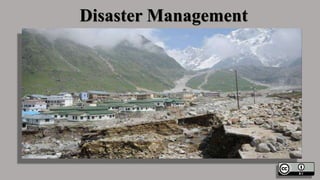
Disaster Management
• The United Nations defines a Disaster as a serious
disruption of the functioning of a community or a society.
• Disasters involve widespread human, material, economic
or environmental impacts, which exceed the ability of the
affected community or society to cope using its own
resources.
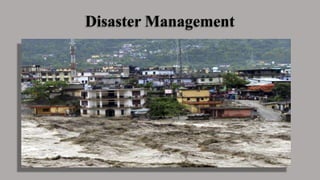
Disaster Management
Disaster Management
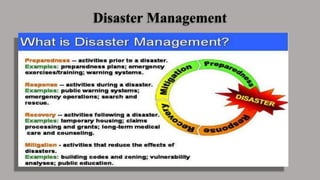
• The Red Cross and Red Crescent Societies define disaster
management as the organisation and management of
resources and responsibilities for dealing with all
humanitarian aspects of emergencies, in particular
preparedness, response and recovery in order to lessen the
impact of disasters.
Disaster Management
Types of Disasters
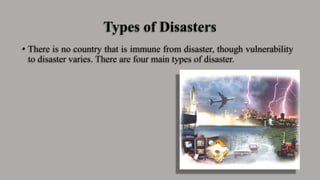
• There is no country that is immune from disaster, though vulnerability
to disaster varies. There are four main types of disaster.
Types of Disasters
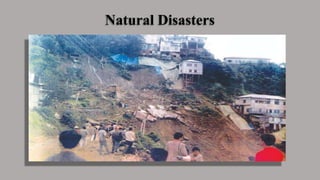
• Natural Disasters: including floods, hurricanes, earthquakes and
volcano eruptions that have immediate impacts on human health
and secondary impacts causing further death and suffering from
(for example) floods, landslides, fires, tsunamis.
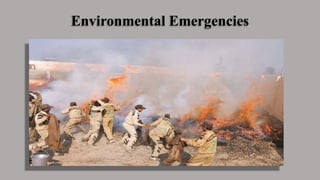
• Environmental Emergencies: including technological or industrial
accidents, usually involving the production, use or transportation
of hazardous material, and occur where these materials are produced,
used or transported, and forest fires caused by humans.
Natural Disasters
Environmental Emergencies
Types of Disasters
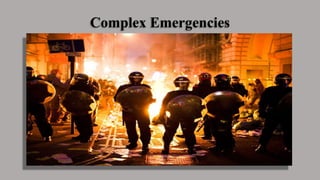
• Complex Emergencies: involving a break-down of
authority, looting and attacks on strategic installations,
including conflict situations and war.
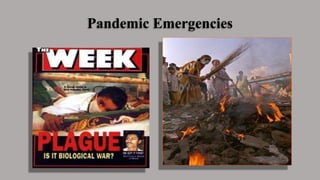
• Pandemic Emergencies: involving a sudden onset of
contagious disease that affects health, disrupts services
and businesses, brings economic and social costs.
Complex Emergencies
Pandemic Emergencies
Types of Disasters
• Any disaster can interrupt essential services, such as health care,
electricity, water, sewage/garbage removal, transportation and
communications.
• The interruption can seriously affect the health, social and
economic networks of local communities and countries.
• Disasters have a major and long-lasting impact on people long after
the immediate effect has been mitigated.
Types of Disasters
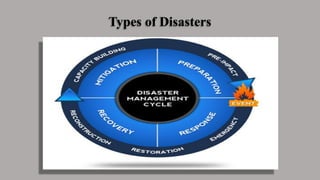
• Local, regional, national and international organisations
are all involved in mounting a humanitarian response to
disasters. Each will have a prepared disaster management
plan. These plans cover prevention, preparedness, relief and
recovery.
Types of Disasters
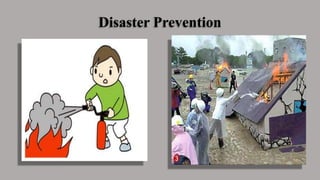
Disaster Prevention
• These are activities designed to provide permanent protection
from disasters. Not all disasters, particularly natural
disasters, can be prevented, but the risk of loss of life and
injury can be mitigated with good evacuation plans,
environmental planning and design standards.
Disaster Prevention
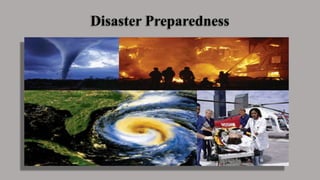
Disaster Preparedness
• These activities are designed to minimise loss of life and
damage – for example by removing people and property
from a threatened location and by facilitating timely and
effective rescue, relief and rehabilitation. Preparedness is the
main way of reducing the impact of disasters. Community-
based preparedness and management should be a high
priority in physical therapy practice management.
Disaster Preparedness
Disaster Relief
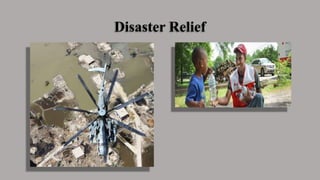
• This is a coordinated multi-agency response to reduce the
impact of a disaster and its long-term results. Relief
activities include rescue, relocation, providing food and
water, preventing disease and disability, repairing vital
services such as telecommunications and transport,
providing temporary shelter and emergency health care.
Disaster Relief
Disaster Recovery
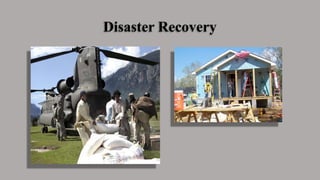
• Once emergency needs have been met and the initial crisis is over,
the people affected and the communities that support them are
still vulnerable. Recovery activities include rebuilding infrastructure,
health care and rehabilitation. These should blend with development
activities, such as building human resources for health and
developing policies and practices to avoid similar situations in
future.
Disaster Recovery
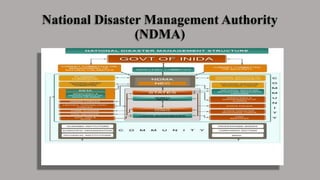
National Disaster Management Authority
(NDMA)
• In recognition of the importance of Disaster Management as a
national priority, set up a High-Powered Committee (HPC) in
August 1999 and a National Committee after the Gujarat
earthquake, for making recommendations on the preparation of
Disaster Management plans and suggesting effective mitigation
mechanisms. The Tenth Five-Year Plan document also had, for the
first time, a detailed chapter on Disaster Management. The Twelfth
Finance Commission was also mandated to review the financial
arrangements for Disaster Management.
National Disaster Management Authority
(NDMA)
• On 23 December 2005, the Government of India enacted the Disaster
Management Act, which envisaged the creation of National Disaster
Management Authority (NDMA), headed by the Prime Minister, and
State Disaster Management Authorities (SDMAs) headed by
respective Chief Ministers, to spearhead and implement a holistic
and integrated approach to Disaster Management in India.
National Disaster Management Authority
(NDMA)
Functions and Responsibilities
• NDMA, as the apex body, is mandated to lay down the policies,
plans and guidelines for Disaster Management to ensure timely and
effective response to disasters. Towards this, it has the following
responsibilities:-
• Lay down policies on disaster management ;
• Approve the National Plan;
• Approve plans prepared by the Ministries or Departments of the
Government of India in accordance with the National Plan;
• Lay down guidelines to be followed by the State Authorities in
drawing up the State Plan;
Functions and Responsibilities
• Lay down guidelines to be followed by the different Ministries or
Departments of the Government of India for the Purpose of
integrating the measures for prevention of disaster or the mitigation
of its effects in their development plans and projects;
• Coordinate the enforcement and implementation of the policy and
plans for disaster management;
• Recommend provision of funds for the purpose of mitigation;
National Disaster Management Authority
(NDMA)
Functions and Responsibilities
• Provide such support to other countries affected by major disasters
as may be determined by the Central Government;
• Take such other measures for the prevention of disaster, or the
mitigation, or preparedness and capacity building for dealing with
threatening disaster situations or disasters as it may consider
necessary;
• Lay down broad policies and guidelines for the functioning of the
National Institute of Disaster Management.
Disaster Management in India
National Institute of Disaster Management
• (राष्ट्रीय आपदा प्रबंधन संस्थान ) NIDM, is a premier institute for
training and capacity development programs for managing natural
disasters in India, on a national as well as regional basis.
Disaster Management in India
Origin and Responsibilities
• The National Disaster Management Act of 2005 granted the Institute
statutory organisation status. The Act holds the Institute responsible
for "planning and promoting training and research in the area of
disaster management, documentation and development of national
level information base relating to disaster management policies,
prevention mechanisms and mitigation measures".
National Institute of Disaster Management
Environmental Governance in India
• The concern for environment has its early beginning in India with the
concern for public health, water supply, and disposal of waste. The
rise in the awareness of environmental degradation due to impact
of modern industrial development in the 1970s brought a major
change in the perception at the national & regional level.
Environmental Governance in India
• The rapid growth of institutions to deal with environmental protection
has been accomplied by the rise in public awareness about
environmental Issues.
• The new “environment establishments” include many significant
non-governmental organizations formed to voice public concern.
• The national developments have been reflected at the regional and
international levels. Thus international treaties were signed to deal
with the increasingly complex conservation and pollution
prevention problems.
Public Awareness about Environmental
Issues
Environmental Governance in India
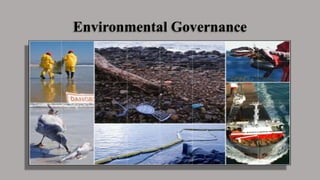
The Forty Second Amendment Act
• Environment protection and improvement were explicitly incorporated
into the constitution by the (42nd Amendment) Act of 1976.
• It Declares “The State shall endeavour to protect and improve the
environment and to safe guard the forest and wildlife of the
country”.
Environmental Governance
Environmental Governance in India
• Article 51 A (g) in a new chapter entitled “Fundamental Duties” ,
impose a similar responsibility on every citizen to protect and
improve the natural environment including the forest, lakes,
rivers, and wildlife, and to have a compassion for living creatures”
• Together, the provisions highlight the national consensus on the
importance of environmental protection and improvement.
Environmental Governance in India
Environment Protection and Fundamental Rights
Right to Wholesome Environment
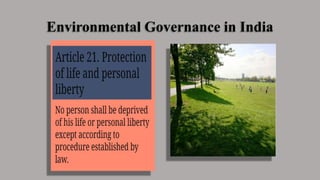
• The Supreme Court expanded Article 21 to include environment
protection the apex court interpreted the right to life and personal
liberty to include the right to wholesome environment and
introduced stiffer penalties.
• Now, the pollution control boards, may close down a defaulting
industrial plant or may stop its supply of electricity or water.
These boards may also apply to courts to restrain emissions that
exceed prescribed standards.
Environmental Governance in India
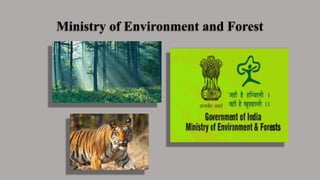
Ministry of Environment and Forest
• The Department of Environment and Forest and wildlife
in the ministry of Environment and forest came into being
with effect from September 25, 1985. The department plays
the role of a watch dog and serves as a nodal agency in the
administrative structure of the government for the central
government for planning, promotion and coordination of
environmental and forestry programmes.
Ministry of Environment and Forest
Environmental Governance in India
Central Pollution Control Board
• The Central Board for Prevention and Control of water pollution
with the state pollution control boards, looks after the
implementation of the government policy in respect of improvement
of water and air quality in the country. Minimal National standards
for pollution discharges from specific industries have been formulated
and control measures implemented a phased manner.
• An elaborate scheme for monitoring the water quality has been
prepared. The department also closely interacts with the R & D,
educational institutions, voluntary organization and of course, the
concerned government ministry, departments, etc at all the state
levels.
Central Pollution Control Board
Environmental Protection Activities of the
Department.
• Environmental protection activities undertaken by the department have
the following objectives:
• To play the role of a “Watch Dog” to study and bring to the
attention of government and the Parliament instances, causes, and
consequences of environmental degradation in all sectors
• To serve as a nodal agency for environmental protection and eco
development in a coordinated manner.
• To Carry out environmental appraisal of the development projects.
• To have administrative responsibility for, pollution monitoring and
regulations, conservation of ecosystems as biosphere reserves.
Environmental Protection Activities of the
Department.
The 42nd Amendment Act
• The 42nd Amendment Act has certain changes in the seventh
schedule of the constitution. In the Concurrent list after 17, entry
17A was inserted, which provides for “forest”. Originally, forest was
a state subject and as there was no uniform policy followed by the
state government in respect of protection of forest, this subject was
transferred to list III.
• The legal sections to protect different segments of the environment
in India has been provided by successive enactment of certain
laws.
The 42nd Amendment Act
ENVIRONMENTAL LAWS
• Following is a list of major Environmental Acts and Rules applicable in India.
• The Water (Prevention & Control of Pollution) Act 1974 (as amended up-to 1998).
• The Water (Prevention &control of Pollution) Cess Act, 1977 (as amended by
Amendment Act 1991).
• The Air (Prevention & Control of Pollution) Act 1981 as amended by Amendment
Act 1986
• Environment (Protection) Act 1986.
• Hazardous Waste (Management & Handling) Rules 1989.
• Manufacture, Storage and Import of Hazardous Chemicals (Amendment) Rules
1984.
• The Factories Act 1984.
• The Forest Conservation Act 1980.
• The Notification on Environment Impact Assessment 1994.
Environmental Governance in India
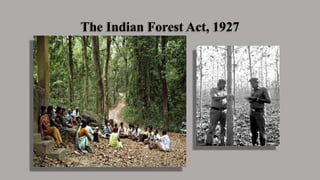
The Indian Forest Act, 1927.
• Although it embodies the colonial policies of the pre-independence era,
the forest Act of 1927 remain in force.
• The 1927, Act deals with four categories of forests, namely, reserved
forest, village forests, protected forests and non government (private)
forests.
• A state may declare forestland or waste lands as reserved forests and may
sell the produce from these forests. Any unauthorized felling of trees,
quarrying, grazing and hunting in reserved forests is punishable with a
fine or imprisonment, or both.
• The preservation of protected forests is enforced through rules, licenses
and criminal prosecutions.
The Indian Forest Act, 1927
Environmental Governance in India
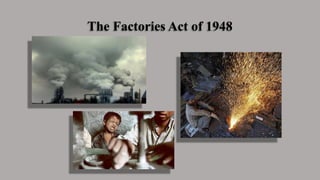
The Factories Act of 1948
• Passed shortly after the Bhopal gas tragedy, the 1987 Amendment
empowers the states to appoint site Appraisal Committees to
advise on the initial location of factories using hazardous
processes.
• The factory inspector and the local authority have to keep a close
watch on all particulars regarding health hazards at the factory,
and the preventive measure taken. These preventive measures must be
published among the workers and nearby residents. Every ‘Occupier”
must also draw up an emergency disaster
The Factories Act of 1948
• Control plan, which must be approved by chief Inspector.
• The permissible limits of exposure to toxic substances are
prescribed in the second schedule of the act.
• Safety committee consisting of workers and managers are required
to review periodically the factor’s safety measures.
• The Factories Act after its 1987 Amendment defines “Occupier” as a
very senior level manager. Such Person is held responsible for
compliance with the Acts provision to Hazardous processes. Non-
Compliance exposes the occupier to stiff penalties.
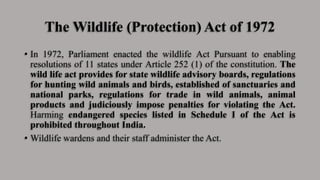
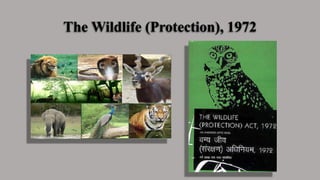
The Wildlife (Protection) Act of 1972
• In 1972, Parliament enacted the wildlife Act Pursuant to enabling
resolutions of 11 states under Article 252 (1) of the constitution. The
wild life act provides for state wildlife advisory boards, regulations
for hunting wild animals and birds, established of sanctuaries and
national parks, regulations for trade in wild animals, animal
products and judiciously impose penalties for violating the Act.
Harming endangered species listed in Schedule I of the Act is
prohibited throughout India.
• Wildlife wardens and their staff administer the Act.
The Wildlife (Protection), 1972
The Water (Prevention and Control of
pollution) Act,1974
• The water Act was the culmination of over a decade of discussion and
deliberation between Centres and states.
• The history and the preamble of the water Act suggest that only state
government can enact water pollution legislation. The Act vests
regulatory authority in state boards and empowers these boards to
establish and enforce effluent standards for factories discharging
pollutants into bodies of water. A central Board performs the
same functions for union territories and coordinate activities
among the states.
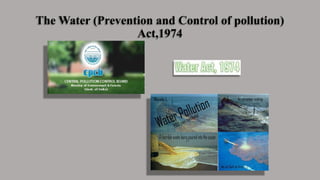
The Water (Prevention and Control of pollution)
Act,1974
The Water (Prevention and Control of
pollution) Act,1974
• Prior to its amendment in 1988, enforcement under the water Act
was achieved through criminal prosecutions initiated by the
board. The 1988 Amendment strengthened implementation
provisions of the Act.
• Now a board may close a defaulting industrial plant or withdraw
its supply of power or water by an administrative order; the
penalties more stringent, and citizens, suit provisions bolsters the
enforcement machinery.
The Water (Prevention and Control of Pollution) Cess Act
of 1977
• The Water Cess Act was passed to help meet the expanses of the
central and State Water Boards. The Act creates economic
incentives for pollution control and requires local authorities and
certain designated industries to pay a cess (tax) for water
consumption.
• The revenue are used to implement the water Act. The Central
Board and the states such sums as it deems necessary to enforce the
provisions of the water Act. To encourage capital investment in
pollution control, the act gives a polluter a 70 % rebate of the
applicable cess upon installing effluent treatment equipment.
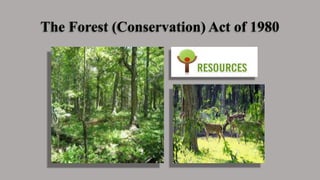
The Forest (Conservation) Act of 1980
• Alarmed at India’s rapid deforestation and the resulting
environment degradation, the central Government enacted
the Forest (Conservation) Act in 1980. AS amendment in
1988, The Act requires the approval of the Central
Government before a state “deserves” a reserved forest, uses
forest land for non-forest purposes, assigns forest land to
private person or corporation, or clears forest land for the
purpose of reforestation.
The Forest (Conservation) Act of 1980
The Air (Preservation and Control of
pollution) Act of 1981
• The Air Act’s framework is similar to the one created by its
predecessor the water Act of 1974.
• To enable an integrated approach to environmental problem. The
Air Act expanded the authority of the Central and State boards
established under the water Act, to include air pollution Control.
States not having air pollution were required to set up air pollution
boards.
The Air (Preservation and Control of
pollution) Act of 1981
• Under the Air Act, all industries operating within designated air
pollution control area must obtain a “consent” from the state
boards. The states are required to prescribe emission standards for
industry and automobiles after consulting the Central Board and
noting its ambient air quality standards.
• The 1987 amendment strengthened the enforcement machinery.
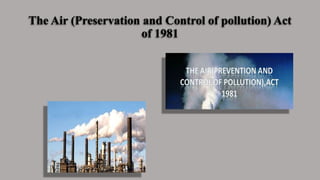
The Air (Preservation and Control of pollution) Act
of 1981
The Environment Protection Act of 1986
• In the wake of the Bhopal Gas Tragedy, The government of India
enacted the Environment (Protection) Act of 1986 under Article 253
of the Constitution.
• The purpose of the act is to implement the decisions of the United
Nations. The Act is an “Umbrella” legislation designed to provide a
framework for central government coordination of the activities of
various Central and State authorities established under previous
laws, such as the Water Act and the Air Act.
The Environment Protection Act, 1986
The Environment Protection Act of 1986
The Scope of the Act
• The potential scope of the Act is broad, with “environment” defined
to Include water, air, land and the inter-relationships which exist
among these, and human beings, and other living creatures,
plants, microorganisms and property.
• The Section 3 (1) of the act empowers the Centre “to take all
such measures as it deems necessary or expedient for the
purpose of protecting and improving the quality of the
environment and preventing, controlling and abating
environment pollution”.
The Environment Protection Act, 1986
• Specifically, the Central Government is authorized to set
new nation standards for the quality of the environment as
well as standards for controlling emissions and effluent
discharges, to regulate industrial safeguards for preventing
accidents, and to collect and disseminate information
regarding environmental pollution.
The Environment Protection Act, 1986
• The Department of Environment, Forests and Wildlife of the
Ministry of environment and forests is responsible for
making rules to implement the Environment (Protection)
Act.
The Environment Protection Act of 1986
Violation of Penalties Under the Act
• The Environment (Protection) Act was the first environment status to
give authority to the Central Government to issue direct written orders,
including orders to close, prohibit, or regulate any industry,
operation or process or to stop or regulate the supply of electricity,
water or any other service.
Violation of Penalties Under the Act
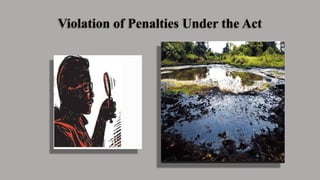
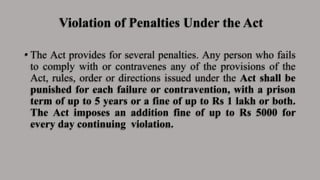
• The Act provides for several penalties. Any person who fails
to comply with or contravenes any of the provisions of the
Act, rules, order or directions issued under the Act shall be
punished for each failure or contravention, with a prison
term of up to 5 years or a fine of up to Rs 1 lakh or both.
The Act imposes an addition fine of up to Rs 5000 for
every day continuing violation.
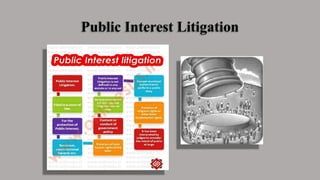
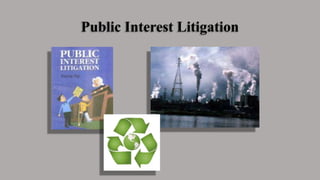
Public Interest Litigation
• Pubic Interest litigation has successfully demonstrated that responsible
non-government organizations and public spirited individuals about
significant pressure on polluting units for adopting abatements
measures.
• As the present system of jurisprudence does provide for
compensation to individuals for environmental damage, including
effect on health and environmental damage caused by pollution, it is
proposed to set up special legal institutions to redress this deficiency
and also make adequate arrangement for interim relief.
Public Interest Litigation
Regulatory Measures
• The regulatory Control Measures include physical as well as fiscal
measure. Physical control Include the imposition of a legal ceiling for
pollution emission and directions to industrial units to install control
equipment to reduce emission or discharge of waste water.
Fiscal Measures
• Fiscal measures Include the imposition of taxes, pollution permits,
and the allocation of property rights. The imposition of financial
liabilities and tax burdens are the weapon of the mechanism
Public Interest Litigation
Promotional Measures
• Includes Subsidies and voluntary programmes which have a

moral and social responsible impact on potential polluters. The
voluntary programmes include moral education and popularization of
social responsibility and ethical considerations
Participatory Measures
• Include Direct Investment by the government in Waste
Management, effluent Treatment and slum clearance, and
increasing forest cover programmes. Direct Participitation will yield
quick results.
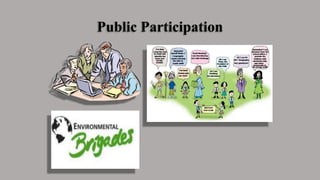
Public Participation
• The policy Statement of government of India, 1992 indicates that it
expects and encourages more and more of public participation in
future.
• Government have conscious constituted certain institutions as a follow
up of above public participation policy.
• Eco-Club Under all Zila Parishads
• Environmental Brigade Under Selected District Collectors
• District Environment Committees Under and every District
Collector.
Public Participation
Non-Government Organization
(NGO) Cell
• A NGO Cell has been setup in the Central Pollution Control Board in
Every State Pollution Control Board. The NGO Cell will Coordinate the
following Tasks:
• Enlisting NGOs involved in Pollution Control Activities
• Providing training for NGOs and equip them with testing kits.
• Organizing mass awareness programmes through NGOs.
• NGOs may take up activities to help implement prevention and control
of pollution.
Non-Government Organization
(NGO) Cell
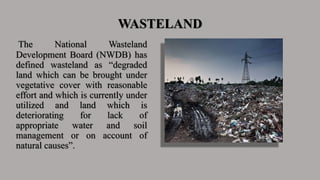
WASTELAND
The National Wasteland
Development Board (NWDB) has
defined wasteland as “degraded
land which can be brought under
vegetative cover with reasonable
effort and which is currently under
utilized and land which is
deteriorating for lack of
appropriate water and soil
management or on account of
natural causes”.
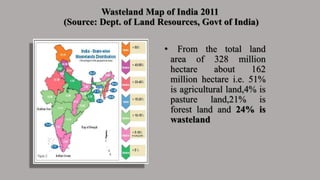
Wasteland Map of India 2011
(Source: Dept. of Land Resources, Govt of India)
• From the total land
area of 328 million
hectare about 162
million hectare i.e. 51%
is agricultural land,4% is
pasture land,21% is
forest land and 24% is
wasteland
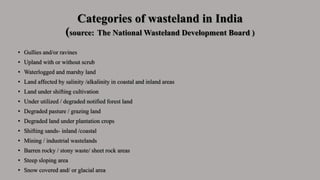
Categories of wasteland in India
(source: The National Wasteland Development Board )
• Gullies and/or ravines
• Upland with or without scrub
• Waterlogged and marshy land
• Land affected by salinity /alkalinity in coastal and inland areas
• Land under shifting cultivation
• Under utilized / degraded notified forest land
• Degraded pasture / grazing land
• Degraded land under plantation crops
• Shifting sands- inland /coastal
• Mining / industrial wastelands
• Barren rocky / stony waste/ sheet rock areas
• Steep sloping area
• Snow covered and/ or glacial area
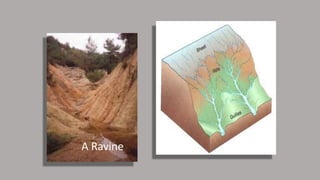
A Ravine
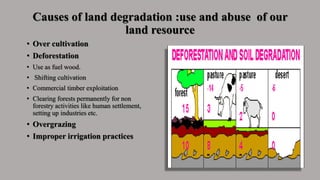
Causes of land degradation :use and abuse of our
land resource
• Over cultivation
• Deforestation
• Use as fuel wood.
• Shifting cultivation
• Commercial timber exploitation
• Clearing forests permanently for non
forestry activities like human settlement,
setting up industries etc.
• Overgrazing
• Improper irrigation practices
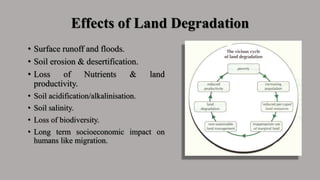
Effects of Land Degradation
• Surface runoff and floods.
• Soil erosion & desertification.
• Loss of Nutrients & land
productivity.
• Soil acidification/alkalinisation.
• Soil salinity.
• Loss of biodiversity.
• Long term socioeconomic impact on
humans like migration.
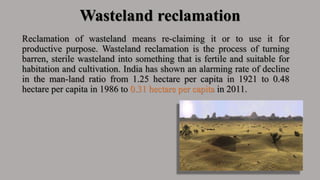
Wasteland reclamation
Reclamation of wasteland means re-claiming it or to use it for
productive purpose. Wasteland reclamation is the process of turning
barren, sterile wasteland into something that is fertile and suitable for
habitation and cultivation. India has shown an alarming rate of decline
in the man-land ratio from 1.25 hectare per capita in 1921 to 0.48
hectare per capita in 1986 to 0.31 hectare per capita in 2011.
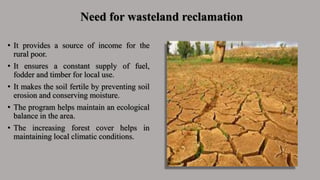
Need for wasteland reclamation
• It provides a source of income for the
rural poor.
• It ensures a constant supply of fuel,
fodder and timber for local use.
• It makes the soil fertile by preventing soil
erosion and conserving moisture.
• The program helps maintain an ecological
balance in the area.
• The increasing forest cover helps in
maintaining local climatic conditions.
Wastelands can be classified into three
forms:
(1)Easily reclaimable,
(2)Reclaimable with some difficulty,
(3)Reclaimable with extreme difficulty.
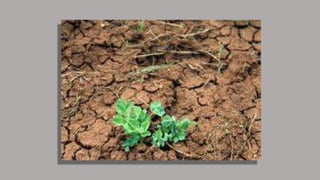
Easily reclaimable
Easily reclaimable wastelands can be used for agricultural
purposes. Wastelands can be reclaimed for agriculture by
reducing the salt content which can be done by leaching etc.
Gypsum, urea, potash and compost are added before planting
crops in such areas.
Reclaimed with some difficulty
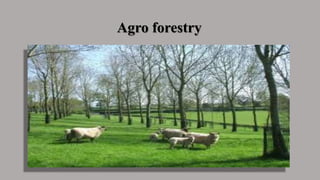
These wastelands can be utilized for agro forestry. Agro
forestry involves putting land to multiple uses. Its main
purpose is to have trees and crops inter- and/or under planted
to form an integrated system of biological production within a
certain area. Thus, agro forestry implies integration of trees
with agricultural crops or livestock management
simultaneously.
Agro forestry
Reclaimed with extreme difficulty
Wasteland that are reclaimed with extreme difficulty can be used for
forestry or to recreate natural ecosystem. Attempts to grow trees in
highly non alkaline saline soils have been largely unsuccessful. Field
experiments have shown that species like Eucalyptus, Prosopis and
Acacia nilotica could not be grown in highly alkaline soil. Studies
have shown that if tree seedlings are planted with a mixture of original
soil, gypsum, and manure, better growth can be achieved. It is
however important to use indigenous species of trees so that the
program recreates the local ecosystem with all its species.
Method of wasteland reclamation
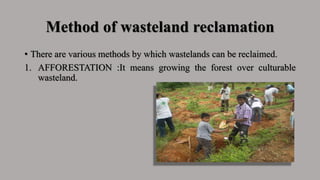
• There are various methods by which wastelands can be reclaimed.
1. AFFORESTATION :It means growing the forest over culturable
wasteland.
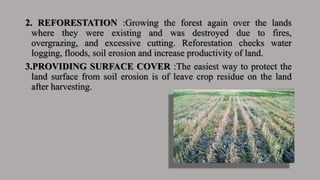
2. REFORESTATION :Growing the forest again over the lands
where they were existing and was destroyed due to fires,
overgrazing, and excessive cutting. Reforestation checks water
logging, floods, soil erosion and increase productivity of land.
3.PROVIDING SURFACE COVER :The easiest way to protect the
land surface from soil erosion is of leave crop residue on the land
after harvesting.
4. MULCHING : Mulch is a layer of material applied to the surface of an
area of soil .In this protective cover of organic matter and plants like
stalks, cotton stalks, tobacco stalks etc. are used which reduce
evaporation, help in retaining soil moisture and reduce soil erosion.
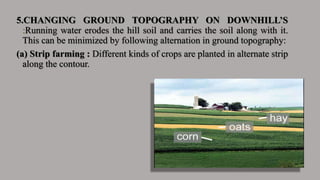
5.CHANGING GROUND TOPOGRAPHY ON DOWNHILL’S
:Running water erodes the hill soil and carries the soil along with it.
This can be minimized by following alternation in ground topography:
(a) Strip farming : Different kinds of crops are planted in alternate strip
along the contour.
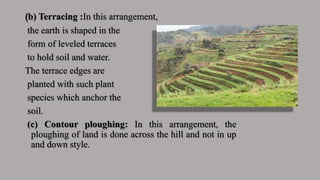
(b) Terracing :In this arrangement,
the earth is shaped in the
form of leveled terraces
to hold soil and water.
The terrace edges are
planted with such plant
species which anchor the
soil.
(c) Contour ploughing: In this arrangement, the
ploughing of land is done across the hill and not in up
and down style.
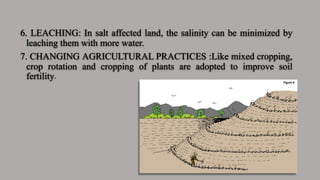
6. LEACHING: In salt affected land, the salinity can be minimized by
leaching them with more water.
7. CHANGING AGRICULTURAL PRACTICES :Like mixed cropping,
crop rotation and cropping of plants are adopted to improve soil
fertility.
8. ECOLOGICAL SUCCESSION :This refers to the
natural development or redevelopment of an
ecosystem which help in reclaiming the minerally
deficient soil of wasteland.
• A massive campaign for increasing
the land under productive use for
fuel and fodder species needs to be
launched.
• Voluntary efforts by farmers’
cooperatives, NGO`s and
organizations should be fully
recognized and assisted.
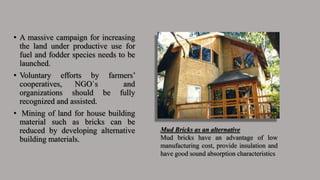
• Mining of land for house building
material such as bricks can be
reduced by developing alternative
building materials.
Mud Bricks as an alternative
Mud bricks have an advantage of low
manufacturing cost, provide insulation and
have good sound absorption characteristics
Issues Involved In The Enforcement Of
Environmental Legislation
• There is little point in passing laws or making international
agreements if there cannot be adequate enforcement.
3 issues/things that are especially important for environmental
legislation are:
1. The precautionary principle This principle has evolved to deal
with risks and uncertainties faced by environmental management.
The principle implies that an ounce of prevention is worth a pound of
cure— it does not prevent problems but may reduce their occurrence
and helps ensure contingency plans are made.
2. The polluter-pays principle In addition to-the obvious—
the polluter pays for the damaged caused by a development—
this principle also implies that a polluter pays for monitoring
and policing.
• A problem with this approach is that fines may bankrupt
small businesses, yet be low enough for a large company to
write them off as an occasional overhead, which does little
for pollution control.
• There is, thus, debate as to whether the principle should be
retrospective. If the polluter pays, how long back does
liability stretch?
3. Freedom of information: Environmental planning and
management is hindered if the public, NGOs or even official
bodies are unable to get information. Many countries have now
begun to release more information
• But still many governors and multinational corporations fear
that industrial secrets will leak to competitors if there is too
much disclosure, and there are situations where authorities
declare strategic’ needs and suspend disclosure.
ROLE OF INFORMATION TECHNOLOGY IN ENVIRONMENT
AND HUMAN HEALTH
• The understanding of environmental concerns and issues related to human health has
exploded during the last few years due to the sudden growth of information
technology.
• The advancement in computer, communication, satellite and other technological
developments have enabled engineers or environmentalists to gather relevant
information simultaneously from many sources.
• The information is utilized for developing and early warning system and to forecast
any eventuality much earlier. A large amount of information is easily available
through Remote Sensing technology, Geographical Information System (GIS)
and Global Positioning System (GPS) that is being used for various
environmental studies.
• Ministry of Environment, Government of India has
established a Environmental Information System (ENVIS) in
1982.
• This has been established as a decentralized information system
network whose purpose is collection, storage, retrieval and
dissemination of environmental information to decision
makers, policy makers, planners, scientists, engineers,
environmentalists, researchers and general public all over the
country
• The ENVIS network has its focal point in the Environmental
ministry along with 13 subject oriented centers, known as
ENVIS Centers, set up in the various institutions,
organizations of the country in the priority areas of
environment
• like pollution control, toxic chemicals, energy and
environment, environmentally sound and mangroves, corals
and lagoons, media and environment etc.
• New communication links are particularly vital to make use of
such information sources as Geographic Information Systems
(GIS), a computer based system for gathering,
manipulating, and analyzing environmental data.
• Remote Sensing – is the art of gathering information
about an object without touching it. It is useful in soil,
agriculture, town and country planning, detection of forest
cover depletion and forest mapping etc.
References
Environmental Management
Bala Krishnamoorthy- PHI publication
Wikipedia- The online free Encyclopedia
http://envfor.nic.in/legis/hsm/hsm1.html
https://www.osha.gov/
http://www.ndmindia.nic.in/
http://www.ndma.gov.in/en/
Thanks….

Disaster Managment

  • 1.
  • 2.
    Disaster Management • TheUnited Nations defines a Disaster as a serious disruption of the functioning of a community or a society. • Disasters involve widespread human, material, economic or environmental impacts, which exceed the ability of the affected community or society to cope using its own resources.
  • 3.
  • 4.
    Disaster Management • TheRed Cross and Red Crescent Societies define disaster management as the organisation and management of resources and responsibilities for dealing with all humanitarian aspects of emergencies, in particular preparedness, response and recovery in order to lessen the impact of disasters.
  • 5.
  • 6.
    Types of Disasters •There is no country that is immune from disaster, though vulnerability to disaster varies. There are four main types of disaster.
  • 7.
    Types of Disasters •Natural Disasters: including floods, hurricanes, earthquakes and volcano eruptions that have immediate impacts on human health and secondary impacts causing further death and suffering from (for example) floods, landslides, fires, tsunamis. • Environmental Emergencies: including technological or industrial accidents, usually involving the production, use or transportation of hazardous material, and occur where these materials are produced, used or transported, and forest fires caused by humans.
  • 8.
  • 9.
  • 10.
    Types of Disasters •Complex Emergencies: involving a break-down of authority, looting and attacks on strategic installations, including conflict situations and war. • Pandemic Emergencies: involving a sudden onset of contagious disease that affects health, disrupts services and businesses, brings economic and social costs.
  • 11.
  • 12.
  • 13.
    Types of Disasters •Any disaster can interrupt essential services, such as health care, electricity, water, sewage/garbage removal, transportation and communications. • The interruption can seriously affect the health, social and economic networks of local communities and countries. • Disasters have a major and long-lasting impact on people long after the immediate effect has been mitigated.
  • 14.
    Types of Disasters •Local, regional, national and international organisations are all involved in mounting a humanitarian response to disasters. Each will have a prepared disaster management plan. These plans cover prevention, preparedness, relief and recovery.
  • 15.
  • 16.
    Disaster Prevention • Theseare activities designed to provide permanent protection from disasters. Not all disasters, particularly natural disasters, can be prevented, but the risk of loss of life and injury can be mitigated with good evacuation plans, environmental planning and design standards.
  • 17.
  • 18.
    Disaster Preparedness • Theseactivities are designed to minimise loss of life and damage – for example by removing people and property from a threatened location and by facilitating timely and effective rescue, relief and rehabilitation. Preparedness is the main way of reducing the impact of disasters. Community- based preparedness and management should be a high priority in physical therapy practice management.
  • 19.
  • 20.
    Disaster Relief • Thisis a coordinated multi-agency response to reduce the impact of a disaster and its long-term results. Relief activities include rescue, relocation, providing food and water, preventing disease and disability, repairing vital services such as telecommunications and transport, providing temporary shelter and emergency health care.
  • 21.
  • 22.
    Disaster Recovery • Onceemergency needs have been met and the initial crisis is over, the people affected and the communities that support them are still vulnerable. Recovery activities include rebuilding infrastructure, health care and rehabilitation. These should blend with development activities, such as building human resources for health and developing policies and practices to avoid similar situations in future.
  • 23.
  • 24.
    National Disaster ManagementAuthority (NDMA) • In recognition of the importance of Disaster Management as a national priority, set up a High-Powered Committee (HPC) in August 1999 and a National Committee after the Gujarat earthquake, for making recommendations on the preparation of Disaster Management plans and suggesting effective mitigation mechanisms. The Tenth Five-Year Plan document also had, for the first time, a detailed chapter on Disaster Management. The Twelfth Finance Commission was also mandated to review the financial arrangements for Disaster Management.
  • 25.
    National Disaster ManagementAuthority (NDMA) • On 23 December 2005, the Government of India enacted the Disaster Management Act, which envisaged the creation of National Disaster Management Authority (NDMA), headed by the Prime Minister, and State Disaster Management Authorities (SDMAs) headed by respective Chief Ministers, to spearhead and implement a holistic and integrated approach to Disaster Management in India.
  • 26.
  • 27.
    Functions and Responsibilities •NDMA, as the apex body, is mandated to lay down the policies, plans and guidelines for Disaster Management to ensure timely and effective response to disasters. Towards this, it has the following responsibilities:- • Lay down policies on disaster management ; • Approve the National Plan; • Approve plans prepared by the Ministries or Departments of the Government of India in accordance with the National Plan; • Lay down guidelines to be followed by the State Authorities in drawing up the State Plan;
  • 28.
    Functions and Responsibilities •Lay down guidelines to be followed by the different Ministries or Departments of the Government of India for the Purpose of integrating the measures for prevention of disaster or the mitigation of its effects in their development plans and projects; • Coordinate the enforcement and implementation of the policy and plans for disaster management; • Recommend provision of funds for the purpose of mitigation;
  • 29.
  • 30.
    Functions and Responsibilities •Provide such support to other countries affected by major disasters as may be determined by the Central Government; • Take such other measures for the prevention of disaster, or the mitigation, or preparedness and capacity building for dealing with threatening disaster situations or disasters as it may consider necessary; • Lay down broad policies and guidelines for the functioning of the National Institute of Disaster Management.
  • 31.
    Disaster Management inIndia National Institute of Disaster Management • (राष्ट्रीय आपदा प्रबंधन संस्थान ) NIDM, is a premier institute for training and capacity development programs for managing natural disasters in India, on a national as well as regional basis.
  • 32.
    Disaster Management inIndia Origin and Responsibilities • The National Disaster Management Act of 2005 granted the Institute statutory organisation status. The Act holds the Institute responsible for "planning and promoting training and research in the area of disaster management, documentation and development of national level information base relating to disaster management policies, prevention mechanisms and mitigation measures".
  • 33.
    National Institute ofDisaster Management
  • 34.
    Environmental Governance inIndia • The concern for environment has its early beginning in India with the concern for public health, water supply, and disposal of waste. The rise in the awareness of environmental degradation due to impact of modern industrial development in the 1970s brought a major change in the perception at the national & regional level.
  • 35.
  • 36.
    Environmental Governance inIndia • The rapid growth of institutions to deal with environmental protection has been accomplied by the rise in public awareness about environmental Issues. • The new “environment establishments” include many significant non-governmental organizations formed to voice public concern. • The national developments have been reflected at the regional and international levels. Thus international treaties were signed to deal with the increasingly complex conservation and pollution prevention problems.
  • 37.
    Public Awareness aboutEnvironmental Issues
  • 38.
    Environmental Governance inIndia The Forty Second Amendment Act • Environment protection and improvement were explicitly incorporated into the constitution by the (42nd Amendment) Act of 1976. • It Declares “The State shall endeavour to protect and improve the environment and to safe guard the forest and wildlife of the country”.
  • 39.
  • 40.
    Environmental Governance inIndia • Article 51 A (g) in a new chapter entitled “Fundamental Duties” , impose a similar responsibility on every citizen to protect and improve the natural environment including the forest, lakes, rivers, and wildlife, and to have a compassion for living creatures” • Together, the provisions highlight the national consensus on the importance of environmental protection and improvement.
  • 41.
  • 42.
    Environmental Governance inIndia Environment Protection and Fundamental Rights Right to Wholesome Environment • The Supreme Court expanded Article 21 to include environment protection the apex court interpreted the right to life and personal liberty to include the right to wholesome environment and introduced stiffer penalties. • Now, the pollution control boards, may close down a defaulting industrial plant or may stop its supply of electricity or water. These boards may also apply to courts to restrain emissions that exceed prescribed standards.
  • 43.
  • 44.
    Environmental Governance inIndia Ministry of Environment and Forest • The Department of Environment and Forest and wildlife in the ministry of Environment and forest came into being with effect from September 25, 1985. The department plays the role of a watch dog and serves as a nodal agency in the administrative structure of the government for the central government for planning, promotion and coordination of environmental and forestry programmes.
  • 45.
  • 46.
    Environmental Governance inIndia Central Pollution Control Board • The Central Board for Prevention and Control of water pollution with the state pollution control boards, looks after the implementation of the government policy in respect of improvement of water and air quality in the country. Minimal National standards for pollution discharges from specific industries have been formulated and control measures implemented a phased manner. • An elaborate scheme for monitoring the water quality has been prepared. The department also closely interacts with the R & D, educational institutions, voluntary organization and of course, the concerned government ministry, departments, etc at all the state levels.
  • 47.
  • 48.
    Environmental Protection Activitiesof the Department. • Environmental protection activities undertaken by the department have the following objectives: • To play the role of a “Watch Dog” to study and bring to the attention of government and the Parliament instances, causes, and consequences of environmental degradation in all sectors • To serve as a nodal agency for environmental protection and eco development in a coordinated manner. • To Carry out environmental appraisal of the development projects. • To have administrative responsibility for, pollution monitoring and regulations, conservation of ecosystems as biosphere reserves.
  • 49.
    Environmental Protection Activitiesof the Department. The 42nd Amendment Act • The 42nd Amendment Act has certain changes in the seventh schedule of the constitution. In the Concurrent list after 17, entry 17A was inserted, which provides for “forest”. Originally, forest was a state subject and as there was no uniform policy followed by the state government in respect of protection of forest, this subject was transferred to list III. • The legal sections to protect different segments of the environment in India has been provided by successive enactment of certain laws.
  • 50.
  • 51.
    ENVIRONMENTAL LAWS • Followingis a list of major Environmental Acts and Rules applicable in India. • The Water (Prevention & Control of Pollution) Act 1974 (as amended up-to 1998). • The Water (Prevention &control of Pollution) Cess Act, 1977 (as amended by Amendment Act 1991). • The Air (Prevention & Control of Pollution) Act 1981 as amended by Amendment Act 1986 • Environment (Protection) Act 1986. • Hazardous Waste (Management & Handling) Rules 1989. • Manufacture, Storage and Import of Hazardous Chemicals (Amendment) Rules 1984. • The Factories Act 1984. • The Forest Conservation Act 1980. • The Notification on Environment Impact Assessment 1994.
  • 52.
    Environmental Governance inIndia The Indian Forest Act, 1927. • Although it embodies the colonial policies of the pre-independence era, the forest Act of 1927 remain in force. • The 1927, Act deals with four categories of forests, namely, reserved forest, village forests, protected forests and non government (private) forests. • A state may declare forestland or waste lands as reserved forests and may sell the produce from these forests. Any unauthorized felling of trees, quarrying, grazing and hunting in reserved forests is punishable with a fine or imprisonment, or both. • The preservation of protected forests is enforced through rules, licenses and criminal prosecutions.
  • 53.
  • 54.
    Environmental Governance inIndia The Factories Act of 1948 • Passed shortly after the Bhopal gas tragedy, the 1987 Amendment empowers the states to appoint site Appraisal Committees to advise on the initial location of factories using hazardous processes. • The factory inspector and the local authority have to keep a close watch on all particulars regarding health hazards at the factory, and the preventive measure taken. These preventive measures must be published among the workers and nearby residents. Every ‘Occupier” must also draw up an emergency disaster
  • 55.
  • 56.
    The Factories Actof 1948 • Control plan, which must be approved by chief Inspector. • The permissible limits of exposure to toxic substances are prescribed in the second schedule of the act. • Safety committee consisting of workers and managers are required to review periodically the factor’s safety measures. • The Factories Act after its 1987 Amendment defines “Occupier” as a very senior level manager. Such Person is held responsible for compliance with the Acts provision to Hazardous processes. Non- Compliance exposes the occupier to stiff penalties.
  • 57.
    The Wildlife (Protection)Act of 1972 • In 1972, Parliament enacted the wildlife Act Pursuant to enabling resolutions of 11 states under Article 252 (1) of the constitution. The wild life act provides for state wildlife advisory boards, regulations for hunting wild animals and birds, established of sanctuaries and national parks, regulations for trade in wild animals, animal products and judiciously impose penalties for violating the Act. Harming endangered species listed in Schedule I of the Act is prohibited throughout India. • Wildlife wardens and their staff administer the Act.
  • 58.
  • 59.
    The Water (Preventionand Control of pollution) Act,1974 • The water Act was the culmination of over a decade of discussion and deliberation between Centres and states. • The history and the preamble of the water Act suggest that only state government can enact water pollution legislation. The Act vests regulatory authority in state boards and empowers these boards to establish and enforce effluent standards for factories discharging pollutants into bodies of water. A central Board performs the same functions for union territories and coordinate activities among the states.
  • 60.
    The Water (Preventionand Control of pollution) Act,1974
  • 61.
    The Water (Preventionand Control of pollution) Act,1974 • Prior to its amendment in 1988, enforcement under the water Act was achieved through criminal prosecutions initiated by the board. The 1988 Amendment strengthened implementation provisions of the Act. • Now a board may close a defaulting industrial plant or withdraw its supply of power or water by an administrative order; the penalties more stringent, and citizens, suit provisions bolsters the enforcement machinery.
  • 62.
    The Water (Preventionand Control of Pollution) Cess Act of 1977 • The Water Cess Act was passed to help meet the expanses of the central and State Water Boards. The Act creates economic incentives for pollution control and requires local authorities and certain designated industries to pay a cess (tax) for water consumption. • The revenue are used to implement the water Act. The Central Board and the states such sums as it deems necessary to enforce the provisions of the water Act. To encourage capital investment in pollution control, the act gives a polluter a 70 % rebate of the applicable cess upon installing effluent treatment equipment.
  • 63.
    The Forest (Conservation)Act of 1980 • Alarmed at India’s rapid deforestation and the resulting environment degradation, the central Government enacted the Forest (Conservation) Act in 1980. AS amendment in 1988, The Act requires the approval of the Central Government before a state “deserves” a reserved forest, uses forest land for non-forest purposes, assigns forest land to private person or corporation, or clears forest land for the purpose of reforestation.
  • 64.
  • 65.
    The Air (Preservationand Control of pollution) Act of 1981 • The Air Act’s framework is similar to the one created by its predecessor the water Act of 1974. • To enable an integrated approach to environmental problem. The Air Act expanded the authority of the Central and State boards established under the water Act, to include air pollution Control. States not having air pollution were required to set up air pollution boards.
  • 66.
    The Air (Preservationand Control of pollution) Act of 1981 • Under the Air Act, all industries operating within designated air pollution control area must obtain a “consent” from the state boards. The states are required to prescribe emission standards for industry and automobiles after consulting the Central Board and noting its ambient air quality standards. • The 1987 amendment strengthened the enforcement machinery.
  • 67.
    The Air (Preservationand Control of pollution) Act of 1981
  • 68.
    The Environment ProtectionAct of 1986 • In the wake of the Bhopal Gas Tragedy, The government of India enacted the Environment (Protection) Act of 1986 under Article 253 of the Constitution. • The purpose of the act is to implement the decisions of the United Nations. The Act is an “Umbrella” legislation designed to provide a framework for central government coordination of the activities of various Central and State authorities established under previous laws, such as the Water Act and the Air Act.
  • 69.
  • 70.
    The Environment ProtectionAct of 1986 The Scope of the Act • The potential scope of the Act is broad, with “environment” defined to Include water, air, land and the inter-relationships which exist among these, and human beings, and other living creatures, plants, microorganisms and property. • The Section 3 (1) of the act empowers the Centre “to take all such measures as it deems necessary or expedient for the purpose of protecting and improving the quality of the environment and preventing, controlling and abating environment pollution”.
  • 71.
    The Environment ProtectionAct, 1986 • Specifically, the Central Government is authorized to set new nation standards for the quality of the environment as well as standards for controlling emissions and effluent discharges, to regulate industrial safeguards for preventing accidents, and to collect and disseminate information regarding environmental pollution.
  • 72.
    The Environment ProtectionAct, 1986 • The Department of Environment, Forests and Wildlife of the Ministry of environment and forests is responsible for making rules to implement the Environment (Protection) Act.
  • 73.
    The Environment ProtectionAct of 1986 Violation of Penalties Under the Act • The Environment (Protection) Act was the first environment status to give authority to the Central Government to issue direct written orders, including orders to close, prohibit, or regulate any industry, operation or process or to stop or regulate the supply of electricity, water or any other service.
  • 74.
  • 75.
    Violation of PenaltiesUnder the Act • The Act provides for several penalties. Any person who fails to comply with or contravenes any of the provisions of the Act, rules, order or directions issued under the Act shall be punished for each failure or contravention, with a prison term of up to 5 years or a fine of up to Rs 1 lakh or both. The Act imposes an addition fine of up to Rs 5000 for every day continuing violation.
  • 76.
    Public Interest Litigation •Pubic Interest litigation has successfully demonstrated that responsible non-government organizations and public spirited individuals about significant pressure on polluting units for adopting abatements measures. • As the present system of jurisprudence does provide for compensation to individuals for environmental damage, including effect on health and environmental damage caused by pollution, it is proposed to set up special legal institutions to redress this deficiency and also make adequate arrangement for interim relief.
  • 77.
  • 78.
    Public Interest Litigation RegulatoryMeasures • The regulatory Control Measures include physical as well as fiscal measure. Physical control Include the imposition of a legal ceiling for pollution emission and directions to industrial units to install control equipment to reduce emission or discharge of waste water. Fiscal Measures • Fiscal measures Include the imposition of taxes, pollution permits, and the allocation of property rights. The imposition of financial liabilities and tax burdens are the weapon of the mechanism
  • 79.
  • 80.
    Public Interest Litigation PromotionalMeasures • Includes Subsidies and voluntary programmes which have a moral and social responsible impact on potential polluters. The voluntary programmes include moral education and popularization of social responsibility and ethical considerations Participatory Measures • Include Direct Investment by the government in Waste Management, effluent Treatment and slum clearance, and increasing forest cover programmes. Direct Participitation will yield quick results.
  • 81.
    Public Participation • Thepolicy Statement of government of India, 1992 indicates that it expects and encourages more and more of public participation in future. • Government have conscious constituted certain institutions as a follow up of above public participation policy. • Eco-Club Under all Zila Parishads • Environmental Brigade Under Selected District Collectors • District Environment Committees Under and every District Collector.
  • 82.
  • 83.
    Non-Government Organization (NGO) Cell •A NGO Cell has been setup in the Central Pollution Control Board in Every State Pollution Control Board. The NGO Cell will Coordinate the following Tasks: • Enlisting NGOs involved in Pollution Control Activities • Providing training for NGOs and equip them with testing kits. • Organizing mass awareness programmes through NGOs. • NGOs may take up activities to help implement prevention and control of pollution.
  • 84.
  • 85.
    WASTELAND The National Wasteland DevelopmentBoard (NWDB) has defined wasteland as “degraded land which can be brought under vegetative cover with reasonable effort and which is currently under utilized and land which is deteriorating for lack of appropriate water and soil management or on account of natural causes”.
  • 86.
    Wasteland Map ofIndia 2011 (Source: Dept. of Land Resources, Govt of India) • From the total land area of 328 million hectare about 162 million hectare i.e. 51% is agricultural land,4% is pasture land,21% is forest land and 24% is wasteland
  • 87.
    Categories of wastelandin India (source: The National Wasteland Development Board ) • Gullies and/or ravines • Upland with or without scrub • Waterlogged and marshy land • Land affected by salinity /alkalinity in coastal and inland areas • Land under shifting cultivation • Under utilized / degraded notified forest land • Degraded pasture / grazing land • Degraded land under plantation crops • Shifting sands- inland /coastal • Mining / industrial wastelands • Barren rocky / stony waste/ sheet rock areas • Steep sloping area • Snow covered and/ or glacial area
  • 88.
  • 89.
    Causes of landdegradation :use and abuse of our land resource • Over cultivation • Deforestation • Use as fuel wood. • Shifting cultivation • Commercial timber exploitation • Clearing forests permanently for non forestry activities like human settlement, setting up industries etc. • Overgrazing • Improper irrigation practices
  • 90.
    Effects of LandDegradation • Surface runoff and floods. • Soil erosion & desertification. • Loss of Nutrients & land productivity. • Soil acidification/alkalinisation. • Soil salinity. • Loss of biodiversity. • Long term socioeconomic impact on humans like migration.
  • 91.
    Wasteland reclamation Reclamation ofwasteland means re-claiming it or to use it for productive purpose. Wasteland reclamation is the process of turning barren, sterile wasteland into something that is fertile and suitable for habitation and cultivation. India has shown an alarming rate of decline in the man-land ratio from 1.25 hectare per capita in 1921 to 0.48 hectare per capita in 1986 to 0.31 hectare per capita in 2011.
  • 92.
    Need for wastelandreclamation • It provides a source of income for the rural poor. • It ensures a constant supply of fuel, fodder and timber for local use. • It makes the soil fertile by preventing soil erosion and conserving moisture. • The program helps maintain an ecological balance in the area. • The increasing forest cover helps in maintaining local climatic conditions.
  • 93.
    Wastelands can beclassified into three forms: (1)Easily reclaimable, (2)Reclaimable with some difficulty, (3)Reclaimable with extreme difficulty.
  • 94.
    Easily reclaimable Easily reclaimablewastelands can be used for agricultural purposes. Wastelands can be reclaimed for agriculture by reducing the salt content which can be done by leaching etc. Gypsum, urea, potash and compost are added before planting crops in such areas.
  • 96.
    Reclaimed with somedifficulty These wastelands can be utilized for agro forestry. Agro forestry involves putting land to multiple uses. Its main purpose is to have trees and crops inter- and/or under planted to form an integrated system of biological production within a certain area. Thus, agro forestry implies integration of trees with agricultural crops or livestock management simultaneously.
  • 97.
  • 98.
    Reclaimed with extremedifficulty Wasteland that are reclaimed with extreme difficulty can be used for forestry or to recreate natural ecosystem. Attempts to grow trees in highly non alkaline saline soils have been largely unsuccessful. Field experiments have shown that species like Eucalyptus, Prosopis and Acacia nilotica could not be grown in highly alkaline soil. Studies have shown that if tree seedlings are planted with a mixture of original soil, gypsum, and manure, better growth can be achieved. It is however important to use indigenous species of trees so that the program recreates the local ecosystem with all its species.
  • 99.
    Method of wastelandreclamation • There are various methods by which wastelands can be reclaimed. 1. AFFORESTATION :It means growing the forest over culturable wasteland.
  • 100.
    2. REFORESTATION :Growingthe forest again over the lands where they were existing and was destroyed due to fires, overgrazing, and excessive cutting. Reforestation checks water logging, floods, soil erosion and increase productivity of land. 3.PROVIDING SURFACE COVER :The easiest way to protect the land surface from soil erosion is of leave crop residue on the land after harvesting.
  • 101.
    4. MULCHING :Mulch is a layer of material applied to the surface of an area of soil .In this protective cover of organic matter and plants like stalks, cotton stalks, tobacco stalks etc. are used which reduce evaporation, help in retaining soil moisture and reduce soil erosion.
  • 102.
    5.CHANGING GROUND TOPOGRAPHYON DOWNHILL’S :Running water erodes the hill soil and carries the soil along with it. This can be minimized by following alternation in ground topography: (a) Strip farming : Different kinds of crops are planted in alternate strip along the contour.
  • 103.
    (b) Terracing :Inthis arrangement, the earth is shaped in the form of leveled terraces to hold soil and water. The terrace edges are planted with such plant species which anchor the soil. (c) Contour ploughing: In this arrangement, the ploughing of land is done across the hill and not in up and down style.
  • 104.
    6. LEACHING: Insalt affected land, the salinity can be minimized by leaching them with more water. 7. CHANGING AGRICULTURAL PRACTICES :Like mixed cropping, crop rotation and cropping of plants are adopted to improve soil fertility.
  • 105.
    8. ECOLOGICAL SUCCESSION:This refers to the natural development or redevelopment of an ecosystem which help in reclaiming the minerally deficient soil of wasteland.
  • 106.
    • A massivecampaign for increasing the land under productive use for fuel and fodder species needs to be launched. • Voluntary efforts by farmers’ cooperatives, NGO`s and organizations should be fully recognized and assisted. • Mining of land for house building material such as bricks can be reduced by developing alternative building materials. Mud Bricks as an alternative Mud bricks have an advantage of low manufacturing cost, provide insulation and have good sound absorption characteristics
  • 107.
    Issues Involved InThe Enforcement Of Environmental Legislation • There is little point in passing laws or making international agreements if there cannot be adequate enforcement. 3 issues/things that are especially important for environmental legislation are: 1. The precautionary principle This principle has evolved to deal with risks and uncertainties faced by environmental management. The principle implies that an ounce of prevention is worth a pound of cure— it does not prevent problems but may reduce their occurrence and helps ensure contingency plans are made.
  • 108.
    2. The polluter-paysprinciple In addition to-the obvious— the polluter pays for the damaged caused by a development— this principle also implies that a polluter pays for monitoring and policing. • A problem with this approach is that fines may bankrupt small businesses, yet be low enough for a large company to write them off as an occasional overhead, which does little for pollution control. • There is, thus, debate as to whether the principle should be retrospective. If the polluter pays, how long back does liability stretch?
  • 109.
    3. Freedom ofinformation: Environmental planning and management is hindered if the public, NGOs or even official bodies are unable to get information. Many countries have now begun to release more information • But still many governors and multinational corporations fear that industrial secrets will leak to competitors if there is too much disclosure, and there are situations where authorities declare strategic’ needs and suspend disclosure.
  • 110.
    ROLE OF INFORMATIONTECHNOLOGY IN ENVIRONMENT AND HUMAN HEALTH • The understanding of environmental concerns and issues related to human health has exploded during the last few years due to the sudden growth of information technology. • The advancement in computer, communication, satellite and other technological developments have enabled engineers or environmentalists to gather relevant information simultaneously from many sources. • The information is utilized for developing and early warning system and to forecast any eventuality much earlier. A large amount of information is easily available through Remote Sensing technology, Geographical Information System (GIS) and Global Positioning System (GPS) that is being used for various environmental studies.
  • 111.
    • Ministry ofEnvironment, Government of India has established a Environmental Information System (ENVIS) in 1982. • This has been established as a decentralized information system network whose purpose is collection, storage, retrieval and dissemination of environmental information to decision makers, policy makers, planners, scientists, engineers, environmentalists, researchers and general public all over the country
  • 112.
    • The ENVISnetwork has its focal point in the Environmental ministry along with 13 subject oriented centers, known as ENVIS Centers, set up in the various institutions, organizations of the country in the priority areas of environment • like pollution control, toxic chemicals, energy and environment, environmentally sound and mangroves, corals and lagoons, media and environment etc.
  • 113.
    • New communicationlinks are particularly vital to make use of such information sources as Geographic Information Systems (GIS), a computer based system for gathering, manipulating, and analyzing environmental data. • Remote Sensing – is the art of gathering information about an object without touching it. It is useful in soil, agriculture, town and country planning, detection of forest cover depletion and forest mapping etc.
  • 114.
    References Environmental Management Bala Krishnamoorthy-PHI publication Wikipedia- The online free Encyclopedia http://envfor.nic.in/legis/hsm/hsm1.html https://www.osha.gov/ http://www.ndmindia.nic.in/ http://www.ndma.gov.in/en/
  • 115.