Disaster Management
B.tech 7th Sem
Civil Engineering Deptt.
By
Er. Amit Talgotra
Assistant Professor
SSCET, Badhani
Introduction
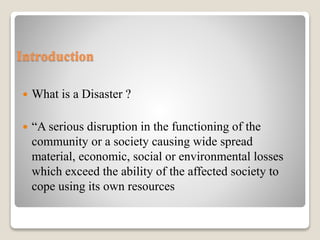
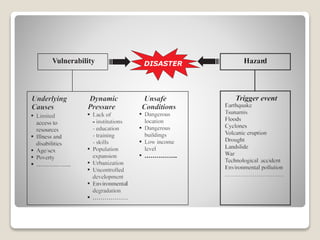
 What is a Disaster ?
 “A serious disruption in the functioning of the
community or a society causing wide spread
material, economic, social or environmental losses
which exceed the ability of the affected society to
cope using its own resources
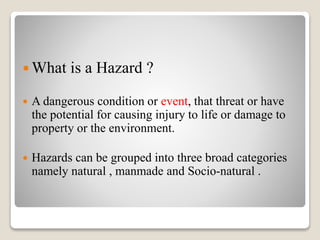
 What is a Hazard ?
 A dangerous condition or event, that threat or have
the potential for causing injury to life or damage to
property or the environment.
 Hazards can be grouped into three broad categories
namely natural , manmade and Socio-natural .
 Natural hazards are hazards which are caused
because of natural phenomena (hazards with
meteorological, geological or even biological origin).
 Examples of natural hazards are cyclones, tsunamis,
earth- quake and volcanic eruption which are
exclusively of natural origin.
 Manmade hazards are hazards which are due to
human negligence. Manmade hazards are associated
with industries or energy generation facilities.
 For example and include explosions, leakage of toxic
waste, pollution, dam failure, wars or civil strife etc.
 Socio-Natural Hazards Landslides, floods, drought,
fires are socio-natural hazards since their causes are
both natural and man made.
 For example flooding may be caused because of
heavy rains, landslide or blocking of drains with
human waste
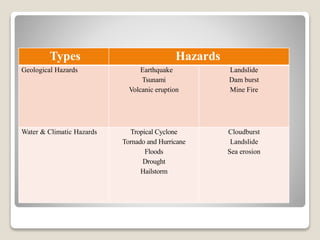
Types Hazards
Geological Hazards Earthquake
Tsunami
Volcanic eruption
Landslide
Dam burst
Mine Fire
Water & Climatic Hazards Tropical Cyclone
Tornado and Hurricane
Floods
Drought
Hailstorm
Cloudburst
Landslide
Sea erosion
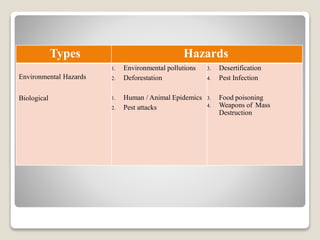
Types Hazards
Environmental Hazards
Biological
1. Environmental pollutions
2. Deforestation
1. Human / Animal Epidemics
2. Pest attacks
3. Desertification
4. Pest Infection
3. Food poisoning
4. Weapons of Mass
Destruction
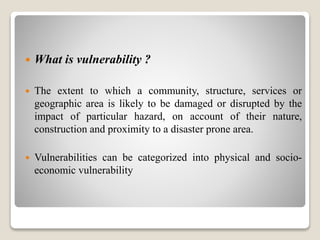
 What is vulnerability ?
 The extent to which a community, structure, services or
geographic area is likely to be damaged or disrupted by the
impact of particular hazard, on account of their nature,
construction and proximity to a disaster prone area.
 Vulnerabilities can be categorized into physical and socio-
economic vulnerability
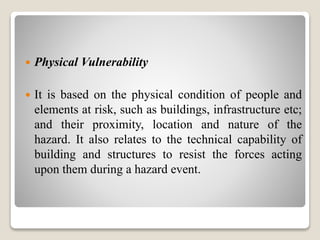
 Physical Vulnerability
 It is based on the physical condition of people and
elements at risk, such as buildings, infrastructure etc;
and their proximity, location and nature of the
hazard. It also relates to the technical capability of
building and structures to resist the forces acting
upon them during a hazard event.
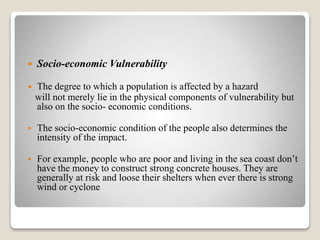
 Socio-economic Vulnerability
 The degree to which a population is affected by a hazard
will not merely lie in the physical components of vulnerability but
also on the socio- economic conditions.
 The socio-economic condition of the people also determines the
intensity of the impact.
 For example, people who are poor and living in the sea coast don’t
have the money to construct strong concrete houses. They are
generally at risk and loose their shelters when ever there is strong
wind or cyclone
 What is capacity ?
 Capacity can be defined as “resources, means and
strengths which exist in households and communities
and which enable them to cope with, withstand,
prepare for, prevent, mitigate or quickly recover from
a disaster”
 Physical Capacity: People whose houses have been
destroyed by the cyclone or crops have been
destroyed by the flood can recover things from their
homes and from their farms. Some family members
have skills, which enable them to find employment if
they migrate, either temporarily or permanently.
 Socio-economic Capacity: In most of the disasters,
people suffer their greatest losses in the physical and
material realm. Rich people have the capacity to
recover soon because of their wealth. In fact, they are
rarely hit by disasters because they live in safe areas
and their houses are built with stronger materials.
However, even when everything is destroyed they
have the capacity to cope up with it.
 What is risk ?
Risk is a “measure of the expected losses due to a hazard event occurring
in a given area over a specific time period. Risk is a function of the
probability of particular hazardous event and the losses each would
cause.” The level of risk depends upon:
 Nature of the hazard
 Vulnerability of the elements which are affected
 Economic value of those elements
 Disaster risk management
A community/locality is said to be at ‘risk’ when it is exposed to hazards
and is likely to be adversely affected by its impact.
Disaster Risk management includes all measures which reduce disaster
related losses of life , property or assets by either reducing the hazard or
vulnerability of the elements at risk
Disaster Risk Reduction can take place in the following ways:
 Preparedness
This protective process includes measures which enable governments,
communities and individuals to respond rapidly to disaster situations to
cope with them effectively. Preparedness includes the formulation of
workable emergency plans, the development of warning systems, the
maintenance of records and the training of personnel. It may also
embrace search and rescue measures as well as evacuation plans for areas
that may be at risk from a frequent disaster.
Preparedness therefore encompasses those measures taken before a disaster
event which are aimed at minimizing loss of life, disruption of critical
services, and damage when the disaster occurs.
 Mitigation
 Mitigation holds measures taken to reduce both the effect of the hazard and the
vulnerable conditions to it in order to reduce the scale of a future disaster.
Therefore mitigation activities can be focused on the hazard itself or the elements
exposed to the threat.
 Examples of mitigation measures which are hazard specific include water
management in drought prone areas, relocating people away from the hazard prone
areas and by strengthening structures to reduce damage when a hazard occurs.
 In addition to these physical measures, mitigation should also aim at reducing the
economic and social vulnerabilities of potential disasters.
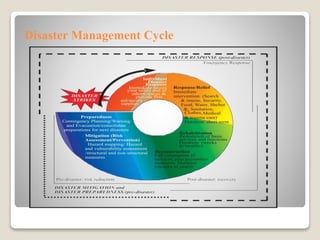
Disaster Management Cycle
 The three key stages of activities that are taken up within disaster risk
management are:
 1. Before a disaster (pre-disaster): Pre-disaster activities those which are
taken to reduce human and property losses caused by a potential hazard.
For example, carrying out awareness campaigns, strengthening the existing
weak structures, preparation of the disaster management plans at
household and community level, etc. Such risk reduction measures taken
under this stage are termed as mitigation and preparedness activities
 2. During a disaster (disaster occurrence): These include initiatives
taken to ensure that the needs and provisions of victims are met and
suffering is minimized. Activities taken under this stage are called
emergency response activities.
3. After a disaster (post-disaster). There are initiatives taken in response to
a disaster with a purpose to achieve early recovery and rehabilitation of
affected communities, immediately after a disaster strikes. These are called
as response and recovery activities.
 Phase 1: Preparedness
 Meaning: To take actions ahead of time to be ready for an emergency
 The “preparedness” phase occurs before a disaster takes place. Here, an
organization attempts to understand how a disaster might affect overall
productivity and the bottom line. The organization will also provide
appropriate education while putting preparedness measures into place.
 Examples of “preparedness” may include hosting training, education,
drills, tabletop exercises and full-scale exercises on disaster preparedness.
 Phase 2: Mitigation
 Meaning: To prevent future emergencies and take steps to minimize their
effects
 The “mitigation” phase occurs before a disaster takes place. Here, an
organization will take steps to protect people and property, while also
decreasing risks and consequences from a given disaster situation. The
organization’s main goal is to reduce vulnerability to disaster impacts (such as
property damage, injuries and loss of life).
 Examples of “mitigation” may include conducting a property inspection to
discover ways to reinforce the building against damage. The organization may
also revise zoning and land-use management to further prevent or reduce the
impact of a disaster.
 Phase 3: Response
 Meaning: To protect people and property in the wake of an emergency, disaster or
crisis.
 The “response” phase occurs in the immediate aftermath of a disaster.
Organizations must focus their attention on addressing immediate threats to people,
property and business. Occupant safety and security largely depends on its
preparedness levels before disaster strikes.
 The most notable example of the “response” phase is to ensure that people are
out of harm’s way. The organization will then move on to assess damage,
implement disaster response plans and start resource distribution as necessary..
 Phase 4: Recovery
 Meaning: To rebuild after a disaster in an effort to return operations back
to normal
 The “recovery” phase takes place after a disaster. This phase is the
restoration of an organization following any impacts from a disaster. By
this time, the organization has achieved at least some degree of physical,
environmental, economic and social stability.
 The recovery phase of a disaster can last anywhere from six months to a
year (or even longer depending on the severity of the incident).
Dm b.tech 7th sem

Dm b.tech 7th sem

  • 1.
    Disaster Management B.tech 7thSem Civil Engineering Deptt. By Er. Amit Talgotra Assistant Professor SSCET, Badhani
  • 2.
    Introduction  What isa Disaster ?  “A serious disruption in the functioning of the community or a society causing wide spread material, economic, social or environmental losses which exceed the ability of the affected society to cope using its own resources
  • 3.
     What isa Hazard ?  A dangerous condition or event, that threat or have the potential for causing injury to life or damage to property or the environment.  Hazards can be grouped into three broad categories namely natural , manmade and Socio-natural .
  • 4.
     Natural hazardsare hazards which are caused because of natural phenomena (hazards with meteorological, geological or even biological origin).  Examples of natural hazards are cyclones, tsunamis, earth- quake and volcanic eruption which are exclusively of natural origin.
  • 5.
     Manmade hazardsare hazards which are due to human negligence. Manmade hazards are associated with industries or energy generation facilities.  For example and include explosions, leakage of toxic waste, pollution, dam failure, wars or civil strife etc.
  • 6.
     Socio-Natural HazardsLandslides, floods, drought, fires are socio-natural hazards since their causes are both natural and man made.  For example flooding may be caused because of heavy rains, landslide or blocking of drains with human waste
  • 7.
    Types Hazards Geological HazardsEarthquake Tsunami Volcanic eruption Landslide Dam burst Mine Fire Water & Climatic Hazards Tropical Cyclone Tornado and Hurricane Floods Drought Hailstorm Cloudburst Landslide Sea erosion
  • 8.
    Types Hazards Environmental Hazards Biological 1.Environmental pollutions 2. Deforestation 1. Human / Animal Epidemics 2. Pest attacks 3. Desertification 4. Pest Infection 3. Food poisoning 4. Weapons of Mass Destruction
  • 9.
     What isvulnerability ?  The extent to which a community, structure, services or geographic area is likely to be damaged or disrupted by the impact of particular hazard, on account of their nature, construction and proximity to a disaster prone area.  Vulnerabilities can be categorized into physical and socio- economic vulnerability
  • 10.
     Physical Vulnerability It is based on the physical condition of people and elements at risk, such as buildings, infrastructure etc; and their proximity, location and nature of the hazard. It also relates to the technical capability of building and structures to resist the forces acting upon them during a hazard event.
  • 11.
     Socio-economic Vulnerability The degree to which a population is affected by a hazard will not merely lie in the physical components of vulnerability but also on the socio- economic conditions.  The socio-economic condition of the people also determines the intensity of the impact.  For example, people who are poor and living in the sea coast don’t have the money to construct strong concrete houses. They are generally at risk and loose their shelters when ever there is strong wind or cyclone
  • 13.
     What iscapacity ?  Capacity can be defined as “resources, means and strengths which exist in households and communities and which enable them to cope with, withstand, prepare for, prevent, mitigate or quickly recover from a disaster”
  • 14.
     Physical Capacity:People whose houses have been destroyed by the cyclone or crops have been destroyed by the flood can recover things from their homes and from their farms. Some family members have skills, which enable them to find employment if they migrate, either temporarily or permanently.
  • 15.
     Socio-economic Capacity:In most of the disasters, people suffer their greatest losses in the physical and material realm. Rich people have the capacity to recover soon because of their wealth. In fact, they are rarely hit by disasters because they live in safe areas and their houses are built with stronger materials. However, even when everything is destroyed they have the capacity to cope up with it.
  • 16.
     What isrisk ? Risk is a “measure of the expected losses due to a hazard event occurring in a given area over a specific time period. Risk is a function of the probability of particular hazardous event and the losses each would cause.” The level of risk depends upon:  Nature of the hazard  Vulnerability of the elements which are affected  Economic value of those elements
  • 17.
     Disaster riskmanagement A community/locality is said to be at ‘risk’ when it is exposed to hazards and is likely to be adversely affected by its impact. Disaster Risk management includes all measures which reduce disaster related losses of life , property or assets by either reducing the hazard or vulnerability of the elements at risk Disaster Risk Reduction can take place in the following ways:
  • 18.
     Preparedness This protectiveprocess includes measures which enable governments, communities and individuals to respond rapidly to disaster situations to cope with them effectively. Preparedness includes the formulation of workable emergency plans, the development of warning systems, the maintenance of records and the training of personnel. It may also embrace search and rescue measures as well as evacuation plans for areas that may be at risk from a frequent disaster. Preparedness therefore encompasses those measures taken before a disaster event which are aimed at minimizing loss of life, disruption of critical services, and damage when the disaster occurs.
  • 19.
     Mitigation  Mitigationholds measures taken to reduce both the effect of the hazard and the vulnerable conditions to it in order to reduce the scale of a future disaster. Therefore mitigation activities can be focused on the hazard itself or the elements exposed to the threat.  Examples of mitigation measures which are hazard specific include water management in drought prone areas, relocating people away from the hazard prone areas and by strengthening structures to reduce damage when a hazard occurs.  In addition to these physical measures, mitigation should also aim at reducing the economic and social vulnerabilities of potential disasters.
  • 20.
  • 21.
     The threekey stages of activities that are taken up within disaster risk management are:  1. Before a disaster (pre-disaster): Pre-disaster activities those which are taken to reduce human and property losses caused by a potential hazard. For example, carrying out awareness campaigns, strengthening the existing weak structures, preparation of the disaster management plans at household and community level, etc. Such risk reduction measures taken under this stage are termed as mitigation and preparedness activities
  • 22.
     2. Duringa disaster (disaster occurrence): These include initiatives taken to ensure that the needs and provisions of victims are met and suffering is minimized. Activities taken under this stage are called emergency response activities. 3. After a disaster (post-disaster). There are initiatives taken in response to a disaster with a purpose to achieve early recovery and rehabilitation of affected communities, immediately after a disaster strikes. These are called as response and recovery activities.
  • 23.
     Phase 1:Preparedness  Meaning: To take actions ahead of time to be ready for an emergency  The “preparedness” phase occurs before a disaster takes place. Here, an organization attempts to understand how a disaster might affect overall productivity and the bottom line. The organization will also provide appropriate education while putting preparedness measures into place.  Examples of “preparedness” may include hosting training, education, drills, tabletop exercises and full-scale exercises on disaster preparedness.
  • 24.
     Phase 2:Mitigation  Meaning: To prevent future emergencies and take steps to minimize their effects  The “mitigation” phase occurs before a disaster takes place. Here, an organization will take steps to protect people and property, while also decreasing risks and consequences from a given disaster situation. The organization’s main goal is to reduce vulnerability to disaster impacts (such as property damage, injuries and loss of life).  Examples of “mitigation” may include conducting a property inspection to discover ways to reinforce the building against damage. The organization may also revise zoning and land-use management to further prevent or reduce the impact of a disaster.
  • 25.
     Phase 3:Response  Meaning: To protect people and property in the wake of an emergency, disaster or crisis.  The “response” phase occurs in the immediate aftermath of a disaster. Organizations must focus their attention on addressing immediate threats to people, property and business. Occupant safety and security largely depends on its preparedness levels before disaster strikes.  The most notable example of the “response” phase is to ensure that people are out of harm’s way. The organization will then move on to assess damage, implement disaster response plans and start resource distribution as necessary..
  • 26.
     Phase 4:Recovery  Meaning: To rebuild after a disaster in an effort to return operations back to normal  The “recovery” phase takes place after a disaster. This phase is the restoration of an organization following any impacts from a disaster. By this time, the organization has achieved at least some degree of physical, environmental, economic and social stability.  The recovery phase of a disaster can last anywhere from six months to a year (or even longer depending on the severity of the incident).