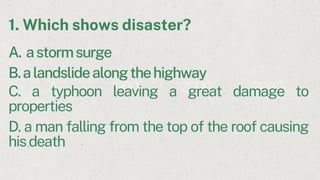
1. Which showsdisaster?
A storm
A 1900 2000 2030
A. astormsurge
B.alandslidealongthehighway
C. a typhoon leaving a great damage to
properties
D. a man falling from the top of the roof causing
hisdeath
3.
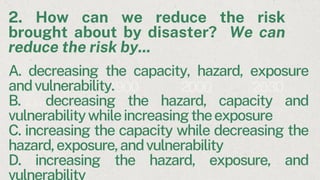
2. How canwe reduce the risk
brought about by disaster? We can
reduce the risk by...
A storm
A 1900 2000 2030
A. decreasing the capacity, hazard, exposure
andvulnerability.
B. decreasing the hazard, capacity and
vulnerabilitywhileincreasingtheexposure
C. increasing the capacity while decreasing the
hazard,exposure,andvulnerability
D. increasing the hazard, exposure, and
vulnerability
4.
A storm
A 19002000 2030
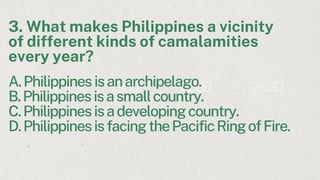
A.Philippinesisanarchipelago.
B.Philippinesisasmallcountry.
C.Philippinesisadevelopingcountry.
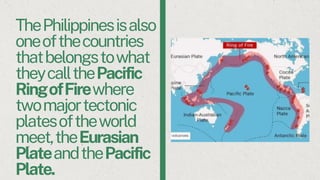
D.PhilippinesisfacingthePacificRingofFire.
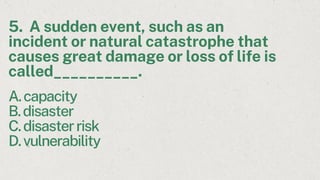
3. What makes Philippines a vicinity
of different kinds of camalamities
every year?
5.
A storm
A 19002000 2030
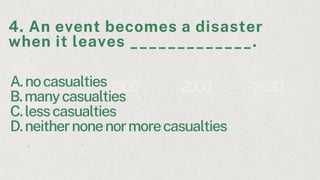
A.nocasualties
B.manycasualties
C.lesscasualties
D.neithernonenormorecasualties
4. An event becomes a disaster
when it leaves _____________.
LEARNING
OBJECTIVES
At the ofthe lesson,
the students will be
able to...
• Explain the meaning of
disaster and disaster risk;
• Differentiate the risk
factors underlying diasters;
• Describe the effects of
disasters on one’s life;
• Explain how and when an
event becomes a disaster
9.
LEARNING
OBJECTIVES
At the ofthe lesson,
the students will be
able to...
• Identify areas/locations
exposed to hazards that
may lead to disasters; and
• Analyze disaster from the
perspectives (physical,
psychological, socio-
cultural, economic, political
and biological)
10.
LEARNING
OBJECTIVES
At the ofthe lesson,
the students will be
able to...
• Identify areas/locations
exposed to hazards that
may lead to disasters; and
• Analyze disaster from the
perspectives (physical,
psychological, socio-
cultural, economic, political
and biological)
11.
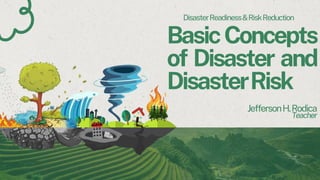
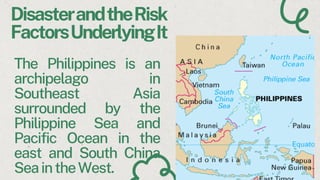
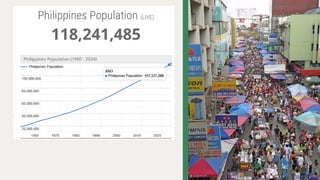
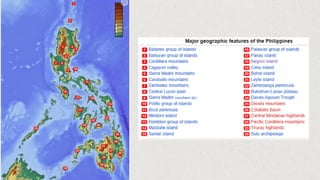
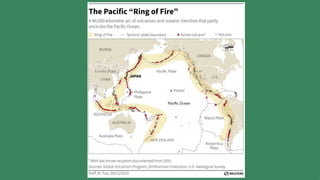
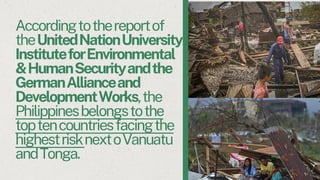
The Philippines isan
archipelago in
Southeast Asia
surrounded by the
Philippine Sea and
Pacific Ocean in the
east and South China
SeaintheWest.
DisasterandtheRisk
FactorsUnderlyingIt
Disasters as theConsequence of
Natural Hazards
The Philippine Disaster Risk Reduction and Management
Act of 2010 adopted the definition of UNISDR of hazard,
naturalortechnological(man-made)as,
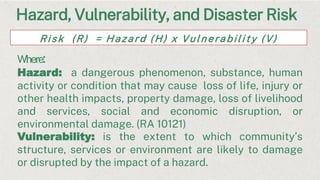
Hazard, Vulnerability, andDisaster Risk
Risk (R) = Hazard (H) x Vulnerability (V)
Where:
Hazard: a dangerous phenomenon, substance, human
activity or condition that may cause loss of life, injury or
other health impacts, property damage, loss of livelihood
and services, social and economic disruption, or
environmental damage. (RA 10121)
Vulnerability: is the extent to which community’s
structure, services or environment are likely to damage
or disrupted by the impact of a hazard.
36.
Risk, Disaster Riskand Disaster Risk
Assessment (DRA)
• RA 10121: Risk is the combination of probability of an
event (hazard) and its negative consequences
(vulnerability).
• Epidemiology: Risk is the probability that a particular
outcome will occur following a particular exposure.
• Finance: Risk is the probability that an actual return on
an investment will be lower than the expected return.
37.
What is Risk?
…”isthe probability of uncertain future events; the
probable frequency and magnitude of future loss the
possibility of suffering harm, loss, or danger; and the
probability of an accident occurring within a certain
time, together with the consequences for people,
property, and the environment.
38.
What is Loss?
Lossesor impacts refer to the number of human losses,
the type and amount of infrastructure damaged or
destroyed , or the amount of crops damaged other
economic losses, or quantifiable damage to the natural
environment (Peduzzi, 2012)
39.
What is RiskAnalysis?
It is the systematic identification, evaluation, and
assessment of risk objects and hazards.
40.
What is DisasterRisk?
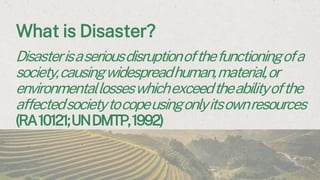
The potential disaster losses in lives, health status,
livelihood, assets, and services, which could occur to a
particular community or a society over some specified
future time period. (RA 10121)
41.
What is DisasterRisk Assessment (DRA)?
It is a methodology to determine the nature and extent
of risk by analyzing potential hazards and evaluating
existing conditions of vulnerability that together could
potentially harm exposed people, property, services,
livelihood, and environment on which they depend.
(RA 10121)
42.
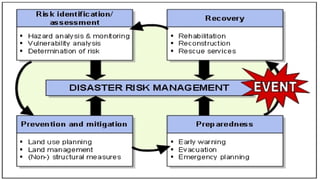
Disaster Risk Reduction(DRR)
The concept and practice of reducing disaster risks
through systematic efforts to analyze and manage the
casual factors of disasters, including through reduced
exposures to hazards, lessened vulnerability of people
and property, wise management of land and the
environment, and the improved preparedness for adverse
events. (RA 10121)
43.
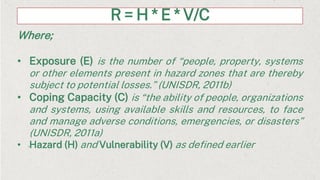
R = H* E * V/C
Where;
• Exposure (E) is the number of “people, property, systems
or other elements present in hazard zones that are thereby
subject to potential losses.” (UNISDR, 2011b)
• Coping Capacity (C) is “the ability of people, organizations
and systems, using available skills and resources, to face
and manage adverse conditions, emergencies, or disasters”
(UNISDR, 2011a)
• Hazard (H) and Vulnerability (V) as defined earlier
44.
Disaster Risk Reduction(DRR)
The concept and practice of reducing disaster risks
through systematic efforts to analyze and manage the
casual factors of disasters, including through reduced
exposures to hazards, lessened vulnerability of
people and property, wise management of land and
the environment, and the improved preparedness for
adverse events. (RA 10121)
45.
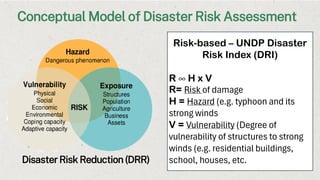
Conceptual Model ofDisaster Risk Assessment
Risk-based – UNDP Disaster
Risk Index (DRI)
R ∞ H x V
R= Risk of damage
H = Hazard (e.g. typhoon and its
strong winds
V = Vulnerability (Degree of
vulnerability of structures to strong
winds (e.g. residential buildings,
school, houses, etc.
Disaster Risk Reduction (DRR)




![DISASTER-READINESS-AND-]hh-Risk REDUCTION (1).pptx](https://cdn.slidesharecdn.com/ss_thumbnails/disaster-readiness-and-hh-riskreduction1-241005100530-4d9357c3-thumbnail.jpg?width=640&height=640&fit=bounds)


![Hacking-Uncovered-How-People-Get-Hacked-and-How-to-Stay-Safe[1].pptx](https://cdn.slidesharecdn.com/ss_thumbnails/hacking-uncovered-how-people-get-hacked-and-how-to-stay-safe1-260130170011-4883a9c7-thumbnail.jpg?width=640&height=640&fit=bounds)


