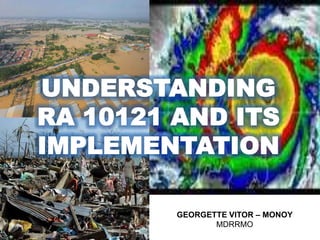
GEORGETTE VITOR – MONOY
MDRRMO
At the end of the session, you will be
able to:
• Understand RA 10121 (PDRRM)
• Understand the equation of disaster risk
• Know the possible risk of one’s family
• Plan for family preparedness
DRRM
• Systematic process of using
administrative directives,
organizations, and operational
skills and capacities to
implement strategies, policies
and improved coping capacities
in order to lessen the adverse
impacts of hazards and the
possibility of disaster
(RA 10121)
2. Basic Concepts on DRRM and CCAM
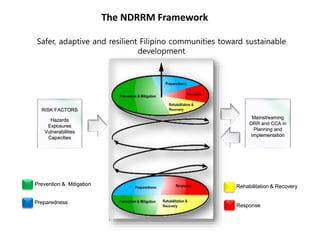
RISK FACTORS
Hazards
Exposures
Vulnerabilities
Capacities
Mainstreaming
DRR and CCA in
Planning and
Implementation
Prevention & Mitigation
Preparedness
Rehabilitation & Recovery
Response
Safer, adaptive and resilient Filipino communities toward sustainable
development
The NDRRM Framework
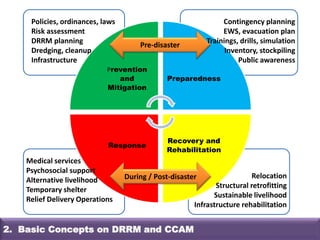
Prevention
and
Mitigation
Preparedness
Recovery and
Rehabilitation
Response
Pre-disaster
During / Post-disaster
Policies, ordinances, laws
Risk assessment
DRRM planning
Dredging, cleanup
Infrastructure
Contingency planning
EWS, evacuation plan
Trainings, drills, simulation
Inventory, stockpiling
Public awareness
Medical services
Psychosocial support
Alternative livelihood
Temporary shelter
Relief Delivery Operations
Relocation
Structural retrofitting
Sustainable livelihood
Infrastructure rehabilitation
2. Basic Concepts on DRRM and CCAM
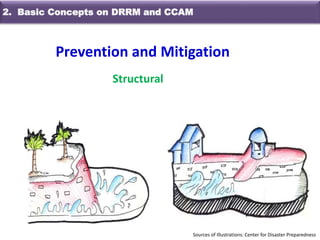
Structural
Prevention and Mitigation
Sources of Illustrations: Center for Disaster Preparedness
2. Basic Concepts on DRRM and CCAM
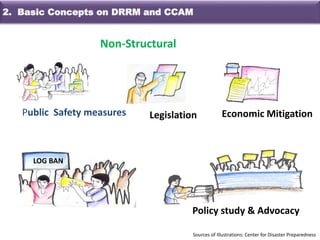
Non-Structural
Legislation Economic Mitigation
LOG BAN
Policy study & Advocacy
Public Safety measures
Sources of Illustrations: Center for Disaster Preparedness
2. Basic Concepts on DRRM and CCAM
Sources of Illustrations: Center for Disaster Preparedness
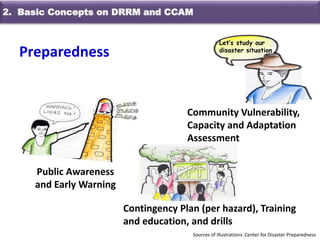
Preparedness
Let’s study our
disaster situation
Contingency Plan (per hazard), Training
and education, and drills
Public Awareness
and Early Warning
Community Vulnerability,
Capacity and Adaptation
Assessment
2. Basic Concepts on DRRM and CCAM
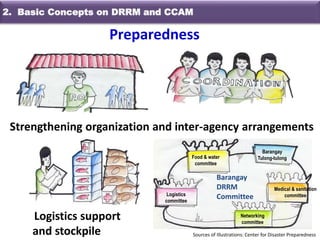
Strengthening organization and inter-agency arrangements
Logistics support
and stockpile
Barangay
Tulong-tulongFood & water
committee
Logistics
committee
Networking
committee
Medical & sanitation
committee
Barangay
DRRM
Committee
Sources of Illustrations: Center for Disaster Preparedness
Preparedness
2. Basic Concepts on DRRM and CCAM
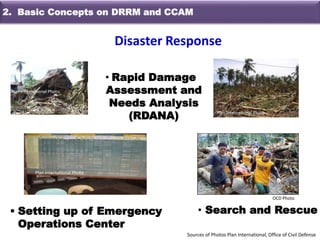
• Rapid Damage
Assessment and
Needs Analysis
(RDANA)
• Setting up of Emergency
Operations Center
• Search and Rescue
OCD Photo
Plan International Photo
Sources of Photos Plan International, Office of Civil Defense
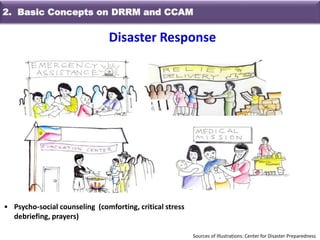
Disaster Response
2. Basic Concepts on DRRM and CCAM
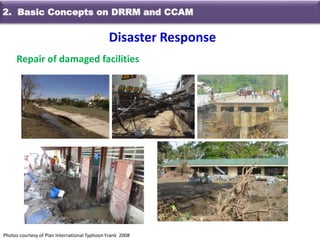
Repair of damaged facilities
Photos courtesy of Plan International Typhoon Frank 2008
Disaster Response
2. Basic Concepts on DRRM and CCAM
• Psycho-social counseling (comforting, critical stress
debriefing, prayers)
Sources of Illustrations: Center for Disaster Preparedness
2. Basic Concepts on DRRM and CCAM
Disaster Response
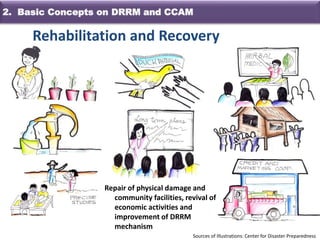
Rehabilitation and Recovery
Sources of Illustrations: Center for Disaster Preparedness
Repair of physical damage and
community facilities, revival of
economic activities and
improvement of DRRM
mechanism
2. Basic Concepts on DRRM and CCAM
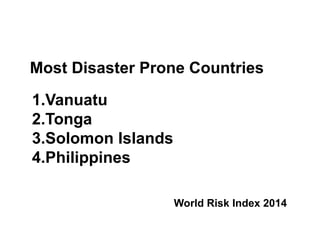
World Risk Index 2014
1.Vanuatu
2.Tonga
3.Solomon Islands
4.Philippines
Most Disaster Prone Countries
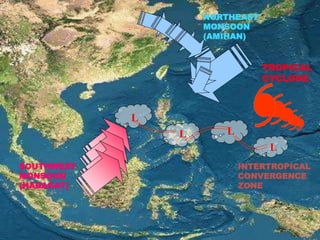
SOUTHWEST
MONSOON
(HABAGAT)
NORTHEAST
MONSOON
(AMIHAN)
L
L L
L
INTERTROPICAL
CONVERGENCE
ZONE
TROPICAL
CYCLONE
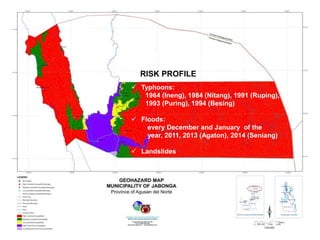
RISK PROFILE
 Typhoons:
1964 (Ineng), 1984 (Nitang), 1991 (Ruping),
1993 (Puring), 1994 (Besing)
 Floods:
every December and January of the
year, 2011, 2013 (Agaton), 2014 (Seniang)
 Landslides
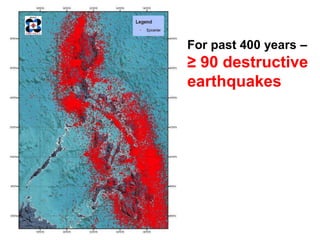
For past 400 years –
≥ 90 destructive
earthquakes
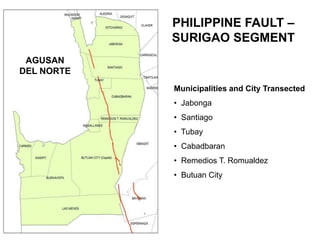
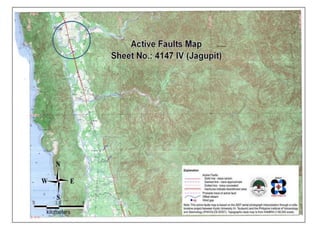
PHILIPPINE FAULT –
SURIGAO SEGMENT
AGUSAN
DEL NORTE
Municipalities and City Transected
• Jabonga
• Santiago
• Tubay
• Cabadbaran
• Remedios T. Romualdez
• Butuan City
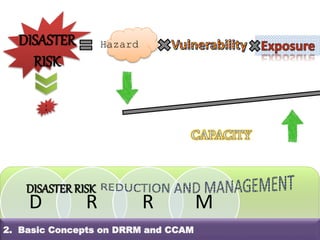
• The probability that a hazard
would hit a vulnerable community
and would result in loss of lives
and physical damages.
DISASTER
RISK
2. Basic Concepts on DRRM and CCAM
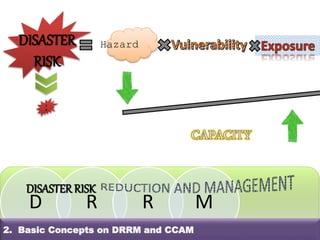
D R R M
DISASTER
RISK
Hazard
S
R
DISASTER RISK
2. Basic Concepts on DRRM and CCAM
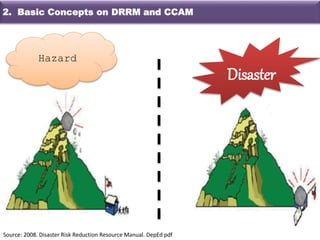
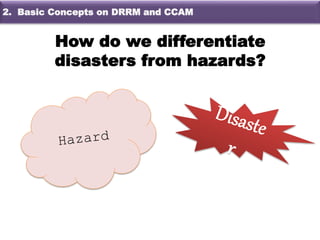
How do we differentiate
disasters from hazards?
2. Basic Concepts on DRRM and CCAM
A potentially damaging physical
event, phenomenon, or human
activity that may cause the loss of
life or injury, property damage,
social and economic disruption, or
environmental degradation
Hazard
2. Basic Concepts on DRRM and CCAM
Happens when there is a serious
disruption of the functioning of a
community or a society causing
widespread human, material,
economic, or environmental losses
which exceed the ability of the
affected community or society to
cope using its own resources
Disaste
r
2. Basehang Konsepto sa DRRM and CCA2. Basic Concepts on DRRM and CCAM
Hazard
Disaster
Source: 2008. Disaster Risk Reduction Resource Manual. DepEd pdf
2. Basic Concepts on DRRM and CCAM
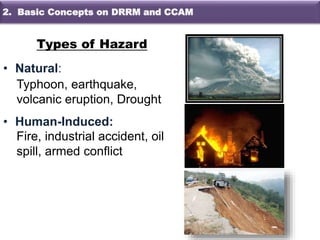
• Natural:
• Human-Induced:
Typhoon, earthquake,
volcanic eruption, Drought
Fire, industrial accident, oil
spill, armed conflict
Types of Hazard
2. Basic Concepts on DRRM and CCAM
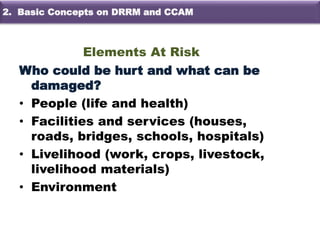
Elements At Risk
Who could be hurt and what can be
damaged?
• People (life and health)
• Facilities and services (houses,
roads, bridges, schools, hospitals)
• Livelihood (work, crops, livestock,
livelihood materials)
• Environment
2. Basic Concepts on DRRM and CCAM
What is the difference between
vulnerability and capacity?
?
2. Basic Concepts on DRRM and CCAM
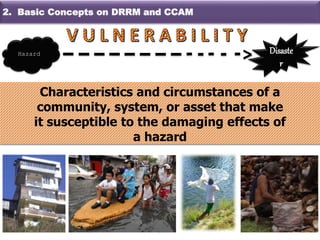
Characteristics and circumstances of a
community, system, or asset that make
it susceptible to the damaging effects of
a hazard
Hazard Disaste
r
>
2. Basic Concepts on DRRM and CCAM
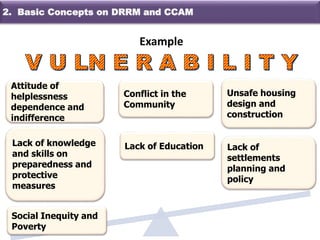
Example
Unsafe housing
design and
construction
Conflict in the
Community
Lack of
settlements
planning and
policy
Lack of EducationLack of knowledge
and skills on
preparedness and
protective
measures
Attitude of
helplessness
dependence and
indifference
Social Inequity and
Poverty
2. Basic Concepts on DRRM and CCAM
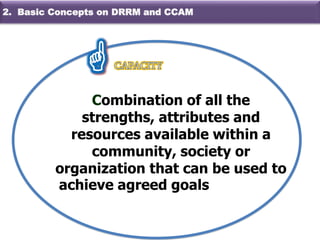
Combination of all the
strengths, attributes and
resources available within a
community, society or
organization that can be used to
achieve agreed goals
2. Basic Concepts on DRRM and CCAM
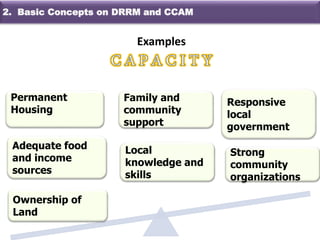
Examples
Responsive
local
government
Family and
community
support
Strong
community
organizations
Local
knowledge and
skills
Adequate food
and income
sources
Permanent
Housing
Ownership of
Land
2. Basic Concepts on DRRM and CCAM
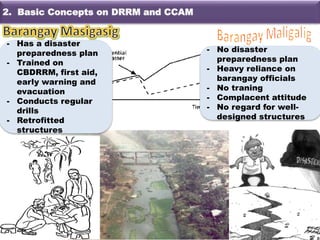
- Has a disaster
preparedness plan
- Trained on
CBDRRM, first aid,
early warning and
evacuation
- Conducts regular
drills
- Retrofitted
structures
- No disaster
preparedness plan
- Heavy reliance on
barangay officials
- No traning
- Complacent attitude
- No regard for well-
designed structures
2. Basic Concepts on DRRM and CCAM
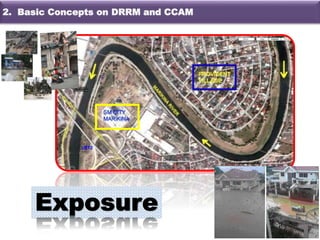
• The degree to which a community is
likely to experience hazard events
of different magnitude
• Refers to the physical location (e.g.
proximity to a body of water),
characteristics (type of soil,
topography, temperature), and
population density (over population,
congestion) of a community that
“exposes” it to hazards
2. Basic Concepts on DRRM and CCAM
D R R M
DISASTER
RISK
Hazard
S
R
DISASTER RISK
2. Basic Concepts on DRRM and CCAM
TEST
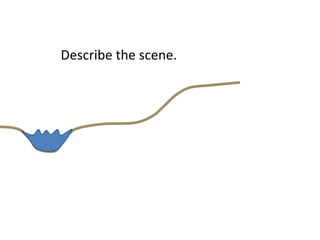
Describe the scene.
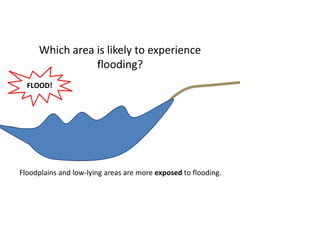
Floodplains and low-lying areas are more exposed to flooding.
FLOOD!
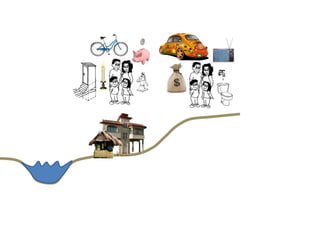
Which area is likely to experience
flooding?
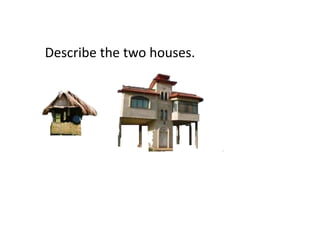
Describe the two houses.
FLOOD!
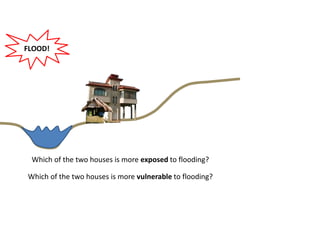
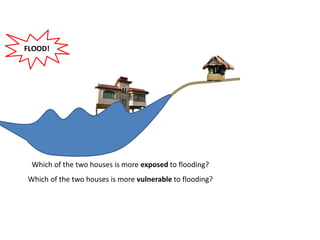
Which of the two houses is more exposed to flooding?
Which of the two houses is more vulnerable to flooding?
FLOOD!
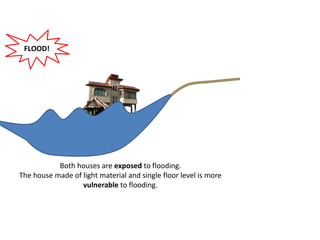
Both houses are exposed to flooding.
The house made of light material and single floor level is more
vulnerable to flooding.
FLOOD!
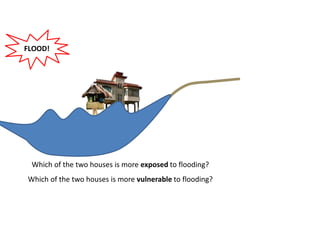
Which of the two houses is more exposed to flooding?
Which of the two houses is more vulnerable to flooding?
FLOOD!
Which of the two houses is more exposed to flooding?
Which of the two houses is more vulnerable to flooding?
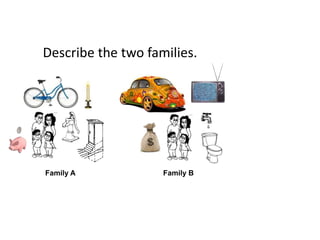
Describe the two families.
Family A Family B
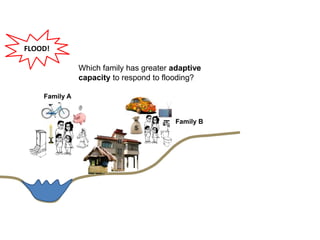
FLOOD!
Which family has greater adaptive
capacity to respond to flooding?
Family A
Family B
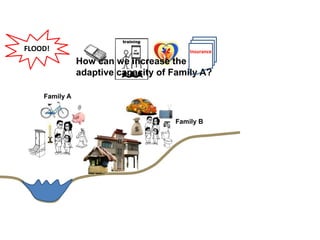
FLOOD!
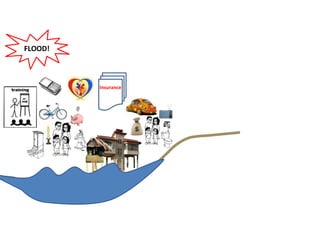
How can we increase the
adaptive capacity of Family A?
Insurance
Family B
Family A
FLOOD!
Insurance
At the end of the session, are you
able to:
• Understand RA 10121 (PDRRM)?
• Understand the equation of disaster risk?
• Imagine the possible risk of family?
• Plan for your family preparedness?
Understanding ra 10121

Understanding ra 10121

  • 1.
    GEORGETTE VITOR –MONOY MDRRMO
  • 2.
    At the endof the session, you will be able to: • Understand RA 10121 (PDRRM) • Understand the equation of disaster risk • Know the possible risk of one’s family • Plan for family preparedness
  • 4.
    DRRM • Systematic processof using administrative directives, organizations, and operational skills and capacities to implement strategies, policies and improved coping capacities in order to lessen the adverse impacts of hazards and the possibility of disaster (RA 10121) 2. Basic Concepts on DRRM and CCAM
  • 5.
    RISK FACTORS Hazards Exposures Vulnerabilities Capacities Mainstreaming DRR andCCA in Planning and Implementation Prevention & Mitigation Preparedness Rehabilitation & Recovery Response Safer, adaptive and resilient Filipino communities toward sustainable development The NDRRM Framework
  • 6.
    Prevention and Mitigation Preparedness Recovery and Rehabilitation Response Pre-disaster During /Post-disaster Policies, ordinances, laws Risk assessment DRRM planning Dredging, cleanup Infrastructure Contingency planning EWS, evacuation plan Trainings, drills, simulation Inventory, stockpiling Public awareness Medical services Psychosocial support Alternative livelihood Temporary shelter Relief Delivery Operations Relocation Structural retrofitting Sustainable livelihood Infrastructure rehabilitation 2. Basic Concepts on DRRM and CCAM
  • 7.
    Structural Prevention and Mitigation Sourcesof Illustrations: Center for Disaster Preparedness 2. Basic Concepts on DRRM and CCAM
  • 8.
    Non-Structural Legislation Economic Mitigation LOGBAN Policy study & Advocacy Public Safety measures Sources of Illustrations: Center for Disaster Preparedness 2. Basic Concepts on DRRM and CCAM
  • 9.
    Sources of Illustrations:Center for Disaster Preparedness Preparedness Let’s study our disaster situation Contingency Plan (per hazard), Training and education, and drills Public Awareness and Early Warning Community Vulnerability, Capacity and Adaptation Assessment 2. Basic Concepts on DRRM and CCAM
  • 10.
    Strengthening organization andinter-agency arrangements Logistics support and stockpile Barangay Tulong-tulongFood & water committee Logistics committee Networking committee Medical & sanitation committee Barangay DRRM Committee Sources of Illustrations: Center for Disaster Preparedness Preparedness 2. Basic Concepts on DRRM and CCAM
  • 11.
    • Rapid Damage Assessmentand Needs Analysis (RDANA) • Setting up of Emergency Operations Center • Search and Rescue OCD Photo Plan International Photo Plan International Photo Plan International Photo Sources of Photos Plan International, Office of Civil Defense Disaster Response 2. Basic Concepts on DRRM and CCAM
  • 12.
    Repair of damagedfacilities Photos courtesy of Plan International Typhoon Frank 2008 Disaster Response 2. Basic Concepts on DRRM and CCAM
  • 13.
    • Psycho-social counseling(comforting, critical stress debriefing, prayers) Sources of Illustrations: Center for Disaster Preparedness 2. Basic Concepts on DRRM and CCAM Disaster Response
  • 14.
    Rehabilitation and Recovery Sourcesof Illustrations: Center for Disaster Preparedness Repair of physical damage and community facilities, revival of economic activities and improvement of DRRM mechanism 2. Basic Concepts on DRRM and CCAM
  • 16.
    World Risk Index2014 1.Vanuatu 2.Tonga 3.Solomon Islands 4.Philippines Most Disaster Prone Countries
  • 19.
  • 21.
    RISK PROFILE  Typhoons: 1964(Ineng), 1984 (Nitang), 1991 (Ruping), 1993 (Puring), 1994 (Besing)  Floods: every December and January of the year, 2011, 2013 (Agaton), 2014 (Seniang)  Landslides
  • 24.
    For past 400years – ≥ 90 destructive earthquakes
  • 25.
    PHILIPPINE FAULT – SURIGAOSEGMENT AGUSAN DEL NORTE Municipalities and City Transected • Jabonga • Santiago • Tubay • Cabadbaran • Remedios T. Romualdez • Butuan City
  • 35.
    • The probabilitythat a hazard would hit a vulnerable community and would result in loss of lives and physical damages. DISASTER RISK 2. Basic Concepts on DRRM and CCAM
  • 36.
    D R RM DISASTER RISK Hazard S R DISASTER RISK 2. Basic Concepts on DRRM and CCAM
  • 37.
    How do wedifferentiate disasters from hazards? 2. Basic Concepts on DRRM and CCAM
  • 38.
    A potentially damagingphysical event, phenomenon, or human activity that may cause the loss of life or injury, property damage, social and economic disruption, or environmental degradation Hazard 2. Basic Concepts on DRRM and CCAM
  • 39.
    Happens when thereis a serious disruption of the functioning of a community or a society causing widespread human, material, economic, or environmental losses which exceed the ability of the affected community or society to cope using its own resources Disaste r 2. Basehang Konsepto sa DRRM and CCA2. Basic Concepts on DRRM and CCAM
  • 40.
    Hazard Disaster Source: 2008. DisasterRisk Reduction Resource Manual. DepEd pdf 2. Basic Concepts on DRRM and CCAM
  • 41.
    • Natural: • Human-Induced: Typhoon,earthquake, volcanic eruption, Drought Fire, industrial accident, oil spill, armed conflict Types of Hazard 2. Basic Concepts on DRRM and CCAM
  • 42.
    Elements At Risk Whocould be hurt and what can be damaged? • People (life and health) • Facilities and services (houses, roads, bridges, schools, hospitals) • Livelihood (work, crops, livestock, livelihood materials) • Environment 2. Basic Concepts on DRRM and CCAM
  • 43.
    What is thedifference between vulnerability and capacity? ? 2. Basic Concepts on DRRM and CCAM
  • 44.
    Characteristics and circumstancesof a community, system, or asset that make it susceptible to the damaging effects of a hazard Hazard Disaste r > 2. Basic Concepts on DRRM and CCAM
  • 45.
    Example Unsafe housing design and construction Conflictin the Community Lack of settlements planning and policy Lack of EducationLack of knowledge and skills on preparedness and protective measures Attitude of helplessness dependence and indifference Social Inequity and Poverty 2. Basic Concepts on DRRM and CCAM
  • 46.
    Combination of allthe strengths, attributes and resources available within a community, society or organization that can be used to achieve agreed goals 2. Basic Concepts on DRRM and CCAM
  • 47.
    Examples Responsive local government Family and community support Strong community organizations Local knowledge and skills Adequatefood and income sources Permanent Housing Ownership of Land 2. Basic Concepts on DRRM and CCAM
  • 48.
    - Has adisaster preparedness plan - Trained on CBDRRM, first aid, early warning and evacuation - Conducts regular drills - Retrofitted structures - No disaster preparedness plan - Heavy reliance on barangay officials - No traning - Complacent attitude - No regard for well- designed structures 2. Basic Concepts on DRRM and CCAM
  • 49.
    • The degreeto which a community is likely to experience hazard events of different magnitude • Refers to the physical location (e.g. proximity to a body of water), characteristics (type of soil, topography, temperature), and population density (over population, congestion) of a community that “exposes” it to hazards 2. Basic Concepts on DRRM and CCAM
  • 50.
    2. Basic Conceptson DRRM and CCAM
  • 51.
    D R RM DISASTER RISK Hazard S R DISASTER RISK 2. Basic Concepts on DRRM and CCAM
  • 52.
  • 53.
  • 54.
    Floodplains and low-lyingareas are more exposed to flooding. FLOOD! Which area is likely to experience flooding?
  • 55.
  • 56.
    FLOOD! Which of thetwo houses is more exposed to flooding? Which of the two houses is more vulnerable to flooding?
  • 57.
    FLOOD! Both houses areexposed to flooding. The house made of light material and single floor level is more vulnerable to flooding.
  • 58.
    FLOOD! Which of thetwo houses is more exposed to flooding? Which of the two houses is more vulnerable to flooding?
  • 59.
    FLOOD! Which of thetwo houses is more exposed to flooding? Which of the two houses is more vulnerable to flooding?
  • 60.
    Describe the twofamilies. Family A Family B
  • 62.
    FLOOD! Which family hasgreater adaptive capacity to respond to flooding? Family A Family B
  • 63.
    FLOOD! How can weincrease the adaptive capacity of Family A? Insurance Family B Family A
  • 64.
  • 66.
    At the endof the session, are you able to: • Understand RA 10121 (PDRRM)? • Understand the equation of disaster risk? • Imagine the possible risk of family? • Plan for your family preparedness?