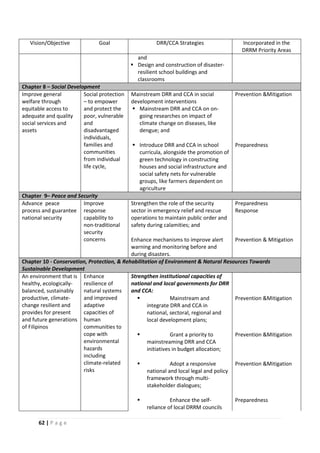
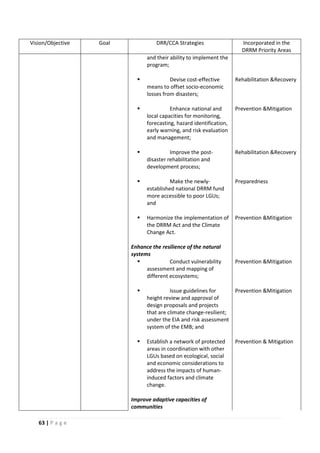
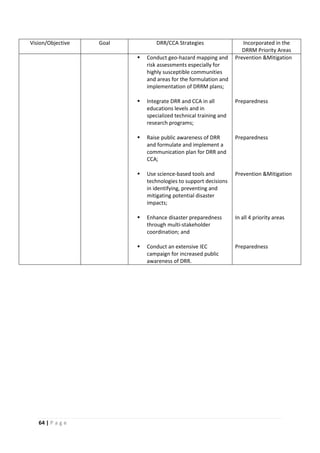
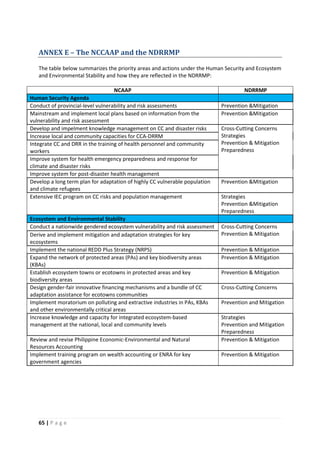
1 | P a g e
2011 to
2028
FINAL VERSION
December 2011
The National Disaster Risk
Reduction and Management Plan
NDRRMP
2 | P a g e
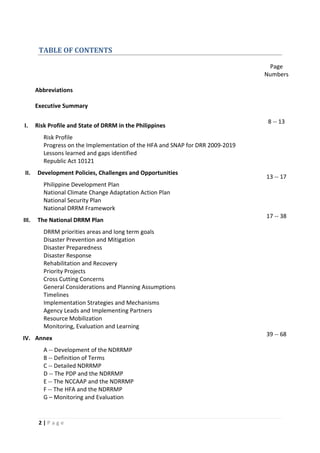
TABLE OF CONTENTS
Page
Numbers
Abbreviations
Executive Summary
I. Risk Profile and State of DRRM in the Philippines
8 -- 13
Risk Profile
Progress on the Implementation of the HFA and SNAP for DRR 2009-2019
Lessons learned and gaps identified
Republic Act 10121
II. Development Policies, Challenges and Opportunities
13 -- 17
Philippine Development Plan
National Climate Change Adaptation Action Plan
National Security Plan
National DRRM Framework
III. The National DRRM Plan
17 -- 38
DRRM priorities areas and long term goals
Disaster Prevention and Mitigation
Disaster Preparedness
Disaster Response
Rehabilitation and Recovery
Priority Projects
Cross Cutting Concerns
General Considerations and Planning Assumptions
Timelines
Implementation Strategies and Mechanisms
Agency Leads and Implementing Partners
Resource Mobilization
Monitoring, Evaluation and Learning
IV. Annex
39 -- 68
A -- Development of the NDRRMP
B -- Definition of Terms
C -- Detailed NDRRMP
D -- The PDP and the NDRRMP
E -- The NCCAAP and the NDRRMP
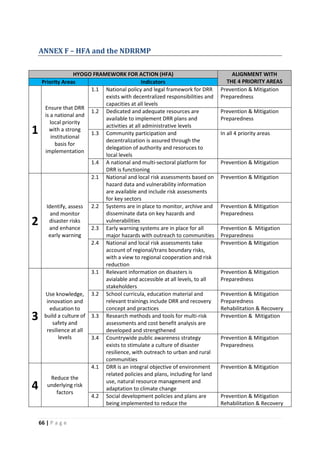
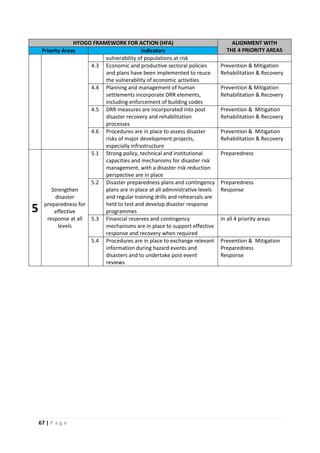
F -- The HFA and the NDRRMP
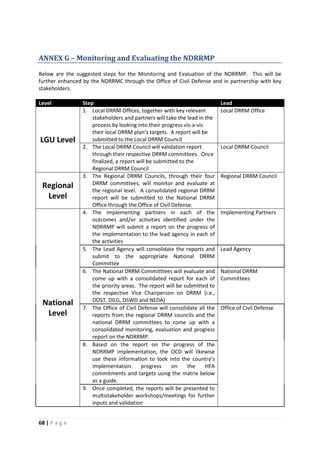
G – Monitoring and Evaluation
3 | P a g e
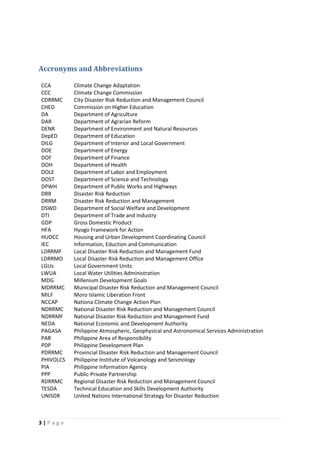
Accronyms and Abbreviations
CCA Climate Change Adaptation
CCC Climate Change Commission
CDRRMC City Disaster Risk Reduction and Management Council
CHED Commission on Higher Education
DA Department of Agriculture
DAR Department of Agrarian Reform
DENR Department of Environment and Natural Resources
DepED Department of Education
DILG Department of Interior and Local Government
DOE Department of Energy
DOF Department of Finance
DOH Department of Health
DOLE Department of Labor and Employment
DOST Department of Science and Technology
DPWH Department of Public Works and Highways
DRR Disaster Risk Reduction
DRRM Disaster Risk Reduction and Management
DSWD Department of Social Welfare and Development
DTI Department of Trade and Industry
GDP Gross Domestic Product
HFA Hyogo Framework for Action
HUDCC Housing and Urban Development Coordinating Council
IEC Information, Eduction and Communication
LDRRMF Local Disaster Risk Reduction and Management Fund
LDRRMO Local Disaster Risk Reduction and Management Office
LGUs Local Government Units
LWUA Local Water Utilities Administration
MDG Millenium Development Goals
MDRRMC Municipal Disaster Risk Reduction and Management Council
MILF Moro Islamic Liberation Front
NCCAP Nationa Climate Change Action Plan
NDRRMC National Disaster Risk Reduction and Management Council
NDRRMF National Disaster Risk Reduction and Management Fund
NEDA National Economic and Development Authority
PAGASA Philippine Atmospheric, Geophysical and Astronomical Services Administration
PAR Philippine Area of Responsibility
PDP Philippine Development Plan
PDRRMC Provincial Disaster Risk Reduction and Management Council
PHIVOLCS Philippine Institute of Volcanology and Seismology
PIA Philippine Information Agency
PPP Public-Private Partnership
RDRRMC Regional Disaster Risk Reduction and Management Council
TESDA Technical Education and Skills Development Authority
UNISDR United Nations International Strategy for Disaster Reduction
4 | P a g e
5 | P a g e
EXECUTIVE SUMMARY
The enactment of Republic Act 10121 otherwise known as the Philippine Disaster Risk Reduction and
Management Act of 2010 has laid the basis for a paradigm shift from just disaster preparedness and
response to disaster risk reduction and management (DRRM).The National DRRM Plan serves as the
national guide on how sustainable development can be achieved through inclusive growth while
building the adaptive capacities of communities; increasing the resilience of vulnerable sectors; and
optimizing disaster mitigation opportunities with the end in view of promoting people’s welfare and
security towards gender-responsive and rights-based sustainable development.
Over the past several years, the country has gained a lot of attention and momentum in the area of
disaster risk reduction. Numerous projects and activities have been undertaken by various
Philippine stakeholders and agencies in DRRM. However, sustaining the positive results and scaling
them up to effect rippling positive changes in the lives of the poeple have been constant challenges.
Threats remain. Disasters and people’s risk to disasters are still present.
This is because the underlying causes of people’s vulnerability has yet to be fully fully recognized and
addressed. For years, DRR has focused more on efforts around disaster preparedness and response
and not so much in identifying the hazard-prone areas and other factors which contribute to
people’s exposure to disasters; incorporating risk analysis to development plans; building people’s
capacities towards sustainable livelihood options; and the like. Although DRR has been gaining
attention among peoples and institutions, complete paradigm shift from “disasters as an immediate
product of hazards” to “disasters as a function of people’s vulnerability” has not yet fully happened.
Also, converging DRR and CCA remains to be a challenge, both in understading, mainstreaming into
plans and policies, including institutional mechanisms. Lastly, gaps in terms of increased knowledge,
understanding and capacities remain and cause a big challenge for the country in terms of DRRM.
The NDRRMP outlines the activities aimed at strengthening the capacity of the national government
and the local government units (LGUs) together with partner stakeholders, to build the disaster
resilience of communities and to institutionalize arrangements and measures for reducing disaster
risks, including projected climate risks and enhancing disaster preparedness and response
capabilities at all levels. It highlights, among others, the importance of mainstream DRRM and CCA
in the development processes such as policy formulation, socioeconoimc development planning,
budgeting and governance particularly in the area of environment, agriculture, water, energy,
health, education, poverty reduction, land-use and urban planning and public infrastructure and
housing among others. Mainstreaming also puts to forth the need to develop common tools to
analyze the various hazards and vulnerability factors which put our communities and people into
harms way.
The NDRRMP also highlights the need for institutionalizing DRRM policies, structures, coordination
mechanisms and programs with continuing budget appropriation on DRR from national down to
local levels. Through permanent mechanisms, competency and science-based capacity building
activities can be done, alongside the nurturing of continuous learning through knowledge
development and management of good DRRM practices on the ground.
Last but not least, the NDRRMP adheres to the principles of good governance within the context of
poverty alleviation and environmental protection. It is about partnerships and workshing together –
engaging the participation of CSOs, the private sector and volunteers in the government’s DRRM
programs towards compelementation of resources and effective delivery of services to the citizenry.
6 | P a g e
In accordance with the NDRRMF, through the NDRRMP, the country will have“Safer, adaptive and
disaster resilient Filipino communities towards sustainable development.”This will be achieved
through the four distinct yet mutually reinforcing prioirty areas, namely, (a) Disaster Prevention and
Mitigation; (b) Disaster Preparedness; (c) Disaster Response; and (d) Disaster Recovery and
Rehabilitation. Each priority area has its own long term goal, which when put together will lead to
the attainment of our country’s over goal/vision in DRRM.
These priority areas are not autonomous from the other nor do they have clear start and end points.
The 4 priority areas are NOT seen as a mere cycle which starts in prevention and mitigation and ends
in rehabilitation and recovery. They...
(a) Mutual reinforce each other and are interoperable.
(b) DO NOT, SHOULD NOT and CANNOT stand alone.
(c) Have no clear starting nor ending points between each of the aspects and overlaps are to be
expected.
(d) Are problem-needs and asset-strengths centered.
(e) All point to one direction  reduce people’s vulnerabilities and increasing their capacities.
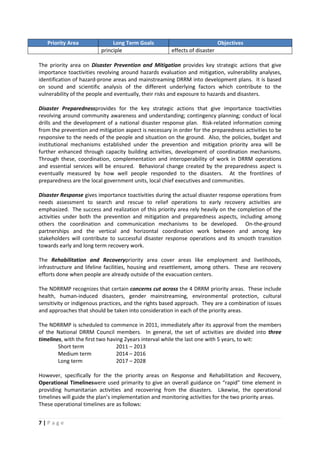
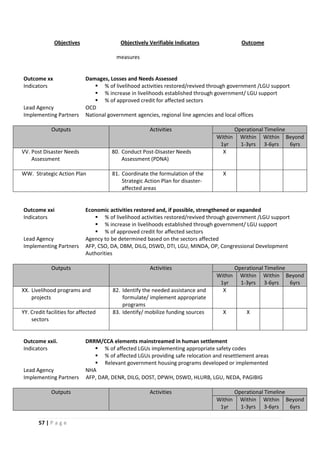
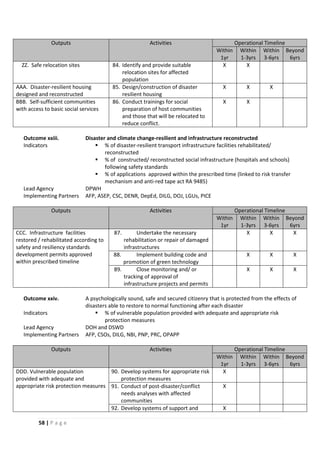
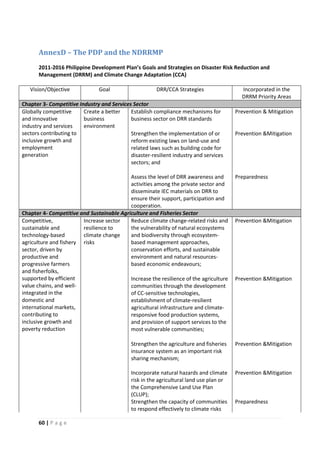
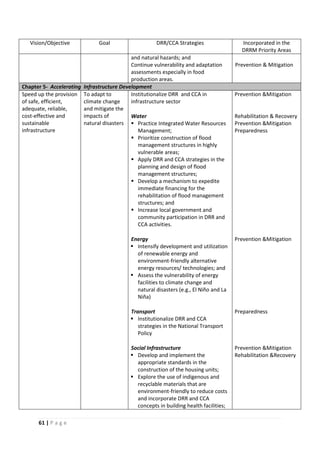
In summary, the NDRRMP has 4 priority areas with 4 long term goals; 14 objectives; 24 outcomes; 56
outputs; and 93 activities.
Priority Area Long Term Goals Objectives
Prevention and Mitigation Avoid hazards and
mitigate their potential
impacts by reducing
vulnerabilities and
exposure and enhancing
capacities of communities
Reduce vulnerability and exposure of
communities to all hazards
Enhance capacities of communities to reduce
their own risks and cope with the impacts of all
hazards
Disaster Preparedness Establish and strengthen
capacities of communities
to anticipate, cope and
recover
from the negative impacts
of emergency occurrences
and disasters
Increase the level of awareness of the
community to the threats and impacts of all
hazards, risks and vulnerabilities
Equip the community with the necessary skills to
cope with the negative impacts of a disaster
Increase the capacity of institutions
Develop and implement comprehensive national
and local disaster preparedness policies, plans
and systems
Disaster Response Provide life preservation
and meet the basic
subsistence needs of
affected population based
on acceptable standards
during or immediately
after a disaster
To decrease the number of preventable deaths
and injuries
To provide basic subsistence needs of affected
population
To immediately restore basic social services
Rehabilitation and
Recovery
Restore and improve
facilities, livelihood and
living conditions and
organizational capacities
of affected communities,
and reduced disaster risks
in accordance with the
“building back better”
To restore people’s means of livelihood and
continuity of economic activities and business
To restore shelter and other
buildings/installation
To reconstruct infrastructure and other public
utilities;
To assist in the physical and psychological
rehabilitation of persons who suffered from the
7 | P a g e
Priority Area Long Term Goals Objectives
principle effects of disaster
The priority area on Disaster Prevention and Mitigation provides key strategic actions that give
importance toactivities revolving around hazards evaluation and mitigation, vulnerability analyses,
identification of hazard-prone areas and mainstreaming DRRM into development plans. It is based
on sound and scientific analysis of the different underlying factors which contribute to the
vulnerability of the people and eventually, their risks and exposure to hazards and disasters.
Disaster Preparednessprovides for the key strategic actions that give importance toactivities
revolving around community awareness and understanding; contingency planning; conduct of local
drills and the development of a national disaster response plan. Risk-related information coming
from the prevention and mitigation aspect is necessary in order for the preparedness activities to be
responsive to the needs of the people and situation on the ground. Also, the policies, budget and
institutional mechanisms established under the prevention and mitigation priority area will be
further enhanced through capacity building activities, development of coordination mechanisms.
Through these, coordination, complementation and interoperability of work in DRRM operations
and essential services will be ensured. Behavioral change created by the preparedness aspect is
eventually measured by how well people responded to the disasters. At the frontlines of
preparedness are the local government units, local chief executives and communities.
Disaster Response gives importance toactivities during the actual disaster response operations from
needs assessment to search and rescue to relief operations to early recovery activities are
emphasized. The success and realization of this priority area rely heavily on the completion of the
activities under both the prevention and mitigation and preparedness aspects, including among
others the coordination and communication mechanisms to be developed. On-the-ground
partnerships and the vertical and horizontal coordination work between and among key
stakeholders will contribute to successful disaster response operations and its smooth transition
towards early and long term recovery work.
The Rehabilitation and Recoverypriority area cover areas like employment and livelihoods,
infrastructure and lifeline facilities, housing and resettlement, among others. These are recovery
efforts done when people are already outside of the evacuation centers.
The NDRRMP recognizes that certain concerns cut across the 4 DRRM priority areas. These include
health, human-induced disasters, gender mainstreaming, environmental protection, cultural
sensitivity or indigenous practices, and the rights based approach. They are a combination of issues
and approaches that should be taken into consideration in each of the priority areas.
The NDRRMP is scheduled to commence in 2011, immediately after its approval from the members
of the National DRRM Council members. In general, the set of activities are divided into three
timelines, with the first two having 2years interval while the last one with 5 years, to wit:
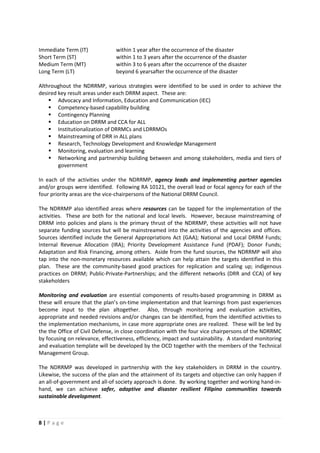
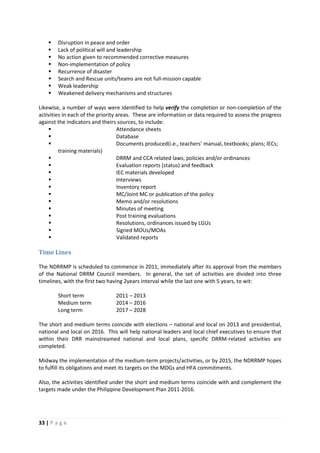
Short term 2011 – 2013
Medium term 2014 – 2016
Long term 2017 – 2028
However, specifically for the the priority areas on Response and Rehabilitation and Recovery,
Operational Timelineswere used primarity to give an overall guidance on “rapid” time element in
providing humanitarian activities and recovering from the disasters. Likewise, the operational
timelines will guide the plan’s implementation and monitoring activities for the two priority areas.
These operational timelines are as follows:
8 | P a g e
Immediate Term (IT) within 1 year after the occurrence of the disaster
Short Term (ST) within 1 to 3 years after the occurrence of the disaster
Medium Term (MT) within 3 to 6 years after the occurrence of the disaster
Long Term (LT) beyond 6 yearsafter the occurrence of the disaster
Althroughout the NDRRMP, various strategies were identified to be used in order to achieve the
desired key result areas under each DRRM aspect. These are:
 Advocacy and Information, Education and Communication (IEC)
 Competency-based capability building
 Contingency Planning
 Education on DRRM and CCA for ALL
 Institutionalization of DRRMCs and LDRRMOs
 Mainstreaming of DRR in ALL plans
 Research, Technology Development and Knowledge Management
 Monitoring, evaluation and learning
 Networking and partnership building between and among stakeholders, media and tiers of
government
In each of the activities under the NDRRMP, agency leads and implementing partner agencies
and/or groups were identified. Following RA 10121, the overall lead or focal agency for each of the
four priority areas are the vice-chairpersons of the National DRRM Council.
The NDRRMP also identified areas where resources can be tapped for the implementation of the
activities. These are both for the national and local levels. However, because mainstreaming of
DRRM into policies and plans is the primary thrust of the NDRRMP, these activities will not have
separate funding sources but will be mainstreamed into the activities of the agencies and offices.
Sources identified include the General Appropriations Act (GAA); National and Local DRRM Funds;
Internal Revenue Allocation (IRA); Priority Development Assistance Fund (PDAF); Donor Funds;
Adaptation and Risk Financing, among others. Aside from the fund sources, the NDRRMP will also
tap into the non-monetary resources available which can help attain the targets identified in this
plan. These are the community-based good practices for replication and scaling up; indigenous
practices on DRRM; Public-Private-Partnerships; and the different networks (DRR and CCA) of key
stakeholders
Monitoring and evaluation are essential components of results-based programming in DRRM as
these will ensure that the plan’s on-time implementation and that learnings from past experiences
become input to the plan altogether. Also, through monitoring and evaluation activities,
appropriate and needed revisions and/or changes can be identified, from the identified activities to
the implementation mechanisms, in case more appropriate ones are realized. These will be led by
the the Office of Civil Defense, in close coordination with the four vice chairpersons of the NDRRMC
by focusing on relevance, effectiveness, efficiency, impact and sustainability. A standard monitoring
and evaluation template will be developed by the OCD together with the members of the Technical
Management Group.
The NDRRMP was developed in partnership with the key stakeholders in DRRM in the country.
Likewise, the success of the plan and the attainment of its targets and objective can only happen if
an all-of-government and all-of society approach is done. By working together and working hand-in-
hand, we can achieve safer, adaptive and disaster resilient Filipino communities towards
sustainable development.
9 | P a g e
RISK PROFILEand STATE OF DRRM
There are compelling reasons why the Philippines should adopt disaster risk reduction and
management(DRRM) and climate change adaptation (CCA). It is exposed to disasters and hazards
due to its geography and geology as well as the presence of internal disputes in some areas.
Tropical cyclones and its sequential effects of rain and windstorms, as well as floods are the most
prevalent types of hydro-meteorological hazards in the country. Between 1997 and 2007, eighty-
four (84) tropical cyclones entered the Philippine Area of Responsibility (PAR). These typhoons
resulted to a total of 13,155 in human casualty and more than 51 million families have been
affected. Economic losses due to typhoon damages in agriculture, infrastructures and private
properties are estimated to reach P158.242-B. Some of the most devastating floods and landslides
are triggered by these typhoons that happened also within this period. The El Nino Southern
Oscillation which is a periodic disaster recorded high economic costs in just a single occurrence. In
2010, out of the almost PhP 25-M worth of damages to properties caused by natural disasters,
tropical cyclones contributed to more than half. These affected more than 3 million people in that
year alone.
Environmental factors such as denuded forests aggravate flood risks. The pace of deforestation
since the 1930s accelerated in the 1950s and 1960s, before falling slightly in the 1980s. Even now,
the effects of loose soil and reduced forest cover from past forestry activities are felt in frequent
landslides and floods. Recent events show that the annual monsoon season in the country has
brought severe flooding in most areas. In 2011, most of the disasters that claimed the lives of
people and affected properties and livelihoods of the most vulnerable were brought about by
increased rainfall which caused massive flash flooding in areas which don’t normally experience
such. Between January to September 2011, more than 50 incidents of flash flooding and flooding
and more than 30 landslides occurred, mostly caused by increased rainfall and illegal logging.
Typhoon Sendong alone caused the lives of more than 1,000 people and damaged properties
amounting to billions of pesos.
In addition, the Philippines is situated along a highly seismic area lying along the Pacific Ring of Fire
and is highly-prone to earthquakes. According to the Philippine Institute on Volcanology and
Seismology (PHIVLOCS), the counrty experiences an average of five (5) earthquakes a day.
Earthquake disasters are not as frequent as the typhoons and flooding that take place in the
Philippines. Nevertheless, the impact generated on affected communities is usually massive and
devastating. Earthquake-induced disasters were few in numbers and in terms of casualties. Within
the 10-year period five (5) destructive earthquakes were recorded and human casualty included 15
deaths and 119 persons injured. Damage to the economy was estimated to reach P0.207-B. The
1990 Luzon Earthquake, the Moro Gulf Tsunami and the collapse of the Ruby Tower were the most
notably devastating earthquake disasters in the Philippines.The Philippines is also prone to volcanic
eruptions being situated along the the Pacific Ring of Fire where two major tectonic plates
(Philippine Sea and Eurasian) meet. This explains the occurrence of earthquakes and tsunamis and
the existence of around 300 volcanoes of which 22 are active.
Based on the data from the National Disaster Risk Reduction and Management Council (NDRRMC),
between 1990 and 2006, annual direct damages caused by disasters amount to PhP20-B per year.
This is roughly 0.5% of the Gross Domestic Product (GDP) on the average per year. In 2009 alone,
tropical storm Ondoy and typhoon Pepeng caused substantial damages and losses equivalent to
about 2.7% of the country’s GDP.
10 | P a g e
Hazards become disasters only if vulnerable people and resources are exposed to them. People who
live in poverty and adverse socio-economic considitions are highly vulnerable to disasters, especially
those who live in river pathways and along the most hazard-prone areas. This explains why some
parts of the country are more prone to specific hazards than others; some parts are exposed to more
hazards than others.In an analysis of natural disaster hotspots by the Hazard Management Unit of
the World Bank in 2005, the Philippines is among the countries where large percentages of
population reside in disaster prone areas. In the 2011 World Risk Report published by United
Nations University and the Institute of Environment and Human Security, looking into the four
components of risk (exposure, susceptibility, coping and adapt capacities), the Philippines is the third
most disaster risk country worldwide.
Aside from natural causes, the country also experiences human-induced disasters. These are
brought about by hazards that are of political and socio-economic origins, among others. Many are
forced to evacuate during times of conflict. Violence continue to plague the country, with most of
the fighting in the South. Intense fighting between government forces and the Moro Islamic
Liberation Front (MILF) during the first half of year 2009 resulted in the displacement of hundreds of
thousands of civilians. The government and the MILF decided to lay down their arms and work
toward peace accord that had failed in 2009 in Malaysia. On the other hand, the Abu Sayyaf Group
(ASG), labelled a terrorist organization, continued to carry out bombings and rebels were killed
during clashes with the military in the latter part of 2009. These human-induced disasters caused by
armed fightings in the South continue to threaten the security of civilian communities which result
into the displacement of thousands of civilians. So long as there is no peace settlement mechanism
in Mindanao, internally displaced civilians will remain a given collateral damage of every armed
conflicts. Such disasters consequently cause public anxiety, lost of lives, destruction of properties
and sometimes socio-political stability.
Progress on the Implementation of HFA and SNAP
Because of the country’s susceptibility to natural and human-induced disasters, efforts have been
made for the past several years to build people’s capacities and resilience to disasters. This is in line
with the country’s commitment to achieve the targets set by the Millenium Development Goals
(MDGs) and its commitment to build resilient communities as expressed by its adoption of the
Hyogo Framework for Action (HFA) in 2005. The HFA was formulated and adopted by 168
governments at the World Conference on Disaster Reduction held in Kobe, Japan and is aimed at
building the resilience of nations and communities to disasters and reducing vulnerabilities and risks
to hazards. It aims to have (a) effective integration of disaster risk considerations into sustainable
development policies, planning and programming at all levels – disaster prevention, mitigation,
preparedness and vulnerability reduction; (b) development and strengthening of institutions,
mechanisms and capacities at all levels; and (c) systematic incorporation of risk reduction
approaches into the design and implementation of emergency preparedness, response and recovery
programmes in the recontsruction of affected communities.
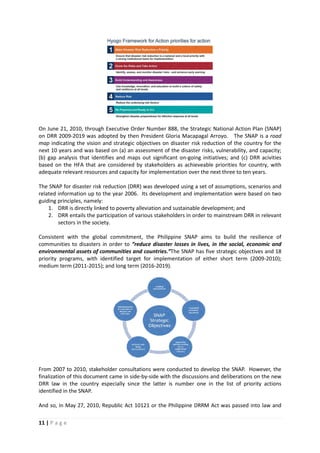
These three (3) strategic goals are to be achieved through the five (5) priorities of action, namely:
11 | P a g e
On June 21, 2010, through Executive Order Number 888, the Strategic National Action Plan (SNAP)
on DRR 2009-2019 was adopted by then President Gloria Macapagal Arroyo. The SNAP is a road
map indicating the vision and strategic objectives on disaster risk reduction of the country for the
next 10 years and was based on (a) an assessment of the disaster risks, vulnerability, and capacity;
(b) gap analysis that identifies and maps out significant on-going initiatives; and (c) DRR acivities
based on the HFA that are considered by stakeholders as achieveable priorities for country, with
adequate relevant resources and capacity for implementation over the next three to ten years.
The SNAP for disaster risk reduction (DRR) was developed using a set of assumptions, scenarios and
related information up to the year 2006. Its development and implementation were based on two
guiding principles, namely:
1. DRR is directly linked to poverty alleviation and sustainable development; and
2. DRR entails the participation of various stakeholders in order to mainstream DRR in relevant
sectors in the society.
Consistent with the global commitment, the Philippine SNAP aims to build the resilience of
communities to disasters in order to “reduce disaster losses in lives, in the social, economic and
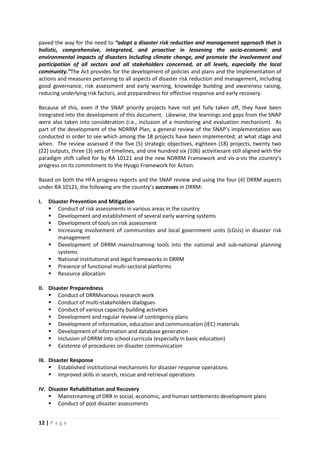
environmental assets of communities and countries.”The SNAP has five strategic objectives and 18
priority programs, with identified target for implementation of either short term (2009-2010);
medium term (2011-2015); and long term (2016-2019).
From 2007 to 2010, stakeholder consultations were conducted to develop the SNAP. However, the
finalization of this document came in side-by-side with the discussions and deliberations on the new
DRR law in the country especially since the latter is number one in the list of priority actions
identified in the SNAP.
And so, in May 27, 2010, Republic Act 10121 or the Philippine DRRM Act was passed into law and
12 | P a g e
paved the way for the need to “adopt a disaster risk reduction and management approach that is
holistic, comprehensive, integrated, and proactive in lessening the socio-economic and
environmental impacts of disasters including climate change, and promote the involvement and
participation of all sectors and all stakeholders concerned, at all levels, especially the local
community.”The Act provides for the development of policies and plans and the implementation of
actions and measures pertaining to all aspects of disaster risk reduction and management, including
good governance, risk assessment and early warning, knowledge building and awareness raising,
reducing underlying risk factors, and preparedness for effective response and early recovery.
Because of this, even if the SNAP priority projects have not yet fully taken off, they have been
integrated into the development of this document. Likewise, the learnings and gaps from the SNAP
were also taken into consideration (i.e., inclusion of a monitoring and evaluation mechanism). As
part of the development of the NDRRM Plan, a general review of the SNAP’s implementation was
conducted in order to see which among the 18 projects have been implemented, at what stage and
when. The review assessed if the five (5) strategic objectives, eighteen (18) projects, twenty two
(22) outputs, three (3) sets of timelines, and one hundred six (106) activitiesare still aligned with the
paradigm shift called for by RA 10121 and the new NDRRM Framework and vis-a-vis the country’s
progress on its commitment to the Hyogo Framework for Action.
Based on both the HFA progress reports and the SNAP review and using the four (4) DRRM aspects
under RA 10121, the following are the country’s successes in DRRM:
I. Disaster Prevention and Mitigation
 Conduct of risk assessments in various areas in the country
 Development and establishment of several early warning systems
 Development of tools on risk assessment
 Increasing involvement of communities and local government units (LGUs) in disaster risk
management
 Development of DRRM mainstreaming tools into the national and sub-national planning
systems
 National institutional and legal frameworks in DRRM
 Presence of functional multi-sectoral platforms
 Resource allocation
II. Disaster Preparedness
 Conduct of DRRMvarious research work
 Conduct of multi-stakeholders dialogues
 Conduct of various capacity building activities
 Development and regular review of contingency plans
 Development of information, education and communication (IEC) materials
 Development of information and database generation
 Inclusion of DRRM into school curricula (especially in basic education)
 Existence of procedures on disaster communication
III. Disaster Response
 Established insititutional mechanisms for disaster response operations
 Improved skills in search, rescue and retrieval operations
IV. Disaster Rehabilitation and Recovery
 Mainstreaming of DRR in social, economic, and human settlements development plans
 Conduct of post disaster assessments
13 | P a g e
 Integration of DRR into post-disaster recovery and rehabilitation processes
 Incorporating DRR elements in planning and management of human settlements
Lessons Learned and Gaps Identified
DRR has gained a lot of attention and momentum in the country over the past several years.
Numerous projects and activities have been undertaken by various Philippine stakeholders and
agencies in DRRM. However, sustaining the positive results and scaling them up to effect rippling
positive changes in the lives and livelihoods of the people have been constant challenges. Threats
remain. Disasters and people’s risk to disasters are still present.
Addressing the underlying causes vulnerable
At the heart of DRR is addressing the underlying causes of people’s vulnerabilities. For the past
several years, DRR in the country has focused more on efforts around disaster preparedness and
response and not so much in identifying the hazard-prone areas and other factors which contribute
to people’s exposure to disasters; incorporating risk analysis to development plans; and building
people’s capacities towards sustainable livelihood options. Although DRR has been gaining attention
among peoples and institutions, complete paradigm shift from “disasters as an immediate product
of hazards” to “disasters as a function of people’s vulnerability” has not yet fully happened. To be
able to reduce the risks of people to disasters, more attention must be given towards proper,
continuous and sustained conduct of disaster risk assesments (hazards, vulnerability, exposure) and
using them to mainstream into development plans DRRM and CCA activities and priority areas which
will address the underlying causes of vulnerabilities of the people. To address these causes, the
availablity of different livelihood options for people should also be seen as a way of reducing their
vulnerability especially in times of disasters.
DRR vs CCA
Although these two accronyms are essentially linked, conceptual and operational divides exist.
Understanding that these two, when converged only mean one thing – increasing people’s capacity
to adapt to the changes and hazards brought about by the climate and reducing their vulnerabilities.
In the country, DRR and CCA are not only seen, in general, as two opposing concepts but they are
likewise divided by institutional arrangements and have worked in isolation from each other.
Because of the effects of climate change, more hazards are expected to hit the country, which in
turn will affect the most vulnerable communities, exposing their lives and livelihoods to more risks.
By increasing the resilience of people to disasters through risk reduction efforts, people will be able
to adapt to the effects of climate changes and become less vulnerable.
Mainstreaming of DRR and CCA into development plans
Because DRRM and CCA are not viewed within a sustainable development framework by most
agencies and communities, the development of programs are done intermittently or only when
there are disasters. Also, programs and projects are not sustained because they are not
mainstreamed into the development plans and more importantly, into national and local policies –
both of which will secure sustained funding and political support.
Information, capacities and skillson DRRM and CCA
Even if a number of IEC materials have already been produced on disasters, most of them still
highlight just disaster preparedness and response. Development of information and campaign
materials which will help people understand DRRM and CCA, how they link together, and how these
two concepts contribute to the reduction of their risks to future disasters are of utmost importance
soonest. Likewise, having institutionalized mechanisms for knowledge development, sharing and
14 | P a g e
management will contribute to the documentation, replication and scaling up of good practices on
DRRM and CCA.
DRRM and Disaster Response complement each other (and it is not either or)
With increased and sustained efforts in DRRM, lesser disaster response in the future is envisioned.
However, in a country like the Philippines, where more and new hazards continue to be present,
disaster response operations need to be continuously enhanced within a risk reduction approach.
By ensuring that the country does disaster risk mitigation, prevention, preparedness, recovery and
rehabilitation; creation of better, more and more sustainable institutional mechansims, and
applying the learnings from good practices in DRRM, better, more effective and efficient and lesser
disaster response will take place.
Building capacities of peoples and institutions
Continuous, targetted and competency-based capacity building programs on DRRM and CCA should
be developed and conducted in order to be effective and responsive to the needs of peoples,
communities and institutions. These capacity building acivities will help build understanding and
skills with the end in view of really applying DRRM and CCA principles, concepts, and concrete action
steps towards building their resilience.
Building back better
The combination of increased knowledge and capacities; mainstreaming into development plans and
progams; and building institutional mechanisms through monitoring, evaluation and learning,
building back better can be achieved. Over time, improvements in the way DRRM and CCA are
addressed should be seen. DRRM can and will happen if acts are put together and each stakeholder
becomes a better and more capable and more resilient to disaster and climate risks.
DEVELOPMENT POLICIES, CHALLENGES AND OPPORTUNITIES
The Philippine Development Plan
The Philippine Development Plan (PDP) 2011-2016 is the development roadmap of the country. It
translates the country’s development agenda -- “Social Contract with the Filipino People”– into
priority actions and projects.The current PDP envisions a country with an organized and widely
shared rapid expansion of the economy through a government dedicated to honing and mobilizing
the people’s skills and energies as well as the responsible harnessing of the country’s natural
resources. The attainment of the vision entails changes among each and every Filipino towards
“doing the right things, giving value to excellence and integrity and rejecting mediocrity and
dishonesty, and giving priority to others over ourselves.”
Bottom line is to achieve inclusive growth, create employment opportunities and reduce
poverty.Inclusive growth means higher economic growth of 7-8% per year for at least six years;
generation of mass employment; and achieving or surpassing the Millennium Development Goals.
The target outcomes of poverty reduction and increased employment will be achieved through three
broad strategies, namely: (a) high and sustained economic growth; (b) equal access to development
opportunities; and (c) effective and responsive social safety nets. Specifically, these include having a
stable macroeconomic environment; mitigating potential impacts of environment factors; and
advancing peace process and guarantee national security.
15 | P a g e
The PDP has identified DRRM and CCA as main cross-cutting concerns. Assuch, these have been
integrated into the different sectors and sub-sectors using various strategies in order to address the
underlying causes of people’s vulnerabilities and contribute to the reduction of people’s risks to
disasters. In general, the PDP’s approaches to DRRM and CCA revolve around the following:
 Mainstream DRRM and CCA into existing policies (i.e., land-use, building code, GAA), plans
(i.e., CLUP) and programs (i.e., researches, school curricula, )
 Reduce vulnerability through continued and sustained assessments especially in high-risk
areas. These will be done through geo-hazard mapping and risk assessments especially for
highly susceptible communities and/or areas and be used as basis for the formulation and
implementation of DRRM plans. Furthermore, this includes the reduction of CC-related risks
and vulnerability of natural ecosystems and biodiversity through ecosystem-based
management approaches, conservation efforts and sustainable environment.
 Integrate DRRM and CCA in all educations levels and in specialized technical training and
research programs. In addition, use science-based tools and technologies to support
decisions in identifying, preventing and mitigating potential disaster impacts
 Raise public awareness of DRR and mitigating the impacts of natural disasters
through the formulation and implementation of a communication plan for DRR and CCA.
This also includes the conduct of extensive IEC campaigns for increased public awareness of
DRR and enhancement of disaster-preparedness through multi-stakeholder coordination
 Increase resilience of communities through the development of CC-sensitive technologies
and systems and the provision of support services to the most vulnerable communities
 Strengthen the capacity of communities to respond effectively to climate and other natural
and human-induced hazards and disasters. This includes the strengthening of civil society-
basic sector participation and PPP; encourage volunteerism and enhance competence of
institutions in social services delivery.
 Institutionalize DRRM and CCA in various sectors and increase local government and
community participation in DRRM and CCA activities
 Push for the practice and use of Integrated Water Resources Management (IWRM) and
prioritize the construction of flood management structures in highly vulnerable areas, while
applying DRRM and CCA strategies in the planning and design of flood management
structures
 Intensify development and utilization of renewable energy and environment-friendly
alternative energy resources/technologies. This include the assessment of the vulnerability
of energy facilities to climate change and natural disasters (e.g., El Niño and La Niña)
Through these, the PDP hopes to attain transparent and accountable governance; uplift and
empower the poor and vulnerable; achieve economic growth through infrastructure development,
strategic public-private partnerships, and policy environment for greater governance; and create a
sustainable development.
The National Climate Change Action Plan
The National Climate Change Action Plan (NCCAP) outlines the agenda for climate change adaptation
and mitigation for 2011 to 2038. Consistent with the Climate Change Adaptation Framework, the
NCCAP’s ultimate goal is to “build the adaptive capacities of women and men in their communities,
increase the resilience of vulnerable sectors and natural ecosystems to climate change and
optimize mitigation opportunities towards gender-resposive and rights-based sustainable
development.”Within the 2 long-term objectives of adaptation and mitigation, NCCAP will pursue
seven (7) strategic priorities:
1. Food security
16 | P a g e
2. Water efficiency
3. Ecosystem and environmental stability
4. Human security
5. Climate-smart industries and services
6. Sustainable energy
7. Knowledge and capacity development
Among the seven strategic objectives, Ecosystem and Environmental Stability and Human Security
directly interphases with DRRM.
The ecosystem provides services to man resulting in the reduction of disaster risk. Human well-
being is highly dependent on ecosystems and the benefits they provide. Ecosystem services are the
benefits people obtain from ecosystems. Maintaining healthy and stable ecosystems is therefore a
necessity especially n the midst of changing climates. But the service the ecosystem provides in the
field of DRRM cannot be sustained if man continually degrades his environment.
The PDP defines human security as the state where the rights of the Filipino family and individuals,
especially the poor and vulnerable, are protected and promoted through access to education,
health, housing and social protection, while ensuring environmental sustainability. Security
concerns associated with CC include the potential conflict over natural resources, population
displacement and migration as the result of sea-level rise or other large-scale humanitarian disasters
as the result of extreme climate events. The notion of human security amidst climate change risks,
therefore, considers a state or condition where individuals and communities have the options
necesary to end, mitigate or adapt to threats to their human, environmental and social rights; have
the capacity and freedom to exercise these options, and actively participate in pursuing these
options (O’Brien, et al. 2008). The growing recognition that there may be an increasing number of
disasters linked to floods, droughts and other climate influenced events calls for a much deeper and
broader assessment of the connections between DRRM, CCA and human security (O’Brien, et al.
2008).
Consequently, there is a call for a convergence of approaches and programmes between DRRM and
CCA especially since climate and weather-based hazards can lead to large scale disasters if processes
and communities are not prepared adn the risksa are not reduced. With climate change and the
expected increase in the severity and frequency of extreme weather events, DRRM will not be
sufficient. However, unlike in the NCCAP wherein DRRM is only mainstreamed or linked under 2 of
its 7 objectives, in the NDRRMP, total convergence between DRRM and CCA is ensured from start to
finish. This is because primarily because both have the same bottomlines  vulnerability reduction
to disasters.
The National Security Policy
Aggravating the many natural disasters are human-induced disasters like terrorist activities, civil
disturbances, hijacking and hostage taking incidents. These disasters and crises cause public anxiety,
loss of lives, destruction of properties and even socio-political stability.The country continues to be
confronted with internal security threats coming from a protracted communist insurgency and a
secessionist rebellion in parts of Mindanao as well as the proliferation of private armed groups
(PAGs). This is further aggravated by the existence of the terrorist Abu Sayyaf Group (ASG) with its
links to international terror group.
The National Security Policy (NSP) provides the overarching framework for the promotion of
people’s welfare and for the posterity of the nation. The national security policy objectives define
17 | P a g e
the strategy and programs in response to threats of opportunities that would have bearing on the
peace and stability of the nation as well as on the well-being of Filipinos. It is anchored on four (4)
key elements, namely, governance, delivery of basic services, economic reconstruction, and
sustainable development, and security sector reforms.
With the main objective of promoting internal socio-political stability, the NSP will use the following
strategies:
1. To win the hearts and minds of those with valid grievances and retain the allegiance of the
rest;
2. Strengthen the Integrity of national institutions and promote good governance;
3. Promote the peace process as the centerpiece of our internal security program; and
4. Launch a proactive and holistic program to combat terrorism
The National DRRM Framework (NDRRMF)
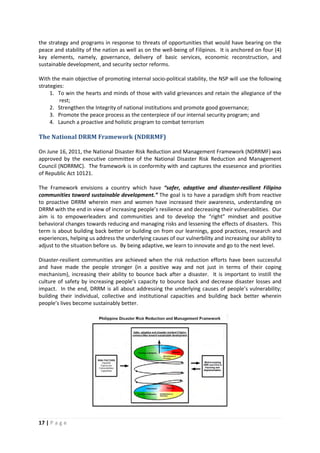
On June 16, 2011, the National Disaster Risk Reduction and Management Framework (NDRRMF) was
approved by the executive committee of the National Disaster Risk Reduction and Management
Council (NDRRMC). The framework is in conformity with and captures the essesence and priorities
of Republic Act 10121.
The Framework envisions a country which have “safer, adaptive and disaster-resilient Filipino
communities toward sustainable development.” The goal is to have a paradigm shift from reactive
to proactive DRRM wherein men and women have increased their awareness, understanding on
DRRM with the end in view of increasing people’s resilience and decreasing their vulnerabilities. Our
aim is to empowerleaders and communities and to develop the “right” mindset and positive
behavioral changes towards reducing and managing risks and lessening the effects of disasters. This
term is about building back better or building on from our learnings, good practices, research and
experiences, helping us address the underlying causes of our vulnerbility and increasing our ability to
adjust to the situation before us. By being adaptive, we learn to innovate and go to the next level.
Disaster-resilient communities are achieved when the risk reduction efforts have been successful
and have made the people stronger (in a positive way and not just in terms of their coping
mechanism), increasing their ability to bounce back after a disaster. It is important to instill the
culture of safety by increasing people’s capacity to bounce back and decrease disaster losses and
impact. In the end, DRRM is all about addressing the underlying causes of people’s vulnerability;
building their individual, collective and institutional capacities and building back better wherein
people’s lives become sustainably better.
18 | P a g e
The country is challenged by increasing disaster and climate risks caused by dynamic combinations
of natural and human-induced hazards, exposure, and people’s vulnerabilities and capacities. There
is an urgent need for the country to work together through multi-stakeholder partnerships and
robust institutional mechanisms and processes so that Filipinos will be able to live in safer, adaptive
and disaster resilient communities on the path to developing sustainably.
This DRRM framework emphasizes that through time, resources invested in disaster prevention,
mitigation, preparedness and climate change adaptation will be more effective towards attaining the
goal of adaptive, disaster resilient communities and sustainable development. The Framework
shows that mitigating the potential impacts of existing disaster and climate risks, preventing hazards
and small emergencies from becoming disasters, and being prepared for disasters, will substantially
reduce loss of life and damage to social, economic and environmental assets. It also highlights the
need for effective and coordinated humanitarian assistance and disaster response to save lives and
protect the more vulnerable groups during and immediately after a disaster. Further, building back
better and building better lives after a disaster will lead to sustainable development after the
recovery and reconstruction process.
The National Disaster Risk Reduction and Management Plan
(NDRRMP)
Given all these, it is imperative for the country to have a national plan that will serve a road map on
how disaster risk reduction and management will contribute to the attainment of sustainable
development through inclusive growth and build the adaptive capacities of communities, increase
the resilience of vulnerable sectors and optimize disaster mitigation opportunities with the end in
view of promoting people’s welfare and security towards gender-responsive and rights-based
sustainable development.
Overall, the NDRRMP outlines the activities aimed at strengthening the capacity of the national
government and the LGUs together with partner stakeholders, to build the disaster resilience of
communities and to institutionalize arrangements and measures for reducing disaster risks, including
projected climate risks and enhancing disaster preparedness and response capabilities at all levels.
It highlights, among others, the importance of mainstream DRRM and CCA in the development
processes such as policy formulation, socioeconoimc development planning, budgeting and
governance particularly in the area of environment, agriculture, water, energy, health, education,
poverty reduction, land-use and urban planning and public infrastructure and housing among others.
Mainstreaming also puts to forth the need to develop common tools to analyze the various hazards
and vulnerability factors which put our communities and people into harms way.
The NDRRMP also highlights the need for institutionalizing DRRM policies, structures, coordination
mechanisms and programs with continuing budget appropriation on DRR from national down to
local levels. Through permanent mechanisms, competency and science-based capacity building
activities can be done, alongside the nurturing of continuous learning through knowledge
development and management of good DRRM practices on the ground.
Unique to the country is the inclusion of human-induced disasters in the area of DRRM, based on RA
10121. This means that mainstreaming DRRM into the peace process and conflict resolution
approaches is also included in the national DRRM plan. Through this, losses in lives and damages to
properties will be minimized and communities in hazards and conflict zones can immediately go back
to their normal lives after.
19 | P a g e
Last but not least, the NDRRMP adheres to the principles of good governance within the context of
poverty alleviation and environmental protection. It is about partnerships, working together and all
of government/community approach– engaging the participation of CSOs, the private sector and
volunteers in the government’s DRRM programs towards compelementation of resources and
effective delivery of services to the citizenry.
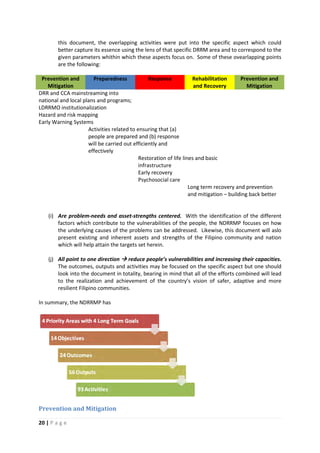
DRRM Priority Areas and Long-Term Goals
In accordance with the NDRRMF, through the NDRRMP, the country will have“Safer, adaptive and
disaster resilient Filipino communities towards sustainable development.”This will be achieved
through the four distinct yet mutually reinforcing prioirty areas, namely, (a) Disaster Prevention and
Mitigation; (b) Disaster Preparedness; (c) Disaster Response; and (d) Disaster Recovery and
Rehabilitation. Each priority area has its own long term goal, which when put together will lead to
the attainment of our country’s over goal/vision in DRRM.
These priority areas are not autonomous from the other nor do they have clear start and end points.
The 4 priority areas are NOT seen as a mere cycle which starts in prevention and mitigation and ends
in rehabilitation and recovery. They...
(f) Mutual reinforce each other and are interoperable. This means that whatever we do in one
aspect will have a direct or indirect effect on the activities identified under the other
aspects. Furthermore, this means that it is assumed that the level of preparedness and
intensity of response activities we conduct are lessened because proper prevention and
mitigation activities have been done already.
(g) DO NOT, SHOULD NOT and CANNOT stand alone. Because they are inter-linked, one
cannot just focus on one aspect without considering the others.
(h) Have no clear starting nor ending points between each of the aspects and overlaps are to
be expected. There are some areas which are divided very thinly by gray areas. These are
activities which need to be smoothly integrated into two aspects. However, for purposes of
20 | P a g e
this document, the overlapping activities were put into the specific aspect which could
better capture its essence using the lens of that specific DRRM area and to correspond to the
given parameters whithin which these aspects focus on. Some of these ovearlapping points
are the following:
Prevention and
Mitigation
Preparedness Response Rehabilitation
and Recovery
Prevention and
Mitigation
DRR and CCA mainstreaming into
national and local plans and programs;
LDRRMO institutionalization
Hazard and risk mapping
Early Warning Systems
Activities related to ensuring that (a)
people are prepared and (b) response
will be carried out efficiently and
effectively
Restoration of life lines and basic
infrastructure
Early recovery
Psychosocial care
Long term recovery and prevention
and mitigation – building back better
(i) Are problem-needs and asset-strengths centered. With the identification of the different
factors which contribute to the vulnerabilities of the people, the NDRRMP focuses on how
the underlying causes of the problems can be addressed. Likewise, this document will aslo
present existing and inherent assets and strengths of the Filipino community and nation
which will help attain the targets set herein.
(j) All point to one direction  reduce people’s vulnerabilities and increasing their capacities.
The outcomes, outputs and activities may be focused on the specific aspect but one should
look into the document in totality, bearing in mind that all of the efforts combined will lead
to the realization and achievement of the country’s vision of safer, adaptive and more
resilient Filipino communities.
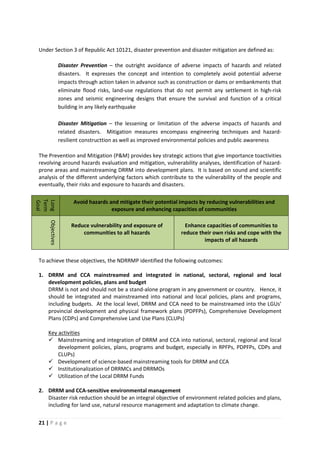
In summary, the NDRRMP has
Prevention and Mitigation
21 | P a g e
Under Section 3 of Republic Act 10121, disaster prevention and disaster mitigation are defined as:
Disaster Prevention – the outright avoidance of adverse impacts of hazards and related
disasters. It expresses the concept and intention to completely avoid potential adverse
impacts through action taken in advance such as construction or dams or embankments that
eliminate flood risks, land-use regulations that do not permit any settlement in high-risk
zones and seismic engineering designs that ensure the survival and function of a critical
building in any likely earthquake
Disaster Mitigation – the lessening or limitation of the adverse impacts of hazards and
related disasters. Mitigation measures encompass engineering techniques and hazard-
resilient constructtion as well as improved environmental policies and public awareness
The Prevention and Mitigation (P&M) provides key strategic actions that give importance toactivities
revolving around hazards evaluation and mitigation, vulnerability analyses, identification of hazard-
prone areas and mainstreaming DRRM into development plans. It is based on sound and scientific
analysis of the different underlying factors which contribute to the vulnerability of the people and
eventually, their risks and exposure to hazards and disasters.
Long
Term
Goal
Avoid hazards and mitigate their potential impacts by reducing vulnerabilities and
exposure and enhancing capacities of communities
Objectives
Reduce vulnerability and exposure of
communities to all hazards
Enhance capacities of communities to
reduce their own risks and cope with the
impacts of all hazards
To achieve these objectives, the NDRRMP identified the following outcomes:
1. DRRM and CCA mainstreamed and integrated in national, sectoral, regional and local
development policies, plans and budget
DRRM is not and should not be a stand-alone program in any government or country. Hence, it
should be integrated and mainstreamed into national and local policies, plans and programs,
including budgets. At the local level, DRRM and CCA need to be mainstreamed into the LGUs’
provincial development and physical framework plans (PDPFPs), Comprehensive Development
Plans (CDPs) and Comprehensive Land Use Plans (CLUPs)
 Mainstreaming and integration of DRRM and CCA into national, sectoral, regional and local
development policies, plans, programs and budget, especially in RPFPs, PDPFPs, CDPs and
CLUPs)
Key activities
 Development of science-based mainstreaming tools for DRRM and CCA
 Institutionalization of DRRMCs and DRRMOs
 Utilization of the Local DRRM Funds
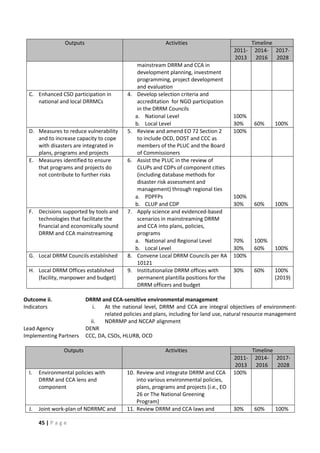
2. DRRM and CCA-sensitive environmental management
Disaster risk reduction should be an integral objective of environment related policies and plans,
including for land use, natural resource management and adaptation to climate change.
22 | P a g e
 Integration of DRRM and CCA in the different environment-related policies and plans,
including for land use, natural resource management
Key activities
 Development of a joint work-plan and alignment of the NDRRMP and the National Climate
Change Adaptation Action Plan (NCCAAP)
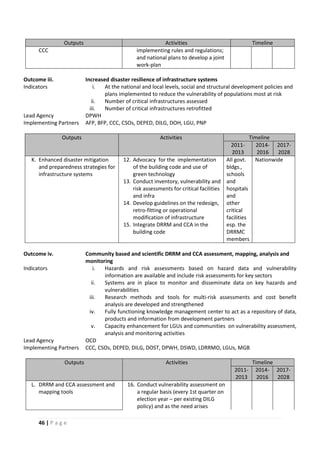
3. Increased disaster resiliency of infrastructure systems
Urban disasters are among the country’s growing concerns in DRRM. With the exponential
increase of poor people living in highly congested urban communities surrounded by old,
unstable and highly vulnerable buildings, attention to how risks can be reduced in infrastructure
systems need to be emphasized.
 Conduct of inventory, vulnerability and risk assessments of critical facilities
Key activities
 Develop guidelines on the redesign, retrofitting or operational modifications of
infrastructure
 Integration of DRRM and CCA in the building code
 Advocacy for the implementation of the building code and use of green technology
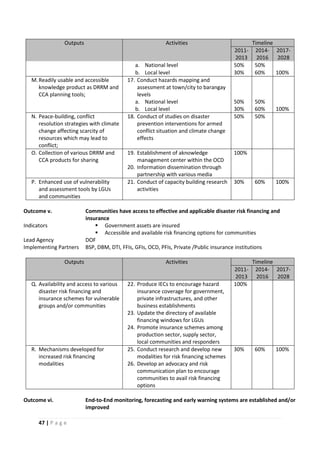
4. Community based and scientific DRR-CCA
assessment, mapping, analysis and monitoring
To be a more effective guide in national and local planning, a combination of community-based
and scientific DRR/CCA hazard and risk mapping will be a priority. Through this, not only will the
findings be validated, communities will be able to participate and take part in knowing about the
different factors which increase their risks and exposure to disasters as well as be involved in the
process of assessment, analysis and the conduct of monitoring activities.
 Conduct of hazard mapping and vulnerability assessments
Key activities
 Conduct of studies on disaster risk prevention interventions for armed conflict situation and
climate change effects
 Establishment of a knowledge management center within the OCD which will also conduct
capacity building and research activities on DRRM
 Information dissemination through partnerships with various media
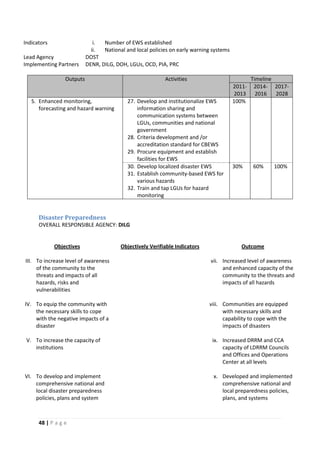
5. Communities have access to effective and applicable disaster risk financing and insurance
Risk transfer mechanisms through disaster risk financing and insurance contributes to the
prevention and mitigation of disasters, especially at the community level. Through this, their
vulnerabilities are lessened through the options and buffers available for them.
 Conduct of research and develop new modalities for risk financing schemes
Key activities
 Develop advocacy and risk communication plan to encourage communities to avail risk
financing options
 Update the directory of available risk financing windows of LGUs
6. End-to-End monitoring, forecasting and early warning systems are established and/or
improved
As defined under Republic Act 10121, EWS is the set of capacities needed to generate and
disseminate timely and meaningful warning information to enable individuals, communities and
23 | P a g e
organizations threatened by a hazard to prepare and to act appropriately and in sufficient time
to reduce the possibility of harm or loss. A people-centered EWS is about having (a) the
knowledge of the risks; (b) monitoring, analysis and forecasting of the hazards; (c)
communication or dissemination of alerts and warnings; (d) and local capabilities to respond to
the warnings received. “End-to-end warning system” is emphasized which incorporates all steps
from hazard detection to community response.
 Develop and institutionalize EWS information sharing and communication systems between
LGUs, communities and national government
Key activities
 Develop criteria for accreditation and/or standardized EWS
 Procure equipment and establish EWS facilities
 Develop community-based and local early warning systems for various hazards
Disaster Preparedness
Under Section 3 of Republic Act 10121, disaster preparedness is defined as
Disaster Preparedness -- the knowledge and capacities developed by governments,
professional response and recovery organizations, communities and individuals to effectively
anticipate, respond to, and recover from teh impacts of likely, imminent or currrent hazard
events or conditions. Preparedness action is carried out within the context of DRRM and
aims to build the capacities needed to efficiently manage all types of emergencies and
achieve orderly transitions from response to sustained recovery. Preparedness is based on a
sound analysis of DRR and good linkaes with early warning systems and includes such
activities as contingency planning, stockpiling of equipment and supplies, the development
of arrangements for coordination, evacuation and public information and associated training
and field exercises. These must be supported by formal, institutional, legal and budgetary
capacities.
This priority area provides for the key strategic actions that give importance toactivities revolving
around community awareness and understanding; contingency planning; conduct of local drills and
the development of a national disaster response plan. Likewise, in preparing our communities and
governments for possible disasters, predetermined needs based on information available are crucial.
Risk-related information coming from the prevention and mitigation aspect is necessary in order for
the preparedness activities to be responsive to the needs of the people and situation on the ground.
Also, the policies (and budget) and institutional mechanisms established under the prevention and
mitigation priority area will be further enhanced through capacity building activities, development of
coordination mechanisms and the like. Through these, coordination, complementation and
interoperability of work in DRRM operations and essential services will be ensured.
It should be noted that the activities under this priority area are not linear but they are cyclical and
anticipate improvements over time. Behavioral change created by the preparedness aspect is
eventually measured by how well people responded to the disasters. At the frontlines of
preparedness are the local government units, local chief executives and communities. Overall, the
bottomline is, having more prepared citizenry and governments.
24 | P a g e
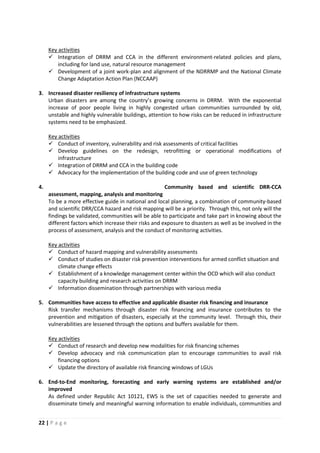
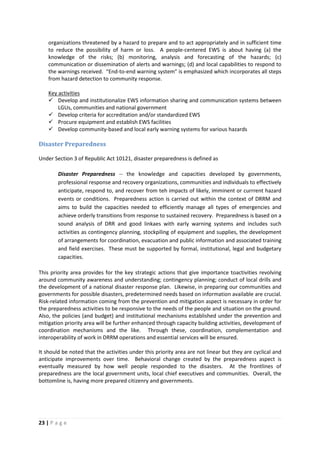
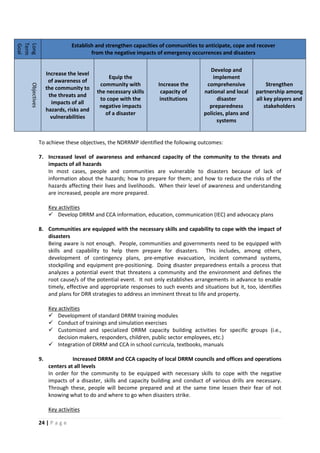
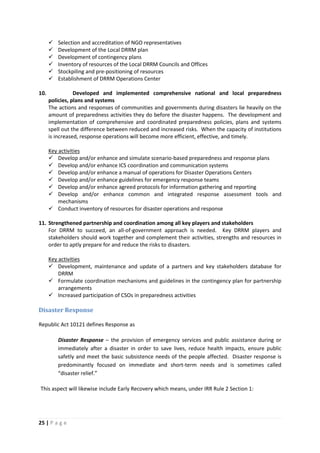
Long
Term
Goal
Establish and strengthen capacities of communities to anticipate, cope and recover
from the negative impacts of emergency occurrences and disasters
Objectives
Increase the level
of awareness of
the community to
the threats and
impacts of all
hazards, risks and
vulnerabilities
Equip the
community with
the necessary skills
to cope with the
negative impacts
of a disaster
Increase the
capacity of
institutions
Develop and
implement
comprehensive
national and local
disaster
preparedness
policies, plans and
systems
Strengthen
partnership among
all key players and
stakeholders
To achieve these objectives, the NDRRMP identified the following outcomes:
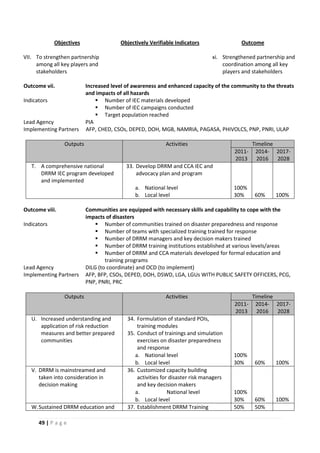
7. Increased level of awareness and enhanced capacity of the community to the threats and
impacts of all hazards
In most cases, people and communities are vulnerable to disasters because of lack of
information about the hazards; how to prepare for them; and how to reduce the risks of the
hazards affecting their lives and livelihoods. When their level of awareness and understanding
are increased, people are more prepared.
 Develop DRRM and CCA information, education, communication (IEC) and advocacy plans
Key activities
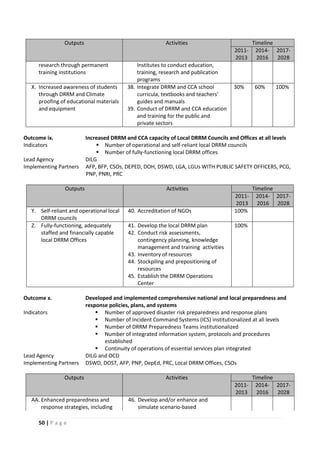
8. Communities are equipped with the necessary skills and capability to cope with the impact of
disasters
Being aware is not enough. People, communities and governments need to be equipped with
skills and capability to help them prepare for disasters. This includes, among others,
development of contingency plans, pre-emptive evacuation, incident command systems,
stockpiling and equipment pre-positioning. Doing disaster preparedness entails a process that
analyzes a potential event that threatens a community and the environment and defines the
root cause/s of the potential event. It not only establishes arrangements in advance to enable
timely, effective and appropriate responses to such events and situations but it, too, identifies
and plans for DRR strategies to address an imminent threat to life and property.
 Development of standard DRRM training modules
Key activities
 Conduct of trainings and simulation exercises
 Customized and specialized DRRM capacity building activities for specific groups (i.e.,
decision makers, responders, children, public sector employees, etc.)
 Integration of DRRM and CCA in school curricula, textbooks, manuals
9. Increased DRRM and CCA capacity of local DRRM councils and offices and operations
centers at all levels
In order for the community to be equipped with necessary skills to cope with the negative
impacts of a disaster, skills and capacity building and conduct of various drills are necessary.
Through these, people will become prepared and at the same time lessen their fear of not
knowing what to do and where to go when disasters strike.
Key activities
25 | P a g e
 Selection and accreditation of NGO representatives
 Development of the Local DRRM plan
 Development of contingency plans
 Inventory of resources of the Local DRRM Councils and Offices
 Stockpiling and pre-positioning of resources
 Establishment of DRRM Operations Center
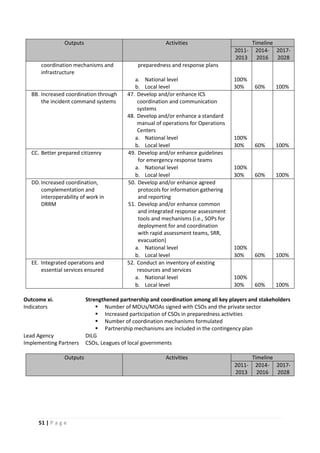
10. Developed and implemented comprehensive national and local preparedness
policies, plans and systems
The actions and responses of communities and governments during disasters lie heavily on the
amount of preparedness activities they do before the disaster happens. The development and
implementation of comprehensive and coordinated preparedness policies, plans and systems
spell out the difference between reduced and increased risks. When the capacity of institutions
is increased, response operations will become more efficient, effective, and timely.
 Develop and/or enhance and simulate scenario-based preparedness and response plans
Key activities
 Develop and/or enhance ICS coordination and communication systems
 Develop and/or enhance a manual of operations for Disaster Operations Centers
 Develop and/or enhance guidelines for emergency response teams
 Develop and/or enhance agreed protocols for information gathering and reporting
 Develop and/or enhance common and integrated response assessment tools and
mechanisms
 Conduct inventory of resources for disaster operations and response
11. Strengthened partnership and coordination among all key players and stakeholders
For DRRM to succeed, an all-of-government approach is needed. Key DRRM players and
stakeholders should work together and complement their activities, strengths and resources in
order to aptly prepare for and reduce the risks to disasters.
 Development, maintenance and update of a partners and key stakeholders database for
DRRM
Key activities
 Formulate coordination mechanisms and guidelines in the contingency plan for partnership
arrangements
 Increased participation of CSOs in preparedness activities
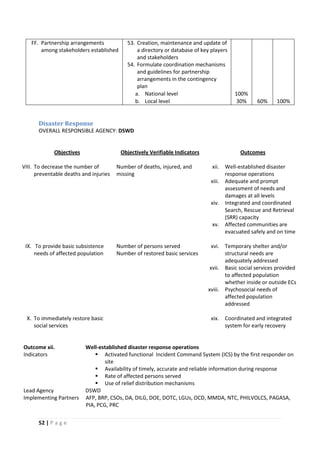
Disaster Response
Republic Act 10121 defines Response as
Disaster Response – the provision of emergency services and public assistance during or
immediately after a disaster in order to save lives, reduce health impacts, ensure public
safetly and meet the basic subsistence needs of the people affected. Disaster response is
predominantly focused on immediate and short-term needs and is sometimes called
“disaster relief.”
This aspect will likewise include Early Recovery which means, under IRR Rule 2 Section 1:
26 | P a g e
Early Recovery -- multidimensional process of recovery that begins in a humanitarian
setting. It is guided by development principles that seek to build on humanitarian
programmes and catalyze sustainable developemnt opportunities. It aims to generate self-
sustaining, nationally-owned, resilient processes for post=crisis recovery. It encompasses
the restoration of basic services, livelihoods, r , governnace, security and rule of law,
environment and social dimensions, including reintegration of displaced populations.
This priority area under the NDRRMP provides for key actions that give importance toactivities
during the actual disaster response operations from needs assessment to search and rescue to relief
operations to early recovery activities. The activities identified below will either be done before the
actual response operations or during. For those activities which need to be completed prior actual
response operations, they will be linked to the activities earlier identified in the preparedness
aspect. However, to ensure that the proper response “lens” is issued in doing the said activities,
they were included in this aspect. Overall, the success and realization of this aspect rely heavily on
the completion of the activities under both the prevention and mitigation and preparedness aspects,
including among others the coordination and communication mechanisms to be developed. On-the-
ground partnerships and the vertical and horizontal coordination work between and among key
stakeholders will contribute to successful disaster response operations and its smooth transition
towards early and long term recovery work.
Long
Term
Goal
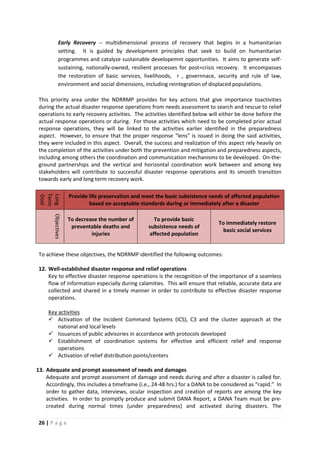
Provide life preservation and meet the basic subsistence needs of affected population
based on acceptable standards during or immediately after a disaster
Objectives
To decrease the number of
preventable deaths and
injuries
To provide basic
subsistence needs of
affected population
To immediately restore
basic social services
To achieve these objectives, the NDRRMP identified the following outcomes:
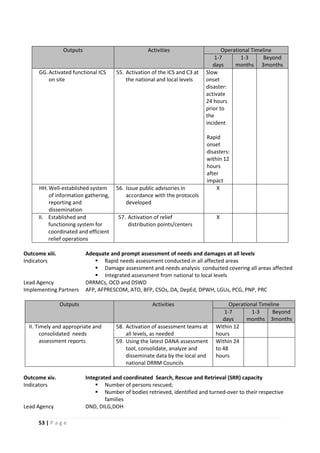
12. Well-established disaster response and relief operations
Key to effective disaster response operations is the recognition of the importance of a seamless
flow of information especially during calamities. This will ensure that reliable, accurate data are
collected and shared in a timely manner in order to contribute to effective disaster response
operations.
 Activation of the Incident Command Systems (ICS), C3 and the cluster approach at the
national and local levels
Key activities
 Issuances of public advisories in accordance with protocols developed
 Establishment of coordination systems for effective and efficient relief and response
operations
 Activation of relief distribution points/centers
13. Adequate and prompt assessment of needs and damages
Adequate and prompt assessment of damage and needs during and after a disaster is called for.
Accordingly, this includes a timeframe (i.e., 24-48 hrs.) for a DANA to be considered as “rapid.” In
order to gather data, interviews, ocular inspection and creation of reports are among the key
activities. In order to promptly produce and submit DANA Report, a DANA Team must be pre-
created during normal times (under preparedness) and activated during disasters. The
27 | P a g e
effectiveness of disaster response operations lies on the efficient and prompt information
collection, consolidation, analysis, and use.
 Activation of assessment teams at all levels
Key activities
 Conduct assessment using the latest DANA tool and use of the information by the
appropriate DRRM council
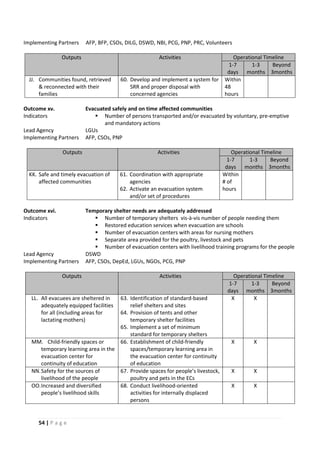
14. Integrated and coordinated Search, Rescue and Retrieval (SRR) capacity
Management of the dead and missing may be one of the most difficult aspects under disaster
response. It has deep and long-lasting impact to victims, survivors, families, and communities.
Accordingly, the care of the dead and missing must never be overlooked in disaster planning.
There must be integrated and coordinated services for the dead and missing to ensure that the
dead maintain its dignity and the missing found.
 Develop and implement systems for SRR with concerned agencies
Key activities
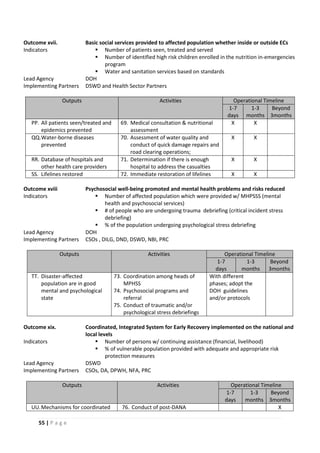
15. Evacuated safely and on time affected communities
The decision to evacuate an area must be done promptly. Timing is essential to an orderly, safe,
and effective evacuation. Authorities must ensure that no person gets stranded; all those who
want/need evacuation must be attended to. Though timing is essential, it is not only the factor
that contributes to successful evacuation operations. The availability of logistics is also a key
consideration; the scale disaster itself (e.g., inclement weather) is also important. Accordingly,
there must be regular coordination with relevant agencies to ensure seamless activation of
evacuation system/procedures.
 Activate an evacuation system and/or set of procedures
Key activities
16. Temporary shelter and/or structural needs are adequately addressed
Disasters leave many people homeless. Temporary shelters in some ways provide a measure of
comfort safety for victims. The provision of adequate temporary shelters is of invaluable
importance during cataclysmic times. It is about a temporary “home” where people, their
sources of livelihoods and important valuables find refuge in times of disasters. Temporary
shelters are not just about structures – a lot of things need to be considered both before, during
and after a disaster happens.
 Identification of standard-based relief shelters and sites
Key activities
 Provision of tents and other temporary shelter facilities
 Development and implementation of a set of minimum standards on temporary shelters
 Establishment of child-friendly spaces and other learning areas in the evacuation centers
 Provision of spaces for people’s livestock, poultry and pets in the ECs
 Conduct of livelihood-oriented activities for internally displaced persons
17. Basic social services provided to affected population (whether inside or outside ECs)
After a calamity, there is always a possibility that critical lifelines (e.g. water system) will get
paralyzed. People living in evacuation centers may also have no access to proper nutrition.
Ultimately, these compromise the overall wellness of affected people. There is a need to ensure
that the health status of affected communities is maintained.
28 | P a g e
 Conduct o medical consultation and nutritional assessment
Key activities
 Assessment of water quality and conduct of quick damage repairs and road clearing
operations
 Determination of existing and available hospital services
 Immediate restoration of lifelines
18. Psychosocial needs of affected population addressed
After a disaster, some of the victims may need help from professional help to normalize their
feelings, overcome trauma and find ways to cope with their ongoing stress. Mental Health and
Psychosocial Services (MPHSS) must therefore be provided in order to address the psychosocial
needs of affected population. Aside from ensuring the physical and mental wellness of disaster
victims, it is equally important to preserve the dignity of evacuees especially the elderly, person
with disabilities, women and children. Gender roles and rights should always be ensured.
 Ensure coordination among heads of MPHSS
Key activities
 Development and conduct of psychosocial programs and/or referral systems
 Conduct of traumatic and/or psychological stress debriefings
19. Coordinated and integrated system for early recovery
There must be a functional, integrated, and coordinated system to assist victims all the way
through their early recovery. Success of such is endeavor is dependent on both the local and
national governments’ level of political commitment. Early recovery is about transition which
starts immediately after the onset of the disaster and priorities are to produce immediate results
for vulnerable populations and to promote opportunities for recovery, a response that evolves
over time into longer term recovery.
 Conduct of post-DANA
Key activities
 Develop and implement a system for early recovery, to include specific activities addressing
the needs identified
 Develop partnership mechanisms with utility providers and key stakeholders
 Design and implement temporary livelihood and/or income generating activities (i.e., cash/
food for work; micro and small enterprise recovery)
Rehabilitation and Recovery
Under Section 3 of Republic Act 10121, rehabilitation and recovery are defined as
Rehabilitation – measures that ensure the ability of affecting communities and/or areas to
restore their normal level of functioning by rebuilding livelihood and damaged infrastructure
and increasing the communities’ organizational capacity
IRR Rule 2 Section 1
(ee) Post Disaster Recovery – the restoration and improvement where appropriate, of
facilities, livelihood and living conditions of disaster-affected communities, including efforts
to reduce disaster risk factors, in accordance with the principles of “build back better”
29 | P a g e
The Rehabilitation and Recovery aspect of DRRM cover areas like employment and livelihoods,
infrastructure and lifeline facilities, housing and resettlement, among others. These are recovery
efforts done when people are already outside of the evacuation centers.
Long
Term
Goal
Restore and improve facilities, livelihood and living conditions and organizational capacities of
affected communities, and reduced disaster risks in accordance with the “building back
better” principle
Objectives
To restore people’s
means of livelihood
and continuity of
economic activities
and business
To restore shelter and
other
buildings/installation
To reconstruct
infrastructure and
other public utilities;
To assist in the
physical and
psychological
rehabilitation of
persons who
suffered from the
effects of disaster
To achieve these objectives, the NDRRMP identified the following outcomes:
20. Damages, Losses and Needs Assessed
An assessment or accounting of damages, losses and needswill be the basis for identifying
programs, projects and activities for the disaster-affected areas.
 Conduct Post-Disaster Needs Assessment (PDNA)one month after the occurrence of a
disaster, with the OCD taking the lead and using as basis the preliminary data
gathered from the field by OCD regional offices.
Key activity
 Coordinate the formulation of the Strategic Action Plan for disaster-affected areas
21. Economic activities restored and if possible, strengthened or expanded
The ability of people affected by disasters to bounce back easily lie heavily on the restoration of
their sources of income and livelihood opportunities. By identifying what the existing situation
is, the government can respond with the appropriate programs that will enable the people to
build back better after the disaster.
 Identify the needed assistance and formulate and implement appropriate programs
Key activities
 Identify and mobilize funding sources
22. DRRM and CCA elements are mainstreamed in human settlement
This is about the development of disaster-resilient housing designs and introduction of improved
and modernized building systems and programs. It also includes, among others, the
identification of secure relocation sites for people displaced by natural and human-induced
disaster of those living in hazardous areas.
 Design and construct disaster resilient housing
Key activities
 Identify and provide suitable relocation sites for affected population
30 | P a g e
 Conduct trainings for social preparation of host communities and those who will be
relocated to reduce conflict
23. Disaster and climate change resilient infrastructure constructed/reconstructed
Long term recovery ensures that the rehabilitation or reconstruction of infrastructures is disaster
and climate-proof.
 Undertake the necessary rehabilitation or repair of damaged infrastructure
Key activities
 Implement the building code and promote green technology
 Conduct monitoring and/or tracking of approval of infrastructure projects and permits
24. An psychologically sound, safe and secured citizenry that is protected from the effects of
disasters are able to restore to normal functioning after each disaster
Disasters are devastating and usually leave a trail of human agoniesincluding loss of human life,
livestock, property, and livelihood loss, physicalinjuries and damages to development works.
Along with relief, rehabilitationand care of physical health and injuries, psychosocial and mental
healthissues are also important and they need to be addressed.Emergencies also create a wide
range of problems experienced at the individual, family,community and societal levels.
 Develop systems for appropriate risk protection measures
Key activities
 Conduct of post-disaster/conflict needs analyses with affected communities
 Develop systems of support and communication among key stakeholders
 Build capacities of psychosocial care providers
Priority Projects
The following are the priority and/or flagship projects of the NDRRMP. These are pilot projects and
demonstrate sites which aim to either replicate of good DRRM practices or implement projects in
areas which need them most. All priority projects are to be implemented within the immediate or
short term period or between 2011 to 2013.
In identifying the priority project should be doable; fundable; high impact; interconnected and
interdependent; and sustainable
 Development of the following plans:
 Joint workplan for DRRM and CCA
 Local DRRM plans
 National Disaster Response Plan (to include a systm for Search, Rescue and Retrieval SRR;
scenario-based preparedness and response plans)
 Risk financing
 Development of understandable and consistent IEC and advocacy materials on RA 10121, DRRM
and CCA
 Development of guidelines on
 Communications and information protocol before, during and after disasters
 Creation of DRRM teams
 Criteria/standards for local flood early warning systems
 Evacuation
 Infrastructue redesign and/or modifications
 Manual of operations of disaster operations centers
31 | P a g e
 Development of tools on
 DRRM and CCA mainstreaming in the national and local-level planning
 DANA and Post-DANA
 Psychosocial concerns
 Establishment of
 DRRM Training Institutes
 End-to-End local flood early warning systemsthroughintegrated and sustainable
management river basins and water sheds in areas like Bulacan, Leyte, Albay, Surigao del
Norte, Surigao del Sur, Agusan del Norte, Butuan City, Cagayan de Oro, Iligan city
 Establishment of local DRRM Councils and Offices and theri operations centers, as prescribed by
RA 10121
 Conduct inventory of existing DRRM and CCA resources and services
 Development and implementation of DRRM and CCA activities using the 5% of government
agency’s GAA;
 Hazard and risk mapping in the most high-risk areas in the country (i.e., Community-based
DRRM and CCA risk mapping in the municipalities of Kitcharao and Santiago, Agusan del Norte
and Butuan City)
 Institutional capability program on DRRM and CCA for decision makers, local chief executives,
public sector employees, and key stakeholders
 Mainstreaming DRRM and CCA (i.e., Esperenza Municipality in Agusan del Sur in CARAGA and in
San Francisco Municipality in Camotes Island)
 PDNA capacity building for national government agencies, regional line agencies, and local
offices.
 Review, amend and/or revise the following
 Building Code and integrate DRRM and CCA
 Executive Order no. 72 s. 1993, which provides for the preparation and implementation of
the CLUPs of local government units
 Implementing Rules and Regulations of RA 10121
 Various environmental policies (i.e., EO 26, etc) to integrate DRRM and CCA
Cross-Cutting Concerns
The NDRRMP recognizes that certain concerns cut across the 4 DRRM priority areas. These include
health, human-induced disasters, gender mainstreaming, environmental protection, cultural
sensitivity or indigenous practices, and the rights based approach. They are a combination of issues
and approaches that should be taken into consideration in each of the priority areas.
People’s vulnerability to disaster has become more complex with the onset of Climate Change.
Single hazard events such as floods and heat waves can overlap resulting in a broad range of impact
scenarios. Minor disturbances in the environment surrounding the ecosystem can have far reaching
consequences on the exposure of humans to health-related hazards like avian influenza (which is
related to the changes in habitate of migratory birds); malaria and dengue (which increases
mosquito abundance in areas experiencing warmer and damper temperatures respectively).
Likewise, rising sea-level and increasing flooding events disproportionately affect the poor through
sanitation of their water sources. It is thus important to look at these concerns in each of the
priority areas under the NDRRMP.
Health
In the Philippines, people are vulnerable not only because of natural hazards but also due to
disasters more commonly associated with armed conflict, terrorism and war. In the entire NDRRMP,
Human-induced disasters
32 | P a g e
consideration to the factors which contribute to these risks are important and should be looked into
at all times, taking cognizance of the underlying causes of people’s vulnerabilities.
Gender mainstreaming is about the recognition, acceptance, identification and addressingof the
different roles, needs, capacities and vulnerabilities of men, women, children, people with
disabilities, older persons and other groups. The NDRRMP is committed to promoting gender-
sensitive vulnerability and capacity analysis in all disaster risk reduction and management activities.
It encourages balancing the roles, responsibilities, needs, interests, capacities of and effect to both
genders in contingency plans as well as implementation of community-based activities. Gender
mainstreaming is about reducing the vulnerabilities and encourages a balance in the participation
and decision making roles in DRRM.
Gender mainstreaming
Care for the environment and making sure that current activities do not create stress on our natural
resources should be considered in all the four aspects of DRRM
Environmental protection
The NDRRMP recognizes the importance of culturally-sensitive risk reduction measures at all levels.
People’s vulnerability to disasters as well as their capacities to adapt to the changing realities are
more often than not related to the cultural and indigenous practices. By beting sensitive to the
indigenous practices and local knowledge, DRRM approaches will become more effective and more
easily understood and embraced by the people.
Cultural sensitivity/indigenous practices
DRRM is our country’s priority because people have the right to live, safety, information, education,
cultural beliefs and right to better lives.
Rights-based
General Considerations and Planning Assumptions
In the development of the NDRRMP, a number of external factors were considered which are likely
to influence the success of the plan and its components. These are factors which the national
government has little control over.
The assumptions include the following:
 Availability of international and/or local assistance
 Enabling policy mechanisms are in place
 Established parameters for effective and efficient operations
 Full-mission capabilities of Search and Rescue (SAR) Units
 Good governance
 Presence of project management capacity
 Resource availability
 Strong political will and leadership
 Strong public-private partnership
 Strong support from LGUs and national government
 Sustainability of socio-economic support
The risksinclude the following:
 Access to timely release of funding
 Cultural differences
 Delayed program, project implementation
33 | P a g e
 Disruption in peace and order
 Lack of political will and leadership
 No action given to recommended corrective measures
 Non-implementation of policy
 Recurrence of disaster
 Search and Rescue units/teams are not full-mission capable
 Weak leadership
 Weakened delivery mechanisms and structures
Likewise, a number of ways were identified to help verify the completion or non-completion of the
activities in each of the priority areas. These are information or data required to assess the progress
against the indicators and theirs sources, to include:
 Attendance sheets
 Database
 Documents produced(i.e., teachers’ manual, textbooks; plans; IECs;
training materials)
 DRRM and CCA related laws, policies and/or ordinances
 Evaluation reports (status) and feedback
 IEC materials developed
 Interviews
 Inventory report
 MC/Joint MC or publication of the policy
 Memo and/or resolutions
 Minutes of meeting
 Post training evaluations
 Resolutions, ordinances issued by LGUs
 Signed MOUs/MOAs
 Validated reports
Time Lines
The NDRRMP is scheduled to commence in 2011, immediately after its approval from the members
of the National DRRM Council members. In general, the set of activities are divided into three
timelines, with the first two having 2years interval while the last one with 5 years, to wit:
Short term 2011 – 2013
Medium term 2014 – 2016
Long term 2017 – 2028
The short and medium terms coincide with elections – national and local on 2013 and presidential,
national and local on 2016. This will help national leaders and local chief executives to ensure that
within their DRR mainstreamed national and local plans, specific DRRM-related activities are
completed.
Midway the implementation of the medium-term projects/activities, or by 2015, the NDRRMP hopes
to fulfill its obligations and meet its targets on the MDGs and HFA commitments.
Also, the activities identified under the short and medium terms coincide with and complement the
targets made under the Philippine Development Plan 2011-2016.
34 | P a g e
The Long Term projects are expected to be completed at the same time as that of the National
Climate Change Action Plan. This reinforces the fact that the convergence of the 2 is an essential
component to our national and sustainable development.
For Disaster Rehabilitation and Recovery
However, specifically for the the priority areas on Response and Rehabilitation and Recovery,
Operational Timelineswere used primarity to give an overall guidance on “rapid” time element in
providing humanitarian activities and recovering from the disasters. Likewise, the operational
timelines will guide the plan’s implementation and monitoring activities for the two priority areas.
These operational timelines are as follows:
Immediate Term (IT) within 1 year after the occurrence of the disaster
Short Term (ST) within 1 to 3 years after the occurrence of the disaster
Medium Term (MT) within 3 to 6 years after the occurrence of the disaster
Long Term (LT) beyond 6 yearsafter the occurrence of the disaster
Implementation Strategies and Mechanisms
Althroughout the NDRRMP, various strategies were identified to be used in order to achieve the
desired key result areas under each DRRM aspect. These are:
Advocacy and Information, Education and Communication (IEC)
A strong national and local commitment is required to save lives and livelihoods threatened by
natural and human-induced disasters. Achieving this will need increasing visibility and
understanding of DRRM and CCA issues, mobilize partnerships, encourage actions and gather public
support for successful implementation of the different activities. The NDRRMP will use evidence-
based advocacy to influence people, policies, structures and systems in order to build resilient
Filipino communities by raising awareness, working with the media and key stakeholders. The
NDRRM will develop advocacy, IEC and various communication strategies based on risk assessments
and good DRRM practices.
Competency-based capability building
Conducting customized training programs should be developed to ensure that people are trained
based on the needed skills in the different DRRM aspects. Different people have different needs and
capacities and developing competency-based capability building programs ensures that knowledge,
skills and attitudes are enhanced and built upon further.
Contingency Planning
More commonly useed before as only part of disaster preparedness activities, contingency planning
is now a living document which is updated and used in all the different the priority areas of DRRM.
Learnings from past experiences and complementary actions between and across areas should be
taken into consideration in developing contingency planning at all levels.
Education on DRRM and CCA for ALL
Mainstreaming DRRM into formal education through the integration of DRRM and CCA concepts in
the curriculum for basic education, NSTP, and bachelors’ degree programs. This also includes the
conduct of DRRM and CCA training to all public sector employees as mandated by law.
Institutionalization of DRRMCs and LDRRMOs
35 | P a g e
The creation of permanent local DRRM offices and functioning councils at the local level are some of
the ways to ensure that all DRRM-related activities, plans and prograsm will be implemented and
sustained, especially at the local level. Having a point of convergence is important to ensure that
risk reduction measures complement one another and are institutionalized with the end in view of
reducing people and institional vulnerabilities to disasters. Thsis will likewise promote the paradigm
shift into local planning by investing into risk-reduction measures and not just be reactionary and
conduct response operations when the disaster strikes.
Mainstreaming of DRR in ALL plans
In all 4 priority areas under the NDRRMP, ensuring the mainstreaming of DRRM and CCA in the
various programs, plans, projects of either national or local government units, including the private
sector groups and other members of the community is a must. This primarily means that disaster
risks analysis and impacts are integrated and taken into consideration in the development of policies
and plans by the different agencies, organizations and sectors.
Research, Technology Development and Knowledge Management
With the changes in the climate and technological advances, regularly conducting research and
technology development will contribute to more innovative and adaptive mechanisms and
approaches towards DRRM and CCA. Along side new information, knowledge management through
database development, documentation, replication and recognition of good practices will help
achieve the objectivesand targets of the NDRRMP through more efficient use of resources, learnings
and experiences.
Monitoring, evaluation and learning
Feedback mechanisms are important aspects of gauging performance targets and learning from our
experiences on the ground. The NDRRMP, being a long plan which transcends various
administrations and leaderships, need to be constantly looked into in terms of its relevance and
impact on the changing situations on the ground.
Networking and partnership building between and among stakeholders, media and tiers of
government
Building resilient communities cannot and should not be done by a single agency or organization.
Its success is highly dependent on the close collaboration and coperation of the different
stakeholders. Building effective and mutually reinforcing parterships and evolving networks ensure
the multi-stakeholder and multi-sectoral participation of the different players in DRRM.
Agency Leads and Implementing Partners
In each of the activities under the NDRRMP, agency leads and implementing partner agencies and/or
groups were identified. Their roles will primarily be:
Vice-Chairpersons of the NDRRMC
Following RA 10121, the overall lead or focal agency for each of the four priority areas are the vice-
chairpersons of the National DRRM Council, namely:
 V-Chairperson for Disaster Prevention and Mitigation  DOST
 V-Chairperson for Disaster Preparedness  DILG
 V-Chairperson for Disaster Response  DSWD
 V-Chairperson for Rehabilitation and Recovery  NEDA
Agency Leads
 Takes the lead in initiating the implementation of the activities
36 | P a g e
 Coordinate and collaborate with the different implementing partners to ensure that the
activities are operationalized
 Monitor the progress of the activities
 Evaluate the implementation development and program efficiency
 Consolidate reports from the implementing partners and submit to the respective vice
chairperson of the DRRM priority area
Implementing Partners
 Perform the activities to achieve the specific outcomes
 Work with other implementing partners within the context of coordination, collaboration
and partnership
 Submit report to the Agency Leads
National Level
At the national level, convergence planning through the integration of DRRM into the Philippine
Development Plan (PDP) as well through the development of national line and government agencies’
DRRM plans along the 4 DRRM aspects. By mainstreaming of DRRM into various national and local
programs aimed at addressing the underlying causes of people’s vulnerability to disasters, we will be
able to approach DRRM as an integral and important component of sustainable development and
NOT just within the context of disaster response or preparedness to response. This is the very heart
of the country’s paradigm shift from a reactive to a proactive approach to disasters.
However, current government programs especially at the national level are already contributing to
the achievement of the DRRM goals but may be still currently termed differently. The identification
of specific programs and projects under the NDRRMP as well as their lead and partner agencies will
help pinpoint specific budgets and will enable better planning and effective investments in DRRM at
the national and local levels. It will also bring in synergies between different government
programmed/schemes in terms of planning process and implementation.
National Disaster Risk Reduction and Management Council (NDRRMC)
As explicitly stated under Republic Act 10121, the NDRRMC has the overall responsibility of
approving the NDRRMP and ensuring it is consistent with the NDRRMF. It also has the main
responsibility of monitoring the development and enforcement by agencies and organizations of the
various laws, guidelines, codes or technical standards required by this Act; managing and mobilizing
resources for DRRM, including the National DRRM Fund (NDRRMF); monitoring and providing the
necessary guidelines and procedures on the Local DRRM Fund (LDRRMF) releases as well as
utilization, accounting and auditing thereof.
Office of Civil Defense
As prescribed in RA 10121, the Office of Civil Defense has the main responsiblity in ensuring the
implementation and monitoring of the NDRRMP. Specifically, it is tasked conduct periodic
assessments and performance monitoring of the member-agencies of the NDRRMC and the
RDRRMCs as defined in the NDRRMP. The OCD is the agency responsible for ensuring that the
physical framework, social, economic and environmental plans of communities, cities, municipalities
and provinces are consistent with the NDRRMP. OCD needs to ensure that all DRR programs,
projects and activities requiring regional and internatioanl support shall be in accordance with duly
established national policies and aligned with international agreements
At the regional and local levels, the OCD needs to review and evaluate the Local DRRM Plans
(LDRRMPs) to facilitate the integration of disaster risk reduction measures into the local
Comprehensive Development Plan (CDP) and Comprehensive Land Use Plan (CLUP)
37 | P a g e
Regional Disaster Risk Reduction and Management Councils (RDRRMCs)
At the regional level, the RDRRMCs shall be responsible in ensuring that DRRM-sensitive regional
development plans contribute to and are aligned with the NDRRMP. The RDRRMC chairperson shall
be the overall lead.
Provincial, City, Municipal Disaster Risk Reduction and Management Councils (P/C/MDRRMCs or
Local DRRMCs)
At the local government level, it is the primary duty of the Local DRRM Council to ensure that DRRM
is mainstreamed into their respective CDP and CLUP and other local plans, programs and budgets as
a strategy in sustainable development and poverty reduction. By doing so, the LGUs will be sure that
their respective DRRM-programs will be included in their local budgets for each fiscal year.But
before DRRM can be mainstreamed into the CDP and CLUP, the local DRRM Plan will have to be
developed by the Local DRRM Office and using the National DRRM Plan as an overall guide.
Local Disaster Risk Reduction and Management Offices (LDRRMOs)
The Local DRRM Offices (LDRRMOs) at the provincial, city and municipal levels and the Baranagay
Development Councils shall design, program and coordinate DRRM activities consistent with the
NDRRMP and develop the Local DRRM Plan of their respective LGUs. The LDRRMPs shall be
consistent and aligned with the targets set by the NDRRMP. Likewise, this office shall take the lead
in implementing the LDRRMP.
To do this, the office shall
1. Facilitate and support risk assessments and contingency planning activities at the local level;
2. Consolidate local disaster risk information which includes natural hazards, vulnerabilities and
climate change risks and maintain a local risk map;
3. Formulate and implement a comprehensive and integrated LDRRMP in accordance with the
national, regional and provincial framework and policies on DRR in close coordination with
the local development councils (LDCs)
4. Prepare and submit to the local sanggunian through the LDRRMC and the LDC the annual
LDRRMO Plan and budget, the proposed programming of the LDRRMF, other dedicated
DRRM resources and other regular funding source/s and budgetary support of the
LDRRMO/BDRRMC.
5. Conduct continuous disaster monitoring
6. Identify, assess and manage the hazards, vulnerabilities and risks that may occur in their
locality
7. Disseminate information and raise public awareness
8. Identify and implement cost-effective risk reduction measures/strategies
9. Maintain a database of human resource, equipment, directories and local of critical
infrastructures and their capacities such as hospitals and evacuation centers
10. Develop, strengthen and operationlize mechanisms for partnerhsip or networking with the
private sector, CSOs, and volunteer groups
Resource Mobilization
At the National and Local Levels, the following sources can be tapped to fund the various DRRM
programs and projects:
1. General Appropriations Act (GAA) – through the exsiting budgets of the national line and
government agencies
2. National Disaster Risk Reduction and Management Fund (NDRRMF)
38 | P a g e
3. Local Disaster Risk Reduction and Management Fund (LDRRMF)
4. Priority Development Assistance Fund (PDAF)
5. Donor Funds
6. Adaptation and Risk Financing
7. Disaster Management Assistnace Fund (DMAF)
Other Resources
Aside from the fund sources, the NDRRMP will also tap into the non-monetary resources available
which can help attain the targets identified in this plan, namely:
1. Community-based good practices for replication and scaling up
2. Indigenous practices on DRRM
3. Publi-Private-Partnerships
4. Networks (DRR and CCA) of key stakeholders
Monitoring, Evaluation and Learning
Monitoring and evaluation are essential components of results-based programming in DRRM as
these will ensure that the plan’s on-time implementation and that learnings from past experiences
become input to the plan altogether. Also, through monitoring and evaluation activities,
appropriate and needed revisions and/or changes can be identified, from the identified activities to
the implementation mechanisms, in case more appropriate ones are realized. These will be led by
the the Office of Civil Defense, in close coordination with the four vice chairpersons of the NDRRMC
by focusing on relevance, effectiveness, efficiency, impact and sustainability. A standard monitoring
and evaluation template will be developed by the OCD together with the members of the Technical
Management Group.
Primarily, monitoring and evaluation will be based on the indicators, targets and activities identified
in each of the four priority areas on DRRM. The indicators set in the NDRRMP will be applicable to
both the national and local levels. The national level targets will be monitored by the lead and
implementing agencies, in close coordination with the regional and local DRRM councils. Each lead
agency will in turn submit reports to the respective vice chairperson of the NDRRMC in charge of the
specific priority area.
The local level targets will be operationalized depending on the needs and situation on the LGU.
These will be captured in the respective local DRRM plans which the LGUs need to develop through
their respective local DRRM offices and councils. Customization of the targets will depend on the
risk assessments and analysis done in their respective local areas. The local DRRM plan will be
mainstreamed into the the CDP and CLUP and will form part of the LGU mandated plans.
Monitoring and evaluation will also include an audit report on the use and status of the National
DRRM Fund and how the said fund contributed to the attainment of the NDRRMP.
Throughout all activities, ensuring “Safer, Adaptive and Disaster-Resilient Filipino Communities
toward Sustainable Development” will be the main focus. It will be essential that this learning is
captured and shared amongst the various stakeholders, leads and partners. Relatedly, throughout
its implementation, reporting on the progress on the NDRRMP will be communicated through
various media and partners, making sure that we are able to share the learnings effectively. These
will then feed-into the NDRRMP, making it adaptive to the changing environment and needs on the
39 | P a g e
ground. In the Monitoring and Evaluation activities, it will be essential to link up the learning from
this NDRRMP with that of the NCCAP and other related plans.
RA 10121 requires the National DRRM Council through the OCD to submit to the Office of the
President, Senate and House of Representatives, within the first quarter of the succeeding year, an
annual report relating to the progress of the implementation of the NDRRMP.
The sugggested steps for monitoring and evaluating the NDRRMP are presented in Annex G of this
document.
HFA Monitoring Tool
Section 2-B of RA 10121 states that as a policy, the State needs to adhere to and adopt the universal
norms, principles and standards of humanitarian assistance and the global effort on risk reduction as
a concrete expression of the country’s commitment to overcome human sufferings due to recurring
disasters.
In line with this, the NDRRMP will likewise make use of the HFA Monitor online tool to capture the
information on progress in HFA, generated through the multi stakeholder review process. The
primary purpose of the tool is to assist the countries to monitor and review their progress and
challenges in the implementation of disaster risk reduction and recovery actions undertaken at the
national level, in accordance with the Hyogo Framework's priorities.
The National DRRM Council will use this as a working format to undertake national multi stakeholder
consultation processes to review progress and challenges in implementation of risk reduction and
recovery actions. The template will help the national coordinating authority to discuss and record
inputs from various partners in a systematic manner.
The alignment of the 4 priority areas under the NDRRMP with the HFA is summarized in Annex F of
this document.
40 | P a g e
Annex A – Development of the NDRRMP
The NDRRMP was developed right after the approval of the NDRRMF by the executive committee of
the National DRRM Council on June 16, 2011. A ___-member National DRRM Plan Task Force was
created by the members of the Technical Management Group of the NDRRMC. To ensure
multistakeholder participation, representatives from the national government and line agencies
(especially the 4 vice chair persons as prescribed by RA 10121), leagues of local government units,
civil society organizations through the DRR Network Philippines, and regional DRRM Councils
through the regional directors of the Office of Civil Defense were chosen to become members of the
Task Force.
The Task Force first did a review the SNAP vis-a-vis RA 10121 and the NDRRMF and the HFA – looking
into the progress of the SNAP implementation from 2009 to 2011 as well as the various country and
agency reports on DRR-related activities. Alignments of these initiatives were then undertaken since
most of these documents did not have a one-to-one correspondence in terms of monitoring and
reporting progress.
With a working draft of the NDRRMP already done, a 3-day national workshop was conducted in
Tagaytay on July 11 to 13, 2011 to gather all the members of the TMG and discuss and develop
national DRRM Plan’s logical framework, including the various outcomes, outputs and activities
under each priority area. After the writeshop, the first draft of the NDRRMP was developed.
Since the first draft was submitted, the plan has undergone rigorous discussions and revisions by the
members of the Task Force’s Core Group. The Core Group, composed of ____ members, was
created in order to have more in-depth discussion under each of the priority areas and across them,
ensuring the mutual reinforcement and complementation of the four DRRM aspects with each
other. The Core Group also discussed and developed the different parts of the Plan to include,
among others, the monitoring and evaluation processes; implementation arrangements; resource
mobilization and other key parts of the NDRRMP.
Once adopted by the members of the TMG, draft #3 of the NDRRMP will then be presented to the
members of the executive committee National DRRM Council for their approval.
41 | P a g e
AnnexB – Definition of Terms
This document adopts the UNSIDR definitions, which were also the bases for the definition of terms
under RA 10121. Those not included in the latter and will be used in this document are defined
below, to wit:
Terminology Definition
Capacity development The process by which people, organizations and society systematically
stimulate and develop their capacities over time to achieve social and
economic goals, including through improvement of knowledge, skills,
systems and institutions. It extends the term of capacity building to
encompass all aspects of creating and sustaining capacty growth over
time. It involves learning and various types of training but also
continuous efforts to develop institutions, political awareness, financial
resources, technology systems and the wider social adn cultural
enabling environment. (UNISDR, 2009)
Contingency Plan A plan which includes management processes that analyzes specific
potential events or emerging situations that might threaten potential
events or emerging situations that might threaten society or the
environment and establishes arrangements in advance to enable
timely, effective and appropriate responses to such events and
situations. It is a set of responses you will do based on valid
information even before the disaster strikes. It is a sub-set of the
comprehensive plan.
Crisis From the greek word krises, means “to separate.” It is a turning point
in progress of an affair or a series of events.A progressive sequence of
events, build-up of instability and growth of tension
Critical facilities The primary physical structures, technical facilities and systems which
are socially, economically or operationally essential to the functioning
of a society or community, both in routine circumstances and in the
extreme circumstances of an emergency. They include such things as
transport systems, air and sea ports, electricity, water and
communications systems, hospitals and health clinics, and centers for
fire, police, and public administration services (Terminology on DRR.
UNISDR, 2009)
Damage and Loss
Assessment (DALA)
This methodology was developed by the UN Economic Commission for
Latin America and the Caribbean (UN-ECLAC) and is used to estimate
the effects and impacts of natural hazards. It bases the assessment of
disaster impacts on the overall economy of the affected country as well
as on household level and provides a basis for defining the needs for
recovery and reconstruction following any disaster. It estimates (a) the
replacement value of totally or partially destroyed physical assets that
must be included in the reconstruction program; (b) losses in the flows
of the economy that arise from the temporary absence of the damaged
assets; and (c) the resulting impact on post-disaster economic
42 | P a g e
Terminology Definition
performance growth, the government’s fiscal position and the balance
of payments. (Focus. ECLAC Newsletter Issue 4, October – December
2008)
Damage Assessment and
Needs Analysis
(DANA)
Damage assessment is of the greatest importance in obtaiing a rapid
diagnosis of the remaining functions and operational capacity of the
systems, the damage suffered, its causes and required repairs and
rehabilitation. Such an assessment will help to locate and quantify the
needs that must be met in order to establish key services and to
estimate the time needed until they can be back in operation.
(PAHO/WHO)
Emergency From the Latin word emergentia meaning a dipping or plunging. A
sudden condition or state of affairs calling for immediate action.
Hazard Mapping Process of establishing geographically where and to what extent
particular hazards/phenomena are likely to pose a threat to people,
property, infrastructure and economic activities
Humanitarian Principles The UNOCHA definse humanitarian through the following principles
which provide the fundamental foundations for humanitarian action:
(a) Humanity – Human suffering must be addressed wherever it is
found. The purpose of humanitarian action is to protect life
and health and ensure respect for human beings;
(b) Neutrality – Humanitarian actors must not take sides in
hostilities or engage in controversies of a political, racial,
religious or ideological nature;
(c) Impartiality – Humanitarian action must be carried out on the
basis of need alone, giving priority to the most urgent cases of
distress and making no distinctions on the basis of nationality,
race, gender, religious belief, class or political opinions;
(d) Operational Independence – Humanitarian action must be
autonomous from the political, economic, militray or other
objectives that any actor may hold with regard to areas where
humanitarian action is being implemented
Incident Command System
(ICS)
A systematic tool used for the command, control, and coordination of
emergency response. It is a set of personnel, policies, procedures,
facilities, and equipment, integrated into a common organizational
structure designed to improve emergency response operations of all
types and complexities. It is based upon a flexible, scalable response
organization providing a common framework within which people can
work together effectively. ICS has been summarized as a "first-on-
scene" structure, where the first responder of a scene has charge of
the scene until the incident has been declared resolved, a superior-
ranking responder arrives on scene and receives command, or the
Incident Commander appoints another individual Incident Commander.
(US Center for Excellence in Disaster Management & Humanitarian
Assistance)
43 | P a g e
Terminology Definition
Preparedness Plans There are 2 types of disaster preparedness plans. One is focused on
the various activities that need to be done to ensure proper and timely
disaster response operations. The other one is focused on the safety of
the people and plans to increase their level of awareness and
preparedness in case disasters happen.
Risk communication Interactive exchange of information about risks among risk assessors,
managers, news, media, interested groups and the general public (IPCS
Risk Assessment Terminology. WHO, Geneva 2004)
44 | P a g e
AnnexC -- Detailed NDRRMP
Prevention and Mitigation
OVERALL RESPONSIBLE AGENCY: DOST
Objectives Objectively Verifiable Indicators
I. Reduce
vulnerability and
exposure of
communities of all
hazards
Outcomes
% of reduction of loss of lives, livelihood
and assets
% of communities in high risks areas
reduced
% of reduction in poverty incidence
i. DRRM and CCA mainstreamed and
integrated in national, sectoral,
regional and local development
policies, plans and budget
ii. DRRM and CCA-sensitive
environmental management
iii. Increased disaster resiliency of
infrastructure systems
II. Enhance capacities
of communities to
reduce their own
risks and cope with
the impacts of all
hazards.
# of communities participating in risk
reduction activities
# of communities with increased
awareness.
iv. Community based and scientific DRR-
CCA assessment, mapping, analysis
and monitoring
v. Communities have access to effective
and applicable disaster risk financing
and insurance
vi. End-to-End monitoring, forecasting
and early warning systems are
established and/or improved
Outcome i. DRRM and CCA mainstreamed and integrated in national, sectoral, regional and local
development policies, plans and budget
Indicators  At the national level, 100% utilization of the 5% agency budget dedicated for
DRRM and CCA activities
 At the LGU level, 100% utilization of the 5% LDRRMF for the implementation of
DRRM-responsive CLUP and CDP and related activities
 DRRM and CCA mainstreamed in various plans (CDP and CLUP), laws, policies
and/or ordinances enacted
 Local DRRM Councils and Offices created and functional
Lead Agency OCD
Implementing Partners CCC, CSOs, DA, DBM, DENR, DILG, DOST, HLURB, NEDA
Outputs Activities Timeline
2011-
2013
2014-
2016
2017-
2028
A. Impacts of risks on development
programs and projects are well
recognized in government plans
and budgets
1. Inclusion a provision in the GAA
guidelines on the 5% per agency’s
budget dedicated on DRRM and CCA
activities
100% 100% 100%
B. Decisions supported by tools and
technologies that facilitate the
financial and economically sound
mainstreaming of DRRM and CCA
2. Develop science-based
mainstreaming tools for DRRM and
CCA
3. Build capacities to effectively
30% 60% 100%
45 | P a g e
Outputs Activities Timeline
2011-
2013
2014-
2016
2017-
2028
mainstream DRRM and CCA in
development planning, investment
programming, project development
and evaluation
C. Enhanced CSO participation in
national and local DRRMCs
4. Develop selection criteria and
accreditation for NGO participation
in the DRRM Councils
a. National Level 100%
b. Local Level 30% 60% 100%
D. Measures to reduce vulnerability
and to increase capacity to cope
with disasters are integrated in
plans, programs and projects
5. Review and amend EO 72 Section 2
to include OCD, DOST and CCC as
members of the PLUC and the Board
of Commissioners
100%
E. Measures identified to ensure
that programs and projects do
not contribute to further risks
6. Assist the PLUC in the review of
CLUPs and CDPs of component cities
(including database methods for
disaster risk assessment and
management) through regional ties
a. PDPFPs 100%
b. CLUP and CDP 30% 60% 100%
F. Decisions supported by tools and
technologies that facilitate the
financial and economically sound
DRRM and CCA mainstreaming
7. Apply science and evidenced-based
scenarios in mainstreaming DRRM
and CCA into plans, policies,
programs
a. National and Regional Level 70% 100%
b. Local Level 30% 60% 100%
G. Local DRRM Councils established 8. Convene Local DRRM Councils per RA
10121
100%
H. Local DRRM Offices established
(facility, manpower and budget)
9. Institutionalize DRRM offices with
permanent plantilla positions for the
DRRM officers and budget
30% 60% 100%
(2019)
Outcome ii. DRRM and CCA-sensitive environmental management
Indicators i. At the national level, DRRM and CCA are integral objectives of environment-
related policies and plans, including for land use, natural resource management
ii. NDRRMP and NCCAP alignment
Lead Agency DENR
Implementing Partners CCC, DA, CSOs, HLURB, OCD
Outputs Activities Timeline
2011-
2013
2014-
2016
2017-
2028
I. Environmental policies with
DRRM and CCA lens and
component
10. Review and integrate DRRM and CCA
into various environmental policies,
plans, programs and projects (i.e., EO
26 or The National Greening
Program)
100%
J. Joint work-plan of NDRRMC and 11. Review DRRM and CCA laws and 30% 60% 100%
46 | P a g e
Outputs Activities Timeline
CCC implementing rules and regulations;
and national plans to develop a joint
work-plan
Outcome iii. Increased disaster resilience of infrastructure systems
Indicators i. At the national and local levels, social and structural development policies and
plans implemented to reduce the vulnerability of populations most at risk
ii. Number of critical infrastructures assessed
iii. Number of critical infrastructures retrofitted
Lead Agency DPWH
Implementing Partners AFP, BFP, CCC, CSOs, DEPED, DILG, DOH, LGU, PNP
Outputs Activities Timeline
2011-
2013
2014-
2016
2017-
2028
K. Enhanced disaster mitigation
and preparedness strategies for
infrastructure systems
12. Advocacy for the implementation
of the building code and use of
green technology
13. Conduct inventory, vulnerability and
risk assessments for critical facilities
and infra
14. Develop guidelines on the redesign,
retro-fitting or operational
modification of infrastructure
15. Integrate DRRM and CCA in the
building code
All govt.
bldgs.,
schools
and
hospitals
and
other
critical
facilities
esp. the
DRRMC
members
Nationwide
Outcome iv. Community based and scientific DRRM and CCA assessment, mapping, analysis and
monitoring
Indicators i. Hazards and risk assessments based on hazard data and vulnerability
information are available and include risk assessments for key sectors
ii. Systems are in place to monitor and disseminate data on key hazards and
vulnerabilities
iii. Research methods and tools for multi-risk assessments and cost benefit
analysis are developed and strengthened
iv. Fully functioning knowledge management center to act as a repository of data,
products and information from development partners
v. Capacity enhancement for LGUs and communities on vulnerability assessment,
analysis and monitoring activities
Lead Agency OCD
Implementing Partners CCC, CSOs, DEPED, DILG, DOST, DPWH, DSWD, LDRRMO, LGUs, MGB
Outputs Activities Timeline
2011-
2013
2014-
2016
2017-
2028
L. DRRM and CCA assessment and
mapping tools
16. Conduct vulnerability assessment on
a regular basis (every 1st quarter on
election year – per existing DILG
policy) and as the need arises
47 | P a g e
Outputs Activities Timeline
2011-
2013
2014-
2016
2017-
2028
a. National level 50% 50%
b. Local level 30% 60% 100%
M.Readily usable and accessible
knowledge product as DRRM and
CCA planning tools;
17. Conduct hazards mapping and
assessment at town/city to barangay
levels
a. National level 50% 50%
b. Local level 30% 60% 100%
N. Peace-building, conflict
resolution strategies with climate
change affecting scarcity of
resources which may lead to
conflict;
18. Conduct of studies on disaster
prevention interventions for armed
conflict situation and climate change
effects
50% 50%
O. Collection of various DRRM and
CCA products for sharing
19. Establishment of aknowledge
management center within the OCD
20. Information dissemination through
partnership with various media
100%
P. Enhanced use of vulnerability
and assessment tools by LGUs
and communities
21. Conduct of capacity building research
activities
30% 60% 100%
Outcome v. Communities have access to effective and applicable disaster risk financing and
insurance
Indicators  Government assets are insured
 Accessible and available risk financing options for communities
Lead Agency DOF
Implementing Partners BSP, DBM, DTI, FFIs, GFIs, OCD, PFIs, Private /Public insurance institutions
Outputs Activities Timeline
2011-
2013
2014-
2016
2017-
2028
Q. Availability and access to various
disaster risk financing and
insurance schemes for vulnerable
groups and/or communities
22. Produce IECs to encourage hazard
insurance coverage for government,
private infrastructures, and other
business establishments
23. Update the directory of available
financing windows for LGUs
24. Promote insurance schemes among
production sector, supply sector,
local communities and responders
100%
R. Mechanisms developed for
increased risk financing
modalities
25. Conduct research and develop new
modalities for risk financing schemes
26. Develop an advocacy and risk
communication plan to encourage
communities to avail risk financing
options
30% 60% 100%
Outcome vi. End-to-End monitoring, forecasting and early warning systems are established and/or
improved
48 | P a g e
Indicators i. Number of EWS established
ii. National and local policies on early warning systems
Lead Agency DOST
Implementing Partners DENR, DILG, DOH, LGUs, OCD, PIA, PRC
Outputs Activities Timeline
2011-
2013
2014-
2016
2017-
2028
S. Enhanced monitoring,
forecasting and hazard warning
27. Develop and institutionalize EWS
information sharing and
communication systems between
LGUs, communities and national
government
28. Criteria development and /or
accreditation standard for CBEWS
29. Procure equipment and establish
facilities for EWS
100%
30. Develop localized disaster EWS
31. Establish community-based EWS for
various hazards
32. Train and tap LGUs for hazard
monitoring
30% 60% 100%
Disaster Preparedness
OVERALL RESPONSIBLE AGENCY: DILG
Objectives Objectively Verifiable Indicators
III. To increase level of awareness
of the community to the
threats and impacts of all
hazards, risks and
vulnerabilities
Outcome
vii. Increased level of awareness
and enhanced capacity of the
community to the threats and
impacts of all hazards
IV. To equip the community with
the necessary skills to cope
with the negative impacts of a
disaster
viii. Communities are equipped
with necessary skills and
capability to cope with the
impacts of disasters
V. To increase the capacity of
institutions
ix. Increased DRRM and CCA
capacity of LDRRM Councils
and Offices and Operations
Center at all levels
VI. To develop and implement
comprehensive national and
local disaster preparedness
policies, plans and system
x. Developed and implemented
comprehensive national and
local preparedness policies,
plans, and systems
49 | P a g e
Objectives Objectively Verifiable Indicators
VII. To strengthen partnership
among all key players and
stakeholders
Outcome
xi. Strengthened partnership and
coordination among all key
players and stakeholders
Outcome vii. Increased level of awareness and enhanced capacity of the community to the threats
and impacts of all hazards
Indicators  Number of IEC materials developed
 Number of IEC campaigns conducted
 Target population reached
Lead Agency PIA
Implementing Partners AFP, CHED, CSOs, DEPED, DOH, MGB, NAMRIA, PAGASA, PHIVOLCS, PNP, PNRI, ULAP
Outputs Activities Timeline
2011-
2013
2014-
2016
2017-
2028
T. A comprehensive national
DRRM IEC program developed
and implemented
33. Develop DRRM and CCA IEC and
advocacy plan and program
a. National level 100%
b. Local level 30% 60% 100%
Outcome viii. Communities are equipped with necessary skills and capability to cope with the
impacts of disasters
Indicators  Number of communities trained on disaster preparedness and response
 Number of teams with specialized training trained for response
 Number of DRRM managers and key decision makers trained
 Number of DRRM training institutions established at various levels/areas
 Number of DRRM and CCA materials developed for formal education and
training programs
Lead Agency DILG (to coordinate) and OCD (to implement)
Implementing Partners AFP, BFP, CSOs, DEPED, DOH, DSWD, LGA, LGUs WITH PUBLIC SAFETY OFFICERS, PCG,
PNP, PNRI, PRC
Outputs Activities Timeline
2011-
2013
2014-
2016
2017-
2028
U. Increased understanding and
application of risk reduction
measures and better prepared
communities
34. Formulation of standard POIs,
training modules
35. Conduct of trainings and simulation
exercises on disaster preparedness
and response
a. National level 100%
b. Local level 30% 60% 100%
V. DRRM is mainstreamed and
taken into consideration in
decision making
36. Customized capacity building
activities for disaster risk managers
and key decision makers
a. National level 100%
b. Local level 30% 60% 100%
W.Sustained DRRM education and 37. Establishment DRRM Training 50% 50%
50 | P a g e
Outputs Activities Timeline
2011-
2013
2014-
2016
2017-
2028
research through permanent
training institutions
Institutes to conduct education,
training, research and publication
programs
X. Increased awareness of students
through DRRM and Climate
proofing of educational materials
and equipment
38. Integrate DRRM and CCA school
curricula, textbooks and teachers’
guides and manuals
39. Conduct of DRRM and CCA education
and training for the public and
private sectors
30% 60% 100%
Outcome ix. Increased DRRM and CCA capacity of Local DRRM Councils and Offices at all levels
Indicators  Number of operational and self-reliant local DRRM councils
 Number of fully-functioning local DRRM offices
Lead Agency DILG
Implementing Partners AFP, BFP, CSOs, DEPED, DOH, DSWD, LGA, LGUs WITH PUBLIC SAFETY OFFICERS, PCG,
PNP, PNRI, PRC
Outputs Activities Timeline
2011-
2013
2014-
2016
2017-
2028
Y. Self-reliant and operational local
DRRM councils
40. Accreditation of NGOs 100%
Z. Fully-functioning, adequately
staffed and financially capable
local DRRM Offices
41. Develop the local DRRM plan
42. Conduct risk assessments,
contingency planning, knowledge
management and training activities
43. Inventory of resources
44. Stockpiling and prepositioning of
resources
45. Establish the DRRM Operations
Center
100%
Outcome x. Developed and implemented comprehensive national and local preparedness and
response policies, plans, and systems
Indicators  Number of approved disaster risk preparedness and response plans
 Number of Incident Command Systems (ICS) institutionalized at all levels
 Number of DRRM Preparedness Teams institutionalized
 Number of integrated information system, protocols and procedures
established
 Continuity of operations of essential services plan integrated
Lead Agency DILG and OCD
Implementing Partners DSWD, DOST, AFP, PNP, DepEd, PRC, Local DRRM Offices, CSOs
Outputs Activities Timeline
2011-
2013
2014-
2016
2017-
2028
AA. Enhanced preparedness and
response strategies, including
46. Develop and/or enhance and
simulate scenario-based
51 | P a g e
Outputs Activities Timeline
2011-
2013
2014-
2016
2017-
2028
coordination mechanisms and
infrastructure
preparedness and response plans
a. National level 100%
b. Local level 30% 60% 100%
BB. Increased coordination through
the incident command systems
47. Develop and/or enhance ICS
coordination and communication
systems
48. Develop and/or enhance a standard
manual of operations for Operations
Centers
a. National level 100%
b. Local level 30% 60% 100%
CC. Better prepared citizenry 49. Develop and/or enhance guidelines
for emergency response teams
a. National level 100%
b. Local level 30% 60% 100%
DD.Increased coordination,
complementation and
interoperability of work in
DRRM
50. Develop and/or enhance agreed
protocols for information gathering
and reporting
51. Develop and/or enhance common
and integrated response assessment
tools and mechanisms (i.e., SOPs for
deployment for and coordination
with rapid assessment teams, SRR,
evacuation)
a. National level 100%
b. Local level 30% 60% 100%
EE. Integrated operations and
essential services ensured
52. Conduct an inventory of existing
resources and services
a. National level 100%
b. Local level 30% 60% 100%
Outcome xi. Strengthened partnership and coordination among all key players and stakeholders
Indicators  Number of MOUs/MOAs signed with CSOs and the private sector
 Increased participation of CSOs in preparedness activities
 Number of coordination mechanisms formulated
 Partnership mechanisms are included in the contingency plan
Lead Agency DILG
Implementing Partners CSOs, Leagues of local governments
Outputs Activities Timeline
2011-
2013
2014-
2016
2017-
2028
52 | P a g e
FF. Partnership arrangements
among stakeholders established
53. Creation, maintenance and update of
a directory or database of key players
and stakeholders
54. Formulate coordination mechanisms
and guidelines for partnership
arrangements in the contingency
plan
a. National level 100%
b. Local level 30% 60% 100%
Disaster Response
OVERALL RESPONSIBLE AGENCY: DSWD
Objectives Objectively Verifiable Indicators Outcomes
VIII. To decrease the number of
preventable deaths and injuries
Number of deaths, injured, and
missing
xii. Well-established disaster
response operations
xiii. Adequate and prompt
assessment of needs and
damages at all levels
xiv. Integrated and coordinated
Search, Rescue and Retrieval
(SRR) capacity
xv. Affected communities are
evacuated safely and on time
IX. To provide basic subsistence
needs of affected population
Number of persons served
Number of restored basic services
xvi. Temporary shelter and/or
structural needs are
adequately addressed
xvii. Basic social services provided
to affected population
whether inside or outside ECs
xviii. Psychosocial needs of
affected population
addressed
X. To immediately restore basic
social services
xix. Coordinated and integrated
system for early recovery
Outcome xii. Well-established disaster response operations
Indicators  Activated functional Incident Command System (ICS) by the first responder on
site
 Availability of timely, accurate and reliable information during response
 Rate of affected persons served
 Use of relief distribution mechanisms
Lead Agency DSWD
Implementing Partners AFP, BRP, CSOs, DA, DILG, DOE, DOTC, LGUs, OCD, MMDA, NTC, PHILVOLCS, PAGASA,
PIA, PCG, PRC
53 | P a g e
Outputs Activities Operational Timeline
1-7
days
1-3
months
Beyond
3months
GG.Activated functional ICS
on site
55. Activation of the ICS and C3 at
the national and local levels
Slow
onset
disaster:
activate
24 hours
prior to
the
incident
Rapid
onset
disasters:
within 12
hours
after
impact
HH.Well-established system
of information gathering,
reporting and
dissemination
56. Issue public advisories in
accordance with the protocols
developed
X
II. Established and
functioning system for
coordinated and efficient
relief operations
57. Activation of relief
distribution points/centers
X
Outcome xiii. Adequate and prompt assessment of needs and damages at all levels
Indicators  Rapid needs assessment conducted in all affected areas
 Damage assessment and needs analysis conducted covering all areas affected
 Integrated assessment from national to local levels
Lead Agency DRRMCs, OCD and DSWD
Implementing Partners AFP, AFPRESCOM, ATO, BFP, CSOs, DA, DepEd, DPWH, LGUs, PCG, PNP, PRC
Outputs Activities Operational Timeline
1-7
days
1-3
months
Beyond
3months
II. Timely and appropriate and
consolidated needs
assessment reports
58. Activation of assessment teams at
all levels, as needed
Within 12
hours
59. Using the latest DANA assessment
tool, consolidate, analyze and
disseminate data by the local and
national DRRM Councils
Within 24
to 48
hours
Outcome xiv. Integrated and coordinated Search, Rescue and Retrieval (SRR) capacity
Indicators  Number of persons rescued;
 Number of bodies retrieved, identified and turned-over to their respective
families
Lead Agency DND, DILG,DOH
54 | P a g e
Implementing Partners AFP, BFP, CSOs, DILG, DSWD, NBI, PCG, PNP, PRC, Volunteers
Outputs Activities Operational Timeline
1-7
days
1-3
months
Beyond
3months
JJ. Communities found, retrieved
& reconnected with their
families
60. Develop and implement a system for
SRR and proper disposal with
concerned agencies
Within
48
hours
Outcome xv. Evacuated safely and on time affected communities
Indicators  Number of persons transported and/or evacuated by voluntary, pre-emptive
and mandatory actions
Lead Agency LGUs
Implementing Partners AFP, CSOs, PNP
Outputs Activities Operational Timeline
1-7
days
1-3
months
Beyond
3months
KK. Safe and timely evacuation of
affected communities
61. Coordination with appropriate
agencies
62. Activate an evacuation system
and/or set of procedures
Within
# of
hours
Outcome xvi. Temporary shelter needs are adequately addressed
Indicators  Number of temporary shelters vis-à-vis number of people needing them
 Restored education services when evacuation are schools
 Number of evacuation centers with areas for nursing mothers
 Separate area provided for the poultry, livestock and pets
 Number of evacuation centers with livelihood training programs for the people
Lead Agency DSWD
Implementing Partners AFP, CSOs, DepEd, LGUs, NGOs, PCG, PNP
Outputs Activities Operational Timeline
1-7
days
1-3
months
Beyond
3months
LL. All evacuees are sheltered in
adequately equipped facilities
for all (including areas for
lactating mothers)
63. Identification of standard-based
relief shelters and sites
64. Provision of tents and other
temporary shelter facilities
65. Implement a set of minimum
standard for temporary shelters
X X
MM. Child-friendly spaces or
temporary learning area in the
evacuation center for
continuity of education
66. Establishment of child-friendly
spaces/temporary learning area in
the evacuation center for continuity
of education
X X
NN.Safety for the sources of
livelihood of the people
67. Provide spaces for people’s livestock,
poultry and pets in the ECs
X X
OO.Increased and diversified
people’s livelihood skills
68. Conduct livelihood-oriented
activities for internally displaced
persons
X X
55 | P a g e
Outcome xvii. Basic social services provided to affected population whether inside or outside ECs
Indicators  Number of patients seen, treated and served
 Number of identified high risk children enrolled in the nutrition in-emergencies
program
 Water and sanitation services based on standards
Lead Agency DOH
Implementing Partners DSWD and Health Sector Partners
Outputs Activities Operational Timeline
1-7
days
1-3
months
Beyond
3months
PP. All patients seen/treated and
epidemics prevented
69. Medical consultation & nutritional
assessment
X X
QQ.Water-borne diseases
prevented
70. Assessment of water quality and
conduct of quick damage repairs and
road clearing operations;
X X
RR. Database of hospitals and
other health care providers
71. Determination if there is enough
hospital to address the casualties
X X
SS. Lifelines restored 72. Immediate restoration of lifelines X X
Outcome xviii Psychosocial well-being promoted and mental health problems and risks reduced
Indicators  Number of affected population which were provided w/ MHPSSS (mental
health and psychosocial services)
 # of people who are undergoing trauma debriefing (critical incident stress
debriefing)
 % of the population undergoing psychological stress debriefing
Lead Agency DOH
Implementing Partners CSOs , DILG, DND, DSWD, NBI, PRC
Outputs Activities Operational Timeline
1-7
days
1-3
months
Beyond
3months
TT. Disaster-affected
population are in good
mental and psychological
state
73. Coordination among heads of
MPHSS
74. Psychosocial programs and
referral
75. Conduct of traumatic and/or
psychological stress debriefings
With different
phases; adopt the
DOH guidelines
and/or protocols
Outcome xix. Coordinated, Integrated System for Early Recovery implemented on the national and
local levels
Indicators  Number of persons w/ continuing assistance (financial, livelihood)
 % of vulnerable population provided with adequate and appropriate risk
protection measures
Lead Agency DSWD
Implementing Partners CSOs, DA, DPWH, NFA, PRC
Outputs Activities Operational Timeline
1-7
days
1-3
months
Beyond
3months
UU.Mechanisms for coordinated 76. Conduct of post-DANA X
56 | P a g e
Outputs Activities Operational Timeline
1-7
days
1-3
months
Beyond
3months
and integrated early recovery
established and essential
services restored
77. Develop and implement a system
for early recovery, to include
specific activities addressing the
needs identified
78. Develop partnership mechanisms
with utility providers and key
stakeholders
79. Design and implement temporary
livelihood and/or income
generating activities (i.e., case for
food or work; micro and small
enterprise recovery)
Rehabilitation and Recovery
OVERALL RESPONSIBLE AGENCY: NEDA
Objectives Objectively Verifiable Indicators Outcome
XI. To restore the people means
of livelihood and continuity
of economic activities and
business
Assistance provided to sectors
affected (e.g., for agriculture,
assistance will be in terms of credit
and technical support)
xx. Economic activities restored
and if possible, strengthened
or expanded
XII. To restore shelter and other
buildings/installation
Government housing assistance
provided such as loans for housing
repair
Population of people from hazard-
prone areas relocated to safe areas
xxi. Houses rebuilt or repaired to
be more resilient to hazard
events; safer sites for
housing
XIII. To reconstruct infrastructure
and other public utilities;
Essential services such as electricity,
water and communications
restored
Infrastructures facilities
rehabilitated or reconstructed
xxii. Disaster and climate change-
resilient infrastructure
constructed/reconstructed
XIV. To assist in the physicaland
psychological rehabilitation
of persons who suffered from
the effects of disaster.
No. of people who are undergoing
traumatic debriefing
Percentage of the population
undergoing psychological stress
debriefing
Percentage of vulnerable
population provided with adequate
and appropriate risk protection
xxiii. A psychologically sound, safe
and secured citizenry that is
protected from the effects of
disasters able to restore to
normal functioning after
each disaster
57 | P a g e
Objectives Objectively Verifiable Indicators Outcome
measures
Outcome xx Damages, Losses and Needs Assessed
Indicators  % of livelihood activities restored/revived through government /LGU support
 % increase in livelihoods established through government/ LGU support
 % of approved credit for affected sectors
Lead Agency OCD
Implementing Partners National government agencies, regional line agencies and local offices
Outputs Activities Operational Timeline
Within
1yr
Within
1-3yrs
Within
3-6yrs
Beyond
6yrs
VV. Post Disaster Needs
Assessment
80. Conduct Post-Disaster Needs
Assessment (PDNA)
X
WW. Strategic Action Plan 81. Coordinate the formulation of the
Strategic Action Plan for disaster-
affected areas
X
Outcome xxi Economic activities restored and, if possible, strengthened or expanded
Indicators  % of livelihood activities restored/revived through government /LGU support
 % increase in livelihoods established through government/ LGU support
 % of approved credit for affected sectors
Lead Agency Agency to be determined based on the sectors affected
Implementing Partners AFP, CSO, DA, DBM, DILG, DSWD, DTI, LGU, MINDA, OP, Congressional Development
Authorities
Outputs Activities Operational Timeline
Within
1yr
Within
1-3yrs
Within
3-6yrs
Beyond
6yrs
XX. Livelihood programs and
projects
82. Identify the needed assistance and
formulate/ implement appropriate
programs
X
YY. Credit facilities for affected
sectors
83. Identify/ mobilize funding sources X X
Outcome xxii. DRRM/CCA elements mainstreamed in human settlement
Indicators  % of affected LGUs implementing appropriate safety codes
 % of affected LGUs providing safe relocation and resettlement areas
 Relevant government housing programs developed or implemented
Lead Agency NHA
Implementing Partners AFP, DAR, DENR, DILG, DOST, DPWH, DSWD, HLURB, LGU, NEDA, PAGIBIG
Outputs Activities Operational Timeline
Within
1yr
Within
1-3yrs
Within
3-6yrs
Beyond
6yrs
58 | P a g e
Outputs Activities Operational Timeline
Within
1yr
Within
1-3yrs
Within
3-6yrs
Beyond
6yrs
ZZ. Safe relocation sites 84. Identify and provide suitable
relocation sites for affected
population
X X
AAA. Disaster-resilient housing
designed and reconstructed
85. Design/construction of disaster
resilient housing
X X X
BBB. Self-sufficient communities
with access to basic social services
86. Conduct trainings for social
preparation of host communities
and those that will be relocated to
reduce conflict.
X X
Outcome xxiii. Disaster and climate change-resilient and infrastructure reconstructed
Indicators  % of disaster-resilient transport infrastructure facilities rehabilitated/
reconstructed
 % of constructed/ reconstructed social infrastructure (hospitals and schools)
following safety standards
 % of applications approved within the prescribed time (linked to risk transfer
mechanism and anti-red tape act RA 9485)
Lead Agency DPWH
Implementing Partners AFP, ASEP, CSC, DENR, DepEd, DILG, DOJ, LGUs, PICE
Outputs Activities Operational Timeline
Within
1yr
Within
1-3yrs
Within
3-6yrs
Beyond
6yrs
CCC. Infrastructure facilities
restored / rehabilitated according to
safety and resiliency standards
development permits approved
within prescribed timeline
87. Undertake the necessary
rehabilitation or repair of damaged
infrastructures
X X X
88. Implement building code and
promotion of green technology
X X X
89. Close monitoring and/ or
tracking of approval of
infrastructure projects and permits
X X X
Outcome xxiv. A psychologically sound, safe and secured citizenry that is protected from the effects of
disasters able to restore to normal functioning after each disaster
Indicators  % of vulnerable population provided with adequate and appropriate risk
protection measures
Lead Agency DOH and DSWD
Implementing Partners AFP, CSOs, DILG, NBI, PNP, PRC, OPAPP
Outputs Activities Operational Timeline
Within
1yr
Within
1-3yrs
Within
3-6yrs
Beyond
6yrs
DDD. Vulnerable population
provided with adequate and
appropriate risk protection measures
90. Develop systems for appropriate risk
protection measures
X
91. Conduct of post-disaster/conflict
needs analyses with affected
communities
X
92. Develop systems of support and X
59 | P a g e
Outputs Activities Operational Timeline
Within
1yr
Within
1-3yrs
Within
3-6yrs
Beyond
6yrs
communication among key
stakeholders
93. Build capacities of psychosocial care
providers
X X
60 | P a g e
AnnexD – The PDP and the NDRRMP
2011-2016 Philippine Development Plan’s Goals and Strategies on Disaster Risk Reduction and
Management (DRRM) and Climate Change Adaptation (CCA)
Vision/Objective Goal DRR/CCA Strategies Incorporated in the
DRRM Priority Areas
Chapter 3- Competitive Industry and Services Sector
Globally competitive
and innovative
industry and services
sectors contributing to
inclusive growth and
employment
generation
Create a better
business
environment
Establish compliance mechanisms for
business sector on DRR standards
Prevention & Mitigation
Strengthen the implementation of or
reform existing laws on land-use and
related laws such as building code for
disaster-resilient industry and services
sectors; and
Prevention &Mitigation
Assess the level of DRR awareness and
activities among the private sector and
disseminate IEC materials on DRR to
ensure their support, participation and
cooperation.
Preparedness
Chapter 4- Competitive and Sustainable Agriculture and Fisheries Sector
Competitive,
sustainable and
technology-based
agriculture and fishery
sector, driven by
productive and
progressive farmers
and fisherfolks,
supported by efficient
value chains, and well-
integrated in the
domestic and
international markets,
contributing to
inclusive growth and
poverty reduction
Increase sector
resilience to
climate change
risks
Reduce climate change-related risks and
the vulnerability of natural ecosystems
and biodiversity through ecosystem-
based management approaches,
conservation efforts, and sustainable
environment and natural resources-
based economic endeavours;
Prevention &Mitigation
Increase the resilience of the agriculture
communities through the development
of CC-sensitive technologies,
establishment of climate-resilient
agricultural infrastructure and climate-
responsive food production systems,
and provision of support services to the
most vulnerable communities;
Prevention &Mitigation
Strengthen the agriculture and fisheries
insurance system as an important risk
sharing mechanism;
Prevention &Mitigation
Incorporate natural hazards and climate
risk in the agricultural land use plan or
the Comprehensive Land Use Plan
(CLUP);
Prevention &Mitigation
Strengthen the capacity of communities
to respond effectively to climate risks
Preparedness
61 | P a g e
Vision/Objective Goal DRR/CCA Strategies Incorporated in the
DRRM Priority Areas
and natural hazards; and
Continue vulnerability and adaptation
assessments especially in food
production areas.
Prevention & Mitigation
Chapter 5- Accelerating Infrastructure Development
Speed up the provision
of safe, efficient,
adequate, reliable,
cost-effective and
sustainable
infrastructure
To adapt to
climate change
and mitigate the
impacts of
natural disasters
Institutionalize DRR and CCA in
infrastructure sector
Prevention &Mitigation
Water
 Practice Integrated Water Resources
Management;
 Prioritize construction of flood
management structures in highly
vulnerable areas;
 Apply DRR and CCA strategies in the
planning and design of flood
management structures;
 Develop a mechanism to expedite
immediate financing for the
rehabilitation of flood management
structures; and
 Increase local government and
community participation in DRR and
CCA activities.
Rehabilitation & Recovery
Prevention &Mitigation
Preparedness
Energy
 Intensify development and utilization
of renewable energy and
environment-friendly alternative
energy resources/ technologies; and
 Assess the vulnerability of energy
facilities to climate change and
natural disasters (e.g., El Niño and La
Niña)
Prevention &Mitigation
Transport
 Institutionalize DRR and CCA
strategies in the National Transport
Policy
Preparedness
Social Infrastructure
 Develop and implement the
appropriate standards in the
construction of the housing units;
 Explore the use of indigenous and
recyclable materials that are
environment-friendly to reduce costs
and incorporate DRR and CCA
concepts in building health facilities;
Prevention &Mitigation
Rehabilitation &Recovery
62 | P a g e
Vision/Objective Goal DRR/CCA Strategies Incorporated in the
DRRM Priority Areas
and
 Design and construction of disaster-
resilient school buildings and
classrooms
Chapter 8 – Social Development
Improve general
welfare through
equitable access to
adequate and quality
social services and
assets
Social protection
– to empower
and protect the
poor, vulnerable
and
disadvantaged
individuals,
families and
communities
from individual
life cycle,
Mainstream DRR and CCA in social
development interventions
 Mainstream DRR and CCA on on-
going researches on impact of
climate change on diseases, like
dengue; and
Prevention &Mitigation
 Introduce DRR and CCA in school
curricula, alongside the promotion of
green technology in constructing
houses and social infrastructure and
social safety nets for vulnerable
groups, like farmers dependent on
agriculture
Preparedness
Chapter 9– Peace and Security
Advance peace
process and guarantee
national security
Improve
response
capability to
non-traditional
security
concerns
Strengthen the role of the security
sector in emergency relief and rescue
operations to maintain public order and
safety during calamities; and
Preparedness
Response
Enhance mechanisms to improve alert
warning and monitoring before and
during disasters.
Prevention & Mitigation
Chapter 10 - Conservation, Protection, & Rehabilitation of Environment & Natural Resources Towards
Sustainable Development
An environment that is
healthy, ecologically-
balanced, sustainably
productive, climate-
change resilient and
provides for present
and future generations
of Filipinos
Enhance
resilience of
natural systems
and improved
adaptive
capacities of
human
communities to
cope with
environmental
hazards
including
climate-related
risks
Strengthen institutional capacities of
national and local governments for DRR
and CCA:
 Mainstream and
integrate DRR and CCA in
national, sectoral, regional and
local development plans;
Prevention &Mitigation
 Grant a priority to
mainstreaming DRR and CCA
initiatives in budget allocation;
Prevention &Mitigation
 Adopt a responsive
national and local legal and policy
framework through multi-
stakeholder dialogues;
Prevention &Mitigation
 Enhance the self-
reliance of local DRRM councils
Preparedness
63 | P a g e
Vision/Objective Goal DRR/CCA Strategies Incorporated in the
DRRM Priority Areas
and their ability to implement the
program;
 Devise cost-effective
means to offset socio-economic
losses from disasters;
Rehabilitation &Recovery
 Enhance national and
local capacities for monitoring,
forecasting, hazard identification,
early warning, and risk evaluation
and management;
Prevention &Mitigation
 Improve the post-
disaster rehabilitation and
development process;
Rehabilitation &Recovery
 Make the newly-
established national DRRM fund
more accessible to poor LGUs;
and
Preparedness
 Harmonize the implementation of
the DRRM Act and the Climate
Change Act.
Prevention &Mitigation
Enhance the resilience of the natural
systems
 Conduct vulnerability
assessment and mapping of
different ecosystems;
Prevention &Mitigation
 Issue guidelines for
height review and approval of
design proposals and projects
that are climate change-resilient;
under the EIA and risk assessment
system of the EMB; and
Prevention &Mitigation
 Establish a network of protected
areas in coordination with other
LGUs based on ecological, social
and economic considerations to
address the impacts of human-
induced factors and climate
change.
Prevention & Mitigation
Improve adaptive capacities of
communities
64 | P a g e
Vision/Objective Goal DRR/CCA Strategies Incorporated in the
DRRM Priority Areas
 Conduct geo-hazard mapping and
risk assessments especially for
highly susceptible communities
and areas for the formulation and
implementation of DRRM plans;
Prevention &Mitigation
 Integrate DRR and CCA in all
educations levels and in
specialized technical training and
research programs;
Preparedness
 Raise public awareness of DRR
and formulate and implement a
communication plan for DRR and
CCA;
Preparedness
 Use science-based tools and
technologies to support decisions
in identifying, preventing and
mitigating potential disaster
impacts;
Prevention &Mitigation
 Enhance disaster preparedness
through multi-stakeholder
coordination; and
In all 4 priority areas
 Conduct an extensive IEC
campaign for increased public
awareness of DRR.
Preparedness
65 | P a g e
ANNEX E – The NCCAAP and the NDRRMP
The table below summarizes the priority areas and actions under the Human Security and Ecosystem
and Environmental Stability and how they are reflected in the NDRRMP:
NCAAP NDRRMP
Human Security Agenda
Conduct of provincial-level vulnerability and risk assessments Prevention &Mitigation
Mainstream and implement local plans based on information from the
vulnerability and risk assessment
Prevention &Mitigation
Develop and impelment knowledge management on CC and disaster risks Cross-Cutting Concerns
Strategies
Prevention & Mitigation
Preparedness
Increase local and community capacities for CCA-DRRM
Integrate CC and DRR in the training of health personnel and community
workers
Improve system for health emergency preparedness and response for
climate and disaster risks
Improve system for post-disaster health management
Develop a long term plan for adaptation of highly CC vulnerable population
and climate refugees
Prevention &Mitigation
Extensive IEC program on CC risks and population management Strategies
Prevention &Mitigation
Preparedness
Ecosystem and Environmental Stability
Conduct a nationwide gendered ecosystem vulnerability and risk assessment Cross-Cutting Concerns
Prevention & MitigationDerive and implement mitigation and adaptation strategies for key
ecosystems
Implement the national REDD Plus Strategy (NRPS) Prevention & Mitigation
Expand the network of protected areas (PAs) and key biodiversity areas
(KBAs)
Prevention & Mitigation
Establish ecosystem towns or ecotowns in protected areas and key
biodiversity areas
Prevention & Mitigation
Design gender-fair innovative financing mechanisms and a bundle of CC
adaptation assistance for ecotowns communities
Cross-Cutting Concerns
Implement moratorium on polluting and extractive industries in PAs, KBAs
and other environmentally critical areas
Prevention and Mitigation
Increase knowledge and capacity for integrated ecosystem-based
management at the national, local and community levels
Strategies
Prevention and Mitigation
Preparedness
Review and revise Philippine Economic-Environmental and Natural
Resources Accounting
Prevention & Mitigation
Implement training program on wealth accounting or ENRA for key
government agencies
Prevention & Mitigation
66 | P a g e
ANNEX F – HFA and the NDRRMP
HYOGO FRAMEWORK FOR ACTION (HFA) ALIGNMENT WITH
THE 4 PRIORITY AREASPriority Areas Indicators
1
Ensure that DRR
is a national and
local priority
with a strong
institutional
basis for
implementation
1.1 National policy and legal framework for DRR
exists with decentralized responsibilities and
capacities at all levels
Prevention & Mitigation
Preparedness
1.2 Dedicated and adequate resources are
available to implement DRR plans and
activities at all administrative levels
Prevention & Mitigation
Preparedness
1.3 Community participation and
decentralization is assured through the
delegation of authority and resoruces to
local levels
In all 4 priority areas
1.4 A national and multi-sectoral platform for
DRR is functioning
Prevention & Mitigation
2
Identify, assess
and monitor
disaster risks
and enhance
early warning
2.1 National and local risk assessments based on
hazard data and vulnerability information
are available and include risk assessments
for key sectors
Prevention & Mitigation
2.2 Systems are in place to monitor, archive and
disseminate data on key hazards and
vulnerabilities
Prevention & Mitigation
Preparedness
2.3 Early warning systems are in place for all
major hazards with outreach to communities
Prevention & Mitigation
Preparedness
2.4 National and local risk assessments take
account of regional/trans boundary risks,
with a view to regional cooperation and risk
reduction
Prevention & Mitigation
3
Use knowledge,
innovation and
education to
build a culture of
safety and
resilience at all
levels
3.1 Relevant information on disasters is
avialable and accessible at all levels, to all
stakeholders
Prevention & Mitigation
Preparedness
3.2 School curricula, education material and
relevant trainings include DRR and recovery
concept and practices
Prevention & Mitigation
Preparedness
Rehabilitation & Recovery
3.3 Research methods and tools for multi-risk
assessments and cost benefit analysis are
developed and strengthened
Prevention & Mitigation
3.4 Countrywide public awareness strategy
exists to stimulate a culture of disaster
resilience, with outreach to urban and rural
communities
Prevention & Mitigation
Preparedness
4
Reduce the
underlying risk
factors
4.1 DRR is an integral objective of environment
related policies and plans, including for land
use, natural resource management and
adaptation to climate change
Prevention & Mitigation
4.2 Social development policies and plans are
being implemented to reduce the
Prevention & Mitigation
Rehabilitation & Recovery
67 | P a g e
HYOGO FRAMEWORK FOR ACTION (HFA) ALIGNMENT WITH
THE 4 PRIORITY AREASPriority Areas Indicators
vulnerability of populations at risk
4.3 Economic and productive sectoral policies
and plans have been implemented to reuce
the vulnerability of economic activities
Prevention & Mitigation
Rehabilitation & Recovery
4.4 Planning and management of human
settlements incorporate DRR elements,
including enforcement of building codes
Prevention & Mitigation
Rehabilitation & Recovery
4.5 DRR measures are incorporated into post
disaster recovery and rehabilitation
processes
Prevention & Mitigation
Rehabilitation & Recovery
4.6 Procedures are in place to assess disaster
risks of major development projects,
especially infrastructure
Prevention & Mitigation
Rehabilitation & Recovery
5
Strengthen
disaster
preparedness for
effective
response at all
levels
5.1 Strong policy, technical and institutional
capacities and mechanisms for disaster risk
management, with a disaster risk reduction
perspective are in place
Preparedness
5.2 Disaster preparedness plans and contingency
plans are in place at all administrative levels
and regular training drills and rehearsals are
held to test and develop disaster response
programmes
Preparedness
Response
5.3 Financial reserves and contingency
mechanisms are in place to support effective
response and recovery when required
In all 4 priority areas
5.4 Procedures are in place to exchange relevant
information during hazard events and
disasters and to undertake post event
reviews
Prevention & Mitigation
Preparedness
Response
68 | P a g e
ANNEX G – Monitoring and Evaluating the NDRRMP
Below are the suggested steps for the Monitoring and Evaluation of the NDRRMP. This will be
further enhanced by the NDRRMC through the Office of Civil Defense and in partnership with key
stakeholders.
Level Step Lead
LGU Level
1. Local DRRM Offices, together with key relevant
stakeholders and partners will take the lead in the
process by looking into their progress vis-a-vis
their local DRRM plan’s targets. A report will be
submitted to the Local DRRM Council
Local DRRM Office
2. The Local DRRM Council will validation report
through their respective DRRM committees. Once
finalized, a report will be submitted to the
Regional DRRM Council
Local DRRM Council
Regional
Level
3. The Regional DRRM Councils, through their four
DRRM committees, will monitor and evaluate at
the regional level. A consolidated regional DRRM
report will be submitted to the National DRRM
Office through the Office of Civil Defense.
Regional DRRM Council
National
Level
4. The implementing partners in each of the
outcomes and/or activities identified under the
NDRRMP will submit a report on the progress of
the implementation to the lead agency in each of
the activities
Implementing Partners
5. The Lead Agency will consolidate the reports and
submit to the appropriate National DRRM
Committee
Lead Agency
6. The National DRRM Committtees will evaluate and
come up with a consolidated report for each of
the priority areas. The report will be submitted to
the respective Vice Chairperson on DRRM (i.e.,
DOST, DILG, DSWD and NEDA)
National DRRM
Committees
7. The Office of Civil Defense will consolidate all the
reports from the regional DRRM councils and the
national DRRM committees to come up with a
consolidated monitoring, evaluation and progress
report on the NDRRMP.
Office of Civil Defense
8. Based on the report on the progress of the
NDRRMP implementation, the OCD will likewise
use these information to look into the country’s
implementation progress on the HFA
commitments and targets using the matrix below
as a guide.
9. Once completed, the reports will be presented to
multistakeholder workshops/meetings for further
inputs and validation
69 | P a g e
Level Step Lead
10. Finalization of the NDRRMP progress and
evaluation report and the country’s HFA
implementation

National Disaster Riask Reduction and Management Plan

  • 1.
    1 | Pa g e 2011 to 2028 FINAL VERSION December 2011 The National Disaster Risk Reduction and Management Plan NDRRMP
  • 2.
    2 | Pa g e TABLE OF CONTENTS Page Numbers Abbreviations Executive Summary I. Risk Profile and State of DRRM in the Philippines 8 -- 13 Risk Profile Progress on the Implementation of the HFA and SNAP for DRR 2009-2019 Lessons learned and gaps identified Republic Act 10121 II. Development Policies, Challenges and Opportunities 13 -- 17 Philippine Development Plan National Climate Change Adaptation Action Plan National Security Plan National DRRM Framework III. The National DRRM Plan 17 -- 38 DRRM priorities areas and long term goals Disaster Prevention and Mitigation Disaster Preparedness Disaster Response Rehabilitation and Recovery Priority Projects Cross Cutting Concerns General Considerations and Planning Assumptions Timelines Implementation Strategies and Mechanisms Agency Leads and Implementing Partners Resource Mobilization Monitoring, Evaluation and Learning IV. Annex 39 -- 68 A -- Development of the NDRRMP B -- Definition of Terms C -- Detailed NDRRMP D -- The PDP and the NDRRMP E -- The NCCAAP and the NDRRMP F -- The HFA and the NDRRMP G – Monitoring and Evaluation
  • 3.
    3 | Pa g e Accronyms and Abbreviations CCA Climate Change Adaptation CCC Climate Change Commission CDRRMC City Disaster Risk Reduction and Management Council CHED Commission on Higher Education DA Department of Agriculture DAR Department of Agrarian Reform DENR Department of Environment and Natural Resources DepED Department of Education DILG Department of Interior and Local Government DOE Department of Energy DOF Department of Finance DOH Department of Health DOLE Department of Labor and Employment DOST Department of Science and Technology DPWH Department of Public Works and Highways DRR Disaster Risk Reduction DRRM Disaster Risk Reduction and Management DSWD Department of Social Welfare and Development DTI Department of Trade and Industry GDP Gross Domestic Product HFA Hyogo Framework for Action HUDCC Housing and Urban Development Coordinating Council IEC Information, Eduction and Communication LDRRMF Local Disaster Risk Reduction and Management Fund LDRRMO Local Disaster Risk Reduction and Management Office LGUs Local Government Units LWUA Local Water Utilities Administration MDG Millenium Development Goals MDRRMC Municipal Disaster Risk Reduction and Management Council MILF Moro Islamic Liberation Front NCCAP Nationa Climate Change Action Plan NDRRMC National Disaster Risk Reduction and Management Council NDRRMF National Disaster Risk Reduction and Management Fund NEDA National Economic and Development Authority PAGASA Philippine Atmospheric, Geophysical and Astronomical Services Administration PAR Philippine Area of Responsibility PDP Philippine Development Plan PDRRMC Provincial Disaster Risk Reduction and Management Council PHIVOLCS Philippine Institute of Volcanology and Seismology PIA Philippine Information Agency PPP Public-Private Partnership RDRRMC Regional Disaster Risk Reduction and Management Council TESDA Technical Education and Skills Development Authority UNISDR United Nations International Strategy for Disaster Reduction
  • 4.
    4 | Pa g e
  • 5.
    5 | Pa g e EXECUTIVE SUMMARY The enactment of Republic Act 10121 otherwise known as the Philippine Disaster Risk Reduction and Management Act of 2010 has laid the basis for a paradigm shift from just disaster preparedness and response to disaster risk reduction and management (DRRM).The National DRRM Plan serves as the national guide on how sustainable development can be achieved through inclusive growth while building the adaptive capacities of communities; increasing the resilience of vulnerable sectors; and optimizing disaster mitigation opportunities with the end in view of promoting people’s welfare and security towards gender-responsive and rights-based sustainable development. Over the past several years, the country has gained a lot of attention and momentum in the area of disaster risk reduction. Numerous projects and activities have been undertaken by various Philippine stakeholders and agencies in DRRM. However, sustaining the positive results and scaling them up to effect rippling positive changes in the lives of the poeple have been constant challenges. Threats remain. Disasters and people’s risk to disasters are still present. This is because the underlying causes of people’s vulnerability has yet to be fully fully recognized and addressed. For years, DRR has focused more on efforts around disaster preparedness and response and not so much in identifying the hazard-prone areas and other factors which contribute to people’s exposure to disasters; incorporating risk analysis to development plans; building people’s capacities towards sustainable livelihood options; and the like. Although DRR has been gaining attention among peoples and institutions, complete paradigm shift from “disasters as an immediate product of hazards” to “disasters as a function of people’s vulnerability” has not yet fully happened. Also, converging DRR and CCA remains to be a challenge, both in understading, mainstreaming into plans and policies, including institutional mechanisms. Lastly, gaps in terms of increased knowledge, understanding and capacities remain and cause a big challenge for the country in terms of DRRM. The NDRRMP outlines the activities aimed at strengthening the capacity of the national government and the local government units (LGUs) together with partner stakeholders, to build the disaster resilience of communities and to institutionalize arrangements and measures for reducing disaster risks, including projected climate risks and enhancing disaster preparedness and response capabilities at all levels. It highlights, among others, the importance of mainstream DRRM and CCA in the development processes such as policy formulation, socioeconoimc development planning, budgeting and governance particularly in the area of environment, agriculture, water, energy, health, education, poverty reduction, land-use and urban planning and public infrastructure and housing among others. Mainstreaming also puts to forth the need to develop common tools to analyze the various hazards and vulnerability factors which put our communities and people into harms way. The NDRRMP also highlights the need for institutionalizing DRRM policies, structures, coordination mechanisms and programs with continuing budget appropriation on DRR from national down to local levels. Through permanent mechanisms, competency and science-based capacity building activities can be done, alongside the nurturing of continuous learning through knowledge development and management of good DRRM practices on the ground. Last but not least, the NDRRMP adheres to the principles of good governance within the context of poverty alleviation and environmental protection. It is about partnerships and workshing together – engaging the participation of CSOs, the private sector and volunteers in the government’s DRRM programs towards compelementation of resources and effective delivery of services to the citizenry.
  • 6.
    6 | Pa g e In accordance with the NDRRMF, through the NDRRMP, the country will have“Safer, adaptive and disaster resilient Filipino communities towards sustainable development.”This will be achieved through the four distinct yet mutually reinforcing prioirty areas, namely, (a) Disaster Prevention and Mitigation; (b) Disaster Preparedness; (c) Disaster Response; and (d) Disaster Recovery and Rehabilitation. Each priority area has its own long term goal, which when put together will lead to the attainment of our country’s over goal/vision in DRRM. These priority areas are not autonomous from the other nor do they have clear start and end points. The 4 priority areas are NOT seen as a mere cycle which starts in prevention and mitigation and ends in rehabilitation and recovery. They... (a) Mutual reinforce each other and are interoperable. (b) DO NOT, SHOULD NOT and CANNOT stand alone. (c) Have no clear starting nor ending points between each of the aspects and overlaps are to be expected. (d) Are problem-needs and asset-strengths centered. (e) All point to one direction  reduce people’s vulnerabilities and increasing their capacities. In summary, the NDRRMP has 4 priority areas with 4 long term goals; 14 objectives; 24 outcomes; 56 outputs; and 93 activities. Priority Area Long Term Goals Objectives Prevention and Mitigation Avoid hazards and mitigate their potential impacts by reducing vulnerabilities and exposure and enhancing capacities of communities Reduce vulnerability and exposure of communities to all hazards Enhance capacities of communities to reduce their own risks and cope with the impacts of all hazards Disaster Preparedness Establish and strengthen capacities of communities to anticipate, cope and recover from the negative impacts of emergency occurrences and disasters Increase the level of awareness of the community to the threats and impacts of all hazards, risks and vulnerabilities Equip the community with the necessary skills to cope with the negative impacts of a disaster Increase the capacity of institutions Develop and implement comprehensive national and local disaster preparedness policies, plans and systems Disaster Response Provide life preservation and meet the basic subsistence needs of affected population based on acceptable standards during or immediately after a disaster To decrease the number of preventable deaths and injuries To provide basic subsistence needs of affected population To immediately restore basic social services Rehabilitation and Recovery Restore and improve facilities, livelihood and living conditions and organizational capacities of affected communities, and reduced disaster risks in accordance with the “building back better” To restore people’s means of livelihood and continuity of economic activities and business To restore shelter and other buildings/installation To reconstruct infrastructure and other public utilities; To assist in the physical and psychological rehabilitation of persons who suffered from the
  • 7.
    7 | Pa g e Priority Area Long Term Goals Objectives principle effects of disaster The priority area on Disaster Prevention and Mitigation provides key strategic actions that give importance toactivities revolving around hazards evaluation and mitigation, vulnerability analyses, identification of hazard-prone areas and mainstreaming DRRM into development plans. It is based on sound and scientific analysis of the different underlying factors which contribute to the vulnerability of the people and eventually, their risks and exposure to hazards and disasters. Disaster Preparednessprovides for the key strategic actions that give importance toactivities revolving around community awareness and understanding; contingency planning; conduct of local drills and the development of a national disaster response plan. Risk-related information coming from the prevention and mitigation aspect is necessary in order for the preparedness activities to be responsive to the needs of the people and situation on the ground. Also, the policies, budget and institutional mechanisms established under the prevention and mitigation priority area will be further enhanced through capacity building activities, development of coordination mechanisms. Through these, coordination, complementation and interoperability of work in DRRM operations and essential services will be ensured. Behavioral change created by the preparedness aspect is eventually measured by how well people responded to the disasters. At the frontlines of preparedness are the local government units, local chief executives and communities. Disaster Response gives importance toactivities during the actual disaster response operations from needs assessment to search and rescue to relief operations to early recovery activities are emphasized. The success and realization of this priority area rely heavily on the completion of the activities under both the prevention and mitigation and preparedness aspects, including among others the coordination and communication mechanisms to be developed. On-the-ground partnerships and the vertical and horizontal coordination work between and among key stakeholders will contribute to successful disaster response operations and its smooth transition towards early and long term recovery work. The Rehabilitation and Recoverypriority area cover areas like employment and livelihoods, infrastructure and lifeline facilities, housing and resettlement, among others. These are recovery efforts done when people are already outside of the evacuation centers. The NDRRMP recognizes that certain concerns cut across the 4 DRRM priority areas. These include health, human-induced disasters, gender mainstreaming, environmental protection, cultural sensitivity or indigenous practices, and the rights based approach. They are a combination of issues and approaches that should be taken into consideration in each of the priority areas. The NDRRMP is scheduled to commence in 2011, immediately after its approval from the members of the National DRRM Council members. In general, the set of activities are divided into three timelines, with the first two having 2years interval while the last one with 5 years, to wit: Short term 2011 – 2013 Medium term 2014 – 2016 Long term 2017 – 2028 However, specifically for the the priority areas on Response and Rehabilitation and Recovery, Operational Timelineswere used primarity to give an overall guidance on “rapid” time element in providing humanitarian activities and recovering from the disasters. Likewise, the operational timelines will guide the plan’s implementation and monitoring activities for the two priority areas. These operational timelines are as follows:
  • 8.
    8 | Pa g e Immediate Term (IT) within 1 year after the occurrence of the disaster Short Term (ST) within 1 to 3 years after the occurrence of the disaster Medium Term (MT) within 3 to 6 years after the occurrence of the disaster Long Term (LT) beyond 6 yearsafter the occurrence of the disaster Althroughout the NDRRMP, various strategies were identified to be used in order to achieve the desired key result areas under each DRRM aspect. These are:  Advocacy and Information, Education and Communication (IEC)  Competency-based capability building  Contingency Planning  Education on DRRM and CCA for ALL  Institutionalization of DRRMCs and LDRRMOs  Mainstreaming of DRR in ALL plans  Research, Technology Development and Knowledge Management  Monitoring, evaluation and learning  Networking and partnership building between and among stakeholders, media and tiers of government In each of the activities under the NDRRMP, agency leads and implementing partner agencies and/or groups were identified. Following RA 10121, the overall lead or focal agency for each of the four priority areas are the vice-chairpersons of the National DRRM Council. The NDRRMP also identified areas where resources can be tapped for the implementation of the activities. These are both for the national and local levels. However, because mainstreaming of DRRM into policies and plans is the primary thrust of the NDRRMP, these activities will not have separate funding sources but will be mainstreamed into the activities of the agencies and offices. Sources identified include the General Appropriations Act (GAA); National and Local DRRM Funds; Internal Revenue Allocation (IRA); Priority Development Assistance Fund (PDAF); Donor Funds; Adaptation and Risk Financing, among others. Aside from the fund sources, the NDRRMP will also tap into the non-monetary resources available which can help attain the targets identified in this plan. These are the community-based good practices for replication and scaling up; indigenous practices on DRRM; Public-Private-Partnerships; and the different networks (DRR and CCA) of key stakeholders Monitoring and evaluation are essential components of results-based programming in DRRM as these will ensure that the plan’s on-time implementation and that learnings from past experiences become input to the plan altogether. Also, through monitoring and evaluation activities, appropriate and needed revisions and/or changes can be identified, from the identified activities to the implementation mechanisms, in case more appropriate ones are realized. These will be led by the the Office of Civil Defense, in close coordination with the four vice chairpersons of the NDRRMC by focusing on relevance, effectiveness, efficiency, impact and sustainability. A standard monitoring and evaluation template will be developed by the OCD together with the members of the Technical Management Group. The NDRRMP was developed in partnership with the key stakeholders in DRRM in the country. Likewise, the success of the plan and the attainment of its targets and objective can only happen if an all-of-government and all-of society approach is done. By working together and working hand-in- hand, we can achieve safer, adaptive and disaster resilient Filipino communities towards sustainable development.
  • 9.
    9 | Pa g e RISK PROFILEand STATE OF DRRM There are compelling reasons why the Philippines should adopt disaster risk reduction and management(DRRM) and climate change adaptation (CCA). It is exposed to disasters and hazards due to its geography and geology as well as the presence of internal disputes in some areas. Tropical cyclones and its sequential effects of rain and windstorms, as well as floods are the most prevalent types of hydro-meteorological hazards in the country. Between 1997 and 2007, eighty- four (84) tropical cyclones entered the Philippine Area of Responsibility (PAR). These typhoons resulted to a total of 13,155 in human casualty and more than 51 million families have been affected. Economic losses due to typhoon damages in agriculture, infrastructures and private properties are estimated to reach P158.242-B. Some of the most devastating floods and landslides are triggered by these typhoons that happened also within this period. The El Nino Southern Oscillation which is a periodic disaster recorded high economic costs in just a single occurrence. In 2010, out of the almost PhP 25-M worth of damages to properties caused by natural disasters, tropical cyclones contributed to more than half. These affected more than 3 million people in that year alone. Environmental factors such as denuded forests aggravate flood risks. The pace of deforestation since the 1930s accelerated in the 1950s and 1960s, before falling slightly in the 1980s. Even now, the effects of loose soil and reduced forest cover from past forestry activities are felt in frequent landslides and floods. Recent events show that the annual monsoon season in the country has brought severe flooding in most areas. In 2011, most of the disasters that claimed the lives of people and affected properties and livelihoods of the most vulnerable were brought about by increased rainfall which caused massive flash flooding in areas which don’t normally experience such. Between January to September 2011, more than 50 incidents of flash flooding and flooding and more than 30 landslides occurred, mostly caused by increased rainfall and illegal logging. Typhoon Sendong alone caused the lives of more than 1,000 people and damaged properties amounting to billions of pesos. In addition, the Philippines is situated along a highly seismic area lying along the Pacific Ring of Fire and is highly-prone to earthquakes. According to the Philippine Institute on Volcanology and Seismology (PHIVLOCS), the counrty experiences an average of five (5) earthquakes a day. Earthquake disasters are not as frequent as the typhoons and flooding that take place in the Philippines. Nevertheless, the impact generated on affected communities is usually massive and devastating. Earthquake-induced disasters were few in numbers and in terms of casualties. Within the 10-year period five (5) destructive earthquakes were recorded and human casualty included 15 deaths and 119 persons injured. Damage to the economy was estimated to reach P0.207-B. The 1990 Luzon Earthquake, the Moro Gulf Tsunami and the collapse of the Ruby Tower were the most notably devastating earthquake disasters in the Philippines.The Philippines is also prone to volcanic eruptions being situated along the the Pacific Ring of Fire where two major tectonic plates (Philippine Sea and Eurasian) meet. This explains the occurrence of earthquakes and tsunamis and the existence of around 300 volcanoes of which 22 are active. Based on the data from the National Disaster Risk Reduction and Management Council (NDRRMC), between 1990 and 2006, annual direct damages caused by disasters amount to PhP20-B per year. This is roughly 0.5% of the Gross Domestic Product (GDP) on the average per year. In 2009 alone, tropical storm Ondoy and typhoon Pepeng caused substantial damages and losses equivalent to about 2.7% of the country’s GDP.
  • 10.
    10 | Pa g e Hazards become disasters only if vulnerable people and resources are exposed to them. People who live in poverty and adverse socio-economic considitions are highly vulnerable to disasters, especially those who live in river pathways and along the most hazard-prone areas. This explains why some parts of the country are more prone to specific hazards than others; some parts are exposed to more hazards than others.In an analysis of natural disaster hotspots by the Hazard Management Unit of the World Bank in 2005, the Philippines is among the countries where large percentages of population reside in disaster prone areas. In the 2011 World Risk Report published by United Nations University and the Institute of Environment and Human Security, looking into the four components of risk (exposure, susceptibility, coping and adapt capacities), the Philippines is the third most disaster risk country worldwide. Aside from natural causes, the country also experiences human-induced disasters. These are brought about by hazards that are of political and socio-economic origins, among others. Many are forced to evacuate during times of conflict. Violence continue to plague the country, with most of the fighting in the South. Intense fighting between government forces and the Moro Islamic Liberation Front (MILF) during the first half of year 2009 resulted in the displacement of hundreds of thousands of civilians. The government and the MILF decided to lay down their arms and work toward peace accord that had failed in 2009 in Malaysia. On the other hand, the Abu Sayyaf Group (ASG), labelled a terrorist organization, continued to carry out bombings and rebels were killed during clashes with the military in the latter part of 2009. These human-induced disasters caused by armed fightings in the South continue to threaten the security of civilian communities which result into the displacement of thousands of civilians. So long as there is no peace settlement mechanism in Mindanao, internally displaced civilians will remain a given collateral damage of every armed conflicts. Such disasters consequently cause public anxiety, lost of lives, destruction of properties and sometimes socio-political stability. Progress on the Implementation of HFA and SNAP Because of the country’s susceptibility to natural and human-induced disasters, efforts have been made for the past several years to build people’s capacities and resilience to disasters. This is in line with the country’s commitment to achieve the targets set by the Millenium Development Goals (MDGs) and its commitment to build resilient communities as expressed by its adoption of the Hyogo Framework for Action (HFA) in 2005. The HFA was formulated and adopted by 168 governments at the World Conference on Disaster Reduction held in Kobe, Japan and is aimed at building the resilience of nations and communities to disasters and reducing vulnerabilities and risks to hazards. It aims to have (a) effective integration of disaster risk considerations into sustainable development policies, planning and programming at all levels – disaster prevention, mitigation, preparedness and vulnerability reduction; (b) development and strengthening of institutions, mechanisms and capacities at all levels; and (c) systematic incorporation of risk reduction approaches into the design and implementation of emergency preparedness, response and recovery programmes in the recontsruction of affected communities. These three (3) strategic goals are to be achieved through the five (5) priorities of action, namely:
  • 11.
    11 | Pa g e On June 21, 2010, through Executive Order Number 888, the Strategic National Action Plan (SNAP) on DRR 2009-2019 was adopted by then President Gloria Macapagal Arroyo. The SNAP is a road map indicating the vision and strategic objectives on disaster risk reduction of the country for the next 10 years and was based on (a) an assessment of the disaster risks, vulnerability, and capacity; (b) gap analysis that identifies and maps out significant on-going initiatives; and (c) DRR acivities based on the HFA that are considered by stakeholders as achieveable priorities for country, with adequate relevant resources and capacity for implementation over the next three to ten years. The SNAP for disaster risk reduction (DRR) was developed using a set of assumptions, scenarios and related information up to the year 2006. Its development and implementation were based on two guiding principles, namely: 1. DRR is directly linked to poverty alleviation and sustainable development; and 2. DRR entails the participation of various stakeholders in order to mainstream DRR in relevant sectors in the society. Consistent with the global commitment, the Philippine SNAP aims to build the resilience of communities to disasters in order to “reduce disaster losses in lives, in the social, economic and environmental assets of communities and countries.”The SNAP has five strategic objectives and 18 priority programs, with identified target for implementation of either short term (2009-2010); medium term (2011-2015); and long term (2016-2019). From 2007 to 2010, stakeholder consultations were conducted to develop the SNAP. However, the finalization of this document came in side-by-side with the discussions and deliberations on the new DRR law in the country especially since the latter is number one in the list of priority actions identified in the SNAP. And so, in May 27, 2010, Republic Act 10121 or the Philippine DRRM Act was passed into law and
  • 12.
    12 | Pa g e paved the way for the need to “adopt a disaster risk reduction and management approach that is holistic, comprehensive, integrated, and proactive in lessening the socio-economic and environmental impacts of disasters including climate change, and promote the involvement and participation of all sectors and all stakeholders concerned, at all levels, especially the local community.”The Act provides for the development of policies and plans and the implementation of actions and measures pertaining to all aspects of disaster risk reduction and management, including good governance, risk assessment and early warning, knowledge building and awareness raising, reducing underlying risk factors, and preparedness for effective response and early recovery. Because of this, even if the SNAP priority projects have not yet fully taken off, they have been integrated into the development of this document. Likewise, the learnings and gaps from the SNAP were also taken into consideration (i.e., inclusion of a monitoring and evaluation mechanism). As part of the development of the NDRRM Plan, a general review of the SNAP’s implementation was conducted in order to see which among the 18 projects have been implemented, at what stage and when. The review assessed if the five (5) strategic objectives, eighteen (18) projects, twenty two (22) outputs, three (3) sets of timelines, and one hundred six (106) activitiesare still aligned with the paradigm shift called for by RA 10121 and the new NDRRM Framework and vis-a-vis the country’s progress on its commitment to the Hyogo Framework for Action. Based on both the HFA progress reports and the SNAP review and using the four (4) DRRM aspects under RA 10121, the following are the country’s successes in DRRM: I. Disaster Prevention and Mitigation  Conduct of risk assessments in various areas in the country  Development and establishment of several early warning systems  Development of tools on risk assessment  Increasing involvement of communities and local government units (LGUs) in disaster risk management  Development of DRRM mainstreaming tools into the national and sub-national planning systems  National institutional and legal frameworks in DRRM  Presence of functional multi-sectoral platforms  Resource allocation II. Disaster Preparedness  Conduct of DRRMvarious research work  Conduct of multi-stakeholders dialogues  Conduct of various capacity building activities  Development and regular review of contingency plans  Development of information, education and communication (IEC) materials  Development of information and database generation  Inclusion of DRRM into school curricula (especially in basic education)  Existence of procedures on disaster communication III. Disaster Response  Established insititutional mechanisms for disaster response operations  Improved skills in search, rescue and retrieval operations IV. Disaster Rehabilitation and Recovery  Mainstreaming of DRR in social, economic, and human settlements development plans  Conduct of post disaster assessments
  • 13.
    13 | Pa g e  Integration of DRR into post-disaster recovery and rehabilitation processes  Incorporating DRR elements in planning and management of human settlements Lessons Learned and Gaps Identified DRR has gained a lot of attention and momentum in the country over the past several years. Numerous projects and activities have been undertaken by various Philippine stakeholders and agencies in DRRM. However, sustaining the positive results and scaling them up to effect rippling positive changes in the lives and livelihoods of the people have been constant challenges. Threats remain. Disasters and people’s risk to disasters are still present. Addressing the underlying causes vulnerable At the heart of DRR is addressing the underlying causes of people’s vulnerabilities. For the past several years, DRR in the country has focused more on efforts around disaster preparedness and response and not so much in identifying the hazard-prone areas and other factors which contribute to people’s exposure to disasters; incorporating risk analysis to development plans; and building people’s capacities towards sustainable livelihood options. Although DRR has been gaining attention among peoples and institutions, complete paradigm shift from “disasters as an immediate product of hazards” to “disasters as a function of people’s vulnerability” has not yet fully happened. To be able to reduce the risks of people to disasters, more attention must be given towards proper, continuous and sustained conduct of disaster risk assesments (hazards, vulnerability, exposure) and using them to mainstream into development plans DRRM and CCA activities and priority areas which will address the underlying causes of vulnerabilities of the people. To address these causes, the availablity of different livelihood options for people should also be seen as a way of reducing their vulnerability especially in times of disasters. DRR vs CCA Although these two accronyms are essentially linked, conceptual and operational divides exist. Understanding that these two, when converged only mean one thing – increasing people’s capacity to adapt to the changes and hazards brought about by the climate and reducing their vulnerabilities. In the country, DRR and CCA are not only seen, in general, as two opposing concepts but they are likewise divided by institutional arrangements and have worked in isolation from each other. Because of the effects of climate change, more hazards are expected to hit the country, which in turn will affect the most vulnerable communities, exposing their lives and livelihoods to more risks. By increasing the resilience of people to disasters through risk reduction efforts, people will be able to adapt to the effects of climate changes and become less vulnerable. Mainstreaming of DRR and CCA into development plans Because DRRM and CCA are not viewed within a sustainable development framework by most agencies and communities, the development of programs are done intermittently or only when there are disasters. Also, programs and projects are not sustained because they are not mainstreamed into the development plans and more importantly, into national and local policies – both of which will secure sustained funding and political support. Information, capacities and skillson DRRM and CCA Even if a number of IEC materials have already been produced on disasters, most of them still highlight just disaster preparedness and response. Development of information and campaign materials which will help people understand DRRM and CCA, how they link together, and how these two concepts contribute to the reduction of their risks to future disasters are of utmost importance soonest. Likewise, having institutionalized mechanisms for knowledge development, sharing and
  • 14.
    14 | Pa g e management will contribute to the documentation, replication and scaling up of good practices on DRRM and CCA. DRRM and Disaster Response complement each other (and it is not either or) With increased and sustained efforts in DRRM, lesser disaster response in the future is envisioned. However, in a country like the Philippines, where more and new hazards continue to be present, disaster response operations need to be continuously enhanced within a risk reduction approach. By ensuring that the country does disaster risk mitigation, prevention, preparedness, recovery and rehabilitation; creation of better, more and more sustainable institutional mechansims, and applying the learnings from good practices in DRRM, better, more effective and efficient and lesser disaster response will take place. Building capacities of peoples and institutions Continuous, targetted and competency-based capacity building programs on DRRM and CCA should be developed and conducted in order to be effective and responsive to the needs of peoples, communities and institutions. These capacity building acivities will help build understanding and skills with the end in view of really applying DRRM and CCA principles, concepts, and concrete action steps towards building their resilience. Building back better The combination of increased knowledge and capacities; mainstreaming into development plans and progams; and building institutional mechanisms through monitoring, evaluation and learning, building back better can be achieved. Over time, improvements in the way DRRM and CCA are addressed should be seen. DRRM can and will happen if acts are put together and each stakeholder becomes a better and more capable and more resilient to disaster and climate risks. DEVELOPMENT POLICIES, CHALLENGES AND OPPORTUNITIES The Philippine Development Plan The Philippine Development Plan (PDP) 2011-2016 is the development roadmap of the country. It translates the country’s development agenda -- “Social Contract with the Filipino People”– into priority actions and projects.The current PDP envisions a country with an organized and widely shared rapid expansion of the economy through a government dedicated to honing and mobilizing the people’s skills and energies as well as the responsible harnessing of the country’s natural resources. The attainment of the vision entails changes among each and every Filipino towards “doing the right things, giving value to excellence and integrity and rejecting mediocrity and dishonesty, and giving priority to others over ourselves.” Bottom line is to achieve inclusive growth, create employment opportunities and reduce poverty.Inclusive growth means higher economic growth of 7-8% per year for at least six years; generation of mass employment; and achieving or surpassing the Millennium Development Goals. The target outcomes of poverty reduction and increased employment will be achieved through three broad strategies, namely: (a) high and sustained economic growth; (b) equal access to development opportunities; and (c) effective and responsive social safety nets. Specifically, these include having a stable macroeconomic environment; mitigating potential impacts of environment factors; and advancing peace process and guarantee national security.
  • 15.
    15 | Pa g e The PDP has identified DRRM and CCA as main cross-cutting concerns. Assuch, these have been integrated into the different sectors and sub-sectors using various strategies in order to address the underlying causes of people’s vulnerabilities and contribute to the reduction of people’s risks to disasters. In general, the PDP’s approaches to DRRM and CCA revolve around the following:  Mainstream DRRM and CCA into existing policies (i.e., land-use, building code, GAA), plans (i.e., CLUP) and programs (i.e., researches, school curricula, )  Reduce vulnerability through continued and sustained assessments especially in high-risk areas. These will be done through geo-hazard mapping and risk assessments especially for highly susceptible communities and/or areas and be used as basis for the formulation and implementation of DRRM plans. Furthermore, this includes the reduction of CC-related risks and vulnerability of natural ecosystems and biodiversity through ecosystem-based management approaches, conservation efforts and sustainable environment.  Integrate DRRM and CCA in all educations levels and in specialized technical training and research programs. In addition, use science-based tools and technologies to support decisions in identifying, preventing and mitigating potential disaster impacts  Raise public awareness of DRR and mitigating the impacts of natural disasters through the formulation and implementation of a communication plan for DRR and CCA. This also includes the conduct of extensive IEC campaigns for increased public awareness of DRR and enhancement of disaster-preparedness through multi-stakeholder coordination  Increase resilience of communities through the development of CC-sensitive technologies and systems and the provision of support services to the most vulnerable communities  Strengthen the capacity of communities to respond effectively to climate and other natural and human-induced hazards and disasters. This includes the strengthening of civil society- basic sector participation and PPP; encourage volunteerism and enhance competence of institutions in social services delivery.  Institutionalize DRRM and CCA in various sectors and increase local government and community participation in DRRM and CCA activities  Push for the practice and use of Integrated Water Resources Management (IWRM) and prioritize the construction of flood management structures in highly vulnerable areas, while applying DRRM and CCA strategies in the planning and design of flood management structures  Intensify development and utilization of renewable energy and environment-friendly alternative energy resources/technologies. This include the assessment of the vulnerability of energy facilities to climate change and natural disasters (e.g., El Niño and La Niña) Through these, the PDP hopes to attain transparent and accountable governance; uplift and empower the poor and vulnerable; achieve economic growth through infrastructure development, strategic public-private partnerships, and policy environment for greater governance; and create a sustainable development. The National Climate Change Action Plan The National Climate Change Action Plan (NCCAP) outlines the agenda for climate change adaptation and mitigation for 2011 to 2038. Consistent with the Climate Change Adaptation Framework, the NCCAP’s ultimate goal is to “build the adaptive capacities of women and men in their communities, increase the resilience of vulnerable sectors and natural ecosystems to climate change and optimize mitigation opportunities towards gender-resposive and rights-based sustainable development.”Within the 2 long-term objectives of adaptation and mitigation, NCCAP will pursue seven (7) strategic priorities: 1. Food security
  • 16.
    16 | Pa g e 2. Water efficiency 3. Ecosystem and environmental stability 4. Human security 5. Climate-smart industries and services 6. Sustainable energy 7. Knowledge and capacity development Among the seven strategic objectives, Ecosystem and Environmental Stability and Human Security directly interphases with DRRM. The ecosystem provides services to man resulting in the reduction of disaster risk. Human well- being is highly dependent on ecosystems and the benefits they provide. Ecosystem services are the benefits people obtain from ecosystems. Maintaining healthy and stable ecosystems is therefore a necessity especially n the midst of changing climates. But the service the ecosystem provides in the field of DRRM cannot be sustained if man continually degrades his environment. The PDP defines human security as the state where the rights of the Filipino family and individuals, especially the poor and vulnerable, are protected and promoted through access to education, health, housing and social protection, while ensuring environmental sustainability. Security concerns associated with CC include the potential conflict over natural resources, population displacement and migration as the result of sea-level rise or other large-scale humanitarian disasters as the result of extreme climate events. The notion of human security amidst climate change risks, therefore, considers a state or condition where individuals and communities have the options necesary to end, mitigate or adapt to threats to their human, environmental and social rights; have the capacity and freedom to exercise these options, and actively participate in pursuing these options (O’Brien, et al. 2008). The growing recognition that there may be an increasing number of disasters linked to floods, droughts and other climate influenced events calls for a much deeper and broader assessment of the connections between DRRM, CCA and human security (O’Brien, et al. 2008). Consequently, there is a call for a convergence of approaches and programmes between DRRM and CCA especially since climate and weather-based hazards can lead to large scale disasters if processes and communities are not prepared adn the risksa are not reduced. With climate change and the expected increase in the severity and frequency of extreme weather events, DRRM will not be sufficient. However, unlike in the NCCAP wherein DRRM is only mainstreamed or linked under 2 of its 7 objectives, in the NDRRMP, total convergence between DRRM and CCA is ensured from start to finish. This is because primarily because both have the same bottomlines  vulnerability reduction to disasters. The National Security Policy Aggravating the many natural disasters are human-induced disasters like terrorist activities, civil disturbances, hijacking and hostage taking incidents. These disasters and crises cause public anxiety, loss of lives, destruction of properties and even socio-political stability.The country continues to be confronted with internal security threats coming from a protracted communist insurgency and a secessionist rebellion in parts of Mindanao as well as the proliferation of private armed groups (PAGs). This is further aggravated by the existence of the terrorist Abu Sayyaf Group (ASG) with its links to international terror group. The National Security Policy (NSP) provides the overarching framework for the promotion of people’s welfare and for the posterity of the nation. The national security policy objectives define
  • 17.
    17 | Pa g e the strategy and programs in response to threats of opportunities that would have bearing on the peace and stability of the nation as well as on the well-being of Filipinos. It is anchored on four (4) key elements, namely, governance, delivery of basic services, economic reconstruction, and sustainable development, and security sector reforms. With the main objective of promoting internal socio-political stability, the NSP will use the following strategies: 1. To win the hearts and minds of those with valid grievances and retain the allegiance of the rest; 2. Strengthen the Integrity of national institutions and promote good governance; 3. Promote the peace process as the centerpiece of our internal security program; and 4. Launch a proactive and holistic program to combat terrorism The National DRRM Framework (NDRRMF) On June 16, 2011, the National Disaster Risk Reduction and Management Framework (NDRRMF) was approved by the executive committee of the National Disaster Risk Reduction and Management Council (NDRRMC). The framework is in conformity with and captures the essesence and priorities of Republic Act 10121. The Framework envisions a country which have “safer, adaptive and disaster-resilient Filipino communities toward sustainable development.” The goal is to have a paradigm shift from reactive to proactive DRRM wherein men and women have increased their awareness, understanding on DRRM with the end in view of increasing people’s resilience and decreasing their vulnerabilities. Our aim is to empowerleaders and communities and to develop the “right” mindset and positive behavioral changes towards reducing and managing risks and lessening the effects of disasters. This term is about building back better or building on from our learnings, good practices, research and experiences, helping us address the underlying causes of our vulnerbility and increasing our ability to adjust to the situation before us. By being adaptive, we learn to innovate and go to the next level. Disaster-resilient communities are achieved when the risk reduction efforts have been successful and have made the people stronger (in a positive way and not just in terms of their coping mechanism), increasing their ability to bounce back after a disaster. It is important to instill the culture of safety by increasing people’s capacity to bounce back and decrease disaster losses and impact. In the end, DRRM is all about addressing the underlying causes of people’s vulnerability; building their individual, collective and institutional capacities and building back better wherein people’s lives become sustainably better.
  • 18.
    18 | Pa g e The country is challenged by increasing disaster and climate risks caused by dynamic combinations of natural and human-induced hazards, exposure, and people’s vulnerabilities and capacities. There is an urgent need for the country to work together through multi-stakeholder partnerships and robust institutional mechanisms and processes so that Filipinos will be able to live in safer, adaptive and disaster resilient communities on the path to developing sustainably. This DRRM framework emphasizes that through time, resources invested in disaster prevention, mitigation, preparedness and climate change adaptation will be more effective towards attaining the goal of adaptive, disaster resilient communities and sustainable development. The Framework shows that mitigating the potential impacts of existing disaster and climate risks, preventing hazards and small emergencies from becoming disasters, and being prepared for disasters, will substantially reduce loss of life and damage to social, economic and environmental assets. It also highlights the need for effective and coordinated humanitarian assistance and disaster response to save lives and protect the more vulnerable groups during and immediately after a disaster. Further, building back better and building better lives after a disaster will lead to sustainable development after the recovery and reconstruction process. The National Disaster Risk Reduction and Management Plan (NDRRMP) Given all these, it is imperative for the country to have a national plan that will serve a road map on how disaster risk reduction and management will contribute to the attainment of sustainable development through inclusive growth and build the adaptive capacities of communities, increase the resilience of vulnerable sectors and optimize disaster mitigation opportunities with the end in view of promoting people’s welfare and security towards gender-responsive and rights-based sustainable development. Overall, the NDRRMP outlines the activities aimed at strengthening the capacity of the national government and the LGUs together with partner stakeholders, to build the disaster resilience of communities and to institutionalize arrangements and measures for reducing disaster risks, including projected climate risks and enhancing disaster preparedness and response capabilities at all levels. It highlights, among others, the importance of mainstream DRRM and CCA in the development processes such as policy formulation, socioeconoimc development planning, budgeting and governance particularly in the area of environment, agriculture, water, energy, health, education, poverty reduction, land-use and urban planning and public infrastructure and housing among others. Mainstreaming also puts to forth the need to develop common tools to analyze the various hazards and vulnerability factors which put our communities and people into harms way. The NDRRMP also highlights the need for institutionalizing DRRM policies, structures, coordination mechanisms and programs with continuing budget appropriation on DRR from national down to local levels. Through permanent mechanisms, competency and science-based capacity building activities can be done, alongside the nurturing of continuous learning through knowledge development and management of good DRRM practices on the ground. Unique to the country is the inclusion of human-induced disasters in the area of DRRM, based on RA 10121. This means that mainstreaming DRRM into the peace process and conflict resolution approaches is also included in the national DRRM plan. Through this, losses in lives and damages to properties will be minimized and communities in hazards and conflict zones can immediately go back to their normal lives after.
  • 19.
    19 | Pa g e Last but not least, the NDRRMP adheres to the principles of good governance within the context of poverty alleviation and environmental protection. It is about partnerships, working together and all of government/community approach– engaging the participation of CSOs, the private sector and volunteers in the government’s DRRM programs towards compelementation of resources and effective delivery of services to the citizenry. DRRM Priority Areas and Long-Term Goals In accordance with the NDRRMF, through the NDRRMP, the country will have“Safer, adaptive and disaster resilient Filipino communities towards sustainable development.”This will be achieved through the four distinct yet mutually reinforcing prioirty areas, namely, (a) Disaster Prevention and Mitigation; (b) Disaster Preparedness; (c) Disaster Response; and (d) Disaster Recovery and Rehabilitation. Each priority area has its own long term goal, which when put together will lead to the attainment of our country’s over goal/vision in DRRM. These priority areas are not autonomous from the other nor do they have clear start and end points. The 4 priority areas are NOT seen as a mere cycle which starts in prevention and mitigation and ends in rehabilitation and recovery. They... (f) Mutual reinforce each other and are interoperable. This means that whatever we do in one aspect will have a direct or indirect effect on the activities identified under the other aspects. Furthermore, this means that it is assumed that the level of preparedness and intensity of response activities we conduct are lessened because proper prevention and mitigation activities have been done already. (g) DO NOT, SHOULD NOT and CANNOT stand alone. Because they are inter-linked, one cannot just focus on one aspect without considering the others. (h) Have no clear starting nor ending points between each of the aspects and overlaps are to be expected. There are some areas which are divided very thinly by gray areas. These are activities which need to be smoothly integrated into two aspects. However, for purposes of
  • 20.
    20 | Pa g e this document, the overlapping activities were put into the specific aspect which could better capture its essence using the lens of that specific DRRM area and to correspond to the given parameters whithin which these aspects focus on. Some of these ovearlapping points are the following: Prevention and Mitigation Preparedness Response Rehabilitation and Recovery Prevention and Mitigation DRR and CCA mainstreaming into national and local plans and programs; LDRRMO institutionalization Hazard and risk mapping Early Warning Systems Activities related to ensuring that (a) people are prepared and (b) response will be carried out efficiently and effectively Restoration of life lines and basic infrastructure Early recovery Psychosocial care Long term recovery and prevention and mitigation – building back better (i) Are problem-needs and asset-strengths centered. With the identification of the different factors which contribute to the vulnerabilities of the people, the NDRRMP focuses on how the underlying causes of the problems can be addressed. Likewise, this document will aslo present existing and inherent assets and strengths of the Filipino community and nation which will help attain the targets set herein. (j) All point to one direction  reduce people’s vulnerabilities and increasing their capacities. The outcomes, outputs and activities may be focused on the specific aspect but one should look into the document in totality, bearing in mind that all of the efforts combined will lead to the realization and achievement of the country’s vision of safer, adaptive and more resilient Filipino communities. In summary, the NDRRMP has Prevention and Mitigation
  • 21.
    21 | Pa g e Under Section 3 of Republic Act 10121, disaster prevention and disaster mitigation are defined as: Disaster Prevention – the outright avoidance of adverse impacts of hazards and related disasters. It expresses the concept and intention to completely avoid potential adverse impacts through action taken in advance such as construction or dams or embankments that eliminate flood risks, land-use regulations that do not permit any settlement in high-risk zones and seismic engineering designs that ensure the survival and function of a critical building in any likely earthquake Disaster Mitigation – the lessening or limitation of the adverse impacts of hazards and related disasters. Mitigation measures encompass engineering techniques and hazard- resilient constructtion as well as improved environmental policies and public awareness The Prevention and Mitigation (P&M) provides key strategic actions that give importance toactivities revolving around hazards evaluation and mitigation, vulnerability analyses, identification of hazard- prone areas and mainstreaming DRRM into development plans. It is based on sound and scientific analysis of the different underlying factors which contribute to the vulnerability of the people and eventually, their risks and exposure to hazards and disasters. Long Term Goal Avoid hazards and mitigate their potential impacts by reducing vulnerabilities and exposure and enhancing capacities of communities Objectives Reduce vulnerability and exposure of communities to all hazards Enhance capacities of communities to reduce their own risks and cope with the impacts of all hazards To achieve these objectives, the NDRRMP identified the following outcomes: 1. DRRM and CCA mainstreamed and integrated in national, sectoral, regional and local development policies, plans and budget DRRM is not and should not be a stand-alone program in any government or country. Hence, it should be integrated and mainstreamed into national and local policies, plans and programs, including budgets. At the local level, DRRM and CCA need to be mainstreamed into the LGUs’ provincial development and physical framework plans (PDPFPs), Comprehensive Development Plans (CDPs) and Comprehensive Land Use Plans (CLUPs)  Mainstreaming and integration of DRRM and CCA into national, sectoral, regional and local development policies, plans, programs and budget, especially in RPFPs, PDPFPs, CDPs and CLUPs) Key activities  Development of science-based mainstreaming tools for DRRM and CCA  Institutionalization of DRRMCs and DRRMOs  Utilization of the Local DRRM Funds 2. DRRM and CCA-sensitive environmental management Disaster risk reduction should be an integral objective of environment related policies and plans, including for land use, natural resource management and adaptation to climate change.
  • 22.
    22 | Pa g e  Integration of DRRM and CCA in the different environment-related policies and plans, including for land use, natural resource management Key activities  Development of a joint work-plan and alignment of the NDRRMP and the National Climate Change Adaptation Action Plan (NCCAAP) 3. Increased disaster resiliency of infrastructure systems Urban disasters are among the country’s growing concerns in DRRM. With the exponential increase of poor people living in highly congested urban communities surrounded by old, unstable and highly vulnerable buildings, attention to how risks can be reduced in infrastructure systems need to be emphasized.  Conduct of inventory, vulnerability and risk assessments of critical facilities Key activities  Develop guidelines on the redesign, retrofitting or operational modifications of infrastructure  Integration of DRRM and CCA in the building code  Advocacy for the implementation of the building code and use of green technology 4. Community based and scientific DRR-CCA assessment, mapping, analysis and monitoring To be a more effective guide in national and local planning, a combination of community-based and scientific DRR/CCA hazard and risk mapping will be a priority. Through this, not only will the findings be validated, communities will be able to participate and take part in knowing about the different factors which increase their risks and exposure to disasters as well as be involved in the process of assessment, analysis and the conduct of monitoring activities.  Conduct of hazard mapping and vulnerability assessments Key activities  Conduct of studies on disaster risk prevention interventions for armed conflict situation and climate change effects  Establishment of a knowledge management center within the OCD which will also conduct capacity building and research activities on DRRM  Information dissemination through partnerships with various media 5. Communities have access to effective and applicable disaster risk financing and insurance Risk transfer mechanisms through disaster risk financing and insurance contributes to the prevention and mitigation of disasters, especially at the community level. Through this, their vulnerabilities are lessened through the options and buffers available for them.  Conduct of research and develop new modalities for risk financing schemes Key activities  Develop advocacy and risk communication plan to encourage communities to avail risk financing options  Update the directory of available risk financing windows of LGUs 6. End-to-End monitoring, forecasting and early warning systems are established and/or improved As defined under Republic Act 10121, EWS is the set of capacities needed to generate and disseminate timely and meaningful warning information to enable individuals, communities and
  • 23.
    23 | Pa g e organizations threatened by a hazard to prepare and to act appropriately and in sufficient time to reduce the possibility of harm or loss. A people-centered EWS is about having (a) the knowledge of the risks; (b) monitoring, analysis and forecasting of the hazards; (c) communication or dissemination of alerts and warnings; (d) and local capabilities to respond to the warnings received. “End-to-end warning system” is emphasized which incorporates all steps from hazard detection to community response.  Develop and institutionalize EWS information sharing and communication systems between LGUs, communities and national government Key activities  Develop criteria for accreditation and/or standardized EWS  Procure equipment and establish EWS facilities  Develop community-based and local early warning systems for various hazards Disaster Preparedness Under Section 3 of Republic Act 10121, disaster preparedness is defined as Disaster Preparedness -- the knowledge and capacities developed by governments, professional response and recovery organizations, communities and individuals to effectively anticipate, respond to, and recover from teh impacts of likely, imminent or currrent hazard events or conditions. Preparedness action is carried out within the context of DRRM and aims to build the capacities needed to efficiently manage all types of emergencies and achieve orderly transitions from response to sustained recovery. Preparedness is based on a sound analysis of DRR and good linkaes with early warning systems and includes such activities as contingency planning, stockpiling of equipment and supplies, the development of arrangements for coordination, evacuation and public information and associated training and field exercises. These must be supported by formal, institutional, legal and budgetary capacities. This priority area provides for the key strategic actions that give importance toactivities revolving around community awareness and understanding; contingency planning; conduct of local drills and the development of a national disaster response plan. Likewise, in preparing our communities and governments for possible disasters, predetermined needs based on information available are crucial. Risk-related information coming from the prevention and mitigation aspect is necessary in order for the preparedness activities to be responsive to the needs of the people and situation on the ground. Also, the policies (and budget) and institutional mechanisms established under the prevention and mitigation priority area will be further enhanced through capacity building activities, development of coordination mechanisms and the like. Through these, coordination, complementation and interoperability of work in DRRM operations and essential services will be ensured. It should be noted that the activities under this priority area are not linear but they are cyclical and anticipate improvements over time. Behavioral change created by the preparedness aspect is eventually measured by how well people responded to the disasters. At the frontlines of preparedness are the local government units, local chief executives and communities. Overall, the bottomline is, having more prepared citizenry and governments.
  • 24.
    24 | Pa g e Long Term Goal Establish and strengthen capacities of communities to anticipate, cope and recover from the negative impacts of emergency occurrences and disasters Objectives Increase the level of awareness of the community to the threats and impacts of all hazards, risks and vulnerabilities Equip the community with the necessary skills to cope with the negative impacts of a disaster Increase the capacity of institutions Develop and implement comprehensive national and local disaster preparedness policies, plans and systems Strengthen partnership among all key players and stakeholders To achieve these objectives, the NDRRMP identified the following outcomes: 7. Increased level of awareness and enhanced capacity of the community to the threats and impacts of all hazards In most cases, people and communities are vulnerable to disasters because of lack of information about the hazards; how to prepare for them; and how to reduce the risks of the hazards affecting their lives and livelihoods. When their level of awareness and understanding are increased, people are more prepared.  Develop DRRM and CCA information, education, communication (IEC) and advocacy plans Key activities 8. Communities are equipped with the necessary skills and capability to cope with the impact of disasters Being aware is not enough. People, communities and governments need to be equipped with skills and capability to help them prepare for disasters. This includes, among others, development of contingency plans, pre-emptive evacuation, incident command systems, stockpiling and equipment pre-positioning. Doing disaster preparedness entails a process that analyzes a potential event that threatens a community and the environment and defines the root cause/s of the potential event. It not only establishes arrangements in advance to enable timely, effective and appropriate responses to such events and situations but it, too, identifies and plans for DRR strategies to address an imminent threat to life and property.  Development of standard DRRM training modules Key activities  Conduct of trainings and simulation exercises  Customized and specialized DRRM capacity building activities for specific groups (i.e., decision makers, responders, children, public sector employees, etc.)  Integration of DRRM and CCA in school curricula, textbooks, manuals 9. Increased DRRM and CCA capacity of local DRRM councils and offices and operations centers at all levels In order for the community to be equipped with necessary skills to cope with the negative impacts of a disaster, skills and capacity building and conduct of various drills are necessary. Through these, people will become prepared and at the same time lessen their fear of not knowing what to do and where to go when disasters strike. Key activities
  • 25.
    25 | Pa g e  Selection and accreditation of NGO representatives  Development of the Local DRRM plan  Development of contingency plans  Inventory of resources of the Local DRRM Councils and Offices  Stockpiling and pre-positioning of resources  Establishment of DRRM Operations Center 10. Developed and implemented comprehensive national and local preparedness policies, plans and systems The actions and responses of communities and governments during disasters lie heavily on the amount of preparedness activities they do before the disaster happens. The development and implementation of comprehensive and coordinated preparedness policies, plans and systems spell out the difference between reduced and increased risks. When the capacity of institutions is increased, response operations will become more efficient, effective, and timely.  Develop and/or enhance and simulate scenario-based preparedness and response plans Key activities  Develop and/or enhance ICS coordination and communication systems  Develop and/or enhance a manual of operations for Disaster Operations Centers  Develop and/or enhance guidelines for emergency response teams  Develop and/or enhance agreed protocols for information gathering and reporting  Develop and/or enhance common and integrated response assessment tools and mechanisms  Conduct inventory of resources for disaster operations and response 11. Strengthened partnership and coordination among all key players and stakeholders For DRRM to succeed, an all-of-government approach is needed. Key DRRM players and stakeholders should work together and complement their activities, strengths and resources in order to aptly prepare for and reduce the risks to disasters.  Development, maintenance and update of a partners and key stakeholders database for DRRM Key activities  Formulate coordination mechanisms and guidelines in the contingency plan for partnership arrangements  Increased participation of CSOs in preparedness activities Disaster Response Republic Act 10121 defines Response as Disaster Response – the provision of emergency services and public assistance during or immediately after a disaster in order to save lives, reduce health impacts, ensure public safetly and meet the basic subsistence needs of the people affected. Disaster response is predominantly focused on immediate and short-term needs and is sometimes called “disaster relief.” This aspect will likewise include Early Recovery which means, under IRR Rule 2 Section 1:
  • 26.
    26 | Pa g e Early Recovery -- multidimensional process of recovery that begins in a humanitarian setting. It is guided by development principles that seek to build on humanitarian programmes and catalyze sustainable developemnt opportunities. It aims to generate self- sustaining, nationally-owned, resilient processes for post=crisis recovery. It encompasses the restoration of basic services, livelihoods, r , governnace, security and rule of law, environment and social dimensions, including reintegration of displaced populations. This priority area under the NDRRMP provides for key actions that give importance toactivities during the actual disaster response operations from needs assessment to search and rescue to relief operations to early recovery activities. The activities identified below will either be done before the actual response operations or during. For those activities which need to be completed prior actual response operations, they will be linked to the activities earlier identified in the preparedness aspect. However, to ensure that the proper response “lens” is issued in doing the said activities, they were included in this aspect. Overall, the success and realization of this aspect rely heavily on the completion of the activities under both the prevention and mitigation and preparedness aspects, including among others the coordination and communication mechanisms to be developed. On-the- ground partnerships and the vertical and horizontal coordination work between and among key stakeholders will contribute to successful disaster response operations and its smooth transition towards early and long term recovery work. Long Term Goal Provide life preservation and meet the basic subsistence needs of affected population based on acceptable standards during or immediately after a disaster Objectives To decrease the number of preventable deaths and injuries To provide basic subsistence needs of affected population To immediately restore basic social services To achieve these objectives, the NDRRMP identified the following outcomes: 12. Well-established disaster response and relief operations Key to effective disaster response operations is the recognition of the importance of a seamless flow of information especially during calamities. This will ensure that reliable, accurate data are collected and shared in a timely manner in order to contribute to effective disaster response operations.  Activation of the Incident Command Systems (ICS), C3 and the cluster approach at the national and local levels Key activities  Issuances of public advisories in accordance with protocols developed  Establishment of coordination systems for effective and efficient relief and response operations  Activation of relief distribution points/centers 13. Adequate and prompt assessment of needs and damages Adequate and prompt assessment of damage and needs during and after a disaster is called for. Accordingly, this includes a timeframe (i.e., 24-48 hrs.) for a DANA to be considered as “rapid.” In order to gather data, interviews, ocular inspection and creation of reports are among the key activities. In order to promptly produce and submit DANA Report, a DANA Team must be pre- created during normal times (under preparedness) and activated during disasters. The
  • 27.
    27 | Pa g e effectiveness of disaster response operations lies on the efficient and prompt information collection, consolidation, analysis, and use.  Activation of assessment teams at all levels Key activities  Conduct assessment using the latest DANA tool and use of the information by the appropriate DRRM council 14. Integrated and coordinated Search, Rescue and Retrieval (SRR) capacity Management of the dead and missing may be one of the most difficult aspects under disaster response. It has deep and long-lasting impact to victims, survivors, families, and communities. Accordingly, the care of the dead and missing must never be overlooked in disaster planning. There must be integrated and coordinated services for the dead and missing to ensure that the dead maintain its dignity and the missing found.  Develop and implement systems for SRR with concerned agencies Key activities 15. Evacuated safely and on time affected communities The decision to evacuate an area must be done promptly. Timing is essential to an orderly, safe, and effective evacuation. Authorities must ensure that no person gets stranded; all those who want/need evacuation must be attended to. Though timing is essential, it is not only the factor that contributes to successful evacuation operations. The availability of logistics is also a key consideration; the scale disaster itself (e.g., inclement weather) is also important. Accordingly, there must be regular coordination with relevant agencies to ensure seamless activation of evacuation system/procedures.  Activate an evacuation system and/or set of procedures Key activities 16. Temporary shelter and/or structural needs are adequately addressed Disasters leave many people homeless. Temporary shelters in some ways provide a measure of comfort safety for victims. The provision of adequate temporary shelters is of invaluable importance during cataclysmic times. It is about a temporary “home” where people, their sources of livelihoods and important valuables find refuge in times of disasters. Temporary shelters are not just about structures – a lot of things need to be considered both before, during and after a disaster happens.  Identification of standard-based relief shelters and sites Key activities  Provision of tents and other temporary shelter facilities  Development and implementation of a set of minimum standards on temporary shelters  Establishment of child-friendly spaces and other learning areas in the evacuation centers  Provision of spaces for people’s livestock, poultry and pets in the ECs  Conduct of livelihood-oriented activities for internally displaced persons 17. Basic social services provided to affected population (whether inside or outside ECs) After a calamity, there is always a possibility that critical lifelines (e.g. water system) will get paralyzed. People living in evacuation centers may also have no access to proper nutrition. Ultimately, these compromise the overall wellness of affected people. There is a need to ensure that the health status of affected communities is maintained.
  • 28.
    28 | Pa g e  Conduct o medical consultation and nutritional assessment Key activities  Assessment of water quality and conduct of quick damage repairs and road clearing operations  Determination of existing and available hospital services  Immediate restoration of lifelines 18. Psychosocial needs of affected population addressed After a disaster, some of the victims may need help from professional help to normalize their feelings, overcome trauma and find ways to cope with their ongoing stress. Mental Health and Psychosocial Services (MPHSS) must therefore be provided in order to address the psychosocial needs of affected population. Aside from ensuring the physical and mental wellness of disaster victims, it is equally important to preserve the dignity of evacuees especially the elderly, person with disabilities, women and children. Gender roles and rights should always be ensured.  Ensure coordination among heads of MPHSS Key activities  Development and conduct of psychosocial programs and/or referral systems  Conduct of traumatic and/or psychological stress debriefings 19. Coordinated and integrated system for early recovery There must be a functional, integrated, and coordinated system to assist victims all the way through their early recovery. Success of such is endeavor is dependent on both the local and national governments’ level of political commitment. Early recovery is about transition which starts immediately after the onset of the disaster and priorities are to produce immediate results for vulnerable populations and to promote opportunities for recovery, a response that evolves over time into longer term recovery.  Conduct of post-DANA Key activities  Develop and implement a system for early recovery, to include specific activities addressing the needs identified  Develop partnership mechanisms with utility providers and key stakeholders  Design and implement temporary livelihood and/or income generating activities (i.e., cash/ food for work; micro and small enterprise recovery) Rehabilitation and Recovery Under Section 3 of Republic Act 10121, rehabilitation and recovery are defined as Rehabilitation – measures that ensure the ability of affecting communities and/or areas to restore their normal level of functioning by rebuilding livelihood and damaged infrastructure and increasing the communities’ organizational capacity IRR Rule 2 Section 1 (ee) Post Disaster Recovery – the restoration and improvement where appropriate, of facilities, livelihood and living conditions of disaster-affected communities, including efforts to reduce disaster risk factors, in accordance with the principles of “build back better”
  • 29.
    29 | Pa g e The Rehabilitation and Recovery aspect of DRRM cover areas like employment and livelihoods, infrastructure and lifeline facilities, housing and resettlement, among others. These are recovery efforts done when people are already outside of the evacuation centers. Long Term Goal Restore and improve facilities, livelihood and living conditions and organizational capacities of affected communities, and reduced disaster risks in accordance with the “building back better” principle Objectives To restore people’s means of livelihood and continuity of economic activities and business To restore shelter and other buildings/installation To reconstruct infrastructure and other public utilities; To assist in the physical and psychological rehabilitation of persons who suffered from the effects of disaster To achieve these objectives, the NDRRMP identified the following outcomes: 20. Damages, Losses and Needs Assessed An assessment or accounting of damages, losses and needswill be the basis for identifying programs, projects and activities for the disaster-affected areas.  Conduct Post-Disaster Needs Assessment (PDNA)one month after the occurrence of a disaster, with the OCD taking the lead and using as basis the preliminary data gathered from the field by OCD regional offices. Key activity  Coordinate the formulation of the Strategic Action Plan for disaster-affected areas 21. Economic activities restored and if possible, strengthened or expanded The ability of people affected by disasters to bounce back easily lie heavily on the restoration of their sources of income and livelihood opportunities. By identifying what the existing situation is, the government can respond with the appropriate programs that will enable the people to build back better after the disaster.  Identify the needed assistance and formulate and implement appropriate programs Key activities  Identify and mobilize funding sources 22. DRRM and CCA elements are mainstreamed in human settlement This is about the development of disaster-resilient housing designs and introduction of improved and modernized building systems and programs. It also includes, among others, the identification of secure relocation sites for people displaced by natural and human-induced disaster of those living in hazardous areas.  Design and construct disaster resilient housing Key activities  Identify and provide suitable relocation sites for affected population
  • 30.
    30 | Pa g e  Conduct trainings for social preparation of host communities and those who will be relocated to reduce conflict 23. Disaster and climate change resilient infrastructure constructed/reconstructed Long term recovery ensures that the rehabilitation or reconstruction of infrastructures is disaster and climate-proof.  Undertake the necessary rehabilitation or repair of damaged infrastructure Key activities  Implement the building code and promote green technology  Conduct monitoring and/or tracking of approval of infrastructure projects and permits 24. An psychologically sound, safe and secured citizenry that is protected from the effects of disasters are able to restore to normal functioning after each disaster Disasters are devastating and usually leave a trail of human agoniesincluding loss of human life, livestock, property, and livelihood loss, physicalinjuries and damages to development works. Along with relief, rehabilitationand care of physical health and injuries, psychosocial and mental healthissues are also important and they need to be addressed.Emergencies also create a wide range of problems experienced at the individual, family,community and societal levels.  Develop systems for appropriate risk protection measures Key activities  Conduct of post-disaster/conflict needs analyses with affected communities  Develop systems of support and communication among key stakeholders  Build capacities of psychosocial care providers Priority Projects The following are the priority and/or flagship projects of the NDRRMP. These are pilot projects and demonstrate sites which aim to either replicate of good DRRM practices or implement projects in areas which need them most. All priority projects are to be implemented within the immediate or short term period or between 2011 to 2013. In identifying the priority project should be doable; fundable; high impact; interconnected and interdependent; and sustainable  Development of the following plans:  Joint workplan for DRRM and CCA  Local DRRM plans  National Disaster Response Plan (to include a systm for Search, Rescue and Retrieval SRR; scenario-based preparedness and response plans)  Risk financing  Development of understandable and consistent IEC and advocacy materials on RA 10121, DRRM and CCA  Development of guidelines on  Communications and information protocol before, during and after disasters  Creation of DRRM teams  Criteria/standards for local flood early warning systems  Evacuation  Infrastructue redesign and/or modifications  Manual of operations of disaster operations centers
  • 31.
    31 | Pa g e  Development of tools on  DRRM and CCA mainstreaming in the national and local-level planning  DANA and Post-DANA  Psychosocial concerns  Establishment of  DRRM Training Institutes  End-to-End local flood early warning systemsthroughintegrated and sustainable management river basins and water sheds in areas like Bulacan, Leyte, Albay, Surigao del Norte, Surigao del Sur, Agusan del Norte, Butuan City, Cagayan de Oro, Iligan city  Establishment of local DRRM Councils and Offices and theri operations centers, as prescribed by RA 10121  Conduct inventory of existing DRRM and CCA resources and services  Development and implementation of DRRM and CCA activities using the 5% of government agency’s GAA;  Hazard and risk mapping in the most high-risk areas in the country (i.e., Community-based DRRM and CCA risk mapping in the municipalities of Kitcharao and Santiago, Agusan del Norte and Butuan City)  Institutional capability program on DRRM and CCA for decision makers, local chief executives, public sector employees, and key stakeholders  Mainstreaming DRRM and CCA (i.e., Esperenza Municipality in Agusan del Sur in CARAGA and in San Francisco Municipality in Camotes Island)  PDNA capacity building for national government agencies, regional line agencies, and local offices.  Review, amend and/or revise the following  Building Code and integrate DRRM and CCA  Executive Order no. 72 s. 1993, which provides for the preparation and implementation of the CLUPs of local government units  Implementing Rules and Regulations of RA 10121  Various environmental policies (i.e., EO 26, etc) to integrate DRRM and CCA Cross-Cutting Concerns The NDRRMP recognizes that certain concerns cut across the 4 DRRM priority areas. These include health, human-induced disasters, gender mainstreaming, environmental protection, cultural sensitivity or indigenous practices, and the rights based approach. They are a combination of issues and approaches that should be taken into consideration in each of the priority areas. People’s vulnerability to disaster has become more complex with the onset of Climate Change. Single hazard events such as floods and heat waves can overlap resulting in a broad range of impact scenarios. Minor disturbances in the environment surrounding the ecosystem can have far reaching consequences on the exposure of humans to health-related hazards like avian influenza (which is related to the changes in habitate of migratory birds); malaria and dengue (which increases mosquito abundance in areas experiencing warmer and damper temperatures respectively). Likewise, rising sea-level and increasing flooding events disproportionately affect the poor through sanitation of their water sources. It is thus important to look at these concerns in each of the priority areas under the NDRRMP. Health In the Philippines, people are vulnerable not only because of natural hazards but also due to disasters more commonly associated with armed conflict, terrorism and war. In the entire NDRRMP, Human-induced disasters
  • 32.
    32 | Pa g e consideration to the factors which contribute to these risks are important and should be looked into at all times, taking cognizance of the underlying causes of people’s vulnerabilities. Gender mainstreaming is about the recognition, acceptance, identification and addressingof the different roles, needs, capacities and vulnerabilities of men, women, children, people with disabilities, older persons and other groups. The NDRRMP is committed to promoting gender- sensitive vulnerability and capacity analysis in all disaster risk reduction and management activities. It encourages balancing the roles, responsibilities, needs, interests, capacities of and effect to both genders in contingency plans as well as implementation of community-based activities. Gender mainstreaming is about reducing the vulnerabilities and encourages a balance in the participation and decision making roles in DRRM. Gender mainstreaming Care for the environment and making sure that current activities do not create stress on our natural resources should be considered in all the four aspects of DRRM Environmental protection The NDRRMP recognizes the importance of culturally-sensitive risk reduction measures at all levels. People’s vulnerability to disasters as well as their capacities to adapt to the changing realities are more often than not related to the cultural and indigenous practices. By beting sensitive to the indigenous practices and local knowledge, DRRM approaches will become more effective and more easily understood and embraced by the people. Cultural sensitivity/indigenous practices DRRM is our country’s priority because people have the right to live, safety, information, education, cultural beliefs and right to better lives. Rights-based General Considerations and Planning Assumptions In the development of the NDRRMP, a number of external factors were considered which are likely to influence the success of the plan and its components. These are factors which the national government has little control over. The assumptions include the following:  Availability of international and/or local assistance  Enabling policy mechanisms are in place  Established parameters for effective and efficient operations  Full-mission capabilities of Search and Rescue (SAR) Units  Good governance  Presence of project management capacity  Resource availability  Strong political will and leadership  Strong public-private partnership  Strong support from LGUs and national government  Sustainability of socio-economic support The risksinclude the following:  Access to timely release of funding  Cultural differences  Delayed program, project implementation
  • 33.
    33 | Pa g e  Disruption in peace and order  Lack of political will and leadership  No action given to recommended corrective measures  Non-implementation of policy  Recurrence of disaster  Search and Rescue units/teams are not full-mission capable  Weak leadership  Weakened delivery mechanisms and structures Likewise, a number of ways were identified to help verify the completion or non-completion of the activities in each of the priority areas. These are information or data required to assess the progress against the indicators and theirs sources, to include:  Attendance sheets  Database  Documents produced(i.e., teachers’ manual, textbooks; plans; IECs; training materials)  DRRM and CCA related laws, policies and/or ordinances  Evaluation reports (status) and feedback  IEC materials developed  Interviews  Inventory report  MC/Joint MC or publication of the policy  Memo and/or resolutions  Minutes of meeting  Post training evaluations  Resolutions, ordinances issued by LGUs  Signed MOUs/MOAs  Validated reports Time Lines The NDRRMP is scheduled to commence in 2011, immediately after its approval from the members of the National DRRM Council members. In general, the set of activities are divided into three timelines, with the first two having 2years interval while the last one with 5 years, to wit: Short term 2011 – 2013 Medium term 2014 – 2016 Long term 2017 – 2028 The short and medium terms coincide with elections – national and local on 2013 and presidential, national and local on 2016. This will help national leaders and local chief executives to ensure that within their DRR mainstreamed national and local plans, specific DRRM-related activities are completed. Midway the implementation of the medium-term projects/activities, or by 2015, the NDRRMP hopes to fulfill its obligations and meet its targets on the MDGs and HFA commitments. Also, the activities identified under the short and medium terms coincide with and complement the targets made under the Philippine Development Plan 2011-2016.
  • 34.
    34 | Pa g e The Long Term projects are expected to be completed at the same time as that of the National Climate Change Action Plan. This reinforces the fact that the convergence of the 2 is an essential component to our national and sustainable development. For Disaster Rehabilitation and Recovery However, specifically for the the priority areas on Response and Rehabilitation and Recovery, Operational Timelineswere used primarity to give an overall guidance on “rapid” time element in providing humanitarian activities and recovering from the disasters. Likewise, the operational timelines will guide the plan’s implementation and monitoring activities for the two priority areas. These operational timelines are as follows: Immediate Term (IT) within 1 year after the occurrence of the disaster Short Term (ST) within 1 to 3 years after the occurrence of the disaster Medium Term (MT) within 3 to 6 years after the occurrence of the disaster Long Term (LT) beyond 6 yearsafter the occurrence of the disaster Implementation Strategies and Mechanisms Althroughout the NDRRMP, various strategies were identified to be used in order to achieve the desired key result areas under each DRRM aspect. These are: Advocacy and Information, Education and Communication (IEC) A strong national and local commitment is required to save lives and livelihoods threatened by natural and human-induced disasters. Achieving this will need increasing visibility and understanding of DRRM and CCA issues, mobilize partnerships, encourage actions and gather public support for successful implementation of the different activities. The NDRRMP will use evidence- based advocacy to influence people, policies, structures and systems in order to build resilient Filipino communities by raising awareness, working with the media and key stakeholders. The NDRRM will develop advocacy, IEC and various communication strategies based on risk assessments and good DRRM practices. Competency-based capability building Conducting customized training programs should be developed to ensure that people are trained based on the needed skills in the different DRRM aspects. Different people have different needs and capacities and developing competency-based capability building programs ensures that knowledge, skills and attitudes are enhanced and built upon further. Contingency Planning More commonly useed before as only part of disaster preparedness activities, contingency planning is now a living document which is updated and used in all the different the priority areas of DRRM. Learnings from past experiences and complementary actions between and across areas should be taken into consideration in developing contingency planning at all levels. Education on DRRM and CCA for ALL Mainstreaming DRRM into formal education through the integration of DRRM and CCA concepts in the curriculum for basic education, NSTP, and bachelors’ degree programs. This also includes the conduct of DRRM and CCA training to all public sector employees as mandated by law. Institutionalization of DRRMCs and LDRRMOs
  • 35.
    35 | Pa g e The creation of permanent local DRRM offices and functioning councils at the local level are some of the ways to ensure that all DRRM-related activities, plans and prograsm will be implemented and sustained, especially at the local level. Having a point of convergence is important to ensure that risk reduction measures complement one another and are institutionalized with the end in view of reducing people and institional vulnerabilities to disasters. Thsis will likewise promote the paradigm shift into local planning by investing into risk-reduction measures and not just be reactionary and conduct response operations when the disaster strikes. Mainstreaming of DRR in ALL plans In all 4 priority areas under the NDRRMP, ensuring the mainstreaming of DRRM and CCA in the various programs, plans, projects of either national or local government units, including the private sector groups and other members of the community is a must. This primarily means that disaster risks analysis and impacts are integrated and taken into consideration in the development of policies and plans by the different agencies, organizations and sectors. Research, Technology Development and Knowledge Management With the changes in the climate and technological advances, regularly conducting research and technology development will contribute to more innovative and adaptive mechanisms and approaches towards DRRM and CCA. Along side new information, knowledge management through database development, documentation, replication and recognition of good practices will help achieve the objectivesand targets of the NDRRMP through more efficient use of resources, learnings and experiences. Monitoring, evaluation and learning Feedback mechanisms are important aspects of gauging performance targets and learning from our experiences on the ground. The NDRRMP, being a long plan which transcends various administrations and leaderships, need to be constantly looked into in terms of its relevance and impact on the changing situations on the ground. Networking and partnership building between and among stakeholders, media and tiers of government Building resilient communities cannot and should not be done by a single agency or organization. Its success is highly dependent on the close collaboration and coperation of the different stakeholders. Building effective and mutually reinforcing parterships and evolving networks ensure the multi-stakeholder and multi-sectoral participation of the different players in DRRM. Agency Leads and Implementing Partners In each of the activities under the NDRRMP, agency leads and implementing partner agencies and/or groups were identified. Their roles will primarily be: Vice-Chairpersons of the NDRRMC Following RA 10121, the overall lead or focal agency for each of the four priority areas are the vice- chairpersons of the National DRRM Council, namely:  V-Chairperson for Disaster Prevention and Mitigation  DOST  V-Chairperson for Disaster Preparedness  DILG  V-Chairperson for Disaster Response  DSWD  V-Chairperson for Rehabilitation and Recovery  NEDA Agency Leads  Takes the lead in initiating the implementation of the activities
  • 36.
    36 | Pa g e  Coordinate and collaborate with the different implementing partners to ensure that the activities are operationalized  Monitor the progress of the activities  Evaluate the implementation development and program efficiency  Consolidate reports from the implementing partners and submit to the respective vice chairperson of the DRRM priority area Implementing Partners  Perform the activities to achieve the specific outcomes  Work with other implementing partners within the context of coordination, collaboration and partnership  Submit report to the Agency Leads National Level At the national level, convergence planning through the integration of DRRM into the Philippine Development Plan (PDP) as well through the development of national line and government agencies’ DRRM plans along the 4 DRRM aspects. By mainstreaming of DRRM into various national and local programs aimed at addressing the underlying causes of people’s vulnerability to disasters, we will be able to approach DRRM as an integral and important component of sustainable development and NOT just within the context of disaster response or preparedness to response. This is the very heart of the country’s paradigm shift from a reactive to a proactive approach to disasters. However, current government programs especially at the national level are already contributing to the achievement of the DRRM goals but may be still currently termed differently. The identification of specific programs and projects under the NDRRMP as well as their lead and partner agencies will help pinpoint specific budgets and will enable better planning and effective investments in DRRM at the national and local levels. It will also bring in synergies between different government programmed/schemes in terms of planning process and implementation. National Disaster Risk Reduction and Management Council (NDRRMC) As explicitly stated under Republic Act 10121, the NDRRMC has the overall responsibility of approving the NDRRMP and ensuring it is consistent with the NDRRMF. It also has the main responsibility of monitoring the development and enforcement by agencies and organizations of the various laws, guidelines, codes or technical standards required by this Act; managing and mobilizing resources for DRRM, including the National DRRM Fund (NDRRMF); monitoring and providing the necessary guidelines and procedures on the Local DRRM Fund (LDRRMF) releases as well as utilization, accounting and auditing thereof. Office of Civil Defense As prescribed in RA 10121, the Office of Civil Defense has the main responsiblity in ensuring the implementation and monitoring of the NDRRMP. Specifically, it is tasked conduct periodic assessments and performance monitoring of the member-agencies of the NDRRMC and the RDRRMCs as defined in the NDRRMP. The OCD is the agency responsible for ensuring that the physical framework, social, economic and environmental plans of communities, cities, municipalities and provinces are consistent with the NDRRMP. OCD needs to ensure that all DRR programs, projects and activities requiring regional and internatioanl support shall be in accordance with duly established national policies and aligned with international agreements At the regional and local levels, the OCD needs to review and evaluate the Local DRRM Plans (LDRRMPs) to facilitate the integration of disaster risk reduction measures into the local Comprehensive Development Plan (CDP) and Comprehensive Land Use Plan (CLUP)
  • 37.
    37 | Pa g e Regional Disaster Risk Reduction and Management Councils (RDRRMCs) At the regional level, the RDRRMCs shall be responsible in ensuring that DRRM-sensitive regional development plans contribute to and are aligned with the NDRRMP. The RDRRMC chairperson shall be the overall lead. Provincial, City, Municipal Disaster Risk Reduction and Management Councils (P/C/MDRRMCs or Local DRRMCs) At the local government level, it is the primary duty of the Local DRRM Council to ensure that DRRM is mainstreamed into their respective CDP and CLUP and other local plans, programs and budgets as a strategy in sustainable development and poverty reduction. By doing so, the LGUs will be sure that their respective DRRM-programs will be included in their local budgets for each fiscal year.But before DRRM can be mainstreamed into the CDP and CLUP, the local DRRM Plan will have to be developed by the Local DRRM Office and using the National DRRM Plan as an overall guide. Local Disaster Risk Reduction and Management Offices (LDRRMOs) The Local DRRM Offices (LDRRMOs) at the provincial, city and municipal levels and the Baranagay Development Councils shall design, program and coordinate DRRM activities consistent with the NDRRMP and develop the Local DRRM Plan of their respective LGUs. The LDRRMPs shall be consistent and aligned with the targets set by the NDRRMP. Likewise, this office shall take the lead in implementing the LDRRMP. To do this, the office shall 1. Facilitate and support risk assessments and contingency planning activities at the local level; 2. Consolidate local disaster risk information which includes natural hazards, vulnerabilities and climate change risks and maintain a local risk map; 3. Formulate and implement a comprehensive and integrated LDRRMP in accordance with the national, regional and provincial framework and policies on DRR in close coordination with the local development councils (LDCs) 4. Prepare and submit to the local sanggunian through the LDRRMC and the LDC the annual LDRRMO Plan and budget, the proposed programming of the LDRRMF, other dedicated DRRM resources and other regular funding source/s and budgetary support of the LDRRMO/BDRRMC. 5. Conduct continuous disaster monitoring 6. Identify, assess and manage the hazards, vulnerabilities and risks that may occur in their locality 7. Disseminate information and raise public awareness 8. Identify and implement cost-effective risk reduction measures/strategies 9. Maintain a database of human resource, equipment, directories and local of critical infrastructures and their capacities such as hospitals and evacuation centers 10. Develop, strengthen and operationlize mechanisms for partnerhsip or networking with the private sector, CSOs, and volunteer groups Resource Mobilization At the National and Local Levels, the following sources can be tapped to fund the various DRRM programs and projects: 1. General Appropriations Act (GAA) – through the exsiting budgets of the national line and government agencies 2. National Disaster Risk Reduction and Management Fund (NDRRMF)
  • 38.
    38 | Pa g e 3. Local Disaster Risk Reduction and Management Fund (LDRRMF) 4. Priority Development Assistance Fund (PDAF) 5. Donor Funds 6. Adaptation and Risk Financing 7. Disaster Management Assistnace Fund (DMAF) Other Resources Aside from the fund sources, the NDRRMP will also tap into the non-monetary resources available which can help attain the targets identified in this plan, namely: 1. Community-based good practices for replication and scaling up 2. Indigenous practices on DRRM 3. Publi-Private-Partnerships 4. Networks (DRR and CCA) of key stakeholders Monitoring, Evaluation and Learning Monitoring and evaluation are essential components of results-based programming in DRRM as these will ensure that the plan’s on-time implementation and that learnings from past experiences become input to the plan altogether. Also, through monitoring and evaluation activities, appropriate and needed revisions and/or changes can be identified, from the identified activities to the implementation mechanisms, in case more appropriate ones are realized. These will be led by the the Office of Civil Defense, in close coordination with the four vice chairpersons of the NDRRMC by focusing on relevance, effectiveness, efficiency, impact and sustainability. A standard monitoring and evaluation template will be developed by the OCD together with the members of the Technical Management Group. Primarily, monitoring and evaluation will be based on the indicators, targets and activities identified in each of the four priority areas on DRRM. The indicators set in the NDRRMP will be applicable to both the national and local levels. The national level targets will be monitored by the lead and implementing agencies, in close coordination with the regional and local DRRM councils. Each lead agency will in turn submit reports to the respective vice chairperson of the NDRRMC in charge of the specific priority area. The local level targets will be operationalized depending on the needs and situation on the LGU. These will be captured in the respective local DRRM plans which the LGUs need to develop through their respective local DRRM offices and councils. Customization of the targets will depend on the risk assessments and analysis done in their respective local areas. The local DRRM plan will be mainstreamed into the the CDP and CLUP and will form part of the LGU mandated plans. Monitoring and evaluation will also include an audit report on the use and status of the National DRRM Fund and how the said fund contributed to the attainment of the NDRRMP. Throughout all activities, ensuring “Safer, Adaptive and Disaster-Resilient Filipino Communities toward Sustainable Development” will be the main focus. It will be essential that this learning is captured and shared amongst the various stakeholders, leads and partners. Relatedly, throughout its implementation, reporting on the progress on the NDRRMP will be communicated through various media and partners, making sure that we are able to share the learnings effectively. These will then feed-into the NDRRMP, making it adaptive to the changing environment and needs on the
  • 39.
    39 | Pa g e ground. In the Monitoring and Evaluation activities, it will be essential to link up the learning from this NDRRMP with that of the NCCAP and other related plans. RA 10121 requires the National DRRM Council through the OCD to submit to the Office of the President, Senate and House of Representatives, within the first quarter of the succeeding year, an annual report relating to the progress of the implementation of the NDRRMP. The sugggested steps for monitoring and evaluating the NDRRMP are presented in Annex G of this document. HFA Monitoring Tool Section 2-B of RA 10121 states that as a policy, the State needs to adhere to and adopt the universal norms, principles and standards of humanitarian assistance and the global effort on risk reduction as a concrete expression of the country’s commitment to overcome human sufferings due to recurring disasters. In line with this, the NDRRMP will likewise make use of the HFA Monitor online tool to capture the information on progress in HFA, generated through the multi stakeholder review process. The primary purpose of the tool is to assist the countries to monitor and review their progress and challenges in the implementation of disaster risk reduction and recovery actions undertaken at the national level, in accordance with the Hyogo Framework's priorities. The National DRRM Council will use this as a working format to undertake national multi stakeholder consultation processes to review progress and challenges in implementation of risk reduction and recovery actions. The template will help the national coordinating authority to discuss and record inputs from various partners in a systematic manner. The alignment of the 4 priority areas under the NDRRMP with the HFA is summarized in Annex F of this document.
  • 40.
    40 | Pa g e Annex A – Development of the NDRRMP The NDRRMP was developed right after the approval of the NDRRMF by the executive committee of the National DRRM Council on June 16, 2011. A ___-member National DRRM Plan Task Force was created by the members of the Technical Management Group of the NDRRMC. To ensure multistakeholder participation, representatives from the national government and line agencies (especially the 4 vice chair persons as prescribed by RA 10121), leagues of local government units, civil society organizations through the DRR Network Philippines, and regional DRRM Councils through the regional directors of the Office of Civil Defense were chosen to become members of the Task Force. The Task Force first did a review the SNAP vis-a-vis RA 10121 and the NDRRMF and the HFA – looking into the progress of the SNAP implementation from 2009 to 2011 as well as the various country and agency reports on DRR-related activities. Alignments of these initiatives were then undertaken since most of these documents did not have a one-to-one correspondence in terms of monitoring and reporting progress. With a working draft of the NDRRMP already done, a 3-day national workshop was conducted in Tagaytay on July 11 to 13, 2011 to gather all the members of the TMG and discuss and develop national DRRM Plan’s logical framework, including the various outcomes, outputs and activities under each priority area. After the writeshop, the first draft of the NDRRMP was developed. Since the first draft was submitted, the plan has undergone rigorous discussions and revisions by the members of the Task Force’s Core Group. The Core Group, composed of ____ members, was created in order to have more in-depth discussion under each of the priority areas and across them, ensuring the mutual reinforcement and complementation of the four DRRM aspects with each other. The Core Group also discussed and developed the different parts of the Plan to include, among others, the monitoring and evaluation processes; implementation arrangements; resource mobilization and other key parts of the NDRRMP. Once adopted by the members of the TMG, draft #3 of the NDRRMP will then be presented to the members of the executive committee National DRRM Council for their approval.
  • 41.
    41 | Pa g e AnnexB – Definition of Terms This document adopts the UNSIDR definitions, which were also the bases for the definition of terms under RA 10121. Those not included in the latter and will be used in this document are defined below, to wit: Terminology Definition Capacity development The process by which people, organizations and society systematically stimulate and develop their capacities over time to achieve social and economic goals, including through improvement of knowledge, skills, systems and institutions. It extends the term of capacity building to encompass all aspects of creating and sustaining capacty growth over time. It involves learning and various types of training but also continuous efforts to develop institutions, political awareness, financial resources, technology systems and the wider social adn cultural enabling environment. (UNISDR, 2009) Contingency Plan A plan which includes management processes that analyzes specific potential events or emerging situations that might threaten potential events or emerging situations that might threaten society or the environment and establishes arrangements in advance to enable timely, effective and appropriate responses to such events and situations. It is a set of responses you will do based on valid information even before the disaster strikes. It is a sub-set of the comprehensive plan. Crisis From the greek word krises, means “to separate.” It is a turning point in progress of an affair or a series of events.A progressive sequence of events, build-up of instability and growth of tension Critical facilities The primary physical structures, technical facilities and systems which are socially, economically or operationally essential to the functioning of a society or community, both in routine circumstances and in the extreme circumstances of an emergency. They include such things as transport systems, air and sea ports, electricity, water and communications systems, hospitals and health clinics, and centers for fire, police, and public administration services (Terminology on DRR. UNISDR, 2009) Damage and Loss Assessment (DALA) This methodology was developed by the UN Economic Commission for Latin America and the Caribbean (UN-ECLAC) and is used to estimate the effects and impacts of natural hazards. It bases the assessment of disaster impacts on the overall economy of the affected country as well as on household level and provides a basis for defining the needs for recovery and reconstruction following any disaster. It estimates (a) the replacement value of totally or partially destroyed physical assets that must be included in the reconstruction program; (b) losses in the flows of the economy that arise from the temporary absence of the damaged assets; and (c) the resulting impact on post-disaster economic
  • 42.
    42 | Pa g e Terminology Definition performance growth, the government’s fiscal position and the balance of payments. (Focus. ECLAC Newsletter Issue 4, October – December 2008) Damage Assessment and Needs Analysis (DANA) Damage assessment is of the greatest importance in obtaiing a rapid diagnosis of the remaining functions and operational capacity of the systems, the damage suffered, its causes and required repairs and rehabilitation. Such an assessment will help to locate and quantify the needs that must be met in order to establish key services and to estimate the time needed until they can be back in operation. (PAHO/WHO) Emergency From the Latin word emergentia meaning a dipping or plunging. A sudden condition or state of affairs calling for immediate action. Hazard Mapping Process of establishing geographically where and to what extent particular hazards/phenomena are likely to pose a threat to people, property, infrastructure and economic activities Humanitarian Principles The UNOCHA definse humanitarian through the following principles which provide the fundamental foundations for humanitarian action: (a) Humanity – Human suffering must be addressed wherever it is found. The purpose of humanitarian action is to protect life and health and ensure respect for human beings; (b) Neutrality – Humanitarian actors must not take sides in hostilities or engage in controversies of a political, racial, religious or ideological nature; (c) Impartiality – Humanitarian action must be carried out on the basis of need alone, giving priority to the most urgent cases of distress and making no distinctions on the basis of nationality, race, gender, religious belief, class or political opinions; (d) Operational Independence – Humanitarian action must be autonomous from the political, economic, militray or other objectives that any actor may hold with regard to areas where humanitarian action is being implemented Incident Command System (ICS) A systematic tool used for the command, control, and coordination of emergency response. It is a set of personnel, policies, procedures, facilities, and equipment, integrated into a common organizational structure designed to improve emergency response operations of all types and complexities. It is based upon a flexible, scalable response organization providing a common framework within which people can work together effectively. ICS has been summarized as a "first-on- scene" structure, where the first responder of a scene has charge of the scene until the incident has been declared resolved, a superior- ranking responder arrives on scene and receives command, or the Incident Commander appoints another individual Incident Commander. (US Center for Excellence in Disaster Management & Humanitarian Assistance)
  • 43.
    43 | Pa g e Terminology Definition Preparedness Plans There are 2 types of disaster preparedness plans. One is focused on the various activities that need to be done to ensure proper and timely disaster response operations. The other one is focused on the safety of the people and plans to increase their level of awareness and preparedness in case disasters happen. Risk communication Interactive exchange of information about risks among risk assessors, managers, news, media, interested groups and the general public (IPCS Risk Assessment Terminology. WHO, Geneva 2004)
  • 44.
    44 | Pa g e AnnexC -- Detailed NDRRMP Prevention and Mitigation OVERALL RESPONSIBLE AGENCY: DOST Objectives Objectively Verifiable Indicators I. Reduce vulnerability and exposure of communities of all hazards Outcomes % of reduction of loss of lives, livelihood and assets % of communities in high risks areas reduced % of reduction in poverty incidence i. DRRM and CCA mainstreamed and integrated in national, sectoral, regional and local development policies, plans and budget ii. DRRM and CCA-sensitive environmental management iii. Increased disaster resiliency of infrastructure systems II. Enhance capacities of communities to reduce their own risks and cope with the impacts of all hazards. # of communities participating in risk reduction activities # of communities with increased awareness. iv. Community based and scientific DRR- CCA assessment, mapping, analysis and monitoring v. Communities have access to effective and applicable disaster risk financing and insurance vi. End-to-End monitoring, forecasting and early warning systems are established and/or improved Outcome i. DRRM and CCA mainstreamed and integrated in national, sectoral, regional and local development policies, plans and budget Indicators  At the national level, 100% utilization of the 5% agency budget dedicated for DRRM and CCA activities  At the LGU level, 100% utilization of the 5% LDRRMF for the implementation of DRRM-responsive CLUP and CDP and related activities  DRRM and CCA mainstreamed in various plans (CDP and CLUP), laws, policies and/or ordinances enacted  Local DRRM Councils and Offices created and functional Lead Agency OCD Implementing Partners CCC, CSOs, DA, DBM, DENR, DILG, DOST, HLURB, NEDA Outputs Activities Timeline 2011- 2013 2014- 2016 2017- 2028 A. Impacts of risks on development programs and projects are well recognized in government plans and budgets 1. Inclusion a provision in the GAA guidelines on the 5% per agency’s budget dedicated on DRRM and CCA activities 100% 100% 100% B. Decisions supported by tools and technologies that facilitate the financial and economically sound mainstreaming of DRRM and CCA 2. Develop science-based mainstreaming tools for DRRM and CCA 3. Build capacities to effectively 30% 60% 100%
  • 45.
    45 | Pa g e Outputs Activities Timeline 2011- 2013 2014- 2016 2017- 2028 mainstream DRRM and CCA in development planning, investment programming, project development and evaluation C. Enhanced CSO participation in national and local DRRMCs 4. Develop selection criteria and accreditation for NGO participation in the DRRM Councils a. National Level 100% b. Local Level 30% 60% 100% D. Measures to reduce vulnerability and to increase capacity to cope with disasters are integrated in plans, programs and projects 5. Review and amend EO 72 Section 2 to include OCD, DOST and CCC as members of the PLUC and the Board of Commissioners 100% E. Measures identified to ensure that programs and projects do not contribute to further risks 6. Assist the PLUC in the review of CLUPs and CDPs of component cities (including database methods for disaster risk assessment and management) through regional ties a. PDPFPs 100% b. CLUP and CDP 30% 60% 100% F. Decisions supported by tools and technologies that facilitate the financial and economically sound DRRM and CCA mainstreaming 7. Apply science and evidenced-based scenarios in mainstreaming DRRM and CCA into plans, policies, programs a. National and Regional Level 70% 100% b. Local Level 30% 60% 100% G. Local DRRM Councils established 8. Convene Local DRRM Councils per RA 10121 100% H. Local DRRM Offices established (facility, manpower and budget) 9. Institutionalize DRRM offices with permanent plantilla positions for the DRRM officers and budget 30% 60% 100% (2019) Outcome ii. DRRM and CCA-sensitive environmental management Indicators i. At the national level, DRRM and CCA are integral objectives of environment- related policies and plans, including for land use, natural resource management ii. NDRRMP and NCCAP alignment Lead Agency DENR Implementing Partners CCC, DA, CSOs, HLURB, OCD Outputs Activities Timeline 2011- 2013 2014- 2016 2017- 2028 I. Environmental policies with DRRM and CCA lens and component 10. Review and integrate DRRM and CCA into various environmental policies, plans, programs and projects (i.e., EO 26 or The National Greening Program) 100% J. Joint work-plan of NDRRMC and 11. Review DRRM and CCA laws and 30% 60% 100%
  • 46.
    46 | Pa g e Outputs Activities Timeline CCC implementing rules and regulations; and national plans to develop a joint work-plan Outcome iii. Increased disaster resilience of infrastructure systems Indicators i. At the national and local levels, social and structural development policies and plans implemented to reduce the vulnerability of populations most at risk ii. Number of critical infrastructures assessed iii. Number of critical infrastructures retrofitted Lead Agency DPWH Implementing Partners AFP, BFP, CCC, CSOs, DEPED, DILG, DOH, LGU, PNP Outputs Activities Timeline 2011- 2013 2014- 2016 2017- 2028 K. Enhanced disaster mitigation and preparedness strategies for infrastructure systems 12. Advocacy for the implementation of the building code and use of green technology 13. Conduct inventory, vulnerability and risk assessments for critical facilities and infra 14. Develop guidelines on the redesign, retro-fitting or operational modification of infrastructure 15. Integrate DRRM and CCA in the building code All govt. bldgs., schools and hospitals and other critical facilities esp. the DRRMC members Nationwide Outcome iv. Community based and scientific DRRM and CCA assessment, mapping, analysis and monitoring Indicators i. Hazards and risk assessments based on hazard data and vulnerability information are available and include risk assessments for key sectors ii. Systems are in place to monitor and disseminate data on key hazards and vulnerabilities iii. Research methods and tools for multi-risk assessments and cost benefit analysis are developed and strengthened iv. Fully functioning knowledge management center to act as a repository of data, products and information from development partners v. Capacity enhancement for LGUs and communities on vulnerability assessment, analysis and monitoring activities Lead Agency OCD Implementing Partners CCC, CSOs, DEPED, DILG, DOST, DPWH, DSWD, LDRRMO, LGUs, MGB Outputs Activities Timeline 2011- 2013 2014- 2016 2017- 2028 L. DRRM and CCA assessment and mapping tools 16. Conduct vulnerability assessment on a regular basis (every 1st quarter on election year – per existing DILG policy) and as the need arises
  • 47.
    47 | Pa g e Outputs Activities Timeline 2011- 2013 2014- 2016 2017- 2028 a. National level 50% 50% b. Local level 30% 60% 100% M.Readily usable and accessible knowledge product as DRRM and CCA planning tools; 17. Conduct hazards mapping and assessment at town/city to barangay levels a. National level 50% 50% b. Local level 30% 60% 100% N. Peace-building, conflict resolution strategies with climate change affecting scarcity of resources which may lead to conflict; 18. Conduct of studies on disaster prevention interventions for armed conflict situation and climate change effects 50% 50% O. Collection of various DRRM and CCA products for sharing 19. Establishment of aknowledge management center within the OCD 20. Information dissemination through partnership with various media 100% P. Enhanced use of vulnerability and assessment tools by LGUs and communities 21. Conduct of capacity building research activities 30% 60% 100% Outcome v. Communities have access to effective and applicable disaster risk financing and insurance Indicators  Government assets are insured  Accessible and available risk financing options for communities Lead Agency DOF Implementing Partners BSP, DBM, DTI, FFIs, GFIs, OCD, PFIs, Private /Public insurance institutions Outputs Activities Timeline 2011- 2013 2014- 2016 2017- 2028 Q. Availability and access to various disaster risk financing and insurance schemes for vulnerable groups and/or communities 22. Produce IECs to encourage hazard insurance coverage for government, private infrastructures, and other business establishments 23. Update the directory of available financing windows for LGUs 24. Promote insurance schemes among production sector, supply sector, local communities and responders 100% R. Mechanisms developed for increased risk financing modalities 25. Conduct research and develop new modalities for risk financing schemes 26. Develop an advocacy and risk communication plan to encourage communities to avail risk financing options 30% 60% 100% Outcome vi. End-to-End monitoring, forecasting and early warning systems are established and/or improved
  • 48.
    48 | Pa g e Indicators i. Number of EWS established ii. National and local policies on early warning systems Lead Agency DOST Implementing Partners DENR, DILG, DOH, LGUs, OCD, PIA, PRC Outputs Activities Timeline 2011- 2013 2014- 2016 2017- 2028 S. Enhanced monitoring, forecasting and hazard warning 27. Develop and institutionalize EWS information sharing and communication systems between LGUs, communities and national government 28. Criteria development and /or accreditation standard for CBEWS 29. Procure equipment and establish facilities for EWS 100% 30. Develop localized disaster EWS 31. Establish community-based EWS for various hazards 32. Train and tap LGUs for hazard monitoring 30% 60% 100% Disaster Preparedness OVERALL RESPONSIBLE AGENCY: DILG Objectives Objectively Verifiable Indicators III. To increase level of awareness of the community to the threats and impacts of all hazards, risks and vulnerabilities Outcome vii. Increased level of awareness and enhanced capacity of the community to the threats and impacts of all hazards IV. To equip the community with the necessary skills to cope with the negative impacts of a disaster viii. Communities are equipped with necessary skills and capability to cope with the impacts of disasters V. To increase the capacity of institutions ix. Increased DRRM and CCA capacity of LDRRM Councils and Offices and Operations Center at all levels VI. To develop and implement comprehensive national and local disaster preparedness policies, plans and system x. Developed and implemented comprehensive national and local preparedness policies, plans, and systems
  • 49.
    49 | Pa g e Objectives Objectively Verifiable Indicators VII. To strengthen partnership among all key players and stakeholders Outcome xi. Strengthened partnership and coordination among all key players and stakeholders Outcome vii. Increased level of awareness and enhanced capacity of the community to the threats and impacts of all hazards Indicators  Number of IEC materials developed  Number of IEC campaigns conducted  Target population reached Lead Agency PIA Implementing Partners AFP, CHED, CSOs, DEPED, DOH, MGB, NAMRIA, PAGASA, PHIVOLCS, PNP, PNRI, ULAP Outputs Activities Timeline 2011- 2013 2014- 2016 2017- 2028 T. A comprehensive national DRRM IEC program developed and implemented 33. Develop DRRM and CCA IEC and advocacy plan and program a. National level 100% b. Local level 30% 60% 100% Outcome viii. Communities are equipped with necessary skills and capability to cope with the impacts of disasters Indicators  Number of communities trained on disaster preparedness and response  Number of teams with specialized training trained for response  Number of DRRM managers and key decision makers trained  Number of DRRM training institutions established at various levels/areas  Number of DRRM and CCA materials developed for formal education and training programs Lead Agency DILG (to coordinate) and OCD (to implement) Implementing Partners AFP, BFP, CSOs, DEPED, DOH, DSWD, LGA, LGUs WITH PUBLIC SAFETY OFFICERS, PCG, PNP, PNRI, PRC Outputs Activities Timeline 2011- 2013 2014- 2016 2017- 2028 U. Increased understanding and application of risk reduction measures and better prepared communities 34. Formulation of standard POIs, training modules 35. Conduct of trainings and simulation exercises on disaster preparedness and response a. National level 100% b. Local level 30% 60% 100% V. DRRM is mainstreamed and taken into consideration in decision making 36. Customized capacity building activities for disaster risk managers and key decision makers a. National level 100% b. Local level 30% 60% 100% W.Sustained DRRM education and 37. Establishment DRRM Training 50% 50%
  • 50.
    50 | Pa g e Outputs Activities Timeline 2011- 2013 2014- 2016 2017- 2028 research through permanent training institutions Institutes to conduct education, training, research and publication programs X. Increased awareness of students through DRRM and Climate proofing of educational materials and equipment 38. Integrate DRRM and CCA school curricula, textbooks and teachers’ guides and manuals 39. Conduct of DRRM and CCA education and training for the public and private sectors 30% 60% 100% Outcome ix. Increased DRRM and CCA capacity of Local DRRM Councils and Offices at all levels Indicators  Number of operational and self-reliant local DRRM councils  Number of fully-functioning local DRRM offices Lead Agency DILG Implementing Partners AFP, BFP, CSOs, DEPED, DOH, DSWD, LGA, LGUs WITH PUBLIC SAFETY OFFICERS, PCG, PNP, PNRI, PRC Outputs Activities Timeline 2011- 2013 2014- 2016 2017- 2028 Y. Self-reliant and operational local DRRM councils 40. Accreditation of NGOs 100% Z. Fully-functioning, adequately staffed and financially capable local DRRM Offices 41. Develop the local DRRM plan 42. Conduct risk assessments, contingency planning, knowledge management and training activities 43. Inventory of resources 44. Stockpiling and prepositioning of resources 45. Establish the DRRM Operations Center 100% Outcome x. Developed and implemented comprehensive national and local preparedness and response policies, plans, and systems Indicators  Number of approved disaster risk preparedness and response plans  Number of Incident Command Systems (ICS) institutionalized at all levels  Number of DRRM Preparedness Teams institutionalized  Number of integrated information system, protocols and procedures established  Continuity of operations of essential services plan integrated Lead Agency DILG and OCD Implementing Partners DSWD, DOST, AFP, PNP, DepEd, PRC, Local DRRM Offices, CSOs Outputs Activities Timeline 2011- 2013 2014- 2016 2017- 2028 AA. Enhanced preparedness and response strategies, including 46. Develop and/or enhance and simulate scenario-based
  • 51.
    51 | Pa g e Outputs Activities Timeline 2011- 2013 2014- 2016 2017- 2028 coordination mechanisms and infrastructure preparedness and response plans a. National level 100% b. Local level 30% 60% 100% BB. Increased coordination through the incident command systems 47. Develop and/or enhance ICS coordination and communication systems 48. Develop and/or enhance a standard manual of operations for Operations Centers a. National level 100% b. Local level 30% 60% 100% CC. Better prepared citizenry 49. Develop and/or enhance guidelines for emergency response teams a. National level 100% b. Local level 30% 60% 100% DD.Increased coordination, complementation and interoperability of work in DRRM 50. Develop and/or enhance agreed protocols for information gathering and reporting 51. Develop and/or enhance common and integrated response assessment tools and mechanisms (i.e., SOPs for deployment for and coordination with rapid assessment teams, SRR, evacuation) a. National level 100% b. Local level 30% 60% 100% EE. Integrated operations and essential services ensured 52. Conduct an inventory of existing resources and services a. National level 100% b. Local level 30% 60% 100% Outcome xi. Strengthened partnership and coordination among all key players and stakeholders Indicators  Number of MOUs/MOAs signed with CSOs and the private sector  Increased participation of CSOs in preparedness activities  Number of coordination mechanisms formulated  Partnership mechanisms are included in the contingency plan Lead Agency DILG Implementing Partners CSOs, Leagues of local governments Outputs Activities Timeline 2011- 2013 2014- 2016 2017- 2028
  • 52.
    52 | Pa g e FF. Partnership arrangements among stakeholders established 53. Creation, maintenance and update of a directory or database of key players and stakeholders 54. Formulate coordination mechanisms and guidelines for partnership arrangements in the contingency plan a. National level 100% b. Local level 30% 60% 100% Disaster Response OVERALL RESPONSIBLE AGENCY: DSWD Objectives Objectively Verifiable Indicators Outcomes VIII. To decrease the number of preventable deaths and injuries Number of deaths, injured, and missing xii. Well-established disaster response operations xiii. Adequate and prompt assessment of needs and damages at all levels xiv. Integrated and coordinated Search, Rescue and Retrieval (SRR) capacity xv. Affected communities are evacuated safely and on time IX. To provide basic subsistence needs of affected population Number of persons served Number of restored basic services xvi. Temporary shelter and/or structural needs are adequately addressed xvii. Basic social services provided to affected population whether inside or outside ECs xviii. Psychosocial needs of affected population addressed X. To immediately restore basic social services xix. Coordinated and integrated system for early recovery Outcome xii. Well-established disaster response operations Indicators  Activated functional Incident Command System (ICS) by the first responder on site  Availability of timely, accurate and reliable information during response  Rate of affected persons served  Use of relief distribution mechanisms Lead Agency DSWD Implementing Partners AFP, BRP, CSOs, DA, DILG, DOE, DOTC, LGUs, OCD, MMDA, NTC, PHILVOLCS, PAGASA, PIA, PCG, PRC
  • 53.
    53 | Pa g e Outputs Activities Operational Timeline 1-7 days 1-3 months Beyond 3months GG.Activated functional ICS on site 55. Activation of the ICS and C3 at the national and local levels Slow onset disaster: activate 24 hours prior to the incident Rapid onset disasters: within 12 hours after impact HH.Well-established system of information gathering, reporting and dissemination 56. Issue public advisories in accordance with the protocols developed X II. Established and functioning system for coordinated and efficient relief operations 57. Activation of relief distribution points/centers X Outcome xiii. Adequate and prompt assessment of needs and damages at all levels Indicators  Rapid needs assessment conducted in all affected areas  Damage assessment and needs analysis conducted covering all areas affected  Integrated assessment from national to local levels Lead Agency DRRMCs, OCD and DSWD Implementing Partners AFP, AFPRESCOM, ATO, BFP, CSOs, DA, DepEd, DPWH, LGUs, PCG, PNP, PRC Outputs Activities Operational Timeline 1-7 days 1-3 months Beyond 3months II. Timely and appropriate and consolidated needs assessment reports 58. Activation of assessment teams at all levels, as needed Within 12 hours 59. Using the latest DANA assessment tool, consolidate, analyze and disseminate data by the local and national DRRM Councils Within 24 to 48 hours Outcome xiv. Integrated and coordinated Search, Rescue and Retrieval (SRR) capacity Indicators  Number of persons rescued;  Number of bodies retrieved, identified and turned-over to their respective families Lead Agency DND, DILG,DOH
  • 54.
    54 | Pa g e Implementing Partners AFP, BFP, CSOs, DILG, DSWD, NBI, PCG, PNP, PRC, Volunteers Outputs Activities Operational Timeline 1-7 days 1-3 months Beyond 3months JJ. Communities found, retrieved & reconnected with their families 60. Develop and implement a system for SRR and proper disposal with concerned agencies Within 48 hours Outcome xv. Evacuated safely and on time affected communities Indicators  Number of persons transported and/or evacuated by voluntary, pre-emptive and mandatory actions Lead Agency LGUs Implementing Partners AFP, CSOs, PNP Outputs Activities Operational Timeline 1-7 days 1-3 months Beyond 3months KK. Safe and timely evacuation of affected communities 61. Coordination with appropriate agencies 62. Activate an evacuation system and/or set of procedures Within # of hours Outcome xvi. Temporary shelter needs are adequately addressed Indicators  Number of temporary shelters vis-à-vis number of people needing them  Restored education services when evacuation are schools  Number of evacuation centers with areas for nursing mothers  Separate area provided for the poultry, livestock and pets  Number of evacuation centers with livelihood training programs for the people Lead Agency DSWD Implementing Partners AFP, CSOs, DepEd, LGUs, NGOs, PCG, PNP Outputs Activities Operational Timeline 1-7 days 1-3 months Beyond 3months LL. All evacuees are sheltered in adequately equipped facilities for all (including areas for lactating mothers) 63. Identification of standard-based relief shelters and sites 64. Provision of tents and other temporary shelter facilities 65. Implement a set of minimum standard for temporary shelters X X MM. Child-friendly spaces or temporary learning area in the evacuation center for continuity of education 66. Establishment of child-friendly spaces/temporary learning area in the evacuation center for continuity of education X X NN.Safety for the sources of livelihood of the people 67. Provide spaces for people’s livestock, poultry and pets in the ECs X X OO.Increased and diversified people’s livelihood skills 68. Conduct livelihood-oriented activities for internally displaced persons X X
  • 55.
    55 | Pa g e Outcome xvii. Basic social services provided to affected population whether inside or outside ECs Indicators  Number of patients seen, treated and served  Number of identified high risk children enrolled in the nutrition in-emergencies program  Water and sanitation services based on standards Lead Agency DOH Implementing Partners DSWD and Health Sector Partners Outputs Activities Operational Timeline 1-7 days 1-3 months Beyond 3months PP. All patients seen/treated and epidemics prevented 69. Medical consultation & nutritional assessment X X QQ.Water-borne diseases prevented 70. Assessment of water quality and conduct of quick damage repairs and road clearing operations; X X RR. Database of hospitals and other health care providers 71. Determination if there is enough hospital to address the casualties X X SS. Lifelines restored 72. Immediate restoration of lifelines X X Outcome xviii Psychosocial well-being promoted and mental health problems and risks reduced Indicators  Number of affected population which were provided w/ MHPSSS (mental health and psychosocial services)  # of people who are undergoing trauma debriefing (critical incident stress debriefing)  % of the population undergoing psychological stress debriefing Lead Agency DOH Implementing Partners CSOs , DILG, DND, DSWD, NBI, PRC Outputs Activities Operational Timeline 1-7 days 1-3 months Beyond 3months TT. Disaster-affected population are in good mental and psychological state 73. Coordination among heads of MPHSS 74. Psychosocial programs and referral 75. Conduct of traumatic and/or psychological stress debriefings With different phases; adopt the DOH guidelines and/or protocols Outcome xix. Coordinated, Integrated System for Early Recovery implemented on the national and local levels Indicators  Number of persons w/ continuing assistance (financial, livelihood)  % of vulnerable population provided with adequate and appropriate risk protection measures Lead Agency DSWD Implementing Partners CSOs, DA, DPWH, NFA, PRC Outputs Activities Operational Timeline 1-7 days 1-3 months Beyond 3months UU.Mechanisms for coordinated 76. Conduct of post-DANA X
  • 56.
    56 | Pa g e Outputs Activities Operational Timeline 1-7 days 1-3 months Beyond 3months and integrated early recovery established and essential services restored 77. Develop and implement a system for early recovery, to include specific activities addressing the needs identified 78. Develop partnership mechanisms with utility providers and key stakeholders 79. Design and implement temporary livelihood and/or income generating activities (i.e., case for food or work; micro and small enterprise recovery) Rehabilitation and Recovery OVERALL RESPONSIBLE AGENCY: NEDA Objectives Objectively Verifiable Indicators Outcome XI. To restore the people means of livelihood and continuity of economic activities and business Assistance provided to sectors affected (e.g., for agriculture, assistance will be in terms of credit and technical support) xx. Economic activities restored and if possible, strengthened or expanded XII. To restore shelter and other buildings/installation Government housing assistance provided such as loans for housing repair Population of people from hazard- prone areas relocated to safe areas xxi. Houses rebuilt or repaired to be more resilient to hazard events; safer sites for housing XIII. To reconstruct infrastructure and other public utilities; Essential services such as electricity, water and communications restored Infrastructures facilities rehabilitated or reconstructed xxii. Disaster and climate change- resilient infrastructure constructed/reconstructed XIV. To assist in the physicaland psychological rehabilitation of persons who suffered from the effects of disaster. No. of people who are undergoing traumatic debriefing Percentage of the population undergoing psychological stress debriefing Percentage of vulnerable population provided with adequate and appropriate risk protection xxiii. A psychologically sound, safe and secured citizenry that is protected from the effects of disasters able to restore to normal functioning after each disaster
  • 57.
    57 | Pa g e Objectives Objectively Verifiable Indicators Outcome measures Outcome xx Damages, Losses and Needs Assessed Indicators  % of livelihood activities restored/revived through government /LGU support  % increase in livelihoods established through government/ LGU support  % of approved credit for affected sectors Lead Agency OCD Implementing Partners National government agencies, regional line agencies and local offices Outputs Activities Operational Timeline Within 1yr Within 1-3yrs Within 3-6yrs Beyond 6yrs VV. Post Disaster Needs Assessment 80. Conduct Post-Disaster Needs Assessment (PDNA) X WW. Strategic Action Plan 81. Coordinate the formulation of the Strategic Action Plan for disaster- affected areas X Outcome xxi Economic activities restored and, if possible, strengthened or expanded Indicators  % of livelihood activities restored/revived through government /LGU support  % increase in livelihoods established through government/ LGU support  % of approved credit for affected sectors Lead Agency Agency to be determined based on the sectors affected Implementing Partners AFP, CSO, DA, DBM, DILG, DSWD, DTI, LGU, MINDA, OP, Congressional Development Authorities Outputs Activities Operational Timeline Within 1yr Within 1-3yrs Within 3-6yrs Beyond 6yrs XX. Livelihood programs and projects 82. Identify the needed assistance and formulate/ implement appropriate programs X YY. Credit facilities for affected sectors 83. Identify/ mobilize funding sources X X Outcome xxii. DRRM/CCA elements mainstreamed in human settlement Indicators  % of affected LGUs implementing appropriate safety codes  % of affected LGUs providing safe relocation and resettlement areas  Relevant government housing programs developed or implemented Lead Agency NHA Implementing Partners AFP, DAR, DENR, DILG, DOST, DPWH, DSWD, HLURB, LGU, NEDA, PAGIBIG Outputs Activities Operational Timeline Within 1yr Within 1-3yrs Within 3-6yrs Beyond 6yrs
  • 58.
    58 | Pa g e Outputs Activities Operational Timeline Within 1yr Within 1-3yrs Within 3-6yrs Beyond 6yrs ZZ. Safe relocation sites 84. Identify and provide suitable relocation sites for affected population X X AAA. Disaster-resilient housing designed and reconstructed 85. Design/construction of disaster resilient housing X X X BBB. Self-sufficient communities with access to basic social services 86. Conduct trainings for social preparation of host communities and those that will be relocated to reduce conflict. X X Outcome xxiii. Disaster and climate change-resilient and infrastructure reconstructed Indicators  % of disaster-resilient transport infrastructure facilities rehabilitated/ reconstructed  % of constructed/ reconstructed social infrastructure (hospitals and schools) following safety standards  % of applications approved within the prescribed time (linked to risk transfer mechanism and anti-red tape act RA 9485) Lead Agency DPWH Implementing Partners AFP, ASEP, CSC, DENR, DepEd, DILG, DOJ, LGUs, PICE Outputs Activities Operational Timeline Within 1yr Within 1-3yrs Within 3-6yrs Beyond 6yrs CCC. Infrastructure facilities restored / rehabilitated according to safety and resiliency standards development permits approved within prescribed timeline 87. Undertake the necessary rehabilitation or repair of damaged infrastructures X X X 88. Implement building code and promotion of green technology X X X 89. Close monitoring and/ or tracking of approval of infrastructure projects and permits X X X Outcome xxiv. A psychologically sound, safe and secured citizenry that is protected from the effects of disasters able to restore to normal functioning after each disaster Indicators  % of vulnerable population provided with adequate and appropriate risk protection measures Lead Agency DOH and DSWD Implementing Partners AFP, CSOs, DILG, NBI, PNP, PRC, OPAPP Outputs Activities Operational Timeline Within 1yr Within 1-3yrs Within 3-6yrs Beyond 6yrs DDD. Vulnerable population provided with adequate and appropriate risk protection measures 90. Develop systems for appropriate risk protection measures X 91. Conduct of post-disaster/conflict needs analyses with affected communities X 92. Develop systems of support and X
  • 59.
    59 | Pa g e Outputs Activities Operational Timeline Within 1yr Within 1-3yrs Within 3-6yrs Beyond 6yrs communication among key stakeholders 93. Build capacities of psychosocial care providers X X
  • 60.
    60 | Pa g e AnnexD – The PDP and the NDRRMP 2011-2016 Philippine Development Plan’s Goals and Strategies on Disaster Risk Reduction and Management (DRRM) and Climate Change Adaptation (CCA) Vision/Objective Goal DRR/CCA Strategies Incorporated in the DRRM Priority Areas Chapter 3- Competitive Industry and Services Sector Globally competitive and innovative industry and services sectors contributing to inclusive growth and employment generation Create a better business environment Establish compliance mechanisms for business sector on DRR standards Prevention & Mitigation Strengthen the implementation of or reform existing laws on land-use and related laws such as building code for disaster-resilient industry and services sectors; and Prevention &Mitigation Assess the level of DRR awareness and activities among the private sector and disseminate IEC materials on DRR to ensure their support, participation and cooperation. Preparedness Chapter 4- Competitive and Sustainable Agriculture and Fisheries Sector Competitive, sustainable and technology-based agriculture and fishery sector, driven by productive and progressive farmers and fisherfolks, supported by efficient value chains, and well- integrated in the domestic and international markets, contributing to inclusive growth and poverty reduction Increase sector resilience to climate change risks Reduce climate change-related risks and the vulnerability of natural ecosystems and biodiversity through ecosystem- based management approaches, conservation efforts, and sustainable environment and natural resources- based economic endeavours; Prevention &Mitigation Increase the resilience of the agriculture communities through the development of CC-sensitive technologies, establishment of climate-resilient agricultural infrastructure and climate- responsive food production systems, and provision of support services to the most vulnerable communities; Prevention &Mitigation Strengthen the agriculture and fisheries insurance system as an important risk sharing mechanism; Prevention &Mitigation Incorporate natural hazards and climate risk in the agricultural land use plan or the Comprehensive Land Use Plan (CLUP); Prevention &Mitigation Strengthen the capacity of communities to respond effectively to climate risks Preparedness
  • 61.
    61 | Pa g e Vision/Objective Goal DRR/CCA Strategies Incorporated in the DRRM Priority Areas and natural hazards; and Continue vulnerability and adaptation assessments especially in food production areas. Prevention & Mitigation Chapter 5- Accelerating Infrastructure Development Speed up the provision of safe, efficient, adequate, reliable, cost-effective and sustainable infrastructure To adapt to climate change and mitigate the impacts of natural disasters Institutionalize DRR and CCA in infrastructure sector Prevention &Mitigation Water  Practice Integrated Water Resources Management;  Prioritize construction of flood management structures in highly vulnerable areas;  Apply DRR and CCA strategies in the planning and design of flood management structures;  Develop a mechanism to expedite immediate financing for the rehabilitation of flood management structures; and  Increase local government and community participation in DRR and CCA activities. Rehabilitation & Recovery Prevention &Mitigation Preparedness Energy  Intensify development and utilization of renewable energy and environment-friendly alternative energy resources/ technologies; and  Assess the vulnerability of energy facilities to climate change and natural disasters (e.g., El Niño and La Niña) Prevention &Mitigation Transport  Institutionalize DRR and CCA strategies in the National Transport Policy Preparedness Social Infrastructure  Develop and implement the appropriate standards in the construction of the housing units;  Explore the use of indigenous and recyclable materials that are environment-friendly to reduce costs and incorporate DRR and CCA concepts in building health facilities; Prevention &Mitigation Rehabilitation &Recovery
  • 62.
    62 | Pa g e Vision/Objective Goal DRR/CCA Strategies Incorporated in the DRRM Priority Areas and  Design and construction of disaster- resilient school buildings and classrooms Chapter 8 – Social Development Improve general welfare through equitable access to adequate and quality social services and assets Social protection – to empower and protect the poor, vulnerable and disadvantaged individuals, families and communities from individual life cycle, Mainstream DRR and CCA in social development interventions  Mainstream DRR and CCA on on- going researches on impact of climate change on diseases, like dengue; and Prevention &Mitigation  Introduce DRR and CCA in school curricula, alongside the promotion of green technology in constructing houses and social infrastructure and social safety nets for vulnerable groups, like farmers dependent on agriculture Preparedness Chapter 9– Peace and Security Advance peace process and guarantee national security Improve response capability to non-traditional security concerns Strengthen the role of the security sector in emergency relief and rescue operations to maintain public order and safety during calamities; and Preparedness Response Enhance mechanisms to improve alert warning and monitoring before and during disasters. Prevention & Mitigation Chapter 10 - Conservation, Protection, & Rehabilitation of Environment & Natural Resources Towards Sustainable Development An environment that is healthy, ecologically- balanced, sustainably productive, climate- change resilient and provides for present and future generations of Filipinos Enhance resilience of natural systems and improved adaptive capacities of human communities to cope with environmental hazards including climate-related risks Strengthen institutional capacities of national and local governments for DRR and CCA:  Mainstream and integrate DRR and CCA in national, sectoral, regional and local development plans; Prevention &Mitigation  Grant a priority to mainstreaming DRR and CCA initiatives in budget allocation; Prevention &Mitigation  Adopt a responsive national and local legal and policy framework through multi- stakeholder dialogues; Prevention &Mitigation  Enhance the self- reliance of local DRRM councils Preparedness
  • 63.
    63 | Pa g e Vision/Objective Goal DRR/CCA Strategies Incorporated in the DRRM Priority Areas and their ability to implement the program;  Devise cost-effective means to offset socio-economic losses from disasters; Rehabilitation &Recovery  Enhance national and local capacities for monitoring, forecasting, hazard identification, early warning, and risk evaluation and management; Prevention &Mitigation  Improve the post- disaster rehabilitation and development process; Rehabilitation &Recovery  Make the newly- established national DRRM fund more accessible to poor LGUs; and Preparedness  Harmonize the implementation of the DRRM Act and the Climate Change Act. Prevention &Mitigation Enhance the resilience of the natural systems  Conduct vulnerability assessment and mapping of different ecosystems; Prevention &Mitigation  Issue guidelines for height review and approval of design proposals and projects that are climate change-resilient; under the EIA and risk assessment system of the EMB; and Prevention &Mitigation  Establish a network of protected areas in coordination with other LGUs based on ecological, social and economic considerations to address the impacts of human- induced factors and climate change. Prevention & Mitigation Improve adaptive capacities of communities
  • 64.
    64 | Pa g e Vision/Objective Goal DRR/CCA Strategies Incorporated in the DRRM Priority Areas  Conduct geo-hazard mapping and risk assessments especially for highly susceptible communities and areas for the formulation and implementation of DRRM plans; Prevention &Mitigation  Integrate DRR and CCA in all educations levels and in specialized technical training and research programs; Preparedness  Raise public awareness of DRR and formulate and implement a communication plan for DRR and CCA; Preparedness  Use science-based tools and technologies to support decisions in identifying, preventing and mitigating potential disaster impacts; Prevention &Mitigation  Enhance disaster preparedness through multi-stakeholder coordination; and In all 4 priority areas  Conduct an extensive IEC campaign for increased public awareness of DRR. Preparedness
  • 65.
    65 | Pa g e ANNEX E – The NCCAAP and the NDRRMP The table below summarizes the priority areas and actions under the Human Security and Ecosystem and Environmental Stability and how they are reflected in the NDRRMP: NCAAP NDRRMP Human Security Agenda Conduct of provincial-level vulnerability and risk assessments Prevention &Mitigation Mainstream and implement local plans based on information from the vulnerability and risk assessment Prevention &Mitigation Develop and impelment knowledge management on CC and disaster risks Cross-Cutting Concerns Strategies Prevention & Mitigation Preparedness Increase local and community capacities for CCA-DRRM Integrate CC and DRR in the training of health personnel and community workers Improve system for health emergency preparedness and response for climate and disaster risks Improve system for post-disaster health management Develop a long term plan for adaptation of highly CC vulnerable population and climate refugees Prevention &Mitigation Extensive IEC program on CC risks and population management Strategies Prevention &Mitigation Preparedness Ecosystem and Environmental Stability Conduct a nationwide gendered ecosystem vulnerability and risk assessment Cross-Cutting Concerns Prevention & MitigationDerive and implement mitigation and adaptation strategies for key ecosystems Implement the national REDD Plus Strategy (NRPS) Prevention & Mitigation Expand the network of protected areas (PAs) and key biodiversity areas (KBAs) Prevention & Mitigation Establish ecosystem towns or ecotowns in protected areas and key biodiversity areas Prevention & Mitigation Design gender-fair innovative financing mechanisms and a bundle of CC adaptation assistance for ecotowns communities Cross-Cutting Concerns Implement moratorium on polluting and extractive industries in PAs, KBAs and other environmentally critical areas Prevention and Mitigation Increase knowledge and capacity for integrated ecosystem-based management at the national, local and community levels Strategies Prevention and Mitigation Preparedness Review and revise Philippine Economic-Environmental and Natural Resources Accounting Prevention & Mitigation Implement training program on wealth accounting or ENRA for key government agencies Prevention & Mitigation
  • 66.
    66 | Pa g e ANNEX F – HFA and the NDRRMP HYOGO FRAMEWORK FOR ACTION (HFA) ALIGNMENT WITH THE 4 PRIORITY AREASPriority Areas Indicators 1 Ensure that DRR is a national and local priority with a strong institutional basis for implementation 1.1 National policy and legal framework for DRR exists with decentralized responsibilities and capacities at all levels Prevention & Mitigation Preparedness 1.2 Dedicated and adequate resources are available to implement DRR plans and activities at all administrative levels Prevention & Mitigation Preparedness 1.3 Community participation and decentralization is assured through the delegation of authority and resoruces to local levels In all 4 priority areas 1.4 A national and multi-sectoral platform for DRR is functioning Prevention & Mitigation 2 Identify, assess and monitor disaster risks and enhance early warning 2.1 National and local risk assessments based on hazard data and vulnerability information are available and include risk assessments for key sectors Prevention & Mitigation 2.2 Systems are in place to monitor, archive and disseminate data on key hazards and vulnerabilities Prevention & Mitigation Preparedness 2.3 Early warning systems are in place for all major hazards with outreach to communities Prevention & Mitigation Preparedness 2.4 National and local risk assessments take account of regional/trans boundary risks, with a view to regional cooperation and risk reduction Prevention & Mitigation 3 Use knowledge, innovation and education to build a culture of safety and resilience at all levels 3.1 Relevant information on disasters is avialable and accessible at all levels, to all stakeholders Prevention & Mitigation Preparedness 3.2 School curricula, education material and relevant trainings include DRR and recovery concept and practices Prevention & Mitigation Preparedness Rehabilitation & Recovery 3.3 Research methods and tools for multi-risk assessments and cost benefit analysis are developed and strengthened Prevention & Mitigation 3.4 Countrywide public awareness strategy exists to stimulate a culture of disaster resilience, with outreach to urban and rural communities Prevention & Mitigation Preparedness 4 Reduce the underlying risk factors 4.1 DRR is an integral objective of environment related policies and plans, including for land use, natural resource management and adaptation to climate change Prevention & Mitigation 4.2 Social development policies and plans are being implemented to reduce the Prevention & Mitigation Rehabilitation & Recovery
  • 67.
    67 | Pa g e HYOGO FRAMEWORK FOR ACTION (HFA) ALIGNMENT WITH THE 4 PRIORITY AREASPriority Areas Indicators vulnerability of populations at risk 4.3 Economic and productive sectoral policies and plans have been implemented to reuce the vulnerability of economic activities Prevention & Mitigation Rehabilitation & Recovery 4.4 Planning and management of human settlements incorporate DRR elements, including enforcement of building codes Prevention & Mitigation Rehabilitation & Recovery 4.5 DRR measures are incorporated into post disaster recovery and rehabilitation processes Prevention & Mitigation Rehabilitation & Recovery 4.6 Procedures are in place to assess disaster risks of major development projects, especially infrastructure Prevention & Mitigation Rehabilitation & Recovery 5 Strengthen disaster preparedness for effective response at all levels 5.1 Strong policy, technical and institutional capacities and mechanisms for disaster risk management, with a disaster risk reduction perspective are in place Preparedness 5.2 Disaster preparedness plans and contingency plans are in place at all administrative levels and regular training drills and rehearsals are held to test and develop disaster response programmes Preparedness Response 5.3 Financial reserves and contingency mechanisms are in place to support effective response and recovery when required In all 4 priority areas 5.4 Procedures are in place to exchange relevant information during hazard events and disasters and to undertake post event reviews Prevention & Mitigation Preparedness Response
  • 68.
    68 | Pa g e ANNEX G – Monitoring and Evaluating the NDRRMP Below are the suggested steps for the Monitoring and Evaluation of the NDRRMP. This will be further enhanced by the NDRRMC through the Office of Civil Defense and in partnership with key stakeholders. Level Step Lead LGU Level 1. Local DRRM Offices, together with key relevant stakeholders and partners will take the lead in the process by looking into their progress vis-a-vis their local DRRM plan’s targets. A report will be submitted to the Local DRRM Council Local DRRM Office 2. The Local DRRM Council will validation report through their respective DRRM committees. Once finalized, a report will be submitted to the Regional DRRM Council Local DRRM Council Regional Level 3. The Regional DRRM Councils, through their four DRRM committees, will monitor and evaluate at the regional level. A consolidated regional DRRM report will be submitted to the National DRRM Office through the Office of Civil Defense. Regional DRRM Council National Level 4. The implementing partners in each of the outcomes and/or activities identified under the NDRRMP will submit a report on the progress of the implementation to the lead agency in each of the activities Implementing Partners 5. The Lead Agency will consolidate the reports and submit to the appropriate National DRRM Committee Lead Agency 6. The National DRRM Committtees will evaluate and come up with a consolidated report for each of the priority areas. The report will be submitted to the respective Vice Chairperson on DRRM (i.e., DOST, DILG, DSWD and NEDA) National DRRM Committees 7. The Office of Civil Defense will consolidate all the reports from the regional DRRM councils and the national DRRM committees to come up with a consolidated monitoring, evaluation and progress report on the NDRRMP. Office of Civil Defense 8. Based on the report on the progress of the NDRRMP implementation, the OCD will likewise use these information to look into the country’s implementation progress on the HFA commitments and targets using the matrix below as a guide. 9. Once completed, the reports will be presented to multistakeholder workshops/meetings for further inputs and validation
  • 69.
    69 | Pa g e Level Step Lead 10. Finalization of the NDRRMP progress and evaluation report and the country’s HFA implementation