Understanding Disaster
and Climate Change
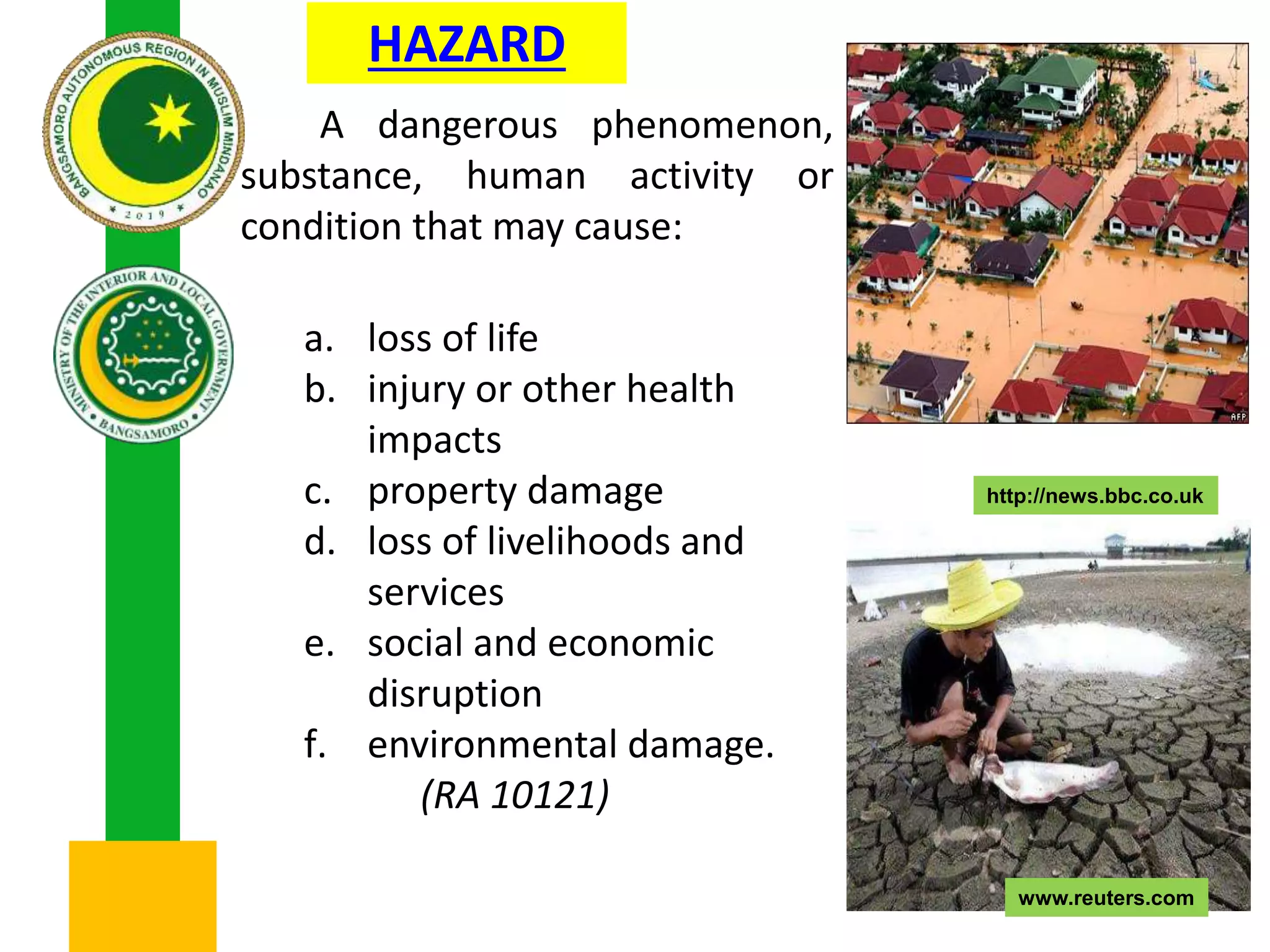
A dangerous phenomenon,
substance, human activity or
condition that may cause:
a. loss of life
b. injury or other health
impacts
c. property damage
d. loss of livelihoods and
services
e. social and economic
disruption
f. environmental damage.
(RA 10121)
HAZARD
http://news.bbc.co.uk
www.reuters.com
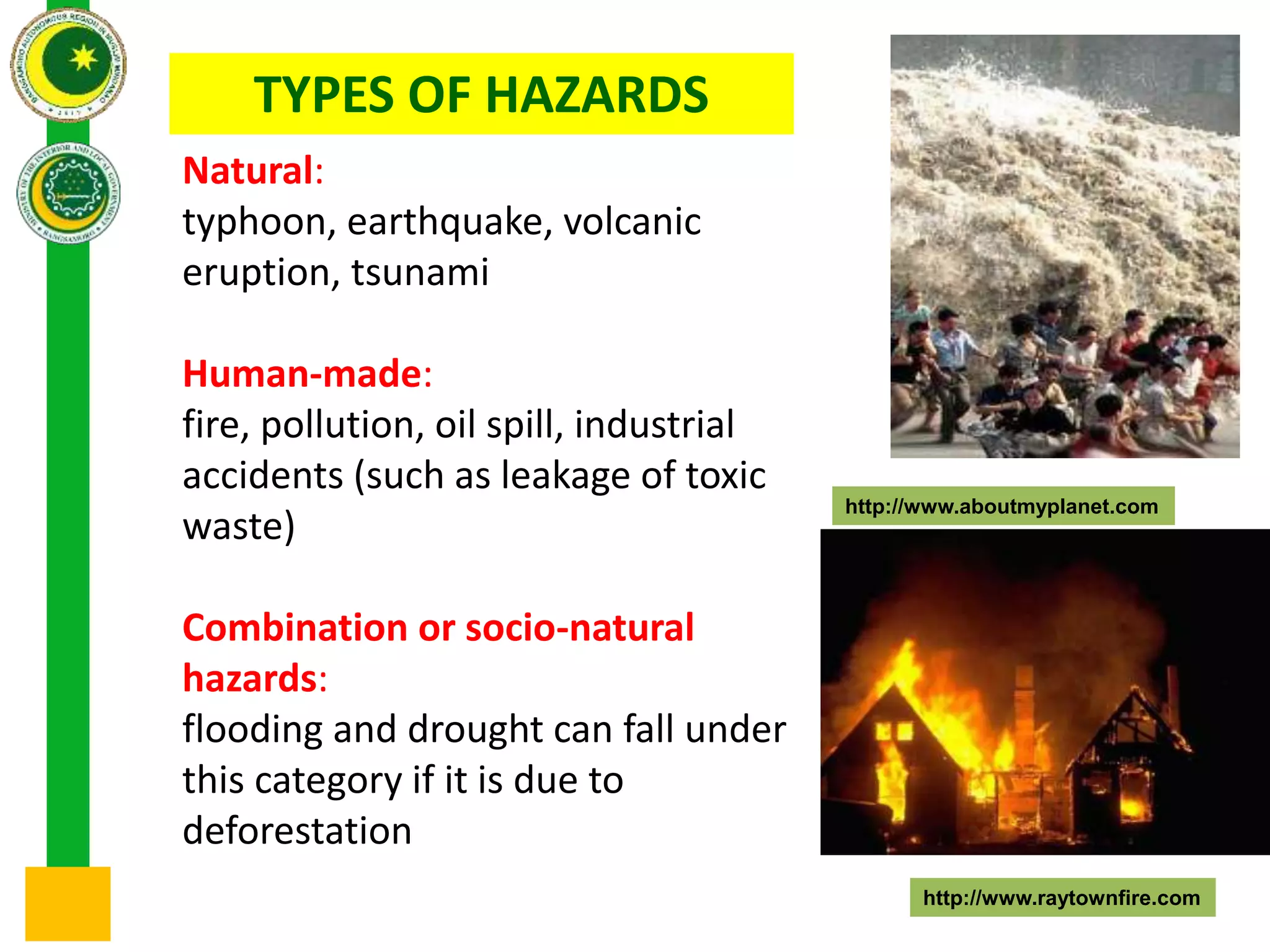
TYPES OF HAZARDS
Natural:
typhoon, earthquake, volcanic
eruption, tsunami
Human-made:
fire, pollution, oil spill, industrial
accidents (such as leakage of toxic
waste)
Combination or socio-natural
hazards:
flooding and drought can fall under
this category if it is due to
deforestation
http://www.aboutmyplanet.com
http://www.raytownfire.com
The characteristics
and circumstances of a
community, system or
asset that make it
susceptible to the
damaging effects of a
hazard.
(RA 10121)
VULNERABILITY
http://www.dpf.or.th
http://aarontybradley.blogspot.com
EXAMPLES OF VULNERABILITY
• Poor locations
• Houses made of light
materials
• Conflict in the community
• Lack of knowledge and
skills on disaster
preparedness and
protective measures
• Attitude of helplessness
and dependence
http://www.dpf.or.th
The combination
of all the strengths,
attributes and
resources available
within a community,
society or
organization that can
be used to achieve
agreed goals.
(RA 10121)
CAPACITY
• Permanent housing
• Ownership of land
• Adequate food and income
sources
• Family and community
support in times of crises
• Local knowledge
• Responsive local government
• Strong community
organizations
EXAMPLES OF CAPACITY
http://drh.edm.bosai.go.jp
The degree to which the elements at risk are
likely to experience hazard events of different
magnitudes (RA 10121)
EXPOSURE
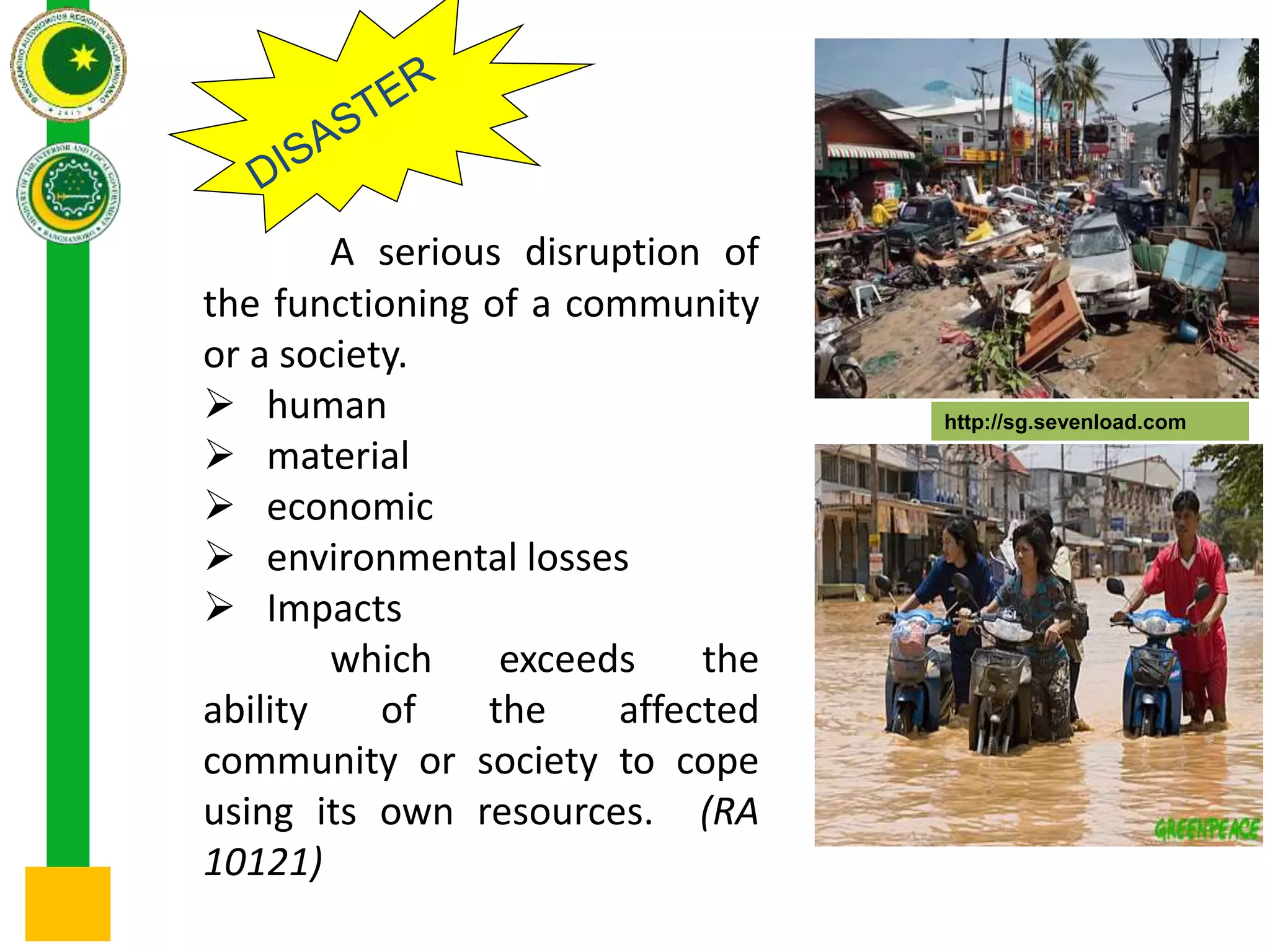
A serious disruption of
the functioning of a community
or a society.
 human
 material
 economic
 environmental losses
 Impacts
which exceeds the
ability of the affected
community or society to cope
using its own resources. (RA
10121)
http://sg.sevenload.com
Disaster
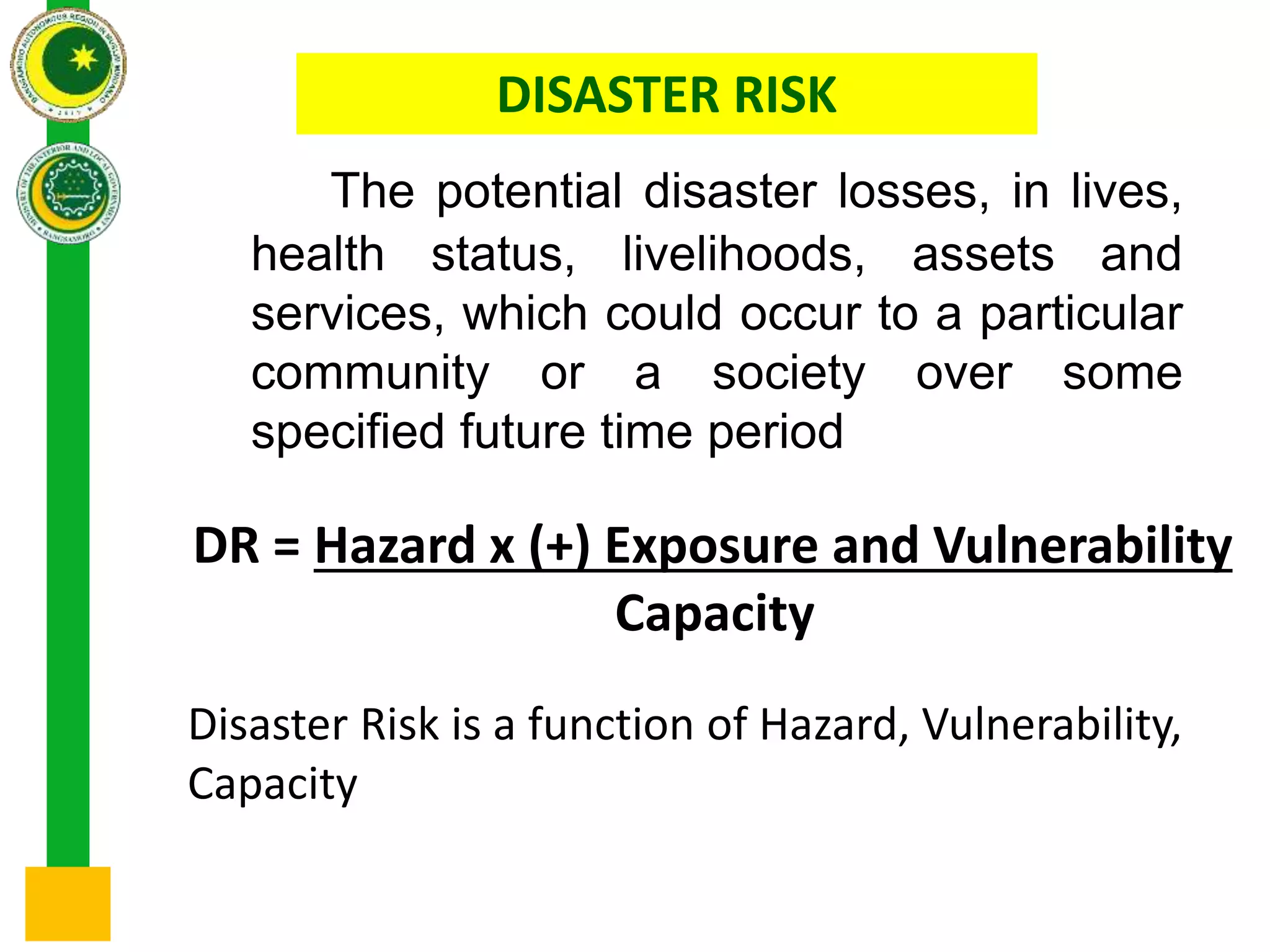
The potential disaster losses, in lives,
health status, livelihoods, assets and
services, which could occur to a particular
community or a society over some
specified future time period
DISASTER RISK
DR = Hazard x (+) Exposure and Vulnerability
Capacity
Disaster Risk is a function of Hazard, Vulnerability,
Capacity
Who and what can be damaged:
• People (their lives and health)
• Household and community structures (houses,
community centres, schools)
• Community facilities and services (access roads,
bridges, hospital, electricity, water supply, etc.)
• Livelihood and economic activities (jobs, crops,
livestock, equipment, etc.)
• Environment (natural resource base)
ELEMENTS AT RISK
changes in the
mean or variability of its
properties that persists
for an extended period
typically decades or
longer, whether due to
natural variability or as
a result of human
activity (RA 9729)
CLIMATE CHANGE
Source: N. Sano, 2010
 warmer and more frequent hot
days and nights
 heat waves over most land
areas.
 more frequent rainfall events
over most areas resulting in:
increased flood
landslide
soil erosion
mudslide
 Increase in tropical cyclone wind
and rainfall intensities in some
areas.
What to expect in the 21st Century?
Source: L. V. Tibig: 2010
 Human-induced warming
and sea level rise would
continue for centuries
(highly certain).
More intense El Niño-related
droughts and floods in many
different regions (medium
confidence)
Source: L. V. Tibig: 2010
Human activities contribute to climate change
by causing changes in Earth’s atmosphere in
the amounts of greenhouse gases, aerosols
and cloudiness.
How do human activities contribute
to climate change?
Source: L. V. Tibig: 2010
Sea level rise
Increased
temperatures
More extreme
weather/
climate events
Impact on
water
quality/
aquaculture
Increased
risk to lives
properties/
livelihood
Less
freshwater
availability
Salt-water
intrusion
Inundation
of low-lying
areas
Drier
soils/siltatio
n/erosion
Droughts/
floods
Damage to
crops
El Nino events
(increased/
decreased
rainfall)
More rains
strong
winds
More
frequent/
stronger
typhoons
Decreased
yields
Increased pest
infestation
Increased crop
water demand
Drier soils
Higher
evaporative
demand
Climate Variability/ Change
Changes in
rainfall
patterns
Less
rains
More
rains
Less water
for
irrigation
Source: L. V. Tibig: 2010
An adjustment in natural and human
systems in response to actual or
expected climate stimuli or their
effects, which moderates harm or
exploits benefit opportunities (RA
9729)
CLIMATE CHANGE ADAPTATION
Refers to human intervention to
address anthropogenic emissions by
sources and removals by sinks of
GHGs, including ozone-depleting
substance and their substitute (RA
9729)
CLIMATE CHANGE MITIGATION
Development that meets the needs of
the present without compromising the
ability of future generations to meet their
own needs
(RA 10121)
SUSTAINABLE DEVELOPMENT
Disaster Risk
Reduction and
Management (DRRM)
Millions
of Filipinos
are at risk.
Disaster Risk Reduction and Management
(DRRM)
The systematic process of using
administrative directives, organizations, and
operational skills and capacities to implement
strategies, policies and improved coping capacities
in order to lessen the adverse impacts of hazards
and the possibility of disasters.
(RA 10121)
DRRM is good governance
What is DISASTER RISK REDUCTION?
It is a proactive approach to minimize
vulnerabilities and disaster risks to minimize
loss of life, livelihood and property.
DRR incorporates aspects of:
a. good governance
b. sustainable development
c. risk (natural; human; and climate risks)
assessments
d. knowledge and education
e. risk management
f. vulnerability reduction
g. disaster preparedness and response
PREPAREDNESS Let’s study our
disaster situation
Contingency Plan (per
hazard), Training and
education, and drills
Public Awareness
and Early Warning
Community
Vulnerability, Capacity
and Adaptation
Assessment
PREPAREDNESS
Strengthening organization and inter-agency
arrangements
Logistics support
and stockpile
Barangay
Tulong-tulong
Food & water
committee
Logistics
committee
Networkin
g
committee
Medical & sanitation
committee
Barangay
DRRM
Committee
MITIGATION /PREVENTION
Structural
MITIGATION
Non-Structural
Legislation
Economic Mitigation
LOG BAN
Policy study & Advocacy
Public Safety measures
Poverty
Reduction
Strategies
Ecological profile, land
use planning,
comprehensive
development plan
must be DRR and
climate change
adaptation sensitive
Photo courtesy of Commissioner Sano
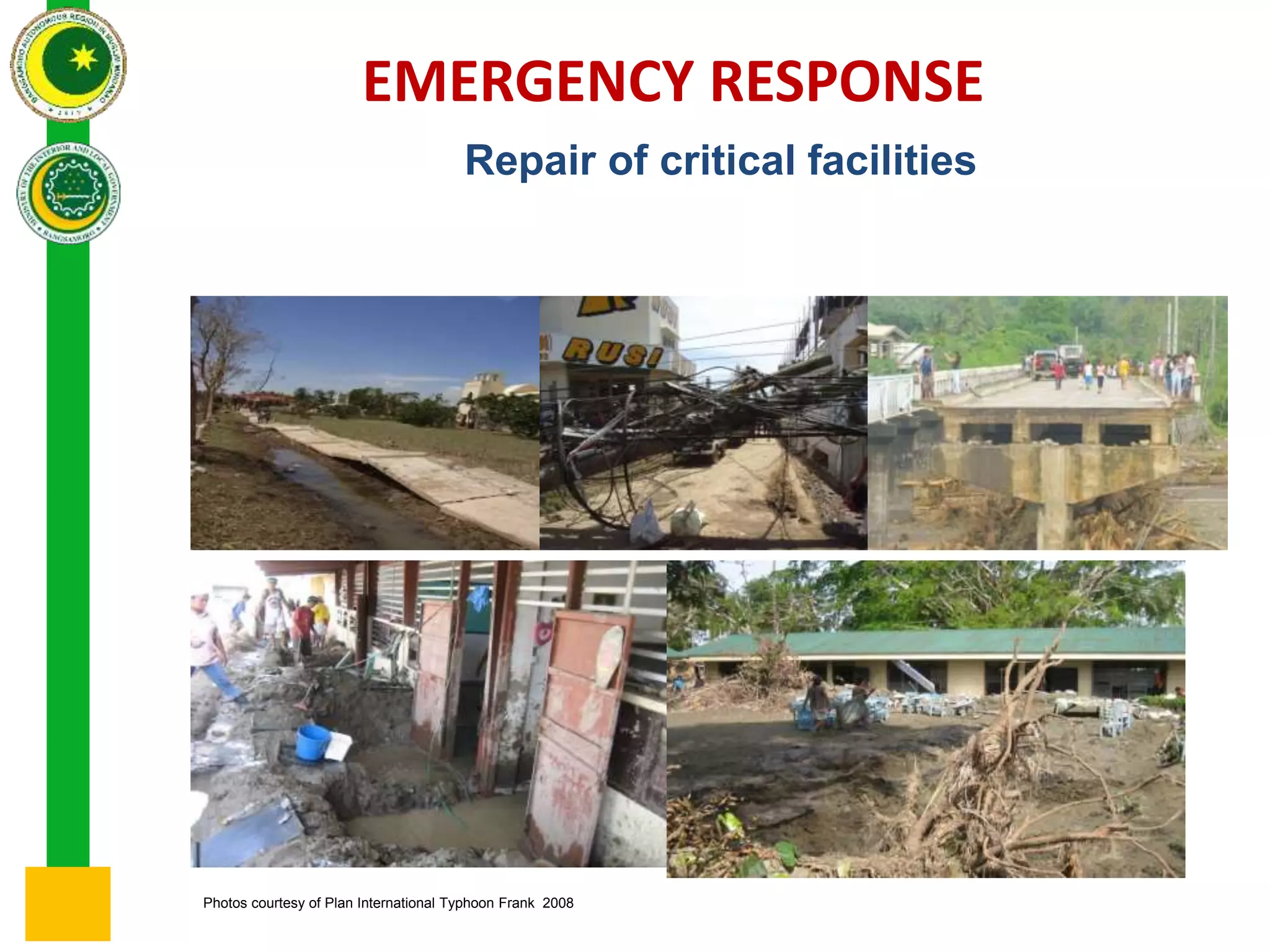
EMERGENCY RESPONSE
Damage Needs
Capacity
Assessment (DANA)
•Setting up of Emergency
Operations Center (for major
disaster)
• Search and Rescue
OCD Photo
Plan International Photo
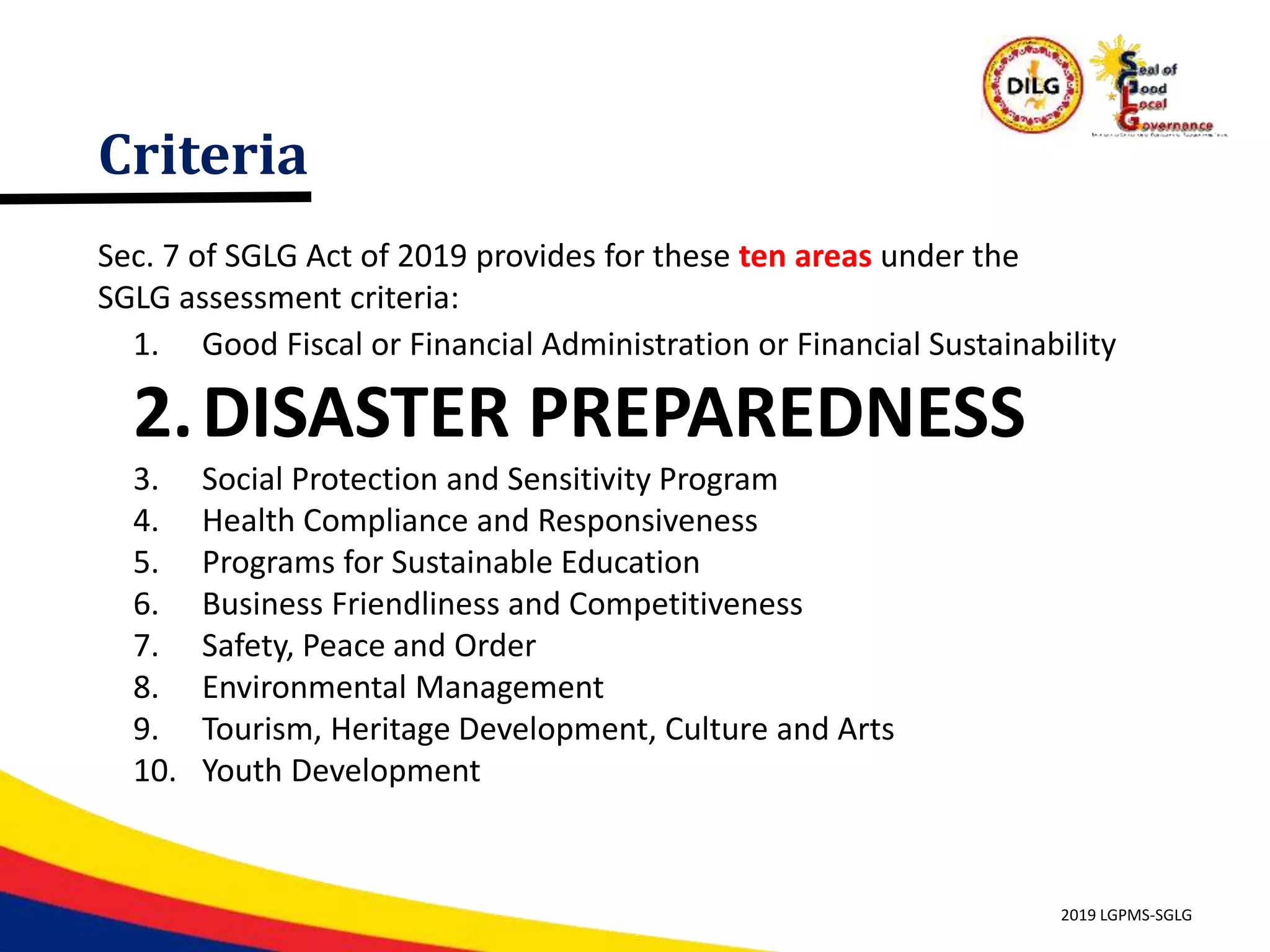
EMERGENCY RESPONSE
Repair of critical facilities
Photos courtesy of Plan International Typhoon Frank 2008
EMERGENCY RESPONSE
Psycho-social counseling (comforting, critical stress
debriefing, prayers)
RECOVERY
Rehabilitation
CCA MEASURES
•Diversifying income
sources
•Decent work agenda
•Entrepreneur development
•Food preservation
•Handicraft
•Increasing livelihood
options and access to
resources
Livelihood & Food Security, Water, Health & Nutrition
Practical measures: What can we do?
• Plant trees
• Re-use, reduce, recycle
• Go organic
• Buy local products
• Conserve water
Source: L. V. Tibig: 2010
What can we do?
• Conserve energy
– Be conscious of energy ratings in
appliances
– Walk short distances
– Do car pooling
– Unplug appliances not in use
– Help disseminate information
Source: L. V. Tibig: 2010
DISASTER RESILIENCE
The capacity of a system, community or
society to resist or to change.
This is determined by the degree to
which the social system is capable of organizing
itself and the ability to increase its capacity for
learning and adaptation, including the capacity
to recover from a disaster.
Disaster Risk Reduction
and
Management (DRRM) in
RA no. 11292
(SGLG ACT OF 2019)
Republic Act No. 11292
2019 LGPMS-SGLG
• Full title: An Act Establishing and
Institutionalizing the Seal of Good Local
Governance for Local Government Units, and
Allocating for This Purpose the Seal of Good
Local Governance Fund
10 SGLG GOVERNANCE AREAS
Criteria
2019 LGPMS-SGLG
1. Good Fiscal or Financial Administration or Financial Sustainability
2.DISASTER PREPAREDNESS
3. Social Protection and Sensitivity Program
4. Health Compliance and Responsiveness
5. Programs for Sustainable Education
6. Business Friendliness and Competitiveness
7. Safety, Peace and Order
8. Environmental Management
9. Tourism, Heritage Development, Culture and Arts
10. Youth Development
Sec. 7 of SGLG Act of 2019 provides for these ten areas under the
SGLG assessment criteria:
RA no. 11292
(SGLG ACT OF 2019)
GOVERNANCE AREA:
DISASTER PREPAREDNESS
INDICATORS
RA 11292 (SGLG OF ACT OF 2019)
SGLG Governance Area on Disaster Preparedness
1. Functional LDRRMC (Composition and
Meetings)
Compliance of the LGU with the minimum standards
required by R.A. No. 10121 for DRRM purposes,
particularly on the establishment, and functions of the
Local Disaster Risk Reduction and Management
Council (LDRRMC), its organizational structure,
composition, and its meetings.
Cont’n
1. Functional LDRRMC (Composition and
Meetings)
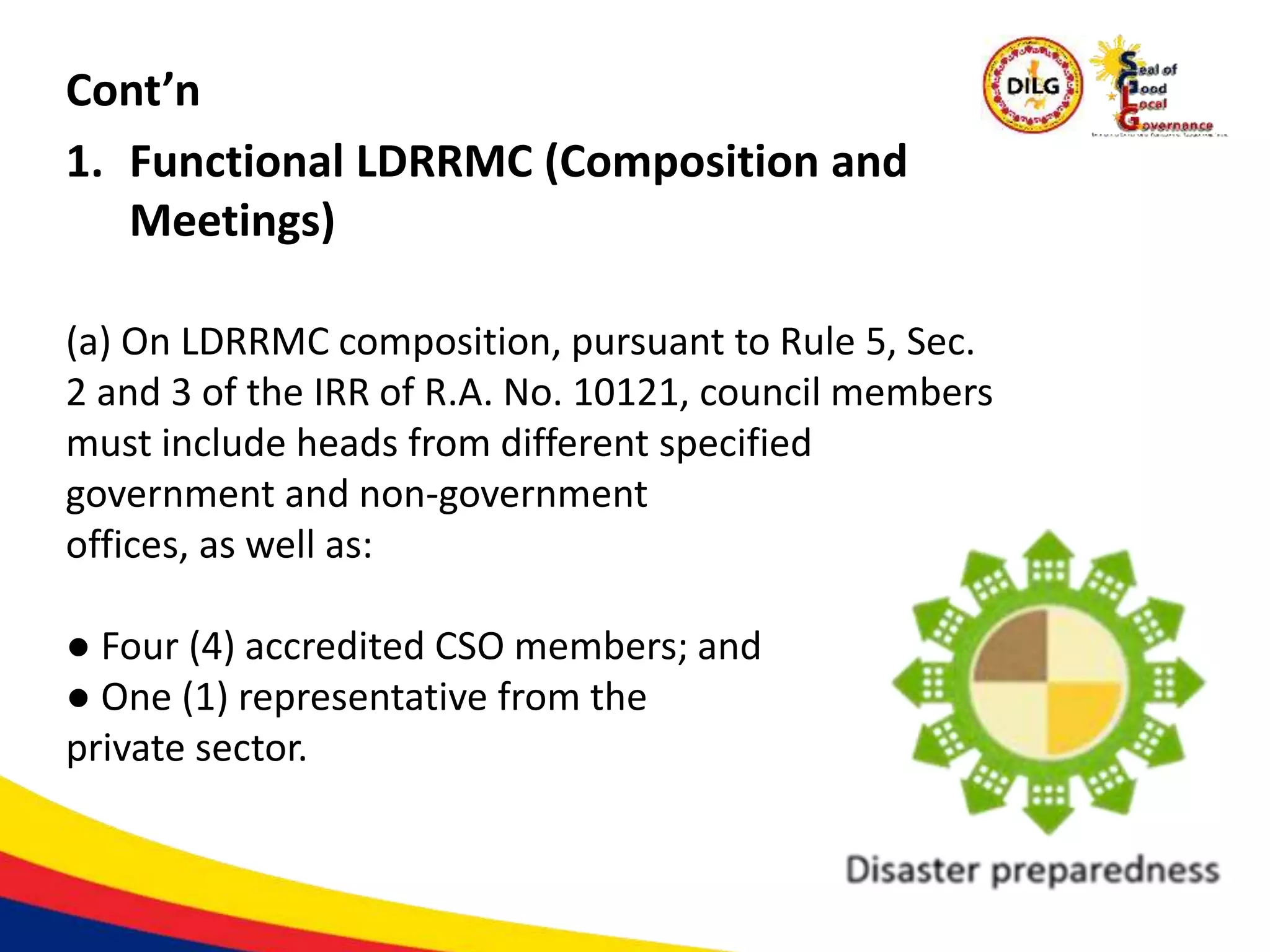
(a) On LDRRMC composition, pursuant to Rule 5, Sec.
2 and 3 of the IRR of R.A. No. 10121, council members
must include heads from different specified
government and non-government
offices, as well as:
● Four (4) accredited CSO members; and
● One (1) representative from the
private sector.
Cont’n
1. Functional LDRRMC (Composition and
Meetings)
(b) On LDRRMC meetings, Rule 5, Section
5 states that meetings “shall be held
every three months” to ensure that the
councils would be more able to perform
their duties in protecting the integrity of
their LGUs’ DRRM programs and
initiatives.
RA 11292 (SGLG OF ACT OF 2019)
SGLG Governance Area on Disaster Preparedness
2. Established Local Disaster Risk Reduction
and Management Office (LDRRMO)
LGU must comply with minimum requirements of
establishing an LDRRM Office responsible
for the development and implementation of
programs or strategies relative to disaster
risk reduction pursuant to Sec. 12 of RA 10121 and
NDRRMC-DILG-DBM-CCC JMC 2014-1: Implementing
Guidelines for the Establishment of LDRRM Offices or
Barangay DRRM Committee in LGUs.
Cont’n
2. Established Local Disaster Risk Reduction
and Management Office (LDRRMO)
a. Local Disaster Risk Reduction and Management
Officer (Head of Office)
(a) On LDRRMO Head – NDRRMC-DILGDBM-CCC
JMC 2014-1 provides for the creation of a permanent
(plantilla) position for a Local DRRM Officer serving as
Head of the LDRRM Office. It also specifies the
corresponding salary grade per LGU type and the minimum
qualification standards for the position.
Cont’n
2. Established Local Disaster Risk Reduction and
Management Office (LDRRMO)
b. LDRRMO Staff Complement
(b) On staff complement – NDRRMCDILG-DBM-CCC JMC 2014-1
provides for the creation of plantilla positions For LDRRMO staff
complement who shall be responsible for:
1. DRRM research and planning;
2. DRRM administration and training; and
3. DRRM operations and warning.
Cont’n
2. Established Local Disaster Risk Reduction and
Management Office (LDRRMO)
c. LDRRMO Work Space
this refers to the physical space within LGU premises which is allocated
for the LDRRMO to occupy for the purposes of the conduct of its
functions and operations.
RA 11292 (SGLG OF ACT OF 2019)
SGLG Governance Area on Disaster Preparedness
3. Approved Provincial Development and
Physical Framework Plan (PDPFP) or
Comprehensive Land Use Plan (CLUP)
PDPFP (Provinces) guides future land use and physical
developments and the location of programs,
projects and activities in the province.
CLUP (Cities and Municipalities) determines the specific
uses of land and other physical and natural resources,
both private and public, within their territorial
jurisdiction including areas co-managed
RA 11292 (SGLG OF ACT OF 2019)
SGLG Governance Area on Disaster Preparedness
4. Local Disaster Risk Reduction and
Management (LDRRM) Plan
Sec. 12 of R.A. No. 10121 states that among the duties of
LDRRMOs is to formulate and implement a comprehensive
LDRRMP. LDRRM Plan sets out goals and specific objectives
for reducing disaster risks together with related actions to
accomplish these objectives. It covers four (4) DRRM
Thematic Areas: prevention and
mitigation, preparedness, response, and
rehabilitation and recovery.
Cont’n
4. Local Disaster Risk Reduction and
Management (LDRRM) Plan
It also provides for the identification of hazards, vulnerabilities, and
risks to be managed at the local level; disaster risk reduction and
management approaches and strategies to be applied in managing
said hazards and risks; monitoring & evaluation system, among
others.
RA 11292 (SGLG OF ACT OF 2019)
SGLG Governance Area on Disaster Preparedness
5. Presence of Local Climate Change Action
Plan (LCCAP)
Sec. 11 (b) of R.A. No. 10121 states that among the duties
of LDRRMCs is to “Ensure the integration of disaster risk
reduction and climate change adaptation into local
development plans, programs, and budgets as a strategy in
sustainable development and poverty reduction.” In
addition, the National Disaster Preparedness Plan: Disaster
Preparedness Minimum Standards Vol. 2 states that
LCCAPs are required for provinces, cities, and
municipalities.
Cont’n
5. Presence of Local Climate Change Action
Plan (LCCAP)
The LCCAP sets out the strategies of an LGU to mitigate and
adapt to the impacts of climate change. Depending on the
planning scenarios in the LGUs, the LCCAP may either be
integrated into the PDPFP/CLUP/CDP or it may be a
standalone document.
RA 11292 (SGLG OF ACT OF 2019)
SGLG Governance Area on Disaster Preparedness
6. Approved Contingency Plans (CP)
A Contingency Plan is a scenario-based plan for a
specific and projected natural and/or human-induced
hazard. It aims to address the impacts of the hazard to
people, properties, and the environment; and/or to
prevent the occurrence of the emerging threats
through the arrangement of timely,
effective, appropriate, and well-coordinated
responses as well as the efficient
management of resources.
RA 11292 (SGLG OF ACT OF 2019)
SGLG Governance Area on Disaster Preparedness
7. Utilization of the Local Disaster Risk Reduction
and Management Fund (LDRRMF)
– 70% Disaster Preparedness and Mitigation
component
Section 21 of R.A. No. 10121 indicates that the LDRRM Fund must
be at least 5% of the estimated revenue from regular sources to
support activities related to disaster risk management which
includes training, purchase of disaster response and rescue
equipment, supplies and medicines, for post- disaster activities,
and payment of premiums on calamity insurance.
Cont’n
7. Utilization of the Local Disaster Risk Reduction
and Management Fund (LDRRMF)
– 70% Disaster Preparedness and Mitigation
component
NDRRMC, DBM & DILG JMC No. 2013-1 provides guidance to
LGUs on the allocation & utilization of the LDRRMF. Up to 30% of
the fund is allocated for the Quick Response Fund (QRF) 30%, and
up to 70% is earmarked for disaster prevention and mitigation,
preparedness, response, rehabilitation and recovery, or the
Disaster Preparedness and Mitigation Fund.
Cont’n
7. Utilization of the Local Disaster Risk Reduction and
Management Fund (LDRRMF)
– 70% Disaster Preparedness and Mitigation
component
The assessment focuses only on the utilization of the 70%
Disaster Preparedness and Mitigation component.
To compute % allocation for LDRRMF: (LDRRMF Allocated /
Estimated Total Revenue from Regular Sources) x 100
To compute for % utilization:
% = (𝑇𝑜𝑡𝑎𝑙 𝐴𝑚𝑜𝑢𝑛𝑡 𝑈𝑡𝑖𝑙𝑖𝑧𝑒𝑑/𝑇𝑜𝑡𝑎𝑙 𝐴𝑚𝑜𝑢𝑛𝑡 𝐴𝑙𝑙𝑜𝑐𝑎𝑡𝑒𝑑) 𝑥
100
Cont’n
7. Utilization of the Local Disaster Risk Reduction and
Management Fund (LDRRMF)
– 70% Disaster Preparedness and Mitigation
component
DBM Memorandum LBC 124 s. 2020 indicates that allprovinces,
cities, municipalities, and barangays are strongly advised to
provide funds for the implementation of PPAs to contain the
spread of COVID-19 and to provide basic services to the
affected population, including the necessary support to
frontline workers.
Cont’n
7. Utilization of the Local Disaster Risk Reduction and
Management Fund (LDRRMF)
– 70% Disaster Preparedness and Mitigation
component
In providing funds for COVID-19-related PPAs, the LGUs shall
effect changes in their respective annual budgets through
supplemental budgets in accordance with Section 321 of the
Code and Article 417 of its IRR, as amended by AO No. 47, as
discussed under the Budget Operations Manual for LGUs, 2016
Edition, under the following circumstances:
(a) when supported by funds actually available as certified by
the local treasurer; (b) if covered by new revenue source(s);
and (c) in times of public calamity.
RA 11292 (SGLG OF ACT OF 2019)
SGLG Governance Area on Disaster Preparedness
8. Early Warning System (EWS)
Section 12 of R.A. No. 10121 mandates LGUs through their LDRRMOs to operate
a “multi-hazard early warning system” linked to DRR to provide accurate and
timely advice to national or local emergency response organizations and the
general public, through diverse mass media, particularly radio, landline
communications, SMS (thru text blasts) and technologies for communication
within rural communities. An Early Warning System (EWS), as stated in Sec 3 of
R.A. No. 10121, is defined as a “set of capacities needed to generate and
disseminate timely and meaningful warning information to enable individuals,
communities and organizations threatened by a hazard to prepare and act
appropriately and in sufficient time to reduce the possibility of harm or loss.”
RA 11292 (SGLG OF ACT OF 2019)
SGLG Governance Area on Disaster Preparedness
8. Early Warning System (EWS)
Section 12 of R.A. No. 10121 mandates LGUs through their LDRRMOs to operate
a “multi-hazard early warning system” linked to DRR to provide accurate and
timely advice to national or local emergency response organizations and the
general public, through diverse mass media, particularly radio, landline
communications, SMS (thru text blasts) and technologies for communication
within rural communities. An Early Warning System (EWS), as stated in Sec 3 of
R.A. No. 10121, is defined as a “set of capacities needed to generate and
disseminate timely and meaningful warning information to enable individuals,
communities and organizations threatened by a hazard to prepare and act
appropriately and in sufficient time to reduce the possibility of harm or loss.”
RA 11292 (SGLG OF ACT OF 2019)
SGLG Governance Area on Disaster Preparedness
9. Pre-emptive and forced evacuation Mechanism
Pre-emptive and forced evacuation is to be
implemented by the LGU as a course of
action during a disaster or emergency where
there is a high threat of loss of lives within
an identified area according to DILG MC No.
2012-3
RA 11292 (SGLG OF ACT OF 2019)
SGLG Governance Area on Disaster Preparedness
10. Established Evacuation Management (EM)
system and resources
The Evacuation Management System ensures that the rights and
dignity of the affected population of crisis/disasters are upheld.
To complement the same, sufficient and appropriate resources
should be available. This includes water access; toilets/hygiene,
safe spaces and sleeping facilities that ensure the safety of
children and women; PWD and elderly accessibility; kitchen;
evacuation area for farm animals (as necessary) among others,
that is safe from hazards.
CONT’N
10. Established Evacuation Management (EM)
system and resources
a. Evacuation center
DSWD-DILG-DOH-DepED JMC No. 1, series of 2013, provides
guidelines on evacuation center coordination and management
particularly for LGUs to guide them on how to manage
evacuation centers and on how to determine opportunities
to coordinate, collaborate and cooperate with other stakeholders
to facilitate the provision of essential services to victims of
disasters.
CONT’N
10. Established Evacuation Management (EM)
system and resources
b. Evacuation information guides
The National Disaster Preparedness Plan – Disaster Preparedness
Minimum Standards Vol. 2 states that evacuation guides are
required for barangays.
At the minimum, an evacuation guide maps out a primary
evacuation route, including alternate routes in case the intended
route to he evacuation center is blocked.
CONT’N
10. Established Evacuation Management (EM)
system and resources
c. Prepositioned goods, resources, and services
Presence of systems that facilitate the deployment and
management of pre-determined goods and resources even
before the occurrence of disasters.
Indicates the level of LGU readiness with the ability to provide for
immediate essential needs such as relief goods, medical support,
and medicines.
RA 11292 (SGLG OF ACT OF 2019)
SGLG Governance Area on Disaster Preparedness
11. Equipped and trained Search and Rescue (SAR)
or Emergency Response (ER) teams :
Section 12 of R.A. No. 10121 mandates the LDRRMO to “organize,
train, equip and supervise local emergency response teams”, and
to provide continuing training to improve the competence of staff
in civil defense and DRRM.
CONT’N
11. Equipped and trained Search and Rescue (SAR) or
Emergency Response (ER) teams :
Based on the National Disaster Preparedness Plan: Disaster Preparedness
Minimum Standards Vol. 2:
a. Water rescue kit, at the minimum, contains: rope, lifejacket, flotation ring;
b. Extrication kit, at the minimum, contains: spine board, rope for water
rescue, shovel or alternate digging device;
c. Personal protective gear refers to helmet, goggles, work gloves & boots;
d. First aid kit, at the minimum, contains: adhesive strips, medical tape,
conforming bandage, triangular bandage, wound dressing, swabs antiseptic,
scissors, tweezers, safety pin, disposable gloves, plastic bag, first aid
instruction booklet; and
e. Emergency medical kit or survival kit, at the minimum, contains food,
water, flashlight, battery, radio, medications and medical items, whistle, and
other signaling devices.
RA 11292 (SGLG OF ACT OF 2019)
SGLG Governance Area on Disaster Preparedness
12. LDRRM Operations Center
The establishment of the LDRRM Operations Center is pursuant
to Rule 6 Section 4 (24) of the IRR of R.A. No. 10121. Based on
the National Disaster Preparedness Plan: Disaster Preparedness
Minimum Standards Vol. 2, the OpCen must (1) be able to
function 24/7 (3 shifts); (2) have a dedicated officer; and (3)
develop and implement Standard Operating Procedures and
Contingency Plan.
RA 11292 (SGLG OF ACT OF 2019)
SGLG Governance Area on Disaster Preparedness
13. Incident Command System (ICS)
Incident Command System is a temporary organization and an
on-scene disaster response that will be activated in response
to disasters or emergencies pursuant to NDRRMC MC. No 04, s.
2012.
Pursuant to NDRRMC Memo No. 4 s. 2012, LGUs are mandated to
capacitate its ICS organization through the conduct of ICS training
to institutionalize ICS. The ICS Cadre shall take the lead in
undertaking the ICS capacity building and development program
under the leadership of the Office of Civil Defense.
RA 11292 (SGLG OF ACT OF 2019)
SGLG Governance Area on Disaster Preparedness
14. Approved Community Based Disaster Risk Reduction
and Management (CBDRRM) Plans and
Budgets
Sec. 12 of R.A. No. 10121 states that among the duties of
BDRRMCs is to formulate and implement a comprehensive
CBDRRM Plan.
The CBDRRM Plan sets out goals and specific objectives for
reducing disaster risks together with related actions to accomplish
these objectives. The CBDRRM Plan shall cover the four (4) DRRM
Thematic Areas, namely: prevention and mitigation,
preparedness, response, and rehabilitation and recovery.
RA 11292 (SGLG OF ACT OF 2019)
SGLG Governance Area on Disaster Preparedness
15. Participation in Gawad KALASAG (GK) Seal for
LDRRMCOs
As stated in NDRRMC MC No. 06 s. 2021, the Gawad KALASAG
Seal and Special Awards for Excellence in Disaster Risk Reduction
and Management and Humanitarian Assistance (GK) was
conceptualized to adopt a mandatory assessment of, among
others, all LGUs to ensure and sustain the efforts of LDRRM
Offices in implementing comprehensive DRRM-CCA programs that
will build further the resiliency of their communities.

DISASTER PREPAREDNESS PPT.pptx

  • 1.
  • 2.
    A dangerous phenomenon, substance,human activity or condition that may cause: a. loss of life b. injury or other health impacts c. property damage d. loss of livelihoods and services e. social and economic disruption f. environmental damage. (RA 10121) HAZARD http://news.bbc.co.uk www.reuters.com
  • 3.
    TYPES OF HAZARDS Natural: typhoon,earthquake, volcanic eruption, tsunami Human-made: fire, pollution, oil spill, industrial accidents (such as leakage of toxic waste) Combination or socio-natural hazards: flooding and drought can fall under this category if it is due to deforestation http://www.aboutmyplanet.com http://www.raytownfire.com
  • 4.
    The characteristics and circumstancesof a community, system or asset that make it susceptible to the damaging effects of a hazard. (RA 10121) VULNERABILITY http://www.dpf.or.th http://aarontybradley.blogspot.com
  • 5.
    EXAMPLES OF VULNERABILITY •Poor locations • Houses made of light materials • Conflict in the community • Lack of knowledge and skills on disaster preparedness and protective measures • Attitude of helplessness and dependence http://www.dpf.or.th
  • 6.
    The combination of allthe strengths, attributes and resources available within a community, society or organization that can be used to achieve agreed goals. (RA 10121) CAPACITY
  • 7.
    • Permanent housing •Ownership of land • Adequate food and income sources • Family and community support in times of crises • Local knowledge • Responsive local government • Strong community organizations EXAMPLES OF CAPACITY http://drh.edm.bosai.go.jp
  • 8.
    The degree towhich the elements at risk are likely to experience hazard events of different magnitudes (RA 10121) EXPOSURE
  • 9.
    A serious disruptionof the functioning of a community or a society.  human  material  economic  environmental losses  Impacts which exceeds the ability of the affected community or society to cope using its own resources. (RA 10121) http://sg.sevenload.com
  • 10.
  • 11.
    The potential disasterlosses, in lives, health status, livelihoods, assets and services, which could occur to a particular community or a society over some specified future time period DISASTER RISK DR = Hazard x (+) Exposure and Vulnerability Capacity Disaster Risk is a function of Hazard, Vulnerability, Capacity
  • 12.
    Who and whatcan be damaged: • People (their lives and health) • Household and community structures (houses, community centres, schools) • Community facilities and services (access roads, bridges, hospital, electricity, water supply, etc.) • Livelihood and economic activities (jobs, crops, livestock, equipment, etc.) • Environment (natural resource base) ELEMENTS AT RISK
  • 13.
    changes in the meanor variability of its properties that persists for an extended period typically decades or longer, whether due to natural variability or as a result of human activity (RA 9729) CLIMATE CHANGE Source: N. Sano, 2010
  • 14.
     warmer andmore frequent hot days and nights  heat waves over most land areas.  more frequent rainfall events over most areas resulting in: increased flood landslide soil erosion mudslide  Increase in tropical cyclone wind and rainfall intensities in some areas. What to expect in the 21st Century? Source: L. V. Tibig: 2010
  • 15.
     Human-induced warming andsea level rise would continue for centuries (highly certain). More intense El Niño-related droughts and floods in many different regions (medium confidence) Source: L. V. Tibig: 2010
  • 16.
    Human activities contributeto climate change by causing changes in Earth’s atmosphere in the amounts of greenhouse gases, aerosols and cloudiness. How do human activities contribute to climate change? Source: L. V. Tibig: 2010
  • 17.
    Sea level rise Increased temperatures Moreextreme weather/ climate events Impact on water quality/ aquaculture Increased risk to lives properties/ livelihood Less freshwater availability Salt-water intrusion Inundation of low-lying areas Drier soils/siltatio n/erosion Droughts/ floods Damage to crops El Nino events (increased/ decreased rainfall) More rains strong winds More frequent/ stronger typhoons Decreased yields Increased pest infestation Increased crop water demand Drier soils Higher evaporative demand Climate Variability/ Change Changes in rainfall patterns Less rains More rains Less water for irrigation Source: L. V. Tibig: 2010
  • 18.
    An adjustment innatural and human systems in response to actual or expected climate stimuli or their effects, which moderates harm or exploits benefit opportunities (RA 9729) CLIMATE CHANGE ADAPTATION
  • 19.
    Refers to humanintervention to address anthropogenic emissions by sources and removals by sinks of GHGs, including ozone-depleting substance and their substitute (RA 9729) CLIMATE CHANGE MITIGATION
  • 20.
    Development that meetsthe needs of the present without compromising the ability of future generations to meet their own needs (RA 10121) SUSTAINABLE DEVELOPMENT
  • 21.
  • 22.
  • 23.
    Disaster Risk Reductionand Management (DRRM) The systematic process of using administrative directives, organizations, and operational skills and capacities to implement strategies, policies and improved coping capacities in order to lessen the adverse impacts of hazards and the possibility of disasters. (RA 10121) DRRM is good governance
  • 24.
    What is DISASTERRISK REDUCTION? It is a proactive approach to minimize vulnerabilities and disaster risks to minimize loss of life, livelihood and property. DRR incorporates aspects of: a. good governance b. sustainable development c. risk (natural; human; and climate risks) assessments d. knowledge and education e. risk management f. vulnerability reduction g. disaster preparedness and response
  • 25.
    PREPAREDNESS Let’s studyour disaster situation Contingency Plan (per hazard), Training and education, and drills Public Awareness and Early Warning Community Vulnerability, Capacity and Adaptation Assessment
  • 26.
    PREPAREDNESS Strengthening organization andinter-agency arrangements Logistics support and stockpile Barangay Tulong-tulong Food & water committee Logistics committee Networkin g committee Medical & sanitation committee Barangay DRRM Committee
  • 27.
  • 28.
  • 29.
    Poverty Reduction Strategies Ecological profile, land useplanning, comprehensive development plan must be DRR and climate change adaptation sensitive Photo courtesy of Commissioner Sano Photo courtesy of Commissioner Sano
  • 30.
    EMERGENCY RESPONSE Damage Needs Capacity Assessment(DANA) •Setting up of Emergency Operations Center (for major disaster) • Search and Rescue OCD Photo Plan International Photo Plan International Photo Plan International Photo
  • 31.
    EMERGENCY RESPONSE Repair ofcritical facilities Photos courtesy of Plan International Typhoon Frank 2008
  • 32.
    EMERGENCY RESPONSE Psycho-social counseling(comforting, critical stress debriefing, prayers)
  • 33.
  • 34.
  • 35.
    •Diversifying income sources •Decent workagenda •Entrepreneur development •Food preservation •Handicraft •Increasing livelihood options and access to resources
  • 36.
    Livelihood & FoodSecurity, Water, Health & Nutrition
  • 37.
    Practical measures: Whatcan we do? • Plant trees • Re-use, reduce, recycle • Go organic • Buy local products • Conserve water Source: L. V. Tibig: 2010
  • 38.
    What can wedo? • Conserve energy – Be conscious of energy ratings in appliances – Walk short distances – Do car pooling – Unplug appliances not in use – Help disseminate information Source: L. V. Tibig: 2010
  • 39.
    DISASTER RESILIENCE The capacityof a system, community or society to resist or to change. This is determined by the degree to which the social system is capable of organizing itself and the ability to increase its capacity for learning and adaptation, including the capacity to recover from a disaster.
  • 40.
    Disaster Risk Reduction and Management(DRRM) in RA no. 11292 (SGLG ACT OF 2019)
  • 41.
    Republic Act No.11292 2019 LGPMS-SGLG • Full title: An Act Establishing and Institutionalizing the Seal of Good Local Governance for Local Government Units, and Allocating for This Purpose the Seal of Good Local Governance Fund
  • 42.
  • 43.
    Criteria 2019 LGPMS-SGLG 1. GoodFiscal or Financial Administration or Financial Sustainability 2.DISASTER PREPAREDNESS 3. Social Protection and Sensitivity Program 4. Health Compliance and Responsiveness 5. Programs for Sustainable Education 6. Business Friendliness and Competitiveness 7. Safety, Peace and Order 8. Environmental Management 9. Tourism, Heritage Development, Culture and Arts 10. Youth Development Sec. 7 of SGLG Act of 2019 provides for these ten areas under the SGLG assessment criteria:
  • 44.
    RA no. 11292 (SGLGACT OF 2019) GOVERNANCE AREA: DISASTER PREPAREDNESS INDICATORS
  • 45.
    RA 11292 (SGLGOF ACT OF 2019) SGLG Governance Area on Disaster Preparedness 1. Functional LDRRMC (Composition and Meetings) Compliance of the LGU with the minimum standards required by R.A. No. 10121 for DRRM purposes, particularly on the establishment, and functions of the Local Disaster Risk Reduction and Management Council (LDRRMC), its organizational structure, composition, and its meetings.
  • 46.
    Cont’n 1. Functional LDRRMC(Composition and Meetings) (a) On LDRRMC composition, pursuant to Rule 5, Sec. 2 and 3 of the IRR of R.A. No. 10121, council members must include heads from different specified government and non-government offices, as well as: ● Four (4) accredited CSO members; and ● One (1) representative from the private sector.
  • 47.
    Cont’n 1. Functional LDRRMC(Composition and Meetings) (b) On LDRRMC meetings, Rule 5, Section 5 states that meetings “shall be held every three months” to ensure that the councils would be more able to perform their duties in protecting the integrity of their LGUs’ DRRM programs and initiatives.
  • 48.
    RA 11292 (SGLGOF ACT OF 2019) SGLG Governance Area on Disaster Preparedness 2. Established Local Disaster Risk Reduction and Management Office (LDRRMO) LGU must comply with minimum requirements of establishing an LDRRM Office responsible for the development and implementation of programs or strategies relative to disaster risk reduction pursuant to Sec. 12 of RA 10121 and NDRRMC-DILG-DBM-CCC JMC 2014-1: Implementing Guidelines for the Establishment of LDRRM Offices or Barangay DRRM Committee in LGUs.
  • 49.
    Cont’n 2. Established LocalDisaster Risk Reduction and Management Office (LDRRMO) a. Local Disaster Risk Reduction and Management Officer (Head of Office) (a) On LDRRMO Head – NDRRMC-DILGDBM-CCC JMC 2014-1 provides for the creation of a permanent (plantilla) position for a Local DRRM Officer serving as Head of the LDRRM Office. It also specifies the corresponding salary grade per LGU type and the minimum qualification standards for the position.
  • 50.
    Cont’n 2. Established LocalDisaster Risk Reduction and Management Office (LDRRMO) b. LDRRMO Staff Complement (b) On staff complement – NDRRMCDILG-DBM-CCC JMC 2014-1 provides for the creation of plantilla positions For LDRRMO staff complement who shall be responsible for: 1. DRRM research and planning; 2. DRRM administration and training; and 3. DRRM operations and warning.
  • 51.
    Cont’n 2. Established LocalDisaster Risk Reduction and Management Office (LDRRMO) c. LDRRMO Work Space this refers to the physical space within LGU premises which is allocated for the LDRRMO to occupy for the purposes of the conduct of its functions and operations.
  • 52.
    RA 11292 (SGLGOF ACT OF 2019) SGLG Governance Area on Disaster Preparedness 3. Approved Provincial Development and Physical Framework Plan (PDPFP) or Comprehensive Land Use Plan (CLUP) PDPFP (Provinces) guides future land use and physical developments and the location of programs, projects and activities in the province. CLUP (Cities and Municipalities) determines the specific uses of land and other physical and natural resources, both private and public, within their territorial jurisdiction including areas co-managed
  • 53.
    RA 11292 (SGLGOF ACT OF 2019) SGLG Governance Area on Disaster Preparedness 4. Local Disaster Risk Reduction and Management (LDRRM) Plan Sec. 12 of R.A. No. 10121 states that among the duties of LDRRMOs is to formulate and implement a comprehensive LDRRMP. LDRRM Plan sets out goals and specific objectives for reducing disaster risks together with related actions to accomplish these objectives. It covers four (4) DRRM Thematic Areas: prevention and mitigation, preparedness, response, and rehabilitation and recovery.
  • 54.
    Cont’n 4. Local DisasterRisk Reduction and Management (LDRRM) Plan It also provides for the identification of hazards, vulnerabilities, and risks to be managed at the local level; disaster risk reduction and management approaches and strategies to be applied in managing said hazards and risks; monitoring & evaluation system, among others.
  • 55.
    RA 11292 (SGLGOF ACT OF 2019) SGLG Governance Area on Disaster Preparedness 5. Presence of Local Climate Change Action Plan (LCCAP) Sec. 11 (b) of R.A. No. 10121 states that among the duties of LDRRMCs is to “Ensure the integration of disaster risk reduction and climate change adaptation into local development plans, programs, and budgets as a strategy in sustainable development and poverty reduction.” In addition, the National Disaster Preparedness Plan: Disaster Preparedness Minimum Standards Vol. 2 states that LCCAPs are required for provinces, cities, and municipalities.
  • 56.
    Cont’n 5. Presence ofLocal Climate Change Action Plan (LCCAP) The LCCAP sets out the strategies of an LGU to mitigate and adapt to the impacts of climate change. Depending on the planning scenarios in the LGUs, the LCCAP may either be integrated into the PDPFP/CLUP/CDP or it may be a standalone document.
  • 57.
    RA 11292 (SGLGOF ACT OF 2019) SGLG Governance Area on Disaster Preparedness 6. Approved Contingency Plans (CP) A Contingency Plan is a scenario-based plan for a specific and projected natural and/or human-induced hazard. It aims to address the impacts of the hazard to people, properties, and the environment; and/or to prevent the occurrence of the emerging threats through the arrangement of timely, effective, appropriate, and well-coordinated responses as well as the efficient management of resources.
  • 58.
    RA 11292 (SGLGOF ACT OF 2019) SGLG Governance Area on Disaster Preparedness 7. Utilization of the Local Disaster Risk Reduction and Management Fund (LDRRMF) – 70% Disaster Preparedness and Mitigation component Section 21 of R.A. No. 10121 indicates that the LDRRM Fund must be at least 5% of the estimated revenue from regular sources to support activities related to disaster risk management which includes training, purchase of disaster response and rescue equipment, supplies and medicines, for post- disaster activities, and payment of premiums on calamity insurance.
  • 59.
    Cont’n 7. Utilization ofthe Local Disaster Risk Reduction and Management Fund (LDRRMF) – 70% Disaster Preparedness and Mitigation component NDRRMC, DBM & DILG JMC No. 2013-1 provides guidance to LGUs on the allocation & utilization of the LDRRMF. Up to 30% of the fund is allocated for the Quick Response Fund (QRF) 30%, and up to 70% is earmarked for disaster prevention and mitigation, preparedness, response, rehabilitation and recovery, or the Disaster Preparedness and Mitigation Fund.
  • 60.
    Cont’n 7. Utilization ofthe Local Disaster Risk Reduction and Management Fund (LDRRMF) – 70% Disaster Preparedness and Mitigation component The assessment focuses only on the utilization of the 70% Disaster Preparedness and Mitigation component. To compute % allocation for LDRRMF: (LDRRMF Allocated / Estimated Total Revenue from Regular Sources) x 100 To compute for % utilization: % = (𝑇𝑜𝑡𝑎𝑙 𝐴𝑚𝑜𝑢𝑛𝑡 𝑈𝑡𝑖𝑙𝑖𝑧𝑒𝑑/𝑇𝑜𝑡𝑎𝑙 𝐴𝑚𝑜𝑢𝑛𝑡 𝐴𝑙𝑙𝑜𝑐𝑎𝑡𝑒𝑑) 𝑥 100
  • 61.
    Cont’n 7. Utilization ofthe Local Disaster Risk Reduction and Management Fund (LDRRMF) – 70% Disaster Preparedness and Mitigation component DBM Memorandum LBC 124 s. 2020 indicates that allprovinces, cities, municipalities, and barangays are strongly advised to provide funds for the implementation of PPAs to contain the spread of COVID-19 and to provide basic services to the affected population, including the necessary support to frontline workers.
  • 62.
    Cont’n 7. Utilization ofthe Local Disaster Risk Reduction and Management Fund (LDRRMF) – 70% Disaster Preparedness and Mitigation component In providing funds for COVID-19-related PPAs, the LGUs shall effect changes in their respective annual budgets through supplemental budgets in accordance with Section 321 of the Code and Article 417 of its IRR, as amended by AO No. 47, as discussed under the Budget Operations Manual for LGUs, 2016 Edition, under the following circumstances: (a) when supported by funds actually available as certified by the local treasurer; (b) if covered by new revenue source(s); and (c) in times of public calamity.
  • 63.
    RA 11292 (SGLGOF ACT OF 2019) SGLG Governance Area on Disaster Preparedness 8. Early Warning System (EWS) Section 12 of R.A. No. 10121 mandates LGUs through their LDRRMOs to operate a “multi-hazard early warning system” linked to DRR to provide accurate and timely advice to national or local emergency response organizations and the general public, through diverse mass media, particularly radio, landline communications, SMS (thru text blasts) and technologies for communication within rural communities. An Early Warning System (EWS), as stated in Sec 3 of R.A. No. 10121, is defined as a “set of capacities needed to generate and disseminate timely and meaningful warning information to enable individuals, communities and organizations threatened by a hazard to prepare and act appropriately and in sufficient time to reduce the possibility of harm or loss.”
  • 65.
    RA 11292 (SGLGOF ACT OF 2019) SGLG Governance Area on Disaster Preparedness 8. Early Warning System (EWS) Section 12 of R.A. No. 10121 mandates LGUs through their LDRRMOs to operate a “multi-hazard early warning system” linked to DRR to provide accurate and timely advice to national or local emergency response organizations and the general public, through diverse mass media, particularly radio, landline communications, SMS (thru text blasts) and technologies for communication within rural communities. An Early Warning System (EWS), as stated in Sec 3 of R.A. No. 10121, is defined as a “set of capacities needed to generate and disseminate timely and meaningful warning information to enable individuals, communities and organizations threatened by a hazard to prepare and act appropriately and in sufficient time to reduce the possibility of harm or loss.”
  • 66.
    RA 11292 (SGLGOF ACT OF 2019) SGLG Governance Area on Disaster Preparedness 9. Pre-emptive and forced evacuation Mechanism Pre-emptive and forced evacuation is to be implemented by the LGU as a course of action during a disaster or emergency where there is a high threat of loss of lives within an identified area according to DILG MC No. 2012-3
  • 67.
    RA 11292 (SGLGOF ACT OF 2019) SGLG Governance Area on Disaster Preparedness 10. Established Evacuation Management (EM) system and resources The Evacuation Management System ensures that the rights and dignity of the affected population of crisis/disasters are upheld. To complement the same, sufficient and appropriate resources should be available. This includes water access; toilets/hygiene, safe spaces and sleeping facilities that ensure the safety of children and women; PWD and elderly accessibility; kitchen; evacuation area for farm animals (as necessary) among others, that is safe from hazards.
  • 68.
    CONT’N 10. Established EvacuationManagement (EM) system and resources a. Evacuation center DSWD-DILG-DOH-DepED JMC No. 1, series of 2013, provides guidelines on evacuation center coordination and management particularly for LGUs to guide them on how to manage evacuation centers and on how to determine opportunities to coordinate, collaborate and cooperate with other stakeholders to facilitate the provision of essential services to victims of disasters.
  • 69.
    CONT’N 10. Established EvacuationManagement (EM) system and resources b. Evacuation information guides The National Disaster Preparedness Plan – Disaster Preparedness Minimum Standards Vol. 2 states that evacuation guides are required for barangays. At the minimum, an evacuation guide maps out a primary evacuation route, including alternate routes in case the intended route to he evacuation center is blocked.
  • 70.
    CONT’N 10. Established EvacuationManagement (EM) system and resources c. Prepositioned goods, resources, and services Presence of systems that facilitate the deployment and management of pre-determined goods and resources even before the occurrence of disasters. Indicates the level of LGU readiness with the ability to provide for immediate essential needs such as relief goods, medical support, and medicines.
  • 71.
    RA 11292 (SGLGOF ACT OF 2019) SGLG Governance Area on Disaster Preparedness 11. Equipped and trained Search and Rescue (SAR) or Emergency Response (ER) teams : Section 12 of R.A. No. 10121 mandates the LDRRMO to “organize, train, equip and supervise local emergency response teams”, and to provide continuing training to improve the competence of staff in civil defense and DRRM.
  • 72.
    CONT’N 11. Equipped andtrained Search and Rescue (SAR) or Emergency Response (ER) teams : Based on the National Disaster Preparedness Plan: Disaster Preparedness Minimum Standards Vol. 2: a. Water rescue kit, at the minimum, contains: rope, lifejacket, flotation ring; b. Extrication kit, at the minimum, contains: spine board, rope for water rescue, shovel or alternate digging device; c. Personal protective gear refers to helmet, goggles, work gloves & boots; d. First aid kit, at the minimum, contains: adhesive strips, medical tape, conforming bandage, triangular bandage, wound dressing, swabs antiseptic, scissors, tweezers, safety pin, disposable gloves, plastic bag, first aid instruction booklet; and e. Emergency medical kit or survival kit, at the minimum, contains food, water, flashlight, battery, radio, medications and medical items, whistle, and other signaling devices.
  • 78.
    RA 11292 (SGLGOF ACT OF 2019) SGLG Governance Area on Disaster Preparedness 12. LDRRM Operations Center The establishment of the LDRRM Operations Center is pursuant to Rule 6 Section 4 (24) of the IRR of R.A. No. 10121. Based on the National Disaster Preparedness Plan: Disaster Preparedness Minimum Standards Vol. 2, the OpCen must (1) be able to function 24/7 (3 shifts); (2) have a dedicated officer; and (3) develop and implement Standard Operating Procedures and Contingency Plan.
  • 79.
    RA 11292 (SGLGOF ACT OF 2019) SGLG Governance Area on Disaster Preparedness 13. Incident Command System (ICS) Incident Command System is a temporary organization and an on-scene disaster response that will be activated in response to disasters or emergencies pursuant to NDRRMC MC. No 04, s. 2012. Pursuant to NDRRMC Memo No. 4 s. 2012, LGUs are mandated to capacitate its ICS organization through the conduct of ICS training to institutionalize ICS. The ICS Cadre shall take the lead in undertaking the ICS capacity building and development program under the leadership of the Office of Civil Defense.
  • 80.
    RA 11292 (SGLGOF ACT OF 2019) SGLG Governance Area on Disaster Preparedness 14. Approved Community Based Disaster Risk Reduction and Management (CBDRRM) Plans and Budgets Sec. 12 of R.A. No. 10121 states that among the duties of BDRRMCs is to formulate and implement a comprehensive CBDRRM Plan. The CBDRRM Plan sets out goals and specific objectives for reducing disaster risks together with related actions to accomplish these objectives. The CBDRRM Plan shall cover the four (4) DRRM Thematic Areas, namely: prevention and mitigation, preparedness, response, and rehabilitation and recovery.
  • 81.
    RA 11292 (SGLGOF ACT OF 2019) SGLG Governance Area on Disaster Preparedness 15. Participation in Gawad KALASAG (GK) Seal for LDRRMCOs As stated in NDRRMC MC No. 06 s. 2021, the Gawad KALASAG Seal and Special Awards for Excellence in Disaster Risk Reduction and Management and Humanitarian Assistance (GK) was conceptualized to adopt a mandatory assessment of, among others, all LGUs to ensure and sustain the efforts of LDRRM Offices in implementing comprehensive DRRM-CCA programs that will build further the resiliency of their communities.

Editor's Notes

  • #23 The socio-economic and political conditions of the country makes Filipinos very vulnerable to disasters. This has placed the Philippines as one of the world’s most disaster prone nations … and climate change can only exacerbate all of these.
  • #24 25 to 29 September 2006
  • #25 One way by which the DRRNet seeks to achieve this is by lobbying for the enactment of an effective DRRM Law.