Direct Method
Dyah Ayu N
Brief History
 It was established in Germany and France around 1900, and it
was an answer to the dissatisfaction with the older Grammar
Translation Method, which teaches students grammar and
vocabulary through direct translations and thus focuses on the
written language.
 Direct Method views that L2 learning should be more like first
lanhuage learning – lots of oral interaction, spontaneous use of
the language, no translation between first and second
languages, and little or no analysis of grammatical rules.
 One of its main proponents was the German Maximilian
Berlitz, whose schools in the form of Berlitz International
exist to this day.
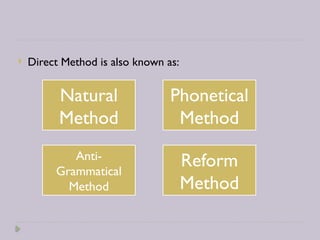
 Direct Method is also known as:
Natural
Method
Phonetical
Method
Anti-
Grammatical
Method
Reform
Method
 The Direct Method, it ’s sometimes called the Natural
Method. Not limited to but often used in teaching
foreign languages, the method refrains from using the
learners' native language and uses only the target
language.
 It ’s named “direct", because meaning should be
connected directly with the target language without
translation into the native language.
Definition:
 Direct Method is a method of teaching language directly establishing a
direct or immediate association between experience and expression,
between the English word, phrase or idiom and its meaning through
demonstration, dramatization without the use of the mother tongue.
Aims of this Method:
 Direct method aims to build a direct relation between experience and
language, word and idea, thought and expression.
 This method intends for students to learn how to communicate in the
target language.
 This method is based on the assumption that the learner should
experience the new language in the same way as he/she experienced
his/her mother tongue.
The Main Principles of Direct Method
1. Classroom instructions are conducted exclusively in the
target language.
2. Only everyday vocabulary and sentences are taught
during the initial phase; grammar, reading and writing
are introduced in intermediate phase.
3. Oral communication skills are built up in a carefully
graded progression organized around question-and-
answer exchanges between teachers and students in
small, intensive classes.
4. Grammar is taught inductively.
Students Figure Out RulesThemselves. Because we
aren’t translating for our students, we’re introducing
language in context through action and interaction. We’re
pushing students to think in English and to develop their own
understanding of the rules of the language. For example, by
hearing the teacher say “he is a student” to Ricardo, and “they
are students” to Chris and Natalia, students start learning
verb conjugations without creating diagram or having patterns
laid out for them.
5. Concrete vocabulary is taught through demonstration,
objects, and pictures; abstract vocabulary is taught by
association of ideas.
6. Both speech and listening comprehensions are taught.
7. Correct pronunciation and grammar are emphasized.
8. Student should be speaking at least 89% of the time
during the lesson.
9. Students are taught from inception to ask questions as
well as answer them.
Techniques
 Q & A:The teacher asks questions of any nature and the
students answer.
 Dictation:The teacher chooses a grade appropriate
passage and reads the text aloud.Teacher reads the
passage three times.
 Reading Aloud: Students take turn reading sections of a
passage, play or dialogue out loud.
 Map Drawing: Students are given a map without labeled
then the students label it by using the directions the
teacher gives.
 Paragraph Writing :The students are asked to write a
passage in their own words.
The teaching techniques rely mostly on
 Reading aloud,
 Question answer exercise,
 Self-correction,
 Conversation practice,
 Fill-in-the-blank exercise,
 Dictation
 Paragraph writing.
Teacher’s Role
 The role of the teacher is to direct class activities,
encourage students to participate in class and corrects
their mistakes immediately. But students and teacher are
partners in the learning process.
Students’ Role
 Students are active in repeating and imitating the teacher.
Oral communication skills are emphasized, there is a large
amount of Learner-Learner interaction.
Advantages & Disadvantages of
Direct Method
Advantages Disadvantages
Students are encourage & motivated to
use L2 spontaneously.
Lack of teachers that interested in using
DM (not many teachers creative to create
their own materials)
Its emphasis on speech made it more
attractive for those who have needs of
real communication in the target language.
DM ignores written work & reading
activities and sufficient attention is not
paid to reading & writing skills.
It make learning process interesting and
fun because DM encourage using realia
during learning process.
In large class, DM is not properly
Applied (not satisfy the needs of
individual)
Students are able to understand what
they learn.(it focus on meaning not the
rules)
DM is not suitable for public school
because it is costly (realia, visual materials)
Criticism of DM
 In spite of its achievements, the direct method fell short from
fulfilling the needs of educational systems.
 One of its major shortcomings is that it was hard for public
schools to integrate it.As R. Brown (1994:56) points out, the
Direct Method “did not take well in public schools where the
constraints of budget, classroom size, time, and teacher
background (native speakers or native like fluency) made such a
method difficult to use.”
 Direct Method was criticized for its weak theoretical foundations.
 After a short popularity in the beginning of the 20th century, it
soon began to lose its appeal because of these constraints. It then
paved the Sway to the Audio-lingual Method (US) and Situational
Language Teahing (Britain)
References
 Richard, J.C. and Rodgers,T. S. 2001. Approaches and
Methods in LanguageTeaching a Description and Analysis.
Cambridge: Cambridge University Press.
 Brown, H. Douglas. 2007. Teaching by Principles An
Interactive Approach to Language Pedagogy (3rd edition.)
NewYork: Longman.

Direct Method.pptxBBBBBBBBBBBBBBBBBBBBBBBBBB

  • 1.
  • 2.
    Brief History  Itwas established in Germany and France around 1900, and it was an answer to the dissatisfaction with the older Grammar Translation Method, which teaches students grammar and vocabulary through direct translations and thus focuses on the written language.  Direct Method views that L2 learning should be more like first lanhuage learning – lots of oral interaction, spontaneous use of the language, no translation between first and second languages, and little or no analysis of grammatical rules.  One of its main proponents was the German Maximilian Berlitz, whose schools in the form of Berlitz International exist to this day.
  • 3.
     Direct Methodis also known as: Natural Method Phonetical Method Anti- Grammatical Method Reform Method
  • 4.
     The DirectMethod, it ’s sometimes called the Natural Method. Not limited to but often used in teaching foreign languages, the method refrains from using the learners' native language and uses only the target language.  It ’s named “direct", because meaning should be connected directly with the target language without translation into the native language.
  • 5.
    Definition:  Direct Methodis a method of teaching language directly establishing a direct or immediate association between experience and expression, between the English word, phrase or idiom and its meaning through demonstration, dramatization without the use of the mother tongue. Aims of this Method:  Direct method aims to build a direct relation between experience and language, word and idea, thought and expression.  This method intends for students to learn how to communicate in the target language.  This method is based on the assumption that the learner should experience the new language in the same way as he/she experienced his/her mother tongue.
  • 6.
    The Main Principlesof Direct Method 1. Classroom instructions are conducted exclusively in the target language. 2. Only everyday vocabulary and sentences are taught during the initial phase; grammar, reading and writing are introduced in intermediate phase. 3. Oral communication skills are built up in a carefully graded progression organized around question-and- answer exchanges between teachers and students in small, intensive classes.
  • 7.
    4. Grammar istaught inductively. Students Figure Out RulesThemselves. Because we aren’t translating for our students, we’re introducing language in context through action and interaction. We’re pushing students to think in English and to develop their own understanding of the rules of the language. For example, by hearing the teacher say “he is a student” to Ricardo, and “they are students” to Chris and Natalia, students start learning verb conjugations without creating diagram or having patterns laid out for them.
  • 8.
    5. Concrete vocabularyis taught through demonstration, objects, and pictures; abstract vocabulary is taught by association of ideas. 6. Both speech and listening comprehensions are taught. 7. Correct pronunciation and grammar are emphasized. 8. Student should be speaking at least 89% of the time during the lesson. 9. Students are taught from inception to ask questions as well as answer them.
  • 9.
    Techniques  Q &A:The teacher asks questions of any nature and the students answer.  Dictation:The teacher chooses a grade appropriate passage and reads the text aloud.Teacher reads the passage three times.  Reading Aloud: Students take turn reading sections of a passage, play or dialogue out loud.
  • 10.
     Map Drawing:Students are given a map without labeled then the students label it by using the directions the teacher gives.  Paragraph Writing :The students are asked to write a passage in their own words.
  • 11.
    The teaching techniquesrely mostly on  Reading aloud,  Question answer exercise,  Self-correction,  Conversation practice,  Fill-in-the-blank exercise,  Dictation  Paragraph writing.
  • 12.
    Teacher’s Role  Therole of the teacher is to direct class activities, encourage students to participate in class and corrects their mistakes immediately. But students and teacher are partners in the learning process.
  • 13.
    Students’ Role  Studentsare active in repeating and imitating the teacher. Oral communication skills are emphasized, there is a large amount of Learner-Learner interaction.
  • 14.
    Advantages & Disadvantagesof Direct Method Advantages Disadvantages Students are encourage & motivated to use L2 spontaneously. Lack of teachers that interested in using DM (not many teachers creative to create their own materials) Its emphasis on speech made it more attractive for those who have needs of real communication in the target language. DM ignores written work & reading activities and sufficient attention is not paid to reading & writing skills. It make learning process interesting and fun because DM encourage using realia during learning process. In large class, DM is not properly Applied (not satisfy the needs of individual) Students are able to understand what they learn.(it focus on meaning not the rules) DM is not suitable for public school because it is costly (realia, visual materials)
  • 15.
    Criticism of DM In spite of its achievements, the direct method fell short from fulfilling the needs of educational systems.  One of its major shortcomings is that it was hard for public schools to integrate it.As R. Brown (1994:56) points out, the Direct Method “did not take well in public schools where the constraints of budget, classroom size, time, and teacher background (native speakers or native like fluency) made such a method difficult to use.”  Direct Method was criticized for its weak theoretical foundations.  After a short popularity in the beginning of the 20th century, it soon began to lose its appeal because of these constraints. It then paved the Sway to the Audio-lingual Method (US) and Situational Language Teahing (Britain)
  • 16.
    References  Richard, J.C.and Rodgers,T. S. 2001. Approaches and Methods in LanguageTeaching a Description and Analysis. Cambridge: Cambridge University Press.  Brown, H. Douglas. 2007. Teaching by Principles An Interactive Approach to Language Pedagogy (3rd edition.) NewYork: Longman.