By: Farah Hanum
Ikhwanna Divah
Teaching Methodology
The Grammar-Translation
Method and Direct Method
The Grammar-Translation
Method
Introduction
Background of GTM
• GTM is a traditional teaching technique that was
used to teach Latin and Greek and was
particulaly in vogue during the 16th century.
• The method dominated language teaching from
the 1840s to the 1940s (and is still being used in
some of today’s classrooms).
• The methods used at that time were mostly
designed to enable people to speak, read and
write Latin.
Objectives of GTM
• To be able to read literature written in
the target language
• To be able to translate from one
language to another
• To develop reading and writing skill
Key Features of GTM
• Native language
• Vocabulary / grammatical rules
• Accuracy /translation
• Language skills
Principles of GTM
• Grammar rules are presented and studied explicity.
Grammar is taught deductively and then practiced
through translation exercises.
• The primary skills to be developed are reading and
writing.
• Mastering the grammar of the foreign language is
essential in order for the students to understand the
written target language.
• Vocabulary is learnt from billingual word lists.
• The mother tounge is used as the medium of the
instrution.
Procedures of GTM
I.Reading
• The class begins with a reading passage from the
foreign language literature.
• Each student is called upon to read a few lines from the
passage, then they translate into their mother tongue the
few lines they have just read. The teacher helps them
with suitable translations in case the lack the required
vocabulary.
• After finishing reading and translating the passage, the
teacher asks them in their mother tongue if they have
any questions. Questions and answers are
communicated using the mother tongue
II. Vocabulary
• Students turn to a list of words taken from the passage,
and are asked to give the mother tongue equivalent for
each one of them. This is conducted as a whole class
activity. If no one knows the equivalent of a certain word,
the teacher provides it.
• Students are given another list of words from the
passage and are asked to provide the opposites of these
words (antonyms).
• The same procedure is repeated with words that look the
same in English and Arabic (cognates). Students are
asked to search the passage for examples of cognates
and to translate them into their mother tongue.
III. Grammar
• The teacher reads a list of two-word verbs (phrasal
verbs). He begins with phrasal verbs that are familiar to
them, then moves to new phrasal verbs in the passage.
• Students are asked to translate them into their mother
tongue.
• Then, they are given the rule of a direct object with two-
word verbs (separable vs. inseparable phrasal verbs).
• After reading over the rule and examples, students are
asked to tell which of the following two-word verbs are
separable and which inseparable= all these verbs are
taken from the passage.
• They are asked to fill in the blanks with one of these
phrasal verbs.
Techniques
• Translation of literary passages.
• Reading comprehension questions
• Antonyms/ synonyms
• Cognates
• Deductive application of grammatical rules
• Fill in the blanks
• Memorization (of grammar and vocabulary)
• Use words in sentences
• Composition writing
Advantages of GTM
• An effective way for application of
grammar and sentence structure
• Few demands on teachers
• Least stressful for students
Disadvantage of GTM
• Wrong idea of what language is
• Less learners’ motivation
• Create frustration for learners
The Direct Method
Introduction
Background of DM
• DM also known as the ‘oral‘ or ‘natural‘
method, originated around the 1900s as an
alternative to the traditional grammatical
translation method.
• The focus is on good pronunciation, with
spontaneous use of the language, no
translation, and little grammar analysis.
• The Direct Method is based on the direct
involvement of the student when speaking,
and listening to, the foreign language in
common everyday situations.
Rationale of DM
• First language learning process
(1) No grammar
(2) No mother tongue
(3) No translation
(4) Postponement of printed word
(5) Postponement of written word
Key Features of DM
• Target language
• Vocabulary / grammar
• Teaching point
• Language skills
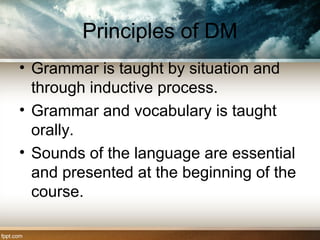
Principles of DM
• Grammar is taught by situation and
through inductive process.
• Grammar and vocabulary is taught
orally.
• Sounds of the language are essential
and presented at the beginning of the
course.
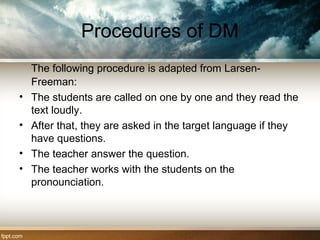
Procedures of DM
The following procedure is adapted from Larsen-
Freeman:
• The students are called on one by one and they read the
text loudly.
• After that, they are asked in the target language if they
have questions.
• The teacher answer the question.
• The teacher works with the students on the
pronounciation.
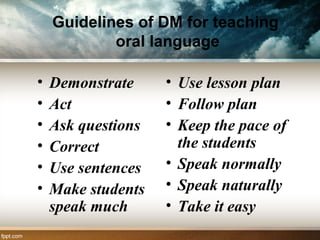
Guidelines of DM for teaching
oral language
• Demonstrate
• Act
• Ask questions
• Correct
• Use sentences
• Make students
speak much
• Use lesson plan
• Follow plan
• Keep the pace of
the students
• Speak normally
• Speak naturally
• Take it easy
Advantages of DM
• An effective way in creating
learners to be competent in using
the target communicatively.
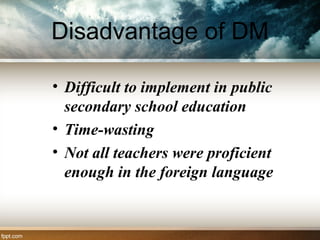
Disadvantage of DM
• Difficult to implement in public
secondary school education
• Time-wasting
• Not all teachers were proficient
enough in the foreign language
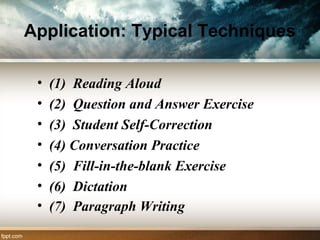
Application: Typical Techniques
• (1) Reading Aloud
• (2) Question and Answer Exercise
• (3) Student Self-Correction
• (4) Conversation Practice
• (5) Fill-in-the-blank Exercise
• (6) Dictation
• (7) Paragraph Writing
Thank You 

DIRECT METHOD AND TRNASLATION METHOD

  • 1.
    By: Farah Hanum IkhwannaDivah Teaching Methodology The Grammar-Translation Method and Direct Method
  • 2.
  • 3.
    Background of GTM •GTM is a traditional teaching technique that was used to teach Latin and Greek and was particulaly in vogue during the 16th century. • The method dominated language teaching from the 1840s to the 1940s (and is still being used in some of today’s classrooms). • The methods used at that time were mostly designed to enable people to speak, read and write Latin.
  • 4.
    Objectives of GTM •To be able to read literature written in the target language • To be able to translate from one language to another • To develop reading and writing skill
  • 5.
    Key Features ofGTM • Native language • Vocabulary / grammatical rules • Accuracy /translation • Language skills
  • 6.
    Principles of GTM •Grammar rules are presented and studied explicity. Grammar is taught deductively and then practiced through translation exercises. • The primary skills to be developed are reading and writing. • Mastering the grammar of the foreign language is essential in order for the students to understand the written target language. • Vocabulary is learnt from billingual word lists. • The mother tounge is used as the medium of the instrution.
  • 7.
    Procedures of GTM I.Reading •The class begins with a reading passage from the foreign language literature. • Each student is called upon to read a few lines from the passage, then they translate into their mother tongue the few lines they have just read. The teacher helps them with suitable translations in case the lack the required vocabulary. • After finishing reading and translating the passage, the teacher asks them in their mother tongue if they have any questions. Questions and answers are communicated using the mother tongue
  • 8.
    II. Vocabulary • Studentsturn to a list of words taken from the passage, and are asked to give the mother tongue equivalent for each one of them. This is conducted as a whole class activity. If no one knows the equivalent of a certain word, the teacher provides it. • Students are given another list of words from the passage and are asked to provide the opposites of these words (antonyms). • The same procedure is repeated with words that look the same in English and Arabic (cognates). Students are asked to search the passage for examples of cognates and to translate them into their mother tongue.
  • 9.
    III. Grammar • Theteacher reads a list of two-word verbs (phrasal verbs). He begins with phrasal verbs that are familiar to them, then moves to new phrasal verbs in the passage. • Students are asked to translate them into their mother tongue. • Then, they are given the rule of a direct object with two- word verbs (separable vs. inseparable phrasal verbs). • After reading over the rule and examples, students are asked to tell which of the following two-word verbs are separable and which inseparable= all these verbs are taken from the passage. • They are asked to fill in the blanks with one of these phrasal verbs.
  • 10.
    Techniques • Translation ofliterary passages. • Reading comprehension questions • Antonyms/ synonyms • Cognates • Deductive application of grammatical rules • Fill in the blanks • Memorization (of grammar and vocabulary) • Use words in sentences • Composition writing
  • 11.
    Advantages of GTM •An effective way for application of grammar and sentence structure • Few demands on teachers • Least stressful for students
  • 12.
    Disadvantage of GTM •Wrong idea of what language is • Less learners’ motivation • Create frustration for learners
  • 13.
  • 14.
    Background of DM •DM also known as the ‘oral‘ or ‘natural‘ method, originated around the 1900s as an alternative to the traditional grammatical translation method. • The focus is on good pronunciation, with spontaneous use of the language, no translation, and little grammar analysis. • The Direct Method is based on the direct involvement of the student when speaking, and listening to, the foreign language in common everyday situations.
  • 15.
    Rationale of DM •First language learning process (1) No grammar (2) No mother tongue (3) No translation (4) Postponement of printed word (5) Postponement of written word
  • 16.
    Key Features ofDM • Target language • Vocabulary / grammar • Teaching point • Language skills
  • 17.
    Principles of DM •Grammar is taught by situation and through inductive process. • Grammar and vocabulary is taught orally. • Sounds of the language are essential and presented at the beginning of the course.
  • 18.
    Procedures of DM Thefollowing procedure is adapted from Larsen- Freeman: • The students are called on one by one and they read the text loudly. • After that, they are asked in the target language if they have questions. • The teacher answer the question. • The teacher works with the students on the pronounciation.
  • 19.
    Guidelines of DMfor teaching oral language • Demonstrate • Act • Ask questions • Correct • Use sentences • Make students speak much • Use lesson plan • Follow plan • Keep the pace of the students • Speak normally • Speak naturally • Take it easy
  • 20.
    Advantages of DM •An effective way in creating learners to be competent in using the target communicatively.
  • 21.
    Disadvantage of DM •Difficult to implement in public secondary school education • Time-wasting • Not all teachers were proficient enough in the foreign language
  • 22.
    Application: Typical Techniques •(1) Reading Aloud • (2) Question and Answer Exercise • (3) Student Self-Correction • (4) Conversation Practice • (5) Fill-in-the-blank Exercise • (6) Dictation • (7) Paragraph Writing
  • 23.