Audio 
Lingual 
Method 
Presented To: 
Ms. Saima Umar 
Presented By: 
Haseeb 
M 3rd 
M.A A NUML 
Eng
Historical Background: 
• Audio Lingual Method (ALM) is 
the method that was introduced in 
the United States in the 1940’s. 
• This method is accepted by the 
people of other countries and was 
introduced in Indonesia in the 
1960’s.
• Not a lot of Literature in audio 
lingual method, and most of the 
ideas in this section is adapted 
from how to teach foreign 
languages e ffectively.
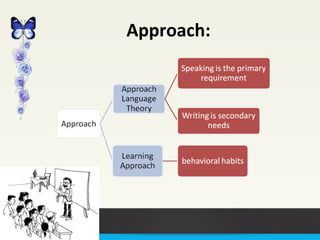
Approach:
Definition: 
• The method of teaching 
foreign language in terms of 
speaking and listening. 
• It is similar to direct method & 
also known as AURALORAL 
APPROACH.
In Practice: 
• It focuses on correct imitation of 
teacher by the students. 
• To get correct output, one 
needs(either teacher or students) 
correct pronunciation. 
• Target language, the only language 
to be used in the classroom.
Fall From Popularity: 
• In 1950’s theoretical Support of ALM 
were questioned by Noams 
Chomsky. 
• Losing its popularity because many 
linguistics believe it is marked of 
scientific techniques.
Key Features: 
• It is need based method. 
• Situation based grammar & 
vocabulary is stressed. 
• Little or no grammar is explained in 
specific situation.
• Use of audio visual aids is 
present. 
• Great importance is laid on 
pronunciation.
Strategies using ALM: 
• Dialogue Memorization: 
–Short conversation between two 
or more people. 
–Students memorize when dialogue 
plays.
Backward Build up (expansion) drill: 
• Introduced by Larsen Freeman in 
1986. 
• Main purpose  divide into small 
junks. 
• Line breakup into several parts. 
• Easily understandable.
Transformation Drill: 
• Change the form method. 
• Active  Passive 
• Direct  Indirect
Chain drill: 
• It only talks about one 
topic. 
• It remains around only one 
thing.
Single Slot Substitution Drill: 
• Fill in the blanks method in single 
sentences. 
• Students have to substitute the 
clue given by teacher.
Multiple Slot substitute drill: 
•Same as single slot drill. 
•More than one slots or 
blank places.
Question & Answer drill: 
• Question answer base. 
• Teacher asks a question & students 
have to answer very quickly in target 
language. 
• Students are able to use the target 
language.
Use of minimal pairs: 
• Pair of words. 
• Teacher should stress on those 
words having same 
pronunciation or same 
spelling.
Situation in Pakistan: 
• This method is applying in some 
institutes in Pakistan. Some 
institutes having high standard 
syllabus using this method to 
memorize their students lessons at it 
initial stages.
• Some institutes which are helping 
their students to improve their 
speaking skills in English Language 
are also using this method. 
• “A good listener is a good 
speaker”
Advantages: 
• Speaking & listening skills are 
improved. 
• It follows modern trends regarding 
L2 learning. 
• ALM falls in the category of ESP 
(English For Specific People) which is 
a key issue at present in language.
Disadvantages: 
• Reading & writing skills are 
completely ignored. 
• Language is taught without rules but 
mastering language is rule based. 
• It works in one context not I all 
contexts.
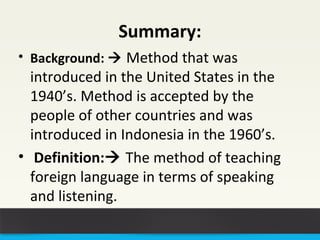
Summary: 
• Background:  Method that was 
introduced in the United States in the 
1940’s. Method is accepted by the 
people of other countries and was 
introduced in Indonesia in the 1960’s. 
• Definition: The method of teaching 
foreign language in terms of speaking 
and listening.
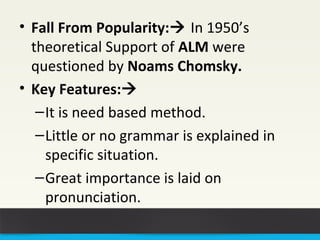
• Fall From Popularity: In 1950’s 
theoretical Support of ALM were 
questioned by Noams Chomsky. 
• Key Features: 
–It is need based method. 
–Little or no grammar is explained in 
specific situation. 
–Great importance is laid on 
pronunciation.
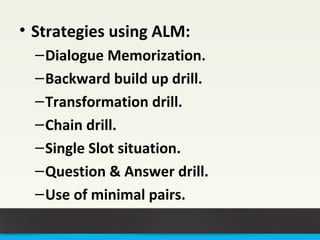
• Strategies using ALM: 
–Dialogue Memorization. 
–Backward build up drill. 
–Transformation drill. 
–Chain drill. 
–Single Slot situation. 
–Question & Answer drill. 
–Use of minimal pairs.
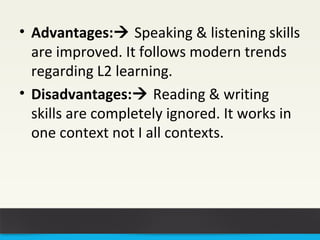
• Advantages: Speaking & listening skills 
are improved. It follows modern trends 
regarding L2 learning. 
• Disadvantages: Reading & writing 
skills are completely ignored. It works in 
one context not I all contexts.
Conclusion: 
• Keeping in mind the above discussion 
regarding the importance and drawbacks 
of ALM. We can safely say that no 
method of teaching a target language is 
absolute rather contextual. A teacher 
can easily maximum advantages from 
handling ALM.
THANK YOU

Alm final

  • 2.
    Audio Lingual Method Presented To: Ms. Saima Umar Presented By: Haseeb M 3rd M.A A NUML Eng
  • 3.
    Historical Background: •Audio Lingual Method (ALM) is the method that was introduced in the United States in the 1940’s. • This method is accepted by the people of other countries and was introduced in Indonesia in the 1960’s.
  • 4.
    • Not alot of Literature in audio lingual method, and most of the ideas in this section is adapted from how to teach foreign languages e ffectively.
  • 5.
  • 6.
    Definition: • Themethod of teaching foreign language in terms of speaking and listening. • It is similar to direct method & also known as AURALORAL APPROACH.
  • 7.
    In Practice: •It focuses on correct imitation of teacher by the students. • To get correct output, one needs(either teacher or students) correct pronunciation. • Target language, the only language to be used in the classroom.
  • 8.
    Fall From Popularity: • In 1950’s theoretical Support of ALM were questioned by Noams Chomsky. • Losing its popularity because many linguistics believe it is marked of scientific techniques.
  • 9.
    Key Features: •It is need based method. • Situation based grammar & vocabulary is stressed. • Little or no grammar is explained in specific situation.
  • 10.
    • Use ofaudio visual aids is present. • Great importance is laid on pronunciation.
  • 11.
    Strategies using ALM: • Dialogue Memorization: –Short conversation between two or more people. –Students memorize when dialogue plays.
  • 12.
    Backward Build up(expansion) drill: • Introduced by Larsen Freeman in 1986. • Main purpose  divide into small junks. • Line breakup into several parts. • Easily understandable.
  • 13.
    Transformation Drill: •Change the form method. • Active  Passive • Direct  Indirect
  • 14.
    Chain drill: •It only talks about one topic. • It remains around only one thing.
  • 15.
    Single Slot SubstitutionDrill: • Fill in the blanks method in single sentences. • Students have to substitute the clue given by teacher.
  • 16.
    Multiple Slot substitutedrill: •Same as single slot drill. •More than one slots or blank places.
  • 17.
    Question & Answerdrill: • Question answer base. • Teacher asks a question & students have to answer very quickly in target language. • Students are able to use the target language.
  • 18.
    Use of minimalpairs: • Pair of words. • Teacher should stress on those words having same pronunciation or same spelling.
  • 19.
    Situation in Pakistan: • This method is applying in some institutes in Pakistan. Some institutes having high standard syllabus using this method to memorize their students lessons at it initial stages.
  • 20.
    • Some instituteswhich are helping their students to improve their speaking skills in English Language are also using this method. • “A good listener is a good speaker”
  • 21.
    Advantages: • Speaking& listening skills are improved. • It follows modern trends regarding L2 learning. • ALM falls in the category of ESP (English For Specific People) which is a key issue at present in language.
  • 22.
    Disadvantages: • Reading& writing skills are completely ignored. • Language is taught without rules but mastering language is rule based. • It works in one context not I all contexts.
  • 23.
    Summary: • Background: Method that was introduced in the United States in the 1940’s. Method is accepted by the people of other countries and was introduced in Indonesia in the 1960’s. • Definition: The method of teaching foreign language in terms of speaking and listening.
  • 24.
    • Fall FromPopularity: In 1950’s theoretical Support of ALM were questioned by Noams Chomsky. • Key Features: –It is need based method. –Little or no grammar is explained in specific situation. –Great importance is laid on pronunciation.
  • 25.
    • Strategies usingALM: –Dialogue Memorization. –Backward build up drill. –Transformation drill. –Chain drill. –Single Slot situation. –Question & Answer drill. –Use of minimal pairs.
  • 26.
    • Advantages: Speaking& listening skills are improved. It follows modern trends regarding L2 learning. • Disadvantages: Reading & writing skills are completely ignored. It works in one context not I all contexts.
  • 27.
    Conclusion: • Keepingin mind the above discussion regarding the importance and drawbacks of ALM. We can safely say that no method of teaching a target language is absolute rather contextual. A teacher can easily maximum advantages from handling ALM.
  • 29.