ENGLISH DIPHTHONGS
For this lesson it will undertake the definition of diphthongs, closing
diphthongs, centering diphthongs
DIPTHONG
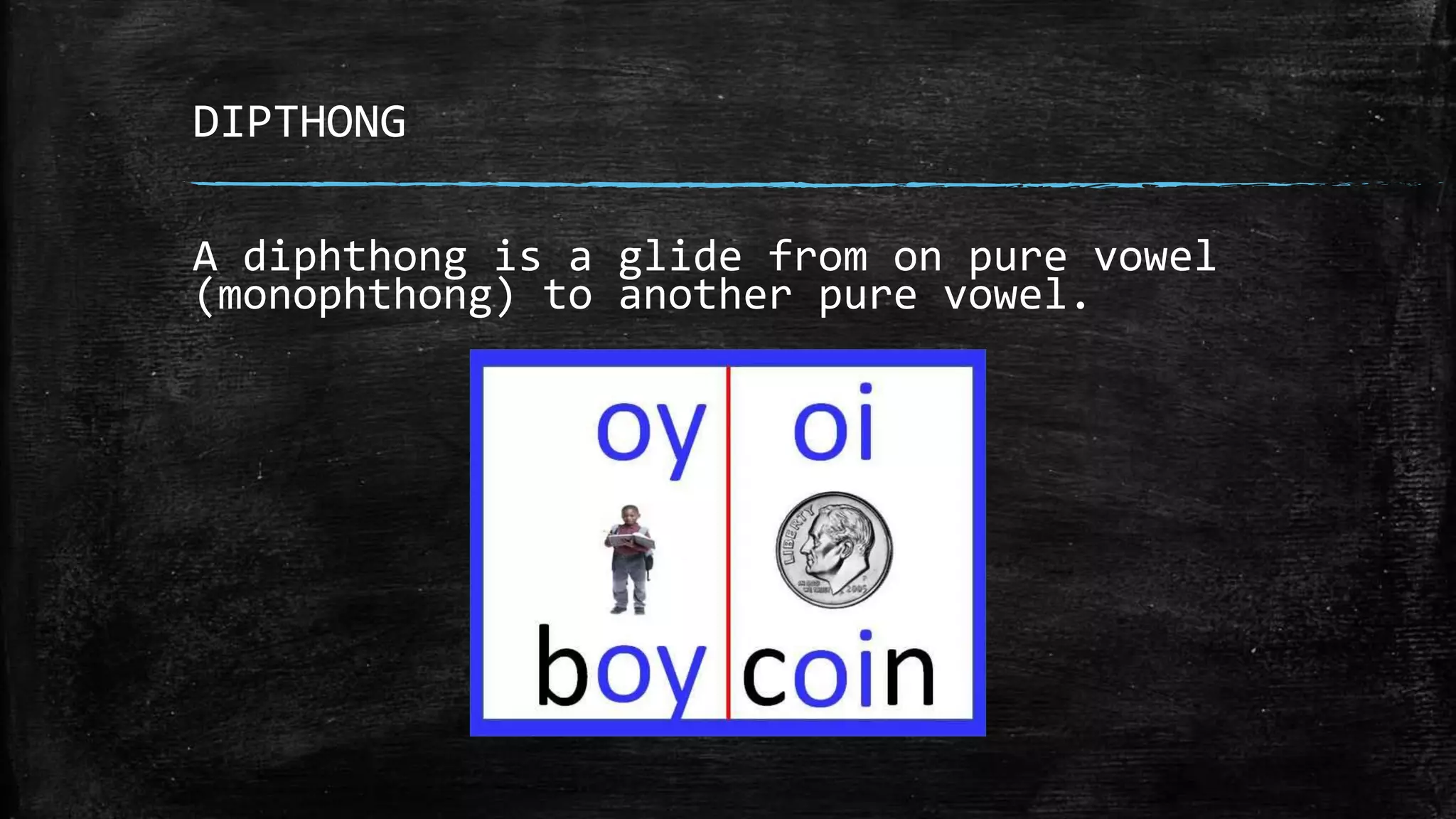
A diphthong is a glide from on pure vowel
(monophthong) to another pure vowel.
O b j e c t i v e s
By the end of this lesson, you should
be able to identify and describe the
English diphthongs.
CLOSING DIPHTHONGS
These diphthongs are initiated by five
pure vowels, namely: /e ə æ ɑ ɔ/. They
glide or move towards two hosting pure
vowels, namely: /ɪ ʊ/, which happen to
be closing vowels. This is why these two
sets of pure vowels have given “birth”
to these closing diphthongs.
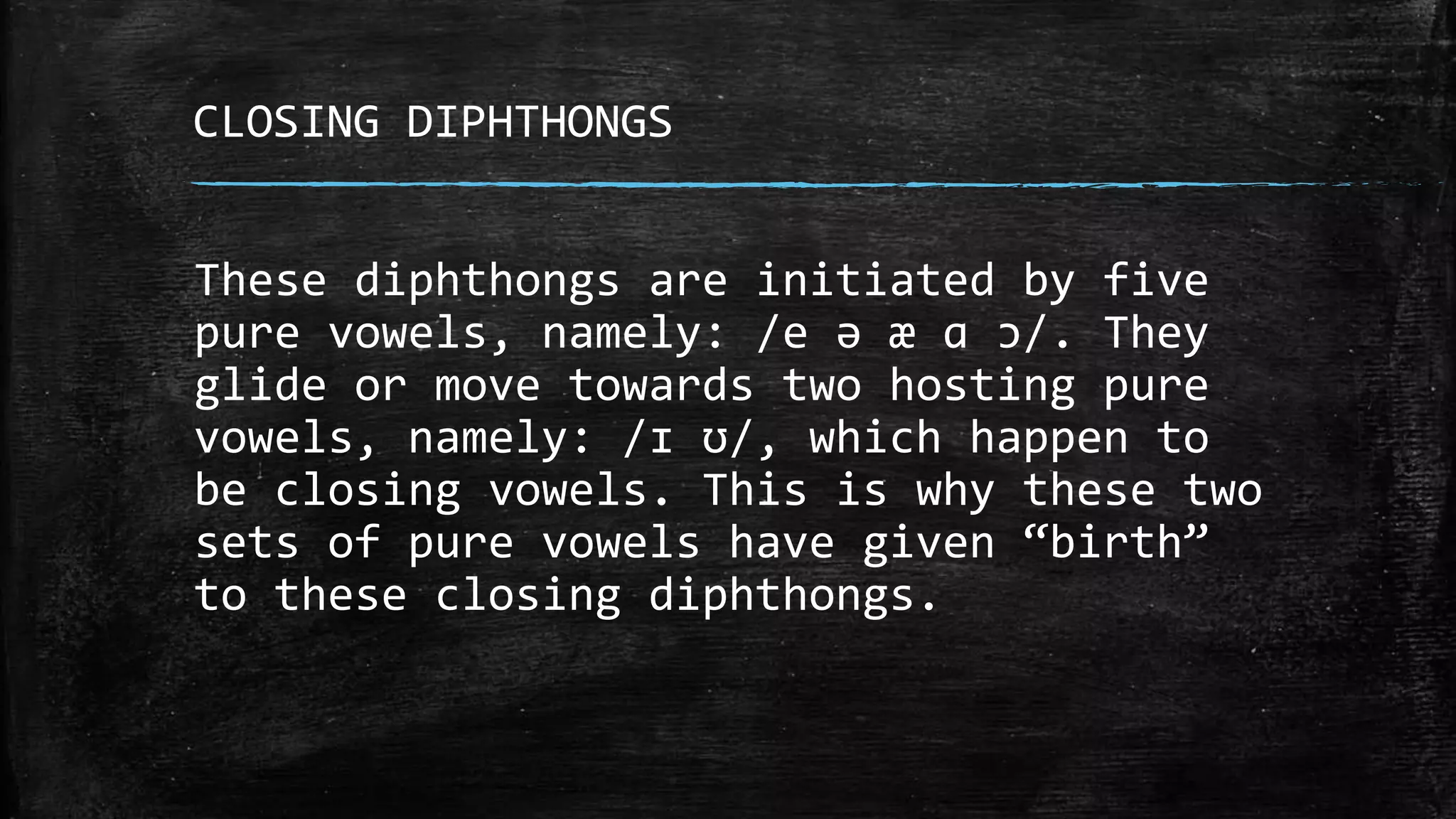
/eɪ/As the diphthong trapezium shows a glide that is initiated
around the half-close region of the mouth ends up at a region around
the close/back of the mouth. A glide such as this gives rise to the
closing diphthong above. It appears as:
a in: late, Kate, day
/eɪ/As the diphthong trapezium shows a glide that is initiated
around the half-close region of the mouth ends up at a region around
the close/back of the mouth. A glide such as this gives rise to the
closing diphthong above. It appears as:
ai in: rain, fail, wait
/eɪ/As the diphthong trapezium shows a glide that is initiated
around the half-close region of the mouth ends up at a region around
the close/back of the mouth. A glide such as this gives rise to the
closing diphthong above. It appears as:
ei in: eight, weight, rein
/eɪ/As the diphthong trapezium shows a glide that is initiated
around the half-close region of the mouth ends up at a region around
the close/back of the mouth. A glide such as this gives rise to the
closing diphthong above. It appears as:
ea in: great, break, steak
/əʊ/Like /eɪ/, this diphthong moves from the half-
close position to the close and back region. It appears as:
o in: sow, oh, both
/əʊ/Like /eɪ/, this diphthong moves from the half-
close position to the close and back region. It appears as:
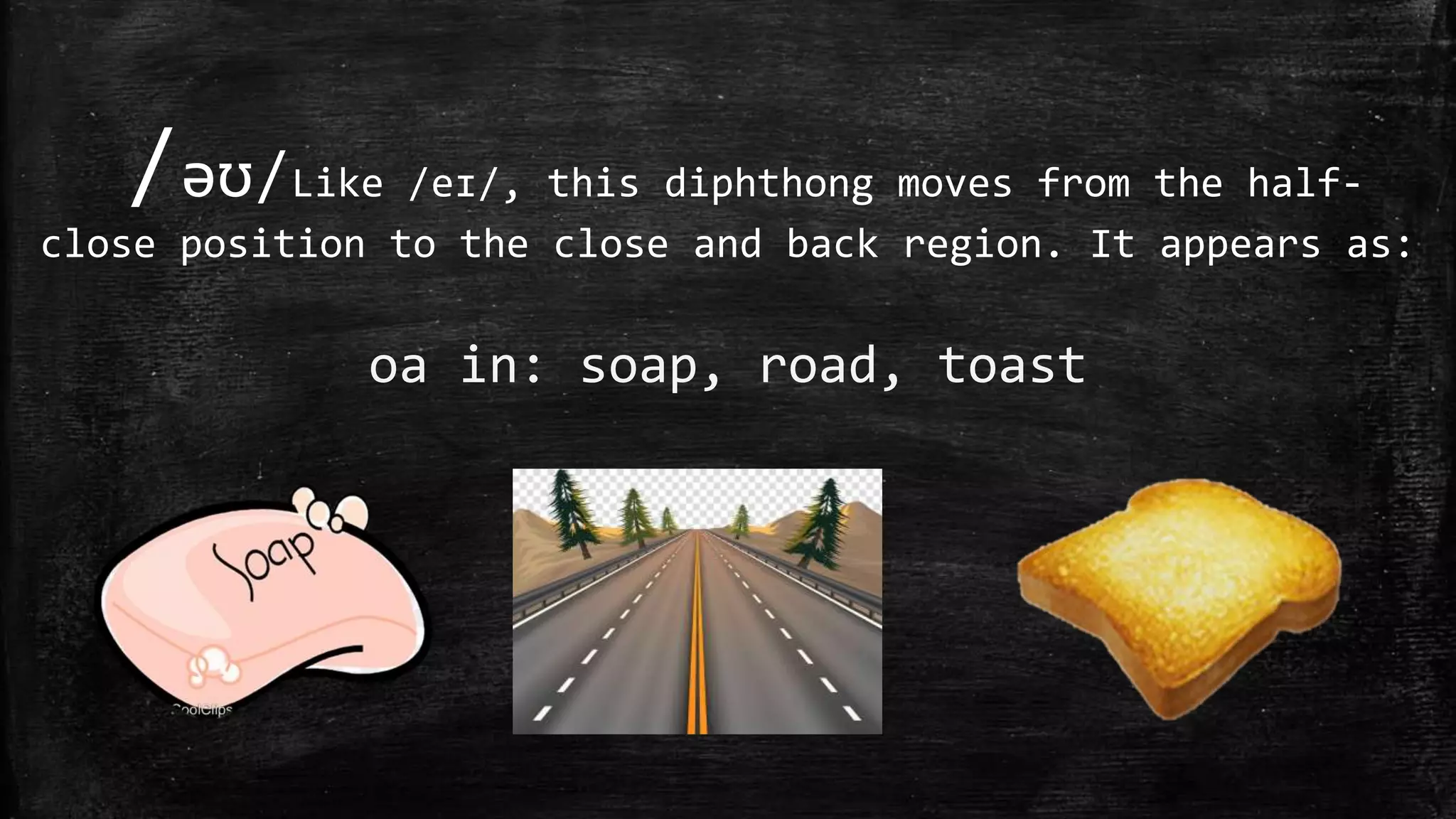
oa in: soap, road, toast
/əʊ/Like /eɪ/, this diphthong moves from the half-
close position to the close and back region. It appears as:
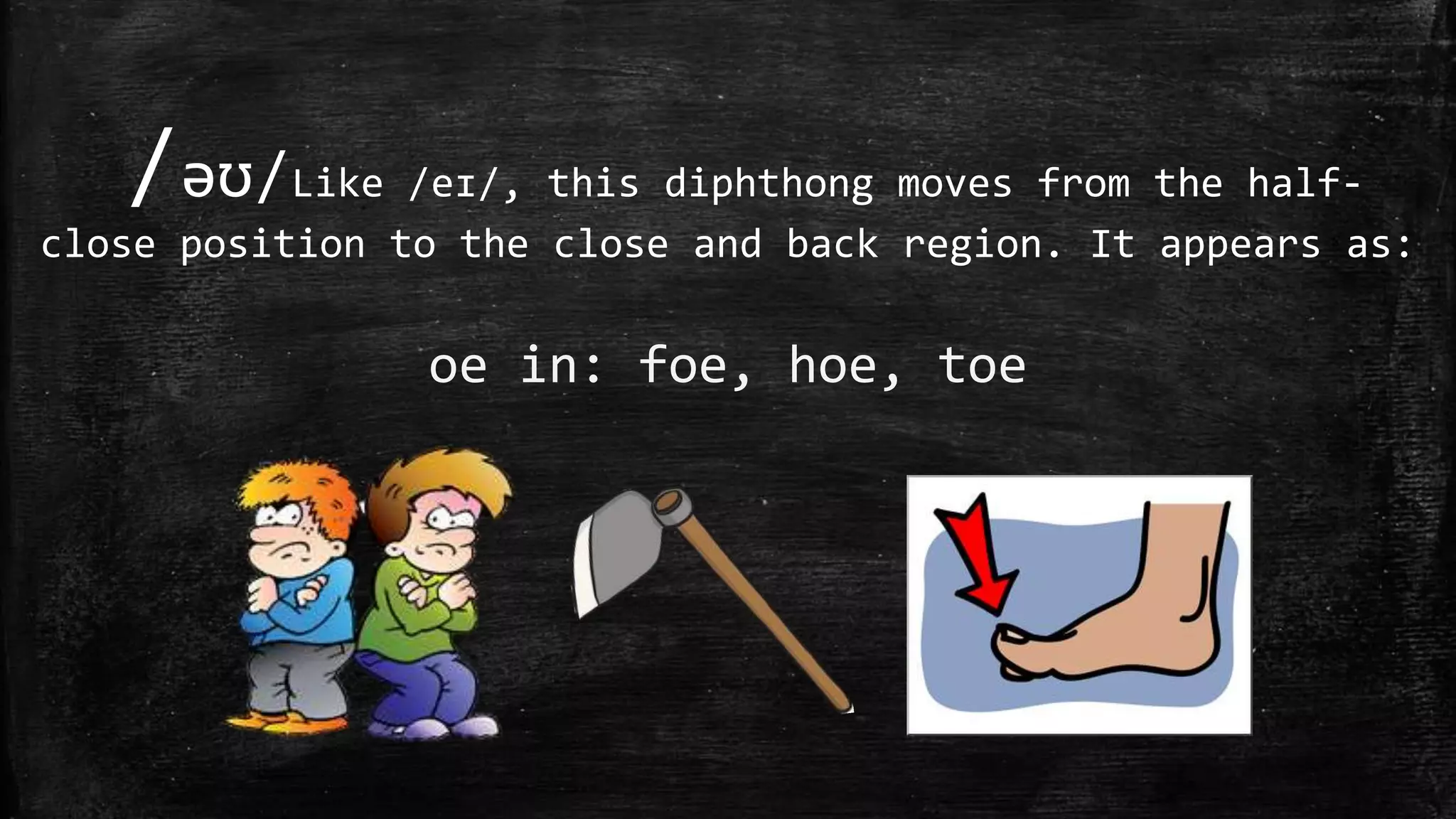
oe in: foe, hoe, toe
/əʊ/Like /eɪ/, this diphthong moves from the half-
close position to the close and back region. It appears as:
ou in: soul, though, shoulder
/ɑɪ/This diphthong glides from a front open position near vowel
No. 4, /æ/, as indicated in the trapezium, to the front close region
where we have the hosting pure vowel no. 2, /ɪ/. Some varieties of the
diphthong extend till the front back of the mouth. It appears as:
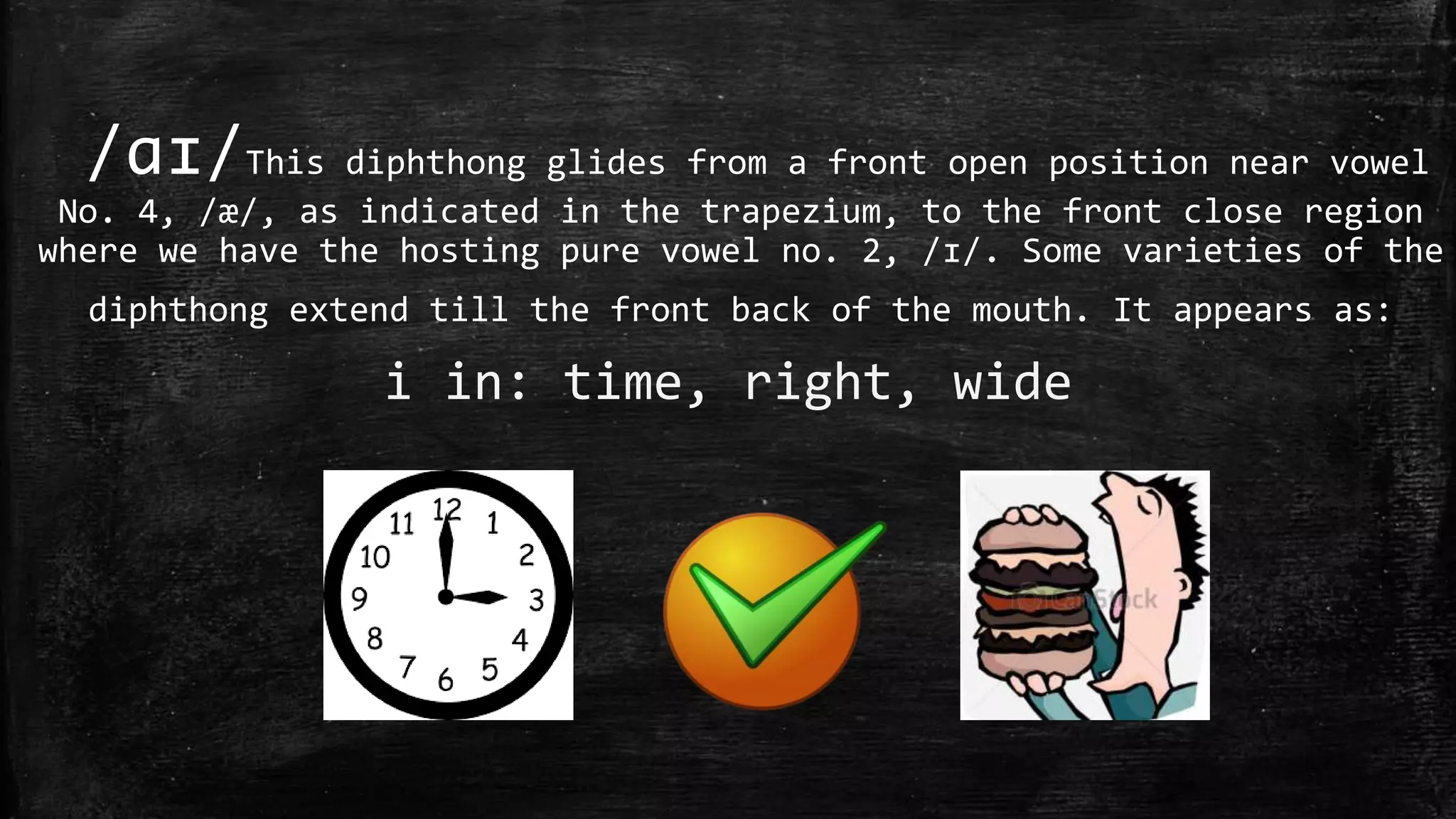
i in: time, right, wide
/ɑɪ/This diphthong glides from a front open position near vowel
No. 4, /æ/, as indicated in the trapezium, to the front close region
where we have the hosting pure vowel no. 2, /ɪ/. Some varieties of the
diphthong extend till the front back of the mouth. It appears as:
y in: dry, why, by
/ɑɪ/This diphthong glides from a front open position near vowel
No. 4, /æ/, as indicated in the trapezium, to the front close region
where we have the hosting pure vowel no. 2, /ɪ/. Some varieties of the
diphthong extend till the front back of the mouth. It appears as:
ie, ye in: lie, die, pie
/ɑɪ/This diphthong glides from a front open position near vowel
No. 4, /æ/, as indicated in the trapezium, to the front close region
where we have the hosting pure vowel no. 2, /ɪ/. Some varieties of the
diphthong extend till the front back of the mouth. It appears as:
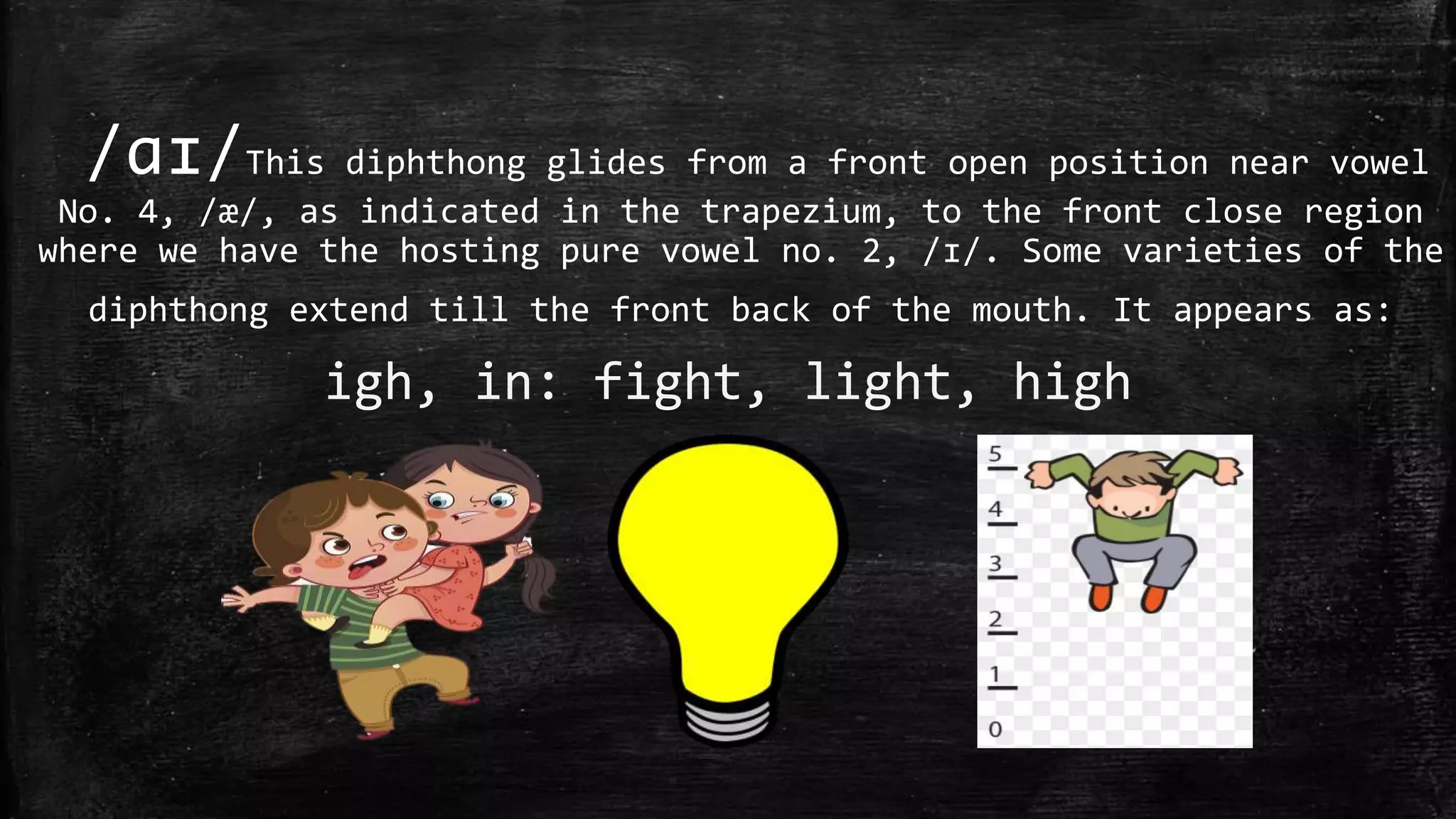
igh, in: fight, light, high
/ɑɪ/This diphthong glides from a front open position near vowel
No. 4, /æ/, as indicated in the trapezium, to the front close region
where we have the hosting pure vowel no. 2, /ɪ/. Some varieties of the
diphthong extend till the front back of the mouth. It appears as:
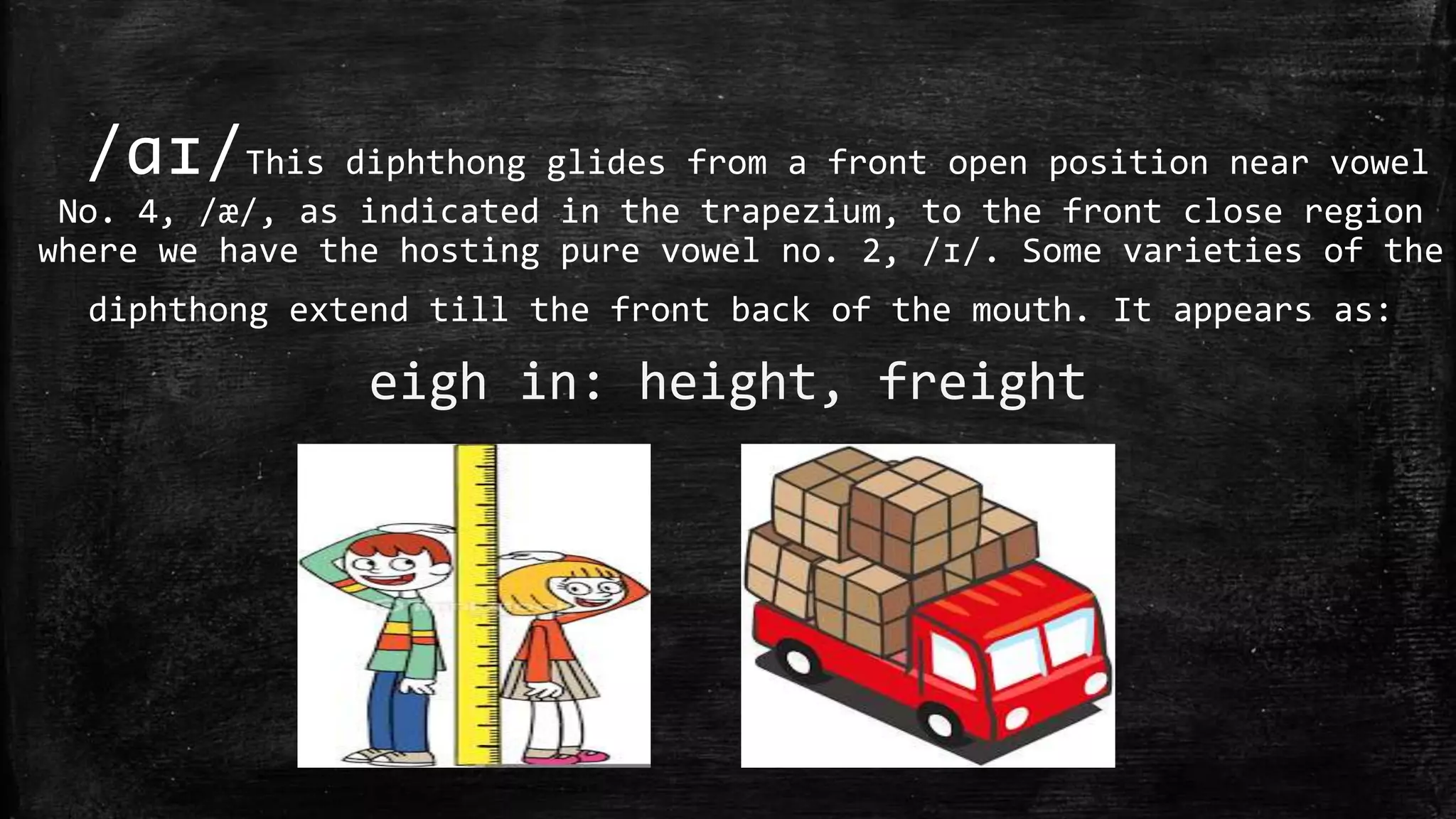
eigh in: height, freight
/ɑɪ/This diphthong glides from a front open position near vowel
No. 4, /æ/, as indicated in the trapezium, to the front close region
where we have the hosting pure vowel no. 2, /ɪ/. Some varieties of the
diphthong extend till the front back of the mouth. It appears as:
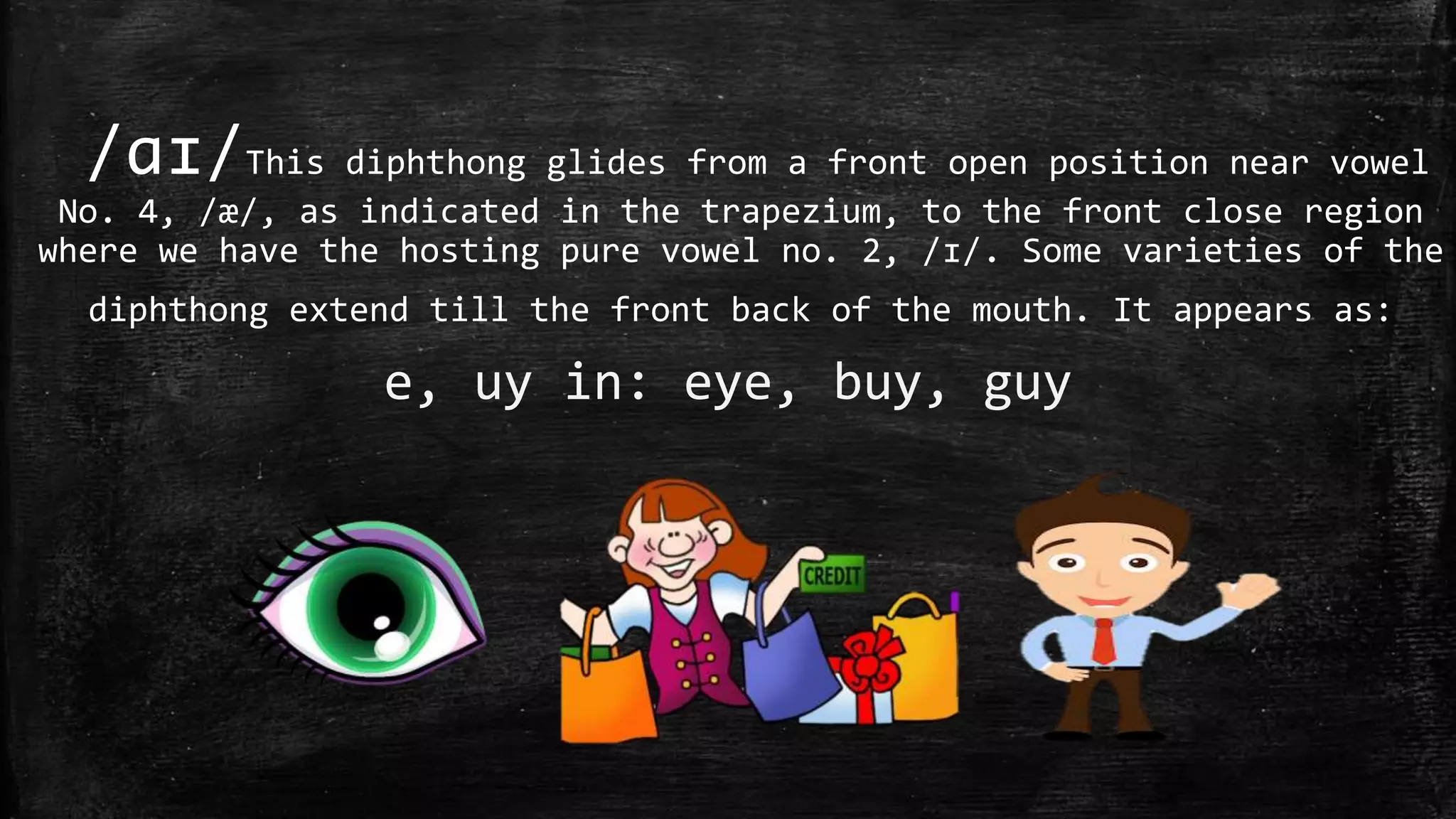
e, uy in: eye, buy, guy
/ɑɪ/This diphthong glides from a front open position near vowel
No. 4, /æ/, as indicated in the trapezium, to the front close region
where we have the hosting pure vowel no. 2, /ɪ/. Some varieties of the
diphthong extend till the front back of the mouth. It appears as:
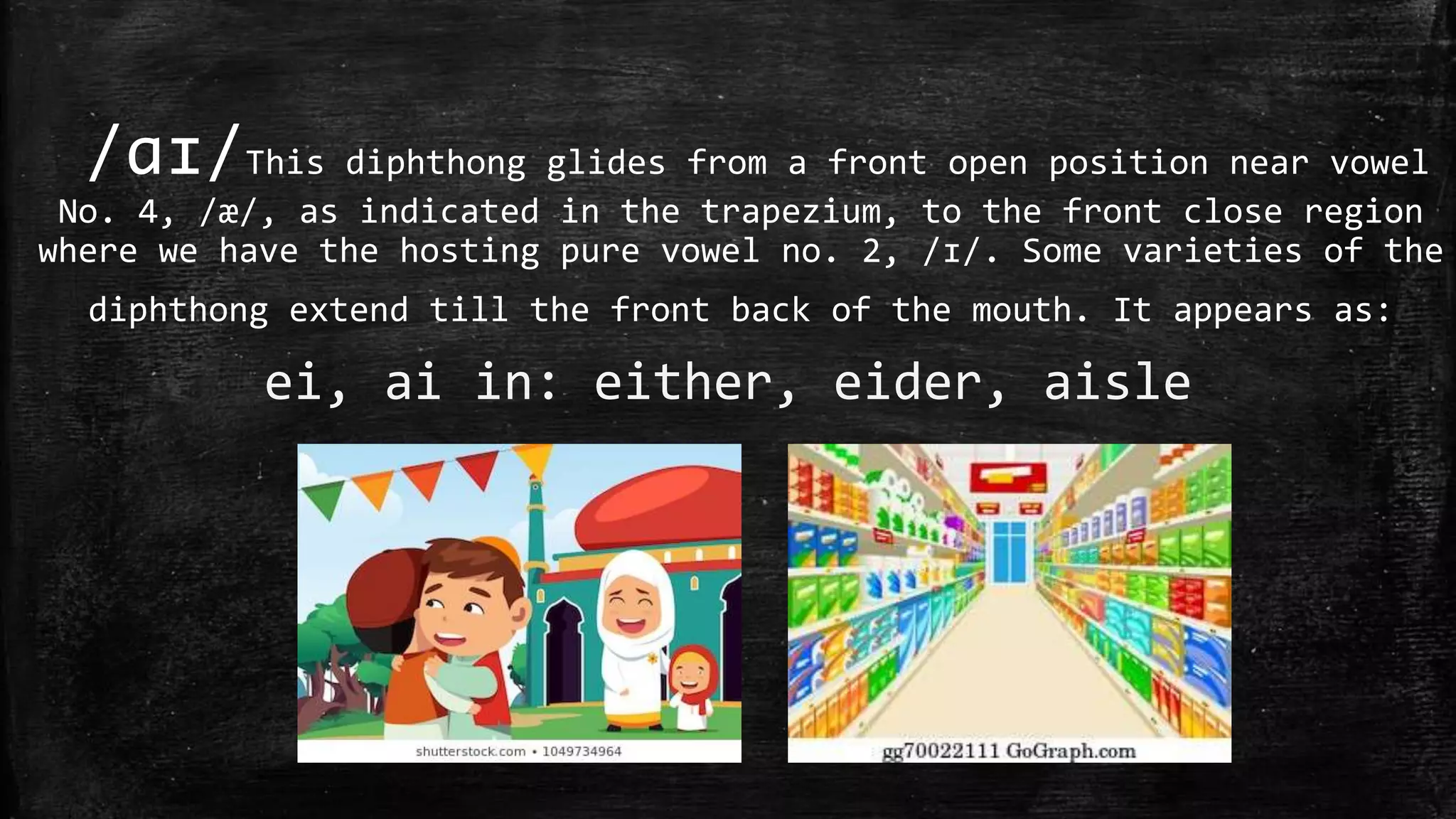
ei, ai in: either, eider, aisle
/ɑʊ/ This is a counterpart to /ɑɪ/ but its host to which it
glides resides at the back close region. It appears as:
Ou, in: house, sound, bough, plough
/ɑʊ/ This is a counterpart to /ɑɪ/ but its host to which it
glides resides at the back close region. It appears as:
ow, in: now, cow, how
/ɔɪ/ This diphthong glides from the back open region to the
front close region. it appears as:
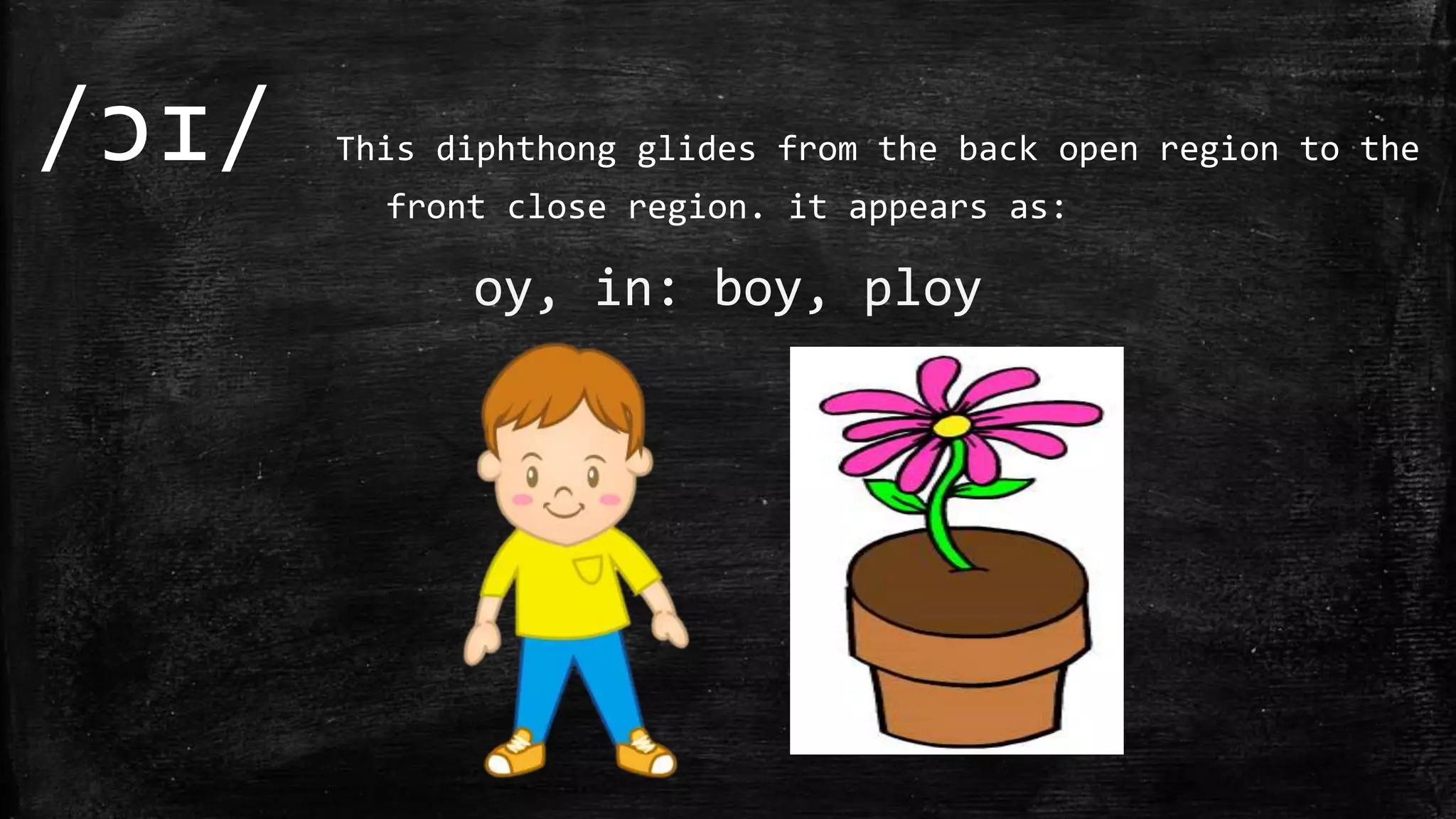
oy, in: boy, ploy
/ɔɪ/ This diphthong glides from the back open region to the
front close region. it appears as:
oi, in: noise, choice, point
/ɔɪ/ This diphthong glides from the back open region to the
front close region. it appears as:
uo, in: buoy
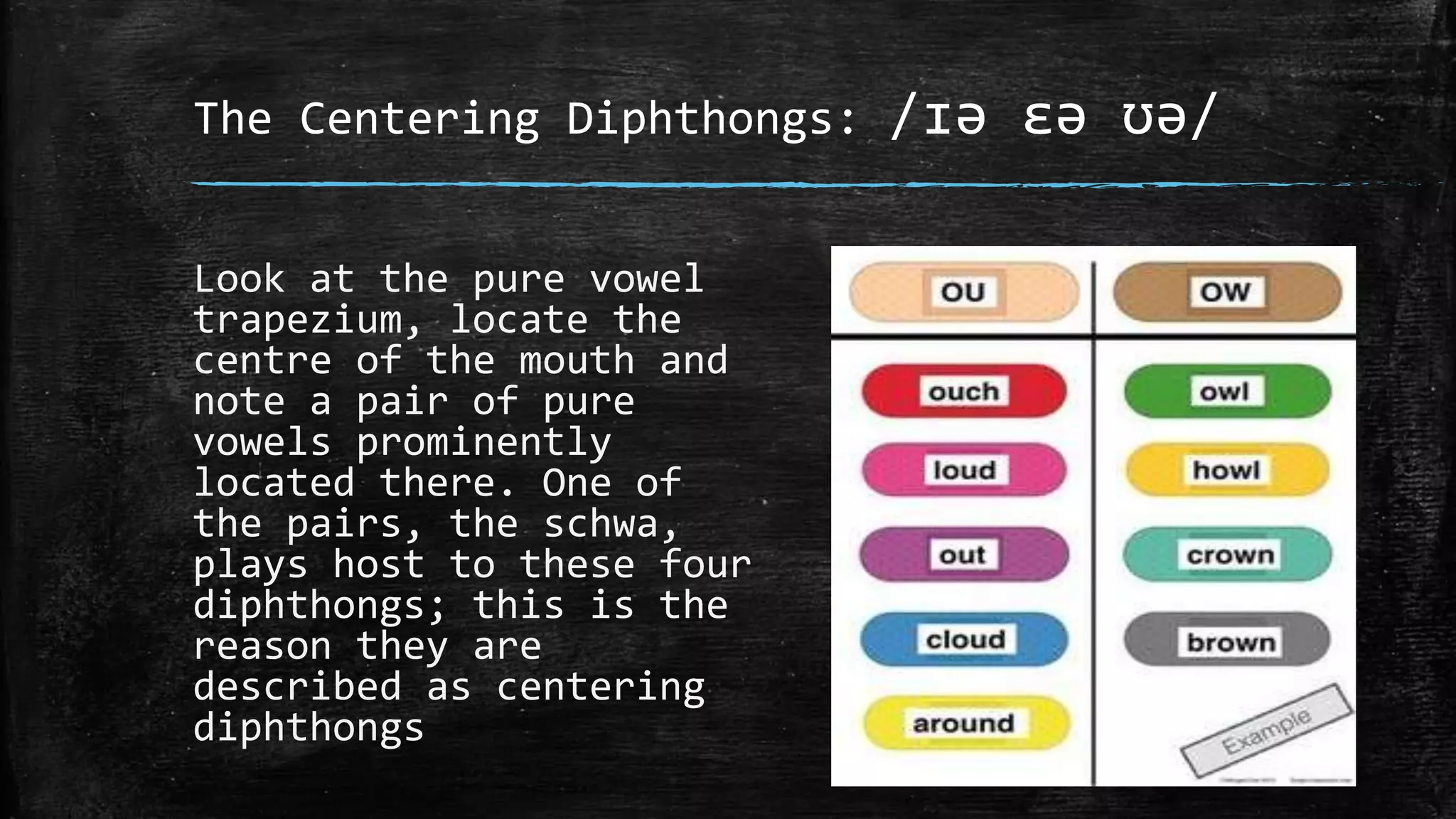
The Centering Diphthongs: /ɪə ɛə ʊə/
Look at the pure vowel
trapezium, locate the
centre of the mouth and
note a pair of pure
vowels prominently
located there. One of
the pairs, the schwa,
plays host to these four
diphthongs; this is the
reason they are
described as centering
diphthongs
/ɪə/This is a centring diphthong initiated from the
front close region. It appears as:
ee, ere, ea, in: deer, dear, here, tear
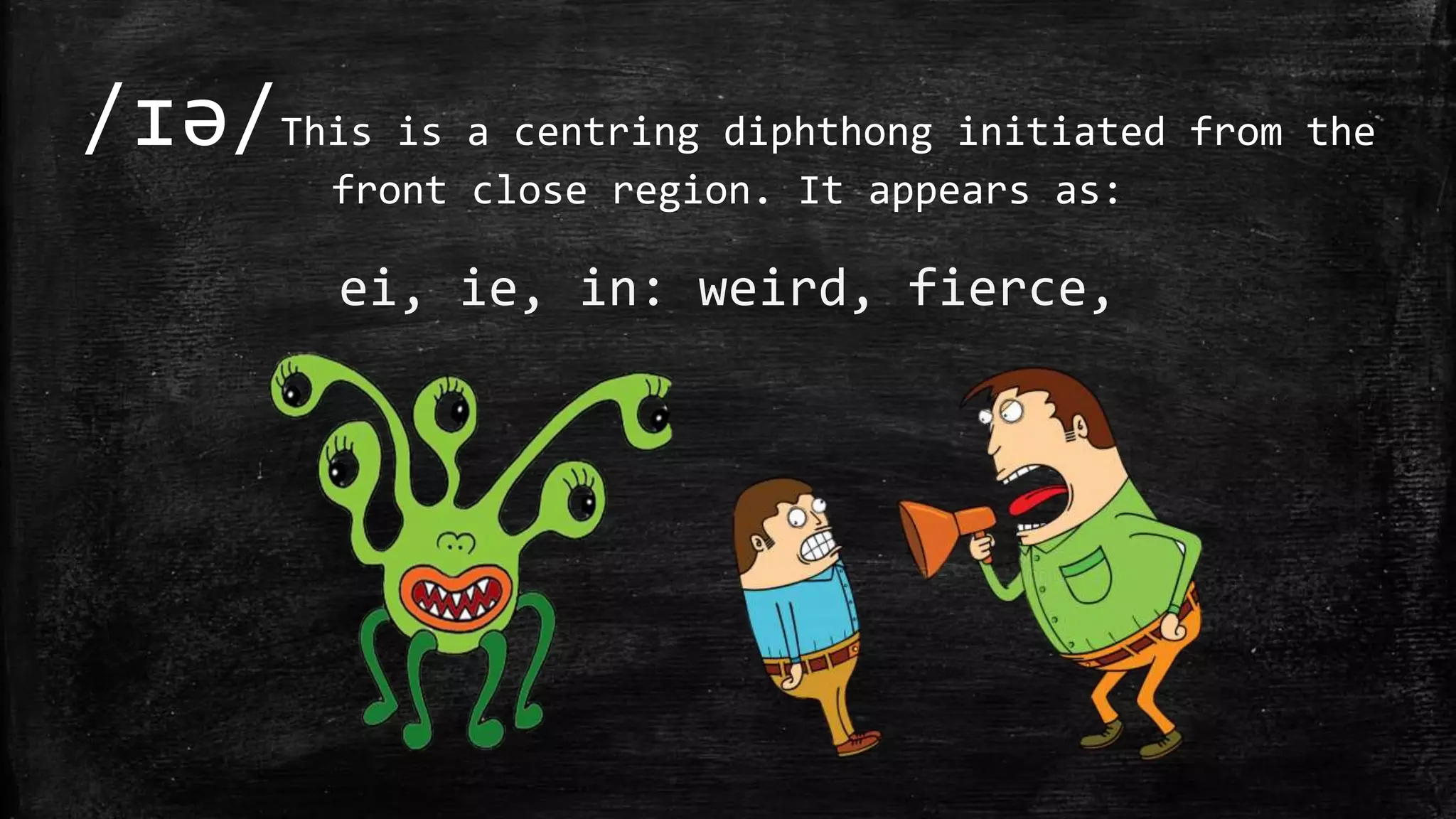
/ɪə/This is a centring diphthong initiated from the
front close region. It appears as:
ei, ie, in: weird, fierce,
/ɪə/This is a centring diphthong initiated from the
front close region. It appears as:
ea, ia, eu, eo, in:
idea, Ian, museum, theological
/ɛə/This centering diphthong is initiated at the
half-close region. It appears as:
are in: care, rare, share
/ɛə/This centering diphthong is initiated at the
half-close region. It appears as:
air in: fair, pair
/ɛə/This centering diphthong is initiated at the
half-close region. It appears as:
ear in: bear, pear, wear, tear
/ʊə/This diphthong begins at the close back region of
the mouth and goes on to meet the host at the centre of the
mouth. It appears as:
oor in: poor, moor
/ʊə/This diphthong begins at the close back region of
the mouth and goes on to meet the host at the centre of the
mouth. It appears as:
ure in: pure, endure, cure, sure
/ʊə/This diphthong begins at the close back region of
the mouth and goes on to meet the host at the centre of the
mouth. It appears as:
ur in: curious, spurious, during
/ʊə/This diphthong begins at the close back region of
the mouth and goes on to meet the host at the centre of the
mouth. It appears as:
ewer in: sewer
/ʊə/This diphthong begins at the close back region of
the mouth and goes on to meet the host at the centre of the
mouth. It appears as:
our in: sewer
/ʊə/This diphthong begins at the close back region of
the mouth and goes on to meet the host at the centre of the
mouth. It appears as:
our in: tour, dour, gourd
https://liduaeka.weebly.com/uploads/1/0/7/6/10761275/u4_engl
ish_diphthongs_and_triphthongs.pdf

English Diphthongs

  • 1.
    ENGLISH DIPHTHONGS For thislesson it will undertake the definition of diphthongs, closing diphthongs, centering diphthongs
  • 2.
    DIPTHONG A diphthong isa glide from on pure vowel (monophthong) to another pure vowel.
  • 3.
    O b je c t i v e s By the end of this lesson, you should be able to identify and describe the English diphthongs.
  • 4.
    CLOSING DIPHTHONGS These diphthongsare initiated by five pure vowels, namely: /e ə æ ɑ ɔ/. They glide or move towards two hosting pure vowels, namely: /ɪ ʊ/, which happen to be closing vowels. This is why these two sets of pure vowels have given “birth” to these closing diphthongs.
  • 5.
    /eɪ/As the diphthongtrapezium shows a glide that is initiated around the half-close region of the mouth ends up at a region around the close/back of the mouth. A glide such as this gives rise to the closing diphthong above. It appears as: a in: late, Kate, day
  • 6.
    /eɪ/As the diphthongtrapezium shows a glide that is initiated around the half-close region of the mouth ends up at a region around the close/back of the mouth. A glide such as this gives rise to the closing diphthong above. It appears as: ai in: rain, fail, wait
  • 7.
    /eɪ/As the diphthongtrapezium shows a glide that is initiated around the half-close region of the mouth ends up at a region around the close/back of the mouth. A glide such as this gives rise to the closing diphthong above. It appears as: ei in: eight, weight, rein
  • 8.
    /eɪ/As the diphthongtrapezium shows a glide that is initiated around the half-close region of the mouth ends up at a region around the close/back of the mouth. A glide such as this gives rise to the closing diphthong above. It appears as: ea in: great, break, steak
  • 9.
    /əʊ/Like /eɪ/, thisdiphthong moves from the half- close position to the close and back region. It appears as: o in: sow, oh, both
  • 10.
    /əʊ/Like /eɪ/, thisdiphthong moves from the half- close position to the close and back region. It appears as: oa in: soap, road, toast
  • 11.
    /əʊ/Like /eɪ/, thisdiphthong moves from the half- close position to the close and back region. It appears as: oe in: foe, hoe, toe
  • 12.
    /əʊ/Like /eɪ/, thisdiphthong moves from the half- close position to the close and back region. It appears as: ou in: soul, though, shoulder
  • 13.
    /ɑɪ/This diphthong glidesfrom a front open position near vowel No. 4, /æ/, as indicated in the trapezium, to the front close region where we have the hosting pure vowel no. 2, /ɪ/. Some varieties of the diphthong extend till the front back of the mouth. It appears as: i in: time, right, wide
  • 14.
    /ɑɪ/This diphthong glidesfrom a front open position near vowel No. 4, /æ/, as indicated in the trapezium, to the front close region where we have the hosting pure vowel no. 2, /ɪ/. Some varieties of the diphthong extend till the front back of the mouth. It appears as: y in: dry, why, by
  • 15.
    /ɑɪ/This diphthong glidesfrom a front open position near vowel No. 4, /æ/, as indicated in the trapezium, to the front close region where we have the hosting pure vowel no. 2, /ɪ/. Some varieties of the diphthong extend till the front back of the mouth. It appears as: ie, ye in: lie, die, pie
  • 16.
    /ɑɪ/This diphthong glidesfrom a front open position near vowel No. 4, /æ/, as indicated in the trapezium, to the front close region where we have the hosting pure vowel no. 2, /ɪ/. Some varieties of the diphthong extend till the front back of the mouth. It appears as: igh, in: fight, light, high
  • 17.
    /ɑɪ/This diphthong glidesfrom a front open position near vowel No. 4, /æ/, as indicated in the trapezium, to the front close region where we have the hosting pure vowel no. 2, /ɪ/. Some varieties of the diphthong extend till the front back of the mouth. It appears as: eigh in: height, freight
  • 18.
    /ɑɪ/This diphthong glidesfrom a front open position near vowel No. 4, /æ/, as indicated in the trapezium, to the front close region where we have the hosting pure vowel no. 2, /ɪ/. Some varieties of the diphthong extend till the front back of the mouth. It appears as: e, uy in: eye, buy, guy
  • 19.
    /ɑɪ/This diphthong glidesfrom a front open position near vowel No. 4, /æ/, as indicated in the trapezium, to the front close region where we have the hosting pure vowel no. 2, /ɪ/. Some varieties of the diphthong extend till the front back of the mouth. It appears as: ei, ai in: either, eider, aisle
  • 20.
    /ɑʊ/ This isa counterpart to /ɑɪ/ but its host to which it glides resides at the back close region. It appears as: Ou, in: house, sound, bough, plough
  • 21.
    /ɑʊ/ This isa counterpart to /ɑɪ/ but its host to which it glides resides at the back close region. It appears as: ow, in: now, cow, how
  • 22.
    /ɔɪ/ This diphthongglides from the back open region to the front close region. it appears as: oy, in: boy, ploy
  • 23.
    /ɔɪ/ This diphthongglides from the back open region to the front close region. it appears as: oi, in: noise, choice, point
  • 24.
    /ɔɪ/ This diphthongglides from the back open region to the front close region. it appears as: uo, in: buoy
  • 25.
    The Centering Diphthongs:/ɪə ɛə ʊə/ Look at the pure vowel trapezium, locate the centre of the mouth and note a pair of pure vowels prominently located there. One of the pairs, the schwa, plays host to these four diphthongs; this is the reason they are described as centering diphthongs
  • 26.
    /ɪə/This is acentring diphthong initiated from the front close region. It appears as: ee, ere, ea, in: deer, dear, here, tear
  • 27.
    /ɪə/This is acentring diphthong initiated from the front close region. It appears as: ei, ie, in: weird, fierce,
  • 28.
    /ɪə/This is acentring diphthong initiated from the front close region. It appears as: ea, ia, eu, eo, in: idea, Ian, museum, theological
  • 29.
    /ɛə/This centering diphthongis initiated at the half-close region. It appears as: are in: care, rare, share
  • 30.
    /ɛə/This centering diphthongis initiated at the half-close region. It appears as: air in: fair, pair
  • 31.
    /ɛə/This centering diphthongis initiated at the half-close region. It appears as: ear in: bear, pear, wear, tear
  • 32.
    /ʊə/This diphthong beginsat the close back region of the mouth and goes on to meet the host at the centre of the mouth. It appears as: oor in: poor, moor
  • 33.
    /ʊə/This diphthong beginsat the close back region of the mouth and goes on to meet the host at the centre of the mouth. It appears as: ure in: pure, endure, cure, sure
  • 34.
    /ʊə/This diphthong beginsat the close back region of the mouth and goes on to meet the host at the centre of the mouth. It appears as: ur in: curious, spurious, during
  • 35.
    /ʊə/This diphthong beginsat the close back region of the mouth and goes on to meet the host at the centre of the mouth. It appears as: ewer in: sewer
  • 36.
    /ʊə/This diphthong beginsat the close back region of the mouth and goes on to meet the host at the centre of the mouth. It appears as: our in: sewer
  • 37.
    /ʊə/This diphthong beginsat the close back region of the mouth and goes on to meet the host at the centre of the mouth. It appears as: our in: tour, dour, gourd
  • 38.

Editor's Notes

  • #8  Rein means of long, narrow strap attached at one end to a horse's bit, typically used in pairs to guide or check a horse while riding or driving. rein /rān/ Learn to pronounce noun a long, narrow strap attached at one end to a horse's bit, typically used in pairs to guide or check a horse while riding or driving.
  • #33 Ps: The children display their artworks.
  • #34 Ps: The children display their artworks.
  • #35 Ps: The children display their artworks.
  • #36 Ps: The children display their artworks.
  • #37 Ps: The children display their artworks.
  • #38 Ps: The children display their artworks.