WAYS OF SOUND PRODUCTION 
The manner of articulation has to do with the 
kind of obstruction the air meets on its 
way out, after it has passed the vocal folds. 
It may meet a complete closure (plosives), an 
almost complete closure (fricatives), or a 
smaller degree of closure (approximants), or 
the air might escape in more exceptional ways, 
around the sides of the tongue (laterals), or 
through the nasal cavity (nasals).
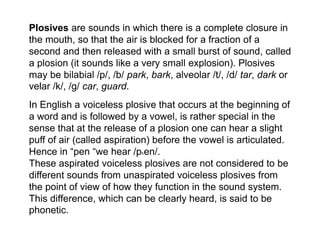
Plosives are sounds in which there is a complete closure in 
the mouth, so that the air is blocked for a fraction of a 
second and then released with a small burst of sound, called 
a plosion (it sounds like a very small explosion). Plosives 
may be bilabial /p/, /b/ park, bark, alveolar /t/, /d/ tar, dark or 
velar /k/, /g/ car, guard. 
In English a voiceless plosive that occurs at the beginning of 
a word and is followed by a vowel, is rather special in the 
sense that at the release of a plosion one can hear a slight 
puff of air (called aspiration) before the vowel is articulated. 
Hence in “pen “we hear /phen/. 
These aspirated voiceless plosives are not considered to be 
different sounds from unaspirated voiceless plosives from 
the point of view of how they function in the sound system. 
This difference, which can be clearly heard, is said to be 
phonetic.
Fricatives have a closure which is not quite complete. This 
means that the air is not blocked at any point, and therefore 
there is no plosion. On the other hand the obstruction is big 
enough for the air to make a noise when it passes through it, 
because of the friction. This effect is similar to the wind 
whistling around the corner of a house. Fricatives may be 
labiodental /f/, /v/ wife, wives, dental / / , / / 
breath, breathe, 
alveolar /s/, /z/ sink, zinc, palato-alveolar / /, / / nation, 
evasion, or glottal /h/ help. /h/ is a glottal fricative. As it has no 
closure anywhere else, and as all air passes between the 
vocal folds, this means that /h/ is like aspiration 
unaccompanied by any obstruction. 
A distinction may be made between sibilant and non-sibilant 
fricatives. Sibilant sounds are the fricatives with a 
clear "hissing" noise, /s/, /z/, / /, / / and the two affricates 
/ /, / / choke, joke.
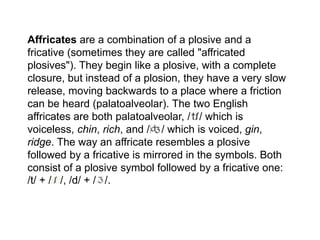
Affricates are a combination of a plosive and a 
fricative (sometimes they are called "affricated 
plosives"). They begin like a plosive, with a complete 
closure, but instead of a plosion, they have a very slow 
release, moving backwards to a place where a friction 
can be heard (palatoalveolar). The two English 
affricates are both palatoalveolar, / / which is 
voiceless, chin, rich, and / / which is voiced, gin, 
ridge. The way an affricate resembles a plosive 
followed by a fricative is mirrored in the symbols. Both 
consist of a plosive symbol followed by a fricative one: 
/t/ + / /, /d/ + / /.
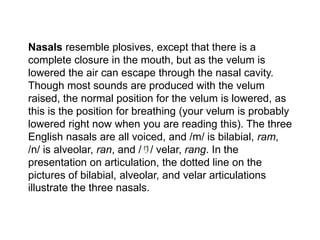
Nasals resemble plosives, except that there is a 
complete closure in the mouth, but as the velum is 
lowered the air can escape through the nasal cavity. 
Though most sounds are produced with the velum 
raised, the normal position for the velum is lowered, as 
this is the position for breathing (your velum is probably 
lowered right now when you are reading this). The three 
English nasals are all voiced, and /m/ is bilabial, ram, 
/n/ is alveolar, ran, and / / velar, rang. In the 
presentation on articulation, the dotted line on the 
pictures of bilabial, alveolar, and velar articulations 
illustrate the three nasals.
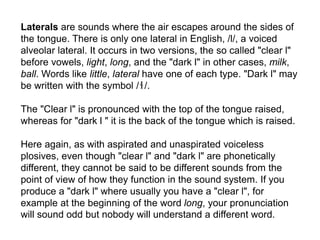
Laterals are sounds where the air escapes around the sides of 
the tongue. There is only one lateral in English, /l/, a voiced 
alveolar lateral. It occurs in two versions, the so called "clear l" 
before vowels, light, long, and the "dark l" in other cases, milk, 
ball. Words like little, lateral have one of each type. "Dark l" may 
be written with the symbol / /. 
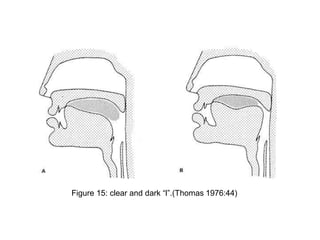
The "Clear l" is pronounced with the top of the tongue raised, 
whereas for "dark l " it is the back of the tongue which is raised. 
Here again, as with aspirated and unaspirated voiceless 
plosives, even though "clear l" and "dark l" are phonetically 
different, they cannot be said to be different sounds from the 
point of view of how they function in the sound system. If you 
produce a "dark l" where usually you have a "clear l", for 
example at the beginning of the word long, your pronunciation 
will sound odd but nobody will understand a different word.
Figure 15: clear and dark “l”.(Thomas 1976:44)
Approximants are sounds where the tongue only 
approaches the roof of the mouth, so that there is not enough 
obstruction to create any friction. English has three 
approximants, which are all voiced. /r/ is alveolar, right, 
brown, sometimes called post-alveolar, because it is slightly 
further back that the other alveolar sounds /t/, /d/, /s/, /l/. /j/ is 
a palatal approximant, use, youth, and /w/ is a velar 
approximant, why, twin, square. /w/ always has lip-rounding 
as well, and therefore it is sometimes called labio-velar. 
/r/ only occurs before vowels in southern British English, 
whereas other accents, like Scottish, Irish, and most 
American ones, also can have it after vowels. Therefore 
those accents can make a distinction between e.g. saw and 
sore, which are pronounced exactly alike in southern British 
English.
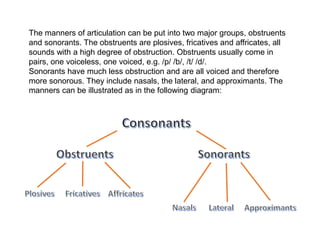
The manners of articulation can be put into two major groups, obstruents 
and sonorants. The obstruents are plosives, fricatives and affricates, all 
sounds with a high degree of obstruction. Obstruents usually come in 
pairs, one voiceless, one voiced, e.g. /p/ /b/, /t/ /d/. 
Sonorants have much less obstruction and are all voiced and therefore 
more sonorous. They include nasals, the lateral, and approximants. The 
manners can be illustrated as in the following diagram:

Sound production

  • 1.
    WAYS OF SOUNDPRODUCTION The manner of articulation has to do with the kind of obstruction the air meets on its way out, after it has passed the vocal folds. It may meet a complete closure (plosives), an almost complete closure (fricatives), or a smaller degree of closure (approximants), or the air might escape in more exceptional ways, around the sides of the tongue (laterals), or through the nasal cavity (nasals).
  • 2.
    Plosives are soundsin which there is a complete closure in the mouth, so that the air is blocked for a fraction of a second and then released with a small burst of sound, called a plosion (it sounds like a very small explosion). Plosives may be bilabial /p/, /b/ park, bark, alveolar /t/, /d/ tar, dark or velar /k/, /g/ car, guard. In English a voiceless plosive that occurs at the beginning of a word and is followed by a vowel, is rather special in the sense that at the release of a plosion one can hear a slight puff of air (called aspiration) before the vowel is articulated. Hence in “pen “we hear /phen/. These aspirated voiceless plosives are not considered to be different sounds from unaspirated voiceless plosives from the point of view of how they function in the sound system. This difference, which can be clearly heard, is said to be phonetic.
  • 3.
    Fricatives have aclosure which is not quite complete. This means that the air is not blocked at any point, and therefore there is no plosion. On the other hand the obstruction is big enough for the air to make a noise when it passes through it, because of the friction. This effect is similar to the wind whistling around the corner of a house. Fricatives may be labiodental /f/, /v/ wife, wives, dental / / , / / breath, breathe, alveolar /s/, /z/ sink, zinc, palato-alveolar / /, / / nation, evasion, or glottal /h/ help. /h/ is a glottal fricative. As it has no closure anywhere else, and as all air passes between the vocal folds, this means that /h/ is like aspiration unaccompanied by any obstruction. A distinction may be made between sibilant and non-sibilant fricatives. Sibilant sounds are the fricatives with a clear "hissing" noise, /s/, /z/, / /, / / and the two affricates / /, / / choke, joke.
  • 4.
    Affricates are acombination of a plosive and a fricative (sometimes they are called "affricated plosives"). They begin like a plosive, with a complete closure, but instead of a plosion, they have a very slow release, moving backwards to a place where a friction can be heard (palatoalveolar). The two English affricates are both palatoalveolar, / / which is voiceless, chin, rich, and / / which is voiced, gin, ridge. The way an affricate resembles a plosive followed by a fricative is mirrored in the symbols. Both consist of a plosive symbol followed by a fricative one: /t/ + / /, /d/ + / /.
  • 5.
    Nasals resemble plosives,except that there is a complete closure in the mouth, but as the velum is lowered the air can escape through the nasal cavity. Though most sounds are produced with the velum raised, the normal position for the velum is lowered, as this is the position for breathing (your velum is probably lowered right now when you are reading this). The three English nasals are all voiced, and /m/ is bilabial, ram, /n/ is alveolar, ran, and / / velar, rang. In the presentation on articulation, the dotted line on the pictures of bilabial, alveolar, and velar articulations illustrate the three nasals.
  • 6.
    Laterals are soundswhere the air escapes around the sides of the tongue. There is only one lateral in English, /l/, a voiced alveolar lateral. It occurs in two versions, the so called "clear l" before vowels, light, long, and the "dark l" in other cases, milk, ball. Words like little, lateral have one of each type. "Dark l" may be written with the symbol / /. The "Clear l" is pronounced with the top of the tongue raised, whereas for "dark l " it is the back of the tongue which is raised. Here again, as with aspirated and unaspirated voiceless plosives, even though "clear l" and "dark l" are phonetically different, they cannot be said to be different sounds from the point of view of how they function in the sound system. If you produce a "dark l" where usually you have a "clear l", for example at the beginning of the word long, your pronunciation will sound odd but nobody will understand a different word.
  • 7.
    Figure 15: clearand dark “l”.(Thomas 1976:44)
  • 8.
    Approximants are soundswhere the tongue only approaches the roof of the mouth, so that there is not enough obstruction to create any friction. English has three approximants, which are all voiced. /r/ is alveolar, right, brown, sometimes called post-alveolar, because it is slightly further back that the other alveolar sounds /t/, /d/, /s/, /l/. /j/ is a palatal approximant, use, youth, and /w/ is a velar approximant, why, twin, square. /w/ always has lip-rounding as well, and therefore it is sometimes called labio-velar. /r/ only occurs before vowels in southern British English, whereas other accents, like Scottish, Irish, and most American ones, also can have it after vowels. Therefore those accents can make a distinction between e.g. saw and sore, which are pronounced exactly alike in southern British English.
  • 9.
    The manners ofarticulation can be put into two major groups, obstruents and sonorants. The obstruents are plosives, fricatives and affricates, all sounds with a high degree of obstruction. Obstruents usually come in pairs, one voiceless, one voiced, e.g. /p/ /b/, /t/ /d/. Sonorants have much less obstruction and are all voiced and therefore more sonorous. They include nasals, the lateral, and approximants. The manners can be illustrated as in the following diagram: