UNIT - I

PHONETICS
Elements of English language Phonology, morphology, lexis, grammar

• Phonology - the study of sound
systems of languages. (Greek word
phonema which means sound. )
• Phoneme – A phonological segment
that can be phonetically predicted by a
rule – /b/ in bit and /p/ in pit.
MORPHOLOGY
• Morphology is a branch of grammar concerned
with the study and analysis of the structure and
forms.
• A sentence is not the minimal grammatical unit.
• It consists of other smaller units called words.
Words can be further analyzed into smaller units,
which are known as morphemes.
• Linguists commonly use tree diagram to analyze
the structural descriptions of words and
sentences of a language.
Free and bound morphemes
• Free morpheme is a linguistic unit that can
occur by itself.
• A bound morpheme on the other hand is
always attached to some other morpheme.
• Free morphemes are those which can stand
alone as words of a language whereas bound
morphemes
are
attached
to
other
morphemes.
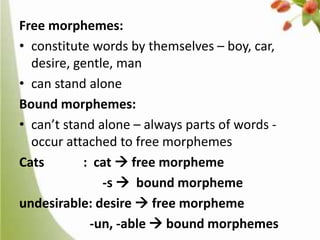
Free morphemes:
• constitute words by themselves – boy, car,
desire, gentle, man
• can stand alone
Bound morphemes:
• can’t stand alone – always parts of words occur attached to free morphemes
Cats
: cat  free morpheme
-s  bound morpheme
undesirable: desire  free morpheme
-un, -able  bound morphemes
MORPHEME
• A morpheme is the smallest grammatical unit
in a language. The field of study dedicated to
morphemes is called morphology.
• A morpheme is not identical to a word, and the
difference between the two is that a morpheme
may or may not stand alone, whereas a word is
freestanding.
Lexis and Grammar
• Lexis
Lexis is a term in linguistics which means the
vocabulary of a language. The adjective is
lexical. In Greek lexis means word.
• Grammar
In linguistics, grammar refers to the logical
and structural rules that govern the
composition of sentences, phrases, and words
in any given natural language.
Received Pronunciation
• In England, one accent has traditionally stood
above all.
• This "prestige" accent is known as RECEIVED
PRONUNCIATION, or RP.
• RP is the pronunciation of British English,
originally based on the speech of the upper
class of southeastern England.
• It is the characteristic of the English spoken at
the public schools and at Oxford and
Cambridge Universities.
• It is the standard form of English used in
British broadcasting.

• Traditionally, Received Pronunciation is
the "everyday speech in the families of
Southern English persons who are
educated at the great public boardingschools".
Chapter – 2
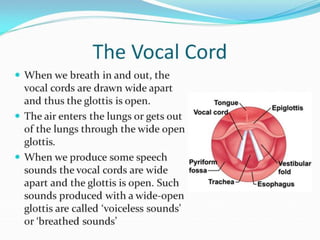
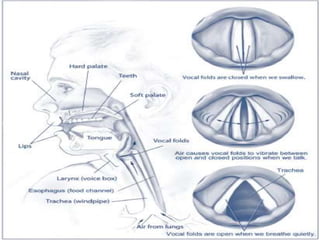
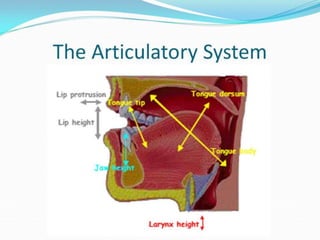
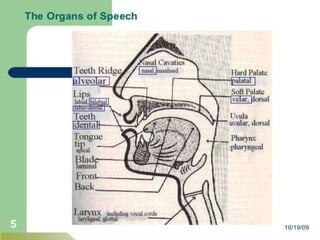
The Different Speech Organs and their Role
Chapter - 3
Individual Sounds – Vowels,
Consonants and Semi Vowels
Chapter – 4
Pure vowels – The Cardinal
Vowel Scale
What is a vowel?
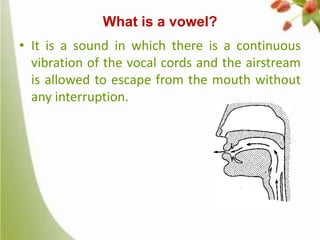
• It is a sound in which there is a continuous
vibration of the vocal cords and the airstream
is allowed to escape from the mouth without
any interruption.
How do we distinguish the different
vowel sounds?
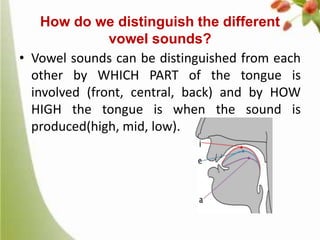
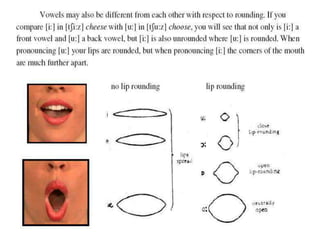
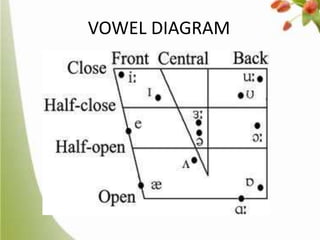
• Vowel sounds can be distinguished from each
other by WHICH PART of the tongue is
involved (front, central, back) and by HOW
HIGH the tongue is when the sound is
produced(high, mid, low).
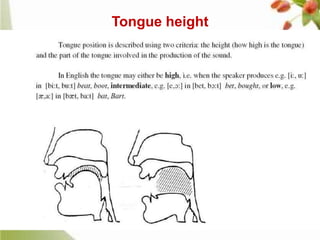
Tongue height
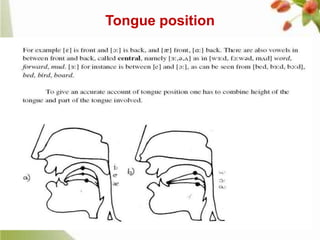
Tongue position
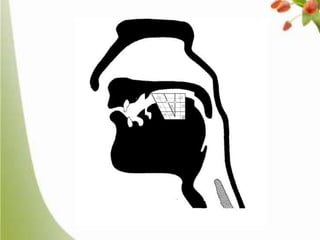
VOWEL DIAGRAM
Description of Vowels
• the tongue-position, indicated in vowel
diagram, and
• the distribution of each vowel in terms of its
occurrence (i.e. initial, medial and final)
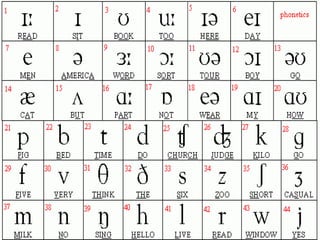
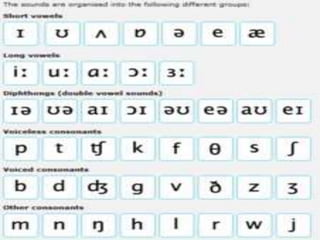
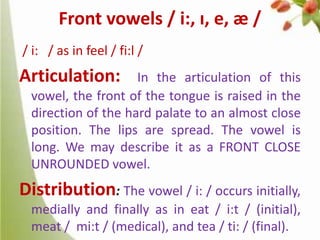
Front vowels / i:, ɪ, e, æ /
/ i: / as in feel / fi:l /

Articulation:

In the articulation of this
vowel, the front of the tongue is raised in the
direction of the hard palate to an almost close
position. The lips are spread. The vowel is
long. We may describe it as a FRONT CLOSE
UNROUNDED vowel.

Distribution: The vowel / i: / occurs initially,
medially and finally as in eat / i:t / (initial),
meat / mi:t / (medical), and tea / ti: / (final).
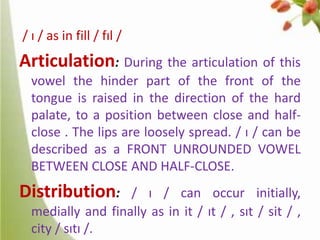
/ ɪ / as in fill / fɪl /

Articulation: During the articulation of this
vowel the hinder part of the front of the
tongue is raised in the direction of the hard
palate, to a position between close and halfclose . The lips are loosely spread. / ɪ / can be
described as a FRONT UNROUNDED VOWEL
BETWEEN CLOSE AND HALF-CLOSE.

Distribution:

/ ɪ / can occur initially,
medially and finally as in it / ɪt / , sɪt / sit / ,
city / sɪtɪ /.
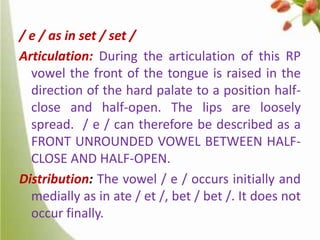
/ e / as in set / set /
Articulation: During the articulation of this RP
vowel the front of the tongue is raised in the
direction of the hard palate to a position halfclose and half-open. The lips are loosely
spread. / e / can therefore be described as a
FRONT UNROUNDED VOWEL BETWEEN HALFCLOSE AND HALF-OPEN.
Distribution: The vowel / e / occurs initially and
medially as in ate / et /, bet / bet /. It does not
occur finally.
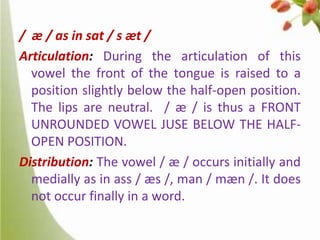
/ æ / as in sat / s æt /
Articulation: During the articulation of this
vowel the front of the tongue is raised to a
position slightly below the half-open position.
The lips are neutral. / æ / is thus a FRONT
UNROUNDED VOWEL JUSE BELOW THE HALFOPEN POSITION.
Distribution: The vowel / æ / occurs initially and
medially as in ass / æs /, man / mæn /. It does
not occur finally in a word.
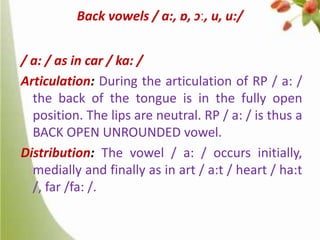
Back vowels / a:, ɒ, ɔː, u, u:/
/ a: / as in car / ka: /
Articulation: During the articulation of RP / a: /
the back of the tongue is in the fully open
position. The lips are neutral. RP / a: / is thus a
BACK OPEN UNROUNDED vowel.
Distribution: The vowel / a: / occurs initially,
medially and finally as in art / a:t / heart / ha:t
/, far /fa: /.
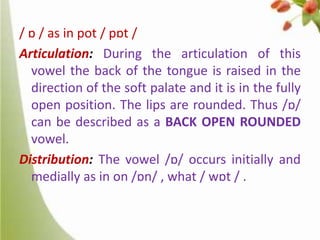
/ ɒ / as in pot / pɒt /
Articulation: During the articulation of this
vowel the back of the tongue is raised in the
direction of the soft palate and it is in the fully
open position. The lips are rounded. Thus /ɒ/
can be described as a BACK OPEN ROUNDED
vowel.
Distribution: The vowel /ɒ/ occurs initially and
medially as in on /ɒn/ , what / wɒt / .
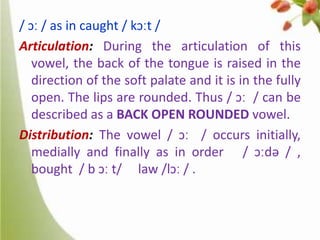
/ ɔː / as in caught / kɔːt /
Articulation: During the articulation of this
vowel, the back of the tongue is raised in the
direction of the soft palate and it is in the fully
open. The lips are rounded. Thus / ɔː / can be
described as a BACK OPEN ROUNDED vowel.
Distribution: The vowel / ɔː / occurs initially,
medially and finally as in order / ɔːdə / ,
bought / b ɔː t/ law /lɔː / .
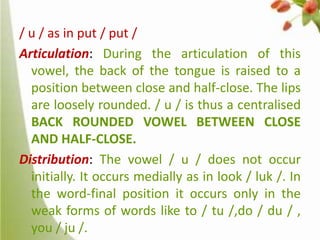
/ u / as in put / put /
Articulation: During the articulation of this
vowel, the back of the tongue is raised to a
position between close and half-close. The lips
are loosely rounded. / u / is thus a centralised
BACK ROUNDED VOWEL BETWEEN CLOSE
AND HALF-CLOSE.
Distribution: The vowel / u / does not occur
initially. It occurs medially as in look / luk /. In
the word-final position it occurs only in the
weak forms of words like to / tu /,do / du / ,
you / ju /.
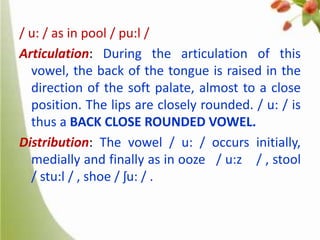
/ u: / as in pool / pu:l /
Articulation: During the articulation of this
vowel, the back of the tongue is raised in the
direction of the soft palate, almost to a close
position. The lips are closely rounded. / u: / is
thus a BACK CLOSE ROUNDED VOWEL.
Distribution: The vowel / u: / occurs initially,
medially and finally as in ooze / u:z / , stool
/ stu:l / , shoe / ʃu: / .
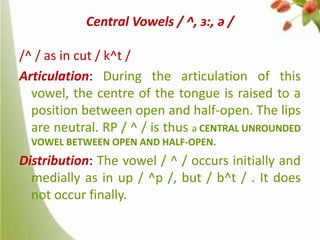
Central Vowels / ^, ɜ:, ə /
/^ / as in cut / k^t /
Articulation: During the articulation of this
vowel, the centre of the tongue is raised to a
position between open and half-open. The lips
are neutral. RP / ^ / is thus a CENTRAL UNROUNDED
VOWEL BETWEEN OPEN AND HALF-OPEN.

Distribution: The vowel / ^ / occurs initially and
medially as in up / ^p /, but / b^t / . It does
not occur finally.
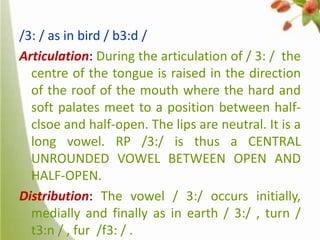
/3: / as in bird / b3:d /
Articulation: During the articulation of / 3: / the
centre of the tongue is raised in the direction
of the roof of the mouth where the hard and
soft palates meet to a position between halfclsoe and half-open. The lips are neutral. It is a
long vowel. RP /3:/ is thus a CENTRAL
UNROUNDED VOWEL BETWEEN OPEN AND
HALF-OPEN.
Distribution: The vowel / 3:/ occurs initially,
medially and finally as in earth / 3:/ , turn /
t3:n / , fur /f3: / .
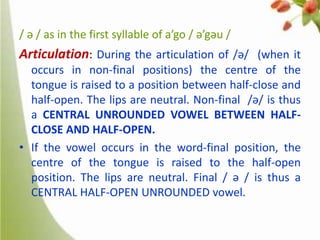
/ ə / as in the first syllable of a’go / ə’gəu /

Articulation: During the articulation of /ə/ (when it
occurs in non-final positions) the centre of the
tongue is raised to a position between half-close and
half-open. The lips are neutral. Non-final /ə/ is thus
a CENTRAL UNROUNDED VOWEL BETWEEN HALFCLOSE AND HALF-OPEN.
• If the vowel occurs in the word-final position, the
centre of the tongue is raised to the half-open
position. The lips are neutral. Final / ə / is thus a
CENTRAL HALF-OPEN UNROUNDED vowel.
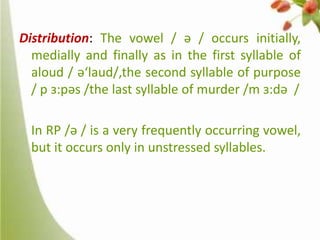
Distribution: The vowel / ə / occurs initially,
medially and finally as in the first syllable of
aloud / ə‘laud/,the second syllable of purpose
/ p ɜ:pəs /the last syllable of murder /m ɜ:də /
In RP /ə / is a very frequently occurring vowel,
but it occurs only in unstressed syllables.
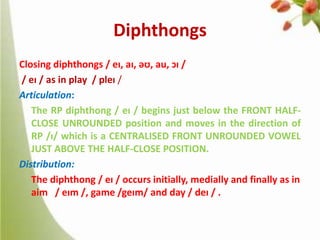
Diphthongs
Closing diphthongs / eɪ, aɪ, əʊ, au, ɔɪ /
/ eɪ / as in play / pleɪ /
Articulation:
The RP diphthong / eɪ / begins just below the FRONT HALFCLOSE UNROUNDED position and moves in the direction of
RP /ɪ/ which is a CENTRALISED FRONT UNROUNDED VOWEL
JUST ABOVE THE HALF-CLOSE POSITION.
Distribution:
The diphthong / eɪ / occurs initially, medially and finally as in
aim / eɪm /, game /geɪm/ and day / deɪ / .
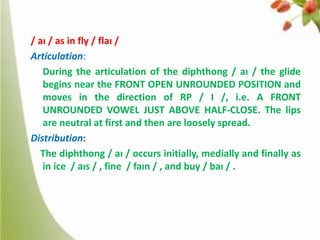
/ aɪ / as in fly / flaɪ /
Articulation:
During the articulation of the diphthong / aɪ / the glide
begins near the FRONT OPEN UNROUNDED POSITION and
moves in the direction of RP / I /, i.e. A FRONT
UNROUNDED VOWEL JUST ABOVE HALF-CLOSE. The lips
are neutral at first and then are loosely spread.
Distribution:
The diphthong / aɪ / occurs initially, medially and finally as
in ice / aɪs / , fine / faɪn / , and buy / baɪ / .
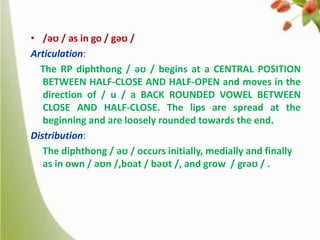
• /əʊ / as in go / gəʊ /
Articulation:
The RP diphthong / əʊ / begins at a CENTRAL POSITION
BETWEEN HALF-CLOSE AND HALF-OPEN and moves in the
direction of / u / a BACK ROUNDED VOWEL BETWEEN
CLOSE AND HALF-CLOSE. The lips are spread at the
beginning and are loosely rounded towards the end.
Distribution:
The diphthong / əʊ / occurs initially, medially and finally
as in own / əʊn /,boat / bəʊt /, and grow / grəʊ / .
• / au / as in now / nau /
Articulation:
During the articulation of the diphthong / au / the
glide begins at an (advanced) BACK OPEN
UNROUNDED POSITION and moves in the
direction of RP /u/ i.e. A CENTRALIZED BACK
ROUNDED VOWEL JUST ABOVE THE HALF-CLOSE
POSITION.
Distribution:
The diphthong / au / occurs initially, medially and
finally as in owl / aul / , crowd / kraud / , and
how / hau / .
• / ɔɪ / as in boil / bɔɪl /
Articulation:
During the articulation of / ɔɪ / the glide begins at a
point BETWEEN THE BACK OPEN AND HALF-OPEN
POSITION AND MOVES IN THE DIRECTION OF RP /I/
JUST ABOVE THE HALF-CLOSE POSITION. The lips
are slightly rounded at the beginning and are
loosely spread at the end.
Distribution:
The diphthong /ɔɪ/ occurs initially, medially and
finally as in oil / ɔɪl / , soil / sɔɪl / and boy / bɔɪ / .
Centering diphthongs / ɪə, ɛə, ʊə /
• / ɪə / as in fear / fɪə /
Articulation:
During the articulation of the diphthong / ɪə / the
glide is from a FRONT UNROUNDED VOWEL JUST
ABOVE THE HALF-CLOSE POSITION and moves in
the direction of A CENTRAL UNROUNDED VOWEL
BETWEEN HALF-CLOSE AND HALF-OPEN (halfopen when final).
Distribution:
The diphthong /ɪə/ occurs initially, medially and
finally as in earphone / ɪəfəʊn /, merely / ‘mɪəli /
and dear / dɪə / .
• / ɛə / as in fare / fɛə /
Articulation:
During the articulation of the diphthong / ɛə /
the glide begins at the FRONT POSITION
BETWEEN HALF CLOSE AND HALF OPEN
UNROUNDED POSITION and moves in the
direction of A CENTRAL UNROUNDED VOWEL
BETWEEN HALF-CLOSE AND HALF-OPEN.
Distribution:
The diphthong / ɛə / occurs initially, medially and
finally as in area / ɛərɪə/, caring / ‘kɛərɪŋ / and
hare / hɛə / .
• / ʊə / as in poor / pʊə /
Articulation:
During the articulation of / ʊə / the glide is
from A BACK ROUNDED VOWEL JUST ABOVE
THE HALF-CLOSE POSITION and moves in the
direction of a CENTRAL UNROUNDED VOWEL
BETWEEN HALF-CLOSE AND HALF-OPEN.
Distribution:
The diphthong / ʊə / does not occur initially.
It occurs medially and finally as in surely
/ʃʊəlɪ / and tour /tʊə /.

Phonetics presentation part i

  • 1.
  • 2.
    Elements of Englishlanguage Phonology, morphology, lexis, grammar • Phonology - the study of sound systems of languages. (Greek word phonema which means sound. ) • Phoneme – A phonological segment that can be phonetically predicted by a rule – /b/ in bit and /p/ in pit.
  • 3.
    MORPHOLOGY • Morphology isa branch of grammar concerned with the study and analysis of the structure and forms. • A sentence is not the minimal grammatical unit. • It consists of other smaller units called words. Words can be further analyzed into smaller units, which are known as morphemes. • Linguists commonly use tree diagram to analyze the structural descriptions of words and sentences of a language.
  • 4.
    Free and boundmorphemes • Free morpheme is a linguistic unit that can occur by itself. • A bound morpheme on the other hand is always attached to some other morpheme. • Free morphemes are those which can stand alone as words of a language whereas bound morphemes are attached to other morphemes.
  • 5.
    Free morphemes: • constitutewords by themselves – boy, car, desire, gentle, man • can stand alone Bound morphemes: • can’t stand alone – always parts of words occur attached to free morphemes Cats : cat  free morpheme -s  bound morpheme undesirable: desire  free morpheme -un, -able  bound morphemes
  • 6.
    MORPHEME • A morphemeis the smallest grammatical unit in a language. The field of study dedicated to morphemes is called morphology. • A morpheme is not identical to a word, and the difference between the two is that a morpheme may or may not stand alone, whereas a word is freestanding.
  • 7.
    Lexis and Grammar •Lexis Lexis is a term in linguistics which means the vocabulary of a language. The adjective is lexical. In Greek lexis means word. • Grammar In linguistics, grammar refers to the logical and structural rules that govern the composition of sentences, phrases, and words in any given natural language.
  • 8.
    Received Pronunciation • InEngland, one accent has traditionally stood above all. • This "prestige" accent is known as RECEIVED PRONUNCIATION, or RP. • RP is the pronunciation of British English, originally based on the speech of the upper class of southeastern England. • It is the characteristic of the English spoken at the public schools and at Oxford and Cambridge Universities.
  • 9.
    • It isthe standard form of English used in British broadcasting. • Traditionally, Received Pronunciation is the "everyday speech in the families of Southern English persons who are educated at the great public boardingschools".
  • 10.
    Chapter – 2 TheDifferent Speech Organs and their Role
  • 27.
    Chapter - 3 IndividualSounds – Vowels, Consonants and Semi Vowels
  • 31.
    Chapter – 4 Purevowels – The Cardinal Vowel Scale
  • 32.
    What is avowel? • It is a sound in which there is a continuous vibration of the vocal cords and the airstream is allowed to escape from the mouth without any interruption.
  • 33.
    How do wedistinguish the different vowel sounds? • Vowel sounds can be distinguished from each other by WHICH PART of the tongue is involved (front, central, back) and by HOW HIGH the tongue is when the sound is produced(high, mid, low).
  • 34.
  • 35.
  • 38.
  • 39.
    Description of Vowels •the tongue-position, indicated in vowel diagram, and • the distribution of each vowel in terms of its occurrence (i.e. initial, medial and final)
  • 40.
    Front vowels /i:, ɪ, e, æ / / i: / as in feel / fi:l / Articulation: In the articulation of this vowel, the front of the tongue is raised in the direction of the hard palate to an almost close position. The lips are spread. The vowel is long. We may describe it as a FRONT CLOSE UNROUNDED vowel. Distribution: The vowel / i: / occurs initially, medially and finally as in eat / i:t / (initial), meat / mi:t / (medical), and tea / ti: / (final).
  • 41.
    / ɪ /as in fill / fɪl / Articulation: During the articulation of this vowel the hinder part of the front of the tongue is raised in the direction of the hard palate, to a position between close and halfclose . The lips are loosely spread. / ɪ / can be described as a FRONT UNROUNDED VOWEL BETWEEN CLOSE AND HALF-CLOSE. Distribution: / ɪ / can occur initially, medially and finally as in it / ɪt / , sɪt / sit / , city / sɪtɪ /.
  • 42.
    / e /as in set / set / Articulation: During the articulation of this RP vowel the front of the tongue is raised in the direction of the hard palate to a position halfclose and half-open. The lips are loosely spread. / e / can therefore be described as a FRONT UNROUNDED VOWEL BETWEEN HALFCLOSE AND HALF-OPEN. Distribution: The vowel / e / occurs initially and medially as in ate / et /, bet / bet /. It does not occur finally.
  • 43.
    / æ /as in sat / s æt / Articulation: During the articulation of this vowel the front of the tongue is raised to a position slightly below the half-open position. The lips are neutral. / æ / is thus a FRONT UNROUNDED VOWEL JUSE BELOW THE HALFOPEN POSITION. Distribution: The vowel / æ / occurs initially and medially as in ass / æs /, man / mæn /. It does not occur finally in a word.
  • 44.
    Back vowels /a:, ɒ, ɔː, u, u:/ / a: / as in car / ka: / Articulation: During the articulation of RP / a: / the back of the tongue is in the fully open position. The lips are neutral. RP / a: / is thus a BACK OPEN UNROUNDED vowel. Distribution: The vowel / a: / occurs initially, medially and finally as in art / a:t / heart / ha:t /, far /fa: /.
  • 45.
    / ɒ /as in pot / pɒt / Articulation: During the articulation of this vowel the back of the tongue is raised in the direction of the soft palate and it is in the fully open position. The lips are rounded. Thus /ɒ/ can be described as a BACK OPEN ROUNDED vowel. Distribution: The vowel /ɒ/ occurs initially and medially as in on /ɒn/ , what / wɒt / .
  • 46.
    / ɔː /as in caught / kɔːt / Articulation: During the articulation of this vowel, the back of the tongue is raised in the direction of the soft palate and it is in the fully open. The lips are rounded. Thus / ɔː / can be described as a BACK OPEN ROUNDED vowel. Distribution: The vowel / ɔː / occurs initially, medially and finally as in order / ɔːdə / , bought / b ɔː t/ law /lɔː / .
  • 47.
    / u /as in put / put / Articulation: During the articulation of this vowel, the back of the tongue is raised to a position between close and half-close. The lips are loosely rounded. / u / is thus a centralised BACK ROUNDED VOWEL BETWEEN CLOSE AND HALF-CLOSE. Distribution: The vowel / u / does not occur initially. It occurs medially as in look / luk /. In the word-final position it occurs only in the weak forms of words like to / tu /,do / du / , you / ju /.
  • 48.
    / u: /as in pool / pu:l / Articulation: During the articulation of this vowel, the back of the tongue is raised in the direction of the soft palate, almost to a close position. The lips are closely rounded. / u: / is thus a BACK CLOSE ROUNDED VOWEL. Distribution: The vowel / u: / occurs initially, medially and finally as in ooze / u:z / , stool / stu:l / , shoe / ʃu: / .
  • 49.
    Central Vowels /^, ɜ:, ə / /^ / as in cut / k^t / Articulation: During the articulation of this vowel, the centre of the tongue is raised to a position between open and half-open. The lips are neutral. RP / ^ / is thus a CENTRAL UNROUNDED VOWEL BETWEEN OPEN AND HALF-OPEN. Distribution: The vowel / ^ / occurs initially and medially as in up / ^p /, but / b^t / . It does not occur finally.
  • 50.
    /3: / asin bird / b3:d / Articulation: During the articulation of / 3: / the centre of the tongue is raised in the direction of the roof of the mouth where the hard and soft palates meet to a position between halfclsoe and half-open. The lips are neutral. It is a long vowel. RP /3:/ is thus a CENTRAL UNROUNDED VOWEL BETWEEN OPEN AND HALF-OPEN. Distribution: The vowel / 3:/ occurs initially, medially and finally as in earth / 3:/ , turn / t3:n / , fur /f3: / .
  • 51.
    / ə /as in the first syllable of a’go / ə’gəu / Articulation: During the articulation of /ə/ (when it occurs in non-final positions) the centre of the tongue is raised to a position between half-close and half-open. The lips are neutral. Non-final /ə/ is thus a CENTRAL UNROUNDED VOWEL BETWEEN HALFCLOSE AND HALF-OPEN. • If the vowel occurs in the word-final position, the centre of the tongue is raised to the half-open position. The lips are neutral. Final / ə / is thus a CENTRAL HALF-OPEN UNROUNDED vowel.
  • 52.
    Distribution: The vowel/ ə / occurs initially, medially and finally as in the first syllable of aloud / ə‘laud/,the second syllable of purpose / p ɜ:pəs /the last syllable of murder /m ɜ:də / In RP /ə / is a very frequently occurring vowel, but it occurs only in unstressed syllables.
  • 53.
    Diphthongs Closing diphthongs /eɪ, aɪ, əʊ, au, ɔɪ / / eɪ / as in play / pleɪ / Articulation: The RP diphthong / eɪ / begins just below the FRONT HALFCLOSE UNROUNDED position and moves in the direction of RP /ɪ/ which is a CENTRALISED FRONT UNROUNDED VOWEL JUST ABOVE THE HALF-CLOSE POSITION. Distribution: The diphthong / eɪ / occurs initially, medially and finally as in aim / eɪm /, game /geɪm/ and day / deɪ / .
  • 54.
    / aɪ /as in fly / flaɪ / Articulation: During the articulation of the diphthong / aɪ / the glide begins near the FRONT OPEN UNROUNDED POSITION and moves in the direction of RP / I /, i.e. A FRONT UNROUNDED VOWEL JUST ABOVE HALF-CLOSE. The lips are neutral at first and then are loosely spread. Distribution: The diphthong / aɪ / occurs initially, medially and finally as in ice / aɪs / , fine / faɪn / , and buy / baɪ / .
  • 55.
    • /əʊ /as in go / gəʊ / Articulation: The RP diphthong / əʊ / begins at a CENTRAL POSITION BETWEEN HALF-CLOSE AND HALF-OPEN and moves in the direction of / u / a BACK ROUNDED VOWEL BETWEEN CLOSE AND HALF-CLOSE. The lips are spread at the beginning and are loosely rounded towards the end. Distribution: The diphthong / əʊ / occurs initially, medially and finally as in own / əʊn /,boat / bəʊt /, and grow / grəʊ / .
  • 56.
    • / au/ as in now / nau / Articulation: During the articulation of the diphthong / au / the glide begins at an (advanced) BACK OPEN UNROUNDED POSITION and moves in the direction of RP /u/ i.e. A CENTRALIZED BACK ROUNDED VOWEL JUST ABOVE THE HALF-CLOSE POSITION. Distribution: The diphthong / au / occurs initially, medially and finally as in owl / aul / , crowd / kraud / , and how / hau / .
  • 57.
    • / ɔɪ/ as in boil / bɔɪl / Articulation: During the articulation of / ɔɪ / the glide begins at a point BETWEEN THE BACK OPEN AND HALF-OPEN POSITION AND MOVES IN THE DIRECTION OF RP /I/ JUST ABOVE THE HALF-CLOSE POSITION. The lips are slightly rounded at the beginning and are loosely spread at the end. Distribution: The diphthong /ɔɪ/ occurs initially, medially and finally as in oil / ɔɪl / , soil / sɔɪl / and boy / bɔɪ / .
  • 58.
    Centering diphthongs /ɪə, ɛə, ʊə / • / ɪə / as in fear / fɪə / Articulation: During the articulation of the diphthong / ɪə / the glide is from a FRONT UNROUNDED VOWEL JUST ABOVE THE HALF-CLOSE POSITION and moves in the direction of A CENTRAL UNROUNDED VOWEL BETWEEN HALF-CLOSE AND HALF-OPEN (halfopen when final). Distribution: The diphthong /ɪə/ occurs initially, medially and finally as in earphone / ɪəfəʊn /, merely / ‘mɪəli / and dear / dɪə / .
  • 59.
    • / ɛə/ as in fare / fɛə / Articulation: During the articulation of the diphthong / ɛə / the glide begins at the FRONT POSITION BETWEEN HALF CLOSE AND HALF OPEN UNROUNDED POSITION and moves in the direction of A CENTRAL UNROUNDED VOWEL BETWEEN HALF-CLOSE AND HALF-OPEN. Distribution: The diphthong / ɛə / occurs initially, medially and finally as in area / ɛərɪə/, caring / ‘kɛərɪŋ / and hare / hɛə / .
  • 60.
    • / ʊə/ as in poor / pʊə / Articulation: During the articulation of / ʊə / the glide is from A BACK ROUNDED VOWEL JUST ABOVE THE HALF-CLOSE POSITION and moves in the direction of a CENTRAL UNROUNDED VOWEL BETWEEN HALF-CLOSE AND HALF-OPEN. Distribution: The diphthong / ʊə / does not occur initially. It occurs medially and finally as in surely /ʃʊəlɪ / and tour /tʊə /.