Silberschatz, Galvin and Gagne ©2009
Operating System Concepts – 8th Edition,
Chapter 4: Threads
4.2 Silberschatz, Galvin and Gagne ©2009
Operating System Concepts – 8th Edition
Thread
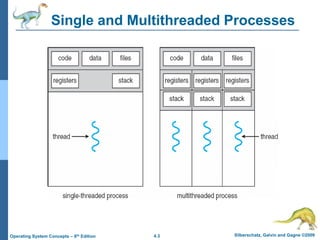
 Thread Is a light weight process (LWP), is a basic unit of CPU utilization
 It comprises thread ID ,program counter,register set
 It shares code section and data section belonging to same program
4.3 Silberschatz, Galvin and Gagne ©2009
Operating System Concepts – 8th Edition
Single and Multithreaded Processes
4.4 Silberschatz, Galvin and Gagne ©2009
Operating System Concepts – 8th Edition
Benefits
 Responsiveness
 Resource Sharing
 Economy
 Utilization of MP architecture /Scalability
4.5 Silberschatz, Galvin and Gagne ©2009
Operating System Concepts – 8th Edition
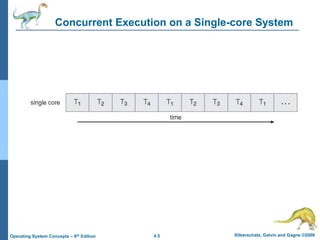
Concurrent Execution on a Single-core System
4.6 Silberschatz, Galvin and Gagne ©2009
Operating System Concepts – 8th Edition
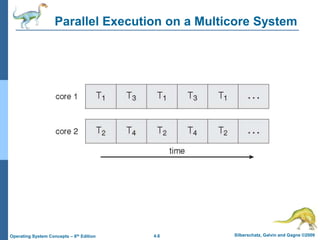
Parallel Execution on a Multicore System
4.7 Silberschatz, Galvin and Gagne ©2009
Operating System Concepts – 8th Edition
User Threads
 Thread management done by user-level threads library
 Three primary thread libraries:
 POSIX Pthreads
 Win32 threads
 Java threads
4.8 Silberschatz, Galvin and Gagne ©2009
Operating System Concepts – 8th Edition
Kernel Threads
 Supported by the Kernel
 Examples
 Windows XP/2000
 Solaris
 Linux
 Tru64 UNIX
 Mac OS X
4.9 Silberschatz, Galvin and Gagne ©2009
Operating System Concepts – 8th Edition
Multithreading Models
 Many-to-One
 One-to-One
 Many-to-Many
4.10 Silberschatz, Galvin and Gagne ©2009
Operating System Concepts – 8th Edition
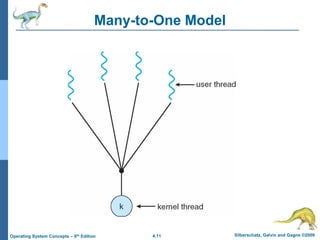
Many-to-One
 Many user-level threads mapped to single kernel thread
 Examples:
 Solaris Green Threads
 GNU Portable Threads
4.11 Silberschatz, Galvin and Gagne ©2009
Operating System Concepts – 8th Edition
Many-to-One Model
4.12 Silberschatz, Galvin and Gagne ©2009
Operating System Concepts – 8th Edition
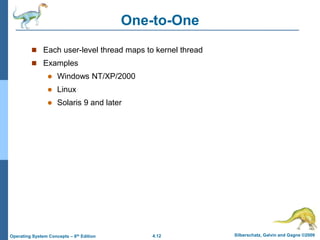
One-to-One
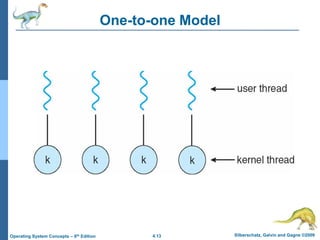
 Each user-level thread maps to kernel thread
 Examples
 Windows NT/XP/2000
 Linux
 Solaris 9 and later
4.13 Silberschatz, Galvin and Gagne ©2009
Operating System Concepts – 8th Edition
One-to-one Model
4.14 Silberschatz, Galvin and Gagne ©2009
Operating System Concepts – 8th Edition
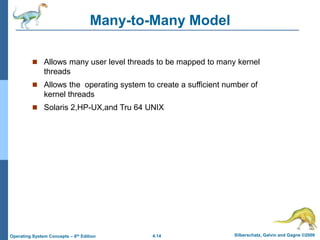
Many-to-Many Model
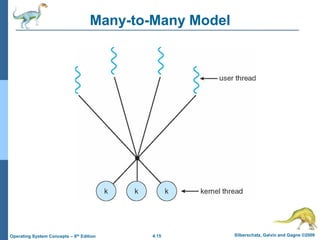
 Allows many user level threads to be mapped to many kernel
threads
 Allows the operating system to create a sufficient number of
kernel threads
 Solaris 2,HP-UX,and Tru 64 UNIX
4.15 Silberschatz, Galvin and Gagne ©2009
Operating System Concepts – 8th Edition
Many-to-Many Model
4.16 Silberschatz, Galvin and Gagne ©2009
Operating System Concepts – 8th Edition
Thread Libraries
 Thread library provides programmer with API for creating and managing
threads
 Two primary ways of implementing
 Library entirely in user space
 Kernel-level library supported by the OS
4.17 Silberschatz, Galvin and Gagne ©2009
Operating System Concepts – 8th Edition
Pthreads
 May be provided either as user-level or kernel-level
 A POSIX standard (IEEE 1003.1c) API for thread creation
and synchronization
 API specifies behavior of the thread library, implementation
is up to development of the library
 Common in UNIX operating systems (Solaris, Linux, Mac
OS X)
4.18 Silberschatz, Galvin and Gagne ©2009
Operating System Concepts – 8th Edition
Java Threads
 Java threads are managed by the JVM
 Typically implemented using the threads model provided by
underlying OS
 Java threads may be created by:
 Extending Thread class
 Implementing the Runnable interface
4.19 Silberschatz, Galvin and Gagne ©2009
Operating System Concepts – 8th Edition
Threading Issues
 Semantics of fork() and exec() system calls
 Thread cancellation of target thread
 Asynchronous or deferred
 Signal handling
 Thread pools
 Thread-specific data
 Scheduler activations
4.20 Silberschatz, Galvin and Gagne ©2009
Operating System Concepts – 8th Edition
Semantics of fork() and exec()
 Does fork() duplicate only the calling thread or all threads?
4.21 Silberschatz, Galvin and Gagne ©2009
Operating System Concepts – 8th Edition
Thread Cancellation
 Terminating a thread before it has finished
 Two general approaches:
 Asynchronous cancellation terminates the target
thread immediately
 Deferred cancellation allows the target thread to
periodically check if it should be cancelled
4.22 Silberschatz, Galvin and Gagne ©2009
Operating System Concepts – 8th Edition
Signal Handling
 Signals are used in UNIX systems to notify a process that a
particular event has occurred
 A signal handler is used to process signals
1. Signal is generated by particular event
2. Signal is delivered to a process
3. Signal is handled
 Options:
 Deliver the signal to the thread to which the signal applies
 Deliver the signal to every thread in the process
 Deliver the signal to certain threads in the process
 Assign a specific threa to receive all signals for the process
4.23 Silberschatz, Galvin and Gagne ©2009
Operating System Concepts – 8th Edition
Thread Pools
 Create a number of threads in a pool where they await work
 Advantages:
 Usually slightly faster to service a request with an existing thread
than create a new thread
 Allows the number of threads in the application(s) to be bound to
the size of the pool
4.24 Silberschatz, Galvin and Gagne ©2009
Operating System Concepts – 8th Edition
Thread Specific Data
 Allows each thread to have its own copy of data
 Useful when you do not have control over the thread creation
process (i.e., when using a thread pool)
4.25 Silberschatz, Galvin and Gagne ©2009
Operating System Concepts – 8th Edition
Scheduler Activations
 Both M:M and Two-level models require communication to maintain
the appropriate number of kernel threads allocated to the application
 Scheduler activations provide upcalls - a communication mechanism
from the kernel to the thread library
 This communication allows an application to maintain the correct
number kernel threads
4.26 Silberschatz, Galvin and Gagne ©2009
Operating System Concepts – 8th Edition
Operating System Examples
 Windows XP Threads
 Linux Thread
4.27 Silberschatz, Galvin and Gagne ©2009
Operating System Concepts – 8th Edition
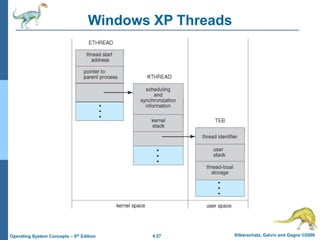
Windows XP Threads
4.28 Silberschatz, Galvin and Gagne ©2009
Operating System Concepts – 8th Edition
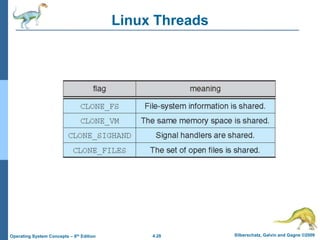
Linux Threads
4.29 Silberschatz, Galvin and Gagne ©2009
Operating System Concepts – 8th Edition
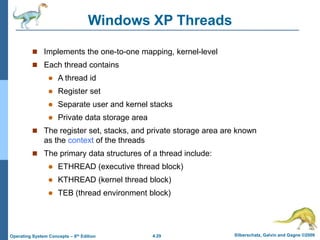
Windows XP Threads
 Implements the one-to-one mapping, kernel-level
 Each thread contains
 A thread id
 Register set
 Separate user and kernel stacks
 Private data storage area
 The register set, stacks, and private storage area are known
as the context of the threads
 The primary data structures of a thread include:
 ETHREAD (executive thread block)
 KTHREAD (kernel thread block)
 TEB (thread environment block)
4.30 Silberschatz, Galvin and Gagne ©2009
Operating System Concepts – 8th Edition
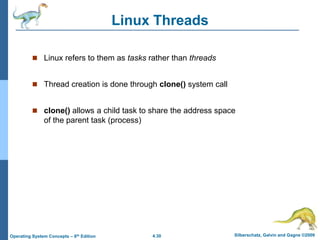
Linux Threads
 Linux refers to them as tasks rather than threads
 Thread creation is done through clone() system call
 clone() allows a child task to share the address space
of the parent task (process)
Silberschatz, Galvin and Gagne ©2009
Operating System Concepts – 8th Edition,
End of Chapter 4

Ch4 threads

  • 1.
    Silberschatz, Galvin andGagne ©2009 Operating System Concepts – 8th Edition, Chapter 4: Threads
  • 2.
    4.2 Silberschatz, Galvinand Gagne ©2009 Operating System Concepts – 8th Edition Thread  Thread Is a light weight process (LWP), is a basic unit of CPU utilization  It comprises thread ID ,program counter,register set  It shares code section and data section belonging to same program
  • 3.
    4.3 Silberschatz, Galvinand Gagne ©2009 Operating System Concepts – 8th Edition Single and Multithreaded Processes
  • 4.
    4.4 Silberschatz, Galvinand Gagne ©2009 Operating System Concepts – 8th Edition Benefits  Responsiveness  Resource Sharing  Economy  Utilization of MP architecture /Scalability
  • 5.
    4.5 Silberschatz, Galvinand Gagne ©2009 Operating System Concepts – 8th Edition Concurrent Execution on a Single-core System
  • 6.
    4.6 Silberschatz, Galvinand Gagne ©2009 Operating System Concepts – 8th Edition Parallel Execution on a Multicore System
  • 7.
    4.7 Silberschatz, Galvinand Gagne ©2009 Operating System Concepts – 8th Edition User Threads  Thread management done by user-level threads library  Three primary thread libraries:  POSIX Pthreads  Win32 threads  Java threads
  • 8.
    4.8 Silberschatz, Galvinand Gagne ©2009 Operating System Concepts – 8th Edition Kernel Threads  Supported by the Kernel  Examples  Windows XP/2000  Solaris  Linux  Tru64 UNIX  Mac OS X
  • 9.
    4.9 Silberschatz, Galvinand Gagne ©2009 Operating System Concepts – 8th Edition Multithreading Models  Many-to-One  One-to-One  Many-to-Many
  • 10.
    4.10 Silberschatz, Galvinand Gagne ©2009 Operating System Concepts – 8th Edition Many-to-One  Many user-level threads mapped to single kernel thread  Examples:  Solaris Green Threads  GNU Portable Threads
  • 11.
    4.11 Silberschatz, Galvinand Gagne ©2009 Operating System Concepts – 8th Edition Many-to-One Model
  • 12.
    4.12 Silberschatz, Galvinand Gagne ©2009 Operating System Concepts – 8th Edition One-to-One  Each user-level thread maps to kernel thread  Examples  Windows NT/XP/2000  Linux  Solaris 9 and later
  • 13.
    4.13 Silberschatz, Galvinand Gagne ©2009 Operating System Concepts – 8th Edition One-to-one Model
  • 14.
    4.14 Silberschatz, Galvinand Gagne ©2009 Operating System Concepts – 8th Edition Many-to-Many Model  Allows many user level threads to be mapped to many kernel threads  Allows the operating system to create a sufficient number of kernel threads  Solaris 2,HP-UX,and Tru 64 UNIX
  • 15.
    4.15 Silberschatz, Galvinand Gagne ©2009 Operating System Concepts – 8th Edition Many-to-Many Model
  • 16.
    4.16 Silberschatz, Galvinand Gagne ©2009 Operating System Concepts – 8th Edition Thread Libraries  Thread library provides programmer with API for creating and managing threads  Two primary ways of implementing  Library entirely in user space  Kernel-level library supported by the OS
  • 17.
    4.17 Silberschatz, Galvinand Gagne ©2009 Operating System Concepts – 8th Edition Pthreads  May be provided either as user-level or kernel-level  A POSIX standard (IEEE 1003.1c) API for thread creation and synchronization  API specifies behavior of the thread library, implementation is up to development of the library  Common in UNIX operating systems (Solaris, Linux, Mac OS X)
  • 18.
    4.18 Silberschatz, Galvinand Gagne ©2009 Operating System Concepts – 8th Edition Java Threads  Java threads are managed by the JVM  Typically implemented using the threads model provided by underlying OS  Java threads may be created by:  Extending Thread class  Implementing the Runnable interface
  • 19.
    4.19 Silberschatz, Galvinand Gagne ©2009 Operating System Concepts – 8th Edition Threading Issues  Semantics of fork() and exec() system calls  Thread cancellation of target thread  Asynchronous or deferred  Signal handling  Thread pools  Thread-specific data  Scheduler activations
  • 20.
    4.20 Silberschatz, Galvinand Gagne ©2009 Operating System Concepts – 8th Edition Semantics of fork() and exec()  Does fork() duplicate only the calling thread or all threads?
  • 21.
    4.21 Silberschatz, Galvinand Gagne ©2009 Operating System Concepts – 8th Edition Thread Cancellation  Terminating a thread before it has finished  Two general approaches:  Asynchronous cancellation terminates the target thread immediately  Deferred cancellation allows the target thread to periodically check if it should be cancelled
  • 22.
    4.22 Silberschatz, Galvinand Gagne ©2009 Operating System Concepts – 8th Edition Signal Handling  Signals are used in UNIX systems to notify a process that a particular event has occurred  A signal handler is used to process signals 1. Signal is generated by particular event 2. Signal is delivered to a process 3. Signal is handled  Options:  Deliver the signal to the thread to which the signal applies  Deliver the signal to every thread in the process  Deliver the signal to certain threads in the process  Assign a specific threa to receive all signals for the process
  • 23.
    4.23 Silberschatz, Galvinand Gagne ©2009 Operating System Concepts – 8th Edition Thread Pools  Create a number of threads in a pool where they await work  Advantages:  Usually slightly faster to service a request with an existing thread than create a new thread  Allows the number of threads in the application(s) to be bound to the size of the pool
  • 24.
    4.24 Silberschatz, Galvinand Gagne ©2009 Operating System Concepts – 8th Edition Thread Specific Data  Allows each thread to have its own copy of data  Useful when you do not have control over the thread creation process (i.e., when using a thread pool)
  • 25.
    4.25 Silberschatz, Galvinand Gagne ©2009 Operating System Concepts – 8th Edition Scheduler Activations  Both M:M and Two-level models require communication to maintain the appropriate number of kernel threads allocated to the application  Scheduler activations provide upcalls - a communication mechanism from the kernel to the thread library  This communication allows an application to maintain the correct number kernel threads
  • 26.
    4.26 Silberschatz, Galvinand Gagne ©2009 Operating System Concepts – 8th Edition Operating System Examples  Windows XP Threads  Linux Thread
  • 27.
    4.27 Silberschatz, Galvinand Gagne ©2009 Operating System Concepts – 8th Edition Windows XP Threads
  • 28.
    4.28 Silberschatz, Galvinand Gagne ©2009 Operating System Concepts – 8th Edition Linux Threads
  • 29.
    4.29 Silberschatz, Galvinand Gagne ©2009 Operating System Concepts – 8th Edition Windows XP Threads  Implements the one-to-one mapping, kernel-level  Each thread contains  A thread id  Register set  Separate user and kernel stacks  Private data storage area  The register set, stacks, and private storage area are known as the context of the threads  The primary data structures of a thread include:  ETHREAD (executive thread block)  KTHREAD (kernel thread block)  TEB (thread environment block)
  • 30.
    4.30 Silberschatz, Galvinand Gagne ©2009 Operating System Concepts – 8th Edition Linux Threads  Linux refers to them as tasks rather than threads  Thread creation is done through clone() system call  clone() allows a child task to share the address space of the parent task (process)
  • 31.
    Silberschatz, Galvin andGagne ©2009 Operating System Concepts – 8th Edition, End of Chapter 4