INTRODUCTION:
DIFFERENT TYPES OF DIODE AND
IT'S FUNCTION AND
APPLICATION
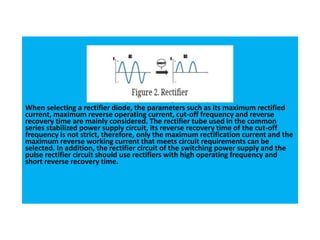
When selecting a rectifier diode, the parameters such as its maximum rectified
current, maximum reverse operating current, cut-off frequency and reverse
recovery time are mainly considered. The rectifier tube used in the common
series stabilized power supply circuit, its reverse recovery time of the cut-off
frequency is not strict, therefore, only the maximum rectification current and the
maximum reverse working current that meets circuit requirements can be
selected. In addition, the rectifier circuit of the switching power supply and the
pulse rectifier circuit should use rectifiers with high operating frequency and
short reverse recovery time.
Rectifier Diode
Rectifier diodes can rectify AC power into pulsating DC power using the unidirectional
conductivity characteristics. Because the forward current of the rectifier diode is
relatively large, the structure always adopt to the surface-contact type. But this
structure will cause a large junction capacitance. Generally, the operating frequency
of the rectifier diode is less than 3KHz. Fully sealed metal structure packaging and
plastic packaging are common for rectifier diodes. The rectifiers with a forward rated
current of more than 1A are packaged in a metal shell to dissipate heat fully; the
rectifiers with a forward rated current of less than 1A are mostly packaged with full
plastic.
Rectifier Function
The rectifier diode has obvious unidirectional
conductivity. The rectifier diode can be made of materials
such as semiconductor germanium or silicon. The role of
silicon rectifier diodes can effectively have high
breakdown voltage, small reverse leakage current, and
excellent high-temperature performance. The function of
the rectifier diode is to use the unidirectional conduction
characteristics of the PN junction to convert alternating
current into pulsating direct current. The current of the
rectifier diode is relatively large, and most of them are
packaged with surface contact materials.
Rectifier Application
The rectifier diodes have many applications. Here are a few of the typical applications of diodes
include:
Rectifying a voltage, such as turning the AC into DC voltages
•Isolating signals from a supply
•Voltage Reference
•Controlling the size of a signal
•Mixing signals
•Detection signals
•Lighting systems
•LASER diodes
Thus, a rectifier diode allows the flow of electrical current in simply one direction, used for the
operation of the power supply. These diodes can handle the maximum flow of current as
compared to normal diodes. These diodes are normally used to alter alternating current (AC) to
direct current (DC). The designing of these can be done like discrete components otherwise
integrated circuits. These are designed from Si & distinguished through a quite large PN junction
surface so, it results in high capacitance in reverse-bias conditions. The two rectifier diodes are
connected to high-voltage supplies in series to enhance the rating of PIV (peak-inverse-voltage)
for the combination.
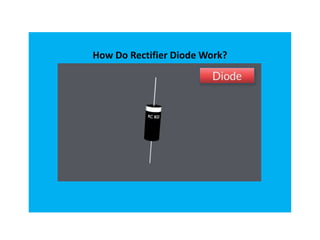
How Do Rectifier Diode Work?
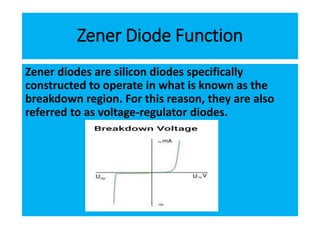
Zener Diode Function
Zener diodes are silicon diodes specifically
constructed to operate in what is known as the
breakdown region. For this reason, they are also
referred to as voltage-regulator diodes.
The maximum voltage rating specifies how much reverse voltage a
diode can withstand before breakdown occurs. For most, this is at
least 50 V. Ordinary diodes that are reverse-biased have reverse
current that is so small as to be zero, so that the diode behaves
similar to an open circuit. When the maximum voltage rating is
exceeded, however, a large reverse current is produced, and the
diode becomes destroyed. This destruction occurs at what is
known as the reverse breakdown voltage or peak inverse voltage
(PIV). Zener diodes are created to operate optimally when they
are reverse-biased and, instead of being destroyed, will conduct
electricity under conditions where normal a diode's breakdown
voltages are reached. Zener diode breakdown voltages can range
from 2 to 200 V.
Zener Diode Application
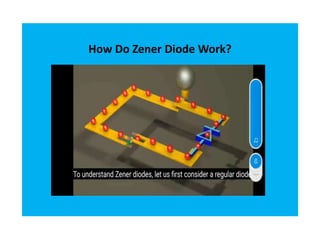
Zener diode is used as a shunt voltage
regulator. Zener diode is connected parallel
to the load to make it reverse bias and once
the Zener diode exceeds knee voltage, the
voltage across the load becomes constant
How Do Zener Diode Work?
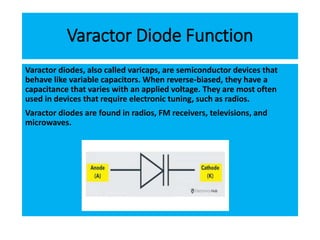
Varactor Diode Function
Varactor diodes, also called varicaps, are semiconductor devices that
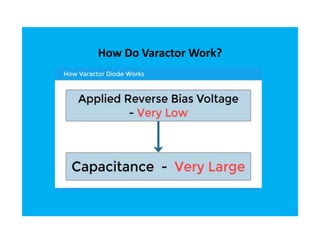
behave like variable capacitors. When reverse-biased, they have a
capacitance that varies with an applied voltage. They are most often
used in devices that require electronic tuning, such as radios.
Varactor diodes are found in radios, FM receivers, televisions, and
microwaves.
Varactor Diode Application
Applications of varactor diode
• Varactor diode is used in frequency multipliers. •
Varactor diode is used in parametric amplifiers. •
Varactor diode is used in voltage-controlled
oscillators.
How Do Varactor Work?
Optical Diode Function
An optical isolator or optical diode is a device that is
designed to allow the optical signal travel in the
forward direction while block reflections that would
travel in the backward direction. Optical isolators
are critically important in many applications in
optical systems.
The two types of diodes, reciprocal and
nonreciprocal optical diodes, have been proposed
based on different mechanisms.
Optical Diode Application
An optical isolator, or optical diode, is an optical
component which allows the transmission of light in
only one direction. It is typically used to prevent
unwanted feedback into an optical oscillator, such
as a laser cavity.
How Do Optical Diode Work?
Light Emitting Diode Function
The Light-emitting diode is a two-lead semiconductor
light source. In 1962, Nick Holonyak has come up with
the idea of a light-emitting diode, and he was working
for the general electric company. The LED is a special
type of diode and they have similar electrical
characteristics to a PN junction diode. Hence the LED
allows the flow of current in the forward direction and
blocks the current in the reverse direction. The LED
occupies a small area which is less than 1 mm2. The
applications of LEDs used to make various electrical and
electronic projects.
Light Emitting Diode Application
There are many applications of LED and some of
them are explained below.
LED is used as a bulb in the homes and industries
The light-emitting diodes are used in motorcycles
and cars
These are used in mobile phones to display the
message
At the traffic light signals led’s are used
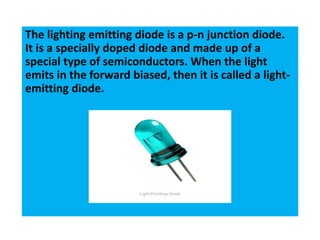
The lighting emitting diode is a p-n junction diode.
It is a specially doped diode and made up of a
special type of semiconductors. When the light
emits in the forward biased, then it is called a light-
emitting diode.
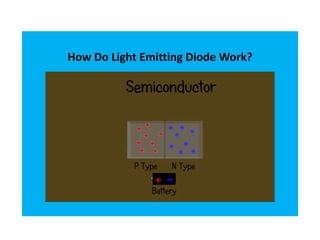
How Do Light Emitting Diode Work?
Seven Segment Led Function
Seven-segment displays are widely used in digital
clocks, electronic meters, basic calculators, displays
in home appliances, cars, and various other
electronic devices that display numerical
information. There are two different types of
driving seven-segment displays:- the common
anode type and the common cathode type.
Seven Segment Led Application
Seven-segment displays are widely used
in digital clocks, electronic meters, basic
calculators, and other electronic devices
that display numerical information.
How Do Seven Segment Led or Display work?
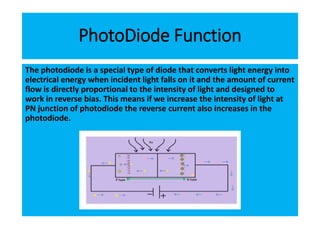
PhotoDiode Function
The photodiode is a special type of diode that converts light energy into
electrical energy when incident light falls on it and the amount of current
flow is directly proportional to the intensity of light and designed to
work in reverse bias. This means if we increase the intensity of light at
PN junction of photodiode the reverse current also increases in the
photodiode.
Photodiode Application
There is a wide range of use of photodiodes and found in most of the devices:
• Photodiode used as a light sensor. As the current in it is directly proportional to the intensity of light thus also used to measure the intensity
of light.
• We can use the photodiode in smoke detectors to sense smoke and fire.
• Photodiode coupled with led to make optoisolators and optocouplers
• Used in a solar panel as solar cells
• Used in barcode scanner, character recognition
• Used in the obstacle detection system,
• Can be used in printers as page presence and page counter
• Used in proximity detection, oximeters
• It is also used in optical encoders and decoders
• Optical message transmission, Fibre optics-based communication
• Position sensorhotodiode used as a light sensor. As the current in it is directly proportional to the intensity of light thus also used to measure
the intensity of light.
• We can use the photodiode in smoke detectors to sense smoke and fire.
• Photodiode coupled with led to make optoisolators and optocouplers
• Used in a solar panel as solar cells
• Used in barcode scanner, character recognition
• Used in the obstacle detection system,
• Can be used in printers as page presence and page counter
• Used in proximity detection, oximeters
• It is also used in optical encoders and decoders
• Optical message transmission, Fibre optics-based communication
How Do Photodiode Work?
Schottky Diode Function
Schottky diodes are used for their low turn-
on voltage, fast recovery time and low-loss
energy at higher frequencies. These
characteristics make Schottky diodes capable
of rectifying a current by facilitating a quick
transition from conducting to blocking state.
Schottky Diode application
A Schottky diode is one type of electronic
component, which is also known as a barrier
diode. It is widely used in different
applications like a mixer, in radio frequency
applications, and as a rectifier in power
applications. It's a low voltage diode. The
power drop is lower compared to the PN
junction diodes.
How Do Schottky Diode work?
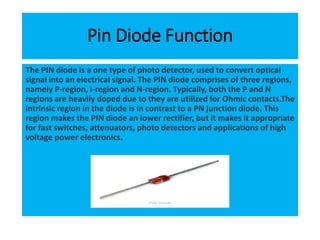
Pin Diode Function
The PIN diode is a one type of photo detector, used to convert optical
signal into an electrical signal. The PIN diode comprises of three regions,
namely P-region, I-region and N-region. Typically, both the P and N
regions are heavily doped due to they are utilized for Ohmic contacts.The
intrinsic region in the diode is in contrast to a PN junction diode. This
region makes the PIN diode an lower rectifier, but it makes it appropriate
for fast switches, attenuators, photo detectors and applications of high
voltage power electronics.
Pin Diode Application
The applications of PIN mainly include the following areas
•The PIN diode is used as a high voltage rectifier. The intrinsic layer in the diode offers a partition
between the both the layers, permitting higher reverse voltages to be tolerated
•The PIN diode is used as an ideal radio frequency switch. The intrinsic layer among the P & N
layers increases the space between them. This also reduces the capacitance between both the
regions, thus raising the level of isolation when the PIN diode is reverse biased.
•The PIN diode is used as a photo detector to convert the light into the current which takes place
in the depletion layer of a photo diode, rising the depletion layer by inserting the intrinsic layer
progresses the performance by increasing the volume in where light change occurs.
•This diode is an ideal element to give electronics switching in applications of electronics. It is
mainly useful for RF design applications and also for providing the switching, or an attenuating
element in RF attenuators and RF switches. The PIN diode is capable to give much higher levels of
consistency than RF relays that are frequently the only other alternative.
•The main applications of the PIN diode are discussed in the above, although they can also be
applied in some other areas
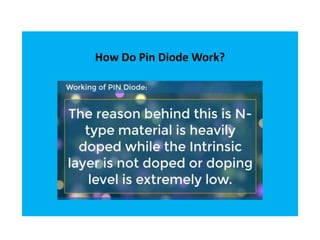
How Do Pin Diode Work?
Tunnel Diode Function
A tunnel diode is a semiconductor diode that
exhibits negative resistance, meaning the current
decreases with an increase in voltage. By making
use of quantum mechanical effects, the tunnel
diode is capable of fast operation and can function
well into the microwave radio frequency band.
Tunnel diode Application
Tunnel diode can be used as a switch, amplifier, and
oscillator. Since it shows a fast response, it is used
as high frequency component. Tunnel diode acts as
logic memory storage device. They are used in
oscillator circuits, and in FM receivers. Since it is a
low current device, it is not used more.
How Do Tunnel Diode Work?
Laser Diode Function
A Laser Diode is a semiconductor device similar to a
light-emitting diode (LED). It uses p-n junction to emit
coherent light in which all the waves are at the same
frequency and phase. This coherent light is produced by
the laser diode using a process termed as “Light
Amplification by Stimulated Emission of Radiation”,
which is abbreviated as LASER. And since a p-n junction
is used to produce laser light, this device is named as a
laser diode. Before we learn more about the working
process of a laser diode, let’s look at how laser light is
different from other types of light, and its advantages.
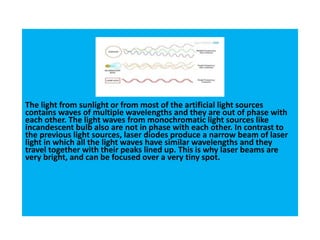
The light from sunlight or from most of the artificial light sources
contains waves of multiple wavelengths and they are out of phase with
each other. The light waves from monochromatic light sources like
incandescent bulb also are not in phase with each other. In contrast to
the previous light sources, laser diodes produce a narrow beam of laser
light in which all the light waves have similar wavelengths and they
travel together with their peaks lined up. This is why laser beams are
very bright, and can be focused over a very tiny spot.
Of all the devices that produce laser light, laser diodes or
semiconductor lasers are the most efficient and they come in
smaller packages. So they are widely used in various devices
like laser printers, barcode readers, security systems,
Autonomous vehicles (LIDAR), Fiber optic communications etc.
Laser diode Application
Laser Diode modules are used in all major areas of electronics ranging from
•Consumer Electronics: CD/DVD players, Laser printers, Fiber Optic
Communication, Barcode Readers etc.
•Medical Machines: Laser diodes are used in machines used to remove
unwanted tissues, eliminating cancer cells, non-invasive and cataract
surgeries etc.
•Autonomous Vehicles: Laser diode technology is used in making LIDAR
systems implemented for autonomous driving
•Scientific Instrumentation: Lasers are used in devices used for remote
contactless measurements, spectrometry, range finders etc.
•Industrial Applications: Laser Diodes are used as a source of high intensity
laser beam for precise cutting of materials. They are also used in 3D printing
to soften the substrate.
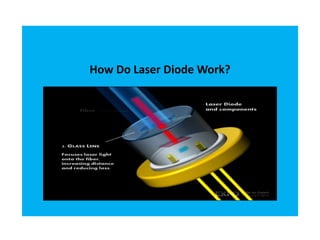
How Do Laser Diode Work?
THE END!
Prepared by:
Canobar Jr Jay N.
BSEE 3A

INTRODUCTION DIFFERENT TYPES OF DIODE AND IT'S FUNCTION AND APPLICATION

  • 1.
    INTRODUCTION: DIFFERENT TYPES OFDIODE AND IT'S FUNCTION AND APPLICATION
  • 2.
    When selecting arectifier diode, the parameters such as its maximum rectified current, maximum reverse operating current, cut-off frequency and reverse recovery time are mainly considered. The rectifier tube used in the common series stabilized power supply circuit, its reverse recovery time of the cut-off frequency is not strict, therefore, only the maximum rectification current and the maximum reverse working current that meets circuit requirements can be selected. In addition, the rectifier circuit of the switching power supply and the pulse rectifier circuit should use rectifiers with high operating frequency and short reverse recovery time.
  • 3.
    Rectifier Diode Rectifier diodescan rectify AC power into pulsating DC power using the unidirectional conductivity characteristics. Because the forward current of the rectifier diode is relatively large, the structure always adopt to the surface-contact type. But this structure will cause a large junction capacitance. Generally, the operating frequency of the rectifier diode is less than 3KHz. Fully sealed metal structure packaging and plastic packaging are common for rectifier diodes. The rectifiers with a forward rated current of more than 1A are packaged in a metal shell to dissipate heat fully; the rectifiers with a forward rated current of less than 1A are mostly packaged with full plastic.
  • 4.
    Rectifier Function The rectifierdiode has obvious unidirectional conductivity. The rectifier diode can be made of materials such as semiconductor germanium or silicon. The role of silicon rectifier diodes can effectively have high breakdown voltage, small reverse leakage current, and excellent high-temperature performance. The function of the rectifier diode is to use the unidirectional conduction characteristics of the PN junction to convert alternating current into pulsating direct current. The current of the rectifier diode is relatively large, and most of them are packaged with surface contact materials.
  • 5.
    Rectifier Application The rectifierdiodes have many applications. Here are a few of the typical applications of diodes include: Rectifying a voltage, such as turning the AC into DC voltages •Isolating signals from a supply •Voltage Reference •Controlling the size of a signal •Mixing signals •Detection signals •Lighting systems •LASER diodes Thus, a rectifier diode allows the flow of electrical current in simply one direction, used for the operation of the power supply. These diodes can handle the maximum flow of current as compared to normal diodes. These diodes are normally used to alter alternating current (AC) to direct current (DC). The designing of these can be done like discrete components otherwise integrated circuits. These are designed from Si & distinguished through a quite large PN junction surface so, it results in high capacitance in reverse-bias conditions. The two rectifier diodes are connected to high-voltage supplies in series to enhance the rating of PIV (peak-inverse-voltage) for the combination.
  • 6.
    How Do RectifierDiode Work?
  • 7.
    Zener Diode Function Zenerdiodes are silicon diodes specifically constructed to operate in what is known as the breakdown region. For this reason, they are also referred to as voltage-regulator diodes.
  • 8.
    The maximum voltagerating specifies how much reverse voltage a diode can withstand before breakdown occurs. For most, this is at least 50 V. Ordinary diodes that are reverse-biased have reverse current that is so small as to be zero, so that the diode behaves similar to an open circuit. When the maximum voltage rating is exceeded, however, a large reverse current is produced, and the diode becomes destroyed. This destruction occurs at what is known as the reverse breakdown voltage or peak inverse voltage (PIV). Zener diodes are created to operate optimally when they are reverse-biased and, instead of being destroyed, will conduct electricity under conditions where normal a diode's breakdown voltages are reached. Zener diode breakdown voltages can range from 2 to 200 V.
  • 9.
    Zener Diode Application Zenerdiode is used as a shunt voltage regulator. Zener diode is connected parallel to the load to make it reverse bias and once the Zener diode exceeds knee voltage, the voltage across the load becomes constant
  • 10.
    How Do ZenerDiode Work?
  • 11.
    Varactor Diode Function Varactordiodes, also called varicaps, are semiconductor devices that behave like variable capacitors. When reverse-biased, they have a capacitance that varies with an applied voltage. They are most often used in devices that require electronic tuning, such as radios. Varactor diodes are found in radios, FM receivers, televisions, and microwaves.
  • 12.
    Varactor Diode Application Applicationsof varactor diode • Varactor diode is used in frequency multipliers. • Varactor diode is used in parametric amplifiers. • Varactor diode is used in voltage-controlled oscillators.
  • 13.
  • 14.
    Optical Diode Function Anoptical isolator or optical diode is a device that is designed to allow the optical signal travel in the forward direction while block reflections that would travel in the backward direction. Optical isolators are critically important in many applications in optical systems. The two types of diodes, reciprocal and nonreciprocal optical diodes, have been proposed based on different mechanisms.
  • 15.
    Optical Diode Application Anoptical isolator, or optical diode, is an optical component which allows the transmission of light in only one direction. It is typically used to prevent unwanted feedback into an optical oscillator, such as a laser cavity.
  • 16.
    How Do OpticalDiode Work?
  • 17.
    Light Emitting DiodeFunction The Light-emitting diode is a two-lead semiconductor light source. In 1962, Nick Holonyak has come up with the idea of a light-emitting diode, and he was working for the general electric company. The LED is a special type of diode and they have similar electrical characteristics to a PN junction diode. Hence the LED allows the flow of current in the forward direction and blocks the current in the reverse direction. The LED occupies a small area which is less than 1 mm2. The applications of LEDs used to make various electrical and electronic projects.
  • 18.
    Light Emitting DiodeApplication There are many applications of LED and some of them are explained below. LED is used as a bulb in the homes and industries The light-emitting diodes are used in motorcycles and cars These are used in mobile phones to display the message At the traffic light signals led’s are used
  • 19.
    The lighting emittingdiode is a p-n junction diode. It is a specially doped diode and made up of a special type of semiconductors. When the light emits in the forward biased, then it is called a light- emitting diode.
  • 20.
    How Do LightEmitting Diode Work?
  • 21.
    Seven Segment LedFunction Seven-segment displays are widely used in digital clocks, electronic meters, basic calculators, displays in home appliances, cars, and various other electronic devices that display numerical information. There are two different types of driving seven-segment displays:- the common anode type and the common cathode type.
  • 22.
    Seven Segment LedApplication Seven-segment displays are widely used in digital clocks, electronic meters, basic calculators, and other electronic devices that display numerical information.
  • 23.
    How Do SevenSegment Led or Display work?
  • 24.
    PhotoDiode Function The photodiodeis a special type of diode that converts light energy into electrical energy when incident light falls on it and the amount of current flow is directly proportional to the intensity of light and designed to work in reverse bias. This means if we increase the intensity of light at PN junction of photodiode the reverse current also increases in the photodiode.
  • 25.
    Photodiode Application There isa wide range of use of photodiodes and found in most of the devices: • Photodiode used as a light sensor. As the current in it is directly proportional to the intensity of light thus also used to measure the intensity of light. • We can use the photodiode in smoke detectors to sense smoke and fire. • Photodiode coupled with led to make optoisolators and optocouplers • Used in a solar panel as solar cells • Used in barcode scanner, character recognition • Used in the obstacle detection system, • Can be used in printers as page presence and page counter • Used in proximity detection, oximeters • It is also used in optical encoders and decoders • Optical message transmission, Fibre optics-based communication • Position sensorhotodiode used as a light sensor. As the current in it is directly proportional to the intensity of light thus also used to measure the intensity of light. • We can use the photodiode in smoke detectors to sense smoke and fire. • Photodiode coupled with led to make optoisolators and optocouplers • Used in a solar panel as solar cells • Used in barcode scanner, character recognition • Used in the obstacle detection system, • Can be used in printers as page presence and page counter • Used in proximity detection, oximeters • It is also used in optical encoders and decoders • Optical message transmission, Fibre optics-based communication
  • 26.
  • 27.
    Schottky Diode Function Schottkydiodes are used for their low turn- on voltage, fast recovery time and low-loss energy at higher frequencies. These characteristics make Schottky diodes capable of rectifying a current by facilitating a quick transition from conducting to blocking state.
  • 28.
    Schottky Diode application ASchottky diode is one type of electronic component, which is also known as a barrier diode. It is widely used in different applications like a mixer, in radio frequency applications, and as a rectifier in power applications. It's a low voltage diode. The power drop is lower compared to the PN junction diodes.
  • 29.
    How Do SchottkyDiode work?
  • 30.
    Pin Diode Function ThePIN diode is a one type of photo detector, used to convert optical signal into an electrical signal. The PIN diode comprises of three regions, namely P-region, I-region and N-region. Typically, both the P and N regions are heavily doped due to they are utilized for Ohmic contacts.The intrinsic region in the diode is in contrast to a PN junction diode. This region makes the PIN diode an lower rectifier, but it makes it appropriate for fast switches, attenuators, photo detectors and applications of high voltage power electronics.
  • 31.
    Pin Diode Application Theapplications of PIN mainly include the following areas •The PIN diode is used as a high voltage rectifier. The intrinsic layer in the diode offers a partition between the both the layers, permitting higher reverse voltages to be tolerated •The PIN diode is used as an ideal radio frequency switch. The intrinsic layer among the P & N layers increases the space between them. This also reduces the capacitance between both the regions, thus raising the level of isolation when the PIN diode is reverse biased. •The PIN diode is used as a photo detector to convert the light into the current which takes place in the depletion layer of a photo diode, rising the depletion layer by inserting the intrinsic layer progresses the performance by increasing the volume in where light change occurs. •This diode is an ideal element to give electronics switching in applications of electronics. It is mainly useful for RF design applications and also for providing the switching, or an attenuating element in RF attenuators and RF switches. The PIN diode is capable to give much higher levels of consistency than RF relays that are frequently the only other alternative. •The main applications of the PIN diode are discussed in the above, although they can also be applied in some other areas
  • 32.
    How Do PinDiode Work?
  • 33.
    Tunnel Diode Function Atunnel diode is a semiconductor diode that exhibits negative resistance, meaning the current decreases with an increase in voltage. By making use of quantum mechanical effects, the tunnel diode is capable of fast operation and can function well into the microwave radio frequency band.
  • 34.
    Tunnel diode Application Tunneldiode can be used as a switch, amplifier, and oscillator. Since it shows a fast response, it is used as high frequency component. Tunnel diode acts as logic memory storage device. They are used in oscillator circuits, and in FM receivers. Since it is a low current device, it is not used more.
  • 35.
    How Do TunnelDiode Work?
  • 36.
    Laser Diode Function ALaser Diode is a semiconductor device similar to a light-emitting diode (LED). It uses p-n junction to emit coherent light in which all the waves are at the same frequency and phase. This coherent light is produced by the laser diode using a process termed as “Light Amplification by Stimulated Emission of Radiation”, which is abbreviated as LASER. And since a p-n junction is used to produce laser light, this device is named as a laser diode. Before we learn more about the working process of a laser diode, let’s look at how laser light is different from other types of light, and its advantages.
  • 37.
    The light fromsunlight or from most of the artificial light sources contains waves of multiple wavelengths and they are out of phase with each other. The light waves from monochromatic light sources like incandescent bulb also are not in phase with each other. In contrast to the previous light sources, laser diodes produce a narrow beam of laser light in which all the light waves have similar wavelengths and they travel together with their peaks lined up. This is why laser beams are very bright, and can be focused over a very tiny spot.
  • 38.
    Of all thedevices that produce laser light, laser diodes or semiconductor lasers are the most efficient and they come in smaller packages. So they are widely used in various devices like laser printers, barcode readers, security systems, Autonomous vehicles (LIDAR), Fiber optic communications etc.
  • 39.
    Laser diode Application LaserDiode modules are used in all major areas of electronics ranging from •Consumer Electronics: CD/DVD players, Laser printers, Fiber Optic Communication, Barcode Readers etc. •Medical Machines: Laser diodes are used in machines used to remove unwanted tissues, eliminating cancer cells, non-invasive and cataract surgeries etc. •Autonomous Vehicles: Laser diode technology is used in making LIDAR systems implemented for autonomous driving •Scientific Instrumentation: Lasers are used in devices used for remote contactless measurements, spectrometry, range finders etc. •Industrial Applications: Laser Diodes are used as a source of high intensity laser beam for precise cutting of materials. They are also used in 3D printing to soften the substrate.
  • 40.
    How Do LaserDiode Work?
  • 41.