Dioda AC
dwiky purba c
Here is where your presentation begins
#INDIGENOUS PEOPLE DAY
INTRODUCTION
Diode is a two-pole active component which is
generally a semiconductor, which allows electric
current to flow in one direction (forward bias
condition) and inhibits current from the opposite
direction (backward bias condition).
Its function is to deliver electric current in one
direction but inhibit electricity from the opposite
direction.
The Construction and
Symbol Of Diode
• Made from cpmbination of 2 extrinsic semiconductors, P-type
and N-type material.
• The joint between the P-type and N-type material is called PN
junction
• Have 2 terminal 9anode and cathode)
• Produced from the silicon water
DIODES
CHARACTERISTICS
Diodes have two characteristics, namely forward bias and
reverse bias.
1). Diode in Forward Bias
The first characteristic of the diode is that it is forward biased.
This diode is to provide an external voltage towards the
diode terminal direction.
2). Diode in Reverse Bias
The second characteristic of the diode is that it is reverse
biased. The anode electrode is connected to the negative
pole and the cathode is connected to the positive pole so
that the current flowing in this circuit will be smaller.
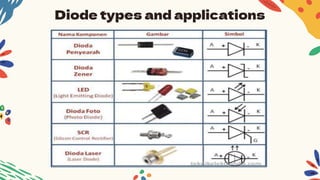
Diode types and applications
Power Diode
01.
• Rectifying power supply circuit (Rectifier =
penerus)
Signal Diode
• Signal sensor in radar
02
Zener Diode
• Voltage regulator in power supply circuit.
• Voltage clipper in power supply circuit.
03
LED Diode
• Indicator light in electronic circuit
04
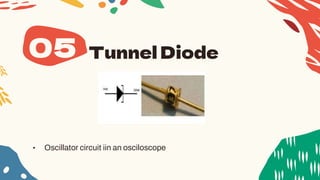
Tunnel Diode
• Oscillator circuit iin an osciloscope
05
Varactor Diode
• Variable capacitor in a tune circuit
06
Photo Diode
• Light sensor in a remote control unit
07
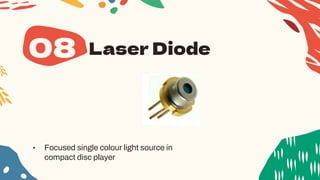
Laser Diode
• Focused single colour light source in
compact disc player
08
How Diodes Work
The way the diode works is that the diode can only
pass one direct current, when the diode gains current the diode will
advance in one direction. This is because there is a junction on the
diode, which is the conductor junction between the P-type and N-
type.
Under these conditions the introductory conduction is
still relatively small. If the diode is reverse biased, the diode will not
work and in this condition the diode has a high internal resistance
which makes it difficult for current to flow.
CREDITS: This presentation template was created by Slidesgo,
including icons by Flaticon and infographics & images by Freepik
THANKS!
DO YOU HAVE ANY QUESTIONS?
youremail@freepik.com | +91 620 421 838
yourwebsite.com
Please keep this slide for attribution

03_DIODA_DWIKY PURBA C.pptx

  • 1.
    Dioda AC dwiky purbac Here is where your presentation begins #INDIGENOUS PEOPLE DAY
  • 2.
    INTRODUCTION Diode is atwo-pole active component which is generally a semiconductor, which allows electric current to flow in one direction (forward bias condition) and inhibits current from the opposite direction (backward bias condition). Its function is to deliver electric current in one direction but inhibit electricity from the opposite direction.
  • 3.
    The Construction and SymbolOf Diode • Made from cpmbination of 2 extrinsic semiconductors, P-type and N-type material. • The joint between the P-type and N-type material is called PN junction • Have 2 terminal 9anode and cathode) • Produced from the silicon water
  • 4.
    DIODES CHARACTERISTICS Diodes have twocharacteristics, namely forward bias and reverse bias. 1). Diode in Forward Bias The first characteristic of the diode is that it is forward biased. This diode is to provide an external voltage towards the diode terminal direction. 2). Diode in Reverse Bias The second characteristic of the diode is that it is reverse biased. The anode electrode is connected to the negative pole and the cathode is connected to the positive pole so that the current flowing in this circuit will be smaller.
  • 5.
    Diode types andapplications
  • 6.
    Power Diode 01. • Rectifyingpower supply circuit (Rectifier = penerus)
  • 7.
    Signal Diode • Signalsensor in radar 02
  • 8.
    Zener Diode • Voltageregulator in power supply circuit. • Voltage clipper in power supply circuit. 03
  • 9.
    LED Diode • Indicatorlight in electronic circuit 04
  • 10.
    Tunnel Diode • Oscillatorcircuit iin an osciloscope 05
  • 11.
    Varactor Diode • Variablecapacitor in a tune circuit 06
  • 12.
    Photo Diode • Lightsensor in a remote control unit 07
  • 13.
    Laser Diode • Focusedsingle colour light source in compact disc player 08
  • 14.
    How Diodes Work Theway the diode works is that the diode can only pass one direct current, when the diode gains current the diode will advance in one direction. This is because there is a junction on the diode, which is the conductor junction between the P-type and N- type. Under these conditions the introductory conduction is still relatively small. If the diode is reverse biased, the diode will not work and in this condition the diode has a high internal resistance which makes it difficult for current to flow.
  • 15.
    CREDITS: This presentationtemplate was created by Slidesgo, including icons by Flaticon and infographics & images by Freepik THANKS! DO YOU HAVE ANY QUESTIONS? youremail@freepik.com | +91 620 421 838 yourwebsite.com Please keep this slide for attribution