Precision Dimensioning
Engineering II
Dimensioning Rectangular Prisms
Dimensioning Cylinders
• The diameter of
cylinders should be
dimensioned in the
rectangular view
(not the circular
view).
• Cylinders without a
hole passing
through them only
require one view.
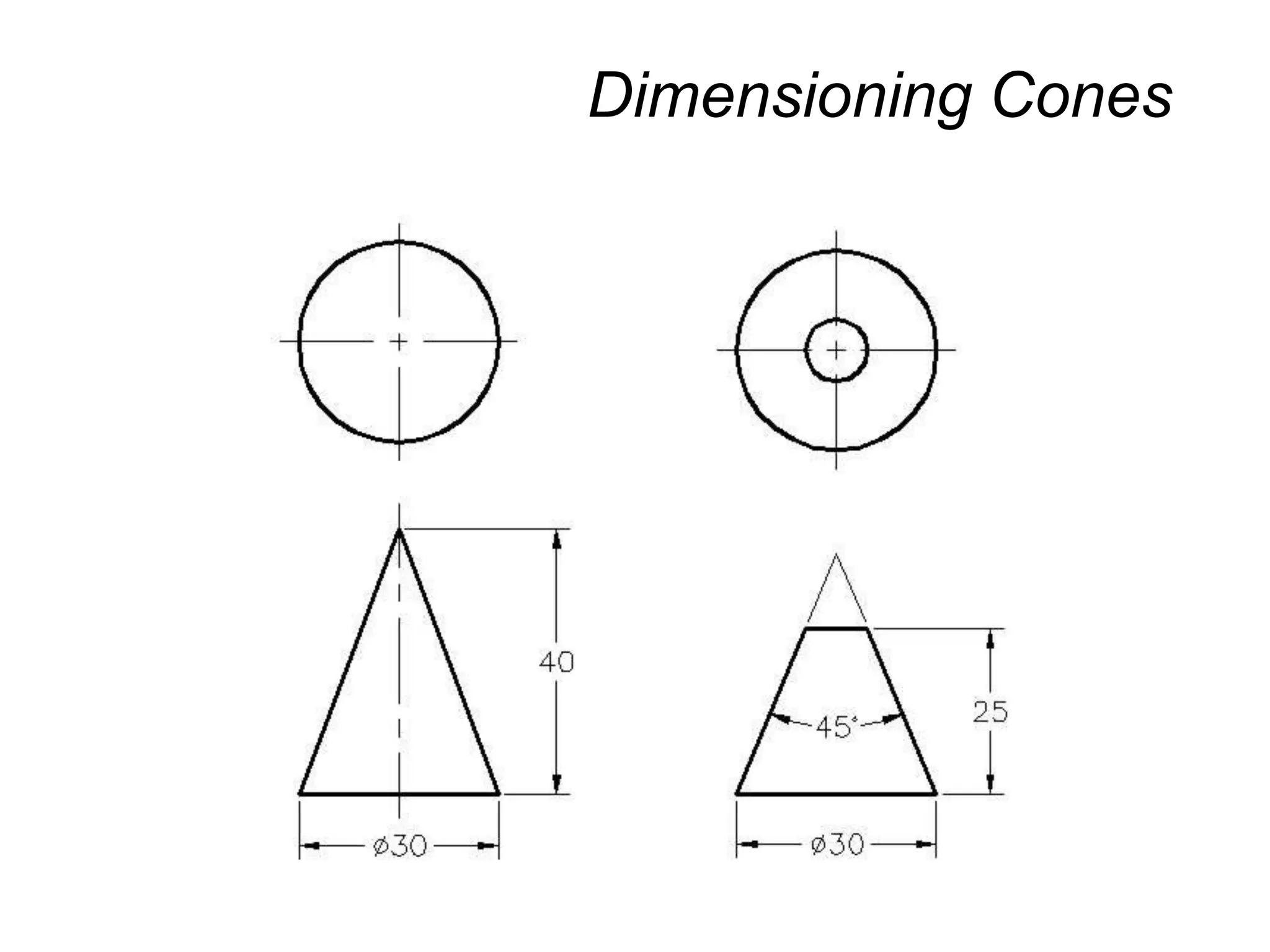
Dimensioning Cones
Dimensioning Spheres
Rectangular Coordinate Dimensioning
• Used when computer-controlled production
machines are used to manufacture parts.
• The designer should consult with personnel in
manufacturing to ensure that the origin is
located in an appropriate position.
• Two types of rectangular coordinate
dimensioning:
– Coordinate Dimensioning with Dimension Lines
– Coordinate Dimensioning Without Dimension
Lines
Coordinate Dimensioning with
Dimension Lines
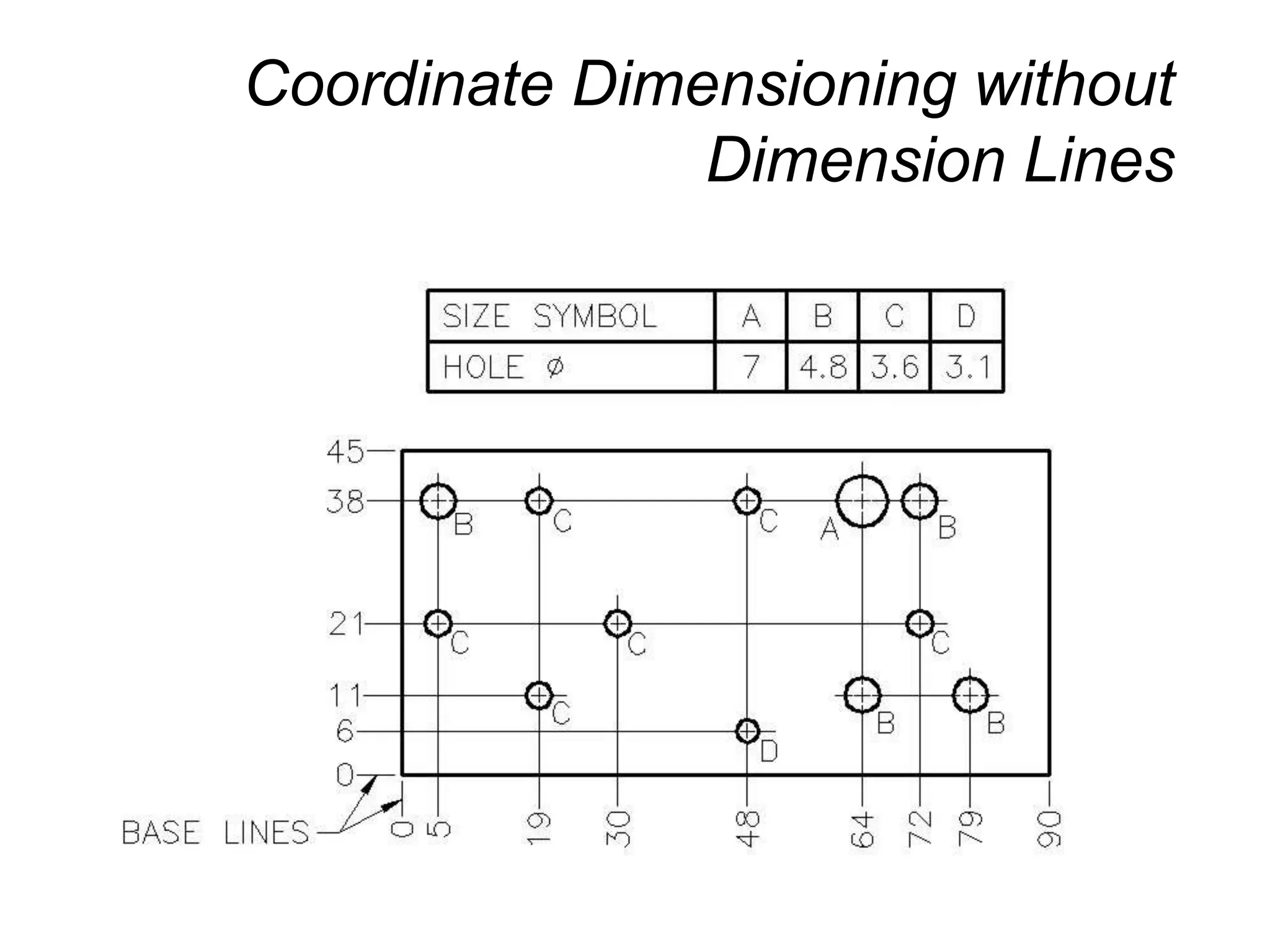
Coordinate Dimensioning without
Dimension Lines
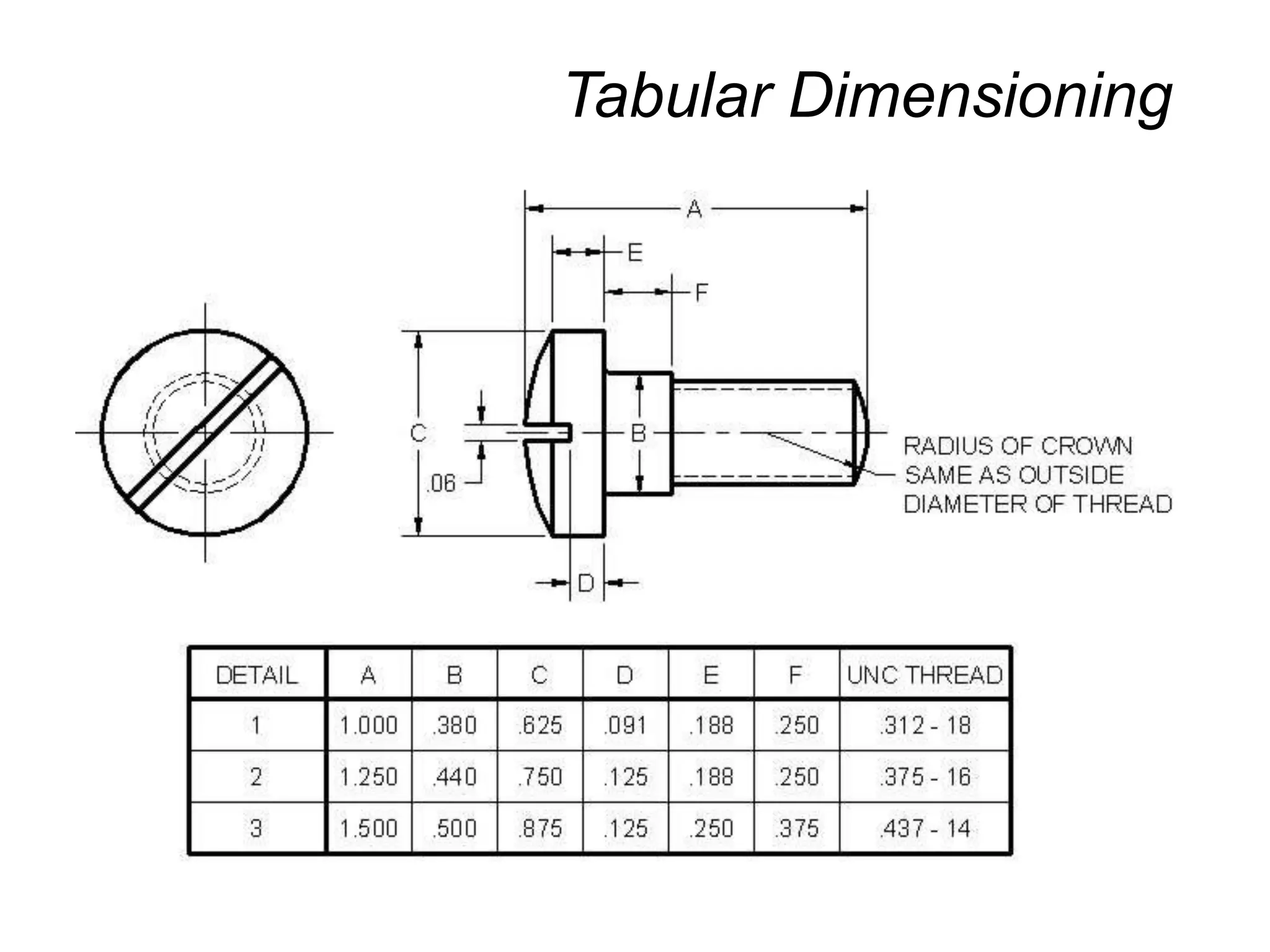
Tabular Dimensioning
• Tabular dimensioning is used when a
series of parts consists of the same
features or geometry but vary in
dimension.
• Letters are used in place of dimension
values, and the values are then placed
in a table.
• Most standard parts are dimensioned
this way in catalogs, the machinery
handbook, and in the back of most
textbooks.
Tabular Dimensioning
Dual Dimensioning – Position Method
• Millimeter value is placed above (or
below) the inch value or separated by a
dash.
Dual Dimensioning – Bracket Method
• Millimeter value is enclosed in square
brackets. A note should be placed on the
drawing such as: DIMENSIONS IN [ ]
ARE MILLIMETERS.
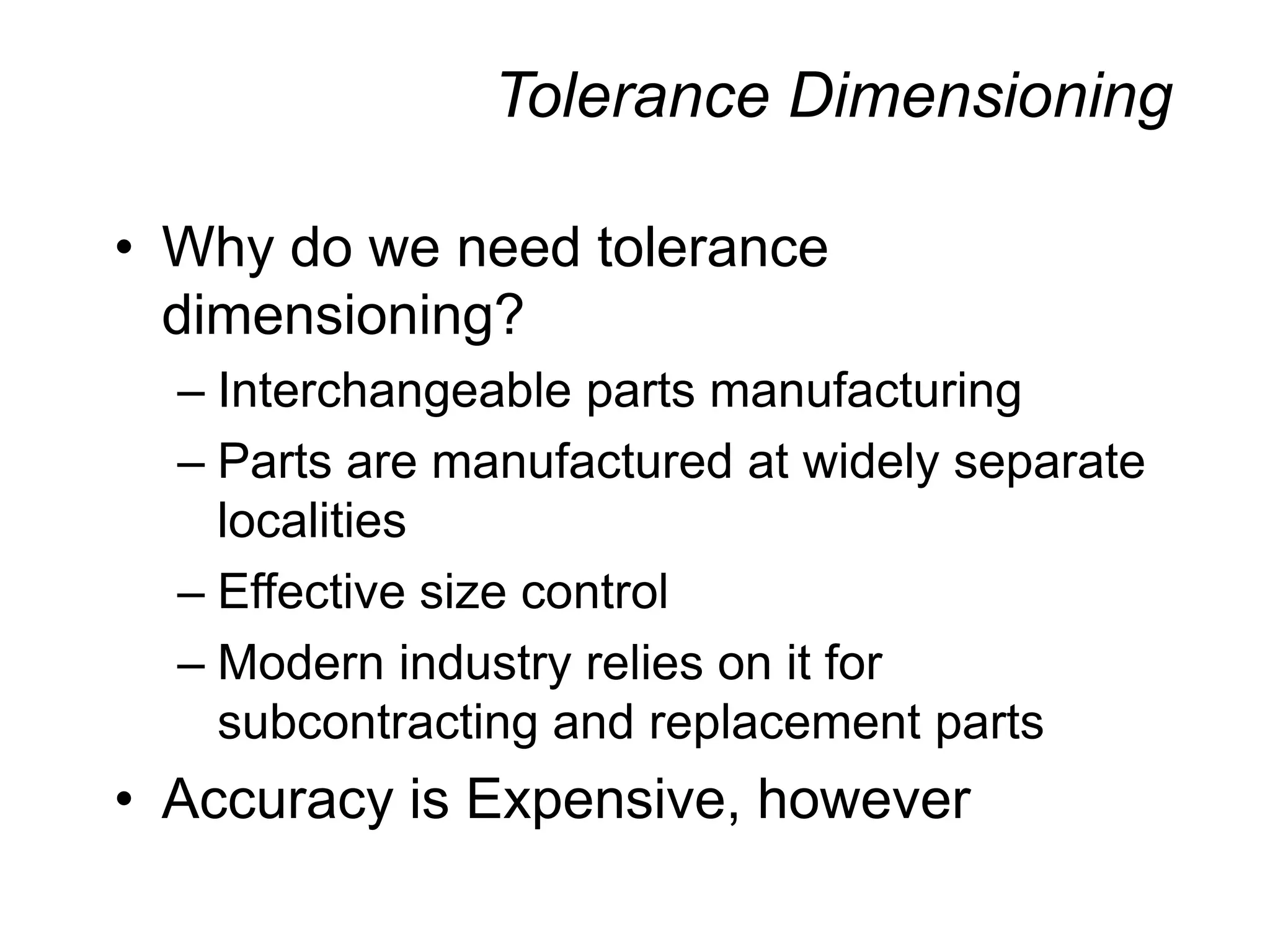
Tolerance Dimensioning
• Why do we need tolerance
dimensioning?
– Interchangeable parts manufacturing
– Parts are manufactured at widely separate
localities
– Effective size control
– Modern industry relies on it for
subcontracting and replacement parts
• Accuracy is Expensive, however
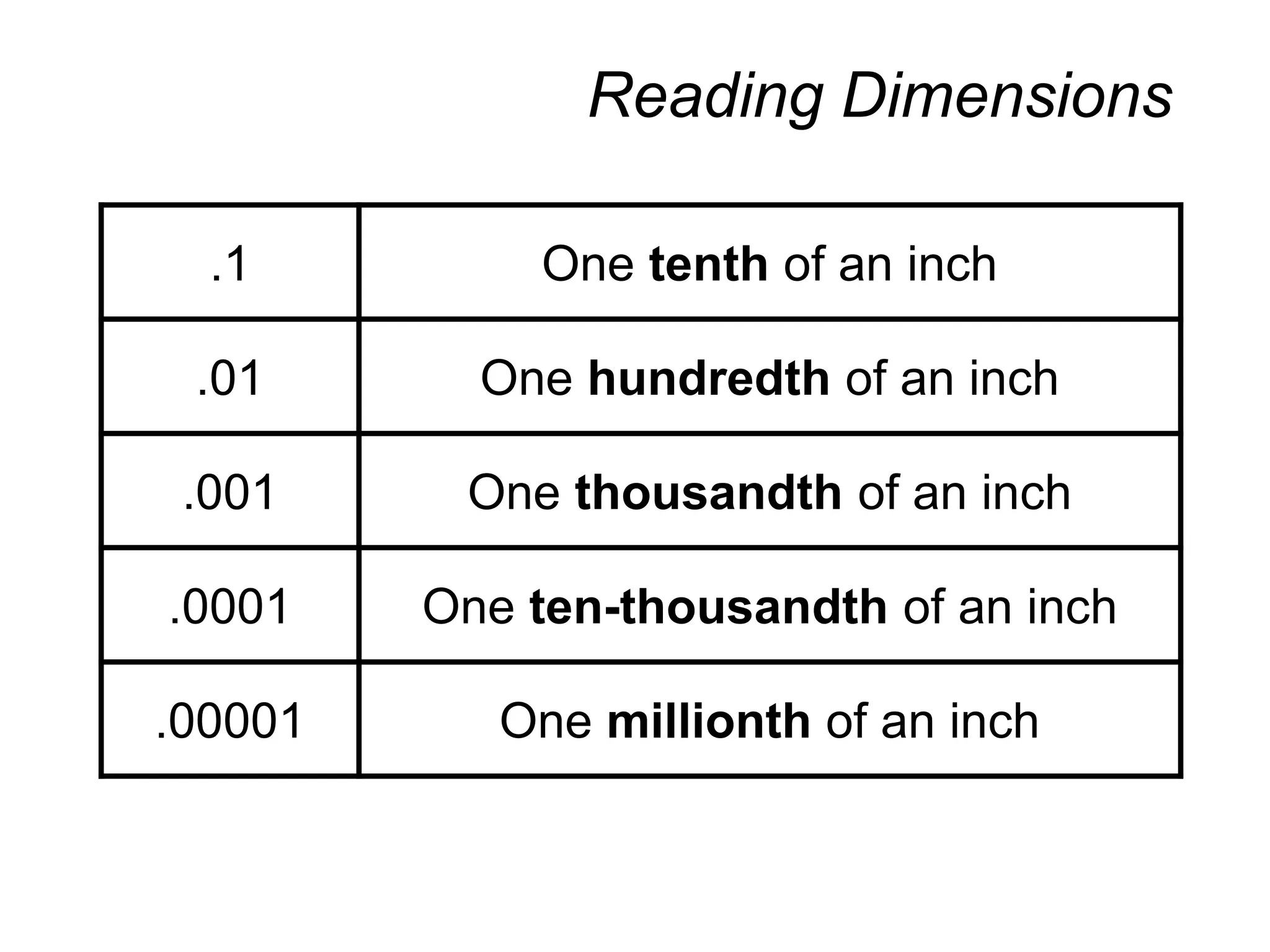
Reading Dimensions
.1 One tenth of an inch
.01 One hundredth of an inch
.001 One thousandth of an inch
.0001 One ten-thousandth of an inch
.00001 One millionth of an inch
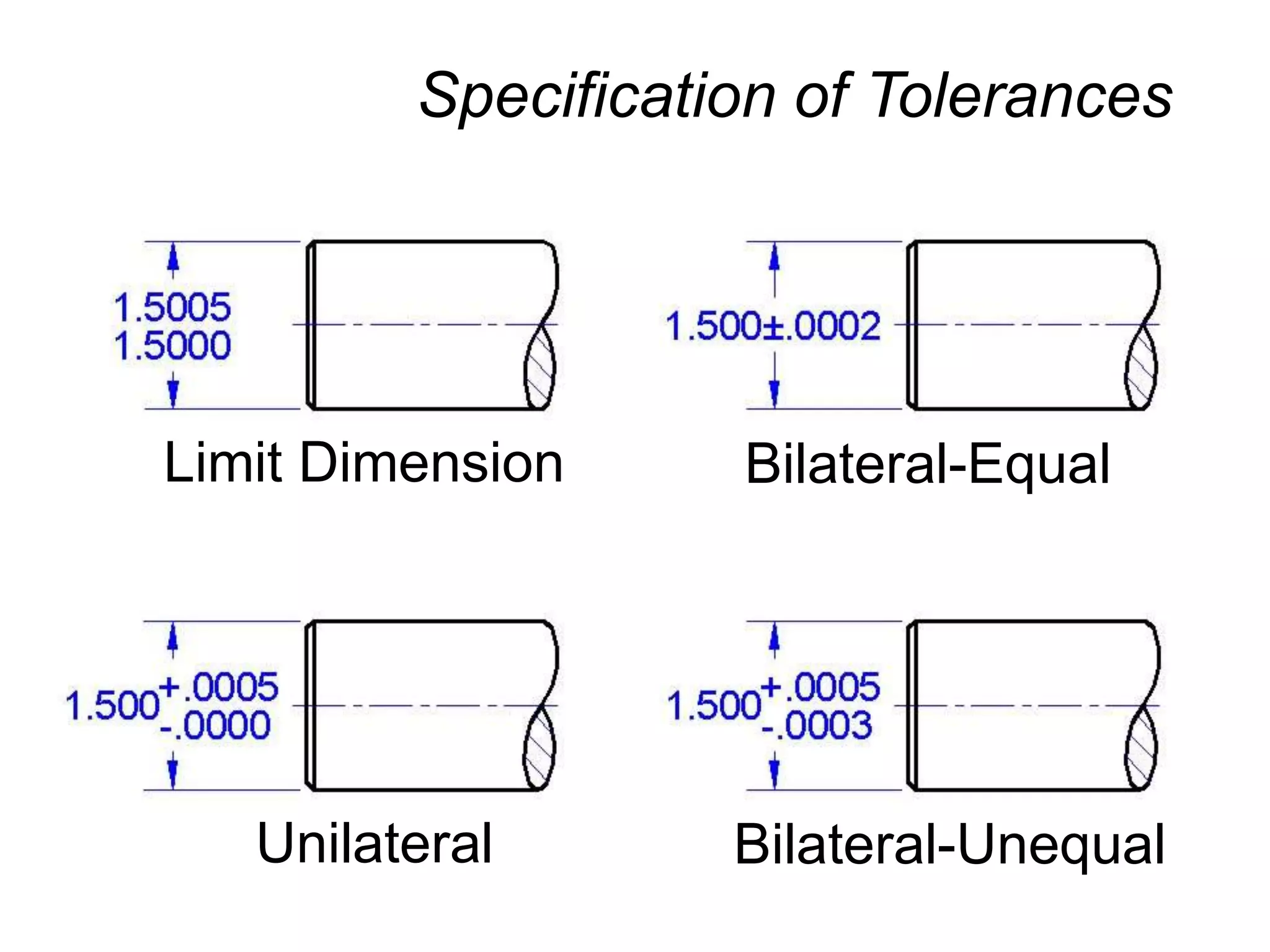
Specification of Tolerances
Bilateral-Equal
Limit Dimension
Bilateral-Unequal
Unilateral
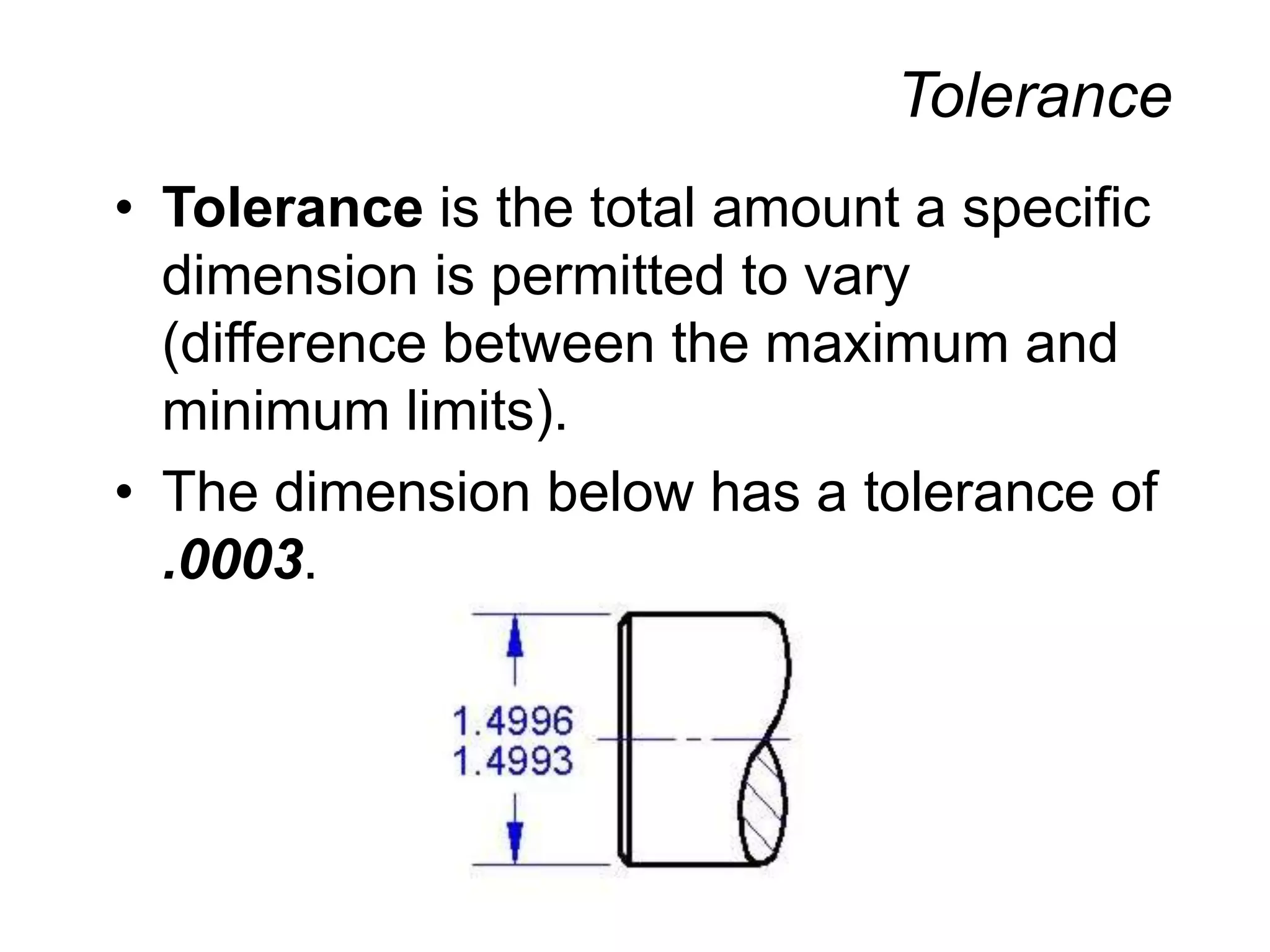
Tolerance
• Tolerance is the total amount a specific
dimension is permitted to vary
(difference between the maximum and
minimum limits).
• The dimension below has a tolerance of
.0003.
Maximum Material Condition
• When specifying tolerance dimensions,
the maximum material condition
(MMC) means the product or part
contains the maximum amount of
material specified by the tolerance.
• The heaviest part.
Maximum Material Condition
• For the part shown here the MMC is
1.4996 since that size would yield the
most material.
Allowance
• Allowance is the minimum clearance or
maximum interference intended
between the maximum material
condition (MMC) of mating parts.
• The allowance for the system below is:
25.000 - 24.890 = 0.110
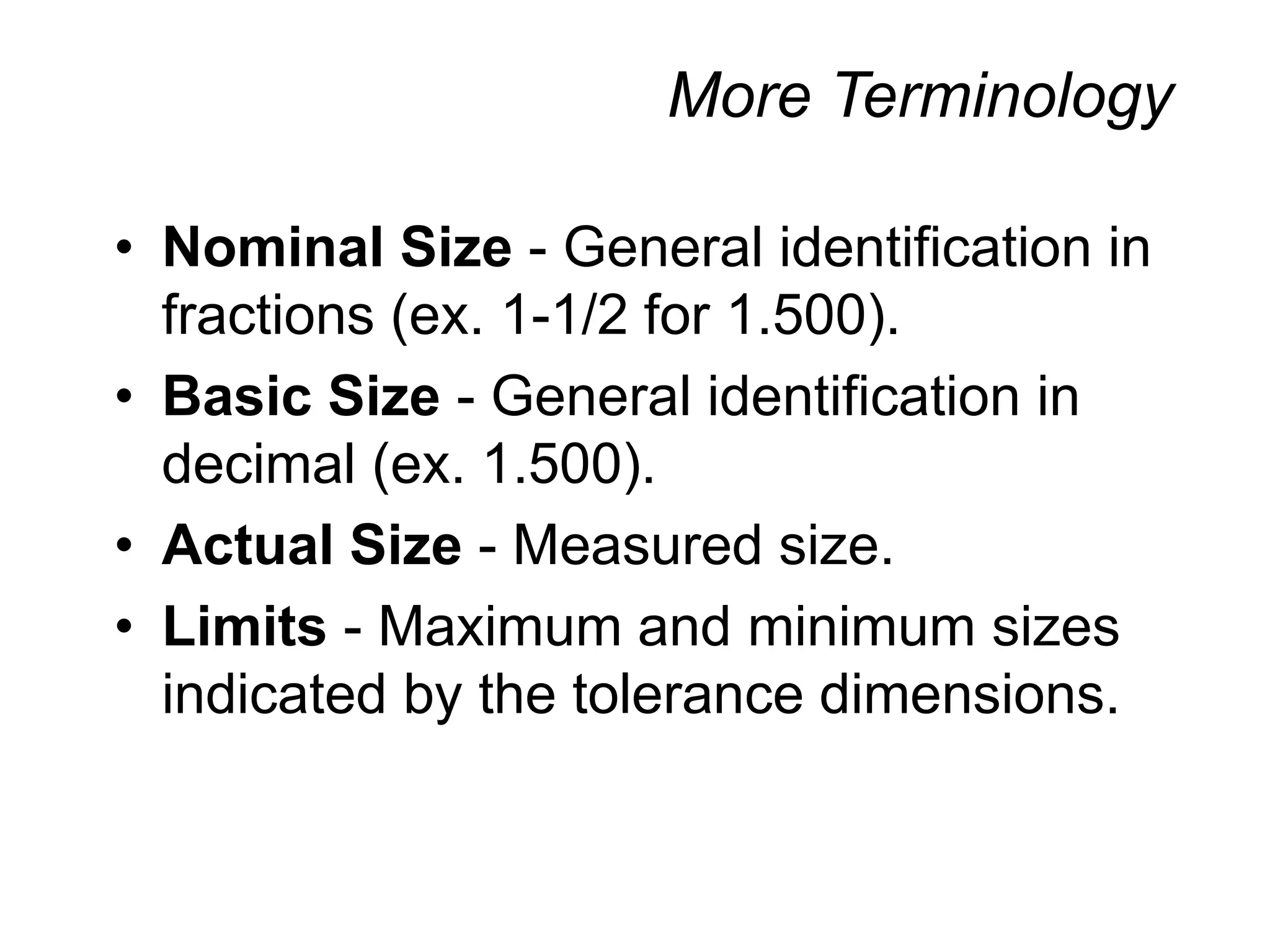
More Terminology
• Nominal Size - General identification in
fractions (ex. 1-1/2 for 1.500).
• Basic Size - General identification in
decimal (ex. 1.500).
• Actual Size - Measured size.
• Limits - Maximum and minimum sizes
indicated by the tolerance dimensions.
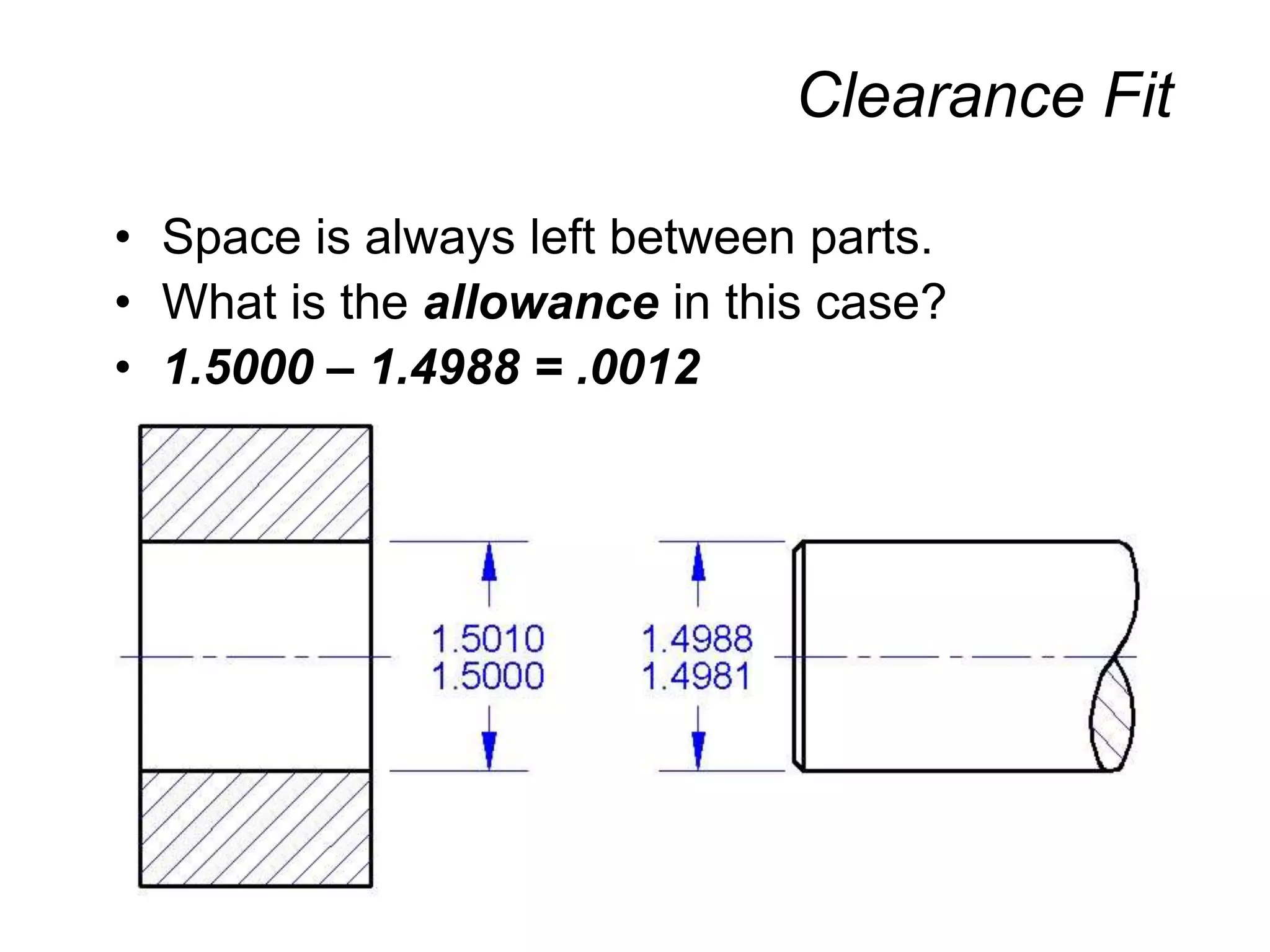
Clearance Fit
• Space is always left between parts.
• What is the allowance in this case?
• 1.5000 – 1.4988 = .0012
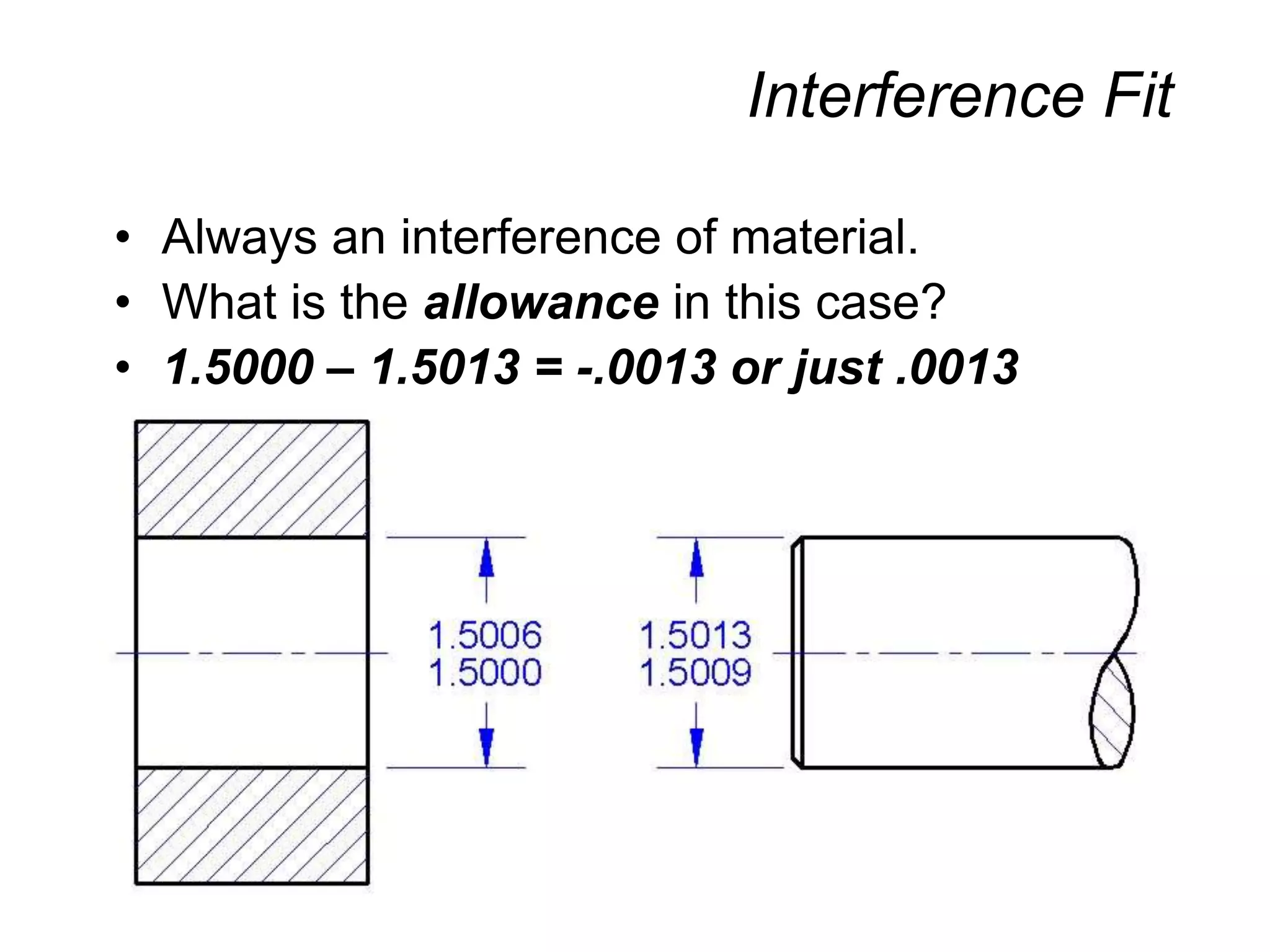
Interference Fit
• Always an interference of material.
• What is the allowance in this case?
• 1.5000 – 1.5013 = -.0013 or just .0013
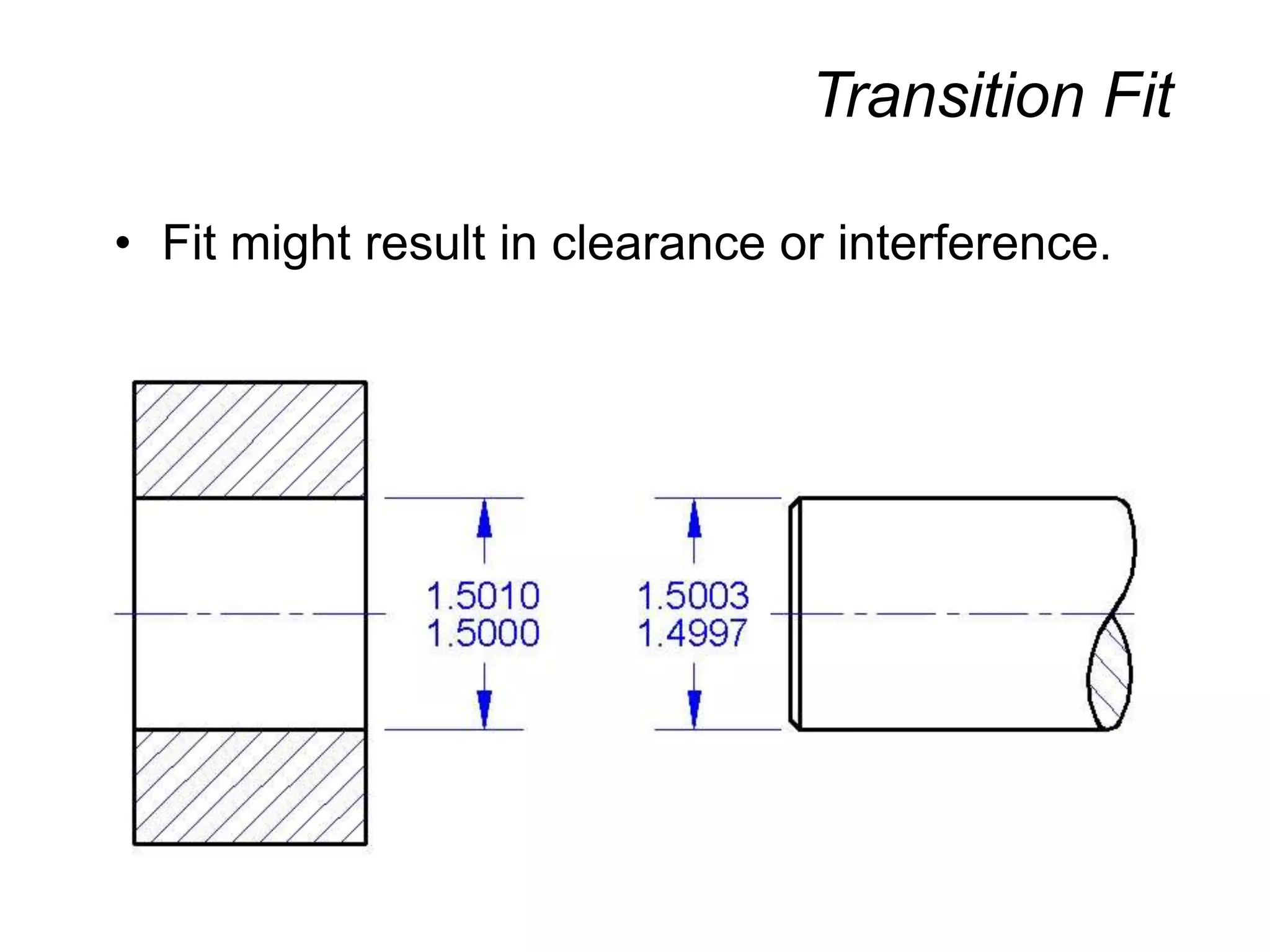
Transition Fit
• Fit might result in clearance or interference.
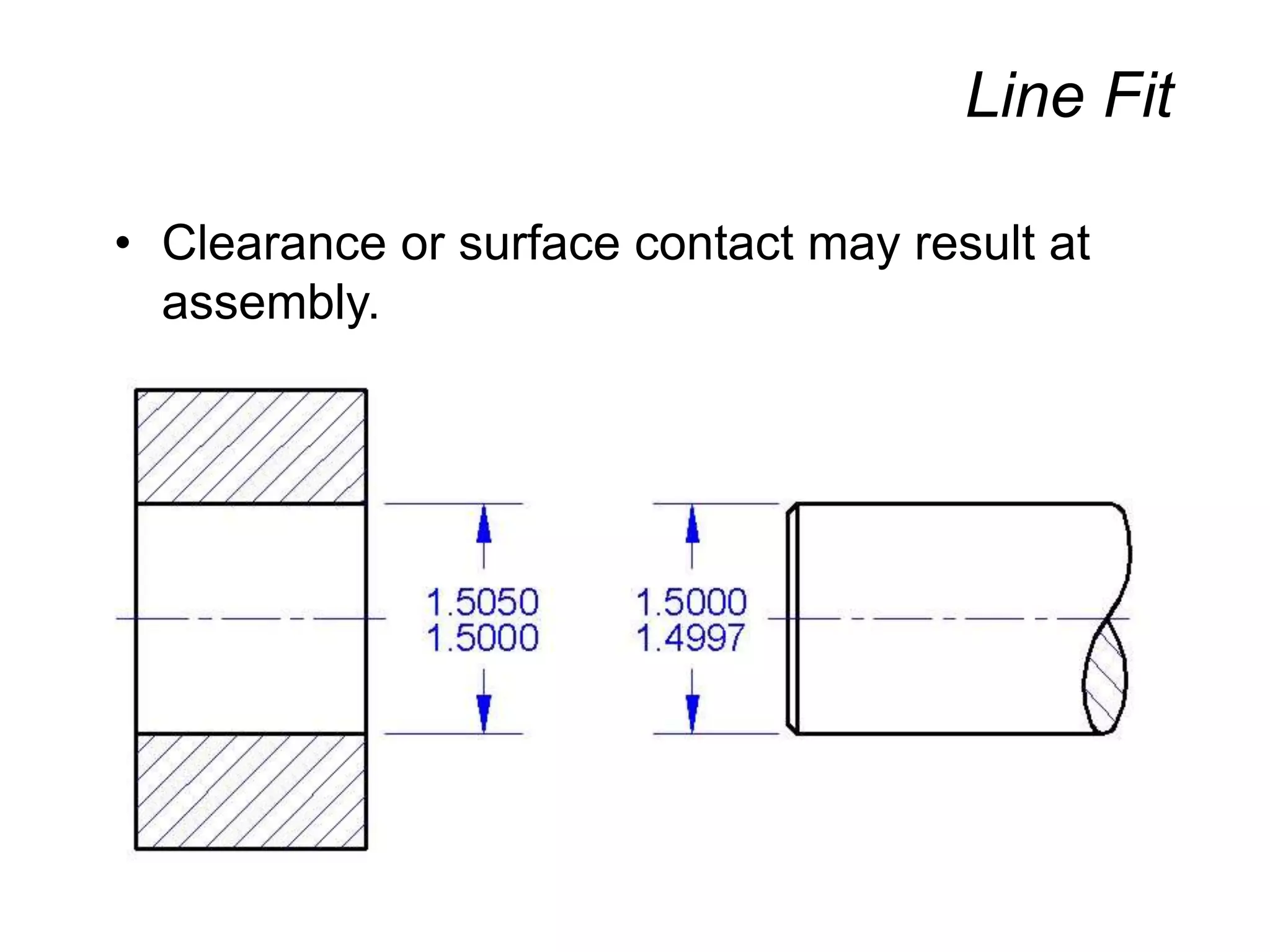
Line Fit
• Clearance or surface contact may result at
assembly.
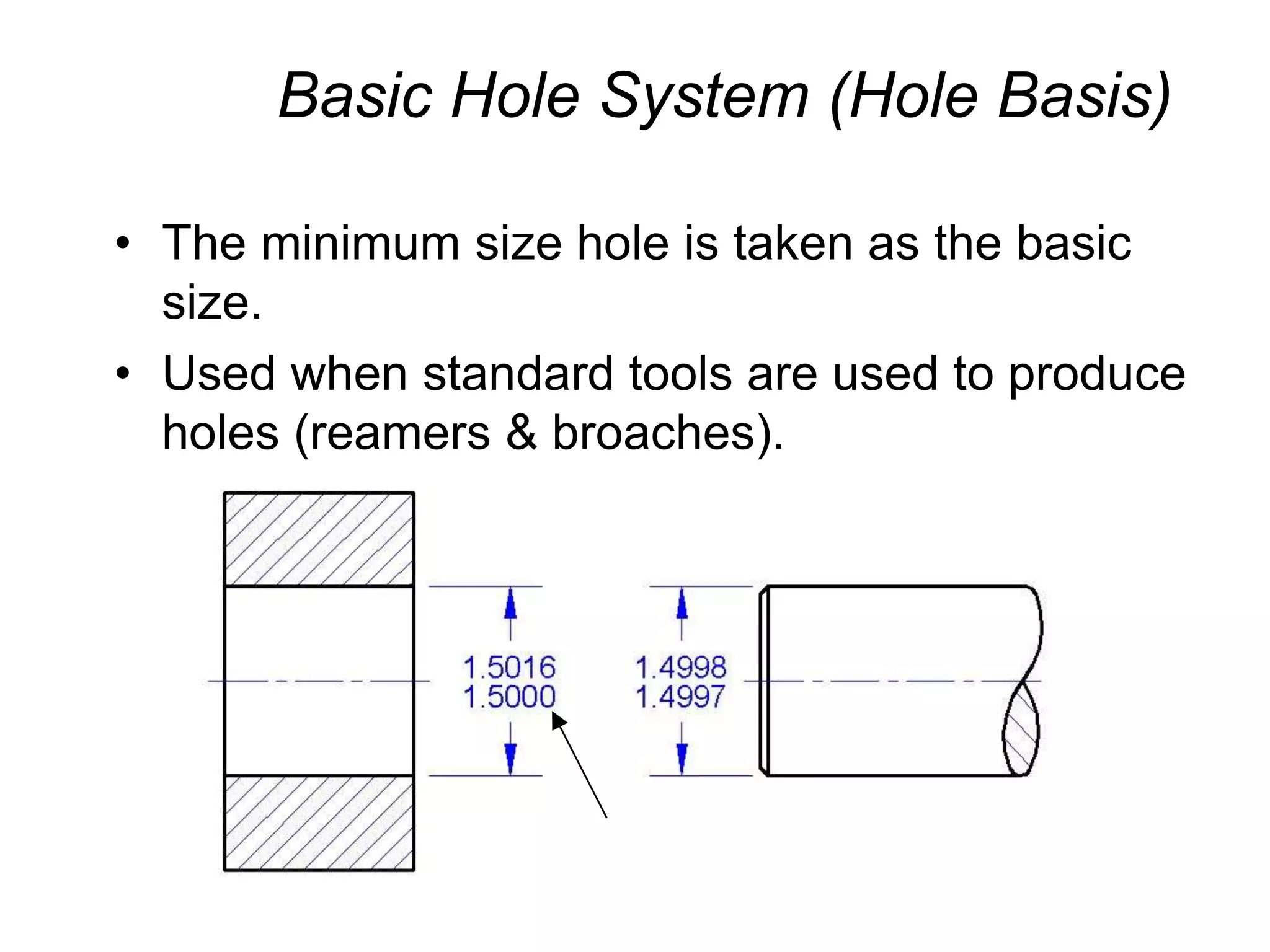
Basic Hole System (Hole Basis)
• The minimum size hole is taken as the basic
size.
• Used when standard tools are used to produce
holes (reamers & broaches).
Basic Shaft System (Shaft Basis)
• The maximum shaft size is taken as the basic
size.
• When several parts having different fits, but
one nominal size are required on a single shaft.
Specifying a Fit - Inches
Nominal
Size Range
Inches
Over To
Class RC 1
Limits
of
Clear.
Standard
Limits
Hole
H5
Shaft
g4
0-0.12
0.1
0.45
+0.2
–0
–0.1
–0.25
0.12-0.24
0.15
0.5
+0.2
–0
–0.15
–0.3
0.24-0.40
0.2
0.6
+0.25
–0
–0.2
–0.35
0.40-0.71
0.25
0.75
+0.3
–0
–0.25
–0.45
0.71-1.19
0.3
0.95
+0.4
–0
–0.3
–0.55
1.19-1.97
0.4
1.1
+0.4
–0
–0.4
–0.7
• Determine type of fit
and find corresponding
table
• Determine basic size
• Find size range on
table
• Determine tolerances
for Hole and Shaft
• Remember values are
in thousandths of an
inch.
Specifying a Fit - Inches
Nominal
Size Range
Inches
Over To
Class RC 1
Limits
of
Clear.
Standard
Limits
Hole
H5
Shaft
g4
0-0.12
0.1
0.45
+0.2
–0
–0.1
–0.25
0.12-0.24
0.15
0.5
+0.2
–0
–0.15
–0.3
0.24-0.40
0.2
0.6
+0.25
–0
–0.2
–0.35
0.40-0.71
0.25
0.75
+0.3
–0
–0.25
–0.45
0.71-1.19
0.3
0.95
+0.4
–0
–0.3
–0.55
1.19-1.97
0.4
1.1
+0.4
–0
–0.4
–0.7
• RC1 - Close Sliding Fit
• Basic size of 1.500
• Upper tolerance on
hole is +0.4, which is
really +0.0004
• Lower tolerance on
hole is -0.
• Upper tolerance on
shaft is -0.0004
• Lower tolerance on
shaft is -0.0007
Specifying a Fit - Inches
Nominal
Size Range
Inches
Over To
Class RC 1
Limits
of
Clear.
Standard
Limits
Hole
H5
Shaft
g4
0-0.12
0.1
0.45
+0.2
–0
–0.1
–0.25
0.12-0.24
0.15
0.5
+0.2
–0
–0.15
–0.3
0.24-0.40
0.2
0.6
+0.25
–0
–0.2
–0.35
0.40-0.71
0.25
0.75
+0.3
–0
–0.25
–0.45
0.71-1.19
0.3
0.95
+0.4
–0
–0.3
–0.55
1.19-1.97
0.4
1.1
+0.4
–0
–0.4
–0.7
Specifying Fits - Metric
Basic
Size
Loose Running
Hole
H11
Shaft
c11
Fit
1 Max
Min
1.060
1.060
0.940
0.880
0.180
0.060
20 Max
Min
20.130
20.000
19.890
19.760
0.370
0.110
25 Max
Min
25.130
25.000
24.890
24.760
0.370
0.110
• Determine type of fit
and find corresponding
table
• Determine basic size
• Find size range on
table
• Determine tolerances
for Hole and Shaft
Specifying Fits - Metric
Basic
Size
Loose Running
Hole
H11
Shaft
c11
Fit
1 Max
Min
1.060
1.060
0.940
0.880
0.180
0.060
20 Max
Min
20.130
20.000
19.890
19.760
0.370
0.110
25 Max
Min
25.130
25.000
24.890
24.760
0.370
0.110
• Loose Running Fit
• Basic size of 25

Dimension and Tolerancing ppt.ppt

  • 1.
  • 2.
  • 3.
    Dimensioning Cylinders • Thediameter of cylinders should be dimensioned in the rectangular view (not the circular view). • Cylinders without a hole passing through them only require one view.
  • 4.
  • 5.
  • 6.
    Rectangular Coordinate Dimensioning •Used when computer-controlled production machines are used to manufacture parts. • The designer should consult with personnel in manufacturing to ensure that the origin is located in an appropriate position. • Two types of rectangular coordinate dimensioning: – Coordinate Dimensioning with Dimension Lines – Coordinate Dimensioning Without Dimension Lines
  • 7.
  • 8.
  • 9.
    Tabular Dimensioning • Tabulardimensioning is used when a series of parts consists of the same features or geometry but vary in dimension. • Letters are used in place of dimension values, and the values are then placed in a table. • Most standard parts are dimensioned this way in catalogs, the machinery handbook, and in the back of most textbooks.
  • 10.
  • 11.
    Dual Dimensioning –Position Method • Millimeter value is placed above (or below) the inch value or separated by a dash.
  • 12.
    Dual Dimensioning –Bracket Method • Millimeter value is enclosed in square brackets. A note should be placed on the drawing such as: DIMENSIONS IN [ ] ARE MILLIMETERS.
  • 13.
    Tolerance Dimensioning • Whydo we need tolerance dimensioning? – Interchangeable parts manufacturing – Parts are manufactured at widely separate localities – Effective size control – Modern industry relies on it for subcontracting and replacement parts • Accuracy is Expensive, however
  • 14.
    Reading Dimensions .1 Onetenth of an inch .01 One hundredth of an inch .001 One thousandth of an inch .0001 One ten-thousandth of an inch .00001 One millionth of an inch
  • 15.
    Specification of Tolerances Bilateral-Equal LimitDimension Bilateral-Unequal Unilateral
  • 16.
    Tolerance • Tolerance isthe total amount a specific dimension is permitted to vary (difference between the maximum and minimum limits). • The dimension below has a tolerance of .0003.
  • 17.
    Maximum Material Condition •When specifying tolerance dimensions, the maximum material condition (MMC) means the product or part contains the maximum amount of material specified by the tolerance. • The heaviest part.
  • 18.
    Maximum Material Condition •For the part shown here the MMC is 1.4996 since that size would yield the most material.
  • 19.
    Allowance • Allowance isthe minimum clearance or maximum interference intended between the maximum material condition (MMC) of mating parts. • The allowance for the system below is: 25.000 - 24.890 = 0.110
  • 20.
    More Terminology • NominalSize - General identification in fractions (ex. 1-1/2 for 1.500). • Basic Size - General identification in decimal (ex. 1.500). • Actual Size - Measured size. • Limits - Maximum and minimum sizes indicated by the tolerance dimensions.
  • 21.
    Clearance Fit • Spaceis always left between parts. • What is the allowance in this case? • 1.5000 – 1.4988 = .0012
  • 22.
    Interference Fit • Alwaysan interference of material. • What is the allowance in this case? • 1.5000 – 1.5013 = -.0013 or just .0013
  • 23.
    Transition Fit • Fitmight result in clearance or interference.
  • 24.
    Line Fit • Clearanceor surface contact may result at assembly.
  • 25.
    Basic Hole System(Hole Basis) • The minimum size hole is taken as the basic size. • Used when standard tools are used to produce holes (reamers & broaches).
  • 26.
    Basic Shaft System(Shaft Basis) • The maximum shaft size is taken as the basic size. • When several parts having different fits, but one nominal size are required on a single shaft.
  • 27.
    Specifying a Fit- Inches Nominal Size Range Inches Over To Class RC 1 Limits of Clear. Standard Limits Hole H5 Shaft g4 0-0.12 0.1 0.45 +0.2 –0 –0.1 –0.25 0.12-0.24 0.15 0.5 +0.2 –0 –0.15 –0.3 0.24-0.40 0.2 0.6 +0.25 –0 –0.2 –0.35 0.40-0.71 0.25 0.75 +0.3 –0 –0.25 –0.45 0.71-1.19 0.3 0.95 +0.4 –0 –0.3 –0.55 1.19-1.97 0.4 1.1 +0.4 –0 –0.4 –0.7 • Determine type of fit and find corresponding table • Determine basic size • Find size range on table • Determine tolerances for Hole and Shaft • Remember values are in thousandths of an inch.
  • 28.
    Specifying a Fit- Inches Nominal Size Range Inches Over To Class RC 1 Limits of Clear. Standard Limits Hole H5 Shaft g4 0-0.12 0.1 0.45 +0.2 –0 –0.1 –0.25 0.12-0.24 0.15 0.5 +0.2 –0 –0.15 –0.3 0.24-0.40 0.2 0.6 +0.25 –0 –0.2 –0.35 0.40-0.71 0.25 0.75 +0.3 –0 –0.25 –0.45 0.71-1.19 0.3 0.95 +0.4 –0 –0.3 –0.55 1.19-1.97 0.4 1.1 +0.4 –0 –0.4 –0.7 • RC1 - Close Sliding Fit • Basic size of 1.500 • Upper tolerance on hole is +0.4, which is really +0.0004 • Lower tolerance on hole is -0. • Upper tolerance on shaft is -0.0004 • Lower tolerance on shaft is -0.0007
  • 29.
    Specifying a Fit- Inches Nominal Size Range Inches Over To Class RC 1 Limits of Clear. Standard Limits Hole H5 Shaft g4 0-0.12 0.1 0.45 +0.2 –0 –0.1 –0.25 0.12-0.24 0.15 0.5 +0.2 –0 –0.15 –0.3 0.24-0.40 0.2 0.6 +0.25 –0 –0.2 –0.35 0.40-0.71 0.25 0.75 +0.3 –0 –0.25 –0.45 0.71-1.19 0.3 0.95 +0.4 –0 –0.3 –0.55 1.19-1.97 0.4 1.1 +0.4 –0 –0.4 –0.7
  • 30.
    Specifying Fits -Metric Basic Size Loose Running Hole H11 Shaft c11 Fit 1 Max Min 1.060 1.060 0.940 0.880 0.180 0.060 20 Max Min 20.130 20.000 19.890 19.760 0.370 0.110 25 Max Min 25.130 25.000 24.890 24.760 0.370 0.110 • Determine type of fit and find corresponding table • Determine basic size • Find size range on table • Determine tolerances for Hole and Shaft
  • 31.
    Specifying Fits -Metric Basic Size Loose Running Hole H11 Shaft c11 Fit 1 Max Min 1.060 1.060 0.940 0.880 0.180 0.060 20 Max Min 20.130 20.000 19.890 19.760 0.370 0.110 25 Max Min 25.130 25.000 24.890 24.760 0.370 0.110 • Loose Running Fit • Basic size of 25