Production drawing
By- OM Patil
What is Production Drawing ?
 Production drawings (sometimes called as working drawing are complete
sets of drawings that the manufacturing and assembly of products. They are
widely used as orthographic views of machine parts and their assembly.
 Production drawings are 'drawn(graphic) information prepared by
the design team for use by the construction or production team, the main
purpose of which is to define the size, shape, location and production of the
building or component'.
 The drawings may also outline the most convenient order in which to
assemble components.
Main sets of production drawings
The three main sets of production drawings include the following:
 Detail of each non-standard part on a drawing sheet,usually one part
per sheet
 Assembly drawing showing all parts on one sheet
 A Bill of materials (BOM), essentially of each part
Elements of production drawings
 Size and shape of component
 Format of drawing sheet
 Process sheet
 Projection method
 Limits, fits, and tolerances of size, form, and position
 Production method
 Indication of surface roughness and other heat treatments
 Material specification and Shape such as Castings, Forgings, Plates, Rounds, etc.
 Conventions used to represent certain machine components
 Inspection and Testing Methods
Basic principles of dimensioning in
production drawings
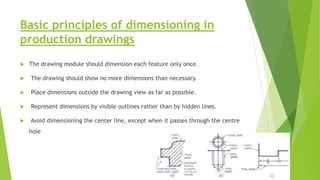
 The drawing module should dimension each feature only once.
 The drawing should show no more dimensions than necessary.
 Place dimensions outside the drawing view as far as possible.
 Represent dimensions by visible outlines rather than by hidden lines.
 Avoid dimensioning the center line, except when it passes through the centre
hole
Lettering:
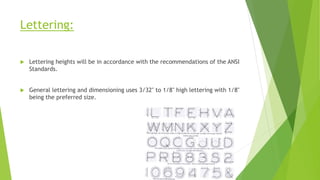
 Lettering heights will be in accordance with the recommendations of the ANSI
Standards.
 General lettering and dimensioning uses 3/32" to 1/8" high lettering with 1/8"
being the preferred size.
Hidden lines:
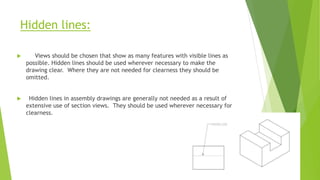
 Views should be chosen that show as many features with visible lines as
possible. Hidden lines should be used wherever necessary to make the
drawing clear. Where they are not needed for clearness they should be
omitted.
 Hidden lines in assembly drawings are generally not needed as a result of
extensive use of section views. They should be used wherever necessary for
clearness.
Parts List:
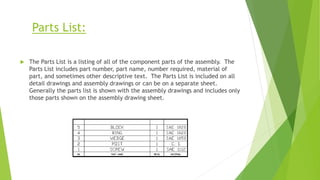
 The Parts List is a listing of all of the component parts of the assembly. The
Parts List includes part number, part name, number required, material of
part, and sometimes other descriptive text. The Parts List is included on all
detail drawings and assembly drawings or can be on a separate sheet.
Generally the parts list is shown with the assembly drawings and includes only
those parts shown on the assembly drawing sheet.
Assembly Drawings
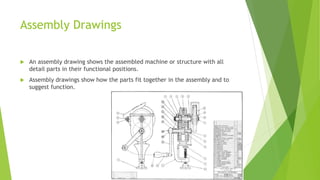
 An assembly drawing shows the assembled machine or structure with all
detail parts in their functional positions.
 Assembly drawings show how the parts fit together in the assembly and to
suggest function.
Part Identification:
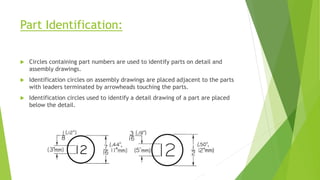
 Circles containing part numbers are used to identify parts on detail and
assembly drawings.
 Identification circles on assembly drawings are placed adjacent to the parts
with leaders terminated by arrowheads touching the parts.
 Identification circles used to identify a detail drawing of a part are placed
below the detail.
Prodution Drawing

Prodution Drawing

  • 1.
  • 2.
    What is ProductionDrawing ?  Production drawings (sometimes called as working drawing are complete sets of drawings that the manufacturing and assembly of products. They are widely used as orthographic views of machine parts and their assembly.  Production drawings are 'drawn(graphic) information prepared by the design team for use by the construction or production team, the main purpose of which is to define the size, shape, location and production of the building or component'.  The drawings may also outline the most convenient order in which to assemble components.
  • 3.
    Main sets ofproduction drawings The three main sets of production drawings include the following:  Detail of each non-standard part on a drawing sheet,usually one part per sheet  Assembly drawing showing all parts on one sheet  A Bill of materials (BOM), essentially of each part
  • 4.
    Elements of productiondrawings  Size and shape of component  Format of drawing sheet  Process sheet  Projection method  Limits, fits, and tolerances of size, form, and position  Production method  Indication of surface roughness and other heat treatments  Material specification and Shape such as Castings, Forgings, Plates, Rounds, etc.  Conventions used to represent certain machine components  Inspection and Testing Methods
  • 5.
    Basic principles ofdimensioning in production drawings  The drawing module should dimension each feature only once.  The drawing should show no more dimensions than necessary.  Place dimensions outside the drawing view as far as possible.  Represent dimensions by visible outlines rather than by hidden lines.  Avoid dimensioning the center line, except when it passes through the centre hole
  • 6.
    Lettering:  Lettering heightswill be in accordance with the recommendations of the ANSI Standards.  General lettering and dimensioning uses 3/32" to 1/8" high lettering with 1/8" being the preferred size.
  • 7.
    Hidden lines:  Viewsshould be chosen that show as many features with visible lines as possible. Hidden lines should be used wherever necessary to make the drawing clear. Where they are not needed for clearness they should be omitted.  Hidden lines in assembly drawings are generally not needed as a result of extensive use of section views. They should be used wherever necessary for clearness.
  • 8.
    Parts List:  TheParts List is a listing of all of the component parts of the assembly. The Parts List includes part number, part name, number required, material of part, and sometimes other descriptive text. The Parts List is included on all detail drawings and assembly drawings or can be on a separate sheet. Generally the parts list is shown with the assembly drawings and includes only those parts shown on the assembly drawing sheet.
  • 9.
    Assembly Drawings  Anassembly drawing shows the assembled machine or structure with all detail parts in their functional positions.  Assembly drawings show how the parts fit together in the assembly and to suggest function.
  • 10.
    Part Identification:  Circlescontaining part numbers are used to identify parts on detail and assembly drawings.  Identification circles on assembly drawings are placed adjacent to the parts with leaders terminated by arrowheads touching the parts.  Identification circles used to identify a detail drawing of a part are placed below the detail.