Manufacturing and Service Operations
Learning Block 7
Maintenance and Quality
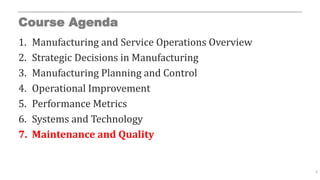
Course Agenda
1. Manufacturing and Service Operations Overview
2. Strategic Decisions in Manufacturing
3. Manufacturing Planning and Control
4. Operational Improvement
5. Performance Metrics
6. Systems and Technology
7. Maintenance and Quality
2
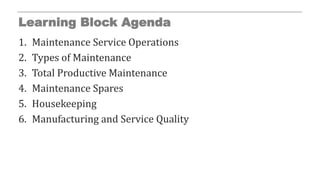
Learning Block Agenda
1. Maintenance Service Operations
2. Types of Maintenance
3. Total Productive Maintenance
4. Maintenance Spares
5. Housekeeping
6. Manufacturing and Service Quality
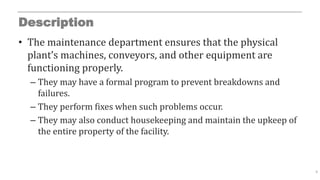
Description
• The maintenance department ensures that the physical
plant’s machines, conveyors, and other equipment are
functioning properly.
– They may have a formal program to prevent breakdowns and
failures.
– They perform fixes when such problems occur.
– They may also conduct housekeeping and maintain the upkeep of
the entire property of the facility.
4
Learning Objectives
• Recognize the role and importance of maintenance service
operations in helping to ensure equipment availability and
reliability
• Understand the differences between preventive and corrective
maintenance
• Analyze the key aspects of housekeeping and cleaning services
in a manufacturing environment
• Summarize the concept of outsourcing, including how inventory
management works with a third party
• Differentiate between quality assurance and quality control in
operations
Unit 1: Maintenance Service Operations
• Equipment breakdowns and failures disrupt manufacturing
process flows, create idle worker time, and hinder a
company’s ability to meet demand.
– Equipment readiness indicates the proportion of time that
equipment is functioning and producing goods.
• No equipment functions 100% of the time, due to routine maintenance.
• Machinery does not always operate at its intended output rate due to
wear-and-tear, poor installation, or inadequate setup.
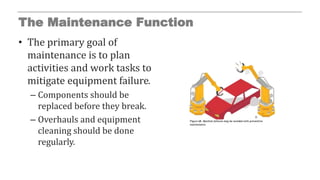
The Maintenance Function
• The primary goal of
maintenance is to plan
activities and work tasks to
mitigate equipment failure.
– Components should be
replaced before they break.
– Overhauls and equipment
cleaning should be done
regularly.
Figure 68. Machine failures may be avoided with preventive
maintenance.
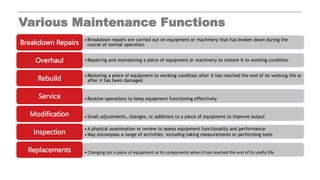
Various Maintenance Functions
•Breakdown repairs are carried out on equipment or machinery that has broken down during the
course of normal operation
Breakdown Repairs
•Repairing and maintaining a piece of equipment or machinery to restore it to working condition
Overhaul
•Restoring a piece of equipment to working condition after it has reached the end of its working life or
after it has been damaged
Rebuild
•Routine operations to keep equipment functioning effectively
Service
•Small adjustments, changes, or additions to a piece of equipment to improve output
Modification
•A physical examination or review to assess equipment functionality and performance
•May encompass a range of activities, including taking measurements or performing tests
Inspection
•Changing out a piece of equipment or its components when it has reached the end of its useful life
Replacements
Unit 2: Types of Maintenance
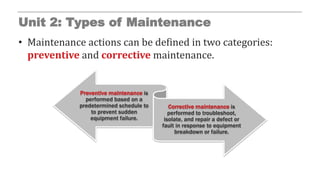
• Maintenance actions can be defined in two categories:
preventive and corrective maintenance.
Preventive maintenance is
performed based on a
predetermined schedule to
to prevent sudden
equipment failure.
Corrective maintenance is
performed to troubleshoot,
isolate, and repair a defect or
fault in response to equipment
breakdown or failure.
Preventive Maintenance Tasks
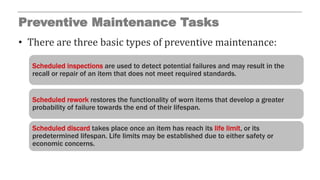
• There are three basic types of preventive maintenance:
Scheduled inspections are used to detect potential failures and may result in the
recall or repair of an item that does not meet required standards.
Scheduled rework restores the functionality of worn items that develop a greater
probability of failure towards the end of their lifespan.
Scheduled discard takes place once an item has reach its life limit, or its
predetermined lifespan. Life limits may be established due to either safety or
economic concerns.
Services and Lubrication
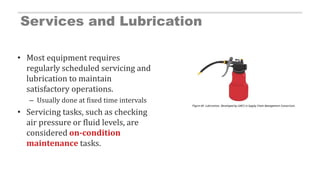
• Most equipment requires
regularly scheduled servicing and
lubrication to maintain
satisfactory operations.
– Usually done at fixed time intervals
• Servicing tasks, such as checking
air pressure or fluid levels, are
considered on-condition
maintenance tasks.
Figure 69. Lubrication. Developed by LINCS in Supply Chain Management Consortium.
Equipment and Machinery Failure
• Machinery experiences functional failure due to either a
total breakdown or an inability to meet specified
performance.
– A product’s performance specifications and capabilities must first
be defined.
– Once specifications are identified, physical conditions can be
identified that suggest imminent failure.
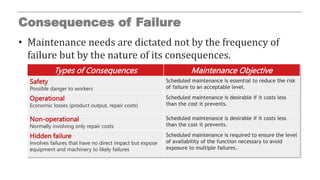
Consequences of Failure
• Maintenance needs are dictated not by the frequency of
failure but by the nature of its consequences.
Types of Consequences Maintenance Objective
Safety
Possible danger to workers
Scheduled maintenance is essential to reduce the risk
of failure to an acceptable level.
Operational
Economic losses (product output, repair costs)
Scheduled maintenance is desirable if it costs less
than the cost it prevents.
Non-operational
Normally involving only repair costs
Scheduled maintenance is desirable if it costs less
than the cost it prevents.
Hidden failure
Involves failures that have no direct impact but expose
equipment and machinery to likely failures
Scheduled maintenance is required to ensure the level
of availability of the function necessary to avoid
exposure to multiple failures.
Unit 3: Total Productive Maintenance
• Total Productive Maintenance (TPM) ensures that
machinery operates as intended without failure by keeping
it in like-new condition.
– TPM is a major element of lean manufacturing.
– TPM increases overall equipment effectiveness.
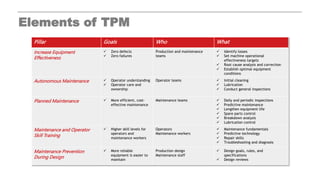
Elements of TPM
Pillar Goals Who What
Increase Equipment
Effectiveness
 Zero defects
 Zero failures
Production and maintenance
teams
 Identify losses
 Set machine operational
effectiveness targets
 Root cause analysis and correction
 Establish optimal equipment
conditions
Autonomous Maintenance  Operator understanding
 Operator care and
ownership
Operator teams  Initial cleaning
 Lubrication
 Conduct general inspections
Planned Maintenance  More efficient, cost-
effective maintenance
Maintenance teams  Daily and periodic inspections
 Predictive maintenance
 Lengthen equipment life
 Spare parts control
 Breakdown analysis
 Lubrication control
Maintenance and Operator
Skill Training
 Higher skill levels for
operators and
maintenance workers
Operators
Maintenance workers
 Maintenance fundamentals
 Predictive technology
 Repair skills
 Troubleshooting and diagnosis
Maintenance Prevention
During Design
 More reliable
equipment is easier to
maintain
Production design
Maintenance staff
 Design goals, rules, and
specifications
 Design reviews
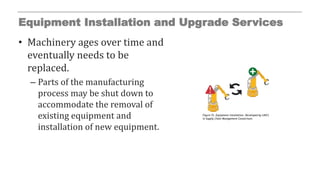
Equipment Installation and Upgrade Services
• Machinery ages over time and
eventually needs to be
replaced.
– Parts of the manufacturing
process may be shut down to
accommodate the removal of
existing equipment and
installation of new equipment.
Figure 72. Equipment installation. Developed by LINCS
in Supply Chain Management Consortium.
Unit 4: Maintenance Spares
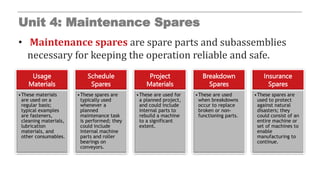
• Maintenance spares are spare parts and subassemblies
necessary for keeping the operation reliable and safe.
Usage
Materials
•These materials
are used on a
regular basis;
typical examples
are fasteners,
cleaning materials,
lubrication
materials, and
other consumables.
Schedule
Spares
•These spares are
typically used
whenever a
planned
maintenance task
is performed; they
could include
internal machine
parts and roller
bearings on
conveyors.
Project
Materials
•These are used for
a planned project,
and could include
internal parts to
rebuild a machine
to a significant
extent.
Breakdown
Spares
•These are used
when breakdowns
occur to replace
broken or non-
functioning parts.
Insurance
Spares
•These spares are
used to protect
against natural
disasters; they
could consist of an
entire machine or
set of machines to
enable
manufacturing to
continue.
Unit 5: Housekeeping
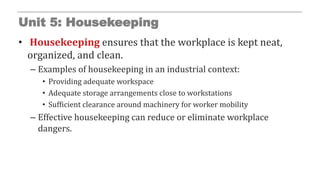
• Housekeeping ensures that the workplace is kept neat,
organized, and clean.
– Examples of housekeeping in an industrial context:
• Providing adequate workspace
• Adequate storage arrangements close to workstations
• Sufficient clearance around machinery for worker mobility
– Effective housekeeping can reduce or eliminate workplace
dangers.
Unit 6: Manufacturing and Service Quality
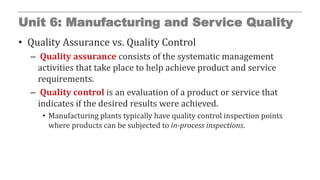
• Quality Assurance vs. Quality Control
– Quality assurance consists of the systematic management
activities that take place to help achieve product and service
requirements.
– Quality control is an evaluation of a product or service that
indicates if the desired results were achieved.
• Manufacturing plants typically have quality control inspection points
where products can be subjected to in-process inspections.
Summary
Optional Supplemental Resources
The optional supplemental resources listed below may be used to reinforce the
content covered within this learning block.
• Davis, M., & Heineke, J. (2005) Operations Management: Integrating Manufacturing and Services
(5th ed.). Waltham, MA: McGraw-Hill.
• Sanders, N., (2014). The Definitive Guide to Manufacturing and Service Operations (3rd ed.).
Upper Saddle River, NJ: Pearson.
Practice Questions
1. What is the primary goal of the maintenance function?
a. Plan activities and work tasks to mitigate equipment failure
b. Retain and restore equipment to a specified condition to achieve its
minimum useful life
c. Retain and restore equipment to an unspecified condition to achieve its
maximum useful life
d. Destroy equipment once it has reached its maximum useful life
2. Which choice best defines preventive maintenance?
a. Routine maintenance to guarantee that equipment will break down
b. Maintenance of equipment after a failure
c. Ignoring maintenance requirements so that equipment will fail
d. Predetermined, scheduled work to prevent a sudden failure
Practice Questions
3. A functional failure is defined as:
a. The ability of an item to meet a specified performance standard
b.The inability of an item to meet a specified performance standard
c. The inability of an item to meet an unspecified performance standard
d.The ability of an item to meet an unspecified performance standard
4. Scheduled inspections are also called:
a. Run-to-failure maintenance
b.Outsourced maintenance
c. On-condition maintenance
d.Supplier-managed maintenance
Practice Questions
5. The total preventive maintenance (TPM) discipline is aimed at:
a. Ensuring that equipment is kept in like-new condition so that it rarely breaks down
b. Ensuring that equipment is only in new condition so the machinery never breaks
down
c. Ensuring that equipment is only maintained by maintenance personnel so the
machinery rarely breaks down
d. Eliminating the need for maintenance personnel to be involved in maintaining the
equipment
6. Which choice best defines corrective maintenance?
a. Planned maintenance
b. Perform in response to a machine breakdown or failure
c. Maintenance prevention during machine design
d. Maintenance and operator skill training
Practice Questions
7. Which choice best defines maintenance spares?
a. Items that are consumed in the production process to make products
b. Items used to ensure that the plant and equipment are kept in a reliable and
safe condition
c. Utility backup systems such as generators
d. Part-time maintenance department employees
8. Insurance spares are kept in inventory to protect against:
a. Production schedule fluctuations
b. Natural disasters, to enable the continuation of manufacturing
c. Maintenance operation changeovers
d. Schedule slippage
Practice Questions
9. Housekeeping is defined as:
a. The procurement of adequate workspace and utilities around workstations
b. Scheduling the production equipment in plants
c. The elimination of the need to keep the workplace clean and tidy
d. The process of ensuring the workplace is kept organized, clean, and neat
10. The maintenance process of making a small adjustment, change, or addition to a machine
to improve its operational output is called:
a. Breakdown repair
b. Modification
c. Inspection
d. Overhaul

ManufacturingAndServicesOperations LB7.pptx

  • 1.
    Manufacturing and ServiceOperations Learning Block 7 Maintenance and Quality
  • 2.
    Course Agenda 1. Manufacturingand Service Operations Overview 2. Strategic Decisions in Manufacturing 3. Manufacturing Planning and Control 4. Operational Improvement 5. Performance Metrics 6. Systems and Technology 7. Maintenance and Quality 2
  • 3.
    Learning Block Agenda 1.Maintenance Service Operations 2. Types of Maintenance 3. Total Productive Maintenance 4. Maintenance Spares 5. Housekeeping 6. Manufacturing and Service Quality
  • 4.
    Description • The maintenancedepartment ensures that the physical plant’s machines, conveyors, and other equipment are functioning properly. – They may have a formal program to prevent breakdowns and failures. – They perform fixes when such problems occur. – They may also conduct housekeeping and maintain the upkeep of the entire property of the facility. 4
  • 5.
    Learning Objectives • Recognizethe role and importance of maintenance service operations in helping to ensure equipment availability and reliability • Understand the differences between preventive and corrective maintenance • Analyze the key aspects of housekeeping and cleaning services in a manufacturing environment • Summarize the concept of outsourcing, including how inventory management works with a third party • Differentiate between quality assurance and quality control in operations
  • 6.
    Unit 1: MaintenanceService Operations • Equipment breakdowns and failures disrupt manufacturing process flows, create idle worker time, and hinder a company’s ability to meet demand. – Equipment readiness indicates the proportion of time that equipment is functioning and producing goods. • No equipment functions 100% of the time, due to routine maintenance. • Machinery does not always operate at its intended output rate due to wear-and-tear, poor installation, or inadequate setup.
  • 7.
    The Maintenance Function •The primary goal of maintenance is to plan activities and work tasks to mitigate equipment failure. – Components should be replaced before they break. – Overhauls and equipment cleaning should be done regularly. Figure 68. Machine failures may be avoided with preventive maintenance.
  • 8.
    Various Maintenance Functions •Breakdownrepairs are carried out on equipment or machinery that has broken down during the course of normal operation Breakdown Repairs •Repairing and maintaining a piece of equipment or machinery to restore it to working condition Overhaul •Restoring a piece of equipment to working condition after it has reached the end of its working life or after it has been damaged Rebuild •Routine operations to keep equipment functioning effectively Service •Small adjustments, changes, or additions to a piece of equipment to improve output Modification •A physical examination or review to assess equipment functionality and performance •May encompass a range of activities, including taking measurements or performing tests Inspection •Changing out a piece of equipment or its components when it has reached the end of its useful life Replacements
  • 9.
    Unit 2: Typesof Maintenance • Maintenance actions can be defined in two categories: preventive and corrective maintenance. Preventive maintenance is performed based on a predetermined schedule to to prevent sudden equipment failure. Corrective maintenance is performed to troubleshoot, isolate, and repair a defect or fault in response to equipment breakdown or failure.
  • 10.
    Preventive Maintenance Tasks •There are three basic types of preventive maintenance: Scheduled inspections are used to detect potential failures and may result in the recall or repair of an item that does not meet required standards. Scheduled rework restores the functionality of worn items that develop a greater probability of failure towards the end of their lifespan. Scheduled discard takes place once an item has reach its life limit, or its predetermined lifespan. Life limits may be established due to either safety or economic concerns.
  • 11.
    Services and Lubrication •Most equipment requires regularly scheduled servicing and lubrication to maintain satisfactory operations. – Usually done at fixed time intervals • Servicing tasks, such as checking air pressure or fluid levels, are considered on-condition maintenance tasks. Figure 69. Lubrication. Developed by LINCS in Supply Chain Management Consortium.
  • 12.
    Equipment and MachineryFailure • Machinery experiences functional failure due to either a total breakdown or an inability to meet specified performance. – A product’s performance specifications and capabilities must first be defined. – Once specifications are identified, physical conditions can be identified that suggest imminent failure.
  • 13.
    Consequences of Failure •Maintenance needs are dictated not by the frequency of failure but by the nature of its consequences. Types of Consequences Maintenance Objective Safety Possible danger to workers Scheduled maintenance is essential to reduce the risk of failure to an acceptable level. Operational Economic losses (product output, repair costs) Scheduled maintenance is desirable if it costs less than the cost it prevents. Non-operational Normally involving only repair costs Scheduled maintenance is desirable if it costs less than the cost it prevents. Hidden failure Involves failures that have no direct impact but expose equipment and machinery to likely failures Scheduled maintenance is required to ensure the level of availability of the function necessary to avoid exposure to multiple failures.
  • 14.
    Unit 3: TotalProductive Maintenance • Total Productive Maintenance (TPM) ensures that machinery operates as intended without failure by keeping it in like-new condition. – TPM is a major element of lean manufacturing. – TPM increases overall equipment effectiveness.
  • 15.
    Elements of TPM PillarGoals Who What Increase Equipment Effectiveness  Zero defects  Zero failures Production and maintenance teams  Identify losses  Set machine operational effectiveness targets  Root cause analysis and correction  Establish optimal equipment conditions Autonomous Maintenance  Operator understanding  Operator care and ownership Operator teams  Initial cleaning  Lubrication  Conduct general inspections Planned Maintenance  More efficient, cost- effective maintenance Maintenance teams  Daily and periodic inspections  Predictive maintenance  Lengthen equipment life  Spare parts control  Breakdown analysis  Lubrication control Maintenance and Operator Skill Training  Higher skill levels for operators and maintenance workers Operators Maintenance workers  Maintenance fundamentals  Predictive technology  Repair skills  Troubleshooting and diagnosis Maintenance Prevention During Design  More reliable equipment is easier to maintain Production design Maintenance staff  Design goals, rules, and specifications  Design reviews
  • 16.
    Equipment Installation andUpgrade Services • Machinery ages over time and eventually needs to be replaced. – Parts of the manufacturing process may be shut down to accommodate the removal of existing equipment and installation of new equipment. Figure 72. Equipment installation. Developed by LINCS in Supply Chain Management Consortium.
  • 17.
    Unit 4: MaintenanceSpares • Maintenance spares are spare parts and subassemblies necessary for keeping the operation reliable and safe. Usage Materials •These materials are used on a regular basis; typical examples are fasteners, cleaning materials, lubrication materials, and other consumables. Schedule Spares •These spares are typically used whenever a planned maintenance task is performed; they could include internal machine parts and roller bearings on conveyors. Project Materials •These are used for a planned project, and could include internal parts to rebuild a machine to a significant extent. Breakdown Spares •These are used when breakdowns occur to replace broken or non- functioning parts. Insurance Spares •These spares are used to protect against natural disasters; they could consist of an entire machine or set of machines to enable manufacturing to continue.
  • 18.
    Unit 5: Housekeeping •Housekeeping ensures that the workplace is kept neat, organized, and clean. – Examples of housekeeping in an industrial context: • Providing adequate workspace • Adequate storage arrangements close to workstations • Sufficient clearance around machinery for worker mobility – Effective housekeeping can reduce or eliminate workplace dangers.
  • 19.
    Unit 6: Manufacturingand Service Quality • Quality Assurance vs. Quality Control – Quality assurance consists of the systematic management activities that take place to help achieve product and service requirements. – Quality control is an evaluation of a product or service that indicates if the desired results were achieved. • Manufacturing plants typically have quality control inspection points where products can be subjected to in-process inspections.
  • 20.
  • 21.
    Optional Supplemental Resources Theoptional supplemental resources listed below may be used to reinforce the content covered within this learning block. • Davis, M., & Heineke, J. (2005) Operations Management: Integrating Manufacturing and Services (5th ed.). Waltham, MA: McGraw-Hill. • Sanders, N., (2014). The Definitive Guide to Manufacturing and Service Operations (3rd ed.). Upper Saddle River, NJ: Pearson.
  • 22.
    Practice Questions 1. Whatis the primary goal of the maintenance function? a. Plan activities and work tasks to mitigate equipment failure b. Retain and restore equipment to a specified condition to achieve its minimum useful life c. Retain and restore equipment to an unspecified condition to achieve its maximum useful life d. Destroy equipment once it has reached its maximum useful life 2. Which choice best defines preventive maintenance? a. Routine maintenance to guarantee that equipment will break down b. Maintenance of equipment after a failure c. Ignoring maintenance requirements so that equipment will fail d. Predetermined, scheduled work to prevent a sudden failure
  • 23.
    Practice Questions 3. Afunctional failure is defined as: a. The ability of an item to meet a specified performance standard b.The inability of an item to meet a specified performance standard c. The inability of an item to meet an unspecified performance standard d.The ability of an item to meet an unspecified performance standard 4. Scheduled inspections are also called: a. Run-to-failure maintenance b.Outsourced maintenance c. On-condition maintenance d.Supplier-managed maintenance
  • 24.
    Practice Questions 5. Thetotal preventive maintenance (TPM) discipline is aimed at: a. Ensuring that equipment is kept in like-new condition so that it rarely breaks down b. Ensuring that equipment is only in new condition so the machinery never breaks down c. Ensuring that equipment is only maintained by maintenance personnel so the machinery rarely breaks down d. Eliminating the need for maintenance personnel to be involved in maintaining the equipment 6. Which choice best defines corrective maintenance? a. Planned maintenance b. Perform in response to a machine breakdown or failure c. Maintenance prevention during machine design d. Maintenance and operator skill training
  • 25.
    Practice Questions 7. Whichchoice best defines maintenance spares? a. Items that are consumed in the production process to make products b. Items used to ensure that the plant and equipment are kept in a reliable and safe condition c. Utility backup systems such as generators d. Part-time maintenance department employees 8. Insurance spares are kept in inventory to protect against: a. Production schedule fluctuations b. Natural disasters, to enable the continuation of manufacturing c. Maintenance operation changeovers d. Schedule slippage
  • 26.
    Practice Questions 9. Housekeepingis defined as: a. The procurement of adequate workspace and utilities around workstations b. Scheduling the production equipment in plants c. The elimination of the need to keep the workplace clean and tidy d. The process of ensuring the workplace is kept organized, clean, and neat 10. The maintenance process of making a small adjustment, change, or addition to a machine to improve its operational output is called: a. Breakdown repair b. Modification c. Inspection d. Overhaul

Editor's Notes

  • #5 (Page 19)
  • #6 (Page 19)
  • #21 The primary goal of maintenance is to plan activities and work tasks to mitigate equipment failure. Maintenance operations focus on maintaining equipment readiness to facilitate smooth and efficient operations. There are two types of maintenance: preventive and corrective maintenance. Maintenance needs are dictated not by the frequency of failure but by the nature of its consequences. Total Productive Maintenance, as a part of lean manufacturing, focuses on eliminating equipment failures that interrupt the flow of operations.