
















DIGITAL TRANSFORMATION
IN THE POST SMARTPHONE AGE
Ólafur Andri Ragnarsson
Living in the future - predict how
technology will impact businesses in
the next 3-5 years
New Technology at
Reykjavik University
“Humanity will change more in the
next 20 years than in the past 300
years” — Gerd Leonhard
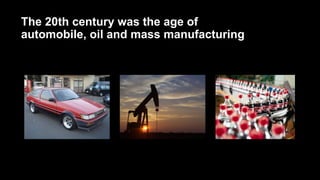
The 20th century was the age of
automobile, oil and mass manufacturing
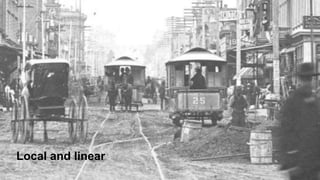
Local and linear
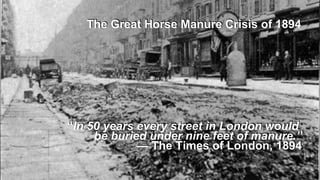
The Great Horse Manure Crisis of 1894
“In 50 years every street in London would
be buried under nine feet of manure.”
— The Times of London, 1894
New Technological Revolution takes off
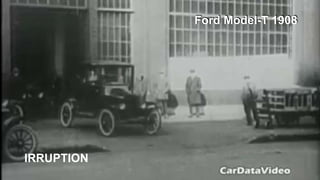
Ford Model-T 1908
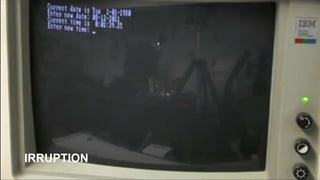
IRRUPTION
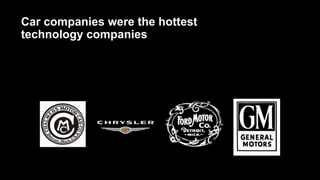
Car companies were the hottest
technology companies
FRENZY
The Roaring Twenties
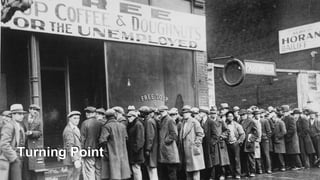
Turning Point
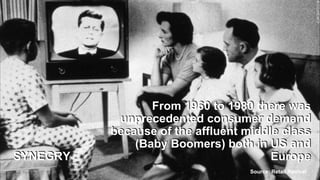
From 1960 to 1980 there was
unprecedented consumer demand
because of the affluent middle class
(Baby Boomers) both in US and
Europe
Source: Retail Revival
SYNEGRY
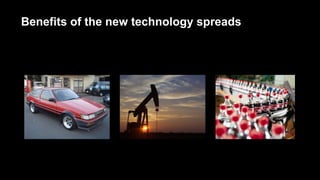
Benefits of the new technology spreads
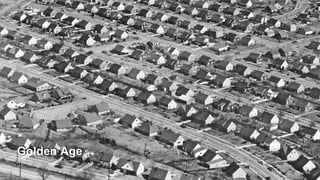
Golden Age
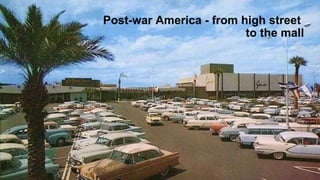
Post-war America - from high street
to the mall
Silent Boomer Gen X Millennial Gen Z
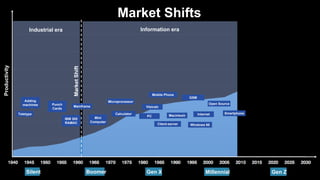
Industrial era
Teletype
Adding
machines Punch
Cards
IBM 305
RAMAC
Productivity
MarketShift
Information era
Mainframe
Mini
Computer
PC
Client-server
Internet
Open Source
Visicalc
Macintosh
Windows 95
Mobile Phone
GSM
Calculator
Market Shifts
Microprocessor
Smartphone
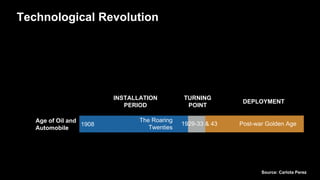
INSTALLATION
PERIOD
TURNING
POINT
DEPLOYMENT
Age of Oil and
Automobile
1908
The Roaring
Twenties
1929-33 & 43 Post-war Golden Age
Source: Carlota Perez
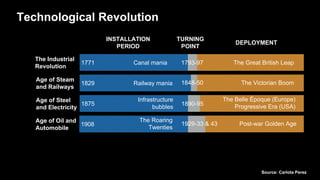
Technological Revolution
INSTALLATION
PERIOD
TURNING
POINT
DEPLOYMENT
The Industrial
Revolution
1771 Canal mania 1793-97 The Great British Leap
Age of Steam
and Railways
1829 Railway mania 1848-50 The Victorian Boom
Age of Steel
and Electricity
1875
Infrastructure
bubbles
1890-95
The Belle Époque (Europe)
Progressive Era (USA)
Age of Oil and
Automobile
1908
The Roaring
Twenties
1929-33 & 43 Post-war Golden Age
Source: Carlota Perez
Technological Revolution
The Age of Information
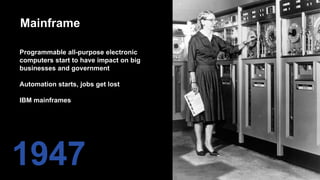
1947
Programmable all-purpose electronic
computers start to have impact on big
businesses and government
Automation starts, jobs get lost
IBM mainframes
Mainframe
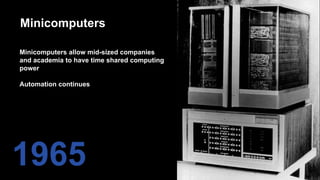
1965
Minicomputers allow mid-sized companies
and academia to have time shared computing
power
Automation continues
Minicomputers
Fifth Technological Revolution
starts
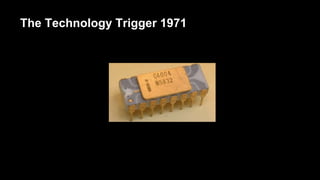
Intel 1971
The Technology Trigger 1971
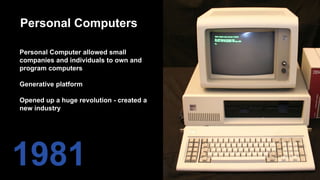
1981
Personal Computer allowed small
companies and individuals to own and
program computers
Generative platform
Opened up a huge revolution - created a
new industry
Personal Computers
IRRUPTION
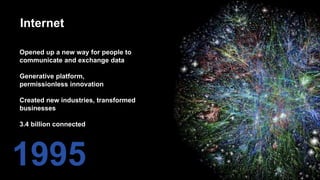
1995
Opened up a new way for people to
communicate and exchange data
Generative platform,
permissionless innovation
Created new industries, transformed
businesses
3.4 billion connected
Internet
FRENZY
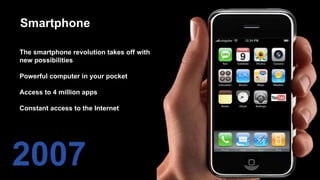
2007
The smartphone revolution takes off with
new possibilities
Powerful computer in your pocket
Access to 4 million apps
Constant access to the Internet
Smartphone
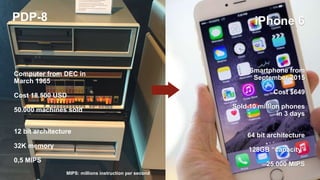
PDP-8
Computer from DEC in
March 1965
Cost 18.500 USD
50.000 machines sold
12 bit architecture
32K memory
0,5 MIPS
MIPS: millions instruction per second
iPhone 6
Smartphone from
September 2015
Cost $649
Sold 10 million phones
in 3 days
64 bit architecture
128GB “capacity”
25.000 MIPS
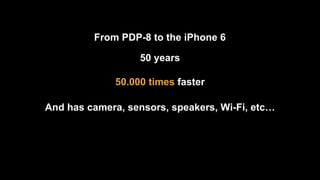
From PDP-8 to the iPhone 6
50.000 times faster
50 years
And has camera, sensors, speakers, Wi-Fi, etc…
We have a supercomputer in our pocket
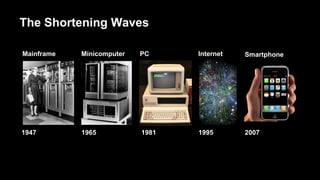
Mainframe
1947
Minicomputer
1965
PC
1981 1995
Internet Smartphone
2007
The Shortening Waves
The Next Wave is built on the Smartphone Wave
What does this mean?
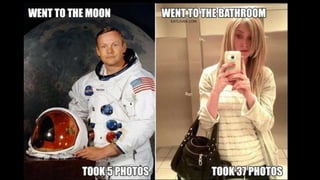
WE EMPHASIZE
TECHNOLOGY
BUT IGNORE THE
SOCIAL AND CULTURAL IMPACT
How will technology
change people’s behavior?
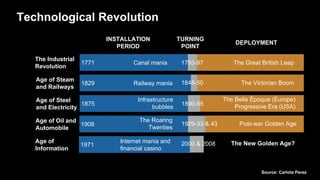
INSTALLATION
PERIOD
TURNING
POINT
DEPLOYMENT
Age of
Information
1971
Internet mania and
financial casino
2000 & 2008
The Industrial
Revolution
1771 Canal mania 1793-97 The Great British Leap
Age of Steam
and Railways
1829 Railway mania 1848-50 The Victorian Boom
Age of Steel
and Electricity
1875
Infrastructure
bubbles
1890-95
The Belle Époque (Europe)
Progressive Era (USA)
Age of Oil and
Automobile
1908
The Roaring
Twenties
1929-33 & 43 Post-war Golden Age
The New Golden Age?
Source: Carlota Perez
Technological Revolution
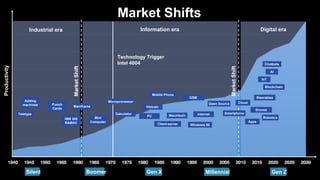
Silent Boomer Gen X Millennial Gen Z
Industrial era
Teletype
Adding
machines Punch
Cards
IBM 305
RAMAC
Productivity
MarketShift
Information era
Mainframe
Mini
Computer
PC
Client-server
Internet
Open Source
Visicalc
Macintosh
Windows 95
Mobile Phone
GSM
Calculator
MarketShift
Digital era
Apps
Cloud
Wearables
Blockchain
IoT
AI
Chatbots
Robotics
Drones
Market Shifts
Smartphone
Microprocessor
Technology Trigger
Intel 4004
Software eats the world
Intelligent Software
Real-time Software
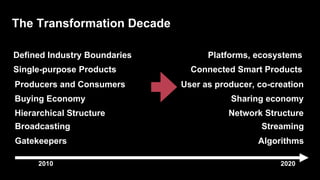
Businesses are going though
Digital Transformation
2010 2020
Defined Industry Boundaries
Single-purpose Products
Producers and Consumers
Buying Economy
Hierarchical Structure
Platforms, ecosystems
Connected Smart Products
User as producer, co-creation
Sharing economy
Network Structure
The Transformation Decade
Broadcasting Streaming
Gatekeepers Algorithms
2010 2020
Ushering in the Golden Era in
the Information Age
Source: Carlota Perez
“We’ll only have it if we build it.”
— Carlota Perez
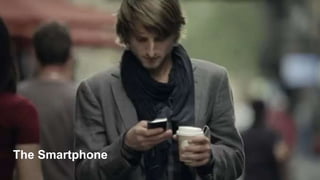
The Smartphone
2+ billion people carry
smartphones
Source: ITU, a16z, Benedict Evans slides
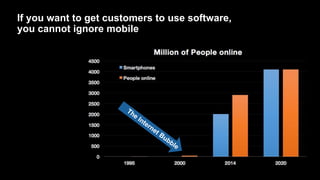
If you want to get customers to use software,
you cannot ignore mobile
Source: ITU, a16z, Benedict Evans slides
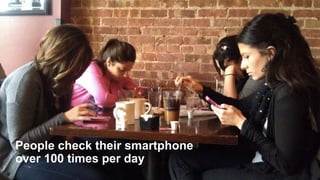
People check their smartphone
over 100 times per day
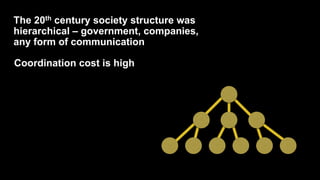
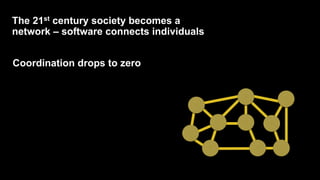
Transformation from Hierarchical to Networks
The 20th century society structure was
hierarchical – government, companies,
any form of communication
Coordination cost is high
The 21st century society becomes a
network – software connects individuals
Coordination drops to zero
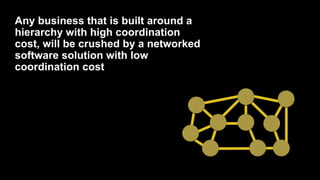
Any business that is built around a
hierarchy with high coordination
cost, will be crushed by a networked
software solution with low
coordination cost
Smart things that connect
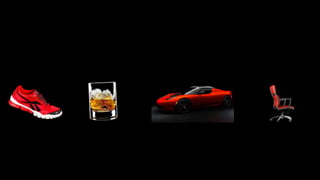
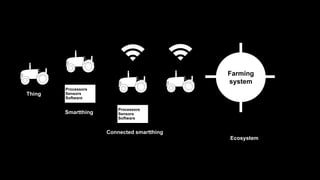
Everyday objects get sensors and
software and connect to the Internet
Thing
Smartthing
Processors
Sensors
Software
Connected smartthing
Processors
Sensors
Software
Source: HBR
Farming
system
Planters
Tillers
Tractor
Combine
harvesters
Ecosystem
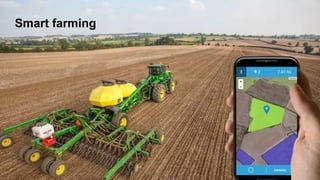
Smart farming
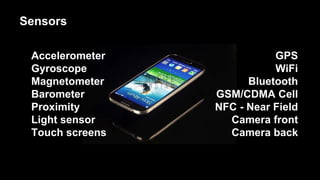
Accelerometer
Gyroscope
Magnetometer
Barometer
Proximity
Light sensor
Touch screens
GPS
WiFi
Bluetooth
GSM/CDMA Cell
NFC - Near Field
Camera front
Camera back
Sensors
Fitness tracking – healthy lifestyle
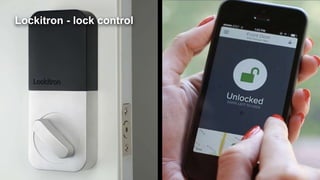
Lockitron - lock control
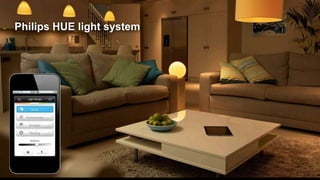
Philips HUE light system
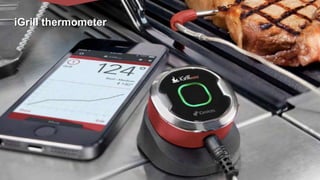
iGrill thermometer
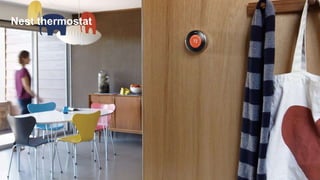
Nest thermostat
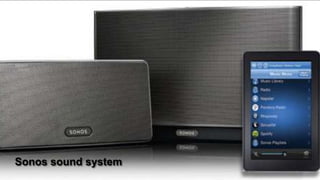
Sonos sound system
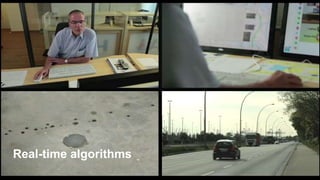
Real-time algorithms
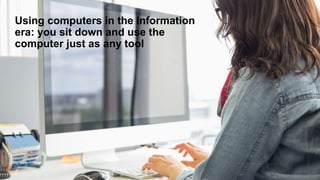
Using computers in the Information
era: you sit down and use the
computer just as any tool
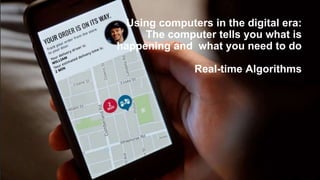
Using computers in the digital era:
The computer tells you what is
happening and what you need to do
Real-time Algorithms
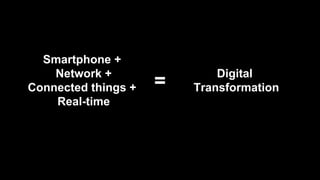
Smartphone +
Network +
Connected things +
Real-time
=
Digital
Transformation
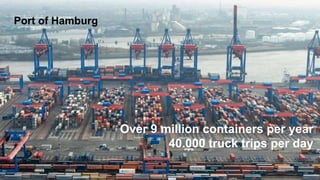
Port of Hamburg
Over 9 million containers per year
40.000 truck trips per day
Rise of online ordering and
delivery services
78
79
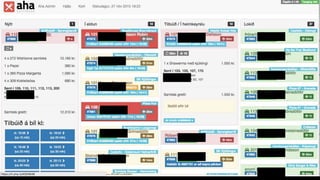
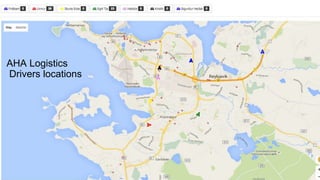
AHA Logistics
Drivers locations
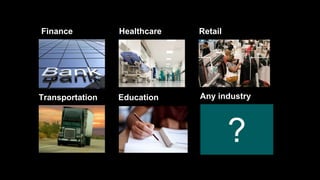
Finance Healthcare Retail
Transportation Education
?
Any industry
DIGITAL TRANSFORMATION
IN THE POST SMARTPHONE AGE
Ólafur Andri Ragnarsson
olafurandri.com
andri@olafurandri.com
@olandri
slideshart.net/olandri
Takk

Digital Transformation in the Post-smartphone Age