LECTURE L06
TECHNOLOGICAL REVOLUTIONS
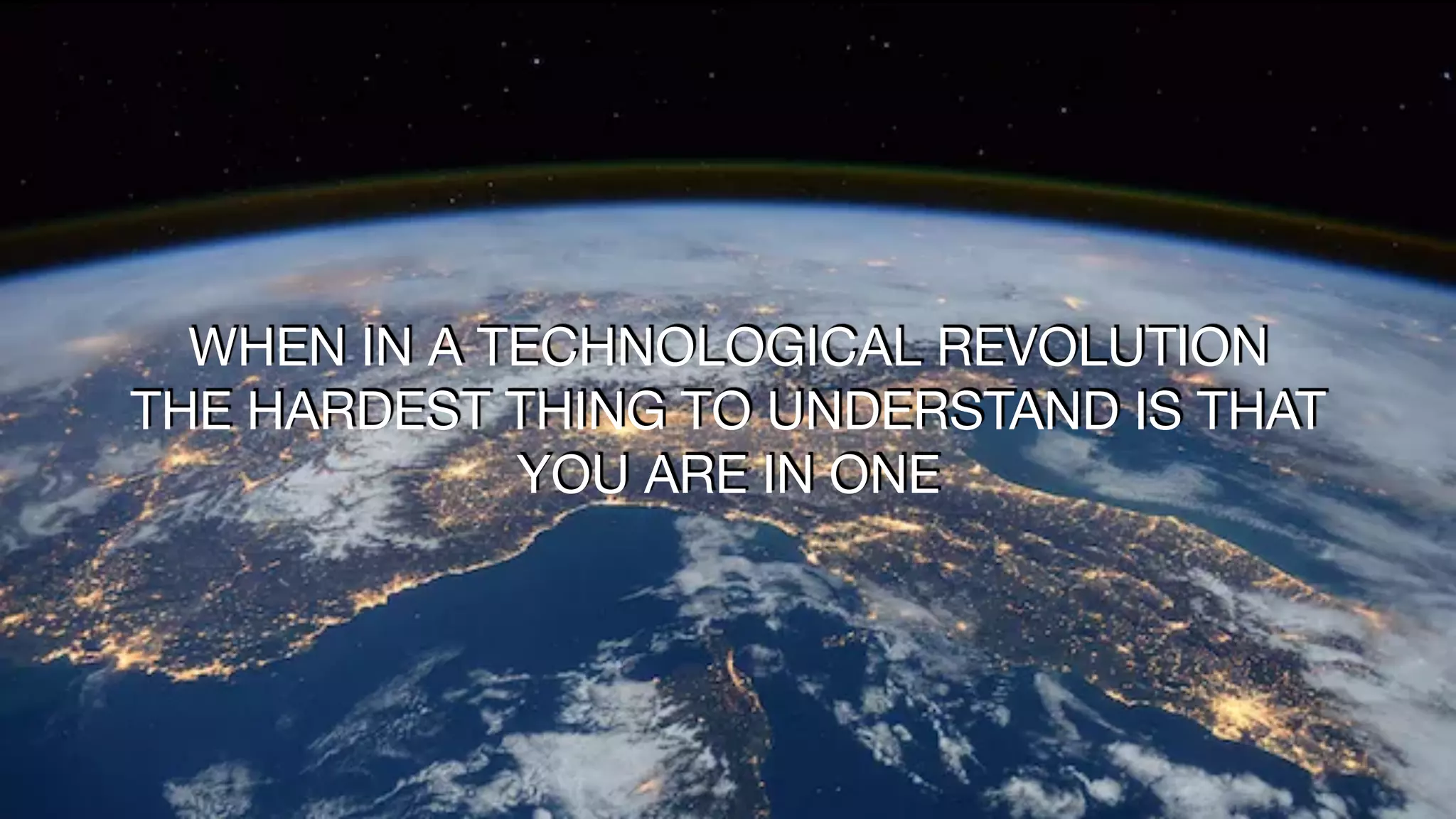
WHEN IN A TECHNOLOGICAL REVOLUTION

THE HARDEST THING TO UNDERSTAND IS THAT
YOU ARE IN ONE
We tend to overestimate the immediate impact
of technology and underestimate the long-
term impact
Timing is everything
We tend to place emphasis on the technology
itself, when it is really the social and cultural
change that will be the most dramatic
Perception is everything
WE EMPHASIZE

TECHNOLOGY
BUT IGNORE THE
SOCIAL AND CULTURAL
IMPACT
Is it really up to politicians with their plans?
Economic Growth
THE LAST REVOLUTION
The 20th century was the age of
automobile, oil and mass manufacturing
THE WORLD IN 1899
Local and linear
The Great Horse Manure Crisis of 1894
“In 50 years every street in London would
be buried under nine feet of manure.”
— An article in Times of London, 1894
New Technological Revolution takes off
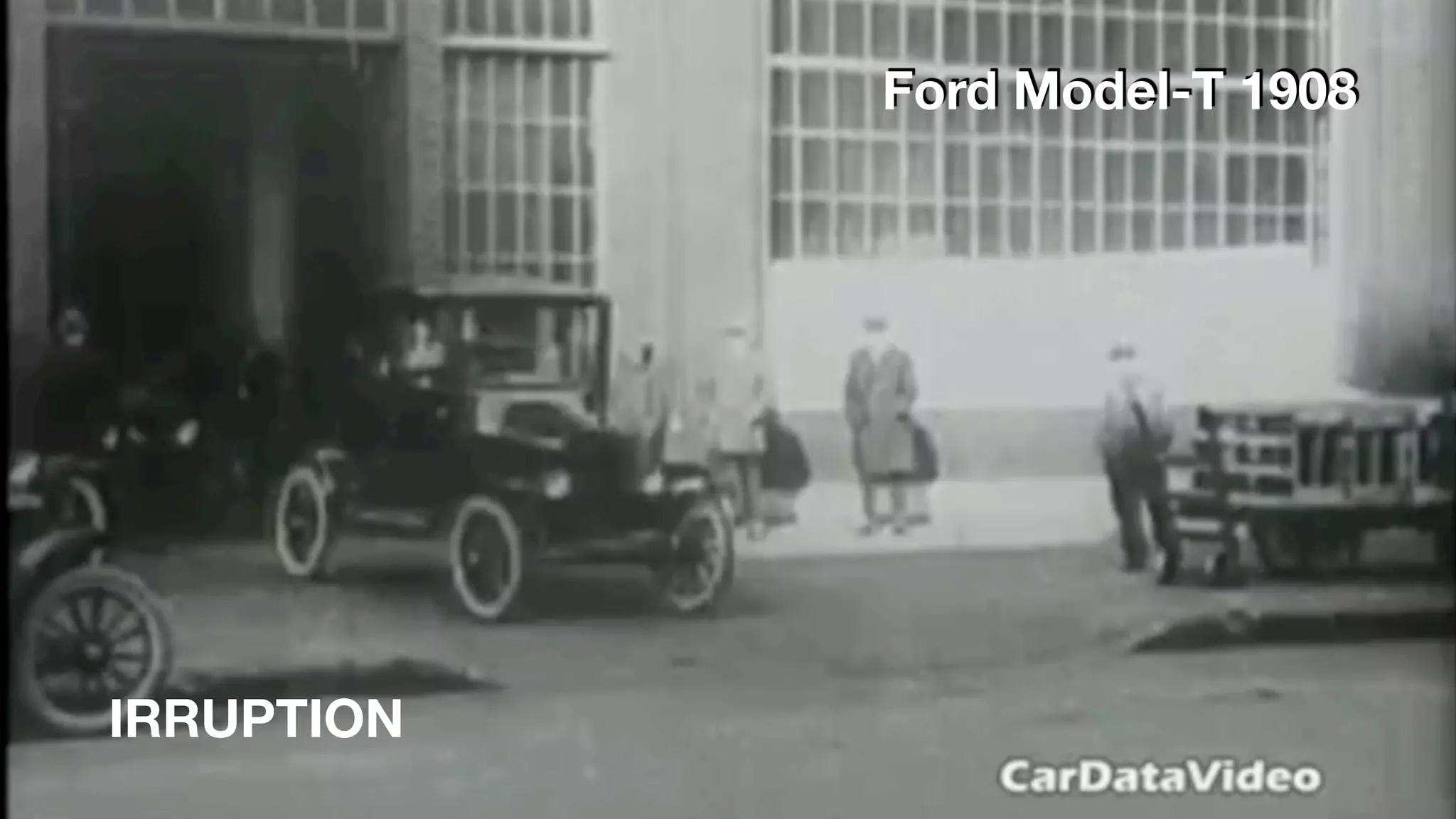
Ford Model-T 1908
Ford Model-T 1908
IRRUPTION
Car companies were the hottest
technology companies
Andrew MellonAndrew Carnegie Henry Ford John D. Rockefeller

Inequality rises - few people get very
rich
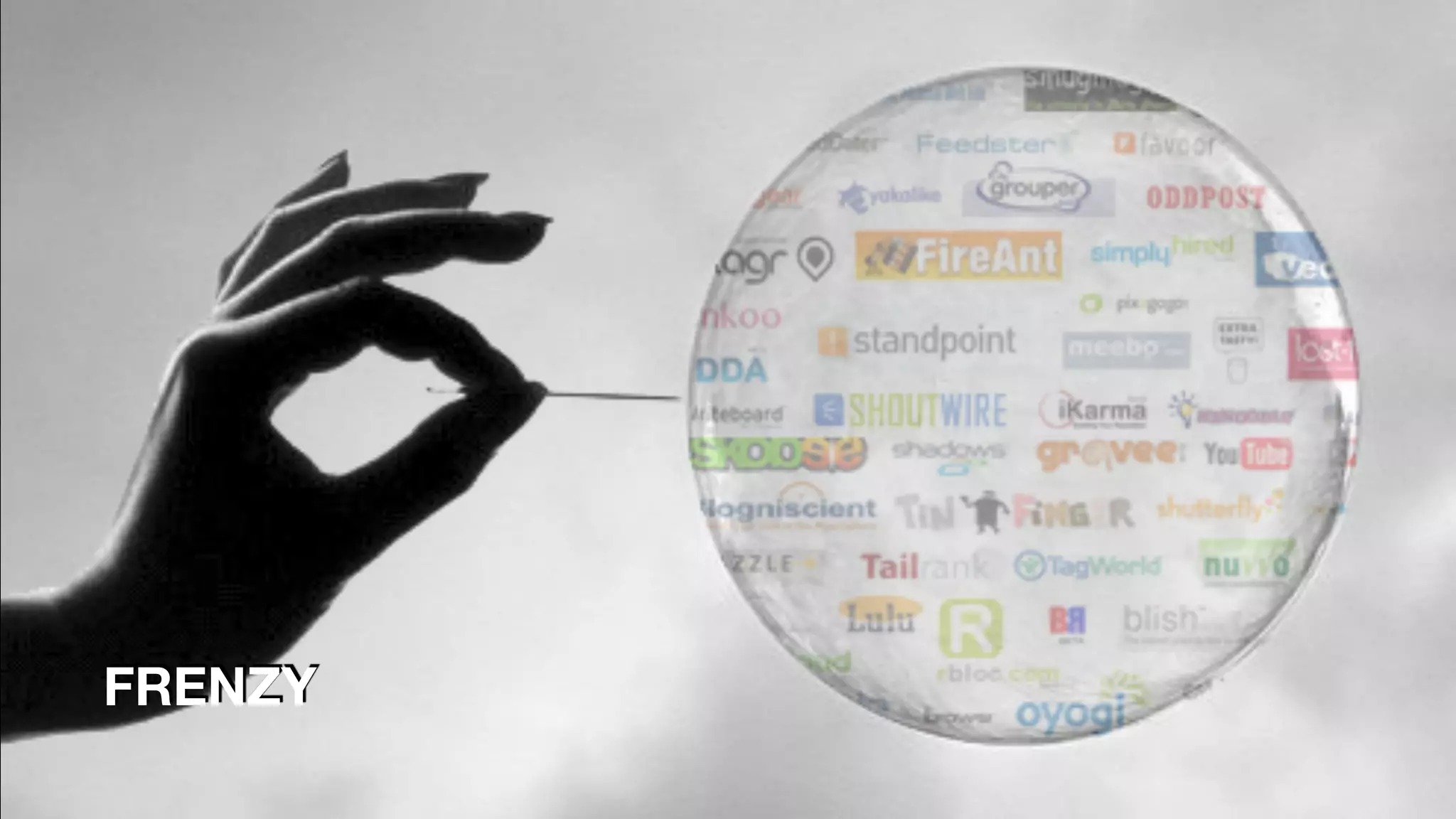
FRENZY
The Roaring Twenties
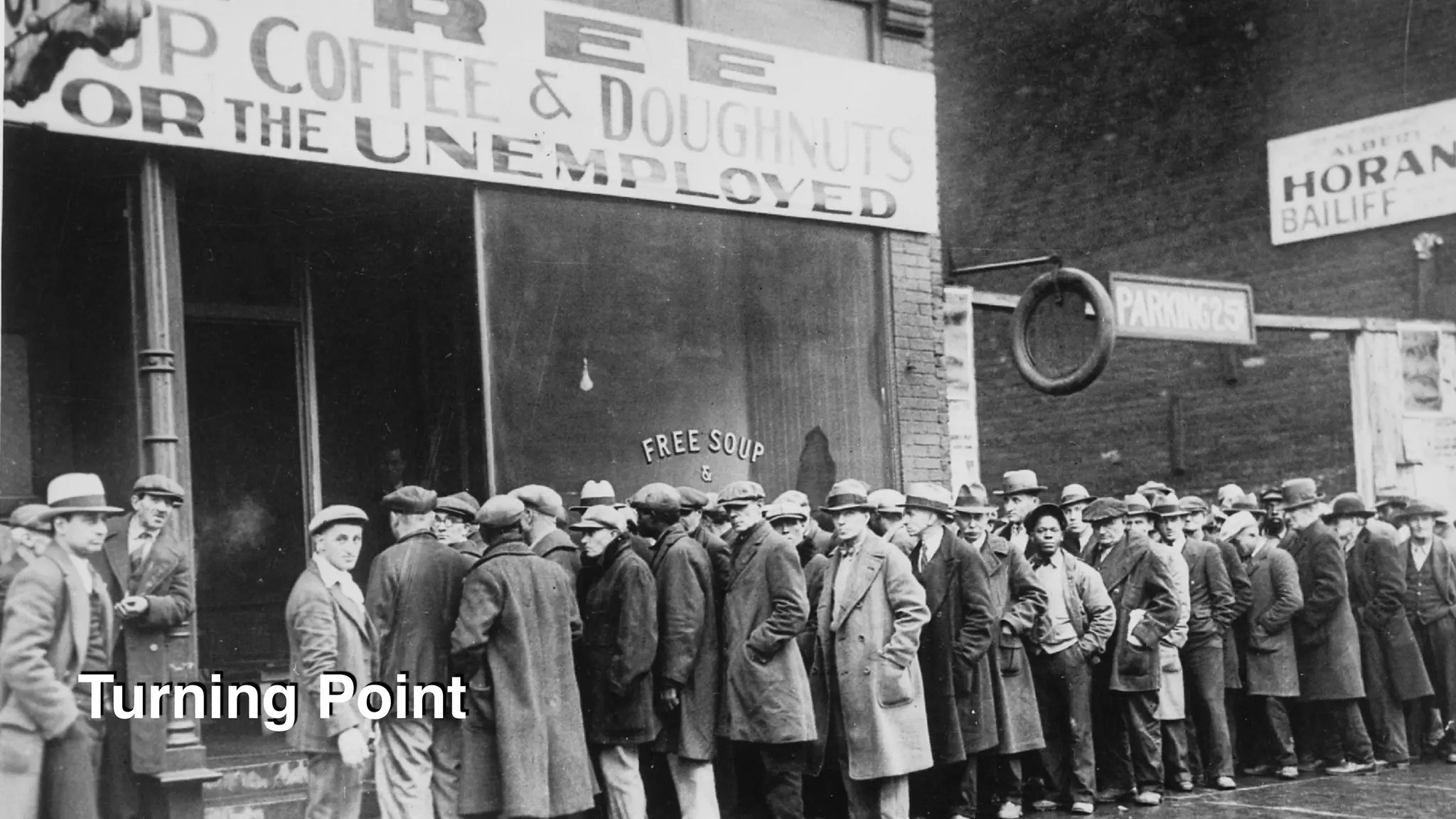
The crash began on October 24. Institutions
and financiers started to buy stocks to keep
them up. The stock bounced back only to
collapse on Tuesday, 29th - Black Tuesday.
The 1929 Wall Street Stock Crash
Depression spread world-wide and lasted until
the second Great War
The Great Depression
Turning Point
Fundamental changes are made to move from
the frenzy mode, shaped by financial criteria to
synergy mode, solidly based on growing
production capabilites
Turning Point
Carlota Perez, Technological Revolution and Financial Capital
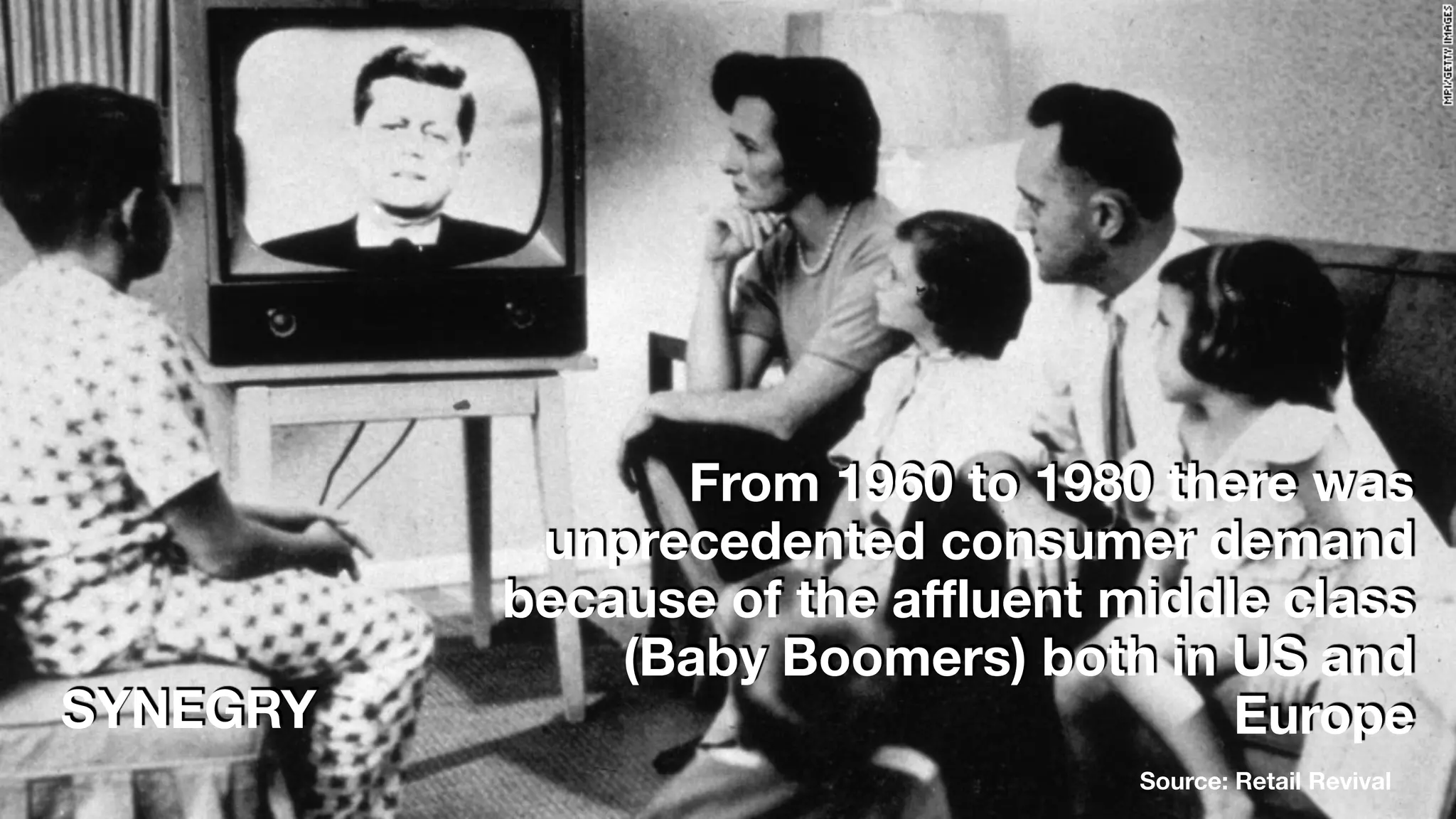
From 1960 to 1980 there was
unprecedented consumer demand
because of the affluent middle class
(Baby Boomers) both in US and
Europe
Source: Retail Revival
SYNEGRY
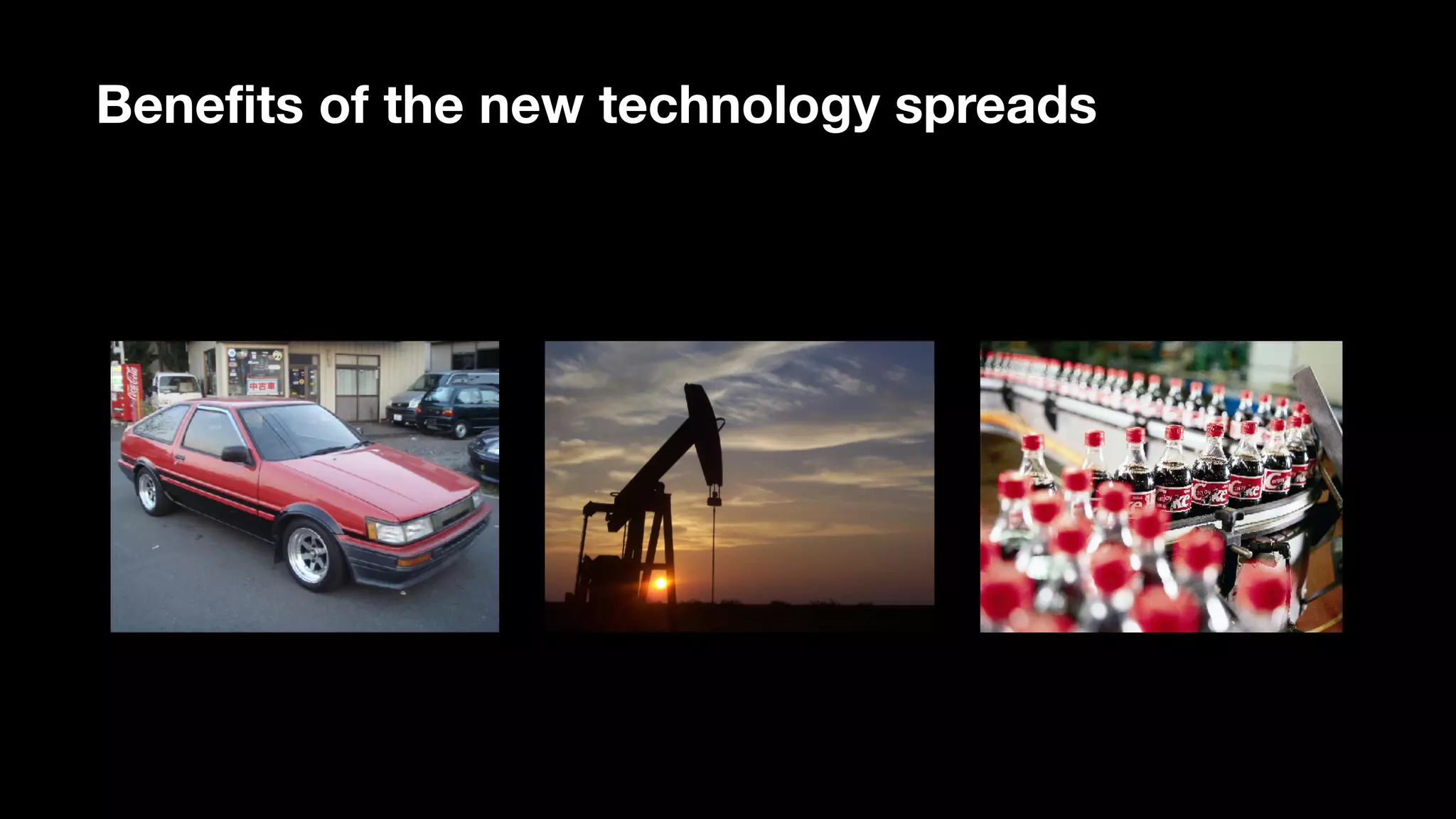
Benefits of the new technology spreads
Golden Age
Post-war America - from high street 

to the mall
INSTALLATION
PERIOD
TURNING

POINT
DEPLOYMENT
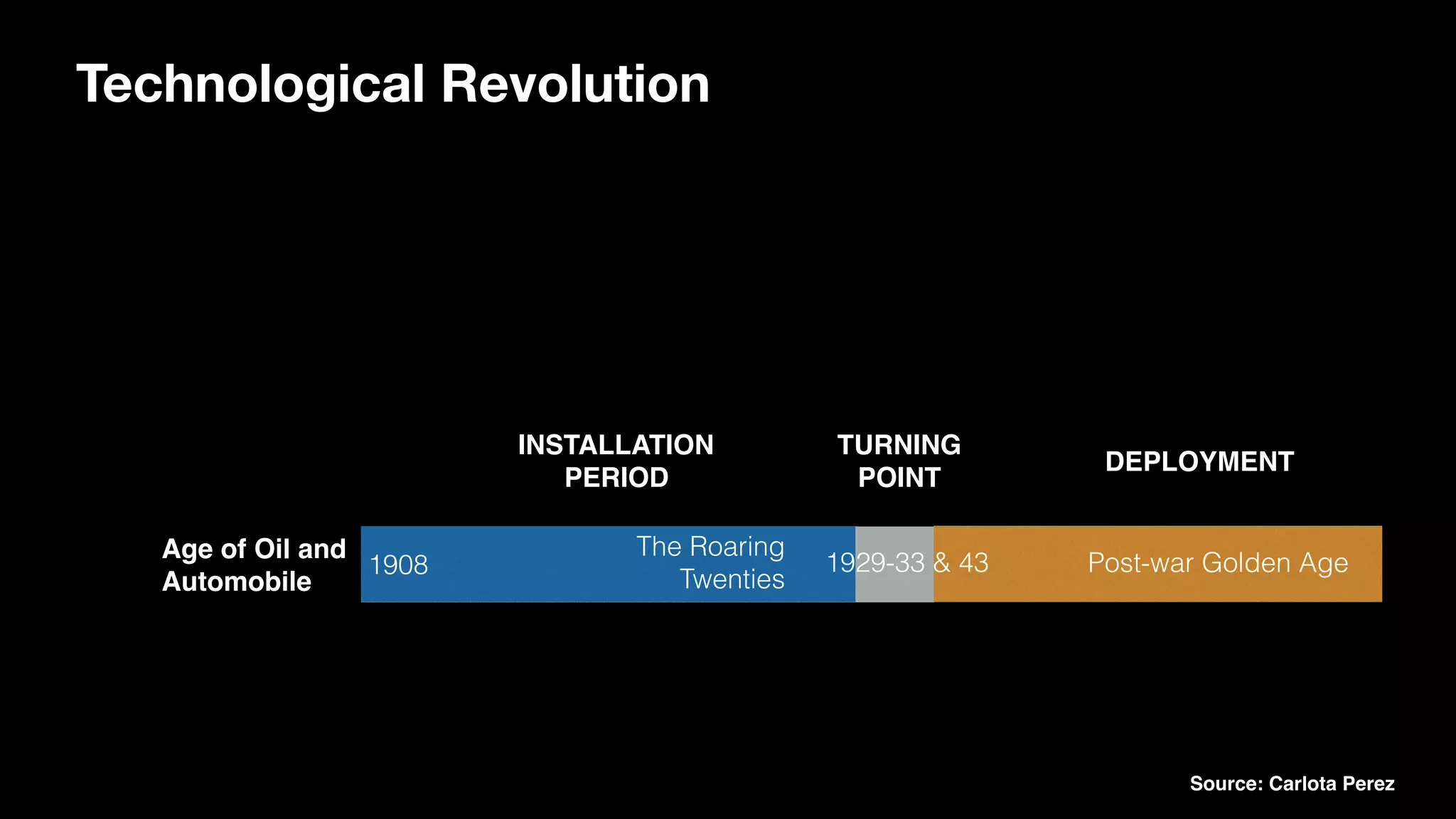
Age of Oil and

Automobile
1908
The Roaring
Twenties
1929-33 & 43 Post-war Golden Age
Source: Carlota Perez
Technological Revolution
INSTALLATION
PERIOD
TURNING

POINT
DEPLOYMENT
The Industrial 

Revolution
1771 Canal mania 1793-97 The Great British Leap
Age of Steam

and Railways
1829 Railway mania 1848-50 The Victorian Boom
Age of Steel
and Electricity 1875
Infrastructure

bubbles
1890-95
The Belle Époque (Europe)

Progressive Era (USA)
Age of Oil and

Automobile
1908
The Roaring
Twenties
1929-33 & 43 Post-war Golden Age
Source: Carlota Perez
Technological Revolution
The Long View
The Industrial
Revolution

Arkwright’s mill

in Cromford
1771
Age of Steam

and Railways

Manchester-
Liverpool Rocket
line
1829
Age of Steel and
Electricity

Carnegie
Bessemer steel
plant, Pittsburg
1875
Age of Oil and
automobile

Ford’s model T
plant, Detroit
1908
Age of
Information

Intel’s microchip,
Santa Clara
1971
Technical Revolutions span over generations
Starts with a cluster of technological revolutions in a particular place
Source: Carlota Perez
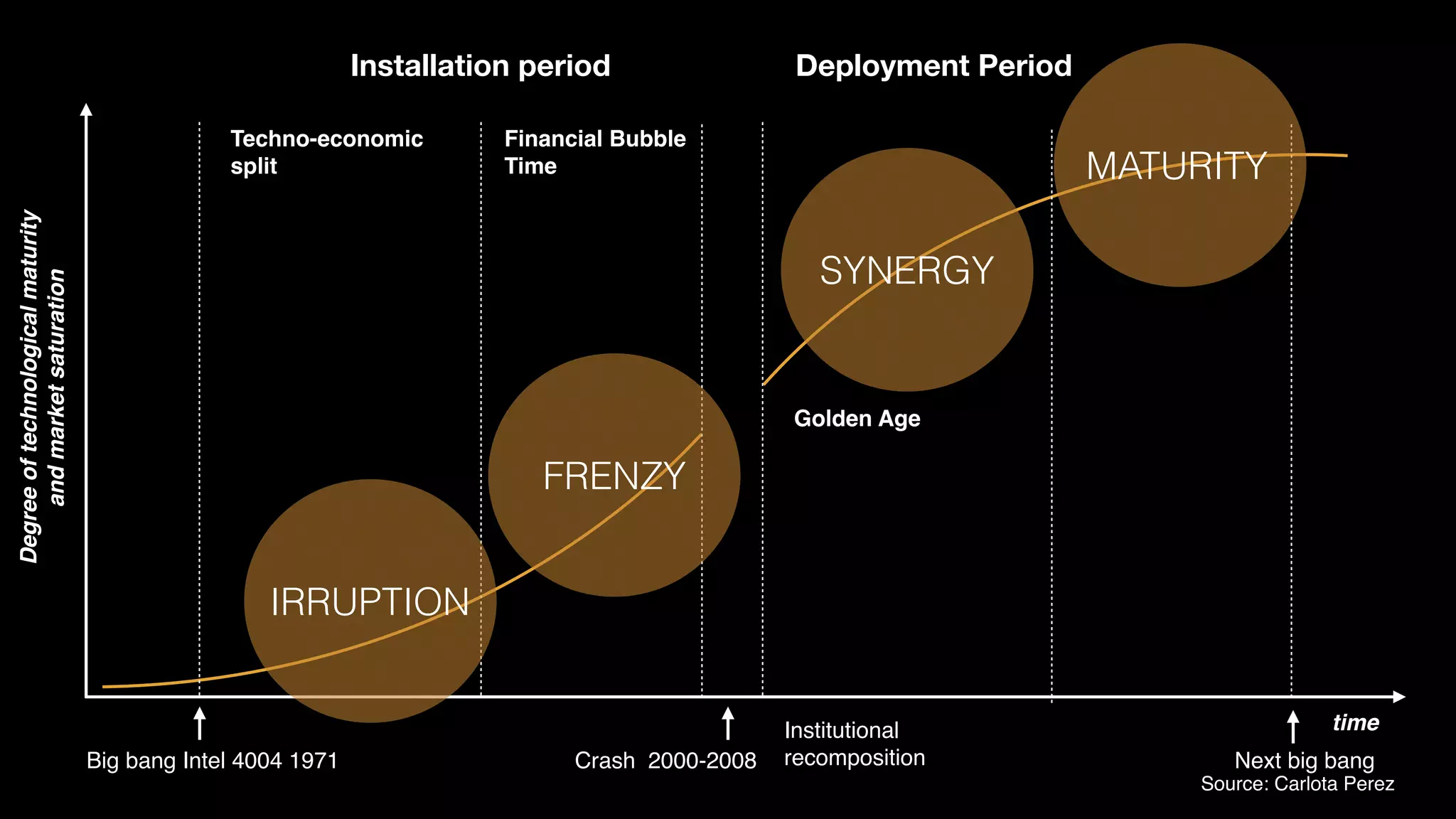
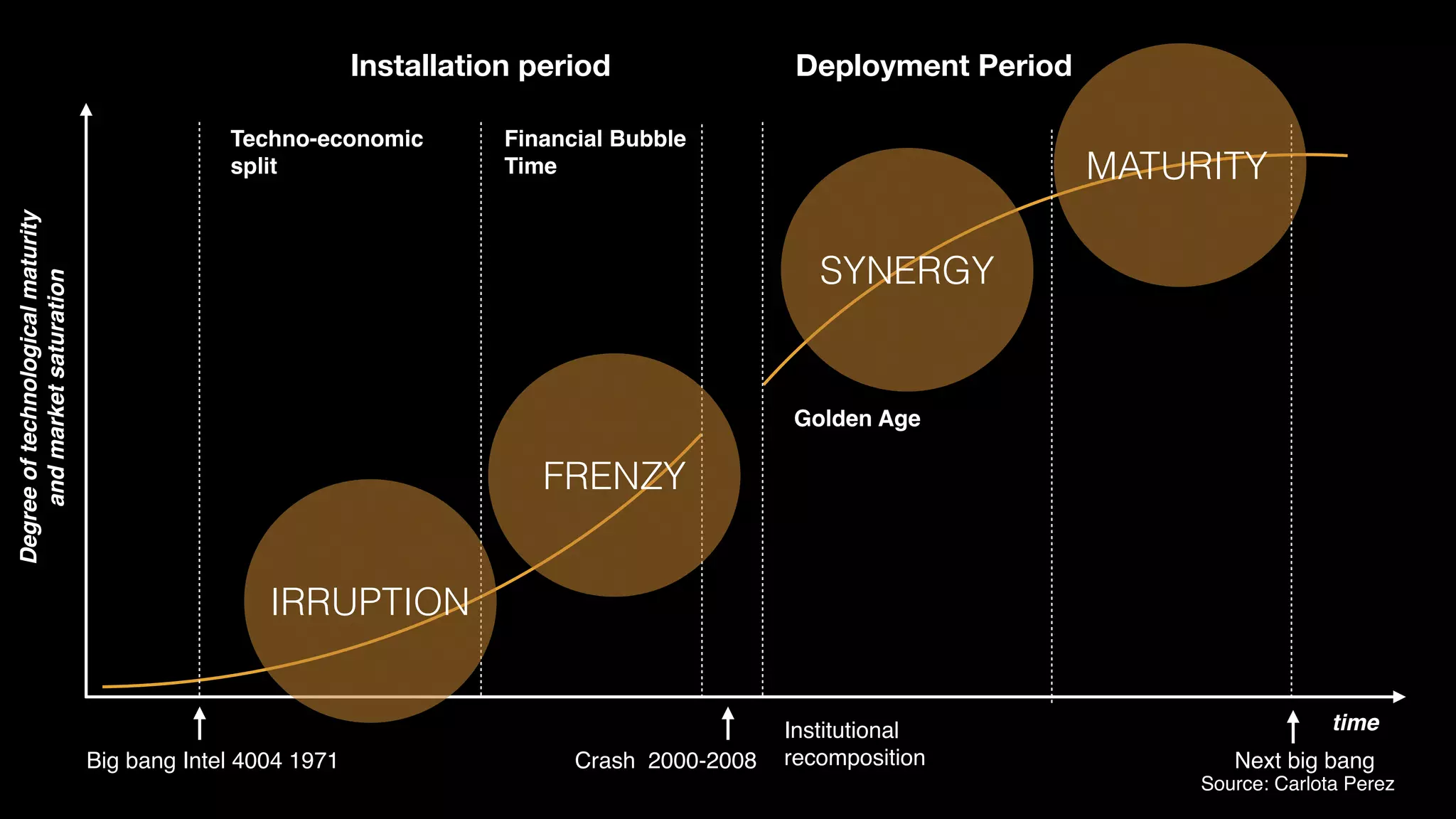
Installation period Deployment Period
Institutional
recomposition
Degreeoftechnologicalmaturity

andmarketsaturation
time
Crash 2000-2008Big bang Intel 4004 1971 Next big bang
Techno-economic
split
IRRUPTION
Financial Bubble
Time
FRENZY
Golden Age
SYNERGY
MATURITY
Source: Carlota Perez
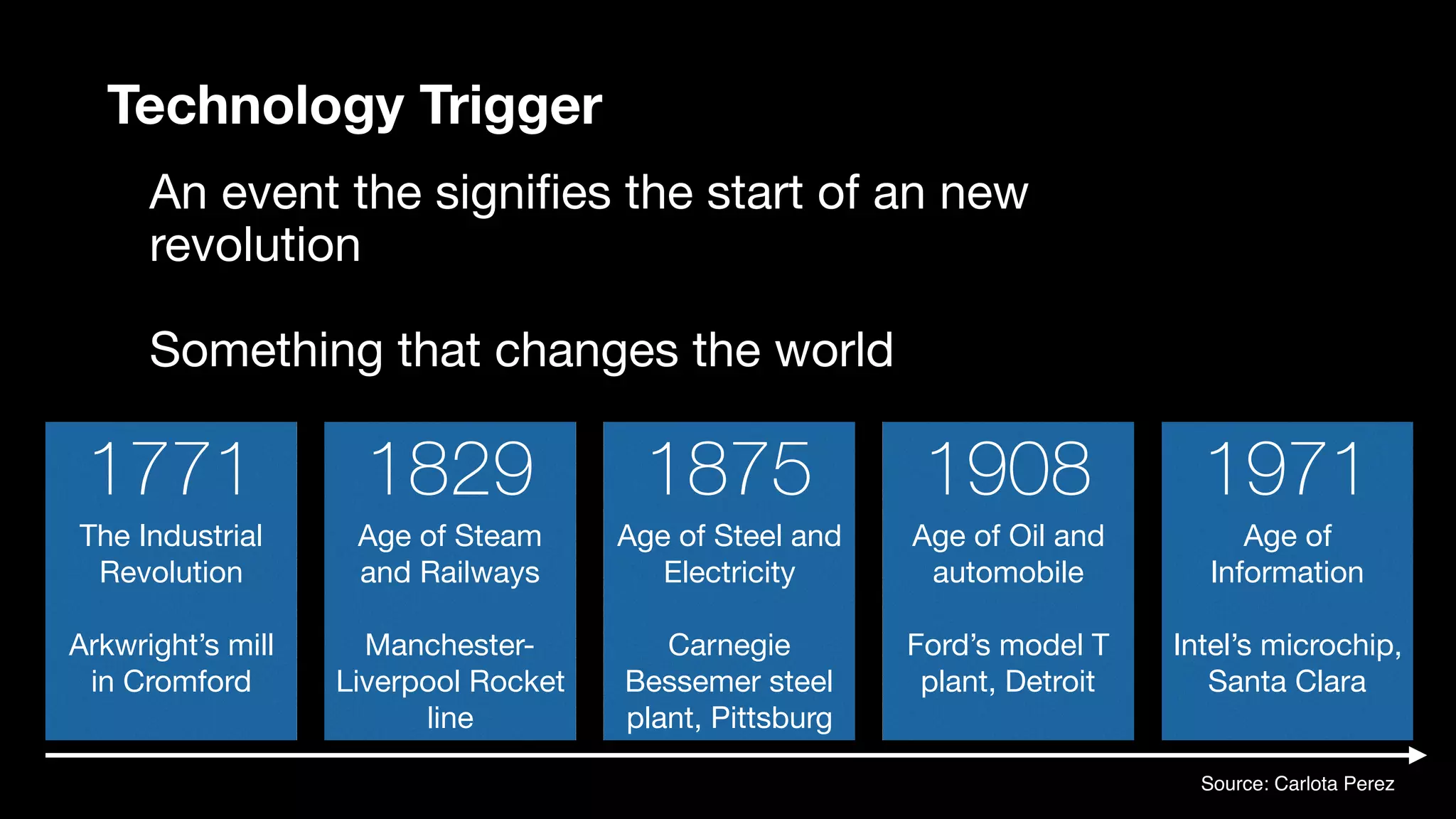
An event the signifies the start of an new
revolution

Something that changes the world
Technology Trigger
The Industrial
Revolution

Arkwright’s mill

in Cromford
1771
Age of Steam

and Railways

Manchester-
Liverpool Rocket
line
1829
Age of Steel and
Electricity

Carnegie
Bessemer steel
plant, Pittsburg
1875
Age of Oil and
automobile

Ford’s model T
plant, Detroit
1908
Age of
Information

Intel’s microchip,
Santa Clara
1971
Source: Carlota Perez
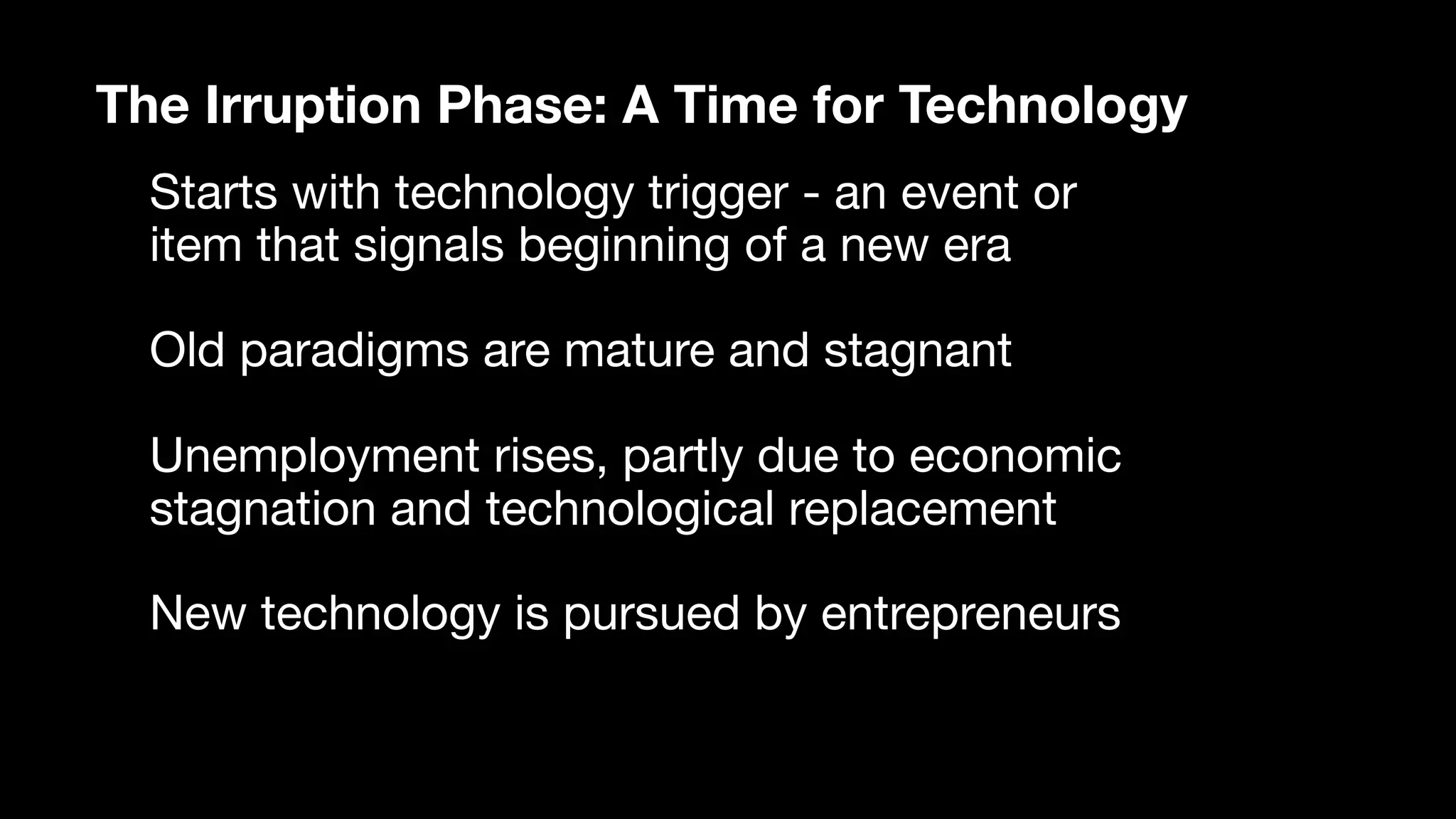
The Irruption Phase: A Time for Technology
Starts with technology trigger - an event or
item that signals beginning of a new era

Old paradigms are mature and stagnant

Unemployment rises, partly due to economic
stagnation and technological replacement

New technology is pursued by entrepreneurs
Despair and impotence affect those loosing out

Old industries see declining profits

Policymakers try to keep and protect outdated
industries

Political uncertainty and division, sometimes
new movements
The Irruption Phase: A Time for Technology
The Frenzy Phase: A Time for Finance
Financial capital takes over - paper economy
decouples the real economoy

Small number of people get very rich, inequality
rises

Massive migration as people look for
opportunities
The Frenzy Phase: A Time for Finance
Time of speculations, corruption, and love of
wealth

The wealth that has grown and concentrated in
relatively few hands is greater that can be
absorbed by real investment

Excess money goes into infrastucture,
overinvestment
The Turning Point
A conceptual device to represent the
fundamental change required to move from
frenzy mode to synergy

Process of contextual change

Move from individualism to collective well-being

Period that is ripe for reshaping regualtions and
policies
The Synergy Phase: A Time for Production
Golden age

Infrastructure serves as engines of growth

Wealth gets distributed as investment is in
production
The Synergy Phase: A Time for Production
Full employment - production

Reign of the middle class

New paradigms are now accepted and
permeates every activity
The Maturity Phase: A Time for Questioning
Markets get saturated

Technology is stable and mature, productivity
gains are drained

The young start to see things as ‘all wrong’ -
movements form

Time of questioning
The Maturity Phase: A Time for Questioning
Company mergers

Migration of activities to less-saturated markets
abroad
Age of Information and Telecommunications
1947
Programmable all-purpose electronic
computers start to have impact on big
businesses and government
Automation starts, jobs get lost
IBM mainframes
Mainframe
1965
Minicomputers allow mid-sized companies
and academia to have time shared
computing power
Automation continues
Minicomputers
Fifth Technological Revolution
starts
Intel 1971
The Technology Trigger 1971
1981
Personal Computer allowed small
companies and individuals to own and
program computers
Generative platform
Opened up a huge revolution - created a
new industry
Personal Computers
IRRUPTION
Bill Gates Steve Jobs Michael Dell Larry Ellison
1995
Opened up a new way for people to
communicate and exchange data
Generative platform, 

permissionless innovation
Created new industries, transformed
businesses
3.4 billion connected
Internet
FRENZY
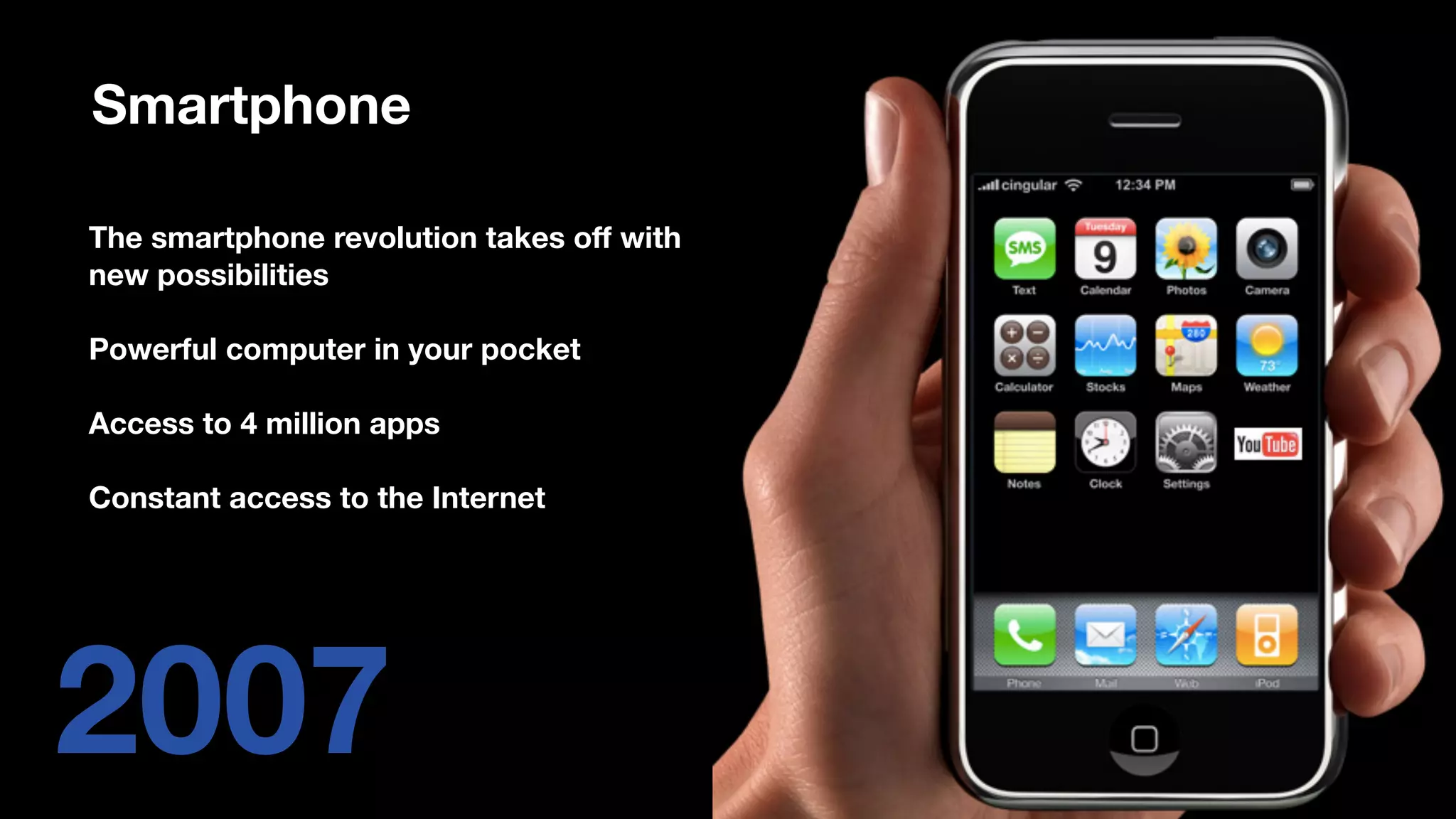
2007
The smartphone revolution takes off with
new possibilities
Powerful computer in your pocket
Access to 4 million apps
Constant access to the Internet
Smartphone
PDP-8
Computer from DEC in
March 1965
Cost 18.500 USD
50.000 machines sold
12 bit architecture
32K memory
0,5 MIPS
MIPS: millions instruction per second
iPhone 6
Smartphone from

September 2015
Cost $649
Sold 10 million phones

in 3 days
64 bit architecture
128GB “capacity”
25.000 MIPS
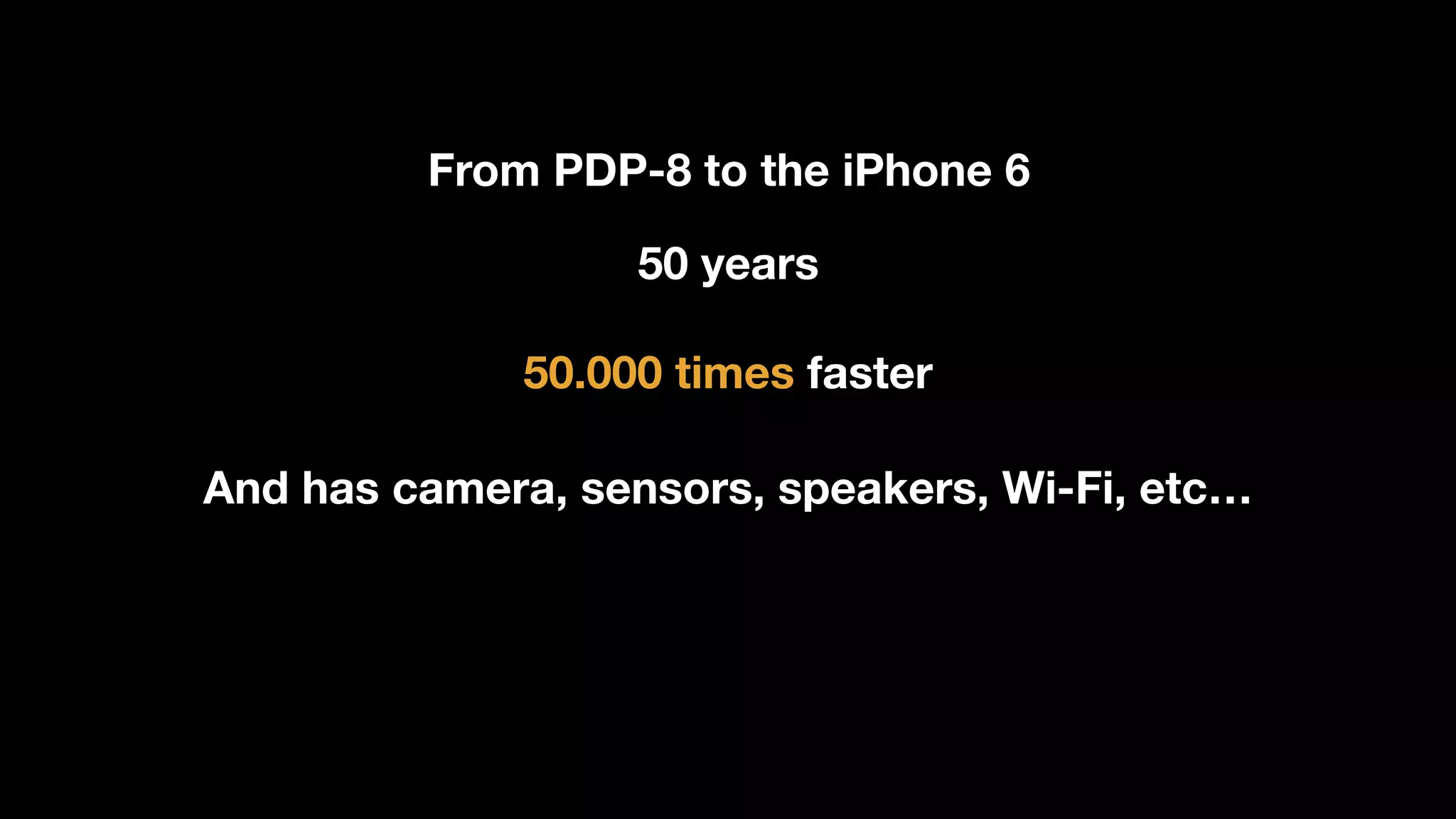
From PDP-8 to the iPhone 6
50.000 times faster
50 years
And has camera, sensors, speakers, Wi-Fi, etc…
Mainframe
1947
Minicomputer
1965
PC
1981 1995
Internet Smartphone
2007
The Shortening Waves
INSTALLATION
PERIOD
TURNING

POINT
DEPLOYMENT
Age of 

Information
1971
Internet mania and

financial casino
2000 & 2008
The Industrial 

Revolution
1771 Canal mania 1793-97 The Great British Leap
Age of Steam

and Railways
1829 Railway mania 1848-50 The Victorian Boom
Age of Steel
and Electricity 1875
Infrastructure

bubbles
1890-95
The Belle Époque (Europe)

Progressive Era (USA)
Age of Oil and

Automobile
1908
The Roaring
Twenties
1929-33 & 43 Post-war Golden Age
The New Golden Age?
Source: Carlota Perez
Technological Revolution
Installation period Deployment Period
Institutional
recomposition
Degreeoftechnologicalmaturity

andmarketsaturation
time
Crash 2000-2008Big bang Intel 4004 1971 Next big bang
Techno-economic
split
IRRUPTION
Financial Bubble
Time
FRENZY
Golden Age
SYNERGY
MATURITY
Source: Carlota Perez
Is the turning point over?
Talking About Generations
Generations
Major technological shifts always happens with generations
Research into understanding generations and how they behave
Here are some of the stereotypes - and should be used as a guideline,
not absolute facts
Although we see trends human nature is usually the same in any
generation
Silent Generation
Born 1925 until 1942, sometimes called “Lucky Few” and are retired
today
Born too early for WWII but before the Baby Boomers
Entered the workplace in a booming economy, the Sputnik Era - high
wagers, low fixed rate mortgages
The healthiest and most educated generation of elders that ever lived—
and, of course, the wealthiest.
The last Silent cohort reached age 65 in 2007 - perfect timing to the end!
Baby Boomers
Born 1946 until 1964, following the booming years after World War II.
Larger than previous generation.
Associated with privilege. Time of widespread government subsidies in
post-war housing and education, and increasing affluence. The boomers
moved to the suburbs and were perfect consumers for the newly erected
malls.
Received peak levels of income. Therefore, the boomers were perfect
consumers. In 2015, the boomers are between 51 and 69 years.
Generation X
Born ca. 1965 until 1980, MTV generation
Grew up when the wife stopped being a housewife and started working
so Xers became latchkey kids, and got used to daycare and divorce as
well as microwave dinners (there is a theory that states that microwave
owens and divorce is related).
This is the generation in the middle - boomers and millennials
Got access to computers at school and later work, played video games
in arcades. Just as the baby boomers, the Xers are passive consumers.
This is the last generation to use email as main form of correspondence.
Millennials
Born ca. 1980 until 2000 - the net generation or NetGen
Grew up with computers and the internet, and played video games on
consoles at home. With online technologies this generation is much
better connected with their parents.
More liberal than previous generations and more open minded, don’t
mind big governments if they get service.
Unlikely to conform to a routine schedule like working 9-5 or showing up
at any particular time, work according their own schedule, output driven.
Not as loyal, move from one job to the next.
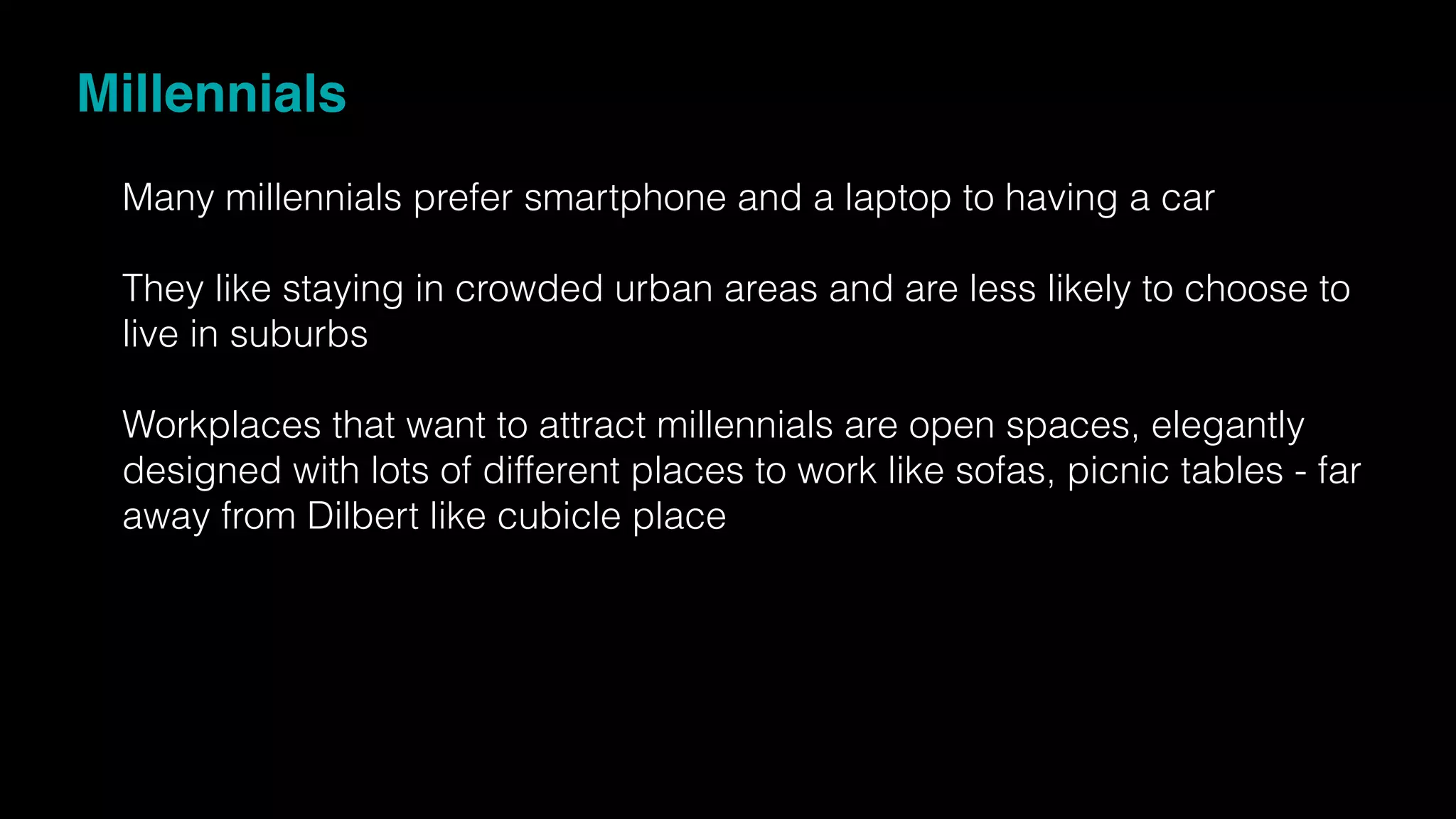
Millennials
Many millennials prefer smartphone and a laptop to having a car
They like staying in crowded urban areas and are less likely to choose to
live in suburbs
Workplaces that want to attract millennials are open spaces, elegantly
designed with lots of different places to work like sofas, picnic tables - far
away from Dilbert like cubicle place
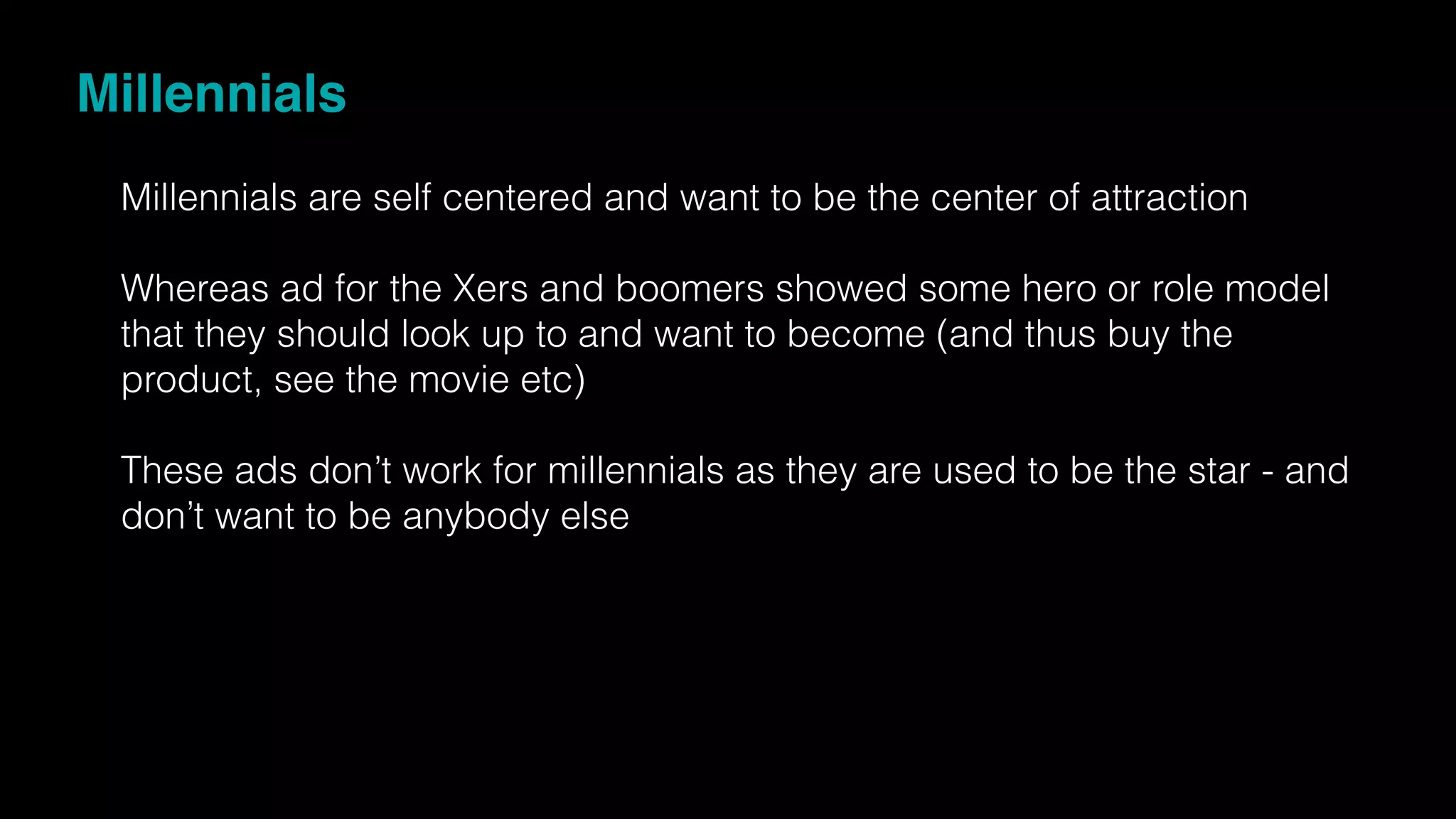
Millennials
Millennials are self centered and want to be the center of attraction
Whereas ad for the Xers and boomers showed some hero or role model
that they should look up to and want to become (and thus buy the
product, see the movie etc)
These ads don’t work for millennials as they are used to be the star - and
don’t want to be anybody else
Millennials
Millennials
Have the reputation of choosing brands but lacking loyalty
They are quicker to switch brands, loyalty is shorter
Today we have much more choses, much more brands are available and
the sources of information that let you switch brands is far bigger than
ever
A consumer may choose a brand if a friend recommends it
Millennials
In the book Retail Revival, author points out that brands that are winning
with the millennials, of course they need to be good, but also:
• authentic like Lululemon, living what their brands espouses and being
real
• purpose driven like TOMS Shoes, supporting human purpose beyond
pure profit;
• quick to change like Apple, constantly driving obsolescence with its
latest products; and
• socially savvy like Zappos.com, nurturing the visibility of everyone in
the company through social networks.
Comparing Generations
Millennials use technology differently
Comparing Generations
What makes your generation unique
0	
1,000	
2,000	
3,000	
4,000	
5,000	
6,000	
20	 21	 22	 23	 24	 25	 26	 27	 28	 29	 30	 31	 32	 33	 34	 35	 36	 37	 38	 39	 40	 41	 42	 43	 44	 45	 46	 47	 48	 49	 50	 51	 52	 53	 54	 55	 56	 57	 58	 59	 60	 61	 62	 63	 64	 65	 66	 67	 68	 69	 70	 71	 72	 73	 74	 75	 76	 77	 78	 79	 80	 81	 82	 83	 84	 85	 86	 87	 88	 89	 90	 91	 92	 93	 94	 95	 96	 97	 98	 99	100	101	102	103	104	105	106	107	108	
Series1	
Millennials
76,321
Gen-X
59,302
Baby boomers
69,897
hippies/“counterculture”
Beatles Kingdom
World war II
World war I
Values and traditions
MTV Latchkeys
smartphones
computers/net
computers/BASIC
Punk
Born at farms
TV
Religion
Gögn frá Hagstofunni
Radio/telegrams
Rás2
Youtube
Social Media
Selfies
Bond
Movie stars
Queen
Live Aid
Spotify
Netflix
Silent and before
30,054
game consoles
Arcades
Generations
Industrial/progress
LP
CD
Key Insight
Research suggest that millennials are in some ways different than
the previous generations, in particular their use of technology.
This is the generation that established businesses need to attract as
customers, and that means using the same technology as they do -
smartphones, web sites, and social media.

L06 Technological Revolutions

  • 1.
  • 2.
    WHEN IN ATECHNOLOGICAL REVOLUTION
 THE HARDEST THING TO UNDERSTAND IS THAT YOU ARE IN ONE
  • 3.
    We tend tooverestimate the immediate impact of technology and underestimate the long- term impact Timing is everything
  • 4.
    We tend toplace emphasis on the technology itself, when it is really the social and cultural change that will be the most dramatic Perception is everything
  • 5.
    WE EMPHASIZE
 TECHNOLOGY BUT IGNORETHE SOCIAL AND CULTURAL IMPACT
  • 6.
    Is it reallyup to politicians with their plans? Economic Growth
  • 7.
  • 8.
    The 20th centurywas the age of automobile, oil and mass manufacturing
  • 9.
  • 10.
  • 12.
    The Great HorseManure Crisis of 1894 “In 50 years every street in London would be buried under nine feet of manure.” — An article in Times of London, 1894
  • 13.
  • 14.
  • 15.
  • 16.
    Car companies werethe hottest technology companies
  • 17.
    Andrew MellonAndrew CarnegieHenry Ford John D. Rockefeller Inequality rises - few people get very rich
  • 18.
  • 21.
    The crash beganon October 24. Institutions and financiers started to buy stocks to keep them up. The stock bounced back only to collapse on Tuesday, 29th - Black Tuesday. The 1929 Wall Street Stock Crash
  • 23.
    Depression spread world-wideand lasted until the second Great War The Great Depression
  • 24.
  • 25.
    Fundamental changes aremade to move from the frenzy mode, shaped by financial criteria to synergy mode, solidly based on growing production capabilites Turning Point Carlota Perez, Technological Revolution and Financial Capital
  • 26.
    From 1960 to1980 there was unprecedented consumer demand because of the affluent middle class (Baby Boomers) both in US and Europe Source: Retail Revival SYNEGRY
  • 27.
    Benefits of thenew technology spreads
  • 28.
  • 29.
    Post-war America -from high street 
 to the mall
  • 30.
    INSTALLATION PERIOD TURNING
 POINT DEPLOYMENT Age of Oiland
 Automobile 1908 The Roaring Twenties 1929-33 & 43 Post-war Golden Age Source: Carlota Perez Technological Revolution
  • 31.
    INSTALLATION PERIOD TURNING
 POINT DEPLOYMENT The Industrial 
 Revolution 1771Canal mania 1793-97 The Great British Leap Age of Steam
 and Railways 1829 Railway mania 1848-50 The Victorian Boom Age of Steel and Electricity 1875 Infrastructure
 bubbles 1890-95 The Belle Époque (Europe)
 Progressive Era (USA) Age of Oil and
 Automobile 1908 The Roaring Twenties 1929-33 & 43 Post-war Golden Age Source: Carlota Perez Technological Revolution
  • 32.
    The Long View TheIndustrial Revolution Arkwright’s mill
 in Cromford 1771 Age of Steam
 and Railways Manchester- Liverpool Rocket line 1829 Age of Steel and Electricity Carnegie Bessemer steel plant, Pittsburg 1875 Age of Oil and automobile Ford’s model T plant, Detroit 1908 Age of Information Intel’s microchip, Santa Clara 1971 Technical Revolutions span over generations Starts with a cluster of technological revolutions in a particular place Source: Carlota Perez
  • 33.
    Installation period DeploymentPeriod Institutional recomposition Degreeoftechnologicalmaturity
 andmarketsaturation time Crash 2000-2008Big bang Intel 4004 1971 Next big bang Techno-economic split IRRUPTION Financial Bubble Time FRENZY Golden Age SYNERGY MATURITY Source: Carlota Perez
  • 34.
    An event thesignifies the start of an new revolution Something that changes the world Technology Trigger The Industrial Revolution Arkwright’s mill
 in Cromford 1771 Age of Steam
 and Railways Manchester- Liverpool Rocket line 1829 Age of Steel and Electricity Carnegie Bessemer steel plant, Pittsburg 1875 Age of Oil and automobile Ford’s model T plant, Detroit 1908 Age of Information Intel’s microchip, Santa Clara 1971 Source: Carlota Perez
  • 35.
    The Irruption Phase:A Time for Technology Starts with technology trigger - an event or item that signals beginning of a new era Old paradigms are mature and stagnant Unemployment rises, partly due to economic stagnation and technological replacement New technology is pursued by entrepreneurs
  • 36.
    Despair and impotenceaffect those loosing out Old industries see declining profits Policymakers try to keep and protect outdated industries Political uncertainty and division, sometimes new movements The Irruption Phase: A Time for Technology
  • 37.
    The Frenzy Phase:A Time for Finance Financial capital takes over - paper economy decouples the real economoy Small number of people get very rich, inequality rises Massive migration as people look for opportunities
  • 38.
    The Frenzy Phase:A Time for Finance Time of speculations, corruption, and love of wealth The wealth that has grown and concentrated in relatively few hands is greater that can be absorbed by real investment Excess money goes into infrastucture, overinvestment
  • 40.
    The Turning Point Aconceptual device to represent the fundamental change required to move from frenzy mode to synergy Process of contextual change Move from individualism to collective well-being Period that is ripe for reshaping regualtions and policies
  • 41.
    The Synergy Phase:A Time for Production Golden age Infrastructure serves as engines of growth Wealth gets distributed as investment is in production
  • 42.
    The Synergy Phase:A Time for Production Full employment - production Reign of the middle class New paradigms are now accepted and permeates every activity
  • 43.
    The Maturity Phase:A Time for Questioning Markets get saturated Technology is stable and mature, productivity gains are drained The young start to see things as ‘all wrong’ - movements form Time of questioning
  • 44.
    The Maturity Phase:A Time for Questioning Company mergers Migration of activities to less-saturated markets abroad
  • 45.
    Age of Informationand Telecommunications
  • 46.
    1947 Programmable all-purpose electronic computersstart to have impact on big businesses and government Automation starts, jobs get lost IBM mainframes Mainframe
  • 47.
    1965 Minicomputers allow mid-sizedcompanies and academia to have time shared computing power Automation continues Minicomputers
  • 48.
    Fifth Technological Revolution starts Intel1971 The Technology Trigger 1971
  • 49.
    1981 Personal Computer allowedsmall companies and individuals to own and program computers Generative platform Opened up a huge revolution - created a new industry Personal Computers
  • 50.
  • 51.
    Bill Gates SteveJobs Michael Dell Larry Ellison
  • 52.
    1995 Opened up anew way for people to communicate and exchange data Generative platform, 
 permissionless innovation Created new industries, transformed businesses 3.4 billion connected Internet
  • 53.
  • 55.
    2007 The smartphone revolutiontakes off with new possibilities Powerful computer in your pocket Access to 4 million apps Constant access to the Internet Smartphone
  • 56.
    PDP-8 Computer from DECin March 1965 Cost 18.500 USD 50.000 machines sold 12 bit architecture 32K memory 0,5 MIPS MIPS: millions instruction per second iPhone 6 Smartphone from
 September 2015 Cost $649 Sold 10 million phones
 in 3 days 64 bit architecture 128GB “capacity” 25.000 MIPS
  • 57.
    From PDP-8 tothe iPhone 6 50.000 times faster 50 years And has camera, sensors, speakers, Wi-Fi, etc…
  • 58.
  • 59.
    INSTALLATION PERIOD TURNING
 POINT DEPLOYMENT Age of 
 Information 1971 Internetmania and
 financial casino 2000 & 2008 The Industrial 
 Revolution 1771 Canal mania 1793-97 The Great British Leap Age of Steam
 and Railways 1829 Railway mania 1848-50 The Victorian Boom Age of Steel and Electricity 1875 Infrastructure
 bubbles 1890-95 The Belle Époque (Europe)
 Progressive Era (USA) Age of Oil and
 Automobile 1908 The Roaring Twenties 1929-33 & 43 Post-war Golden Age The New Golden Age? Source: Carlota Perez Technological Revolution
  • 60.
    Installation period DeploymentPeriod Institutional recomposition Degreeoftechnologicalmaturity
 andmarketsaturation time Crash 2000-2008Big bang Intel 4004 1971 Next big bang Techno-economic split IRRUPTION Financial Bubble Time FRENZY Golden Age SYNERGY MATURITY Source: Carlota Perez
  • 61.
    Is the turningpoint over?
  • 62.
  • 63.
    Generations Major technological shiftsalways happens with generations Research into understanding generations and how they behave Here are some of the stereotypes - and should be used as a guideline, not absolute facts Although we see trends human nature is usually the same in any generation
  • 64.
    Silent Generation Born 1925until 1942, sometimes called “Lucky Few” and are retired today Born too early for WWII but before the Baby Boomers Entered the workplace in a booming economy, the Sputnik Era - high wagers, low fixed rate mortgages The healthiest and most educated generation of elders that ever lived— and, of course, the wealthiest. The last Silent cohort reached age 65 in 2007 - perfect timing to the end!
  • 65.
    Baby Boomers Born 1946until 1964, following the booming years after World War II. Larger than previous generation. Associated with privilege. Time of widespread government subsidies in post-war housing and education, and increasing affluence. The boomers moved to the suburbs and were perfect consumers for the newly erected malls. Received peak levels of income. Therefore, the boomers were perfect consumers. In 2015, the boomers are between 51 and 69 years.
  • 66.
    Generation X Born ca.1965 until 1980, MTV generation Grew up when the wife stopped being a housewife and started working so Xers became latchkey kids, and got used to daycare and divorce as well as microwave dinners (there is a theory that states that microwave owens and divorce is related). This is the generation in the middle - boomers and millennials Got access to computers at school and later work, played video games in arcades. Just as the baby boomers, the Xers are passive consumers. This is the last generation to use email as main form of correspondence.
  • 67.
    Millennials Born ca. 1980until 2000 - the net generation or NetGen Grew up with computers and the internet, and played video games on consoles at home. With online technologies this generation is much better connected with their parents. More liberal than previous generations and more open minded, don’t mind big governments if they get service. Unlikely to conform to a routine schedule like working 9-5 or showing up at any particular time, work according their own schedule, output driven. Not as loyal, move from one job to the next.
  • 68.
    Millennials Many millennials prefersmartphone and a laptop to having a car They like staying in crowded urban areas and are less likely to choose to live in suburbs Workplaces that want to attract millennials are open spaces, elegantly designed with lots of different places to work like sofas, picnic tables - far away from Dilbert like cubicle place
  • 69.
    Millennials Millennials are selfcentered and want to be the center of attraction Whereas ad for the Xers and boomers showed some hero or role model that they should look up to and want to become (and thus buy the product, see the movie etc) These ads don’t work for millennials as they are used to be the star - and don’t want to be anybody else
  • 71.
  • 72.
    Millennials Have the reputationof choosing brands but lacking loyalty They are quicker to switch brands, loyalty is shorter Today we have much more choses, much more brands are available and the sources of information that let you switch brands is far bigger than ever A consumer may choose a brand if a friend recommends it
  • 73.
    Millennials In the bookRetail Revival, author points out that brands that are winning with the millennials, of course they need to be good, but also: • authentic like Lululemon, living what their brands espouses and being real • purpose driven like TOMS Shoes, supporting human purpose beyond pure profit; • quick to change like Apple, constantly driving obsolescence with its latest products; and • socially savvy like Zappos.com, nurturing the visibility of everyone in the company through social networks.
  • 74.
  • 75.
    Comparing Generations What makesyour generation unique
  • 76.
    0 1,000 2,000 3,000 4,000 5,000 6,000 20 21 22 23 24 25 26 27 28 29 30 31 32 33 34 35 36 37 38 39 40 41 42 43 44 45 46 47 48 49 50 51 52 53 54 55 56 57 58 59 60 61 62 63 64 65 66 67 68 69 70 71 72 73 74 75 76 77 78 79 80 81 82 83 84 85 86 87 88 89 90 91 92 93 94 95 96 97 98 99 100 101 102 103 104 105 106 107 108 Series1 Millennials 76,321 Gen-X 59,302 Baby boomers 69,897 hippies/“counterculture” Beatles Kingdom World war II World war I Values and traditions MTV Latchkeys smartphones computers/net computers/BASIC Punk Born at farms TV Religion Gögn frá Hagstofunni Radio/telegrams Rás2 Youtube Social Media Selfies Bond Movie stars Queen Live Aid Spotify Netflix Silent and before 30,054 game consoles Arcades Generations Industrial/progress LP CD
  • 77.
    Key Insight Research suggestthat millennials are in some ways different than the previous generations, in particular their use of technology. This is the generation that established businesses need to attract as customers, and that means using the same technology as they do - smartphones, web sites, and social media.