INTRODUCTION TO ICT
-ICT is the technology required for information
processing, in particular, the use of electronic
computers, communication devices and software
applications to convert, store, protect, process,
transmit and retrieve information from anywhere,
anytime.
What is ICT?
3.
Information and CommunicationTechnology
INFORMATION - Information refers to the knowledge obtained from
reading, investigation, study or research. The tools to transmit information
are the telephone, television and radio. Information is knowledge and
helps us to fulfill our daily tasks.
COMMUNICATION - Communication is an act of transmitting messages.
It is a process whereby information is exchanged between individuals
using symbols, signs or verbal interactions.
TECHNOLOGY - Technology is the use of scientific knowledge,
experience and resources to create processes products that fulfill human
needs. Technology is vital in communication
4.
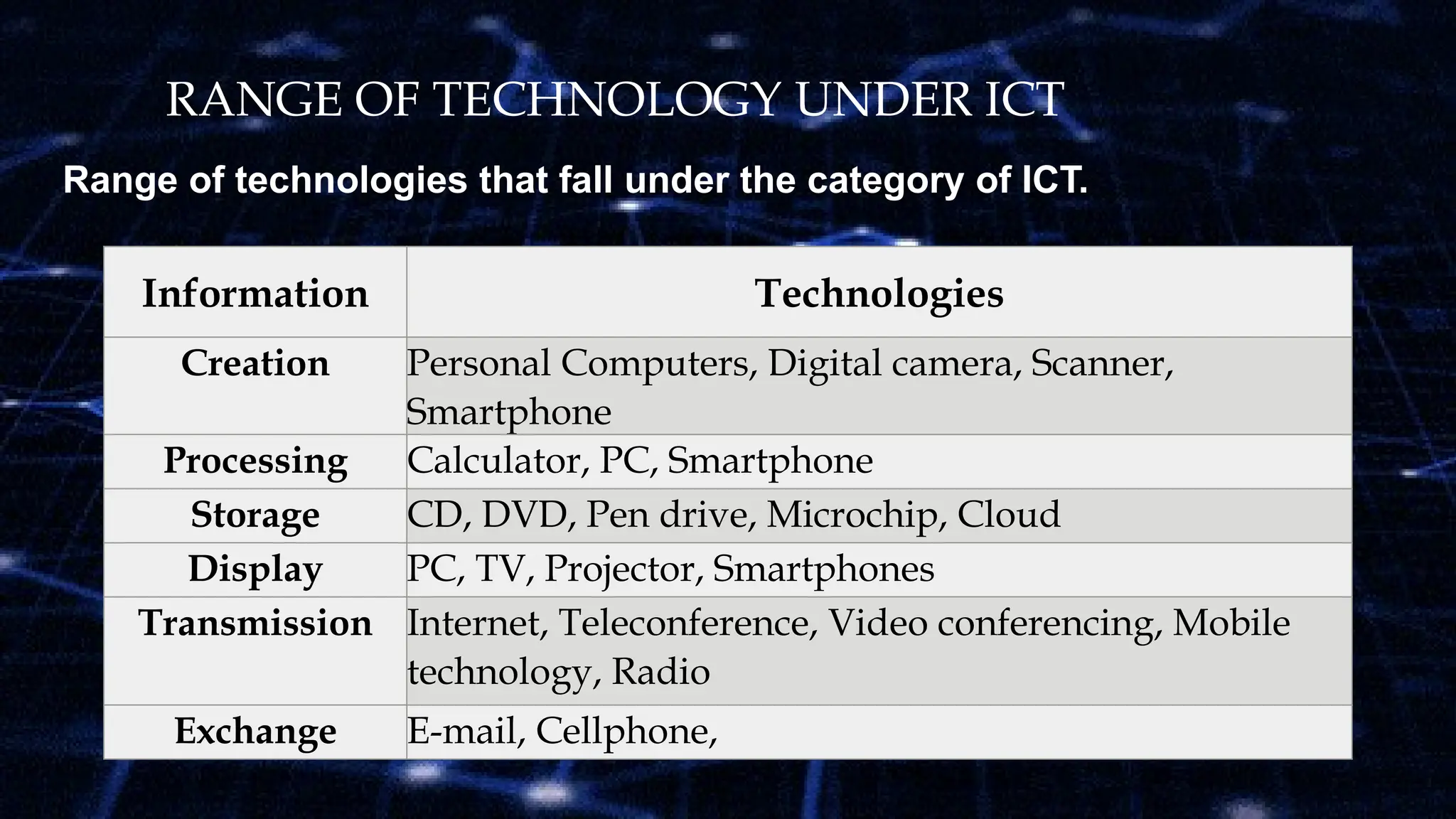
RANGE OF TECHNOLOGYUNDER ICT
Range of technologies that fall under the category of ICT.
Information Technologies
Creation Personal Computers, Digital camera, Scanner,
Smartphone
Processing Calculator, PC, Smartphone
Storage CD, DVD, Pen drive, Microchip, Cloud
Display PC, TV, Projector, Smartphones
Transmission Internet, Teleconference, Video conferencing, Mobile
technology, Radio
Exchange E-mail, Cellphone,
5.
History of InformationTechnology
Information technology has been
around for a long time. Basically,
information technology has been around
because there were always ways of
communicating through technology
available at that point in time.
6.
MACHINE AGE
There are4 main eras in the history of ICT:
1. The Pre-mechanical Age: 3000 BC and 1450 AD
2. The Mechanical Age: 1450 – 1840
3. The Electromechanical Age: 1840 - 1940.
4. The Electronic Age: 1940 - Present.
7.
The Pre-mechanical Age(3000B.C. and 1450A.D.)
It is the earliest age of
information technology.
When humans first started
communicating they would try
to use language or simple
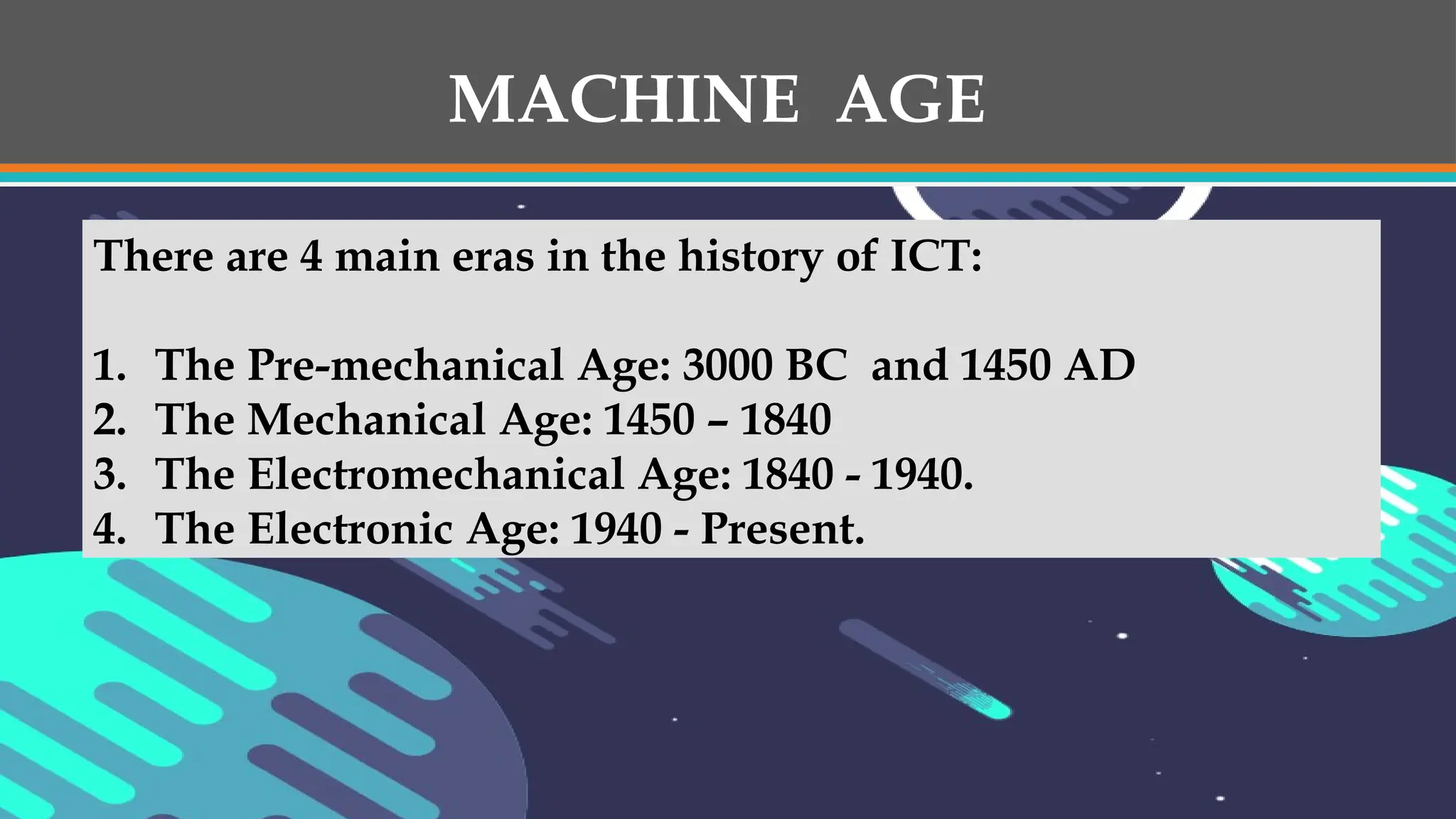
picture drawings known as
petroglyphs which were
usually carved in rock. Early
alphabets were developed such
as the Phoenician alphabet. Petroglyph
8.
Mechanical Age (1450and 1840)
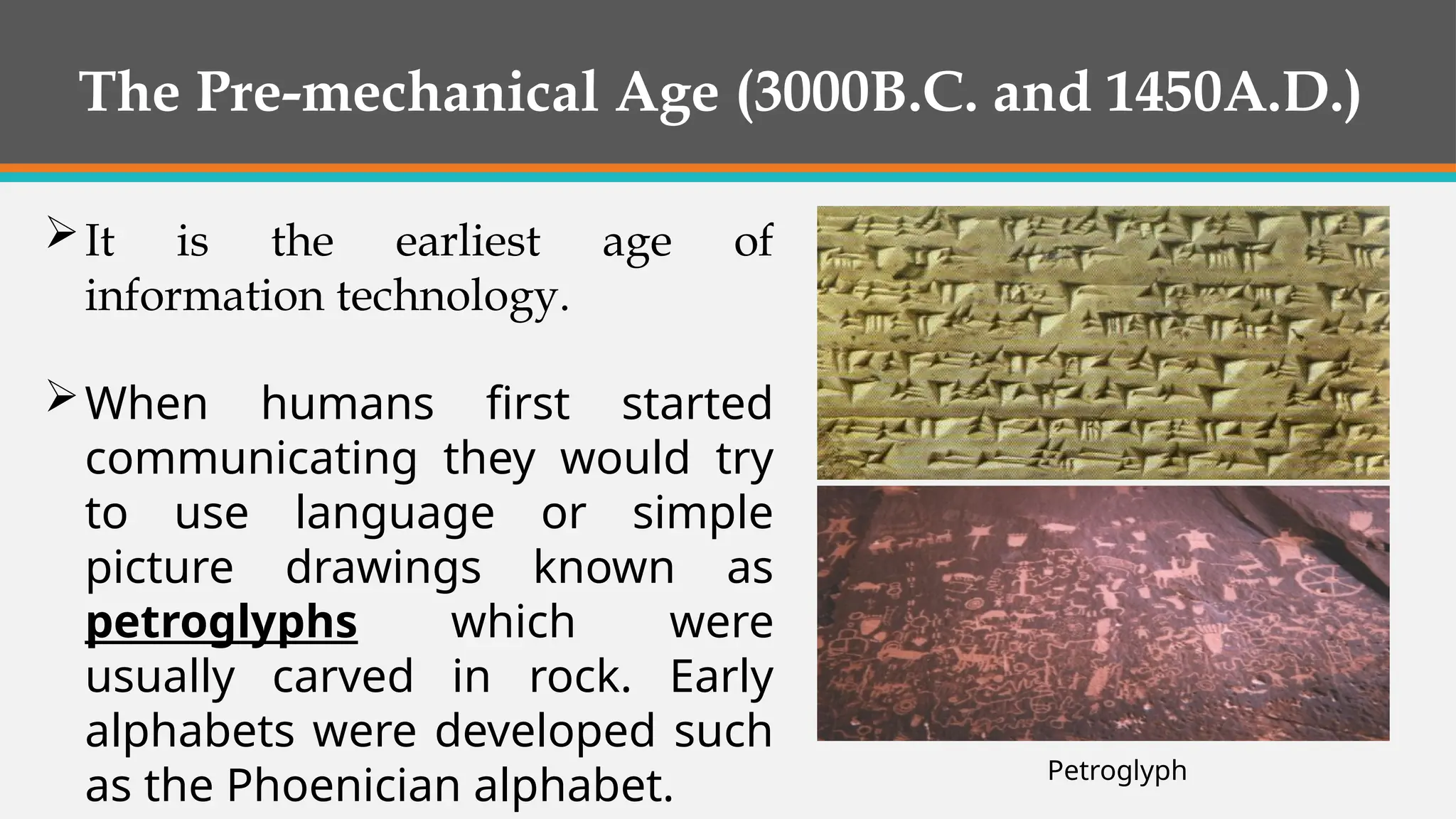
Technologies like the slide rule (an analog
computer used for multiplying and dividing) were
invented.
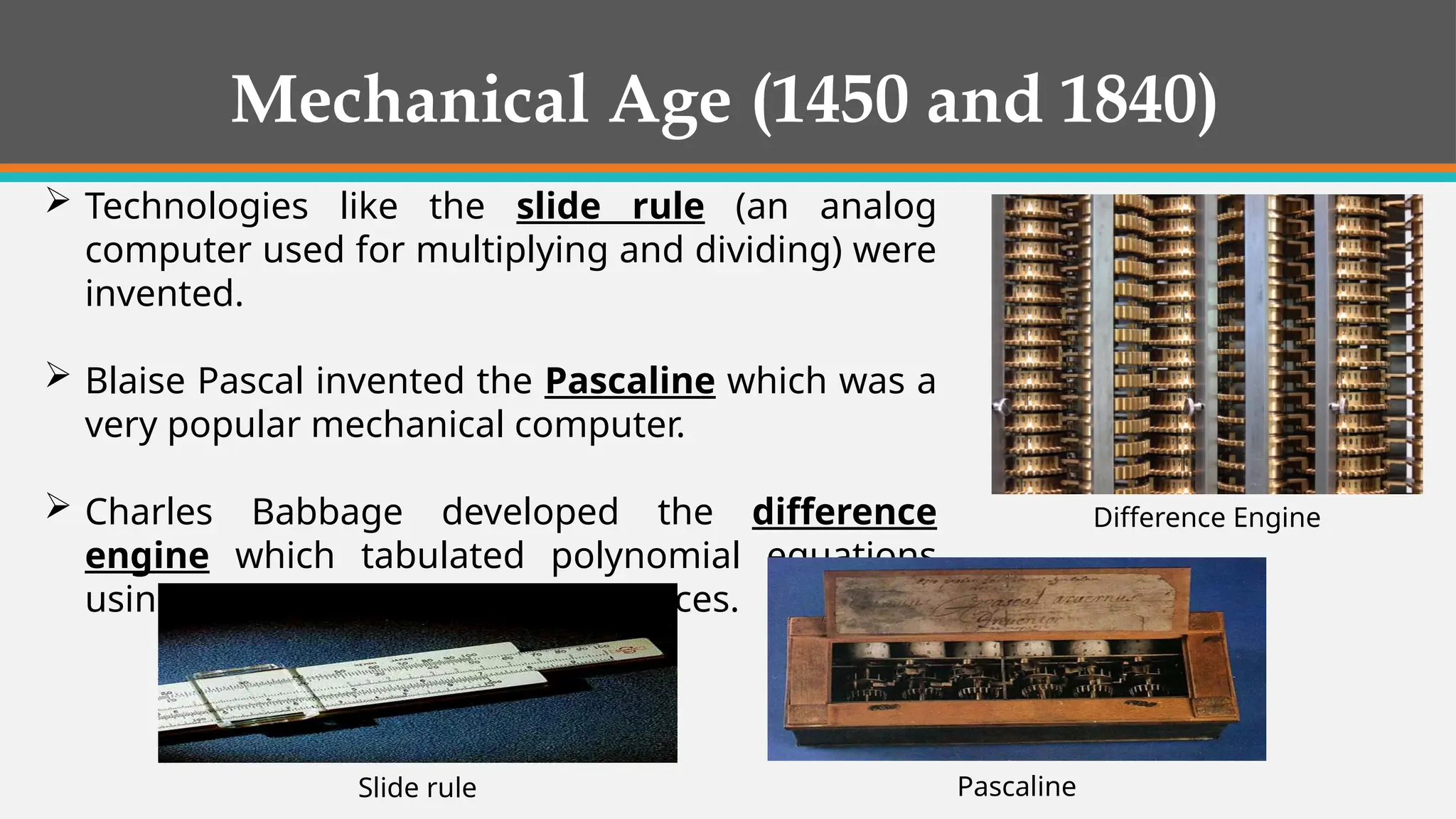
Blaise Pascal invented the Pascaline which was a
very popular mechanical computer.
Charles Babbage developed the difference
engine which tabulated polynomial equations
using the method of finite differences.
Pascaline
Slide rule
Difference Engine
9.
Electromechanical Age (1840and 1940 )
It can be defined as the time between
These are the beginnings of telecommunication.
The telegraph was created in the early 1800s.
Morse code was created by Samuel Morse in
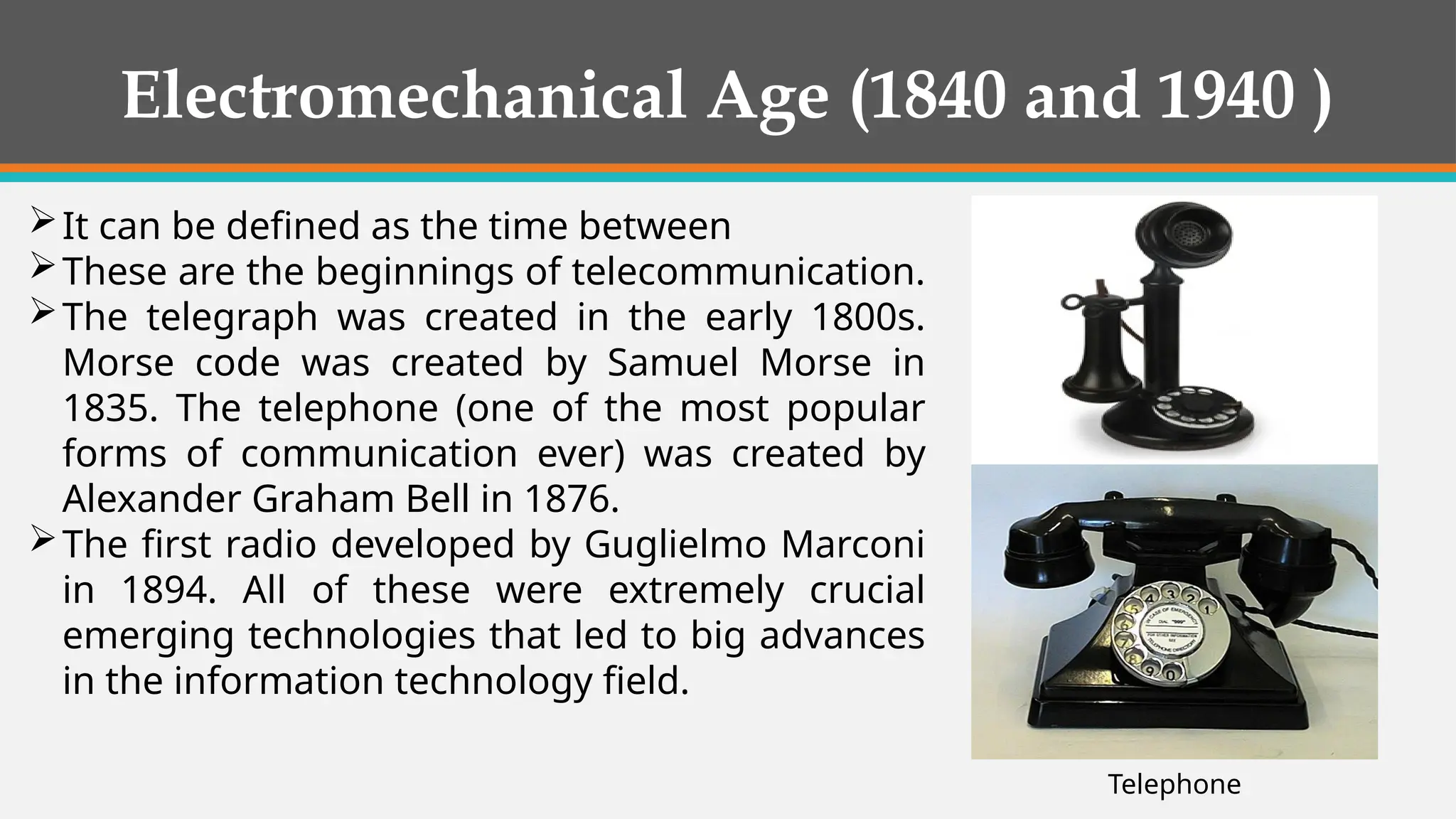
1835. The telephone (one of the most popular
forms of communication ever) was created by
Alexander Graham Bell in 1876.
The first radio developed by Guglielmo Marconi
in 1894. All of these were extremely crucial
emerging technologies that led to big advances
in the information technology field.
Telephone
10.
The firstlarge-scale automatic digital
computer in the United States was the
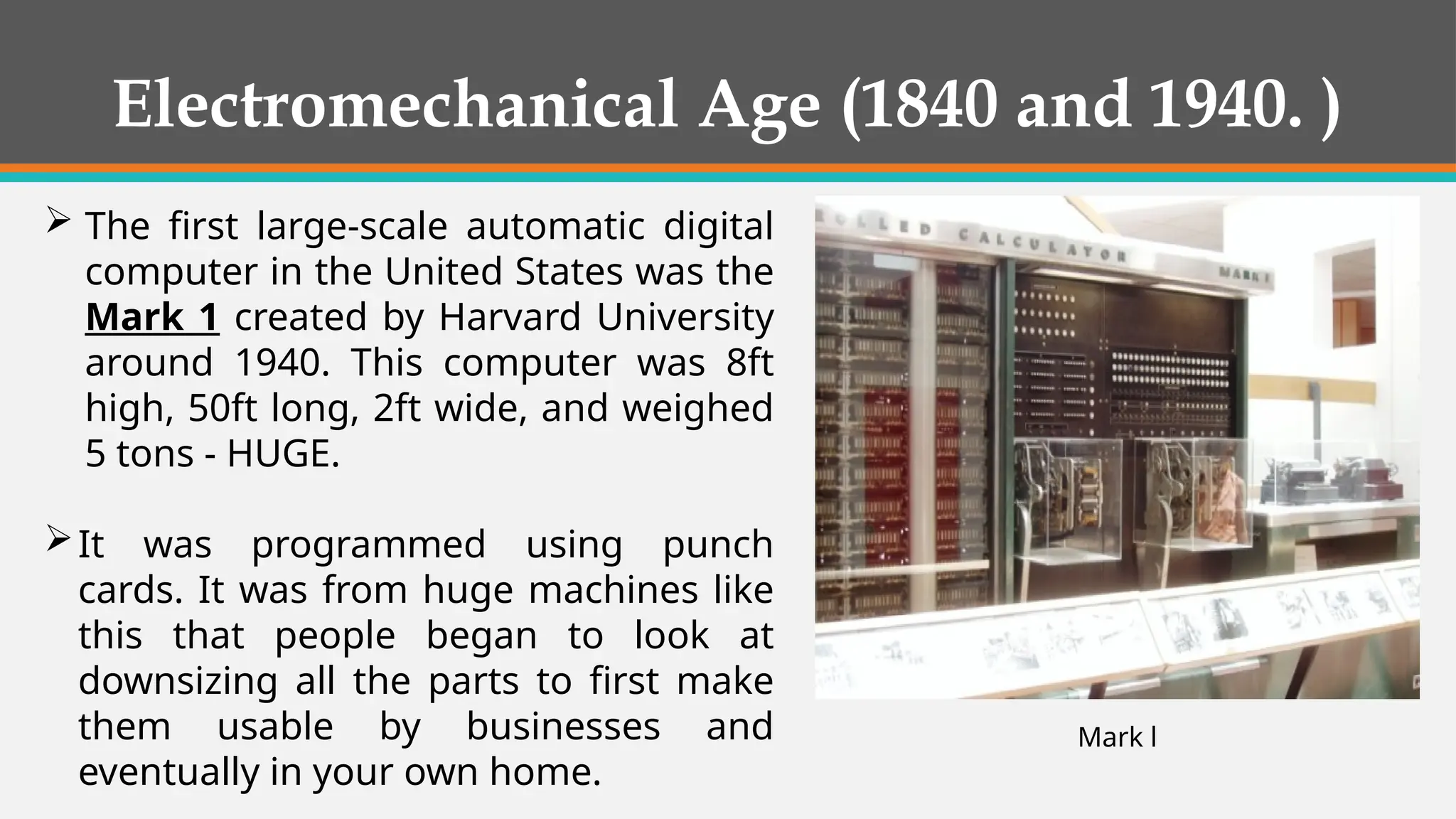
Mark 1 created by Harvard University
around 1940. This computer was 8ft
high, 50ft long, 2ft wide, and weighed
5 tons - HUGE.
It was programmed using punch
cards. It was from huge machines like
this that people began to look at
downsizing all the parts to first make
them usable by businesses and
eventually in your own home.
Mark l
Electromechanical Age (1840 and 1940. )
11.
The ENIACwas the first high-speed,
digital computer capable of being
reprogrammed to solve a full range of
computing problems.
This computer was designed to be
used by the U.S. Army for artillery
firing tables.
This machine was even bigger than
the Mark 1 taking up 680 square feet
and weighing 30 tons - HUGE.
It mainly used vacuum tubes to do its
calculations.
No storage of programs.
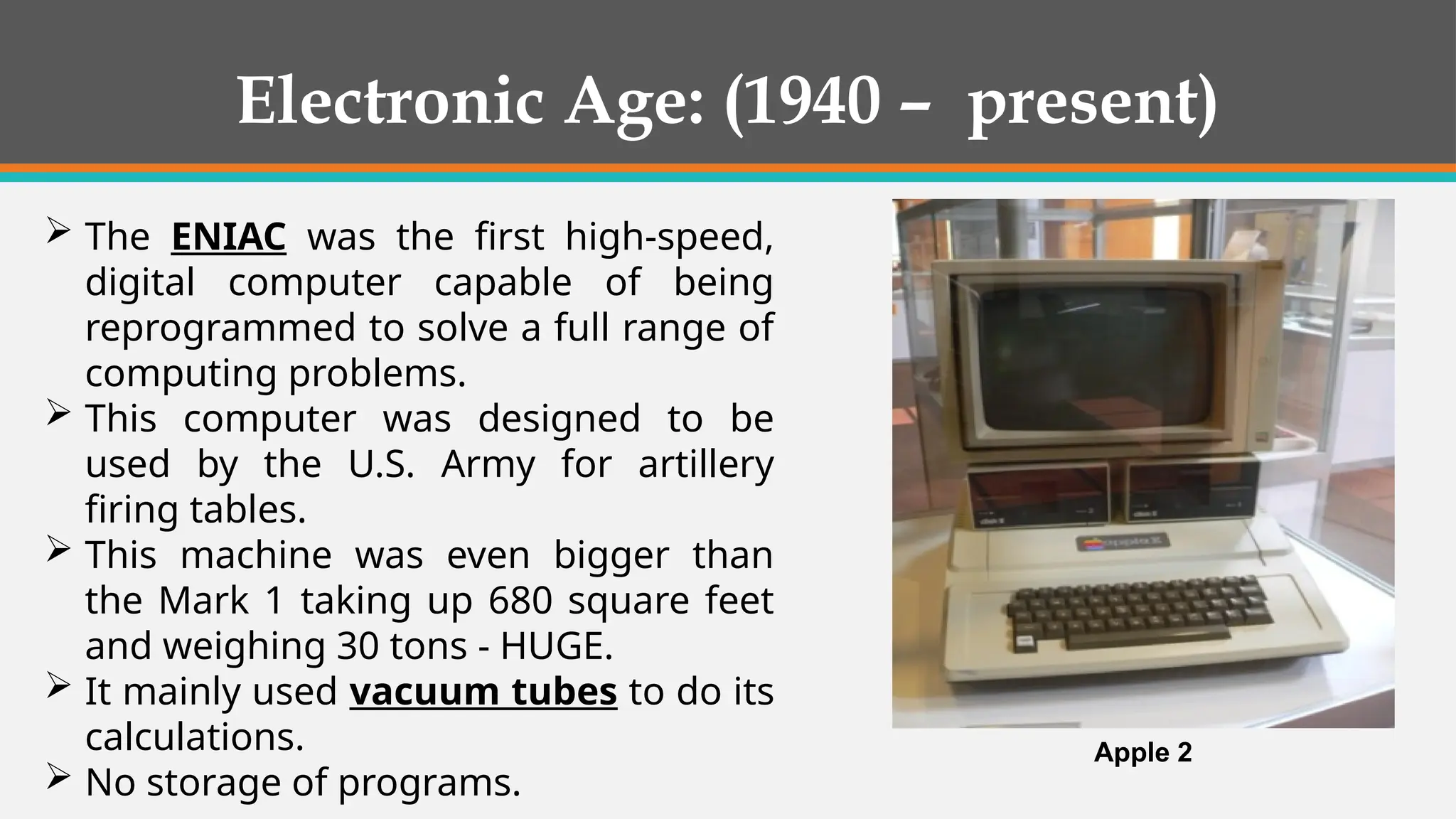
Apple 2
Electronic Age: (1940 – present)
12.
The first storedprogram
computer(s): The University of
Manchester Mark I and The EDSAC
in Cambridge in 1949.
The First General-Purpose
Computer for Commercial Use:
Universal Automatic Computer
(UNIVAC)
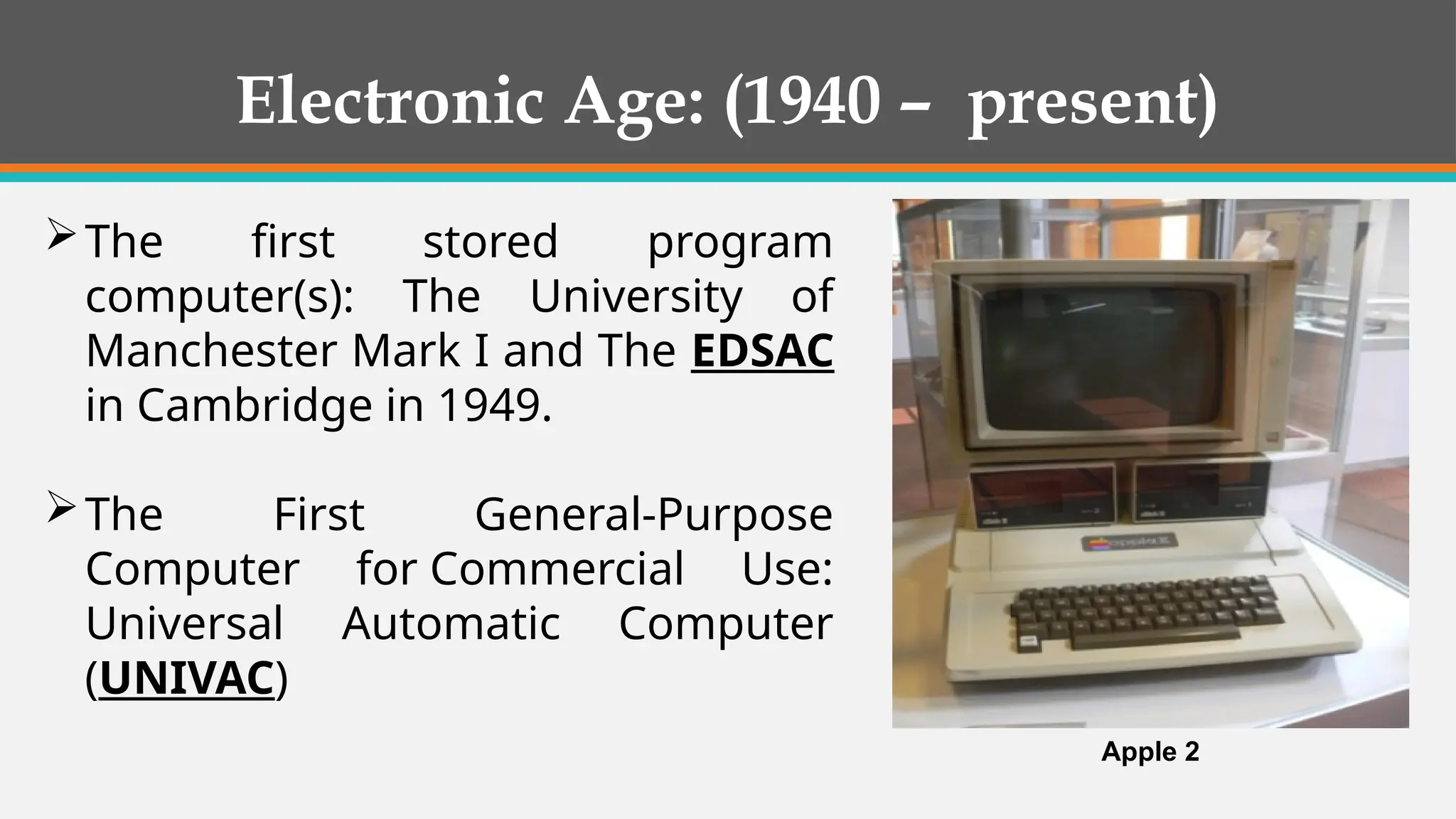
Apple 2
Electronic Age: (1940 – present)
13.
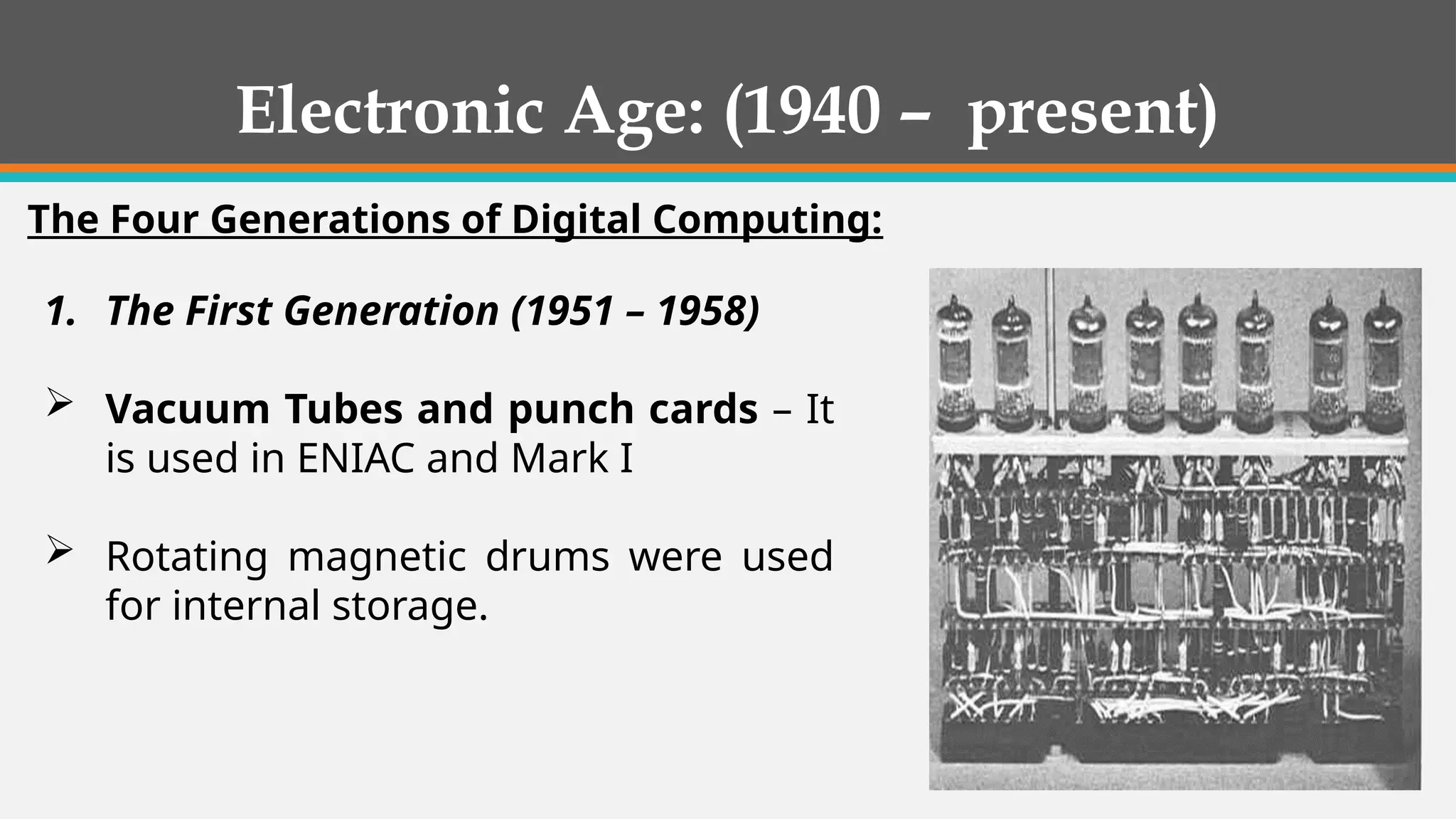
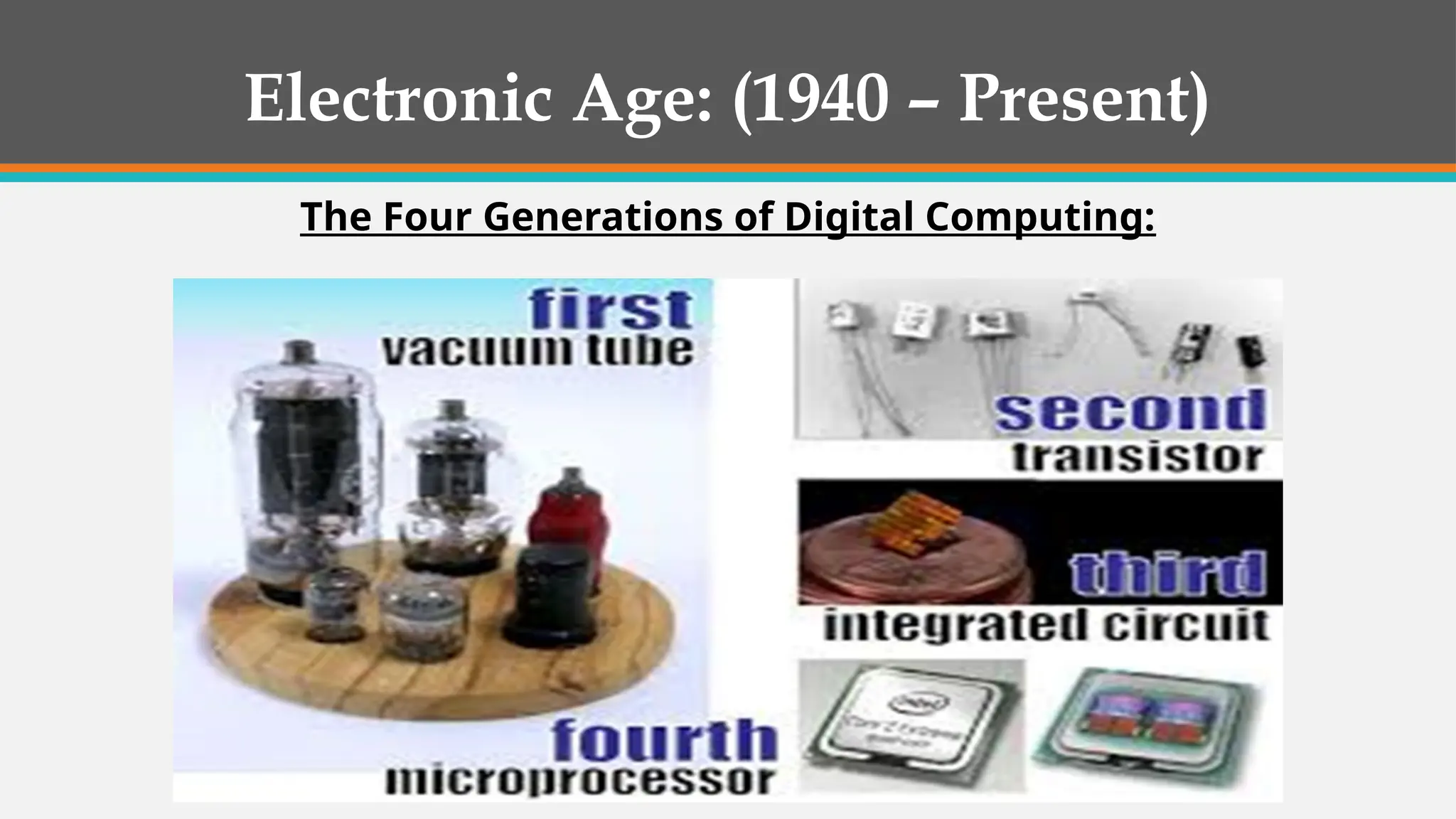
1. The FirstGeneration (1951 – 1958)
Vacuum Tubes and punch cards – It
is used in ENIAC and Mark I
Rotating magnetic drums were used
for internal storage.
Electronic Age: (1940 – present)
The Four Generations of Digital Computing:
14.
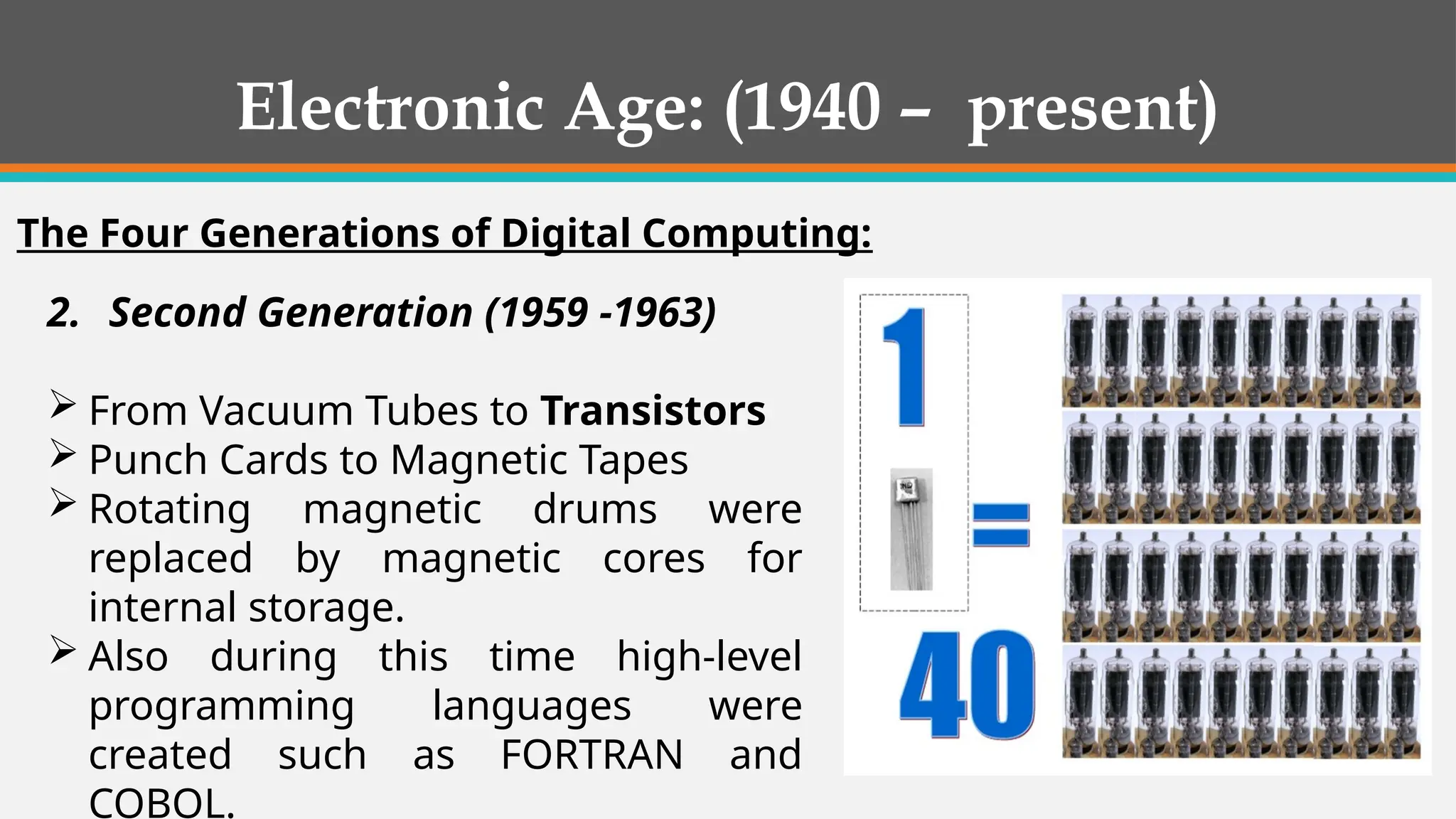
2. Second Generation(1959 -1963)
From Vacuum Tubes to Transistors
Punch Cards to Magnetic Tapes
Rotating magnetic drums were
replaced by magnetic cores for
internal storage.
Also during this time high-level
programming languages were
created such as FORTRAN and
COBOL.
Electronic Age: (1940 – present)
The Four Generations of Digital Computing:
15.
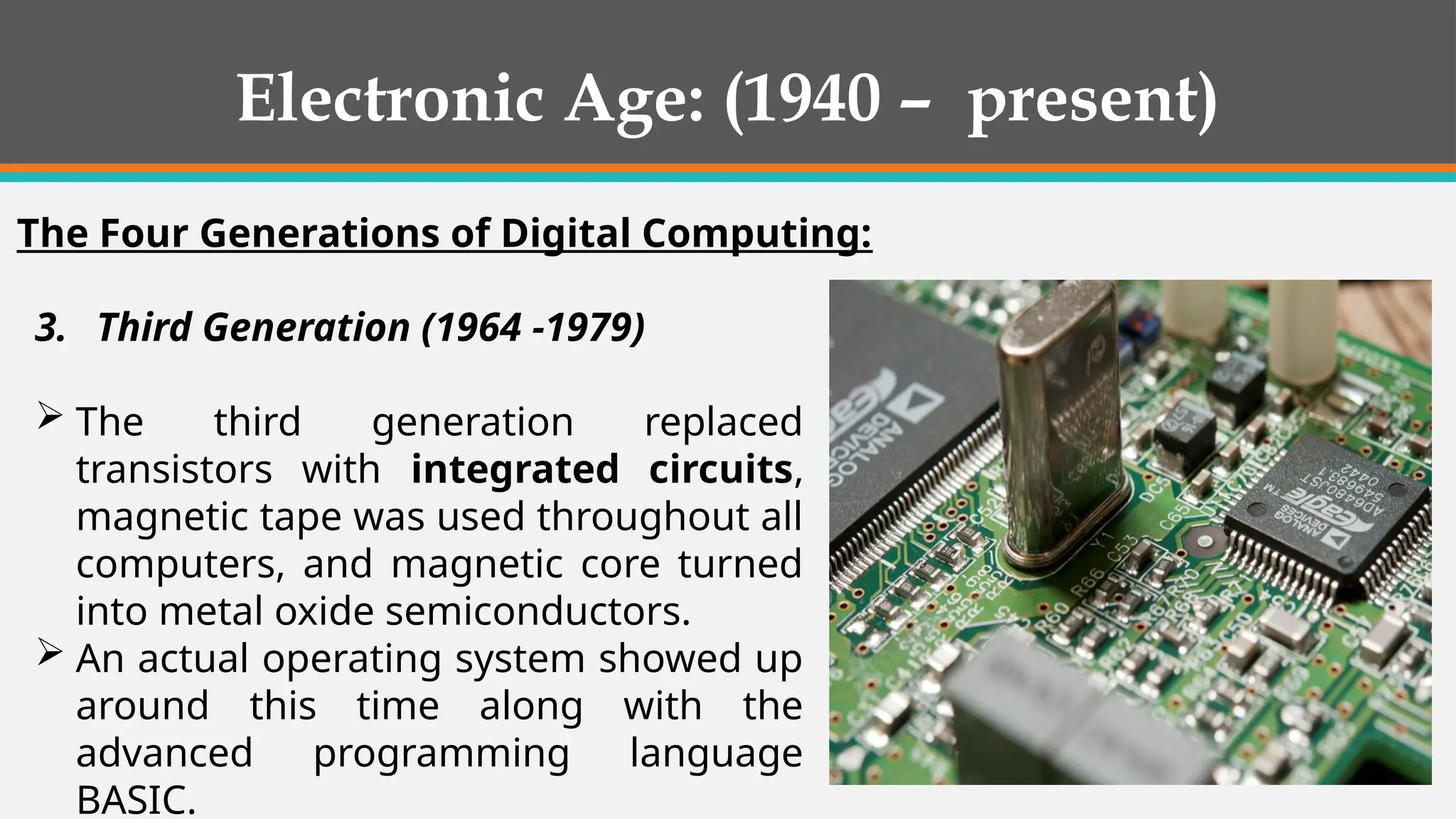
3. Third Generation(1964 -1979)
The third generation replaced
transistors with integrated circuits,
magnetic tape was used throughout all
computers, and magnetic core turned
into metal oxide semiconductors.
An actual operating system showed up
around this time along with the
advanced programming language
BASIC.
Electronic Age: (1940 – present)
The Four Generations of Digital Computing:
16.
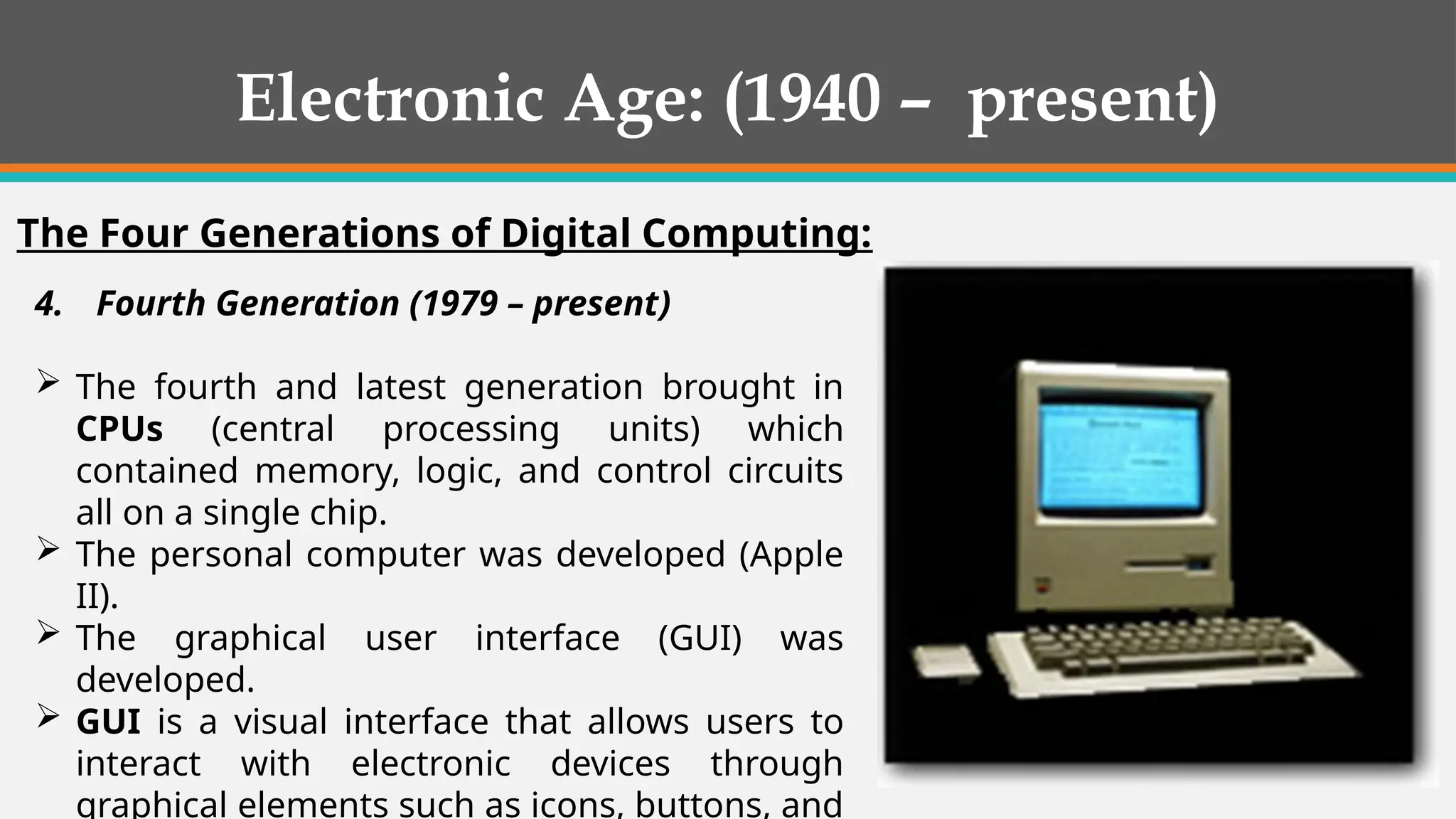
4. Fourth Generation(1979 – present)
The fourth and latest generation brought in
CPUs (central processing units) which
contained memory, logic, and control circuits
all on a single chip.
The personal computer was developed (Apple
II).
The graphical user interface (GUI) was
developed.
GUI is a visual interface that allows users to
interact with electronic devices through
graphical elements such as icons, buttons, and
Electronic Age: (1940 – present)
The Four Generations of Digital Computing: