Digital
Signature
UNDER THE GUIDANCE OF
MR. V. BASHA(ASSISTANT PROFESSOR)
PRESENTED BY
N.Ranga (195U1A0582)
DEPARTMENT OF CSE
Table Contents
Definition
Introduction
Working of Digital Signature
About Digital Signature
Conclusion
2
Definition
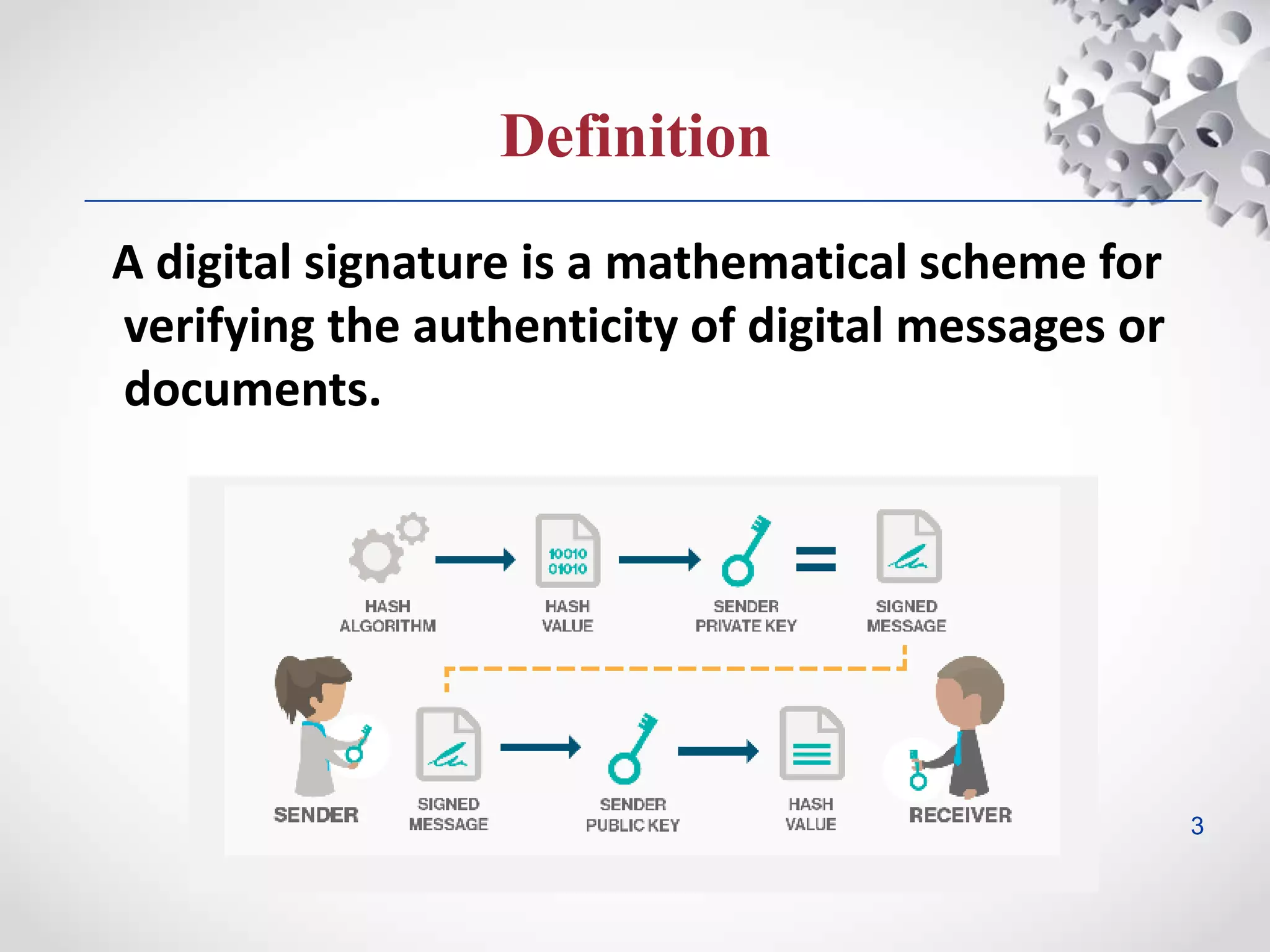
A digital signature is a mathematical scheme for
verifying the authenticity of digital messages or
documents.
3
Introduction
• A valid digital signature, where the
prerequisites are satisfied, gives a recipient very
high confidence that the message was created
by a known sender (authenticity), and that the
message was not altered in transit (integrity).
• Digitally signed messages may be anything
representable as a bitstring: examples include
electronic mail, contracts, or a message sent via
some other cryptographic protocol.
4
●●●
5
Working of Digital Signature
Hash function –
• A hash function (also called a “hash”) is a
fixed-length string of numbers and letters
generated from a mathematical algorithm
and an arbitrarily sized file such as an email,
document, picture, or other type of data.
●●●
6
Working of Digital Signature
Public key cryptography –
• Public key cryptography (also known as
asymmetric encryption) is a cryptographic
method that uses a key pair system. One key,
called the public key, encrypts the data. The
other key, called the private key, decrypts the
data.
●●●
7
Working of Digital Signature
Public key infrastructure (PKI) –
• PKI consists of the policies, standards,
people, and systems that support the
distribution of public keys and the identity
validation of individuals or entities with
digital certificates and a certificate authority.
●●●
8
Working of Digital Signature
Certificate authority (CA) –
• A CA is a trusted third party that validates a
person’s identity and either generates a
public/private key pair on their behalf or
associates an existing public key provided by
the person to that person.
• Once a CA validates someone’s identity, they
issue a digital certificate that is digitally
signed by the CA.
●●●
9
Working of Digital Signature
Digital certificates –
• Digital certificates are analogous to driver
licenses in that their purpose is to identify
the holder of a certificate. Digital certificates
contain the public key of the individual or
organization and are digitally signed by a CA.
• Other information about the organization,
individual, and CA can be included in the
certificate as well.
●●●
10
Working of Digital Signature
• Pretty Good Privacy (PGP)/OpenPGP –
PGP/OpenPGP is an alternative to PKI. With
PGP/OpenPGP, users “trust” other users by
signing certificates of people with verifiable
identities.
• The more interconnected these signatures
are, the higher the likelihood of verifying a
particular user on the internet. This concept
is called the “Web of Trust.”
11
About Digital Signature
• Digital signatures work by proving that a
digital message or document was not
modified—intentionally or unintentionally—
from the time it was signed.
• Digital signatures do this by generating a
unique hash of the message or document
and encrypting it using the sender’s private
key.
●●●
12
About Digital Signature
• The hash generated is unique to the
message or document, and changing any
part of it will completely change the hash.
• The recipient then generates their own hash
of the message or digital document and
decrypts the sender’s hash (included in the
original message) using the sender’s public
key.
●●●
13
About Digital Signature
• Once completed, the message or digital
document is digitally signed and sent to the
recipient.
• The recipient compares the hash they
generate against the sender’s decrypted
hash; if they match, the message or digital
document has not been modified and the
sender is authenticated.
14
Conclusion
 A digital signature is an electronic, encrypted,
stamp of authentication on digital information
such as email messages, macros, or electronic
documents.
 A signature confirms that the information
originated from the signer and has not been
altered.
15
References
• Google.com
• Wikipedia.org
• Studymafia.org
• Slidespanda.com
THANK YOU

DIGITAL SIGNATURE PPT.pptx

  • 1.
    Digital Signature UNDER THE GUIDANCEOF MR. V. BASHA(ASSISTANT PROFESSOR) PRESENTED BY N.Ranga (195U1A0582) DEPARTMENT OF CSE
  • 2.
    Table Contents Definition Introduction Working ofDigital Signature About Digital Signature Conclusion 2
  • 3.
    Definition A digital signatureis a mathematical scheme for verifying the authenticity of digital messages or documents. 3
  • 4.
    Introduction • A validdigital signature, where the prerequisites are satisfied, gives a recipient very high confidence that the message was created by a known sender (authenticity), and that the message was not altered in transit (integrity). • Digitally signed messages may be anything representable as a bitstring: examples include electronic mail, contracts, or a message sent via some other cryptographic protocol. 4
  • 5.
  • 6.
    Working of DigitalSignature Hash function – • A hash function (also called a “hash”) is a fixed-length string of numbers and letters generated from a mathematical algorithm and an arbitrarily sized file such as an email, document, picture, or other type of data. ●●● 6
  • 7.
    Working of DigitalSignature Public key cryptography – • Public key cryptography (also known as asymmetric encryption) is a cryptographic method that uses a key pair system. One key, called the public key, encrypts the data. The other key, called the private key, decrypts the data. ●●● 7
  • 8.
    Working of DigitalSignature Public key infrastructure (PKI) – • PKI consists of the policies, standards, people, and systems that support the distribution of public keys and the identity validation of individuals or entities with digital certificates and a certificate authority. ●●● 8
  • 9.
    Working of DigitalSignature Certificate authority (CA) – • A CA is a trusted third party that validates a person’s identity and either generates a public/private key pair on their behalf or associates an existing public key provided by the person to that person. • Once a CA validates someone’s identity, they issue a digital certificate that is digitally signed by the CA. ●●● 9
  • 10.
    Working of DigitalSignature Digital certificates – • Digital certificates are analogous to driver licenses in that their purpose is to identify the holder of a certificate. Digital certificates contain the public key of the individual or organization and are digitally signed by a CA. • Other information about the organization, individual, and CA can be included in the certificate as well. ●●● 10
  • 11.
    Working of DigitalSignature • Pretty Good Privacy (PGP)/OpenPGP – PGP/OpenPGP is an alternative to PKI. With PGP/OpenPGP, users “trust” other users by signing certificates of people with verifiable identities. • The more interconnected these signatures are, the higher the likelihood of verifying a particular user on the internet. This concept is called the “Web of Trust.” 11
  • 12.
    About Digital Signature •Digital signatures work by proving that a digital message or document was not modified—intentionally or unintentionally— from the time it was signed. • Digital signatures do this by generating a unique hash of the message or document and encrypting it using the sender’s private key. ●●● 12
  • 13.
    About Digital Signature •The hash generated is unique to the message or document, and changing any part of it will completely change the hash. • The recipient then generates their own hash of the message or digital document and decrypts the sender’s hash (included in the original message) using the sender’s public key. ●●● 13
  • 14.
    About Digital Signature •Once completed, the message or digital document is digitally signed and sent to the recipient. • The recipient compares the hash they generate against the sender’s decrypted hash; if they match, the message or digital document has not been modified and the sender is authenticated. 14
  • 15.
    Conclusion  A digitalsignature is an electronic, encrypted, stamp of authentication on digital information such as email messages, macros, or electronic documents.  A signature confirms that the information originated from the signer and has not been altered. 15
  • 16.
    References • Google.com • Wikipedia.org •Studymafia.org • Slidespanda.com
  • 17.