Lucknow Institute of Technology
Lucknow
Submitted By:
Mohammad Irshad
B.Tech (CSE)
Roll no. : 1736210003
Department of Computer Science & Engineering
Session 2020 -21
Content
 Introduction
 History
 What is Digital Signature
 Why Digital Signature
 Basic Requirements
 How the Technology Works
 Approaches
Content
 Purpose of Digital Signature
 Algorithm of Digital Signature
 Challenges and Opportunities
 Application
 Drawbacks
 Conclusion
INTRODUCTION
 The authenticity of many legal, financial, and other
documents is determined by the presence or absence of an
authorized handwritten signature.
 Various methods have been devised to solve this problem,
but the use of ‘digital signature’ is definitely the best
solution amongst them.
 A digital signature is nothing but an attachment to any
piece of electronic information, which represents the
content of the document and the identity of the originator
of that document uniquely.
HISTORY
 Use of signatures is recorded in the Talmud (fourth
century), complete with security procedures to prevent the
alteration of documents after they are signed.
 The practice of authenticating documents by affixing
handwritten signatures began to be used within the Roman
Empire in the year AD 439, during the rule of Valentinian
III.
 It is from this Roman usage of signatures that the practice
obtained its significance in Western legal tradition.
What is digital signature
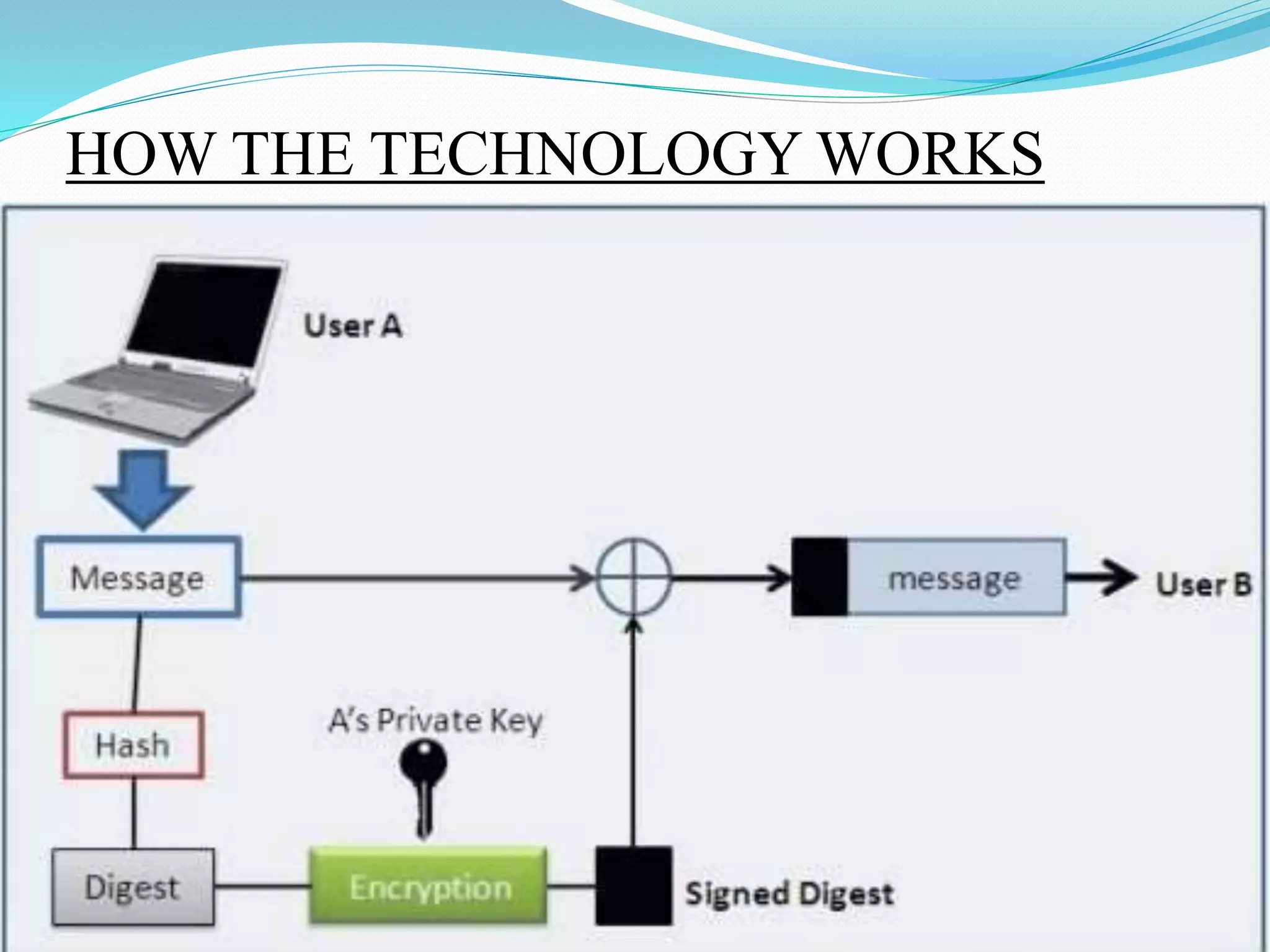
 Hash value of a message when encrypted with
the private key of a person is his digital
signature on that e-Document.
 Digital Signature of a person therefore varies
from document to document thus ensuring
authenticity of each word of that document.
 As the public key of the signer is known,
anybody can verify the message and the
digital signature.
Why Digital Signatures
• To provide Authenticity, Integrity and Non-
repudiation to electronic documents
• To use the Internet as the safe and secure
medium for e-Commerce and e-Governance
BASIC REQUIREMENTS….
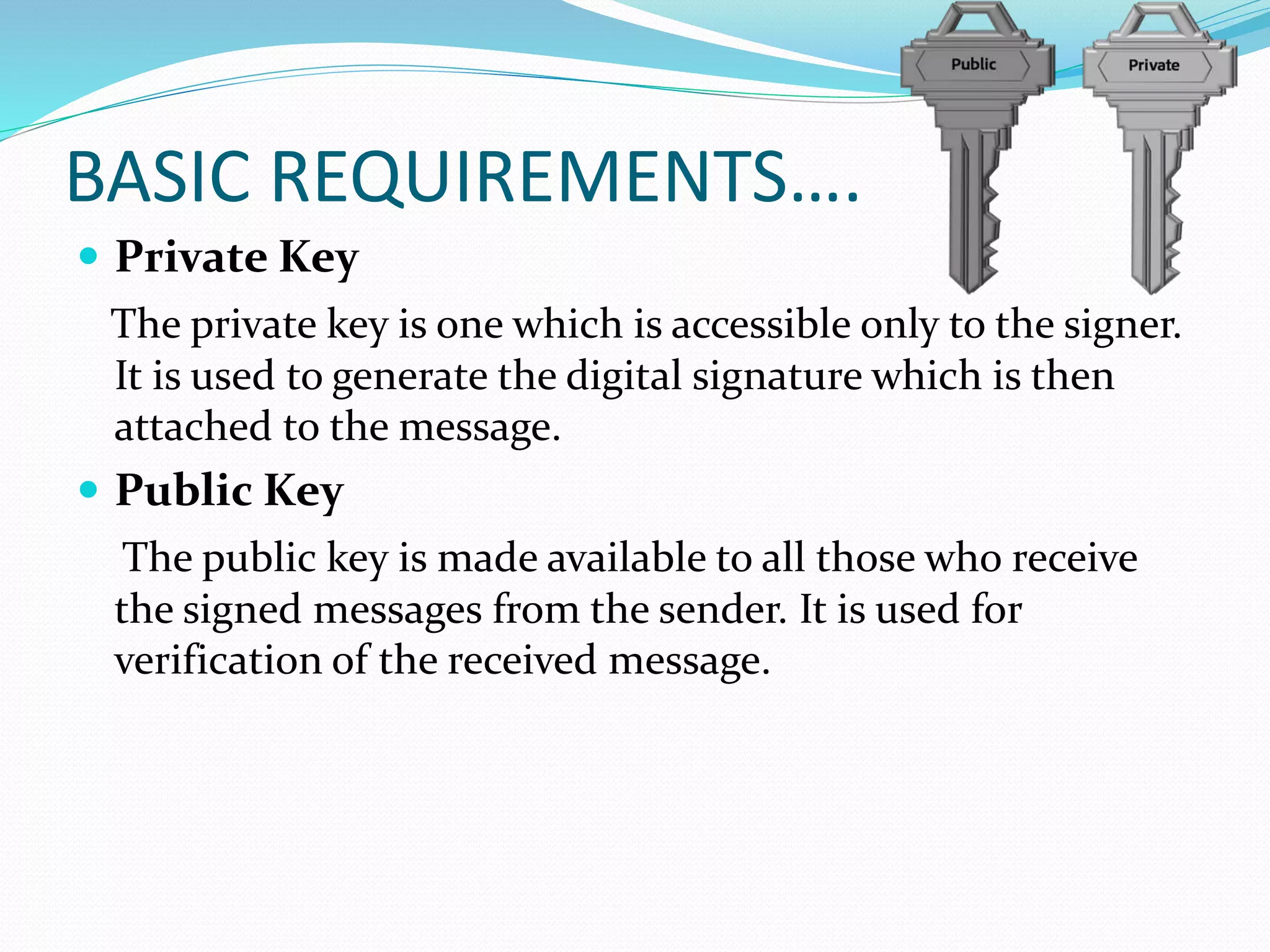
 Private Key
The private key is one which is accessible only to the signer.
It is used to generate the digital signature which is then
attached to the message.
 Public Key
The public key is made available to all those who receive
the signed messages from the sender. It is used for
verification of the received message.
BASIC REQUIREMENTS
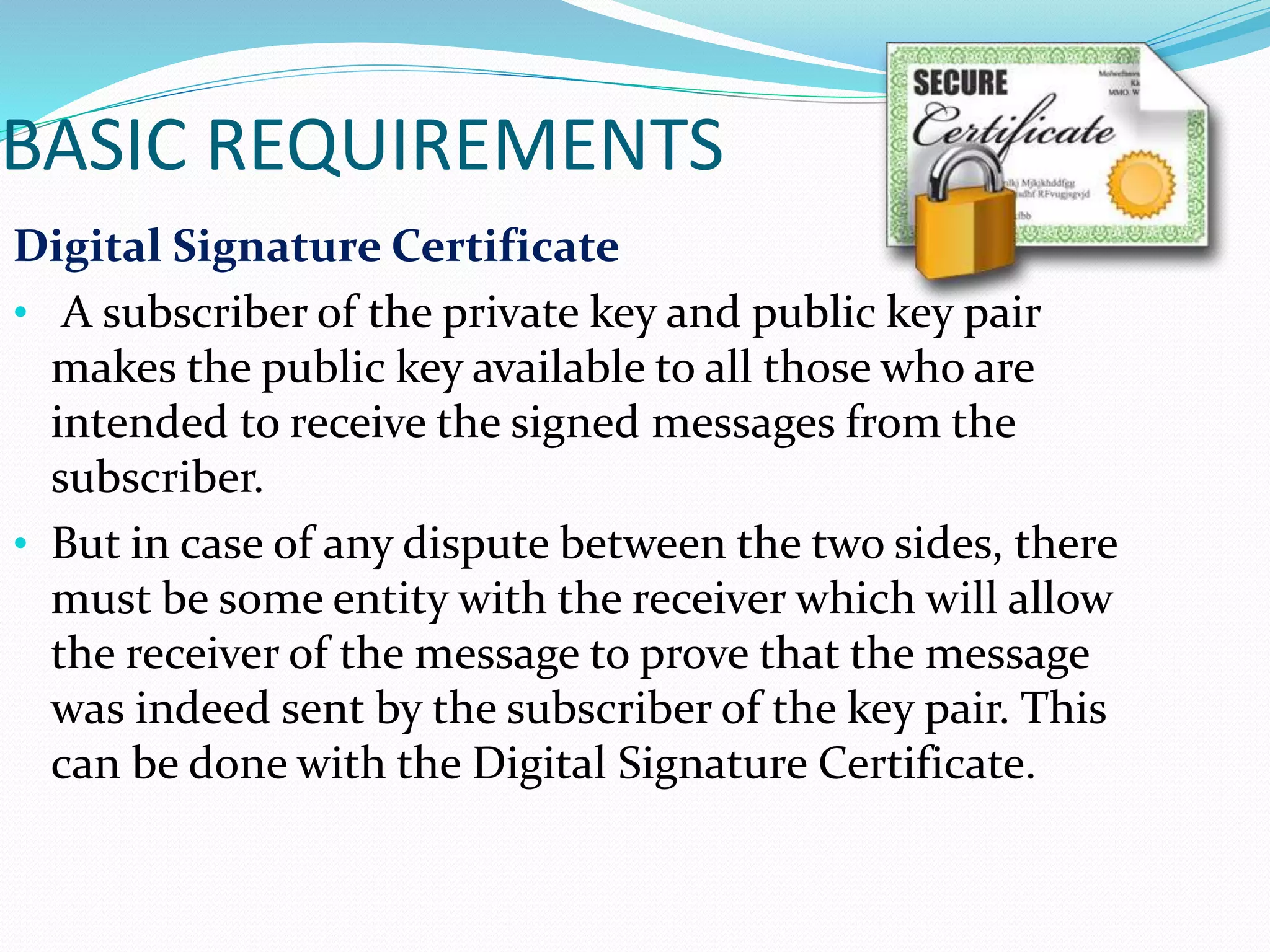
Digital Signature Certificate
• A subscriber of the private key and public key pair
makes the public key available to all those who are
intended to receive the signed messages from the
subscriber.
• But in case of any dispute between the two sides, there
must be some entity with the receiver which will allow
the receiver of the message to prove that the message
was indeed sent by the subscriber of the key pair. This
can be done with the Digital Signature Certificate.
HOW THE TECHNOLOGY WORKS
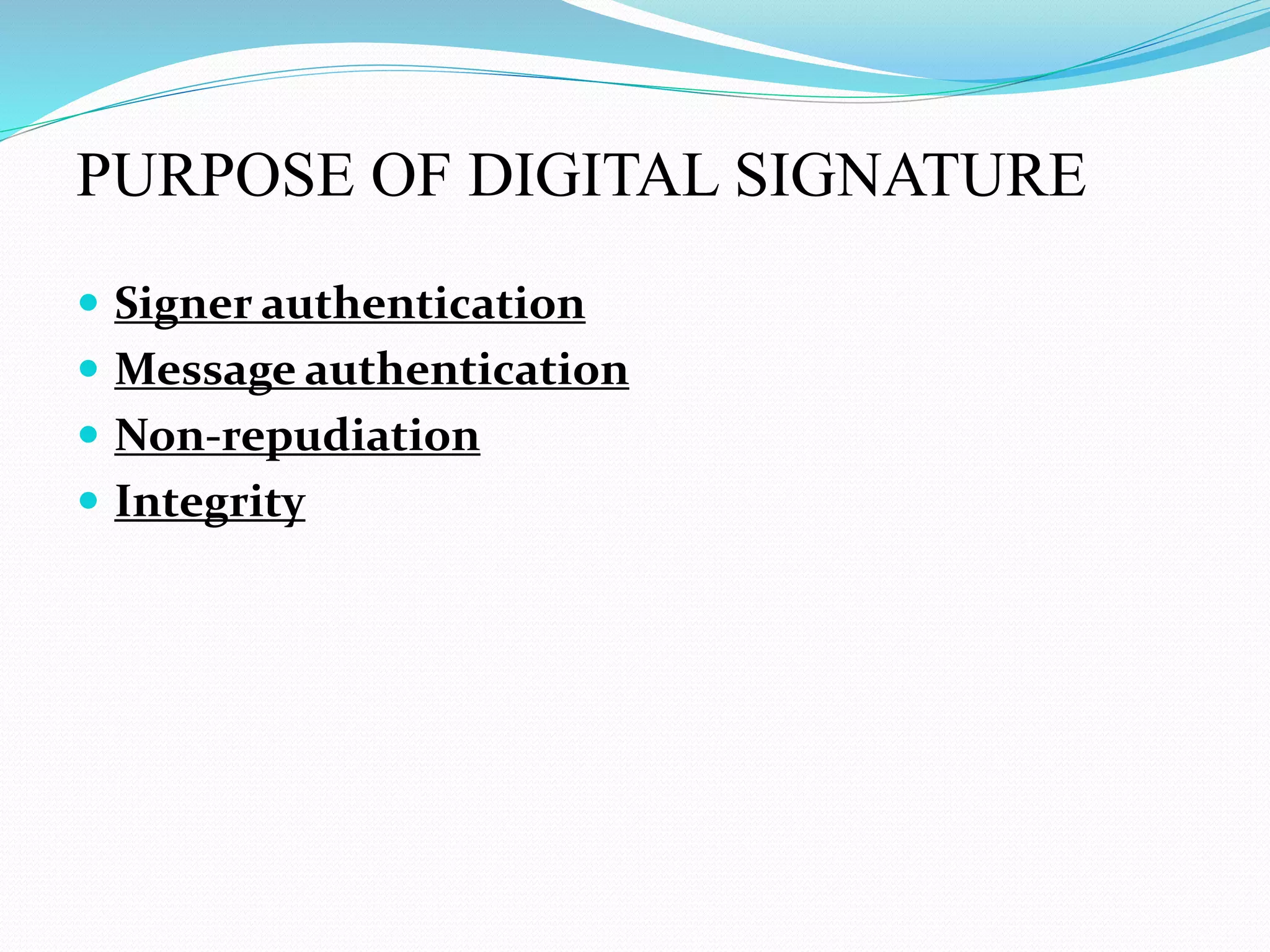
PURPOSE OF DIGITAL SIGNATURE
 Signer authentication
 Message authentication
 Non-repudiation
 Integrity
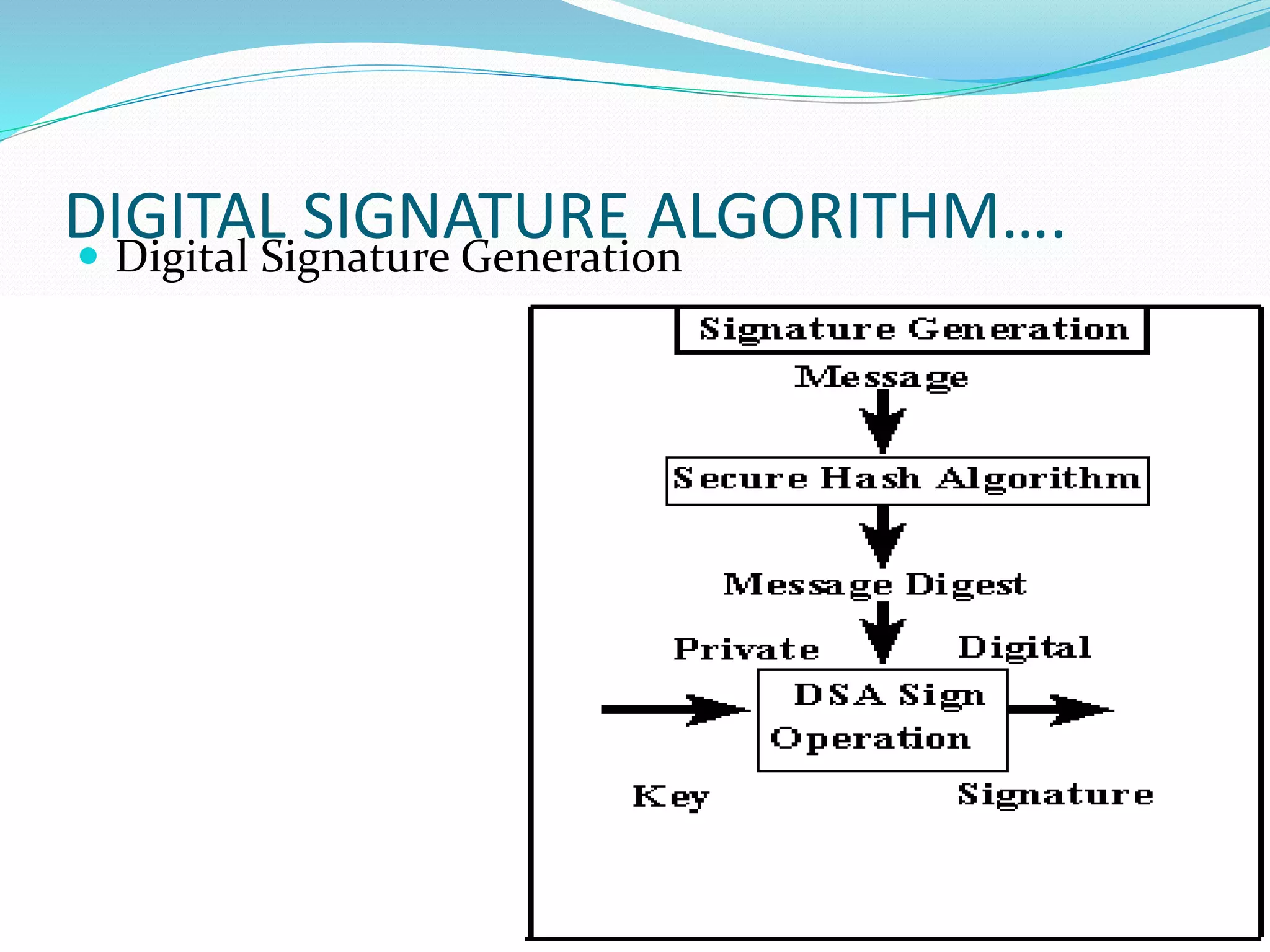
DIGITAL SIGNATURE ALGORITHM….
 Digital Signature Generation
DIGITAL SIGNATURE ALGORITHM….
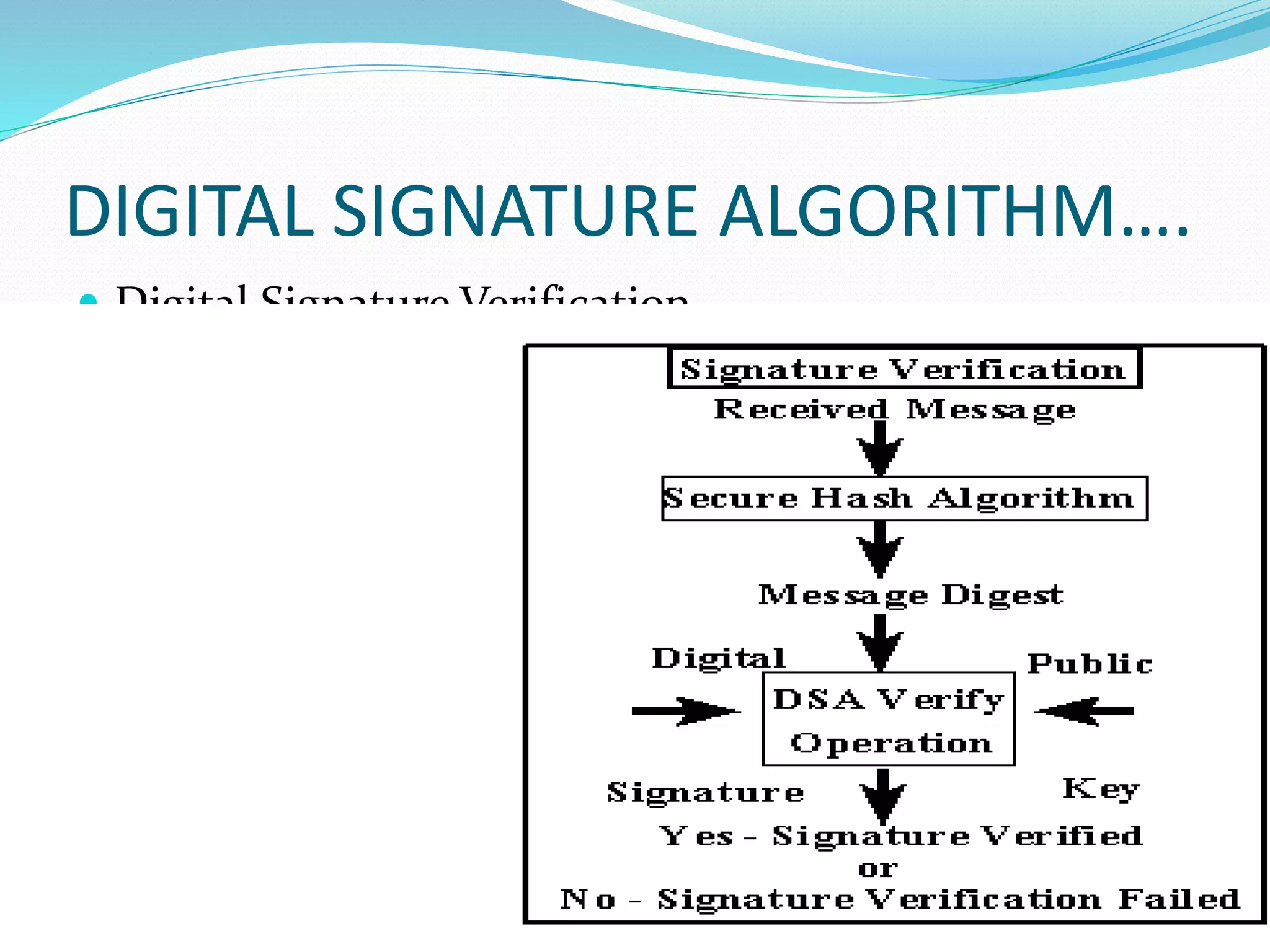
 Digital Signature Verification
DIGITAL SIGNATURE ALGORITHM
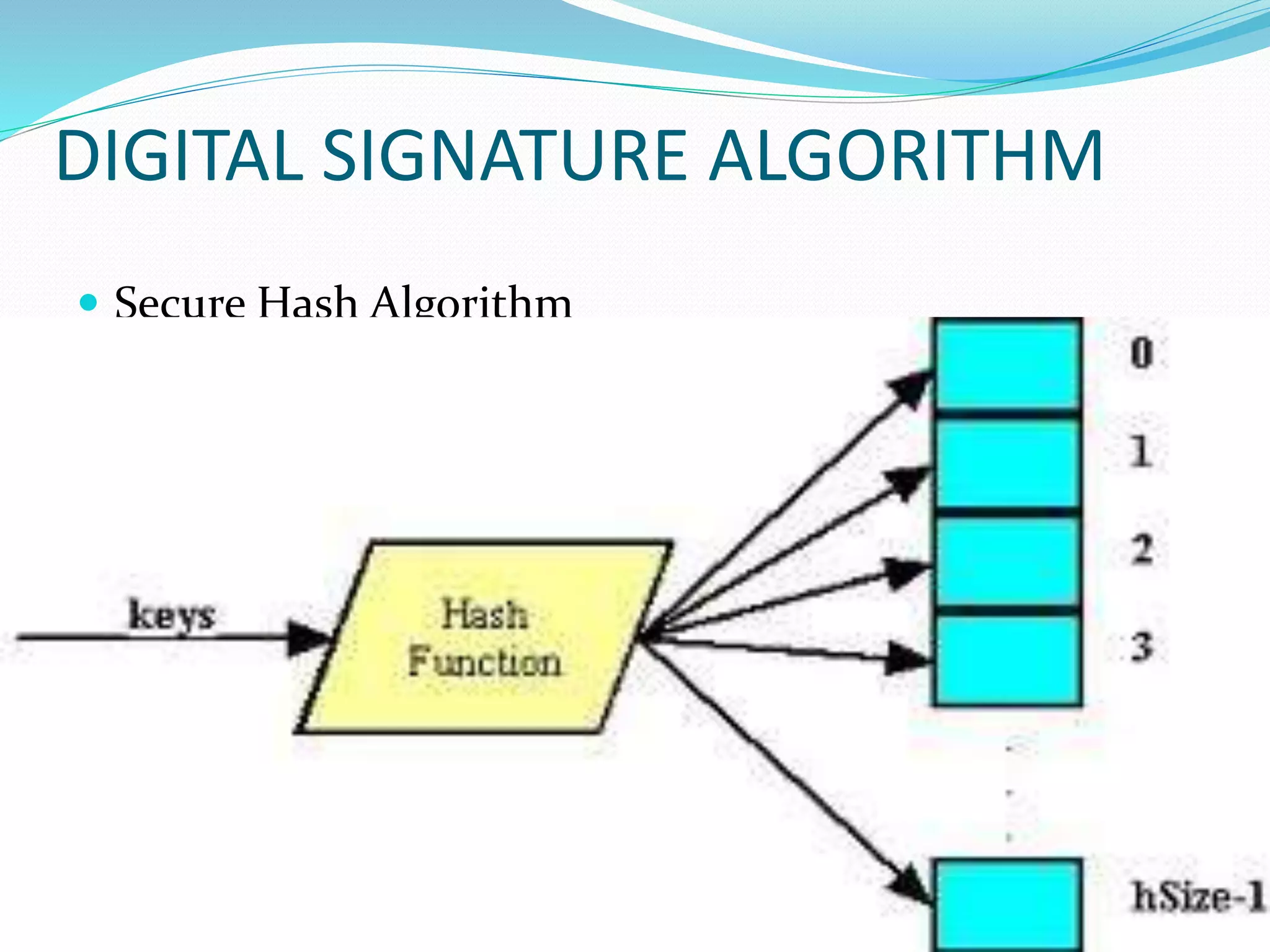
 Secure Hash Algorithm
Challenges and Opportunities
 Institutional overhead:
The cost of establishing and utilizing certification
authorities, repositories, and other important
services, as well as assuring quality in the
performance of their functions.
 Subscriber and Relying Party Costs:
A digital signer will require software, and will
probably have to pay a certification authority
some price to issue a certificate. Hardware to
secure the subscriber's private key may also be
advisable.
APPLICATIONS …..
Electronic Mail
Data storage
Electronic funds transfer
Software Distribution
DRAWBACKS
 The private key must be kept in a secured manner.
 The process of generation and verification of digital
signature requires considerable amount of time.
 For using the digital signature the user has to obtain
private and public key, the receiver has to obtain the
digital signature certificate also.
CONCLUSION
Digital signatures are difficult to understand. Digital
signatures will be championed by many players that
the public distrusts, including national security
agencies, law enforcement agencies, and consumer
marketing companies.
References
 www.wikipedia.com
 www.google.com
Thanks…!!!

digital signature ppt

  • 1.
    Lucknow Institute ofTechnology Lucknow Submitted By: Mohammad Irshad B.Tech (CSE) Roll no. : 1736210003 Department of Computer Science & Engineering Session 2020 -21
  • 3.
    Content  Introduction  History What is Digital Signature  Why Digital Signature  Basic Requirements  How the Technology Works  Approaches
  • 4.
    Content  Purpose ofDigital Signature  Algorithm of Digital Signature  Challenges and Opportunities  Application  Drawbacks  Conclusion
  • 5.
    INTRODUCTION  The authenticityof many legal, financial, and other documents is determined by the presence or absence of an authorized handwritten signature.  Various methods have been devised to solve this problem, but the use of ‘digital signature’ is definitely the best solution amongst them.  A digital signature is nothing but an attachment to any piece of electronic information, which represents the content of the document and the identity of the originator of that document uniquely.
  • 6.
    HISTORY  Use ofsignatures is recorded in the Talmud (fourth century), complete with security procedures to prevent the alteration of documents after they are signed.  The practice of authenticating documents by affixing handwritten signatures began to be used within the Roman Empire in the year AD 439, during the rule of Valentinian III.  It is from this Roman usage of signatures that the practice obtained its significance in Western legal tradition.
  • 7.
    What is digitalsignature  Hash value of a message when encrypted with the private key of a person is his digital signature on that e-Document.  Digital Signature of a person therefore varies from document to document thus ensuring authenticity of each word of that document.  As the public key of the signer is known, anybody can verify the message and the digital signature.
  • 8.
    Why Digital Signatures •To provide Authenticity, Integrity and Non- repudiation to electronic documents • To use the Internet as the safe and secure medium for e-Commerce and e-Governance
  • 9.
    BASIC REQUIREMENTS….  PrivateKey The private key is one which is accessible only to the signer. It is used to generate the digital signature which is then attached to the message.  Public Key The public key is made available to all those who receive the signed messages from the sender. It is used for verification of the received message.
  • 10.
    BASIC REQUIREMENTS Digital SignatureCertificate • A subscriber of the private key and public key pair makes the public key available to all those who are intended to receive the signed messages from the subscriber. • But in case of any dispute between the two sides, there must be some entity with the receiver which will allow the receiver of the message to prove that the message was indeed sent by the subscriber of the key pair. This can be done with the Digital Signature Certificate.
  • 11.
  • 12.
    PURPOSE OF DIGITALSIGNATURE  Signer authentication  Message authentication  Non-repudiation  Integrity
  • 13.
    DIGITAL SIGNATURE ALGORITHM…. Digital Signature Generation
  • 14.
    DIGITAL SIGNATURE ALGORITHM…. Digital Signature Verification
  • 15.
    DIGITAL SIGNATURE ALGORITHM Secure Hash Algorithm
  • 16.
    Challenges and Opportunities Institutional overhead: The cost of establishing and utilizing certification authorities, repositories, and other important services, as well as assuring quality in the performance of their functions.  Subscriber and Relying Party Costs: A digital signer will require software, and will probably have to pay a certification authority some price to issue a certificate. Hardware to secure the subscriber's private key may also be advisable.
  • 17.
    APPLICATIONS ….. Electronic Mail Datastorage Electronic funds transfer Software Distribution
  • 18.
    DRAWBACKS  The privatekey must be kept in a secured manner.  The process of generation and verification of digital signature requires considerable amount of time.  For using the digital signature the user has to obtain private and public key, the receiver has to obtain the digital signature certificate also.
  • 19.
    CONCLUSION Digital signatures aredifficult to understand. Digital signatures will be championed by many players that the public distrusts, including national security agencies, law enforcement agencies, and consumer marketing companies.
  • 20.
  • 21.