UNIVERSITY OF NAIROBI
GEOLOGY DEPARTMENT
SGL 310
REMOTE SENSING AND
PHOTOGEOLOGY
Sources of errors in Remote
Sensing
(Geometric Distortion)
Presenter: -
O. Gilbert O.
Contents
1. Introduction.
2. Sources of errors in remotely sensed images.
3. whiz quiz.
4. References.
Introduction
• Any remote sensing image, regardless of
whether it is acquired by a multispectral
scanner on a satellite, a photographic system
in an aircraft, or any other platform/sensor
combination, will have various errors that can
be described in terms of geometric
distortions.
Cont’
• This problem is inherent in remote sensing, as
we attempt to accurately represent the three-
dimensional surface of the Earth as a two-
dimensional image
Sources of errors
• All remote sensing images are subject to
geometric distortions, depending on the manner
in which the data is acquired. They include the
following:
– The perspective of the sensor optics.
– The motion and orientation of the scanning system.
– The stability of the platform.
– The platform altitude, attitude, and velocity.
– The terrain relief.
– The curvature and rotation of the Earth
Sensor Optics
• If the velocity of the scanning mirror (Sensor) is
constant (the ideal case) the sampling interval is
well-defined and the size of the resolution cell, is
easily calculated. In many scanning systems, the
mirror does not maintain a precise, constant
angular velocity. This is notably the case with
which uses an oscillating rather
than a rotating mirror.
• Along scan, distortions are introduced causing
pixel compression or pixel stretching at various
points along the scan line. This distortion is
difficult to correct since it is again difficult to
measure and also changes gradually with time.
Landsat MSS
The motion and orientation of the
scanning system
• The motion and orientation of the platform
may introduce distortions. This is as a result of
attitude changes, position variation and slew.
– Attitude changes.
– Position variation: - The simplest is a deviation in
altitude, shifts (lateral or vertical) which simply
causes a change in scale.
– Slew: -change in position about an axis.
The stability of the platform
Platform stability includes changes in their
speed, altitude, and attitude (angular
orientation with respect to the ground) during
data acquisition.
These effects are most pronounced when using
aircraft platforms and are alleviated to a large
degree with the use of satellite platforms, as
their orbits are relatively stable, particularly in
relation to their distance from the Earth.
The curvature and rotation of the
Earth
• The eastward rotation of the Earth, during a
satellite orbit causes the sweep of scanning
systems to cover an area slightly to the west of
each previous scan. The resultant imagery is
thus skewed (non parallel imagery) across the
image. This is known as skew distortion and is
common in imagery obtained from satellite
multispectral scanners.
The terrain relief
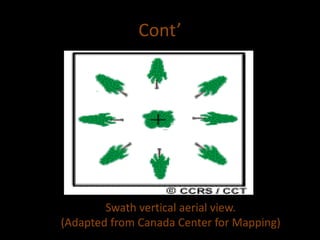
• The distortion exhibited here involves relief
displacement, similar to aerial photographs, but
in only one direction parallel to the direction of
scan. There is no displacement directly below the
sensor, at nadir (downward-facing viewing
geometry of an orbiting satellite or any other
relevant platform).
• As the sensor scans across the swath, the top
and side of objects are imaged and appear to
lean away from the nadir point in each scan line.
Again, the displacement increases, moving
towards the edges of the swath.
Cont’
Swath vertical aerial view.
(Adapted from Canada Center for Mapping)
Captain
• Did you know?
"...oblique aerial scanning…"
...that, just as in aerial photography, some thermal
scanner systems views the surface obliquely.
Forward-Looking Infrared (FLIR) systems point
ahead of the aircraft and scan across the scene. FLIR
systems produce images very similar in appearance
to oblique aerial photographs and are used for
applications ranging from forest fire detection to
law enforcement.
Whiz quiz
If you wanted to map a mountainous
region, limiting geometric distortions as
much as possible, would you choose a
satellite-based or aircraft-based scanning
system?
Explain why in terms of imaging geometry.
Whiz quiz - answer
• Although an aircraft scanning system may provide adequate
geometric accuracy in most instances, a satellite scanner
would probably be preferable in a mountainous region.
Because of the large variations in relief, geometric
distortions as a result of relief displacement would be
amplified at aircraft altitudes much more than from
satellite altitudes.
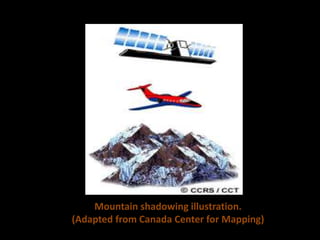
• Also, given the same lighting conditions, shadowing would
be a greater problem using aircraft imagery because of the
shallower viewing angles and would eliminate the
possibility for practical mapping in these areas.
Mountain shadowing illustration.
(Adapted from Canada Center for Mapping)
References
The Canada Centre for Mapping, n.d., Fundamentals of Remote Sensing [online].
Available at http://www.nrcan.gc.ca/earth-sciences/geomatics/satellite-imagery-air-
photos/satellite-imagery-products/educational. [Accessed on 20/10/2015]
Philpot, W., 1990. Digital Image Processing, Topic 4, Geometric correction.
Conrady, Alexander E., 2001. Decentred Lens-Systems. Monthly notices of the Royal
Astronomical Society 79 (1919): 384–390.
Kir'yanovK., Sizikov V., 2012. C/C++ Programming of Distorted Image Restoration
Problem In Texas Instruments Signal Microprocessors, Scientific and Technical
Journal of Information Technologies, Mechanics and Optics, Number 6, Volume 12,

Remote Sensing error sources

  • 1.
    UNIVERSITY OF NAIROBI GEOLOGYDEPARTMENT SGL 310 REMOTE SENSING AND PHOTOGEOLOGY
  • 2.
    Sources of errorsin Remote Sensing (Geometric Distortion) Presenter: - O. Gilbert O.
  • 3.
    Contents 1. Introduction. 2. Sourcesof errors in remotely sensed images. 3. whiz quiz. 4. References.
  • 4.
    Introduction • Any remotesensing image, regardless of whether it is acquired by a multispectral scanner on a satellite, a photographic system in an aircraft, or any other platform/sensor combination, will have various errors that can be described in terms of geometric distortions.
  • 5.
    Cont’ • This problemis inherent in remote sensing, as we attempt to accurately represent the three- dimensional surface of the Earth as a two- dimensional image
  • 6.
    Sources of errors •All remote sensing images are subject to geometric distortions, depending on the manner in which the data is acquired. They include the following: – The perspective of the sensor optics. – The motion and orientation of the scanning system. – The stability of the platform. – The platform altitude, attitude, and velocity. – The terrain relief. – The curvature and rotation of the Earth
  • 7.
    Sensor Optics • Ifthe velocity of the scanning mirror (Sensor) is constant (the ideal case) the sampling interval is well-defined and the size of the resolution cell, is easily calculated. In many scanning systems, the mirror does not maintain a precise, constant angular velocity. This is notably the case with which uses an oscillating rather than a rotating mirror. • Along scan, distortions are introduced causing pixel compression or pixel stretching at various points along the scan line. This distortion is difficult to correct since it is again difficult to measure and also changes gradually with time. Landsat MSS
  • 8.
    The motion andorientation of the scanning system • The motion and orientation of the platform may introduce distortions. This is as a result of attitude changes, position variation and slew. – Attitude changes. – Position variation: - The simplest is a deviation in altitude, shifts (lateral or vertical) which simply causes a change in scale. – Slew: -change in position about an axis.
  • 9.
    The stability ofthe platform Platform stability includes changes in their speed, altitude, and attitude (angular orientation with respect to the ground) during data acquisition. These effects are most pronounced when using aircraft platforms and are alleviated to a large degree with the use of satellite platforms, as their orbits are relatively stable, particularly in relation to their distance from the Earth.
  • 10.
    The curvature androtation of the Earth • The eastward rotation of the Earth, during a satellite orbit causes the sweep of scanning systems to cover an area slightly to the west of each previous scan. The resultant imagery is thus skewed (non parallel imagery) across the image. This is known as skew distortion and is common in imagery obtained from satellite multispectral scanners.
  • 11.
    The terrain relief •The distortion exhibited here involves relief displacement, similar to aerial photographs, but in only one direction parallel to the direction of scan. There is no displacement directly below the sensor, at nadir (downward-facing viewing geometry of an orbiting satellite or any other relevant platform). • As the sensor scans across the swath, the top and side of objects are imaged and appear to lean away from the nadir point in each scan line. Again, the displacement increases, moving towards the edges of the swath.
  • 12.
    Cont’ Swath vertical aerialview. (Adapted from Canada Center for Mapping)
  • 13.
    Captain • Did youknow? "...oblique aerial scanning…" ...that, just as in aerial photography, some thermal scanner systems views the surface obliquely. Forward-Looking Infrared (FLIR) systems point ahead of the aircraft and scan across the scene. FLIR systems produce images very similar in appearance to oblique aerial photographs and are used for applications ranging from forest fire detection to law enforcement.
  • 14.
    Whiz quiz If youwanted to map a mountainous region, limiting geometric distortions as much as possible, would you choose a satellite-based or aircraft-based scanning system? Explain why in terms of imaging geometry.
  • 15.
    Whiz quiz -answer • Although an aircraft scanning system may provide adequate geometric accuracy in most instances, a satellite scanner would probably be preferable in a mountainous region. Because of the large variations in relief, geometric distortions as a result of relief displacement would be amplified at aircraft altitudes much more than from satellite altitudes. • Also, given the same lighting conditions, shadowing would be a greater problem using aircraft imagery because of the shallower viewing angles and would eliminate the possibility for practical mapping in these areas.
  • 16.
    Mountain shadowing illustration. (Adaptedfrom Canada Center for Mapping)
  • 17.
    References The Canada Centrefor Mapping, n.d., Fundamentals of Remote Sensing [online]. Available at http://www.nrcan.gc.ca/earth-sciences/geomatics/satellite-imagery-air- photos/satellite-imagery-products/educational. [Accessed on 20/10/2015] Philpot, W., 1990. Digital Image Processing, Topic 4, Geometric correction. Conrady, Alexander E., 2001. Decentred Lens-Systems. Monthly notices of the Royal Astronomical Society 79 (1919): 384–390. Kir'yanovK., Sizikov V., 2012. C/C++ Programming of Distorted Image Restoration Problem In Texas Instruments Signal Microprocessors, Scientific and Technical Journal of Information Technologies, Mechanics and Optics, Number 6, Volume 12,