
DIGITAL 
FINGERPRINTING 
PRESENTED BY 
DHARAMSOTH SANTHOSH
What is digital fingerprinting??? 
• Digital fingerprint technology is designed to protect large 
documents, the contents of which do not change, or 
change little. 
• The technique used to detect digital fingerprints can 
automatically identify phrases from sample documents 
containing confidential information that appears in an 
analyzed text.
How digital fingerprinting 
works??? 
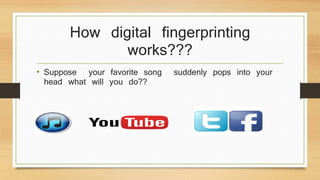
• Suppose your favorite song suddenly pops into your 
head what will you do??
Continue…. 
• Digital fingerprinting technology relies on complex 
computer-driven analysis to identify a piece of media like 
a song or video clip. 
• Just like every person has a unique fingerprint, every 
piece of media has identifying features that can be 
spotted by smart software. 
• Sites like YouTube can scan files and match their 
fingerprints against a database of copyrighted material 
and stop users from uploading copyrighted files.
Watermarking vs Fingerprinting 
• These are two very different technologies with somewhat 
similar goals. 
• A watermark is a logo or other identifying marking 
placed on an image or video that is visible at all times. 
• Pirates can still share watermarked videos, and some 
photos with smaller watermarks can easily be cropped to 
hide the identity of rightful owner. 
• Digital fingerprinting offers an even more promising way 
to restrict the spread of copyrighted material.
Digital fingerprinting technology 
• For fingerprinting to work, software has to be able to 
accurately identify a piece of media and relate that file 
to an external database. 
• Fingerprinting software samples of an audio or video file 
to pick out tiny portions of the file that are unique to 
that piece of media. 
• One major digital fingerprinting company, Audible Magic 
works for NBC universal, sony music and 20th century 
fox.
Continue… 
• Audible magic copy sense technology can identify the 
source of video clip in 5 seconds and audio file in 10 
seconds. 
• Software can recognize a piece of media that was, say, 
recorded off a movie theater with a handheld camera. 
• It cannot identify every piece of content on internet it 
will identify which is present in its database.
Reasons for digital fingerprinting 
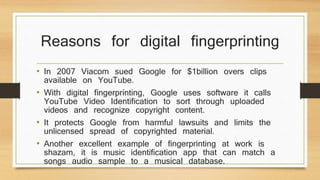
• In 2007 Viacom sued Google for $1billion overs clips 
available on YouTube. 
• With digital fingerprinting, Google uses software it calls 
YouTube Video Identification to sort through uploaded 
videos and recognize copyright content. 
• It protects Google from harmful lawsuits and limits the 
unlicensed spread of copyrighted material. 
• Another excellent example of fingerprinting at work is 
shazam, it is music identification app that can match a 
songs audio sample to a musical database.
Effectiveness of digital 
fingerprinting 
• Digital fingerprinting sounds like the perfect technology to 
combat internet privacy. 
• Digital fingerprinting must be able to identify thousands 
or millions of pieces of content- content that can be 
disseminated in many media formants or even recorded 
off a movie theatre screen. 
• Audible magic protects against 11 million songs, movies 
and television shows.
Homomorphic Encryption
Introduction 
• Homomorphic encryption is a form of encryption which 
allows specific types of computations to be carried out 
on cipher text and generate an encrypted result which, 
when decrypted, matches the result of operations 
performed on the plain text. 
• For instance, one person could add two encrypted numbers and then 
another person could decrypt the result, without either of them being able 
to find the value of the individual numbers.
• Earlier there was Somewhat Homomorphic Encryption technique. This 
encryption used low polynomial degree, which was its big drawback. 
• In June 2009, “Gentry” proposed the first efficient Fully Homomorphic 
Encryption technique. It is efficient in the sense that all algorithms run in 
polynomial time.
An Analogy: Alice’s Jewellery Store 
• Alice’s workers need to assemble raw materials into jewellery 
• But Alice is worried about theft 
How can the workers process the raw materials without having access to them?
• Alice puts materials in locked glove box 
• For which only she has the key 
• Workers assemble jewellery in the box 
• Alice unlocks box to get “results
Why homomorphic encryption? 
• Proposed by Rivest, Adleman and Dertouzos 
• Confidentiality problems 
• Ability to compute over cipher text instead of plaintext 
• One could use information without knowing the content 
of that information 
• Privacy guaranted
Homomorphic Encryption 
• It is of two types: 
• 1. partially homomorphic 
• 2. fully homomorphic
Partially homomorphic schemes 
• RSA: CT(x)*CT(y)=(x^e mod M)*(y^e mod M)=x^e*y^e mod 
M=CT(x*y) 
• Where ‘e’ is the exponent key and M the modulus 
• We take an example:- 
• p=61, q=53; n=pq=3233; ø(n)=(p-1)*(q-1)=60*52=3120; 
• e=17; d=2753; d=e^(-1)mod ø(n)=17^(-1)mod 3120 
• Here e is kept as public key exponent and d is kept 
as private key exponent.
Continued.. 
• RSA: obtain 5*6 performing RSA(5)*RSA(6) 
• RSA(5)= 5^17(mod 3233)=3086; 
• RSA(6)=6^17(mod 3233)=824; 
• 3086*824=2542864; 
• RSA^-1(2542864)=2542864^2753(mod 3233)=30; 
• 5*6=30
Fully homomorphic schemes 
• We consider CRAIG GENTRY scheme. 
• Suppose a scheme with a “noise parameter” attached to each 
CT; 
• Encryption algorithm outputs a CT with a small noise 
parameter(say less than n); 
• Decryption algorithm only works if noise is less than some 
parameters N>>n; 
• To compute E(a+b)/E(a*b), include noise; 
• This gives a “somewhat homomorphic” scheme.
CRAIG GENTRY scheme 
• Now suppose a new algorithm RECRYPT, such that: 
• - input: E(a), with noise N’<n 
• - output: E’(a), with noise√N 
• “somewhat homomorphic” -> fully homomorphic 
• Apply RECRYPT to E(a) and E(b) to ensure that the 
noise in E(a*b) or E(a+b) is smaller than N.
CRAIG GENTRY 
scheme(integers) 
• KEY: odd integers p>2N 
• ENCRYPTION ALGORITHM: given a bit b-> E(b)=c= 
b+2x+kp, where x is in [-n/2,n/2] and k is an integer 
chosen from some range 
• DECRYPTION ALGORITHM: b=(c mod p) mod 2, where 
(c mod p) is the noise and belongs to [-n,n] 
• Decryption works if b+2x ∈ [-N,N] ⊂[-p/2,p/2]
CRAIG GENTRY 
scheme(integers) 
• Graig Gentry scheme’s homomorphic assumptions 
• Addiction: c1 + c2 = b1+ b2 + 2(x1+x2) + (k1+k2)p = b1 xor b2 + 
2x + kp 
• Decryption works if (b1+2x1) + (b2+2x2) is in 
[-N,N] 
• Multiplication: c1*c2 = b1*b2 + 2(b1x2 + b2x1 + 2x1x2) + kp = 
b1*b2 + 2x + kp 
• Decryption works if (b1+2x1) * (b2+2x2) is in 
[-N,N]
Craig Gentry scheme (integers) 
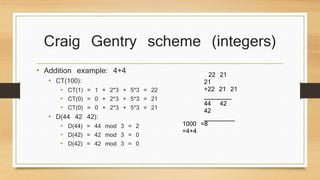
• Addition example: 4+4 
• CT(100): 
• CT(1) = 1 + 2*3 + 5*3 = 22 
• CT(0) = 0 + 2*3 + 5*3 = 21 
• D(44 42 42): 
• D(44) = 44 mod 3 = 2 
• D(42) = 42 mod 3 = 0 
22 21 
21 
+22 21 21 
________ 
44 42 
42 
_________ 
1000 =8 
=4+4
Craig Gentry scheme (integers) 
• Multiplication example: 4*4 
• CT(100): 
• CT(1) = 1 + 2*3 + 5*3 = 22 
• CT(0) = 0 + 2*3 + 5*3 = 21 
• D(484 924 1365 882 441): 
• D(484) = 484 mod 3 = 1 
• D(924) = 924 mod 3 = 0 
• D(1365) = 1365 mod 3 = 0 
• D(882) = 882 mod 3 = 0 
• D(441) = 441 mod 3 = 0 
22 21 21 
×22 21 21 
-------------------------- 
484 924 1365 882 441 
--------------------------- 
10000 =16=4*4
Why inefficient? 
• CT size and computation time increase sharply as the security 
level increases; 
• 2k security -> CT size and computation time are high-degree 
polynomials in k; 
• Efforts are being made to reduce the computational requirements 
of Craig Gentry construction 
• Noise grows with each operation 
• Threat for increasing cybercrimes through encrypted malwares
Applications 
• Nowadays: 
• Craig Gentry presented a working implementation of the fully 
homomorphic system, including the bootstrapping function 
• Exists a practical application of homomorphic encryption to a 
hybrid wireless network 
• Perform statistical tests over encrypted data such as temperature, 
humidity, etc. 
• There are also some practical implementations of simplifications 
of this scheme over databases
Problems solved 
• Cloud security 
• Problems related to personal records like medical records 
• Work with information stored in databases 
• Query's to search engines
Digital Fingerprinting

Digital Fingerprinting

  • 1.
    DIGITAL FINGERPRINTING PRESENTEDBY DHARAMSOTH SANTHOSH
  • 2.
    What is digitalfingerprinting??? • Digital fingerprint technology is designed to protect large documents, the contents of which do not change, or change little. • The technique used to detect digital fingerprints can automatically identify phrases from sample documents containing confidential information that appears in an analyzed text.
  • 3.
    How digital fingerprinting works??? • Suppose your favorite song suddenly pops into your head what will you do??
  • 4.
    Continue…. • Digitalfingerprinting technology relies on complex computer-driven analysis to identify a piece of media like a song or video clip. • Just like every person has a unique fingerprint, every piece of media has identifying features that can be spotted by smart software. • Sites like YouTube can scan files and match their fingerprints against a database of copyrighted material and stop users from uploading copyrighted files.
  • 5.
    Watermarking vs Fingerprinting • These are two very different technologies with somewhat similar goals. • A watermark is a logo or other identifying marking placed on an image or video that is visible at all times. • Pirates can still share watermarked videos, and some photos with smaller watermarks can easily be cropped to hide the identity of rightful owner. • Digital fingerprinting offers an even more promising way to restrict the spread of copyrighted material.
  • 6.
    Digital fingerprinting technology • For fingerprinting to work, software has to be able to accurately identify a piece of media and relate that file to an external database. • Fingerprinting software samples of an audio or video file to pick out tiny portions of the file that are unique to that piece of media. • One major digital fingerprinting company, Audible Magic works for NBC universal, sony music and 20th century fox.
  • 7.
    Continue… • Audiblemagic copy sense technology can identify the source of video clip in 5 seconds and audio file in 10 seconds. • Software can recognize a piece of media that was, say, recorded off a movie theater with a handheld camera. • It cannot identify every piece of content on internet it will identify which is present in its database.
  • 8.
    Reasons for digitalfingerprinting • In 2007 Viacom sued Google for $1billion overs clips available on YouTube. • With digital fingerprinting, Google uses software it calls YouTube Video Identification to sort through uploaded videos and recognize copyright content. • It protects Google from harmful lawsuits and limits the unlicensed spread of copyrighted material. • Another excellent example of fingerprinting at work is shazam, it is music identification app that can match a songs audio sample to a musical database.
  • 9.
    Effectiveness of digital fingerprinting • Digital fingerprinting sounds like the perfect technology to combat internet privacy. • Digital fingerprinting must be able to identify thousands or millions of pieces of content- content that can be disseminated in many media formants or even recorded off a movie theatre screen. • Audible magic protects against 11 million songs, movies and television shows.
  • 10.
  • 11.
    Introduction • Homomorphicencryption is a form of encryption which allows specific types of computations to be carried out on cipher text and generate an encrypted result which, when decrypted, matches the result of operations performed on the plain text. • For instance, one person could add two encrypted numbers and then another person could decrypt the result, without either of them being able to find the value of the individual numbers.
  • 12.
    • Earlier therewas Somewhat Homomorphic Encryption technique. This encryption used low polynomial degree, which was its big drawback. • In June 2009, “Gentry” proposed the first efficient Fully Homomorphic Encryption technique. It is efficient in the sense that all algorithms run in polynomial time.
  • 13.
    An Analogy: Alice’sJewellery Store • Alice’s workers need to assemble raw materials into jewellery • But Alice is worried about theft How can the workers process the raw materials without having access to them?
  • 14.
    • Alice putsmaterials in locked glove box • For which only she has the key • Workers assemble jewellery in the box • Alice unlocks box to get “results
  • 15.
    Why homomorphic encryption? • Proposed by Rivest, Adleman and Dertouzos • Confidentiality problems • Ability to compute over cipher text instead of plaintext • One could use information without knowing the content of that information • Privacy guaranted
  • 16.
    Homomorphic Encryption •It is of two types: • 1. partially homomorphic • 2. fully homomorphic
  • 17.
    Partially homomorphic schemes • RSA: CT(x)*CT(y)=(x^e mod M)*(y^e mod M)=x^e*y^e mod M=CT(x*y) • Where ‘e’ is the exponent key and M the modulus • We take an example:- • p=61, q=53; n=pq=3233; ø(n)=(p-1)*(q-1)=60*52=3120; • e=17; d=2753; d=e^(-1)mod ø(n)=17^(-1)mod 3120 • Here e is kept as public key exponent and d is kept as private key exponent.
  • 18.
    Continued.. • RSA:obtain 5*6 performing RSA(5)*RSA(6) • RSA(5)= 5^17(mod 3233)=3086; • RSA(6)=6^17(mod 3233)=824; • 3086*824=2542864; • RSA^-1(2542864)=2542864^2753(mod 3233)=30; • 5*6=30
  • 19.
    Fully homomorphic schemes • We consider CRAIG GENTRY scheme. • Suppose a scheme with a “noise parameter” attached to each CT; • Encryption algorithm outputs a CT with a small noise parameter(say less than n); • Decryption algorithm only works if noise is less than some parameters N>>n; • To compute E(a+b)/E(a*b), include noise; • This gives a “somewhat homomorphic” scheme.
  • 20.
    CRAIG GENTRY scheme • Now suppose a new algorithm RECRYPT, such that: • - input: E(a), with noise N’<n • - output: E’(a), with noise√N • “somewhat homomorphic” -> fully homomorphic • Apply RECRYPT to E(a) and E(b) to ensure that the noise in E(a*b) or E(a+b) is smaller than N.
  • 21.
    CRAIG GENTRY scheme(integers) • KEY: odd integers p>2N • ENCRYPTION ALGORITHM: given a bit b-> E(b)=c= b+2x+kp, where x is in [-n/2,n/2] and k is an integer chosen from some range • DECRYPTION ALGORITHM: b=(c mod p) mod 2, where (c mod p) is the noise and belongs to [-n,n] • Decryption works if b+2x ∈ [-N,N] ⊂[-p/2,p/2]
  • 22.
    CRAIG GENTRY scheme(integers) • Graig Gentry scheme’s homomorphic assumptions • Addiction: c1 + c2 = b1+ b2 + 2(x1+x2) + (k1+k2)p = b1 xor b2 + 2x + kp • Decryption works if (b1+2x1) + (b2+2x2) is in [-N,N] • Multiplication: c1*c2 = b1*b2 + 2(b1x2 + b2x1 + 2x1x2) + kp = b1*b2 + 2x + kp • Decryption works if (b1+2x1) * (b2+2x2) is in [-N,N]
  • 23.
    Craig Gentry scheme(integers) • Addition example: 4+4 • CT(100): • CT(1) = 1 + 2*3 + 5*3 = 22 • CT(0) = 0 + 2*3 + 5*3 = 21 • CT(0) = 0 + 2*3 + 5*3 = 21 • D(44 42 42): • D(44) = 44 mod 3 = 2 • D(42) = 42 mod 3 = 0 • D(42) = 42 mod 3 = 0 22 21 21 +22 21 21 ________ 44 42 42 _________ 1000 =8 =4+4
  • 24.
    Craig Gentry scheme(integers) • Multiplication example: 4*4 • CT(100): • CT(1) = 1 + 2*3 + 5*3 = 22 • CT(0) = 0 + 2*3 + 5*3 = 21 • CT(0) = 0 + 2*3 + 5*3 = 21 • D(484 924 1365 882 441): • D(484) = 484 mod 3 = 1 • D(924) = 924 mod 3 = 0 • D(1365) = 1365 mod 3 = 0 • D(882) = 882 mod 3 = 0 • D(441) = 441 mod 3 = 0 22 21 21 ×22 21 21 -------------------------- 484 924 1365 882 441 --------------------------- 10000 =16=4*4
  • 25.
    Why inefficient? •CT size and computation time increase sharply as the security level increases; • 2k security -> CT size and computation time are high-degree polynomials in k; • Efforts are being made to reduce the computational requirements of Craig Gentry construction • Noise grows with each operation • Threat for increasing cybercrimes through encrypted malwares
  • 26.
    Applications • Nowadays: • Craig Gentry presented a working implementation of the fully homomorphic system, including the bootstrapping function • Exists a practical application of homomorphic encryption to a hybrid wireless network • Perform statistical tests over encrypted data such as temperature, humidity, etc. • There are also some practical implementations of simplifications of this scheme over databases
  • 27.
    Problems solved •Cloud security • Problems related to personal records like medical records • Work with information stored in databases • Query's to search engines