Searchable Encryption Systems
   Christopher M. Frenz


July 2012
The Current State of Information
Insecurity
 July 2012 - Yahoo confirmed that over 400,000
  user name and password combinations were
  stolen
 June 2012 - LinkedIn suffered a data breach that
  resulted in the theft of over 6 million unsalted
  user passwords
 From 2005 to July 2012 there have been 3,226
  data breaches that resulted in over 562,872,534
  records being compromised
  (http://www.privacyrights.org/data-breach).
 Verizon reported that 2011 was the second
  largest year for data breaches since they started
  investigating them in 2004
Security Controls
 Publications, such as NIST Special
  Publication 800-53 and others like it, list
  well over 150 possible security controls
  that could be implemented to improve
  upon information security
 This presentation is going to focus on the
  use of encryption as a security control
Common Uses of Encryption Today
   Securing Data Transmission
    ◦   SSL/TLS
    ◦   IPSEC
    ◦   S/MIME
    ◦   Etc
   Securing Stored Data
    ◦ TrueCrypt
    ◦ Bitlocker
    ◦ Etc
The Growth of Cloud Computing
   In 2009 cloud computing services were
    reported to be valued at $17.4 billion
    with the market expected to grow to
    over $44 billion by 2013
Cloud Computing
   Cloud services can offer some security
    advantages
    ◦ e.g. - resource pooling to build more robust
      infrastructures
    ◦ options for the dynamic scaling of services to
      help maintain availability
   But they are not without risk
    ◦ e.g. – much of your data is being stored by a
      trusted? 3rd party
Role of Encryption
 One of the primary ways of ensuring that
  cloud hosted data remains secret is via
  the encrypted transmission of data and
  the encrypted storage of data
 However, data hosted on a cloud
  provider’s system cannot be searched
  without first being decrypted
 How can this issue be dealt with?
Yao’s Garbled Circuits
 Yao developed a system whereby one party in the
  communication (party A) creates a garbled circuit
  that is capable of computing a desired function in
  such a way that the inputs required from party A are
  encoded into the garbled circuit in such a manner
  that party B cannot determine what the inputs are
 Party B is able to use his inputs in conjunction with
  the garbled circuit to compute the answer to the
  desired function
 This allows party A and B to retrieve the desired
  information while at the same time limiting the
  amount of information disclosure to just the result of
  the computed function
Limitation of Yao’s Garbled Circuits
 Yao’s Garbled Circuits only work to
  prevent “honest but curious” attackers
 That is attackers that only attempt to run
  the circuit as designed
 Increasingly research around such secure
  communication is focused on the concept
  of homomorphic encryption
Homomorphism
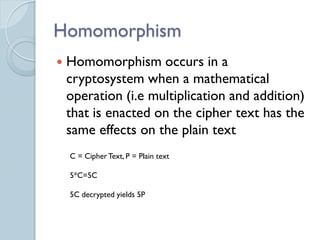
   Homomorphism occurs in a
    cryptosystem when a mathematical
    operation (i.e multiplication and addition)
    that is enacted on the cipher text has the
    same effects on the plain text
    C = Cipher Text, P = Plain text

    5*C=5C

    5C decrypted yields 5P
Homomorphic Properties of
Current Encryption Systems
 Symmetric encryption systems like AES
  and DES are not homomorphic
 Some asymmetric encryption systems like
  RSA and ElGammal are partially
  homomorphic in that they can support
  one homomorphic math operation
Partially Homomorphic Encryption
Systems
 Boneh, Goh, and Nissim (BGN)
  cryptosystem was developed to support
  an arbitrary number of additions and one
  multiplication
 Melchor, Gaborit, and Herranz developed
  improvements upon BGN which allowed
  for an arbitrary number of additions and
  2 multiplications
Fully Homomorphic Encryption
 Developed by Craig Gentry in 2009
 This fully homomorphic encryption
  system allows for an arbitrary number of
  additions and an arbitrary number of
  multiplications to be performed while still
  demonstrating the same effects on both
  the cipher text and plain text
Applications of Fully Homomorphic
Encryption
 Private Information Retrieval without the
  need to decrypt data
 Filtering/sorting encrypted emails
 Improved security of electronic medical
  records
 Analysis of electronic medical record data
  without decrypting the data
 Secure electronic voting
Limitation – Time
 Homomorphic encryption is computationally
  intensive
 A Google search using homomorphic
  encryption would require approximately a
  trillion times as much computing time as a
  normal Google search
 Even if Moore’s Law continues to hold true,
  it will be at least 40 years before
  homomorphic encryption based search
  resembles the search speeds of today
Addressing this limitation
   GPGPU – Performing these operations
    on a GPU instead of a CPU can improve
    performance
    ◦ A CUDA implementation of the PIR
      algorithms proposed by Aguilar and Gaborit
      was used to demonstrate data processing
      rates of up to 2Gbits/sec
   FPGAs – performing these operations on
    specialty hardware can improve
    performance
Limitation – Security?
 These algorithms are still in their infancy
 They are not yet as well tested and vetted
  by the cryptographic community as other
  encryption algorithms
 There may be security flaws in the
  algorithms that have not yet been
  identified
Conclusion
 Homomorphic encryptions holds great
  promise for the future
 There are limitations with these
  algorithms, but with continued research
  these limitations could be reduced
 The ability to search and analyze
  encrypted data sets will likely create many
  novel applications that make use of
  homomorphic encryption systems

Searchable Encryption Systems

  • 1.
    Searchable Encryption Systems Christopher M. Frenz July 2012
  • 2.
    The Current Stateof Information Insecurity  July 2012 - Yahoo confirmed that over 400,000 user name and password combinations were stolen  June 2012 - LinkedIn suffered a data breach that resulted in the theft of over 6 million unsalted user passwords  From 2005 to July 2012 there have been 3,226 data breaches that resulted in over 562,872,534 records being compromised (http://www.privacyrights.org/data-breach).  Verizon reported that 2011 was the second largest year for data breaches since they started investigating them in 2004
  • 3.
    Security Controls  Publications,such as NIST Special Publication 800-53 and others like it, list well over 150 possible security controls that could be implemented to improve upon information security  This presentation is going to focus on the use of encryption as a security control
  • 4.
    Common Uses ofEncryption Today  Securing Data Transmission ◦ SSL/TLS ◦ IPSEC ◦ S/MIME ◦ Etc  Securing Stored Data ◦ TrueCrypt ◦ Bitlocker ◦ Etc
  • 5.
    The Growth ofCloud Computing  In 2009 cloud computing services were reported to be valued at $17.4 billion with the market expected to grow to over $44 billion by 2013
  • 6.
    Cloud Computing  Cloud services can offer some security advantages ◦ e.g. - resource pooling to build more robust infrastructures ◦ options for the dynamic scaling of services to help maintain availability  But they are not without risk ◦ e.g. – much of your data is being stored by a trusted? 3rd party
  • 7.
    Role of Encryption One of the primary ways of ensuring that cloud hosted data remains secret is via the encrypted transmission of data and the encrypted storage of data  However, data hosted on a cloud provider’s system cannot be searched without first being decrypted  How can this issue be dealt with?
  • 8.
    Yao’s Garbled Circuits Yao developed a system whereby one party in the communication (party A) creates a garbled circuit that is capable of computing a desired function in such a way that the inputs required from party A are encoded into the garbled circuit in such a manner that party B cannot determine what the inputs are  Party B is able to use his inputs in conjunction with the garbled circuit to compute the answer to the desired function  This allows party A and B to retrieve the desired information while at the same time limiting the amount of information disclosure to just the result of the computed function
  • 9.
    Limitation of Yao’sGarbled Circuits  Yao’s Garbled Circuits only work to prevent “honest but curious” attackers  That is attackers that only attempt to run the circuit as designed  Increasingly research around such secure communication is focused on the concept of homomorphic encryption
  • 10.
    Homomorphism  Homomorphism occurs in a cryptosystem when a mathematical operation (i.e multiplication and addition) that is enacted on the cipher text has the same effects on the plain text C = Cipher Text, P = Plain text 5*C=5C 5C decrypted yields 5P
  • 11.
    Homomorphic Properties of CurrentEncryption Systems  Symmetric encryption systems like AES and DES are not homomorphic  Some asymmetric encryption systems like RSA and ElGammal are partially homomorphic in that they can support one homomorphic math operation
  • 12.
    Partially Homomorphic Encryption Systems Boneh, Goh, and Nissim (BGN) cryptosystem was developed to support an arbitrary number of additions and one multiplication  Melchor, Gaborit, and Herranz developed improvements upon BGN which allowed for an arbitrary number of additions and 2 multiplications
  • 13.
    Fully Homomorphic Encryption Developed by Craig Gentry in 2009  This fully homomorphic encryption system allows for an arbitrary number of additions and an arbitrary number of multiplications to be performed while still demonstrating the same effects on both the cipher text and plain text
  • 14.
    Applications of FullyHomomorphic Encryption  Private Information Retrieval without the need to decrypt data  Filtering/sorting encrypted emails  Improved security of electronic medical records  Analysis of electronic medical record data without decrypting the data  Secure electronic voting
  • 15.
    Limitation – Time Homomorphic encryption is computationally intensive  A Google search using homomorphic encryption would require approximately a trillion times as much computing time as a normal Google search  Even if Moore’s Law continues to hold true, it will be at least 40 years before homomorphic encryption based search resembles the search speeds of today
  • 16.
    Addressing this limitation  GPGPU – Performing these operations on a GPU instead of a CPU can improve performance ◦ A CUDA implementation of the PIR algorithms proposed by Aguilar and Gaborit was used to demonstrate data processing rates of up to 2Gbits/sec  FPGAs – performing these operations on specialty hardware can improve performance
  • 17.
    Limitation – Security? These algorithms are still in their infancy  They are not yet as well tested and vetted by the cryptographic community as other encryption algorithms  There may be security flaws in the algorithms that have not yet been identified
  • 18.
    Conclusion  Homomorphic encryptionsholds great promise for the future  There are limitations with these algorithms, but with continued research these limitations could be reduced  The ability to search and analyze encrypted data sets will likely create many novel applications that make use of homomorphic encryption systems