1
Digital Fabrication Lab
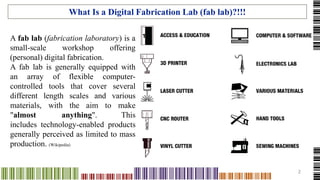
A fab lab (fabrication laboratory) is a
small-scale workshop offering
(personal) digital fabrication.
A fab lab is generally equipped with
an array of flexible computer-
controlled tools that cover several
different length scales and various
materials, with the aim to make
"almost anything". This
includes technology-enabled products
generally perceived as limited to mass
production. (Wikipedia)
2
What Is a Digital Fabrication Lab (fab lab)?!!!
3
WHY
IT
IS
C
O
N
T
E
M
P
O
R
A
R
Y
4
SOME EQUIPMENTS OF DIGITAL FABRICATION LAB
3D PRINTER 7-AXIS ROBOT
CNC KNITTING MACHINE
CNC WATERJET DIGITIZERCNC ROUTER
LASER CUTTERS
ZUND KNIFE CUTTER
5
• It provides teachers with 3 dimensional visual aids
that they can use in their classroom particularly in
illustrating a hard to grasp concept.
• Digital Fabrication make it easy for teachers to seize
the interest of their students compared to just
showing the pictorial representations of objects.
• It enhances hands on learning and learning by doing.
Using this prototyping technology, students will be
able to produce realistic 3 dimensional mini models
• It provides more room for interactive class activities.
How beneficial is Digital fabrication in Architecture Education ?
6
7 AXIS KUKA ROBOT (KR100 HA L90)
• The 7 axis Robotic Work cell is a large
format 6 axis articulated robotic arm
mounted on a 10 m linear axis.
• The robotic system serves as a flexible,
reconfigurable, motion control platform.
• A variety of tools can be mounted to the
arm, including a high speed router
spindle, miller and an abrasive water jet
cutting nozzle.
• In addition to machining processes, the
arm can be reconfigured to perform
assembly work using a gripper.
7
6 AXIS + 1 AXIS
8
PHYSICALASPECTS
• The Robotic system is composed of a Kuka KR100 HA L90 arm mounted on a K-1500-3
linear axis.
• The arm has a max reach of 2.8m and a max payload of 90 Kg.
• The linear axis has a 10m travel. This allows the system to move between work cells,
allowing rapid conversion from one task to the next.
• The work cell is pre-configured with a 4'x8' cutting area for multi axis water jet and a 4'x8'
cutting area for multi axis routing.
9
PROCEDURE
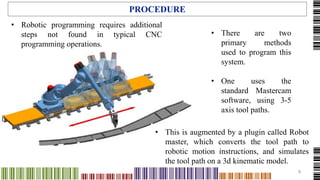
• Robotic programming requires additional
steps not found in typical CNC
programming operations.
• There are two
primary methods
used to program this
system.
• One uses the
standard Mastercam
software, using 3-5
axis tool paths.
• This is augmented by a plugin called Robot
master, which converts the tool path to
robotic motion instructions, and simulates
the tool path on a 3d kinematic model.
10
MATERIALS SUPPORTED
• In Water jet applications the robot can cut all
metals and plastics, as well as rubber and wood.
• Milling application, mills the wood and mdf like
materials to produce a desired form.
• In routing applications, The robot is limited to
wood and foam materials.
• In general, robots do not possess the necessary
rigidity to perform heavy cuts compared to a
gantry or bridge type router.
COST
Varies between ₤9500 to ₤10000 depending upon the model used
11
Abrasive Water Jets
1. Water jet machining is a mechanical energy based
process used to cut machine soft and non-metallic
materials.
2. Involves the use of high velocity water jet to smoothly
cut a work piece.
3. During this process its kinetic energy is converted to
pressure energy.
1. Reservoir
2. Pump
3. Intensifier
4. Accumulator
5. Control valve
6. Flow regulator
7. Nozzle
8. Mixing tube
9. Catcher.
Components-
12
Has an ability to cut intricate design, at high
speed without breakage-
‒ cutting granite, marble, slate, limestone,
soapstone, travertine, engineered stone or
any other material for floors and counters.
‒ porcelain or ceramic tile for inlays or
medallions;
‒ glass and metal for artistic accents and
signage.
APPLICATIONS The Advantages of WJM are:
1. Water jet machining is a relatively
fast process.
2. It prevents the formation of heat
affected zones on the work piece.
3. It automatically cleans the surface of
the work piece.
4. WJM has excellent precision.
Tolerances of the order of ±0.005″
can be obtained.
5. It does not produce any hazardous
gas.
6. It is eco-friendly.
WJM has following disadvantages
which are:
1. Initial investment is high.
2. Requires large space for installation.
13
ACHIEVED PRODUCTS…..
14
FUNCTIONING of DIGITAL
FAB R ICATION L AB
‘TAUB MAN COL L EGE OF
AR CHITECTUR E’
AS a Case Ex ample
15
The newly renovated Digital Fabrication Lab (FABLab) at Taubman College leverages
state-of-the-art industrial technology to perform architectural fabrication research.
Currently the FABLab houses
• six industrial robots, organized into three cooperative work cells, providing the ability to
work at a wide range of material scales.
• A wide range of large-scale CNC machines
• including two 3-axis routers
• one 5-axis router
• one 3-axis vertical machining center for metals, one 3-axis water jet.
• one 4-axis digital knife cutter.
• Lasers
• 3D printers.
• A CNC industrial knitting machine is a recent addition to the FAB Lab’s suite of digitally
driven tools, enabling complex textile forms to be produced for a wide range of
applications.
16
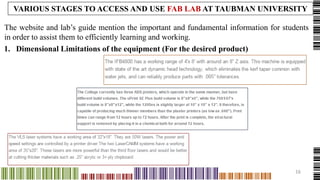
VARIOUS STAGES TO ACCESS AND USE FAB LAB AT TAUBMAN UNIVERSITY
The website and lab’s guide mention the important and fundamental information for students
in order to assist them to efficiently learning and working.
1. Dimensional Limitations of the equipment (For the desired product)
17
2. SIGN UP CALENDER
18
4. PROCEDURE
1. Have an Idea
2. Become Familiar
with Equipment
3. Create the File
4. Submitting the
File
5. Fill out Form
6. Pay for Print
7. Finishing
5. MATERIALS
The manual or webpage describes the various materials
that are compatible with the respective equipment of the
digital lab.
3. FILE PREPARATION
• Checking Nurbs File
• Trouble Creating a
Solid. (LA will assist)
• Exporting to STL
• Checking STL Mesh
19
Conclusion
Given all these attributes, Digital fabrication seems to
hold some promising and groundbreaking innovation that
will definitely assist in the fulfillment of a productive
Architectural educational experience.
It turns students, professionals (users) from being passive consumers
to active creators.
20
References…
• https://taubmancollege.umich.edu/labs-workshops/digital-fabrication-lab
• Dan Collins and Don Vance, Arizona State University, Digital Culture / 3D Tools
August 23, 2012
THANK YOU…..

Digital Fabrication Lab

  • 1.
  • 2.
    A fab lab(fabrication laboratory) is a small-scale workshop offering (personal) digital fabrication. A fab lab is generally equipped with an array of flexible computer- controlled tools that cover several different length scales and various materials, with the aim to make "almost anything". This includes technology-enabled products generally perceived as limited to mass production. (Wikipedia) 2 What Is a Digital Fabrication Lab (fab lab)?!!!
  • 3.
  • 4.
    4 SOME EQUIPMENTS OFDIGITAL FABRICATION LAB 3D PRINTER 7-AXIS ROBOT CNC KNITTING MACHINE CNC WATERJET DIGITIZERCNC ROUTER LASER CUTTERS ZUND KNIFE CUTTER
  • 5.
    5 • It providesteachers with 3 dimensional visual aids that they can use in their classroom particularly in illustrating a hard to grasp concept. • Digital Fabrication make it easy for teachers to seize the interest of their students compared to just showing the pictorial representations of objects. • It enhances hands on learning and learning by doing. Using this prototyping technology, students will be able to produce realistic 3 dimensional mini models • It provides more room for interactive class activities. How beneficial is Digital fabrication in Architecture Education ?
  • 6.
    6 7 AXIS KUKAROBOT (KR100 HA L90) • The 7 axis Robotic Work cell is a large format 6 axis articulated robotic arm mounted on a 10 m linear axis. • The robotic system serves as a flexible, reconfigurable, motion control platform. • A variety of tools can be mounted to the arm, including a high speed router spindle, miller and an abrasive water jet cutting nozzle. • In addition to machining processes, the arm can be reconfigured to perform assembly work using a gripper.
  • 7.
    7 6 AXIS +1 AXIS
  • 8.
    8 PHYSICALASPECTS • The Roboticsystem is composed of a Kuka KR100 HA L90 arm mounted on a K-1500-3 linear axis. • The arm has a max reach of 2.8m and a max payload of 90 Kg. • The linear axis has a 10m travel. This allows the system to move between work cells, allowing rapid conversion from one task to the next. • The work cell is pre-configured with a 4'x8' cutting area for multi axis water jet and a 4'x8' cutting area for multi axis routing.
  • 9.
    9 PROCEDURE • Robotic programmingrequires additional steps not found in typical CNC programming operations. • There are two primary methods used to program this system. • One uses the standard Mastercam software, using 3-5 axis tool paths. • This is augmented by a plugin called Robot master, which converts the tool path to robotic motion instructions, and simulates the tool path on a 3d kinematic model.
  • 10.
    10 MATERIALS SUPPORTED • InWater jet applications the robot can cut all metals and plastics, as well as rubber and wood. • Milling application, mills the wood and mdf like materials to produce a desired form. • In routing applications, The robot is limited to wood and foam materials. • In general, robots do not possess the necessary rigidity to perform heavy cuts compared to a gantry or bridge type router. COST Varies between ₤9500 to ₤10000 depending upon the model used
  • 11.
    11 Abrasive Water Jets 1.Water jet machining is a mechanical energy based process used to cut machine soft and non-metallic materials. 2. Involves the use of high velocity water jet to smoothly cut a work piece. 3. During this process its kinetic energy is converted to pressure energy. 1. Reservoir 2. Pump 3. Intensifier 4. Accumulator 5. Control valve 6. Flow regulator 7. Nozzle 8. Mixing tube 9. Catcher. Components-
  • 12.
    12 Has an abilityto cut intricate design, at high speed without breakage- ‒ cutting granite, marble, slate, limestone, soapstone, travertine, engineered stone or any other material for floors and counters. ‒ porcelain or ceramic tile for inlays or medallions; ‒ glass and metal for artistic accents and signage. APPLICATIONS The Advantages of WJM are: 1. Water jet machining is a relatively fast process. 2. It prevents the formation of heat affected zones on the work piece. 3. It automatically cleans the surface of the work piece. 4. WJM has excellent precision. Tolerances of the order of ±0.005″ can be obtained. 5. It does not produce any hazardous gas. 6. It is eco-friendly. WJM has following disadvantages which are: 1. Initial investment is high. 2. Requires large space for installation.
  • 13.
  • 14.
    14 FUNCTIONING of DIGITAL FABR ICATION L AB ‘TAUB MAN COL L EGE OF AR CHITECTUR E’ AS a Case Ex ample
  • 15.
    15 The newly renovatedDigital Fabrication Lab (FABLab) at Taubman College leverages state-of-the-art industrial technology to perform architectural fabrication research. Currently the FABLab houses • six industrial robots, organized into three cooperative work cells, providing the ability to work at a wide range of material scales. • A wide range of large-scale CNC machines • including two 3-axis routers • one 5-axis router • one 3-axis vertical machining center for metals, one 3-axis water jet. • one 4-axis digital knife cutter. • Lasers • 3D printers. • A CNC industrial knitting machine is a recent addition to the FAB Lab’s suite of digitally driven tools, enabling complex textile forms to be produced for a wide range of applications.
  • 16.
    16 VARIOUS STAGES TOACCESS AND USE FAB LAB AT TAUBMAN UNIVERSITY The website and lab’s guide mention the important and fundamental information for students in order to assist them to efficiently learning and working. 1. Dimensional Limitations of the equipment (For the desired product)
  • 17.
    17 2. SIGN UPCALENDER
  • 18.
    18 4. PROCEDURE 1. Havean Idea 2. Become Familiar with Equipment 3. Create the File 4. Submitting the File 5. Fill out Form 6. Pay for Print 7. Finishing 5. MATERIALS The manual or webpage describes the various materials that are compatible with the respective equipment of the digital lab. 3. FILE PREPARATION • Checking Nurbs File • Trouble Creating a Solid. (LA will assist) • Exporting to STL • Checking STL Mesh
  • 19.
    19 Conclusion Given all theseattributes, Digital fabrication seems to hold some promising and groundbreaking innovation that will definitely assist in the fulfillment of a productive Architectural educational experience. It turns students, professionals (users) from being passive consumers to active creators.
  • 20.
    20 References… • https://taubmancollege.umich.edu/labs-workshops/digital-fabrication-lab • DanCollins and Don Vance, Arizona State University, Digital Culture / 3D Tools August 23, 2012 THANK YOU…..