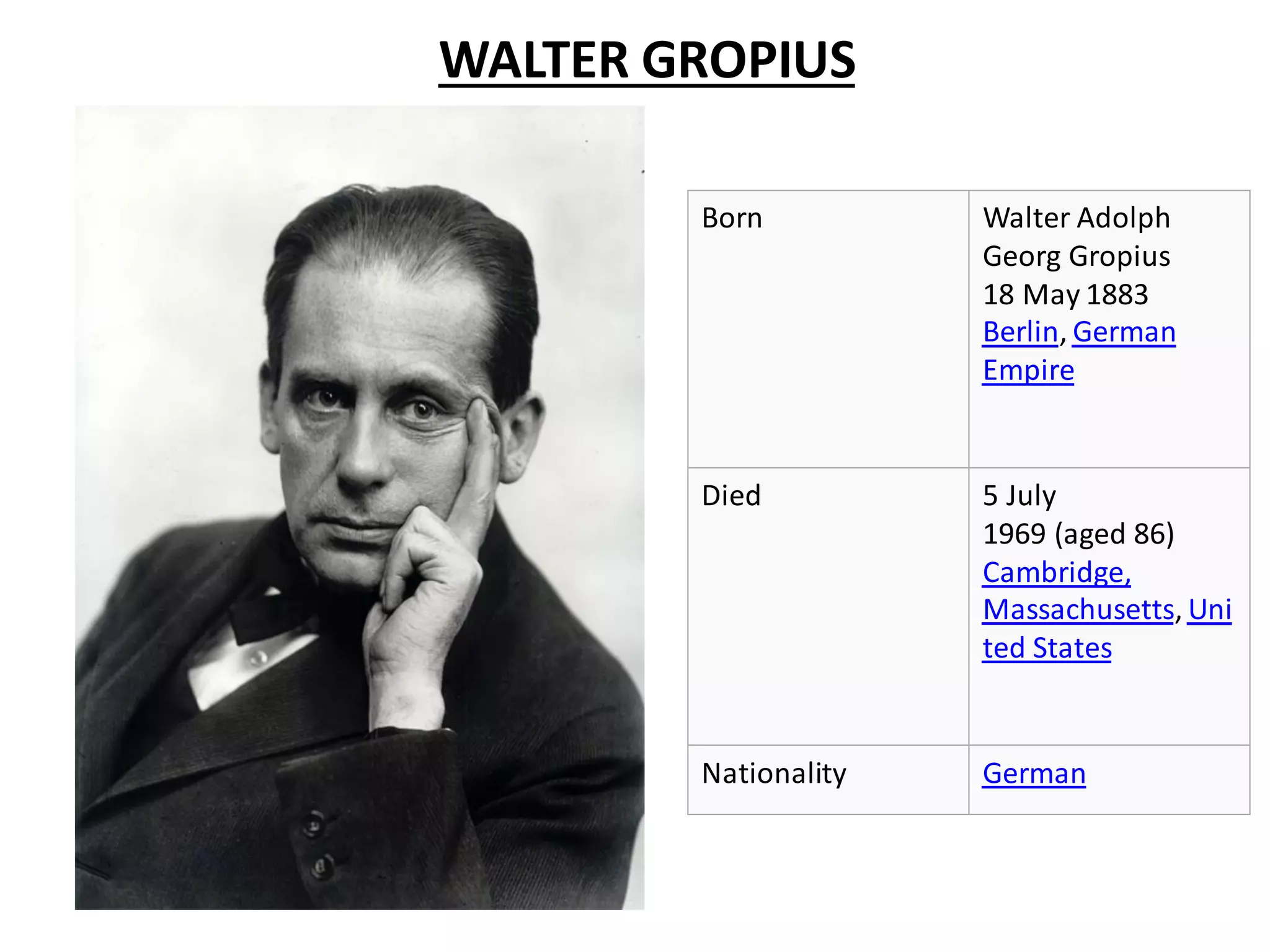
WALTER GROPIUS
Born Walter Adolph
Georg Gropius
18 May 1883
Berlin, German
Empire
Died 5 July
1969 (aged 86)
Cambridge,
Massachusetts, Uni
ted States
Nationality German
INTRODUCTION :
• Walter Adolph Georg Gropius (18 May 1883 – 5 July 1969) was
a German architect and founder of the Bauhaus School,who,along with Ludwig
Mies van der Rohe, Le Corbusier and Frank Lloyd Wright, is widely regarded as one
of the pioneeringmasters of modern architecture.
• Walter Gropius was drafted August 1914 and served as a sergeant and then as a
lieutenantin the signal corps in the First World War.
• He survived being both buried under rubble and dead bodies, and shot out of the
sky with a dead pilot.
• He was awardedthe Iron Crosstwice. Gropius then, like his father and his great-
uncle Martin Gropius before him, became an architect.
• Gropius could not draw, and was dependenton collaboratorsand partner-
interpreters throughout his career. In school he hired an assistantto complete his
homework for him.
• In 1908, after studying architecture in Munich and Berlin for four semesters,
Gropiusjoined the office of the renowned architect and industrialdesigner Peter
Behrens, one of the first members of the utilitarianschool.
• His fellow employees at this time included Ludwig Mies van der Rohe, Le
Corbusier, and Dietrich Marcks.
• In 1910 Gropius left the firm of Behrens and together with fellow employee Adolf
Meyer establisheda practice in Berlin
BAUHAUS PERIOD:
• Gropius's career advanced in the postwar period.
• Henry van de Velde, the master of the Grand-DucalSaxon School of Arts and Crafts in
Weimar was asked to step down in 1915 due to hisBelgiannationality.
• His recommendationfor Gropius to succeed him led eventuallyto Gropius's appointmentas
master of the school in 1919.
• It was this academy which Gropius transformed into the world famous Bauhaus, attractinga
faculty that included Paul Klee, Johannes Itten, Josef Albers, Herbert Bayer, László Moholy-
Nagy, Otto Bartning and Wassily Kandinsky.
• In principle, the Bauhaus represented an opportunityto extend beauty and qualityto every
home through well designed industriallyproduced objects.
• The Bauhaus program was experimentaland the emphasis, was theoretical.
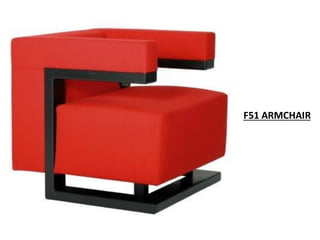
• One example product of the Bauhaus was the armchair F 51, designed for the Bauhaus's
directors room in 1920 – nowadaysa re-editionin the market, manufacturedby the German
company TECTA/Lauenfoerde.
• In 1919, Gropius was involvedin the Glass Chain utopianexpressionist correspondence under
the pseudonym "Mass.“
• In 1923, Gropius designed his famous door handles, now considered an icon of 20th-century
design and often listed as one of the most influentialdesigns to emerge from Bauhaus.
• Walter Gropius designed the newly constructed school buildingin 1925 on behalf of the city
of Dessau.
• He also designed large-scale housing projects in Berlin, Karlsruhe and Dessau in 1926–32
that were major contributionsto the New Objectivitymovement, includinga contributionto
the Siemensstadt project in Berlin.
CHARACTERISTICS FEATURES :
• Walter Gropius was a German architect who created innovativedesigns that involved
materialsand methods of constructionfrom modern technology availableat his time.
• Gropius theory was that all design should be functional as well as aesthetically pleasing.
• Using technologyas a basis, he transformed buildinginto a science of precise mathematical
calculations.
• He believedin industrializedand efficient buildingsso that his buildingsoften provided the
evidence of standardization,mass productionand prefabrication.
• Gropius also introduced a screen wall system that utilized a structural steel frame to
support the floors and which allowedthe external glass wallsto cover a surface
uninterrupted.
• Gropiuswas the founder of the innovativeBauhausdesign school in Germany, which the
school then became a dominantforce in architecture and the appliedarts in the 20th
century.
• The design outcomes of the school greatly influenced architecture, design art and new
media.
• All the Bauhausdesigns are recognized as innovativeandcontemporary, which make them
classic and last until today.
• The designs appliedthe logic where form follows function and less is more. This philosophy
resulted in clean, simple and modern design. The design produced in Bauhausstyle was
frequently used steel, glass, leathers, bent wood and plastic. The colorsused are generally
black, white, brown, grey and chromium. Sometimes the primary colorsof the furniture are
used irregularly to emphasize and to give entirelythe less dark appearance.
F51 ARMCHAIR
ARCHITECTURAL WORKS :
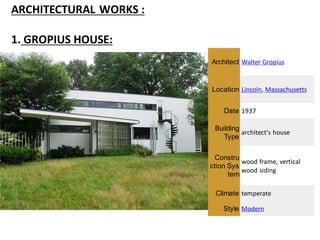
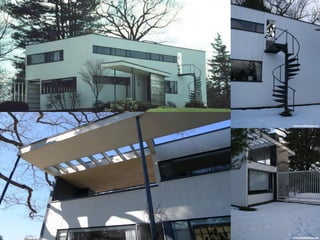
1. GROPIUS HOUSE:
Architect Walter Gropius
Location Lincoln, Massachusetts
Date 1937
Building
Type
architect's house
Constru
ction Sys
tem
wood frame, vertical
wood siding
Climate temperate
Style Modern
Introduction
• After the beginning of World War II in Europe and after walking an interesting
way in the Bauhaus, Walter Gropius decided to open its office in 1928 in
Germany, however the current government did not like their ideas or their
projects so that the work was decreased and the need to leave their country.
• In 1934 the German government requested his transfer to London to try to
accommodate, then the dean of the Harvard Graduate School of Design,
Joseph Hudnut, Gropius visited London and offered him a professorship at the
university.
• Finally decided to go to America, to the city of Lincoln, Massachusetts, where
he established.
• In 1937 would come to the city of Lincoln, which only lead him to his family
and some furniture made in the Bauhaus.
• They sat in a rented house due to his immigration status was given to establish
the economic facilities and thanks to this home designed and directly
influenced the architecture of New England and in collaboration with Marcel
Breuer.
• Walter Gropius died in 1969 and his wife decided to cede the property to the
Society for Historical Preservation of New England Antiquities in 1974, but
remained in the house until his death in 1983.
• Two years after his death, was opened as a Historic House Museum.
Concept
• Located on the hill of a mountain, still leading the nature
that surrounds it, the Gropius house was made according to
standards that were raised at the Bauhaus but consistent
with some features of the architecture of New England.
• As for space, simplicity and order prevailed under European
influences, while the geometry-free beauty and decoration
of the architecture of New England were made to see.
• W. Gropius also combines materials such as bricks, stone
slabs and wooden slats with new materials that were used
in the United States as gypsum, industrial handrails, new
laminated glass block and new technologies for facilities.
Design
• GropiusHouse has two levelswith stone structure in the basement, wood and brick.
• It can be said that the project is a box or volume settled in stone.
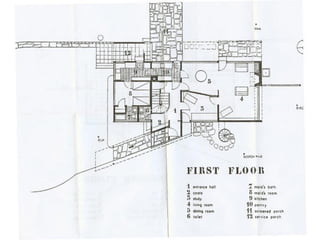
• Ground Floor
o On this floor access is diagonal,under a porch that welcomes visitors, here Gropius
used hollow glass block to give privacy to the lobby.
o On the back porch is locatedone space covering the porch with stone flooring.
o The bathroomsin both the plantand in the top group in the north corner where there
is no just views.
o The spaces such as dining and livingarea, are next to the center of the house which is
located a stone fireplace.
o From this level starts a spiral staircase which reaches the second level terrace. It has:
1. Detailliving room
2. Access arcade
3. Two bathrooms
4. Lounge
5. Study
6. Wardrobe
7. Kitchen
8. Room service
9. Spiral staircase
10. Porch
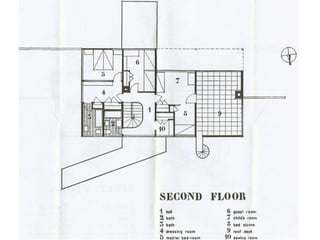
• First Floor
o This plantis accessed from the main staircase to the lobbywhich leads
to the bedrooms, study and terrace.
o The bathroomsare in the same corner north and just abovethe seating
area will find the terrace, which can be accessed from the garden.
o In the back of the house, a pergola performs the function of double
height covered terrace which allowsthe lightingin the dining room.
o It has:
1. Lobby
2. Three bedrooms
3. Terrace
4. Study
5. Two bathrooms
Structure and Materials
• The basement of the house was built in stone, so it uproots a highest
level of the ground level.
• Used for brick walls and wood, they are charging and are mostly lined
or covered with plaster and wood slats on the front.
• Some brick walls were left with apparent view was also considered to
elements such as stone fireplace.
• The materials used were wooden tablets on the walls, brick, steel to
the forges as stairs, pergolas, balustrades, columns and ornamental
porches lined with sheet metal building, the foundation stone and
flooring, as well as laminated glass for the woodwork and glass block to
shed light on some points.
• We can not forget the furniture of the Bauhaus Gropius design because
when you finish building the house, gavethem a suitable place inside
the house.
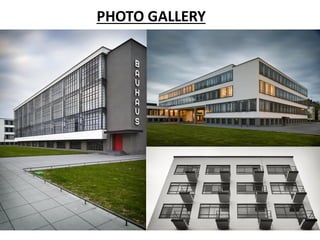
PHOTO GALLERY
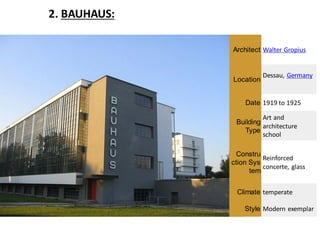
2. BAUHAUS:
Architect Walter Gropius
Location
Dessau, Germany
Date 1919 to 1925
Building
Type
Art and
architecture
school
Constru
ction Sys
tem
Reinforced
concerte, glass
Climate temperate
Style Modern exemplar
Introduction
• Bauhaus, etymologicallymeans, Home Construction,was founded in 1919 in Weimar
(Germany), by Walter Gropius, moved to Dessau in 1925 and disbandedin 1933 in Berlin.
• The spirit and the teachingsof this institutioncan be said to be spread throughout the
world.
• With the move from Weimar to Dessau, the Bauhaushad the opportunityto create a
buildingthat offered the best working conditionsto develop their own design, which was
carried out by Walter Gropiushimself and opened on December 4, 1926, quickly becoming
icon of early modern movement.
• With the buildingof the Bauhaus, Gropiusimplementedits ambitionof designing processes
of life, and to unite art, technique and aesthetics in search functionality.
• From the merger of the Academy of Fine Arts and the School of Arts and Crafts, trying to
overcome the divorce between art and industrialproductionon one side and the other
between art and craft.
• Develop the use of new materialsand technologywithout neglecting the legacy of
craftsmanship.
Concept
• After the First World War, the defeated Germany was seeking a solution to the
crisis of values in which he was immersed.
• Intellectuals believed that the political irrationalism had led to violence, should be
imposed now critical rationalism, able to resolve social contradictions.
• Gropius was deeply involved in these approaches, their great show of architectural
rationalism would be the unique Bauhaus building in which are grouped the
characteristics of the Modern Movement: rationally articulated pure volumes
(functionalism), innovative use of new materials such as curtain wall glass facades,
horizontal windows, no decoration, overall design of all elements and, above all, a
conception of space dominated by the interplay between inside and outside
through the glass wall.
• These principles were accepted and were consolidated rapidly internationally with
home workers who Mies van der Rohe, past director of the Bauhaus, raised near
Stuttgart in the Weissenhof Estate.
Description
Facades
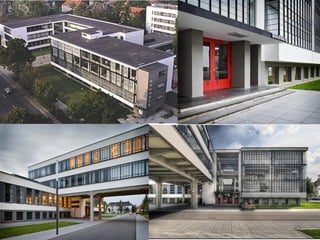
• The facades are mostlywitnesses that the Bauhaus is by far a building typical of
modernity. Although sought, never found a main facade, all were made with
"affection" for the details, all with the intention that it be recognized outside the
function.
• Each facade responds to the demands of the activity taking place inside: the front
of the classroom block is composed of horizontal windows, whose function is to
ensure adequate lighting, the apartments, however, shows individual openings
designed to increase privacy.
• The workshops have a significant glass front, allowing maximum lightand view of
the interior from outside.
• Gropius on this facade incorporates the theme of Faguswerk and the factory in
Cologne, setting a glass enclosure that passes the edge of the slab, leaving the
recessed pillars and providing an overhang that lets you remove the buttress of the
corner, thus creating that famous image of transparency angle which is one of the
more typical formal aspects of the Bauhaus.
• The front facade is where the first level is set back to produce the levitation of a
higher volume consists of a curtain wall tension obtaining access to the product of
the contrast of the opaque background volumes.
Ceilings
• They were very large flat roofs, back then there was almostno experience
with similar constructions.
• This means that the building of the roofs had several problems.
• The largest of these was his inclination to only one degree of slope, the
following was the drain on the inside, and ultimately missing the drain
with gravel, so the sun radiated directly onto the layers of tar, and as there
were no meetings layers were deformed expansion.
• That is, the roofs of the Bauhaus were never tight.
Spaces
• The main entrance of the Bauhaus is dividedby three separatedoors with red
columns that give access to the stairs and lobby.
Ladder
• The latter is designed in three sections, the wider environmentis what leads to
the upper floors, down the sides closer. In front of the stairs we found a large
window that runs from floor to ceiling and as wide as the stairs
Lobby
• Going half the lobby level is reached, a very interesting place for its components.
Something very typicalfor the buildingof the Bauhaus, is that almost always when
walking in the corridors or staircases have several options for where to go, the result
of the different sections of the buildingget some correspondence.
• Climbing the stairs from the lobby not only can go to the workshops and the
administration,but since both sides of the stairs are locatedaroundlarge
windows in every step you can see a new perspective of the interior, but
especiallyabroad.
Functional spaces
• The buildingwas distributedin three main wings connected by a bridge element,
the form of blade breaks the concept of symmetry and functionalefficiency puts
the aesthetic coherence.
• It is characterized by plants and orthogonalsections, usuallyasymmetric and
lack of decorationon the facades. The interior is light and airy.
Vocational education
• Three levelsin the northern part that housed classrooms and small laboratories
Laboratories, workshops,dining room and lecture hall
• Three levelsat one end are devotedto testing laboratoriesand workshops. At the opposite
end providedfor the student cafeteria, kitchen and lecture hall.
• Aula Magna
o The lecture hallis like the heart of the Bauhausbecause here you can see in a compact
form that was developedin those years and that is where the festivities were.
o This compartment of the buildingis calledthe holidaysection and is composed of the hall,
the stage and the dininghall.
o The dining room and the stage was separated by three folding doors, so that whole section
is actuallya great space.
• Kitchen and dining
o A window separatesthe kitchen from the dining room, still a noveltyfor the time to see
what you are doing the cook.
Accommodation
• Paving cantileveredin front bedroom
• Six levels with 28 rooms of 20 square meters each.
• All have a small balcony,a slab of concrete that juts out into the open space.
• Each floor also had bathroomsand a kitchenette.
• The students had semisubsuelo showers, a laundry room with vending machines and a
gym.
• But what is special about the homes was that students had many opportunitiesto
enjoy the good weather, as well as the balconies,the roof is a large terrace, surrounded
by banks and partly semi-covered.
• This buildingis also more massive volume, interruptedonly in the east and west
facades, respectively, for cantileveredbalconiesand windows.
Bridge Element
• Besides connecting the various wings, was assigned to offices, the privateworkshop of
Gropius and a club or playarea.
• The bridge embodies the idea of an architecture liberatedfrom the soil, which does not
hinder urban traffic.
Structure
• An iron and concrete structure forms the skeleton of the buildingensuring the unity of
the whole and allows the existence of three different facades, builtwith fragile materials
like glass and innovative.
• The construction is not static as it may seem entirely concrete but it is only the skeleton,
the areas in between are mostly paved with brick floors also.
Materials
• The modern movement took advantageof the possibilities of new industrial
materials like reinforced concrete, rolled steel and plate glass in large sizes.
• Apart from these new materials, here the walls have the typical smooth white
plaster, but also have a base with rough plaster and gray.
• This base has an optical effect, because it gives the impression that the building is
still lighter.
• Apart from the plaster and color are the windows to one of the basic elements of
the structure of the facades.
• The windows of the Bauhaus are all steel, not glass drain and simple.
• Never had the color black but dark gray, and gray has the advantagethat the
distance does not recognize frames, so that seems to be a large area.
• Thus we see that the Bauhaus worked a lot with effects, whether light or optical
illusions, but also did so with psychology, as depending on these effects are also
influenced by the mood of the people who worked and studied in it.
• The corridors and stairs were Magnesians floors, linoleum offices in different colors,
the walls were made with a lime plaster.
• The concrete used in construction was very porous gravel for having too much
while the lining of the shell of the building was too low, which is why this
frame has rusted iron.
• The plaster used in the columns of the bridge that has been seen as concrete
presents a relief as having been worked to hammer, something that was not
usual in works of modernism.
• A detail that shows that not only was a functional building for the location of
the spaces, but also in the sense of practical use, is that right from the start
was scheduled a cleaning of the many windows of the building, consisting of
hooks affirmed on the ceiling from which hang strings could chairs.
• The central heating with radiators scattered around the building is a symbol
that indicates the intention that the Bauhaus had wanted to work with
industry and demonstrate the use of new technological systems.
• In some areas these radiators occupy the space would be devoted to the
exhibition of a painting in the Baroque period, demonstrating the importance
for the Bauhaus movement was the use of industrial elements.
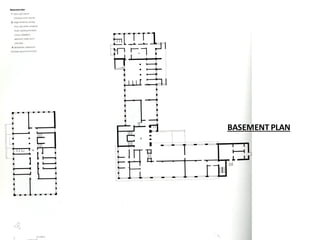
BASEMENT PLAN
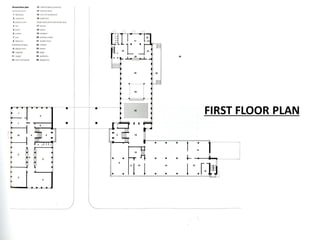
FIRST FLOOR PLAN
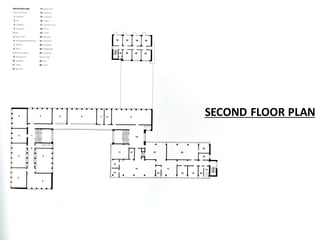
SECOND FLOOR PLAN
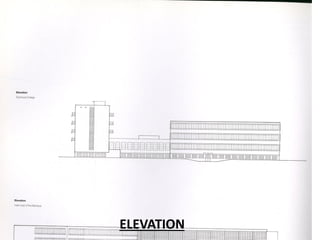
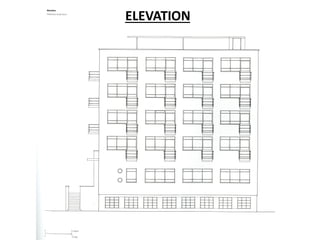
ELEVATION
ELEVATION
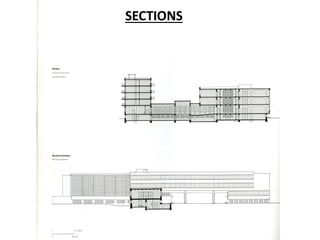
SECTIONS
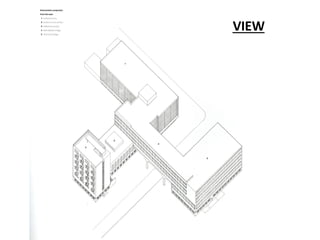
VIEW
PHOTO GALLERY
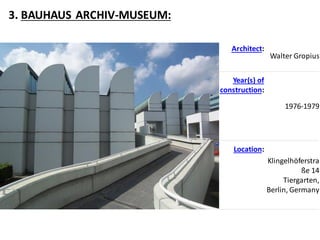
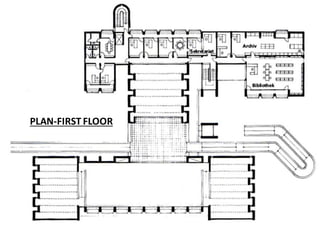
3. BAUHAUS ARCHIV-MUSEUM:
Architect:
Walter Gropius
Year(s) of
construction:
1976-1979
Location:
Klingelhöferstra
ße 14
Tiergarten,
Berlin, Germany
Introduction
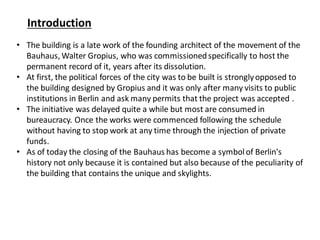
• The building is a late work of the founding architect of the movement of the
Bauhaus, Walter Gropius, who was commissionedspecifically to host the
permanent record of it, years after its dissolution.
• At first, the political forces of the city was to be built is stronglyopposed to
the building designed by Gropius and it was only after many visits to public
institutions in Berlin and ask many permits that the project was accepted .
• The initiative was delayed quite a while but most are consumed in
bureaucracy. Once the works were commenced following the schedule
without having to stop work at any time through the injection of private
funds.
• As of today the closing of the Bauhaus has become a symbolof Berlin's
history not only because it is contained but also because of the peculiarity of
the building that contains the unique and skylights.
Concept
• Walter Gropius dreamed draft a permanent archive Bauhaus for manyyears before
being commissionedthis project.
• Gropius could only imagine the file as an independent entity unrelated to any
other museum because of the innovative nature of the school he founded.
• He believed the project would "capado" by the lack of people outside the school if
the file is formalized as a department of another institution more conservative.
• Years before the file was even a dream Gropius building design ideal to host such
an institution.
• This project served as a basis for building the final but suffered significant changes
due to differences arising from the land transfer locality.
Projects
1964
• The originalproject was created by Gropius to the northern slope of the Rosenhöhe in
Darmstads and had the support of Hans Wingles, founding director of the Bauhaus Archive.
• The site chosen was in full growth and developmentand city officials felt that it was too
prominent a positionto builda new school and not yet defined a profile, showing their
disapproval.
• The design of the complex had a small trainingH, adaptingto the slope of the terrain and
the exhibitionspace would be illuminated throughdome on the roof.
1971
• After attractinginterest from SenatorShcwedler Rolf, in 1971 the file was moved to Berlin
with a promise to respect the Senate's draft Gropius.
• The architect was able to choose among three availableland,and opted for that was close
to that in contrast to LandwehrkanalDramstadtwas completelyflat.
• Necessary modificationsto the original project to adaptto its new location,were developed
by Alex Cvijanovic,as the ramp through the complex, in collaborationwith the Berlin
architect Hans Bandel, and the adaptationprocess presented many difficulties and took a
long time, untilin 1976 the cornerstone was laid for a buildingvery close to 1964, both
plans in silhouette.
• Due to the simple structure, the construction progressed quicklyand was opened in 1979.
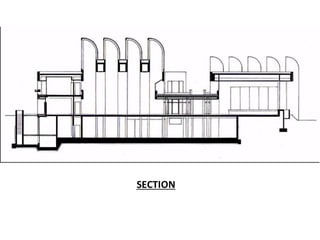
Description
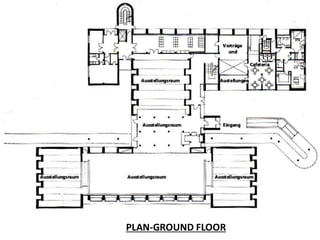
• The complex consists of two two-story structures that are each nearly equaland parallelto
each other, united by a middle section and communicatewith each other by corridors and
sometimes disappearunder the structure of the buildingand see the landscapecan emerge.
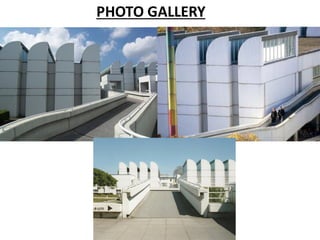
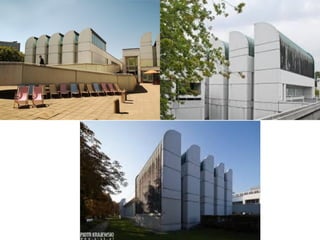
• The characteristicfeatures of both structures are the rows of 4x4 meters high ceiling of the
bells, closely aligned to the north face, for better lighting.
• The front mounted on a reinforced concrete frame is dividedinto individualsections
highlightedby dark jointsbetween concrete panels paintedwhite.
Spaces
• In the north lie the administrativesections and work areas in the southern section of the
exhibitionhalls.
• Exhibition Halls
o It has 800 square meters to 400 for permanent exhibitionsand temporary. The new
exhibitionspaces are almost underground.The complex also has a shop, a cafe and space
for support.
o The roof of the cafe has a shell and is one of the few spaces at ground level, opening into
the plaza in front of the existing museum.
Materials
• The idealof the form, followed by the role in this project, which emphasized the
direct and honest use of materials as a functionaldesign.
• The result was rectilineararchitecturalforms, of which structural componentssuch
as steel, glass and concrete were used, directly and honestly, without trying to
imitateany other way.
• The colorful metal columns placed at both ends of the ramp are the work of Max
Bill.
PLAN-GROUND FLOOR
PLAN-FIRST FLOOR
SECTION
PHOTO GALLERY
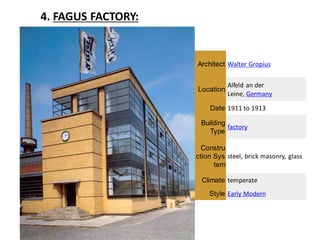
4. FAGUS FACTORY:
Architect Walter Gropius
Location
Alfeld an der
Leine, Germany
Date 1911 to 1913
Building
Type
factory
Constru
ction Sys
tem
steel, brick masonry, glass
Climate temperate
Style Early Modern
INTRODUCTION
• This shoe lasts factory was the first industrial commissionfor Walter
Gropius and its design was made in collaboration with whom at that time was
his partner Adolf Meyer.
• At first he thought his promoter Carl Benscheidt work with another architect,
Eduard Werner, but Gropius convinced him to pursue a more artistic project.
• To persuade his client was invited to a conference on monumental art and
industrial construction and in his speech posited that "modern life needed new
building organisms that match the lifestyles of our time."
• Once he was awarded the Walter Gropius Fagus Factory made in different
phases between 1911 and 1925, although the most commonpicture for the
office sector which was built before the First World War, between 1911 1914.
• As they were constructing each of the buildings of the complex, Gropius and
Meyer took into account not only the function of each one of them but the
overall visual unity.
• With the steady growth of the plant, which had become one of the largest in
Germany, it would be completed only in 1925.
• Benscheidt, father and son, chose the artists of the Bauhaus school of Gropius,
for interior design.
CONCEPT
• For the architect as the building had to fit the function for which it was planned
and consistent with a constructive logic based on that function, your image
should not hide but show it as a beautiful and modern architecture should adapt
to the new world machines.
• According to Gropius, without masking the exact shape, with clear contrasts,
sequencing of identical forms and the unity of form and color to form the basis of
the rhythm of architectural creation.
• In this building are embodied these ideas, a prismatic block, three plants with
rectangular and flat base which reinforced concrete structure with brackets
displaced inward frees the exterior walls of any load bearing plant whose clearly
expressed their interest modern commercial and functional.
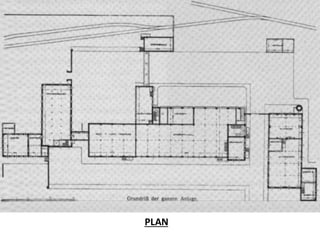
Description And Areas:
• The first buildingdesigned by Gropiusto the shoe factory was the office and is one of the
most important and characteristic of the complex.
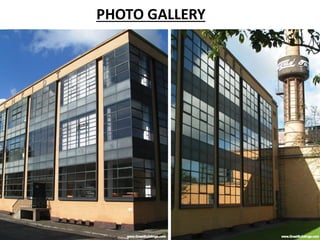
• The buildinghas three floors with a flat roof which together with the replacement of the
wallswith large windows, which in turn also made up the corners of the buildingbecame one
of the buildingsystems characteristic of the modern movement, especiallyin high-rise as the
paradigmaticBunshaft Lever House or the Seagram Building in Mies van der Rohe and Philip
Johnson or Bauhausbuildingin Dessau also made by Gropius.
• The facade is articulatedwith narrow brick pillars,slightly recessed, which were placed
between the iron frames sticking out of the buildingand housed the large windows creating
a light curtain wall of a hitherto unseen, creating an inner space naturallight and partly
dilutingindoor-outdoorboundaries.
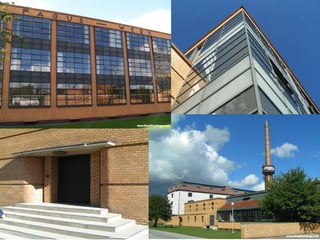
• It is particularlystriking resolutionof the corners of the block as they converge on two
windowsperpendicularto the uniquepresence in them of the light metal support bar.
• According to Gropius, the factory should be a kind of palace for the workers who were
offered light, air and hygienic atmosphere but also "feel the dignity of the great common
idea, which of course would improve their performance".
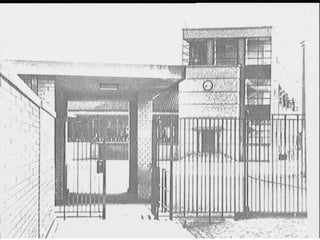
• The front door is solved with two beautifulconvexcorners that create a more fluid
relationshipbetween the facade and the small porch that is set up at the door.
• In 1913 he rebuilt the house and after the First World War were other works that lasted until
1925. The clock input is part of the reform of 1913 and the interior of the buildingthat
containedmainlyoffices, were completed by mid 20.
Production hall
• The two other large buildingsin the complexare the productionhalland warehouse.
Both were built in 1911 and expanded in 1913.
• The productionhall is a one-story buildingthat became the present facade after
enlargement.
Storage
• The store is a four-story buildingwith few openings.
• The design closely followed the originalplan of Werner and leaves out many of the
photographs.Besides them, the site containsseveral small buildingsdesigned by
Gropiusand Meyer later.
• Despite its novelty and modernity detailsthe buildingis severely deterioratedover
time, their iron frames are quickly oxidized and insulatingthe buildingwas really
poor.
Structure:
• The reinforced concrete structure, with supporting displacedinwards, allowedto
free the exterior walls, especially at the corners of the buildingsupporting role.
• The main building,rectangularin shape, was designed as a structural framework
without pillars in the corners, with a front metal grid cut by glass covers, one of the
first examples of "curtain wall",or curtain wall.
• This structure does not seem constructive formal need to clarify a coating
composition,on the contrary, the form and language of architecture are given by
the art.
Building System
• For many years it was thought that the main buildingwas done only with a frame of
concrete or steel because of its glass facade.
• However, during its renovationin the 80's, it became clear that this was not the
case.
• Jürgen Götz, the engineer responsiblefor the renovationsince 1982, describes the
construction system in this way:
"The main buildingwas built over a basement structurallystable. A mixture of cement
uncompressed gravel was used for the walls of the basement and these are unableto
accommodatelarge single loads. From the basement up, the buildingwas constructed
in plainbrickwork, reinforced with wooden floors. The roofs were reinforced formwork
and finishes with a rough plaster on the side of the facility.
The floors were composed of loose boards on sleepers, ie, that the ties were not
establishedbetween the floor joists. Therefore, the ceilings in the main buildingwas
not continuousshear and thus could not meet the necessary boost function. "
Materials
• Gropius's Fagus factory is where for the first time the walls of a factory was replaced with
glass.
• This novel,for the time, "curtain wall"has a height that spans all three floorsof the
building.
• A metal structure of iron bars holdingthe glass planes that make up those windowsand
metal planes contribute to highlightthe distributionof plants.
• The narrow columns that articulate the facade and the reception and lower sockets were
made of brick colored stew.
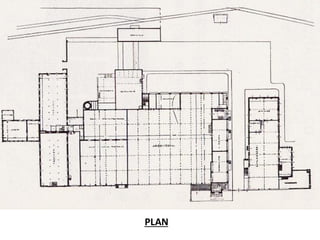
PLAN
PLAN
PHOTO GALLERY
Walter gropius
Walter gropius

Walter gropius

  • 1.
    WALTER GROPIUS Born WalterAdolph Georg Gropius 18 May 1883 Berlin, German Empire Died 5 July 1969 (aged 86) Cambridge, Massachusetts, Uni ted States Nationality German
  • 2.
    INTRODUCTION : • WalterAdolph Georg Gropius (18 May 1883 – 5 July 1969) was a German architect and founder of the Bauhaus School,who,along with Ludwig Mies van der Rohe, Le Corbusier and Frank Lloyd Wright, is widely regarded as one of the pioneeringmasters of modern architecture. • Walter Gropius was drafted August 1914 and served as a sergeant and then as a lieutenantin the signal corps in the First World War. • He survived being both buried under rubble and dead bodies, and shot out of the sky with a dead pilot. • He was awardedthe Iron Crosstwice. Gropius then, like his father and his great- uncle Martin Gropius before him, became an architect. • Gropius could not draw, and was dependenton collaboratorsand partner- interpreters throughout his career. In school he hired an assistantto complete his homework for him. • In 1908, after studying architecture in Munich and Berlin for four semesters, Gropiusjoined the office of the renowned architect and industrialdesigner Peter Behrens, one of the first members of the utilitarianschool. • His fellow employees at this time included Ludwig Mies van der Rohe, Le Corbusier, and Dietrich Marcks. • In 1910 Gropius left the firm of Behrens and together with fellow employee Adolf Meyer establisheda practice in Berlin
  • 3.
    BAUHAUS PERIOD: • Gropius'scareer advanced in the postwar period. • Henry van de Velde, the master of the Grand-DucalSaxon School of Arts and Crafts in Weimar was asked to step down in 1915 due to hisBelgiannationality. • His recommendationfor Gropius to succeed him led eventuallyto Gropius's appointmentas master of the school in 1919. • It was this academy which Gropius transformed into the world famous Bauhaus, attractinga faculty that included Paul Klee, Johannes Itten, Josef Albers, Herbert Bayer, László Moholy- Nagy, Otto Bartning and Wassily Kandinsky. • In principle, the Bauhaus represented an opportunityto extend beauty and qualityto every home through well designed industriallyproduced objects. • The Bauhaus program was experimentaland the emphasis, was theoretical. • One example product of the Bauhaus was the armchair F 51, designed for the Bauhaus's directors room in 1920 – nowadaysa re-editionin the market, manufacturedby the German company TECTA/Lauenfoerde. • In 1919, Gropius was involvedin the Glass Chain utopianexpressionist correspondence under the pseudonym "Mass.“ • In 1923, Gropius designed his famous door handles, now considered an icon of 20th-century design and often listed as one of the most influentialdesigns to emerge from Bauhaus. • Walter Gropius designed the newly constructed school buildingin 1925 on behalf of the city of Dessau. • He also designed large-scale housing projects in Berlin, Karlsruhe and Dessau in 1926–32 that were major contributionsto the New Objectivitymovement, includinga contributionto the Siemensstadt project in Berlin.
  • 4.
    CHARACTERISTICS FEATURES : •Walter Gropius was a German architect who created innovativedesigns that involved materialsand methods of constructionfrom modern technology availableat his time. • Gropius theory was that all design should be functional as well as aesthetically pleasing. • Using technologyas a basis, he transformed buildinginto a science of precise mathematical calculations. • He believedin industrializedand efficient buildingsso that his buildingsoften provided the evidence of standardization,mass productionand prefabrication. • Gropius also introduced a screen wall system that utilized a structural steel frame to support the floors and which allowedthe external glass wallsto cover a surface uninterrupted. • Gropiuswas the founder of the innovativeBauhausdesign school in Germany, which the school then became a dominantforce in architecture and the appliedarts in the 20th century. • The design outcomes of the school greatly influenced architecture, design art and new media. • All the Bauhausdesigns are recognized as innovativeandcontemporary, which make them classic and last until today. • The designs appliedthe logic where form follows function and less is more. This philosophy resulted in clean, simple and modern design. The design produced in Bauhausstyle was frequently used steel, glass, leathers, bent wood and plastic. The colorsused are generally black, white, brown, grey and chromium. Sometimes the primary colorsof the furniture are used irregularly to emphasize and to give entirelythe less dark appearance.
  • 5.
  • 6.
    ARCHITECTURAL WORKS : 1.GROPIUS HOUSE: Architect Walter Gropius Location Lincoln, Massachusetts Date 1937 Building Type architect's house Constru ction Sys tem wood frame, vertical wood siding Climate temperate Style Modern
  • 7.
    Introduction • After thebeginning of World War II in Europe and after walking an interesting way in the Bauhaus, Walter Gropius decided to open its office in 1928 in Germany, however the current government did not like their ideas or their projects so that the work was decreased and the need to leave their country. • In 1934 the German government requested his transfer to London to try to accommodate, then the dean of the Harvard Graduate School of Design, Joseph Hudnut, Gropius visited London and offered him a professorship at the university. • Finally decided to go to America, to the city of Lincoln, Massachusetts, where he established. • In 1937 would come to the city of Lincoln, which only lead him to his family and some furniture made in the Bauhaus. • They sat in a rented house due to his immigration status was given to establish the economic facilities and thanks to this home designed and directly influenced the architecture of New England and in collaboration with Marcel Breuer. • Walter Gropius died in 1969 and his wife decided to cede the property to the Society for Historical Preservation of New England Antiquities in 1974, but remained in the house until his death in 1983. • Two years after his death, was opened as a Historic House Museum.
  • 8.
    Concept • Located onthe hill of a mountain, still leading the nature that surrounds it, the Gropius house was made according to standards that were raised at the Bauhaus but consistent with some features of the architecture of New England. • As for space, simplicity and order prevailed under European influences, while the geometry-free beauty and decoration of the architecture of New England were made to see. • W. Gropius also combines materials such as bricks, stone slabs and wooden slats with new materials that were used in the United States as gypsum, industrial handrails, new laminated glass block and new technologies for facilities.
  • 9.
    Design • GropiusHouse hastwo levelswith stone structure in the basement, wood and brick. • It can be said that the project is a box or volume settled in stone. • Ground Floor o On this floor access is diagonal,under a porch that welcomes visitors, here Gropius used hollow glass block to give privacy to the lobby. o On the back porch is locatedone space covering the porch with stone flooring. o The bathroomsin both the plantand in the top group in the north corner where there is no just views. o The spaces such as dining and livingarea, are next to the center of the house which is located a stone fireplace. o From this level starts a spiral staircase which reaches the second level terrace. It has: 1. Detailliving room 2. Access arcade 3. Two bathrooms 4. Lounge 5. Study 6. Wardrobe 7. Kitchen 8. Room service 9. Spiral staircase 10. Porch
  • 10.
    • First Floor oThis plantis accessed from the main staircase to the lobbywhich leads to the bedrooms, study and terrace. o The bathroomsare in the same corner north and just abovethe seating area will find the terrace, which can be accessed from the garden. o In the back of the house, a pergola performs the function of double height covered terrace which allowsthe lightingin the dining room. o It has: 1. Lobby 2. Three bedrooms 3. Terrace 4. Study 5. Two bathrooms
  • 11.
    Structure and Materials •The basement of the house was built in stone, so it uproots a highest level of the ground level. • Used for brick walls and wood, they are charging and are mostly lined or covered with plaster and wood slats on the front. • Some brick walls were left with apparent view was also considered to elements such as stone fireplace. • The materials used were wooden tablets on the walls, brick, steel to the forges as stairs, pergolas, balustrades, columns and ornamental porches lined with sheet metal building, the foundation stone and flooring, as well as laminated glass for the woodwork and glass block to shed light on some points. • We can not forget the furniture of the Bauhaus Gropius design because when you finish building the house, gavethem a suitable place inside the house.
  • 15.
  • 17.
    2. BAUHAUS: Architect WalterGropius Location Dessau, Germany Date 1919 to 1925 Building Type Art and architecture school Constru ction Sys tem Reinforced concerte, glass Climate temperate Style Modern exemplar
  • 18.
    Introduction • Bauhaus, etymologicallymeans,Home Construction,was founded in 1919 in Weimar (Germany), by Walter Gropius, moved to Dessau in 1925 and disbandedin 1933 in Berlin. • The spirit and the teachingsof this institutioncan be said to be spread throughout the world. • With the move from Weimar to Dessau, the Bauhaushad the opportunityto create a buildingthat offered the best working conditionsto develop their own design, which was carried out by Walter Gropiushimself and opened on December 4, 1926, quickly becoming icon of early modern movement. • With the buildingof the Bauhaus, Gropiusimplementedits ambitionof designing processes of life, and to unite art, technique and aesthetics in search functionality. • From the merger of the Academy of Fine Arts and the School of Arts and Crafts, trying to overcome the divorce between art and industrialproductionon one side and the other between art and craft. • Develop the use of new materialsand technologywithout neglecting the legacy of craftsmanship.
  • 19.
    Concept • After theFirst World War, the defeated Germany was seeking a solution to the crisis of values in which he was immersed. • Intellectuals believed that the political irrationalism had led to violence, should be imposed now critical rationalism, able to resolve social contradictions. • Gropius was deeply involved in these approaches, their great show of architectural rationalism would be the unique Bauhaus building in which are grouped the characteristics of the Modern Movement: rationally articulated pure volumes (functionalism), innovative use of new materials such as curtain wall glass facades, horizontal windows, no decoration, overall design of all elements and, above all, a conception of space dominated by the interplay between inside and outside through the glass wall. • These principles were accepted and were consolidated rapidly internationally with home workers who Mies van der Rohe, past director of the Bauhaus, raised near Stuttgart in the Weissenhof Estate.
  • 20.
    Description Facades • The facadesare mostlywitnesses that the Bauhaus is by far a building typical of modernity. Although sought, never found a main facade, all were made with "affection" for the details, all with the intention that it be recognized outside the function. • Each facade responds to the demands of the activity taking place inside: the front of the classroom block is composed of horizontal windows, whose function is to ensure adequate lighting, the apartments, however, shows individual openings designed to increase privacy. • The workshops have a significant glass front, allowing maximum lightand view of the interior from outside. • Gropius on this facade incorporates the theme of Faguswerk and the factory in Cologne, setting a glass enclosure that passes the edge of the slab, leaving the recessed pillars and providing an overhang that lets you remove the buttress of the corner, thus creating that famous image of transparency angle which is one of the more typical formal aspects of the Bauhaus. • The front facade is where the first level is set back to produce the levitation of a higher volume consists of a curtain wall tension obtaining access to the product of the contrast of the opaque background volumes.
  • 21.
    Ceilings • They werevery large flat roofs, back then there was almostno experience with similar constructions. • This means that the building of the roofs had several problems. • The largest of these was his inclination to only one degree of slope, the following was the drain on the inside, and ultimately missing the drain with gravel, so the sun radiated directly onto the layers of tar, and as there were no meetings layers were deformed expansion. • That is, the roofs of the Bauhaus were never tight.
  • 22.
    Spaces • The mainentrance of the Bauhaus is dividedby three separatedoors with red columns that give access to the stairs and lobby. Ladder • The latter is designed in three sections, the wider environmentis what leads to the upper floors, down the sides closer. In front of the stairs we found a large window that runs from floor to ceiling and as wide as the stairs Lobby • Going half the lobby level is reached, a very interesting place for its components. Something very typicalfor the buildingof the Bauhaus, is that almost always when walking in the corridors or staircases have several options for where to go, the result of the different sections of the buildingget some correspondence. • Climbing the stairs from the lobby not only can go to the workshops and the administration,but since both sides of the stairs are locatedaroundlarge windows in every step you can see a new perspective of the interior, but especiallyabroad. Functional spaces • The buildingwas distributedin three main wings connected by a bridge element, the form of blade breaks the concept of symmetry and functionalefficiency puts the aesthetic coherence. • It is characterized by plants and orthogonalsections, usuallyasymmetric and lack of decorationon the facades. The interior is light and airy.
  • 23.
    Vocational education • Threelevelsin the northern part that housed classrooms and small laboratories Laboratories, workshops,dining room and lecture hall • Three levelsat one end are devotedto testing laboratoriesand workshops. At the opposite end providedfor the student cafeteria, kitchen and lecture hall. • Aula Magna o The lecture hallis like the heart of the Bauhausbecause here you can see in a compact form that was developedin those years and that is where the festivities were. o This compartment of the buildingis calledthe holidaysection and is composed of the hall, the stage and the dininghall. o The dining room and the stage was separated by three folding doors, so that whole section is actuallya great space. • Kitchen and dining o A window separatesthe kitchen from the dining room, still a noveltyfor the time to see what you are doing the cook. Accommodation • Paving cantileveredin front bedroom • Six levels with 28 rooms of 20 square meters each. • All have a small balcony,a slab of concrete that juts out into the open space. • Each floor also had bathroomsand a kitchenette. • The students had semisubsuelo showers, a laundry room with vending machines and a gym.
  • 24.
    • But whatis special about the homes was that students had many opportunitiesto enjoy the good weather, as well as the balconies,the roof is a large terrace, surrounded by banks and partly semi-covered. • This buildingis also more massive volume, interruptedonly in the east and west facades, respectively, for cantileveredbalconiesand windows. Bridge Element • Besides connecting the various wings, was assigned to offices, the privateworkshop of Gropius and a club or playarea. • The bridge embodies the idea of an architecture liberatedfrom the soil, which does not hinder urban traffic. Structure • An iron and concrete structure forms the skeleton of the buildingensuring the unity of the whole and allows the existence of three different facades, builtwith fragile materials like glass and innovative. • The construction is not static as it may seem entirely concrete but it is only the skeleton, the areas in between are mostly paved with brick floors also.
  • 25.
    Materials • The modernmovement took advantageof the possibilities of new industrial materials like reinforced concrete, rolled steel and plate glass in large sizes. • Apart from these new materials, here the walls have the typical smooth white plaster, but also have a base with rough plaster and gray. • This base has an optical effect, because it gives the impression that the building is still lighter. • Apart from the plaster and color are the windows to one of the basic elements of the structure of the facades. • The windows of the Bauhaus are all steel, not glass drain and simple. • Never had the color black but dark gray, and gray has the advantagethat the distance does not recognize frames, so that seems to be a large area. • Thus we see that the Bauhaus worked a lot with effects, whether light or optical illusions, but also did so with psychology, as depending on these effects are also influenced by the mood of the people who worked and studied in it. • The corridors and stairs were Magnesians floors, linoleum offices in different colors, the walls were made with a lime plaster.
  • 26.
    • The concreteused in construction was very porous gravel for having too much while the lining of the shell of the building was too low, which is why this frame has rusted iron. • The plaster used in the columns of the bridge that has been seen as concrete presents a relief as having been worked to hammer, something that was not usual in works of modernism. • A detail that shows that not only was a functional building for the location of the spaces, but also in the sense of practical use, is that right from the start was scheduled a cleaning of the many windows of the building, consisting of hooks affirmed on the ceiling from which hang strings could chairs. • The central heating with radiators scattered around the building is a symbol that indicates the intention that the Bauhaus had wanted to work with industry and demonstrate the use of new technological systems. • In some areas these radiators occupy the space would be devoted to the exhibition of a painting in the Baroque period, demonstrating the importance for the Bauhaus movement was the use of industrial elements.
  • 27.
  • 28.
  • 29.
  • 30.
  • 31.
  • 32.
  • 33.
  • 34.
  • 36.
    3. BAUHAUS ARCHIV-MUSEUM: Architect: WalterGropius Year(s) of construction: 1976-1979 Location: Klingelhöferstra ße 14 Tiergarten, Berlin, Germany
  • 37.
    Introduction • The buildingis a late work of the founding architect of the movement of the Bauhaus, Walter Gropius, who was commissionedspecifically to host the permanent record of it, years after its dissolution. • At first, the political forces of the city was to be built is stronglyopposed to the building designed by Gropius and it was only after many visits to public institutions in Berlin and ask many permits that the project was accepted . • The initiative was delayed quite a while but most are consumed in bureaucracy. Once the works were commenced following the schedule without having to stop work at any time through the injection of private funds. • As of today the closing of the Bauhaus has become a symbolof Berlin's history not only because it is contained but also because of the peculiarity of the building that contains the unique and skylights.
  • 38.
    Concept • Walter Gropiusdreamed draft a permanent archive Bauhaus for manyyears before being commissionedthis project. • Gropius could only imagine the file as an independent entity unrelated to any other museum because of the innovative nature of the school he founded. • He believed the project would "capado" by the lack of people outside the school if the file is formalized as a department of another institution more conservative. • Years before the file was even a dream Gropius building design ideal to host such an institution. • This project served as a basis for building the final but suffered significant changes due to differences arising from the land transfer locality.
  • 39.
    Projects 1964 • The originalprojectwas created by Gropius to the northern slope of the Rosenhöhe in Darmstads and had the support of Hans Wingles, founding director of the Bauhaus Archive. • The site chosen was in full growth and developmentand city officials felt that it was too prominent a positionto builda new school and not yet defined a profile, showing their disapproval. • The design of the complex had a small trainingH, adaptingto the slope of the terrain and the exhibitionspace would be illuminated throughdome on the roof. 1971 • After attractinginterest from SenatorShcwedler Rolf, in 1971 the file was moved to Berlin with a promise to respect the Senate's draft Gropius. • The architect was able to choose among three availableland,and opted for that was close to that in contrast to LandwehrkanalDramstadtwas completelyflat. • Necessary modificationsto the original project to adaptto its new location,were developed by Alex Cvijanovic,as the ramp through the complex, in collaborationwith the Berlin architect Hans Bandel, and the adaptationprocess presented many difficulties and took a long time, untilin 1976 the cornerstone was laid for a buildingvery close to 1964, both plans in silhouette. • Due to the simple structure, the construction progressed quicklyand was opened in 1979.
  • 40.
    Description • The complexconsists of two two-story structures that are each nearly equaland parallelto each other, united by a middle section and communicatewith each other by corridors and sometimes disappearunder the structure of the buildingand see the landscapecan emerge. • The characteristicfeatures of both structures are the rows of 4x4 meters high ceiling of the bells, closely aligned to the north face, for better lighting. • The front mounted on a reinforced concrete frame is dividedinto individualsections highlightedby dark jointsbetween concrete panels paintedwhite. Spaces • In the north lie the administrativesections and work areas in the southern section of the exhibitionhalls. • Exhibition Halls o It has 800 square meters to 400 for permanent exhibitionsand temporary. The new exhibitionspaces are almost underground.The complex also has a shop, a cafe and space for support. o The roof of the cafe has a shell and is one of the few spaces at ground level, opening into the plaza in front of the existing museum.
  • 41.
    Materials • The idealofthe form, followed by the role in this project, which emphasized the direct and honest use of materials as a functionaldesign. • The result was rectilineararchitecturalforms, of which structural componentssuch as steel, glass and concrete were used, directly and honestly, without trying to imitateany other way. • The colorful metal columns placed at both ends of the ramp are the work of Max Bill.
  • 42.
  • 43.
  • 44.
  • 45.
  • 47.
    4. FAGUS FACTORY: ArchitectWalter Gropius Location Alfeld an der Leine, Germany Date 1911 to 1913 Building Type factory Constru ction Sys tem steel, brick masonry, glass Climate temperate Style Early Modern
  • 48.
    INTRODUCTION • This shoelasts factory was the first industrial commissionfor Walter Gropius and its design was made in collaboration with whom at that time was his partner Adolf Meyer. • At first he thought his promoter Carl Benscheidt work with another architect, Eduard Werner, but Gropius convinced him to pursue a more artistic project. • To persuade his client was invited to a conference on monumental art and industrial construction and in his speech posited that "modern life needed new building organisms that match the lifestyles of our time." • Once he was awarded the Walter Gropius Fagus Factory made in different phases between 1911 and 1925, although the most commonpicture for the office sector which was built before the First World War, between 1911 1914. • As they were constructing each of the buildings of the complex, Gropius and Meyer took into account not only the function of each one of them but the overall visual unity. • With the steady growth of the plant, which had become one of the largest in Germany, it would be completed only in 1925. • Benscheidt, father and son, chose the artists of the Bauhaus school of Gropius, for interior design.
  • 49.
    CONCEPT • For thearchitect as the building had to fit the function for which it was planned and consistent with a constructive logic based on that function, your image should not hide but show it as a beautiful and modern architecture should adapt to the new world machines. • According to Gropius, without masking the exact shape, with clear contrasts, sequencing of identical forms and the unity of form and color to form the basis of the rhythm of architectural creation. • In this building are embodied these ideas, a prismatic block, three plants with rectangular and flat base which reinforced concrete structure with brackets displaced inward frees the exterior walls of any load bearing plant whose clearly expressed their interest modern commercial and functional.
  • 50.
    Description And Areas: •The first buildingdesigned by Gropiusto the shoe factory was the office and is one of the most important and characteristic of the complex. • The buildinghas three floors with a flat roof which together with the replacement of the wallswith large windows, which in turn also made up the corners of the buildingbecame one of the buildingsystems characteristic of the modern movement, especiallyin high-rise as the paradigmaticBunshaft Lever House or the Seagram Building in Mies van der Rohe and Philip Johnson or Bauhausbuildingin Dessau also made by Gropius. • The facade is articulatedwith narrow brick pillars,slightly recessed, which were placed between the iron frames sticking out of the buildingand housed the large windows creating a light curtain wall of a hitherto unseen, creating an inner space naturallight and partly dilutingindoor-outdoorboundaries. • It is particularlystriking resolutionof the corners of the block as they converge on two windowsperpendicularto the uniquepresence in them of the light metal support bar. • According to Gropius, the factory should be a kind of palace for the workers who were offered light, air and hygienic atmosphere but also "feel the dignity of the great common idea, which of course would improve their performance". • The front door is solved with two beautifulconvexcorners that create a more fluid relationshipbetween the facade and the small porch that is set up at the door. • In 1913 he rebuilt the house and after the First World War were other works that lasted until 1925. The clock input is part of the reform of 1913 and the interior of the buildingthat containedmainlyoffices, were completed by mid 20.
  • 51.
    Production hall • Thetwo other large buildingsin the complexare the productionhalland warehouse. Both were built in 1911 and expanded in 1913. • The productionhall is a one-story buildingthat became the present facade after enlargement. Storage • The store is a four-story buildingwith few openings. • The design closely followed the originalplan of Werner and leaves out many of the photographs.Besides them, the site containsseveral small buildingsdesigned by Gropiusand Meyer later. • Despite its novelty and modernity detailsthe buildingis severely deterioratedover time, their iron frames are quickly oxidized and insulatingthe buildingwas really poor.
  • 52.
    Structure: • The reinforcedconcrete structure, with supporting displacedinwards, allowedto free the exterior walls, especially at the corners of the buildingsupporting role. • The main building,rectangularin shape, was designed as a structural framework without pillars in the corners, with a front metal grid cut by glass covers, one of the first examples of "curtain wall",or curtain wall. • This structure does not seem constructive formal need to clarify a coating composition,on the contrary, the form and language of architecture are given by the art. Building System • For many years it was thought that the main buildingwas done only with a frame of concrete or steel because of its glass facade. • However, during its renovationin the 80's, it became clear that this was not the case. • Jürgen Götz, the engineer responsiblefor the renovationsince 1982, describes the construction system in this way: "The main buildingwas built over a basement structurallystable. A mixture of cement uncompressed gravel was used for the walls of the basement and these are unableto accommodatelarge single loads. From the basement up, the buildingwas constructed in plainbrickwork, reinforced with wooden floors. The roofs were reinforced formwork and finishes with a rough plaster on the side of the facility. The floors were composed of loose boards on sleepers, ie, that the ties were not establishedbetween the floor joists. Therefore, the ceilings in the main buildingwas not continuousshear and thus could not meet the necessary boost function. "
  • 53.
    Materials • Gropius's Fagusfactory is where for the first time the walls of a factory was replaced with glass. • This novel,for the time, "curtain wall"has a height that spans all three floorsof the building. • A metal structure of iron bars holdingthe glass planes that make up those windowsand metal planes contribute to highlightthe distributionof plants. • The narrow columns that articulate the facade and the reception and lower sockets were made of brick colored stew.
  • 54.
  • 55.
  • 57.