Digital Electronics
MINIMIZATION TECHNIQUES AND LOGIC
GATES
BOOLEAN POSTULATES AND LAWS:
T1 : Commutative Law
(a) A + B = B + A
(b) A B = B A
T2 : Associate Law
(a) (A + B) + C = A + (B + C)
(b) (A B) C = A (B C)
T3 : Distributive Law
(a) A (B + C) = A B + A C
(b) A + (B C) = (A + B) (A + C)
T4 : Identity Law
(a) A + A = A
(b) A A = A
Cont.
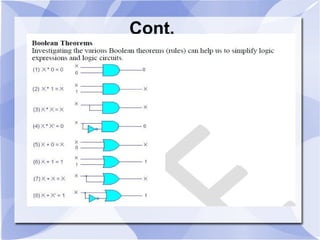
T6 : Redundance Law
(a) A + A B = A
(b) A (A + B) = A
T7 :
(a) 0 + A = A
(b) 0 A = 0
T8 :
(a) 1 + A = 1
(b) 1 A = A
Cont.
Boolean postulates
Boolean postulates are
•The Commutative Law of addition for two variable.
A + B = B + A
•The Commutative Law of multiplication for two variable.
A . B = B . A
•The Associative law of addition with multiplication is written as
A + (B + C) = A +B +C
•The Associative law of multiplication with addition is written as
A . (B . C) = (A . B) . C
•The Associative law of multiplication with addition is written as
A . (B + C) = A . B + A . C
•The Associative law of addition with multiplication is written as
A + (B . C) = (A + B) . (A + C)
De-morgan’s Theorem
DE-MORGAN’S THEOREM
1.(AB)' = A' + B'
The complement of a product is equal to the sum of the
complements
2.( A+B)' = A' . B'
The complement of a sum term is equal to the product of
the complements
Duality Principle
PRINCIPLE OF DUALITY:
Principle of Duality theorem says,
•Changing each OR operator to an AND operator
•Changing each AND operator to an OR operator
•Replace 0’s by 1’s and 1’s by 0’s
BOOLEAN EXPRESSION:
Boolean expressions are minimized by using Boolean laws
and postulates.
Minimization of Boolean
Expressions
MINIMIZATION OF BOOLEAN EXPRESSIONS
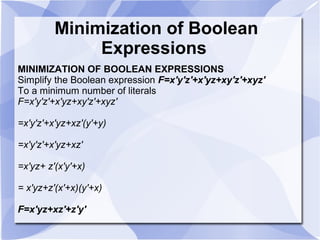
Simplify the Boolean expression F=x′y′z′+x′yz+xy′z′+xyz′
To a minimum number of literals
F=x′y′z′+x′yz+xy′z′+xyz′
=x′y′z′+x′yz+xz′(y′+y)
=x′y′z′+x′yz+xz′
=x′yz+ z′(x′y′+x)
= x′yz+z′(x′+x)(y′+x)
F=x′yz+xz′+z′y′
Canonical and standard forms
•Sum-of-Product (SOP) form: When two or more
product terms are summed by Boolean addition, the
result is a Sum-of-Product or SOP expression
• Product-of-Sum (POS) form: When two or more sum
terms are multiplied by Boolean multiplication, the
result is a Product-of-Sum or POS expression
Cont.
CANONICAL FORM:
In Sum Of Products(SOP) and Product Of Sums(POS), if all the term
contains all the variables either in true or in complementary form then its
said to be canonical SOP or canonical POS.
MINTERM ( canonical SOP)
•In a Boolean function, a binary variable (x) may appear either in its
normal form (x) or in its complement form (x’).
• Consider 2 binary variables x and y and an AND operation, there are 4
and only 4 possible combinations: x’•y’, x’•y, x•y’ & x•y.
•Each of the 4 product terms is called a MINTERM or STANDARD
PRODUCT
•By definition, a Minterm is a product which consists of all the variables
in the normal form or the complement form but NOT BOTH.
e.g. for a function with 2 variables x and y: x•y’ is a minterm but x’ is
NOT a minterm
e.g. for a function with 3 variables x, y and z: x’yz’ is a minterm but
xy’ is NOT a minterm
Cont.
MAXTERM (canonical POS)
•Consider 2 binary variables x and y and an OR
operation, there are 4 and only 4 possible combinations:
x’+y’, x’+y, x+y’, x+y.
•Each of the 4 sum terms is called a MAXTERM or
STANDARD SUM.
•By definition, a Maxterm is a sum in which each variable
appears once and only once either in its normal form or
its complement form but NOT BOTH.
Minterms and Maxterms for 3
Variables
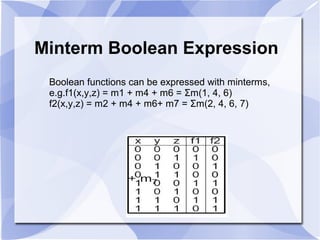
Minterm Boolean Expression
Boolean functions can be expressed with minterms,
e.g.f1(x,y,z) = m1 + m4 + m6 = Σm(1, 4, 6)
f2(x,y,z) = m2 + m4 + m6+ m7 = Σm(2, 4, 6, 7)
Maxterm Boolean Expression
Boolean functions can also be expressed with maxterms,
e.g.f1’ = x’y’z’+x’yz’+x’yz+xy’z+xyz
f1 = (x’y’z’+x’yz’+x’yz+xy’z+xyz)’
= (x+y+z)(x+y’+z)(x+y’+z’)(x’+y+z’)(x’+y’+z’)
= M0•M2•M3•M5•M7
= Π M(0, 2, 3, 5, 7)
f2 = M0•M1•M3•M5 = Π M(0, 1, 3, 5)
Truth table for f1 and f2
Express Boolean Functions in
Minterms
Express Boolean Functions in Minterms
•If product terms in a Boolean function are not minterms, they can
be converted to minterms
e.g. f(a,b,c) = a’ + bc’ + ab’c
•Function f has 3 variables, therefore, each minterm must have 3
literals.
•Neither a’ nor bc’ are minterms.They can be converted to
minterm.ab’c is a minterm
Cont.
Conversion to Minterms
Let the function be f(a,b,c) = a’ + bc’ + ab’c
•To convert a’ to a minterm, the 2 variables (b, c) must
be added, without changing its functionality.
Since a’=a’•1 & 1 = b+b’, a’= a’(b + b’) = a’b + a’b’
•Similarly, a’b = a’b(c + c’) = a’bc + a’bc’ and a’b’ =
a’b’(c+c’) = a’b’c + a’b’c’
•bc’ = bc’(a+a’) = abc’ + a’bc’
•f = a’bc+a’bc’+a’b’c+a’b’c’+abc’+a’bc’+ab’c
Express Boolean Functions in
Maxterms
Express Boolean Functions in Maxterms
By using the Distribution Law: x+yz = (x+y)(x+z),
•Boolean function can be converted to an expression
in product of maxterms
e.g. f(a,b,c) = a’+bc’
= (a’+b)(a’+c’) {not maxterms}
= (a’+b+cc’)(a’+c’+bb’) {cc’=0}
= (a’+b+c)(a’+b+c’)(a’+c’+b)(a’+c’+b’)
= (a’+b+c)(a’+b+c’)(a’+c’+b’)
Cont.
Express the Boolean function F=A+B′C in sum of
min terms.
Given
F=A+B′C
=A(B+ B′)(C+C′)+ B′C(A+A′)
=(AB+A B′)(C+C′)+B′C(A+A′) =ABC+ABC′+AB′C+AB
′C′+AB′C+A′B′C
= ABC+ABC′+AB′C+AB′C+A′B′C
F=m1+m4+m5+m6+m7
Cont.
POS form:
Given
D=(A′+B)(B′+C)
=A′B′+A′C+BB′+BC
= A′B′+A′C+BC
= A′+B′+ A′C+BC
= A′(1+C)+B′+BC
= A′+B′+BC
D= A′B′+BC
Using missed terms formulae;
= A′B′(C+C′)+(A+A′)BC
= A′B′C+ A′B′C′+ABC+A′BC
D(A,B,C)= Σ m(1,0,7,3)
Thank You

Digital Electronics

  • 1.
  • 2.
    BOOLEAN POSTULATES ANDLAWS: T1 : Commutative Law (a) A + B = B + A (b) A B = B A T2 : Associate Law (a) (A + B) + C = A + (B + C) (b) (A B) C = A (B C) T3 : Distributive Law (a) A (B + C) = A B + A C (b) A + (B C) = (A + B) (A + C) T4 : Identity Law (a) A + A = A (b) A A = A
  • 3.
    Cont. T6 : RedundanceLaw (a) A + A B = A (b) A (A + B) = A T7 : (a) 0 + A = A (b) 0 A = 0 T8 : (a) 1 + A = 1 (b) 1 A = A
  • 4.
  • 5.
    Boolean postulates Boolean postulatesare •The Commutative Law of addition for two variable. A + B = B + A •The Commutative Law of multiplication for two variable. A . B = B . A •The Associative law of addition with multiplication is written as A + (B + C) = A +B +C •The Associative law of multiplication with addition is written as A . (B . C) = (A . B) . C •The Associative law of multiplication with addition is written as A . (B + C) = A . B + A . C •The Associative law of addition with multiplication is written as A + (B . C) = (A + B) . (A + C)
  • 6.
    De-morgan’s Theorem DE-MORGAN’S THEOREM 1.(AB)'= A' + B' The complement of a product is equal to the sum of the complements 2.( A+B)' = A' . B' The complement of a sum term is equal to the product of the complements
  • 7.
    Duality Principle PRINCIPLE OFDUALITY: Principle of Duality theorem says, •Changing each OR operator to an AND operator •Changing each AND operator to an OR operator •Replace 0’s by 1’s and 1’s by 0’s BOOLEAN EXPRESSION: Boolean expressions are minimized by using Boolean laws and postulates.
  • 8.
    Minimization of Boolean Expressions MINIMIZATIONOF BOOLEAN EXPRESSIONS Simplify the Boolean expression F=x′y′z′+x′yz+xy′z′+xyz′ To a minimum number of literals F=x′y′z′+x′yz+xy′z′+xyz′ =x′y′z′+x′yz+xz′(y′+y) =x′y′z′+x′yz+xz′ =x′yz+ z′(x′y′+x) = x′yz+z′(x′+x)(y′+x) F=x′yz+xz′+z′y′
  • 9.
    Canonical and standardforms •Sum-of-Product (SOP) form: When two or more product terms are summed by Boolean addition, the result is a Sum-of-Product or SOP expression • Product-of-Sum (POS) form: When two or more sum terms are multiplied by Boolean multiplication, the result is a Product-of-Sum or POS expression
  • 10.
    Cont. CANONICAL FORM: In SumOf Products(SOP) and Product Of Sums(POS), if all the term contains all the variables either in true or in complementary form then its said to be canonical SOP or canonical POS. MINTERM ( canonical SOP) •In a Boolean function, a binary variable (x) may appear either in its normal form (x) or in its complement form (x’). • Consider 2 binary variables x and y and an AND operation, there are 4 and only 4 possible combinations: x’•y’, x’•y, x•y’ & x•y. •Each of the 4 product terms is called a MINTERM or STANDARD PRODUCT •By definition, a Minterm is a product which consists of all the variables in the normal form or the complement form but NOT BOTH. e.g. for a function with 2 variables x and y: x•y’ is a minterm but x’ is NOT a minterm e.g. for a function with 3 variables x, y and z: x’yz’ is a minterm but xy’ is NOT a minterm
  • 11.
    Cont. MAXTERM (canonical POS) •Consider2 binary variables x and y and an OR operation, there are 4 and only 4 possible combinations: x’+y’, x’+y, x+y’, x+y. •Each of the 4 sum terms is called a MAXTERM or STANDARD SUM. •By definition, a Maxterm is a sum in which each variable appears once and only once either in its normal form or its complement form but NOT BOTH.
  • 12.
    Minterms and Maxtermsfor 3 Variables
  • 13.
    Minterm Boolean Expression Booleanfunctions can be expressed with minterms, e.g.f1(x,y,z) = m1 + m4 + m6 = Σm(1, 4, 6) f2(x,y,z) = m2 + m4 + m6+ m7 = Σm(2, 4, 6, 7)
  • 14.
    Maxterm Boolean Expression MaxtermBoolean Expression Boolean functions can also be expressed with maxterms, e.g.f1’ = x’y’z’+x’yz’+x’yz+xy’z+xyz f1 = (x’y’z’+x’yz’+x’yz+xy’z+xyz)’ = (x+y+z)(x+y’+z)(x+y’+z’)(x’+y+z’)(x’+y’+z’) = M0•M2•M3•M5•M7 = Π M(0, 2, 3, 5, 7) f2 = M0•M1•M3•M5 = Π M(0, 1, 3, 5)
  • 15.
    Truth table forf1 and f2
  • 16.
    Express Boolean Functionsin Minterms Express Boolean Functions in Minterms •If product terms in a Boolean function are not minterms, they can be converted to minterms e.g. f(a,b,c) = a’ + bc’ + ab’c •Function f has 3 variables, therefore, each minterm must have 3 literals. •Neither a’ nor bc’ are minterms.They can be converted to minterm.ab’c is a minterm
  • 17.
    Cont. Conversion to Minterms Letthe function be f(a,b,c) = a’ + bc’ + ab’c •To convert a’ to a minterm, the 2 variables (b, c) must be added, without changing its functionality. Since a’=a’•1 & 1 = b+b’, a’= a’(b + b’) = a’b + a’b’ •Similarly, a’b = a’b(c + c’) = a’bc + a’bc’ and a’b’ = a’b’(c+c’) = a’b’c + a’b’c’ •bc’ = bc’(a+a’) = abc’ + a’bc’ •f = a’bc+a’bc’+a’b’c+a’b’c’+abc’+a’bc’+ab’c
  • 18.
    Express Boolean Functionsin Maxterms Express Boolean Functions in Maxterms By using the Distribution Law: x+yz = (x+y)(x+z), •Boolean function can be converted to an expression in product of maxterms e.g. f(a,b,c) = a’+bc’ = (a’+b)(a’+c’) {not maxterms} = (a’+b+cc’)(a’+c’+bb’) {cc’=0} = (a’+b+c)(a’+b+c’)(a’+c’+b)(a’+c’+b’) = (a’+b+c)(a’+b+c’)(a’+c’+b’)
  • 19.
    Cont. Express the Booleanfunction F=A+B′C in sum of min terms. Given F=A+B′C =A(B+ B′)(C+C′)+ B′C(A+A′) =(AB+A B′)(C+C′)+B′C(A+A′) =ABC+ABC′+AB′C+AB ′C′+AB′C+A′B′C = ABC+ABC′+AB′C+AB′C+A′B′C F=m1+m4+m5+m6+m7
  • 20.
    Cont. POS form: Given D=(A′+B)(B′+C) =A′B′+A′C+BB′+BC = A′B′+A′C+BC =A′+B′+ A′C+BC = A′(1+C)+B′+BC = A′+B′+BC D= A′B′+BC Using missed terms formulae; = A′B′(C+C′)+(A+A′)BC = A′B′C+ A′B′C′+ABC+A′BC D(A,B,C)= Σ m(1,0,7,3)
  • 21.