Presentation
Data Logic Design
Group Members
• Shahban Iqbal 1421-116033
• Raja Faizan Ali 1421-116032
• Raja Usman 1421-116036
• Usama Hameed 1421-116028
Content:
• Sum of product (SOP)
• Product of sum (POS)
• Standard SOP and POS Forms
• Convert SOP to standard SOP
• Convert POS to Standard POS
• Minterms and Maxterms
Sum of Product
• The sum-of-products (SOP) form is a method
(or form) of simplifying the Boolean
expressions of logic gates.
• Sum and product derived from the symbolic
representations of the OR and AND functions.
• OR (+) , AND ( . ) , addition and multiplication.
f(A,B,C) = ABC + A’BC’
Sum
Product terms
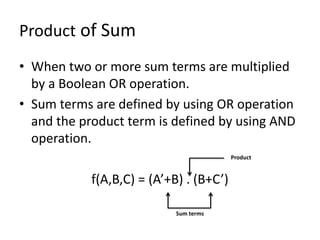
Product of Sum
• When two or more sum terms are multiplied
by a Boolean OR operation.
• Sum terms are defined by using OR operation
and the product term is defined by using AND
operation.
f(A,B,C) = (A’+B) . (B+C’)
Product
Sum terms
Standard SOP and POS Forms
• The canonical forms are the special cases of
SOP and POS forms.
• These are also known as standard SOP and
POS forms.
Canonical Form
• In SOP or POS form, all individual terms do not
involve all literals.
• For example AB + A’BC the first product term
do not contain literal C.
• If each term in SOP or POS contain all literals
then the expression is known as standard or
canonical form.
Canonical Form
• Each individual term in the POS form is called Maxterm.
• Each individual term in the SOP form is called Minterm.
• In Minterm, we look for the functions where the output
results is “1”.
• while in Maxterm we look for function where the output
results is “0”.
• We perform Sum of minterm also known as Sum of products
(SOP) .
• We perform Product of Maxterm also known as Product of
sum (POS).
Convert SOP to standard SOP form
Step 1: Find the missing literal in each product
term if any.
Step 2: And each product term having missing
literals with terms form by ORing the literal and
its complement.
Step 3: Expends the term by applying,
distributive law and reorder the literals.
Step 4: Reduce the repeated product terms.
Because A + A = A (Theorem 1a ).
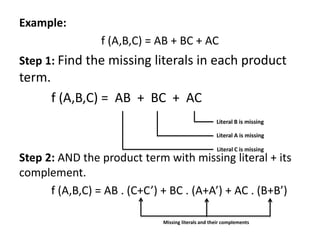
Example:
f (A,B,C) = AB + BC + AC
Step 1: Find the missing literals in each product
term.
f (A,B,C) = AB + BC + AC
Step 2: AND the product term with missing literal + its
complement.
f (A,B,C) = AB . (C+C’) + BC . (A+A’) + AC . (B+B’)
Literal B is missing
Literal A is missing
Literal C is missing
Missing literals and their complements
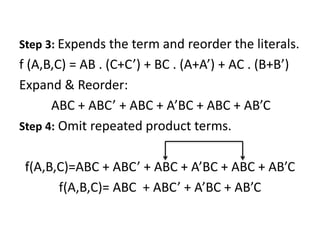
Step 3: Expends the term and reorder the literals.
f (A,B,C) = AB . (C+C’) + BC . (A+A’) + AC . (B+B’)
Expand & Reorder:
ABC + ABC’ + ABC + A’BC + ABC + AB’C
Step 4: Omit repeated product terms.
f(A,B,C)=ABC + ABC’ + ABC + A’BC + ABC + AB’C
f(A,B,C)= ABC + ABC’ + A’BC + AB’C
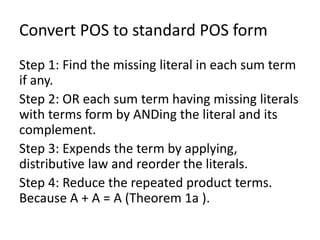
Convert POS to standard POS form
Step 1: Find the missing literal in each sum term
if any.
Step 2: OR each sum term having missing literals
with terms form by ANDing the literal and its
complement.
Step 3: Expends the term by applying,
distributive law and reorder the literals.
Step 4: Reduce the repeated product terms.
Because A + A = A (Theorem 1a ).
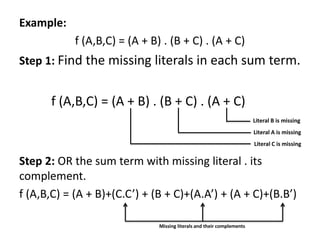
Example:
f (A,B,C) = (A + B) . (B + C) . (A + C)
Step 1: Find the missing literals in each sum term.
f (A,B,C) = (A + B) . (B + C) . (A + C)
Step 2: OR the sum term with missing literal . its
complement.
f (A,B,C) = (A + B)+(C.C’) + (B + C)+(A.A’) + (A + C)+(B.B’)
Literal B is missing
Literal A is missing
Literal C is missing
Missing literals and their complements
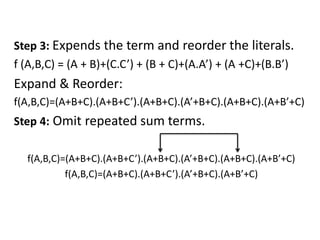
Step 3: Expends the term and reorder the literals.
f (A,B,C) = (A + B)+(C.C’) + (B + C)+(A.A’) + (A +C)+(B.B’)
Expand & Reorder:
f(A,B,C)=(A+B+C).(A+B+C’).(A+B+C).(A’+B+C).(A+B+C).(A+B’+C)
Step 4: Omit repeated sum terms.
f(A,B,C)=(A+B+C).(A+B+C’).(A+B+C).(A’+B+C).(A+B+C).(A+B’+C)
f(A,B,C)=(A+B+C).(A+B+C’).(A’+B+C).(A+B’+C)
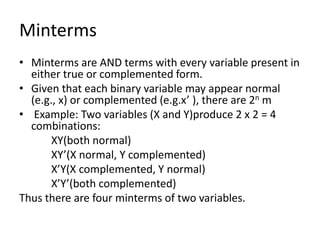
Minterms
• Minterms are AND terms with every variable present in
either true or complemented form.
• Given that each binary variable may appear normal
(e.g., x) or complemented (e.g.x’ ), there are 2n m
• Example: Two variables (X and Y)produce 2 x 2 = 4
combinations:
XY(both normal)
XY’(X normal, Y complemented)
X’Y(X complemented, Y normal)
X’Y’(both complemented)
Thus there are four minterms of two variables.
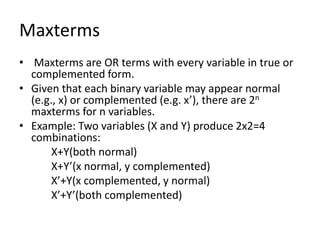
Maxterms
• Maxterms are OR terms with every variable in true or
complemented form.
• Given that each binary variable may appear normal
(e.g., x) or complemented (e.g. x’), there are 2n
maxterms for n variables.
• Example: Two variables (X and Y) produce 2x2=4
combinations:
X+Y(both normal)
X+Y’(x normal, y complemented)
X’+Y(x complemented, y normal)
X’+Y’(both complemented)
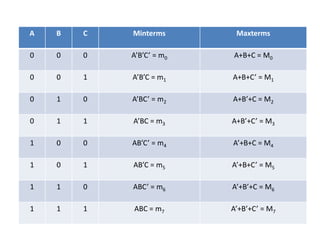
A B C Minterms Maxterms
0 0 0 A’B’C’ = m0 A+B+C = M0
0 0 1 A’B’C = m1 A+B+C’ = M1
0 1 0 A’BC’ = m2 A+B’+C = M2
0 1 1 A’BC = m3 A+B’+C’ = M3
1 0 0 AB’C’ = m4 A’+B+C = M4
1 0 1 AB’C = m5 A’+B+C’ = M5
1 1 0 ABC’ = m6 A’+B’+C = M6
1 1 1 ABC = m7 A’+B’+C’ = M7
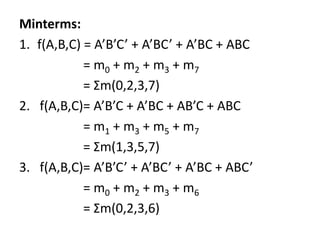
Minterms:
1. f(A,B,C) = A’B’C’ + A’BC’ + A’BC + ABC
= m0 + m2 + m3 + m7
= Σm(0,2,3,7)
2. f(A,B,C)= A’B’C + A’BC + AB’C + ABC
= m1 + m3 + m5 + m7
= Σm(1,3,5,7)
3. f(A,B,C)= A’B’C’ + A’BC’ + A’BC + ABC’
= m0 + m2 + m3 + m6
= Σm(0,2,3,6)
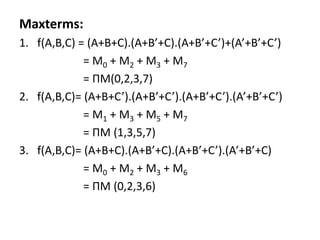
Maxterms:
1. f(A,B,C) = (A+B+C).(A+B’+C).(A+B’+C’)+(A’+B’+C’)
= M0 + M2 + M3 + M7
= ΠM(0,2,3,7)
2. f(A,B,C)= (A+B+C’).(A+B’+C’).(A+B’+C’).(A’+B’+C’)
= M1 + M3 + M5 + M7
= ΠM (1,3,5,7)
3. f(A,B,C)= (A+B+C).(A+B’+C).(A+B’+C’).(A’+B’+C)
= M0 + M2 + M3 + M6
= ΠM (0,2,3,6)

SOP POS, Minterm and Maxterm

  • 1.
  • 2.
    Group Members • ShahbanIqbal 1421-116033 • Raja Faizan Ali 1421-116032 • Raja Usman 1421-116036 • Usama Hameed 1421-116028
  • 3.
    Content: • Sum ofproduct (SOP) • Product of sum (POS) • Standard SOP and POS Forms • Convert SOP to standard SOP • Convert POS to Standard POS • Minterms and Maxterms
  • 4.
    Sum of Product •The sum-of-products (SOP) form is a method (or form) of simplifying the Boolean expressions of logic gates. • Sum and product derived from the symbolic representations of the OR and AND functions. • OR (+) , AND ( . ) , addition and multiplication. f(A,B,C) = ABC + A’BC’ Sum Product terms
  • 5.
    Product of Sum •When two or more sum terms are multiplied by a Boolean OR operation. • Sum terms are defined by using OR operation and the product term is defined by using AND operation. f(A,B,C) = (A’+B) . (B+C’) Product Sum terms
  • 6.
    Standard SOP andPOS Forms • The canonical forms are the special cases of SOP and POS forms. • These are also known as standard SOP and POS forms.
  • 7.
    Canonical Form • InSOP or POS form, all individual terms do not involve all literals. • For example AB + A’BC the first product term do not contain literal C. • If each term in SOP or POS contain all literals then the expression is known as standard or canonical form.
  • 8.
    Canonical Form • Eachindividual term in the POS form is called Maxterm. • Each individual term in the SOP form is called Minterm. • In Minterm, we look for the functions where the output results is “1”. • while in Maxterm we look for function where the output results is “0”. • We perform Sum of minterm also known as Sum of products (SOP) . • We perform Product of Maxterm also known as Product of sum (POS).
  • 9.
    Convert SOP tostandard SOP form Step 1: Find the missing literal in each product term if any. Step 2: And each product term having missing literals with terms form by ORing the literal and its complement. Step 3: Expends the term by applying, distributive law and reorder the literals. Step 4: Reduce the repeated product terms. Because A + A = A (Theorem 1a ).
  • 10.
    Example: f (A,B,C) =AB + BC + AC Step 1: Find the missing literals in each product term. f (A,B,C) = AB + BC + AC Step 2: AND the product term with missing literal + its complement. f (A,B,C) = AB . (C+C’) + BC . (A+A’) + AC . (B+B’) Literal B is missing Literal A is missing Literal C is missing Missing literals and their complements
  • 11.
    Step 3: Expendsthe term and reorder the literals. f (A,B,C) = AB . (C+C’) + BC . (A+A’) + AC . (B+B’) Expand & Reorder: ABC + ABC’ + ABC + A’BC + ABC + AB’C Step 4: Omit repeated product terms. f(A,B,C)=ABC + ABC’ + ABC + A’BC + ABC + AB’C f(A,B,C)= ABC + ABC’ + A’BC + AB’C
  • 12.
    Convert POS tostandard POS form Step 1: Find the missing literal in each sum term if any. Step 2: OR each sum term having missing literals with terms form by ANDing the literal and its complement. Step 3: Expends the term by applying, distributive law and reorder the literals. Step 4: Reduce the repeated product terms. Because A + A = A (Theorem 1a ).
  • 13.
    Example: f (A,B,C) =(A + B) . (B + C) . (A + C) Step 1: Find the missing literals in each sum term. f (A,B,C) = (A + B) . (B + C) . (A + C) Step 2: OR the sum term with missing literal . its complement. f (A,B,C) = (A + B)+(C.C’) + (B + C)+(A.A’) + (A + C)+(B.B’) Literal B is missing Literal A is missing Literal C is missing Missing literals and their complements
  • 14.
    Step 3: Expendsthe term and reorder the literals. f (A,B,C) = (A + B)+(C.C’) + (B + C)+(A.A’) + (A +C)+(B.B’) Expand & Reorder: f(A,B,C)=(A+B+C).(A+B+C’).(A+B+C).(A’+B+C).(A+B+C).(A+B’+C) Step 4: Omit repeated sum terms. f(A,B,C)=(A+B+C).(A+B+C’).(A+B+C).(A’+B+C).(A+B+C).(A+B’+C) f(A,B,C)=(A+B+C).(A+B+C’).(A’+B+C).(A+B’+C)
  • 15.
    Minterms • Minterms areAND terms with every variable present in either true or complemented form. • Given that each binary variable may appear normal (e.g., x) or complemented (e.g.x’ ), there are 2n m • Example: Two variables (X and Y)produce 2 x 2 = 4 combinations: XY(both normal) XY’(X normal, Y complemented) X’Y(X complemented, Y normal) X’Y’(both complemented) Thus there are four minterms of two variables.
  • 16.
    Maxterms • Maxterms areOR terms with every variable in true or complemented form. • Given that each binary variable may appear normal (e.g., x) or complemented (e.g. x’), there are 2n maxterms for n variables. • Example: Two variables (X and Y) produce 2x2=4 combinations: X+Y(both normal) X+Y’(x normal, y complemented) X’+Y(x complemented, y normal) X’+Y’(both complemented)
  • 17.
    A B CMinterms Maxterms 0 0 0 A’B’C’ = m0 A+B+C = M0 0 0 1 A’B’C = m1 A+B+C’ = M1 0 1 0 A’BC’ = m2 A+B’+C = M2 0 1 1 A’BC = m3 A+B’+C’ = M3 1 0 0 AB’C’ = m4 A’+B+C = M4 1 0 1 AB’C = m5 A’+B+C’ = M5 1 1 0 ABC’ = m6 A’+B’+C = M6 1 1 1 ABC = m7 A’+B’+C’ = M7
  • 18.
    Minterms: 1. f(A,B,C) =A’B’C’ + A’BC’ + A’BC + ABC = m0 + m2 + m3 + m7 = Σm(0,2,3,7) 2. f(A,B,C)= A’B’C + A’BC + AB’C + ABC = m1 + m3 + m5 + m7 = Σm(1,3,5,7) 3. f(A,B,C)= A’B’C’ + A’BC’ + A’BC + ABC’ = m0 + m2 + m3 + m6 = Σm(0,2,3,6)
  • 19.
    Maxterms: 1. f(A,B,C) =(A+B+C).(A+B’+C).(A+B’+C’)+(A’+B’+C’) = M0 + M2 + M3 + M7 = ΠM(0,2,3,7) 2. f(A,B,C)= (A+B+C’).(A+B’+C’).(A+B’+C’).(A’+B’+C’) = M1 + M3 + M5 + M7 = ΠM (1,3,5,7) 3. f(A,B,C)= (A+B+C).(A+B’+C).(A+B’+C’).(A’+B’+C) = M0 + M2 + M3 + M6 = ΠM (0,2,3,6)