1Department of ECE –Avinashilingam Institute
Power Generation
 Power generation is the process of generating electric power from
other sources of primary energy
 There are various methods to generate electricity
 The selection of electricity production modes and their economic
viability varies in accordance with demand and region
2Department of ECE -Sudar
Fossil fuels
3
Fossil energy sources, including oil, coal and natural gas, are non-
renewable resources that formed when prehistoric plants and animals
died and were gradually buried by layers of rock. Over millions of years,
different types of fossil fuels formed -- depending on what combination
of organic matter was present, how long it was buried and what
temperature and pressure conditions existed as time passed.
Department of ECE -Sudar
Fossil fuels
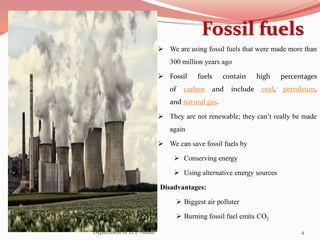
 We are using fossil fuels that were made more than
300 million years ago
 Fossil fuels contain high percentages
of carbon and include coal, petroleum,
and natural gas.
 They are not renewable; they can’t really be made
again
 We can save fossil fuels by
 Conserving energy
 Using alternative energy sources
Disadvantages:
 Biggest air polluter
 Burning fossil fuel emits CO2
4Department of ECE -Sudar
More money and research will go into developing alternative
energy sources
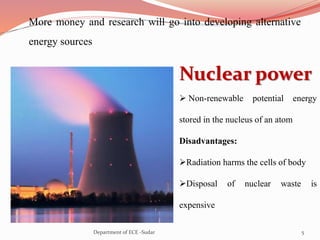
Nuclear power
 Non-renewable potential energy
stored in the nucleus of an atom
Disadvantages:
Radiation harms the cells of body
Disposal of nuclear waste is
expensive
5Department of ECE -Sudar
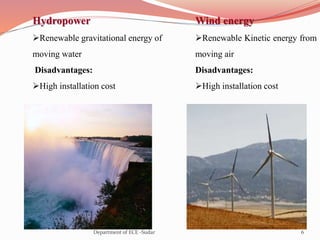
Hydropower
Renewable gravitational energy of
moving water
Disadvantages:
High installation cost
Wind energy
Renewable Kinetic energy from
moving air
Disadvantages:
High installation cost
6Department of ECE -Sudar
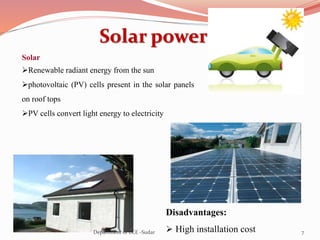
Solar power
Disadvantages:
 High installation cost
Solar
Renewable radiant energy from the sun
photovoltaic (PV) cells present in the solar panels
on roof tops
PV cells convert light energy to electricity
7Department of ECE -Sudar
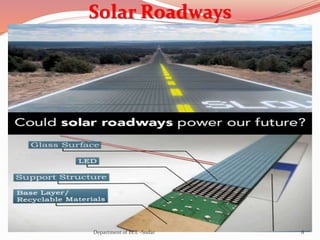
Solar Roadways
8Department of ECE -Sudar
Many career opportunities will be involved
with the research and development of
alternative energy sources
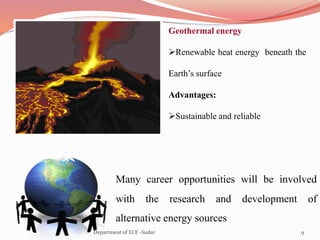
Geothermal energy
Renewable heat energy beneath the
Earth’s surface
Advantages:
Sustainable and reliable
9Department of ECE -Sudar
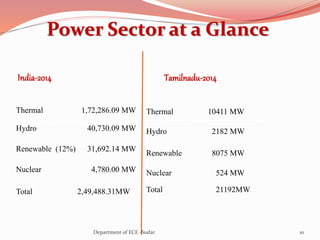
Power Sector at a Glance
India-2014 Tamilnadu-2014
Thermal 1,72,286.09 MW
Hydro 40,730.09 MW
Renewable (12%) 31,692.14 MW
Nuclear
Total
4,780.00 MW
2,49,488.31MW
Thermal 10411 MW
Hydro 2182 MW
Renewable 8075 MW
Nuclear 524 MW
Total 21192MW
10Department of ECE -Sudar
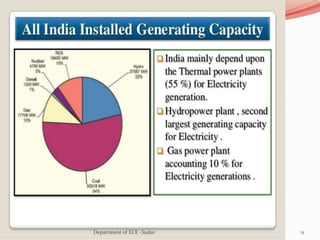
11Department of ECE -Sudar
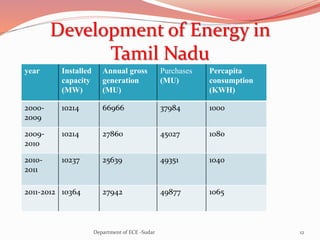
Development of Energy in
Tamil Nadu
year Installed
capacity
(MW)
Annual gross
generation
(MU)
Purchases
(MU)
Percapita
consumption
(KWH)
2000-
2009
10214 66966 37984 1000
2009-
2010
10214 27860 45027 1080
2010-
2011
10237 25639 49351 1040
2011-2012 10364 27942 49877 1065
12Department of ECE -Sudar
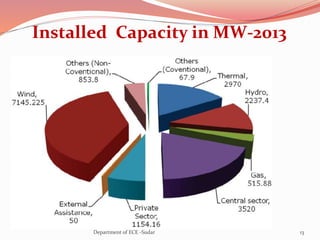
Installed Capacity in MW-2013
13Department of ECE -Sudar
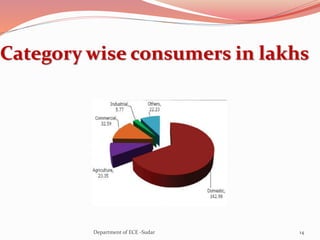
Category wise consumers in lakhs
14Department of ECE -Sudar
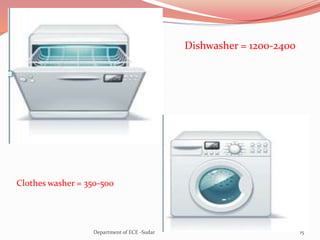
Clothes washer = 350-500
Dishwasher = 1200-2400
15Department of ECE -Sudar
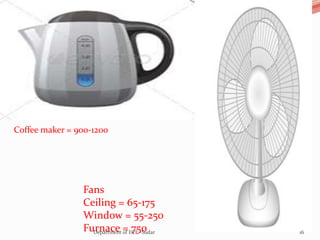
Fans
Ceiling = 65-175
Window = 55-250
Furnace = 750
Coffee maker = 900-1200
16Department of ECE -Sudar
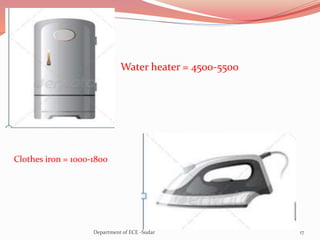
Water heater = 4500-5500
Clothes iron = 1000-1800
17Department of ECE -Sudar
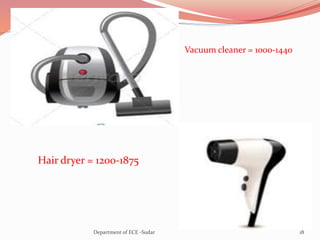
Hair dryer = 1200-1875
Vacuum cleaner = 1000-1440
18Department of ECE -Sudar
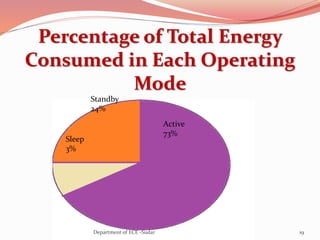
Active
73%
Standby
24%
Sleep
3%
Percentage of Total Energy
Consumed in Each Operating
Mode
19Department of ECE -Sudar
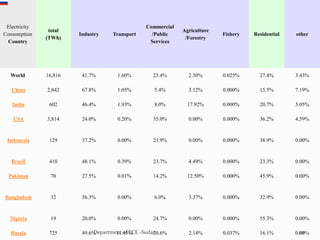
Electricity
Consumption
Country
total
(TWh)
Industry Transport
Commercial
/Public
Services
Agriculture
/Forestry
Fishery Residential other
World 16,816 41.7% 1.60% 23.4% 2.50% 0.025% 27.4% 3.43%
China 2,842 67.8% 1.05% 5.4% 3.12% 0.000% 15.5% 7.19%
India 602 46.4% 1.93% 8.0% 17.92% 0.000% 20.7% 5.05%
USA 3,814 24.0% 0.20% 35.0% 0.00% 0.000% 36.2% 4.59%
Indonesia 129 37.2% 0.00% 23.9% 0.00% 0.000% 38.9% 0.00%
Brazil 410 48.1% 0.39% 23.7% 4.49% 0.000% 23.3% 0.00%
Pakistan 70 27.5% 0.01% 14.2% 12.50% 0.000% 45.9% 0.00%
Bangladesh 32 56.3% 0.00% 6.0% 3.37% 0.000% 32.9% 0.00%
Nigeria 19 20.0% 0.00% 24.7% 0.00% 0.000% 55.3% 0.00%
Russia 725 49.6% 11.45% 20.6% 2.14% 0.037% 16.1% 0.00%20Department of ECE -Sudar
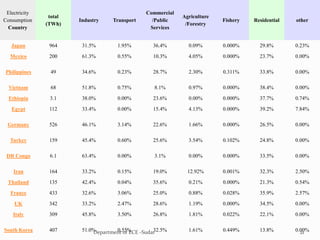
Japan 964 31.5% 1.95% 36.4% 0.09% 0.000% 29.8% 0.23%
Mexico 200 61.3% 0.55% 10.3% 4.05% 0.000% 23.7% 0.00%
Philippines 49 34.6% 0.23% 28.7% 2.30% 0.311% 33.8% 0.00%
Vietnam 68 51.8% 0.75% 8.1% 0.97% 0.000% 38.4% 0.00%
Ethiopia 3.1 38.0% 0.00% 23.6% 0.00% 0.000% 37.7% 0.74%
Egypt 112 33.4% 0.00% 15.4% 4.13% 0.000% 39.2% 7.84%
Germany 526 46.1% 3.14% 22.6% 1.66% 0.000% 26.5% 0.00%
Turkey 159 45.4% 0.60% 25.6% 3.54% 0.102% 24.8% 0.00%
DR Congo 6.1 63.4% 0.00% 3.1% 0.00% 0.000% 33.5% 0.00%
Iran 164 33.2% 0.15% 19.0% 12.92% 0.001% 32.3% 2.50%
Thailand 135 42.4% 0.04% 35.6% 0.21% 0.000% 21.3% 0.54%
France 433 32.6% 3.06% 25.0% 0.88% 0.028% 35.9% 2.57%
UK 342 33.2% 2.47% 28.6% 1.19% 0.000% 34.5% 0.00%
Italy 309 45.8% 3.50% 26.8% 1.81% 0.022% 22.1% 0.00%
South Korea 407 51.0% 0.55% 32.5% 1.61% 0.449% 13.8% 0.00%
Electricity
Consumption
Country
total
(TWh)
Industry Transport
Commercial
/Public
Services
Agriculture
/Forestry
Fishery Residential other
21Department of ECE -Sudar
22Department of ECE -Sudar
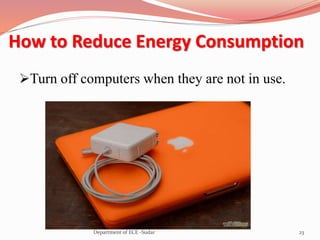
How to Reduce Energy Consumption
Turn off computers when they are not in use.
23Department of ECE -Sudar
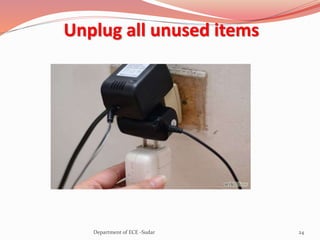
Unplug all unused items
24Department of ECE -Sudar
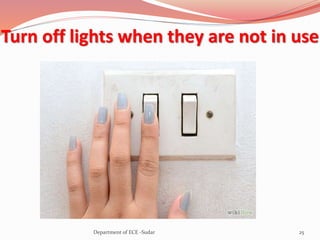
Turn off lights when they are not in use
25Department of ECE -Sudar
power Calculation
26Department of ECE -Sudar
27Department of ECE -Sudar
28Department of ECE -Sudar
29Department of ECE -Sudar
30Department of ECE -Sudar
31Department of ECE -Sudar
32Department of ECE -Sudar
33Department of ECE -Sudar
34Department of ECE -Sudar
35Department of ECE -Sudar
36Department of ECE -Sudar
37Department of ECE -Sudar
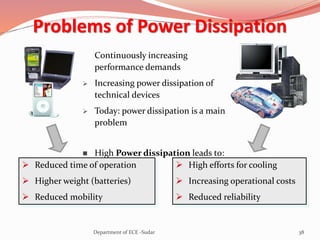
Problems of Power Dissipation
38
• Continuously increasing
performance demands
 Increasing power dissipation of
technical devices
 Today: power dissipation is a main
problem
 High Power dissipation leads to:
 High efforts for cooling
 Increasing operational costs
 Reduced reliability
 Reduced time of operation
 Higher weight (batteries)
 Reduced mobility
Department of ECE -Sudar
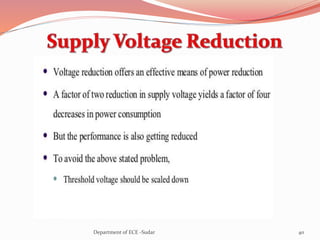
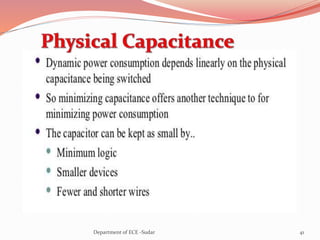
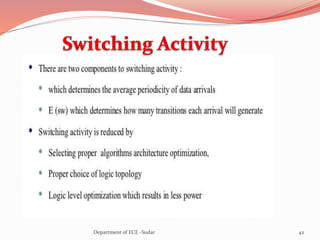
Three factors that can reduce power dissipation are:
Voltage
Physical Capacitance
Switching Activity
Low Power Design Space
39Department of ECE -Sudar
40Department of ECE -Sudar
41Department of ECE -Sudar
42Department of ECE -Sudar
43Department of ECE -Sudar
Power Dissipation
 Power dissipation is a measure of the rate at which energy is
dissipated, or lost, from an electrical system
 When an electric current does work on a conductor, the internal
energy of that conductor increases, causing its temperature to
rise above the ambient temperature
 This causes energy to dissipate away from the conductor into
the surroundings, through the process of heat transfer
 The rate of this heat transfer (joules per second) is termed
'power dissipation' (in watts)
44Department of ECE -Sudar
Mechanisms of power dissipation
 Mechanisms of power dissipation are usually divided into two
classes:
 dynamic and
 static power dissipation
 Dynamic power dissipation occurs when the circuit is operational
 Static power dissipation becomes an issue when the circuit is inactive
or in a power-down mode
45Department of ECE -Sudar
Dynamic Power Dissipation
 Dynamic power dissipation can be further subdivided into three
mechanisms:
Switched
Short-circuit
Glitch power dissipation
 This depends upon the activity, timing, output capacitance, and
supply voltage of the circuit
46Department of ECE -Sudar
Switched power dissipation
Repeated charging and discharging of the output
capacitance
Necessary to transmit information in CMOS circuits
47Department of ECE -Sudar
Short circuit Power Dissipation
 Short circuit current occurs during signal transitions when both
the NMOS and PMOS are ON and there is a direct path
between Vdd and GND- crowbar current
 Accounts for more than 20% of total power dissipation
 As clock frequency increases- transitions increase consequently
short circuit power dissipation increases
48Department of ECE -Sudar
Glitch Power Dissipation
 Glitches are temporary changes in the value of the output –
unnecessary transitions
 They are caused due to the skew in the input signals to a gate
 Glitch power dissipation accounts for 15% – 20 % of the
global power
49Department of ECE -Sudar
Static Power Dissipation
 Power dissipation -device is in standby mode
 As technology scales this becomes significant- Leakage power
dissipation
Reverse biased p-n junction
Sub threshold leakage
Channel punch through
50Department of ECE -Sudar
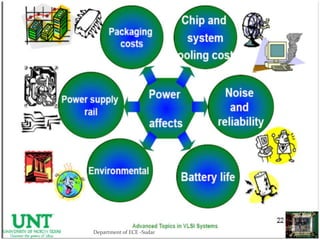
Effects of Power Dissipation
 Power dissipation affects:
Performance
Reliability
Packaging
Cost
Portability
51Department of ECE -Sudar
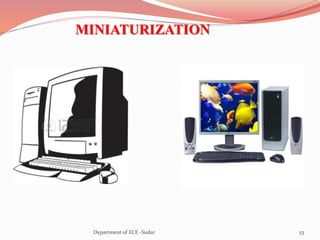
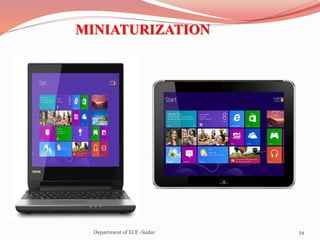
Miniaturization
 Miniaturization is the trend to manufacture smaller mechanical,
optical and electronic products and devices
 Advantages:
- Lower material costs
- Higher production output
- Potentially faster operation
 Disadvantages:
- Increased complexity in circuit design (may lead to poorer
performance)
- Increased engineering/R&D costs
- Not serviceable after manufacture
52Department of ECE -Sudar
MINIATURIZATION
53Department of ECE -Sudar
MINIATURIZATION
54Department of ECE -Sudar
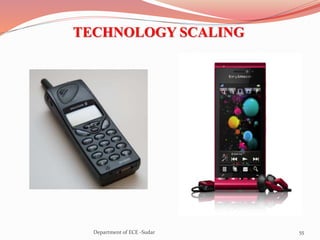
TECHNOLOGY SCALING
55Department of ECE -Sudar
56
Portable Devices
Department of ECE -Sudar
Portable device
A Portable device -easily be carried.
Examples:
 Smart Phone
 Lap Top
 i-pad
 Tablets
57Department of ECE -Sudar
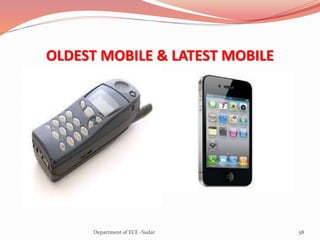
OLDEST MOBILE & LATEST MOBILE
58Department of ECE -Sudar
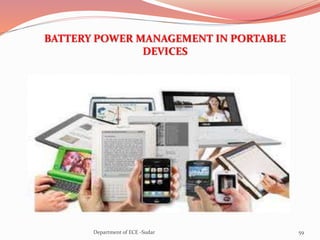
BATTERY POWER MANAGEMENT IN PORTABLE
DEVICES
59Department of ECE -Sudar
BATTERY POWER MANAGEMENT
Turn off the mobile phone
Stop searching for the signal
Do not follow the method of full charge and
discharge
Avoid putting your mobile phone in vibrating
function
60Department of ECE -Sudar
BATTERY POWER MANAGEMENT
Turn off your phones backlight
Avoid using unnecessary features
Turn off Bluetooth
Avoid using animated pictures or videos for
background
Avoid placing the battery under direct sunlight
61Department of ECE -Sudar
62Department of ECE -Sudar
63Department of ECE -Sudar
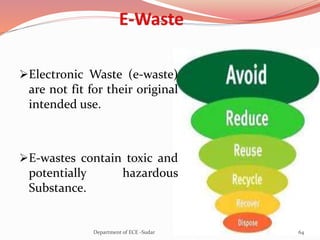
Electronic Waste (e-waste)
are not fit for their original
intended use.
E-wastes contain toxic and
potentially hazardous
Substance.
64Department of ECE -Sudar
65Department of ECE -Sudar
66Department of ECE -Sudar
67Department of ECE -Sudar
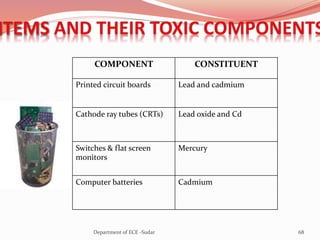
COMPONENT CONSTITUENT
Printed circuit boards Lead and cadmium
Cathode ray tubes (CRTs) Lead oxide and Cd
Switches & flat screen
monitors
Mercury
Computer batteries Cadmium
68Department of ECE -Sudar
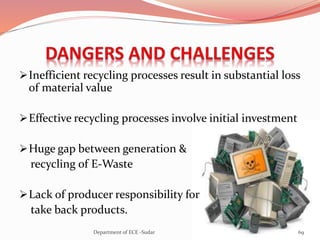
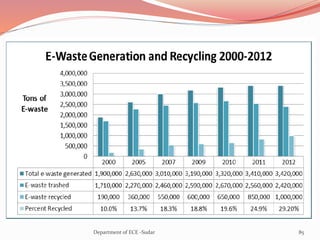
Inefficient recycling processes result in substantial loss
of material value
Effective recycling processes involve initial investment
Huge gap between generation &
recycling of E-Waste
Lack of producer responsibility for
take back products.
69Department of ECE -Sudar
Consumer recycling
Corporate recycling
Sale
Take back
Exchange
Scrapping/recycling
Donations/Nonprofits
70Department of ECE -Sudar
71Department of ECE -Sudar
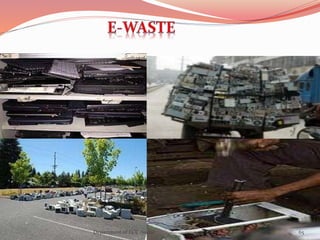
More than 4.6 million tones of e-waste ended up in
landfills .
Toxic chemicals in electronics products can leach into
the land over time and released into the atmosphere.
Regulations have been introduced to prevent
electronic waste being dumped .
72Department of ECE -Sudar
This releases heavy metals such as lead, cadmium and
mercury into the air.
Mercury released into the atmosphere can bio
accumulate in the food chain.
 If the products contain PVC plastic, highly toxic
dioxins and furans are also released.
73Department of ECE -Sudar
A good way to increase a product's lifespan.
 Many old products are exported to developing
countries.
The hazardous chemicals in e-waste electronics can
harm workers in
 recycling yards
 neighboring communities
 environment.
74Department of ECE -Sudar
EFFECTS ON HUMAN HEALTH
LEAD:
 Damages both the central and peripheral nervous systems
 High blood pressure, damage to the kidneys and liver
MERCURY:
 Attacks the central nervous and endocrine systems
 Harmful to mouth, teeth and gums
ARSENIC:
 Arsenic causes severe damage to the digestive tract .
CADMIUM:
 Repeated exposure can damage the lungs, kidneys and liver.
75Department of ECE -Sudar
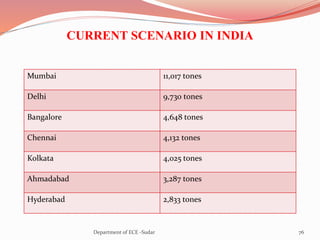
CURRENT SCENARIO IN INDIA
Mumbai 11,017 tones
Delhi 9,730 tones
Bangalore 4,648 tones
Chennai 4,132 tones
Kolkata 4,025 tones
Ahmadabad 3,287 tones
Hyderabad 2,833 tones
76Department of ECE -Sudar
77Department of ECE -Sudar
To preserve the earth’s natural resources which are limited
To prevent environmental pollution on releasing hazardous toxins
into the environment
To eliminate landfill
Generates employment opportunity
Extracting precious metals
78Department of ECE -Sudar
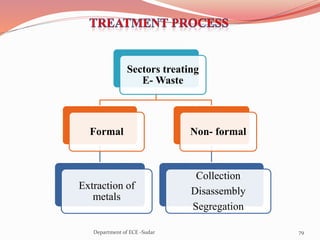
Sectors treating
E- Waste
Formal
Extraction of
metals
Non- formal
Collection
Disassembly
Segregation
79Department of ECE -Sudar
80Department of ECE -Sudar
81Department of ECE -Sudar
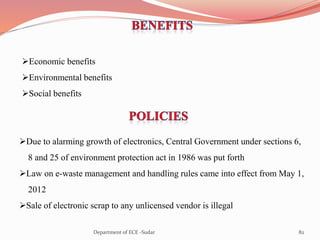
Economic benefits
Environmental benefits
Social benefits
Due to alarming growth of electronics, Central Government under sections 6,
8 and 25 of environment protection act in 1986 was put forth
Law on e-waste management and handling rules came into effect from May 1,
2012
Sale of electronic scrap to any unlicensed vendor is illegal
82Department of ECE -Sudar
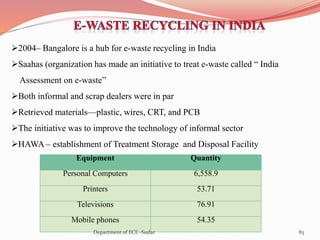
2004– Bangalore is a hub for e-waste recycling in India
Saahas (organization has made an initiative to treat e-waste called “ India
Assessment on e-waste”
Both informal and scrap dealers were in par
Retrieved materials—plastic, wires, CRT, and PCB
The initiative was to improve the technology of informal sector
HAWA – establishment of Treatment Storage and Disposal Facility
Equipment Quantity
Personal Computers 6,558.9
Printers 53.71
Televisions 76.91
Mobile phones 54.35
83Department of ECE -Sudar
84Department of ECE -Sudar
85Department of ECE -Sudar
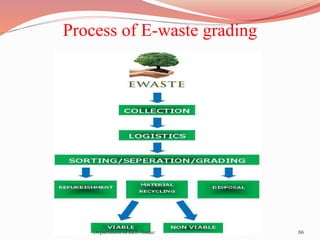
Process of E-waste grading
86Department of ECE -Sudar
Each one of us has a role to play!
 Encourage and facilitate organized recycling systems
 Should subsidies recycling and disposal industries
 Collect fee from manufactured/consumers for the disposal of toxic
material
 Incentive schemes for garbage collectors and general public for
collecting and handling over e-waste
 Awareness program on e-waste for school children and general
public
 The total e-waste in India has been estimated to be 1,46,180 tones
per year 87Department of ECE -Sudar
88Department of ECE -Sudar
89Department of ECE -Sudar

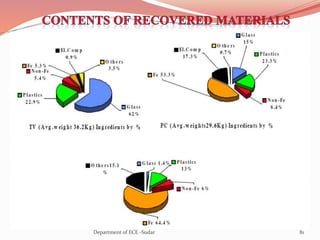
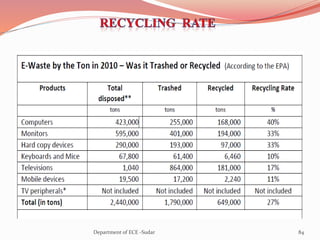
E waste

  • 1.
    1Department of ECE–Avinashilingam Institute
  • 2.
    Power Generation  Powergeneration is the process of generating electric power from other sources of primary energy  There are various methods to generate electricity  The selection of electricity production modes and their economic viability varies in accordance with demand and region 2Department of ECE -Sudar
  • 3.
    Fossil fuels 3 Fossil energysources, including oil, coal and natural gas, are non- renewable resources that formed when prehistoric plants and animals died and were gradually buried by layers of rock. Over millions of years, different types of fossil fuels formed -- depending on what combination of organic matter was present, how long it was buried and what temperature and pressure conditions existed as time passed. Department of ECE -Sudar
  • 4.
    Fossil fuels  Weare using fossil fuels that were made more than 300 million years ago  Fossil fuels contain high percentages of carbon and include coal, petroleum, and natural gas.  They are not renewable; they can’t really be made again  We can save fossil fuels by  Conserving energy  Using alternative energy sources Disadvantages:  Biggest air polluter  Burning fossil fuel emits CO2 4Department of ECE -Sudar
  • 5.
    More money andresearch will go into developing alternative energy sources Nuclear power  Non-renewable potential energy stored in the nucleus of an atom Disadvantages: Radiation harms the cells of body Disposal of nuclear waste is expensive 5Department of ECE -Sudar
  • 6.
    Hydropower Renewable gravitational energyof moving water Disadvantages: High installation cost Wind energy Renewable Kinetic energy from moving air Disadvantages: High installation cost 6Department of ECE -Sudar
  • 7.
    Solar power Disadvantages:  Highinstallation cost Solar Renewable radiant energy from the sun photovoltaic (PV) cells present in the solar panels on roof tops PV cells convert light energy to electricity 7Department of ECE -Sudar
  • 8.
  • 9.
    Many career opportunitieswill be involved with the research and development of alternative energy sources Geothermal energy Renewable heat energy beneath the Earth’s surface Advantages: Sustainable and reliable 9Department of ECE -Sudar
  • 10.
    Power Sector ata Glance India-2014 Tamilnadu-2014 Thermal 1,72,286.09 MW Hydro 40,730.09 MW Renewable (12%) 31,692.14 MW Nuclear Total 4,780.00 MW 2,49,488.31MW Thermal 10411 MW Hydro 2182 MW Renewable 8075 MW Nuclear 524 MW Total 21192MW 10Department of ECE -Sudar
  • 11.
  • 12.
    Development of Energyin Tamil Nadu year Installed capacity (MW) Annual gross generation (MU) Purchases (MU) Percapita consumption (KWH) 2000- 2009 10214 66966 37984 1000 2009- 2010 10214 27860 45027 1080 2010- 2011 10237 25639 49351 1040 2011-2012 10364 27942 49877 1065 12Department of ECE -Sudar
  • 13.
    Installed Capacity inMW-2013 13Department of ECE -Sudar
  • 14.
    Category wise consumersin lakhs 14Department of ECE -Sudar
  • 15.
    Clothes washer =350-500 Dishwasher = 1200-2400 15Department of ECE -Sudar
  • 16.
    Fans Ceiling = 65-175 Window= 55-250 Furnace = 750 Coffee maker = 900-1200 16Department of ECE -Sudar
  • 17.
    Water heater =4500-5500 Clothes iron = 1000-1800 17Department of ECE -Sudar
  • 18.
    Hair dryer =1200-1875 Vacuum cleaner = 1000-1440 18Department of ECE -Sudar
  • 19.
    Active 73% Standby 24% Sleep 3% Percentage of TotalEnergy Consumed in Each Operating Mode 19Department of ECE -Sudar
  • 20.
    Electricity Consumption Country total (TWh) Industry Transport Commercial /Public Services Agriculture /Forestry Fishery Residentialother World 16,816 41.7% 1.60% 23.4% 2.50% 0.025% 27.4% 3.43% China 2,842 67.8% 1.05% 5.4% 3.12% 0.000% 15.5% 7.19% India 602 46.4% 1.93% 8.0% 17.92% 0.000% 20.7% 5.05% USA 3,814 24.0% 0.20% 35.0% 0.00% 0.000% 36.2% 4.59% Indonesia 129 37.2% 0.00% 23.9% 0.00% 0.000% 38.9% 0.00% Brazil 410 48.1% 0.39% 23.7% 4.49% 0.000% 23.3% 0.00% Pakistan 70 27.5% 0.01% 14.2% 12.50% 0.000% 45.9% 0.00% Bangladesh 32 56.3% 0.00% 6.0% 3.37% 0.000% 32.9% 0.00% Nigeria 19 20.0% 0.00% 24.7% 0.00% 0.000% 55.3% 0.00% Russia 725 49.6% 11.45% 20.6% 2.14% 0.037% 16.1% 0.00%20Department of ECE -Sudar
  • 21.
    Japan 964 31.5%1.95% 36.4% 0.09% 0.000% 29.8% 0.23% Mexico 200 61.3% 0.55% 10.3% 4.05% 0.000% 23.7% 0.00% Philippines 49 34.6% 0.23% 28.7% 2.30% 0.311% 33.8% 0.00% Vietnam 68 51.8% 0.75% 8.1% 0.97% 0.000% 38.4% 0.00% Ethiopia 3.1 38.0% 0.00% 23.6% 0.00% 0.000% 37.7% 0.74% Egypt 112 33.4% 0.00% 15.4% 4.13% 0.000% 39.2% 7.84% Germany 526 46.1% 3.14% 22.6% 1.66% 0.000% 26.5% 0.00% Turkey 159 45.4% 0.60% 25.6% 3.54% 0.102% 24.8% 0.00% DR Congo 6.1 63.4% 0.00% 3.1% 0.00% 0.000% 33.5% 0.00% Iran 164 33.2% 0.15% 19.0% 12.92% 0.001% 32.3% 2.50% Thailand 135 42.4% 0.04% 35.6% 0.21% 0.000% 21.3% 0.54% France 433 32.6% 3.06% 25.0% 0.88% 0.028% 35.9% 2.57% UK 342 33.2% 2.47% 28.6% 1.19% 0.000% 34.5% 0.00% Italy 309 45.8% 3.50% 26.8% 1.81% 0.022% 22.1% 0.00% South Korea 407 51.0% 0.55% 32.5% 1.61% 0.449% 13.8% 0.00% Electricity Consumption Country total (TWh) Industry Transport Commercial /Public Services Agriculture /Forestry Fishery Residential other 21Department of ECE -Sudar
  • 22.
  • 23.
    How to ReduceEnergy Consumption Turn off computers when they are not in use. 23Department of ECE -Sudar
  • 24.
    Unplug all unuseditems 24Department of ECE -Sudar
  • 25.
    Turn off lightswhen they are not in use 25Department of ECE -Sudar
  • 26.
  • 27.
  • 28.
  • 29.
  • 30.
  • 31.
  • 32.
  • 33.
  • 34.
  • 35.
  • 36.
  • 37.
  • 38.
    Problems of PowerDissipation 38 • Continuously increasing performance demands  Increasing power dissipation of technical devices  Today: power dissipation is a main problem  High Power dissipation leads to:  High efforts for cooling  Increasing operational costs  Reduced reliability  Reduced time of operation  Higher weight (batteries)  Reduced mobility Department of ECE -Sudar
  • 39.
    Three factors thatcan reduce power dissipation are: Voltage Physical Capacitance Switching Activity Low Power Design Space 39Department of ECE -Sudar
  • 40.
  • 41.
  • 42.
  • 43.
  • 44.
    Power Dissipation  Powerdissipation is a measure of the rate at which energy is dissipated, or lost, from an electrical system  When an electric current does work on a conductor, the internal energy of that conductor increases, causing its temperature to rise above the ambient temperature  This causes energy to dissipate away from the conductor into the surroundings, through the process of heat transfer  The rate of this heat transfer (joules per second) is termed 'power dissipation' (in watts) 44Department of ECE -Sudar
  • 45.
    Mechanisms of powerdissipation  Mechanisms of power dissipation are usually divided into two classes:  dynamic and  static power dissipation  Dynamic power dissipation occurs when the circuit is operational  Static power dissipation becomes an issue when the circuit is inactive or in a power-down mode 45Department of ECE -Sudar
  • 46.
    Dynamic Power Dissipation Dynamic power dissipation can be further subdivided into three mechanisms: Switched Short-circuit Glitch power dissipation  This depends upon the activity, timing, output capacitance, and supply voltage of the circuit 46Department of ECE -Sudar
  • 47.
    Switched power dissipation Repeatedcharging and discharging of the output capacitance Necessary to transmit information in CMOS circuits 47Department of ECE -Sudar
  • 48.
    Short circuit PowerDissipation  Short circuit current occurs during signal transitions when both the NMOS and PMOS are ON and there is a direct path between Vdd and GND- crowbar current  Accounts for more than 20% of total power dissipation  As clock frequency increases- transitions increase consequently short circuit power dissipation increases 48Department of ECE -Sudar
  • 49.
    Glitch Power Dissipation Glitches are temporary changes in the value of the output – unnecessary transitions  They are caused due to the skew in the input signals to a gate  Glitch power dissipation accounts for 15% – 20 % of the global power 49Department of ECE -Sudar
  • 50.
    Static Power Dissipation Power dissipation -device is in standby mode  As technology scales this becomes significant- Leakage power dissipation Reverse biased p-n junction Sub threshold leakage Channel punch through 50Department of ECE -Sudar
  • 51.
    Effects of PowerDissipation  Power dissipation affects: Performance Reliability Packaging Cost Portability 51Department of ECE -Sudar
  • 52.
    Miniaturization  Miniaturization isthe trend to manufacture smaller mechanical, optical and electronic products and devices  Advantages: - Lower material costs - Higher production output - Potentially faster operation  Disadvantages: - Increased complexity in circuit design (may lead to poorer performance) - Increased engineering/R&D costs - Not serviceable after manufacture 52Department of ECE -Sudar
  • 53.
  • 54.
  • 55.
  • 56.
  • 57.
    Portable device A Portabledevice -easily be carried. Examples:  Smart Phone  Lap Top  i-pad  Tablets 57Department of ECE -Sudar
  • 58.
    OLDEST MOBILE &LATEST MOBILE 58Department of ECE -Sudar
  • 59.
    BATTERY POWER MANAGEMENTIN PORTABLE DEVICES 59Department of ECE -Sudar
  • 60.
    BATTERY POWER MANAGEMENT Turnoff the mobile phone Stop searching for the signal Do not follow the method of full charge and discharge Avoid putting your mobile phone in vibrating function 60Department of ECE -Sudar
  • 61.
    BATTERY POWER MANAGEMENT Turnoff your phones backlight Avoid using unnecessary features Turn off Bluetooth Avoid using animated pictures or videos for background Avoid placing the battery under direct sunlight 61Department of ECE -Sudar
  • 62.
  • 63.
  • 64.
    Electronic Waste (e-waste) arenot fit for their original intended use. E-wastes contain toxic and potentially hazardous Substance. 64Department of ECE -Sudar
  • 65.
  • 66.
  • 67.
  • 68.
    COMPONENT CONSTITUENT Printed circuitboards Lead and cadmium Cathode ray tubes (CRTs) Lead oxide and Cd Switches & flat screen monitors Mercury Computer batteries Cadmium 68Department of ECE -Sudar
  • 69.
    Inefficient recycling processesresult in substantial loss of material value Effective recycling processes involve initial investment Huge gap between generation & recycling of E-Waste Lack of producer responsibility for take back products. 69Department of ECE -Sudar
  • 70.
    Consumer recycling Corporate recycling Sale Takeback Exchange Scrapping/recycling Donations/Nonprofits 70Department of ECE -Sudar
  • 71.
  • 72.
    More than 4.6million tones of e-waste ended up in landfills . Toxic chemicals in electronics products can leach into the land over time and released into the atmosphere. Regulations have been introduced to prevent electronic waste being dumped . 72Department of ECE -Sudar
  • 73.
    This releases heavymetals such as lead, cadmium and mercury into the air. Mercury released into the atmosphere can bio accumulate in the food chain.  If the products contain PVC plastic, highly toxic dioxins and furans are also released. 73Department of ECE -Sudar
  • 74.
    A good wayto increase a product's lifespan.  Many old products are exported to developing countries. The hazardous chemicals in e-waste electronics can harm workers in  recycling yards  neighboring communities  environment. 74Department of ECE -Sudar
  • 75.
    EFFECTS ON HUMANHEALTH LEAD:  Damages both the central and peripheral nervous systems  High blood pressure, damage to the kidneys and liver MERCURY:  Attacks the central nervous and endocrine systems  Harmful to mouth, teeth and gums ARSENIC:  Arsenic causes severe damage to the digestive tract . CADMIUM:  Repeated exposure can damage the lungs, kidneys and liver. 75Department of ECE -Sudar
  • 76.
    CURRENT SCENARIO ININDIA Mumbai 11,017 tones Delhi 9,730 tones Bangalore 4,648 tones Chennai 4,132 tones Kolkata 4,025 tones Ahmadabad 3,287 tones Hyderabad 2,833 tones 76Department of ECE -Sudar
  • 77.
  • 78.
    To preserve theearth’s natural resources which are limited To prevent environmental pollution on releasing hazardous toxins into the environment To eliminate landfill Generates employment opportunity Extracting precious metals 78Department of ECE -Sudar
  • 79.
    Sectors treating E- Waste Formal Extractionof metals Non- formal Collection Disassembly Segregation 79Department of ECE -Sudar
  • 80.
  • 81.
  • 82.
    Economic benefits Environmental benefits Socialbenefits Due to alarming growth of electronics, Central Government under sections 6, 8 and 25 of environment protection act in 1986 was put forth Law on e-waste management and handling rules came into effect from May 1, 2012 Sale of electronic scrap to any unlicensed vendor is illegal 82Department of ECE -Sudar
  • 83.
    2004– Bangalore isa hub for e-waste recycling in India Saahas (organization has made an initiative to treat e-waste called “ India Assessment on e-waste” Both informal and scrap dealers were in par Retrieved materials—plastic, wires, CRT, and PCB The initiative was to improve the technology of informal sector HAWA – establishment of Treatment Storage and Disposal Facility Equipment Quantity Personal Computers 6,558.9 Printers 53.71 Televisions 76.91 Mobile phones 54.35 83Department of ECE -Sudar
  • 84.
  • 85.
  • 86.
    Process of E-wastegrading 86Department of ECE -Sudar
  • 87.
    Each one ofus has a role to play!  Encourage and facilitate organized recycling systems  Should subsidies recycling and disposal industries  Collect fee from manufactured/consumers for the disposal of toxic material  Incentive schemes for garbage collectors and general public for collecting and handling over e-waste  Awareness program on e-waste for school children and general public  The total e-waste in India has been estimated to be 1,46,180 tones per year 87Department of ECE -Sudar
  • 88.
  • 89.