DIGESTIVE SYSTEM
205-17 BIOLOGY
SONAL BHARAL (218)
S.Y.B.Ed
TILAK COLLEGE OF EDUCATION
• We know that there are various life processes namely nutrition, respiration, circulation,
excretion, locomotion, reproduction, etc.The processes which are responsible for providing
energy are nutrition and respiration.
• Nutrition is the sum total of all processes through which food is taken in, digested, absorbed,
utilized and defecation.
• Nutrition includes process of ingestion, digestion, absorption, assimilation and egestion.
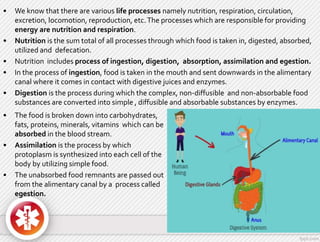
• In the process of ingestion, food is taken in the mouth and sent downwards in the alimentary
canal where it comes in contact with digestive juices and enzymes.
• Digestion is the process during which the complex, non-diffusible and non-absorbable food
substances are converted into simple , diffusible and absorbable substances by enzymes.
• The food is broken down into carbohydrates,
fats, proteins, minerals, vitamins which can be
absorbed in the blood stream.
• Assimilation is the process by which
protoplasm is synthesized into each cell of the
body by utilizing simple food.
• The unabsorbed food remnants are passed out
from the alimentary canal by a process called
egestion.
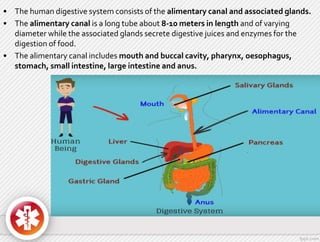
• The human digestive system consists of the alimentary canal and associated glands.
• The alimentary canal is a long tube about 8-10 meters in length and of varying
diameter while the associated glands secrete digestive juices and enzymes for the
digestion of food.
• The alimentary canal includes mouth and buccal cavity, pharynx, oesophagus,
stomach, small intestine, large intestine and anus.
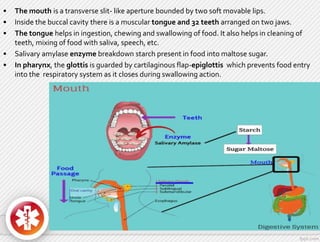
• The mouth is a transverse slit- like aperture bounded by two soft movable lips.
• Inside the buccal cavity there is a muscular tongue and 32 teeth arranged on two jaws.
• The tongue helps in ingestion, chewing and swallowing of food. It also helps in cleaning of
teeth, mixing of food with saliva, speech, etc.
• Salivary amylase enzyme breakdown starch present in food into maltose sugar.
• In pharynx, the glottis is guarded by cartilaginous flap-epiglottis which prevents food entry
into the respiratory system as it closes during swallowing action.
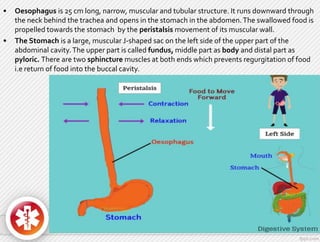
• Oesophagus is 25 cm long, narrow, muscular and tubular structure. It runs downward through
the neck behind the trachea and opens in the stomach in the abdomen.The swallowed food is
propelled towards the stomach by the peristalsis movement of its muscular wall.
• The Stomach is a large, muscular J-shaped sac on the left side of the upper part of the
abdominal cavity.The upper part is called fundus, middle part as body and distal part as
pyloric. There are two sphincture muscles at both ends which prevents regurgitation of food
i.e return of food into the buccal cavity.
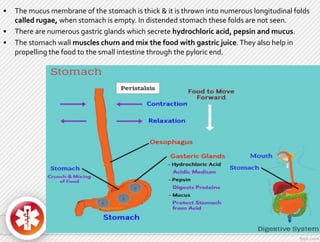
• The mucus membrane of the stomach is thick & it is thrown into numerous longitudinal folds
called rugae, when stomach is empty. In distended stomach these folds are not seen.
• There are numerous gastric glands which secrete hydrochloric acid, pepsin and mucus.
• The stomach wall muscles churn and mix the food with gastric juice.They also help in
propelling the food to the small intestine through the pyloric end.
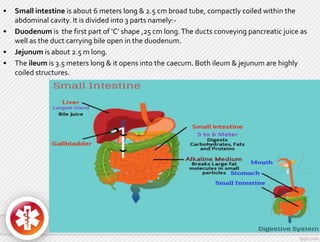
• Small intestine is about 6 meters long & 2.5 cm broad tube, compactly coiled within the
abdominal cavity. It is divided into 3 parts namely:-
• Duodenum is the first part of ‘C’ shape ,25 cm long.The ducts conveying pancreatic juice as
well as the duct carrying bile open in the duodenum.
• Jejunum is about 2.5 m long.
• The ileum is 3.5 meters long & it opens into the caecum. Both ileum & jejunum are highly
coiled structures.
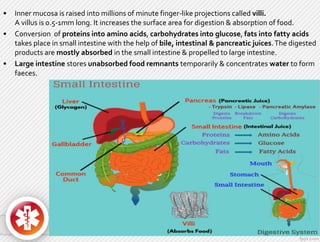
• Inner mucosa is raised into millions of minute finger-like projections called villi.
A villus is 0.5-1mm long. It increases the surface area for digestion & absorption of food.
• Conversion of proteins into amino acids, carbohydrates into glucose, fats into fatty acids
takes place in small intestine with the help of bile, intestinal & pancreatic juices.The digested
products are mostly absorbed in the small intestine & propelled to large intestine.
• Large intestine stores unabsorbed food remnants temporarily & concentrates water to form
faeces.
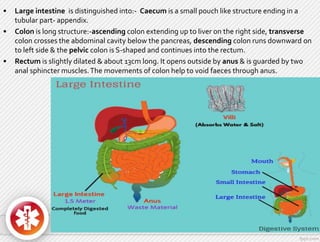
• Large intestine is distinguished into:- Caecum is a small pouch like structure ending in a
tubular part- appendix.
• Colon is long structure:-ascending colon extending up to liver on the right side, transverse
colon crosses the abdominal cavity below the pancreas, descending colon runs downward on
to left side & the pelvic colon is S-shaped and continues into the rectum.
• Rectum is slightly dilated & about 13cm long. It opens outside by anus & is guarded by two
anal sphincter muscles.The movements of colon help to void faeces through anus.
https://www.youtube.com/watch?v=_l8aLmomDPU&feature=youtu.be
Digestive system

Digestive system

  • 1.
    DIGESTIVE SYSTEM 205-17 BIOLOGY SONALBHARAL (218) S.Y.B.Ed TILAK COLLEGE OF EDUCATION
  • 2.
    • We knowthat there are various life processes namely nutrition, respiration, circulation, excretion, locomotion, reproduction, etc.The processes which are responsible for providing energy are nutrition and respiration. • Nutrition is the sum total of all processes through which food is taken in, digested, absorbed, utilized and defecation. • Nutrition includes process of ingestion, digestion, absorption, assimilation and egestion. • In the process of ingestion, food is taken in the mouth and sent downwards in the alimentary canal where it comes in contact with digestive juices and enzymes. • Digestion is the process during which the complex, non-diffusible and non-absorbable food substances are converted into simple , diffusible and absorbable substances by enzymes. • The food is broken down into carbohydrates, fats, proteins, minerals, vitamins which can be absorbed in the blood stream. • Assimilation is the process by which protoplasm is synthesized into each cell of the body by utilizing simple food. • The unabsorbed food remnants are passed out from the alimentary canal by a process called egestion.
  • 3.
    • The humandigestive system consists of the alimentary canal and associated glands. • The alimentary canal is a long tube about 8-10 meters in length and of varying diameter while the associated glands secrete digestive juices and enzymes for the digestion of food. • The alimentary canal includes mouth and buccal cavity, pharynx, oesophagus, stomach, small intestine, large intestine and anus.
  • 4.
    • The mouthis a transverse slit- like aperture bounded by two soft movable lips. • Inside the buccal cavity there is a muscular tongue and 32 teeth arranged on two jaws. • The tongue helps in ingestion, chewing and swallowing of food. It also helps in cleaning of teeth, mixing of food with saliva, speech, etc. • Salivary amylase enzyme breakdown starch present in food into maltose sugar. • In pharynx, the glottis is guarded by cartilaginous flap-epiglottis which prevents food entry into the respiratory system as it closes during swallowing action.
  • 5.
    • Oesophagus is25 cm long, narrow, muscular and tubular structure. It runs downward through the neck behind the trachea and opens in the stomach in the abdomen.The swallowed food is propelled towards the stomach by the peristalsis movement of its muscular wall. • The Stomach is a large, muscular J-shaped sac on the left side of the upper part of the abdominal cavity.The upper part is called fundus, middle part as body and distal part as pyloric. There are two sphincture muscles at both ends which prevents regurgitation of food i.e return of food into the buccal cavity.
  • 6.
    • The mucusmembrane of the stomach is thick & it is thrown into numerous longitudinal folds called rugae, when stomach is empty. In distended stomach these folds are not seen. • There are numerous gastric glands which secrete hydrochloric acid, pepsin and mucus. • The stomach wall muscles churn and mix the food with gastric juice.They also help in propelling the food to the small intestine through the pyloric end.
  • 7.
    • Small intestineis about 6 meters long & 2.5 cm broad tube, compactly coiled within the abdominal cavity. It is divided into 3 parts namely:- • Duodenum is the first part of ‘C’ shape ,25 cm long.The ducts conveying pancreatic juice as well as the duct carrying bile open in the duodenum. • Jejunum is about 2.5 m long. • The ileum is 3.5 meters long & it opens into the caecum. Both ileum & jejunum are highly coiled structures.
  • 8.
    • Inner mucosais raised into millions of minute finger-like projections called villi. A villus is 0.5-1mm long. It increases the surface area for digestion & absorption of food. • Conversion of proteins into amino acids, carbohydrates into glucose, fats into fatty acids takes place in small intestine with the help of bile, intestinal & pancreatic juices.The digested products are mostly absorbed in the small intestine & propelled to large intestine. • Large intestine stores unabsorbed food remnants temporarily & concentrates water to form faeces.
  • 9.
    • Large intestineis distinguished into:- Caecum is a small pouch like structure ending in a tubular part- appendix. • Colon is long structure:-ascending colon extending up to liver on the right side, transverse colon crosses the abdominal cavity below the pancreas, descending colon runs downward on to left side & the pelvic colon is S-shaped and continues into the rectum. • Rectum is slightly dilated & about 13cm long. It opens outside by anus & is guarded by two anal sphincter muscles.The movements of colon help to void faeces through anus.
  • 10.