

TYLER MODEL CURRICULUM
SHAILIJA BHANDALKAR(217) SONAL BHARAL (218)
B.ED 202 KNOWLEDGE AND CURRICULUM
TILAK COLLEGE OF EDUCATION
INTRODUCTION
 Ralph Tyler in the book ‘Basic Principles of Curriculum and
Instruction’ (1949) formalized his thoughts known as the Tyler Rationale:
• What educational purposes should the school seek to attain? (Defining
appropriate learning objectives)
• How can learning experiences be selected which are likely to be useful in
attaining these objectives? (Introducing useful learning experiences)
• How can learning experiences be organized for effective instruction?
(Organizing experiences to maximize their effect)
• How can the effectiveness of learning experiences be evaluated?
(Evaluating the process and revising the areas that were not effective)
• In this book, Tyler describes learning as taking place through the action of
the student. "It is what he does that he learns, not what the teacher does"
(Tyler p. 63)
TYLER’S RATIONALE
1. Defining appropriate learning objectives
 Tyler’s model obtains the curriculum objectives from three sources:
• the student
• the society
• the subject content
 Emphasizes the importance of studying the child to find out
• kinds of interests
• problems encountered
• purpose to be served
 Tyler believed that these curriculum objectives if not addressed would not
result in creation of the best curriculum
TYLER’S RATIONALE
2. Introducing useful learning experiences (Denham, 2002)
 Students learn through exploration
 Teachers should encourage children and provide opportunities to be
actively engaged.
 The student-centered approach to learning
3.Organizing Effective Learning Experiences (Denham, 2002)
 Students need concrete experiences which are useful and meaningfully
connected.
 The model focus primarily on the product rather than the process for
achieving the goals and objectives of the curriculum.
 Three major criteria are required in building organized learning
experiences: continuity, sequence and integration
TYLER’S RATIONALE
4. Evaluating the process and revising the areas that were not effective
 Tyler regarded evaluation as the process of determining the extent to
which the objectives of a project are actually attained.
 He proposed that to evaluate a project he/ she must:
• Establish broad goals or objectives of that project
• Classify the goals or the objectives
• Define those objectives in measurable terms
• Find situations in which achievement of objectives can be shown
• Develop or select measurement techniques
• Collect performance data
• Compare performance data with measurable terms stated
TYLER’S MODEL
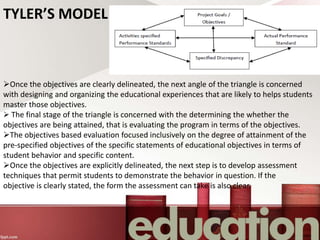
Once the objectives are clearly delineated, the next angle of the triangle is concerned
with designing and organizing the educational experiences that are likely to helps students
master those objectives.
 The final stage of the triangle is concerned with the determining the whether the
objectives are being attained, that is evaluating the program in terms of the objectives.
The objectives based evaluation focused inclusively on the degree of attainment of the
pre-specified objectives of the specific statements of educational objectives in terms of
student behavior and specific content.
Once the objectives are explicitly delineated, the next step is to develop assessment
techniques that permit students to demonstrate the behavior in question. If the
objective is clearly stated, the form the assessment can take is also clear.
ADMINISTRATION
 Once measures of the objectives are developed, they are administered as
pre- test to students before the programs begins.
 The pre-test provides a baseline to compare performance at the end of the
programs , when the students take the post- test.
 Change in percentage from pre- test to post- test of the students mastering
each objective become the key criteria of the program’s success.
CRITICISM
 Narrowly interpreted objectives.
 Difficult and time consuming construction of behavioral objectives.
 Curriculum restricted to a constricted range of student skills and
knowledge
 Critical thinking, problem solving and value acquiring processes
cannot be plainly declared in behavioral objectives .
 Learning experiences are individual and are not totally within the
power of the teacher to select.
 The teacher cannot control the learning experience through the
manipulation of the environment, which would result in stimulating
situations sufficient to evoke the kind of learning outcomes desired.
ADVANTAGES
 The model is widely used and credible for answering whether a program has
met its goals.
 It forces program personnel to be clear about their intended outcomes and is
used to hold them accountable for attainment or outcomes.
 It minimizes disruption and instruction on the part of the evaluator, who only
appear briefly to administer tests.
 The objectives are relatively inexpensive, particularly when standardized
machine scored tests are used.
 It provides easily quantifiable, easy to assess objectives information about
student performance.
 The model checks the degree of congruency between performance and
objective.
 The model focuses on clear definition of the objectives
 It is easy to understand in terms of implementation
 It produces relevant information of the project
LIMITATIONS
 The problem is that main goals cannot be specified in terms of easily
measured behavioral objectives.
 Most of the behavioral objectives are often a difficult process involving
complex issues of feasibility, reliability, and validity.
 Program often have unintended outcomes that may be more important
than the goals of a program either positively or negatively.
 It has a tendency to focus directly and narrowly on objectives with the
little attention on the worth of the objectives.
 It neglect the context in which the evaluation is taking place
 It ignores important unplanned and focuses only on stated objectives.
 It promotes linear, inflexible approach to evaluation.
 There is a tendency to oversimplify project and tendency to focus on
terminal rather than on –going and pre-project information.
 It does not consider how the activities lead to achievement of project
objectives are carried.
QUESTIONS
THANKYOU

Tyler model

  • 1.
    TYLER MODEL CURRICULUM SHAILIJABHANDALKAR(217) SONAL BHARAL (218) B.ED 202 KNOWLEDGE AND CURRICULUM TILAK COLLEGE OF EDUCATION
  • 2.
    INTRODUCTION  Ralph Tylerin the book ‘Basic Principles of Curriculum and Instruction’ (1949) formalized his thoughts known as the Tyler Rationale: • What educational purposes should the school seek to attain? (Defining appropriate learning objectives) • How can learning experiences be selected which are likely to be useful in attaining these objectives? (Introducing useful learning experiences) • How can learning experiences be organized for effective instruction? (Organizing experiences to maximize their effect) • How can the effectiveness of learning experiences be evaluated? (Evaluating the process and revising the areas that were not effective) • In this book, Tyler describes learning as taking place through the action of the student. "It is what he does that he learns, not what the teacher does" (Tyler p. 63)
  • 3.
    TYLER’S RATIONALE 1. Definingappropriate learning objectives  Tyler’s model obtains the curriculum objectives from three sources: • the student • the society • the subject content  Emphasizes the importance of studying the child to find out • kinds of interests • problems encountered • purpose to be served  Tyler believed that these curriculum objectives if not addressed would not result in creation of the best curriculum
  • 4.
    TYLER’S RATIONALE 2. Introducinguseful learning experiences (Denham, 2002)  Students learn through exploration  Teachers should encourage children and provide opportunities to be actively engaged.  The student-centered approach to learning 3.Organizing Effective Learning Experiences (Denham, 2002)  Students need concrete experiences which are useful and meaningfully connected.  The model focus primarily on the product rather than the process for achieving the goals and objectives of the curriculum.  Three major criteria are required in building organized learning experiences: continuity, sequence and integration
  • 5.
    TYLER’S RATIONALE 4. Evaluatingthe process and revising the areas that were not effective  Tyler regarded evaluation as the process of determining the extent to which the objectives of a project are actually attained.  He proposed that to evaluate a project he/ she must: • Establish broad goals or objectives of that project • Classify the goals or the objectives • Define those objectives in measurable terms • Find situations in which achievement of objectives can be shown • Develop or select measurement techniques • Collect performance data • Compare performance data with measurable terms stated
  • 6.
    TYLER’S MODEL Once theobjectives are clearly delineated, the next angle of the triangle is concerned with designing and organizing the educational experiences that are likely to helps students master those objectives.  The final stage of the triangle is concerned with the determining the whether the objectives are being attained, that is evaluating the program in terms of the objectives. The objectives based evaluation focused inclusively on the degree of attainment of the pre-specified objectives of the specific statements of educational objectives in terms of student behavior and specific content. Once the objectives are explicitly delineated, the next step is to develop assessment techniques that permit students to demonstrate the behavior in question. If the objective is clearly stated, the form the assessment can take is also clear.
  • 7.
    ADMINISTRATION  Once measuresof the objectives are developed, they are administered as pre- test to students before the programs begins.  The pre-test provides a baseline to compare performance at the end of the programs , when the students take the post- test.  Change in percentage from pre- test to post- test of the students mastering each objective become the key criteria of the program’s success.
  • 8.
    CRITICISM  Narrowly interpretedobjectives.  Difficult and time consuming construction of behavioral objectives.  Curriculum restricted to a constricted range of student skills and knowledge  Critical thinking, problem solving and value acquiring processes cannot be plainly declared in behavioral objectives .  Learning experiences are individual and are not totally within the power of the teacher to select.  The teacher cannot control the learning experience through the manipulation of the environment, which would result in stimulating situations sufficient to evoke the kind of learning outcomes desired.
  • 9.
    ADVANTAGES  The modelis widely used and credible for answering whether a program has met its goals.  It forces program personnel to be clear about their intended outcomes and is used to hold them accountable for attainment or outcomes.  It minimizes disruption and instruction on the part of the evaluator, who only appear briefly to administer tests.  The objectives are relatively inexpensive, particularly when standardized machine scored tests are used.  It provides easily quantifiable, easy to assess objectives information about student performance.  The model checks the degree of congruency between performance and objective.  The model focuses on clear definition of the objectives  It is easy to understand in terms of implementation  It produces relevant information of the project
  • 10.
    LIMITATIONS  The problemis that main goals cannot be specified in terms of easily measured behavioral objectives.  Most of the behavioral objectives are often a difficult process involving complex issues of feasibility, reliability, and validity.  Program often have unintended outcomes that may be more important than the goals of a program either positively or negatively.  It has a tendency to focus directly and narrowly on objectives with the little attention on the worth of the objectives.  It neglect the context in which the evaluation is taking place  It ignores important unplanned and focuses only on stated objectives.  It promotes linear, inflexible approach to evaluation.  There is a tendency to oversimplify project and tendency to focus on terminal rather than on –going and pre-project information.  It does not consider how the activities lead to achievement of project objectives are carried.
  • 11.