HUMAN DIGESTIVE SYSTEM
Arif Fahmi
MOUTH
• Food starts its journey from the mouth or coral cavity.
• There are many other organs that contribute to the digestion
process, including:
• Teeth
• Salivary glands
• Tounge
• Teeth are designed to for grinding food particles into small
pieces and moistened with saliva before the tounge pushes
the food into pharynx.
PHARYNX
• A fibromuscular y-shaped tube attached to the terminal
end of the mouth.
• It is mainly involve in the passage of chewed/crushed
food from the mouth through the oesophagus.
• It also has a major part in the respiratory system, as air
travels through the pharynx from the nasal cavity on its
way to the lungs.
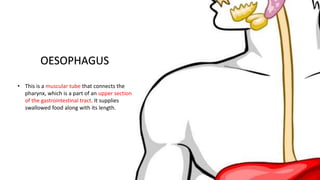
OESOPHAGUS
• This is a muscular tube that connects the
pharynx, which is a part of an upper section
of the gastrointestinal tract. It supplies
swallowed food along with its length.
STOMACH
• It serves as a muscular bag which is situated
towards the left side of the abdominal cavity,
beneath the diaphragm.
• This vital organ acts as a storage for the food
and provides enough time to digest meals.
• The stomach also produces digestive enzymes
and hydrochloric acid that maintains the process
of digestion.
• Mucus: It is a protective barrier to stomach acid,
bile salts, pancreatic enzymes, macromolecules.
The mucus lining your stomach helps prevent
your stomach from the negative effects of
excessive exposure to acid or pepsin.
• Pepsin : Break down proteins
STOMACH
• Hydrochloric acid: Main component of the
gastric juices an it maintans the stomach pH of 1
to 2.
STOMACH
SMALL INTESTINE
• A thin long tube for about 10 feet long and a
part of the lower gastrointestinal tract.
• It is present just behind the stomach and
acquires a maximum area of the abdominal
cavity.
• The complete small intestine is coiled and the
inner surface consists of folds and ridges.
LARGE INTESTINE
• A slurry of digested food, known as chyme,
enters the large intestine from the small
intestine via the ileocecal sphincter.
• Large intestine converting food into feces,
absorbing essential vitamins produced by gut
bacteria, and reclaiming water from feces.
RECTUM
• Rectum holds the feces until you push it out of
the body, through the anal canal, by having a
bowel movement.

Human Digestive System

  • 1.
  • 3.
    MOUTH • Food startsits journey from the mouth or coral cavity. • There are many other organs that contribute to the digestion process, including: • Teeth • Salivary glands • Tounge • Teeth are designed to for grinding food particles into small pieces and moistened with saliva before the tounge pushes the food into pharynx.
  • 4.
    PHARYNX • A fibromusculary-shaped tube attached to the terminal end of the mouth. • It is mainly involve in the passage of chewed/crushed food from the mouth through the oesophagus. • It also has a major part in the respiratory system, as air travels through the pharynx from the nasal cavity on its way to the lungs.
  • 5.
    OESOPHAGUS • This isa muscular tube that connects the pharynx, which is a part of an upper section of the gastrointestinal tract. It supplies swallowed food along with its length.
  • 6.
    STOMACH • It servesas a muscular bag which is situated towards the left side of the abdominal cavity, beneath the diaphragm. • This vital organ acts as a storage for the food and provides enough time to digest meals. • The stomach also produces digestive enzymes and hydrochloric acid that maintains the process of digestion.
  • 7.
    • Mucus: Itis a protective barrier to stomach acid, bile salts, pancreatic enzymes, macromolecules. The mucus lining your stomach helps prevent your stomach from the negative effects of excessive exposure to acid or pepsin. • Pepsin : Break down proteins STOMACH
  • 8.
    • Hydrochloric acid:Main component of the gastric juices an it maintans the stomach pH of 1 to 2. STOMACH
  • 9.
    SMALL INTESTINE • Athin long tube for about 10 feet long and a part of the lower gastrointestinal tract. • It is present just behind the stomach and acquires a maximum area of the abdominal cavity. • The complete small intestine is coiled and the inner surface consists of folds and ridges.
  • 10.
    LARGE INTESTINE • Aslurry of digested food, known as chyme, enters the large intestine from the small intestine via the ileocecal sphincter. • Large intestine converting food into feces, absorbing essential vitamins produced by gut bacteria, and reclaiming water from feces.
  • 11.
    RECTUM • Rectum holdsthe feces until you push it out of the body, through the anal canal, by having a bowel movement.