Chapter 3
Linear Equations, Inequalities,
Quadratic Equations, and Applications
MATH 020
Dr. Farhana Shaheen
1
Chapter3
Linear Equations, Inequalities,
Quadratic Equations, and
Applications
• 3.1 Linear Equations in One Variable
• 3.2 Applications of Linear Equations
• 3.3 Linear Inequalities in One Variable
• 3.4 Quadratic Equations
2
3.1
3
3.1 – Linear Equations in One Variable
Solve linear equations involving
fractions
Application of Linear Equations
Objective – Solve linear equations using properties of equality.
-Solve linear equations that can be simplified by combining like terms.
4
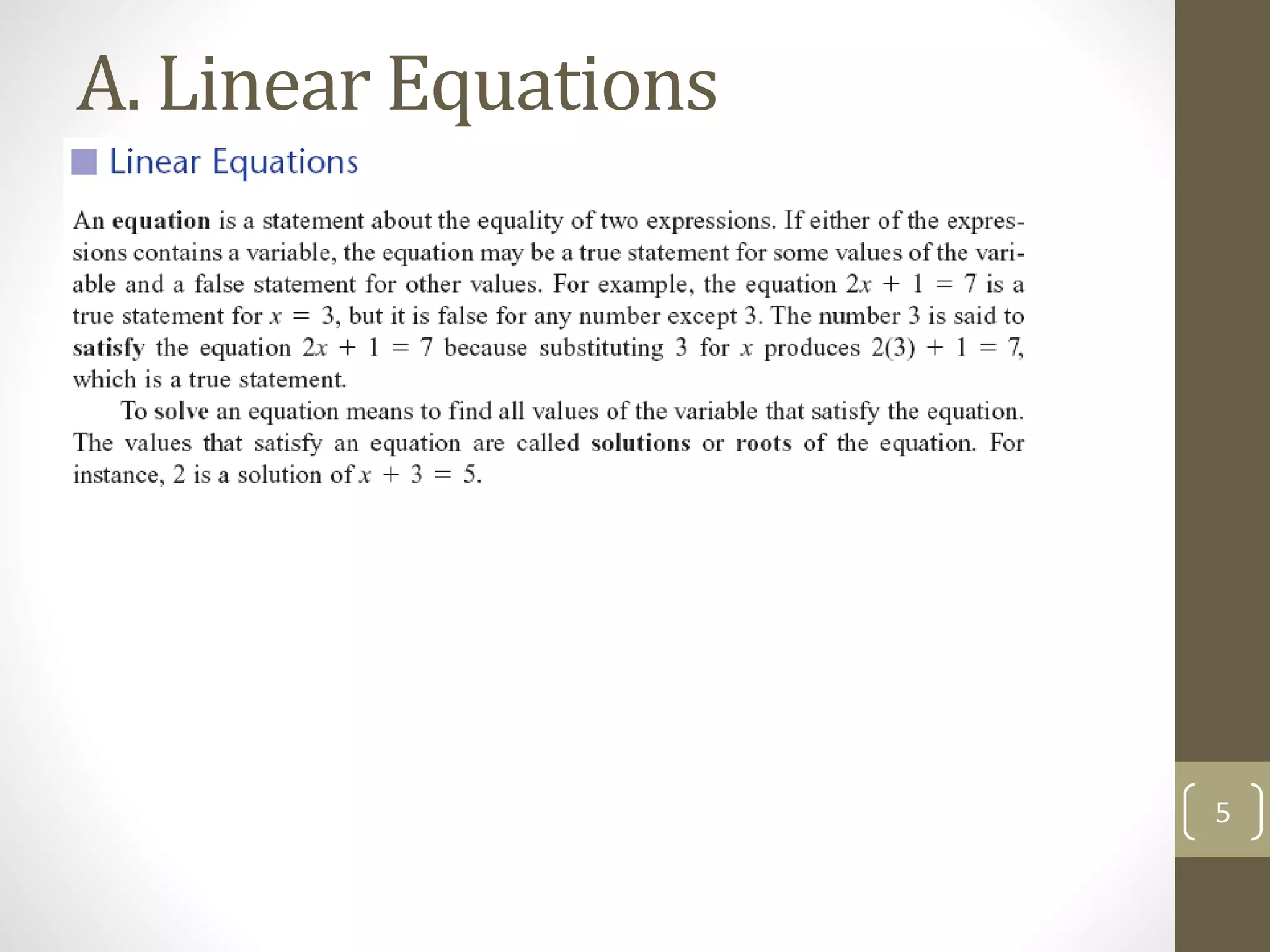
A. Linear Equations
5
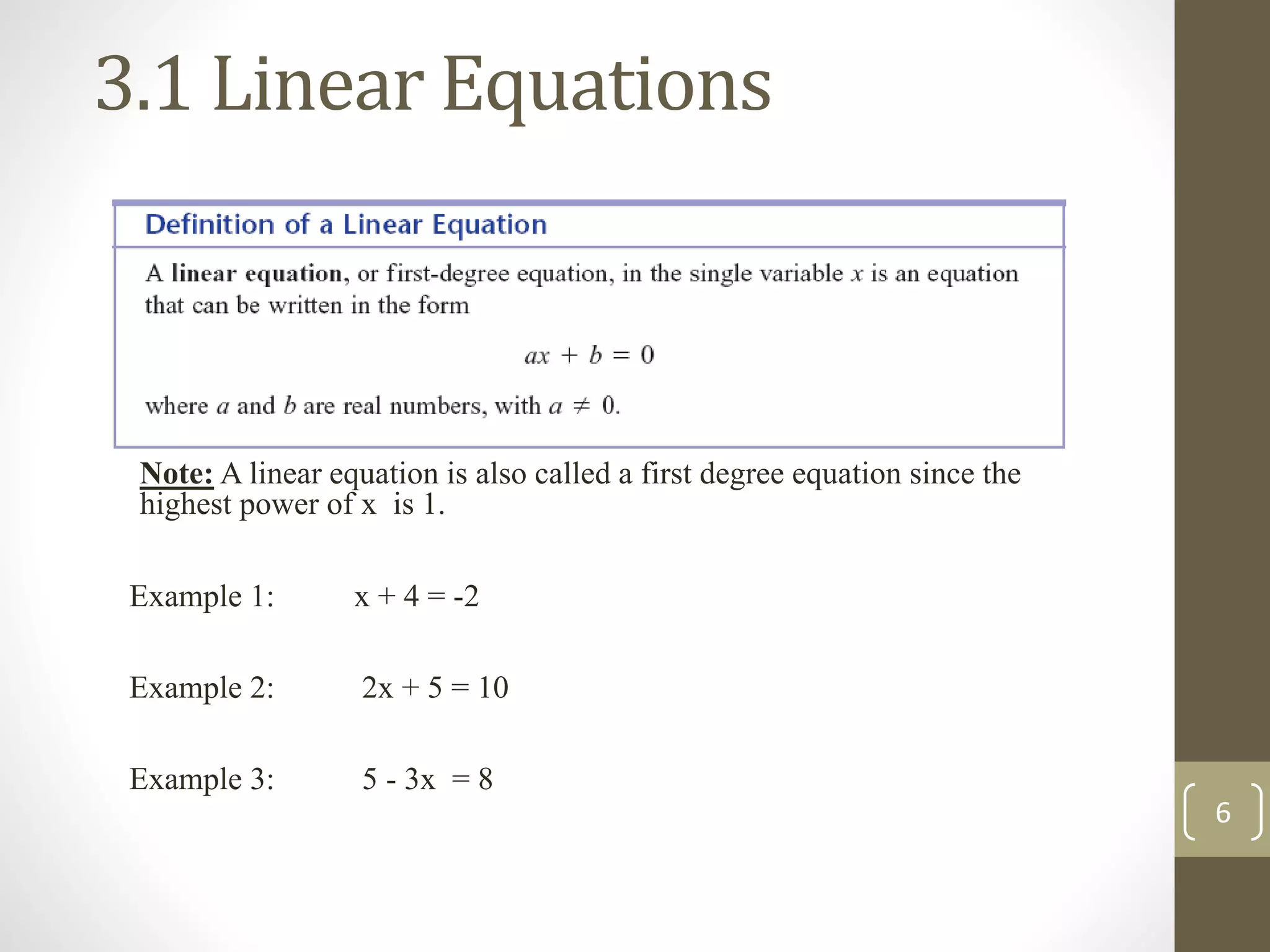
3.1 Linear Equations
Example 1: x + 4 = -2
Example 2: 2x + 5 = 10
Example 3: 5 - 3x = 8
Note: A linear equation is also called a first degree equation since the
highest power of x is 1.
6
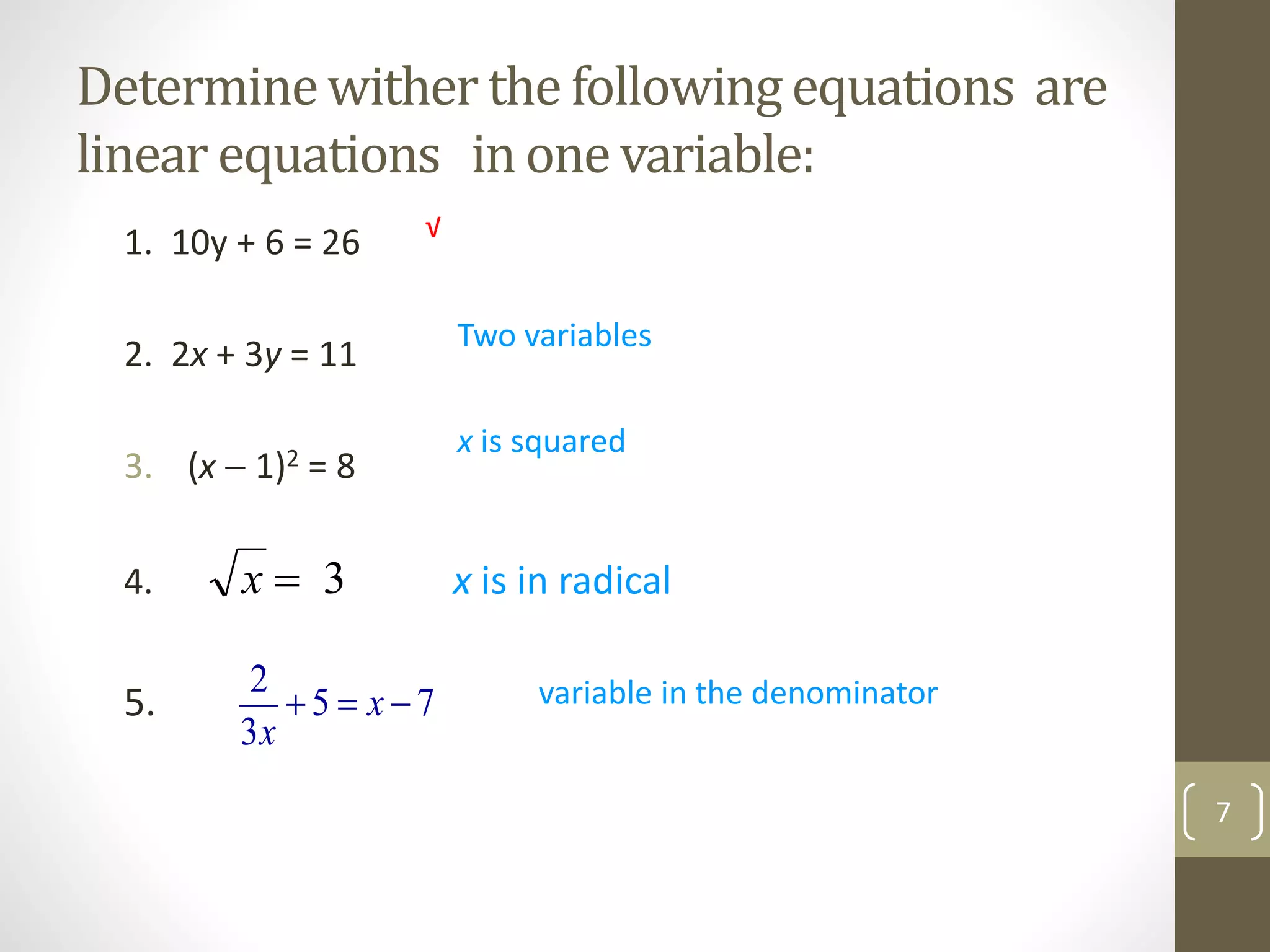
Determinewither the followingequations are
linear equations in one variable:
1. 10y + 6 = 26
2. 2x + 3y = 11
3. (x  1)2 = 8
4. x is in radical
5. 75
3
2
 x
x
Two variables
x is squared
variable in the denominator
√
7
3x
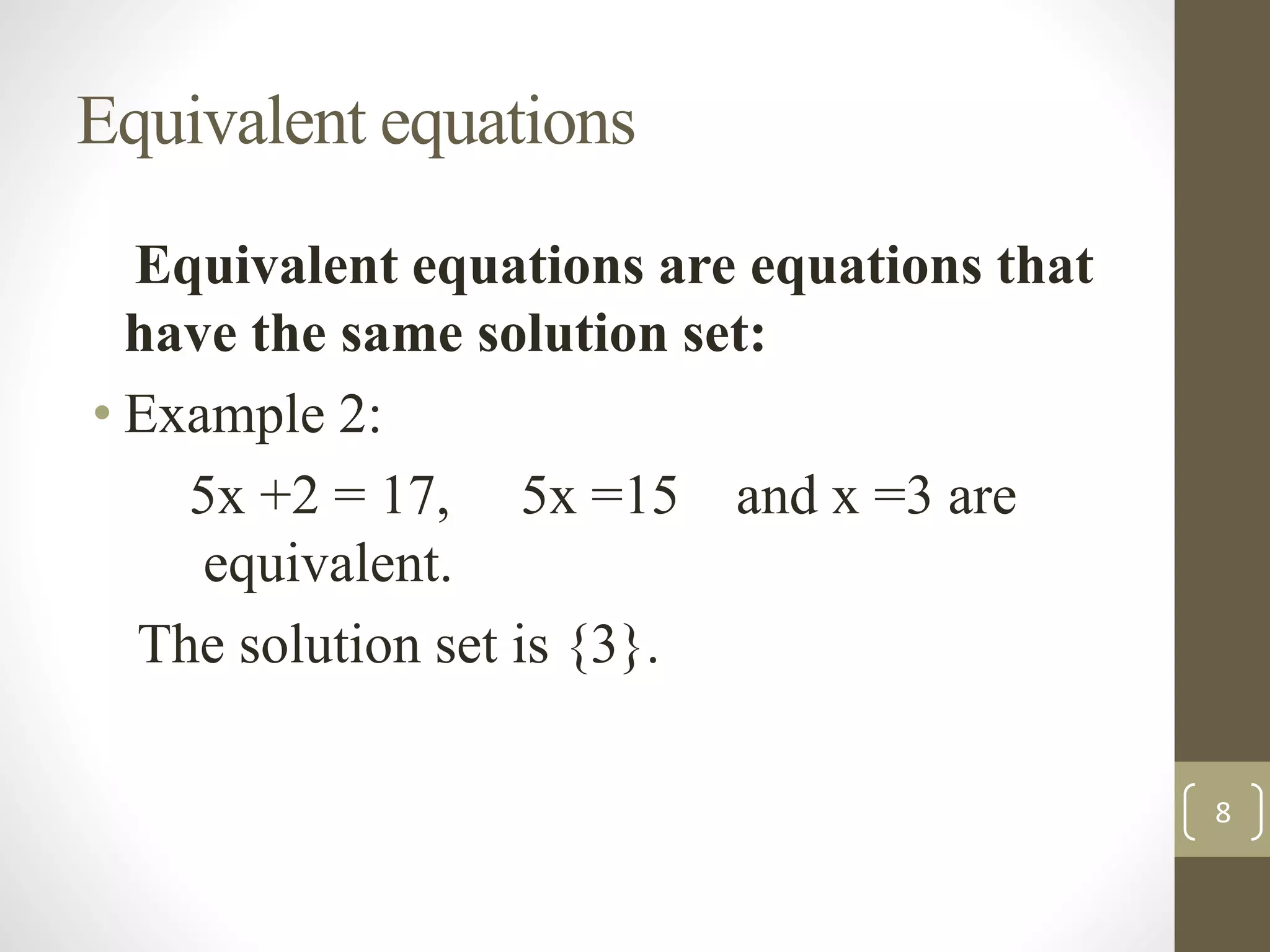
Equivalent equations
Equivalent equations are equations that
have the same solution set:
• Example 2:
5x +2 = 17, 5x =15 and x =3 are
equivalent.
The solution set is {3}.
8
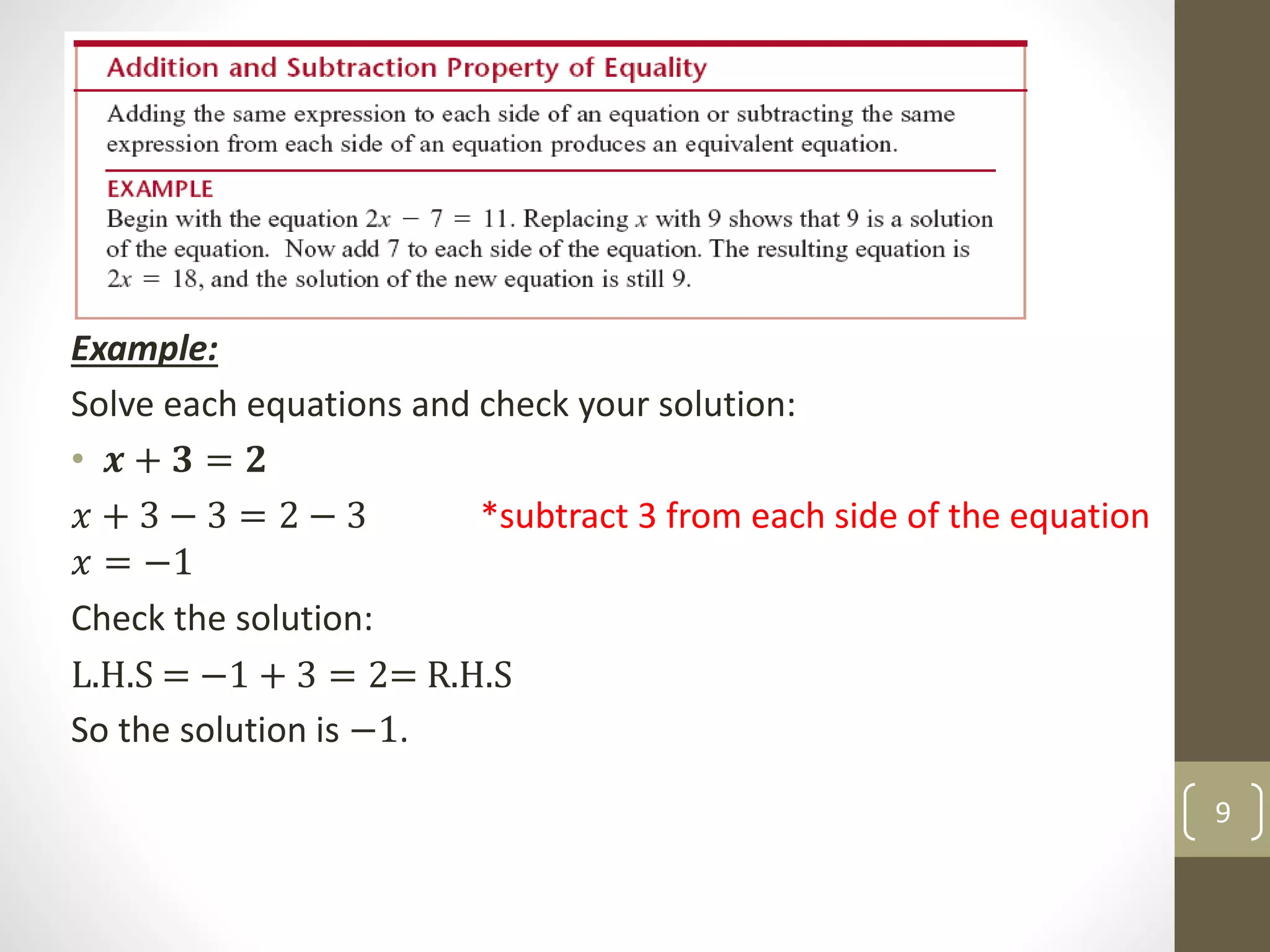
Example:
Solve each equations and check your solution:
• 𝒙 + 𝟑 = 𝟐
𝑥 + 3 − 3 = 2 − 3 *subtract 3 from each side of the equation
𝑥 = −1
Check the solution:
L.H.S = −1 + 3 = 2= R.H.S
So the solution is −1.
9
•
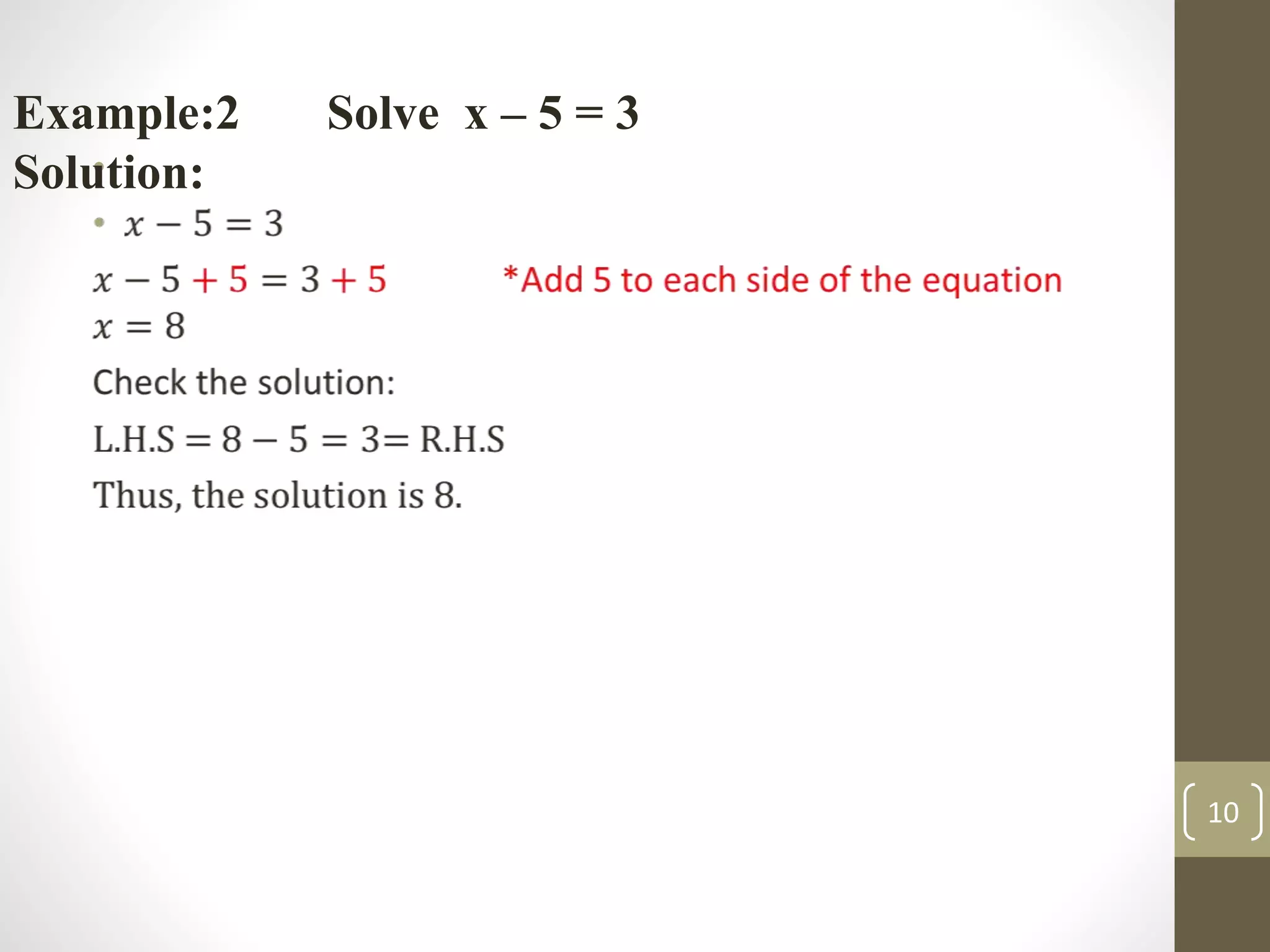
Example:2 Solve x – 5 = 3
Solution:
10
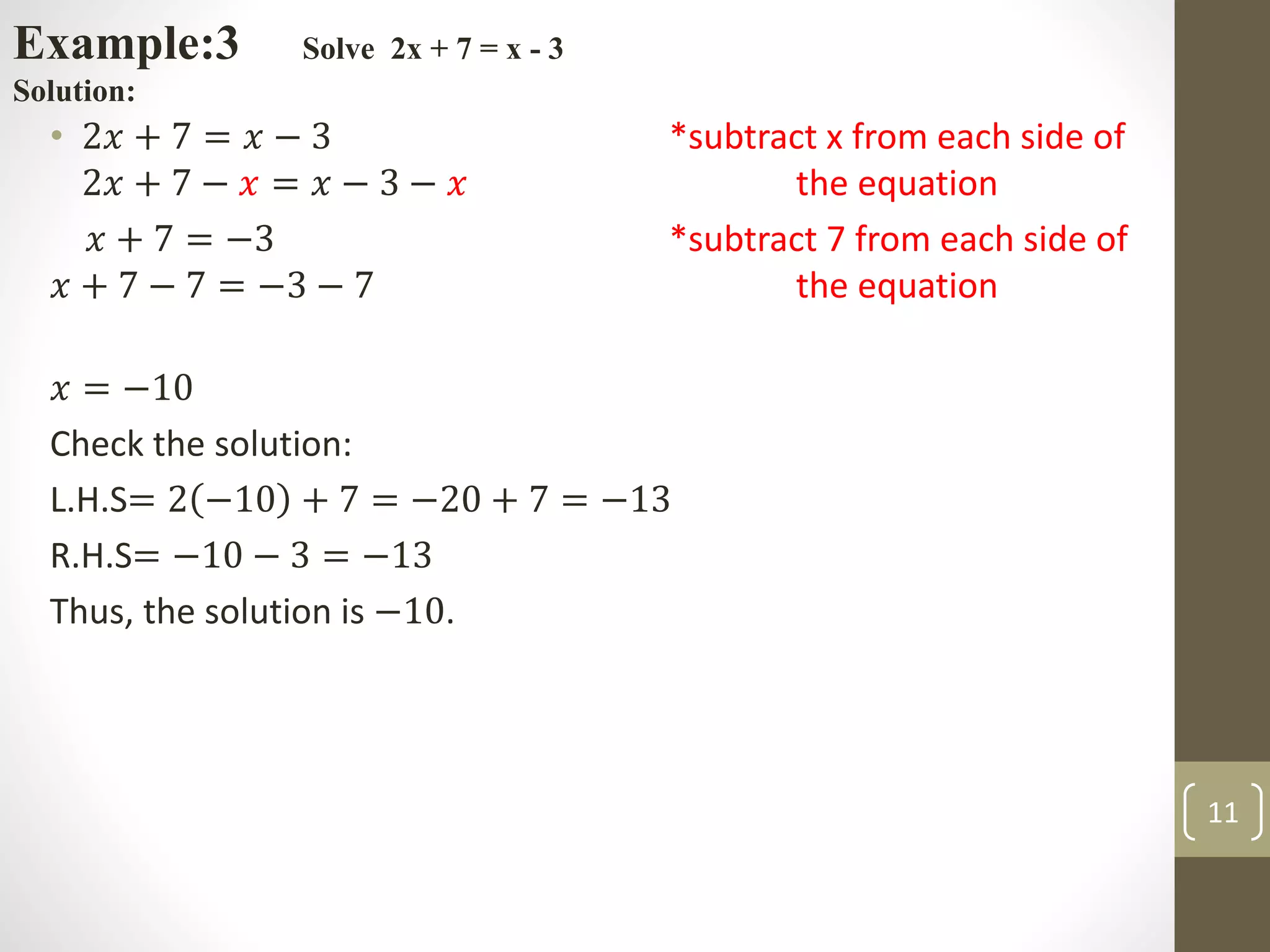
• 2𝑥 + 7 = 𝑥 − 3 *subtract x from each side of
2𝑥 + 7 − 𝑥 = 𝑥 − 3 − 𝑥 the equation
𝑥 + 7 = −3 *subtract 7 from each side of
𝑥 + 7 − 7 = −3 − 7 the equation
𝑥 = −10
Check the solution:
L.H.S= 2 −10 + 7 = −20 + 7 = −13
R.H.S= −10 − 3 = −13
Thus, the solution is −10.
Example:3 Solve 2x + 7 = x - 3
Solution:
11
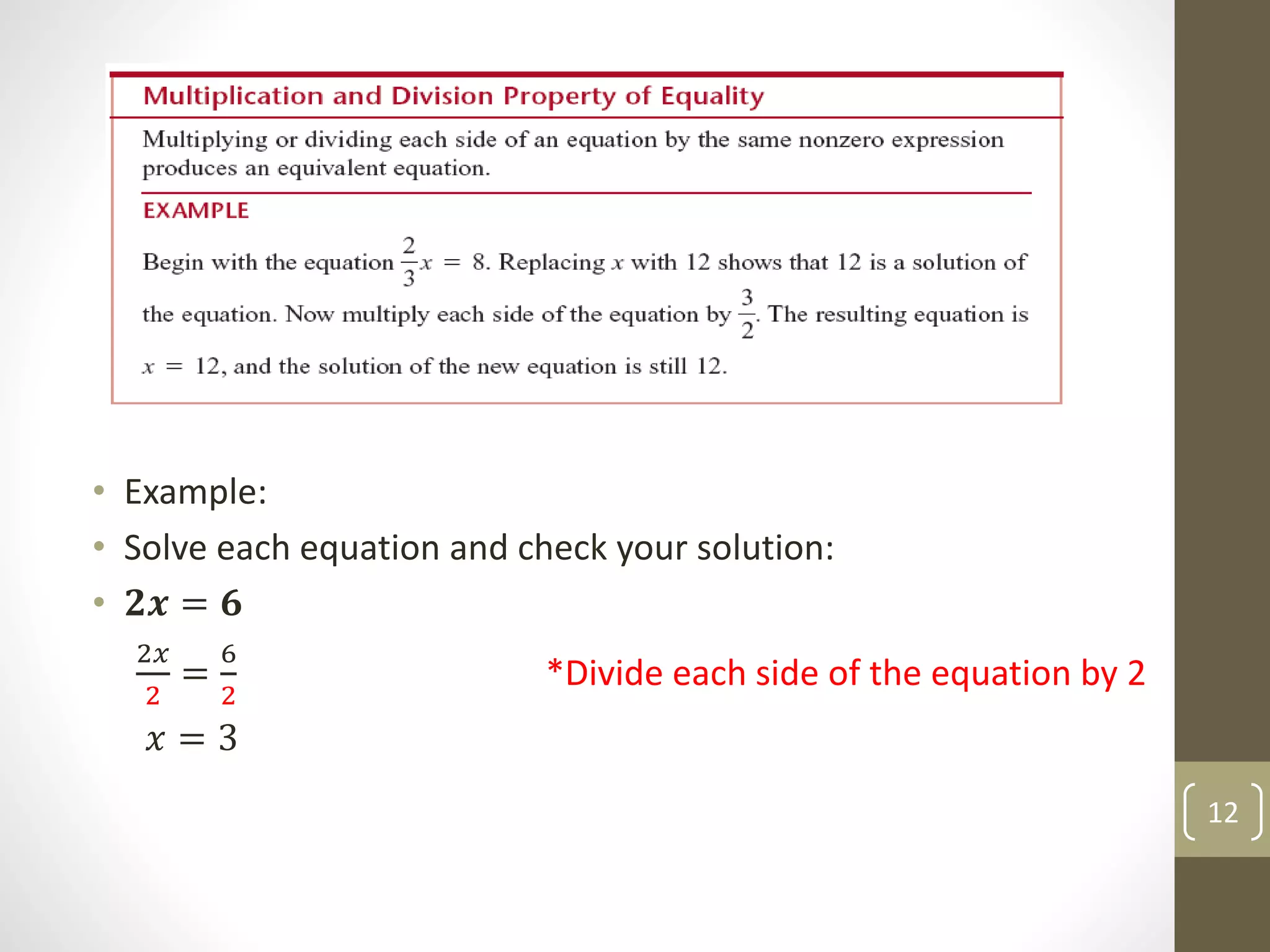
• Example:
• Solve each equation and check your solution:
• 𝟐𝒙 = 𝟔
2𝑥
2
=
6
2
*Divide each side of the equation by 2
𝑥 = 3
12
•
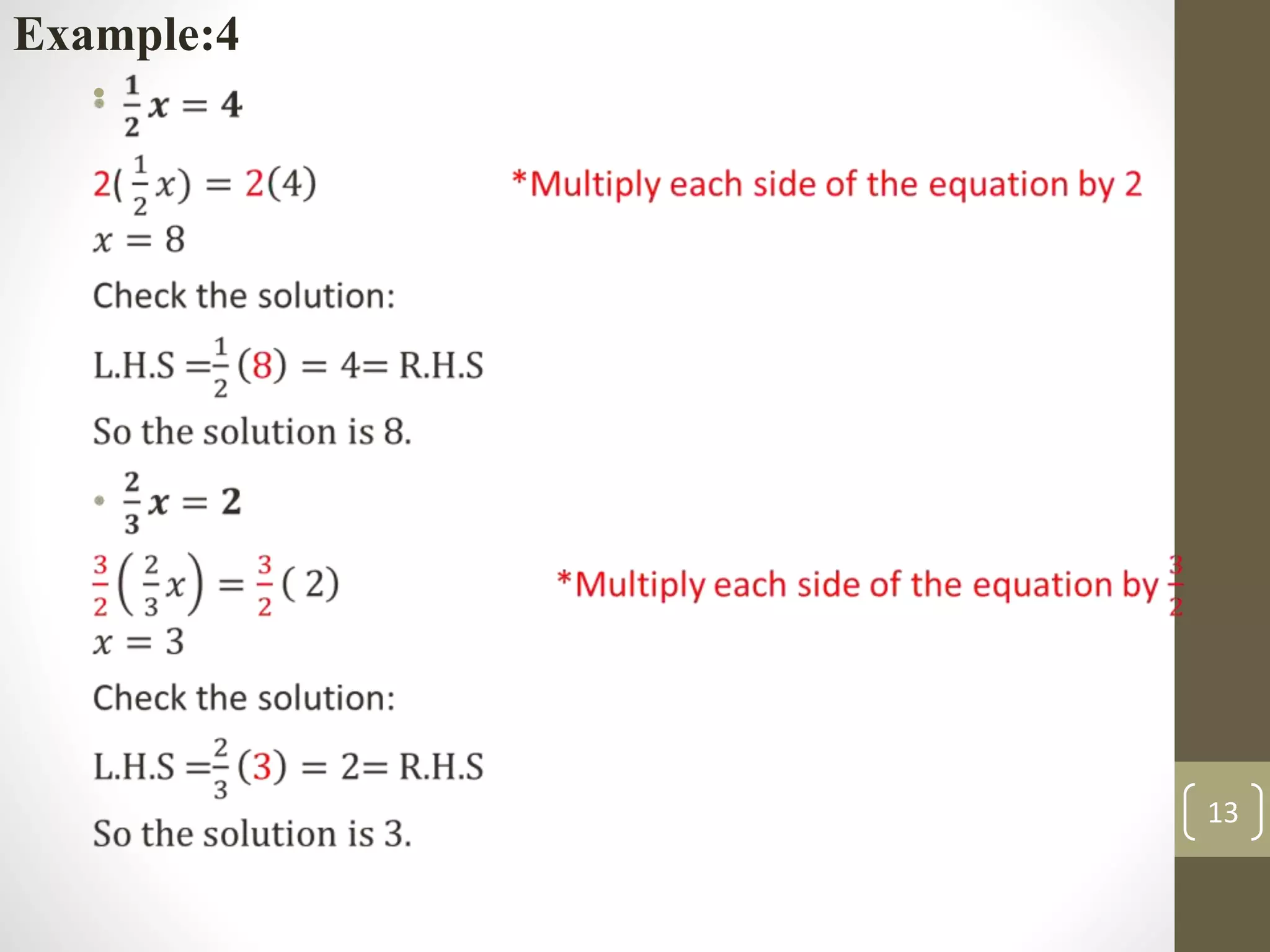
Example:4
13
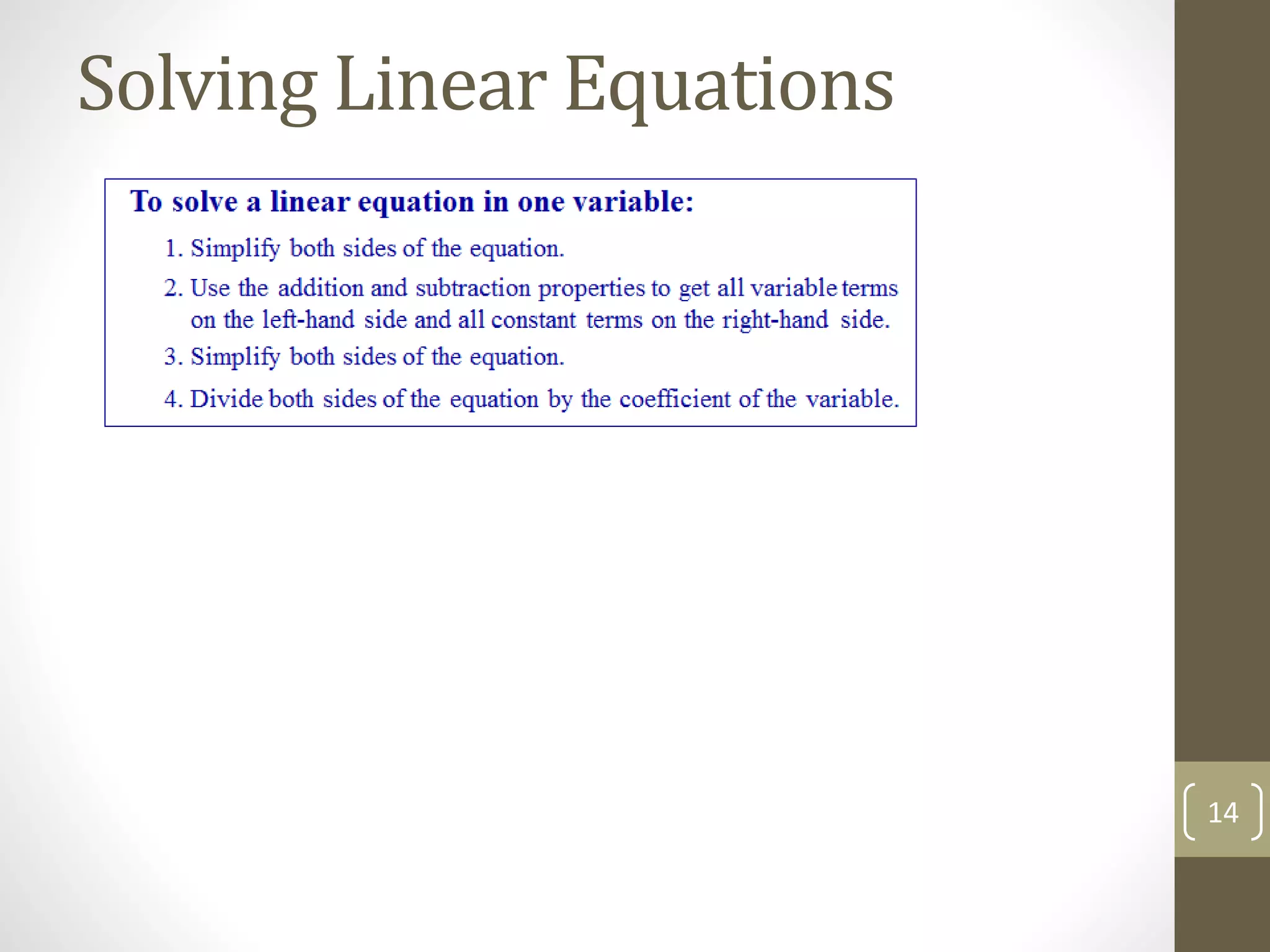
Solving Linear Equations
14
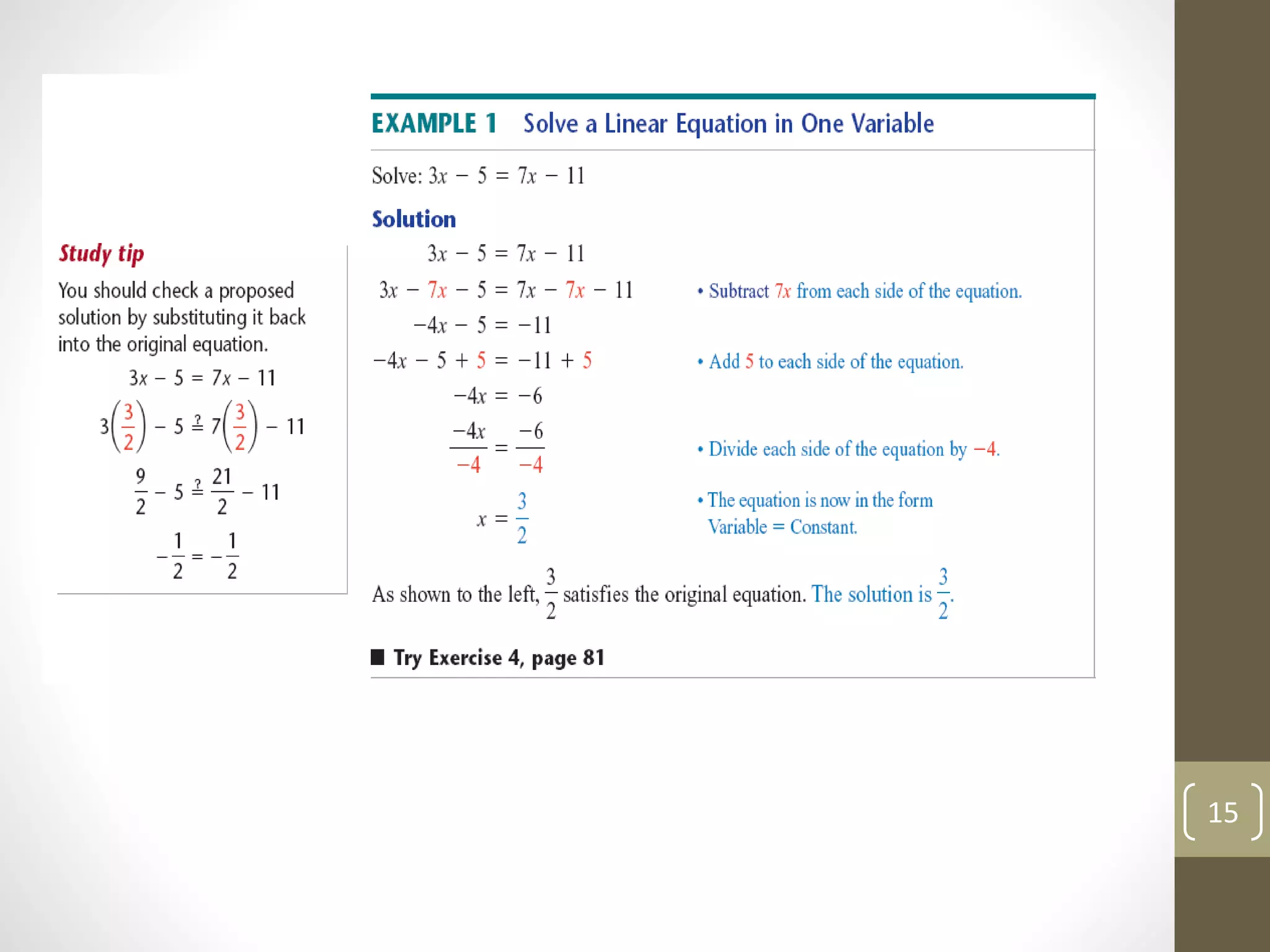
15
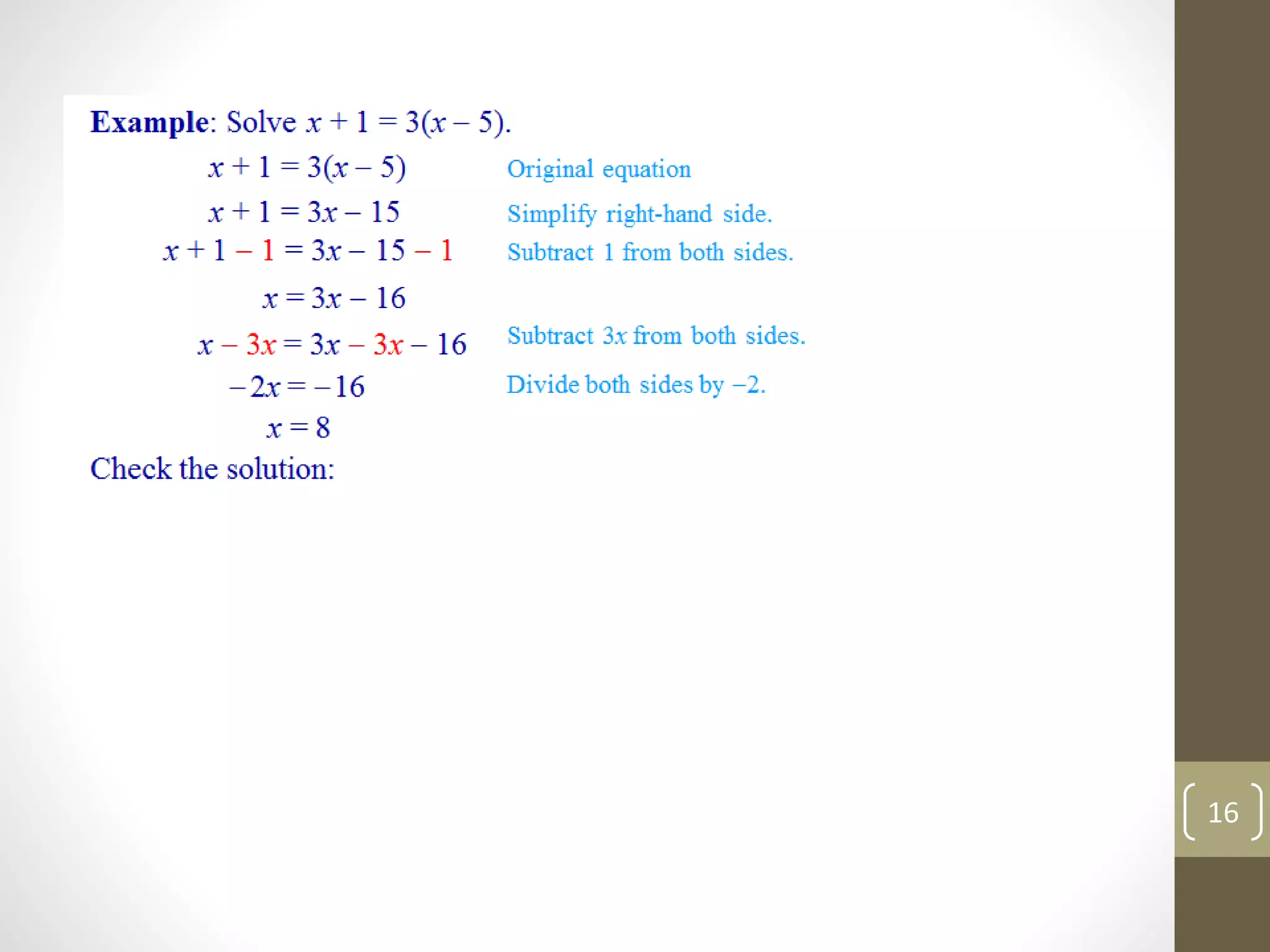
16
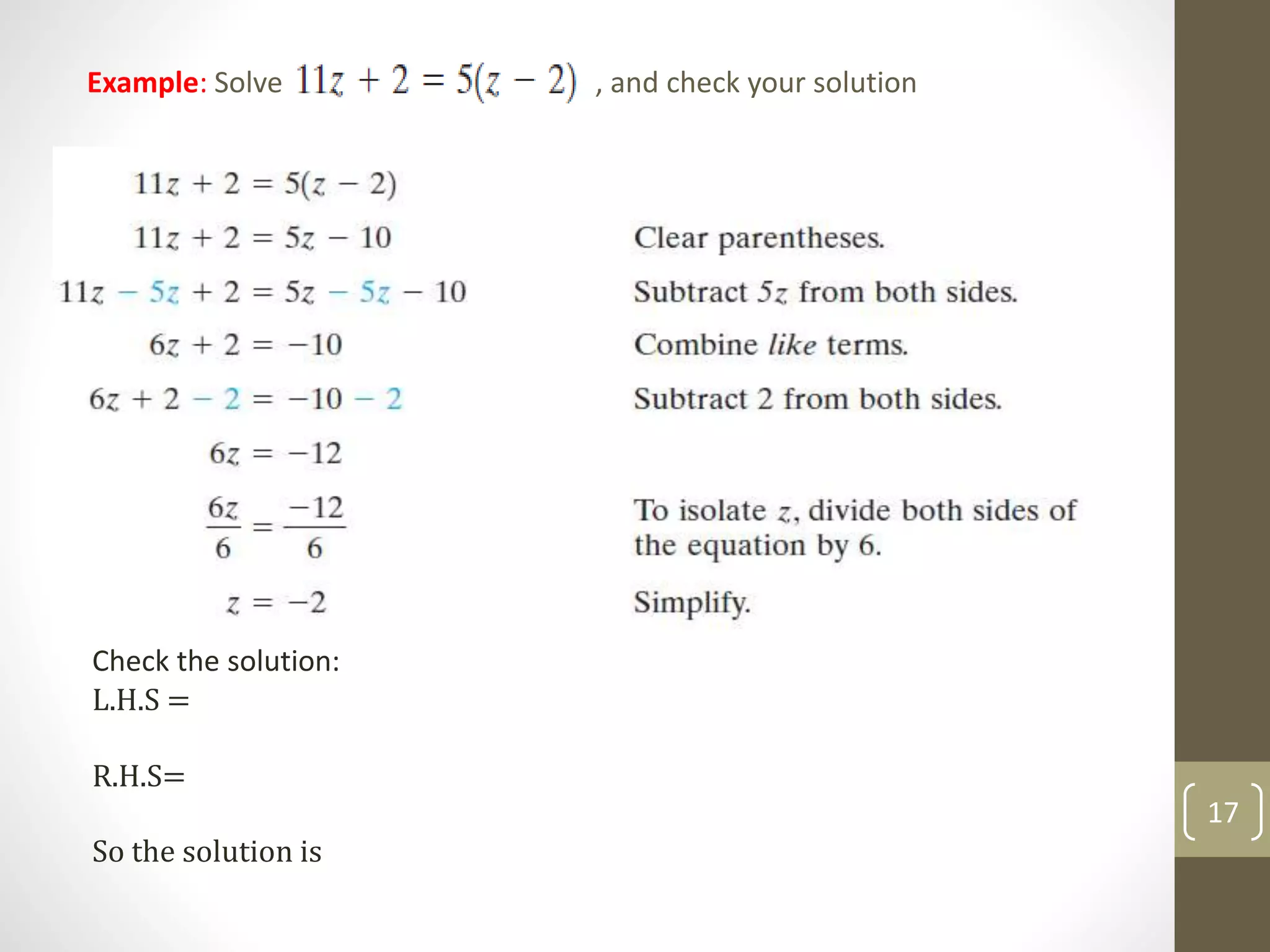
Example: Solve , and check your solution
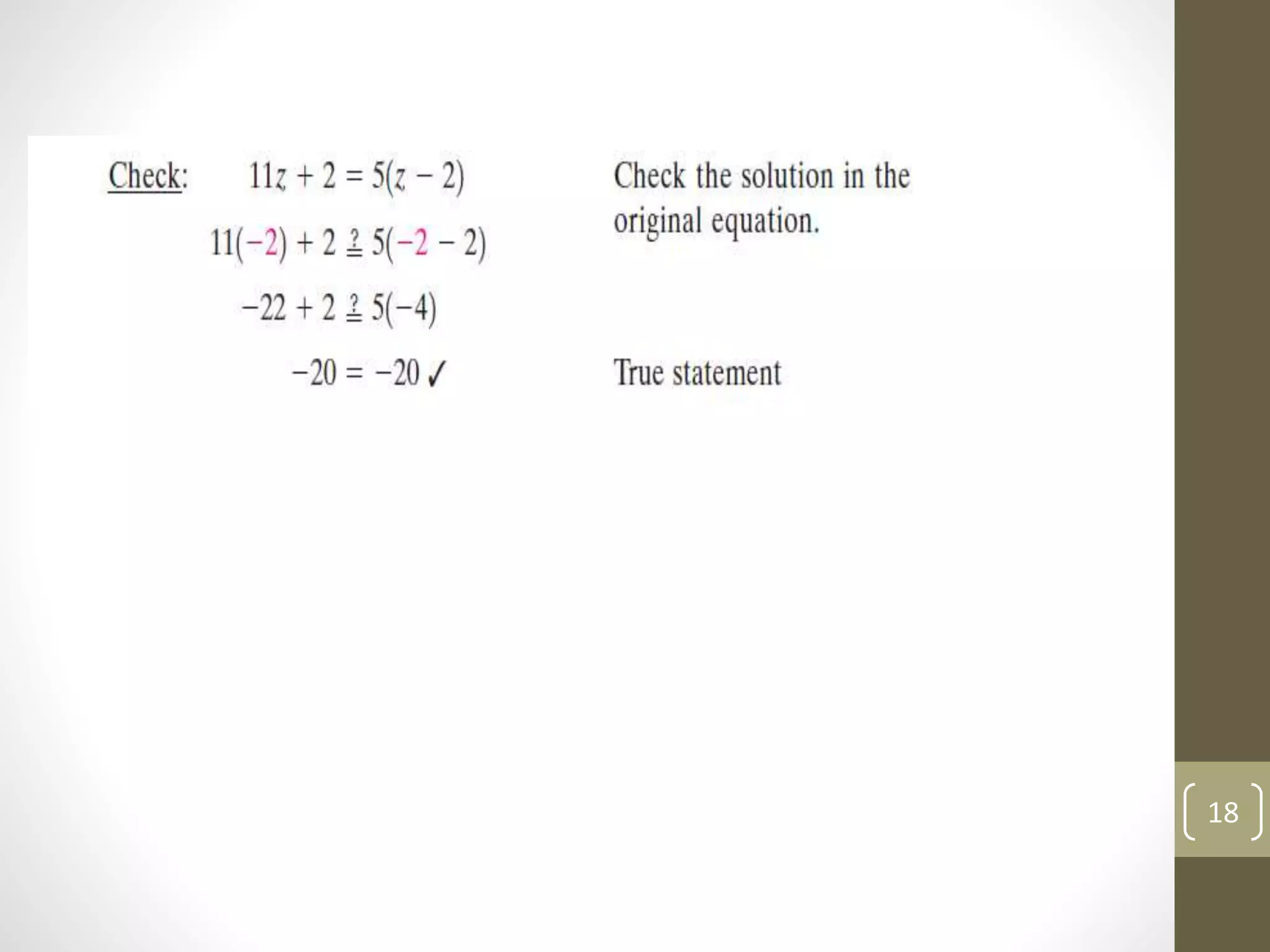
Check the solution:
L.H.S =
R.H.S=
So the solution is
17
18
19
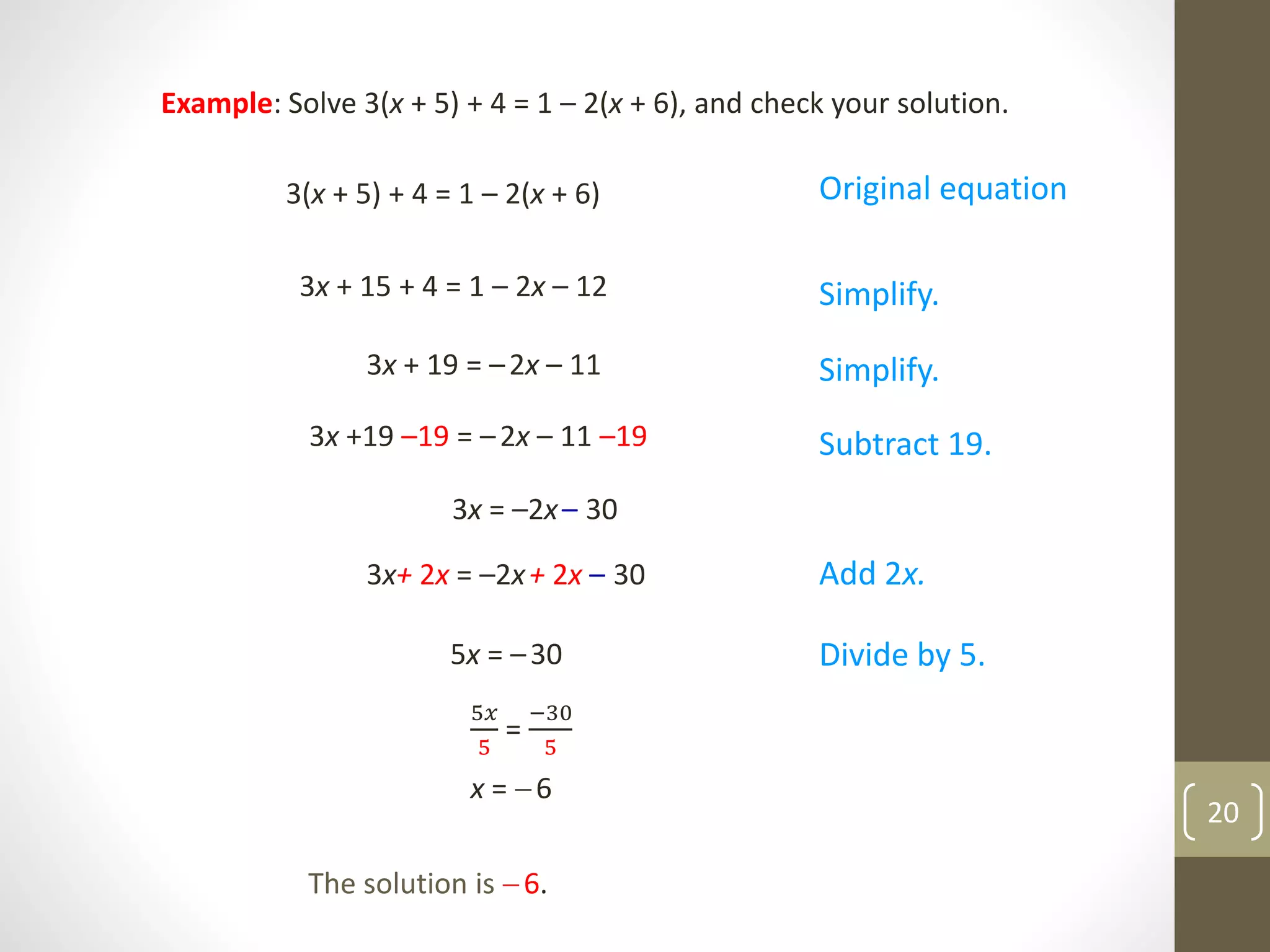
Example: Solve 3(x + 5) + 4 = 1 – 2(x + 6), and check your solution.
3(x + 5) + 4 = 1 – 2(x + 6)
3x + 15 + 4 = 1 – 2x – 12
3x + 19 = –2x – 11
3x +19 –19 = –2x – 11 –19
3x = –2x– 30
5𝑥
5
=
−30
5
The solution is 6.
Original equation
Simplify.
Simplify.
Subtract 19.
Add 2x.
Divide by 5.5x = –30
3x+ 2x = –2x+ 2x – 30
x = 6
20
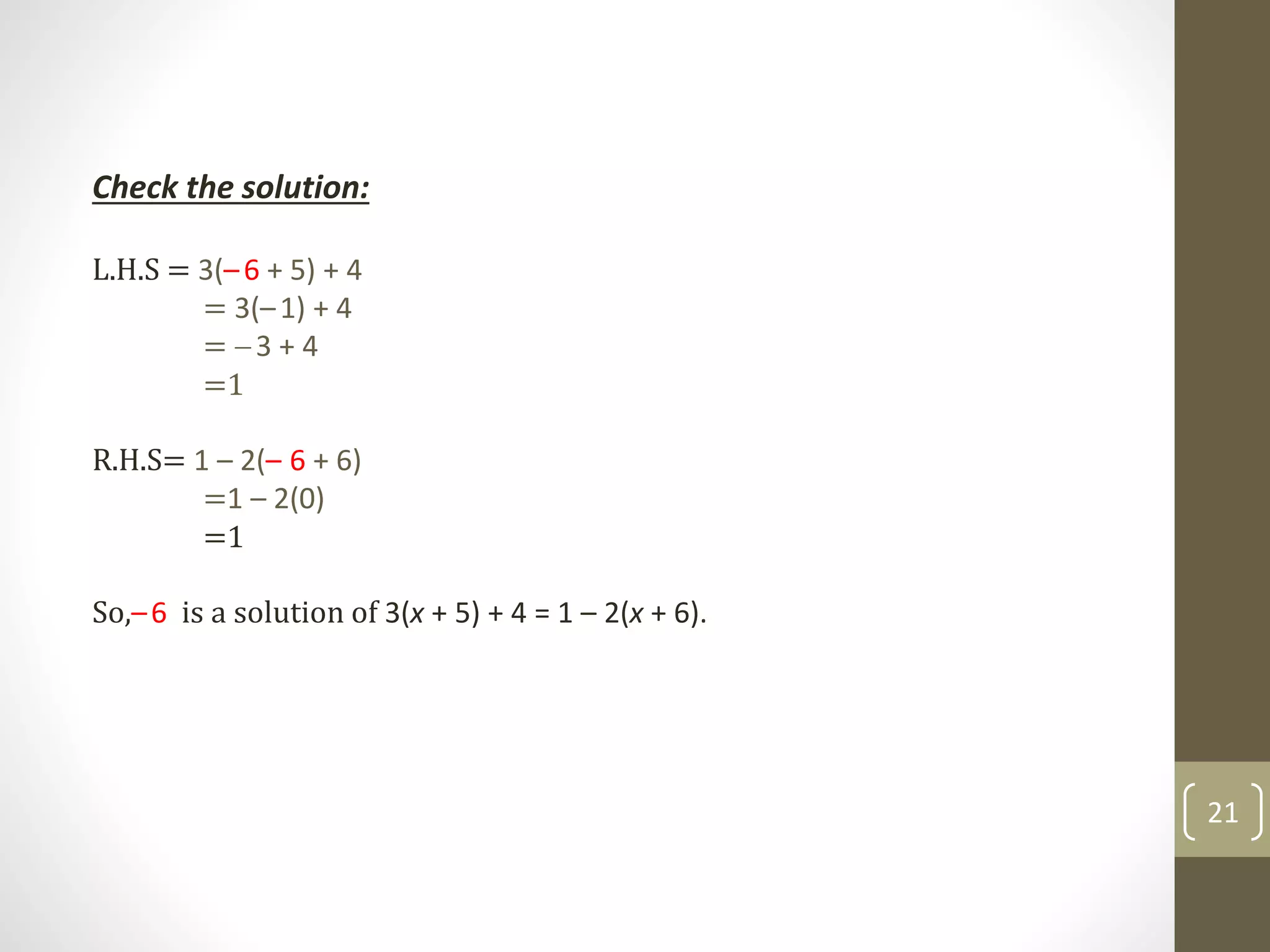
Check the solution:
L.H.S = 3(–6 + 5) + 4
= 3(–1) + 4
= 3 + 4
=1
R.H.S= 1 – 2(– 6 + 6)
=1 – 2(0)
=1
So,–6 is a solution of 3(x + 5) + 4 = 1 – 2(x + 6).
21
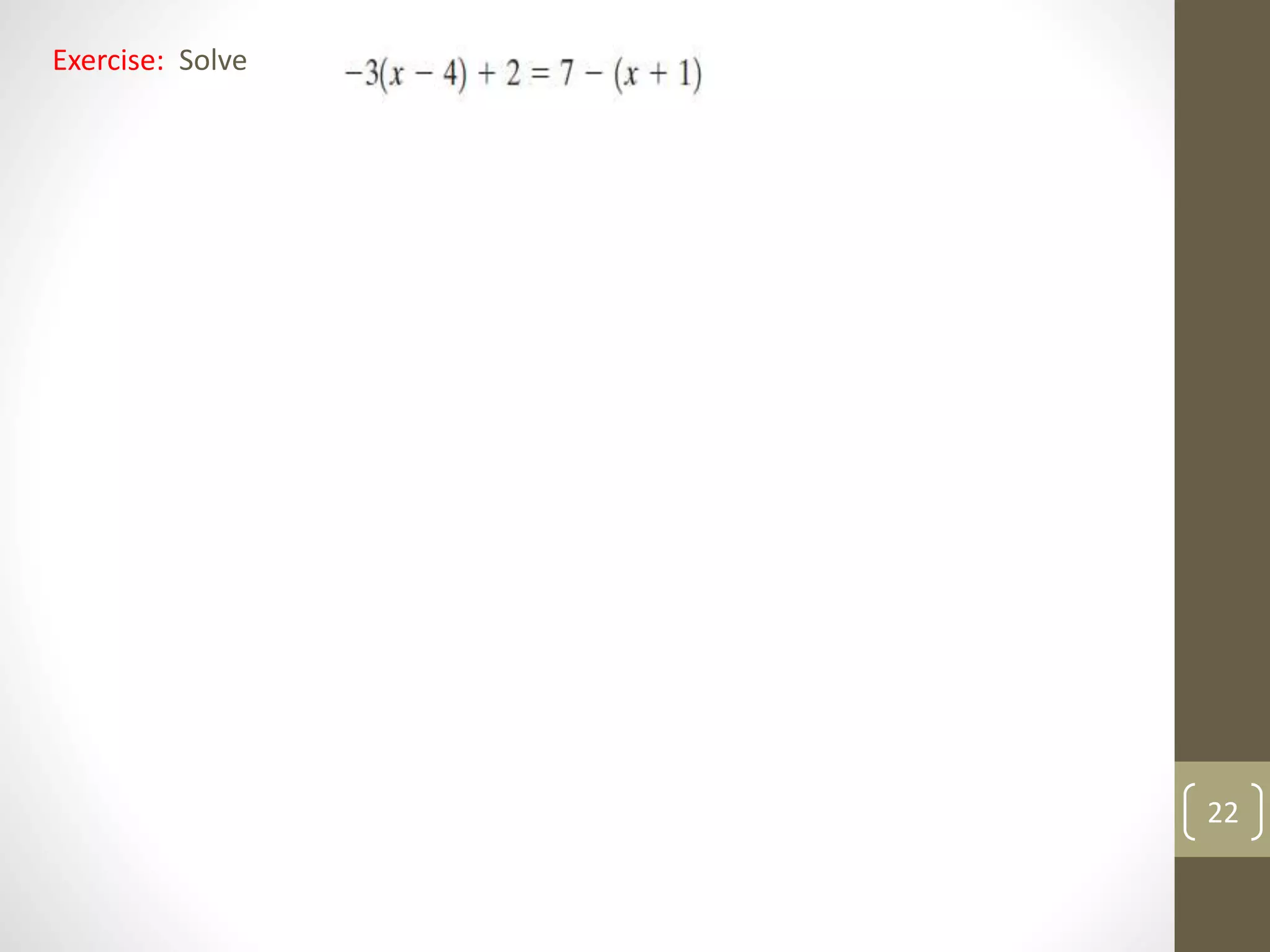
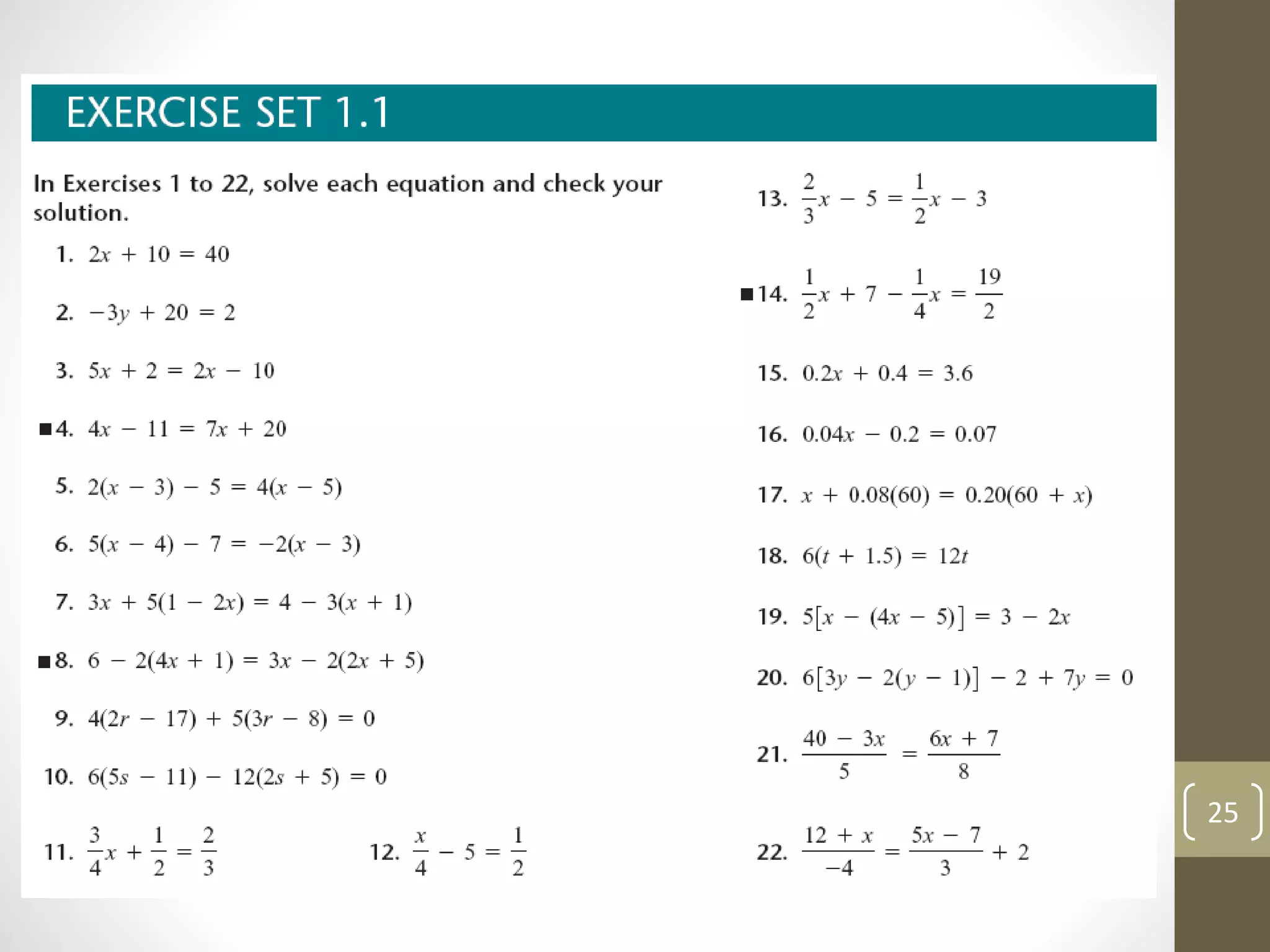
Exercise: Solve
22
23
24
25

3.1.2 Linear Equations in one Variable dfs

  • 1.
    Chapter 3 Linear Equations,Inequalities, Quadratic Equations, and Applications MATH 020 Dr. Farhana Shaheen 1
  • 2.
    Chapter3 Linear Equations, Inequalities, QuadraticEquations, and Applications • 3.1 Linear Equations in One Variable • 3.2 Applications of Linear Equations • 3.3 Linear Inequalities in One Variable • 3.4 Quadratic Equations 2
  • 3.
  • 4.
    3.1 – LinearEquations in One Variable Solve linear equations involving fractions Application of Linear Equations Objective – Solve linear equations using properties of equality. -Solve linear equations that can be simplified by combining like terms. 4
  • 5.
  • 6.
    3.1 Linear Equations Example1: x + 4 = -2 Example 2: 2x + 5 = 10 Example 3: 5 - 3x = 8 Note: A linear equation is also called a first degree equation since the highest power of x is 1. 6
  • 7.
    Determinewither the followingequationsare linear equations in one variable: 1. 10y + 6 = 26 2. 2x + 3y = 11 3. (x  1)2 = 8 4. x is in radical 5. 75 3 2  x x Two variables x is squared variable in the denominator √ 7 3x
  • 8.
    Equivalent equations Equivalent equationsare equations that have the same solution set: • Example 2: 5x +2 = 17, 5x =15 and x =3 are equivalent. The solution set is {3}. 8
  • 9.
    Example: Solve each equationsand check your solution: • 𝒙 + 𝟑 = 𝟐 𝑥 + 3 − 3 = 2 − 3 *subtract 3 from each side of the equation 𝑥 = −1 Check the solution: L.H.S = −1 + 3 = 2= R.H.S So the solution is −1. 9
  • 10.
    • Example:2 Solve x– 5 = 3 Solution: 10
  • 11.
    • 2𝑥 +7 = 𝑥 − 3 *subtract x from each side of 2𝑥 + 7 − 𝑥 = 𝑥 − 3 − 𝑥 the equation 𝑥 + 7 = −3 *subtract 7 from each side of 𝑥 + 7 − 7 = −3 − 7 the equation 𝑥 = −10 Check the solution: L.H.S= 2 −10 + 7 = −20 + 7 = −13 R.H.S= −10 − 3 = −13 Thus, the solution is −10. Example:3 Solve 2x + 7 = x - 3 Solution: 11
  • 12.
    • Example: • Solveeach equation and check your solution: • 𝟐𝒙 = 𝟔 2𝑥 2 = 6 2 *Divide each side of the equation by 2 𝑥 = 3 12
  • 13.
  • 14.
  • 15.
  • 16.
  • 17.
    Example: Solve ,and check your solution Check the solution: L.H.S = R.H.S= So the solution is 17
  • 18.
  • 19.
  • 20.
    Example: Solve 3(x+ 5) + 4 = 1 – 2(x + 6), and check your solution. 3(x + 5) + 4 = 1 – 2(x + 6) 3x + 15 + 4 = 1 – 2x – 12 3x + 19 = –2x – 11 3x +19 –19 = –2x – 11 –19 3x = –2x– 30 5𝑥 5 = −30 5 The solution is 6. Original equation Simplify. Simplify. Subtract 19. Add 2x. Divide by 5.5x = –30 3x+ 2x = –2x+ 2x – 30 x = 6 20
  • 21.
    Check the solution: L.H.S= 3(–6 + 5) + 4 = 3(–1) + 4 = 3 + 4 =1 R.H.S= 1 – 2(– 6 + 6) =1 – 2(0) =1 So,–6 is a solution of 3(x + 5) + 4 = 1 – 2(x + 6). 21
  • 22.
  • 23.
  • 24.
  • 25.